Results by title
5448 books match the query 'History and criticism' and 403 start with s
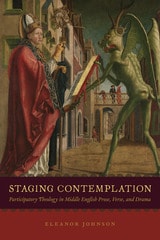
Staging Contemplation
Participatory Theology in Middle English Prose, Verse, and DramaEleanor Johnson
University of Chicago Press, 2018
Yet, in this groundbreaking new book, Eleanor Johnson argues instead for the pervasiveness and accessibility of contemplative works to medieval audiences. By drawing together ostensibly diverse literary genres—devotional prose, allegorical poetry, cycle dramas, and morality plays—Staging Contemplation paints late Middle English contemplative writing as a broad genre that operated collectively and experientially as much as through radical individual disengagement from the world. Johnson further argues that the contemplative genre played a crucial role in the exploration of the English vernacular as a literary and theological language in the fifteenth century, tracing how these works engaged modes of disfluency—from strained syntax and aberrant grammar, to puns, slang, code-switching, and laughter—to explore the limits, norms, and potential of English as a devotional language. Full of virtuoso close readings, this book demonstrates a sustained interest in how poetic language can foster a participatory experience of likeness to God among lay and devotional audiences alike.
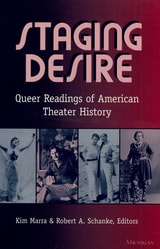
Staging Desire
Queer Readings of American Theater HistoryKim Marra and Robert A. Schanke, Editors
University of Michigan Press, 2002
Essays cover the careers of major figures Clyde Fitch, Rachel Crothers, Mercedes de Acosta, Djuna Barnes, Cole Porter, Lorenz Hart, George Kelly, William Inge, James "Acorn" Oaks, Adam "Vagabond" Badeau, Eric Bentley, Loie Fuller, Robert Edmond Jones, and Jean Rosenthal. Grounded in research into the history of sexuality, the book engages central problems of terminology and evidence in analyzing sexual practices of the past and the modes of articulation of sexuality in theater, conditioned by American culture's peculiar anxieties about both.
Kim Marra is Associate Professor of Theatre Arts, University of Iowa. Robert A. Schanke is Professor of Theatre, Central College, Iowa. They edited Passing Performances: Queer Readings of Leading Players in American Theater History, a previous volume in this series.
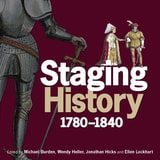
Staging History
1780-1840Edited by Michael Burden, Wendy Heller, Jonathan Hicks, and Ellen Lockhart
Bodleian Library Publishing, 2016
Drawing on copious new research, Staging History reexamines extraordinary theatrical works of the period to show the role they played in shaping popular interpretations of history. Editors Michael Burden, Wendy Heller, Jonathan Hicks, and Ellen Lockhart are joined by other experts in the field in analyzing theatrical documents, including playbills, set designs, and musical scores, as well as paintings, prints, and other illustrations, in order to explore what counted as historical truth for the writers, performers, and audiences of these plays.
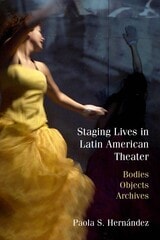
Staging Lives in Latin American Theater
Bodies, Objects, ArchivesPaola S. Hernández
Northwestern University Press, 2021
Richly detailed, nuanced, and theoretically wide-ranging, Staging Lives in Latin American Theater reveals a range of interpretations about how documentary theater can conceptualize the idea of self while also proclaiming a new mode of testimony through theatrical practices.
Staging Masculinity
The Rhetoric of Performance in the Roman WorldErik Gunderson
University of Michigan Press, 2000
Staging Place
The Geography of Modern DramaUna Chaudhuri
University of Michigan Press, 1997
Chaudhuri starts with a discussion of a "poetics of exile" in early modern drama, where the figure of home is constructed as a locus of two conflicting impulses: the desire to find a stable site for individual identity and the desire to deterritorialize the self. By mid-century, she argues, a new discourse of "failed homecoming" begins to displace this geopathic model and replace the poetics of exile with a grim anti-poetics of immigration. She then employs postmodern and postcolonial theories of place and culture to define the emerging multiculturalism as a creative reworking of the figures of home, homecoming, homelessness, immigration and exile.
"This is a book of real originality. Its treatment of space in modern drama is elegant and powerful. . . ." --William B. Worthen, Northwestern University
"Staging Place is a powerfully written book, deft in its handling of familiar and unfamiliar plays alike and eclectic in its use of theatrical sources." --Essays in Theatre/ Études théâtrales
"This sophisticated and well-written study for graduate students and their teachers explores modern drama's preoccupation with the seemingly irreconcilable discontinuities between the notions of home and homelessness, belonging and exile. . . . The readings of individual plays are fresh and invigorating. . . ." --Choice
Una Chaudhuri is Associate Professor of English, New York University.
Staging Process
The Aesthetic Politics of Collective PerformanceRachel Anderson-Rabern
Northwestern University Press, 2020
Rachel Anderson-Rabern explores the ideas of boredom and quotidian employment that permeate particular performance projects. Using Henri Lefebvre’s concepts of work roles within everyday philosophy, she demonstrates that collective creation gives rise to new economies of performance. The book also presents theories of the political stakes of danced gestural forms in performance, informed by Giorgio Agamben’s writings on gesture, and elaborates the ways in which these ensembles make use of durational performance to posit ethical frameworks: ways of living in the world.
Conversing with the ideas of Paul Virilio and Guy Debord among others, Anderson- Rabern claims that these groups posit new models of aesthetic politics through careful, speed-based investigations of construction and destruction that unearth the powerful potential of contemporary collaborative methods to be at once aesthetically minded, ethically driven, and politically engaged.
Staging a Comeback
Broadway, Hollywood, and the Disney RenaissancePeter C. Kunze
Rutgers University Press, 2023
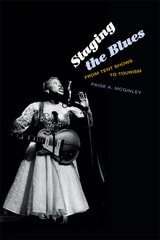
Staging the Blues
From Tent Shows to TourismPaige A. McGinley
Duke University Press, 2014
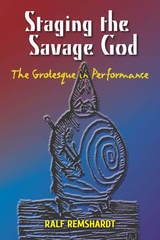
Staging the Savage God
The Grotesque in PerformanceRalf Remshardt
Southern Illinois University Press, 2004
In this broadly conceived study, Ralf Remshardt delineates the theatre’s deep connection with the grotesque and traces the historically extensive and theoretically intensive relationship between performance and its “other,” the grotesque. Staging the Savage God: The Grotesque in Performance examines the aesthetic complicity shared by the two in both art and theatre and presents a general theory of the grotesque.
Performing the grotesque is both a challenge to a culture’s order and the affirmation of certain ethical principles that it recognizes as its own. Remshardt investigates the aesthetics and ideology of grotesque theatre from antiquity—in works such as The Bacchae and Thyestes—to modernity—in Ubu Roi and Hamletmachine—and opens up new critical possibilities for the analysis of both classical and avant-gardetheatre.
Divided into three sections, Staging the Savage God first interrogates the grotesque as primarily a visual artistic and theatrical mode and then inventories various critical approaches to the grotesque, establishing the outlines of a theory with regard to drama. In the most extensive part of the study, Remshardt shifts his emphasis to the theatre of the grotesque, from self-consuming tragedies and the modernist trope of the artificial human figure to the characterology of the grotesque. Remshardt’s conclusion takes bold steps toward unraveling the paradox inherent in the grotesque theatre.
Written in an engaging style and aided by nine illustrations, Staging the Savage God is a comprehensive and rigorous study that incorporates critical approaches from disciplines such as philosophy, psychoanalysis, art history, literature, and theatre to fully investigate the historical function of the grotesque in performance.
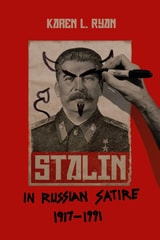
Stalin in Russian Satire, 1917–1991
Karen L. Ryan
University of Wisconsin Press, 2009
Examining works from the 1917 Revolution to the fall of the Soviet Union in 1991, Karen L. Ryan reveals how satirical treatments of Stalin often emphasize his otherness, distancing him from Russian culture. Some satirists portray Stalin as a madman. Others show him as feminized, animal-like, monstrous, or diabolical. Stalin has also appeared as the unquiet dead, a spirit that keeps returning to haunt the collective memory of the nation. While many writers seem anxious to exorcise Stalin from the body politic, for others he illuminates the self in disturbing ways. To what degree Stalin was and is “in us” is a central question of all these works. Although less visible than public trials, policy shifts, or statements of apology, Russian satire has subtly yet insistently participated in the protracted process of de-Stalinization.
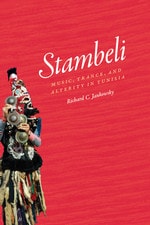
Stambeli
Music, Trance, and Alterity in TunisiaRichard C. Jankowsky
University of Chicago Press, 2010
Part ethnography, part history of the complex relationship between Tunisia’s Arab and sub-Saharan populations, Stambeli will be welcomed by scholars and students of ethnomusicology, anthropology, African studies, and religion.
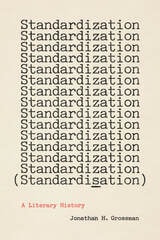
Standardization (Standardisation)
A Literary HistoryJonathan H. Grossman
University of Chicago Press, 2026
An innovative study of the history of standardization that draws on both technical documents and novels.
Jonathan H. Grossman’s elegant analysis of standardization approaches the topic by exploring how institutions create standards. Grossman tracks how published standards documents became the dominant means of homogenizing durable objects during the nineteenth century’s industrialization of manufacturing, including printing. Examining these documents as a genre, he reconstructs the nineteenth-century history of published standards documents and shows how they evolved to produce uniformity across manufactured objects.
Shifting focus from the standardized creation of objects to their use by subjects, Grossman then probes how people reimagined, through print, the ways in which their subjectivity combined with identical, interchangeable manufactured objects. To understand that relation, he looks to nineteenth-century novels by Charles Dickens, Mark Twain, and Elizabeth Gaskell, revealing how these books depicted the interchangeability of the subjects implied by this production of identical objects. The novels do not merely observe the interplay between subjects and standardized objects; they materialize it in the assemblage of readers holding their industrially manufactured, print copy.
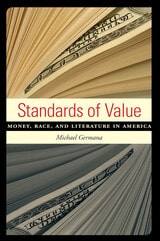
Standards of Value
Money, Race, and Literature in AmericaGermana, Michael
University of Iowa Press, 2010
In Standards of Value, Michael Germana reveals how tectonic shifts in U.S. monetary policy—from the Coinage Act of 1834 to the abolition of the domestic gold standard in 1933–34—correspond to strategic changes by American writers who renegotiated the value of racial difference. Populating the pages of this bold and innovative study are authors as varied as Harriet Beecher Stowe, George Washington Cable, Charles Chesnutt, James Weldon Johnson, Nella Larsen, Jessie Redmon Fauset, and Ralph Ellison—all of whom drew analogies between the form Americans thought the nation's money should take and the form they thought race relations and the nation should take.
A cultural history of race organized around and enmeshed within the theories of literary and monetary value, Standards of Value also recovers a rhetorical tradition in American culture whose echoes can be found in the visual and lyrical grammars of hip hop, the paintings of John W. Jones and Michael Ray Charles, the cinematography of Spike Lee, and many other contemporary forms and texts.
This reconsideration of American literature and cultural history has implications for how we value literary texts and how we read shifting standards of value. In vivid prose, Germana explains why dollars and cents appear where black and white bodies meet in American novels, how U.S. monetary policy gave these symbols their cultural currency, and why it matters for scholars of literary and cultural studies.
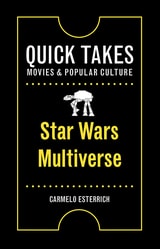
Star Wars Multiverse
Carmelo Esterrich
Rutgers University Press, 2021
Star Wars may have started out as a film about a Manichean battle between good and evil, but as countless filmmakers, novelists, animators, fan artists and even cosplayers have taken the opportunity to play in the fictional world George Lucas created, it has expanded into something far greater, resulting in a richly layered and diverse Star Wars multiverse.
Drawing from a full range of Star Wars media, including comics, children’s books, fan films, and television shows like Clone Wars and The Mandalorian, Carmelo Esterrich explores how these stories set in a galaxy far far away reflect issues that hit closer to home. He examines what they have to say about political oppression, authoritarianism, colonialism, discrimination, xenophobia, and perpetual war. Yet he also investigates subtler ways in which the personal is political within the multiverse, including its articulations of gender and sexuality, its cultural hierarchies of language use, and its complex relationships between humans, droids and myriad species. This book demonstrates that the Star Wars multiverse is not just a stage for thrilling interstellar battles, but also an exciting space for interpretation and discovery.
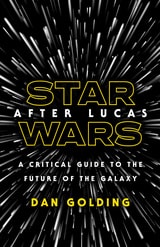
Star Wars after Lucas
A Critical Guide to the Future of the GalaxyDan Golding
University of Minnesota Press, 2019
Politics, craft, and cultural nostalgia in the remaking of Star Wars for a new age
A long time ago, in a galaxy far, far away—way back in the twenty-first century’s first decade—Star Wars seemed finished. Then in 2012 George Lucas shocked the entertainment world by selling the franchise, along with Lucasfilm, to Disney. This is the story of how, over the next five years, Star Wars went from near-certain extinction to what Wired magazine would call “the forever franchise,” with more films in the works than its first four decades had produced.
Focusing on The Force Awakens (2015), Rogue One (2016), The Last Jedi (2017), and the television series Rebels (2014–18), Dan Golding explores the significance of pop culture nostalgia in overcoming the skepticism, if not downright hostility, that greeted the Star Wars relaunch. At the same time he shows how Disney, even as it tapped a backward-looking obsession, was nonetheless creating genuinely new and contemporary entries in the Star Wars universe.
A host of cultural factors and forces propelled the Disney-engineered Star Wars renaissance, and all figure in Golding’s deeply informed analysis: from John Williams’s music in The Force Awakens to Peter Cushing’s CGI face in Rogue One, to Carrie Fisher’s passing, to the rapidly changing audience demographic. Star Wars after Lucas delves into the various responses and political uses of the new Star Wars in a wider context, as in reaction videos on YouTube and hate-filled, misogynistic online rants. In its granular textual readings, broad cultural scope, and insights into the complexities of the multimedia galaxy, this book is as entertaining as it is enlightening, an apt reflection of the enduring power of the Star Wars franchise.
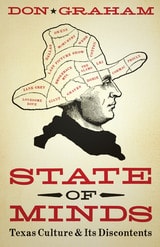
State of Minds
Texas Culture and Its DiscontentsBy Don Graham
University of Texas Press, 2011
John Steinbeck once famously wrote that "Texas is a state of mind." For those who know it well, however, the Lone Star State is more than one mind-set, more than a collection of clichés, more than a static stereotype. There are minds in Texas, Don Graham asserts, and some of the most important are the writers and filmmakers whose words and images have helped define the state to the nation, the world, and the people of Texas themselves. For many years, Graham has been critiquing Texas writers and films in the pages of Texas Monthly and other publications. In State of Minds, he brings together and updates essays he published between 1999 and 2009 to paint a unique, critical picture of Texas culture.
In a strong personal voice—wry, humorous, and ironic—Graham offers his take on Texas literary giants ranging from J. Frank Dobie to Larry McMurtry and Cormac McCarthy and on films such as The Alamo, The Last Picture Show, and Brokeback Mountain. He locates the works he discusses in relation to time and place, showing how they sprang (or not) from the soil of Texas and thereby helped to define Texas culture for generations of readers and viewers—including his own younger self growing up on a farm in Collin County. Never shying from controversy and never dull, Graham's essays in State of Minds demolish the notion that "Texas culture" is an oxymoron.
Statelessness
On Almost Not ExistingTony C. Brown
University of Minnesota Press, 2022
A pathbreaking new genealogy of statelessness
Just as the modern state and the citizenship associated with it are commonly thought of as a European invention, so too is citizenship’s negation in the form of twentieth-century diaspora and statelessness. Statelessness sets forth a new genealogy, suggesting that Europe first encountered mass statelessness neither inside its own borders nor during the twentieth century, as Hannah Arendt so influentially claimed, but outside of itself—in the New World, several hundred years earlier.
Through close readings of political philosophers from Hobbes to Rousseau to Kant, Tony C. Brown argues that statelessness became a central problem for political thought early on, with far-reaching implications for thinking both on the state and on being human. What Europeans thought they saw among the “savages” of the Americas was life without political order, life less than human. Lacking almost everything those deemed clearly human had achieved, the stateless existed in a radically precarious, almost inhuman privation.
And yet this existence also raised the unsettling possibility that state-based existence may not be inevitable, necessary, or even ideal. This possibility, as Brown shows, prompts the response—as defensive as it was aggressive—that we call Enlightenment political philosophy, which arguably still orders much thinking on being stateless today, including our discourses concerning migrants and Indigenous peoples.
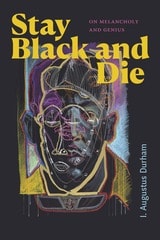
Stay Black and Die
On Melancholy and GeniusI. Augustus Durham
Duke University Press, 2023
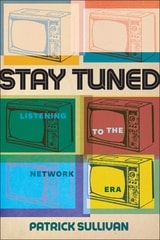
Stay Tuned
Listening to the Network EraPatrick Sullivan
Rutgers University Press, 2026
Since the 1950s, television flooded the American soundscape with not just pictures but sounds, a constant aural stream infiltrating domestic life. In Stay Tuned, Patrick Sullivan treats network-era television sound not as background noise or auxiliary signal but as a formative texture of aesthetic life in postwar America. He theorizes how television’s sonic forms—asynchronous audiovisuals, noises, affective rhythms, what he collectively terms “network aurality”—trouble traditional aesthetic theory. Stay Tuned takes up critiques of television sound and repurposes them as evidence of a deeper philosophical discomfort: Namely, that television sound does something to aesthetic categories that they weren’t built to handle. From the laugh track to the cartoon “boinks,” from noises to the jingle, Sullivan reads television sounds not as cultural detritus but as formal interventions—forcing a redefinition of what aesthetics means when form is mass-produced, commercial, and built for syndication. What emerges is not just a new theory and history of television sound but a reimagined account of aesthetic experience itself—expanded, recalibrated, and a little wacky.

Staying Tuned
Contemporary Soap Opera CriticismSuzanne Frentz
University of Wisconsin Press, 1992
A growing body of scholarly literature exists now to provide insights and suggest answers to the question of why so many continually return to the routine tragedies of daytime drama. Each of our chapters explores an aspect of soap opera which contributes to the endurance of the genre.
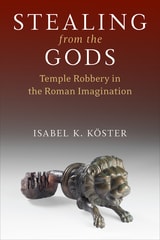
Stealing from the Gods
Temple Robbery in the Roman ImaginationIsabel K. Köster
University of Michigan Press, 2026
Ancient authors including Cicero, Caesar, Livy, Appian, and Pausanias present isolated, grotesque individuals whose actions have no bearing on the conduct of Romans as a whole, rendering temple robbery not a matter of collective responsibility, but of individual moral failure. By revealing how narratives of temple robbery are constructed from a literary perspective and how they inform discourses about military conquest and imperial rule, Isabel K. Köster shines a new light on how the Romans coped with the more pernicious aspects of their empire.
Stephen King's America
Jonathan P. Davis
University of Wisconsin Press, 1994
Stephen King's America aims to heighten awareness of the numerous American issues that resonate throughout King's fiction, issues that bear universal application to the evolution of the human condition.
Stewards of the House
Detective Fiction of Jonathan LatimerBill Brubaker
University of Wisconsin Press, 1993
Jonathan Latimer (1906-1983) wrote nine detective novels. He also wrote or co-wrote 20 film scripts, including such noir classics as the second version of Dasheill Hammett's The Glass Key, Kenneth Fearing's The Big Clock, and Cornell Woolrich's The Night Has a Thousand Eyes. Moving to television writing, he scripted 45 original stories and adapted 50 Eric Stanley Gardner novels for the Perry Mason series.
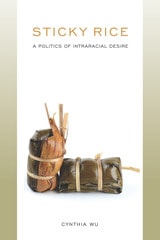
Sticky Rice
A Politics of Intraracial DesireCynthia Wu
Temple University Press, 2018
Cynthia Wu’s provocative Sticky Rice examines representations of same-sex desires and intraracial intimacies in some of the most widely read pieces of Asian American literature. Analyzing canonical works such as John Okada’s No-No Boy, Monique Truong’s The Book of Salt, H. T. Tsiang’s And China Has Hands, and Lois-Ann Yamanaka’s Blu’s Hanging, as well as Philip Kan Gotanda’s play, Yankee Dawg You Die, Wu considers how male relationships in these texts blur the boundaries among the homosocial, the homoerotic, and the homosexual in ways that lie beyond our concepts of modern gay identity.
The “sticky rice” of Wu’s title is a term used in gay Asian American culture to describe Asian American men who desire other Asian American men. The bonds between men addressed in Sticky Rice show how the thoughts and actions founded by real-life intraracially desiring Asian-raced men can inform how we read the refusal of multiple normativities in Asian Americanist discourse. Wu lays bare the trope of male same-sex desires that grapple with how Asian America’s internal divides can be resolved in order to resist assimilation.
Stolen Time
Black Fad Performance and the Calypso CrazeShane Vogel
University of Chicago Press, 2018
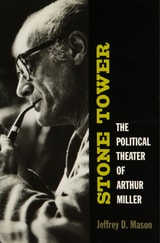
Stone Tower
The Political Theater of Arthur MillerJeffrey D. Mason
University of Michigan Press, 2008
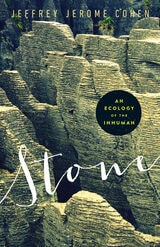
Stone
An Ecology of the InhumanJeffrey Jerome Cohen
University of Minnesota Press, 2015
Stone maps the force, vivacity, and stories within our most mundane matter, stone. For too long stone has served as an unexamined metaphor for the “really real”: blunt factuality, nature’s curt rebuke. Yet, medieval writers knew that stones drop with fire from the sky, emerge through the subterranean lovemaking of the elements, tumble along riverbeds from Eden, partner with the masons who build worlds with them. Such motion suggests an ecological enmeshment and an almost creaturely mineral life.
Although geological time can leave us reeling, Jeffrey Jerome Cohen argues that stone’s endurance is also an invitation to apprehend the world in other than human terms. Never truly inert, stone poses a profound challenge to modernity’s disenchantments. Its agency undermines the human desire to be separate from the environment, a bifurcation that renders nature “out there,” a mere resource for recreation, consumption, and exploitation.
Written with great verve and elegance, this pioneering work is notable not only for interweaving the medieval and the modern but also as a major contribution to ecotheory. Comprising chapters organized by concept —“Geophilia,” “Time,” “Force,” and “Soul”—Cohen seamlessly brings together a wide range of topics including stone’s potential to transport humans into nonanthropocentric scales of place and time, the “petrification” of certain cultures, the messages fossils bear, the architecture of Bordeaux and Montparnasse, Yucca Mountain and nuclear waste disposal, the ability of stone to communicate across millennia in structures like Stonehenge, and debates over whether stones reproduce and have souls.
Showing that what is often assumed to be the most lifeless of substances is, in its own time, restless and forever in motion, Stone fittingly concludes by taking us to Iceland⎯a land that, writes the author, “reminds us that stone like water is alive, that stone like water is transient.”

Stories Of Raymond Carver
A Critical StudyKirk Nesset
Ohio University Press, 1994
In this comprehensive study of Carver, Nesset discusses the relationship of minimalism and postmodern trends and the rise of new realism. By locating Carver in the gallery of American letters, Nesset shows him to be at once more simple and more complex than we might have believed, skillfully laying the groundwork for Carver studies to come.
Stories Through Theories/ Theories Through Stories
North American Indian Writing, Storytelling, and CritiqueGordon D. Henry Jr.
Michigan State University Press, 2009
Stories Through Theories/Theories Through Stories explores the uneasy relations—often contentious, sometimes complicit—between American Indian Literature and literary theory. Some of the essays in this book open American Indian narratives to theoretical critique based on "western depth models." Others work from a very different direction, finding critique in storytelling and processes of narrative production, thereby exposing dimensions of literary theory that grow from the indigenous ground of Native stories themselves.
This collection of essays—sometimes playfully but always insistently—changes our readings of Native works and challenges our roles as intellectual guides until we step deeper into the ambiguous territories where writer, listener, reader, and critic intersect.
Taken together, these essays provide compelling evidence for looking at primary Native cultures, authors, and histories as enrichments of Native literature.
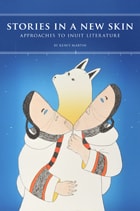
Stories in a New Skin
Approaches to Unuit LiteratureKeavy Martin
University of Manitoba Press, 2012

Storm Warnings
Science Fiction Confronts the FutureGeorge E Slusser
Southern Illinois University Press, 1987
These 17 original essays, written for the sixth Eaton Conference on Fantasy and Science Fiction, explore the uses, origins, and forms of future fiction. The contributors are George E. Slusser, Paul Alkon, Marie-Hélène Huet, Howard V. Hendrix, Bradford Lyau, Gregory Benford, José Manuel Mota, Frederik Pohl, George Hay, Colin Greenland, John Huntington, Elizabeth Maslen, W. M. S. and Claire Russell, T. A. Shippey, Kenneth V. Bailey, Gary Kern, and Frank McConnell.
The essays address the question “Do we call up images of future societies in order to prepare for them, or to forestall their ever coming into existence?”
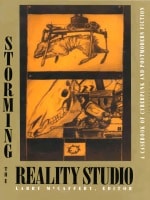
Storming the Reality Studio
A Casebook of Cyberpunk & Postmodern Science FictionLarry McCaffery, ed.
Duke University Press, 1992
By bringing together original fiction by well-known contemporary writers (William Burroughs, Thomas Pynchon, Don DeLillo, Kathy Acker, J. G. Ballard, Samuel R. Delany), critical commentary by some of the major theorists of postmodern art and culture (Jacques Derrida, Fredric Jameson, Timothy Leary, Jean-François Lyotard), and work by major practitioners of cyberpunk (William Gibson, Rudy Rucker, John Shirley, Pat Cadigan, Bruce Sterling), Storming the Reality Studio reveals a fascinating ongoing dialog in contemporary culture.
What emerges most strikingly from the colloquy is a shared preoccupation with the force of technology in shaping modern life. It is precisely this concern, according to McCaffery, that has put science fiction, typically the province of technological art, at the forefront of creative explorations of our unique age.
A rich opporunity for reading across genres, this anthology offers a new perspective on the evolution of postmodern culture and ultimately shows how deeply technological developments have influenced our vision and our art.
Selected Fiction contributors: Kathy Acker, J. G. Ballard, William S. Burroughs, Pat Cadigan, Samuel R. Delany, Don DeLillo, William Gibson, Harold Jaffe, Richard Kadrey, Marc Laidlaw, Mark Leyner, Joseph McElroy, Misha, Ted Mooney, Thomas Pynchon, Rudy Rucker, Lucius Shepard, Lewis Shiner, John Shirley, Bruce Sterling, William Vollman
Selected Non-Fiction contributors: Jean Baudrillard, Jacques Derrida, Joan Gordon, Veronica Hollinger, Fredric Jameson, Arthur Kroker and David Cook, Timothy Leary, Jean-François Lyotard, Larry McCaffery, Brian McHale, Dave Porush, Bruce Sterling, Darko Suvin, Takayuki Tatsumi
Story and Situation
Narrative Seduction and the Power of FictionRoss Chambers
University of Minnesota Press, 1984
Ross Chambers shifs the emphasis to precisely the play of authority and mastery by focusing on the narrative situation or the “point” of telling a story in given context. He studies the relation between teller and listener in a set of French, English, and American short stories from the nineteenth and early twentieth centuries and detects in that relationship the key to the power of fiction. In each of these stories, the author identifies the narrative situation by recourse to the metaphor of seduction, a phenomenon Chambers finds characteristic of literary production in the modern period.
“Story and Situation is a powerful work of criticism, the best work in short narrative I know, and will redirect critics’ attention to a form which has always engaged readers but has recently been neglected by literary theorists. . . . It is clear, assured, and intelligently paced.”-Jonathan Culler, Cornell University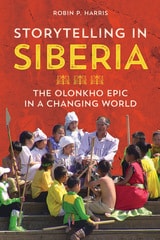
Storytelling in Siberia
The Olonkho Epic in a Changing WorldRobin P. Harris
University of Illinois Press, 2017
Drawing on her ten years of living in the Russian North, Robin P. Harris documents how the Sakha have used the Masterpiece program to revive olonkho and strengthen their cultural identity. Harris’s personal relationships with and primary research among Sakha people provide vivid insights into understanding olonkho and the attenuation, revitalization, transformation, and sustainability of the Sakha’s cultural reemergence. Interdisciplinary in scope, Storytelling in Siberia considers the nature of folklore alongside ethnomusicology, anthropology, comparative literature, and cultural studies to shed light on how marginalized peoples are revitalizing their own intangible cultural heritage.
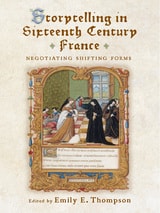
Storytelling in Sixteenth-Century France
Negotiating Shifting FormsEmily E. Thompson
University of Delaware Press, 2022
Published by the University of Delaware Press. Distributed worldwide by Rutgers University Press.
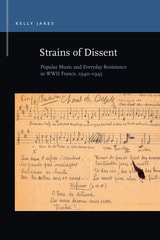
Strains of Dissent
Popular Music and Everyday Resistance in WWII France, 1940 - 1945Kelly Jakes
Michigan State University Press, 2019
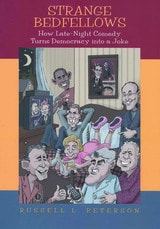
Strange Bedfellows
How Late-Night Comedy Turns Democracy into a JokePeterson, Russell
Rutgers University Press, 2008
It is no coincidence that presidential candidates have been making it a point to add the late-night comedy circuit to the campaign trail in recent years. In 2004, when John Kerry decided it was time to do his first national television interview, he did not choose CBS’s 60 Minutes, ABC’s Nightline, or NBC Nightly News. Kerry picked Comedy Central’s The Daily Show. When George W. Bush was lagging in the polls, his appearance on the David Letterman Show gave him a measurable boost. Candidates for the 2008 presidential election began their late-night bookings almost as soon as they launched their campaigns.
How can this be? The reason is that polls have been consistently finding that a significant number of Americans—and an even larger proportion of those under the age of thirty—get at least some of their “news” about politics and national affairs from comedy shows. While this trend toward what some have called “infotainment” seems to herald the descent of our national discourse—the triumph of entertainment over substance—the reality, according to Russell L. Peterson, is more complex. He explains that this programming is more than a mere replacement for traditional news outlets; it plays its own role in shaping public perception of government and the political process.
From Johnny Carson to Jon Stewart, from Chevy Chase’s spoofing of President Ford on Saturday Night Live to Stephen Colbert’s roasting of President Bush at the White House Correspondents Dinner, Strange Bedfellows explores what Americans have found so funny about our political institutions and the people who inhabit them, and asks what this says about the health of our democracy. Comparing the mainstream network hosts—Jay, Dave, Conan, and Johnny before them—who have always strived to be “equal opportunity offenders” to the newer, edgier crop of comedians on cable networks, Peterson shows how each brand of satire plays off a different level of Americans’ frustrations with politics.
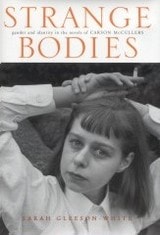
Strange Bodies
Gender and Identity in the Novels of Carson McCullersSarah Gleeson-White
University of Alabama Press, 2003
Adapts Mikhail Bakhtin's theory of the grotesque, as well as the latest in gender and psychoanalytic theory, to the major works of acclaimed southern writer Carson McCullers.
This innovative reconsideration of the themes of Carson McCullers's fiction argues that her work has heretofore suffered under the pall of narrow gothic interpretations, obscuring a more subversive agenda. By examining McCullers’s major novels—The Heart is a Lonely Hunter, Reflections in a Golden Eye, The Member of the Wedding, and The Ballad of the Sad Café—Gleeson-White locates a radical and specific form of the grotesque in the author's fiction: the liberating and redemptive possibilities of errant gender roles and shifting sexuality. She does this by employing Bakhtin's theory of the grotesque, which is both affirming and revolutionary, and thereby moves McCullers's texts beyond the 'gloom and doom' with which they have been charged for over fifty years.
The first chapter explores female adolescence by focusing on McCullers's tomboys in the context of oppressive southern womanhood. The second chapter analyzes McCullers's fascinating struggle to depict homosexual desire outside of traditional stereotypes. Gleeson-White then examines McCullers's portrayals of feminine and masculine gender through the tropes of cross-dressing, transvestism, and masquerade. The final chapter takes issue with earlier readings of androgyny in the texts to suggest a more useful concept McCullers herself called "the hybrid." Underpinning the whole study is the idea of a provocative, dynamic form of the grotesque that challenges traditional categories of normal and abnormal.
Because the characters and themes of McCullers's fiction were created in the 1940s and 1950s, a time of tension between the changing status of women and the southern ideal of womanhood, they are particularly fertile ground for a modern reexamination of this nature. Gleeson-White's study will be valued by scholars of American literature and gender and queer studies, by students of psychology, by academic libraries, and by readers of Carson McCullers. Strange Bodies is a thoughtful, highly credible analysis that adds dimension to the study of southern literature.
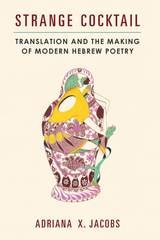
Strange Cocktail
Translation and the Making of Modern Hebrew PoetryAdriana X. Jacobs
University of Michigan Press, 2018
For centuries, poets have turned to translation for creative inspiration. Through and in translation, poets have introduced new poetic styles, languages, and forms into their own writing, sometimes changing the course of literary history in the process. Strange Cocktail is the first comprehensive study of this phenomenon in modern Hebrew literature of the late nineteenth century to the present day. Its chapters on Esther Raab, Leah Goldberg, Avot Yeshurun, and Harold Schimmel offer close readings that examine the distinct poetics of translation that emerge from reciprocal practices of writing and translating. Working in a minor literary vernacular, the translation strategies that these poets employed allowed them to create and participate in transnational and multilingual poetic networks. Strange Cocktail thereby advances a comparative and multilingual reframing of modern Hebrew literature that considers how canons change and are undone when translation occupies a central position—how lines of influence and affiliation are redrawn and literary historiographies are revised when the work of translation occupies the same status as an original text, when translating and writing go hand in hand.
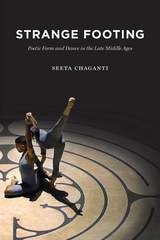
Strange Footing
Poetic Form and Dance in the Late Middle AgesSeeta Chaganti
University of Chicago Press, 2018
Exploring the complex relationship between medieval dance and medieval poetry, Strange Footing argues that the intersection of texts and dance produced an experience of poetic form based in disorientation, asymmetry, and even misstep. Medieval dance guided audiences to approach poetry not in terms of the body’s regular marking of time and space, but rather in the irregular and surprising forces of virtual motion around, ahead of, and behind the dancing body. Reading medieval poems through artworks, paintings, and sculptures depicting dance, Seeta Chaganti illuminates texts that have long eluded our full understanding, inviting us to inhabit their strange footings askew of conventional space and time.
Strange Footing deploys the motion of dance to change how we read medieval poetry, generating a new theory of poetic form for medieval studies and beyond.
Strange Future
Pessimism and the 1992 Los Angeles RiotsMin Hyoung Song
Duke University Press, 2005
Song considers works that address the riots and often the traumatic place of the Korean American community within them: the independent documentary Sa-I-Gu (Korean for April 29, the date the riots began), Chang-rae Lee’s novel Native Speaker, the commercial film Strange Days, and the experimental drama of Anna Deavere Smith, among many others. He describes how cultural producers have used the riots to examine the narrative of national decline, manipulating language and visual elements, borrowing and refashioning familiar tropes, and, perhaps most significantly, repeatedly turning to metaphors of bodily suffering to convey a sense of an unraveling social fabric. Song argues that these aesthetic experiments offer ways of revisiting the traumas of the past in order to imagine more survivable futures.
Strange Good Fortune
Essays on Contemporary PoetryDavid Wojahn
University of Arkansas Press, 2000
Strange Gourmets
Sophistication, Theory, and the NovelJoseph Litvak
Duke University Press, 1997
Though commonly thought of as a kind of worldliness at its best and an elitist snobbery at its worst, sophistication, Litvak reminds us, remains tied to its earlier, if forgotten, meaning of "perversion"—a perversion whose avatars are the homosexual and the intellectual. Proceeding with his investigations from a specifically gay academic perspective, Litvak presents thoroughly inventive readings of novels by Austen, Thackeray, and Proust, and of theoretical works by Adorno and Barthes, each text epitomizing sophistication in one of its more familiar modes. Among the issues he explores are the ways in which these texts teach sophistication, the embarrassment that sophistication causes the sophisticated, and how the class politics of sophistication are inseparable from its sexual politics. Helping gay, queer, feminist, and other provocative critics to make the most of their bad publicity, Litvak mindfully celebrates sophistication’s economy of taste and pleasure.
Strange Likeness
Description and the Modernist NovelDora Zhang
University of Chicago Press, 2020
Description is the novelistic technique charged with establishing a common world, but in the early twentieth century, there was little agreement about how a common world could be known and represented. Zhang argues that the protagonists in her study responded by shifting description away from visualizing objects to revealing relations—social, formal, and experiential—between disparate phenomena. In addition to shedding new light on some of the best-known works of modernism, Zhang opens up new ways of thinking about description more broadly. She moves us beyond the classic binary of narrate-or-describe and reinvigorates our thinking about the novel. Strange Likeness will enliven conversations around narrative theory, affect theory, philosophy and literature, and reading practices in the academy.
Strange Meetings
Anglo-German Literary Encounters from 1910 to 1960Peter Edgerly Firchow
Catholic University of America Press, 2008
Strangers in Berlin
Modern Jewish Literature between East and West, 1919–1933Rachel Seelig
University of Michigan Press, 2016
Author Rachel Seelig portrays Berlin during the Weimar Republic as a “threshold” between exile and homeland in which national and artistic commitments were reexamined, reclaimed, and rebuilt. In the pulsating yet precarious capital of Germany’s first fledgling democracy, the collision of East and West engendered a broad spectrum of poetic styles and Jewish national identities.
Strategic Occidentalism
On Mexican Fiction, the Neoliberal Book Market, and the Question of World LiteratureIgnacio M. Sánchez Prado
Northwestern University Press, 2018
In the course of this analysis, Ignacio M. Sánchez Prado engages with theories of world literature, proposing that “world literature” is a construction produced at various levels, including the national, that must be studied from its material conditions of production in specific sites. In particular, he argues that Mexican writers have engaged in a “strategic Occidentalism” in which their idiosyncratic connections with world literature have responded to dynamics different from those identified by world-systems or diffusionist theorists.
Strategic Occidentalism identifies three scenes in which a cosmopolitan aesthetics in Mexican world literature has been produced: Sergio Pitol’s translation of Eastern European and marginal British modernist literature; the emergence of the Crack group as a polemic against the legacies of magical realism; and the challenges of writers like Carmen Boullosa, Cristina Rivera Garza, and Ana García Bergua to the roles traditionally assigned to Latin American writers in world literature.
Street Players
Black Pulp Fiction and the Making of a Literary UndergroundKinohi Nishikawa
University of Chicago Press, 2018
Kinohi Nishikawa contends that black pulp fiction was built on white readers’ fears of the feminization of society—and the appeal of black masculinity as a way to counter it. In essence, it was the original form of blaxploitation: a strategy of mass-marketing race to suit the reactionary fantasies of a white audience. But while chauvinism and misogyny remained troubling yet constitutive aspects of this literature, from 1973 onward, Holloway House moved away from publishing sleaze for a white audience to publishing solely for black readers. The standard account of this literary phenomenon is based almost entirely on where this literature ended up: in the hands of black, male, working-class readers. When it closed, Holloway House was synonymous with genre fiction written by black authors for black readers—a field of cultural production that Nishikawa terms the black literary underground. But as Street Players demonstrates, this cultural authenticity had to be created, promoted, and in some cases made up, and there is a story of exploitation at the heart of black pulp fiction’s origins that cannot be ignored.
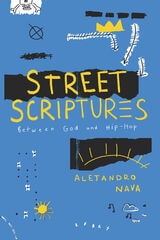
Street Scriptures
Between God and Hip-HopAlejandro Nava
University of Chicago Press, 2022
The world of hip-hop is saturated with religion, but rarely is that element given serious consideration. In Street Scriptures, Alejandro Nava focuses our attention on this aspect of the music and culture in a fresh way, combining his profound love of hip-hop, his passion for racial and social justice, and his deep theological knowledge. Street Scriptures offers a refreshingly earnest and beautifully written journey through hip-hop’s deep entanglement with the sacred.
Nava reveals a largely unheard religious heartbeat in hip-hop, exploring crosscurrents of the sacred and profane in rap, reggaeton, and Latinx hip-hop today. Ranging from Kendrick Lamar, Chance the Rapper, Lauryn Hill, Cardi B, and Bad Bunny to St. Augustine and William James, Nava examines the ethical-political, mystical-prophetic, and theological qualities in hip-hop, probing the pure sonic and aesthetic signatures of music, while also diving deep into the voices that invoke the spirit of protest. The result is nothing short of a new liberation theology for our time, what Nava calls a “street theology.”