316 books match the query 'Ethnomusicology' and 37 start with t
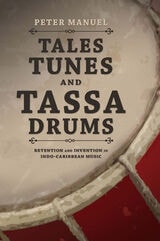
cover of Tales, Tunes, and Tassa Drums: Retention and Invention into Indo-Caribbean Music

Tales, Tunes, and Tassa Drums

Retention and Invention into Indo-Caribbean Music

Peter Manuel

University of Illinois Press, 2015

Today's popular tassa drumming emerged from the fragments of transplanted Indian music traditions half-forgotten and creatively recombined, rearticulated, and elaborated into a dynamic musical genre. A uniquely Indo-Trinidadian form, tassa drumming invites exploration of how the distinctive nature of the Indian diaspora and its relationship to its ancestral homeland influenced Indo-Caribbean music culture.
 
Music scholar Peter Manuel traces the roots of neotraditional music genres like tassa drumming to North India and reveals the ways these genres represent survivals, departures, or innovative elaborations of transplanted music forms. Drawing on ethnographic work and a rich archive of field recordings, he contemplates the music carried to Trinidad by Bhojpuri-speaking and other immigrants, including forms that died out in India but continued to thrive in the Caribbean. His reassessment of ideas of creolization, retention, and cultural survival defies suggestions that the diaspora experience inevitably leads to the loss of the original culture, while also providing avenues to broader applications for work being done in other ethnic contexts.
[more]
cover of Tarab: Music, Ecstasy, Emotion, and Performance

Tarab

Music, Ecstasy, Emotion, and Performance

Edited by Michael Frishkopf, Scott Marcus, and Dwight F. Reynolds

University of Texas Press, 2025

In Arab culture, at the ineffable point where music meets emotion, lies ṭarab. Often glossed as the ecstasy experienced and expressed when performing or listening to singing, instrumental works, and recitations of poetry, ṭarab is both a practice and an orienting concept central to musical aesthetics and spirituality characteristic of Middle Eastern cultures.

Gathering fifteen essays by scholars of music, affect, literature, religion, and education, Ṭarab extends the study of ṭarab historically, geographically, and sociologically. Historical essays explore ṭarab’s role in the medieval Middle East and the Ottoman Empire. Turning to the modern era, authors examine ṭarab and related concepts in Egypt, Albania, and Iraq, and among Turkish Roma and Lebanese Maronite Christians. The contributors also address contemporary practitioners and the intersections of ṭarab and maqām, belly dancing, music streaming, and university music ensembles. Situating this unique cultural concept in a global context, these studies enrich the story of ṭarab and provide new insight into music’s powerful emotional appeal.

[more]
cover of Tehrangeles Dreaming: Intimacy and Imagination in Southern California's Iranian Pop Music

Tehrangeles Dreaming

Intimacy and Imagination in Southern California's Iranian Pop Music

Farzaneh Hemmasi

Duke University Press, 2020

Los Angeles, called Tehrangeles because it is home to the largest concentration of Iranians outside of Iran, is the birthplace of a distinctive form of postrevolutionary pop music. Created by professional musicians and media producers fleeing Iran's revolutionary-era ban on “immoral” popular music, Tehrangeles pop has been a part of daily life for Iranians at home and abroad for decades. In Tehrangeles Dreaming Farzaneh Hemmasi draws on ethnographic fieldwork in Los Angeles and musical and textual analysis to examine how the songs, music videos, and television made in Tehrangeles express modes of Iranianness not possible in Iran. Exploring Tehrangeles pop producers' complex commercial and political positioning and the histories, sensations, and fantasies their music makes available to global Iranian audiences, Hemmasi shows how unquestionably Iranian forms of Tehrangeles popular culture exemplify the manner in which culture, media, and diaspora combine to respond to the Iranian state and its political transformations. The transnational circulation of Tehrangeles culture, she contends, transgresses Iran's geographical, legal, and moral boundaries while allowing all Iranians the ability to imagine new forms of identity and belonging.
[more]
cover of The Accordion in the Americas: Klezmer, Polka, Tango, Zydeco, and More!

The Accordion in the Americas

Klezmer, Polka, Tango, Zydeco, and More!

Edited by Helena Simonett

University of Illinois Press, 2012

An invention of the Industrial Revolution, the accordion provided the less affluent with an inexpensive, loud, portable, and durable "one-man-orchestra" capable of producing melody, harmony, and bass all at once. Imported from Europe into the Americas, the accordion with its distinctive sound became a part of the aural landscape for millions of people but proved to be divisive: while the accordion formed an integral part of working-class musical expression, bourgeois commentators often derided it as vulgar and tasteless.

This rich collection considers the accordion and its myriad forms, from the concertina, button accordion, and piano accordion familiar in European and North American music to the exotic-sounding South American bandoneon and the sanfoninha. Capturing the instrument's spread and adaptation to many different cultures in North and South America, contributors illuminate how the accordion factored into power struggles over aesthetic values between elites and working-class people who often were members of immigrant and/or marginalized ethnic communities. Specific histories and cultural contexts discussed include the accordion in Brazil, Argentine tango, accordion traditions in Colombia and the Dominican Republic, cross-border accordion culture between Mexico and Texas, Cajun and Creole identity, working-class culture near Lake Superior, the virtuoso Italian-American and Klezmer accordions, Native American dance music, and American avant-garde.

Contributors are María Susana Azzi, Egberto Bermúdez, Mark DeWitt, Joshua Horowitz, Sydney Hutchinson, Marion Jacobson, James P. Leary, Megwen Loveless, Richard March, Cathy Ragland, Helena Simonett, Jared Snyder, Janet L. Sturman, and Christine F. Zinni.
[more]
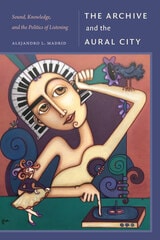
cover of The Archive and the Aural City: Sound, Knowledge, and the Politics of Listening

The Archive and the Aural City

Sound, Knowledge, and the Politics of Listening

Alejandro L. Madrid

Duke University Press, 2025
In The Archive and the Aural City, Alejandro L. Madrid examines the possibilities for retrieving from the archive sounds that were not meant to be heard. Drawing on Ángel Rama’s notion of the Lettered City, Madrid proposes a notion of the Aural City—a Latin American urban intellectual elite for whom sound and listening are central to the creation, re-creation, and circulation of new types of knowledge. While many of these elites carry forward a nationalistic agenda, Madrid contends that the Aural City’s archives and the ways they are listened to and conceived through sound and music can also help dismantle dominant frameworks of national or colonial culture and build more inclusive spaces for intellectual exchange and political mobilization. From national archives in Latin America and colonial institutions abroad to sound exhibits, instruments, and internet-based archival projects, Madrid demonstrates how the development of urban spaces is understood through sound. In this way, he expands understandings of the archive’s social and sonic power.
[more]
cover of The Art of Making Do in Naples

The Art of Making Do in Naples

Jason Pine

University of Minnesota Press, 2012

“In Naples, there are more singers than there are unemployed people.” These words echo through the neomelodica music scene, a vast undocumented economy animated by wedding singers, pirate TV, and tens of thousands of fans throughout southern Italy and beyond. In a city with chronic unemployment, this setting has attracted hundreds of aspiring singers trying to make a living—or even a fortune. In the process, they brush up against affiliates of the region’s violent organized crime networks, the camorra. In The Art of Making Do in Naples, Jason Pine explores the murky neomelodica music scene and finds himself on uncertain ground.

The “art of making do” refers to the informal and sometimes illicit entrepreneurial tactics of some Neapolitans who are pursuing a better life for themselves and their families. In the neomelodica music scene, the art of making do involves operating do-it-yourself recording studios and performing at the private parties of crime bosses. It can also require associating with crime boss-impresarios who guarantee their success by underwriting it with extortion, drug trafficking, and territorial influence. Pine, likewise “making do,” gradually realized that the completion of his ethnographic work also depended on the aid of forbidding figures.

The Art of Making Do in Naples offers a riveting ethnography of the lives of men who seek personal sovereignty in a shadow economy dominated, in incalculable ways, by the camorra. Pine navigates situations suffused with secrecy, moral ambiguity, and fears of ruin that undermine the anthropologist’s sense of autonomy. Making his way through Naples’s spectacular historic center and outer slums, on the trail of charmingly evasive neomelodici singers and unsettlingly elusive camorristi, Pine himself becomes a music video director and falls into the orbit of a shadowy music promoter who may or may not be a camorra affiliate.

Pine’s trenchant observations and his own improvised attempts at “making do” provide a fascinating look into the lives of people in the gray zones where organized crime blends into ordinary life.

[more]
cover of The Art of Mbira: Musical Inheritance and Legacy

The Art of Mbira

Musical Inheritance and Legacy

Paul F. Berliner

University of Chicago Press, 2020

Growing out of the collaborative research of an American ethnomusicologist and Zimbabwean musician, Paul F. Berliner’s The Art of Mbira documents the repertory for a keyboard instrument known generally as mbira. At the heart of this work lies the analysis of the improvisatory processes that propel mbira music’s magnificent creativity.

In this book, Berliner provides insight into the communities of study, performance, and worship that surround mbira. He chronicles how master player Cosmas Magaya and his associates have developed their repertory and practices over more than four decades, shaped by musical interaction, social and political dynamics in Zimbabwe, and the global economy of the music industry. At once a detailed exposition of the music’s forms and practices, it is also an indispensable historical and cultural guide to mbira in a changing world.

Together with Berliner and Magaya's compendium of mbira compositions, Mbira’s Restless Dance, The Art of Mbira breaks new ground in the depth and specificity of its exploration of an African musical tradition, and in the entwining of the authors’ collaborative voices. It is a testament to the powerful relationship between music and social life—and the rewards of lifelong musical study, performance, and friendship.

[more]
cover of The Black Cow's Footprint: Time, Space and Music in the Lives of the Kotas of South India

The Black Cow's Footprint

Time, Space and Music in the Lives of the Kotas of South India

Richard K. Wolf

University of Illinois Press, 2006
A black cow leads the members of a South Indian hill tribe, the Kotas, to the Nilgiri Hills and, with its hoof, indicates where to found each village. This footprint acts as a moral center of gravity, an important place for music-making, dancing, and other rituals. Places such as this, and moments in time, serve as physical and moral “anchors” for the Kota community. In this book, Richard K. Wolf explores how the Kotas “anchor” their musical and other activities around places and significant moments in time and, in the process, constitute themselves as individuals and as a group. This volume also includes a CD of Richard Wolf’s Kota field recordings.
[more]
cover of The Costs of the Gig Economy: Musical Entrepreneurs and the Cultural Politics of Inequality in Northeastern Brazil

The Costs of the Gig Economy

Musical Entrepreneurs and the Cultural Politics of Inequality in Northeastern Brazil

Falina Enriquez

University of Illinois Press, 2022

Institutions in Recife, Brazil, have restructured subsidies in favor of encouraging musicians to become more entrepreneurial. Falina Enriquez explores how contemporary and traditional musicians in the fabled musical city have negotiated these intensified neoliberal cultural policies and economic uncertainties.

Drawing on years of fieldwork, Enriquez shows how forcing artists to adopt “neutral” market solutions reinforces, and generates, overlapping racial and class-based inequalities. Lacking the social and financial resources of their middle-class peers, working-class musicians find it difficult to uphold institutional goals of connecting the city’s cultural roots to global markets and consumers. Enriquez also links the artists’ situation to that of cultural and creative workers around the world. As she shows, musical sponsorship in Recife and the contemporary gig economy elsewhere employ processes that, far from being neutral, uphold governmental and corporate ideologies that produce social stratification.

Rich and vibrant, The Costs of the Gig Economy offers a rare English-language portrait of the changing musical culture in Recife.
[more]
cover of The Creolization of American Culture: William Sidney Mount and the Roots of Blackface Minstrelsy

The Creolization of American Culture

William Sidney Mount and the Roots of Blackface Minstrelsy

Christopher J. Smith

University of Illinois Press, 2014
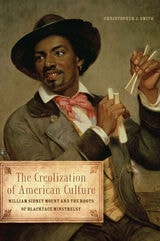
The Creolization of American Culture examines the artworks, letters, sketchbooks, music collection, and biography of the painter William Sidney Mount (1807–1868) as a lens through which to see the multiethnic antebellum world that gave birth to blackface minstrelsy. As a young man living in the multiethnic working-class community of New York's Lower East Side, Mount took part in the black-white musical interchange his paintings depict. An avid musician and tune collector as well as an artist, he was the among the first to depict vernacular fiddlers, banjo players, and dancers precisely and sympathetically. His close observations and meticulous renderings provide rich evidence of performance techniques and class-inflected paths of musical apprenticeship that connected white and black practitioners.
 
Looking closely at the bodies and instruments Mount depicts in his paintings as well as other ephemera, Christopher J. Smith traces the performance practices of African American and Anglo-European music-and-dance traditions while recovering the sounds of that world. Further, Smith uses Mount's depictions of black and white music-making to open up fresh perspectives on cross-ethnic cultural transference in Northern and urban contexts, showing how rivers, waterfronts, and other sites of interracial interaction shaped musical practices by transporting musical culture from the South to the North and back. The "Africanization" of Anglo-Celtic tunes created minstrelsy's musical "creole synthesis," a body of melodic and rhythmic vocabularies, repertoires, tunes, and musical techniques that became the foundation of American popular music.
 
Reading Mount's renderings of black and white musicians against a background of historical sites and practices of cross-racial interaction, Smith offers a sophisticated interrogation and reinterpretation of minstrelsy, significantly broadening historical views of black-white musical exchange.
[more]
cover of The Dance of Politics: Gender, Performance, and Democratization in Malawi

The Dance of Politics

Gender, Performance, and Democratization in Malawi

Lisa Gilman

Temple University Press, 2011

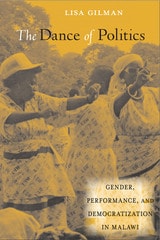
Election campaigns, political events, and national celebration days in Malawi usually feature groups of women who dance and perform songs of praise for politicians and political parties. These lively performances help to attract and energize throngs of prospective voters. However, as Lisa Gilman explains, “praise performing” is one of the only ways that women are allowed to participate in a male-dominated political system.

Although political performances by women are not unique to Malawi, the case in Malawi is complicated by the fact that until 1994 all Malawianwomen were required to perform on behalf of the long-reigning political party and its self-declared “President for Life,” Dr. Hastings Kamuzu Banda+. This is the first book to examine the present-day situation, where issues of gender, economics and politics collide in surprising ways. Along with its solid grounding in the relevant literature, The Dance of Politics draws strength from Gilman’s first-hand observations and her interviews with a range of participants in the political process, from dancers to politicians.
[more]
cover of The Dancer's Voice: Performance and Womanhood in Transnational India

The Dancer's Voice

Performance and Womanhood in Transnational India

Rumya Sree Putcha

Duke University Press, 2023

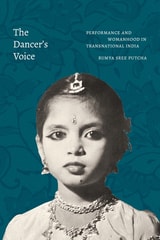
In The Dancer’s Voice Rumya Sree Putcha theorizes how the Indian classical dancer performs the complex dynamics of transnational Indian womanhood. Putcha argues that the public persona of the Indian dancer has come to represent India in the global imagination—a representation that supports caste hierarchies and Hindu ethnonationalism, as well as white supremacist model minority narratives. Generations of Indian women have been encouraged to embody the archetype of the dancer, popularized through film cultures from the 1930s to the present. Through analyses of films, immigration and marriage laws, histories of caste and race, advertising campaigns, and her own family’s heirlooms, photographs, and memories, Putcha reveals how women’s citizenship is based on separating their voices from their bodies. In listening closely to and for the dancer’s voice, she offers a new way to understand the intersections of body, voice, performance, caste, race, gender, and nation.
[more]
cover of The Inspiration Machine: Computational Creativity in Poetry and Jazz

The Inspiration Machine

Computational Creativity in Poetry and Jazz

Eitan Y. Wilf

University of Chicago Press, 2023

Explores how creative digital technologies and artificial intelligence are embedded in culture and society.
 
In The Inspiration Machine, Eitan Y. Wilf explores the transformative potentials that digital technology opens up for creative practice through three ethnographic cases, two with jazz musicians and one with a group of poets. At times dissatisfied with the limitations of human creativity, these artists do not turn to computerized algorithms merely to execute their preconceived ideas. Rather, they approach them as creative partners, delegating to them different degrees of agentive control and artistic decision-making in the hopes of finding inspiration in their output and thereby expanding their own creative horizons.
 
The algorithms these artists develop and use, however, remain rooted in and haunted by the specific social predicaments and human shortfalls that they were intended to overcome. Experiments in the digital thus hold an important lesson: although Wilf’s interlocutors returned from their adventures with computational creativity with modified, novel, and enriched capacities and predilections, they also gained a renewed appreciation for, and at times a desire to re-inhabit, non-digital creativity. In examining the potentials and pitfalls of seemingly autonomous digital technologies in the realm of art, Wilf shows that computational solutions to the real or imagined insufficiencies of human practice are best developed in relation to, rather than away from, the social and cultural contexts that gave rise to those insufficiencies, in the first place.

[more]
cover of The Jazz Republic: Music, Race, and American Culture in Weimar Germany

The Jazz Republic

Music, Race, and American Culture in Weimar Germany

Jonathan O. Wipplinger

University of Michigan Press, 2017

The Jazz Republic examines jazz music and the jazz artists who shaped Germany’s exposure to this African American art form from 1919 through 1933. Jonathan O. Wipplinger explores the history of jazz in Germany as well as the roles that music, race (especially Blackness), and America played in German culture and follows the debate over jazz through the fourteen years of Germany’s first democracy. He explores visiting jazz musicians including the African American Sam Wooding and the white American Paul Whiteman and how their performances were received by German critics and artists. The Jazz Republic also engages with the meaning of jazz in debates over changing gender norms and jazz’s status between paradigms of high and low culture.  By looking at German translations of Langston Hughes’s poetry, as well as Theodor W. Adorno’s controversial rejection of jazz in light of racial persecution, Wipplinger examines how jazz came to be part of German cultural production more broadly in both the US and Germany, in the early 1930s.
 
Using a wide array of sources from newspapers, modernist and popular journals, as well as items from the music press, this work intervenes in the debate over the German encounter with jazz by arguing that the music was no mere “symbol” of Weimar’s modernism and modernity. Rather than reflecting intra-German and/or European debates, it suggests that jazz and its practitioners, African American, white American, Afro-European, German and otherwise, shaped Weimar culture in a central way. 

[more]
cover of The Lost Paradise: Andalusi Music in Urban North Africa

The Lost Paradise

Andalusi Music in Urban North Africa

Jonathan Glasser

University of Chicago Press, 2016

For more than a century, urban North Africans have sought to protect and revive Andalusi music, a prestigious Arabic-language performance tradition said to originate in the “lost paradise” of medieval Islamic Spain. Yet despite the Andalusi repertoire’s enshrinement as the national classical music of postcolonial North Africa, its devotees continue to describe it as being in danger of disappearance. In The Lost Paradise, Jonathan Glasser explores the close connection between the paradox of patrimony and the questions of embodiment, genealogy, secrecy, and social class that have long been central to Andalusi musical practice.
           
Through a historical and ethnographic account of the Andalusi music of Algiers, Tlemcen, and their Algerian and Moroccan borderlands since the end of the nineteenth century, Glasser shows how anxiety about Andalusi music’s disappearance has emerged from within the practice itself and come to be central to its ethos. The result is a sophisticated examination of musical survival and transformation that is also a meditation on temporality, labor, colonialism and nationalism, and the relationship of the living to the dead.

[more]
cover of The Music of Brazil

The Music of Brazil

By David P. Appleby

University of Texas Press, 1983

Here is the most comprehensive history of Brazilian music available in English. Concise yet remarkably detailed, it provides professional musicologists and music lovers alike with a clear outline of the major trends, important composers, and currents of thought that have shaped the folk, popular, and art music that are an important part of Brazil's unique cultural heritage.

The Music of Brazil contains over seventy musical examples representing musical idiom and form throughout recent history. A useful glossary introduces the reader to the key terms of Brazilian music, from agogô—a percussion instrument composed of two bells—to xocalho—a wooden or metal rattler.
[more]
cover of The Political Force of Musical Beauty

The Political Force of Musical Beauty

Barry Shank

Duke University Press, 2014
In The Political Force of Musical Beauty, Barry Shank shows how musical acts and performances generate their own aesthetic and political force, creating, however fleetingly, a shared sense of the world among otherwise diverse listeners. Rather than focusing on the ways in which music enables the circulation of political messages, he argues that communities grounded in the act and experience of listening can give rise to new political ideas and expression. Analyzing a wide range of "beautiful music" within popular and avant-garde genres—including the Japanese traditions in the music of Takemitsu Toru and Yoko Ono, the drone of the Velvet Underground, and the insistence of hardcore punk and Riot grrrl post-punk—Shank finds that when it fulfills the promise of combining sonic and lyrical differences into a cohesive whole, musical beauty has the power to reorganize the basis of social relations and produce communities that recognize meaningful difference.
[more]
cover of The Race of Sound: Listening, Timbre, and Vocality in African American Music

The Race of Sound

Listening, Timbre, and Vocality in African American Music

Nina Sun Eidsheim

Duke University Press, 2018

In The Race of Sound Nina Sun Eidsheim traces the ways in which sonic attributes that might seem natural, such as the voice and its qualities, are socially produced. Eidsheim illustrates how listeners measure race through sound and locate racial subjectivities in vocal timbre—the color or tone of a voice. Eidsheim examines singers Marian Anderson, Billie Holiday, and Jimmy Scott as well as the vocal synthesis technology Vocaloid to show how listeners carry a series of assumptions about the nature of the voice and to whom it belongs. Outlining how the voice is linked to ideas of racial essentialism and authenticity, Eidsheim untangles the relationship between race, gender, vocal technique, and timbre while addressing an undertheorized space of racial and ethnic performance. In so doing, she advances our knowledge of the cultural-historical formation of the timbral politics of difference and the ways that comprehending voice remains central to understanding human experience, all the while advocating for a form of listening that would allow us to hear singers in a self-reflexive, denaturalized way.
[more]
cover of The Republic of Love: Cultural Intimacy in Turkish Popular Music

The Republic of Love

Cultural Intimacy in Turkish Popular Music

Martin Stokes

University of Chicago Press, 2010

At the heart of The Republic of Love are the voices of three musicians—queer nightclub star Zeki Müren, arabesk originator Orhan Gencebay, and pop diva Sezen Aksu—who collectively have dominated mass media in Turkey since the early 1950s. Their fame and ubiquity have made them national icons—but, Martin Stokes here contends, they do not represent the official version of Turkish identity propagated by anthems or flags; instead they evoke a much more intimate and ambivalent conception of Turkishness.

Using these three singers as a lens, Stokes examines Turkey’s repressive politics and civil violence as well as its uncommonly vibrant public life in which music, art, literature, sports, and journalism have flourished. However, Stokes’s primary concern is how Müren, Gencebay, and Aksu’s music and careers can be understood in light of theories of cultural intimacy. In particular, he considers their contributions to the development of a Turkish concept of love, analyzing the ways these singers explore the private matters of intimacy, affection, and sentiment on the public stage.
[more]
cover of The Revolution’s Echoes: Music, Politics, and Pleasure in Guinea

The Revolution’s Echoes

Music, Politics, and Pleasure in Guinea

Nomi Dave

University of Chicago Press, 2019

Music has long been an avenue for protest, seen as a way to promote freedom and equality, instill hope, and fight for change. Popular music, in particular, is considered to be an effective form of subversion and resistance under oppressive circumstances. But, as Nomi Dave shows us in The Revolution’s Echoes, the opposite is also true: music can often support, rather than challenge, the powers that be.

Dave introduces readers to the music supporting the authoritarian regime of former Guinean president Sékou Touré, and the musicians who, even long after his death, have continued to praise dictators and avoid dissent. Dave shows that this isn’t just the result of state manipulation; even in the absence of coercion, musicians and their audiences take real pleasure in musical praise of leaders. Time and again, whether in traditional music or in newer genres such as rap, Guinean musicians have celebrated state power and authority. With The Revolution’s Echoes, Dave insists that we must grapple with the uncomfortable truth that some forms of music choose to support authoritarianism, generating new pleasures and new politics in the process.

[more]
cover of The Scattered Court: Hindustani Music in Colonial Bengal

The Scattered Court

Hindustani Music in Colonial Bengal

Richard David Williams

University of Chicago Press, 2023

Presents a new history of how Hindustani court music responded to the political transitions of the nineteenth century.
 
How far did colonialism transform north Indian music? In the period between the Mughal empire and the British Raj, how did the political landscape bleed into aesthetics, music, dance, and poetry? Examining musical culture through a diverse and multilingual archive, primarily using sources in Urdu, Bengali, and Hindi that have not been translated or critically examined before, The Scattered Court challenges our assumptions about the period. Richard David Williams presents a long history of interactions between northern India and Bengal, with a core focus on the two courts of Wajid Ali Shah (1822–1887), the last ruler of the kingdom of Awadh. He charts the movement of musicians and dancers between the two courts in Lucknow and Matiyaburj, as well as the transregional circulation of intellectual traditions and musical genres, and demonstrates the importance of the exile period for the rise of Calcutta as a celebrated center of Hindustani classical music. Since Lucknow is associated with late Mughal or Nawabi society and Calcutta with colonial modernity, examining the relationship between the two cities sheds light on forms of continuity and transition over the nineteenth century, as artists and their patrons navigated political ruptures and social transformations. The Scattered Court challenges the existing historiography of Hindustani music and Indian culture under colonialism by arguing that our focus on Anglophone sources and modernizing impulses has directed us away from the aesthetic subtleties, historical continuities, and emotional dimensions of nineteenth-century music.

[more]
cover of The Search for Medieval Music in Africa and Germany, 1891-1961: Scholars, Singers, Missionaries

The Search for Medieval Music in Africa and Germany, 1891-1961

Scholars, Singers, Missionaries

Anna Maria Busse Berger

University of Chicago Press, 2020

This innovative book reassesses the history of musicology, unearthing the field’s twentieth-century German and global roots. In the process, Anna Maria Busse Berger exposes previously unseen historical relationships such as those between the modern rediscovery of medieval music, the rise of communal singing, and the ways in which African music intersected with missionary work in the German colonial period. Ultimately, Busse Berger offers a monumental new account of the early twentieth-century music culture in Germany and East Africa.

​The book unfolds in three parts. Busse Berger starts with the origins of comparative musicology circa 1900, when early proponents used ideas from comparative linguistics to test whether parallels could be drawn between nonwestern and medieval European music. She then turns to youth movements of the era—the Wandervogel, Jugendmusikbewegung, and Singbewegung—whose focus on joint music making influenced many musicologists. Finally, she considers case studies of Protestant and Catholic mission societies in what is now Tanzania, where missionaries—many of them musicologists and former youth-group members—extended the discipline via ethnographic research and a focus on local music and communities. In highlighting these long-overlooked transnational connections and the role of global music in early musicology, Busse Berger shapes a fresh conception of music scholarship during a pivotal part of the twentieth century.
[more]
cover of The Study of Ethnomusicology: Thirty-Three Discussions

The Study of Ethnomusicology

Thirty-Three Discussions

Bruno Nettl

University of Illinois Press, 2015

Known affectionately as "The Red Book," Bruno Nettl's The Study of Ethnomusicology became a classic upon its original publication in 1983. Scholars and students alike have hailed it not just for its insights but for a disarming, witty style able to engage and entertain even casual readers while providing essential grounding in the field. In this third edition, Nettl revises the text throughout, adding new chapters and discussions that take into account recent developments across the field and reflecting on how his thinking has changed or even reversed itself during his sixty-year career. An updated bibliography rounds out the volume.

A classroom perennial and a must-have for any scholar's bookshelf, the third edition of The Study of Ethnomusicology introduces Nettl's thought to a new generation.
[more]
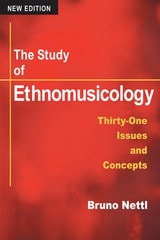
cover of The Study of Ethnomusicology: Thirty-one Issues and Concepts

The Study of Ethnomusicology

Thirty-one Issues and Concepts

Bruno Nettl

University of Illinois Press, 2010

The first edition of this book, The Study of Ethnomusicology: Twenty-Nine Issues and Concepts, has become a classic in the field. This revised edition, written twenty-two years after the original, continues the tradition of providing engagingly written analysis that offers the most comprehensive discussion of the field available anywhere. 
This book looks at the field of ethnomusicology--defined as the study of the world's musics from a comparative perspective, and the study of all music from an anthropological perspective--as a field of research. Nettl selects thirty-one concepts and issues that have been the subjects of continuing debate by ethnomusicologists, and he adds four entirely new chapters and thoroughly updates the text to reflect new developments and concerns in the field.               
                                    
Each chapter looks at its subject historically and goes on to make its points with case studies, many taken from Nettl's own field experience. Drawing extensively on his field research in the Middle East, Western urban settings, and North American Indian societies, as well as on a critical survey of the available literature, Nettl advances our understanding of both the diversity and universality of the world's music. This revised edition's four new chapters deal with the doing and writing of musical ethnography, the scholarly study of instruments, aspects of women's music and women in music, and the ethnomusicologist's study of his or her own culture.
 
[more]
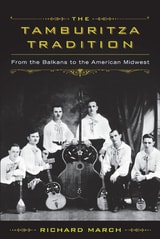
cover of The Tamburitza Tradition: From the Balkans to the American Midwest

The Tamburitza Tradition

From the Balkans to the American Midwest

Richard March

University of Wisconsin Press, 2013

The Tamburitza Tradition is a lively and well-illustrated comprehensive introduction to a Balkan folk music that now also thrives in communities throughout Europe, the Americas, and Australia. Tamburitza features acoustic stringed instruments, ranging in size from tamburas as small as a ukulele to ones as large as a bass viol.
            Folklorist Richard March documents the centuries-old origins and development of the tradition, including its intertwining with nationalist and ethnic symbolism. The music survived the complex politics of nineteenth-century Europe but remains a point of contention today. In Croatia, tamburitza is strongly associated with national identity and supported by an artistic and educational infrastructure. Serbia is proud of its outstanding performers and composers who have influenced tamburitza bands on four continents. In the United States, tamburitza was brought by Balkan immigrants in the nineteenth century and has become a flourishing American ethnic music with its own set of representational politics.
            Combining historical research with in-depth interviews and extensive participant-observer description, The Tamburitza Tradition reveals a dynamic and expressive music tradition on both sides of the Atlantic and beyond, illuminating the cultures and societies from which it has emerged.
[more]
cover of The Tango Machine: Musical Culture in the Age of Expediency

The Tango Machine

Musical Culture in the Age of Expediency

Morgan James Luker

University of Chicago Press, 2016

In Argentina, tango isn’t just the national music—it’s a national brand. But ask any contemporary Argentine if they ever really listen to it and chances are the answer is no: tango hasn’t been popular for more than fifty years. In this book, Morgan James Luker explores that odd paradox by tracing the many ways Argentina draws upon tango as a resource for a wide array of economic, social, and cultural—that is to say, non-musical—projects. In doing so, he illuminates new facets of all musical culture in an age of expediency when the value and meaning of the arts is less about the arts themselves and more about how they can be used.
           
Luker traces the diverse and often contradictory ways tango is used in Argentina in activities ranging from state cultural policy-making to its export abroad as a cultural emblem, from the expanding nonprofit arts sector to tango-themed urban renewal projects. He shows how projects such as these are not peripheral to an otherwise “real” tango—they are the absolutely central means by which the values of this musical culture are cultivated. By richly detailing the interdependence of aesthetic value and the regimes of cultural management, this book sheds light on core conceptual challenges facing critical music scholarship today.  
 
[more]
cover of The Voice in the Drum: Music, Language, and Emotion in Islamicate South Asia

The Voice in the Drum

Music, Language, and Emotion in Islamicate South Asia

Richard K. Wolf

University of Illinois Press, 2014
Based on extensive field research in India and Pakistan, this new study examines the ways drumming and voices interconnect over vast areas of South Asia and considers what it means for instruments to be voice-like and carry textual messages in particular contexts. Richard K. Wolf employs a hybrid, novelistic form of presentation, in which a fictional protagonist interacts with Wolf's field consultants, to communicate ethnographic and historical realities that transcend the local details of any one person's life. The narrative explores how the themes of South Asian Muslims and their neighbors coming together, moving apart, and relating to God and spiritual intermediaries resonate across ritual and expressive forms such as drumming and dancing. Wolf weaves in the story of a family led by Ahmed Ali Khan, a North Indian ruler who revels in the glories of 19th century life, when many religious communities joined together harmoniously in grand processions. His journalist son Muharram Ali obsessively scours the subcontinent in pursuit of a music he naively hopes will dissolve religious and political barriers. The story charts the breakdown of this naiveté. A daring narrative of music, religion and politics in late twentieth century South Asia, The Voice in the Drum delves into the social and religious principles around which Muslims, Hindus, and others bond, create distinctions, reflect upon one another, or decline to acknowledge differences.
[more]
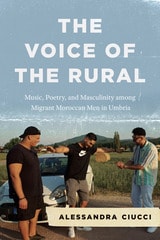
cover of The Voice of the Rural: Music, Poetry, and Masculinity among Migrant Moroccan Men in Umbria

The Voice of the Rural

Music, Poetry, and Masculinity among Migrant Moroccan Men in Umbria

Alessandra Ciucci

University of Chicago Press, 2022

A moving portrait of the contemporary experiences of migrant Moroccan men.

Umbria is known to most Americans for its picturesque rolling hills and medieval villages, but to the many migrant Moroccan men who travel there, Umbria is better known for the tobacco fields, construction sites, small industries, and the outdoor weekly markets where they work. Marginalized and far from their homes, these men turn to Moroccan traditions of music and poetry that evoke the countryside they have left— l-‘arubiya, or the rural. In this book, Alessandra Ciucci takes us inside the lives of Moroccan workers, unpacking the way they share a particular musical style of the rural to create a sense of home and belonging in a foreign and inhospitable nation. Along the way, she uncovers how this culture of belonging is not just the product of the struggles of migration, but also tied to the reclamation of a noble and virtuous masculine identity that is inaccessible to Moroccan migrants in Italy.
 
The Voice of the Rural allows us to understand the contemporary experiences of migrant Moroccan men by examining their imagined relationship to the rural through sound, shedding new light on the urgent issues of migration and belonging.  

 
 
[more]
cover of Theory of African Music, Volume I

Theory of African Music, Volume I

Gerhard Kubik

University of Chicago Press, 2010

Taken together, these comprehensive volumes offer an authoritative account of the music of Africa. One of the most prominent experts on the subject, Gerhard Kubik draws on his extensive travels and three decades of study in many parts of the continent to compare and contrast a wealth of musical traditions from a range of cultures.


In the first volume, Kubik describes and examines xylophone playing in southern Uganda and harp music from the Central African Republic; compares multi-part singing from across the continent; and explores movement and sound in eastern Angola. And in the second volume, he turns to the cognitive study of African rhythm, Yoruba chantefables, the musical Kachamba family of Malaŵi, and African conceptions of space and time.


Each volume features an extensive number of photographs and is accompanied by a compact disc of Kubik’s own recordings. Erudite and exhaustive, Theory of African Music will be an invaluable reference for years to come.

[more]
cover of Theory of African Music, Volume II

Theory of African Music, Volume II

Gerhard Kubik

University of Chicago Press, 2010

Erudite and exhaustive, Gerhard Kubik’s Theory of African Music provides an authoritative account of its subject. Over the course of two volumes, Kubik, one of the most prominent experts in the field, draws on his extensive travels and three decades of study throughout Africa to compare and contrast a wealth of musical traditions from a range of cultures.

In this second volume, Kubik explores a variety of topics, including Yoruba chantefables, the musical Kachamba family of Malawˆ i, and the cognitive study of African rhythm. Drawing on his remarkable ability to make cross-cultural comparisons, Kubik illuminates every facet of the African understanding of rhythm, from timing systems to elementary pulsation. His analysis of tusona ideographs in Luchazi culture leads to an exploration of African space/time concepts that synthesizes his theories of art, rhythm, and culture.

Featuring a large number of photographs and accompanied by a compact disc of Kubik’s own recordings, Theory of African Music, Volume II, will be an invaluable reference for years to come.
[more]
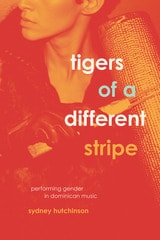
cover of Tigers of a Different Stripe: Performing Gender in Dominican Music

Tigers of a Different Stripe

Performing Gender in Dominican Music

Sydney Hutchinson

University of Chicago Press, 2016

Tigers of a Different Stripe takes readers inside the unique world of merengue típico, a traditional music of the Dominican Republic. While in most genres of Caribbean music women usually participate as dancers or vocalists, in merengue típico they are more often instrumentalists and even bandleaders—something nearly unheard of in the macho Caribbean music scene. Examining this cultural phenomenon, Sydney Hutchinson offers an unexpected and fascinating account of gender in Dominican art and life.
           
Drawing on over a decade of fieldwork in the Dominican Republic and New York among musicians, fans, and patrons of merengue típico—not to mention her own experiences as a female instrumentalist—Hutchinson details a complex nexus of class, race, and artistic tradition that unsettles the typical binary between the masculine and feminine. She sketches the portrait of the classic male figure of the tíguere, a dandified but sexually aggressive and street-smart “tiger,” and she shows how female musicians have developed a feminine counterpart: the tíguera, an assertive, sensual, and respected female figure who looks like a woman but often plays and even sings like a man. Through these musical figures and studies of both straight and queer performers, she unveils rich ambiguities in gender construction in the Dominican Republic and the long history of a unique form of Caribbean feminism.

[more]
cover of To Win the Indian Heart: Music at Chemawa Indian School

To Win the Indian Heart

Music at Chemawa Indian School

Melissa D. Parkhurst

Oregon State University Press, 2014

Since 1879, Indian children from all regions of the United States have entered federal boarding schools—institutions designed to assimilate them into mainstream society. Chemawa Indian School in western Oregon, one of the nation’s oldest and the longest still in continuous operation, is an emblem of a system that has intimately impacted countless lives and communities.

In To Win the Indian Heart: Music at Chemawa Indian School, Melissa Parkhurst records the history of the school’s musical life. She explores the crucial role music was meant to play in the total transformation of Indian children, and the cultural recovery and resiliency it often inspired instead. Parkhurst chronicles the complex ways in which students, families, faculty, and administrators employed music, both as a tool for assimilation and, conversely, as a vehicle for student resistance—a subject long overlooked in literature on Indian education and the assimilation campaign.  

Combining oral histories of Chemawa alumni with archival records of campus life, the book examines the prominent forms of music making at Chemawa—school band, choirs, private lessons, pageants, dance, garage bands, and powwows. Parkhurst traces the trajectory of federal Indian policy, highlighting students’ creative responses and the ways in which music reveals the inherent contradictions in the U.S. government’s assimilation practices.

[more]
cover of Together, Somehow: Music, Affect, and Intimacy on the Dancefloor

Together, Somehow

Music, Affect, and Intimacy on the Dancefloor

Luis Manuel Garcia-Mispireta

Duke University Press, 2023
In Together, Somehow, Luis Manuel Garcia-Mispireta examines how people find ways to get along and share a dancefloor, a vibe, and a sound. Drawing on time spent in the minimal techno and house music subscenes in Chicago, Paris, and Berlin as the first decade of the new millennium came to a close, Garcia-Mispireta explains this bonding in terms of what he calls stranger-intimacy: the kind of warmth, sharing, and vulnerability between people that happens surprisingly often at popular electronic dance music parties. He shows how affect lubricates the connections between music and the dancers. Intense shared senses of sound and touch help support a feeling of belonging to a larger social world. However, as Garcia-Mispireta points out, this sense of belonging can be vague, fluid, and may hide exclusions and injustices. By showing how sharing a dancefloor involves feeling, touch, sound, sexuality, and subculture, Garcia-Mispireta rethinks intimacy and belonging through dancing crowds and the utopian vision of throbbing dancefloors.
[more]
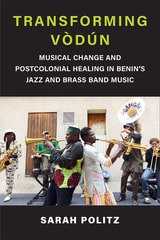
cover of Transforming Vòdún: Musical Change and Postcolonial Healing in Benin's Jazz and Brass Band Music

Transforming Vòdún

Musical Change and Postcolonial Healing in Benin's Jazz and Brass Band Music

Sarah Politz

University of Michigan Press, 2023
Transforming Vòdún examines how musicians from the West African Republic of Benin transform Benin’s cultural traditions, especially the ancestral spiritual practice of vòdún and its musical repertoires, as part of the process of healing postcolonial trauma through music and ritual. Based on fieldwork in Benin, France, and New York City, Sarah Politz uses historical ethnography, music analysis, and participant observation to examine three case studies of brass band and jazz musicians from Benin. The multi-sited nature of this study highlights the importance of mobility, and diasporic connections in musicians’ professional lives, while grounding these connections in the particularities of the African continent, its histories, its people, and its present.  
[more]
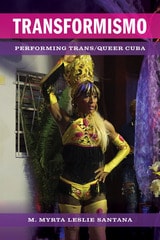
cover of Transformismo: Performing Trans/Queer Cuba

Transformismo

Performing Trans/Queer Cuba

M. Myrta Leslie Santana

University of Michigan Press, 2025

In Transformismo, M. Myrta Leslie Santana draws on years of embedded research within Cuban trans/queer communities to analyze how transformistas, or drag performers, understand their roles in the social transformation of the island. Once banned and censored in Cuba, drag performance is now a state-sponsored event. Transformismo suggests that these performances make critical interventions in Cuban trans/queer life and politics and in doing so, the volume offers critical insight into how Cuba’s postsocialist reform has exacerbated racial, sexual, and economic inequalities. Leslie Santana argues that mainstream trans/queer nightlife in Cuba is entangled with the island’s tourism economy and has shaped the aesthetics and social makeup of transformismo in coastal Havana, which largely caters to foreigners. Leslie Santana considers how Black lesbian and transgender transformistas are expanding understandings of sexual selfhood and politics on the island, particularly questioning the ways that Black women’s creativity is prominently featured in the aesthetics of tourism and trans/queer nightlife, while Black women themselves are denied social and material capital.
[more]
cover of Transounding: Listening for Black Queer Lusophone Diasporas

Transounding

Listening for Black Queer Lusophone Diasporas

Daniel da Silva

Duke University Press, 2027
In Transounding, Daniel da Silva examines the work of popular music artists from Portugal, Brazil, and Angola whose singing and performances blur boundaries of gender and genre. These artists engage in collaborations that traverse uneven transatlantic Lusophone geographies and complicate North-South and South-South axes, composing, expressing, and performing modes of musical and affective political bonds across Luso-Afro-Brazilian cultures and transposing hegemonic cultural narratives into sites of Black queer and transfeminine possibility. Silva describes how transfeminine Brazilian artists complicate categories of gender and sexuality; how queer Portuguese fado performers inhabit and transform the genre's gendered conventions; and how queer, trans, and travesti Angolan and Lisbon-based Black queer artists produce resistant expressions within and against postcolonial and anti-Black contexts. Transounding traces queerness, Blackness, and diaspora across popular culture forms in the Lusophone world and explores the fundamental question of what listeners hear when transgressive voices sing.
[more]
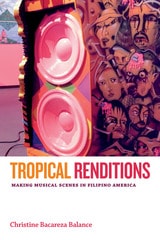
cover of Tropical Renditions: Making Musical Scenes in Filipino America

Tropical Renditions

Making Musical Scenes in Filipino America

Christine Bacareza Balance

Duke University Press, 2016

In Tropical Renditions Christine Bacareza Balance examines how the performance and reception of post-World War II Filipino and Filipino American popular music provide crucial tools for composing Filipino identities, publics, and politics. To understand this dynamic, Balance advocates for a "disobedient listening" that reveals how Filipino musicians challenge dominant racialized U.S. imperialist tropes of Filipinos as primitive, childlike, derivative, and mimetic. Balance disobediently listens to how the Bay Area turntablist DJ group the Invisibl Skratch Piklz bear the burden of racialized performers in the United States and defy conventions on musical ownership; to karaoke as affective labor, aesthetic expression, and pedagogical instrument; to how writer and performer Jessica Hagedorn's collaborative and improvisational authorial voice signals the importance of migration and place; and how Pinoy indie rock scenes challenge the relationship between race and musical genre by tracing the alternative routes that popular music takes. In each instance Filipino musicians, writers, visual artists, and filmmakers work within and against the legacies of the U.S./Philippine imperial encounter, and in so doing, move beyond preoccupations with authenticity and offer new ways to reimagine tropical places.
 
[more]