Results by title
732 books match the query 'Indigenous' and 169 start with t
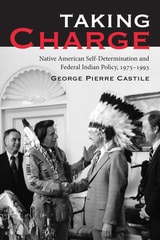
Taking Charge
Native American Self-Determination and Federal Indian Policy, 1975–1993George Pierre Castile
University of Arizona Press, 2006
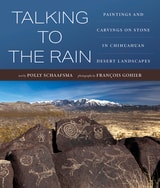
Talking to the Rain
Paintings and Carvings on Stone in Chihuahuan Desert LandscapesPolly Schaafsma, photographs by François Gohier
University of Utah Press, 2025
In this visually stunning volume, Polly Schaafsma, leading authority on pre-Hispanic Indian rock imagery and kiva murals of the greater American Southwest, provides an insightful journey into the petroglyphs and rock paintings of the Jornada Mogollon farmers in southern New Mexico's lower Chihuahuan Desert.
Talking to the Rain defines the Rio Grande Tradition, emphasizing the foundational Jornada Style as exemplified by its Mimbres-like imagery as well as its diverse and complex rain-making symbolism. By examining visual metaphors of cosmology and place-making, the book reveals an ancient dialogue between farmers and the cosmos that places rain for crops as its central concern. Exceptional color photographs by François Gohier invite readers to experience the landscapes and locations selected for creating these images. Both scholarly and accessible, Talking to the Rain offers a fresh perspective on cultural landscapes and the profound connections between people, art, and environment, making it essential for understanding Southwest cultural history.
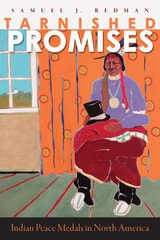
Tarnished Promises
Indian Peace Medals in North AmericaSamuel J. Redman
University Press of Colorado, 2026
Using a collection of medals held at the Denver Museum of Nature & Science, Tarnished Promises presents an updated overview of the history and story of peace medals through an examination of their legacy in the modern world. Accompanying the history and analysis are images of thirteen exemplar peace medals from the DMNS collections and their accompanying object biographies.
Peace medals paradoxically worked as tools of colonialism and also Native American agency, sovereignty, power, resistance, and change in response to growing challenges. Their widespread adoption by Native people in North America both prefigured and coincided with the many ways in which Native Americans and First Nations peoples worked to adapt to the unwelcome and undesirable changes wrought by expanding western colonialism. The unique individual histories behind the medals and the larger peace medal story suggest how material objects can hold several, sometimes contradictory, meanings and be influenced by varied strands of culture and historical memory. Tarnished Promises tells this complex story in two parts, with the first detailing the history of Indian peace medals from 1670 to the present day and the second part exploring their meaning at different points in time and to different peoples.
The first book-length treatment of peace medals using an anticolonialist perspective, Tarnished Promises is significant to scholars and the general public interested in numismatics, American history, Indigenous studies, and museum collections.
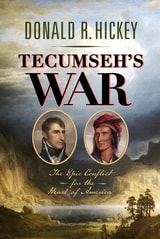
Tecumseh's War
The Epic Conflict for the Heart of AmericaDonald R. Hickey
Westholme Publishing, 2026
The Shawnee leader Tecumseh came to prominence in a war against the United States waged from 1811 to 1815. In 1805, Tecumseh’s younger brother Lalawethika (soon to be known as “the Prophet”) had a vision for an Indian revitalization movement that would restore Native culture and resist American expansion. Tecumseh organized the growing support for this movement, which came from Indigenous peoples across the Old Northwest and parts of the Great Plains, into a loose but powerful military alliance.
In late 1811, while Tecumseh was away on a recruiting mission in the South, General William Henry Harrison led an army to the center of Native resistance at Prophetstown in present-day Indiana. In the early morning hours of November 7, in what came to be known as the Battle of Tippecanoe, Harrison’s men fought off an Indian attack, which marked the beginning of Tecumseh’s War. Seven months later, when the United States declared war on Britain, thus initiating the War of 1812, the British and Tecumseh forged an alliance against the United States. Initially, the Anglo-Indian alliance enjoyed considerable success at Detroit, Chicago, Mackinac, and elsewhere, exposing much of the Old Northwest to border warfare, but the tide turned in 1813 when Harrison invaded Canada. On October 5 the American army defeated a much smaller Anglo-Indian force in the climactic Battle of the Thames. Tecumseh was killed in this battle, and although his confederacy disintegrated, British support ensured that the Indian war would continue for another two years with the Sauk chief Black Hawk now providing the inspiration and leadership. Tecumseh’s War ended only in late 1815 after the British made peace with the United States and abandoned their native allies.
Tecumseh’s War: The Epic Conflict for the Heart of America is the first complete story of this major conflict. Distinguished historian Donald R. Hickey detaches it from the War of 1812, moving Tecumseh’s confederation to center stage to tell the sweeping and engrossing story of this last great Indian War—the last time that Indigenous Peoples had a powerful European ally to oppose United States expansion and thus the lastchance they had of shaping the future of the continent.
Teller Tales
HistoriesJo Carson
Ohio University Press, 2007
“All my work fits in my mouth,” Jo Carson says. “I write performance material no matter what else the pieces get called, and whether they are for my voice or other characters’ voices … they are first to be spoken aloud.” Following an oral tradition that has strong roots in her native Tennessee, the author of Teller Tales invites the reader to participate in events in a way that no conventional history book can.
Both stories in this book are set in East Tennessee in the mid-eighteenth century and share certain characters. The first narrative, “What Sweet Lips Can Do,” recounts the story of the Overmountain Men and the battle of King’s Mountain, a tide-turning battle in the American Revolution. “Men of Their Time” is an exploration of white-Cherokee relationships from early contact through the time of the Revolution.
Although not well known to the outside world, the stories recounted in Teller Tales are cornerstones in the heritage of the Appalachian region and of American history. In ways that will appeal to young and old alike, Jo Carson’s irreverent telling will broaden the audience and the understanding for the stories of native Americans, settlers, explorers, and revolutionaries of early America.
Tellin' It Like It Is
Selected Works of Adrian C. LouisAdrian C. Louis
University of Nevada Press, 2026
Tellin’ It Like It Is offers a powerful introduction to Adrian C. Louis (1946–2018), one of the most unflinching Native American literary voices of the twentieth century. Drawing from a half-century of published writing—and including a few previously unpublished pieces—this collection captures the evolution of Louis’s voice, worldview, and craft.
Editor David Pichaske, a close friend of Louis in his later years, curates this volume with deep insight into both the public figure and the private man. Selections are arranged chronologically to trace Louis’s transformation from a Nevada reservation teenager to a California hippie, a sixties hitchhiker, a Boston academic, a South Dakota reservation journalist, and finally, a Midwestern college professor.
Louis’s work immerses readers in reservation life, yet its critique reaches the broadest dimensions of American and human experience. To enrich understanding, the book includes literary reviews, scholarly essays (including one by a noted Polish critic), an interview with Louis, and his own reflections on literature and identity. A foreword by poet Bojan Louis provides further context for this essential collection.

Tennesseans at War, 1812–1815
Andrew Jackson, the Creek War, and the Battle of New OrleansTom Kanon
University of Alabama Press, 2014
Although frequently discussed as separate military conflicts, the War of 1812 against Great Britain and the Creek War against Native Americans in the territory that would become Alabama were part of the same forceful projection of growing American power. Success in both wars won for America security against attack from abroad and vast tracks of new land in “the Old Southwest.” In Tennesseans at War, 1812–1815, Tom Kanon explains the role Tennesseans played in these changes and how they remade the south.
Because it was a landlocked frontier state, Tennessee’s economy and security depended heavily upon the river systems that traversed the region; some, like the Tennessee River, flowed south out of the state and into Native American lands. Tennesseans of the period perceived that gaining mastery of these waterways formed an urgent part of their economic survival and stability.
The culmination of fifteen years’ research, Kanon’s work draws on state archives, primary sources, and eyewitness accounts, bringing the information in these materials together for first time. Not only does he narrate the military campaigns at the heart of the young nation’s expansion, but he also deftly recalls the economic and social pressures and opportunities that encouraged large numbers of Tennesseans to leave home and fight. He expertly weaves these themes into a cohesive narrative that culminates in the vivid military victories of the War of 1812, the Creek War, and the legendary Battle of New Orleans—the victory that catapulted Tennessee’s citizen-soldier Andrew Jackson to the presidency.
Expounding on the social roles and conditions of women, slaves, minorities, and Native Americans in Tennessee, Kanon also brings into focus the key idea of the “home front” in the minds of Tennesseans doing battle in Alabama and beyond. Kanon shows how the goal of creating, strengthening, and maintaining an ordered society permeated the choices and actions of the American elites on the frontiers of the young nation.
Much more than a history of Tennesseans or the battles they fought in Alabama, Tennesseans at War, 1812–1815, is the gripping story of a pivotal turning point in the history of the young American republic.
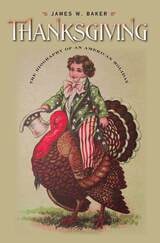
Thanksgiving
The Biography of an American HolidayJames W. Baker
University of New Hampshire Press, 2009
In this, the first in-depth study of the most American of holidays, James Baker sweeps away lingering myths and misconceptions to show how this celebration day was born and grew to be an essential part of our national spirit. Thanksgiving: The Biography of an American Holiday opens with an overview of the popular mythos of the holiday before discussing its possible religious and cultural precedents. This classic Yankee holiday is examined in historical and contemporary detail that embraces everything from proclamations, sermons, and local and regional traditions to family reunions, turkey dinners, and recipes. Thanksgiving's evolving face is illustrated with charming and often revealing period prints that chart our changing attitudes: the influence of Victorian sentiment in Thanksgiving's development, Progressive utilitarianism, intellectual “debunking,” patriotic wartime reclamation, and 1960s-era protest. Thanksgiving remains controversial up to the present day, as Mayflower descendants, Native Americans, and commercial exploiters compete for the American public's opinion of the holiday's contemporary significance and its future status. This is an intelligent and illuminating introduction to a beloved holiday and a fascinating cultural history of America and Americana.

That Guy Wolf Dancing
Elizabeth Cook-Lynn
Michigan State University Press, 2014

The American Café
Sara Sue Hoklotubbe
University of Arizona Press, 2011
When Sadie Walela decides to pursue her childhood dream of owning a restaurant, she has no idea that murder will be on the menu.
In this second book in the Sadie Walela series, set in the heart of the Cherokee Nation, Sadie discovers life as an entrepreneur is not as easy as she anticipated. On her first day, she is threatened by the town’s resident "crazy" woman and the former owner of the American Café turns up dead, engulfing the café—and Sadie herself—in a cloud of suspicion and unanswered questions.
Drawing on the intuition and perseverance of her Cherokee ancestry, Sadie is determined to get some answers when an old friend unexpectedly turns up to lend a hand. A diverse cast of characters—including a mysterious Creek Indian, a corrupt police chief, an angry Marine home from Iraq, and the victim’s grieving sister and alcoholic niece—all come together to create a multilayered story of denial and deceit.
While striving to untangle relationships and old family secrets, Sadie ends up unraveling far more than a murder.
The American Discovery of Europe
Jack D. Forbes
University of Illinois Press, 2011
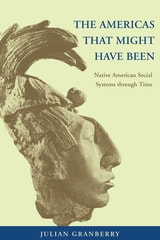
The Americas That Might Have Been
Native American Social Systems through TimeJulian Granberry
University of Alabama Press, 2005
This work answers the hypothetical question: What would the Americas be like today—politically, economically, culturally—if Columbus and the Europeans had never found them, and how would American peoples interact with the world’s other societies? It assumes that Columbus did not embark from Spain in 1492 and that no Europeans found or settled the New World afterward, leaving the peoples of the two American continents free to follow the natural course of their Native lives.
The Americas That Might Have Been is a professional but layman-accessible, fact-based, nonfiction account of the major Native American political states that were thriving in the New World in 1492. Granberry considers a contemporary New World in which the glories of Aztec Mexico, Maya Middle America, and Inca Peru survived intact. He imagines the roles that the Iroquois Confederacy of the American Northeast, the powerful city-states along the Mississippi River in the Midwest and Southeast, the Navajo Nation and the Pueblo culture of the Southwest, the Eskimo Nation in the Far North, and the Taino/Arawak chiefdoms of the Caribbean would play in American and world politics in the 21st Century.
Following a critical examination of the data using empirical archaeology, linguistics, and ethnohistory, Granberry presents a reasoned and compelling discussion of native cultures and the paths they would have logically taken over the past five centuries. He reveals the spectacular futures these brilliant pre-Columbian societies might have had, if not for one epochal meeting that set off a chain of events so overwhelming to them that the course of human history was forever changed.
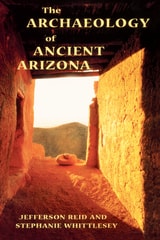
The Archaeology of Ancient Arizona
Jefferson Reid and Stephanie Whittlesey
University of Arizona Press, 1997
This book invites us to step into a Hohokam village with its sounds of barking dogs, children's laughter, and the ever-present grinding of mano on metate to produce the daily bread. Here, too, readers will marvel at the skills of Clovis elephant hunters and touch the lives of other ancestral people known as Mogollon, Anasazi, Sinagua, and Salado. Descriptions of long-ago people are balanced with tales about the archaeologists who have devoted their lives to learning more about "those who came before." Trekking through the desert with the famed Emil Haury, readers will stumble upon Ventana Cave, his "answer to a prayer." With amateur archaeologist Richard Wetherill, they will sense the peril of crossing the flooded San Juan River on the way to Chaco Canyon. Others profiled in the book are A. V. Kidder, Andrew Ellicott Douglass, Julian Hayden, Harold S. Gladwin, and many more names synonymous with the continuing saga of southwestern archaeology.
This book is an open invitation to general readers to join in solving the great archaeological puzzles of this part of the world. Moreover, it is the only up-to-date summary of a field advancing so rapidly that much of the material is new even to professional archaeologists. Lively and fast paced, the book will appeal to anyone who finds magic in a broken bowl or pueblo wall touched by human hands hundreds of years ago. For all readers, these pages offer a sense of adventure, that "you are there" stir of excitement that comes only with making new discoveries about the distant past.
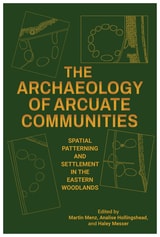
The Archaeology of Arcuate Communities
Spatial Patterning and Settlement in the Eastern WoodlandsEdited by Martin Menz, Analise Hollingshead, and Haley Messer
University of Alabama Press, 2024
A comparative archaeological synthesis examining the spatial, social, and ceremonial logics underpinning circular community formations across the Eastern Woodlands from 10,000 BC to the sixteenth century.
The Archaeology of Arcuate Communities is an edited collection of ten essays that illuminate how Indigenous communities of the Eastern Woodlands, from 10,000 BC to the 1550s, are analyzed and interpreted by archaeologists today. Volume editors Martin Menz, Analise Hollingshead, and Haley Messer define the persistent circular or “arcuate” pattern of Native settlements in this region as a spatial manifestation of community activities that reinforced group identity alongside plazas, mounds, and other architectural features.
The varied case studies in this volume focus on specific communities, how they evolved, and the types of archaeological data that have been used to assess them. Part I, “Defining the Domestic Unit in Arcuate Communities,” reveals social distinctions between households and household clusters in arcuate communities, how they differ in terms of stylistic patterns and exchange, and how they combined to form distinct social groups at different scales within a broader community. Part II, “Organizing Principles of Arcuate Communities,” broadens the scope to identify the organizing principles of entire arcuate communities, such as the central role of plazas in structuring their development, how the distribution of households and central features within communities was contested and reorganized, and the importance of mounds in both delineating arcuate communities and marking their position on the landscape. Part III, “Comparison and Change in Arcuate Communities,” comprises case studies that examine changes in the organization of arcuate communities over time. Rounding out the volume is a concluding chapter that assesses how and why communities around the world formed in circular patterns.
A valuable resource for archaeologists, this collection will also be of interest to those seeking to learn about Native North American settlement, ceremony, and community organization.
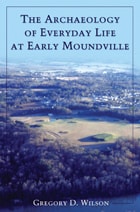
The Archaeology of Everyday Life at Early Moundville
Gregory D. Wilson
University of Alabama Press, 2007
Complex Mississippian polities were neither developed nor sustained in a vacuum. A broad range of small-scale social groups played a variety of roles in the emergence of regionally organized political hierarchies that governed large-scale ceremonial centers. Recent research has revealed the extent to which interactions among corporately organized clans led to the development, success, and collapse of Moundville. These insights into Moundville’s social complexity are based primarily on the study of monumental architecture and mortuary ceremonialism. Less is known about how everyday domestic practices produced and were produced by broader networks of power and inequality in the region.
Wilson’s research addresses this gap in our understanding by analyzing and interpreting large-scale architectural and ceramic data sets from domestic contexts. This study has revealed that the early Mississippian Moundville community consisted of numerous spatially discrete multi-household groups, similar to ethnohistorically described kin groups from the southeastern United States. Hosting feasts, dances, and other ceremonial events were important strategies by which elite groups created social debts and legitimized their positions of authority. Non-elite groups, on the other hand, maintained considerable economic and ritual autonomy through diversified production activities, risk sharing, and household ceremonialism. Organizational changes in Moundville’s residential occupation highlight the different ways kin groups defined and redefined their corporate status and identities over the long term.
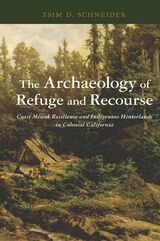
The Archaeology of Refuge and Recourse
Coast Miwok Resilience and Indigenous Hinterlands in Colonial CaliforniaTsim D. Schneider
University of Arizona Press, 2021
Applying theories of place and landscape, social memory, and mobility to the analysis of six archaeological sites, Tsim D. Schneider argues for a new direction in the archaeology of colonialism. This book offers insight about the critical and ongoing relationships Indigenous people maintained to their homelands despite colonization and systematic destruction of their cultural sites.
Schneider is a citizen of the Federated Indians of Graton Rancheria, the sovereign and federally recognized tribe of Coast Miwok and Southern Pomo people whose ancestral homelands and homewaters are the central focus of The Archaeology of Refuge and Recourse. Viewing this colonial narrative from an Indigenous perspective, Schneider focuses on the nearly one quarter of Coast Miwok people who survived the missions and created outlets within and beyond colonial settlements to resist and endure colonialism.
Fleeing these colonial missions and other establishments and taking refuge around the San Francisco Bay Area, Coast Miwok people sought to protect their identities by remaining connected to culturally and historically significant places. Mobility and a sense of place further enabled Coast Miwok people to find recourse and make decisions about their future through selective participation in colonial projects. In this book, Tsim D. Schneider argues that these distancing and familiarizing efforts contribute to the resilience of Coast Miwok communities and a sense of relevance and belonging to stolen lands and waters. Facing death, violence, and the pervading uncertainty of change, Indigenous people of the Marin Peninsula balanced the pull and persistence of place against the unknown possibilities of a dynamic colonial landscape and the forward-thinking required to survive. History, change, and the future can be read in the story of Coast Miwok people.
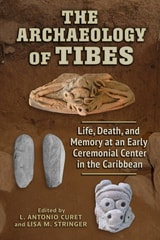
The Archaeology of Tibes
Life, Death, and Memory at an Early Ceremonial Center in the CaribbeanEdited by L. Antonio Curet and Lisa M. Stringer
University of Alabama Press, 2025
A collection of new essays that brings archaeological insights and discoveries at the Tibes Ceremonial Center up to date
The Archaeology of Tibes is a collection of essays offering a fresh analysis of this important ceremonial center. It brings new insights about social structure, illuminating the smaller-scale daily lives of ancient peoples rather than focusing on large-scale chiefdoms.
Tibes is the earliest known (ca. 400 to 1300 CE) ceremonial center in Puerto Rico. It has been the focus of one of the largest and longest-running archaeological programs in the Caribbean. Early researchers interpreted evidence in the area of a shift from dispersed villages to a ceremonial center as suggesting the development of social stratification and accumulation of power. Seen as the seat of an early chiefdom, Tibes served as a model applied broadly across the Greater Antilles.
New discoveries prompted archaeologists to question their original assumptions about ancient Puerto Rico, and later research failed to produce evidence of social stratification at Tibes. The Archaeology of Tibes therefore incorporates updated and wider perspectives on social formation. It considers agency, decisions, and events and the possibility of more than one form of social organization. It also presents a more accurate “humanized” past: the sociological meanings of that space and its significance for the people who created, used, and occupied it and who influenced rituals, social memory, and community.
Summarizing findings from excavations at Tibes after 2010, the collection also reviews the geoarchaeology of the site. Additional essays cover ceramic pastes, lithic production, faunal remains, coral, burials, and rock art. This work will engender discussion and future research by archaeologists across the Caribbean and beyond.

The Battle of Upper Sandusky, 1782
Eric Sterner
Westholme Publishing, 2023
In May 1782, Colonel William Crawford led over 450 volunteers across Ohio to attack British-allied Native Americans who had been raiding the frontiers of Pennsylvania and Virginia for years. An experienced yet reluctant commander, Crawford and his men clashed with a similarly sized force of British Rangers and Wyandot, Delaware, and Shawnee Indians on the Sandusky River in early June. After three days, the Americans were routed in one of the worst defeats American arms suffered on the frontier during the American Revolution. During the retreat, Native American warriors captured dozens of men, including Colonel Crawford. Many were horrifically tortured to death in revenge for the Gnadenhutten massacre earlier that spring, when American volunteers bludgeoned nearly one hundred unarmed and unresisting Delaware Indians to death.
The Battle of Upper Sandusky, 1782 places military operations at the forefront of events in the waning months of the American Revolution on the frontier. Importantly, it gives long-deserved credit to Native American leaders, particularly Dunquat of the Wyandot and Hopocan of the Delaware, for their roles and commands on the battlefield. For over two centuries, their victory was attributed to the presence of British Rangers and a few officers, but Dunquat and Hopocan made the critical decisions before and after the battle while Native American warriors constituted the bulk of their army.
The book also reconsiders the effectiveness of American operations. Crawford was an unenthusiastic commander who had to be talked into leading the campaign to help prevent a repeat of the Gnadenhutten massacre. Despite his long service on the frontier and experience in the Continental Army, Crawford failed to unite his ad hoc command, suffered from constant indecision, and could not put his own stamp on the campaign. The unprofessional nature of his army also contributed to its defeat as it lacked organization, experience, leadership, training, and standardization.
The presence of Simon Girty, demonized by Americans on the frontier as a turncoat, and the gruesomeness of Crawford’s execution focused stories about the campaign on those two individuals, rather than the military operations themselves or the Indians who won the victory. Myths were accepted as fact. Afterward, interest in the campaign and the combatants faded. The Battle of Upper Sandusky, 1782 gives Crawford’s campaign its proper place as one of the largest battles between frontier forces and Native Americans during the Revolutionary War.

The Bingo Queens of Oneida
How Two Moms Started Tribal Gaming in WisconsinMike Hoeft
Wisconsin Historical Society Press, 2014
While militant Indian activists often dominated national headlines in the 1970s, these church-going Oneida women were the unsung catalysts behind bingo’s rising prominence as a sovereignty issue in the Oneida Nation. The bingo moms were just trying to take care of the kids in the community.
The Bingo Queens of Oneida: How Two Moms Started Tribal Gaming tells the story through the eyes of Sandra Ninham and Alma Webster, the Oneida women who had the idea for a bingo operation run by the tribe to benefit the entire tribe. Bingo became the tribe’s first moneymaker on a reservation where about half the population was living in poverty.
Author Mike Hoeft traces the historical struggles of the Oneida—one of six nations of the Iroquois, or Haudenosaunee, confederacy—from their alliance with America during the Revolutionary War to their journey to Wisconsin. He also details the lives of inspirational tribal members who worked alongside Ninham and Webster, and also those who were positively affected by their efforts.
The women-run bingo hall helped revitalize an indigenous culture on the brink of being lost. The Bingo Queens of Oneida is the story of not only how one game helped revive the Oneida economy but also how one game strengthened the Oneida community.
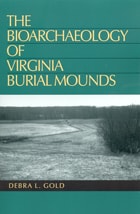
The Bioarchaeology of Virginia Burial Mounds
Debra L. Gold
University of Alabama Press, 2004
Uncovering the stories of Virginia's ancient peoples through the science of bioarchaeology.
By the 14th century more than a dozen accretional burial mounds—reaching heights of 12 to 15 feet—marked the floodplains of interior Virginia. Today, none of these mounds built by the nearly forgotten Monacan Indians remain on the landscape, having been removed over the centuries by a variety of natural and cultural causes. This study uses what remains of the mounds—excavated from the 1890s to the 1980s— to gain a new understanding of the Monacans and to gauge their importance in the realm of the late prehistoric period in the Eastern Woodlands.
Based on osteological examinations of dozens of complete skeletons and thousands of isolated bones and bone fragments, this work constructs information on Monacan demography, diet, health, and mortuary ritual in the 10th through the 15th centuries. The results show an overall pattern of stability and local autonomy among the Late Woodland village societies of interior Virginia in which a mixture of maize farming and the collection of wild food resources were successful for more than 600 years.
This book—uniting biological and cultural aspects of the data for a holistic understanding of everyday life in the period—will be of interest to ethnohistorians, osteologists, bioarchaeologists, and anyone studying Late Woodland, Mississippian, and contact periods, as well as middle range societies, in the Eastern Woodlands.
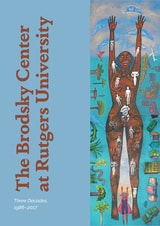
The Brodsky Center at Rutgers University
Three Decades, 1986-2017Ferris Olin
Rutgers University Press, 2024
Published in partnership with the Zimmerli Museum.
The Cadottes
A Fur Trade Family on Lake SuperiorRobert Silbernagel
Wisconsin Historical Society Press, 2023
The Cadottes
A Fur Trade Family on Lake SuperiorRobert Silbernagel
Wisconsin Historical Society Press, 2026
The Chippewa Landscape of Louise Erdrich
Allan Chavkin
University of Alabama Press, 1999
Louise Erdrich is arguably the most prolific and prominent contemporary writer of American Indian descent in North America today. Her novels and short stories have won great critical acclaim and are widely taught in American and world literature courses.
This collection of original ssays focuses on Erdrich's writings rooted in the Chippewa experience. Premier scholars of Native American literature investigate narrative structure, signs of ethnicity, the notions of luck and chance in Erdrich's narrative cosmology, her use of hunting metaphors, her efforts to counter stereotypes of American Indian women, her use of comedy in exploring American Indians' tragic past, her intentions underlying the process of revision in Love Medicine, and other subjects.
Including a variety of theoretical approaches, this book provides a comprehensive examination of Erdrich's work, making it more accessible to new readers and richer to those already familiar with her work.
The Colonial Construction of Indian Country
Native American Literatures and Federal Indian LawEric Cheyfitz
University of Minnesota Press, 2024
A guide to the colonization and projected decolonization of Native America
In The Colonial Construction of Indian Country, Eric Cheyfitz mounts a pointed historical critique of colonialism through careful analysis of the dialogue between Native American literatures and federal Indian law. Illuminating how these literatures indict colonial practices, he argues that if the decolonization of Indian country is to be achieved, then federal Indian law must be erased and replaced with independent Native nation sovereignty—because subordinate sovereignty, the historical regime, is not sovereignty at all.
At the same time, Cheyfitz argues that Native American literatures, specifically U.S. American Indian literatures, cannot be fully understood without a knowledge of U.S. federal Indian law: the matrix of colonialism in Indian country. Providing intersectional readings of a range of literary and legal texts, he discusses such authors as Louise Erdrich, Frances Washburn, James Welch, Gerald Vizenor, Simon Ortiz, Leslie Marmon Silko, and others. Cheyfitz examines how American Indian writers and critics have responded to the impact of law on Native life, revealing recent trends in Native writing that build upon traditional modes of storytelling and governance.
With a focus on resistance to the colonial regime of federal Indian law, The Colonial Construction of Indian Country not only elucidates how Native American literatures and federal Indian law are each crucial to any reading of the other, it also guides readers to better understand the genocidal assault on Indigenous peoples by Western structures of literacy, politics, and law.
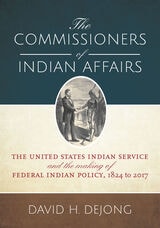
The Commissioners of Indian Affairs
The United States Indian Service and the Making of Federal Indian Policy, 1824 to 2017David H. DeJong
University of Utah Press, 2020
By examining the work of the Indian affairs commissioners and the assistant secretaries, DeJong gives new insight into how federal Indian policy has evolved and been shaped by the social, political, and cultural winds of the day.
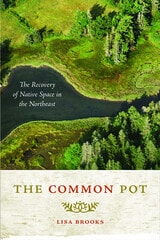
The Common Pot
The Recovery of Native Space in the NortheastLisa Brooks
University of Minnesota Press, 2008
Illuminates the significance of writing to colonial-era Native American resistance
Literary critics frequently portray early Native American writers either as individuals caught between two worlds or as subjects who, even as they defied the colonial world, struggled to exist within it. In striking counterpoint to these analyses, Lisa Brooks demonstrates the ways in which Native leaders—including Samson Occom, Joseph Brant, Hendrick Aupaumut, and William Apess—adopted writing as a tool to reclaim rights and land in the Native networks of what is now the northeastern United States.
“The Common Pot,” a metaphor that appears in Native writings during the eighteenth and nineteenth centuries, embodies land, community, and the shared space of sustenance among relations. Far from being corrupted by forms of writing introduced by European colonizers, Brooks contends, Native people frequently rejected the roles intended for them by their missionary teachers and used the skills they acquired to compose petitions, political tracts, and speeches; to record community councils and histories; and most important, to imagine collectively the routes through which the Common Pot could survive.Reframing the historical landscape of the region, Brooks constructs a provocative new picture of Native space before and after colonization. By recovering and reexamining Algonquian and Iroquoian texts, she shows that writing was not a foreign technology but rather a crucial weapon in the Native Americans’ arsenal as they resisted—and today continue to oppose—colonial domination.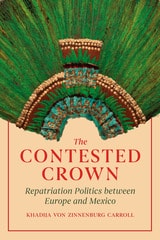
The Contested Crown
Repatriation Politics between Europe and MexicoKhadija von Zinnenburg Carroll
University of Chicago Press, 2022
In The Contested Crown, Khadija von Zinnenburg Carroll meditates on the case of a spectacular feather headdress believed to have belonged to Montezuma, emperor of the Aztecs. This crown has long been the center of political and cultural power struggles, and it is one of the most contested museum claims between Europe and the Americas. Taken to Europe during the conquest of Mexico, it was placed at Ambras Castle, the Habsburg residence of the author’s ancestors, and is now in Vienna’s Welt Museum. Mexico has long requested to have it back, but the Welt Museum uses science to insist it is too fragile to travel.
Both the biography of a cultural object and a history of collecting and colonizing, this book offers an artist’s perspective on the creative potentials of repatriation. Carroll compares Holocaust and colonial ethical claims, and she considers relationships between indigenous people, international law and the museums that amass global treasures, the significance of copies, and how conservation science shapes collections. Illustrated with diagrams and rare archival material, this book brings together global history, European history, and material culture around this fascinating object and the debates about repatriation.
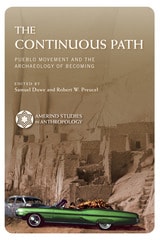
The Continuous Path
Pueblo Movement and the Archaeology of BecomingEdited by Samuel Duwe and Robert W. Preucel
University of Arizona Press, 2019
The Continuous Path challenges archaeologists to take Pueblo notions of movement seriously by privileging Pueblo concepts of being and becoming in the interpretation of anthropological data. In this volume, archaeologists, anthropologists, and Native community members weave multiple perspectives together to write histories of particular Pueblo peoples. Within these histories are stories of the movements of people, materials, and ideas, as well as the interconnectedness of all as the Pueblo people find, leave, and return to their middle places. What results is an emphasis on historical continuities and the understanding that the same concepts of movement that guided the actions of Pueblo people in the past continue to do so into the present and the future.
Movement is a never-ending and directed journey toward an ideal existence and a continuous path of becoming. This path began as the Pueblo people emerged from the underworld and sought their middle places, and it continues today at multiple levels, integrating the people, the village, and the individual.
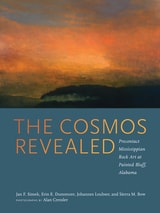
The Cosmos Revealed
Precontact Mississippian Rock Art at Painted Bluff, AlabamaBy Jan F. Simek, Erin E. Dunsmore, Johannes Loubser, and Sierra M. Bow
University of Alabama Press, 2021
The definitive rock art book on Painted Bluff, Alabama and the visual language of a Native American cosmos.
Boasting more than 130 paintings and engravings, Painted Bluff is perhaps the most elaborate prehistoric pictograph site east of the Mississippi River. Positioned at several levels on a dramatic sandstone cliff along the Tennessee River in northern Alabama, the spectacular paintings and engravings depict mythical creatures, dancing humans, and mystical portals. The Cosmos Revealed: Precontact Mississippian Rock Art at Painted Bluff, Alabama is the first complete documentation of one of the most important archaeological sites in eastern North America. Through art, the site materializes a model or “cosmogram” of the Mississippian Native American view of the universe, offering connections between the visible and invisible worlds for Native spiritual leaders and other visitors.
Discovered by Euro-Americans in the early 1800s, the site became known as “Painted Bluff” because of its pictographs, but inexplicably it has only recently been subjected to the intensive archaeological study it deserves. Under the auspices of the Tennessee Valley Authority (TVA), the authors of this volume have documented and assessed the site since 2005, and efforts have been made to reverse some of the vandalism that has occurred over many decades and to stabilize natural degradation of the cliff and its artwork.
Including more than one hundred remarkable prehistoric paintings on the cliff face that have been recorded, mapped, and photographed, this book synthesizes the research done on Painted Bluff to date and documents the entire site. Richly illustrated chapters cover the historical background, geology and archaeology, documentation methods, types of rock art, stratigraphy, paint recipes, TVA management, graffiti removal, and a summary that broadly synthesizes the meaning, timeframe, artistry, organization, conceptual boundaries, and the cosmos revealed. This groundbreaking study features 113 color photographs and a complete catalog of the pictographs and petroglyphs at the site.

The Creek War of 1813 and 1814
H. S. Halbert and T. H. Ball, edited by Frank L. Owsley, Jr.
University of Alabama Press, 1995
This standard account of one of the most controversial wars in which Americans have fought is again available, with introductory materials and a bibliography revised to reflect the advances in scholarship since the 1969 edition.
The first edition of Halbert and Ball's Creek War was published in 1895, and a new edition containing an introductory essay, supplementary notes, a bibliography, and an index by Frank L. Owsley Jr., was published in 1969. This standard account of one of the most controversial wars in which Americans have fought is again available, with introductory materials and a bibliography revised to reflect the advances in scholarship since the 1969 edition. This facsimile reproduction of the 1895 original provides a full and sympathetic account of the Indians' point of view, from the earliest visit of the great Shawnee chief Tecumseh to the southern tribes in 1811, through the buildup of apprehension and hostilities leading to the fateful battles at Burnt Corn, Fort Mims, and Holy Ground.

The De Soto Chronicles Vol 1
The Expedition of Hernando de Soto to North America in 1539-1543Edited by Lawrence A. Clayton, Vernon James Knight Jr., and Edward C. Moore
University of Alabama Press, 2022
1993 CHOICE OUTSTANDING ACADEMIC BOOK, SPONSORED BY CHOICE MAGAZINE
Unearthing the documents that shaped our earliest understanding of a continent.
The De Soto expedition was the first major encounter of Europeans with indigenous North Americans in the eastern half of the United States. De Soto and his army of over 600 men, including 200 cavalry, spent four years traveling through what is now Florida, Georgia, Alabama, North and South Carolina, Tennessee, Mississippi, Louisiana, Arkansas, and Texas. The De Soto Chronicles Volume 1 and Volume 2 present for the first time all four primary accounts of the De Soto expedition together in English translation.
The four primary accounts are generally referred to as Elvas, Rangel, Biedma (in Volume 1), and Garcilaso, or the Inca (in Volume 2). In this landmark 1993 publication, Clayton’s team presents the four accounts with literary and historical introductions. They further add brief essays about De Soto and the expedition, translations of De Soto documents from the Spanish Archivo General de Indias, two short biographies of De Soto, and bibliographical studies.
For anthropologists, archaeologists, and historians, The De Soto Chronicles are valued for the unique ethnological information they contain. They form the only detailed eyewitness records of the most advanced native civilization in North America—the Mississippian culture—a culture largely lost in the wake of European contact.
The De Soto Chronicles Vol 1
The Expedition of Hernando de Soto to North America in 1539-1543Lawrence A. Clayton
University of Alabama Press, 1993
1993 CHOICE OUTSTANDING ACADEMIC BOOK, SPONSORED BY CHOICE MAGAZINE
Unearthing the documents that shaped our earliest understanding of a continent.
The De Soto expedition was the first major encounter of Europeans with indigenous North Americans in the eastern half of the United States. De Soto and his army of over 600 men, including 200 cavalry, spent four years traveling through what is now Florida, Georgia, Alabama, North and South Carolina, Tennessee, Mississippi, Louisiana, Arkansas, and Texas. The De Soto Chronicles Volume 1 and Volume 2 present for the first time all four primary accounts of the De Soto expedition together in English translation.
The four primary accounts are generally referred to as Elvas, Rangel, Biedma (in Volume 1), and Garcilaso, or the Inca (in Volume 2). In this landmark 1993 publication, Clayton’s team presents the four accounts with literary and historical introductions. They further add brief essays about De Soto and the expedition, translations of De Soto documents from the Spanish Archivo General de Indias, two short biographies of De Soto, and bibliographical studies.
For anthropologists, archaeologists, and historians, The De Soto Chronicles are valued for the unique ethnological information they contain. They form the only detailed eyewitness records of the most advanced native civilization in North America—the Mississippian culture—a culture largely lost in the wake of European contact.
The De Soto Chronicles Vol 2
The Expedition of Hernando de Soto to North America in 1539-1543Edited by Lawrence A. Clayton, Vernon James Knight Jr., and Edward C. Moore
University of Alabama Press, 2022
A critical expansion of the documentary record of the de Soto expedition.
The De Soto expedition was the first major encounter of Europeans with indigenous North Americans in the eastern half of the United States. De Soto and his army of over 600 men, including 200 cavalry, spent four years traveling through what is now Florida, Georgia, Alabama, North and South Carolina, Tennessee, Mississippi, Louisiana, Arkansas, and Texas. The De Soto Chronicles Volume 1 and Volume 2 present for the first time all four primary accounts of the De Soto expedition together in English translation.
The four primary accounts are generally referred to as Elvas, Rangel, Biedma (in Volume 1), and Garcilaso, or the Inca (in Volume 2). In this landmark 1993 publication, Clayton’s team presents the four accounts with literary and historical introductions. They further add brief essays about De Soto and the expedition, translations of De Soto documents from the Spanish Archivo General de Indias, two short biographies of De Soto, and bibliographical studies.
For anthropologists, archaeologists, and historians, The De Soto Chronicles are valued for the unique ethnological information they contain. They form the only detailed eyewitness records of the most advanced native civilization in North America—the Mississippian culture—a culture largely lost in the wake of European contact.
The De Soto Chronicles Vol 2
The Expedition of Hernando de Soto to North America in 1539-1543Edited by Lawrence A. Clayton, Vernon James Knight Jr., and Edward C. Moore
University of Alabama Press, 1993
A critical expansion of the documentary record of the de Soto expedition.
The De Soto expedition was the first major encounter of Europeans with indigenous North Americans in the eastern half of the United States. De Soto and his army of over 600 men, including 200 cavalry, spent four years traveling through what is now Florida, Georgia, Alabama, North and South Carolina, Tennessee, Mississippi, Louisiana, Arkansas, and Texas. The De Soto Chronicles Volume 1 and Volume 2 present for the first time all four primary accounts of the De Soto expedition together in English translation.
The four primary accounts are generally referred to as Elvas, Rangel, Biedma (in Volume 1), and Garcilaso, or the Inca (in Volume 2). In this landmark 1993 publication, Clayton’s team presents the four accounts with literary and historical introductions. They further add brief essays about De Soto and the expedition, translations of De Soto documents from the Spanish Archivo General de Indias, two short biographies of De Soto, and bibliographical studies.
For anthropologists, archaeologists, and historians, The De Soto Chronicles are valued for the unique ethnological information they contain. They form the only detailed eyewitness records of the most advanced native civilization in North America—the Mississippian culture—a culture largely lost in the wake of European contact.
The De Soto Chronicles, 2 Volume Set
The Expedition of Hernando de Soto to North America in 1539-1543Edited by Lawrence A. Clayton, Vernon James Knight Jr., and Edward C. Moore
University of Alabama Press, 1995
1993 CHOICE OUTSTANDING ACADEMIC BOOK, SPONSORED BY CHOICE MAGAZINE
Unearthing the documents that shaped our earliest understanding of a continent.
The De Soto expedition was the first major encounter of Europeans with indigenous North Americans in the eastern half of the United States. De Soto and his army of over 600 men, including 200 cavalry, spent four years traveling through what is now Florida, Georgia, Alabama, North and South Carolina, Tennessee, Mississippi, Louisiana, Arkansas, and Texas. The De Soto Chronicles Volume 1 and Volume 2 present for the first time all four primary accounts of the De Soto expedition together in English translation.
The four primary accounts are generally referred to as Elvas, Rangel, Biedma (in Volume 1), and Garcilaso, or the Inca (in Volume 2). In this landmark 1993 publication, Clayton’s team presents the four accounts with literary and historical introductions. They further add brief essays about De Soto and the expedition, translations of De Soto documents from the Spanish Archivo General de Indias, two short biographies of De Soto, and bibliographical studies.
For anthropologists, archaeologists, and historians, The De Soto Chronicles are valued for the unique ethnological information they contain. They form the only detailed eyewitness records of the most advanced native civilization in North America—the Mississippian culture—a culture largely lost in the wake of European contact.
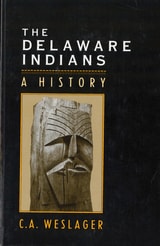
The Delaware Indians
A HistoryWeslager, C. A.
Rutgers University Press, 1990
In the seventeenth century white explorers and settlers encountered a tribe of Indians calling themselves Lenni Lenape along the Delaware River and its tributaries in New Jersey, Delaware, eastern Pennsylvania, and southeastern New York. Today communities of their descendants, known as Delawares, are found in Oklahoma, Kansas, Wisconsin, and Ontario, and individuals of Delaware ancestry are mingled with the white populations in many other states. The Delaware Indians is the first comprehensive account of what happened to the main body of the Delaware Nation over the past three centuries.
C. A. Weslager puts into perspective the important events in United States history in which the Delawares participated and he adds new information about the Delawares. He bridges the gap between history and ethnology by analyzing the reasons why the Delawares were repeatedly victimized by the white man.
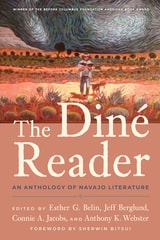
The Diné Reader
An Anthology of Navajo LiteratureEdited by Esther G. Belin, Jeff Berglund, Connie A. Jacobs, and Anthony K. Webster; Foreword by Sherwin Bitsui
University of Arizona Press, 2021
The Diné Reader: An Anthology of Navajo Literature is unprecedented. It showcases the breadth, depth, and diversity of Diné creative artists and their poetry, fiction, and nonfiction prose.This wide-ranging anthology brings together writers who offer perspectives that span generations and perspectives on life and Diné history. The collected works display a rich variety of and creativity in themes: home and history; contemporary concerns about identity, historical trauma, and loss of language; and economic and environmental inequalities.
The Diné Reader developed as a way to demonstrate both the power of Diné literary artistry and the persistence of the Navajo people. The volume opens with a foreword by poet Sherwin Bitsui, who offers insight into the importance of writing to the Navajo people. The editors then introduce the volume by detailing the literary history of the Diné people, establishing the context for the tremendous diversity of the works that follow, which includes free verse, sestinas, limericks, haiku, prose poems, creative nonfiction, mixed genres, and oral traditions reshaped into the written word.
This volume combines an array of literature with illuminating interviews, biographies, and photographs of the featured Diné writers and artists. A valuable resource to educators, literature enthusiasts, and beyond, this anthology is a much-needed showcase of Diné writers and their compelling work. The volume also includes a chronology of important dates in Diné history by Jennifer Nez Denetdale, as well as resources for teachers, students, and general readers by Michael Thompson. The Diné Reader is an exciting convergence of Navajo writers and artists with scholars and educators.
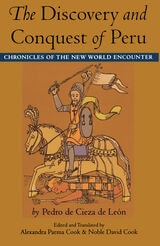
The Discovery and Conquest of Peru
Pedro de Cieza de León
Duke University Press, 1998
Alexandra Parma Cook and Noble David Cook present this recently discovered third book of a four-part chronicle that provides the most thorough and definitive record of the birth of modern Andean America. It describes with unparalleled detail the exploration of the Pacific coast of South America led by Francisco Pizarro and Diego de Almagro, the imprisonment and death of the Inca Atahualpa, the Indian resistance, and the ultimate Spanish domination.
Students and scholars of Latin American history and conquest narratives will welcome the publication of this volume.
The Eagle Returns
The Legal History of the Grand Traverse Band of Ottawa and Chippewa IndiansMatthew L.M. Fletcher
Michigan State University Press, 2012

The Economy of British West Florida, 1763-1783
Robin F. A. Fabel
University of Alabama Press, 1988
The untold economic story of Britain’s Gulf Coast frontier.
This is the first book-length investigation of the economy of British West Florida and the extent to which it was economically viable given that it had been an economic failure for Spain. In it, author Robin Fabel explores both the territory's economy and history but also analyzes previously neglected but key aspects of British West Florida, including the maritime life of the province, the institution of slavery, and the potentially great immigration scheme sponsored by the Company of Military Adventures.
The British divided Florida into two colonies: East Florida and West Florida. West Florida comprised the area between the Apalachicola, Chattahoochee, and Mississippi rivers, and from the Gulf of Mexico north to thirty-two degrees twenty-eight minutes north latitude, roughly the latitude of modern-day Jackson, MS and Montgomery, AL. In the geographic center of the colony were Mobile, Alabama and Pensacola, Floriday. British West Florida included parts of the states of Alabama, Florida, Louisiana, and Mississippi and existed from 1763 until 1783 at the end of the American Revolutionary War.
Fabel contrasts the founding of Georgia, where slaves were initially excluded, with West Florida, where the slave trade became important economically. The British believed that only enslaved Blacks could labor successfully in the hot climate. Fabel gives an account of how owners employed enslaved people, how rare it was for slaves to be emancipated, and the passage of slave laws for West Florida. Fabel also explores British West Florida’s trade with Native Americans and the Caribbean islands, as well as the colony's relationships with neighboring Spanish and French communities.
Fabel's work offers an engaging and accessible account of the history of an expansive region of colonial North America during a fluid period of colonial history before American independence.
The Edge of the Woods
Iroquoia, 1534-1701Jon Parmenter
Michigan State University Press, 2010

The Ends of Research
Indigenous and Settler Science after the War in the WoodsTom Özden-Schilling
Duke University Press, 2023

The Fertile Earth and the Ordered Cosmos
Reflections on the Newark Earthworks and World HeritageEdited by M. Elizabeth Weiser, Timothy R. W. Jordan, and Richard D. Shiels
The Ohio State University Press, 2023
The lush photos and wide-ranging essays of The Fertile Earth and the Ordered Cosmos honor this significance, not only to the global community but to local individuals and scholars who have developed intimate connections to the Earthworks. In sharing their experiences with this ancient site, public historians, archaeologists, physicists, architects, and others—including local and Indigenous voices—continue the work of nearly two hundred years of citizen efforts to protect and make accessible the Newark Earthworks after centuries of stewardship by Indigenous people. The resulting volume serves as a rich primer on the site for those unfamiliar with its history and a beautifully produced tribute for those who are already acquainted with its wonders.
The Flowery Death
The Image of Death in the Nahua Songs of Cantares MexicanosKatarzyna Szoblik
University Press of Colorado, 2026
The Flowery Death is a groundbreaking exploration of xochimiquiztli, or “flowery death,” a central concept in the pre-Hispanic Nahua worldview. In the highly militarized societies of the Valley of Mexico, dying in honor of the gods—on the battlefield, in ritual sacrifice, or in childbirth—was not only a social expectation but also a path to spiritual glory. While this idea appears throughout colonial sources, previous studies have relied largely on the writings of Bernardino de Sahagún and other European chroniclers, whose perspectives often simplify or distort Indigenous understandings.
Drawing on the rich oral tradition preserved in the sixteenth-century manuscript Cantares Mexicanos, this book provides one of the first English translations of these songs since John Bierhorst’s 1985 translation. It combines paleographic fidelity, literal English translation, and detailed interpretation, revealing the metaphor- and symbol-rich meanings behind the songs. The book is divided into two interrelated parts: The first reconstructs the Nahua worldview, contextualizing war, death, and sacrifice through myths, chronicles, and visual sources; the second presents selected songs, offering readers the tools to understand their metaphors, historical references, and symbolic language, making the work both a scholarly reference and an accessible guide for students and enthusiasts.
By examining the cultural, religious, and social significance of xochimiquiztli, The Flowery Death provides fresh insights into Nahua ideology, gender roles, and collective memory. It is essential reading for anyone interested in Mesoamerican culture, early colonial history, and the power of Indigenous oral traditions.
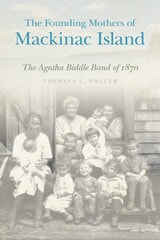
The Founding Mothers of Mackinac Island
The Agatha Biddle Band of 1870Theresa L. Weller
Michigan State University Press, 2021
The Ghost Dancers
A NovelAdrian C. Louis
University of Nevada Press, 2021
The Good Road
A K’iche’ Revolutionary TheopoliticsCarlota McAllister
Duke University Press, 2026
The Great Tree and the Summer Sun
Survivance and Futurity in the Narragansett CountryMack H. Scott III
University of Massachusetts Press, 2027
Documenting the long struggle of the Narragansett Nation to protect their land, sovereignty, and future
On a hot mid-July morning in 2003, members of the Narragansett Nation formed an impromptu human shield. They assembled to protect what they understood to be sacred and sovereign land. On the other side of the road stood dozens of local police officers and more than twenty state troopers, acting on direct orders from Rhode Island Governor Donald L. Carcieri to forcibly close a smoke shop the state claimed was operating illegally. It was a flashpoint in a long, drawn-out, and continuing struggle—one that historian Mack H. Scott III, himself a member of the Narragansett Nation, has spent his career documenting.
In The Great Tree and the Summer Sun, Scott tells the story of his people: the largest and most influential Indigenous community in the Dawnland, the coastal New England region his ancestors have called home for centuries. The Narragansett, whom the sachem Miantonomo described as “a great tree,” have endured nearly 400 years of mostly adversarial relations with their non-Indigenous neighbors—despite the mythology of Rhode Island’s benevolent founding and its supposed social egalitarianism.
Scott explores the long durée of local cross-cultural interactions that hardened hearts, minds, and viewpoints, not just in Rhode Island, but throughout Turtle Island (North America), as Natives and newcomers struggled to reconstitute and redefine themselves within a contested landscape. Commencing in the seventeenth century and concluding in the twenty-first, this episodic historical survey foregrounds the varied experiences of members of the Great Tree as they negotiated the realities of the Summer Sun—settler colonialism—to ensure that their futures remained irrepressible.
The Grimace of Macho Ratón
Artisans, Identity, and Nation in Late-Twentieth-Century Western NicaraguaLes W. Field
Duke University Press, 1999
Elite appropriations of El Güegüence construe it as an allegory of mestizo national identity in which mestizaje is defined as the production of a national majority of ethnically bounded non-Indians in active collaboration with the state. By contrast, Field interprets the play as a parable of cultural history and not a declaration of cultural identity, a scatological reflection on power and the state, and an evocation of collective loss and humor broadly associated with the national experience of disempowered social groups. By engaging with those most intimately involved in the performance of the play—and by including essays by some of these artisans—Field shows how El Güegüence tells a story about the passing of time, the absurdity of authority, and the contradictions of coping with inheritances of the past. Refusing essentialist notions of what it means to be Indian or artisan, Field explains the reemergence of politicized indigenous identity in western Nicaragua and relates this to the longer history of artisan political organization. Parting ways with many scholars who associate the notion of mestizaje with identity loss and hegemony, Field emphasizes its creative,
productive, and insightful meanings. With an emphasis on the particular struggles of women artisans, he explores the reasons why forms of collective identity have posed various kinds of predicaments for this marginalized class of western Nicaraguans.
This book will appeal to readers beyond the field of Latin American anthropology, including students and scholars of literature, intellectual history, women’s studies, and the politics of ethnicity.