Results by title
496 books match the query 'Jewish' and 99 start with t
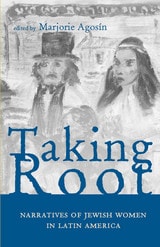
Taking Root
Narratives of Jewish Women in Latin AmericaMarjorie Agosín
Ohio University Press, 2002
In Taking Root, Latin American women of Jewish descent, from Mexico to Uruguay, recall their coming of age with Sabbath candles and Hebrew prayers, Ladino songs and merengue music, Queen Esther and the Virgin of Guadalupe. Rich and poor, Sephardi and Ashkenazi, Jewish immigrant families searched for a new home and identity in predominantly Catholic societies. The essays included here examine the religious, economic, social, and political choices these families have made and continue to make as they forge Jewish identities in the New World.
Marjorie Agosín has gathered narratives and testimonies that reveal the immense diversity of Latin American Jewish experience. These essays, based on first- and second-generation immigrant experience, describe differing points of view and levels of involvement in Jewish tradition. In Taking Root, Agosín presents us with a contemporary and vivid account of the Jewish experience in Latin America.
Taking Root documents the sadness of exile and loss but also a fierce determination to maintain Jewish traditions. This is Jewish history but it is also part of the untold history of Brazil, Argentina, El Salvador, Ecuador, Chile, Peru, and all of Latin America.
Tangled Roots
The Emergence of Israeli CultureIsrael Bartal
SBL Press, 2020
A new interpretation of the roots of Israeli culture
In Tangled Roots: The Emergence of Israeli Culture, Israel Bartal traces the history of modern Hebrew culture prior to the emergence of political Zionism. Bartal examines how traditional and modernist ideals and Western and non-European Jewish cultures merged in an unprecedented encounter between an ancient land (Israel) and a multigenerational people (the Jews). Premodern Jewish traditionalists, Palestinian locals, foreign imperial forces, and Jewish intellectuals, writers, journalists, and party functionaries each affected the Israeli culture that emerged. As this new Hebrew culture was taking shape, the memory of the recent European past played a highly influential role in shaping the image of the New Hebrew, that mythological hero who was meant to supplant the East European exilic Jew.
Features
- A critical revision of most contemporary politicized histories of Jewish nationalism
- An examination of the history of modern Hebrew culture prior to political Zionism
Telling the Little Secrets
American Jewish Writing since the 1980sJanet Handler Burstein
University of Wisconsin Press, 2006
Janet Burstein argues that American Jewish writers since the 1980s have created a significant literature by wrestling with the troubled legacy of trauma, loss, and exile. Their ranks include Cynthia Ozick, Todd Gitlin, Art Spiegelman, Pearl Abraham, Aryeh Lev Stollman, Jonathan Rosen, and Gerda Lerner. Whether confronting the massive losses of the Holocaust, the sense of “home” in exile, or the continuing power of Jewish memory, these Jewish writers search for understanding within “the little secrets” of their dark, complicated, and richly furnished past.
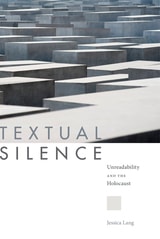
Textual Silence
Unreadability and the HolocaustLang, Jessica
Rutgers University Press, 2017
Holocaust texts, which encompass works as diverse as memoirs, novels, poems, and diaries, are traditionally characterized by silences the authors place throughout the text, both deliberately and unconsciously. While a reader may have the desire and will to comprehend the Holocaust, the presence of “textual silence” is a force that removes the experience of genocide from the reader’s analysis and imaginative recourse. Lang defines silences as omissions that take many forms, including the use of italics and quotation marks, ellipses and blank pages in poetry, and the presence of unreliable narrators in fiction. While this limits the reader’s ability to read in any conventional sense, these silences are not flaws. They are instead a critical presence that forces readers to acknowledge how words and meaning can diverge in the face of events as unimaginable as those of the Holocaust.
The "Spirit of Poesy"
Essays on Jewish and German Literature and Thought in Honor of Geza von MolnarRichard Block and Peter Fenves
Northwestern University Press, 2000
The Animal Is Chemical
Hadara Bar-Nadav
Four Way Books, 2024
Lyrically enacting the cognitive dissonance and embodied contradictions of our contemporary age, Hadara Bar-Nadav’s The Animal Is Chemical collects innovative poems that straddle the frontiers of language and scientific knowledge. She brilliantly draws on her own experience as a medical editor and her family’s history of Holocaust survival to write into the hybrid legacy of Western medicine: part clinical empiricism, part human fallibility and moral bankruptcy. Displaying a robust formal range, these poems move from feverish elegies to drug-pamphlet erasures, tangible articulations of Bar-Nadav’s epigenetic, cultural, and memorial inheritance as a writer navigating chronic illness and pain. In these pages, Nazi medical experiments, pharmaceutical literature, and manifestations of intergenerational trauma collide in the lyrical archive of Bar-Nadav’s latest collection, winner of the 2022 Four Way Books Levis Prize in Poetry. Just as she illuminates the paradox of time — that we may think of the past as something gone and yet always present in context and legacy — Bar-Nadav proves the enduring ambivalence of pharmakon, that antidote which poisons us, the medicine that kills. This febrile, fierce book casts spells and confronts illusions, ignites grief and awe, and challenges our assumptions about what it means to heal our bodies, our families, and our shared histories. Perhaps this work fulfills the specious salvation it describes in its opening pages, performing an exorcism of truth-telling that harnesses the heat of a “myth in which a god sets us / on fire and then sets us free.”
The Anti-Semitic Moment
A Tour of France in 1898Pierre Birnbaum
University of Chicago Press, 2011
In 1898, the Dreyfus Affair plunged French society into a yearlong frenzy. In Paris and provincial villages throughout the country, angry crowds paraded through the streets, threatening to attack Jews and destroy Jewish-owned businesses. Anger about the imagined power of Jewish capital, as well as fears of treason and racial degeneration, made anti-Semitism a convenient banner behind which social and political factions could fall in line. Anti-Semitic feelings that had been simmering in France for decades came boiling to the surface.
Here Pierre Birnbaum guides readers on a tour of France during this crisis. He shows that in the midst of violence, Jewish citizens bravely and effectively defended themselves and were aided by a police force determined to maintain order. Birnbaum paints a vivid portrait of French Jewish culture at the time and explains why the French state remained strong in this time of widespread unrest.
The Apocalypse in Reformation Nuremberg
Jews and Turks in Andreas Osiander’s WorldAndrew L. Thomas
University of Michigan Press, 2022
The Architect of Genocide
Himmler and the Final SolutionRichard Breitman
Brandeis University Press, 1992
The Army of Truth
Selected PoemsHenrik Wergeland
University of Wisconsin Press, 2003
One of Norway’s most celebrated literary figures of the nineteenth century, Henrik Wergeland worked tirelessly for the civil rights of Jews in Norway. He used the words and structure of his poetry to enliven the ideals of truth, freedom, and equality. This translated volume, containing several of Wergeland’s most prominent poems, beautifully encapsulates the compelling force of his message, allowing its enduring influence to benefit a wider contemporary audience.
The Art of the Jewish Family
A History of Women in Early New York in Five ObjectsLaura Arnold Leibman
Bard Graduate Center, 2020
Each chapter creates a biography of a single woman through an object, offering a new methodology that looks past texts alone to material culture in order to further understand early Jewish American women’s lives and restore their agency as creators of Jewish identity. While much of the available history was written by men, the objects that Leibman studies were made for and by Jewish women. Speaking to American Jewish life, women’s studies, and American history, The Art of the Jewish Family sheds new light on the lives and values of these women, while also revealing the social and religious structures that led to Jewish women being erased from historical archives.
The Art of the Jewish Family was the winner of three 2020 National Jewish Book Awards: the Celebrate 350 Award for American Jewish Studies, the Gerrard and Ella Berman Memorial Award for History, and the Barbara Dobkin Award for Women's Studies.
The Beginnings of Anti-Jewish Legislation
The 1920 Numerus Clausus Law in HungaryMária M. Kovács
Central European University Press, 2024
The Nazi 1933 Civil Service Law and the 1935 Nuremberg Laws are often considered the first anti-Jewish decrees in interwar Europe. Mária M. Kovács convincingly argues that Hungary’s numerus clausus law of 1920, which introduced a Jewish quota at Hungary’s institutions of higher learning, was, in fact, interwar Europe’s first antisemitic law. By defining—and discriminating against—Jews as a separate “racial” or “national” group, it abrogated the principle of equal rights that had been enshrined into law; as such, it marked an abrupt reversal of Jewish emancipation in Hungary. Moreover, the numerus clausus law set the stage for subsequent “Jewish Laws” (in the late 1930s and early 1940s) that sought to solve Hungary’s “Jewish Question” by means of extraordinary legal measures that targeted Jews alone. This book examines the origins and implementation of the numerus clausus, as well as the attempts to dampen its impact on Hungary’s international reputation, focusing on the debates surrounding it promulgation (1920), its modification (1928) and its eventual application to other areas of Jewish life (1938–45).
The Bible of Dirty Jokes
Eileen Pollack
Four Way Books, 2018
The Boundaries of Pluralism
The World of the University of Michigan’s Jewish Students from 1897 to 1945Andrei S. Markovits & Kenneth Garner
Michigan Publishing Services, 2020
Raoul Wallenberg Distinguished University Professor of History,
University of Michigan
Arthur F. Thurnau Professor, University of Michigan,
and Director, Bentley Historical Library
The Choosing
A Rabbi's Journey from Silent Nights to High Holy DaysMyers, Andrea
Rutgers University Press, 2011
A young Lutheran girl grows up on Long Island, New York. She aspires to be a doctor, and is on the fast track to marriage and the conventional happily-ever-after. But, as the Yiddish saying goes, "Man plans, and God laughs." Meet Andrea Myers, whose coming-of-age at Brandeis, conversion to Judaism, and awakening sexual identity make for a rich and well-timed life in the rabbinate.
In The Choosing, Myers fuses heartwarming anecdotes with rabbinic insights and generous dollops of humor to describe what it means to survive and flourish on your own terms. Portioned around the cycle of the Jewish year, with stories connected to each of the holidays, Myers draws on her unique path to the rabbinate--leaving behind her Christian upbringing, coming out as a lesbian, discovering Judaism in college, moving to Israel, converting, and returning to New York to become a rabbi, partner, and parent.
Myers relates tales of new beginnings, of reinventing oneself, and finding oneself. Whether it's a Sicilian grandmother attempting to bake hamantaschen on Purim for her Jewish granddaughter, or an American in Jerusalem saving a chicken from slaughter during a Rosh Hashanah ritual, Myers keeps readers entertained as she reflects that spirituality, goodness, and morality can and do take many forms. Readers will enthusiastically embrace stories of doors closing and windows opening, of family and community, of integration and transformation. These captivating narratives will resonate and, in the author's words, "reach across coasts, continents, and generations."
The Conflagration of Community
Fiction before and after AuschwitzJ. Hillis Miller
University of Chicago Press, 2011
“After Auschwitz to write even a single poem is barbaric.” The Conflagration of Community challenges Theodor Adorno’s famous statement about aesthetic production after the Holocaust, arguing for the possibility of literature to bear witness to extreme collective and personal experiences. J. Hillis Miller masterfully considers how novels about the Holocaust relate to fictions written before and after it, and uses theories of community from Jean-Luc Nancy and Derrida to explore the dissolution of community bonds in its wake.
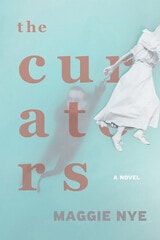
The Curators
A NovelMaggie Nye
Northwestern University Press, 2024
A dark, lyrical blend of historical fiction and magical realism, The Curators examines a critically underexplored event in American history through unlikely eyes. All of Atlanta is obsessed with the two-year-long trial and subsequent lynching of Jewish factory superintendent Leo Frank in 1915. None more so than thirteen-year-old Ana Wulff and her friends, who take history into their own hands—quite literally—when they use dirt from Ana’s garden to build and animate a golem in Frank’s image. They’ll do anything to keep his story alive, but when their scheme gets out of hand, they must decide what responsibility requires of them. The Curators tells the story of five zealous girls and the cyclonic power of their friendship as they come of age in a country riven by white supremacy.
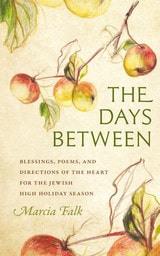
The Days Between
Blessings, Poems, and Directions of the Heart for the Jewish High Holiday SeasonMarcia Falk
Brandeis University Press, 2014

The Devil’s Own Luck
From Hell to HappinessLadislav Grosman
Karolinum Press, 2026
Ladislav Grosman's powerful story of a twelve-year-old Jewish boy in wartime Slovakia smuggled into Hungary to escape deportation.
In The Devil's Own Luck, readers experience the horrors of war and the Holocaust through the lens of the young boy's obsessive reading of pulp fiction, imposing a layer of adventure on the bleak landscape of his experience. This simultaneously tragic, humorous, and poetic novel by Ladislav Grosman was published posthumously.
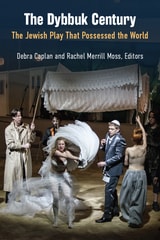
The Dybbuk Century
The Jewish Play That Possessed the WorldDebra Caplan and Rachel Merrill Moss, Editors
University of Michigan Press, 2023
A little over 100 years ago, the first production of An-sky’s The Dybbuk, a play about the possession of a young woman by a dislocated spirit, opened in Warsaw. In the century that followed, The Dybbuk became a theatrical conduit for a wide range of discourses about Jews, belonging, and modernity. This timeless Yiddish play about spiritual possession beyond the grave would go on to exert a remarkable and unforgettable impact on modern theater, film, literature, music, and culture.
The Dybbuk Century collects essays from an interdisciplinary group of scholars who explore the play’s original Yiddish and Hebrew productions and offer critical reflections on the play’s enduring influence. The collection will appeal to scholars, students, and theater practitioners, as well as general readers.
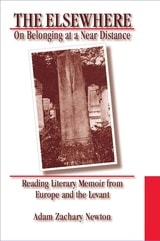
The Elsewhere
On Belonging at a Near DistanceAdam Zachary Newton
University of Wisconsin Press, 2005

The End of Jewish Modernity
Enzo Traverso
Pluto Press, 2016
Previously a beacon for critical thinking in the Western world, the mainstream of Jewish thought has, since the end of the war, undergone a conservative turn. With great sensitivity and nuance, Traverso traces this development to the virtual destruction of European Jewry by the Nazis, and the establishment of the United States and Israel as the new poles of Jewish communal life. This is a compelling narrative, hinged upon a highly original discussion of Hannah Arendt's writings on Jewishness and politics.
With provocative chapters on the relationship between antisemitism and Islamophobia, the ascendance of Zionism, and the new 'civil religion of the Holocaust', The End of Jewish Modernity is both an elegy to a lost tradition and an intellectual history of the present.
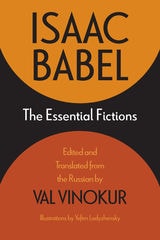
The Essential Fictions
Isaac Babel; Edited and translated from the Russian by Val Vinokur; Illustrations by Yefim Ladyzhensky
Northwestern University Press, 2018
Babel was born in 1894 into multicultural Odessa’s thriving Jewish community. Working as a journalist, he witnessed the Bolshevik Revolution and Civil War, and accompanied the Cossack horsemen of the Red Cavalry during the 1920 Polish-Soviet War, distilling these experiences into his fiction. Vinokur highlights Babel’s “horrified hopefulness” and “doleful and bespectacled Jewish comedy” in the face of the bloody conflicts that plagued his generation.
On the centenary of the revolution that toppled the Romanov tsars, Babel’s fictions continue to absorb and fascinate contemporary readers interested in eastern European and Jewish literature as well as the history and politics of the twentieth century.
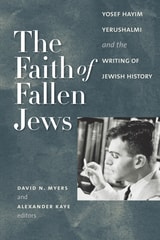
The Faith of Fallen Jews
Yosef Hayim Yerushalmi and the Writing of Jewish HistoryEdited by David N. Myers and Alexander Kaye
Brandeis University Press, 2013
The Fatal Embrace
Jews and the StateBenjamin Ginsberg
University of Chicago Press, 1993
The Formation of a Modern Rabbi
The Life and Times of the Viennese Scholar and Preacher Adolf JellinekSamuel Joseph Kessler
SBL Press, 2022
An intellectual biography that critically engages Adolf Jellinek’s scholarship and communal activities
Adolf Jellinek (1821–1893), the Czech-born, German-educated, liberal chief rabbi of Vienna, was the most famous Jewish preacher in Central Europe in the second half of the nineteenth century. As an innovative rhetorician, Jellinek helped mold and define the modern synagogue sermon into an instrument for expressing Jewish religious and ethical values for a new era. As a historian, he made groundbreaking contributions to the study of the Zohar and medieval Jewish mysticism. Jellinek was emblematic of rabbi-as-scholar-preacher during the earliest, formative years of communal synagogues as urban religious space. In a world that was rapidly losing the felt and remembered past of premodern Jewish society, the rabbi, with Jellinek as prime exemplar, took hold of the Sabbath sermon as an instrument to define and mold Judaism and Jewish values for a new world.
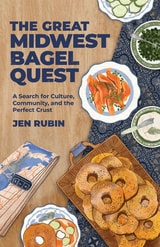
The Great Midwest Bagel Quest
A Search for Culture, Community, and the Perfect CrustJen Rubin
Wisconsin Historical Society Press, 2027
One woman’s quest for a great bagel becomes a poignant pursuit of culture and belonging.
Bagels have always been Jen Rubin’s cultural comfort food. Born and raised in New York City, she grew up on family gatherings anchored by sprawling bagel spreads. But after moving to Wisconsin thirty years ago, she struggled to maintain ties to her Jewish heritage—including a bagel worthy of her New York upbringing. When her mother’s death leads her to revisit her roots, Rubin embarks on a deeply personal mission: to discover whether the Midwest can produce a quality, authentic bagel. What begins as a search for comfort and connection becomes an enlightening exploration of food, identity, and belonging.
In The Great Midwest Bagel Quest, Rubin visits Chicago and St. Louis, Detroit and Ann Arbor, the Twin Cities, and Madison and Milwaukee—with a couple of side trips to New York City—sampling dozens of bagels, meeting artisan bakers, and exploring the histories of Jewish communities across the region. Along the way, she challenges the assumption that the Midwest has never produced truly authentic bagels.
Blending memoir, culinary history, travel narrative, and cultural reporting, Rubin uncovers a rich but overlooked bagel tradition while reflecting on her own complicated relationship with home. As she traces the evolution of the bagel from Jewish immigrant staple to mass-market commodity to the innovative artisanal varieties being produced today, she begins to see an evolution in her own relationship to her Jewish and familial traditions.
Warm, witty, and illuminating, The Great Midwest Bagel Quest is a fresh contribution to food writing that will appeal to readers of culinary history, immigrant history, and memoir. Most of all, it is a celebration of how food creates and sustains community—and how the search for the perfect bagel can lead us back to our true selves.
The Hidden Isaac Bashevis Singer
Edited by Seth L. Wolitz
University of Texas Press, 2002
Nobel Prize-winning author Isaac Bashevis Singer stands virtually alone among prominent writers for being more widely known through translations of his work than through the original texts. Yet readers and critics of the Yiddish originals have long pointed out that the English versions are generally shortened, often shorn of much description and religious matter, and their perspectives and denouements are significantly altered. In short, they turn the Yiddish author into a Jewish-American English writer, detached from of his Eastern European Jewish literary and cultural roots.
By contrast, this collection of essays by leading Yiddish scholars seeks to recover the authentic voice and vision of the writer known to his Yiddish readers as Yitskhok Bashevis. The essays are grouped around four themes:
- The Yiddish language and the Yiddish cultural experience in Bashevis's writings
- Thematic approaches to the study of Bashevis's literature
- Bashevis's interface with other times and cultures
- Interpretations of Bashevis's autobiographical writings
A special feature of this volume is the inclusion of Joseph Sherman's new, faithful translation of a chapter from Bashevis's Yiddish "underworld" novel Yarme and Keyle.
The Holocaust and the Book
Destruction and PreservationJonathan Rose
University of Massachusetts Press, 2001
Between 1933 and 1945, Nazi Germany systematically destroyed an estimated 100 million books throughout occupied Europe, an act that was inextricably bound up with the murder of 6 million Jews. By burning and looting libraries and censoring “un-German” publications, the Nazis aimed to eradicate all traces of Jewish culture along with the Jewish people themselves.
The Holocaust and the Book examines this bleak chapter in the history of printing, reading, censorship, and libraries. Topics include the development of Nazi censorship policies, the celebrated library of the Vilna ghetto, the confiscation of books from the Sephardic communities in Rome and Salonika, the experience of reading in the ghettos and concentration camps, the rescue of Polish incunabula, the uses of fine printing by the Dutch underground, and the suppression of Jewish books and authors in the Soviet Union. Several authors discuss the continuing relevance of Nazi book burnings to the present day, with essays on German responses to Friedrich Nietzsche and the destruction of Bosnian libraries in the 1990s.
The collection also includes eyewitness accounts by Holocaust survivors and a translation of Herman Kruk's report on the Vilna ghetto library. An annotated bibliography offers readers a concise guide to research in this growing field.
The Holocaust in Hungary
Seventy Years LaterRandolph L. Braham
Central European University Press, 2016
The Holocaust, Corporations, and the Law
Unfinished BusinessLeora Bilsky
University of Michigan Press, 2017
Leora Bilsky argues class action litigation and settlement offer a mode of accountability well suited to addressing the bureaucratic nature of business involvement in atrocities. Prior to these lawsuits, legal treatment of the Holocaust was dominated by criminal law and its individualistic assumptions, consistently failing to relate to the structural aspects of Nazi crimes. Engaging critically with contemporary debates about corporate responsibility for human rights violations and assumptions about “law,” she argues for the need to design processes that make multinational corporations accountable, and examines the implications for transitional justice, the relationship between law and history, and for community and representation in a post-national world. Her novel interpretation of the restitution lawsuits not only adds an important dimension to the study of Holocaust trials, but also makes an innovative contribution to broader and pressing contemporary legal and political debates. In an era when corporations are ever more powerful and international, Bilsky’s arguments will attract attention beyond those interested in the Holocaust and its long shadow.
The Inability to Love
Jews, Gender, and America in Recent German LiteratureAgnes C. Mueller
Northwestern University Press, 2014
The Inability to Love borrows its title from Alexander and Margarete Mitscherlich’s 1967 landmark book The Inability to Mourn, which discussed German society’s lack of psychological reckoning with the Holocaust. Challenging that notion, Agnes Mueller turns to recently published works by prominent contemporary German, non-Jewish writers to examine whether there has been a thorough engagement with German history and memory. She focuses on literature that invokes Jews, Israel, and the Holocaust. Mueller’s aim is to shed light on pressing questions concerning German memories of the past, and on German images of Jews in Germany at a moment that s ideologically and historically fraught.
The Individual in History
Essays in Honor of Jehuda ReinharzEdited by ChaeRan Y. Freeze, Sylvia Fuks Fried, and Eugene R. Sheppard
Brandeis University Press, 2015
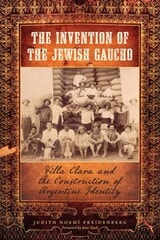
The Invention of the Jewish Gaucho
Villa Clara and the Construction of Argentine IdentityBy Judith Noemí Freidenberg
University of Texas Press, 2009
By the mid-twentieth century, Eastern European Jews had become one of Argentina's largest minorities. Some represented a wave of immigration begun two generations before; many settled in the province of Entre Ríos and founded an agricultural colony. Taking its title from the resulting hybrid of acculturation, The Invention of the Jewish Gaucho examines the lives of these settlers, who represented a merger between native cowboy identities and homeland memories.
The arrival of these immigrants in what would be the village of Villa Clara coincided with the nation's new sense of liberated nationhood. In a meticulous rendition of Villa Clara's social history, Judith Freidenberg interweaves ethnographic and historical information to understand the saga of European immigrants drawn by Argentine open-door policies in the nineteenth century and its impact on the current transformation of immigration into multicultural discourses in the twenty-first century. Using Villa Clara as a case study, Freidenberg demonstrates the broad power of political processes in the construction of ethnic, class, and national identities. The Invention of the Jewish Gaucho draws on life histories, archives, material culture, and performances of heritage to enhance our understanding of a singular population—and to transform our approach to social memory itself.
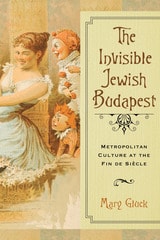
The Invisible Jewish Budapest
Metropolitan Culture at the Fin de SiècleMary Gluck
University of Wisconsin Press, 2019
Famed for its cosmopolitan culture and vibrant nightlife, Budapest owed much to its Jewish population. Indeed, it was Jews who helped shape the city's complex urban modernity between 1867 and 1914. Yet these contributions were often unacknowledged, leading to a metaphoric, if not literal, invisible status for many of Budapest's Jews.
In the years since, particularly between the wars, anti-Semites within and outside Budapest sought to further erase Jewish influences in the city. Appellations such as the "sinful city" and "Judapest" left a toxic inheritance that often inhibited serious conversation or scholarly research on the subject.
Into this breach strides Mary Gluck, whose goal is no less than to retrieve the lost contours of Jewish Budapest. She delves into the popular culture of the city's coffee houses, music halls, and humor magazines to uncover the enormous influence of assimilated Jews in creating modernist Budapest. She explores the paradox of this culture, which was Jewish-identified yet lacked a recognizable Jewish face. Because much of the Jewish population embraced and promoted a secular, metropolitan culture, their influence as Jews was both profound and invisible.
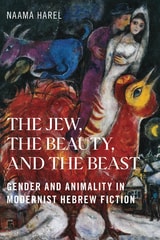
The Jew, the Beauty, and the Beast
Gender and Animality in Modernist Hebrew FictionNaama Harel
Rutgers University Press, 2026
The Jew, the Beauty, and the Beast critically explores the tangled interplay between Jewishness, gender, and animality and its manifestation in modernist Hebrew fiction. Through interdiscursive analysis and close readings, the effeminate Jew is examined vis-à-vis the animalized woman. Intertwining cutting-edge theoretical frameworks of posthumanism and animal studies with established scholarship of Hebrew literature, Jewish studies, and gender studies, Naama Harel offers new Hebrew literary historiography and innovative perspectives on canonical works by Shmuel Yosef Agnon, Devorah Baron, Micha Yosef Berdichevsky, Yosef Haim Brenner, Uri Nissan Gnessin, and David Vogel.
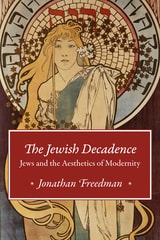
The Jewish Decadence
Jews and the Aesthetics of ModernityJonathan Freedman
University of Chicago Press, 2021
The first to tell this sweeping story, Freedman demonstrates the centrality of decadence to the aesthetics of modernity and its inextricability from Jewishness. Freedman recounts a series of diverse and surprising episodes that he insists do not belong solely to the past, but instead reveal that the identification of Jewishness with decadence persists today.
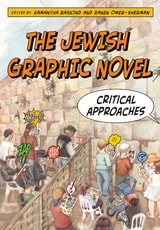
The Jewish Graphic Novel
Critical ApproachesEdited by Samantha Baskind and Ranen Omer-Sherman
Rutgers University Press, 2008
The Jewish Graphic Novel is a lively, interdisciplinary collection of essays that addresses critically acclaimed works in this subgenre of Jewish literary and artistic culture. Featuring insightful discussions of notable figures in the industryùsuch as Will Eisner, Art Spiegelman, and Joann Sfarùthe essays focus on the how graphic novels are increasingly being used in Holocaust memoir and fiction, and to portray Jewish identity in America and abroad
Featuring more than 85 illustrations, this collection is a compelling representation of a major postmodern ethnic and artistic achievement.
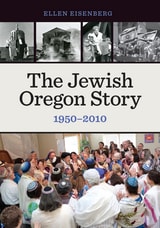
The Jewish Oregon Story, 1950-2010
Ellen Eisenberg
Oregon State University Press, 2016
Six chapters examine a community grappling with, and increasingly embracing, change, from the dramatic national shifts in women’s roles and inter-group relations, to local issues such as the razing of the historic South Portland Jewish neighborhood. An original community musical frames the creation of a new Portland Jewish identity, emerging out of the ashes of South Portland and tapping ethnic expression as an antidote to suburbanization and assimilation. A peek behind the scenes exposes the crucial role of women’s voluntarism, and traces the impact of women entering the workforce and winning acceptance as equals in organizational and ritual life. Chapters on involvement in liberal politics and advocacy for Israel explore communal engagement that reflected national trends, but, beginning in the 1980s, were increasingly shaped by emerging local progressivism. A final chapter charts recent shifts in Oregon Jewish geography, demographics, and organizational life, exploring the rebirth of smaller communities and the embrace of post-denominational Jewry, spirituality, and an ethos of environmentalism and inclusion.
The Jewish Oregon Story will appeal to readers of American Jewish history and Oregon/western history, particularly those interested in questions of ethnicity and identity. Drawing on extensive archival sources and recent scholarship, the book aims to engage both academic audiences and general readers.
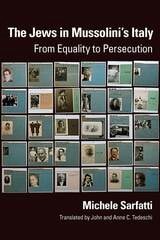
The Jews in Mussolini's Italy
From Equality to PersecutionMichele Sarfatti; Translated by John and Anne C. Tedeschi
University of Wisconsin Press, 2006
The Jews of Europe in the Modern Era
A Socio-Historical OutlineVictor Karady
Central European University Press, 2003
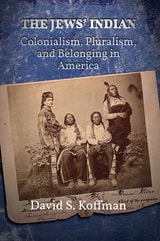
The Jews’ Indian
Colonialism, Pluralism, and Belonging in AmericaKoffman, David S
Rutgers University Press, 2019
Honorable Mention, 2021 Saul Viener Book Prize
The Jews’ Indian investigates the history of American Jewish relationships with Native Americans, both in the realm of cultural imagination and in face-to-face encounters. These two groups’ exchanges were numerous and diverse, proving at times harmonious when Jews’ and Natives people’s economic and social interests aligned, but discordant and fraught at other times. American Jews could be as exploitative of Native cultural, social, and political issues as other American settlers, and historian David Koffman argues that these interactions both unsettle and historicize the often triumphant consensus history of American Jewish life. Focusing on the ways Jewish class mobility and civic belonging were wrapped up in the dynamics of power and myth making that so severely impacted Native Americans, this books is provocative and timely, the first history to critically analyze Jewish participation in, and Jews’ grappling with the legacies of Native American history and the colonial project upon which America rests.
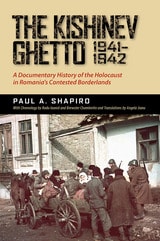
The Kishinev Ghetto, 1941–1942
A Documentary History of the Holocaust in Romania's Contested BorderlandsPaul A. Shapiro with chronology by Radu Ioanid and Brewster Chamberlin and translations by Angela Jianu
University of Alabama Press, 2015
The Kishinev Ghetto, 1941–1942 sheds new light on the little-known historical events surrounding the creation, administration, and liquidation of the Kishinev (Chisinau) ghetto during the first months following the Axis attack on the Soviet Union (Operation Barbarossa) in late June 1941. Mass killings during the combined Romanian-German drive toward Kishinev in Bessarabia, after a year of Soviet rule in this Romanian border province, were followed by the shooting of thousands of Jews on the streets of the city during the first days of reestablished Romanian administration. Survivors were driven into a ghetto, persecuted, and liquidated by year’s end. The Kishinev Ghetto, 1941–1942 is the first major study of these events.
Often overshadowed by events in Germany and Poland, the history of the Holocaust in Romania, including what took place in Bessarabia (corresponding in large part with the territory of the modern Republic of Moldova), was obscured during decades of communist rule by denial and by policies that blocked access to wartime documentation. This book is the result of a lengthy research project that began with Paul A. Shapiro’s missions to Romania for the United States Holocaust Memorial Museum to negotiate access to these documents.
The volume includes:
· A preface describing the origin of the project in the immediate aftermath of the Ceausescu regime in Romania.
· A hundred-page study setting the events of the book within the historical context of Eastern European antisemitism, Romanian-Soviet conflict over control of Bessarabia, and Romania’s alliance with Nazi Germany.
· A thoughtfully curated collection of archival documents linked to the study.
· A chronology of related historical events.
· Twenty-one black and white photographs and a map of the ghetto.
Students and scholars of Holocaust history, Judaic studies, twentieth-century Eastern European history, Romania, Moldova, and historical Bessarabia will want to own this important, revealing volume.
Published in association with the United States Holocaust Memorial Museum
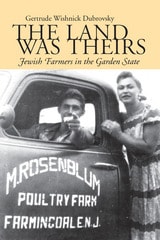
The Land Was Theirs
Jewish Farmers in the Garden StateGertrude W. Dubrovsky
University of Alabama Press, 1992
A historical account of Jewish agricultural colonies in New Jersey that examines how immigrants built farming communities in early America.
The Land Was Theirs is about Farmingdale, New Jersey, a community of Jewish farming communities in the United States established with the help of the Jewish Agricultural Society. The 50 year history of Farmingdale provides a perspective on the pressures, problems, and satisfactions of rural Jewish life as experienced in one community.
Beginning in 1919, the community grew around the small town of Farmingdale, when two Jewish families pooled their resources to establish a farm. The community evolved gradually as unrelated individuals with no previous farm experience settled and then created the institutions and organizations they needed to sustain their Jewish life. By 1945 Farmingdale was one of the leading egg-producing communities in the United States, and contributed in large measure to New Jersey’s reputation as the “egg basket of America.”
The Land Was Theirs draws from life-history interviews with 120 farmers, from the author’s personal experiences, and from a variety of private and community papers and documents. They are the pieces from which a full picture of a single Jewish farm community emerges.
The Last Consolation Vanished
The Testimony of a Sonderkommando in AuschwitzZalmen Gradowski
University of Chicago Press, 2022
On October 7, 1944, a group of Jewish prisoners in Auschwitz obtained explosives and rebelled against their Nazi murderers. It was a desperate uprising that was defeated by the end of the day. More than four hundred prisoners were killed. Filling a gap in history, The Last Consolation Vanished is the first complete English translation and critical edition of one prisoner’s powerful account of life and death in Auschwitz, written in Yiddish and buried in the ashes near Crematorium III.
Zalmen Gradowski was in the Sonderkommando (special squad) at Auschwitz, a Jewish prisoner given the unthinkable task of ushering Jewish deportees into the gas chambers, removing their bodies, salvaging any valuables, transporting their corpses to the crematoria, and destroying all evidence of their murders. Sonderkommandos were forcibly recruited by SS soldiers; when they discovered the horror of their assignment, some of them committed suicide or tried to induce the SS to kill them. Despite their impossible situation, many Sonderkommandos chose to resist in two interlaced ways: planning an uprising and testifying. Gradowski did both, by helping to lead a rebellion and by documenting his experiences. Within 120 scrawled notebook pages, his accounts describe the process of the Holocaust, the relentless brutality of the Nazi regime, the assassination of Czech Jews, the relationships among the community of men forced to assist in this nightmare, and the unbearable separation and death of entire families, including his own. Amid daily unimaginable atrocities, he somehow wrote pages that were literary, sometimes even lyrical—hidden where and when one would least expect to find them.
The October 7th rebellion was completely crushed and Gradowski was killed in the process, but his testimony lives on. His extraordinary and moving account, accompanied by a foreword and afterword by Philippe Mesnard and Arnold I. Davidson, is a voice speaking to us from the past on behalf of millions who were silenced. Their story must be shared.
The Last People You’d Expect
Spencer Wise
Carnegie Mellon University Press, 2027
A budding journalist and a housing advocate join forces to investigate a series of crimes spurred by an act of vandalism at the Boston Holocaust Memorial.
On the eve of the “Summer of Hate,” Mark Bergman, a young struggling Bar Mitzvah photographer trying to break into serious journalism, meets fellow tenant Annie Holt, a Catholic housing activist. The same night, across town, someone vandalizes the Boston Holocaust Memorial, which at first appears to be an isolated event, but when Mark joins Annie at an eviction protest across town, they soon discover it was a part of a more sinister and coordinated series of attacks. From the Vilna Shul in Beacon Hill down to South Carolina low country, Mark and Annie’s relationship deepens as they hunt the perpetrators and ultimately reach a point, both with each other and the crimes they’re investigating, where they must make the most difficult decisions they ever faced. Told from alternating points of view, Last People follows both Mark and Annie and a series of humorous minor characters, all of whom are searching for identity and a place in a fractured, volatile, and dangerous America. Part love story, part mystery, part coming of age, Last People is a novel about homelessness—literally, metaphorically—and the ways in which people grasp onto labels in order to find meaning and purpose in their lives even when those labels fail to adequately define them.
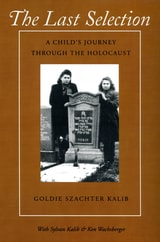
The Last Selection
A Child's Journey through the HolocaustGoldie Szachter Kalib
University of Massachusetts Press, 1991
Just before the end of the Holocaust, Dr. Josef Mengele made “the last selection.” Goldie Szachter Kalib, then a 13-year old Jewish girl from Bodzentyn, Poland, and her mother were part of that selection. In The Last Selection: A Child's Journey through the Holocaust, Goldie describes her life during World War II. She includes accounts about her charming childhood in Bodzentyn, Poland, her experiences hiding with a Polish Christian family, her time in the slave camp and then Auschwitz, life in the gas chamber, her experiences in Bergen-Belsen, and finally liberation. Portions of The Last Selection: A Child's Journey through the Holocaust were used in the ABC Daytime Emmy-Award winning movie on children in the Holocaust.
The Last Thing
Leopold Lahola
Karolinum Press, 2025
Slovak Jewish writer Leopold Lahola was able to escape deportation to a concentration camp and fight in the resistance only to find himself forced into exile by the postwar communist regime. He emerged from obscurity during the brief thaw of the Prague Spring, when he was able to return to his homeland and thrive as a playwright and film director. It was also in 1968 that his short story collection The Last Thing appeared in Slovakia. The collection’s title proved sadly prophetic with the author suffering a fatal heart attack in January 1968, just before his 50th birthday and as his short stories finally appeared in book form.
The nine stories which make up The Last Thing range from the prewar rise of fascism and its dangers for the Jewish community through the concentration camps and the partisan fight against the Germans, concluding in the devastating awareness of all that had been lost and destroyed in the war. Lahola is a master of writing outside of conventional tropes, exploring moral ambivalences where others work within the comforts of good versus evil. He punctures the standard historical image of the partisan fighters by depicting their heroism along with their cruelty and pettiness while also showing how often bravery and madness, kindness and stupidity can coexist. Lahola has written a World War II story collection whose translation will offer not only a compelling read but starkly new perspectives on the tragedy and grandeur of that momentous time in history.
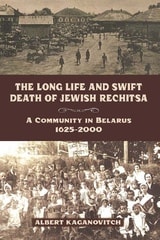
The Long Life and Swift Death of Jewish Rechitsa
A Community in Belarus, 1625–2000Albert Kaganovitch
University of Wisconsin Press, 2013
Based on extensive use of Soviet and Israeli archives, interviews, memoirs, and secondary sources, Kaganovitch’s acclaimed work, originally published in Russian, is presented here in a significantly revised English translation by the author. Details of demographic, social, economic, and cultural changes in Rechitsa’s evolution, presented over the sweep of centuries, reveal a microcosm of daily Jewish life in Rechitsa and similar communities. Kaganovitch looks closely at such critical developments as the spread of Chabad Hasidism, the impact of multiple political transformations and global changes, and the mass murder of Rechitsa’s remaining Jews by the German army in November to December 1941.
Kaganovitch also documents the evolving status of Jews in the postwar era, starting with the reconstitution of a Jewish community in Rechitsa not long after liberation in 1943 and continuing with economic, social, and political trends under Stalin, Khrushchev, and Brezhnev, and finally emigration from post-Soviet Belarus. The Long Life and Swift Death of Jewish Rechitsa is a major achievement.
Winner, Helen and Stan Vine Canadian Jewish Book Award for Scholarship, Koffler Centre of the Arts
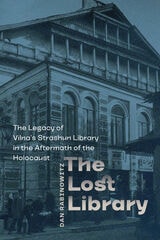
The Lost Library
The Legacy of Vilna's Strashun Library in the Aftermath of the HolocaustDan Rabinowitz
Brandeis University Press, 2018