Results by title
301 books match the query 'Knowledge' and 62 start with t
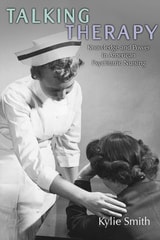
Talking Therapy
Knowledge and Power in American Psychiatric NursingKylie Smith
Rutgers University Press, 2020
Winner of the 2020 Lavinia L. Dock Award from the American Association for the History of Nursing
Talking Therapy traces the rise of modern psychiatric nursing in the United States from the 1930s to the 1970s. Through an analysis of the relationship between nurses and other mental health professions, with an emphasis on nursing scholarship, this book demonstrates the inherently social construction of ‘mental health’, and highlights the role of nurses in challenging, and complying with, modern approaches to psychiatry. After WWII, heightened cultural and political emphasis on mental health for social stability enabled the development of psychiatric nursing as a distinct knowledge project through which nurses aimed to transform institutional approaches to patient care, and to contribute to health and social science beyond the bedside. Nurses now take for granted the ideas that underpin their relationships with patients, but this book demonstrates that these were ideas not easily won, and that nurses in the past fought hard to make mental health nursing what it is today.
Telling Complexions
The Nineteenth-Century English Novel and the BlushMary Ann O Farrell
Duke University Press, 1997
Although the blush was used to tell the truth of character and body, O’Farrell shows how it is actually undermined as a stable indicator of character in novels such as Pride and Prejudice, Persuasion, North and South, and David Copperfield. She reveals how these writers then moved on in search of other bodily indicators of mortification and desire, among them the swoon, the scar, and the blunder. Providing unique and creative insights into the constructedness of the body and its semiotic play in literature and in culture, Telling Complexions includes parallel examples of the blush in contemporary culture and describes ways that textualized bodies are sometimes imagined to resist the constraints imposed by such construction.
Telling Wonders
Ethnographic and Political Discourse in the Work of HerodotusRosaria Munson
University of Michigan Press, 2001
As he explores the causes of the East-West conflict from its most remote antecedents, Herodotus includes conflicting traditions about different historical periods as well as apparently tangential descriptions of the customs of faraway peoples. What was his aim in combining such diverse material? Rosaria Vignolo Munson argues that Herodotus' aim was two-fold: to use historical narrative to illuminate the present and to describe barbarian customs so that the Greeks might understand themselves.
Herodotus assumes the role of advisor to his audience, acting as a master of metaphor and oracular speech and as an intellectual fully aware of new philosophical and political trends. By comparing, interpreting, and evaluating facts through time and space or simply by pointing them out as objects of "wonder," he teaches that correct political action is linked to an appropriate approach to foreigners and additional "others." Munson relies on traditional scholarship and modern studies in narratology and related critical fields to distinguish between narrative and metanarrative, providing a framework for analyzing the construction of Herodotus' discourse and his presentation of himself through it.
Munson's work will be useful to classicists and ancient historians and will also engage anthropologists interested in cultural interaction and notions of ethnicity and literary critics interested in narrative constructions.
Tempest In The Caribbean
Jonathan Goldberg
University of Minnesota Press, 2003
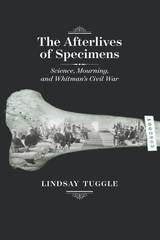
The Afterlives of Specimens
Science, Mourning, and Whitman's Civil WarLindsay Tuggle
University of Iowa Press, 2017
Grounded in archival discoveries, Afterlives traces the origins of nineteenth-century America’s preservation compulsion, illuminating the influences of botanical, medical, spiritualist, and sentimental discourses on Whitman’s work. Tuggle unveils previously unrecognized connections between Whitman and the leading “medical men” of his era, such as the surgeon John H. Brinton, founding curator of the Army Medical Museum, and Silas Weir Mitchell, the neurologist who discovered phantom limb syndrome. Remains from several amputee soldiers whom Whitman nursed in the Washington hospitals became specimens in the Army Medical Museum.
Tuggle is the first scholar to analyze Whitman’s role in medically memorializing the human cadaver and its abandoned parts.
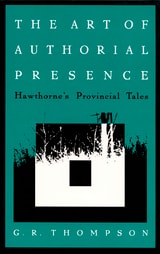
The Art of Authorial Presence
Hawthorne's Provincial TalesG. R. Thompson
Duke University Press, 1993
By focusing on the provincial tales as they were originally conceived--as a narrative cycle--Thompson is able to recover intertextual references that reveal Hawthorne's preoccupation with framing strategies and variations on authorial presence. The author shows how Hawthorne deliberately constructs sentimental narratives, only to deconstruct them. Thompson's analysis provides a new aesthetic context for understanding the whole shape of Hawthorne's career as well as the narrative, ethical, and historical issues within individual works.
Revisionary in its view of one of America's greatest authors, The Art of Authorial Presence also offers invaluable insight into the problems of narratology and historiography, ethics and psychology, romanticism and idealism, and the cultural myths of America.
The Art of Conjecture
Nicholas of Cusa on KnowledgeClyde Lee Miller
Catholic University of America Press, 2021
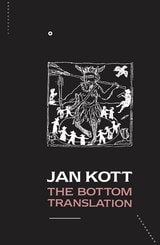
The Bottom Translation
Marlowe and Shakespeare and the Carnival TraditionJan Kott
Northwestern University Press, 1987
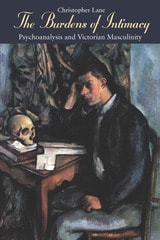
The Burdens of Intimacy
Psychoanalysis and Victorian MasculinityChristopher Lane
University of Chicago Press, 1998
Lane discredits the conservative notion that Victorian literature expresses only a demand for repression and moral restraint. But he also refutes historicist and Foucauldian approaches, arguing that they dismiss the very idea of repression and end up denouncing psychoanalysis as complicit in various kinds of oppression. These approaches, Lane argues, reduce Victorian literature to a drama about politics, power, and the ego. Striving instead to reinvigorate discussions of fantasy and the unconscious, Lane offers a clear, often startling account of writers who grapple with the genuine complexities of love, desire, and friendship.
The Classical Moment
Selected Essays on Knowledge and Its PleasuresJames V. Schall
St. Augustine's Press, 2014
The essay is one of the great inventions of the human mind. It can talk about anything and everything. It can be lightsome or solemn. It can be witty or informative. Above all, it is short. It likes the passage in which Socrates told Callicles in the Gorgias to make his answers brief. Yet, we can find in essays things we need and want to know. Aquinas often managed to make the most profound arguments in two paragraphs. Samuel Johnson did the same.
The Classical Moment is, indeed, a collection of “selected essays.” Such a collection is a classical and beloved form of English letters, the literary form most preferred by Schall.
The essays in this book all touch on knowledge and its pleasures. Schall does not tarry on the effort and determination it often takes to say just what we want to say, then say it and know that we have said it. Somehow, when an essay is written, an author simply knows that it is complete, that it is what he wanted to say. He says to himself, “Yes, that is it.” An essayist may well be conscious that when he begins an essay, he really does not know what he will finally say. The writing is the saying. Our writing is our thinking, our thinking-through, our being pleased to know this is it . . . this is the point Schall, one of America’s greatest essayists, makes here.
The “classical moment” is that intense experience of seeing or hearing or encountering some vista, or song, or person that takes us out of ourselves. We are most ourselves somehow when we are most outside of ourselves, seeing what is not ourselves. We are intended to be more than ourselves in being ourselves, to know with others what is the truth, to know what is.
These essays originally appeared in regular columns done in various journals, papers, and on-line sources. One can read them in any order. The order of the author or collector does have a certain “logic,” but each essay is also a whole, something contained within itself.
The unity of an essay collection is found more in a kind enthrallment that comes to us when we deal with the things that are both important and delightful. At bottom, these essays belong together. Aristotle warned us that if we did not delight in the things that are, we would seek our highest pleasures where they are not really found.
We will always seek something to delight in. What civilization is about lies in finding what is really worthy of the capacity of delight that is given to us in our being. The “classical moment” is the perfect phrase that brings us to the threshold of this experience. We have to enter it ourselves, but once inside, we will find so much more than ourselves. And we will rejoice.
The Converting Imagination
Linguistic Theory and Swift's Satiric ProseMarilyn Francus
Southern Illinois University Press, 1994
By illuminating Jonathan Swift’s fascination with language, Marilyn Francus shows how the linguistic questions posed by his work are at the forefront of twentieth-century literary criticism: What constitutes meaning in language? How do people respond to language? Who has (or should have) authority over language? Is linguistic value synonymous with literary value?
Francus starts with a detailed analysis of Swift’s linguistic education, which straddled a radical transition in linguistic thought, and its effect on his prose. This compelling beginning includes sometimes surprising historical information about the teaching and learning of linguistics and language theory in the seventeenth and eighteenth centuries. Swift’s academic studies reflected the traditional universalist view that seeks an Adamic language to reverse the fragmentation of Babel and achieve epistemological unity. But Swift’s tutor also exposed him to the contemporary linguistics of the scientific societies and of John Locke, who argued that the assignment of linguistic meaning is arbitrary and subjective, capturing an individual’s understanding at a particular instant. These competing theories, Francus maintains, help explain the Irish writer’s conflicting inclinations toward both linguistic order and freewheeling creativity.
To develop a complete vision of Swiftian linguistics, Francus focuses on A Tale of a Tub as the archetypal linguistic text in the Swift canon, but she also includes evidence from his other famous works, including Gulliver’s Travels, A Modest Proposal, Journal to Stella, and The Bickerstaff Papers, as well as from his lesser known religious and political tracts and his correspondence. In addition, Francus draws on the relevant work of contemporary linguists (such as Wilkins, Watts, Dyche, and Stackhouse), philosophers (Hobbes and Locke), and authors (including Temple, Sprat, Dryden, Pope, Addison, and Defoe).
Francus concludes that Swift occupies a pivotal place in literary history: his conscious emphasis on textuality and extended linguistic play anticipates not only the future of satiric prose but the modern novel as well.
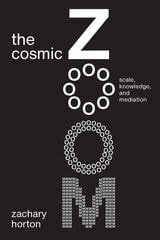
The Cosmic Zoom
Scale, Knowledge, and MediationZachary Horton
University of Chicago Press, 2021
Horton uses the cosmic zoom as a starting point to develop a cross-disciplinary theory of scale as mediated difference. He considers the origins of our notions of scale, how scalar mediation functions differently in analog and digital modes, and how cosmic zoom media has influenced scientific and popular views of the world. Analyzing literature, film, digital media, and database history, Horton establishes a much-needed framework for thinking about scale across multiple domains and disciplines.
The Crafting of the 10,000 Things
Knowledge and Technology in Seventeenth-Century ChinaDagmar Schäfer
University of Chicago Press, 2011
The last decades of the Ming dynasty, though plagued by chaos and destruction, saw a significant increase of publications that examined advances in knowledge and technology. Among the numerous guides and reference books that appeared during this period was a series of texts by Song Yingxing (1587–1666?), a minor local official living in southern China. His Tiangong kaiwu, the longest and most prominent of these works, documents the extraction and processing of raw materials and the manufacture of goods essential to everyday life, from yeast and wine to paper and ink to boats, carts, and firearms.
In The Crafting of the 10,000 Things, Dagmar Schäfer probes this fascinating text and the legacy of its author to shed new light on the development of scientific thinking in China, the purpose of technical writing, and its role in and effects on Chinese history. Meticulously unfolding the layers of Song’s personal and cultural life, Schäfer chronicles the factors that motivated Song to transform practical knowledge into written culture. She then examines how Song gained, assessed, and ultimately presented knowledge, and in doing so articulates this era’s approaches to rationality, truth, and belief in the study of nature and culture alike. Finally, Schäfer places Song’s efforts in conjunction with the work of other Chinese philosophers and writers, before, during, and after his time, and argues that these writings demonstrate collectively a uniquely Chinese way of authorizing technology as a legitimate field of scholarly concern and philosophical knowledge.
Offering an overview of a thousand years of scholarship, The Crafting of the 10,000 Things explains the role of technology and crafts in a culture that had an outstandingly successful tradition in this field and was a crucial influence on the technical development of Europe on the eve of the Industrial Revolution.
The Cultural Dialectics of Knowledge and Desire
Charles W. Nuckolls
University of Wisconsin Press, 1996
Why is culture a problem that can never be solved? Charles W. Nuckolls poses this question to his readers, and offers a genuinely synthetic approach to culture that is both cognitive and psychoanalytic. He develops a theory of cultural dialectics based on the concept of paradox, in which he shows how ambivalence and conflicts, and the desire to resolve them, are at the heart of all cultural knowledge systems.
Nuckolls combines and synthesizes the ideas of Max Weber and Sigmund Freud—major influences in the cognitive and psychoanalytic paradigms—and develops the concept basic to both: the dialectic. He recovers the legacy of Gregory Bateson, who provided the foundation for a theory of paradox in culture. With his integrated theory, Nuckolls explains the conflicts of knowledge and desire in a South Asian knowledge system, in particular the religious mythology and divinatory system of the Jalaris, a Telugu-speaking fishing caste on the southeastern coast of India.
This provocative book allows us to rethink the relationship between the currently competing discourses in psychological and cultural anthropology, and at the same time offers a general synthetic theory of cultural dynamics.
The Eastern Establishment and the Western Experience
The West of Frederic Remington, Theodore Roosevelt, and Owen WisterBy G. Edward White
University of Texas Press, 1989
First published in 1968, The Eastern Establishment and the Western Experience has become a classic in the field of American studies.
G. Edward White traces the origins of “the West of the imagination” to the adolescent experiences of Frederic Remington, Theodore Roosevelt, and Owen Wister—three Easterners from upper-class backgrounds who went West in the 1880s in search of an alternative way of life.
Each of the three men came to identify with a somewhat idealized “Wild West” that embodied the virtues of individualism, self-reliance, and rugged masculinity. When they returned East, they popularized this image of the West through art, literature, politics, and even their public personae. Moreover, these Western virtues soon became and have remained American virtues—a patriotic ideal that links Easterners with Westerners.
With a multidisciplinary blend of history, biography, sociology, psychology, and literary criticism, The Eastern Establishment and the Western Experience will appeal to a wide audience. The author has written a new preface, offering additional perspectives on the mythology of the West and its effect on the American character.
The Floating University
Experience, Empire, and the Politics of KnowledgeTamson Pietsch
University of Chicago Press, 2023
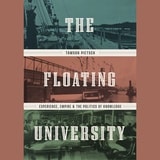
In 1926, New York University professor James E. Lough—an educational reformer with big dreams—embarked on a bold experiment he called the Floating University. Lough believed that taking five hundred American college students around the globe by ship would not only make them better citizens of the world but would demonstrate a model for responsible and productive education amid the unprecedented dangers, new technologies, and social upheavals of the post–World War I world. But the Floating University’s maiden voyage was also its last: when the ship and its passengers returned home, the project was branded a failure—the antics of students in hotel bars and port city back alleys that received worldwide press coverage were judged incompatible with educational attainment, and Lough was fired and even put under investigation by the State Department.
In her new book, Tamson Pietsch excavates a rich and meaningful picture of Lough’s grand ambition, its origins, and how it reveals an early-twentieth-century America increasingly defined both by its imperialism and the professionalization of its higher education system. As Pietsch argues, this voyage—powered by an internationalist worldview—traced the expanding tentacles of US power, even as it tried to model a new kind of experiential education. She shows that this apparent educational failure actually exposes a much larger contest over what kind of knowledge should underpin university authority, one in which direct personal experience came into conflict with academic expertise. After a journey that included stops at nearly fifty international ports and visits with figures ranging from Mussolini to Gandhi, what the students aboard the Floating University brought home was not so much knowledge of the greater world as a demonstration of their nation’s rapidly growing imperial power.
The Floating University
Experience, Empire, and the Politics of KnowledgeTamson Pietsch
University of Chicago Press, 2023
This is an auto-narrated audiobook edition of this book.
The Floating University sheds light on a story of optimism and imperialist ambition in the 1920s.In 1926, New York University professor James E. Lough—an educational reformer with big dreams—embarked on a bold experiment he called the Floating University. Lough believed that taking five hundred American college students around the globe by ship would not only make them better citizens of the world but would demonstrate a model for responsible and productive education amid the unprecedented dangers, new technologies, and social upheavals of the post–World War I world. But the Floating University’s maiden voyage was also its last: when the ship and its passengers returned home, the project was branded a failure—the antics of students in hotel bars and port city back alleys that received worldwide press coverage were judged incompatible with educational attainment, and Lough was fired and even put under investigation by the State Department.
In her new book, Tamson Pietsch excavates a rich and meaningful picture of Lough’s grand ambition, its origins, and how it reveals an early-twentieth-century America increasingly defined both by its imperialism and the professionalization of its higher education system. As Pietsch argues, this voyage—powered by an internationalist worldview—traced the expanding tentacles of US power, even as it tried to model a new kind of experiential education. She shows that this apparent educational failure actually exposes a much larger contest over what kind of knowledge should underpin university authority, one in which direct personal experience came into conflict with academic expertise. After a journey that included stops at nearly fifty international ports and visits with figures ranging from Mussolini to Gandhi, what the students aboard the Floating University brought home was not so much knowledge of the greater world as a demonstration of their nation’s rapidly growing imperial power.
The Game Changed
Essays and Other ProseLawrence Joseph
University of Michigan Press, 2011
Praise for Lawrence Joseph:
"Poetry of great dignity, grace, and unrelenting persuasiveness… Joseph gives us new hope for the resourcefulness of humanity, and of poetry."
---John Ashbery
"Like Henry Adams, Joseph seems to be writing ahead of actual events, and that makes him one of the scariest writers I know."
---David Kirby, The New York Times Book Review
"The most important lawyer-poet of our era."
---David Skeel, Legal Affairs
A volume in the Poets on Poetry series, which collects critical works by contemporary poets, gathering together the articles, interviews, and book reviews by which they have articulated the poetics of a new generation.
Essays on poetry by the most important poet-lawyer of our era
The Game Changed: Essays and Other Prose presents works by prominent poet and lawyer Lawrence Joseph that focus on poetry and poetics, and on what it is to be a poet. Joseph takes the reader through the aesthetics of modernism and postmodernism, a lineage that includes Wallace Stevens, William Carlos Williams, and Gertrude Stein, switching critical tracks to major European poets like Eugenio Montale and Hans Magnus Enzensberger, and back to American masters like James Schuyler and Adrienne Rich.
Always discerning, especially on issues of identity, form, and the pressures of history and politics, Joseph places his own poetry within its critical contexts, presenting narratives of his life in Detroit, where he grew up, and in Manhattan, where he has lived for 30 years. These pieces also portray Joseph’s Lebanese, Syrian, and Catholic heritages, and his life as a lawyer, distinguished law professor, and legal scholar.
The Intercourse of Knowledge
On Gendering Desire and 'Sexuality' in the Hebrew BibleAthalya Brenner
SBL Press, 2016
Now in paperback!
This groundbreaking book, which builds on the author's earlier work in On Gendering Texts, studies how, by what means, and to what extent human love, desire and sex, and possibly even "sexuality"; are gendered in the Hebrew Bible. The investigation looks into the construction of male and female bodies in language and ideologies; the praxis and ideology of sex, procreation, and contraception; deviation from socio-sexual boundaries (e.g. incest, rape, adultery, homosexuality, prostitution); eroticism and "pornoprophetics."
Features:
- Paperback format of an essential Brill monograph
- A classification and gendering of the linguistic and semantic data
- Discussion of wider sociological and theological implications
The Jester and the Sages
Mark Twain in Conversation with Nietzsche, Freud, and MarxForrest G. Robinson, Gabriel Noah Brahm, Jr., and Catherine Carlstroem
University of Missouri Press, 2011
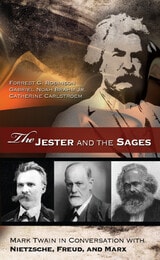
During their lifetimes, Twain, Nietzsche, Freud, and Marx witnessed massive upheavals in Western constructions of religion, morality, history, political economy, and human nature. The foundations of reality had been shaken, and one did not need to be a philosopher—nor did one even need to read philosophy—to weigh in on what this all might mean. Drawing on a wide range of primary and secondary materials, the authors show that Twain was well attuned to debates of the time. Unlike his Continental contemporaries, however, he was not as systematic in developing his views.
Brahm and Robinson’s chapter on Nietzsche and Twain reveals their subjects’ common defiance of the moral and religious truisms of their time. Both desired freedom, resented the constraints of Christian civilization, and saw punishing guilt as the disease of modern man. Pervasive moral evasion and bland conformity were the principal end result, they believed.
In addition to a continuing focus on guilt, Robinson discovers in his chapter on Freud and Twain that the two men shared a lifelong fascination with the mysteries of the human mind. From the formative influence of childhood and repression, to dreams and the unconscious, the mind could free people or keep them in perpetual chains. The realm of the unconscious was of special interest to both men as it pertained to the creation of art.
In the final chapter, Carlstroem and Robinson explain that, despite significant differences in their views of human nature, history, and progress, Twain and Marx were both profoundly disturbed by economic and social injustice in the world. Of particular concern was the gulf that industrial capitalism opened between the privileged elite property owners and the vast class of property-less workers. Moralists impatient with conventional morality, Twain and Marx wanted to free ordinary people from the illusions that enslaved them.
Twain did not know the work's of Nietzsche, Freud, and Marx well, yet many of his thoughts cross those of his philosophical contemporaries. By focusing on the deeper aspects of Twain’s intellectual makeup, Robinson, Brahm, and Carlstroem supplement the traditional appreciation of the forces that drove Twain’s creativity and the dynamics of his humor.
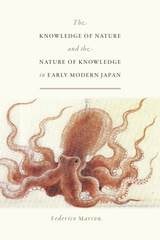
The Knowledge of Nature and the Nature of Knowledge in Early Modern Japan
Federico Marcon
University of Chicago Press, 2015
The first book-length English-language study devoted to the important field of honzogaku, The Knowledge of Nature and the Nature of Knowledge in Early Modern Japan will be an essential text for historians of Japanese and East Asian science, and a fascinating read for anyone interested in the development of science in the early modern era.

The Last Physician
Walker Percy and the Moral Life of MedicineCarl Elliott and John Lantos, eds.
Duke University Press, 1999
The contributors—physicians, philosophers, and literary critics—examine the relevance of Percy’s work to current dilemmas in medical education and health policy. They reflect upon the role doctors and patients play in his novels, his family legacy of depression, how his medical background influenced his writing style, and his philosophy of psychiatry. They contemplate the private ways in which Percy’s work affected their own lives and analyze the author’s tendency to contrast the medical-scientific worldview with a more spiritual one. Assessing Percy’s stature as an author and elucidating the many ways that reading and writing can combine with diagnosing and treating to offer an antidote to despair, they ask what it means to be a doctor, a writer, and a seeker of cures and truths—not just for the body but for the malaise and diseased spirituality of modern times.
This collection will appeal to lovers of literature as well as medical professionals—indeed, anyone concerned with medical ethics and the human side of doctoring.
Contributors. Robert Coles, Brock Eide, Carl Elliott, John D. Lantos, Ross McElwee, Richard Martinez, Martha Montello, David Schiedermayer, Jay Tolson, Bertram Wyatt-Brown, Laurie Zoloth-Dorfman
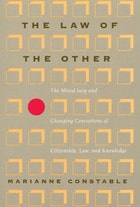
The Law of the Other
The Mixed Jury and Changing Conceptions of Citizenship, Law, and KnowledgeMarianne Constable
University of Chicago Press, 1994
The "mixed jury" doctrine allowed resident foreigners to have law suits against English natives tried before juries composed half of natives and half of aliens like themselves. As she traces the transformations in this doctrine from the Middle Ages to its abolition in 1870, Constable also reveals the emergence of a world where law rooted in actual practices and customs of communities is replaced by law determined by officials, where juries no longer strive to speak the truth but to ascertain the facts.
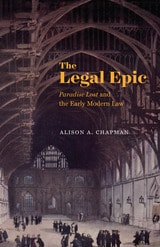
The Legal Epic
"Paradise Lost" and the Early Modern LawAlison A. Chapman
University of Chicago Press, 2017
Alison A. Chapman argues that Milton’s Paradise Lost sits at the apex of the early modern period’s long fascination with law and judicial processes. Milton’s world saw law and religion as linked disciplines and thought therefore that in different ways, both law and religion should reflect the will of God. Throughout Paradise Lost, Milton invites his readers to judge actions using not only reason and conscience but also core principles of early modern jurisprudence. Law thus informs Milton’s attempt to “justify the ways of God to men” and points readers toward the types of legal justice that should prevail on earth.
Adding to the growing interest in the cultural history of law, The Legal Epic shows that England’s preeminent epic poem is also a sustained reflection on the role law plays in human society.
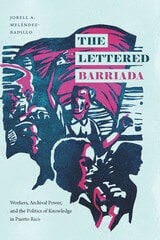
The Lettered Barriada
Workers, Archival Power, and the Politics of Knowledge in Puerto RicoJorell A. Meléndez-Badillo
Duke University Press, 2021
Duke University Press Scholars of Color First Book Award recipient
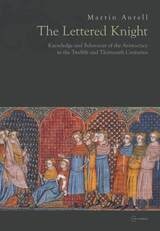
The Lettered Knight
Knowledge and aristocratic behaviour in the twelfth and thirteenth centuriesMartin Aurell
Central European University Press, 2017
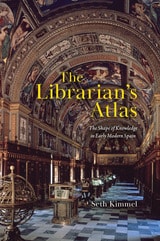
The Librarian's Atlas
The Shape of Knowledge in Early Modern SpainSeth Kimmel
University of Chicago Press, 2024
A history of early modern libraries and the imperial desire for total knowledge—now in paperback.
Medieval scholars imagined the library as a microcosm of the world, but as novel early modern ways of managing information facilitated empire in both the New and Old Worlds, the world became a projection of the library. In The Librarian’s Atlas, Seth Kimmel offers a sweeping material history of how the desire to catalog books coincided in the sixteenth and seventeenth centuries with the aspiration to control territory. Through a careful study of library culture in Spain and Morocco—close readings of catalogs, marginalia, indexes, commentaries, and maps—Kimmel reveals how the booklover’s dream of a comprehensive and well-organized library shaped an expanded sense of the world itself.

The Mark and the Knowledge
Social Stigma in Classic American FictionMarjorie Pryse
The Ohio State University Press, 1900
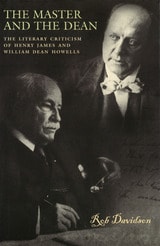
The Master and the Dean
The Literary Criticism of Henry James and William Dean HowellsRob Davidson
University of Missouri Press, 2005
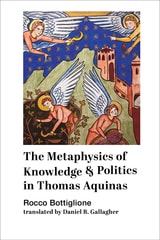
The Metaphysics of Knowledge and Politics in Thomas Aquinas
Rocco Buttiglione
St. Augustine's Press, 2020
In addition to its primary audience of philosophers, theologians, and political theorists, the book surprisingly enjoyed a wide general readership in Italy at the time of its publication. It represented an exciting attempt to harmonize medieval philosophy and the insights of personalism that had already had a deep impact on European intellectual life. Buttiglione was able to describe this attempt in a way accessible to a general readership, and in a way that confronted the political challenges Italy had been confronting for the last forty years.
Now, thirty-five years after the book’s initial publication, the conclusions Buttiglione draws from reading Thomas Aquinas’s commentary on Aristotle’s Politics––and the connections he makes between philosophy, theology, and political theory––are more relevant than ever. He argues that the traditional definition of “person” as rationalis naturae individua substantia––an individual substance or substrate (hypokeimenon) of a rational nature––“lacks that certain element that makes Augustine’s approach to personhood so appealing.” Hence Aquinas’s definition “is left wanting since it fails to elaborate on the crucial aspect of interpersonal relationship.”
The ingenuous way in which Buttiglione enlivens Thomistic political thinking with personalist philosophy helps to explain not only why free societies are more stable, tolerant, and respectful of human rights than totalitarian states, but theocratic ones as well. Only by raising the interpersonal aspects of political society to an ontological level—indeed, only by affirming and esteeming the self-transcendence of the human person as evidenced through ontological analysis—do the personal relationships that root and enliven the human person also lead to a realistic, dynamic, and convincing vision of the person’s real existence.
Buttiglione was startlingly prescient of the problems we confront at the beginning of the third millennium. This book will spark new discussions as it explains the importance of both the medieval tradition and twentieth-century personalism. The book also draws on a wide range of secondary sources unavailable to English readers that I and will have the unique ability to introduce readers to the “Italian” way of relating speculative and political philosophy in a relatively slim volume.
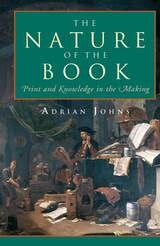
The Nature of the Book
Print and Knowledge in the MakingAdrian Johns
University of Chicago Press, 1998
"A compelling exposition of how authors, printers, booksellers and readers competed for power over the printed page. . . . The richness of Mr. Johns's book lies in the splendid detail he has collected to describe the world of books in the first two centuries after the printing press arrived in England."—Alberto Manguel, Washington Times
"[A] mammoth and stimulating account of the place of print in the history of knowledge. . . . Johns has written a tremendously learned primer."—D. Graham Burnett, New Republic
"A detailed, engrossing, and genuinely eye-opening account of the formative stages of the print culture. . . . This is scholarship at its best."—Merle Rubin, Christian Science Monitor
"The most lucid and persuasive account of the new kind of knowledge produced by print. . . . A work to rank alongside McLuhan."—John Sutherland, The Independent
"Entertainingly written. . . . The most comprehensive account available . . . well documented and engaging."—Ian Maclean, Times Literary Supplement
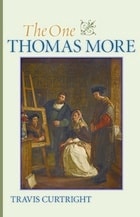
The One Thomas More
Travis Curtright
Catholic University of America Press, 2012
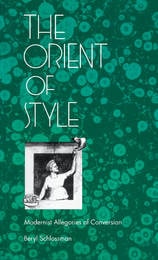
The Orient of Style
Modernist Allegories of ConversionBeryl Schlossman
Duke University Press, 1991
Toward the end of Remembrance of Things Past, the narrator describes the act of creating a work of art as a conversion of sensation into a spiritual equivalent. By means of such allegories of “conversion,” Schlossman shows, the modernist artist disappeared within the work of art and left behind the trace of his sublime vocation, a vocation in which he was transformed, in Schlossman’s words, “into a kind of priest kneeling at the altar of beauty before the masked divinity of representation.”
The author shows how allegory—the representation of the symbolic as something real—was adapted by modernist writers to reflect subjectivity while masking an authorial origin. She reveals how modernist allegory arose, as Walter Benjamin suggests, at the crossroads of history, sociology, economics, urban architecture, and art—providing a kind of map of capitalism—and was produced through the eyes of a melancholic gazing at a “monument of absence.”
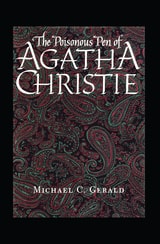
The Poisonous Pen of Agatha Christie
By Michael C. Gerald
University of Texas Press, 1993
Poisoning occurs in over half of Agatha Christie's many novels and stories. In fact, she used a larger number and broader selection of poisons and medicines, for a wider variety of purposes, with greater frequency, ingenuity, and scientific accuracy than any other detective fiction writer. Yet very little has been written on the use of drugs, poisons, and chemicals in Christie's fiction.
The Poisonous Pen of Agatha Christie entertainingly and authoritatively fills this gap. Michael Gerald explores the use of poisons and drugs in Christie's fiction not only to commit murder and suicide but also to incapacitate a victim, alter behavior, treat disease, or support addiction. He also analyzes her views, as expressed in her fiction and autobiography, on drug addiction, the health professions, the value of medicines, and scientific discoveries.
Especially valuable is Gerald's exhaustive listing of all drugs, poisons, and chemicals mentioned in Christie's novels and stories, with references to the work(s) in which each appears and the ways in which each is used. Other tables list all the novels and short stories and the chemicals that are used in each. Throughout, the properties of all drugs are clearly explained so that the reader needs no special scientific or medical knowledge.
The Poisonous Pen of Agatha Christie illuminates the fictional uses Christie made of her real-life experiences as a hospital drug dispenser and as a provider of nursing care. It will be of interest to fans and scholars alike.
The Politics of Knowledge
The Carnegie Corporation, Philanthropy, and Public PolicyEllen Condliffe Lagemann
University of Chicago Press, 1992
The Postmodern Condition
A Report on KnowledgeJean-Francois Lyotard
University of Minnesota Press, 1984
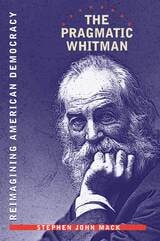
The Pragmatic Whitman
Reimaining American DemocracyStephen John Mack
University of Iowa Press, 2002
In this surprisingly timely book, Stephen Mack examines Whitman’s particular and fascinating brand of patriotism: his far-reaching vision of democracy. For Whitman, loyalty to America was loyalty to democracy. Since the idea that democracy is not just a political process but a social and cultural process as well is associated with American pragmatism, Mack relies on the pragmatic tradition of Emerson, James, Dewey, Mead, and Rorty to demonstrate the ways in which Whitman resides in this tradition.
Mack analyzes Whitman's democratic vision both in its parts and as a whole; he also describes the ways in which Whitman's vision evolved throughout his career. He argues that Whitman initially viewed democratic values such as individual liberty and democratic processes such as collective decision-making as fundamental, organic principles, free and unregulated. But throughout the 1860s and 1870s Whitman came to realize that democracy entailed processes of human agency that are more deliberate and less natural—that human destiny is largely the product of human effort, and a truly humane society can be shaped only by intelligent human efforts to govern the forces that would otherwise govern us.
Mack describes the foundation of Whitman’s democracy as found in the 1855 and 1856 editions of Leaves of Grass, examines the ways in which Whitman’s 1859 sexual crisis and the Civil War transformed his democratic poetics in “Sea-Drift,” “Calamus,” Drum-Taps,and Sequel to Drum-Taps, and explores Whitman’s mature vision in Democratic Vistas, concluding with observations on its moral and political implications today. Throughout, he illuminates Whitman's great achievement—learning that a full appreciation for the complexities of human life meant understanding that liberty can take many different and conflicting forms—and allows us to contemplate the relevance of that achievement at the beginning of the twenty-first century.
The Province of Piety
Moral History in Hawthorne's Early TalesMichael J. Colacurcio
Duke University Press, 1995
Informed by comprehensive historical research, the author shows that Hawthorne was steeped in New England historiography, particularly the sermon literature of the seventeenth century. But, as Colacurcio shows, Hawthorne did not merely borrow from the historical texts he deliberately studied; rather, he is best understood as having written history. In The Province of Piety, originally published in 1984 (Harvard University Press), Hawthorne is seen as a moral historian working with fictional narratives—a writer brilliantly involved in examining the moral and political effects of Puritanism in America and recreating the emotional and cultural contexts in which earlier Americans had lived.
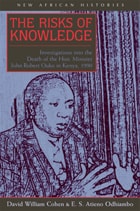
The Risks of Knowledge
Investigations into the Death of the Hon. Minister John Robert Ouko in Kenya, 1990David William Cohen
Ohio University Press, 2004
In February 1990 assailants murdered Kenya’s distinguished Minister of Foreign Affairs and International Cooperation, Robert Ouko. The horror of the attack, the images of his mutilated and burned corpse, the evidence of a notorious cover-up, and the revelations of the pressures, conflicts, and fears he faced in his last weeks have engaged Kenya’s publics for years. The Risks of Knowledge minutely examines the multiple and unfinished investigations into the crime.
Among the probes was an extensive 1990 inquiry organized by a New Scotland Yard team invited to Kenya by the government, as well as an open public commission of inquiry appointed by President Daniel arap Moi. The commission ran for seventeen months in 1990-91 before the president shut it down. International and Kenyan unrest over Ouko’s brutal death brought increasing attention to corruption and violence associated with the Moi government, leading in late 1991 to multiparty politics and in December 2002 to the elections that ended the Moi era.
This powerfully argued book raises important issues about the production of knowledge and the politics of memory that will interest a large interdisciplinary audience.
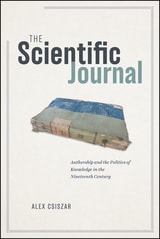
The Scientific Journal
Authorship and the Politics of Knowledge in the Nineteenth CenturyAlex Csiszar
University of Chicago Press, 2018
The Scientific Journal tells the story of how that changed. Alex Csiszar takes readers deep into nineteenth-century London and Paris, where savants struggled to reshape scientific life in the light of rapidly changing political mores and the growing importance of the press in public life. The scientific journal did not arise as a natural solution to the problem of communicating scientific discoveries. Rather, as Csiszar shows, its dominance was a hard-won compromise born of political exigencies, shifting epistemic values, intellectual property debates, and the demands of commerce. Many of the tensions and problems that plague scholarly publishing today are rooted in these tangled beginnings. As we seek to make sense of our own moment of intense experimentation in publishing platforms, peer review, and information curation, Csiszar argues powerfully that a better understanding of the journal’s past will be crucial to imagining future forms for the expression and organization of knowledge.
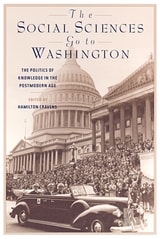
The Social Sciences Go to Washington
The Politics of Knowledge in the Postmodern AgeEdited by Hamilton Cravens
Rutgers University Press, 2003
What happens when the allegedly value-free social sciences enter the national political arena? In The Social Sciences Go to Washington, scholars examine the effects of the massive influx of sociologists, demographers, economists, educators, and others to the federal advisory process in the postwar period. Essays look at how these social scientists sought to change existing policies in welfare, public health, urban policy, national defense, environmental policy, and science and technology policy, and the ways they tried to influence future policies.
Policymakers have been troubled that followers of postmodernism have questioned the legitimacy of scientific and political authority to speak for the desires of social groups. As the social sciences increasingly become expressions of individual preferences, the contributors ask, how can they continue to be used to set public policy for us all?
This collection is a useful resource for anyone studying the relationship between science and the government in the postwar years.
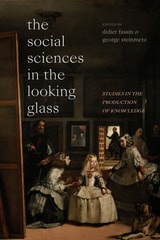
The Social Sciences in the Looking Glass
Studies in the Production of KnowledgeDidier Fassin and George Steinmetz, editors
Duke University Press, 2023
Contributors. Chitralekha, Jean-Louis Fabiani, Didier Fassin, Johan Heilbron, Miriam Kingsberg Kadia, Kristoffer Kropp, Nicolas Langlitz, John Lardas Modern, Álvaro Morcillo Laiz, Amín Pérez, Carel Smith, George Steinmetz, Peter D. Thomas, Bregje van Eekelen, Agata Zysiak
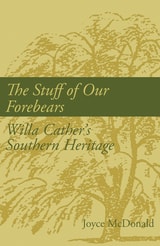
The Stuff of Our Forebears
Willa Cather's Southern HeritageJoyce McDonald
University of Alabama Press, 1998
Connecting Cather's work to the southern literary tradition and the South of her youth
A diverse and experimental writer who lived most of her life in New York City, Willa Cather is best known for her depiction of pioneer life on the Nebraska plains. Despite Cather's association with Nebraska, however, the novelist's Virginia childhood and her southern family were deeply influential in shaping her literary imagination.
Joyce McDonald shows evidence, for example, of Cather's southern sensibility in the class consciousness and aesthetic values of her characters and in their sense of place and desire for historical continuity, a sensibility also evident in her narrative technique of weaving stories within stories and in her use of folklore. For McDonald, however, what most links Cather and her work to the South and to the southern literary tradition is her use of pastoral modes.
Beginning with an examination of Cather's Virginia childhood and the southern influences that continued to mold her during the Nebraska years, McDonald traces the effects of those influences in Cather's novels. The patterns that emerge reveal not only Cather's strong ideological connection to the pastoral but also the political position implicit in her choice of that particular mode. Further analysis of Cather's work reveals her preoccupation with hierarchical constructs and with the use and abuse of power and her interest in order, control, and possession. The Willa Cather who emerges from the pages of The Stuff of Our Forebears is not the Cather who claimed to eschew politics but a far more political novelist than has heretofore been perceived.
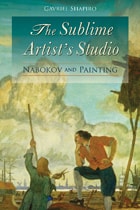
The Sublime Artist's Studio
Nabokov and PaintingGavriel Shapiro
Northwestern University Press, 2009
In his youth, Vladimir Nabokov aspired to become a landscape artist. Even though he eventually realized that his true vocation was literature, his keen sense of visual detail, nuanced perception of color, and vast knowledge of the fine arts are all manifest in his literary works, which abound with painters and paintings, real and imaginary, as well as with magnificent pictorial imagery rendered in a verbal medium. The relation of the visual arts to Nabokov’s work is the subject of The Sublime Artist’s Studio, an in-depth and detailed study of one of the most significant facets of this modern master’s oeuvre.
Gavriel Shapiro pursues his inquiry throughout Nabokov’s literary legacy—poetry, short prose, novels, plays, memoirs, lectures, essays, interviews, and letters. What is the import of Nabokov’s lifelong fascination with the Old Masters? How does landscape function in Nabokov’s writings? What was the author’s relationship to contemporary artists? By addressing these and other questions, while examining Nabokov’s references and allusions to the visual arts and to particular works and artists, Shapiro is able to reveal the centrality of painting to Nabokov’s belles lettres. His book offers a new and promising approach to one of the twentieth century’s most celebrated writers.

The Tangled Roots of Feminism, Environmentalism, and Appalachian Literature
Elizabeth S. D. Engelhardt
Ohio University Press, 2003
Contemporaries were shocked when author Mary Noailles Murfree revealed she was a woman, but modern readers may be more surprised by her cogent discussion of community responses to unwanted development. Effie Waller Smith, an African American woman writing of her love for the Appalachian mountains, wove discussions of women's rights, racial tension, and cultural difference into her Appalachian poetry. Grace MacGowan Cooke participated in avant-garde writers' colonies with the era's literary lights and applied their progressive ideals to her fiction about the Appalachia of her youth. Emma Bell Miles, witness to poverty, industrialization, and violence against women, wrote poignant and insightful critiques of her Appalachian home.
In The Tangled Roots of Feminism, Environmentalism, and Appalachian Literature Elizabeth Engelhardt finds in all four women's writings the origins of what we recognize today as ecological feminism—a wide-reaching philosophy that values the connections between humans and nonhumans and works for social and environmental justice.
People and the land in Appalachia were also the subject of women authors with radically different approaches to mountains and their residents. Authors with progressive ideas about women's rights did not always respect the Appalachian places they were writing about or apply their ideas to all of the women in those places—but they did create hundreds of short stories, novels, letters, diaries, photographs, sketches, and poems about the mountains.
While The Tangled Roots of Feminism, Environmentalism, and Appalachian Literature ascribes much that is noble to the beginnings of the ecological feminism movement as it developed in Appalachia, it is also unyielding in its assessment of the literatures of the voyeur, tourist, and social crusader who supported status quo systems of oppression in Appalachia.
The Troubadour of Knowledge
Michel Serres
University of Michigan Press, 1997
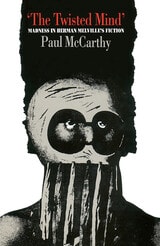
The Twisted Mind
Madness In Melville'S FictionPaul Mccarthy
University of Iowa Press, 1990
Paul McCarthy
"Though madness has been a consistent topic in considerations of Melville's work, this is the first full-scale treatment of the subject. It is in a sense, then, a pioneering work that will no doubt receive widespread attention."
—William B. Dillingham
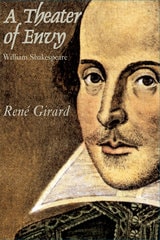
Theater Of Envy
William ShakespeareRene Girard
St. Augustine's Press, 2004
In this ground-breaking work, one of our foremost literary and cultural critics turns to the major figure in English literature, William Shakespeare, and proposes a dramatic new reading of nearly all his plays and poems. The key to A Theater of Envy is Girard's novel reinterpretation of "mimesis." For Girard, people desire objects not for their intrinsic value, but because they are desired by someone else - we mime or imitate their desires. This envy - or "mimetic desire" - he sees as one of the foundations of the human condition.
Bringing such proocative and iconoclastic insights to bear on Shakespeare, Girard reveals the previously overlooked coherence of problem plays like Troilus and Cressida, and makes a convincing argument for elevating A Midsummer Night's Dream from the status of a chaotic comedy to a masterpiece. The book abounds with novel and provocative interpretations: Shakespeare becomes "a prophet of modern advertising," and the threat of nuclear disaster is read in the light of Hamlet. Most intriguing of all, perhaps, is a brief, but brilliant aside in which an entirely new perspective is brought to the chapter on Joyce's Ulysses in which Stephen Dedalus gives a lecture on Shakespeare. In Girard's view only Joyce, perhaps the greatest of twentieth-century novelists, comes close to understanding the greatest of Renaissance playwrights.
Throughout this impressively sustained reading of Shakespeare, Girard's prose is sophisticated, but contemporary, and accessible to the general reader.
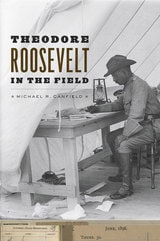
Theodore Roosevelt in the Field
Michael R. Canfield
University of Chicago Press, 2015
Drawing extensively on Roosevelt’s field notebooks, diaries, and letters, Canfield takes readers into the field on adventures alongside him. From Roosevelt’s early childhood observations of ants to his notes on ornithology as a teenager, Canfield shows how Roosevelt’s quest for knowledge coincided with his interest in the outdoors. We later travel to the Badlands, after the deaths of Roosevelt’s wife and mother, to understand his embrace of the rugged freedom of the ranch lifestyle and the Western wilderness. Finally, Canfield takes us to Africa and South America as we consider Roosevelt’s travels and writings after his presidency. Throughout, we see how the seemingly contradictory aspects of Roosevelt’s biography as a hunter and a naturalist are actually complementary traits of a man eager to directly understand and experience the environment around him.
As our connection to the natural world seems to be more tenuous, Theodore Roosevelt in the Field offers the chance to reinvigorate our enjoyment of nature alongside one of history’s most bold and restlessly curious figures.

There She Goes Again
Gender, Power, and Knowledge in Contemporary Film and Television FranchisesAviva Dove-Viebahn
Rutgers University Press, 2024