Results by title
1917 books match the query 'Law' and 526 start with t
TASTE
Andrea Pavoni, Danilo Mandic, Caterina Nirta and Andreas Philippopoulos-Mihalopoulos
University of Westminster Press, 2018
TOUCH
Caterina Nirta, Danilo Mandic, Andrea Pavoni and Andreas Philippopoulos-Mihalopoulos
University of Westminster Press, 2020
Described by Aristotle as the most vital of senses, touch contains both the physical and the metaphysical in its ability to express the determination of being. To manifest itself, touch makes a movement outwards, beyond the body, and relies on a specific physical involvement other senses do not require: to touch is already to be active and to activate. This fundamental ontology makes touch the most essential of all senses.
This volume of ‘Law and the Senses’ attempts to illuminate and reconsider the complex and interflowing relations and contradictions between the tactful intrusion of the law and the untactful movement of touch. Compelling contributors from arts, literature and social science disciplines alongside artist presentations explore touch’s boundaries and formal and informal ‘laws’ of the senses. Each contribution unveils a multi-faceted new dimension to the force of touch, its ability to form, deform and reform what it touches. In unique ways, each of the several contributions to this volume recognises the trans-corporeality of touch to traverse the boundaries on the body and entangle other bodies and spaces, thus challenging the very notion of corporeal integrity and human being.
Taking English Planning Law Scholarship Seriously
Edited by Maria Lee and Carolyn Abbot
University College London, 2022
Planning is at the heart of the response to many of the significant challenges of our time, from the climate and environmental crises to social and economic inequalities. It is embedded in, as well as partially constituting, our democratic systems, so that the challenges of democratic decision-making in a complex society cannot be avoided when thinking about planning. Planning law raises some of the most fundamental questions faced by legal scholars, from the legitimacy of authority to the relationship between public and private rights and interests. And yet, planning law has been relatively neglected by legal scholars. This book helps rectify that by showcasing planning law scholarship in all of its variety and complexity. The chapters reflect this by covering a range of the objects of planning (from housing to energy to highways) and a multiplicity of planning tasks and tools (from compulsory purchase to contracting to planning inquiries).
Taking Juvenile Justice Seriously
Developmental Insights and System ChallengesChristopher J. Sullivan
Temple University Press, 2019
The juvenile justice system navigates a high degree of variation in youthful offenders. While professionals with insights about reform and adolescent development consider the risks, the needs, and the patterns of delinquency of youth, too little attention is paid to the responses and practicalities of a system that is both complex and limited in its resources.
In his essential book, Taking Juvenile Justice Seriously, Christopher Sullivan systematically analyzes key facets of justice-involved youth populations and parses cases to better understand core developmental influences that affect delinquency. He takes a comprehensive look at aspects of the life-course affected by juvenile justice as well as at the juvenile justice system’s operations and its multifaceted mission of delivering both treatment and sanctions to a varied population of youths.
Taking Juvenile Justice Seriously first provides an overview of the youth who encounter the system, then describes its present operations and obstacles, synthesizes relevant developmental insights, and reviews current practices. Drawing on research, theory, and evidence regarding innovative policies, Sullivan offers a series of well-grounded recommendations that suggest how to potentially—and realistically—implement a more effective juvenile justice system that would benefit all.
Taming Alabama
Lawyers and Reformers, 1804-1929Paul M. Pruitt, Jr. introduction by G. Ward Hubbs
University of Alabama Press, 2010
Tangled Loyalties
Conflict of Interest in Legal PracticeSusan P. Shapiro
University of Michigan Press, 2002
This unique, empirical study examines the actual attitudes and perceptions of legal practitioners. The author discusses the realities of the profession--what lawyers face day to day, how they deal with conflicts of interest, and how those experiences vary from LaSalle Street to Wall Street to Main Street, from megafirms to solo practices. In describing how conflicts arise in their daily work, Shapiro sheds light on the nature of legal work--on clients, colleagues, law firm power and politics, economics, markets, malpractice insurance, careers, ethics, values, business judgments, and lawyers' most anguishing moments. In short, we learn what it means to be a lawyer at the end of the twentieth century.
Tangled Loyalties also looks at how these conflicts in law affect other fiduciaries--accountants, doctors, psychotherapists, journalists, and academics--and the way in which they respond to competing interests and the honoring of those interests.
Tangled Loyalties will appeal to readers interested in the legal and other professions, social institutions and relations, and issues of trust, ethics, social control and regulation.
Susan P. Shapiro is Senior Research Fellow, American Bar Foundation.

Television Courtroom Broadcasting
Distraction Effects and Eye-TrackingPaul Lambert
Intellect Books, 2012
Television Violence and Public Policy
James T. Hamilton, Editor
University of Michigan Press, 2000
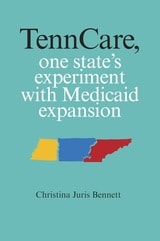
TennCare, One State's Experiment with Medicaid Expansion
Christina Juris Bennett
Vanderbilt University Press, 2014
While many states cut back on their Medicaid enrollments from 1993 to 2001, TennCare grew from 750,000 to 1.47 million enrollees. The state was less successful in controlling costs, however. Each major stakeholder group (the state, the managed care organizations, the providers, and the enrollees and their advocates) pushed back against parts of the state's strategy that adversely affected their interests, and they eventually dismantled the mechanisms of cost constraint.
The author lays out the four stakeholder perspectives for each period in the history of TennCare and provides a link to difficult-to-access primary documents.
Term Limits in State Legislatures
John M. Carey, Richard G. Niemi, and Lynda W. Powell
University of Michigan Press, 2000
Testing for Athlete Citizenship
Regulating Doping and Sex in SportHenne, Kathryn E
Rutgers University Press, 2015
The "Getting to Yes" Guide for ESL Students and Professionals
Principled Negotiation for Non-Native Speakers of EnglishBarrie J. Roberts
University of Michigan Press, 2024
The Getting to Yes Guide for ESL Students and Professionals prepares non-native speakers of English to join the global community of people who use Getting to Yes to negotiate win-win agreements in English. It provides page-by-page explanations of over 1,000 words, phrases, concepts, and examples that these readers may misunderstand; short stories that use these new words and concepts to help readers apply them to new contexts; delightful cartoons to highlight main ideas; optional ESL activities; and a glossary of the key negotiation idioms and terms used in Getting to Yes. In this guide, author Barrie J. Roberts applies her experience as a public interest attorney, court Alternative Dispute Resolution administrator, ESL instructor, and court interpreter trainer to help readers improve their professional-level English along with their negotiation skills.
Benefits for teachers:
- Each Chapter Guide provides a ready-made lesson plan with activities to do before, while, and after reading each chapter of Getting to Yes
- The book can be used as a recommended self-study reference
- This book can be used for selected chapters of Getting to Yes or for a complete standalone course on Getting to Yes for non-native speakers of English or Generation 1.5 students
- Optional activities throughout the book can be assigned for in or out of the classroom. These include activities for reading comprehension, vocabulary building, paraphrasing, critical thinking, discussing, and writing
- Short stories written to accompany each chapter require students to apply new vocabulary and negotiation concepts to real-world disputes
The Actual and the Rational
Hegel and Objective SpiritJean-Francois Kervegan
University of Chicago Press, 2018
Kervégan begins with Hegel’s term “objective spirit,” the public manifestation of our deepest commitments, the binding norms that shape our existence as subjects and agents. He examines objective spirit in three realms: the notion of right, the theory of society, and the state. In conversation with Tocqueville and other theorists of democracy, whether in the Anglophone world or in Europe, Kervégan shows how Hegel—often associated with grand metaphysical ideas—actually had a specific conception of civil society and the state. In Hegel’s view, public institutions represent the fulfillment of deep subjective needs—and in that sense, demonstrate that the real is the rational, because what surrounds us is the product of our collective mindedness. This groundbreaking analysis will guide the study of Hegel and nineteenth-century political thought for years to come.
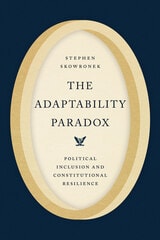
The Adaptability Paradox
Political Inclusion and Constitutional ResilienceStephen Skowronek
University of Chicago Press, 2025
Has American democracy outstripped its constitutional accommodations?
Faith in the resilience and adaptability of the US Constitution rests on a long history of finding new ways to make the system work. In The Adaptability Paradox, political scientist Stephen Skowronek examines the rearrangements that regenerated the American government in the past and brings that experience to bear on our current predicament. He shows how a constitution framed in writing some 230 years ago can run into serious difficulties directly related to its long and impressive history of adaptation.
Skowronek connects questions about the Constitution’s adaptability to the challenges of democratization. For most of American history, serial rearrangements of constitutional relationships widened the government’s purview as a national democracy without giving either nationalism or democracy free rein. Skowronek argues that the politics of adaptation shifted fundamentally with the “Rights Revolution” of the 1960s and `70s when American national democracy approached the inclusion of all its citizens on equal footing. Since then, power and authority have been reconfigured in ways that have steadily magnified conflicts over the essentials of good order. Conservatives aim to dismantle a Constitution that progressives are intent on building upon, and the consensus necessary for a constitutional democracy to function effectively has all but evaporated. No longer a socially bound framework for national action, the Constitution has become an abstract matrix of possibilities, a disembodied opportunity structure open to starkly different, mutually unacceptable futures.
Rather than being liberated by this unbound Constitution, the American people now appear entrapped by it. Is it possible that the development of American democracy has exhausted the adaptive capacities of the Constitution? A timely reminder that constitutional democracies do not survive on faith alone, The Adaptability Paradox is a sober appraisal of the unfamiliar ground on which we now tread.
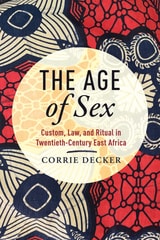
The Age of Sex
Custom, Law, and Ritual in Twentieth-Century East AfricaCorrie Decker
University of Wisconsin Press, 2025
In The Age of Sex, Decker demonstrates how maturation became defined as the hypothetical moment when a girl becomes a woman capable of engaging in heterosexual activity and a boy becomes a man imbued with the right and responsibility to have heterosexual intercourse. Colonial ethnographic studies reduced complex precolonial rites of passage to “puberty rites” fixated on these sexual transformations. The resulting stereotypes influenced, in turn, how colonial and postcolonial court officials decided age-of-consent and other sex crime cases. Court rituals thus legally transformed girls into women by ruling on their sexual maturity and boys into men by sentencing them to corporal punishment, marking their acceptance of heterosexual responsibilities.
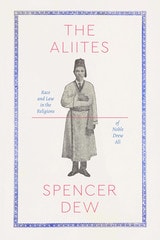
The Aliites
Race and Law in the Religions of Noble Drew AliSpencer Dew
University of Chicago Press, 2019
In The Aliites, Spencer Dew traces the history and impact of Ali’s radical fusion of law and faith. Dew uncovers the influence of Ali’s teachings, including the many movements they inspired. As Dew shows, Ali’s teachings demonstrate an implicit yet critical component of the American approach to law: that it should express our highest ideals for society, even if it is rarely perfect in practice. Examining this robustly creative yet largely overlooked lineage of African American religious thought, Dew provides a window onto religion, race, citizenship, and law in America.

The American Moralist
On Law, Ethics, And GovernmentGeorge Anastaplo
Ohio University Press, 1994
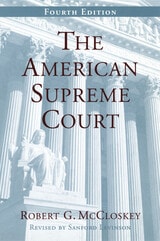
The American Supreme Court
Robert G. McCloskey
University of Chicago Press, 2000
As in the second edition, McCloskey's original text remains unchanged. In his historical interpretation, he argues that the strength of the Court has always been its sensitivity to the changing political scene, as well as its reluctance to stray too far from the main currents of public sentiments. In two new chapters, Levinson discusses the Court's more recent role, especially during the 1960s, as protector of the civil rights and liberties of minorities. He updates as well the Court's continuing role as monitor of the welfare state, looking at the litigation following the 1996 changes in welfare policy by Congress and the President. Also covered in this new edition are the recent Court decisions on federalism, which perhaps portend an enhanced role for the court as the "umpire" of the federal system; the clash between Congress and the Court over the scope of the required accommodation by government of religious conduct; and the Court's role in the impeachment of President Clinton.
Wonderfully readable and concisely written, McCloskey's book is an essential guide to the past, present, and future prospects of America's highest court.
The American Supreme Court
Robert G. McCloskey
University of Chicago Press, 2004
As in previous editions, McCloskey's original text remains unchanged. He argues that the Court's strength has always been its sensitivity to the changing political scene, as well as its reluctance to stray too far from the main currents of public sentiment. Levinson's two new chapters show how McCloskey's approach continues to illuminate recent developments, such as the Court's seeming return to its pre-1937 role as "umpire" of the federal system. It is in Bush v. Gore, however, where the implications of McCloskey's interpretation stand out most clearly.
The best and most concise account of the Supreme Court and its place in American politics, McCloskey's wonderfully readable book is an essential guide to its past, present, and future prospects of this institution.
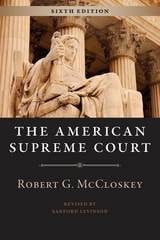
The American Supreme Court, Sixth Edition
Robert G. McCloskey and Sanford Levinson
University of Chicago Press, 2016
As in prior editions, McCloskey’s original text remains unchanged. In his historical interpretation, he argues that the strength of the Court has always been its sensitivity to the changing political scene, as well as its reluctance to stray too far from the main currents of public sentiment. In this new edition, Sanford Levinson extends McCloskey’s magisterial treatment to address developments since the 2010 election, including the Supreme Court’s decisions regarding the Defense of Marriage Act, the Affordable Care Act, and gay marriage.
The best and most concise account of the Supreme Court and its place in American politics, McCloskey's wonderfully readable book is an essential guide to the past, present, and future prospects of this institution.
The American Supreme Court, Sixth Edition
Robert G. McCloskey and Sanford Levinson
University of Chicago Press, 2016
For more than fifty years, Robert G. McCloskey’s classic work on the Supreme Court’s role in constructing the US Constitution has introduced generations of students to the workings of our nation’s highest court.
As in prior editions, McCloskey’s original text remains unchanged. In his historical interpretation, he argues that the strength of the Court has always been its sensitivity to the changing political scene, as well as its reluctance to stray too far from the main currents of public sentiment. In this new edition, Sanford Levinson extends McCloskey’s magisterial treatment to address developments since the 2010 election, including the Supreme Court’s decisions regarding the Defense of Marriage Act, the Affordable Care Act, and gay marriage.
The best and most concise account of the Supreme Court and its place in American politics, McCloskey's wonderfully readable book is an essential guide to the past, present, and future prospects of this institution.
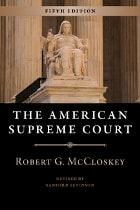
The American Supreme Court
Fifth EditionRobert G. McCloskey
University of Chicago Press, 2010
Celebrating its fiftieth anniversary, Robert McCloskey’s classic work on the Supreme Court’s role in constructing the U.S. Constitution has introduced generations of students to the workings of our nation’s highest court. For this new fifth edition, Sanford Levinson extends McCloskey’s magisterial treatment to address the Court’s most recent decisions.
As in prior editions, McCloskey’s original text remains unchanged. In his historical interpretation, he argues that the strength of the Court has always been its sensitivity to the changing political scene, as well as its reluctance to stray too far from the main currents of public sentiments. In two revised chapters, Levinson shows how McCloskey’s approach continues to illuminate developments since 2005, including the Court’s decisions in cases arising out of the War on Terror, which range from issues of civil liberty to tests of executive power. He also discusses the Court’s skepticism regarding campaign finance regulation; its affirmation of the right to bear arms; and the increasingly important nomination and confirmation process of Supreme Court justices, including that of the first Hispanic justice, Sonia Sotomayor.
The best and most concise account of the Supreme Court and its place in American politics, McCloskey's wonderfully readable book is an essential guide to the past, present, and future prospects of this institution.
The Anti-Federalist
An Abridgment of The Complete Anti-FederalistEdited by Herbert J. Storing
University of Chicago Press, 1985
This one-volume edition presents the essence of the other side of that crucial dialogue. It can be read as a genuine counterpart to the Federalist Papers; as an original source companion to Storing's brilliant essay What the Anti-Federalists Were For (volume I of The Complete Anti-Federalist, available as a separate paperback); or as a guide to exploring the full range of Anti-Federalist writing. The Anti-Federalist makes a fundamental source of our political heritage accessible to everyone.
The Argument and the Action of Plato's Laws
Leo Strauss
University of Chicago Press, 1977
"Strauss's The Argument and the Action of Plato's 'Laws' reflects his interest in political thought, his dogged method of following the argument of the Laws step by step, and his vigorous defense of this dialogue's integrity in respect to the ideals of the Republic."—Cross Currents
"The unique characteristics of this commentary on the Laws reflect the care and precision which were the marks of Professor Strauss's efforts to understand the complex thoughts of other men."—Allan D. Nelson, Canadian Journal of Political Science
"Thorough and provocative, an important addition to Plato scholarship."—Library Journal
"The major purpose of the commentary is to provide a reading of the dialogue which displays its structural arrangement and the continuity of the argument."—J. W. Dy, Bibliographical Bulletin of Philosophy
"The reader of Strauss's book is indeed guided closely through the whole text."— M. J. Silverthorne, The Humanities Association Review
Leo Strauss (1899-1973) was the Robert Maynard Hutchins Distinguished Service Professor Emeritus of political science at the University of Chicago.
The Arkansas Freedom of Information Act
John J. Watkins
University of Arkansas Press, 2017

The Art of the Roman Jurists
An American PerspectiveEssays by Bruce W. Frier Edited by Thomas A.J. McGinn Introduction by Paul J. du Plessis
University of Michigan Press, 2027
The Art of the Roman Jurists offers a clear, detailed, and thorough account of the relationship between Roman law and society from 100 BCE to 235 CE and traces the rise of the group of legal experts known as jurists. While prominent in the first century BCE, they consolidated their position in the first years of the Principate. But it is only in the second century, starting in the reign of Antoninus Pius (138–161), that, in author Bruce W. Frier’s view, they most emphatically come into their own. The collection reveals how the jurists can evince an awareness of the impact their holdings portend for the social and economic reality. Frier's method is anchored in the ancient sources, extending far beyond the legal evidence, offering a perspective on Roman jurisprudence as it was lived. This collection of published and unpublished articles from Frier examines crucial aspects of his methodology and looks to the future of the study of Roman law.
The Assault on American Labor Law
Unions Before the Supreme Court, 1965–2025Roger C. Hartley
University of Massachusetts Press, 2025
Reviewing the dismantling of American labor law in more than 100 Supreme Court cases
The National Labor Relations Act (NLRA), signed into law by Franklin Delano Roosevelt in 1935, guarantees the right of private sector employees to organize into trade unions, engage in collective bargaining, and take collective action such as strikes. Since its passage, the NLRA has functioned as the foundational statute of United States labor law. Opposed by conservatives and members of the Republican Party from the beginning, its provisions were largely upheld by the Supreme Court until the 1960s. In the latter part of the twentieth century and into the twenty-first, however, the Court began to erode the protections of the NLRA. While some cases have received widespread attention from commentators and scholars, such as Starbucks Corp. v. McKinney (2024), there have been numerous detrimental rulings that are little discussed. Taken as a whole, the Supreme Court’s efforts to undermine the NLRA appear sustained and systematic.
In The Assault on American Labor Law, distinguished labor law professor Roger C. Hartley collects and carefully reviews every Supreme Court decision concerning the NLRA over the past sixty years. By examining approximately 100 cases, Hartley demonstrates that the Court has often operated more like a legislature than a judicial body, effectively amending the NLRA’s collectivist policy underpinnings in favor of the interests of individuals and businesses. These judicial decisions create staggering obstacles for American workers to collectively organize and force them to face globalization, deindustrialization, and technological change individually, without the negotiating leverage provided by union representation. While scholars have suggested individual reforms to re-establish the efficacy of the NLRA, Hartley’s thorough study illuminates how the current crisis in US labor law evolved—a comprehensive view that is necessary to help restore the rights of workers to unionize.
The Atlantic Divide in Antitrust
An Examination of US and EU Competition PolicyDaniel J. Gifford and Robert T. Kudrle
University of Chicago Press, 2015
With The Atlantic Divide in Antitrust, Daniel J. Gifford and Robert T. Kudrle explore many of the main contested areas of contemporary antitrust, including mergers, price discrimination, predatory pricing, and intellectual property. After identifying how prevailing analyses differ across these areas, they then examine the policy ramifications. Several themes run throughout the book, including differences in the amount of discretion firms have in dealing with purchasers, the weight given to the welfare of various market participants, and whether competition tends to be viewed as an efficiency-generating process or as rivalry. The authors conclude with forecasts and suggestions for how greater compatibility might ultimately be attained.

The Baneberry Disaster
A Generation of Atomic FalloutLarry C. Johns
University of Nevada Press, 2017
The authors are attorneys from Las Vegas who spent 25 years pursuing a lawsuit for the victims at Baneberry. The story begins in 1971, just after the Baneberry test vented, and takes the reader through the years leading up to the trial, the 41-day trial in 1979, and the multiple appeals following the trial. It discusses the claims and lawsuits filed by others exposed to atomic testing, and the congressional investigations that led to the enactment of the Radiation Exposure Compensation Act in 1990.
The Battle to Stay in America
Immigration's Hidden Front LineMichael Kagan
University of Nevada Press, 2025
The Battle to Stay in America is the story of a community coming to grips with the federal government’s crackdown on immigrants, and learning how to defend itself. Informative and personal, this is a story about mothers and fathers, lawyers and activists, local police and federal agencies, and a struggle for the identity of a nation. This is the quintessential story of the war on immigrants, as fought and felt on the front lines in the heart of America.
The Beginnings of Anti-Jewish Legislation
The 1920 Numerus Clausus Law in HungaryMária M. Kovács
Central European University Press, 2024
The Nazi 1933 Civil Service Law and the 1935 Nuremberg Laws are often considered the first anti-Jewish decrees in interwar Europe. Mária M. Kovács convincingly argues that Hungary’s numerus clausus law of 1920, which introduced a Jewish quota at Hungary’s institutions of higher learning, was, in fact, interwar Europe’s first antisemitic law. By defining—and discriminating against—Jews as a separate “racial” or “national” group, it abrogated the principle of equal rights that had been enshrined into law; as such, it marked an abrupt reversal of Jewish emancipation in Hungary. Moreover, the numerus clausus law set the stage for subsequent “Jewish Laws” (in the late 1930s and early 1940s) that sought to solve Hungary’s “Jewish Question” by means of extraordinary legal measures that targeted Jews alone. This book examines the origins and implementation of the numerus clausus, as well as the attempts to dampen its impact on Hungary’s international reputation, focusing on the debates surrounding it promulgation (1920), its modification (1928) and its eventual application to other areas of Jewish life (1938–45).
The Bellwomen
The Story of the Landmark AT&T Sex Discrimation CaseStockford, Marjorie A
Rutgers University Press, 2004
In the early 1970s, David Copus, a young, long-haired lawyer, teamed up with his government colleagues to confront the mature and staid executives of AT&T over the company’s treatment of its female and minority employees. Their disagreement resulted in a $38 million settlement that benefited 15,000 employees, more than 13,000 of them women, and changed our perceptions of women’s and men’s roles in the workplace forever.
Copus, who worked for the Equal Employment Opportunity Commission (EEOC), was charged with representing American citizens who suffered from employment discrimination. Time and again he saw young, black women in the South being turned down for available jobs in local phone companies—usually as telephone operators—often for no valid reason at all. He and the EEOC decided to challenge AT&T’s company-wide sex discrimination practices. Eventually, AT&T’s corporate colleagues, witnessing AT&T’s capitulation, began to hire and promote women into better jobs themselves. At the same time, the EEOC started to more aggressively push corporate America to give women better opportunities.
The Bellwomen recounts the history of this case in a novelistic style, illuminating the motivations, strengths, and weaknesses of all the players, from AT&T corporate leaders, to the lawyers of the EEOC, to the female activists fighting for what they believed. Stockford also profiles three beneficiaries of the case, presenting their ambitions and achievements.
Combined with the power of America’s civil rights laws and the influence of the second wave women’s movement, this case provided a catalyst that drove many more women into the paid workforce in non-traditional jobs. By the late twentieth century, when women could be seen working everywhere, from construction sites to corporate offices, it appeared that they belonged there and always had.
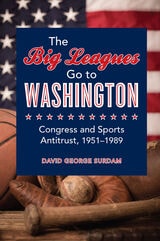
The Big Leagues Go to Washington
Congress and Sports Antitrust, 1951-1989David George Surdam
University of Illinois Press, 2015
In The Big Leagues Go to Washington, David Surdam chronicles the key issues that arose during the hearings and the ways opposing sides used economic data and theory to define what was right, what was feasible, and what was advantageous to one party or another. As Surdam shows, the hearings affected matters as fundamental to the modern game as broadcasting rights, player drafts and unions, league mergers, and the dominance of the New York Yankees. He also charts how lawmakers from the West and South pressed for the relocation of ailing franchises to their states and the ways savvy owners dodged congressional interference when they could and adapted to it when necessary.
The Bilingual Courtroom
Court Interpreters in the Judicial ProcessSusan Berk-Seligson
University of Chicago Press, 2003
Drawing on more than one hundred hours of taped recordings of Spanish/English court proceedings in federal, state, and municipal courts—along with extensive psycholinguistic research using translated testimony and mock jurors—Susan Berk-Seligson's seminal book presents a systematic study of court interpreters, and raises some alarming, vitally important concerns: contrary to the assumption that interpreters do not affect the contents of court proceedings, they could potentially make the difference between a defendant being found guilty or innocent of a crime.
The Bilingual Courtroom
Court Interpreters in the Judicial Process, Second EditionSusan Berk-Seligson
University of Chicago Press, 2017
Susan Berk-Seligson’s groundbreaking book draws on more than one hundred hours of audio recordings of Spanish/English court proceedings in federal, state, and municipal courts—along with a number of psycholinguistic experiments involving mock juror reactions to interpreted testimony—to present a systematic study of court interpreters that raises some alarming, vitally important concerns. Contrary to the assumption that interpreters do not affect the dynamics of court proceedings, Berk-Seligson shows that interpreters could potentially make the difference between a defendant being found guilty or not guilty of a crime.
This second edition of the The Bilingual Courtroom includes a fully updated review of both theoretical and policy-oriented research relevant to the use of interpreters in legal settings, particularly from the standpoint of linguistic pragmatics. It provides new insights into interpreting in quasi-judicial, informal, and specialized judicial settings, such as small claims court, jails, and prisons; updates trends in interpreter certification and credentialing, both in the United States and abroad; explores remote interpreting (for example, by telephone) and interpreter training programs; looks at political trials and tribunals to add to our awareness of international perspectives on court interpreting; and expands upon cross-cultural issues. Also featuring a new preface by Berk-Seligson, this second edition not only highlights the impact of the previous versions of The Bilingual Courtroom, but also draws attention to the continued need for critical study of interpreting in our ever diversifying society.

The Bill of Rights in the Modern State
Edited by Geoffrey R. Stone, Richard A. Epstein, and Cass R. Sunstein
University of Chicago Press, 1992
The contributors to this volume are among the most prominent constitutional scholars in the country. Most of the essays are grouped in pairs, each of which offers conflicting positions on current constitutional controversies, including property rights, freedom of religion, freedom of speech, levels of generality in constitutional interpreation, and unemumerated rights.
The contributors are: Bruce Ackerman, Mary E. Becker, Ronald Dworkin, Frank H. Easterbrook, Richard A. Epstein, Charles Fried, Mary Ann Glendon, Philip B. Kurland, Frank J. Michaelman, Michael W. McConnell, Richard A. Posner, Kathleen M. Sullivan, John Paul Stevens, David A. Strauss, and Cass R. Sunstein.
"A thoughtful and well coordinated set of exchanges between leading modern constitutional theorists about the most significant issues related to the Bill of Rights and the Welfare State. These issues are debated through penetrating essays by opposing theorists who get to the heart of these issues and provide significant answers to their debate opponents' points."—Thomas R. Van Dervort, Southeastern Political Review
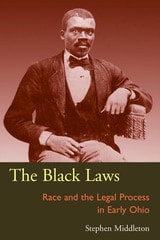
The Black Laws
Race and the Legal Process in Early OhioStephen Middleton
Ohio University Press, 2005

The Bloody Sunday Inquiry
The Families Speak OutEdited by Eamonn McCann
Pluto Press, 2005
Twenty-one wounded survivors and relatives of the dead describe the campaign which led to the establishment of the Inquiry under Lord Saville. They reveal their bitterness at the 'whitewash' of the first inquiry under Lord Chief Justice Widgery, and describe the frustrations and elations of their long struggle to force the British Government to launch a new search for the truth.
The relatives comment sharply on Saville’s performance, and on the attitudes of British and Irish politicians, the media and an array of celebrity lawyers. They reflect on whether soldiers and leading politicians should now be prosecuted for murder, and discuss whether the outcome of the Inquiry is likely to hinder or enhance the peace process. Will the truth about Bloody Sunday raise more ghosts than it sets to rest?
This is the story of the longest legal proceedings in British or Irish history in the raw words of those most intimately involved. What they have to say puts a new focus on the significance of State atrocities in shaping perceptions of the past and aspirations for the future in Ireland.
The Bonfire of The Decencies
Repairing and Restoring the British ConstitutionPeter Hennessy and Andrew Blick
Haus Publishing, 2022
In The Bonfire of the Decencies, Peter Hennessy and Andrew Blick use Boris Johnson’s tenure as prime minister to argue that mechanisms for the upholding of constitutional principles in the United Kingdom are deficient and require an overhaul. They show that, from the outset, Johnson’s time in office was a source of serious disruption that saw standards and integrity compromised, as well as constitutional values violated. Those problems, however, did not end with Johnson’s removal from office. Rather, they are part of longer-term tendencies in the UK, and of a worrying international trend towards the weakening of democracy. Hennessy and Blick analyze the pre-existing vulnerabilities that Johnson exposed in the UK system of government and conclude with a series of proposals to repair the damage and prevent a repetition of this anxious episode in the UK’s political history.

The Borders of Responsibility
Migration Control in the Mediterranean SeaKiri Olivia Santer
Duke University Press, 2026
The Case That Never Dies
The Lindbergh KidnappingLloyd C. Gardner
Rutgers University Press, 2004
The Case That NeverDies places the Lindbergh kidnapping, investigation, and trial in the context of the Depression, when many feared the country was on the edge of anarchy. Gardner delves deeply into the aspects of the case that remain confusing to this day, including Lindbergh’s dealings with crime baron Owney Madden, Al Capone’s New York counterpart, as well as the inexplicable exploits of John Condon, a retired schoolteacher who became the prosecution’s best witness. The initial investigation was hampered by Colonel Lindbergh, who insisted that the police not attempt to find the perpetrator because he feared the investigation would endanger his son’s life. He relented only when the child was found dead.
After two years of fruitless searching, Bruno Richard Hauptmann, a German immigrant, was discovered to have some of the ransom money in his possession. Hauptmann was arrested, tried, and sentenced to death. Throughout the book, Gardner pays special attention to the evidence of the case and how it was used and misused in the trial. Whether Hauptmann was guilty or not, Gardner concludes that there was insufficient evidence to convict him of first-degree murder.
Set in historical context, the book offers not only a compelling read, but a powerful vantage point from which to observe the United States in the 1930s as well as contemporary arguments over capital punishment.
The Case for Palestine
An International Law PerspectiveJohn Quigley
Duke University Press, 2005
In this volume, Quigley provides a thorough understanding of both sides of the conflict in the context of international law. He contends that the Palestinians have a stronger legal claim to Jerusalem than do the Israelis; that Palestinian refugees should be repatriated to areas including those within the borders of Israel; and that Israel should withdraw from the territory it occupied in 1967. As in his earlier volume, Quigley provides an extensively documented evaluation of the conflict over the last century, discussing the Zionist movement, the League of Nations’ decision to promote a Jewish homeland in Palestine, the 1948 war and creation of Israel, and Israel’s occupation of the West Bank, Gaza Strip, and Golan Heights during the 1967 war.
The Case for the Prosecution in the Ciceronian Era
Michael C. Alexander
University of Michigan Press, 2003
The Causes and Consequences of Antitrust
The Public-Choice PerspectiveEdited by Fred S. McChesney and William F. Shughart II
University of Chicago Press, 1995
The contributors are Peter Asch, George Bittlingmayer, Donald J. Boudreaux, Malcolm B. Coate, Louis De Alessi, Thomas J. DiLorenzo, B. Epsen Eckbo, Robert B. Ekelund, Jr., Roger L. Faith, Richard S. Higgins, William E. Kovacic, Donald R. Leavens, William F. Long, Fred S. McChesney, Mike McDonald, Stephen Parker, Richard A. Posner, Paul H. Rubin, Richard Schramm, Joseph J. Seneca, William F. Shughart II, Jon Silverman, George J. Stigler, Robert D. Tollison, Charlie M. Weir, Peggy Wier, and Bruce Yandle.
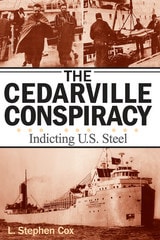
The Cedarville Conspiracy
Indicting U.S. SteelL. Stephen Cox
University of Michigan Press, 2005
The Cedarville Conspiracy is the story of that doomed ship and its crew. It is also the first Great Lakes history to expose the heroism, villainy, courage, and confusion surrounding the Cedarville disaster.
In atmospheric, cinematic style, L. Stephen Cox's gripping page-turner dramatizes the events surrounding the collision between the Norwegian and American freighters. As the mortally wounded Cedarville began to list and sink, U.S. Steel refused to allow the crew to escape to safety, while the captain secretly donned his life jacket and abandoned the sinking ship. Ten seamen died in the frigid waters that morning as the captain and survivors swam to safety.
Researching the story, author L. Stephen Cox interviewed the surviving crew and their rescuers and attorneys, examined more than 20,000 pages of Coast Guard reports, and discovered deposition transcripts and other documentary evidence that detailed the deterioration of the ship, the captain's disregard of Great Lakes navigational rules, the company's participation in the decision to confine the men aboard the sinking vessel, and the subsequent efforts by U.S. Steel to manipulate the evidence.
The Changing Borders of Juvenile Justice
Transfer of Adolescents to the Criminal CourtEdited by Jeffrey Fagan and Franklin E. Zimring
University of Chicago Press, 2000
Research in this area has not kept pace with these legislative developments. There has never been a detailed, sociolegal analytic book devoted to this topic. In this important collection, researchers discuss policy, substantive procedural and empirical dimensions of waivers, and where the boundaries of the courts lie. Part 1 provides an overview of the origins and development of law and contemporary policy on the jurisdiction of adolescents. Part 2 examines the effects of jurisdictional shifts. Part 3 offers valuable insight into the developmental and psychological aspects of current and future reforms.
Contributors: Donna Bishop, Richard Bonnie, M. A. Bortner, Elizabeth Cauffman, Linda Frost Clausel, Robert O. Dawson, Jeffrey Fagan, Barry Feld, Charles Frazier, Thomas Grisso, Darnell Hawkins, James C. Howell, Akiva Liberman, Richard Redding, Simon Singer, Laurence Steinberg, David Tanenhaus, Marjorie Zatz, and Franklin E. Zimring
The Chicago Canon on Free Inquiry and Expression
Edited by Tony Banout and Tom Ginsburg
University of Chicago Press, 2024
Free inquiry and expression are hotly contested, both on campus and in social and political life. Since its founding in the late nineteenth century, the University of Chicago has been at the forefront of conversations around free speech and academic freedom in higher education. The University’s approach to free expression grew from a sterling reputation as a research university as well as a commitment to American pragmatism and democratic progress, all of which depended on what its first president referred to as the “complete freedom of speech on all subjects.” In 2015, more than 100 years later, then University provost and president J. D. Isaacs and Robert Zimmer echoed this commitment, releasing a statement by a faculty committee led by law professor Geoffrey R. Stone that has come to be known as the Chicago Principles, now adopted or endorsed by one hundred US colleges and universities. These principles are just a part of the long-standing dialogue at the University of Chicago around freedom of expression—its meaning and limits. The Chicago Canon on Free Inquiry and Expression brings together exemplary documents – some published for the first time here – that explain and situate this ongoing conversation with an introductory essay that brings the tradition to light.
Throughout waves of historical and societal challenges, this first principle of free expression has required rearticulation and new interpretations. The documents gathered here include, among others, William Rainey Harper’s “Freedom of Speech” (1900), the Kalven Committee’s report on the University’s role in political and social action (1967), and Geoffrey R. Stone’s “Free Speech on Campus: A Challenge of Our Times” (2016). Together, the writings of the canon reveal how the Chicago tradition is neither static nor stagnant, but a vibrant experiment; a lively struggle to understand, practice, and advance free inquiry and expression.
At a time of nationwide campus speech debates, engaging with these texts and the questions they raise is essential to sustaining an environment of broad intellectual and ideological diversity. This book offers a blueprint for the future of higher education’s vital work and points to the civic value of free expression.
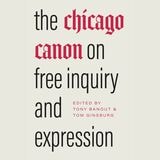
The Chicago Canon on Free Inquiry and Expression
Edited by Tony Banout and Tom Ginsburg
University of Chicago Press, 2024
A collection of texts that provide the foundation for the University of Chicago’s longstanding tradition of free expression, principles that are at the center of current debates within higher education and society more broadly.
Free inquiry and expression are hotly contested, both on campus and in social and political life. Since its founding in the late nineteenth century, the University of Chicago has been at the forefront of conversations around free speech and academic freedom in higher education. The University’s approach to free expression grew from a sterling reputation as a research university as well as a commitment to American pragmatism and democratic progress, all of which depended on what its first president referred to as the “complete freedom of speech on all subjects.” In 2015, more than 100 years later, then University provost and president J. D. Isaacs and Robert Zimmer echoed this commitment, releasing a statement by a faculty committee led by law professor Geoffrey R. Stone that has come to be known as the Chicago Principles, now adopted or endorsed by one hundred US colleges and universities. These principles are just a part of the long-standing dialogue at the University of Chicago around freedom of expression—its meaning and limits. The Chicago Canon on Free Inquiry and Expression brings together exemplary documents – some published for the first time here – that explain and situate this ongoing conversation with an introductory essay that brings the tradition to light.
Throughout waves of historical and societal challenges, this first principle of free expression has required rearticulation and new interpretations. The documents gathered here include, among others, William Rainey Harper’s “Freedom of Speech” (1900), the Kalven Committee’s report on the University’s role in political and social action (1967), and Geoffrey R. Stone’s “Free Speech on Campus: A Challenge of Our Times” (2016). Together, the writings of the canon reveal how the Chicago tradition is neither static nor stagnant, but a vibrant experiment; a lively struggle to understand, practice, and advance free inquiry and expression.
At a time of nationwide campus speech debates, engaging with these texts and the questions they raise is essential to sustaining an environment of broad intellectual and ideological diversity. This book offers a blueprint for the future of higher education’s vital work and points to the civic value of free expression.
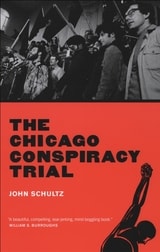
The Chicago Conspiracy Trial
Revised EditionJohn Schultz
University of Chicago Press, 2009
In 1969, the Chicago Seven were charged with intent to "incite, organize, promote, and encourage" antiwar riots during the chaotic 1968 Democratic National Convention in Chicago. The defendants included major figures of the antiwar and racial justice movements: Abbie Hoffman and Jerry Rubin, the madcap founders of the Yippies; Tom Hayden and Rennie Davis, longtime antiwar organizers; David Dellinger, a pacifist and chair of the National Mobilization Committee to End the War in Vietnam; and Bobby Seale, co-founder of the Black Panther Party, who would be bound and gagged in the courtroom before his case was severed from the rest.
The Chicago Conspiracy Trial is an electrifying account of the months-long trial that commanded the attention of a divided nation. John Schultz, on assignment for The Evergreen Review, witnessed the whole trial of the Chicago Seven, from the jury selection to the aftermath of the verdict. In his vivid account, Schultz exposes the raw emotions, surreal testimony, and judicial prejudice that came to define one of the most significant legal events in American history.
In October 2020, Aaron Sorkin's film, The Trial of the Chicago Seven, will bring this iconic trial to the screen.
The Chicago Handbook of University Technology Transfer and Academic Entrepreneurship
Edited by Albert N. Link, Donald S. Siegel, and Mike Wright
University of Chicago Press, 2015
The Chicago Handbook of University Technology Transfer and Academic Entrepreneurship is the first definitive source to synthesize state-of-the-art research in this arena. Edited by three of the foremost experts in the field, the handbook presents evidence from entrepreneurs, administrators, regulators, and professors in numerous disciplines. Together they address the key managerial and policy implications through chapters on how to sustain successful research ventures, ways to stimulate academic entrepreneurship, maintain effective open innovation strategies, and improve the performance of university technology transfer offices.
A broad and ambitious work, the handbook offers comprehensive coverage for universities of all types, allowing them to confidently handle technology commercialization and further cultivate innovation.