Results by title
83 books match the query 'Man' and 25 start with t
Tendings
Feminist Esoterisms and the Abolition of ManNathan Snaza
Duke University Press, 2024

The Boy of Battle Ford and the Man
W. S. Blackman
Southern Illinois University Press, 2012
A classic story of a young man’s journey to adulthood, The Boy of Battle Ford covers Blackman’s years growing up in early post-settlement Illinois, where he gave in to temptations such as drinking, gambling, and the lure of prostitutes before joining the army, finding God and becoming a preacher. Blackman, who notes that he is determined to “write facts” in this book, peppers his story with the sordid details of the sinful times of his life as well as with discussions of faith and of struggling to understand his God and his beliefs.
The City and Man
Leo Strauss
University of Chicago Press, 1978

The Daughter of Man
L. J. Sysko
University of Arkansas Press, 2023
"This whip-smart collection is a playful celebration of feminine power.”
—Publisher’s Weekly
"What a beautiful book.”
—Ross Gay
"With the verve of Alice Fulton and the panache of Gerald Stern, Sysko keens into the canon, a welcome voice. Sing, indeed, heavenly muse.”
—Alan Michael Parker
Finalist for the 2023 Miller Williams Poetry Prize
Selected by Patricia Smith
The Daughter of Man follows its unorthodox heroine as she transforms from maiden to warrior—then to queen, maven, and crone—against the backdrop of suburban America from the 1980s to today. In this bold reframing of the hero’s journey, L. J. Sysko serves up biting social commentary and humorous, unsparing self-critique while enlisting an eccentric cast that includes Betsy Ross as sex worker, Dolly Parton as raptor, and a bemused MILF who exchanges glances with a young man at a gas station. Sysko’s revisions of René Magritte’s modernist icon The Son of Man and the paintings of baroque artist Artemisia Gentileschi, whose extraordinary talent was nearly eclipsed after she took her rapist to trial, loom large in this multifaceted portrait of womanhood. With uncommon force, The Daughter of Man confronts misogyny and violence, even as it bursts with nostalgia, lust, and poignant humor.

The End of Man
A Feminist CounterapocalypseJoanna Zylinska
University of Minnesota Press, 2018
Debugging the Anthropocene’s insistence on apocalyptic tropes
Where the Anthropocene has become linked to an apocalyptic narrative, and where this narrative carries a widespread escapist belief that salvation will come from a supernatural elsewhere, Joanna Zylinska has a different take. The End of Man rethinks the prophecy of the end of humans, interrogating the rise in populism around the world and offering an ethical vision of a “feminist counterapocalypse,” which challenges many of the masculinist and technicist solutions to our planetary crises. The book is accompanied by a short photo-film, Exit Man, which ultimately asks: If unbridled progress is no longer an option, what kinds of coexistences and collaborations do we create in its aftermath?
Forerunners: Ideas First is a thought-in-process series of breakthrough digital publications. Written between fresh ideas and finished books, Forerunners draws on scholarly work initiated in notable blogs, social media, conference plenaries, journal articles, and the synergy of academic exchange. This is gray literature publishing: where intense thinking, change, and speculation take place in scholarship.
The Expression of the Emotions in Man and Animals
Charles Darwin
University of Chicago Press, 1965
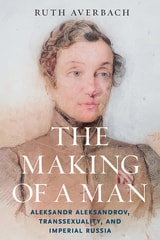
The Making of a Man
Aleksandr Aleksandrov, Transsexuality, and Imperial RussiaRuth Averbach
University of Wisconsin Press, 2026
Aleksandr Aleksandrov was an author and soldier in service of the Russian tsar, active in the Prussian theater of the War of the Fourth Coalition (1806–7) and in the Napoleonic Wars. In scholarship, he is better known by his birth name, Nadezhda Andreevna Durova, and often referred to with the female pronouns bestowed upon him at birth. In this first book-length study of Aleksandrov, Ruth Averbach argues that we should understand this celebrated figure of Imperial Russia, whose sex was legally changed by Tsar Aleksandr I, simply as a man, one whose masculinity was intimately connected to the imperialist cause and Russian nationalism.
For the majority of his life, Aleksandrov lived, wrote, and fought as a man and was recognized as such by most of his contemporaries. This contradicts the dominant position in especially Western feminist scholarship, which understands “Durova” either as a woman so patriotic that she dressed as a man to fight Russia’s wars or as a woman so frustrated by gender restrictions that she dramatically sought to cast them aside. Averbach instead asserts that we should take Aleksandrov at his word and accept his transition as genuine. Doing so allows for fresh interpretations of both his autobiographical writings and his works of fiction, interpretations that Averbach deftly shows have salience not just for a single man’s life but also for how we understand masculinity, imperialism, and nationalism in nineteenth-century Russia more broadly.

The Man With Many Pens
Jonathan Wells
Four Way Books, 2015
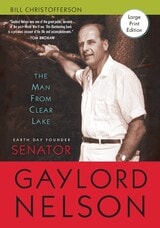
The Man from Clear Lake
Earth Day Founder Senator Gaylord NelsonBill Christofferson
University of Wisconsin Press, 2009
On Earth Day 1970 twenty million Americans displayed their commitment to a clean environment. It was called the largest demonstration in human history, and it permanently changed the nation’s political agenda. By Earth Day 2000 participation had exploded to 500 million people in 167 countries.
The seemingly simple idea—a day set aside to focus on protecting our natural environment—was the brainchild of U.S. Senator Gaylord Nelson of Wisconsin. It accomplished, far beyond his expectations, his lifelong goal of putting the environment onto the nation’s and the world’s political agendas.
A remarkable man, Nelson ranks as one of history’s leading environmentalists. He also played a major role as an early, outspoken opponent of the Vietnam War, and as a senate insider was a key player in civil rights, poverty, civil liberties and consumer protection issues.
The life of Nelson, a small town boy who learned his values and progressive political principles at an early age, is woven through the political history of the twentieth century. Nelson’s story intersects at times with Fighting Bob La Follette, Joe McCarthy, and Bill Proxmire in Wisconsin, and with George McGovern, Lyndon Johnson, Hubert Humphrey, Russell Long, Walter Mondale, John F. Kennedy, and others on the national scene.
Winner, Elizabeth A. Steinberg Prize, University of Wisconsin Press
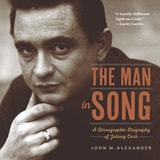
The Man in Song
A Discographic Biography of Johnny CashJohn M. Alexander
University of Arkansas Press, 2018
There have been many books written about Johnny Cash, but The Man in Song is the first to examine Cash’s incredible life through the lens of the songs he wrote and recorded. Music journalist and historian John Alexander has drawn on decades of studying Cash’s music and life, from his difficult depression-era Arkansas childhood through his death in 2003, to tell a life story through songs familiar and obscure. In discovering why Cash wrote a given song or chose to record it, Alexander introduces readers anew to a man whose primary consideration of any song was the difference music makes in people’s lives, and not whether the song would become a hit.
The hits came, of course. Johnny Cash sold more than fifty million albums in forty years, and he holds the distinction of being the only performer inducted into the Rock and Roll Hall of Fame, the Country Music Hall of Fame, the Songwriters Hall of Fame, and the Gospel Music Hall of Fame. The Man in Song connects treasured songs to an incredible life. It explores the intertwined experience and creativity of childhood trauma. It rifles through the discography of a life: Cash’s work with the Tennessee Two at Sam Phillips’s Sun Studios, the unique concept albums Cash recorded for Columbia Records, the spiritual songs, the albums recorded live at prisons, songs about the love of his life, June Carter Cash, songs about murder and death and addiction, songs about ramblers, and even silly songs.
Appropriate for both serious country and folk music enthusiasts and those just learning about this musical legend, The Man in Song will appeal to a fan base spanning generations. Here is a biography for those who first heard “I Walk the Line” in 1956, a younger generation who discovered Cash through songs like his cover of Trent Reznor’s “Hurt,” and everyone in between.

The Man in the Banana Trees
Marguerite Sheffer
University of Iowa Press, 2024
A Debutiful “Most Anticipated Debut Book of 2024”
One of Electric Literature’s Most Exciting Debut Short Story Collection of 2024
Named a Best Book of 2024 by Debutiful and Electric Literature
The stories in The Man in the Banana Trees take place in the past, present, and future—from the American Gulf South to the orbit around Jupiter. We meet teachers and students, ghosts and aliens. An ice cream consultant in the year 2036 predicts a devastating flavor trend and a disgruntled New England waiter investigates a mysterious tanker crash. Although wildly varied in setting, length, and genre, a thread of the fantastic unites these stories, as characters struggle to understand that thing lurking at the edge of their perception: something sinister, or maybe—miraculous.
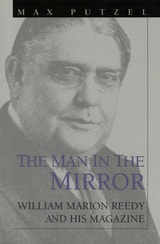
The Man in the Mirror
William Marion Reedy and His MagazineMax Putzel
University of Missouri Press, 1998
A flamboyant and controversial figure, William Marion Reedy was one of the most successful literary entrepreneurs of his day. Editor of the Mirror, a St. Louis weekly, from 1891 to 1920, Reedy played a large role in breaking down the genteel literary tradition, developing a native poetry, and helping to form some fifty significant poets. Emily Dickinson, Stephen Crane, Ezra Pound, Edwin Arlington Robinson, Amy Lowell, Sara Teasdale, Carl Sandburg, and Vachel Lindsay are just a few of the writers whose works Reedy featured in his magazine.
The Man in the Mirror offers a colorful description of Reedy's boyhood in St. Louis during the turbulent period following the Civil War. This well-documented biography follows Reedy throughout his years as a reporter in the early days of the St. Louis Post-Dispatch and Globe-Democrat and as editor of the St. Louis Star. Only seven years after Reedy founded the Mirror as a national journal of opinion--a potpourri of political comment, social gossip, and literary miscellany—the magazine's circulation far surpassed that of the Dial, Atlantic Monthly, or Nation.
Max Putzel truly conveys the spirit and personality of Reedy by carefully examining his life within the context of the literary world he influenced so significantly. Full chapters are devoted to his relationships with Theodore Dreiser, Ezra Pound, Vachel Lindsay, Amy Lowell, and others. Edgar Lee Masters, whose Spoon River Anthology first appeared in the Mirror, called Reedy both the "Literary Boss of the Middle West" and his best friend. In fact, Reedy had quite a range of friends, from librarians to politicians, St. Louis locals to Teddy Roosevelt. His personal effect on people, writers and readers alike, is what has made him such an important historical figure.
It is a tribute to Reedy's critical judgment that the reputations he helped to build would later overshadow his own. The Man in the Mirror, lauded as "the first substantial study of Reedy's work" by American Literature, reveals Reedy's notable contribution to the literary world.
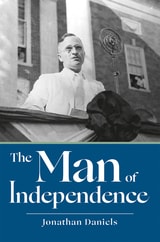
The Man of Independence
Jonathan Daniels
University of Missouri Press, 1998
Having worked closely with Harry S. Truman in the triumphant campaign of 1948, Jonathan Daniels believed that President Truman was an "everyday" American, an ordinary human who aspired to greatness and achieved it. Thus, it was Daniels's intention that The Man of Independence not be a conventional biography; rather, he wanted it to reveal in real terms "the Odyssey of the 'everyday' American through our times." As a result, this comprehensive work not only presents Truman's life, it also details the development of the America in which the president grew up.
Truman spent his youth and his political life believing that old- fashioned, determined conservatism was vital to the preservation of personal liberty. Daniels re-creates Truman's remarkable journey through life—employing newspapers, letters, memos, family papers, as well as interviews with Truman, his family, and his close acquaintances. In the process, Daniels provides powerful evocations of the time during which Truman lived.
Daniels tells this extraordinary story by following this simple farm boy from Missouri through his youth and his years as a farmer, a veteran, and a businessman, on to his early career in politics, and then his presidency. Along the way, Daniels deals with issues, events, and ideas that were part of Missouri and American politics in the 1920s, 1930s, and 1940s; ultimately, he gives us the Truman who was to become the legend.
This inside account provides thought-provoking and personal information about Truman. His relationship with Thomas Pendergast, the seeming conflict between Truman's midwestern conservatism and his belief in equality for American blacks, and his momentous decision to use the atomic bomb to end the war—these are just a few of the topics touched on. Ending in 1949 when Truman was for the second time sworn in as president, The Man of Independence provides a fascinating and valuable look at one of America's most important and beloved presidents, as well as a crucial look at the America from which he emerged.
The Man of Many Devices, Who Wandered Full Many Ways
Festschrift in Honor of János M. BakBalázs Nagy
Central European University Press, 1999

The Man on the Tower
PoemsCharles Rafferty
University of Arkansas Press, 1995

The Man with the Black Coat
Russia's Literature of the AbsurdDaniil Kharms and Alexander Vvedensky
Northwestern University Press, 1997
The Man with the Branded Hand
The Life of Jonathan Walker, AbolitionistAlvin F. Oickle
Westholme Publishing, 2011
Captured While Attempting to Smuggle Slaves to Freedom in 1844, the Only Man Branded in a Courtroom by a United States Marshal
Sailing around the Florida Keys in 1844, forty-five-year-old Jonathan Walker had a price on his head. On board the small boat he had built that winter in Alabama were seven fugitives from slavery. The Cape Cod sailor and abolitionist was wanted in Pensacola, Florida, for his crime: stealing slaves. The slaves’ owners had posted $100 each as reward money for their property and $1,000 for Walker’s apprehension. Only a day’s sail from their goal of freedom in British-controlled Bahamas, Walker and the slaves were stopped and seized by bounty hunters and taken to a Key West court. Ordered back to Pensacola for trial, Walker ended up spending a year in jail. He was fined and sentenced to stand in the pillory; in addition, he was to suffer a unique punishment in American history: while a packed courtroom watched, a United States marshal was ordered to use a hot branding iron to burn the letters SS, for “slave stealer,” into Walker’s right hand.
Walker survived his ordeal, spending much of his incarceration in isolation. Once released, he remained active in the antislavery movement even while he and his devoted wife Jane raised their nine children. His attempt to help form a new colony in Mexico for runaway American slaves also led to punishing experiences for Walker and one of his sons. Living later with his family in Plymouth, Massachusetts, in the years before the Civil War, Walker made room in his crowded house to shelter runaway slaves along the Underground Railroad. He participated in abolitionist lecture tours across the North where he would be urged to reveal his branded hand—made famous by John Greenleaf Whittier’s poem “The Branded Hand”—to astonished audiences. Too old to enlist in the Civil War, Walker instead headed to Virginia in the war’s final year to help educate African Americans fleeing Confederate forces. In The Man With the Branded Hand: The Life of Jonathan Walker, Abolitionist, distinguished journalist Alvin F. Oickle relates this entire remarkable story of a life devoted to the supposition that “all men are created equal.”

The Man with the Getaway Face
A Parker NovelRichard Stark
University of Chicago Press, 1963
Parker goes under the knife in The Man with the Getaway Face, changing his face to escape the mob and a contract on his life. Along the way he scores his biggest heist yet, but there’s a catch—a beautiful, dangerous catch who goes by the name Alma.

The Molds and Man
An Introduction to the FungiClyde M. Christensen
University of Minnesota Press, 1965
The Molds and Man was first published in 1965. Minnesota Archive Editions uses digital technology to make long-unavailable books once again accessible, and are published unaltered from the original University of Minnesota Press editions.
This highly readable volume on a little-known but important subject has been widely used as a text and reference book by the student as well as the interested layman.
The Natural Goodness of Man
On the System of Rousseau's ThoughtArthur M. Melzer
University of Chicago Press, 1990
Arthur M. Melzer adopts this approach in The Natural Goodness of Man. The first two parts of the book restore the original, revolutionary significance of this now time-worn principle and examine the arguments Rousseau offers in proof of it. The final section unfolds and explains Rousseau’s programmatic thought, especially the Social Contract, as a precise solution to the human problem as redefined by the principle of natural goodness.
The result is a systematic reconstruction of Rousseau’s philosophy that discloses with unparalleled clarity both the complex weave of his argument and the majestic unity of his vision. Melzer persuasively resolves one after another of the famous Rousseauian paradoxes–enlarging, in the process, our understanding of modern philosophy and politics. Engagingly and lucidly written, The Natural Goodness of Man will be of interest to general as well as scholarly readers.
The Renaissance Philosophy of Man
Petrarca, Valla, Ficino, Pico, Pomponazzi, VivesEdited by Ernst Cassirer, Paul Oskar Kristeller, and John Herman Randall Jr.
University of Chicago Press, 1956
The Science of Man in Ancient Greece
Maria Michela Sassi
University of Chicago Press, 2000
Maria Michela Sassi reconstructs Greek attempts to answer such questions from Homer's day to late antiquity, ranging across physiognomy, ethnography, geography, medicine, and astrology. Sassi demonstrates that in the Greek science of man, empirical observations were inextricably bound up with a prejudiced view of the free Greek male as superior to all others. Thus, because women were assumed to have pale skin from staying indoors too much, Greek biology and medicine sought to explain this feature as an indication of the "cold" nature of women, as opposed to the "hot" constitution of men.
For this English translation, Sassi has rewritten the introduction and updated the text and references throughout, and Sir Geoffrey Lloyd has provided a new foreword.

The White Plague
Tuberculosis, Man and SocietyDubos, Jean
Rutgers University Press, 1987
In The White Plague, René and Jean Dubos argue that the great increase of tuberculosis was intimately connected with the rise of an industrial, urbanized society and—a much more controversial idea when this book first appeared forty years ago—that the progress of medical science had very little to do with the marked decline in tuberculosis in the twentieth century.
The White Plague has long been regarded as a classic in the social and environmental history of disease. This reprint of the 1952 edition features new introductory writings by two distinguished practitioners of the sociology and history of medicine. David Mechanic's foreword describes the personal and intellectual experience that shaped René Dubos's view of tuberculosis. Barbara Gutmann Rosenkrantz's historical introduction reexamines The White Plague in light of recent work on the social history of tuberculosis. Her thought-provoking essay pays particular attention to the broader cultural and medical assumptions about sickness and sick people that inform a society’s approach to the conquest of disease.
The White River Chronicles of S. C. Turnbo
Man and Wildlife on the Ozarks FrontierJames Keefe
University of Arkansas Press, 1999
This highly readable folklore collection highlights the most representative and evocative tales in the twenty-five hundred pages of backwoods stories collected by Silas Tunbo toward the end of the last century. Turnbo and his informants, antebellum Ozarks natives, believed that the legends of the hunt were, as William Faulkner would write, “the best of all breathing and forever the best of all listening.”
With no apology, the first settlers on the southern frontiers became predators in their own environment. They embraced blood sport and sought its rewards at every turn. The chase promised them a sureness of profit more predictable than land speculation, timbering, or commercial agriculture.
These early opportunists believed that the greatest natural resource along the lush White River drainages in Missouri and Arkansas was large game. Although surrounded by living waters, climax forests, and luxuriant grasses, the tellers of Turnbo’s stories only incidentally made mention of flora. Silas Turnbo and his informants were fascinated by animals and the settlers’ ongoing relationship with them—a relationship often defined by contents for supremacy.
Significantly, Tunbo’s education included only a few years in subscription schools of the 1850s. His writing is direct and in the idiom of hte Ozarks, including spellings that are occasionally whimsical, perfectly befitting these “fireside stories” of the great outdoor drama of the southern frontiers.
Two Lessons on Animal and Man
Gilbert Simondon
University of Minnesota Press, 2011
Simondon is a secret password among certain discussions within philosophy today. As a philosopher of technology, Simondon’s work has a place at the forefront of current thinking in media, technology, psychology, and philosophy with complex accounts of man’s relationship to technology and the realm that continues to form itself via this tension between man and his technical universe. In this introduction to Simondon’s oeuvre, the reader has access to the grounding of one of the most fundamental and critical questions that has been the focus of philosophy for millennia: the relationship between man and animal.