Results by title
231 books match the query 'Revolutionary Period (1775-1800)' and 70 start with t
TALES OF THE ARKANSAS FRONTIER
Territorial and Early Statehood ErasJON DAVID CASH
Parkhurst Brothers, Inc., 2025
Taking Sides in Revolutionary New Jersey
Caught in the CrossfireMaxine N. Lurie
Rutgers University Press, 2022
Supplemental Instructor Resources for Taking Sides in Revolutionary New Jersey:
Questions (https://d3tto5i5w9ogdd.cloudfront.net/wp-content/uploads/2022/07/19144155/Taking-Sides-Supplementary-Instructor-Resources-Questions.pdf)
Bibliography (https://d3tto5i5w9ogdd.cloudfront.net/wp-content/uploads/2022/07/19144154/Taking-Sides-Supplementary-Instructor-Resources-Bibliography.pdf)
Teller Tales
HistoriesJo Carson
Ohio University Press, 2007
“All my work fits in my mouth,” Jo Carson says. “I write performance material no matter what else the pieces get called, and whether they are for my voice or other characters’ voices … they are first to be spoken aloud.” Following an oral tradition that has strong roots in her native Tennessee, the author of Teller Tales invites the reader to participate in events in a way that no conventional history book can.
Both stories in this book are set in East Tennessee in the mid-eighteenth century and share certain characters. The first narrative, “What Sweet Lips Can Do,” recounts the story of the Overmountain Men and the battle of King’s Mountain, a tide-turning battle in the American Revolution. “Men of Their Time” is an exploration of white-Cherokee relationships from early contact through the time of the Revolution.
Although not well known to the outside world, the stories recounted in Teller Tales are cornerstones in the heritage of the Appalachian region and of American history. In ways that will appeal to young and old alike, Jo Carson’s irreverent telling will broaden the audience and the understanding for the stories of native Americans, settlers, explorers, and revolutionaries of early America.
The Algerine Spy in Pennsylvania
Peter Markoe
Westholme Publishing, 2008
An Important Book in America’s Early Encounter with the Arab World
“A pungent satire on American affairs.” —Samuel Eliot Morison
In 1787, while American sailors languished in a Barbary prison, delegates debated the Constitution in Philadelphia. Despite America’s desire to respond to the crisis, without a central government, the new republic had no means to create a naval force. Enter an anonymously published book, The Algerine Spy in Pennsylvania: or, Letters Written by a Native of Algiers on the Affairs of the United States in America, which began circulating among the delegates. Consisting of a series of letters ostensibly written by an Algerian agent “Mehmet” back to his leader, the spy predicted that the former colonies would never be able to resolve their differences and be “ruined by disunion.” The book created a sensation and it helped tip the balance for those in favor of adopting the new Constitution. Following the Constitution’s final ratification in 1789, the United States created a navy and began asserting its power overseas. With its commentary about men and women, business and pleasure, and historical and religious comparisons between nations, The Algerine Spy in Pennsylvania provides both a contemporary snapshot of early American life and the political ideas of the period. Never before reprinted, and recently rated one of the five best works in the history of America’s encounter with the Arab world, this new edition is edited by historian Timothy Marr, who reconsiders the importance of this early work in the political and literary history of the United States.
The American Revolution and the Press
The Promise of IndependenceCarol Sue Humphrey
Northwestern University Press, 2013
Carol Sue Humphrey’s The American Revolution and the Pressargues that newspapers played an important role during America’s struggle for independence by keeping Americans engaged in the war even when the fighting occurred in distant locales. From the moment that the colonials received word of Britain’s new taxes in 1764 until reports of the peace treaty arrived in 1783, the press constituted the major source of information about events and developments in the conflict with the mother country. Both Benjamin Franklin, one of the Revolution’s greatest leaders, and Ambrose Serle, a Loyalist, described the press as an “engine” that should be used to advance the cause. The efforts of Patriot printers to keep readers informed about the war helped ensure ultimate success by boosting morale and rallying Americans to the cause until victory was achieved. As Humphrey illustrates, Revolutionary-era newspapers provided the political and ideological unity that helped Americans secure their independence and create a new nation.
The American Revolution in New Jersey
Where the Battlefront Meets the Home FrontJames J. Gigantino II
Rutgers University Press, 2015
Battles were fought in many colonies during the American Revolution, but New Jersey was home to more sustained and intense fighting over a longer period of time. The nine essays in The American Revolution in New Jersey, depict the many challenges New Jersey residents faced at the intersection of the front lines and the home front.
The Articles of Confederation
An Interpretation of the Social-Constitutional History of the American Revolution, 1774-1781Merrill Jensen
University of Wisconsin Press, 1959
"An admirable analysis. It presents, in succinct form, the results of a generation of study of this chapter of our history and summarizes fairly the conclusions of that study."—Henry Steele Commager, New York Times Book Review
The Battle for the Fourteenth Colony
America’s War of Liberation in Canada, 1774–1776Mark R. Anderson
University Press of New England, 2013
The Battle of Gloucester, 1777
Garry Wheeler Stone
Westholme Publishing, 2022
In The Battle of Gloucester, 1777, archaeological historian Garry Wheeler Stone, with the assistance of historian Paul W. Schopp, recreates this minor but important clash during the Philadelphia campaign. Relying on both primary source documents and the latest archaeological interpretations, the authors have determined the course of this fascinating “battle,” as Benjamin Franklin later proclaimed it to be. As a result of this action, when Washington requested that Lafayette be given a division, Congress agreed. On December 4, 1777, the marquis, promoted to major-general, took command of the brigades of Generals Woodford and Scott to begin what would be a glorious career in American service.
Small Battles: Military History as Local History
Mark Edward Lender and James Kirby Martin, Series Editors
Small Battles offers a fresh and important new perspective on the story of America’s early conflicts. It was the small battles, not the clash of major armies, that truly defined the fighting during the colonial wars, the American Revolution, the War of 1812, and the hostilities on the frontiers. This is dramatic military history as seen through the prism of local history—history with a depth of detail, a feeling for place, people, and the impact of battle and its consequences that the story of major battles often cannot convey. The Small Battles series focuses on America’s military conflicts at their most intimate and revealing level.

The Battle of Harlem Heights, 1776
David Price
Westholme Publishing, 2022
The action began when a contingent of rangers led by Col. Thomas Knowlton of Connecticut encountered British light infantry while conducting a reconnaissance mission on Washington’s orders. What began as a skirmish transformed into a full-fledged battle as both sides reinforced, and a heavy engagement continued for several hours until, with ammunition running low, the British withdrew. Washington decided not to pursue and risk confrontation with a larger force, thereby keeping his army intact. In The Battle of Harlem Heights, 1776, David Price conveys the significance of the Continental Army’s first victory and highlights the role of one of its key participants, the largely forgotten Knowlton—the “father of American military intelligence”—who gave his life during the action while urging his rangers forward. No matter how many times U.S. Army troops have recorded a battlefield success over the past two and a half centuries—whether on American soil, in a European wood, across a Middle Eastern desert, or on a Pacific island—one thing about that history remains indisputable. They did it first at Harlem Heights.
Small Battles: Military History as Local History
Mark Edward Lender and James Kirby Martin, Series Editors
Small Battles offers a fresh and important new perspective on the story of America’s early conflicts. It was the small battles, not the clash of major armies, that truly defined the fighting during the colonial wars, the American Revolution, the War of 1812, and the hostilities on the frontiers. This is dramatic military history as seen through the prism of local history—history with a depth of detail, a feeling for place, people, and the impact of battle and its consequences that the story of major battles often cannot convey. The Small Battles series focuses on America’s military conflicts at their most intimate and revealing level.

The Battle of Musgrove's Mill, 1780
John Buchanan
Westholme Publishing, 2022
The Battle of Musgrove’s Mill, 1780, by award-winning historian John Buchanan, begins by describing the situation in South Carolina following the British invasion of 1780 before introducing the three colonels: Isaac Shelby, James Williams, and Elijah Clarke. These men led Rebel militia from North Carolina, South Carolina, and Georgia in an effort to disrupt British operations and their Loyalist support. The colonels and other leaders led mounted Rebel militia in a sweeping and bloody guerilla war that played an essential role in opening a path to the eventual British surrender at Yorktown and Britain’s loss of America.
Small Battles: Military History as Local History
Mark Edward Lender and James Kirby Martin, Series Editors
Small Battles offers a fresh and important new perspective on the story of America’s early conflicts. It was the small battles, not the clash of major armies, that truly defined the fighting during the colonial wars, the American Revolution, the War of 1812, and the hostilities on the frontiers. This is dramatic military history as seen through the prism of local history—history with a depth of detail, a feeling for place, people, and the impact of battle and its consequences that the story of major battles often cannot convey. The Small Battles series focuses on America’s military conflicts at their most intimate and revealing level.

The Battle of Upper Sandusky, 1782
Eric Sterner
Westholme Publishing, 2023
In May 1782, Colonel William Crawford led over 450 volunteers across Ohio to attack British-allied Native Americans who had been raiding the frontiers of Pennsylvania and Virginia for years. An experienced yet reluctant commander, Crawford and his men clashed with a similarly sized force of British Rangers and Wyandot, Delaware, and Shawnee Indians on the Sandusky River in early June. After three days, the Americans were routed in one of the worst defeats American arms suffered on the frontier during the American Revolution. During the retreat, Native American warriors captured dozens of men, including Colonel Crawford. Many were horrifically tortured to death in revenge for the Gnadenhutten massacre earlier that spring, when American volunteers bludgeoned nearly one hundred unarmed and unresisting Delaware Indians to death.
The Battle of Upper Sandusky, 1782 places military operations at the forefront of events in the waning months of the American Revolution on the frontier. Importantly, it gives long-deserved credit to Native American leaders, particularly Dunquat of the Wyandot and Hopocan of the Delaware, for their roles and commands on the battlefield. For over two centuries, their victory was attributed to the presence of British Rangers and a few officers, but Dunquat and Hopocan made the critical decisions before and after the battle while Native American warriors constituted the bulk of their army.
The book also reconsiders the effectiveness of American operations. Crawford was an unenthusiastic commander who had to be talked into leading the campaign to help prevent a repeat of the Gnadenhutten massacre. Despite his long service on the frontier and experience in the Continental Army, Crawford failed to unite his ad hoc command, suffered from constant indecision, and could not put his own stamp on the campaign. The unprofessional nature of his army also contributed to its defeat as it lacked organization, experience, leadership, training, and standardization.
The presence of Simon Girty, demonized by Americans on the frontier as a turncoat, and the gruesomeness of Crawford’s execution focused stories about the campaign on those two individuals, rather than the military operations themselves or the Indians who won the victory. Myths were accepted as fact. Afterward, interest in the campaign and the combatants faded. The Battle of Upper Sandusky, 1782 gives Crawford’s campaign its proper place as one of the largest battles between frontier forces and Native Americans during the Revolutionary War.

The Battles of Connecticut Farms and Springfield, 1780
Edward G. Lengel
Westholme Publishing, 2020
By the spring of 1780, American fortunes were at a low point. Charleston, South Carolina, fell to British forces on May 12. At Morristown, New Jersey, George Washington’s army struggled to recover from the worst winter of the entire war. The national economy failing, his troops short of supplies and on the verge of mutiny, Washington prepared for an all-out assault on British-occupied New York City with the support of approaching French naval and land forces under General Rochambeau. The planned attack was a gamble born of desperation. Washington felt he had to risk it, or face certain defeat. In New York City, German General Wilhelm von Knyphausen sensed opportunity. Commanding there in the absence of British General Henry Clinton, who was on his way back from Charleston, Knyphausen hoped that a quick strike into New Jersey could deliver a staggering blow to Washington’s weakened army. The June 7–8 Battle of Connecticut Farms, however, found American militia and Continentals—mostly soldiers of General William Maxwell’s New Jersey Brigade—to be shockingly stalwart. In a series of sharp engagements, fought hard on both sides, the Americans convinced Knyphausen to turn back. Clinton, fresh from his victory in the South, tried again on June 23 to end the war. His advance into New Jersey, intended to draw Washington into the open and perhaps capture Morristown, culminated in the Battle of Springfield. Once again, though, Washington’s hardened soldiers, led by men like Colonel Israel Angell, Colonel Elias Dayton, and Major “Light Horse Harry” Lee, fought Clinton’s forces to a standstill.
The Battles for Connecticut Farms and Springfield, 1780, by distinguished historian Edward G. Lengel, chronicles these two important battles that marked a turning of the tide in the Revolutionary War. Drawing on newly available primary sources, the author presents a fresh and engaging interpretation of these events, which exposed King George III’s declining military fortunes in North America even as they revealed the resilience of George Washington’s army.
The Small Battles Series: Military History as Local History
Mark Edward Lender and James Kirby Martin, Series Editors
Small Battles offers a fresh and important new perspective on the story of America’s early conflicts. It was the small battles, not the clash of major armies, that truly defined the fighting during the colonial wars, the American Revolution, the War of 1812, and the hostilities on the frontiers. This is dramatic military history as seen through the prism of local history—history with a depth of detail, a feeling for place, people, and the impact of battle and its consequences that the story of major battles often cannot convey. The Small Battles Series focuses on America’s military conflicts at their most intimate and revealing level.
The Battles of Fort Watson and Fort Motte, 1781
Steven D. Smith
Westholme Publishing, 2024

The Birth of American Tourism
New York, the Hudson Valley, and American Culture, 1790-1835Richard H. Gassan
University of Massachusetts Press, 2008
According to Gassan, the origins of American tourism in the Hudson Valley can be traced to a confluence of historical accidents, including the proximity of the region to the most rapidly growing financial and population center in the country, with its expanding middle class, and the remarkable beauty of the valley itself. But other developments also played a role, from the proliferation of hotels to accommodate tourists, to the construction of an efficient transportation network to get them to their destinations, to the creation of a set of cultural attractions that invested their experience with meaning. In the works of Washington Irving and James Fenimore Cooper and the paintings of Thomas Cole and others of the Hudson River School, travelers in the region encountered the nation's first literary and artistic movements. Tourism thus did more than provide an escape from the routines of everyday urban life; it also helped Americans of the early republic shape a sense of national identity.
The Birth of the Republic, 1763-89
Edmund S. Morgan
University of Chicago Press, 1992
In one remarkable quarter-century, thirteen quarrelsome colonies were transformed into a nation. Edmund S. Morgan's classic account of the Revolutionary period shows how the challenge of British taxation started the Americans on a search for constitutional principles to protect their freedom and eventually led to the Revolution.
Morgan demonstrates that these principles were not abstract doctrines of political theory but grew instead out of the immediate needs and experiences of the colonists. They were held with passionate conviction, and incorporated, finally, into the constitutions of the new American states and of the United States.
Though the basic theme of the book and his assessment of what the Revolution achieved remain the same, Morgan has updated the revised edition of The Birth of the Republic (1977) to include some textual and stylistic changes as well as a substantial revision of the Bibliographic Note.
The Birth of the Republic, 1763-89, Fourth Edition
Edmund S. Morgan
University of Chicago Press, 2012
A Pulitzer Prize winner's classic, compact, authoritative account of the origins of America
In The Birth of the Republic, 1763–89, Edmund S. Morgan shows how the challenge of British taxation started Americans on a search for constitutional principles to protect their freedom, and eventually led to the Revolution. By demonstrating that the founding fathers’ political philosophy was not grounded in theory, but rather grew out of their own immediate needs, Morgan paints a vivid portrait of how the founders’ own experiences shaped their passionate convictions, and these in turn were incorporated into the Constitution and other governmental documents. The Birth of the Republic is the classic account of the beginnings of the American government, and in this fourth edition the original text is supplemented with a new foreword by Joseph J. Ellis and a historiographic essay by Rosemarie Zagarri.This book is the perfect introduction for students or general readers wanting to learn more about the events that led to the American republic.
The Blind African Slave
Memoirs of Boyrereau Brinch, Nicknamed Jeffrey BraceJeffrey Brace, as told to Benjamin F. Prentiss, Esq.
University of Wisconsin Press, 2005
The British Soldier in America
A Social History of Military Life in the Revolutionary PeriodBy Sylvia R. Frey
University of Texas Press, 1981
In her investigation of the social history of the common British soldier in the era of the American Revolution, Sylvia Frey has extensively surveyed recruiting records, contemporary training manuals, statutes, and memoirs in an attempt to provide insight into the soldier's "life and mind." In the process she has discovered more about the common soldier than anyone thought possible: his social origins and occupational background, his size, age, and general physical condition, his personal economics and daily existence. Her findings dispel the traditional assumption that the army was made up largely of criminals and social misfits.
Special attention is given to soldiering as an occupation. Focusing on two of the major campaigns of the war—the Northern Campaign which culminated at Saratoga and the Southern Campaign which ended at Yorktown—Frey describes the human face of war, with particular emphasis on the physical and psychic strains of campaigning in the eighteenth century.
Perhaps the most important part of the work is the analysis of the moral and material factors which induced men to accept the high risks of soldiering. Frey rejects the traditional assumption that soldiers were motivated to fight exclusively by fear and force and argues instead that the primary motivation to battle was generated by regimental esprit, which in the eighteenth century substituted for patriotism. After analyzing the sources of esprit, she concludes that it was the sustaining force for morale in a long and discouraging war.
This book is a contribution to our understanding of the eighteenth century and should appeal not only to military historians but also to social and economic historians and to those interested in the history of medicine.
The Brothers Robidoux and the Opening of the American West
Robert J. Willoughby
University of Missouri Press, 2012
The Burning of His Majesty's Schooner Gaspee
An Attack on Crown Rule Before the American RevolutionSteven Park
Westholme Publishing, 2016
Between the Boston Massacre in 1770 and the Boston Tea Party in 1773—a period historians refer to as “the lull”—a group of prominent Rhode Islanders rowed out to His Majesty’s schooner Gaspee,which had run aground six miles south of Providence while on an anti-smuggling patrol. After threatening and shooting its commanding officer, the raiders looted the vessel and burned it to the waterline. Despite colony-wide sympathy for the June 1772 raid, neither the government in Providence nor authorities in London could let this pass without a response. As a result, a Royal Commission of Inquiry headed by Rhode Island governor Joseph Wanton zealously investigated the incident. In The Burning of His Majesty’s Schooner Gaspee: An Attack on Crown Rule Before the American Revolution, historian Steven Park reveals that what started out as a customs battle over the seizure of a prominent citizen’s rum was soon transformed into the spark that re-ignited Patriot fervor. The significance of the raid was underscored by a fiery Thanksgiving Day sermon given by a little-known Baptist minister in Boston. His inflammatory message was reprinted in several colonies and was one of the most successful pamphlets of the pre-Independence period. The commission turned out to be essentially a sham and made the administration in London look weak and ineffective. In the wake of the Gaspee affair, Committees of Correspondence soon formed in all but one of the original thirteen colonies, and later East India Company tea would be defiantly dumped into Boston Harbor.
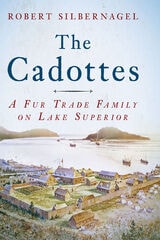
The Cadottes
A Fur Trade Family on Lake SuperiorRobert Silbernagel
Wisconsin Historical Society Press, 2023
The Cadottes
A Fur Trade Family on Lake SuperiorRobert Silbernagel
Wisconsin Historical Society Press, 2026
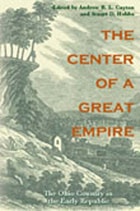
The Center of a Great Empire
The Ohio Country in the Early RepublicAndrew R. L. Cayton
Ohio University Press, 2005
“The people who lived in what became the seventeenth state in the American Union in 1803 were not only at the center of a great empire, they were at the center of the most important historical developments in the revolutionary Atlantic World.”
—From the introduction
Nowhere did the revolutions in politics, commerce, and society in the late eighteenth and early nineteenth centuries occur more quickly or more thoroughly than in the Ohio country. A forested borderland dominated by American Indians in 1780, Ohio was a landscape of farms and towns inhabited by people from all over the world by 1830. The Center of a Great Empire: The Ohio Country in the Early Republic chronicles this dramatic and all-encompassing change.
Andrew R. L. Cayton and Stuart D. Hobbs have assembled an impressive collection of articles by established and rising scholars. They address the conquest of Native Americans, the emergence of a democratic political culture, the origins of capitalism, the formation of public culture, the growth of evangelical Protestantism, the ambiguous status of African Americans, and social life in a place that most regarded as the cutting edge of human history.
For The Center of a Great Empire, distinguished historians of the American nation in its first decades question conventional wisdom. They emphasize contingency rather than inevitability and contention rather than progress. Downplaying the frontier character of Ohio, they offer new interpretations and open new paths of inquiry through investigations of race, education, politics, religion, family, commerce, colonialism, and conquest. As it underscores key themes in the history of the United States, The Center of a Great Empire pursues issues that have fascinated people for two centuries.

The Complete Anti-Federalist
Edited by Herbert J. Storing
University of Chicago Press, 2007
The Complete Anti-Federalist, first published in 1981, contains an unprecedented collection of all the significant pamphlets, newspaper articles and letters, essays, and speeches that were written in opposition to the Constitution during the ratification debate. Storing’s work includes introductions to each entry, along with his own consideration of the Anti-Federalist thought.
This new three-volume set includes all the contents of the original seven-volume publication in a convenient, manageable format.
“A work of magnificent scholarship. Publication of these volumes is a civic event of enduring importance.”—Leonard W. Levy, New York Times Book Review

The Complete Writings and Selected Correspondence of John Dickinson
Volume 1Jane E. Calvert
University of Delaware Press, 2011
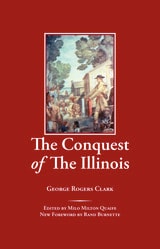
The Conquest of The Illinois
George Rogers Clark. Foreword by Rand Burnette
Southern Illinois University Press, 2001
Written only a decade after George Rogers Clark’s conquest of Illinois, this firsthand account shows the region as it existed in the 1770s, explains how British occupation affected Kentucky settlers, and exhibits Clark’s enormous diplomatic skills in convincing the French settlers and Indians along the rivers of Illinois that they were better off under the jurisdiction of the Americans rather than the British. In his new foreword to this book, Rand Burnette refers to Clark as a psychologist and an expert in human relations.
Believing the British responsible for Indian raids on the people of Kentucky, Clark determined to capture that area, which was claimed by his home state of Virginia. “His plan, which he presented to Governor Patrick Henry,” Burnette notes, “was to take possession of the Illinois country by defeating the British at Kaskaskia, win the support of the French in that area, and thus control both the Mississippi and the Ohio Rivers. The British support of the Indians, who raided the Kentucky settlements from the Illinois country, would be at an end.”
Clark’s stirring narrative—written between 1789 and 1791 and covering 1773–1779—chronicles the events in the Old Northwest in the second half of the eighteenth century. Life on the frontier was dangerous and uncertain at this time. As Clark points out and Milo Milton Quaife underlines in his footnotes, death came to many at the hands of Indians or in military battles and skirmishes.
First published in 1920 and long out of print, the Quaife edition of Clark’s The Conquest of The Illinois reprinted here is for the modern reader superior to the original. First, Quaife provided an index. Equally important for modern readers, he standardized Clark’s spelling. (Clark had little formal education, and his spelling was even more eccentric than that found in a typical eighteenth-century account.) Finally, Quaife’s footnotes often include biographical sketches of the people in the book.
The Constitution of the United States
A Primer for the PeopleDavid P. Currie
University of Chicago Press, 2000
A masterly introduction to the United States Constitution, this slim book leads the reader through a concise overview of the document's individual articles and amendments. With clear and accessible language, Currie then examines each of the three branches of the federal government and explains the relation between the federal and state governments. He analyzes those constitutional provisions that are designed to protect citizens from governmental interference, such as the due process and equal protection clauses and the confusing first amendment provisions respecting the separation of church and state, and includes discussions of judicial review and freedom of speech and of the press.
A sympathetic yet critical guide, Currie's book enables students and laypersons to understand one of the cornerstones of the Western political tradition. The second edition, along with an updated chronology and bibliography, incorporates the Supreme Court decisions over the past decade that have affected constitutional interpretation.
"Superb . . . highly recommended for those seeking a reliable, understandable, and useful introduction to our constitution."—Appellate Practice Journal and Update
The Contest for Liberty
Military Leadership in the Continental Army, 1775–1783Seanegan P. Sculley
Westholme Publishing, 2019
How American Colonial Ideals Shaped Command, Discipline, and Honor in the U.S. Armed Forces
In the summer of 1775, a Virginia gentleman-planter was given command of a New England army laying siege to British-occupied Boston. With his appointment, the Continental Army was born. Yet the cultural differences between those serving in the army and their new commander-in-chief led to conflicts from the very beginning that threatened to end the Revolution before it could start. The key challenge for General George Washington was establishing the standards by which the soldiers would be led by their officers. What kind of man deserved to be an officer? Under what conditions would soldiers agree to serve? And how far could the army and its leaders go to discipline soldiers who violated those enlistment conditions? As historian Seanegan P. Sculley reveals in Contest for Liberty: Military Leadership in the Continental Army, 1775–1783, these questions could not be determined by Washington alone. His junior officers and soldiers believed that they too had a part to play in determining how and to what degree their superior officers exercised military authority and how the army would operate during the war. A cultural negotiation concerning the use of and limits to military authority was worked out between the officers and soldiers of the Continental Army; although an unknown concept at the time, it is what we call leadership today. How this army was led and how the interactions between officers and soldiers from the various states of the new nation changed their understandings of the proper exercise of military authority was finally codified in General Friedrich Wilhelm von Steuben’s The Regulations for the Order and Discipline of the Troops of the United States, first published in 1779. The result was a form of military leadership that recognized the autonomy of the individual soldiers, a changing concept of honor, and a new American tradition of military service.
The Continental Dollar
How the American Revolution Was Financed with Paper MoneyFarley Grubb
University of Chicago Press, 2023
The Continental Dollar is a revelatory history of how the fledgling United States paid for its first war. Farley Grubb upends the common telling of this story, in which the United States printed cross-colony money, called Continentals, to serve as an early fiat currency—a currency that is not tied to a commodity like gold, but rather to a legal authority. As Grubb details, the Continental was not a fiat currency, but a “zero-coupon bond”—a wholly different species of money. As bond payoffs were pushed into the future, the money’s value declined, killing the Continentals’ viability years before the Revolutionary War would officially end.
Drawing on decades of exhaustive mining of eighteenth-century records, The Continental Dollar is an essential origin story of the early American monetary system, promising to serve as the benchmark for critical work for decades to come.
The Correspondence of John Carroll and Charles Plowden, 1779-1816
Thomas W. Jodziewicz
Catholic University of America Press, 2025

The Correspondence of Richard Price, Volume II
March 1778–February 1786D. O. Thomas, ed.
Duke University Press, 1983
The Correspondence of Richard Price, Volume III
February 1786–February 1791William Bernard Peach, editor
Duke University Press, 1983
Price's correspondence with Adams, Franklin, Jefferson, Rush, and other Americans concern the issues of slavery, the rebellion in Massachusetts, use of paper money, opposition to the establishment of religion, and the status of the federal government. Letters to Priestly, Lansdowne, and others in Britain are about science and technology, the crisis in the United Provinces, armed neutrality, the national debt, revolution, religious sects, and foreign relations. In his correspondence with French leaders following the fall of the Bastille, particularly with le Duc del la Rochefoucauld, Price expresses his high hopes for the growth of civil and religious freedom in France.
Indispensable for an understanding of the work of one of the best known and most distinguished Welshmen of the eighteenth century, this book—and the series—will also be of interest to those who study the history of ideas.
The Daily Thomas Paine
A Year of Common-Sense Quotes for a Nonsensical AgeThomas Paine
University of Chicago Press, 2020
The Daily Thomas Paine offers a year’s worth of pithy and provocative quotes from this quintessentially American figure. Editor Edward G. Gray argues that we are living in a moment that Thomas Paine might recognize—or perhaps more precisely, a moment desperate for someone whose rhetoric can ignite a large-scale social and political transformation. Paine was a master of political rhetoric, from the sarcastic insult to the diplomatic aperçu, and this book offers a sleek and approachable sampler of some of the sharpest bits from his oeuvre. As Paine himself says in the entry for January 20: “The present state of America is truly alarming to every man who is capable of reflexion.” The Daily Thomas Paine should prove equally incendiary and inspirational for contemporary readers with an eye for politics, even those who prefer the tweet to the pamphlet.

The Invasion of Virginia, 1781
Michael Cecere
Westholme Publishing, 2017
The American War for Independence was fought in nearly every colony, but some colonies witnessed far more conflict than others. In the first half of the war, the bulk of military operations were concentrated in Massachusetts, New York, New Jersey, and Pennsylvania. A shift in British strategy southward after the Battle of Monmouth in 1778 triggered numerous military engagements in 1779 and 1780 in Georgia and the Carolinas.Surprisingly, Virginia, the largest of the original thirteen colonies, saw relatively little fighting for the first six years of the Revolutionary War. This changed in 1781 when British and American forces converged on Virginia. The war’s arrival did not result from one particular decision or event, but rather, a series of incidents and battles beginning in the fall of 1780 at Kings Mountain, South Carolina.
Benedict Arnold’s sudden appearance in Virginia in early 1781 with 1,600 seasoned British troops and his successful raid up the James River to Richmond and subsequent occupation of Portsmouth, demonstrated Virginia’s vulnerability to attack and the possibility that the colonies could be divided and subdued piecemeal, a strategy Britain had attempted to deploy several times earlier in the war. British General Henry Clinton’s decision to reinforce Arnold in Virginia expanded Britain’s hold on the colony while events in North Carolina, including the battle of Guilford Court House, led British General Charles Cornwallis to conclude that defeating the Patriots in Virginia was the key to ending the war. As a result, Cornwallis marched his army north in May 1781 to assume command of what was now a very powerful British force of over 7,000 troops. The war had returned to Virginia with a vengeance, and how it did so and what happened as a result is the focus of The Invasion of Virginia 1781.
The Jay Treaty Debate, Public Opinion, and the Evolution of Early American Political Culture
Todd Estes
University of Massachusetts Press, 2006
Drawing evidence from a broad range of sources—petitions and newspaper polemics, crowd gatherings, as well as rhetorical exchanges on the floor of Congress—Estes shows how both sides in the Jay Treaty debate mounted extensive and unprecedented campaigns to marshal popular support for their positions. Although many Americans initially opposed the treaty, the Federalists proved particularly skillful at courting the public and eventually prevailed over their opponents, just as they had won earlier battles over neutrality, democratic societies, and the Whiskey Rebellion. But the Republicans, Estes points out, learned from the experience, and in the long run they would become even more adept than the Federalists at shaping public opinion.
Even at the time, amid the fierce political rhetoric and colorful street demonstrations that characterized the Jay Treaty debate, participants recognized that important changes were taking place. Not only did the dispute solidify party allegiances, it also legitimized and advanced popular involvement in the political process. While some welcomed the emergence of this new, more democratic political culture, Estes concludes, others were much more ambivalent.
The Killing of Jane McCrea
An American Tragedy on the Revolutionary FrontierPaul Staiti
Westholme Publishing, 2027
FINALIST FOR THE 2026 GEORGE WASHINGTON PRIZE
Winner of the 2026 Book of the Year Award, George Washington American Revolution Round Table, Washington, DC
The killing of Jane McCrea on July 26, 1777, on the outskirts of a village in the northern Hudson Valley, would unexpectedly rupture the British advance from Canada that was meant to crush the American Revolution in one knockout blow. On that day, twenty-five-year-old McCrea, an unremarkable person preparing for an impending marriage, was assaulted, scalped, and killed by a group of Native Americans in the employ of British general John Burgoyne. Though the murder was but one of many civilian deaths in a fierce war zone, McCrea’s killing had far-reaching consequences for each of the three major parties involved in the Northern Campaign of 1777. In America, she became the great cause célèbre of the Revolution, the sympathetic female victim of the war symbolizing the righteousness of The Cause. In Britain, she was a human-rights tragedy that tarnished the polished surface of British honor and galvanized Whig politicians who shouted out her name in Parliament as an example of how low the nation had fallen. For Native peoples, recruited by both the British and the Americans, and caught in the middle of a war staged on ancestral grounds, McCrea’s killing was the opening salvo in a vicious chain of bloody retribution that led to the disintegration of the venerable Iroquois Confederacy and the obliteration of Native homelands. After the war, the nightmarish image of a young Jane McCrea slaughtered on the New York frontier would obsess white Americans who came to fear Native peoples as irredeemable savages. Her murder would help justify the expulsion of Indigenous tribes and open the doors for an expansionary United States that was fully intent on transforming the American continent into its own image.
The Killing of Jane McCrea: An American Tragedy on the Revolutionary Frontier by distinguished historian Paul Staiti undertakes for the first time a comprehensive investigation into McCrea’s life, death, and especially her long and strange afterlife. Using both visual arts and written records, the author reassembles the scattered fragments to illuminate a historical terrain long since shrouded in misinformation, mired in controversy, and relegated to mythology. Coming into view is a major portrait of the persons, cultures, actions, and motives that fatally converged on that hot July morning in 1777.
The Know-Nothing Campaign Against Higher Learning
James Chandler
Prickly Paradigm Press, 2026
Irony and satire in the contemporary American moment.
The second Trump administration has committed itself to upending the knowledge systems and deliberative institutions that have been essential to modern democracy, with the American university—site of scientific research and liberal education—a primary target. In The Know-Nothing Campaign Against Higher Learning, literary and film critic James Chandler spotlights an American tradition of such hostility to intellectual life, especially the nativist movement of the 1850s that persecuted Catholic immigrants from Ireland and Germany. Ironically, Steve Bannon, the self-proclaimed “Know-Nothing vulgarian” who long ago recruited candidate Trump to his anti-intellectual crusade, is himself the great-grandson of an Irish immigrant who would have faced Know-Nothing backlash in that era.
Such dark ironies define our moment, Chandler argues, and they call out not only for intellectual critique but also for satire. Yet in the midst of the MAGA campaign’s calamitous effects on American public discourse, even satire must confront the “kayfabe” practices imported by Trump from professional wrestling, which mix illusion and reality to turn political life into a “spectacle without thought.” Drawing widely on cultural critics from Jonathan Swift and Alexis de Tocqueville to Roland Barthes, Chandler’s pamphlet offers an elegant and bracing account of the MAGA campaign against higher learning and its transformative effects on criticism and democracy itself.

The Long Affair
Thomas Jefferson and the French Revolution, 1785-1800Conor Cruise O'Brien
University of Chicago Press, 1996
"The book is an attack on America's long affair with Jeffersonian ideology of radical individualism: an ideology that, by confusing Jefferson with a secular prophet, will destroy the United States from within."—David C. Ward, Boston Book Review
"With his background as a politician and a diplomat, O'Brien brings a broad perspective to his effort to define Jefferson's beliefs through the prism of his attitudes toward France. . . . This is an important work that makes an essential contribution to the overall picture of Jefferson."—Booklist
"O'Brien traces the roots of Jefferson's admiration for the revolution in France but notes that Jefferson's enthusiasm for France cooled in the 1790s, when French egalitarian ideals came to threaten the slave-based Southern economy that Jefferson supported."—Library Journal
"In O'Brien's opinion, it's time that Americans face the fact that Jefferson, long seen as a champion of the 'wronged masses,' was a racist who should not be placed on a pedestal in an increasingly multicultural United States."—Boston Phoenix
"O'Brien makes a well-argued revisionist contribution to the literature on Jefferson."—Kirkus Reviews
"O'Brien is right on target . . . determined not to let the evasions and cover-ups continue."—Forrest McDonald, National Review
"The Long Affair should be read by anyone interested in Jefferson—or in a good fight."—Richard Brookhiser, New York Times Book Review

The Lost World of John Witherspoon
Unravelling the Snodgrass affair, 1762 to 1776Ronald Lyndsey Crawford
Aberdeen University Press, 2015
The Lost World of Thomas Jefferson
Daniel J. Boorstin
University of Chicago Press, 1993
"The volume is too subtle, too rich in ideas for anyone to do justice to it in brief summary, too heavily documented and too carefully wrought for anyone to dismiss its thesis. . . . It is a major contribution not only to Jefferson studies but to American intellectual history. . . . All who work in the history of ideas will find themselves in Mr. Boorstin's debt."—Richard Hofstadter, South Atlantic Monthly
The Needle's Eye
Women and Work in the Age of RevolutionMarla R. Miller
University of Massachusetts Press, 2006
In this book, Marla R. Miller illuminates the significance of women's work in the clothing trades of the early Republic. Drawing on diaries, letters, reminiscences, ledgers, and material culture, she explores the contours of working women's lives in rural New England, offering a nuanced view of their varied ranks and roles—skilled and unskilled, black and white, artisanal and laboring—as producers and consumers, clients and craftswomen, employers and employees. By plumbing hierarchies of power and skill, Miller explains how needlework shaped and reflected the circumstances of real women's lives, at once drawing them together and setting them apart.
The heart of the book brings into focus the entwined experiences of six women who lived in and around Hadley, Massachusetts, a thriving agricultural village nestled in a bend in the Connecticut River about halfway between the Connecticut and Vermont borders. Miller's examination of their distinct yet overlapping worlds reveals the myriad ways that the circumstances of everyday lives positioned women in relationship to one another, enlarging and limiting opportunities and shaping the trajectories of days, years, and lifetimes in ways both large and small. The Needle's Eye reveals not only how these women thought about their work, but how they thought about their world.
The New Star Chamber and Other Essays
Annotated EditionEdgar Lee Masters; edited by Jason Stacy
Southern Illinois University Press, 2023
Coedited by noted Masters scholar, Jason Stacy, and his class, “Editing History,” this annotated edition of Edgar Lee Masters’s The New Star Chamber and Other Essays reappears at a perilous time in US history, when large corporations and overseas conflicts once again threaten the integrity of American rights and liberties, and the United States still finds itself beholden to corporate power and the legacy of imperial hubris. In speaking to his times, Masters also speaks to ours.
These thirteen essays lay bare the political ideology that informed Spoon River Anthology. Masters argues that the dangerous imperialism championed by then-President Theodore Roosevelt was rooted in the Constitution itself. By debating the ethics of the Philippine-American War, criticizing Hamiltonian centralization of government, and extolling the virtues of Jeffersonian individualism, Masters elucidates the ways in which America had strayed from its constitutional morals and from democracy itself. The result is a compelling critique of corporate capitalism and burgeoning American imperialism, as well as an exemplary source for understanding its complicated author in the midst of his transformation from urban lawyer to poet of rural America.
In print again for the first time since 1904, this edition includes an introduction and historical annotations throughout. Edited and annotated by students at Southern Illinois University Edwardsville, and designed and illustrated by students at Southern Illinois University Carbondale, this volume traces economic and political pathologies to the origins of the American republic. The New Star Chamber and Other Essays is as vital now as it was over 100 years ago.
The Part and the Whole in Early American Literature, Print Culture, and Art
Matthew Pethers
Bucknell University Press, 2024
The essays in this pathbreaking collection consider the significance of varied early American fragmentary genres and practices—from diaries and poetry, to almanacs and commonplace books, to sermons and lists, to Indigenous ruins and other material shards and fragments—often overlooked by critics in a scholarly privileging of the “whole.” Contributors from literary studies, book history, and visual culture discuss a host of canonical and non-canonical figures, from Edward Taylor and Washington Irving to Mary Rowlandson and Sarah Kemble Knight, offering insight into the many intellectual, ideological, and material variations of “form” that populated the early American cultural landscape. As these essays reveal, the casting of the fragmentary as aesthetically eccentric or incomplete was a way of reckoning with concerns about the related fragmentation of nation, society, and self. For a contemporary audience, they offer new ways to think about the inevitable gaps and absences in our cultural and historical archive.

The Pennsylvania Associators, 1747–1777
Joseph Seymour
Westholme Publishing, 2024
The First Complete History of the Military Force of Colonial Pennsylvania, a Volunteer Body Created as a Practical Response to the Ideal of Pacifism
Known at various times as the Military Association of Pennsylvania, the Pennsylvania Association, or simply Associators, this long-neglected organization represented a new constituency in Pennsylvania politics and by extension, a new American response to arbitrary rule. Organized on December 7, 1747, at Philadelphia, the Military Association, an all-volunteer military establishment pledged to the defense of Pennsylvania, served as the de facto armed force for Pennsylvania, a colony whose leadership, a loose coalition of Quaker and German pacifists, land barons, and merchants, foreswore military preparedness on religious and ideological grounds. For the Associators, including their most noted supporter, Benjamin Franklin, a defenseless colony was no longer practical. During the War of Austrian Succession and again in the Seven Years’ War, Associators organized defense efforts in defiance of the Pennsylvania colonial leadership. Associators also helped defend American Indian refugees against the infamous Paxton Boys in 1764. By 1775, Associators found themselves as the colony’s only legitimate military leadership and, by capitalizing on electoral gains in the lead up to the American Revolution, Associators assumed offices vacated by former officials. During the critical battles of 1776, the Associators in their distinctive round hats and brown coats proved a decisive asset to the Continental Army.
In The Pennsylvania Associators, 1747–1777, historian Joseph Seymour has painstakingly researched primary source materials in order to write the first comprehensive history of this influential organization. Seymour demonstrates that while the Pennsylvania Associators contributed to success in the campaigns in which they fought, particularly the battles of Trenton and Princeton, a more fascinating and important investigation are the concerns that motivated these men. Associators considered military service in defense of their religious and civil liberties as a natural right. For three decades, Associators demonstrated that belief in and out of uniform. In a colony founded on religious exceptionalism, Associators saw themselves as faithful soldiers and active agents against leadership by entitlement, a principle guiding our government today.

The Political Theory of The Federalist
David F. Epstein
University of Chicago Press, 1986
In The Political Theory of “The Federalist,” David F. Epstein offers a guide to the fundamental principles of American government as they were understood by the framers of the Constitution. Epstein here demonstrates the remarkable depth and clarity of The Federalist’s argument, reveals its specifically political (not merely economic) view of human nature, and describes how and why the American regime combines liberal and republican values.
“While it is a model of scholarly care and clarity, this study deserves an audience outside the academy. . . . David F. Epstein’s book is a fine demonstration of just how much a close reading can accomplish, free of any flights of theory or fancy references.”—New Republic
“Epstein’s strength lies in two aspects of his own approach. One is that he reads the text with uncommon closeness and sensitivity; the other is an extensive knowledge of the European political thought which itself forms an indispensable background to the minds of the authors.”—Times Literary Supplement

The Pox of Liberty
How the Constitution Left Americans Rich, Free, and Prone to InfectionWerner Troesken
University of Chicago Press, 2015
Werner Troesken looks at the history of the United States with a focus on three diseases—smallpox, typhoid fever, and yellow fever—to show how constitutional rules and provisions that promoted individual liberty and economic prosperity also influenced, for good and for bad, the country’s ability to eradicate infectious disease. Ranging from federalism under the Commerce Clause to the Contract Clause and the Fourteenth Amendment, Troesken argues persuasively that many institutions intended to promote desirable political or economic outcomes also hindered the provision of public health. We are unhealthy, in other words, at least in part because our political and legal institutions function well. Offering a compelling new perspective, The Pox of Liberty challenges many traditional claims that infectious diseases are inexorable forces in human history, beyond the control of individual actors or the state, revealing them instead to be the result of public and private choices.
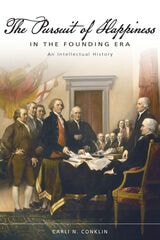
The Pursuit of Happiness in the Founding Era
An Intellectual HistoryCarli N. Conklin
University of Missouri Press, 2020
Scholars have long debated the meaning of the pursuit of happiness, yet have tended to define it narrowly, focusing on a single intellectual tradition, and on the use of the term within a single text, the Declaration of Independence. In this insightful volume, Carli Conklin considers the pursuit of happiness across a variety of intellectual traditions, and explores its usage in two key legal texts of the Founding Era, the Declaration and William Blackstone’s Commentaries on the Laws of England.
For Blackstone, the pursuit of happiness was a science of jurisprudence, by which his students could know, and then rightly apply, the first principles of the Common Law. For the founders, the pursuit of happiness was the individual right to pursue a life lived in harmony with the law of nature and a public duty to govern in accordance with that law. Both applications suggest we consider anew how the phrase, and its underlying legal philosophies, were understood in the founding era. With this work, Conklin makes important contributions to the fields of early American intellectual and legal history.
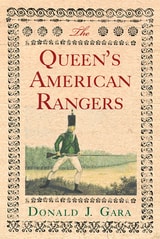
The Queen's American Rangers
Donald J. Gara
Westholme Publishing, 2015
Prior to the British attack on Long Island in August 1776, French and Indian War hero Robert Rogers organized a regiment to join the fight—but not on the side of his native New Hampshire. Named in honor of Queen Charlotte, the wife of King George III, Rogers’s regiment recruited the bulk of its soldiers from the large number of Loyalist refugees on Staten Island who had fled from New York. Rogers’s command of the unit was short-lived, however, after a humiliating defeat in late October by a surprise attack on his headquarters. Under new leadership, the unit played a decisive role and suffered heavy casualties at the battle of Brandywine that brought them their first favorable attention from the British high command. With this performance, and under the able leadership of John Graves Simcoe, the Queen’s American Rangers—sometimes known as “Simcoe’s Rangers”—were frequently assigned to serve alongside British regular troops in many battles, including Monmouth, Springfield, Charleston, and Yorktown. Receiving frequent high praise from Lieutenant General Sir Henry Clinton, the Commander in Chief of the British Army in America, the unit was placed on the American Establishment of the British Army in May 1779, a status conferred on provincial units that had performed valuable services during the war, and was renamed the 1st American Regiment. Before the end of the war, the rangers were fully incorporated into the British regular army, one of only four Loyalist units to be so honored.
The Queen’s American Rangers by historian Donald J. Gara is the first book-length account of this storied unit. Based on extensive primary source research, the book traces the complete movements, command changes, and battle performances of the rangers, from their first muster to their formal incorporation into the British Army and ultimate emigration to Canada on land grants conferred by a grateful British crown.
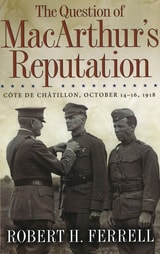
The Question of MacArthur's Reputation
Côte De Châtillon, October 14-16, 1918Robert H. Ferrell
University of Missouri Press, 2008