Results by title
3390 books match the query 'Fiction' and 1041 start with t
The Last of the Ofos
Geary Hobson
University of Arizona Press, 2000
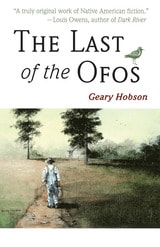
In this subtle but inventive novel, presented as Thomas's memoirs, Geary Hobson offers us a glimpse into a life filled with simple joys and sorrows. In relating his Louisiana childhood, Thomas recalls not just school-learning but being taught Indian ways by the small Ofo community. He tells of his life as a roustabout in the oil fields, of his courtship of the rambunctious Sally Fachette, and of his career as a bootlegger, which landed him in prison. We share Thomas's wartime stint with the Marines—where "for the first time in my life I was treated like a equal"—and his life as a farm laborer and a Hollywood extra portraying warbonneted Cheyennes. Then in his later years, when he truly has become the last of his kind, we find Thomas recruited by an anthropologist from the Smithsonian Institution to preserve his people's culture. In Washington, he is exposed to the vagaries of Indian policy and the emerging Native American movement.
Throughout Thomas's story, readers are introduced to a wide-ranging cast of characters, from the outlaws Bonnie and Clyde to a fellow Marine who is wary of Indians, to an uppity anthropologist who doesn't consider Thomas "expert" enough to handle an Ofo flute. Always poor in material wealth but rich in heritage, Thomas Darko is a Native American Everyman whose identity is shaped by family and homeland. His "autobiography" paints a realistic portrait of an Indian confronting the obstacles in his life and the dilemmas of his age as his story reveals the painful legacy of being the last of one's kind.

The Law of Inheritance
Yasser Abdellatif
Seagull Books, 2018
The symphonic four-part text presents us with narratives of Egyptian identity, a constant knitting and unravelling that moves us back and forth through time, as the reader slides and leaps across the shifting tectonic plates of Abdellatif’s vignettes, his immaculately limpid prose poetry bringing forth the same questions. Nobody quite belongs in Cairo, it seems, but at the same time none of them belongs anywhere else: a relative emigrates from his Nubian village to the Cairo of the 1930s, where Italian fascists chase him through the streets and into a Maltese exile, only for him to return and make his way back South to the homeland he left. Another relative falls into religious esotericism and later madness, spinning away from Cairo and back to the wasteland of a village relocated after it had been flooded by the Aswan Dam. Meanwhile, in the 1990s, students fight security forces and binge on pills amid the dysfunctional remnants of a centralized state whose gravitational pull uprooted their parents and offered the possibility of assimilation into a national identity.
Through the clear sky of Abdellatif’s novel his characters, the spaces they call home, their way-stations, and even the nation that contains them all are a murmuration of starlings, held together and apart forever.
The Law of Miracles
And Other StoriesGregory Blake Smith
University of Massachusetts Press, 2011

The Lean Lands
By Agustin Yáñez
University of Texas Press, 1968
What was it that flew over with such a terrifying roar? Was it, as many said, the devil, or was it that thing a few had heard of, a flying machine? And those electric lights at Jacob Gallo’s farm, were they witchcraft or were they science?
The theme of this harshly powerful novel is the impact of modern technology and ideas on a few isolated, tradition-bound hamlets in the aftermath of the Mexican Revolution of 1910. The old ways are represented by Epifanio Trujillo, the cacique of the region, now ailing and losing his grip on things; by ancient Madre Matiana, the region’s midwife, healer, counselor, and oracle; by penniless Rómulo and his wife Merced. “Progress” is represented by Don Epifanio’s bastard son Jacob, who acquired money and influence elsewhere during the Revolution and who now, against his father’s will, brings electricity, irrigation, fertilizers, and other modernities to the lean lands—together with armed henchmen. The conflict between the old and the new builds slowly and inexorably to a violent climax that will long remain in the reader’s memory.
The author has given psychological and historical depth to his story by alternating the passages of narrative and dialogue with others in which several of the major characters brood on the past, the present, and the future. For instance, Matiana, now in her eighties, touchingly remembers how she was married and widowed before she had reached her seventeenth birthday. This dual technique is superbly handled, so that people and events have both a vivid actuality and an inner richness of meaning. The impact of the narrative is intensified by the twenty-one striking illustrations by Alberto Beltrán.
The Legend
Marie Bronsard
Seagull Books, 2013
Egocentric and domineering, Bronsard’s grandmother was once a vibrant and sensual beauty. In Indochina at the end of the Second World War, she thrived in the social life of the French colony, but her young soldier husband sought a quieter existence, finding solace in the companionship of their adolescent daughter, Bronsard’s mother. The consequences of this choice reverberate throughout the family. But far from being an airing of grievance or dirty laundry, Bronsard’s memoir has the air of catharsis—here, the pain, secrets, and comic moments of Bronsard’s family are remembered with gentle humor, understanding, and affection. A wry irony tempers emotion, and it is in these pages that the author, at last, finds it possible to name the woman of the legend and perhaps bring her grandmother a measure of peace.
The Legendary Detective
The Private Eye in Fact and FictionJohn Walton
University of Chicago Press, 2015
“I’m in a business where people come to me with troubles. Big troubles, little troubles, but always troubles they don’t want to take to the cops.” That’s Raymond Chandler’s Philip Marlowe, succinctly setting out our image of the private eye. A no-nonsense loner, working on the margins of society, working in the darkness to shine a little light.
The reality is a little different—but no less fascinating. In The Legendary Detective, John Walton offers a sweeping history of the American private detective in reality and myth, from the earliest agencies to the hard-boiled heights of the 1930s and ’40s. Drawing on previously untapped archival accounts of actual detective work, Walton traces both the growth of major private detective agencies like Pinkerton, which became powerful bulwarks against social and labor unrest and the motley, unglamorous work of small-time operatives. He then goes on to show us how writers like Dashiell Hammett and editors of sensational pulp magazines like Black Mask embellished on actual experiences and fashioned an image of the PI as a compelling, even admirable, necessary evil, doing society’s dirty work while adhering to a self-imposed moral code. Scandals, public investigations, and regulations brought the boom years of private agencies to an end in the late 1930s, Walton explains, in the process fully cementing the shift from reality to fantasy.
Today, as the private detective has long since given way to security services and armed guards, the myth of the lone PI remains as potent as ever. No fan of crime fiction or American history will want to miss The Legendary Detective.
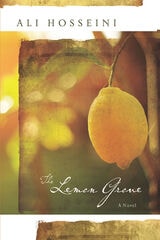
The Lemon Grove
A NovelAli Hosseini
Northwestern University Press, 2012
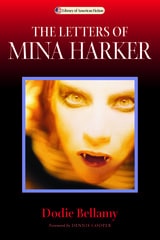
The Letters of Mina Harker
Dodie Bellamy; with a new Forward by Dennis Cooper
University of Wisconsin Press, 2004
Bigger-than-life, half goddess, half Bette Davis, Mina sends letter after letter to friends and co-conspirators, holding her reader captive through a display of illusion and longing. Juggling quivering vulnerability on one hand and gossip on the other, Mina spoofs and consumes and spews back up demented reembodiments of trash media and high theory alike. It's all fodder for her ravenous libido and "a messy ambiguous place where pathology meets pleasure." Sensuous and captivating, The Letters of Mina Harker describes one woman's struggles finding the right words to explain her desires and fears without confining herself to one identity.
The Lieutenant of Kouta
Massa Makan Diabaté
Michigan State University Press, 2017
The Life and Extraordinary Adventures of Private Ivan Chonkin
Vladimir Voinovich
Northwestern University Press, 1995
The Life and Strange Surprizing Adventures of Robinson Crusoe
The Stoke Newington EditionDaniel Defoe
Bucknell University Press, 2019
Published by Bucknell University Press. Distributed worldwide by Rutgers University Press.
The Life of Arseniev
YouthIvan Bunin
Northwestern University Press, 1994
In ways similar to Nabokov's Speak, Memory, Bunin's novel powerfully evokes the atmosphere of Russia in the decades before the Revolution and illuminates those Russian literary and cultural traditions eradicated in the Soviet era. This first full English-language edition updates earlier translations, taking as its source the version Bunin revised in 1952, and including an introduction and annotations by Andrew Baruch Wachtel.
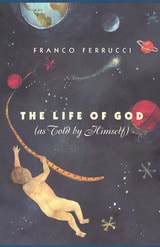
The Life of God (as Told by Himself)
Franco Ferrucci
University of Chicago Press, 1996
When a new arrival emerges from the apes, God believes he has finally found the companion he needs to help him make sense of his unruly creation. Yet, as the centuries pass, God feels more and more out of place in the world he has created; by the close of his memoir, he is packing his bags.
Highly praised and widely reviewed, The Life of God is a playful, wondrous, and irresistible book, recounting thousands of years of religious and philosophical thought.
"A supreme but imperfect entity, the protagonist of this religiously enlightened and orthodoxically heretical novel is possessed by a raving love for his skewed, unbalanced world. . . . Blessed are the readers, for this tale of God's long insomnia will keep them happily awake. . . . Extraordinary." —Umberto Eco
"The Life of God is, in truth, the synthesis of a charming writer's . . . expression of his boundless hopes for, and poignant disappointments in, his own human kind." —Jack Miles, New York Times Book Review
"Rather endearing. . . . This exceedingly amusing novel . . . is a continuous provocation and delight; there isn't a dull page in it." —Kirkus Reviews
"A smart and charming knitting of secular and ecclesiastic views of the world. . . . The character of God is likable—sweet, utterly human. . . . The prose is delightful . . . the writing is consistently witty and intelligent and periodically hilarious." —Allison Stark Draper, Boston Review
"'God's only excuse is that he does not exist,' wrote Stendhal, but now Franco Ferrucci has provided the Supreme Being with another sort of alibi." —James Morrow, Washington Post Book World
The Life of a Simple Man
Emile Guillaumin
University Press of New England, 1982
The Light People
A NovelGordon Henry
Michigan State University Press, 1994
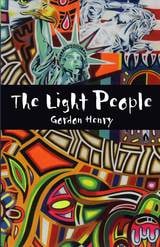
The Light People is a multi-genre novel that includes a series of nested stories about a tribal community in Northern Minnesota. Major themes include Oskinaway’s search for his parents and the legal wrangling over the possession of a leg that has been removed from a tribal elder. Each story is linked to previous and successive stories to form a discourse on identity and cultural appropriation, all told with humor and wisdom.
Taking inspiration from traditional Anishinabe stories and drawing from his own family's storytelling tradition, Gordon Henry, Jr., has woven a tapestry of interlocking narratives in The Light People, a novel of surpassing emotional strength. His characters tell of their experiences, dreams, and visions in a multitude of literary styles and genres. Poetry, drama, legal testimony, letters, and essays combine with more conventional narrative techniques to create a multifaceted, deeply rooted, and vibrant portrait of the author's own tribal culture. Keenly aware of Eurocentric views of that culture, Henry offers a "corrective history" where humor and wisdom transcend the political.
In the contemporary Minnesota village of Four Bears, on the mythical Fineday Reservation, a young Chippewa boy named Oskinaway is trying to learn the whereabouts of his parents. His grandparents turn for help to a tribal elder, one of the light people, Jake Seed. Seed's assistant, a magician who performs at children's birthday parties, tells Oskinaway's family his story, which gives way to the stories of those he encounters. Narratives unfold into earlier narratives, spinning back in time and encompassing the intertwined lives of the Fineday Chippewas, eventually revealing the place of Oskinaway and his parents in a complex web of human relationships.
The Lightning Jar
Christian Felt
University of Iowa Press, 2018
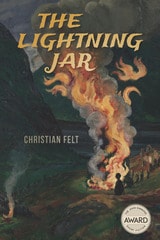
The Lightning Jar is about lonely children. It may be more about lonely children than any other book. These children are good at making imaginary friends but have trouble keeping them. For instance, there’s the Morra, who plunges the world into eternal winter. But she also teaches Mons the meaning of love and helps him burn down his house after some Gypsies turn it into a middle school.
Then there’s the Gorbel. Amanda invented it to scare the Guest, but it ended up liking him best. A bit like a cat but more like a spider, it turned out a lot cuter than she’d intended.
And the Wisps—they’re pretty unhappy about being dead. Karl accidentally turned his smallest cousin into a Wisp. They were trying to catch some lightning in a jar, but they caught the smallest cousin’s ghost instead. Karl had to drown it for its own good. Something similar happened with his grandma Astrid and a rock named Melisande.
But the loneliest character is probably Christian. He insists on being from Jämtland, where Karl and Amanda live. When his cousin Eskild got married, Christian rewrote their past so it’s like The Little Mermaid, except Eskild drowns and Christian doesn’t earn a soul.
In the spirit of Tove Jansson, William Blake, and Calvin & Hobbes, The Lightning Jar contains a volatile mix of innocence and experience, faith and doubt, nostalgia and a sense of all there is to gain by accepting reality on fresh terms.
The Lines
Anthony Varallo
University of Iowa Press, 2019

The Lion and the Cross
Early Christianity in Victorian NovelsRoyal W. Rhodes
The Ohio State University Press, 1900
The Little Lights of Town
StoriesJonathan Johnson
Carnegie Mellon University Press, 2025
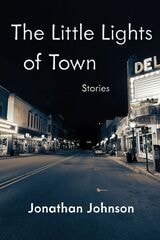
In The Little Lights of Town, acclaimed poet and memoirist Jonathan Johnson turns to fiction, bringing to life the rugged landscapes and tightly knit communities of Michigan’s Upper Peninsula. Against the backdrop of Lake Superior’s cold, untamed shores, his characters navigate love, loss, and the relentless pull of home.
From those who choose to stay despite the ever-present shadow of isolation to those searching for connection in a land where nature looms larger than life, these stories illuminate the quiet urgencies of human existence. With prose as lyrical as it is unflinching, Johnson visualizes a place where the past lingers in the streets, and where even in the darkest winters, little lights continue to shine.

The Lizard Woman
Frank Waters
Ohio University Press, 1985
“The novel was begun in 1926, when I was twenty-four years old and working as a telephone engineer in Imperial Valley, on the California-Baja California border. During my stay there I made a horseback trip down into the little-known desert interior of Lower California. After having lived all of my early years in the high Rockies of California, I was unprepared for the vast sweep of sunstruck desert with its flat wastes, clumps of cacti, and barren parched-rock ranges. Its emotional impact was so profound, I was impelled to give voice to it with pencil and paper.”
— Frank Waters
First published in 1930 under the title Fever Pitch, The Lizard Woman is Frank Waters’ first novel. It foreshadows a theme central to Waters’ later work: that we must attune our spirits to the land to fully understand our places in the natural order.
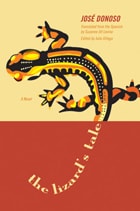
The Lizard's Tale
A NovelJosé Donoso, translated from the Spanish by Suzanne Levine
Northwestern University Press, 2011
José Donoso was the leading Chilean representative of the Latin American “Boom” of the sixties and seventies that included Gabriel García Márquez, Mario Vargas Llosa, and Manuel Puig, among others. Written as a draft in 1973, set aside, and forgotten, The Lizard’s Tale was discovered among Donoso’s papers at Princeton University by his daughter after his death. Edited for publication by critic and poet Julio Ortega, it was published posthumously in Spanish under the title Lagartija sin cola in 2007. Suzanne Jill Levine, who knew Donoso and translated two of his earlier works, brings the book to an English-language audience for the first time.
Defeated and hiding in his Barcelona apartment, painter Antonio Muñoz-Roa—Donoso’s alter ego—relates the story of his flight with Luisa, his cousin, lover, and benefactor, after his scandalous desertion from the “Informalist” movement (a witty reference to a contemporary Spanish art movement and possibly an allusion to the Boom as well), in which he had been a member of a certain standing. Frustrated, old, and alone, the artist looks back on his years in the small town of Dors, a place he unsuccessfully tried to rescue from the crushing advance of modernity, and on the decline of his own family, also threatened by the changing times. In Levine’s able hands, Donoso’s clear prose shines through, forming a compact, powerful, and still-relevant meditation on the commercialization of art and the very places we inhabit.
The Lockmaster
Christoph Ransmayr
Seagull Books, 2024
A longboat plummets over the Great Falls, drowning the five passengers on board. The Lockmaster, the heir to an ancient title and responsible for guiding river traffic safely around this natural barrier on the White River, ought to have prevented this tragedy. His son is convinced that it was not an accident. Is his irascible father a murderer? A hydraulic engineer all too familiar with the brute force of rivers, he sets out to discover the truth and find his missing father.
The Lockmaster is a dramatic tale set in a world where water has become a precious commodity and Europe has fractured into warring ethno-nationalist entities desperate to uphold the traditions and insignia of a so-called glorious bygone era. Christoph Ransmayr recounts this story in his trademark style, its epic force shot through with visions of future technology and reactionary politics amid a climate breakdown. At heart, though, this novel is the story of a father–son relationship straddling the fault lines between past and present, and an exploration of timeless questions of guilt and forgiveness.

The Long March of Basic Trust
Chronicle of Emotions; Notebook 2Alexander Kluge
Seagull Books, 2025
A kaleidoscopic journey through history and the vast landscape of human emotion, The Long March of Basic Trust presents Alexander Kluge at his most expansive and incisive. Moving seamlessly across time and space, Kluge weaves a tapestry of lived and imagined experience, interrogating the forces that shape our resilience in the face of catastrophe. From the wreckage of World War II to the deep time of geology, his singular prose dissolves boundaries between the real and the speculative.
Blurring the lines between fiction and philosophy, Kluge builds an intricate world enriched by hybrid images and his latest experiment: the “virtual camera,” a cinematic eye that captures the interplay of memory and invention. Now in his tenth decade, Kluge continues his lifelong pursuit of uncovering the patterns that connect us and the basic trust that allows us to go on. Both intellectually provocative and deeply humane, this latest installment in his Chronicle of Emotions is a testament to his unmatched ability to fuse thought and feeling into an electrifying literary form.
The Long Night
Andrew Lytle
University of Alabama Press, 1988
A first-rate novel that provides vivid descriptions of Alabama during an important period in the state’s history, The Long Night is set in the vicinity of Montgomery, Alabama, between 1850 and 1865. Originally published in 1936, the book is based on a true story related to Lytle by one of his close friends and colleagues at Vanderbilt University, Frank L. Owsley, who later became the chairman of The University of Alabama Department of History. In fact, the novel opens with a letter to Professor Owsley from the author, and Owsley’s son has written the introduction to this edition.
As described by George B. Tindall, The Long Night is “the episodic story of a young Alabamian beset by the moral dilemma of desire for revenge against the persecutors of his father and his larger duty in the war, a story that rose to its climax in the Battle of Shiloh.” The work is rich in its description of the land and people of Black-Belt Alabama during the mid-19th century.
The Long Swim
StoriesTerese Svoboda
University of Massachusetts Press, 2024
A runaway circus lion haunts a small town where two lovers risk more than their respective marriages. A junket to Cuba and an ambassador’s dalliance with a niece hide dark secrets and political revolution. “I’ve always had a knife,” says the unstable stepson to his parents. Inventive, dark, and absurd, the stories in The Long Swim capture Terese Svoboda’s clear-eyed, wry angle on the world: a place of violence and uncertainty but also wild beauty, adventure, and love both lasting and ephemeral. Her characters strive for escape—through romance, travel, or more self-destructive pursuits—and collide with the constraints of family and home, their longing for freedom and autonomy often at odds with the desire for safety and harmony.
Cynical, irreverent, and formally daring, Svoboda’s stories in The Long Swim are a deft exploration of womanhood and humanity. Waves of provocation and wonder toss the reader and leave them wanting more.

The Look of the 1960s
Barbarella and Pulp Pop ComicsJan Baetens and Hugo Frey
University of Texas Press, 2026
How the classic aesthetic of 1960s pulp comics influenced art, culture, and politics.
As a form of visual art, comic books rely on a distinct and eye-catching aesthetic. This is especially true of the iconic comics, graphic novels, and illustrations of the 1960s and 1970s. The Look of the 1960s explores the sources of inspiration that influenced the world of comics, beginning with the well-known French comics series Barbarella.
Noted comics scholars Jan Baetens and Hugo Frey analyze the impacts of the often-provocative images featured in the comics of the 1960s, which pushed back against French censorship in a politically tense time, and detail how women resisted their objectification in the comic book industry. Barbarella left its mark on the world and gained international attention, inspiring a movie adaptation and changing the look and content of other popular comics. The “Pulp Pop” movement remains relevant today, continuing to influence the art and political world. With new information about artists and an astute analysis of sociopolitical influence, The Look of the 1960s offers deep insights, making it a must read for comics fans all over the world.
The Looking-Glass
William March
University of Alabama Press, 1943
Third in the "Pearl County" series, The Looking-Glass is March's story of a small Alabama town in the early days of the twentieth century. Connected by relationships that bind, support, and strangle, the citizens of Reedyville are drawn ineluctably toward a single climactic night. March's skillful blend of humor and pathos evinces his deep insights and empathy into the problems of the mind and heart that are both peculiar to Reedyville yet found in every town and family.
The Loss
A Novella and Two Short StoriesVladimir Makanin
Northwestern University Press, 1998
In his celebrated short story "The Prisoner of the Caucasus," two Russian soldiers take a Chechen prisoner during the war, and as events unfold, Makanin reveals the casual brutality of the war but also the secret truths of the character's lives. In the novella The Loss, Pekalov, a drunkard and dreamer obsessed with the idea of building a tunnel under the Ural River, disappears in a ditch while working and is made a saint by the people of his village. "Klyucharyov and Alimushkin" tells the story of what happens when one man becomes remarkably lucky while the other loses all his luck.
The Lost Archive
Lynn C. Miller
University of Wisconsin Press, 2023
Stretching the definition of “archive,” Miller builds interconnected webs that surprise, much like the seemingly random papers collected in a box of materials. Fraught relationships, mistaken identities, mysterious disappearances, and the search for love play out in these stories. Friendships are celebrated, ex-husbands cross the line, and Gertrude Stein attempts to write her memoir.
An unusual collection that proves greater than the sum of its parts, The Lost Archive will haunt readers with the intensity of its vision.

The Lost Lives of Lena Wu
A NovelAlvin Lu
University of Alabama Press, 2026
Centered around Lena Wu, a middle-aged Taiwanese immigrant and divorcee, the novel is a recursively structured interrogation of the contingencies between past and present; memory and self-understanding; and memoir and fiction.

The Lovers Set Down Their Spoons
Heather A. Slomski
University of Iowa Press, 2014
In the fifteen stories that comprise this collection—some short as breaths, two of them novelettes—Slomski writes with a keen eye about relationships. About the desires that pull us together and the betrayals that push us apart. About jealousy, obsession, loneliness and regret—the byproducts of loving someone that keep us awake at night.
The characters in these stories share meals, drink wine, buy furniture and art. They live domestic lives, so often wanting to love someone yet ending up alone. In one story, a woman’s fiancé leaves her when she goes to post some mail. In another story, a man can’t move past an affair his wife almost had. Another story describes a series of drawings to detail a couple’s end. But while loss and heartache pervade these stories, there is also occasional hope. For, as the title story shows us, sometimes a breakup isn’t an end at all, but the beginning of your life.
The Lucifer Cypher
J. E. Fender
University Press of New England, 2012
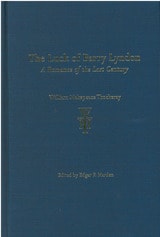
The Luck of Barry Lyndon
A Romance of the Last Century. By Fitz-Boodle.William Makepeace Thackeray
University of Michigan Press, 1999
The Thackeray Edition proudly announces two additions to its collection: Catherine and The Luck of Barry Lyndon. The Thackeray Edition is the first full-scale scholarly edition of William Makepeace Thackeray's works to appear in over seventy years, and the only one ever to be based on an examination of manuscripts and relevant printed texts. It is also a concrete attempt to put into practice a theory of scholarly editing that gives new insight into Thackeray's own compositional process.
The Luck of Barry Lyndon, serialized in Fraser's Magazine in 1844, is a wonderfully hard-edged advance upon Thackeray's previous writing: a tour de force dramatization at novelistic length of the moral vacuity of its first person narrator. The inner workings of this narrator are far more complicated than in earlier Thackeray writings, and are presented in a far more subtle, yet not humorless, manner. The mock-Bildungsroman aspect of the novel is brought about by the non-enlightenment of the title-figure, his failure to find a meaningful love-relationship, and his inability to discover a calling that identifies both a significant direction for his individual existence and, at the same time, an appropriate accommodation to his duties to society. Achieved in brilliant, accomplished style, Barry Lyndon is a significant and progressive experiment in narration for Thackeray.
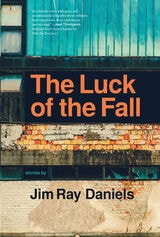
The Luck of the Fall
Jim Ray Daniels
Michigan State University Press, 2023
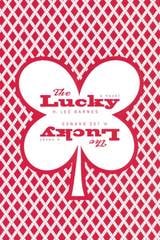
The Lucky
(A Novel)H. Lee Barnes
University of Nevada Press, 2003
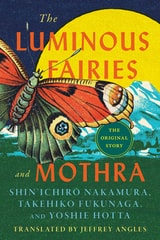
The Luminous Fairies and Mothra
Takehiko Fukunaga
University of Minnesota Press, 2026
The original story that hatched Mothra, one of the most beloved monsters in the “kaijuverse”—available in English for the first time
Mystical and benevolent, the colossal lepidopteran Mothra has been one of the most beloved kaiju since 1961, when The Luminous Fairies and Mothra was originally published in Japanese. Commissioned by Tōhō Studios from three of Japan’s most prominent postwar literary writers (Shin’ichirō Nakamura, Takehiko Fukunaga, and Yoshie Hotta), the novella formed the basis for the now-classic monster film Mothra, with a protagonist second only to Godzilla in number of film appearances by a kaiju. Finally available in its first official English translation, The Luminous Fairies and Mothra will captivate ardent, longtime fans of the films as well as newcomers.
Written just months after the largest political demonstrations Japan had ever seen, The Luminous Fairies and Mothra reflects the rebellious spirit of the time. In this original story, explorers visit a South Pacific island and capture a group of fairies, inciting the fury of the goddess Mothra, who sets out for Japan on a mission of rescue and revenge. Expressing a powerful social stance about Japan’s need to chart its own foreign policy during the Cold War, the novella’s political message was ultimately toned down in the Tōhō Studios film. Through this translation, Anglophone audiences will discover Mothra as a figure of protest fiction intricately reflecting the complex geopolitical situation in early 1960s Japan.
The Luminous Fairies and Mothra is translated into lively prose by Jeffrey Angles, who also wrote an extensive afterword about the novella’s cultural context, the unusual story of its composition, and the development of the 1961 film. Following Angles’s best-selling translation of the original Godzilla novellas, this new work will once again delight kaiju fans everywhere.
Retail e-book files for this title are screen-reader friendly with images accompanied by short alt text and/or extended descriptions.
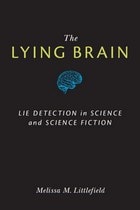
The Lying Brain
Lie Detection in Science and Science FictionMelissa M. Littlefield
University of Michigan Press, 2011
"The Lying Brain is a study to take seriously. Its argument is timely, clear, and of particular importance to the enlargement of our understanding of the relationships among science studies, literary studies, and technology studies."
---Ronald Schleifer, University of Oklahoma
Real and imagined machines, including mental microscopes, thought translators, and polygraphs, have long promised to detect deception in human beings. Now, via fMRI and EEG, neuroscientists seem to have found what scientists, lawyers, and law enforcement officials have sought for over a century: foolproof lie detection. But are these new lie detection technologies any different from their predecessors? The Lying Brain is the first book to explore the cultural history of an array of lie detection technologies: their ideological assumptions, the scientific and fictional literatures that create and market them, and the literacies required for their interpretation.
By examining a rich archive of materials about lie detection---from science to science fiction---The Lying Brain demonstrates the interconnections of science, literature, and popular culture in the development and dissemination of deception detection in the American cultural imagination. As Melissa Littlefield demonstrates, neuroscience is not building a more accurate lie detector; it is simply recycling centuries-old ideologies about deception and its detection.
Cover art: "Human Brain" © Denis Barbulet, courtesy of Shutterstock.com
The Maestro, the Magistrate and the Mathematician
A NovelTendai Huchu
Ohio University Press, 2016
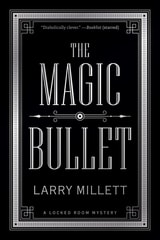
The Magic Bullet
A Locked Room MysteryLarry Millett
University of Minnesota Press, 2020
Enter Shadwell Rafferty: Irishman, St. Paul saloonkeeper, sometime detective, and old friend of the celebrated sleuth Sherlock Holmes. Summoned by Louis B. Hill—son of railroad magnate James J. Hill—to investigate, Rafferty descends into a world dominated by greedy tycoons and awash in political intrigue and wartime fearmongering. Suspects lurk in every corner of the city—including Dodge’s beautiful young widow, his slippery assistant, and a shadowy anarchist—and Rafferty pursues them from the streets of Ramsey Hill and the rooms of the Ryan Hotel to the labyrinthine caves under the Schmidt brewery. Matching wits with his foes at the police department and his unsavory rival, the St. Paul detective Mordecai Jones, Rafferty knows that in order to bring a killer to justice he must first unravel the riddle of a single bullet fired in a locked room, three hundred feet above the streets of St. Paul.
Set during a bitter streetcar strike and amid the clandestine activities of a ruthless commission charged with enforcing wartime patriotism, Larry Millett has created a classic and perfectly executed locked-room mystery in the great tradition of John Dickson Carr. From locked rooms and civil unrest to murder and wartime paranoia, The Magic Bullet presents Rafferty’s most challenging case, and its gripping conclusion—with a timely assist from Sherlock Holmes—finds both Rafferty and Millett at the top of their games.
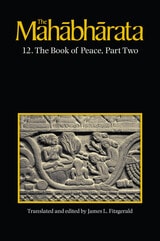
The Mahabharata, Volume 8
Book 12, The Book of Peace, Part 2Translated and Edited by James L. Fitzgerald
University of Chicago Press, 2026
A remarkable composition of 100,000 couplets, The Mahābhārata is the second-longest poem in world literature. In this volume, James L. Fitzgerald completes his translation of the twelfth of The Mahābhārata’s eighteen books, the vast Shanti Parvan, or The Book of Peace. Covering a wide range of ancient Indian intellectual history, The Book of Peace was intended to serve as a comprehensive, brahmin-inspired basis for living a Good Life in a Good Society in a Good Polity and is one of the most important and complex books of the poem.
Fitzgerald’s previous contribution to the Chicago edition of The Mahābhārata, volume 7, opened with Book 11, The Book of the Women, which movingly portrayed the grief of the wives, mothers, and sisters of the many warriors slain in the epic’s central war narrative. The crises of grief presented in The Book of the Women give particular poignancy and depth to the shanti, or pacification, that is the theme of Book 12, The Book of Peace. Volume 7 included the first half of The Book of Peace, and volume 8 now completes it with the second half, which is focused particularly on the ways people can escape the cycle of rebirth and realize sublime beatitude by way of saving knowledge or yoga meditation or devotion to God Viṣṇu-Nārāyaṇa. Supported by an extensive introduction and notes, this publication will be greeted as a major event in Sanskrit studies.
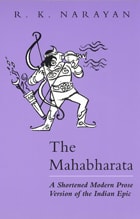
The Mahabharata
A Shortened Modern Prose Version of the Indian EpicR. K. Narayan
University of Chicago Press, 2000
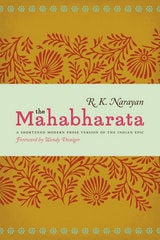
The Mahabharata
A Shortened Modern Prose Version of the Indian EpicR. K. Narayan
University of Chicago Press, 2013
Centuries of listeners and readers have been drawn to The Mahabharata, which began as disparate oral ballads and grew into a sprawling epic. The modern version is famously long, and at more than 1.8 million words—seven times the combined lengths of the Iliad and Odyssey—it can be incredibly daunting.
Contemporary readers have a much more accessible entry point to this important work, thanks to R. K. Narayan’s masterful translation and abridgement of the poem. Now with a new foreword by Wendy Doniger, as well as a concise character and place guide and a family tree, The Mahabharata is ready for a new generation of readers. As Wendy Doniger explains in the foreword, “Narayan tells the stories so well because they’re all his stories.” He grew up hearing them, internalizing their mythology, which gave him an innate ability to choose the right passages and their best translations.
In this elegant translation, Narayan ably distills a tale that is both traditional and constantly changing. He draws from both scholarly analysis and creative interpretation and vividly fuses the spiritual with the secular. Through this balance he has produced a translation that is not only clear, but graceful, one that stands as its own story as much as an adaptation of a larger work.
The Makepeace Experiment
Abram Tertz
Northwestern University Press, 1989
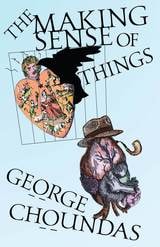
The Making Sense of Things
George Choundas
University of Alabama Press, 2018
A grand tour of the edges of our lives, where glory and significance riot against the logic of living and the pall of tragedy.
The Making Sense of Things is a collection of twelve stories that pulse with memory, magic, and myth—all our favorite ways of trying to make sense of things.
Readers are treated to vivid and unforgettable characters. A fiercely independent woman puts the man who loves her to unconscionable tests, never guessing that arson, suicide, and canine obesity will yield a magical kind of happiness. A honeymooner in Venice, addled by fever and second thoughts, commits by dumb error a double murder. A brisk lawyer founders when a car wreck claims his son and ex-wife, then discovers that the desperation of grief is a kind of hope.
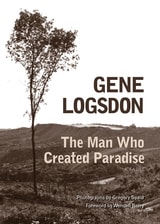
The Man Who Created Paradise
A FableGene Logsdon
Ohio University Press, 2001
Gene Logsdon’s The Man Who Created Paradise is a message of hope at a time when the very concept of earth stewardship is under attack. The fable, inspired by a true story, tells how Wally Spero looked at one of the bleakest places in America—a raw and barren strip-mined landscape—and saw in it his escape from the drudgery of his factory job. He bought an old bulldozer and used the machine to carve patiently, acre by acre, a beautiful little farm out of a seemingly worthless wasteland.
Wally’s story is a charming distillation of the themes that the late, beloved Gene Logsdon returned to again and again in his many books and hundreds of articles. Environmental restoration is the task of our time. The work of healing our land begins in our own backyards and farms, in our neighborhoods and our regions. Humans can turn the earth into a veritable paradise—if they really want to.
Noted photographer Gregory Spaid retraced the trail that Logsdon traveled when he was inspired to write The Man Who Created Paradise. His photographs evoke the same yearning for wholeness, for ties to land and community, that infuses the fable’s poetic prose.
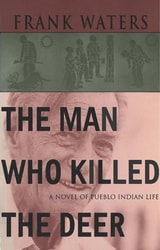
The Man Who Killed The Deer
A Novel of Pueblo Indian LifeFrank Waters
Ohio University Press, 1949
The story of Martiniano, The Man Who Killed the Deer, is a timeless story of Pueblo Indian sin and redemption, and of the conflict between Indian and white laws; written with a poetically charged beauty of style, a purity of conception, and a thorough understanding of Native American values.
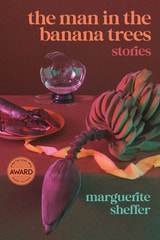
The Man in the Banana Trees
Marguerite Sheffer
University of Iowa Press, 2024
A Debutiful “Most Anticipated Debut Book of 2024”
One of Electric Literature’s Most Exciting Debut Short Story Collection of 2024
Named a Best Book of 2024 by Debutiful and Electric Literature
The stories in The Man in the Banana Trees take place in the past, present, and future—from the American Gulf South to the orbit around Jupiter. We meet teachers and students, ghosts and aliens. An ice cream consultant in the year 2036 predicts a devastating flavor trend and a disgruntled New England waiter investigates a mysterious tanker crash. Although wildly varied in setting, length, and genre, a thread of the fantastic unites these stories, as characters struggle to understand that thing lurking at the edge of their perception: something sinister, or maybe—miraculous.
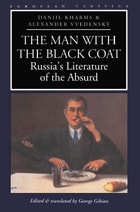
The Man with the Black Coat
Russia's Literature of the AbsurdDaniil Kharms and Alexander Vvedensky
Northwestern University Press, 1997
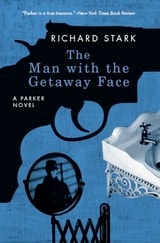
The Man with the Getaway Face
A Parker NovelRichard Stark
University of Chicago Press, 1963
Parker goes under the knife in The Man with the Getaway Face, changing his face to escape the mob and a contract on his life. Along the way he scores his biggest heist yet, but there’s a catch—a beautiful, dangerous catch who goes by the name Alma.
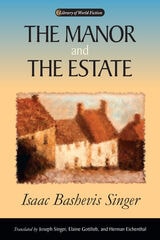
The Manor and the Estate
Isaac Bashevis Singer
University of Wisconsin Press, 2004
The Manor and The Estate—combined in this one-volume edition—bold tales of Polish Jews in the latter half of the nineteenth century, a time of rapid industrial growth and radical social change that enabled the Jewish community to move from the ghetto to prominent positions within Polish society.