Results by title
3785 books match the query 'Poetry' and 833 start with t
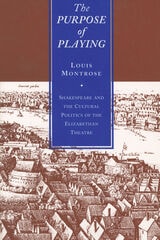
The Purpose of Playing
Shakespeare and the Cultural Politics of the Elizabethan TheatreLouis Montrose
University of Chicago Press, 1996
Montrose first locates the public and professional theater within the ideological and material framework of Elizabethan culture. He considers the role of the professional theater and theatricality in the cultural transformation that was concurrent with religious and socio-political change, and then concentrates upon the formal means by which Shakespeare's Elizabethan plays called into question the absolutist assertions of the Elizabethan state. Drawing dramatic examples from the genres of tragedy and history, Montrose finally focuses his cultural-historical perspective on A Midsummer Night's Dream.
The Purpose of Playing elegantly demonstrates how language and literary imagination shape cultural value, belief, and understanding; social distinction and interaction; and political control and contestation.
The Quarry
PoemsDan Lechay
Ohio University Press, 2004
Once or twice in a generation a poet comes along who captures the essential spirit of the American Midwest and gives name to the peculiar nature that persists there. Like James Wright, Robert Bly, Ted Kooser, and Jared Carter before him, Dan Lechay reshapes our imagination to include his distinct and profound vision of this undersung region.
The poetry of Dan Lechay, collected in The Quarry, constructs a myth of the Midwest that is at once embodied in the permanence of the landscape, the fleeting nature of the seasons, and the eternal flow of the river. Lechay writes of memory and the mutability of memory, of the change brought on a person by the years lived and lost, and of the stoic attempts made by those around him to elicit an order and rationale to their lives.
The Quarry is the first full-length collection from this seasoned poet. Final judge Alan Shapiro in writing about The Quarry said: “If Dan Lechay’s poems often begin with the ordinary details and circumstances of life in a small Midwestern town or city, they always end by reminding us that no moment of life is ever ordinary, that ‘Nothing is more mysterious than the way things are.’
The Quarry is a marvelous, disquieting, extraordinarily beautiful book that meditates on fundamental questions of time and change in and through a clear-eyed yet loving evocation of everyday existence. Under Lechay’s soulful gaze, the backyards, neighborhoods, animals, and landscapes he describes dramatize the often wrenching connection between beauty and loss, evanescence and memory. The Quarry is a thoroughly mature and accomplished book.”
The Queen's Desertion
PoemsCarol Frost
Northwestern University Press, 2006
Pretty to think of the mind at its end
as a metaphysician beekeeping
after the leaves have fallen at autumn's end.
The bee metaphor is handled brilliantly and subtly throughout the collection as a reminder of how often our constant activity, whether it is mental or physical, is taken for granted.
Frost continues her investigation of the mortal plight by entering into a Dantesque descent into the ebb and flow of the seascape. Body consumes body over and over again as fish are caught and killed and the poet observes the flora and fauna as they partake in the darker cycles of nature. A long narrative poem about the Spanish explorer de Baca and his harrowing travels from southern Florida to Mexico powerfully reinforces the certainty of consumption and loss as it comments on the colonizing of the new world. In the final section, Frost returns once more to the need for movement and summons the Greek god Pan, who dances a rite of acceptance through a metaphysical landscape on the verge of seasonal change--the bees are not dead, the dark woods are filled with music.
The Radiant
Lise Goett
Tupelo Press, 2024
The Radiant explores the psychological, physical, and spiritual challenges of living in a body and the changes and distortions that arise from the experience of the body’s limitations and inevitable death. The collection takes its title from the term for the point from which all meteors appear to emanate during a shower, luminous bodies in decay that when traced to their origin seem to converge at a single point. “Perhaps you can remember the time called before, the all-you-can-do-is-see-yourself-in-a-split-second where you recognize that everything you’ve ever known is going to be different after,” writes Goett in the collection’s final poem, “The Bookman,” recounting radiant points of no return and transformation that, in spite of their challenge, remain luminous.
The Rag-Picker's Guide to Poetry
Poems, Poets, ProcessEleanor Wilner and Maurice Manning, editors
University of Michigan Press, 2013
The venture of this inviting collection is to look, from the many vantages that the 35 poets in this eclectic anthology chose to look, at what it was—knowing that a poem can’t be conceived in advance of its creation—that helped their poems to emerge or connected them over time. The Rag-Picker's Guide to Poetry permits an inside view of how poets outwit internal censors and habits of thought, showing how the meticulous and the spontaneous come together in the process of discovery. Within are contained the work and thoughts of:
- Betty Adcock
- Joan Aleshire
- Debra Allbery
- Elizabeth Arnold
- David Baker
- Rick Barot
- Marianne Boruch
- Karen Brennan
- Gabrielle Calvocoressi
- Michael Collier
- Carl Dennis
- Stuart Dischell
- Roger Fanning
- Chris Forhan
- Reginald Gibbons
- Linda Gregerson
- Jennifer Grotz
- Brooks Haxton
- Tony Hoagland
- Mark Jarman
- A. Van Jordan
- Laura Kasischke
- Mary Leader
- Dana Levin
- James Longenbach
- Thomas Lux
- Maurice Manning
- Heather McHugh
- Martha Rhodes
- Alan Shapiro
- Daniel Tobin
- Ellen Bryant Voigt
- Alan Williamson
- Eleanor Wilner
- C. Dale Young
The Ratcatcher
Marina Tsvetaeva, translated from the Russian by Angela Livingstone
Northwestern University Press, 2000
The Ratcatcher, Marina Tsvetaeva's masterpiece, is a satirical version of the Pied Piper of Hamelin legend in the form of a complex narrative poem that bears all the marks of Tsvetaeva's poetic style. Written in 1926, it was not available in Russia until 1965, and has hitherto been virtually unknown in English.
The Reader, the Text, the Poem
The Transactional Theory of the Literary WorkLouise M. Rosenblatt
Southern Illinois University Press, 1994
Louise M. Rosenblatt’s award-winning work continues increasingly to be read in a wide range of academic fields—literary criticism, reading theory, aesthetics, composition, rhetoric, speech communication, and education. Her view of the reading transaction as a unique event involving reader and text at a particular time under particular circumstances rules out the dualistic emphasis of other theories on either the reader or the text as separate and static entities. The transactional concept accounts for the importance of factors such as gender, ethnicity, culture, and socioeconomic context. Essential reading for the specialist, this book is also well suited for courses in criticism, critical theory, rhetoric, and aesthetics.
Starting from the same nonfoundationalist premises, Rosenblatt avoids the extreme relativism of postmodern theories derived mainly from Continental sources. A deep understanding of the pragmatism of Dewey, James, and Peirce and of key issues in the social sciences is the basis for a view of language and the reading process that recognizes the potentialities for alternative interpretations and at the same time provides a rationale for the responsible reading of texts.
The book has been praised for its lucid explanation of the multidimensional character of the reading process—evoking, interpreting, and evaluating the work. The nonliterary (efferent) and the literary (aesthetic) are shown not to be opposites but to represent a continuum of reading behaviors. The author amply illustrates her theoretical points with interpretations of varied texts. The epilogue carries further her critique of rival contemporary theories.
The Real Horse
PoemsFarid Matuk
University of Arizona Press, 2018
Offering a handbook on the possibilities of the verse line, this collection is precise in its figuring, searching in its intellect, and alert in its music. Here lyric energy levitates into constellations that hold their analytic composure, inviting readers into a shared practice of thinking and feeling that interrogates the confounding intersections of gender, race, class, and national status not as abstract concepts but as foundational intimacies.
Matuk’s interrogations of form cut a path through the tangle of a daughter’s position as a natural-born female citizen of the “First World” and of the poet’s position as a once-undocumented immigrant of mixed ethnicity whose paternity is unavoidably implicated in patriarchy. Rejecting nostalgia for homelands, notions of embodied value (self-made or otherwise), and specious ideas of freedom, these luminously multifaceted poem sequences cast their lot with the lyric voice, trusting it to hold a space where we might follow the child’s ongoing revolution against the patrimony of selfhood and citizenship.
The Rebel's Silhouette
Selected PoemsFaiz Ahmed Faiz, translated and edited by Agha Shalid Ali
University of Massachusetts Press, 1995
The Reckoning of Jeanne d'Antietam
PoemsMatthew Moore
University of Nevada Press, 2023
The collection of poems in The Reckoning of Jeanne d’Antietam circles the U.S. Civil War and the failed revolution of Reconstruction, and Matthew Moore makes incursions into the histories and beliefs of the era through architectures of sound, but also via ancillary histories and histories stacked upon histories—densely and visibly scrawled—like Anselm Kiefer's sculptures of lead books, melted and dripping with the texts of illegible songs. His poems include the figure of Joan of Arc (Jeanne d'Arc) and her voices; the explosion of the U.S. prison system and racial legal fictions amid the groundswell of mass terror in the wake of the U.S. Civil War; the politically poisoned poetic lineage that moves from Modernism, to New Criticism, and dead-ends in Southern Agrarianism; and the destructive colonial histories of the sugar and cotton industries.
The Reckoning of Jeanne d’Antietam stands imbricated with the spell of language-the-testament; language as hard rhyme and difficult music, evanescence and violence; and the invocation of names and events at their meeting places in history. Moore’s poems stand against sentiment and pity, and against the consolation of that which cannot be consoled.
The Reef
Elizabeth Arnold
University of Chicago Press, 1998
"Arnold's poetry, much more mature than most writers' first book, links lyrics, slight narratives, and a bit of satire into a work of glorious affirmation. The book is a splendid read."—Mary Sue Koeppel, Florida Times-Union
"For this commitment to both the autobiographical honesty and aesthetic risk, The Reef should be valuable to anyone who has been waiting for where contemporary American poetry is going."—Agni
The Regrets
Joachim du Bellay
Northwestern University Press, 2004
As a member of the mid-sixteenth-century literary group La Pléiade, Joachim du Bellay sought to elevate his native French to the level of the classical languages—a goal pursued with great spirit, elegance, irony, and wit in the poems that comprise The Regrets. Widely viewed as one of the finest sonnet sequences in all of French literature, this Renaissance masterpiece wryly echoes the homesickness and longing of Ovid's poetry written in exile—because du Bellay finds himself lost in Rome, the very home Ovid longed for. In this translation by David R. Slavitt, these brilliant performances retain their original formal playfulness as well as their gracefully rendered but nonetheless moving melancholy. In decadent Rome, among hypocrites, thieves, and snobs, du Bellay uses his poetry as an opportunity for social satire and caustic self-criticism-it becomes a salvation of sorts, an approach peculiarly modern in its blending of the classical, the social, and the personal.
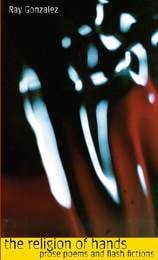
The Religion of Hands
Prose Poems and Flash FictionsRay Gonzalez
University of Arizona Press, 2005
The Religion of Hands does not foster sleep. Look quickly and you will catch the hint of a fox streaking in front of your car’s headlights at night. Look more carefully out your bedroom window and you may see your life going by, lost loved ones waving hello.
"Who were you when the stars were misinterpreted as the fingertips of God?"
Ray Gonzalez blends symbolic play with lyrical beauty as he works from a vast and complex palette to infuse popular culture with myth. The Religion of Hands is imbued with magical realism: a suffocating dream of tamales, mysterious reptilian allusions, a man who "finds God walking down the stairs to hand him an old, tattered phonebook from the year he was born." It offers strange prophecies: "A steady vegetation will grow across the empire as more homeboys are killed in drive-bys. . . . Microscopic scratches on an old vinyl record will form a message discovered in twenty more years when the album is bought at a garage sale." And in 14 flash fictions, it tells of a tiny old man kept in a glass jar, an accordion stored in an old family trunk, tales of sharks and bandits. The religion of hands has its own unspoken sacraments. "The fingers take over, teaching whoever holds the moment that the rapid weight of the open hands is a dangerous way to live."
Seamlessly, effortlessly, multi-dexterously, Ray Gonzalez spins words that speak our very dreams.

The Rendering
Anthony Cody
Omnidawn, 2023
Through a series of experimental poems centered on ecology, Anthony Cody’s The Rendering confronts the history of the Dust Bowl and its residual impacts on our current climate crisis, while acknowledging the complicities of capitalism. These poems grapple with questions of wholeness and annihilation in an Anthropocenic world where the fallout of settler colonialism continues to inflict environmental and cultural devastation. Cody encourages readers to participate in radical acts of refreshing and reimagining the page, poem, collection, and the self, and he invites us to reflect on what lies ahead should our climate continue on its current trajectory toward destruction.
These poems consider if wholeness, or a journey toward wholeness, can exist in the Anthropocene. And, if wholeness cannot exist in these times, we are invited to look at our lives and the world through and beyond annihilation.
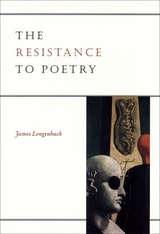
The Resistance to Poetry
James Longenbach
University of Chicago Press, 2005
But the resistance to poetry is quite specifically the wonder of poetry. Considering a wide array of poets, from Virgil and Milton to Dickinson and Glück, Longenbach suggests that poems convey knowledge only inasmuch as they refuse to be vehicles for the efficient transmission of knowledge. In fact, this self-resistance is the source of the reader's pleasure: we read poetry not to escape difficulty but to embrace it.
An astute writer and critic of poems, Longenbach makes his case through a sustained engagement with the language of poetry. Each chapter brings a fresh perspective to a crucial aspect of poetry (line, syntax, figurative language, voice, disjunction) and shows that the power of poetry depends less on meaning than on the way in which it means—on the temporal process we negotiate in the act of reading or writing a poem. Readers and writers who embrace that process, Longenbach asserts, inevitably recoil from the exaggeration of the cultural power of poetry in full awareness that to inflate a poem's claim on our attention is to weaken it.
A graceful and skilled study, The Resistance to Poetry honors poetry by allowing it to be what it is. This book arrives at a critical moment—at a time when many people are trying to mold and market poetry into something it is not.
The Restorers
W. S. Di Piero
University of Chicago Press, 1992

The Revival of Metaphysical Poetry
The History of Style, 1800 to the PresentJoseph E. Duncan
University of Minnesota Press, 1959
The Revival of Metaphysical Poetry was first published in 1959. Minnesota Archive Editions uses digital technology to make long-unavailable books once again accessible, and are published unaltered from the original University of Minnesota Press editions.
The metaphysical style, as expressed in its most distinguished and distinguishable form by the seventeenth-century poet John Donne, has had an increasing influence on latterday critics and poets. Thus it is important to an understanding of literary history to examine this revival. Professor Duncan traces the movement and analyzes changing interpretations of the style in the work of British and American poets and critics. He shows that much of the "new criticism" and the metaphysical poetry of T. S. Eliot and that of the metaphysical style has thrived on fresh critical interpretation and vital poetic experimentation.
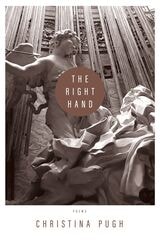
The Right Hand
Christina Pugh
Tupelo Press, 2024
Pain, piercing, and language: with urgent lyricism and lacunae on the page, The Right Hand explores the physical, emotional, and philosophical experiences of chronic pain, bodywork (especially acupuncture), and healing. In the second half of the collection, the poet spends extended time with Bernini's sculpture of St. Teresa in Ecstasy in Rome, finding this famous scene of wounding to be in dialogue with her own experience of pain, as well as her suspension between languages and spiritual isolation. In The Right Hand, the hidden sites of the body speak, and Bernini’s centuries-old arrow pierces us with hurting eloquence.
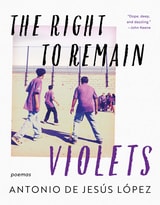
The Right to Remain Violets
poemasAntonio De Jesús López
University of Arizona Press, 2027
The Right to Remain Violets is an electrifying poetry collection that reimagines the language of policing, public education, and state surveillance to illuminate the lived realities of Black and Brown youth in East Palo Alto—a city shaped by redlining, freeway expansion, and decades of over-policing. Blending documentary poetics with hip-hop cadence and Catholic liturgy, Antonio De Jesús López transforms transcripts, municipal documents, and legal language into a powerful form of witness. These poems trace how children are drafted into systems of surveillance and criminalization, even as they search for joy and solidarity amid Silicon Valley’s contrasts of wealth and dispossession.
Inventive and emotionally resonant, the collection spans sonnets, sestinas, hip-hop, and prayer, insisting that language can both indict and heal. López brings his experiences as an award-winning poet, scholar, and former mayor of East Palo Alto to each poem. At once elegy and refusal, The Right to Remain Violets speaks to readers of documentary poetics, social justice literature, and those who believe in the radical importance of protecting childhood in an America reckoning with itself.

The Rival
Sara Wallace
University of Utah Press, 2015
Winner of the Agha Shahid Ali Poetry Prize
In The Rival, Sara Wallace takes her readers on an intimate journey through a woman’s solitary, surreal rural childhood and her brutal, sexually fraught first marriage to the conflicted redemption she finds in motherhood and a second chance at love. In this debut poetry collection, Wallace reveals how closely emotional devastation and transcendence can coexist. The Rival is sensuous, darkly humorous, and frequently luminous in its unflinching exploration of the inner life.
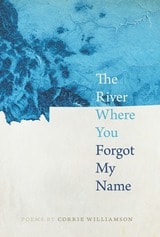
The River Where You Forgot My Name
Corrie Williamson
Southern Illinois University Press, 2019
The River Where You Forgot My Name travels between early 1800s Virginia and Missouri and present-day western Montana, a place where “bats sail the river of dark.” In their crosscutting, the poems in this collection reflect on American progress; technology, exploration, and environment; and the ever-changing landscape at the intersection of wilderness and civilization.
Three of the book’s five sections follow poet Corrie Williamson’s experiences while living for five years in western Montana. The remaining sections are persona poems written in the voice of Julia Hancock Clark, wife of William Clark, who she married soon after he returned from his western expedition with Meriwether Lewis. Julia lived with Clark in the then-frontier town of St. Louis until her early death in 1820. She offers a foil for the poet’s first-person Montana narrative and enriches the historical perspective of the poetry, providing a female voice to counterbalance the often male-centered discovery and frontier narrative.
The collection shines with all-too human moments of levity, tragedy, and beauty such as when Clark names a river Judith after his future wife, not knowing that everyone calls her Julia, or when the poet on a hike to Goldbug Hot Springs imagines a mercury-poisoned Lewis waking “with the dawn between his teeth.” Williamson turns a curious and critical eye on the motives and impact of expansionism, unpacking some of the darker ramifications of American hunger for land and resources. These poems combine breathtaking natural beauty with backbreaking human labor, all in the search for something that approaches grace.
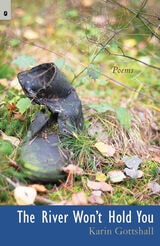
The River Won’t Hold You
Karin Gottshall
The Ohio State University Press, 2014
Haunting and haunted, The River Won’t Hold You navigates loneliness and loss with a quiet, relentless clarity. In poems shaped at the uneasy crossroads of imagination and lived experience, Karin Gottshall searches for solace in the charged spaces between them. “I tell myself I can be content with the pleasures / permitted ghosts,” she writes in “Afterlife,” “but my body wakes up / leaking saltwater, and won’t let my ghost-self be.”
Across the collection, poetic structure and the music of language become vessels for memory, philosophy, and ache. Generous in their formal range and attentive to both sound and silence, these poems resist tidy answers. The beauty of Gottshall's work arises from the steadiness of her gaze, and the startling precision of the images it lands on:
“Wide-open, staring eyes of the tiger / I drew and had to destroy because it wouldn’t sleep.”
The River Won’t Hold You shows how the places we fear most—the gaps, the afterlives, the undefinable spaces—can also be the ones that hold us.
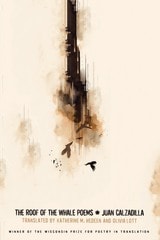
The Roof of the Whale Poems
Juan Calzadilla, Translated by Katherine M. Hedeen and Olivia Lott
University of Wisconsin Press, 2023
In 1961 Calzadilla was a founding member of El Techo de la Ballena (The Roof of the Whale), an avant-garde collective that sought to fuse politics and aesthetics. He published three books of poetry under its umbrella—Dictated by the Pack (1962), Bad Manners (1965), and The SupernaturalContradictions (1967)—which are all presented here in an omnibus edition, masterfully translated by Katherine M. Hedeen and Olivia Lott. Decades later, these poems still resonate, profoundly illustrating a sense of entrapment, of societal pressures on the individual, and of steadfast refusal to give in. Suffused with surrealist imagery, exuberant, exciting, and unexpected, The Roof of the Whale Poems is a breathtaking collection.
The Room Within
PoemsMoore Moran
Ohio University Press, 2010
The Room Withinis a retrospective survey of a poetic career dating back to the late fifties. A student of Yvor Winters at Stanford, Moore Moran has deservedly earned a reputation, along with fellow Winters students Turner Cassity and Edgar Bowers, as a “poet’s poet.” He stands, though, not as a disciple, but as a poet who has earned his own voice over the decades, a voice at once familiar and haunting, down-to-earth and carefully wrought—a unique sensibility that emerges not full blown, but rather line by careful line.
The Rope in Bloom
A Bilingual EditionRadu Vancu
University of Chicago Press, 2026
The first English translation of a Romanian poet’s celebrated and devastating 2012 collection.
In 1997, when he was nineteen, Radu Vancu discovered the body of his father, who had hanged himself in the family home. In the dark years that followed, Vancu turned to literature and self-medication. By 2009, after a decade of “Schopenhauer and vodka” and the publication of seven influential volumes of poetry and essays, Vancu was married, newly sober, and expecting his first child. With these themes in mind—bereavement, love, fatherhood, and poetry—he began writing Frânghia înflorită, or The Rope in Bloom, a poem of Dantesque ambition and scope. Through twenty-four cantos interwoven with prose vignettes, Vancu revisits the scene of the suicide and speaks with the lost soul of his father, who guides and advises him. Each canto begins with the same lines:
What your dead one, what the best-
beloved of your dead loved ones says to you
when you have the heart to dream of him:
Vancu’s verse depicts a nightmare underworld, at once terrible and banal, containing both rivers of blood and family movie nights. Prose vignettes punctuating the book narrate tender years in the early life of a new family. Here, the poet appears in everyday moments, watching cartoons with his son and seeing his wife off to work. Together, the cantos and prose accumulate into a charged collection, where the loss of a father looms over the joy of becoming one.
This volume is the first full-length English translation of Vancu’s work, marking a long-overdue introduction of the poet to anglophone audiences.
The Route as Briefed
James Tate
University of Michigan Press, 1999
In typical Tate style, the book continually straddles the line between fiction and autobiography, entertaining readers with amusing accounts of the poet's own experiences while drawing on these to narrate the fictional stories as well.
James Tate is Professor of Poetry, University of Massachusetts. He is the author of a number of books of poetry, including Worshipful Company of Fletchers: Poems, 1994; Selected Poems, 1991; Distance from Loved Ones, 1990. He has received several awards for his work, including the Pulitzer Prize for poetry in 1992.
The Royal Baker's Daughter
Royal Baker's DaughterBarbara Goldberg
University of Wisconsin Press, 2008
The Rubáiyát of Omar Khayyám
Illustrated Collector's EditionOmar Khayyám
Bodleian Library Publishing, 2014
A book of verses underneath the bough,
A jug of wine, a loaf of bread—and thou.
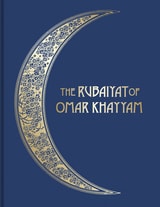
The Rubáiyát is one of the most popular poems of all time. A collection of quatrains composed in the eleventh century by Persian poet and philosopher Omar Khayyám, it was first published in English-language translation by Edward Fitzgerald in 1859. Since then, its melancholy tone and enigmatic philosophy of mourning the painful brevity of life while celebrating what pleasures we may find have made it an inspiration to many writers, including Matthew Arnold and Thomas Hardy. More recently, it has also been the subject of many music adaptations and films.
This collector’s edition of The Rubáiyát features stunning full-color illustrations created by René Bull in 1913 that interpret the poem’s brilliant sensual imagery and provide the perfect complement to Fitzgerald’s translation, which remains the most famous. Every page of poetry in this collector’s edition features unique art nouveau borders in gold, with each illustration framed in a gold border.
The Ruins of Allegory
Paradise Lost and the Metamorphosis of Epic ConventionCatherine Gimelli Martin
Duke University Press, 1998
Martin shows how Paradise Lost, written at the threshold of the enormous imaginative shift that accompanied the Protestant, scientific, and political revolutions of the seventeenth century, conforms to a prophetic baroque model of allegory similar to that outlined by Walter Benjamin. As she demonstrates, Milton’s experimentation with baroque forms radically reformulates classical epic, medieval romance, and Spenserian allegory to allow for both a naturalistic, empirically responsible understanding of the universe and for an infinite and incomprehensible God. In this way, the resulting poetic world of Paradise Lost is like Milton’s God, an allegorical “ruin” in which the divine is preserved but at the price of a loss of certainty. Also, as Martin suggests, the poem affirmatively anticipates modernity by placing the chief hope of human progress in the fully self-authored subject.
Maintaining a dialogue with a critical tradition that extends from Johnson and Coleridge to the best contemporary Milton scholarship, Martin sets Paradise Lost in both the early modern and the postmodern worlds. Ruins of Allegory will greatly interest all Milton scholars, as well as students of literary criticism and early modern studies.
The SILENT SINGER
NEW AND SELECTED POEMSLen Roberts
University of Illinois Press, 2001
The Satiric Poems of John Trumbull
The Progress of Dulness and M'FingalEdited with an introduction and notes by Edwin T. Bowden
University of Texas Press, 1962
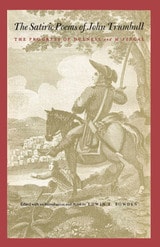
John Trumbull, the colonial American satiric poet, is one of the most readable, and certainly one of the most amusing, of our early men of letters. His poems, with all their wit and bite, bring back to life again the days of the Revolutionary War—powdered wigs, flirting belles, political quarrels, town meetings, brawling mobs, inept generals, flaming national purpose, and all. And if the colonial period seems a long way back in time, his satiric poem on the Progress of Dulness in education will show that time—or at least time in the colleges—has not moved so fast after all.
Trumbull's two long poems, so important to the beginnings of America's national poetry and to an understanding of America's literary heritage, were out of print for a number of years and had, in fact, never before been accurately reprinted from the original versions. Here they are available, complete with the original biting prefaces, in a dependable text for the scholar, annotated for the general reader interested in the literature and history of the American eighteenth century. The annotation is inclusive but kept to a minimum.

The Scandal of the Fabliaux
R. Howard Bloch
University of Chicago Press, 1986
By showing how the medieval poet's obsession with the outrageous, the low, and the lewd was intimately bound to poetry, Bloch forces a revision of traditional approaches to Old French literature. His final chapter, on castration anxiety, fetishism, and the comic, links the fabliaux with the development of modern notions of the self and makes a case for the medieval roots of our own sense of humor.
The Scarlet Ibis
PoemsSusan Hahn
Northwestern University Press, 2007
It’s all about disappearance.
About a bird in a cage
with a mirror, a simple twist
on the handle at the side
that makes it come and go
at the magician’s insistence.
It’s all about innocence.
It’s all about acceptance.
It’s all about compliance.
It’s all about deference.
It’s all about silence.
It’s all about disappearance.
The Scholar's Art
Literary Studies in a Managed WorldJerome McGann
University of Chicago Press, 2006
Of particular interest to McGann is the demise of public discourse about poetry. That poetry has become recondite is, to his mind, at once a problem for how scholars do their work and a general cultural emergency. The Scholar’s Art asks what could be gained by reimagining the way scholars have codified the literary and cultural history of the past two hundred years and goes on to provide a series of case studies that illustrate how scholarly method can help bring about such reimaginings. McGann closes with a discussion of technology’s ability to harness the reimagination of cultural memory and concludes with exemplary acts of critical reflection.
Astute observation from one of America’s most bracing and original commentators on the place of literature in twenty-first century culture, The Scholar’s Art proposes new ways—cultural, philological, and technological—to reimagine our literary past and future.
The School of Solitude
Collected PoemsLuis Hernández
Swan Isle Press, 2014
Derived from these notebooks, The School of Solitude is the first book of Hernández’s poetry in English. The haunting voice of Hernández evokes an irrevocably distant past, with the poems contemplating happiness and joy, love and fulfillment, yet always with a sense of sadness, solitude, and dream. Including rare images from Hernández’s notebooks, as well as several poems never before published in any language, The School of Solitude will be read not only for its powerful poetry and imagery, but also as a means to learn more about this enigmatic Latin American poet and the mystery of his life and work.
The Science Fiction of Poetics and the Avant-Garde Imagination
Michael Golston
University of Alabama Press, 2024
This insightful, playful monograph from Golston does exactly what it advertises: modeling poetics based on how poetry (and some parallel artistic endeavors) has filtered through a century-plus of science fiction. This is not a book about science fiction in and of itself, but it is a book about the resonances of science-fiction tropes and ideas in poetic language.
The germ of Golston’s project is a throwaway line in Robert Smithson’s Entropy and the New Monuments about how cinema supplanted nature as inspiration for many of his fellow artists: “The movies give a ritual pattern to the lives of many artists, and this induces a kind of ‘low budget’ mysticism, which keeps them in a perpetual trance.” Golston charts how the demotic appeal of sci-fi, much like that of the B-movie, cross-pollinated into poetry and other branches of the avant garde.
Golston creates what he calls a “regular Rube Goldberg machine” of a critical apparatus, drawing on Walter Benjamin, Roman Jakobson, and Gilles Deleuze. He starts by acknowledging that, per the important work of Darko Suvin to situate science fiction critically, the genre is premised on cognitive estrangement. But he is not interested in the specific nuts and bolts of science fiction as it exists but rather how science fiction has created a model not only for other poets but also for musicians and landscape artists.
Golston’s critical lens moves around quite a bit, but he begins with familiar enough subjects: Edgar Rice Burroughs, Mina Loy, William S. Burroughs. From there he moves into more “alien” terrain: Ed Dorn’s long poem Gunslinger, the discombobulated work of Clark Coolidge. Sun Ra, Ornette Coleman, and Jimi Hendrix all come under consideration. The result of Golston’s restless, rich scholarship is the first substantial monograph on science fiction and avant-garde poetics, using Russian Formalism, Frankfurt School dialectics, and Deleuzian theory to show how the avant-garde inherently follows the parameters of sci fi, in both theme and form.
The Screams of War
Selected PoemsAkram Alkatreb
Seagull Books, 2024
“Those who believe in the currency of patience / Were burned out in the alleyway.”
The Screams of War is a visceral collection of poems that confront the realities of contemporary Syria. Akram Alkatreb’s verses capture the sense of the quotidian during war. His words, mere “murmurs engraved on stones,” long for and despair over an irrevocable past. At the heart of Alkatreb’s work lies a preoccupation with trauma and the profound burden of alienation that accompanies exile. Nascent memories are shrouded by the “scars of sleep,” and words find themselves nostalgic for destruction. The ubiquity of violence that Alkatreb channels into his poetry does not tolerate enclaves of innocence. The Screams of War is an unforgettable testament to the resilience of the human spirit and a stark reminder of the harsh realities faced by those trapped in conflict.
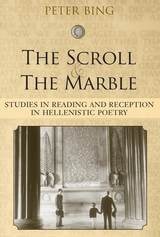
The Scroll and the Marble
Studies in Reading and Reception in Hellenistic PoetryPeter Bing
University of Michigan Press, 2010
---Benjamin Acosta-Hughes, Ohio State University
While people of previous ages relied on public performance as their chief means of experiencing poetry, the Hellenistic age developed what one may term a culture of reading. This was the first era in which poets consciously shaped their works with an eye toward publication and reception not just on the civic stage but in several media---in performance, on inscribed monuments, in scrolls. The essays in Peter Bing's collection explore how poetry accommodated various audiences and how these audiences in turn experienced the text in diverse ways. Over the years, Bing's essays have focused on certain Hellenistic authors and genres---particularly on Callimachus and Posidippus and on epigram. His themes, too, have been broadly consistent. Thus, although the essays in The Scroll and the Marble span some twenty years, they offer a coherent vision of Hellenistic poetics as a whole.
Peter Bing is Professor of Classics at Emory University and editor, most recently, of the Companion to Hellenistic Epigram: Down to Philip (coedited with Jon Steffen Bruss).
Jacket illustration: Film still from Mr. Smith Goes to Washington, directed by Frank Capra, Columbia Pictures 1939. Courtesy of Sony Pictures.
The Sea Is a Continual Miracle
Sea Poems and Other Writings by Walt WhitmanWalt Whitman
University Press of New England, 2017
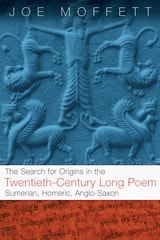
The Search for Origins in the Twentieth-Century Long Poem
Sumerian, Homeric, Anglo-SaxonJOE W. MOFFETT
West Virginia University Press, 2007
In this new, scholarly text—an ambitious study of contemporary poetics—Joe W. Moffett deciphers the twentieth-century long poem, searching for a better understanding of why long-poem writers are preoccupied with a search for origins.
Moffett focuses on issues like postcolonialism, nation, modernism, and postmodernism. He conceptualizes his theories by using what he calls “originiary moments”: historical periods or specific events from which a poet contends our culture descends. These moments enlighten and inspire the modern poet to use origin or “source” as a way to examine present culture and social conditions. The poems also encourage modern readers to question, revise, and repudiate. Moffett organizes his argument by arranging specific examples into three categories of originary moments: Sumerian, Homeric, and Anglo-Saxon.
According to Moffett, the long poem is appealing because it “lacks strict conventions that govern other genres.” Using a wide variety of poems to support his arguments, Moffett asks many stimulating questions and also provides provocative answers.
Questions of when and where It All Began have been off the critical agenda for some time now, embargoed by poststructuralism. Undeterred, Joe Moffett boldly revisits the search for cultural origins, which preoccupied major poets throughout the twentieth century. Capacious in his scope, eclectic in his choices, Moffett rounds up unusual subjects, including long poems by Armand Schwerner, Derek Walcott, Geoffrey Hill, and Judy Grahn, with excursions into Charles Olson, Seamus Heaney, and others. Nowhere will you find clearer, more intelligent, or better-informed readings of these poems than Moffett’s.
The Second Man and Other Poems
Louis Coxe
University of Minnesota Press, 1955
The Second Seedtime
Notebooks, 1980–94Philippe Jaccottet
Seagull Books, 2017
One of Europe’s finest contemporary poets, Jaccottet is a writer of exacting attention. Through keen observations of the natural world, art, literature, and music, and reflections on the human condition, Jaccottet opens his readers’ eyes to the transcendent in everyday life. The Second Seedtime is a collection of “things seen, things read, and things dreamed.” The volume continues the project Jaccottet began three decades earlier in his first volume of notebooks, Seedtime. Here, again, he gathers flashes of beauty dispersed around him like seeds that may blossom into poems or moments of inspiration. He returns, insistently, to such literary touchstones as Dante, Montaigne, Góngora, Goethe, Kierkegaard, Hölderlin, Michaux, Hopkins, Brontë, and Dickinson, as well as musical greats including Bach, Monteverdi, Purcell, and Schubert. The Second Seedtime is the vivid chronicle of one man’s passionate engagement with the life of the mind, the spirit, and the natural world.
The Second Signs Reader
Feminist Scholarship, 1983-1996Edited by Ruth-Ellen Boetcher Joeres and Barbara Laslett
University of Chicago Press, 1996
The Secret Powers of Naming
Sara Littlecrow-Russell; Introduction by Joy Harjo
University of Arizona Press, 2006
As Littlecrow-Russell explores how names imposed by outsiders both collide and merge with the identities that Natives create for themselves, these poems decisively counter the images of Indians as colorful dancers, stoic saints, and defeated warriors. These verses are not constructed of beautiful images, nor are they stories of redemption. Instead, Littlecrow-Russell offers stark and honest witness to urban and reservation life at the beginning of the twenty-first century. In short snaps of honed lyric and voice, she tackles topics ranging from family, love, and spirituality, to welfare, addiction, and the thorny politics of tribal identity. Her work displays tremendous bitterness and anger, but there is also dignity, humor, and plenty of irony.
Candid and compelling, this collection brings fluent verse and human face to the commonly misrepresented experiences of Native Americans.

The Selected Poems Of Howard Nemerov
Howard Nemerov
Ohio University Press, 2003
Howard Nemerov—poet laureate of the United States, winner of the Pulitzer Prize and National Book Award, and chancellor of the Academy of American Poets—was one of the most prolific and significant American poets of the twentieth century. By the time of his death in 1991, he had published fourteen collections of poetry.
Judiciously selected and introduced by poet Daniel Anderson, The Selected Poems of Howard Nemerov represents the broad spectrum of Nemerov’s virtues as a poet—his intelligence, his wit, his compassion, and his irreverence. It stands as the retrospective collection of the best of what Nemerov left behind, which is some of the finest poetry that the twentieth century produced.
“To keep his errors down to a minimum,” W. H. Auden wrote, “the internal Censor to whom a poet submits his work in progress should be a Censorate. It should include, for instance, a sensitive only child, a practical housewife, a logician, a monk, an irreverent buffoon a nd even, perhaps, hated by all others and returning their dislike, a brutal, foul-mouthed drill sergeant who considers all poetry rubbish.”
Such are the readers to whom the poetry of Howard Nemerov might appeal. He distinguished himself on the landscape of American letters as a writer of great versatility. More than a decade after his death, that claim still holds true.
In this, the only edition of Nemerov’s work that surveys his entire poetic output, first-time readers of these poems will find an introduction to a truly remarkable creative mind. Longtime admirers of Nemerov will be reminded once again of his significance as a craftsman and philosopher, and as a poetic steward of the many ways in which we experience the world.
The Selected Poems Of Yvor Winters
Yvor Winters
Ohio University Press, 1999
The Selected Poems of Fulke Greville
Fulke Greville
University of Chicago Press, 2009
Along with his childhood friend Sir Philip Sidney, Fulke Greville (1554–1628) was an important member of the court of Queen Elizabeth I. Although his poems, long out of print, are today less well known than those of Sidney, Spenser, or Shakespeare, Greville left an indelible mark on the world of Renaissance poetry, both in his love poems, which ably work within the English Petrarchan tradition, and in his religious meditations, which, along with the work of Donne and Herbert, stand as a highpoint of early Protestant poetics.
Back in print for a new generation of scholars and readers, Thom Gunn’s selection of Greville’s short poems includes the whole of Greville’s lyric sequence, Caelica, along with choruses from some of Greville’s verse dramas. Gunn’s introduction places Greville’s thought in historical context and in relation to the existential anxieties that came to preoccupy writers in the twentieth century. It is as revealing about Gunn himself, and the reading of earlier English verse in the 1960s, as it is about Greville’s own poetic achievement. This reissue of Selected Poems of Fulke Greville is an event of the first order both for students of early British literature and for readers of Thom Gunn and English poetry generally.

The Selected Poems of Harriet Monroe
Harriet Monroe, edited by Kevin McMullen
Southern Illinois University Press, 2026
Unearthing the overlooked poet behind Poetry magazine
Harriet Monroe, whose work as the visionary founding editor of Poetry magazine profoundly shaped the development of American poetry in the 20th century, was a vital and prolific poet in her own right. This volume showcases the sweeping breadth of Monroe’s poetic talents.
Monroe lived through a period of immense change and global conflict, from the American Civil War, through World War I and the Great Depression, up to the first stirrings of the second Great War. Through her poetry, Monroe confronted major issues, critiquing war, the impact of industrialization on the arts, and inequality, while championing women’s rights and environmental conservation—issues that remain pressingly relevant today. Monroe’s three collections of poetry, as well as her own “selected poems” volume, have all long been out of print. This book, then, represents the first appearance of many of these poems in more than 100 years. This selection includes meditations on modern technology and globalization in the early 20th century, love lyrics, hymns to the deserts of the American West, feminist reflections on gender and motherhood, and more. The volume also includes a number of poems that have never before been published, drawing on manuscripts found in Monroe’s papers at the University of Chicago Library.
Students at the University of Nebraska–Lincoln, under the guidance of Kevin McMullen, project manager of the Walt Whitman Archive, selected these poems to capture the range and breadth of Monroe’s styles and poetic interest. The poems, along with an extensive critical introduction and explanatory notes, establish Monroe’s place as an important and overlooked Modernist poet from the Midwest.
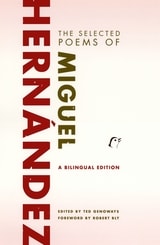
The Selected Poems of Miguel Hernandez
A Bilingual EditionMiguel Hernández
University of Chicago Press, 2001
Now, for the first time, Ted Genoways makes Hernández's extraordinary oeuvre available in an authoritative bilingual edition. Featuring some of the most tender and vigorous poetry on war, death, and social injustice written in the past century, nearly half of the poems in this volume appear in English for the first time, making it the most comprehensive bilingual collection of Hernández's work available. Arranged chronologically, The Selected Poems of Miguel Hernández presents Hernández's remarkable emotional range as well as his stylistic evolution from the Romantic shepherd poet to poet of the prison cell. Thorough annotations and introductory essays illuminate the biographical basis for many of Hernández's poems, while a foreword by Robert Bly and an afterword by Octavio Paz provide a striking frame for the work of this essential poet.
"What a victory it is to watch springing forth from our murky thicket of half-commercialized poetry the silver boar of Hernández's words-to see the world of paper part so as to allow the language tusks and shoulders to emerge, shining, pressed forward by his genius. This generous selection of Miguel Hernández's work, arranged, shepherded, and largely translated by Ted Genoways, is an immense gift for which all of us should be grateful."-from the Foreword by Robert Bly
"To gather Hernández's poetry in such a large volume is to bring one of the 20th century's most important poets to life again. Without Hernandez, the world community of poetry would not be what it is today. The Selected Poems must be read if vital poetry is to continue another 100 years, with Hernández's voice as a cherished example of why great poetry is timeless."—Ray González, Bloomsbury Review
"As Philip Levine write in The Kenyon Review, Hernández is 'one of the great talents of the century,' and this collection is a good place to discover (or rediscover) his moving verses."—Virginia Quarterly Review
"Vivid, often volatile imagery describes wrenching emotions and events in The Selected Poems of Miguel Hernández: A Bilingual Edition. . . . Raw, passionate, despairing and celebratory, these poems are a true discovery."—Publishers Weekly
"Arranged in three chronological sections, the poems presented are not the complete works, but they are a large and representative sampling of the best. This is certainly the most comprehensive bilingual edition of Hernández's poetry available. In addition to the poems, the editor includes eight illustrations, important prefatory materials, and a short list of references, and an epilogue by Octavio Paz."—Choice
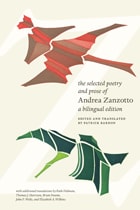
The Selected Poetry and Prose of Andrea Zanzotto
A Bilingual EditionAndrea Zanzotto
University of Chicago Press, 2007
Andrea Zanzotto is widely considered Italy’s most influential living poet. The first comprehensive collection in thirty years to translate this master European poet for an English-speaking audience, The Selected Poetry and Prose of Andrea Zanzotto includes the very best poems from fourteen of his major books of verse and a selection of thirteen essays that helps illuminate themes in his poetry as well as elucidate key theoretical underpinnings of his thought. Assembled with the collaboration of Zanzotto himself and featuring a critical introduction, thorough annotations, and a generous selection of photographs and art, this volume brings an Italian master to vivid life for American readers.
“Now, in [this book], American readers can get a just sense of [Zanzotto’s] true range and extraordinary originality.”—Eric Ormsby, New York Sun
“What I love here is the sense of a voice directly speaking. Throughout these translations, indeed from early to late, the great achievement seems to be the way they achieve a sense of urgent address.”—Eamon Grennan, American Poet