Results by title
5448 books match the query 'History and criticism' and 1116 start with t

The Perfect Murder
A Study in DetectionDavid Lehman
University of Michigan Press, 2000
As Lehman shows, the detective story draws deeply from ancient storytelling traditions. The mystery's conventions--the locked room, the clue "hidden" in plain sight, the diabolical double, the villainous least likely subject--work on us as childhood fairy tales do; they prey upon our darkest fears, taking us to the brink of the unbearable before restoring a comforting sense of order. The myth of Oedipus, for example, contains the essential elements of a whodunit, with the twist that the murderer the detective pursues is himself.
With their wisecracking gumshoe heroes, Dashiell Hammett and Raymond Chandler fashioned an existential romance out of the detective novel. More recent writers such as Ross MacDonald, P. D. James, and Ruth Rendell have raised the genre to a new level of psychological sophistication. Yet the form evolves still, and Lehman guides us to the epistemological riddles of Jorge Luis Borges and Umberto Eco, who challenge the notion of a knowable truth. Originally published in 1989, this new edition features an additional chapter on the mystery novels of the 1990s.
"A lively study of the development and varieties of the detective story since Poe, its relations with other forms high and low, and the latter-day appropriation of its techniques by such writers as Borges and Eco. . . . A thoroughly intelligent and readable book." --Richard Wilbur, Pulitzer-Prize winning poet
David Lehman is the series editor of both the The Best American Poetry, published by Scribner, and the Poets on Poetry series published by the University of Michigan Press. He is a former Guggenheim Fellow in poetry, a vice president of the National Book Critics Circle, and the author of several books of criticism and collections of poems.
The Performance of Power
Theatrical Discourse and PoliticsSue-Ellen Case
University of Iowa Press, 1991
Recently in the field of theatre studies there has been an increasing amount of debate and dissonance regarding the borders of its territory, its methodologies, subject matter, and scholarly perspectives. The nature of this debate could be termed "political" and, in fact, concerns "the performance of power"—the struggle over power relations embedded in texts, methodologies, and the academy itself.
This striking new collection of nineteen divergent essays represents this performance of power and the way in which the recent convergence of new critical theories with historical studies has politicized the study of the theatre. Neither play text, performance, nor scholarship and teaching can safely reside any longer in the "free," politically neutral, self-signifying realm of the aesthetic. Politicizing theatrical discourse means that both the hermeneutics and the histories of theatre reveal the role of ideology and power dynamics.
New strategies and concepts—and a vital new phase of awareness—appear in these illuminating essays. A variety of historical periods, from the Renaissance through the Victorian and up to the most contemporary work of the Wooster group, illustrate the ways in which contemporary strategies do not require contemporary texts and performances but can combine with historical methods and subjects to produce new theatrical discourse.

The Performing Self
Compositions and Decompositions in the Languages of Contemporary LifePoirier, Richard
Rutgers University Press, 1992
.
The Phantom Unmasked
America's First SuperheroKevin Patrick
University of Iowa Press, 2017
By tracing the publication history of The Phantom in magazines and comic books across international markets since the mid-1930s, author Kevin Patrick delves into the largely unexplored prehistory of modern media licensing industries. He also explores the interconnections between the cultural, political, economic, and historical factors that fueled the character’s international popularity. The Phantom Unmasked offers readers a nuanced study of the complex cultural flow of American comic books around the world. Equally important, to provide a rare glimpse of international comics fandom, Patrick surveyed the Phantom’s “phans”—as they call themselves—and lets them explain how and why they came to love the world’s first masked superhero.
The Philosopher and the Storyteller
Eric Voegelin and Twentieth-Century LiteratureCharles R. Embry
University of Missouri Press, 2018
Throughout his philosophical career, Eric Voegelin had much to say about literature in both his published work and his private letters. Many of his most trenchant comments regarding the analysis of literature appear in his correspondence with critic Robert Heilman, and, through his familiarity with that exchange, Charles Embry has gained extraordinary insight into Voegelin’s literary views.
The Philosopher and the Storyteller is the first book-length study of the literary dimensions of Voegelin’s philosophy—and the first to use his philosophy to read specific novels. Bringing to bear a thorough familiarity with both Voegelin and great literature, Embry shows that novels—like myths, philosophy, and religious texts—participate in the human search for the truth of existence, and that reading literature within a Voegelinian framework exposes the existential and philosophical dimensions of those works.
Embry focuses on two key elements of Voegelin’s philosophy as important for reading literature: metaxy, the in-between of human consciousness, and metalepsis, human participation in the community of being. He shows how Voegelin’s philosophy in general is rooted in literary-symbolic interpretation and, therefore, provides a foundation for the interpretation of literature. And finally he explores Voegelin’s insistence that the soundness of literary criticism lies in the consciousness of the reader.
Embry then offers Voegelinian readings that vividly illustrate the principles of this approach. First he considers Graham Swift’s Waterland as an example of the human search for meaning in the modern world, then he explores the deformation and recovery of reality in Heimito von Doderer’s long and complex novel The Demons, and finally he examines how Flannery O’Connor’s The Violent Bear It Away mythically expresses the flux of divine presence in what Voegelin calls the Time of the Tale.
The Philosopher and the Storyteller unites fiction and philosophy in the common quest to understand our nature, our world, and our cosmos. A groundbreaking exploration of the connection between Voegelin and twentieth-century literature, this book opens a new window on the philosopher’s thought and will motivate readers to study other novels in light of this approach.
The Philosopher's Toothache
Embodied Stoicism in Early Modern English DramaDonovan Sherman
Northwestern University Press, 2022
Informed by work in both classical philosophy and performance studies, Donovan Sherman argues that Stoicism infused the complex theatrical culture of early modern England. Plays written and performed during this period gave life to Stoic exercises that instructed audiences to cultivate their virtue, self-awareness, and creativity. By foregrounding Stoicism’s embodied nature, Sherman recovers a vital dimension too often lost in reductive portrayals of the Stoics by early modern writers and contemporary scholars alike. The Philosopher’s Toothache features readings of dramatic works by William Shakespeare, Cyril Tourneur, and John Marston alongside considerations of early modern adaptations of classical Stoics (Seneca, Epictetus, and Marcus Aurelius) and Neo-Stoics such as Justus Lipsius. These plays model Stoic virtues like unpredictability, indifference, vulnerability, and dependence—attributes often framed as negative but that can also rekindle a sense of responsible public action.

The Picara
From Hera to Fantasy HeroineAnne K. Kaler
University of Wisconsin Press, 1991
The Picshuas of H. G. Wells
A Burlesque DiaryGene K. Rinkel and Margaret E. Rinkel
University of Illinois Press, 2000
The Pink Guitar
Writing as Feminist PracticeRachel Blau DuPlessis
University of Alabama Press, 2006
The Pipes of Pan
Intertextuality and Literary Filiation in the Pastoral Tradition from Theocritus to MiltonThomas K. Hubbard
University of Michigan Press, 1999
Pastoral poetry highlights the didactic relationship of older and younger shepherds, whether as rivals or as patron and successor. As such it is an ideal form for young poets' self-representation vis-à-vis their elders, whose work they simultaneously appropriated and transformed, even as the elder poets were represented in the new texts. This influence is reenacted in every generation: Theocritus vs. his Alexandrian forebears, Vergil vs. Theocritus, Calpurnius vs. Vergil, Nemesianus vs. Vergil and Calpurnius, Petrarch vs. Vergil, Boccaccio vs. Petrarch, Spenser vs. Vergil, along with Chaucer and Milton vs. Spenser.
The Pipes of Pan combines multiple strands of contemporary intertextual theory with reception aesthetics and Harold Bloom's theory of intersubjective conflict between generations of poets. It also provides one of the first systematic studies of intertextual and intersubjective dynamics within a whole genre.
This work will be of interest to classicists, students of literary theory, comparative literature, medieval and Renaissance literature, Italian humanism, and English literature of the sixteenth and seventeenth centuries. All texts are translated.
Thomas Hubbard is Associate Professor of Classics, University of Texas at Austin.
The Place of the Stage
License, Play, and Power in Renaissance EnglandSteven Mullaney
University of Michigan Press, 1995
In this richly textured multidisciplinary work, Steven Mullaney examines the cultural situation of popular drama in Elizabethan and Jacobean England. Relying upon a dynamic model of cultural production, Mullaney defines an original and historically grounded perspective on the emergence of popular theater and illustrates the critical, revisionary role it played in the symbolic economy of Renaissance England. Combining literary, historical, and broadly conceived cultural analysis, he investigates, among other topics, the period's exhaustive "rehearsal" of other cultures and its discomfiting apprehensions of the self; the politics of vanished forums for ideological production such as the wonder-cabinet and the leprosarium; the cultural poetics of royal entries; and the incontinent, uncanny language of treason. As Mullaney demonstrates, Shakespearean drama relied upon and embodied the marginal license of the popular stage and, as a result, provides us with powerful readings of the shifting bases of power, license, and theatricality in Elizabethan and Jacobean England. "A major study, not merely of selected Shakespearean plays but of the very conditions of the possibility of Renaissance drama." --Louis Montrose, University of California, San Diego "Mullaney's rich and engaged reading of the place of Shakespeare's stage represents the texture of early modern life and its cultural productions in the vivid tradition of annales history and brilliantly exemplifies his theoretical call for a poetics of culture." -- Shakespeare Quarterly "Mullaney marshals an impressive range of cultural representations which, taken together, will undoubtedly force a reconsideration of the semiotics of the Elizabethan stage." --Times Higher Education Supplement ". . . something of a dramatic feat in cultural studies: literary critic Mullaney calls in a cast ranging from Clifford Geertz and Pierre Bourdieu to Raymond Williams, Mary Douglas, and Michel Foucault." --Contemporary Sociology.
The Places of History
Regionalism Revisited in Latin AmericaDoris Sommer, ed.
Duke University Press, 1999
Representing a broad range of contemporary criticism, this volume features many short essays by the most well-known and respected Latin Americanists, each devoting attention to specific matters of history. The topics range from Incan architecture to Chicano and Nuyorican habitats; from turn of the century Argentine criminology to Caribbean homophobia; from the rhetorics of independence and dictatorship to Mexican ambivalence about opera and Brazil’s move beyond monarchy; and from the precarious survival of Spanish language in Latin America to its paradoxical legacy of enlightenment in the Philippines. Originally published as a special issue of Modern Language Quarterly (June 1996), this expanded edition includes a new introduction by Doris Sommer and a new essay by Vincente Rafael. Viewed together, these essays reveal a cultural richness that is sure to interest literary scholars and Latin Americanists alike.
Contributors. Carlos J. Alonso, Antonio Benítez-Rojo, John Beverley, Debra A. Castillo, Arcadio Diaz-Quiñones, Juan Flores, Mary M. Gaylord, José Limón, Josefina Ludmer, Francine Masiello, Antonio Mazzotti, Walter D. Mignolo, Sylvia Molloy, Mary Louise Pratt, Vincente Rafael, Julio Ramos, Susana Rotker, Roberto Schwarz, Diana Taylor, Nancy Vogeley
The Play of Allusion in the Historia Augusta
David Rohrbacher
University of Wisconsin Press, 2015
The Play of Fictions
Studies in Ovid's Metamorphoses Book 2A. M. Keith
University of Michigan Press, 1992
The Playwright as Thinker
A Study of Drama in Modern Times, Fourth EditionEric Bentley
University of Minnesota Press, 2010
The Playwright at Work
ConversationsRosemarie Tichler
Northwestern University Press, 2012
The Plight of Feeling
Sympathy and Dissent in the Early American NovelJulia A. Stern
University of Chicago Press, 1997
Stern argues that these novels gave voice to a collective mourning over the violence of the Revolution and the foreclosure of liberty for the nation's noncitizens—women, the poor, Native and African Americans. Properly placed in the context of late eighteenth-century thought, the republican novel emerges as essentially political, offering its audience gothic and feminized counternarratives to read against the dominant male-authored accounts of national legitimation.
Drawing upon insights from cultural history and gender studies as well as psychoanalytic, narrative, and genre theory, Stern convincingly exposes the foundation of the republic as an unquiet crypt housing those invisible Americans who contributed to its construction.
The Plot Thickens
Illustrated Victorian Serial Fiction from Dickens to du MaurierMary Elizabeth Leighton
Ohio University Press, 2018
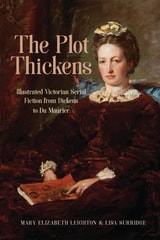
In the early 1800s, books were largely unillustrated. By the 1830s and 1840s, however, innovations in wood- and steel-engraving techniques changed how Victorian readers consumed and conceptualized fiction. A new type of novel was born, often published in serial form, one that melded text and image as partners in meaning-making.
These illustrated serial novels offered Victorians a reading experience that was both verbal and visual, based on complex effects of flash-forward and flashback as the placement of illustrations revealed or recalled significant story elements. Victorians’ experience of what are now canonical novels thus differed markedly from that of modern readers, who are accustomed to reading single volumes with minimal illustration. Even if modern editions do reproduce illustrations, these do not appear as originally laid out. Modern readers therefore lose a crucial aspect of how Victorians understood plot—as a story delivered in both words and images, over time, and with illustrations playing a key role.
In The Plot Thickens, Mary Elizabeth Leighton and Lisa Surridge uncover this overlooked narrative role of illustrations within Victorian serial fiction. They reveal the intricacy and richness of the form and push us to reconsider our notions of illustration, visual culture, narration, and reading practices in nineteenth-century Britain.

The Poem Electric
Technology and the American LyricSeth Perlow
University of Minnesota Press, 2018
An enlightening examination of the relationship between poetry and the information technologies increasingly used to read and write it
Many poets and their readers believe poetry helps us escape straightforward, logical ways of thinking. But what happens when poems confront the extraordinarily rational information technologies that are everywhere in the academy, not to mention everyday life?
Examining a broad array of electronics—including the radio, telephone, tape recorder, Cold War–era computers, and modern-day web browsers—Seth Perlow considers how these technologies transform poems that we don’t normally consider “digital.” From fetishistic attachments to digital images of Emily Dickinson’s manuscripts to Jackson Mac Low’s appropriation of a huge book of random numbers originally used to design thermonuclear weapons, these investigations take Perlow through a revealingly eclectic array of work, offering both exciting new voices and reevaluations of poets we thought we knew.
With close readings of Gertrude Stein, Frank O’Hara, Amiri Baraka, and many others, The Poem Electric constructs a distinctive lineage of experimental writers, from the 1860s to today. Ultimately, Perlow mounts an important investigation into how electronic media allows us to distinguish poetic thought from rationalism. Posing a necessary challenge to the privilege of information in the digital humanities, The Poem Electric develops new ways of reading poetry, alongside and against the electronic equipment that is now ubiquitous in our world.
The Poem in the Story
Music, Poetry, and NarrativeHarold Scheub
University of Wisconsin Press, 2002
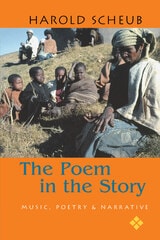
Fact and fiction meet at the boundaries, the betwixt and between where transformations occur. This is the area of ambiguity where fiction and fact become endowed with meaning, and this is the area—where ambiguity, irony, and metaphor join forces—that Harold Scheub exposes in all its nuanced and evocative complexity in The Poem in the Story.
In a career devoted to exploring the art of the African storyteller, Scheub has conducted some of the most interesting and provocative investigations into nonverbal aspects of storytelling, the complex relationship between artist and audience, and, most dramatically, the role played by poetry in storytelling. This book is his most daring effort yet, an unconventional work that searches out what makes a story artistically engaging and emotionally evocative, the metaphorical center that Scheub calls "the poem in the story." Drawing on extensive fieldwork in southern Africa and decades of experience as a researcher and teacher, Scheub develops an original approach—a blend of field notes, diary entries, photographs, and texts of stories and poems—that guides readers into a new way of viewing, even experiencing, meaning in a story. Though this work is largely focused on African storytelling, its universal applications emerge when Scheub brings the work of storytellers as different as Shakespeare and Faulkner into the discussion.
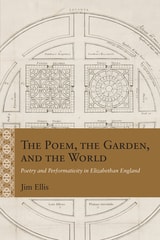
The Poem, the Garden, and the World
Poetry and Performativity in Elizabethan EnglandJim Ellis
Northwestern University Press, 2023
How an early modern understanding of place and movement are embedded in a performative theory of literature
How is a garden like a poem? Early modern writers frequently compared the two, and as Jim Ellis shows, the metaphor gained strength with the arrival of a spectacular new art form—the Renaissance pleasure garden—which immersed visitors in a political allegory to be read by their bodies’ movements. The Poem, the Garden, and the World traces the Renaissance-era relationship of place and movement from garden to poetry to a confluence of both. Starting with the Earl of Leicester’s pleasure garden for Queen Elizabeth’s 1575 progress visit, Ellis explores the political function of the entertainment landscape that plunged visitors into a fully realized golden world—a mythical new form to represent the nation. Next, he turns to one of that garden’s visitors: Philip Sidney, who would later contend that literature’s golden worlds work to move us as we move through them, reorienting readers toward a belief in English empire. This idea would later be illustrated by Edmund Spenser’s Faerie Queen; as with the pleasure garden, both characters and readers are refashioned as they traverse the poem’s dreamlike space. Exploring the artistic creations of three of the era’s major figures, Ellis argues for a performative understanding of literature, in which readers are transformed as they navigate poetic worlds.
The Poet Without a Name
Gray's Elegy and the Problem of HistoryHenry Weinfield
Southern Illinois University Press, 1991
Henry Weinfield offers a new reading not only of the Elegy itself but also of its place in English literary history. His central argument is that in Gray’s Elegy the thematic constellation of poverty, anonymity, alienation, and unfulfilled potential—or what Weinfield calls the "problem of history"—is fully articulated for the first time, and that, as a result, the Elegy represents an important turning-point in the history of English poetry.
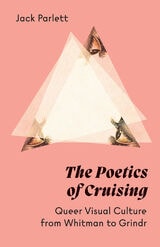
The Poetics of Cruising
Queer Visual Culture from Whitman to GrindrJack Parlett
University of Minnesota Press, 2022
The Poetics of Cruising explores the relationship between cruising, photography, and the visual in the work of leading poets, from Walt Whitman in the nineteenth century to Eileen Myles in the twenty-first. What is it that happens, asks Jack Parlett, and what is it that is sought, in this often transient moment of perception we call cruising, this perceptual arena where acts of looking between strangers are intensified and eroticized? Parlett believes that this moment is not only optical in nature but visual: a mode of looking that warrants comparison with the ways in which we behold still and moving images.
Whether it’s Whitman’s fixation with daguerreotypes, Langston Hughes’s hybrid photographic works, or Frank O’Hara’s love of Hollywood movie stars, argues Parlett, the history of poets cruising abounds with this intermingling between the verbal and the visual, the passing and the fixed. To look at someone in the act of cruising, this history suggests, is to capture, consider, and aestheticize, amid the flux and instantaneity of urban time. But it is also to reveal the ambivalence at the heart of this erotic search, where power may be unevenly distributed across glances, and gendered and racialized bodies are marked. Thus, in identifying for the first time this confluence of cruising, poetry, and visual culture, Parlett concludes that the visual erotic economy associated with gay cruising today, exemplified by the photographic grid of an app like Grindr, is not a uniquely contemporary phenomenon.
Innovative, astute, and highly readable, and drawing on compelling archival material, The Poetics of Cruising is a must for scholars of queer and LGBTQ literature and culture, modern and contemporary poetry, visual studies, and the history of sexuality.
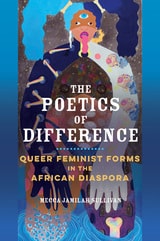
The Poetics of Difference
Queer Feminist Forms in the African DiasporaMecca Jamilah Sullivan
University of Illinois Press, 2021
From Audre Lorde, Ntozake Shange, and Bessie Head, to Zanele Muholi, Suzan-Lori Parks, and Missy Elliott, Black women writers and artists across the African Diaspora have developed nuanced and complex creative forms. Mecca Jamilah Sullivan ventures into the unexplored spaces of black women’s queer creative theorizing to learn its languages and read the textures of its forms. Moving beyond fixed notions, Sullivan points to a space of queer imagination where black women invent new languages, spaces, and genres to speak the many names of difference. Black women’s literary cultures have long theorized the complexities surrounding nation and class, the indeterminacy of gender and race, and the multiple meanings of sexuality. Yet their ideas and work remain obscure in the face of indifference from Western scholarship.
Innovative and timely, The Poetics of Difference illuminates understudied queer contours of black women’s writing.
The Poetics of Epiphany in the Spanish Lyric of Today
Judith Nantell
Bucknell University Press, 2020
Published by Bucknell University Press. Distributed worldwide by Rutgers University Press.
The Poetics of Impudence and Intimacy in the Age of Pushkin
Joe Peschio
University of Wisconsin Press, 2012
Joe Peschio offers the first comprehensive history of a set of associated behaviors known in Russian as “shalosti,” a word which at the time could refer to provocative behaviors like practical joking, insubordination, ritual humiliation, or vandalism, among other things, but also to literary manifestations of these behaviors such as the use of obscenities in poems, impenetrably obscure allusions, and all manner of literary inside jokes. One of the period’s most fashionable literary and social poses became this complex of behaviors taken together. Peschio explains the importance of literary shalosti as a form of challenge to the legitimacy of existing literary institutions and sometimes the Russian regime itself. Working with a wide variety of primary texts—from verse epistles to denunciations, etiquette manuals, and previously unknown archival materials—Peschio argues that the formal innovations fueled by such “prankish” types of literary behavior posed a greater threat to the watchful Russian government and the literary institutions it fostered than did ordinary civic verse or overtly polemical prose.
The Poetics of Indeterminacy
Rimbaud to CageMarjorie Perloff
Northwestern University Press, 1999
The Poetics of Repetition in English and Chinese Lyric Poetry
Cecile Chu-chin Sun
University of Chicago Press, 2010
For more than half a century, Chinese-Western comparative literature has been recognized as a formal academic discipline, but critics and scholars in the field have done little to develop a viable, common basis for comparison between these disparate literatures. In this pioneering book, Cecile Chu-chin Sun establishes repetition as the ideal perspective from which to compare the poetry and poetics from these two traditions.
Sun contends that repetition is at the heart of all that defines the lyric as a unique art form and, by closely examining its use in Chinese and Western poetry, she demonstrates howone can identify important points of convergence and divergence. Through a representative sampling of poems from both traditions, she illustrates how the irreducible generic nature of the lyric transcends linguistic and cultural barriers but also reveals the fundamental distinctions between the traditions. Most crucially, she dissects the two radically different conceptualizations of reality—mimesis and xing—that serve as underlying principles for the poetic practices of each tradition.
Skillfully integrating theory and practice, The Poetics of Repetition in English and Chinese Lyric Poetryprovides a much-needed model for future study of Chinese and English poetry as well as lucid, succinct interpretations of individual poems.
The Poetics of Scale
From Apollinaire to Big DataConrad Steel
University of Iowa Press, 2024
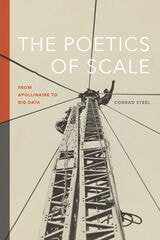
The Poetics of Scale takes us back to the years before the First World War in Paris, where the poet Guillaume Apollinaire claimed to have invented a new mode of poetry large enough to take on the challenges of the coming twentieth century. This history follows Apollinaire’s ideas across the Atlantic and examines how and why his work became such a vital source of inspiration for American poets through the era of intensive American economic expansion and up to the present day. Threading together Apollinaire’s work in the 1910s with three of his American successors—Louis Zukofsky in the 1930s, Allen Ginsberg in the 1950s, and Alice Notley from the 1970s onward—it shows how poetry as a cultural technique became the crucial test case for the scale of our collective imagination.
The Poetics of Transition
Emerson, Pragmatism, and American Literary ModernismJonathan Levin
Duke University Press, 1999
Levin draws on the pragmatist and neopragmatist writings of William James, John Dewey, George Santayana, Richard Rorty, and Cornel West to illuminate the work of modernist literature. In turn, he illuminates the poetic imperatives of pragmatism by tracing the ways in which Henry James, Gertrude Stein, and Wallace Stevens capture the moment of transition—a paradoxical moment that, once it is represented in language or art, requires its own perpetual overcoming. Throughout, he explores how modernist writers, who are masters at recording such “illegible” moments of transition in their poetry and prose, significantly contribute to an expanded understanding of pragmatism and its underlying aesthetics. By linking Emerson with the progressive philosophy of turn-of-the-century pragmatism and the experimentation of American literary modernism, Levin offers new insight into Emerson’s lasting influence on later American philosophers, novelists, and poets.
The Poetics of Transition will interest scholars and students in the fields of literary criticism, neopragmatism, literary modernism, and American literature.
The Poetics of Unremembered Acts
Reading, Lyric, PedagogyBrian McGrath
Northwestern University Press, 2012
The Poetry and Poetics of Olga Sedakova
Origins, Philosophies, Points of ContentionEdited by Stephanie Sandler, Maria Khotimsky, Margarita Krimmel, and Oleg Novikov
University of Wisconsin Press, 2019
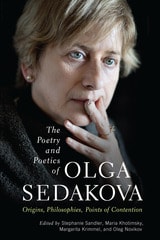
Essayists from Russia, Ukraine, Germany, Italy, and the United States show how Sedakova has contributed to ongoing aesthetic and cultural debates. Like Sedakova's own work, the volume affirms the capacity of words to convey meaning and to change our understanding of life itself. The volume also includes dozens of elegant new translations of Sedakova's poems.
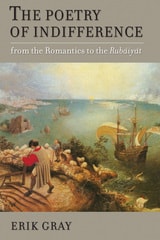
The Poetry of Indifference
From the Romantics to the RubaiyatErik Irving Gray
University of Massachusetts Press, 2005
of poetic indifference began to emerge.
The Poetry of Indifference analyzes nineteenth-century works by Wordsworth, Keats, Byron, Tennyson, Robert Browning, and Edward FitzGerald, among others—works that do not merely declare themselves to be indifferent but formally enact the indifference they describe. Each poem consciously disregards some aspect of poetry that is usually considered to be crucial or definitive, even at the risk of seeming "indifferent" in the sense of "mediocre." Such gestures discourage critical attention, since the poetry of indifference refuses to make claims for itself.
This is particularly true of FitzGerald's Rubáiyát, one of the most popular poems of the nineteenth century, but one that recent critics have almost entirely ignored. In concentrating on this underexplored mode of poetry, Gray not only traces a major shift in recent literary history, from a Romantic poetics of sympathy to a Modernist poetics of alienation, but also considers how this literature can help us understand the sometimes embarrassing but unavoidable presence of indifference in our lives.
The Point Is To Change It
Poetry and Criticism in the Continuing PresentJerome McGann
University of Alabama Press, 2007
A preeminent critic maps the frontier of contemporary poetry.
In this book, Jerome McGann argues that contemporary language-oriented writing implies a marked change in the way we think about our poetic tradition on one hand and in the future of criticism on the other. He focuses on Walter Benjamin and Gertrude Stein as important intellectual resources because both see the history of poetry as a crisis of the present rather than as a legacy of the past. The crisis appears as a poetic deficit in contemporary culture, where values of politics and morality are judged prima facie more important than aesthetic values. McGann argues for the fundamental relevance of the aesthetic dimension and the contemporary relevance of cultural works of the past.
McGann moves through several broad categories in his examination of contemporary poetry, including the ways in which poetry must be abstract, change, and give pleasure. The author draws on sources ranging from the poetry of Bruce Andrews and Robert Duncan to Looney Tunes cartoons. The experimental move in contemporary poetry, McGann contends, is an emergency signal for readers and critics as much as it is for writers and poets, a signal that calls us to rethink the aesthetics of criticism. The interpretation of literary works has been dominated by enlightenment models—the expository essay and monograph—for almost two hundred years. With the emergence of new media, especially digital culture, the limitations of those models have grown increasingly apparent.
The Point Is To Change It explores alternative critical methods and provides a powerful call to reinvent our modes of investigation in order to escape the limitations of our inherited academic models. The goal of this process is to widen existing cracks or create new ones because, as McGann points out via the lyrics of Leonard Cohen, "That's how the light gets in."
The Poisonous Pen of Agatha Christie
By Michael C. Gerald
University of Texas Press, 1993
Poisoning occurs in over half of Agatha Christie's many novels and stories. In fact, she used a larger number and broader selection of poisons and medicines, for a wider variety of purposes, with greater frequency, ingenuity, and scientific accuracy than any other detective fiction writer. Yet very little has been written on the use of drugs, poisons, and chemicals in Christie's fiction.
The Poisonous Pen of Agatha Christie entertainingly and authoritatively fills this gap. Michael Gerald explores the use of poisons and drugs in Christie's fiction not only to commit murder and suicide but also to incapacitate a victim, alter behavior, treat disease, or support addiction. He also analyzes her views, as expressed in her fiction and autobiography, on drug addiction, the health professions, the value of medicines, and scientific discoveries.
Especially valuable is Gerald's exhaustive listing of all drugs, poisons, and chemicals mentioned in Christie's novels and stories, with references to the work(s) in which each appears and the ways in which each is used. Other tables list all the novels and short stories and the chemicals that are used in each. Throughout, the properties of all drugs are clearly explained so that the reader needs no special scientific or medical knowledge.
The Poisonous Pen of Agatha Christie illuminates the fictional uses Christie made of her real-life experiences as a hospital drug dispenser and as a provider of nursing care. It will be of interest to fans and scholars alike.
The Police Procedural
George N. Dove
University of Wisconsin Press, 1982
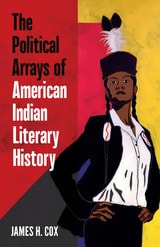
The Political Arrays of American Indian Literary History
James H. Cox
University of Minnesota Press, 2019
Bringing fresh insight to a century of writing by Native Americans
The Political Arrays of American Indian Literary History challenges conventional views of the past one hundred years of Native American writing, bringing Native American Renaissance and post-Renaissance writers into conversation with their predecessors. Addressing the political positions such writers have adopted, explored, and debated in their work, James H. Cox counters what he considers a “flattening” of the politics of American Indian literary expression and sets forth a new method of reading Native literature in a vexingly politicized context.
Examining both canonical and lesser-known writers, Cox proposes that scholars approach these texts as “political arrays”: confounding but also generative collisions of conservative, moderate, and progressive ideas that together constitute the rich political landscape of American Indian literary history. Reviewing a broad range of genres including journalism, short fiction, drama, screenplays, personal letters, and detective fiction—by Lynn Riggs, Will Rogers, Sherman Alexie, Thomas King, Leslie Marmon Silko, Louise Erdrich, Winona LaDuke, Carole laFavor, and N. Scott Momaday—he demonstrates that Native texts resist efforts to be read as advocating a particular set of politics
Meticulously researched, The Political Arrays of American Indian Literary History represents a compelling case for reconceptualizing the Native American Renaissance as a literary–historical constellation. By focusing on post-1968 Native writers and texts, argues Cox, critics have often missed how earlier writers were similarly entangled, hopeful, frustrated, contradictory, and unpredictable in their political engagements.
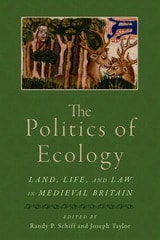
The Politics of Ecology
Land, Life, and Law in Medieval BritainEdited by Randy P. Schiff and Joseph Taylor
The Ohio State University Press, 2016
This volume, edited by Randy P. Schiff and Joseph Taylor, presents a diverse and stimulating group of interconnected essays that respond to these questions by infusing biopolitical material and theory into ecocentric studies of medieval life. The Politics of Ecology: Land, Life, and Law in Medieval Britain pursues the political power of sovereign law as it disciplines and manages various forms of natural life, and discloses the literary biopolitics played out in texts that work out the fraught interactions of life and law, in all its forms. Contributors to this volume explore such issues as legal networks and death, Arthurian bare life, Chaucerian medical biopolitics, the biopolitics of fur, ecologies of sainthood, arboreal political theology, conservation and political ecology, and geographical melancholy.
Bringing together both established and rising critical voices, The Politics of Ecology creates a place for cutting-edge medievalist ecocriticism focused on the intersections of land, life, and law in medieval English, French, and Latin literature.
The Politics of Mirth
Jonson, Herrick, Milton, Marvell, and the Defense of Old Holiday PastimesLeah S. Marcus
University of Chicago Press, 1989
The Politics of Play
Oulipo and the Legacy of French Literary LudicsAubrey Gabel
Northwestern University Press, 2026
Showing the political importance of play in postwar French literature
In postwar France, authors approached writing ludically, placing rules and conditions on language and on the context of composition itself. They eliminated “e’s” and feminized texts; they traveled according to strict rules and invented outright silly public personas. The Politics of Play: Oulipo and the Legacy of French Literary Ludics is a comprehensive examination of how and why French authors turned to these ludic methods to grapple with their political moment.
These writers were responding to a range of historical upheavals, from the rise and fall of French feminist and Third-Worldist groups to the aftermath of international socialism both at home, in the former Parisian Belt and in France more broadly, and abroad, in post-Yugoslavia Balkan states and elsewhere. Juxtaposing an array of case studies and drawing on cross-disciplinary methodologies, Aubrey Gabel reads three generations of the formalist literary group Oulipo, including Raymond Queneau, Georges Perec, and Jacques Jouet, alongside writers not traditionally deemed ludic—or sometimes not even conventionally known as novelists—such as the lesbian activist-writer Monique Wittig and the editor François Maspero. Gabel argues that literary ludics serve as both an authorial strategy and a political form: playful methods allow writers not only to represent history in code but also to intervene creatively—as political actors—in the fraught social fields of midcentury France and beyond.
The Politics of Privacy in Contemporary Native, Latinx, and Asian American Metafictions
Colleen G. Eils
The Ohio State University Press, 2020
Eils breaks strict disciplinary silos by putting visibility/surveillance studies, ethnic studies, and narrative studies in conversation with one another. Eils also puts texts in the Native, Latinx, and Asian American literary canon in conversation with each other. She focuses on texts by Viet Thanh Nguyen, David Treuer, Monique Truong, Rigoberto González, Nam Le, and Stephen Graham Jones that call into question our positions as readers and critics. In deliberately and self-consciously evading readers through the form of their fiction, these writers seize privacy as a political tool for claiming and wielding power in both representational and material registers.
The Politics of Revelation in the English Renaissance
Ester Gilman Richey
University of Missouri Press, 1998
Recognizing that the seventeenth century's volatile debate over apocalyptic interpretation has since become a one-sided discussion, Esther Gilman Richey develops a context that recovers the dynamism so inherent in the writings of the period and provides illuminating details that enhance the prophetic continuum. The Politics of Revelation in the English Renaissance does not ignore the familiar prophetic verse of Spenser and Milton, but it significantly expands the scope of study by examining the interpretations of both men and women who represent a range of ecclesiastical and political perspectives.
Richey rejects Barbara Lewalski's claim that the radical, prophetic writers and metaphysical poets of the seventeenth century drew inspiration from distinct biblical models, the former from the Apocalypse and the latter from the Psalms. Instead she contends that even writers such as Donne and Herbert, whom we have long considered "literary," were in reality using their poetry to participate in the hottest debates of the time.
While the radical writers, such as Spenser and Milton, were immediately responsive to ecclesiastical and political controversies, the conservative, metaphysical poets—Donne, Herbert, and Vaughan—were posing equally politically charged questions: Is the pope Antichrist? Is the Bride of Christ pure? Is the Temple a model of ecclesiastical reform? The writers of the period did not move in divided and distinguished worlds, but in fact constantly responded to one another through poetic and politically charged dialogue.
By drawing from the writings of various individuals, both radical and conformist, male and female, Richey traces the shifting representations of the apocalyptic Bride and Temple over time. Organized chronologically, the chapters of The Politics of Revelation in the English Renaissance reveal the escalating debate among the pacifists, conformists, militants, and feminists. Not only does Richey uncover the prophetic dimension of conformist writers usually described as apolitical and devotional, but she also explores the writings of lesser-known women prophets: Aemilia Lanyer, Mary Cary, Anna Trapnel, and Margaret Fell. In such biblical passages as the apocalyptic "woman clothed with the sun," these early feminists find the authority for their own prophetic speech.
This provocative analysis—at once far-reaching and tightly focused—reveals the complexity of the apocalyptic discourse that transpired among Renaissance writers and poets.
The Politics of Same-Sex Marriage
Edited by Craig A. Rimmerman and Clyde Wilcox
University of Chicago Press, 2007
Same-sex marriage emerged in 2004 as one of the hottest issues of the campaign season. But in a severe blow to gay rights advocates, all eleven states that had the issue on the ballot passed amendments banning the practice, and the subject soon dropped off the media’s radar. This pattern of waxing and waning in the public eye has characterized the debate over same-sex marriage since 1996 and the passing of the Defense of Marriage Act. Since then, court rulings and local legislatures have kept the issue alive in the political sphere, and conservatives and gay rights advocates have made the issue a key battlefield in the culture wars.
The Politics of Same-Sex Marriage brings together an esteemed list of scholars to explore all facets of this heated issue, including the ideologies and strategies on both sides of the argument, the public’s response, the use of the issue in political campaigns, and how same-sex marriage fits into the broad context of policy cycles and windows of political opportunity. With comprehensive coverage from a variety of different approaches, this volume will be a vital sourcebook for activists, politicians, and scholars alike.
The Politics of the Female Body
Postcolonial Women WritersKetu H. Katrak
Rutgers University Press, 2006
Is it possible to simultaneously belong to and be exiled from a community? In Politics of the Female Body, Ketu H. Katrak argues that it is not only possible, but common, especially for women who have been subjects of colonial empires.
Through her careful analysis of postcolonial literary texts, Katrak uncovers the ways that the female body becomes a site of both oppression and resistance. She examines writers working in the English language, including Anita Desai from India, Ama Ata Aidoo from Ghana, and Merle Hodge from Trinidad, among others. The writers share colonial histories, a sense of solidarity, and resistance strategies in the on-going struggles of decolonization that center on the body.
Bringing together a rich selection of primary texts, Katrak examines published novels, poems, stories, and essays, as well as activist materials, oral histories, and pamphlets—forms that push against the boundaries of what is considered strictly literary. In these varied materials, she reveals common political and feminist alliances across geographic boundaries.
A unique comparative look at women’s literary work and its relationship to the body in third world societies, this text will be of interest to literary scholars and to those working in the fields of postcolonial studies and women’s studies.
The Pooh Perplex
Frederick Crews
University of Chicago Press, 2003
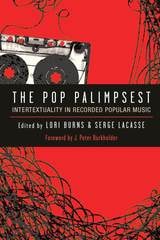
The Pop Palimpsest
Intertextuality in Recorded Popular MusicLori Burns and Serge Lacasse, Editors
University of Michigan Press, 2018
The Popularity of Middle English Romance
Velma B. Richmond
University of Wisconsin Press, 1975
The Middle English romance has elicited throughout the centuries a curious mixture of indifference,hostile apprehension, and contempt that perhaps no other literature—except its most likely offspring, modern best-sellers—has provoked.
The Portuguese-Speaking Diaspora
Seven Centuries of Literature and the ArtsBy Darlene J. Sadlier
University of Texas Press, 2016
Long before the concept of “globalization,” the Portuguese constructed a vast empire that extended into Africa, India, Brazil, and mid-Atlantic territories, as well as parts of China, Southeast Asia, and Japan. Using this empire as its starting point and spanning seven centuries and four continents, The Portuguese-Speaking Diaspora examines literary and artistic works about the ensuing diaspora, or the dispersion of people within the Portuguese-speaking world, resulting from colonization, the slave trade, adventure seeking, religious conversion, political exile, forced labor, war, economic migration, and tourism.
Based on a broad array of written and visual materials, including historiography, letters, memoirs, plays, poetry, fiction, cartographic imagery, paintings, photographs, and films, The Portuguese-Speaking Diaspora is the first detailed analysis of the different and sometimes conflicting cultural productions of the imperial diaspora in its heyday and an important context for understanding the more complex and broader-based culture of population travel and displacement from the former colonies to present-day “homelands.” The topics that Darlene J. Sadlier discusses include exploration and settlement by the Portuguese in different parts of the empire; the Black Atlantic slave trade; nineteenth-century travel and Orientalist imaginings; the colonial wars; and the return of populations to Portugal following African independence. A wide-ranging study of the art and literature of these and other diasporic movements, this book is a major contribution to the growing field of Lusophone studies.
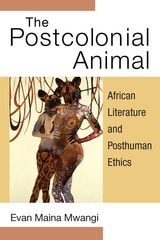
The Postcolonial Animal
African Literature and Posthuman EthicsEvan Maina Mwangi
University of Michigan Press, 2019
Despite the central role that animals play in African writing and daily life, African literature and African thinkers remain conspicuously absent from the field of animal studies. The Postcolonial Animal: African Literature and Posthuman Ethics demonstrates the importance of African writing to animal studies by analyzing how postcolonial African writing—including folktales, religion, philosophy, and anticolonial movements—has been mobilized to call for humane treatment of nonhuman others. Mwangi illustrates how African authors grapple with the possibility of an alternative to eating meat, and how they present postcolonial animal-consuming cultures as shifting toward an embrace of cultural and political practices that avoid the use of animals and minimize animal suffering. The Postcolonial Animal analyzes texts that imagine a world where animals are not abused or used as a source of food, clothing, or labor, and that offer instruction in how we might act responsibly and how we should relate to others—both human and nonhuman—in order to ensure a world free of oppression. The result is an equitable world where even those who are utterly foreign to us are accorded respect and where we recognize the rights of all marginalized groups.
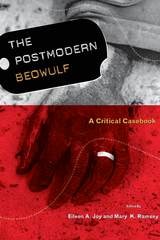
The Postmodern Beowulf
A Critical CasebookEILEEN A. JOY
West Virginia University Press, 2006
This work includes twenty-four essays including a preface, introduction, afterword, and sections containing seminal methodological pieces by such giants as Edward Said and Michel Foucault, as well as contemporary applications to Beowulf and other Old English and Germanic texts focusing on historicism, psychoanalysis, gender, textuality, and post-colonialism.