Results by title
8812 books match the query 'Political Science' and 1911 start with t

The Great Society and Its Legacy
Twenty Years of U.S. Social PolicyMarshall Kaplan and Peggy Cuciti, eds.
Duke University Press, 1986
The Great Society and the High Tide of Liberalism
Sidney M. Milkis
University of Massachusetts Press, 2005
In this volume of original essays, a distinguished group of scholars and activists reassess the mixed legacy of this third major reform period of the last century. They examine not only the policies and programs that were part of LBJ's Great Society, but also the underlying ideological and political shifts that changed the nature of liberalism. Some of the essays focus on Lyndon Johnson himself and the institution of the modern presidency, others on specific reform measures, and still others on the impact of these initiatives in the decades that followed. Perspectives, methodologies, and conclusions differ, yet all of the contributors agree that the Great Society represented an important chapter in the story of the American republic and its ongoing struggle to reconcile the power of the state with the rights of individuals—a struggle that has continued into the twenty-first century.
In addition to the editors, contributors include Henry J. Abraham, Brian Balogh, Rosalyn Baxandall, Edward Berkowitz, Eileen Boris, Richard A. Cloward, Hugh Davis Graham, Hugh Heclo, Frederick Hess, William E. Leuchtenburg, Nelson Lichtenstein, Patrick McGuinn, Wilson Carey McWilliams, R. Shep Melnick, Frances Fox Piven, and David M. Shribman.
The Great Strikes of 1877
Edited by David O. Stowell
University of Illinois Press, 2007
A spectacular example of collective protest, the Great Strike of 1877--actually a sequence of related actions--was America's first national strike and the first major strike against the railroad industry. In some places, non-railroad workers also abandoned city businesses, creating one of the nation's first general strikes. Mobilizing hundreds of thousands of workers, the Great Strikes of 1877 transformed the nation's political landscape, shifting the primary political focus from Reconstruction to labor, capital, and the changing role of the state.
Probing essays by distinguished historians explore the social, political, regional, and ethnic landscape of the Great Strikes of 1877: long-term effects on state militias and national guard units; ethnic and class characterization of strikers; pictorial representations of poor laborers in the press; organizational strategies employed by railroad workers; participation by blacks; violence against Chinese immigrants; and the developing tension between capitalism and racial equality in the United States.
Contributors: Joshua Brown, Steven J. Hoffman, Michael Kazin, David Miller, Richard Schneirov, David O. Stowell, and Shelton Stromquist.
The Great Tree and the Summer Sun
Survivance and Futurity in the Narragansett CountryMack H. Scott III
University of Massachusetts Press, 2027
Documenting the long struggle of the Narragansett Nation to protect their land, sovereignty, and future
On a hot mid-July morning in 2003, members of the Narragansett Nation formed an impromptu human shield. They assembled to protect what they understood to be sacred and sovereign land. On the other side of the road stood dozens of local police officers and more than twenty state troopers, acting on direct orders from Rhode Island Governor Donald L. Carcieri to forcibly close a smoke shop the state claimed was operating illegally. It was a flashpoint in a long, drawn-out, and continuing struggle—one that historian Mack H. Scott III, himself a member of the Narragansett Nation, has spent his career documenting.
In The Great Tree and the Summer Sun, Scott tells the story of his people: the largest and most influential Indigenous community in the Dawnland, the coastal New England region his ancestors have called home for centuries. The Narragansett, whom the sachem Miantonomo described as “a great tree,” have endured nearly 400 years of mostly adversarial relations with their non-Indigenous neighbors—despite the mythology of Rhode Island’s benevolent founding and its supposed social egalitarianism.
Scott explores the long durée of local cross-cultural interactions that hardened hearts, minds, and viewpoints, not just in Rhode Island, but throughout Turtle Island (North America), as Natives and newcomers struggled to reconstitute and redefine themselves within a contested landscape. Commencing in the seventeenth century and concluding in the twenty-first, this episodic historical survey foregrounds the varied experiences of members of the Great Tree as they negotiated the realities of the Summer Sun—settler colonialism—to ensure that their futures remained irrepressible.
The Great Upheaval
Women and Nation in Postwar NigeriaJudith A. Byfield
Ohio University Press, 2021
The Greater Good
Media, Family Removal, and TVA Dam Construction in North AlabamaLaura Beth Daws and Susan L. Brinson
University of Alabama Press, 2019
For poverty-stricken families in the Tennessee River Valley during the Great Depression, news of President Franklin D. Roosevelt’s New Deal plans to create the Tennessee Valley Authority—bringing the promise of jobs, soil conservation, and electricity—offered hope for a better life. The TVA dams would flood a considerable amount of land on the riverbanks, however, forcing many families to relocate. In exchange for this sacrifice for the “greater good,” these families were promised “fair market value” for their land. As the first geographic location to benefit from the electricity provided by TVA, the people of North Alabama had much to gain, but also much to lose.
In The Greater Good: Media, Family Removal, and TVA Dam Construction in North Alabama Laura Beth Daws and Susan L. Brinson describe the region’s preexisting conditions, analyze the effects of relocation, and argue that local newspapers had a significant impact in promoting the TVA’s agenda. The authors contend that it was principally through newspapers that local residents learned about the TVA and the process and reasons for relocation. Newspapers of the day encouraged regional cooperation by creating an overwhelmingly positive image of the TVA, emphasizing its economic benefits and disregarding many of the details of removal.
Using mostly primary research, the volume addresses two key questions: What happened to relocated families after they sacrificed their homes, lifestyles, and communities in the name of progress? And what role did mediated communication play in both the TVA’s family relocation process and the greater movement for the public to accept the TVA’s presence in their lives? The Greater Good offers a unique window into the larger impact of the New Deal in the South. Until now, most research on the TVA was focused on organizational development rather than on families, with little attention paid to the role of the media in garnering acceptance of a government-enforced relocation.

The Greater San Rafael Swell
Honoring Tradition and Preserving Storied LandsStephen E. Strom and Jonathan T. Bailey
University of Arizona Press, 2022
Natural and human history come together in The Greater San Rafael Swell, which spans much of Emery County in Utah. Authors Stephen Strom and Jonathan Bailey paint a multi-faceted picture of a singular place through photographs, along with descriptions of geology, paleontology, archaeology, history, and dozens of interviews with individuals who devoted more than two decades to developing a shared vision of the future of both the Swell and the County. At its core, the book relates the important story of how a coalition of ranchers, miners, off-road enthusiasts, conservationists, recreationists, and Native American tribal nations worked together for nearly 25 years to forge and pass the Emery County Public Lands Management Act in 2019.
This book chronicles hopeful stories for our times: how citizens of Emery and three other counties in the rural West worked to resolve perhaps the most volatile issue in the region – the future of public lands. Both their successes and the processes by which they found common ground serve as beacons in today’s uncertain landscape – beacons that can illuminate paths toward rebuilding our shared democracy from the ground up.
The Greatest Menace
Organized Crime in Cold War AmericaLee Bernstein
University of Massachusetts Press, 2002
The term Cold War has long been associated with the “red menace” of communism at home and abroad. Yet as Lee Bernstein shows in this illuminating study, during the 1950s the threat posed by organized crime preoccupied Americans at least as much as the fear of communist subversion. At the beginning of the decade, the televised hearings of Senator Estes Kefauver's crime committee, focusing on colorful mob figures such as Lucky Luciano and Frank Costello, attracted far more attention than the spy trial of Julius and Ethel Rosenberg. In the years that followed, public concern about gangsters and racketeering continued unabated, even after the anticommunist fever of McCarthyism had begun to subside.
Drawing on a broad range of evidence, from government records to films, television shows, and pulp novels, Bernstein explains how the campaign against organized crime, like the crusade against communism, reflected deep social and political anxieties. Just as the inquisitions of Senator McCarthy fed on popular fears of international conspiracy and alien infiltration, the anticrime investigations of the 1950s raised the specter of a foreign-based criminal cartel—the Sicilian Mafia— preying on a vulnerable American public. In both cases, the association of the foreign-born with criminal or un-American activity led to the creation of state and local citizens committees and to calls for new restrictions on immigration. Labor unions also came under attack, particularly after the McClellan Committee and its chief counsel, Robert F. Kennedy, claimed to have found a link between the International Brotherhood of Teamsters, led by Jimmy Hoffa, and the Mafia.
As Bernstein points out, despite significant changes in the way organized crime actually operated, and despite repeated protests from Italian Americans, the popular image of the sinister gangster persisted, because it served a more profound need. In an era marked by widespread uncertainty and rapid social change, the fight against a common enemy, real or imagined, helped forge a Cold War consensus across shifting lines of race, class, and ethnicity by redefining what it meant to be an American.

The Green New Deal from Below
How Ordinary People Are Building a Just and Climate-Safe EconomyJeremy Brecher
University of Illinois Press, 2024
A visionary program for national renewal, the Green New Deal aims to protect the earth’s climate while creating good jobs, reducing injustice, and eliminating poverty. Its core principle is to use the necessity for climate protection as a basis for realizing full employment and social justice.
Jeremy Brecher goes beyond the national headlines and introduces readers to the community, municipal, county, state, tribal, and industry efforts advancing the Green New Deal across the United States. Brecher illustrates how such programs from below do the valuable work of building constituencies and providing proofs of concept for new ideas and initiatives. Block by block, these activities have come together to form a Green New Deal built on a strong foundation of small-scale movements and grassroots energy.
A call for hope and a better tomorrow, The Green New Deal from Below offers a blueprint for reconstructing society on new principles to avoid catastrophic climate change.

The Green Revolution in the Global South
Science, Politics, and Unintended ConsequencesR. Douglas Hurt
University of Alabama Press, 2020
The Green Revolution was devised to increase agricultural production worldwide, particularly in the developing world. Agriculturalists employed anhydrous ammonia and other fertilizing agents, mechanical tilling, hybridized seeds, pesticides, herbicides, and a multitude of other techniques to increase yields and feed a mushrooming human population that would otherwise suffer starvation as the world’s food supply dwindled.
In The Green Revolution in the Global South: Science, Politics, and Unintended Consequences, R. Douglas Hurt demonstrates that the Green Revolution did not turn out as neatly as scientists predicted. When its methods and products were imported to places like Indonesia and Nigeria, or even replicated indigenously, the result was a tumultuous impact on a society’s functioning. A range of factors—including cultural practices, ethnic and religious barriers, cost and availability of new technologies, climate, rainfall and aridity, soil quality, the scale of landholdings, political policies and opportunism, the rise of industrial farms, civil unrest, indigenous diseases, and corruption—entered into the Green Revolution calculus, producing a series of unintended consequences that varied from place to place. As the Green Revolution played out over time, these consequences rippled throughout societies, affecting environments, economies, political structures, and countless human lives.
Analyzing change over time, almost decade by decade, Hurt shows that the Green Revolution was driven by the state as well as science. Rather than acknowledge the vast problems with the Green Revolution or explore other models, Hurt argues, scientists and political leaders doubled down and repeated the same missteps in the name of humanity and food security. In tracing the permutations of modern science’s impact on international agricultural systems, Hurt documents how, beyond increasing yields, the Green Revolution affected social orders, politics, and lifestyles in every place its methods were applied—usually far more than once.
The Grooves of Change
Eastern Europe at the Turn of the MillenniumJ.F. Brown
Duke University Press, 2001
While acknowledging that the term “Eastern Europe” began to fall into disuse with the end of the cold war, Brown uses it as a framework for discussing the enduring features of the modern history of this region: its basic continuity, the prominence of ethnic and national factors, and its dependence on great powers or combinations of powers outside it. He explains the significance of the growing gulf between East Central Europe and South Eastern Europe, the overall political and economic deprivation and its effect on the people, the urgency of change, and the complex dynamics within Eastern Europe that have defied definitions and generalization. Finally, Brown points to the need for continuing assistance by the United States and the West and suggests what the twenty-first century may bring to this constantly changing part of the world.
Those seeking a clear overview of events in Eastern Europe during the recent psat and the state of these nations now will benefit from this incisive study by J. F. Brown.

The Ground Below Zero
9/11 to Burning Man, New Orleans to Darfur, Haiti to Occupy Wall StreetNicholas Powers
UpSet Press, 0

The Guantanamo Files
The Stories of the 774 Detainees in America's Illegal PrisonAndy Worthington
Pluto Press, 2007
Deprived of the safeguards of the Geneva Conventions, and, for the most part, sold to the Americans by their allies in Afghanistan and Pakistan, the detainees have struggled for five years to have their stories heard. Looking in detail at the circumstances of their capture, and at the coercive interrogations and unsubstantiated allegations that have been used to justify their detention. Stories of torture in Afghanistan and Guantanamo are uncovered, as well as new information about the process of 'extraordinary rendition' that underpins the US administration's 'war on terror'.
Who will speak for the 773 men who have been held in Guantanamo? This passionate and brilliantly detailed book brings their stories to the world for the first time.
The Guise of Exceptionalism
Unmasking the National Narratives of Haiti and the United StatesRobert Fatton
Rutgers University Press, 2021

The Harlequin Eaters
From Food Scraps to Modernism in Nineteenth-Century FranceJanet Beizer
University of Minnesota Press, 2024
How representations of the preparation, sale, and consumption of leftovers in nineteenth-century urban France link socioeconomic and aesthetic history
The concept of the “harlequin” refers to the practice of reassembling dinner scraps cleared from the plates of the wealthy to sell, replated, to the poor in nineteenth-century Paris. In The Harlequin Eaters, Janet Beizer investigates how the alimentary harlequin evolved in the nineteenth and early twentieth centuries from the earlier, similarly patchworked Commedia dell’arte Harlequin character and can be used to rethink the entangled place of class, race, and food in the longer history of modernism.
By superimposing figurations of the edible harlequin taken from a broad array of popular and canonical novels, newspaper articles, postcard photographs, and lithographs, Beizer shows that what is at stake in nineteenth-century discourses surrounding this mixed meal are representations not only of food but also of the marginalized people—the “harlequin eaters”—who consume it at this time when a global society is emerging. She reveals the imbrication of kitchen narratives and intellectual–aesthetic practices of thought and art, presenting a way to integrate socioeconomic history with the history of literature and the visual arts. The Harlequin Eaters also offers fascinating background to today’s problems of food inequity as it unpacks stories of the for-profit recycling of excess food across class and race divisions.
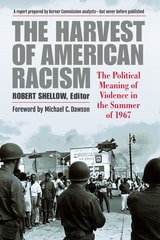
The Harvest of American Racism
The Political Meaning of Violence in the Summer of 1967Robert Shellow
University of Michigan Press, 2018
In the summer of 1967, in response to violent demonstrations that rocked 164 U.S. cities, the National Advisory Commission on Civil Disorders, a.k.a. the Kerner Commission, was formed. The Commission sought reasons for the disturbances, including the role that law enforcement played. Chief among its research projects was a study of 23 American cities, headed by social psychologist Robert Shellow. An early draft of the scientists’ analysis, titled “The Harvest of American Racism: The Political Meaning of Violence in the Summer of 1967,” provoked the Commission’s staff in November 1967 by uncovering political causes for the unrest; the team of researchers was fired, and the controversial report remained buried at the LBJ Presidential Library until now.
The first publication of the Harvest report half a century later reveals that many of the issues it describes are still with us, including how cities might more effectively and humanely react to groups and communities in protest. In addition to the complete text of the suppressed Harvest report, the book includes an introduction by Robert Shellow that provides useful historical context; personal recollections from four of the report’s surviving social scientists, Robert Shellow, David Boesel, Gary T. Marx, and David O. Sears; and an appendix outlining the differences between the unpublished Harvest analysis and the well-known Kerner Commission Report that followed it.
“The [Harvest of American Racism] report was rejected by Johnson administration functionaries as being far too radical—politically ‘unviable’… Social science can play an extremely positive role in fighting racial and other injustice and inequality, but only if it is matched with a powerful political will to implement the findings. That will has never come from within an American presidential administration—that will has only been forged in black and other radical communities’ movements for justice. The political power for change, as incremental as it has been, has come from within those communities. Washington responds, it does not lead."
—from the Foreword by Michael C. Dawson
The Haymarket Conspiracy
Transatlantic Anarchist NetworksTimothy Messer-Kruse
University of Illinois Press, 2012

The Hermetic Deleuze
Philosophy and Spiritual OrdealJoshua Ramey
Duke University Press, 2012
Identifying key hermetic moments in Deleuze's thought, including his theories of art, subjectivity, and immanence, Ramey argues that the philosopher's work represents a kind of contemporary hermeticism, a consistent experiment in unifying thought and affect, percept and concept, and mind and nature in order to engender new relations between knowledge, power, and desire. By uncovering and clarifying the hermetic strand in Deleuze's work, Ramey offers both a new interpretation of Deleuze, particularly his insistence that the development of thought demands a spiritual ordeal, and a framework for retrieving the pre-Kantian paradigm of philosophy as spiritual practice.
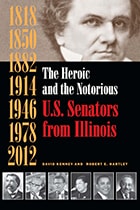
The Heroic and the Notorious
U.S. Senators from IllinoisDavid Kenney and Robert E. Hartley
Southern Illinois University Press, 2012
This sweeping survey constitutes the first comprehensive treatment of the men and women who have been chosen to represent Illinois in the United States Senate from 1818 to the present day. David Kenney and Robert E. Hartley underscore nearly two centuries of Illinois history with these biographical and political portraits, compiling an incomparably rich resource for students, scholars, teachers, journalists, historians, politicians, and any Illinoisan interested in the state’s senatorial heritage.
Originally published as An Uncertain Tradition: U.S. Senators From Illinois 1818–2003, this second edition brings readers up to date with new material on Paul Simon, Richard Durbin, and Peter Fitzgerald, as well as completely new sections on Roland Burris, Barack Obama, and Illinois’s newest senator, Mark Kirk. This fresh and careful study of the shifting set of political issues Illinois’s senators encountered over time is illuminated by the lives of participants in the politics of choice and service in the Senate. Kenney and Hartley offer incisive commentary on the quality of Senate service in each case, as well as timeline graphs relating to the succession of individuals in each of the two sequences of service, the geographical distribution of senators within the state, and the variations in party voting for Senate candidates. Rigorously documented and supremely readable, this convenient reference volume is enhanced by portraits of many of the senators.
The Hidden Face of Local Power
Appointed Boards and the Limits of DemocracyMirya R. Holman
Temple University Press, 2025
The Hidden Face of Local Power explicates the purpose, role, and consequences of appointed boards in U.S. cities. Mirya Holman finds cities create strong boards that generate policy, consolidate power, and defend the interests of businesses and wealthy and white residents. In contrast, weak boards pacify agitation from marginalized groups to give the appearance of inclusivity, democratic deliberation, and redistributional policymaking. Cities preserve this strong board/weak board dichotomy through policymaking power, institutional design, and by controlling who serves on the boards.
The Hidden Face of Local Power examines the role of boards in the development of urban political institutions, the allocation of power in local politics, and the persistence of inequality. Holman enhances our understanding of how political institutions have contributed to racism and their impact on how people use and live in urban spaces. In her shrewd analysis of the creation and use of boards as political institutions, Holman proves that neither weak or strong boards achieves the goal they are advertised to achieve. In doing so, she provides a new view of the failures of local democracy along with ideas for improvement.
The Hidden War
Crime and the Tragedy of Public Housing in ChicagoPopkin, Susan J
Rutgers University Press, 2000
Since the late 1970s, the high-rise developments of the Chicago Housing Authority (CHA) have been dominated by gang violence and drugs, creating a sense of hopelessness among residents. Despite a lengthy war on crime, costing hundreds of millions of dollars, the CHA has been unable to reduce the violence that makes life intolerable. Focusing on three developments—Rockwell Gardens, Henry Horner Homes, and Harold Ickes Homes—Sue Popkin and her co-authors interview residents, community leaders, and CHA staff. The Hidden War chronicles the many failed efforts of the CHA to combat crime and improve its developments, offering a vivid portrait of what life is like when lived among bullets, graffiti, and broken plumbing.
Most families living in these developments are headed by African American single mothers. The authors reveal the dilemmas facing women and children who are often victims or witnesses of violent crime, and yet are dependent on the perpetrators and their drug-dominant economy. The CHA—plagued by financial scandals, managerial incompetence, and inconsistent funding—is no match for thegang-dominated social order. Even well-intentioned initiatives such as the recent effort to demolish and “revitalize” the worst developments seem to be ineffective at combating crime, while the drastic changes leave many vulnerable families facing an uncertain future. The Hidden War sends a humbling message to policy makers and prognosticators who claim to know the right way to “solve poverty.”
The Hidden Wealth of Nations
The Scourge of Tax HavensGabriel Zucman
University of Chicago Press, 2015
In The Hidden Wealth of Nations, Zucman offers an inventive and sophisticated approach to quantifying how big the problem is, how tax havens work and are organized, and how we can begin to approach a solution. His research reveals that tax havens are a quickly growing danger to the world economy. In the past five years, the amount of wealth in tax havens has increased over 25%—there has never been as much money held offshore as there is today. This hidden wealth accounts for at least $7.6 trillion, equivalent to 8% of the global financial assets of households. Fighting the notion that any attempts to vanquish tax havens are futile, since some countries will always offer more advantageous tax rates than others, as well the counter-argument that since the financial crisis tax havens have disappeared, Zucman shows how both sides are actually very wrong. In The Hidden Wealth of Nations he offers an ambitious agenda for reform, focused on ways in which countries can change the incentives of tax havens. Only by first understanding the enormity of the secret wealth can we begin to estimate the kind of actions that would force tax havens to give up their practices.
Zucman’s work has quickly become the gold standard for quantifying the amount of the world’s assets held in havens. In this concise book, he lays out in approachable language how the international banking system works and the dangerous extent to which the large-scale evasion of taxes is undermining the global market as a whole. If we are to find a way to solve the problem of increasing inequality, The Hidden Wealth of Nations is essential reading.
The Hinge
Civil Society, Group Cultures, and the Power of Local CommitmentsGary Alan Fine
University of Chicago Press, 2021
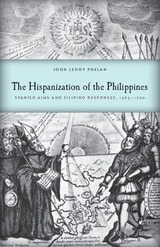
The Hispanization of the Philippines
Spanish Aims and Filipino Responses, 1565–1700John Leddy Phelan
University of Wisconsin Press, 1959
After conquest of the Philippine archipelago in the late sixteenth century, Spanish colonizers launched a sweeping social program designed to bring about dramatic religious, political, and economic changes. But the limitations of Spanish colonial resources, together with the reactions of Filipinos themselves, combined to shape the outcome of that effort in unique and unexpected ways, argues John Leddy Phelan. With no wealth in the islands to attract conquistadores, conquest was accomplished largely by missionaries scattered among isolated native villages. Native chieftains served as intermediaries, thus enabling the Filipinos to react selectively to Spanish innovations. The result was a form of hispanization in which the resilient and adaptable Filipinos played a creative part.
The Historic Turn in the Human Sciences
Terrence J. McDonald, Editor
University of Michigan Press, 1996
The Historiography of Communism
Michael E. Brown
Temple University Press, 2008
The History of Democracy
A Marxist InterpretationBrian S. Roper
Pluto Press, 2012
Brian Roper refreshes our understanding of democracy using a Marxist theoretical framework. He traces the history of democracy from ancient Athens to the emergence of liberal representative and socialist participatory democracy in Europe and North America, through to the global spread of democracy during the past century.
Roper argues that democracy cannot be understood separately from underlying processes of exploitation and class struggle. He offers an engaging Marxist critique of representative democracy, and raises the possibility of alternative democratic forms. The History of Democracy will be of interest to students and scholars of history and politics and all those concerned about the past, present and future of democracy.
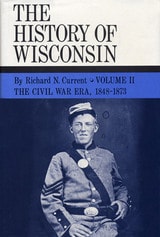
The History of Wisconsin, Volume II
Civil War Era, 1848-1873Richard N. Current
Wisconsin Historical Society Press, 1976
This second volume in the History of Wisconsin series introduces us to the first generation of statehood, from the conversion of prairie and forests into farmland to the development of cities and industry. In addition, this volume presents a synthesis of the Civil War and Reconstruction era in Wisconsin. Scarcely a decade after entering the Union, the state was plunged into the nationwide debate over slavery, the secession crisis, and a war in which 11,000 "Badger Boys in Blue" gave their lives. Wisconsin's role in the Civil War is chronicled, along with the post-war years. Complete with photographs from the Historical Society's collections, as well as many pertinent maps, this book is a must-have for anyone interested in this era of Wisconsin's history.
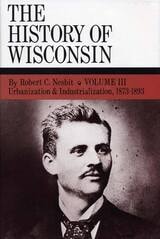
The History of Wisconsin, Volume III
Urbanization & Industrialization 1873-1893Robert C. Nesbit
Wisconsin Historical Society Press, 1985
Although the years from 1873-1893 lacked the well known, dramatic events of the periods before and after, this period presented a major transformation in Wisconsin's economy. The third volume in the History of Wisconsin series presents a balanced, comprehensive, and witty account of these two decades of dynamic growth and change in Wisconsin society, business, and industry. Concentrating on three major areas: the economy, communities, and politics and government, this volume in the History of Wisconsin series adds substantially to our knowledge and understanding of this crucial, but generally little-understood, period.
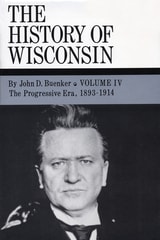
The History of Wisconsin, Volume IV
The Progressive Era, 1893-1914John D. Buenker
Wisconsin Historical Society Press, 1998
Published in Wisconsin's Sesquicentennial year, this fourth volume in The History of Wisconsin series covers the twenty tumultuous years between the World's Columbian Exposition and the First World War when Wisconsin essentially reinvented itself, becoming the nation's "laboratory of democracy."
The period known as the Progressive Era began to emerge in the mid-1890s. A sense of crisis and a widespread clamor for reform arose in reaction to rapid changes in population, technology, work, and society. Wisconsinites responded with action: their advocacy of women's suffrage, labor rights and protections, educational reform, increased social services, and more responsive government led to a veritable flood of reform legislation that established Wisconsin as the most progressive state in the union.
As governor and U.S. Senator from Wisconsin, Robert M. La Follette, Sr., was the most celebrated of the Progressives, but he was surrounded by a host of pragmatic idealists from politics, government, and the state university. Although the Progressives frequently disagreed over priorities and tactics, their values and core beliefs coalesced around broad-based participatory democracy, the application of scientific expertise to governance, and an active concern for the welfare of all members of society-what came to be known as "the Wisconsin Idea."
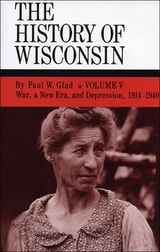
The History of Wisconsin, Volume V
War, a New Era, and Depression, 1914-1940Paul W. Glad
Wisconsin Historical Society Press, 1990
The fifth volume in The History of Wisconsin series covers the years from the outbreak of World War I to the eve of American entry into World War II. In between, the rise of the woman's movement, the advent of universal suffrage, and the "great experiment" of Prohibition are explored, along with the contest between newly emergent labor unions and powerful business and industrial corporations. Author Paul W. Glad also investigates the Great Depression in Wisconsin and its impact on rural and urban families in the state. Photographs and maps further illustrate this volume which tells the story of one of the most exciting and stressful eras in the history of the state.
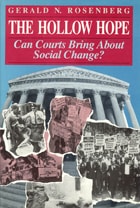
The Hollow Hope
Can Courts Bring About Social Change?Gerald N. Rosenberg
University of Chicago Press, 1991
Rosenberg presents, with remarkable skill, an overwhelming case that efforts to use the courts to generate significant reforms in civil rights, abortion, and women's rights were largely failures.
"The real strength of The Hollow Hope . . . is its resuscitation of American Politics—the old-fashioned representative kind—as a valid instrument of social change. Indeed, the flip side of Mr. Rosenberg's argument that courts don't do all that much is the refreshing view that politics in the best sense of the word—as deliberation and choice over economic and social changes, as well as over moral issues—is still the core of what makes America the great nation it is. . . . A book worth reading."—Gary L. McDowell, The Washington Times
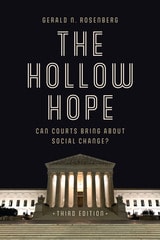
The Hollow Hope
Can Courts Bring About Social Change?Gerald N. Rosenberg
University of Chicago Press, 2023
Since its first publication in 1991, The Hollow Hope has spurred debate and challenged assumptions on both the left and the right about the ability of courts to bring about durable political and social change. What Gerald N. Rosenberg argued then, and what he confirms today through new evidence in this edition, is that it is nearly impossible to generate significant reforms through litigation: American courts are ineffective and relatively weak, far from the uniquely powerful sources for change they are often portrayed to be.
This third edition includes new data and a substantially updated analysis of civil rights, abortion rights and access, women’s rights, and marriage equality. Addressing changes in the political and social environment, Rosenberg draws lessons from the re-segregation of public schools, victories in marriage equality, and new obstacles to abortion access. Through these and other cases, the third edition confirms the power of the book’s original explanatory framework and deepens our understanding of the limits of judicial action in support of social reform, as well as the conditions under which courts do produce change. Up-to-date, thorough, and thought-provoking, The Hollow Hope remains vital reading.
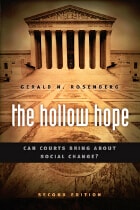
The Hollow Hope
Can Courts Bring About Social Change? Second EditionGerald N. Rosenberg
University of Chicago Press, 2008
Finding that the answer is still a resounding no, Rosenberg reaffirms his powerful contention that it’s nearly impossible to generate significant reforms through litigation. The reason? American courts are ineffective and relatively weak—far from the uniquely powerful sources for change they’re often portrayed as. Rosenberg supports this claim by documenting the direct and secondary effects of key court decisions—particularly Brown v. Board of Education and Roe v. Wade. He reveals, for example, that Congress, the White House, and a determined civil rights movement did far more than Brown to advance desegregation, while pro-choice activists invested too much in Roe at the expense of political mobilization. Further illuminating these cases, as well as the ongoing fight for same-sex marriage rights, Rosenberg also marshals impressive evidence to overturn the common assumption that even unsuccessful litigation can advance a cause by raising its profile.
Directly addressing its critics in a new conclusion, The Hollow Hope, Second Edition promises to reignite for a new generation the national debate it sparked seventeen years ago.

The Holocaust and Other Genocides
History, Representation, EthicsHelmut Walser Smith
Vanderbilt University Press, 2002
The book consists of five parts: introduction; history of the Holocaust; representations of the Holocaust in literature, film, and the arts; other genocides; and ethics. The curriculum, shaped with feedback from those who teach Holocaust studies, consists mainly of primary documents and their analysis. Each section includes a general introduction to a body of knowledge that reflects current research and detailed introductions to particular documents. Throughout the book, there are provocative discussion questions and suggestions for further reading and other resources. Each section features "links" to other parts to encourage interdisciplinary reflection. The final section on ethics addresses the difficult questions raised by genocide.
The Holocaust and Other Genocides is designed as a model for flexible, innovative teaching about this complex subject. It is also a sophisticated, interdisciplinary effort to create the conditions for discussing and understanding the genocides of the twentieth century.
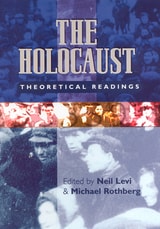
The Holocaust
Theoretical ReadingsLevi, Neil
Rutgers University Press, 2003
This agenda-setting reader brings together both classic and new writings to demonstrate how concerns arising from the Nazi genocide shaped contemporary literary and cultural theory. Wide in its thematic scope, it covers such vital questions as:
- Authenticity and experience
- Memory and trauma
- Historiography and the philosophy of history
- Fascism and Nazi anti-Semitism
- Representation and identity formation
- Race, gender, and genocide
- Implications of the Holocaust for theories of the unconscious, ethics, politics, and aesthetics
The readings, which are fully contextualized by a general introduction, section introductions, and bibliographical notes, represent the work of many influential writers and theorists, including Theodor Adorno, Giorgio Agamben, Hannah Arendt, Jean Baudrillard, Zygmunt Bauman, Walter Benjamin, Cathy Caruth, Jacques Derrida, Shoshana Felman, Saul Friedlander, Paul Gilroy, Lawrence Langer, Emmanuel Levinas, Primo Levi, Jean-François Lyotard, Hayden White, and James E. Young. This multidisciplinary anthology will be welcomed by students and scholars of the Holocaust.
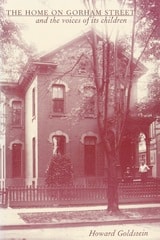
The Home on Gorham Street and the Voices of Its Children
Howard Goldstein
University of Alabama Press, 1996
Giving voice to childhood, memory, and resilience within a shared home.
The Home on Gorham Street looks back to an earlier era of care for orphaned and dependent children of Eastern European Jewish immigrants. Within this social history and ethnography, the voices of elders once wards of the home in the 1930s and 1940s tell us in sometimes poetic, often comic, usually ironic, and always poignant words what it was really like to grow up in an orphanage. Emerging from this penetrating adventure are principles for the future of effective group care in meeting the needs of the rapidly growing number of abused, forsaken, and orphaned children.
Goldstein's ethnography demonstrates amply that children who spend years in an institution can go on to lead productive lives under certain conditions. Such conditions may never have been met in any other children's institution. That they did exist one time, however, is cause not only to rejoice but also to understand that recreating these conditions is difficult and possibly impossible.

The Homeless Of Ironweed
Blossoms On The CragBenedict Giamo
University of Iowa Press, 1997

The Homeowner Ideology
Economic (F)Utility of Real Property Rights in Four African CitiesSingumbe Muyeba
University of Michigan Press, 2025

The Honest Politician's Guide to Crime Control
Norval Morris and Gordon J. Hawkins
University of Chicago Press, 1970
The Horn of Africa
Intra-State and Inter-State Conflicts and SecurityEdited by Redie Bereketeab and Cyril Obi
Pluto Press, 2013
The Horn of Africa, comprising Djibouti, Eritrea, Ethiopia, Sudan and Somalia, is the most conflict-ridden region in Africa. This book explores the origins and impact of these conflicts at both an intra-state and inter-state level and the insecurity they create.
The contributors show how regional and international interventions have compounded pre-existing tensions and have been driven by competing national interests linked to the 'War on Terror' and acts of piracy off the coast of Somalia.
The Horn of Africa outlines proposals for multidimensional mechanisms for conflict resolution in the region. Issues of border demarcation, democratic deficit, crises of nation and state building, and the roles of political actors and traditional authorities are all clearly analysed.
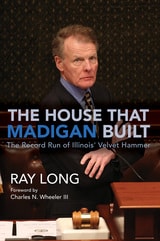
The House That Madigan Built
The Record Run of Illinois' Velvet HammerRay Long. Foreword by Charles N. Wheeler III
University of Illinois Press, 2022
Veteran reporter Ray Long draws on four decades of observing state government to provide the definitive political analysis of Michael Madigan. Secretive, intimidating, shrewd, power-hungry--Madigan mesmerized his admirers and often left his opponents too beaten down to oppose him. Long vividly recreates the battles that defined the Madigan era, from stunning James Thompson with a lightning-strike tax increase, to pressing for a pension overhaul that ultimately failed in the courts, to steering the House toward the Rod Blagojevich impeachment. Long also shines a light on the machinery that kept the Speaker in power. Head of a patronage army, Madigan ruthlessly used his influence and fundraising prowess to reward loyalists and aid his daughter’s electoral fortunes. At the same time, he reshaped bills to guarantee he and his Democratic troops shared in the partisan spoils of his legislative victories. Yet Madigan’s position as the state’s seemingly invulnerable power broker could not survive scandals among his close associates and the widespread belief that his time as Speaker had finally reached its end.
Unsparing and authoritative, The House That Madigan Built is the page-turning account of one the most powerful politicians in Illinois history.

The House Will Come To Order
How the Texas Speaker Became a Power in State and National PoliticsBy Patrick L. Cox and Michael Phillips
University of Texas Press, 2010
In a state assumed to have a constitutionally weak governor, the Speaker of the Texas House wields enormous power, with the ability to almost single-handedly dictate the legislative agenda. The House Will Come to Order charts the evolution of the Speaker's role from a relatively obscure office to one of the most powerful in the state. This fascinating account, drawn from the Briscoe Center's oral history project on the former Speakers, is the story of transition, modernization, and power struggles.
Weaving a compelling story of scandal, service, and opportunity, Patrick Cox and Michael Phillips describe the divisions within the traditional Democratic Party, the ascendance of Republicans, and how Texas business, agriculture, and media shaped perceptions of officeholders. While the governor and lieutenant governor wielded their power, the authors show how the modern Texas House Speaker built an office of equal power as the state became more complex and diverse. The authors also explore how race, class, and gender affected this transition as they explain the importance of the office in Texas and the impact the state's Speakers have had on national politics.
At the apex of its power, the Texas House Speaker's role at last receives the critical consideration it deserves.

The House and Senate in the 1790s
Petitioning, Lobbying, and Institutional DevelopmentKenneth R. Bowling
Ohio University Press, 2002
Amid the turbulent swirl of foreign intrigue, external and internal threats to the young nation’s existence, and the domestic partisan wrangling of the 1790s, the United States Congress solidified its role as the national legislature. The ten essays in The House and Senate in the 1790s demonstrate the mechanisms by which this bicameral legislature developed its institutional identity. The first essay sets the scene for the institutional development of Congress by examining its constitutional origins and the efforts of the Founders to empower the new national legislature. The five following essays focus on two related mechanisms—petitioning and lobbying—by which citizens and private interests communicated with national lawmakers.
Although scholars tend to see lobbying as a later nineteenth-century development, the papers presented here clearly demonstrate the existence of lobbyists and lobbying in the 1790s. The final four papers examine other aspects of the institutional development of the House and the Senate, including the evolution of political parties and congressional leadership.
The essays in this collection, the third volume in the series Perspectives on the History of Congress, 1789-1801, originated in a series of conferences held by the United States Capitol Historical Society from 1994 to 2001.
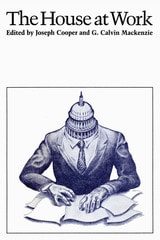
The House at Work
Edited by Joseph Cooper and G. Calvin Mackenzie
University of Texas Press, 1981
There exists a rich literature on the workings of the United States Congress, but The House at Work is the first book to focus on the institutional performance of the House of Representatives. A complete overview of the complex functioning and dynamics of Congress is presented by distinguished contributors, drawing upon both real-life experience and organization theory.
Each essay presents material on activities central to legislative work in the House, including the internal operations of member and committee offices, the administrative support system of the House, the impact of organizational structure and information resources on individual decision making, the expanding application of computer technology, the character of the personnel system, and the processing of constituent casework.
Nearly all contributors were professional staff members of the U.S. House Commission on Administrative Review in 1976 and 1977, whose analysis of the internal operations of the House was acomprehensive investigation. Their academic training, buttressed by significant practical experience on Capitol Hill, makes this book of great value to both students and scholars of the legislative process. In addition to the editors, the contributors include Glenn R. Parker, Thomas E. Cavanagh, Allan J. Katz, John R. Johannes, Thomas J. O'Donnell, David W. Brady, Louis Sandy Maisel, Susan Webb Hammond, Jarold A. Kieffer, James A. Thurber, and Jeffrey A. Goldberg.
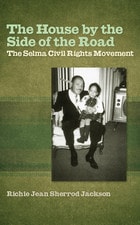
The House by the Side of the Road
The Selma Civil Rights MovementRichie Jean Sherrod Jackson
University of Alabama Press, 2011
King’s informal headquarters in Selma was the home of Dr. Sullivan and Richie Jean Sherrod Jackson and their young daughter, Jawana. The House by the Side of the Road is Richie Jean’s firsthand account of the private meetings King and his lieutenants, including Ralph David Abernathy and John Lewis, held in the haven of the Jackson home.
Sullivan Jackson was an African American dentist in Selma and a prominent supporter of the civil rights movement. Richie Jean was a close childhood friend of King’s wife, Coretta Scott King, a native of nearby Marion, Alabama. Richie Jean’s fascinating account narrates how, in the fraught months of 1965 that preceded the Voting Rights March, King and his inner circle held planning sessions and met with Assistant Attorney General John Doar to negotiate strategies for the event.
Just eight days after Bloody Sunday, President Lyndon Johnson made a televised addressed to a joint session of Congress on Monday, March 15. Jackson relates the intimate scene of King and his lieutenants watching as Johnson called the nation to dedicate itself to equal rights for all and ending his address with the words: “We shall overcome.” Five months later, Congress passed the 1965 Voting Rights Act on August 6.
The major motion picture Selma now commemorates the fiftieth anniversary of Bloody Sunday and the 1965 Voting Rights Act. In it, Niecy Nash and Kent Faulcon star as Sullivan and Richie Jean Jackson among a cast including Oprah Winfrey, Tom Wilkinson, and Cuba Gooding Jr. A gripping primary source, The House by the Side of the Road illuminates the private story whose public outcomes electrified the world and changed the course of American history.

The Human Condition
Second EditionHannah Arendt
University of Chicago Press, 2018
The twenty-first century has seen a resurgence of interest in the political thinker Hannah Arendt, “the theorist of beginnings,” whose work probes the logics underlying unexpected transformations—from totalitarianism to revolution.
A work of striking originality, The Human Condition is in many respects more relevant now than when it first appeared in 1958. In her study of the state of modern humanity, Hannah Arendt considers humankind from the perspective of the actions of which it is capable. The problems Arendt identified then—diminishing human agency and political freedom, the paradox that as human powers increase through technological and humanistic inquiry, we are less equipped to control the consequences of our actions—continue to confront us today. This new edition, published to coincide with the sixtieth anniversary of its original publication, contains Margaret Canovan’s 1998 introduction and a new foreword by Danielle Allen.
A classic in political and social theory, The Human Condition is a work that has proved both timeless and perpetually timely.
The Human Drama of Abortion
A Global Search for ConsensusAnibal Faundes
Vanderbilt University Press, 2006
Deeply touched by the tragedies of botched abortions that they witnessed as medical students and young physicians in Chile in the 1940s and later around the world, the authors have attempted in their professional lives and now in this book to establish a framework for dialogue to replace the polarization that exists today.
Doctors Faundes and Barzelatto use their decades of international work to document the personal experiences of different classes of women in different countries and those countries' policies and practices. No other book provides such a comprehensive and reasoned examination of the entire topic of abortion, from the medical to the religious and ethical and from the psychological to the legal, in plain language understandable by non-specialists.
The central thesis is that there are too many induced abortions in the world today, that most are preventable and should be prevented--a middle ground that both pro-life and pro-choice advocates can accept. The first part of the book reviews why women have abortions, as well as the magnitude and consequences. The second part examines values. The third part discusses effective interventions. The final part states conclusions about what can be done to reach a necessary social consensus.
The Portuguese edition of this book was issued at the very end of 2004. The Spanish edition, launched in mid-2005, is already in a second printing. The authors are making presentations at special events sponsored by universities, professional associations, and feminist networks in Argentina, Chile, Mexico, Peru, Uruguay, Colombia, the Dominican Republic, and the United States.
The Human Rights Paradox
Universality and Its DiscontentsEdited by Steve J. Stern and Scott Straus
University of Wisconsin Press, 2014
The Human Rights Paradox is the first book to fully embrace this contradiction and reframe human rights as history, contemporary social advocacy, and future prospect. In case studies that span Africa, Latin America, South and Southeast Asia, and the United States, contributors carefully illuminate how social actors create the imperative of human rights through relationships whose entanglements of the global and the local are so profound that one cannot exist apart from the other. These chapters provocatively analyze emerging twenty-first-century horizons of human rights—on one hand, the simultaneous promise and peril of global rights activism through social media, and on the other, the force of intergenerational rights linked to environmental concerns that are both local and global. Taken together, they demonstrate how local struggles and realities transform classic human rights concepts, including “victim,” “truth,” and “justice.”
Edited by Steve J. Stern and Scott Straus, The Human Rights Paradox enables us to consider the consequences—for history, social analysis, politics, and advocacy—of understanding that human rights belong both to “humanity” as abstraction as well as to specific people rooted in particular locales.
The Humane Metropolis
People and Nature in the 21st-Century CityRutherford H. Platt
University of Massachusetts Press, 2006
Four-fifths of Americans now live in the nation's sprawling metropolitan areas, and half of the world's population is now classified as “urban.” As cities become the dominant living environment for humans, there is growing concern about how to make such places more habitable, more healthy and safe, more ecological, and more equitable—in short, more “humane.”
This book explores the prospects for a more humane metropolis through a series of essays and case studies that consider why and how urban places can be made greener and more amenable. Its point of departure is the legacy of William H. Whyte (1917-1999), one of America's most admired urban thinkers. From his eyrie high above Manhattan in the offices of the Rockefeller Brothers Fund, Whyte laid the foundation for today's “smart growth” and “new urbanist” movements with books such as The Last Landscape (1968). His passion for improving the habitability of cities and suburbs is reflected in the diverse grassroots urban design and regreening strategies discussed in this volume.
Topics examined in this book include urban and regional greenspaces, urban ecological restoration, social equity, and green design. Some of the contributors are recognized academic experts, while others offer direct practical knowledge of particular problems and initiatives. The editor's introduction and epilogue set the individual chapters in a broader context and suggest how the strategies described, if widely replicated, may help create more humane urban environments.
In addition to Rutherford H. Platt, contributors to the volume include Carl Anthony, Thomas Balsley, Timothy Beatley, Eugenie L. Birch, Edward J. Blakely, Colin M. Cathcart, Steven E. Clemants, Christopher A. De Sousa, Steven N. Handel, Peter Harnik, Michael C. Houck, Jerold S. Kayden, Albert LaFarge, Andrew Light, Charles E. Little, Anne C. Lusk, Thalya Parilla, Deborah E. Popper, Frank J. Popper, Mary V. Rickel, Cynthia Rosenzweig, Robert L. Ryan, Laurin N. Sievert, Andrew G. Wiley-Schwartz, and Ann Louise Strong.
Included in the back of the book is a DVD of a 22-minute film created by Ted White, which serves as a companion to the text.