Results by title
4413 books match the query 'Anthropology' and 750 start with t
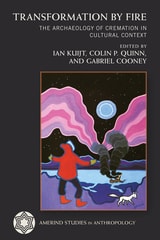
Transformation by Fire
The Archaeology of Cremation in Cultural ContextEdited by Ian Kuijt, Colin P. Quinn, and Gabriel Cooney
University of Arizona Press, 2014
Editors Ian Kuijt, Colin P. Quinn, and Gabriel Cooney’s volume examines cremation by documenting the material signatures of cremation events and processes, as well as its transformative impact on social relations and concepts of the body. Indeed, examining why and how people chose to cremate their dead serves as an important means of understanding how people in the past dealt with death, the body, and the social world.
The contributors develop new perspectives on cremation as important mortuary practices and social transformations. Varying attitudes and beliefs on cremation and other forms of burial within the same cultural paradigm help us understand what constitutes the body and what occurs during its fiery transformation. In addition, they explore issues and interpretive perspectives in the archaeological study of cremation within and between different cultural contexts.
The global and comparative perspectives on cremation render the book a unique contribution to the literature of anthropological and mortuary archaeology.
Transforming Anthropology, volume 32 number 1 (April 2024)
The University of Chicago Press
University of Chicago Press Journals, 2024
Transforming Anthropology, volume 32 number 2 (October 2024)
The University of Chicago Press
University of Chicago Press Journals, 2024
Transforming Anthropology, volume 33 number 1 (April 2025)
The University of Chicago Press
University of Chicago Press Journals, 2025
Transforming Anthropology, volume 33 number 2 (October 2025)
The University of Chicago Press
University of Chicago Press Journals, 2025
Transforming Anthropology, volume 34 number 1 (April 2026)
The University of Chicago Press
University of Chicago Press Journals, 2026
Transforming Displaced Women in Sudan
Politics and the Body in a Squatter SettlementRogaia Mustafa Abusharaf
University of Chicago Press, 2009
Over twenty years of civil war in predominantly Christian Southern Sudan has forced countless people from their homes. Transforming Displaced Women in Sudan examines the lives of women who have forged a new community in a shantytown on the outskirts of Khartoum, the largely Muslim, heavily Arabized capital in the north of the country.
Sudanese-born anthropologist Rogaia Mustafa Abusharaf delivers a rich ethnography of this squatter settlement based on personal interviews with displaced women and careful observation of the various strategies they adopt to reconstruct their lives and livelihoods. Her findings debunk the myth that these settlements are utterly abject, and instead she discovers a dynamic culture where many women play an active role in fighting for peace and social change. Abusharaf also examines the way women’s bodies are politicized by their displacement, analyzing issues such as religious conversion, marriage, and female circumcision.
An urgent dispatch from the ongoing humanitarian crisis in northeastern Africa, Transforming Displaced Women in Sudan will be essential for anyone concerned with the interrelated consequences of war, forced migration, and gender inequality.
Transforming Ethnographic Knowledge
Edited by Rebecca Hardin and Kamari Maxine Clarke
University of Wisconsin Press, 2012
The ethnographic methods that anthropologists first developed to study other cultures—fieldwork, participant observation, dialogue—are now being adapted for a broad array of applications, such as business, conflict resolution and demobilization, wildlife conservation, education, and biomedicine. In Transforming Ethnographic Knowledge, anthropologists trace the changes they have seen in ethnography as a method and as an intellectual approach, and they offer examples of ethnography’s role in social change and its capacity to transform its practitioners.
Senior scholars Mary Catherine Bateson, Sidney Mintz, and J. Lorand Matory look back at how thinking ethnographically shaped both their work and their lives, and George Marcus suggests that the methods for teaching and training anthropologists need rethinking and updating. The second part of the volume features anthropologists working in sectors where ethnography is finding or claiming new relevance: Kamari Maxine Clarke looks at ethnographers’ involvement (or non-involvement) in military conflict, Csilla Kalocsai employs ethnographic tools to understand the dynamics of corporate management, Rebecca Hardin and Melissa Remis take their own anthropological training into rainforests where wildlife conservation and research meet changing subsistence practices and gendered politics of social difference, and Marcia Inhorn shows how the interests in mobility and diasporic connection that characterize a new generation of ethnographic work also apply to medical technologies, as those mediate fertility and relate to social status in the Middle East.
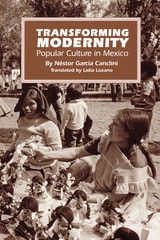
Transforming Modernity
Popular Culture in MexicoBy Néstor García Canclini
University of Texas Press, 1992
Is popular culture merely a process of creating, marketing, and consuming a final product, or is it an expression of the artist's surroundings and an attempt to alter them? Noted Argentine/Mexican anthropologist Néstor García Canclini addresses these questions and more in Transforming Modernity, a translation of Las culturas populares en el capitalismo. Based on fieldwork among the Purépecha of Michoacán, Mexico, some of the most talented artisans of the New World, the book is not so much a work of ethnography as of philosophy—a cultural critique of modernism. García Canclini delineates three interpretations of popular culture: spontaneous creation, which posits that artistic expression is the realization of beauty and knowledge; "memory for sale," which holds that original products are created for sale in the imposed capitalist system; and the tourist outlook, whereby collectibles are created to justify development and to provide insight into what capitalism has achieved.
Transforming Modernity argues strongly for popular culture as an instrument of understanding, reproducing, and transforming the social system in order to elaborate and construct class hegemony and to reflect the unequal appropriation and distribution of cultural capital. With its wide scope, this book should appeal to readers within and well beyond anthropology—those interested in cultural theory, social thought, and Mesoamerican culture.
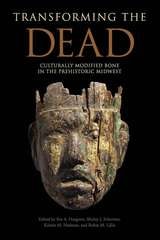
Transforming the Dead
Culturally Modified Bone in the Prehistoric MidwestEve A. Hargrave
University of Alabama Press, 2015
Revealing how the dead continued to shape the spiritual and social worlds of prehistoric North America.
Transforming the Dead is a collection of essays that examines culturally modified human bones and their roles as “cultural and ritual objects” among prehistoric Eastern Woodland cultures. Previous scholarship has explored the role of human body parts in Native American cultures as trophies of war and revered ancestors. This collection discusses new evidence that human elements were also important components of daily and ritual activities across the Eastern Woodlands. The contributors to this volume discuss each case study within the unique regional and temporal contexts of the material, rather than seeking universal answers to how these objects were used.
Most research addressing modified human bone has focused on cut marks and trauma associated with warfare, trophy taking, and burial practices. The editors and contributors of Transforming the Dead document the varied and often overlooked ways that human bone was intentionally modified through drilling, incising, cutting, and polishing for utilitarian, ornamental, spiritual, or ritual use. Examples include bracelets and gorgets to be worn, as well as musical rasps, pipe stems, masks, and protective talismans. The form and function of these objects are not unusual; their construction from the remains of “another” sets them apart.
Through a flexible but systematic analysis of the archaeological record, the contributors bring into focus how the careful selection, modification, and retention of particular bones or body parts of an individual after death offer insights into concepts of personhood, the body, life, and death among the prehistoric Native Americans in the Midwest.
Transforming the Frontier
Peace Parks and the Politics of Neoliberal Conservation in Southern AfricaBram Büscher
Duke University Press, 2013
Based on extensive research in southern Africa with the Maloti-Drakensberg Transfrontier Conservation and Development Project, Büscher explains how the successful promotion of transfrontier conservation as a "win-win" solution happens not only in spite of troubling contradictions and problems, but indeed because of them. This is what he refers to as the "politics of neoliberal conservation," which receives its strength from effectively combining strategies of consensus, antipolitics, and marketing. Drawing on long-term, multilevel ethnographic research, Büscher argues that transfrontier conservation projects are not as concerned with on-the-ground development as they are purported to be. Instead, they are reframing environmental protection and sustainable development to fit an increasingly contradictory world order.
Transient Becoming
Self-improvement and Capitalist Virtuousness in Contemporary ChinaGil Hizi
National University of Singapore Press, 2026
How do individuals seek to become better people in contemporary China? How do they navigate the complex demands of personal growth within the fragmentation of China's moral landscape, which celebrates rabid consumerism and requires political conformity; where a lively and expressive popular culture coexists with official narratives of nationalism, heteronormativity, and social hierarchy; and where a rigid, exam-driven mass educational system is preparation for an economy of great market disruption and employment uncertainty? Sociocultural anthropologist Gil Hizi's careful ethnography provides nuanced answers to these fraught questions by examining the pursuit and enactment of virtue, termed “capitalist virtuousness,” through the expanding genre of self-improvement.
Transient Becoming reveals how workshops in soft skills create heterotopian spaces—distinct moral imaginaries that offer participants transient optimism and virtue realization in compensation for the perceived futility of their ambitions and the socioeconomic uncertainties of their daily lives. Within these spaces, individuals experientially exceed their social reality and perform an idealized sense of self-worth and autonomy, even if these transformations remain short-lived.
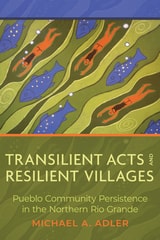
Transilient Acts and Resilient Villages
Pueblo Community Persistence in the Northern Rio GrandeMichael A. Adler
University of Arizona Press, 2026
Focusing on the Tiwa-speaking communities of Taos, Picuris, and Pot Creek Pueblos, Adler shows how social and ritual organization, architectural change, and sacred geographies were mobilized in response to disruption. He challenges conventional resilience theory, which emphasizes systemic stability, instead centering Indigenous agency, mobility, and sacred practice as key to understanding cultural endurance.
Grounded in decades of collaborative research with Pueblo communities, Transilient Acts and Resilient Villages is a vital contribution to southwestern archaeology. It offers a compelling model for how archaeology can respectfully engage with descendant communities and provides essential insights for scholars, students, and community members seeking to understand the complexities of cultural persistence in the face of change.
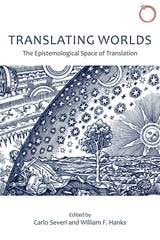
Translating Worlds
The Epistemological Space of TranslationEdited by Carlo Severi and William F. Hanks
HAU, 2015
Since Ferdinand de Saussure and Franz Boas, languages have been seen as systems whose differences make precise translation nearly impossible. And still others have viewed translation between languages as principally indeterminate. The contributors here argue that the challenge posed by the constant confrontation between incommensurable worlds and systems may be the most fertile ground for state-of-the-art ethnographic theory and practice. Ranging from tourism in New Guinea to shamanism in the Amazon to the globally ubiquitous restaurant menu, the contributors mix philosophy and ethnography to redefine translation not only as a key technique for understanding ethnography but as a larger principle in epistemology.
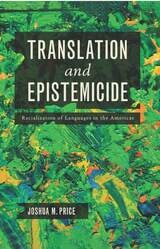
Translation and Epistemicide
Racialization of Languages in the AmericasJoshua M. Price
University of Arizona Press, 2023
The book gives an account of translation-as-epistemicide in the Americas, drawing on a range of examples from the early colonial period to the War on Terror. The first chapters demonstrate four distinct operations of epistemicide: the commensuration of worlds, the epistemic marginalization of subaltern translators and the knowledge they produce, the criminalization of translators and interpreters, and translation as piracy or extractivism. The second part of the book outlines decolonial translation strategies, including an epistemic posture the author calls “bewilderment.”
Translation and Epistemicide tracks how through the centuries translation practices have enabled colonialism and resulted in epistemicide, or the destruction of Indigenous and subaltern knowledge.
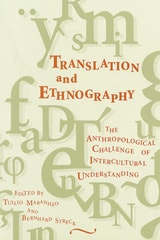
Translation and Ethnography
The Anthropological Challenge of Intercultural UnderstandingTullio Maranhão
University of Arizona Press, 2003
Translation and Ethnography focuses on issues that arise when we attempt to make significant thematic or symbolic elements of one culture meaningful in terms of another. Its chapters cover a wide range of topics, all stressing the interpretive practices that enable the approximation of meaning: the role of differential power, of language and so-called world view, and of translation itself as a metaphor of many contemporary cross-cultural processes.
The topics covered here represent a global sample of translation, ranging from Papua New Guinea to South America to Europe. Some of the issues addressed include postcolonial translation/transculturation from the perspective of colonized languages, as in the Mexican Zapatista movement; mis-translations of Amerindian conceptions and practices in the Amazon, illustrating the subversive potential of anthropology as a science of translation; Ethiopian oracles translating divine messages for the interpretation of believers; and dreams and clowns as translation media among the Gamk of Sudan.
Anthropologists have long been accustomed to handling translation chains; in this book they open their diaries and show the steps they take toward knowledge. Translation and Ethnography raises issues that will shake up the most obdurate, objectivist translators and stimulate scholars in sociolinguistics, communication, ethnography, and other fields who face the challenges of conveying meaning across human boundaries.
Transnational Adoption, Volume 21
Toby Alice Volkman and Cindi Katz, eds.
Duke University Press, 0
In this special issue, scholars—several of whom are adoptive parents—from a variety of disciplines focus on the culture and politics of transnational adoption, exploring relationships between the sending and receiving nations. Until the mid-1970s, adoptive families were pressured to forget the child’s past and birth culture and to create “as if” biological families. Since then, the culture of adoption has moved dramatically toward openness, generating preoccupations with origins and loss, as well as new kinds of border-crossing movements such as orphanage visits, homeland journeys, and culture camps established by sending nations now eager to embrace the adoptees. This collection of essays examines the complex interplay of race, culture, identity, kinship, and belonging in this contemporary form of family building.
Contributors. Lisa Cartwright, Claudia Fonseca, Cindi Katz, Eleana Kim, Toby Alice Volkman, Barbara Yngvesson
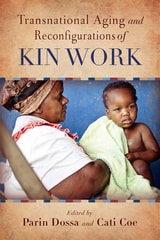
Transnational Aging and Reconfigurations of Kin Work
Dossa, Parin
Rutgers University Press, 2017
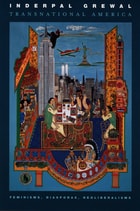
Transnational America
Feminisms, Diasporas, NeoliberalismsInderpal Grewal
Duke University Press, 2005
Grewal combines a postcolonial perspective with social and cultural theory to argue that contemporary notions of gender, race, class, and nationality are linked to earlier histories of colonization. Through an analysis of Mattel’s sales of Barbie dolls in India, she discusses the consumption of American products by middle-class Indian women newly empowered with financial means created by India’s market liberalization. Considering the fate of asylum-seekers, Grewal looks at how a global feminism in which female refugees are figured as human rights victims emerged from a distinctly Western perspective. She reveals in the work of three novelists who emigrated from India to the United States—Bharati Mukherjee, Chitra Banerjee Divakaruni, and Amitav Ghosh—a concept of Americanness linked to cosmopolitanism. In Transnational America Grewal makes a powerful, nuanced case that the United States must be understood—and studied—as a dynamic entity produced and transformed both within and far beyond its territorial boundaries.
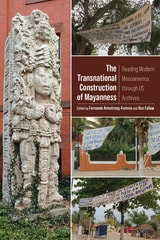
Transnational Construction of Mayanness
Reading Modern Mesoamerica through US ArchivesFernando Armstrong-Fumero
University Press of Colorado, 2023
Contributors tap documentary, ethnographic, and ethnoarchaeological sources from North America to expand established categories of fieldwork and archival research conducted within the national spaces of Mexico and Central America. A particularly rich and diverse set of case studies interrogate the historical processes that remove sources from their place of production in the “field” to the US, challenge the conventional wisdom regarding the geography of data sources that are available for research, and reveal a range of historical relationships that enabled US actors to shape the historical experience of Maya-speaking peoples.
The Transnational Construction of Mayanness offers rich insight into transnational relations and suggests new avenues of research that incorporate an expanded corpus of materials that embody the deep-seated relationship between Maya-speaking peoples and various gringo interlocutors. The work is an important bridge between Mayanist anthropology and historiography and broader literatures in American, Atlantic, and Indigenous studies.
Contributors: David Carey, M. Bianet Castellanos, Matilde Córdoba Azcárate, Lydia Crafts, John Gust, Julio Cesar Hoil Gutierréz, Jennifer Mathews, Matthew Watson
Transnational LGBT Activism
Working for Sexual Rights WorldwideRyan R. Thoreson
University of Minnesota Press, 2014
The International Gay and Lesbian Human Rights Commission (IGLHRC) was founded in 1990 as the first NGO devoted to advancing LGBT human rights worldwide. How, this book asks, is that mission translated into practice? What do transnational LGBT human rights advocates do on a day-to-day basis and for whom? Understanding LGBT human rights claims is impossible, Ryan R. Thoreson contends, without knowing the answers to these questions.
In Transnational LGBT Activism, Thoreson argues that the idea of LGBT human rights is not predetermined but instead is defined by international activists who establish what and who qualifies for protection. He shows how IGLHRC formed and evolved, who is engaged in this work, how they conceptualize LGBT human rights, and how they have institutionalized their views at the United Nations and elsewhere. After a full year of in-depth research in New York City and Cape Town, South Africa, Thoreson is able to reconstruct IGLHRC’s early campaigns and highlight decisive shifts in the organization’s work from its founding to the present day.
Using a number of high-profile campaigns for illustration, he offers insight into why activists have framed particular demands in specific ways and how intergovernmental advocacy shapes the claims that activists ultimately make. The result is a uniquely balanced, empirical response to previous impressionistic and reductive critiques of Western human rights activists—and a clarifying perspective on the nature and practice of global human rights advocacy.
Transnational Sport
Gender, Media, and Global KoreaRachael Miyung Joo
Duke University Press, 2012
Transparency and Conspiracy
Ethnographies of Suspicion in the New World OrderHarry G. West and Todd Sanders, eds.
Duke University Press, 2003
In this collection leading anthropologists reveal the variations and commonalities in conspiratorial thinking or occult cosmologies around the globe—in Korea, Tanzania, Mozambique, New York City, Indonesia, Mongolia, Nigeria, and Orange County, California. The contributors chronicle how people express profound suspicions of the United Nations, the state, political parties, police, courts, international financial institutions, banks, traders and shopkeepers, media, churches, intellectuals, and the wealthy. Rather than focusing on the veracity of these convictions, Transparency and Conspiracy investigates who believes what and why. It makes a compelling argument against the dismissal of conspiracy theories and occult cosmologies as antimodern, irrational oversimplifications, showing how these beliefs render the world more complex by calling attention to its contradictions and proposing alternative ways of understanding it.
Contributors. Misty Bastian, Karen McCarthy Brown, Jean Comaroff, John Comaroff, Susan Harding, Daniel Hellinger, Caroline Humphrey, Laurel Kendall, Todd Sanders, Albert Schrauwers, Kathleen Stewart, Harry G. West
Transplanting Care
Shifting Commitments in Health and Care in the United StatesHeinemann, Laura L.
Rutgers University Press, 2016
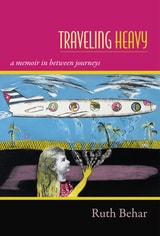
Traveling Heavy
A Memoir in between JourneysRuth Behar
Duke University Press, 2013
Behar calls herself an anthropologist who specializes in homesickness. Repeatedly returning to her homeland of Cuba, unwilling to utter her last goodbye, she is obsessed by the question of why we leave home to find home. For those of us who travel heavy with our own baggage, Behar is an indispensable guide, full of grace and hope, in the perpetual search for connection that defines our humanity.

Travelling Passions
The Hidden Life of Vilhjalmur StefanssonGisli Palsson
University of Manitoba Press, 2005
New evidence of this other life has recently been discovered: a collection of love letters between Stefansson and his fiance Orpha Cecil Smith were found in a New Hampshire flea market; Stefansson's field diaries have revealed elegant essays and insightful commentary on Inupiat society; baptismal records have revealed that Stefansson had a son, Alex, with his informant and guide, Fanny Pannigabluk; and through Web searches and a private detective, Palsson found and conducted interviews with the descendents of both Cecil Smith and Alex Stefansson.
Travelling Passions sheds new light on Stefanssonís life and work, focussing on the tension between his private life and the theories that brought his name to the halls of fame. Palsson draws a clear, vivid, and in many ways unexpected picture of the mythical figure of Stefansson.
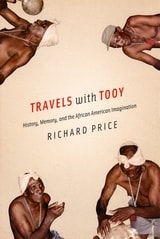
Travels with Tooy
History, Memory, and the African American ImaginationRichard Price
University of Chicago Press, 2007
Included on the itinerary for this hallucinatory expedition: forays into the eighteenth century to talk with slaves newly arrived from Africa; leaps into the midst of battles against colonial armies; close encounters with double agents and femme fatale forest spirits; and trips underwater to speak to the comely sea gods who control the world’s money supply. This enchanting book draws on Price’s long-term ethnographic and archival research, but above all on Tooy’s teachings, songs, stories, and secret languages to explore how Africans in the Americas have created marvelous new worlds of the imagination.

Treadwell Gold
An Alaska Saga of Riches and RuinSheila Kelly
University of Alaska Press, 2010
A century ago, Treadwell, Alaska, was a featured stop on steamship cruises, a rich, up-to-date town that was the most prominent and proud in all Alaska. Its wealth, however, was founded on the remarkably productive gold mines on Douglas Island, and when those caved in and flooded in the early decades of the twentieth century, Treadwell sank into relative obscurity.
Treadwell Gold presents first-person accounts from the sons and daughters of the miners, machinists, hoist operators, and superintendents who together dug and blasted the gold that made Treadwell rich. Alongside these stories are vintage photos that capture both the industrial vigor of the mines and the daily lives that made up Treadwell society. The book will fascinate anyone interested in Alaskan history or the romance of gold mining’s past.
Treasured Possessions
Indigenous Interventions into Cultural and Intellectual PropertyHaidy Geismar
Duke University Press, 2013
Treating AIDS
Politics of Difference, Paradox of PreventionSangaramoorthy, Thurka
Rutgers University Press, 2014
Sangaramoorthy documents in detail the work of AIDS prevention programs and their effect on the health and well-being of Haitians, a transnational community long plagued by the stigma of being stereotyped in public discourse as disease carriers. By tracing the ways in which public knowledge of AIDS prevention science circulates from sites of surveillance and regulation, to various clinics and hospitals, to the social worlds embraced by this immigrant community, she ultimately demonstrates the ways in which AIDS prevention programs help to reinforce categories of individual and collective difference, and how they continue to sustain the persistent and pernicious idea of race and ethnicity as risk factors for the disease.
Treatments
Language, Politics, and the Culture of IllnessLisa Diedrich
University of Minnesota Press, 2007
Creative expression inspired by disease has been criticized as a celebration of victimhood, unmediated personal experience, or just simply bad art. Despite debate, however, memoirs written about illness—particularly AIDS or cancer—have proliferated since the late twentieth century and occupy a highly influential place on the cultural landscape today.
In Treatments, Lisa Diedrich considers illness narratives, demonstrating that these texts not only recount and interpret symptoms but also describe illness as an event that reflects wider cultural contexts, including race, gender, class, and sexuality. Diedrich begins this theoretically rigorous analysis by offering examples of midcentury memoirs of tuberculosis. She then looks at Susan Sontag’s Illness As Metaphor, Audre Lorde’s The Cancer Journals, and Eve Kosofsky Sedgwick’s “White Glasses,” showing how these breast cancer survivors draw on feminist health practices of the 1970s and also anticipate the figure that would appear in the wake of the AIDS crisis in the 1980s—the “politicized patient.” She further reveals how narratives written by doctors Abraham Verghese and Rafael Campo about treating people with AIDS can disrupt the doctor–patient hierarchy, and she explores practices of witnessing that emerge in writing by Paul Monette and John Bayley.
Through these records of intensely personal yet universal experience, Diedrich demonstrates how language both captures and fails to capture these “scenes of loss” and how illness narratives affect the literary, medical, and cultural contexts from which they arise. Finally, by examining the ways in which the sick speak and are spoken for, she argues for an ethics of failure—the revaluation of loss as creating new possibilities for how we live and die.
Lisa Diedrich is assistant professor of women’s studies at Stony Brook University.
Tribal Pastoralists in Transition
The Baharvand of Luristan, IranFrank Hole and Sekandar Amanolahi-Baharvand
University of Michigan Press, 2021
Supplementary videos (on the migration, weaving, harvesting, and the bazaars) can be found on Fulcrum (fulcrum.org/UMMAA).
Troublesome Ground
Farming Trees and Green Policy in Rural IrelandJodie Asselin
University Press of Colorado, 2025
Through ethnographic description, Asselin illuminates how ephemeral worlds of green discourse and development plans manifest in rural areas, demonstrating the lived consequences of today’s competing demands on marginal regions. Troublesome Ground is a significant contribution to the anthropology of rural Ireland while offering insights into the wider realities of conflicting development and conservation strategies in global contemporary rural landscapes.
Trouillot Remixed
The Michel-Rolph Trouillot ReaderMichel-Rolph Trouillot. Edited by Yarimar Bonilla, Greg Beckett, and Mayanthi L. Fernando
Duke University Press, 2021
Trumpets in the Mountains
Theater and the Politics of National Culture in CubaLaurie A. Frederik
Duke University Press, 2012
Campesinos inhabit some of the island's most isolated areas, including the mountainous regions in central and eastern Cuba where Laurie A. Frederik conducted research among rural communities and professional theater groups. Analyzing the ongoing dialogue of cultural officials, urban and rural artists, and campesinos, Frederik provides an on-the-ground account of how visions of the nation are developed, manipulated, dramatized, and maintained in public consciousness. She shows that cubanía is defined, and redefined, in the interactive movement between intellectual, political, and everyday worlds.
Trust Matters
Parsi Endowments in Mumbai and the Horoscope of a CityLeilah Vevaina
Duke University Press, 2023

Trust, Ethnicity, and Identity
Beyond the New Institutional Economics of Ethnic Trading Networks, Contract Law, and Gift-ExchangeJanet Tai Landa
University of Michigan Press, 1995
Trust, Ethnicity, and Identity deals with the economic role of laws and institutions in achieving social order in a decentralized economy. Specifically, this book considers the coordinating role of three major nonprice institutions--ethnic trading networks, contract law, and gift-exchange--in economizing on transaction costs and thus facilitating the process of exchange in decentralized economies in different historical contexts.
The major unifying theme of the book is this: identity matters when traders operate in an environment characterized by contract uncertainty, where the legal framework for the enforcement of contracts is not well developed. This in turn points out the importance of trust embedded in particularistic exchange relations such as kinship or ethnicity.
One unique facet of this book is that the author uses a property rights--public choice approach--part of the New Institutional Economics--to provide a unifying theoretical framework to explain such diverse exchange institutions as contract law, ethnic trading networks, and gift-exchange, In addition, it goes beyond the New Institutional Economics paradigm by incorporating some crucial concepts from sociology, anthropology, and bioeconomics, such as social structure, social norms, culture, reciprocity, and kin-related altruism. This broad interdisciplinary framework gives Landa's work a relevance beyond economics to law, political science, sociology, anthropology, and bioeconomics.
Truth in Motion
The Recursive Anthropology of Cuban DivinationMartin Holbraad
University of Chicago Press, 2012
Truth's Fool
Derek Freeman and the War over Cultural AnthropologyPeter Hempenstall
University of Wisconsin Press, 2017
Truth's Fool documents an intellectual journey that was much larger and more encompassing than Freeman's attack on Mead's work. It peels back the prickly layers to reveal the man in all his complexity. Framing this story within anthropology's development in Britain and America, Peter Hempenstall recounts Freeman's mission to turn the discipline from its cultural-determinist leanings toward a view of human culture underpinned by biological and behavioral drivers. Truth's Fool engages the intellectual questions at the center of the Mead–Freeman debate and illuminates the dark spaces of personal, professional, and even national rivalries.
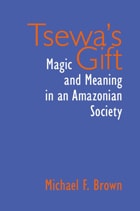
Tsewa's Gift
Magic and Meaning in an Amazonian SocietyMichael F. Brown
University of Alabama Press, 1986
Discover the spiritual threads that bind Amazonian life and culture.
Tsewa’s Gift is a profound exploration of the cultural and spiritual life of the indigenous peoples of the Peruvian Amazon. Anthropologist Michael F. Brown delves into the concept of tsewa, a spiritual force central to the worldview of the Aguaruna people, revealing how this belief system shapes social relationships, moral obligations, and the exchange of gifts. Through vivid ethnographic detail and thoughtful analysis, Brown examines the intersection of ritual, reciprocity, and cosmology, offering readers a nuanced understanding of how indigenous communities navigate identity, power, and meaning in a rapidly changing world. This book is an essential resource for scholars of anthropology, religion, and Latin American studies, as well as anyone seeking insight into the complexities of cultural resilience and adaptation.

Tuberculosis Control and Institutional Change in Shanghai, 1911–2011
Rachel S. Core
Hong Kong University Press, 2023
Tuberculosis Control and Institutional Change in Shanghai, 1911–2011 is the first book on the most widespread and deadly infectious disease in China, both historically and today. Weaving together interviews with data from periodicals and local archives in Shanghai, Rachel Core examines the rise and fall of tuberculosis control in China from the 1950s to the 1990s. Under the socialist work unit system, the vast majority of people had guaranteed employment, a host of benefits tied to their workplace, and there was little mobility—factors that made the delivery of medical and public health services possible in both urban and rural areas. The dismantling of work units amid wider market reforms in the 1980s and 1990s led to the rise of temporary and casual employment and a huge migrant worker population, with little access to health care, creating new challenges in TB control. This study of Shanghai will provide valuable lessons for historians, social scientists, public health specialists, and many others working on public health infrastructure on both the national and global levels.
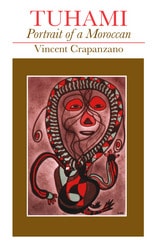
Tuhami
Portrait of a MoroccanVincent Crapanzano
University of Chicago Press, 1980
In a sensitive and bold experiment in interpretive ethnography, Crapanzano presents Tuhami's bizarre account of himself and his world. In so doing, Crapanzano draws on phenomenology, psychoanalysis, and symbolism to reflect upon the nature of reality and truth and to probe the limits of anthropology itself. Tuhami has become one of the most important and widely cited representatives of a new understanding of the whole discipline of anthropology.

Twins Talk
What Twins Tell Us about Person, Self, and SocietyDona Lee Davis
Ohio University Press, 2015
Twins Talk is an ethnographic study of identical twins in the United States, a study unique in that it considers what twins have to say about themselves, instead of what researchers have written about them. It presents, in the first person, the grounded and practical experiences of twins as they engage, both individually and together, the “who am I” and “who are we” questions of life. Here, the twins themselves are the stars.
Dona Lee Davis conducted conversational interviews with twenty-two sets of identical twins attending the Twins Days Festival in Twinsburg, Ohio, the largest such gathering in the world. Lively and often opinionated, each twin comes through as a whole person who at the same time maintains a special bond that the vast majority of people will never experience.
The study provides a distinctive and enlightening insider’s challenge to the nature/nurture debates that dominate contemporary research on twins. The author, herself an identical twin, draws on aspects of her own life to inform her analysis of the data throughout the text. Each chapter addresses a different theme from multiple viewpoints, including those of popular science writers, scientific researchers, and singletons, as well as those of the twins themselves.
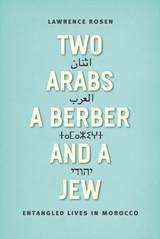
Two Arabs, a Berber, and a Jew
Entangled Lives in MoroccoLawrence Rosen
University of Chicago Press, 2015
Through the intellectual lives of these four men, this book explores a number of interpretative and theoretical issues that have made Arab culture distinct, especially in relationship to the West: how nothing is ever hard and fast, how everything is relational and always a product of negotiation. It showcases the vitality of the local in a global era, and it contrasts Arab notions of time, equality, and self with those in the West. Likewise, Rosen unveils his own entanglement in their world and the drive to keep the analysis of culture first and foremost, even as his own life enmeshes itself in those of his study. An exploration of faith, politics, history, and memory, this book highlights the world of everyday life in Arab society in ways that challenge common notions and stereotypes.
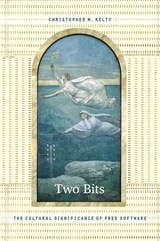
Two Bits
The Cultural Significance of Free SoftwareChristopher M. Kelty
Duke University Press, 2008
Drawing on ethnographic research that took him from an Internet healthcare start-up company in Boston to media labs in Berlin to young entrepreneurs in Bangalore, Kelty describes the technologies and the moral vision that bind together hackers, geeks, lawyers, and other Free Software advocates. In each case, he shows how their practices and way of life include not only the sharing of software source code but also ways of conceptualizing openness, writing copyright licenses, coordinating collaboration, and proselytizing. By exploring in detail how these practices came together as the Free Software movement from the 1970s to the 1990s, Kelty also considers how it is possible to understand the new movements emerging from Free Software: projects such as Creative Commons, a nonprofit organization that creates copyright licenses, and Connexions, a project to create an online scholarly textbook commons.

Two Evenings in Saramaka
Richard Price and Sally Price
University of Chicago Press, 1991
In this innovative work, Richard and Sally Price explore the fully adult world of Saramaka "folktale-land," where animals speak, the social order is inverted, customs have been only partially worked out, and the weak and clever triumph over the strong and arrogant. Joining the Saramaka of the Suriname rain forest for two tale-telling wakes, we witness mischievous Anasi the spider matching wits with lecherous devils, the scrawny little kid rescuing his nubile sisters in distress, and the bitchy white princess being tamed by the one-sided boy. As seas dry up, books speak out loud, and elephants assume human form, we are present at a whole sequence of world-shaping happenings such as the invention of sex, the discovery of drums, and the arrival of death among humans.
Set in the more general context of tale telling by the descendants of Africans throughout the Americas and of recent scholarship in performance studies, these Saramaka tales are presented as a dramatic script. With the help of nearly forty photographs, readers become familiar not only with the characters in folktale-land, but also with the men and women who so imaginatively bring them to life. And because music complements narration in Saramaka just as it does elsewhere in Afro-America, more than fifty songs are presented here in musical notation.
Narrative, song, dance, and social interaction merge in these two evenings of multimedia entertainment, bearing witness to an Afro-American cultural tradition that remains alive and vibrant, constantly renewed but always reflecting its links with the past.
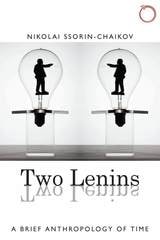
Two Lenins
A Brief Anthropology of TimeNikolai Ssorin-Chaikov
HAU, 2017
Nikolai Ssorin-Chaikov grounds his theoretical exploration in fascinating ethnographic and historical material on two Lenins: the first is the famed Soviet leader of the early twentieth century, and the second is a Siberian Evenki hunter—nicknamed “Lenin”—who experienced the collapse of the USSR during the 1990s. Through their intertwined stories, Ssorin-Chaikov unveils new dimensions of ethnographic reality by multiplying our notions of time.
Ssorin-Chaikov examines Vladimir Lenin at the height of his reign in 1920s Soviet Russia, focusing especially on his relationship with American businessperson Armand Hammer. He casts this scene against the second Lenin—the hunter on the far end of the country, in Siberia, at the far end of the century, the 1990s, who is tasked with improvising postsocialism in the economic and political uncertainties of post-Soviet transition. Moving from Moscow to Siberia to New York, and traveling form the 1920s to the 1960s to the 1990’s, Ssorin-Chaikov takes readers beyond a simple global history or cross-temporal comparison, instead using these two figures to enact an ethnographic study of the very category of time that we use to bridge different historical contexts.
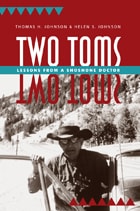
Two Toms
Lessons from a Shoshone DoctorThomas H. Johnson
University of Utah Press, 2011
In 1969, Tom Wesaw was an 83-year-old Shoshone doctor and religious leader on the Wind River Reservation in Wyoming. He could no longer drive, which posed problems in making house calls. The arrival of young anthropologist Tom Johnson changed that. Johnson would drive Wesaw, and cook, pump water, and build fires for sweat lodges. In exchange, the elder Tom would show the younger Tom his work. The two were together so often that the people of Wind River began to refer to them affectionately by one name: Two Toms. By the light of the lamp Wesaw gave him, Johnson would write down what he learned. The Shoshone doctor wanted his student to share everything he saw and heard. Now, in Two Toms: Lessons from a Shoshone Doctor, he has.

Two Vermonts
Geography and Identity, 1865-1910Paul Searls
University of New Hampshire Press, 2006
Two Vermonts establishes a little-known fact about Vermont: that the state's fascination with tourism as a savior for a suffering economy is more than a century old, and that this interest in tourism has always been dogged by controversy. Through this lens, the book is poised to take its place as the standard work on Vermont in the Gilded Age and the Progressive Era. Searls examines the origins of Vermont's contemporary identity and some reasons why that identity ("Who is a Vermonter?") is to this day so hotly contested.
Searls divides nineteenth-century Vermonters into conceptually “uphill,” or rural/parochial, and “downhill,” or urban/cosmopolitan, elements. These two groups, he says, negotiated modernity in distinct and contrary ways. The dissonance between their opposing tactical approaches to progress and change belied the pastoral ideal that contemporary urban Americans had come to associate with the romantic notion of “Vermont.” Downhill Vermonters, espousing a vision of a mutually reinforcing relationship between tradition and progress, unilaterally endeavored to foster the pastoral ideal as a means of stimulating economic development. The hostile uphill resistance to this strategy engendered intense social conflict over issues including education, religion, and prohibition in the late nineteenth and early twentieth centuries. The story of Vermont's vigorous nineteenth-century quest for a unified identity bears witness to the stirring and convoluted forging of today's “Vermont.”
Searls's engaging exploration of this period of Vermont's history advances our understanding of the political, economic, and cultural transformation of all of rural America as industrial capitalism and modernity revolutionized the United States between 1865 and 1910. By the late Progressive Era, Vermont's reputation was rooted in the national yearning to keep society civil, personal, and meaningful in a world growing more informal, bureaucratic, and difficult to navigate. The fundamental ideological differences among Vermont communities are indicative of how elusive and frustrating efforts to balance progress and tradition were in the context of effectively negotiating capitalist transformation in contemporary America.
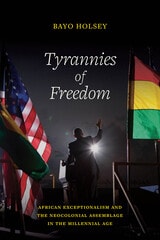
Tyrannies of Freedom
African Exceptionalism and the Neocolonial Assemblage in the Millennial AgeBayo Holsey
University of Chicago Press, 0
Examines the enduring myth of Ghanaian exceptionalism and neoliberal freedom.
What is the legacy of the African Revolution today? Black Studies scholar and anthropologist Bayo Holsey addresses this question by examining the twenty-first-century relationship between the United States and Ghana, a nation that was once associated with a powerful vision of Black freedom. In Tyrannies of Freedom, she demonstrates that the period that saw the expansion of the US counterterror state also witnessed attempts to discredit this vision of freedom and replace it with another—one that centers the agency of US politicians, media pundits, and development experts.
Analyzing international development discourses, the anti-trafficking regime’s representational economy, and the expansion of Ghana’s branding as a homeland of the African diaspora, Holsey interrogates the operation of a millennial neocolonial assemblage that asserts, in various ways, that the United States is the guarantor of Ghanaian freedom while simultaneously implementing policies of surveillance, endangerment, and exploitation. At the same time, Holsey shows how Ghanaians and other Black subjects have contested these projects. Tracking the transformation of the Ghanaian nation from a beacon of Black freedom and Pan-African possibility to a battleground over the meanings of African sovereignty in a post-9/11 world, this important book addresses pressing questions concerning the operation of US power in Africa and the production and legitimation of a racialized global hierarchy.