Results by title
18284 books match the query 'United States' and 3764 start with t
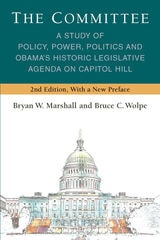
The Committee
A Study of Policy, Power, Politics and Obama’s Historic Legislative Agenda on Capitol HillBryan W. Marshall and Bruce C. Wolpe
University of Michigan Press, 2021
For three years while serving as a senior adviser to Rep. Henry A. Waxman (D-CA), chairman of the House Committee on Energy and Commerce—one of the most powerful committees in Congress—Bruce C. Wolpe kept a diary, a senior staffer’s look at how committees develop and promote legislation. With its insider’s view of the rough-and-tumble politics of cap-and-trade, healthcare reform, tobacco, oversight, and the debt ceiling agreement, The Committee uniquely melds the art of politics and policymaking with the theory and literature of political science. The authors engage with the important questions that political science asks about committee power, partisanship, and the strategies used to build winning policy coalitions both in the Committee and on the floor of the House. In this new edition, the authors revisit the relationship between the executive and Congress in the wake of the sweeping changes wrought by the Trump administration, as well as thoughts about how that relationship will change again as President Biden faces a 117th Congress that is strikingly similar to Obama’s 111th. The insider politics and strategies about moving legislation in Congress, from internal and external coalition building to a chairman’s role in framing policy narratives, will captivate both novice and die-hard readers of politics.
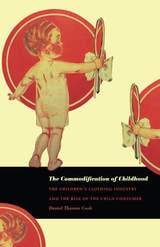
The Commodification of Childhood
The Children’s Clothing Industry and the Rise of the Child ConsumerDaniel Thomas Cook
Duke University Press, 2004
The Commodification of Childhood begins with the publication of the children’s wear industry’s first trade journal, The Infants’ Department, in 1917 and extends into the early 1960s, by which time the changes Cook chronicles were largely complete. Analyzing trade journals and other documentary sources, Cook shows how the industry created a market by developing and promulgating new understandings of the “nature,” needs, and motivations of the child consumer. He discusses various ways that discursive constructions of the consuming child were made material: in the creation of separate children’s clothing departments, in their segmentation and layout by age and gender gradations (such as infant, toddler, boys, girls, tweens, and teens), in merchants’ treatment of children as individuals on the retail floor, and in displays designed to appeal directly to children. Ultimately, The Commodification of Childhood provides a compelling argument that any consideration of “the child” must necessarily take into account how childhood came to be understood through, and structured by, a market idiom.
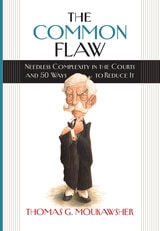
The Common Flaw
Needless Complexity in the Courts and 50 Ways to Reduce ItThomas Moukawsher
Brandeis University Press, 2023
Americans are losing faith in their courts. After long delays, judges often get rid of cases for technical reasons, or force litigants to settle rather than issue a decision. When they do decide cases, we can't understand why.
The Common Flaw seeks to rid the American lawsuit of this needless complexity. The book proposes fifty changes from the filing of a complaint in court to the drafting of appellate decisions to replace the legal system’s formalism with a kind of humanism. Thomas G. Moukawsher calls for courts that decide cases promptly based more on the facts than the law, that prioritize the parties involved over lawyers, that consider the consequences for the people and the public, and that use words we can all understand. Sure to spark an important conversation about court reform, The Common Flaw makes the case for a more effective and credible legal system with warmth and humor, incorporating cartoons alongside insightful reflection.

The Common Ground of Womanhood
Class, Gender, and Working Girls' Clubs, 1884-1928Priscilla Murolo
University of Illinois Press, 1997
Working girls' clubs were a flash-point for class antagonisms yet also provided fertile ground for surprising cross-class alliances. Priscilla Murolo's nuanced study charts the shifting points of conflict and consensus between working women and their genteel club sponsors; working women and their male counterparts; and among working women of differing ethnic backgrounds.
The working girls' club movement lasted from the 1880s, when women poured into the industrial labor force, to the 1920s. Upper-class women initially governed the clubs, and activities converged around standards of "respectability" and the defense and uplift of the character of women who worked for wages. Later, the workers themselves presided over the leadership and shifted the clubs' focus to issues of labor reform, women's rights, and sisterhood across class lines.
A valuable and lucid study of the club movement, The Common Ground of Womanhood throws new light on broader trends in the history of women's alliances, social reform, gender conventions, and worker organizing.
The Common Place of Law
Stories from Everyday LifePatricia Ewick and Susan S. Silbey
University of Chicago Press, 1998
One narrative is based on an idea of the law as magisterial and remote. Another views the law as a game with rules that can be manipulated to one's advantage. A third narrative describes the law as an arbitrary power that is actively resisted. Drawing on these extensive case studies, Ewick and Silbey present individual experiences interwoven with an analysis that charts a coherent and compelling theory of legality. A groundbreaking study of law and narrative, The Common Place of Law depicts the institution as it is lived: strange and familiar, imperfect and ordinary, and at the center of daily life.
The Communal Experience
Anarchist and Mystical Communities in Twentieth Century AmericaLaurence R. Veysey
University of Chicago Press, 1978
Veysey compares the history of secular communities such as the early Ferrer Colony and Modern School, of Shelton, New Jersey, with contemporary anarchist communities in New York, Vermont, and New Mexico. Religious communes—"Communities of Discipline"—such as the Vedanta monasteries of the early twentieth century are compared with contemporary mystical communities in New Mexico. Distinctions between the anarchist and the mystical groups are most obvious from their approach to communal life. As Veysey shows, anarchist communities are loose, unstructured, voluntaristic; the mystics establish more rigid life-styles, focus on spiritual leaders, and hold community a secondary goal to self-realization. In a new preface written for this Phoenix Edition, he describes his return to a New Mexican mystical community and the changes that have occurred in the six years since his last visit.
The Communist Party in Maryland, 1919-57
Vernon L. Pedersen
University of Illinois Press, 2001
Bolsheviks in Baltimore charts the uneven transformation of Baltimore's fledgling Communists into underground revolutionaries in the 1920s. Pedersen documents the mercurial careers of local organizers, their devotion to the Soviet cause, and their efforts to convert the Party from a hodgepodge of ethnic groups to an effective instrument of class interests. He also tracks the public's changing perception of the Communists, from amused unconcern to alarm, and details how the Ober antisubversive law and the HUAC hearings of the 1950s dismantled the Party from without while planting seeds of paranoia that destroyed it from within.
Behind the public fear of a Communist conspiracy against the U.S. government, Pedersen finds a party fractured by conflicting agendas, ineffectual leadership, and unstable membership. However, he also uncovers new evidence that Communists in the United States, acting on Soviet orders, used their influence in unions and front groups to sway American foreign policy in ways that benefited the Soviet Union. He documents the consolidation of an espionage apparatus in Baltimore and demonstrates that while espionage activities may have involved only a few individuals, all Party members shared an attitude of willing support for the activities of the Soviet Union that made these covert practices possible.
Paying tribute to the fervor and the effort dedicated by the Maryland Communists, often at the expense of their own physical and financial well-being, to a cause that ultimately failed them, Bolsheviks in Baltimore assesses an ambiguous legacy of admirable social vision, haphazard international conspiracy, and fierce internal conflict.
The Communist Party of the United States
From the Depression to World War IIOttanelli, Fraser
Rutgers University Press, 1991
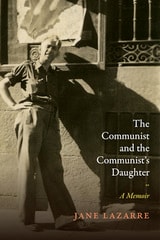
The Communist and the Communist's Daughter
A MemoirJane Lazarre
Duke University Press, 2017
Soon after immigrating to the United States as a young man, Lazarre began a long career as a radical activist, being convicted of sedition, holding leadership positions in the American Communist Party, fighting in the Spanish Civil War, organizing labor unions, testifying in front of the House Un-American Activities Committee, and resisting the FBI’s efforts to recruit him as an informant. Through periods of heroism and deep despair Lazarre never abandoned his ideals or his sustained faith in the fundamental goodness of people.
This is also the story of Jane as she grew up, married an African American civil rights activist, and became a mother and a writer while coming to terms with her father’s legacy. She recounts her arguments with her father over ideology, but also his profound influence on her life. Throughout this poignant and beautifully written work, Jane examines memory, grief, love, and conscience while detailing the sacrifices, humanity, and unwavering convictions of a man who worked tirelessly to create a brighter future for us all.
The Community College Writer
Exceeding ExpectationsHoward Tinberg and Jean-Paul Nadeau
Southern Illinois University Press, 2010
While there have been several studies of writing programs at larger, baccalaureate institutions, the community college classroom has often been overlooked. Authors Howard Tinberg and Jean-Paul Nadeau fill this gap with The Community College Writer, a systematic and unique case study of first semester writing students at a community college. Drawing on surveys, interviews, and samples of classroom assignments, Tinberg and Nadeau use their research at one community college to reach out to instructors throughout the nation, fostering communication between community college faculty members in the effort to establish full-fledged writing programs geared toward student success.
At the heart of the book are the voices of the students themselves, as they discuss both their teachers’ expectations and their own. Through a series of case studies, the authors reveal the challenges students face as budding writers, and their firsthand experiences with writing programs at the community college level.
With this informative study, Tinberg and Nadeau seek not only to encourage dialogue between student and teacher or community college instructors, but to expand the conversation about program improvement to include both two- and four-year colleges, bringing composition faculty together in an effort to improve writing programs in all schools. Included in the volume are seven appendices, including surveys and interviews with faculty and students, making The Community College Writer a comprehensive and practical guide to tackling the issues facing writing programs and instructors.
The Community Economic Development Movement
Law, Business, and the New Social PolicyWilliam H. Simon
Duke University Press, 2001
In this book William H. Simon provides the first comprehensive examination of the evolution of Community Economic Development, complete with an analysis of its operating premises and strategies. He describes the profusion of new institutional forms that have arisen from the movement, amalgamations that cut across conventional distinctions—such as those between private and public—and that encompass the efforts of nonprofits, cooperatives, churches, business corporations, and public agencies. Combining local political mobilization with entrepreneurial initiative and electoral accountability with market competition, this phenomenon has catalyzed new forms of property rights designed to motivate investment and civic participation while curbing the dangers of speculation and middle-class flight.
With its examination of many localities and its appraisal of the strengths and weaknesses of the prevailing approach to Community Economic Development, this book will be a valuable resource for local housing, job, and business development officials; community activists; and students of law, business, and social policy.
The Community in Rural America
Kenneth P. Wilkinson
University Press of Colorado, 2022

The Community of Nuchi Du Takara ("Life Is the Ultimate Treasure") in Postwar Okinawa
Local Subjectivity within and against EmpireMasamichi (Marro) Inoue
University of Michigan Press, 2025
The Compassionate Court?
Support, Surveillance, and Survival in Prostitution Diversion ProgramsCorey S. Shdaimah, Chrysanthi S. Leon, and Shelly A. Wiechelt
Temple University Press, 2023
The authors of The Compassionate Court? provide case studies of such programs and draw upon interviews and observations conducted over a decade to reveal how participants and professionals perceive court-affiliated PDPs, clients, and staff. Considering the motivations, vision, and goals of these programs as well as their limitations—the inequity and disempowerment of their participants—the authors also present their own changing perspectives on prostitution courts, diversion programs, and criminalization of sex work.
The Compensations of War
The Diary of an Ambulance Driver during the Great WarBy Guy Emerson Bowerman
University of Texas Press, 1983
In 1917, shortly after the United States’ declaration of war on Germany, Guy Emerson Bowerman, Jr., enlisted in the American army’s ambulance service. Like other young ambulance drivers—Hemingway, Dos Passos, Cummings, Cowley—Bowerman longed to “see the show.” He was glad to learn that the ambulance units were leaving for France right away.
For seventeen months, until the armistice of November 1918, Bowerman kept an almost daily diary of the war. To read his words today is to live the war with an immediacy and vividness of detail that is astonishing.
Only twenty when he enlisted, Bowerman was an idealistic, if snobbish, young man who exulted that his section was made up mostly of young “Yalies” like himself. But he expected the war to change him, and it did. In the end he writes that he and his compatriots scarcely remember a world at peace. "The old life was gone forever. . ."
Guy Bowerman’s unit was attached to a French infantry division stationed near Verdun. Sent to halt the German drive to Paris in 1918, the division participated in the decisive counterattack of July and tracked the routed Germans through Belgium. Then, “unwarned,” Bowerman and his comrades were “plunged into … a life of peace.” Into this life, he writes, they walked “bewildered,” like “men fearing ambush.”
This remarkable chronicle of one young man’s rite of passage is destined to become a classic in the literature of the Great War.
The Complete Anti-Federalist
Edited by Herbert J. Storing
University of Chicago Press, 2007
The Complete Anti-Federalist, first published in 1981, contains an unprecedented collection of all the significant pamphlets, newspaper articles and letters, essays, and speeches that were written in opposition to the Constitution during the ratification debate. Storing’s work includes introductions to each entry, along with his own consideration of the Anti-Federalist thought.
This new three-volume set includes all the contents of the original seven-volume publication in a convenient, manageable format.
“A work of magnificent scholarship. Publication of these volumes is a civic event of enduring importance.”—Leonard W. Levy, New York Times Book Review

The Complete Cardinal Guide to Planning for and Living in Retirement
Hans "John" Scheil
Tupelo Press, 2016

The Complete Civil War Journal and Selected Letters of Thomas Wentworth Higginson
Thomas Wentworth Higginson
University of Chicago Press, 1999
So wrote Thomas Wentworth Higginson about his role in one of the most compelling and fascinating episodes in the history of the United States. As the colonel of the first regiment of black men in the Union army during the Civil War, Higginson was an early, articulate, and powerful crusader for civil rights, and his journal and letters, collected for the first time in this volume, present some of the most extraordinary documents of the Civil War.
Higginson was a politically engaged intellectual at the forefront of radical antislavery, labor, and feminist causes. Born in 1823 to a formerly wealthy but still prominent Brahmin family, he became one of America's leading social activists and a prominent writer, minister, and reformer. With the publication in 1869 of his classic Army Life in a Black Regiment, which drew on this journal, Higginson became one of the most important chroniclers of the Civil War. The Complete Civil War Journal and Selected Letters of Thomas Wentworth Higginson is the first comprehensive edition of his journal. Sensitively and thoroughly annotated by Christopher Looby and supplemented by a large selection of Higginson's wartime letters, this volume offers the most vivid and intimate picture of the radical interracial solidarity brought about by the transformative experience of the army camp and of Civil War life.
"The immediacy of Higginson's reflections, as well as their sharp insights, make this journal both distinctive and enduringly compelling . . . . Higginson's vivid texts can once again educate, gratify and delight readers."—Publishers Weekly
"This volume will enrich our understanding of the transformations that emancipation and war wrought."—Library Journal
The Complete Ezra Taft Benson FBI File
Signature Books
Signature Books, 2020
Shortly after Benson’s nomination as agricultural secretary, the FBI began keeping a routine file on him, as they did other prominent Americans slated for Eisenhower’s cabinet. Filled with letters, memoranda, newspaper clippings, speeches, published writings, and other items, the file spans Benson’s eight-year tenure with the administration and well beyond. Some of the documents date past the Eisenhower era and even into Benson’s years as president of the LDS Church (1985–94). The material not only deals with Benson’s life and political views, but his association with the John Birch Society, its leaders, and even threats made against his life in the late 1980s. The 570-page dossier is as much a revelation about the workings of the FBI as about the man they were investigating.

The Complete Guide to Institutional Repositories
Stephen Craig Finlay
American Library Association, 2021
The Institutional Repository (IR) has become standard to the academic library in the past decade. In fact, some 5,000 are listed in open access directories. However, IR operations are anything but standard. You are not alone in your challenges, whether it’s discovery of born-digital content or policies for deposit and withdrawal. This resource gathers expertise to offer a comprehensive guide on contemporary institutional repository management. Readers will sharpen their understanding of such key IR topics as
- managing complexity task-by-task using a detailed breakdown of IR projects;
- six crucial elements every deposit policy should address;
- using the SHERPA RoMEO database to quickly locate publisher policies;
- policy development, community outreach, and open source software testing, illuminated through case studies;
- metadata basics for the non-cataloger;
- authority control for electronic theses, dissertations, and grey literature;
- workflow suggestions for small and mid-sized institutions;
- showcasing undergraduates’ work with student peer-reviewed journals, photography, or theater performances;
- promoting faculty engagement with awards and recognition; and
- copyright fundamentals all staff who interact with the IR should know.

The Complete Guide to Personal Digital Archiving
Brianna H. Marshall
American Library Association, 2017
The Complete Library Trustee Handbook
Jillian Kalonick
American Library Association, 2010
The Complete Lincoln-Douglas Debates of 1858
Abraham Lincoln and Stephen A. Douglas
University of Chicago Press, 1991
Zarefsky analyzes the rhetoric of the speeches, showing how Lincoln and Douglas chose their arguments and initiated a debate that shook the nation. Their eloquent, statesmanlike discussion of the morality of slavery illustrates the masterful use of rhetorical strategies and tactics in the public forum: a form of discourse that has nearly disappeared from the political scene today.
The Complete Writings and Selected Correspondence of John Dickinson
Volume 1Jane E. Calvert
University of Delaware Press, 2011
The Complete Writings and Selected Correspondence of John Dickinson
Volume 2Jane E. Calvert
University of Delaware Press, 2021
Dickinson’s hard work on behalf of his clients brought him success in other areas of his public life. In October 1759, he was elected to his first public position as a representative for Kent County, Del., the following year he was elevated to the position of speaker, and in 1762, he became a representative for Philadelphia County, Pa. As a legislator in two colonies, learning his craft as a global war unfolded, he contributed to bills on military and defense, Indian relations, infrastructure improvements and city management, and served on various committees. The death of George II occasioned debates over laws and judges, in which Dickinson participated. This era concludes with Dickinson playing a central role in managing the unfolding Paxton Riots, in which frontiersmen massacred peaceful Indians and threatened the Quaker leadership of Pennsylvania.
In private, Dickinson lost the two most prominent male figures in his life in 1760, his father, Samuel, and soon thereafter, his mentor, colleague, and friend, John Moland. In honor of Moland, Dickinson published a poem and became a proxy head to Moland’s large family. Though his extant correspondence during this period is small, he exchanged letters with Mary Cadwalader Dickinson, Israel Pemberton, William Allason, George Read, Thomas McKean, and others. Perhaps most significant, he wrote a lengthy, unpublished essay on the flag-of-truce trade and also maintained commonplace books as he considered his place within the British Empire, opening up the next phase in Dickinson’s life as a leader of the resistance against Britain.
Published by the University of Delaware Press. Distributed worldwide by Rutgers University Press.
The Complete Writings and Selected Correspondence of John Dickinson
Volume 3Jane E. Calvert
University of Delaware Press, 2024
The Complete Writings and Selected Correspondence of John Dickinson
Volume 4, 1767-1769John Dickinson
University of Delaware Press, 0
The Concept of Liberty in the Age of the American Revolution
John Phillip Reid
University of Chicago Press, 1988
As John Philip Reid goes on to make clear, "liberty" did not mean to the eighteenth-century mind what it means today. In the twentieth century, we take for granted certain rights—such as freedom of speech and freedom of the press—with which the state is forbidden to interfere. To the revolutionary generation, liberty was preserved by curbing its excesses. The concept of liberty taught not what the individual was free to do but what the rule of law permitted. Ultimately, liberty was law—the rule of law and the legalism of custom. The British constitution was the charter of liberty because it provided for the rule of law.
Drawing on an impressive command of the original materials, Reid traces the eighteenth-century notion of liberty to its source in the English common law. He goes on to show how previously problematic arguments involving the related concepts of licentiousness, slavery, arbitrary power, and property can also be fit into the common-law tradition. Throughout, he focuses on what liberty meant to the people who commented on and attempted to influence public affairs on both sides of the Atlantic. He shows the depth of pride in liberty—English liberty—that pervaded the age, and he also shows the extent—unmatched in any other era or among any other people—to which liberty both guided and motivated political and constitutional action.
The Concept of Representation in the Age of the American Revolution
John Phillip Reid
University of Chicago Press, 1989
John Phillip Reid goes on to argue that it was generally the application, not the definition, of these rights that was disputed. The sole—and critical—exception concerned the right of representation. American perceptions of the responsibility of representatives to their constituents, the necessity of equal representation, and the constitutional function of consent had diverged gradually, but significantly, from British tradition. Drawing on his mastery of eighteenth-century legal thought, Reid explores the origins and shifting meanings of representation, consent, arbitrary rule, and constitution. He demonstrates that the controversy which led to the American Revolution had more to do with jurisprudential and constitutional principles than with democracy and equality. This book will interest legal historians, Constitutional scholars, and political theorists.
The Concise History of Woman Suffrage
Selections from History of Woman Suffrage, by Elizabeth Cady Stanton, Susan B. Anthony, Matilda Joslyn Gage, and the National American Woman Suffrage AssociationEdited and with an Introduction by Mari Jo Buhle and Paul Buhle
University of Illinois Press, 2005
In their Concise History of Woman Suffrage, Mari Jo Buhle and Paul Buhle have revitalized this classic text by carefully selecting from among its best material. The eighty-two chosen documents, now including interpretative introductory material by the editors, give researchers easy access to material that the original work's arrangement often caused readers to ignore or to overlook.
The volume contains the work of many reform agitators, among them Angelina Grimké, Lucy Stone, Carrie Chapman Catt, Charlotte Perkins Gilman, Anna Howard Shaw, Jane Addams, Sojourner Truth, and Victoria Woodhull, as well as Elizabeth Cady Stanton, Susan B. Anthony, Matilda Joslyn Gage, and Ida Husted Harper.
The Conditions of Discretion
Joel Handler
Russell Sage Foundation, 1986
The Confederacy
Charles P. Roland
University of Chicago Press, 1962
In The Confederacy Charles P. Roland is faithful to both the larger career and the internal complexity. Paying careful attention to President Davis' struggle against dividing forces within, the author skillfully narrates the attempt of the Confederacy to wage total war against superior forces. All the poignant events and conditions are here: the formation of the government, the upper South's final commitment to the cause, the doomed attempts to combat the Northern blockade at home and Northern diplomacy overseas, an agrarian economy's heroic defiance of an industrial enemy, the desperate measures by which the Davis government tried to sustain the Confederacy, and, at last, the dissolution and flight of the administration in 1865.
With accuracy, sensitivity, and balance, Mr. Roland develops the epic themes of his story against a background of vivid historical detail and re-creates the Confederacy with a tragic splendor—the prime quality of its surviving image among Southerners.
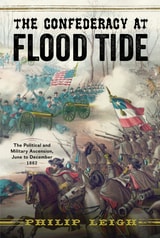
The Confederacy at Flood Tide
The Political and Military Ascension, June to December 1862Philip Leigh
Westholme Publishing, 2016
The first six months of 1862 provided a string of Federal victories in the West at Mill Springs, Fort Donelson, Pea Ridge, Island Number 10, and Shiloh. In May, New Orleans fell, and Union General George McClellan’s army was so close to the Confederate capital of Richmond, Virginia, that the troops could set their watches by the city’s church bells. But then the unexpected happened. In June, Robert E. Lee’s Army of Northern Virginia pushed McClellan’s much larger army back to the James River. In Europe, Confederate diplomats sought international recognition for the Confederate States of America, which was made even more attractive now that a shortage of cotton made the powerful textile interests anxious to end the war. Further tipping the balance, in July, the Confederacy secretly ordered two of the latest ironclad ships from England’s famous Laird Shipyard—the same yard that built the commerce raider Alabama. These steam-powered ironclads would be far superior to anything in the Federal navy.
While the “high tide” of the Confederacy is often identifed as Pickett’s Charge during the Battle of Gettysburg in July 1863, the most opportune time for the Confederacy vanished seven months earlier, coinciding with President Abraham Lincoln’s Emancipation Proclamation on January 1, 1863 and the failure of the secessionist states to be recognized as a sovereign nation. As Philip Leigh explains in his engrossing new book, The Confederacy at Flood Tide: The Political and Military Ascension, June to December 1862, on every battlefront and in the governmental halls of Europe, the Confederate effort reached its furthest extent during the second half of 1862. But with the president’s proclamation, battlefield reverses, Europe's decision to reject Confederate diplomatic overtures, and Britian's decision to halt the sale of the ironclads, the opportunity for Confederate success ended. The Confederacy would recede, and the great battles of 1863 and 1864 only marked the Southerners’ tenacity and stubborn belief in a lost cause.
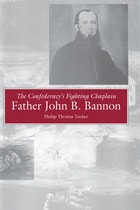
The Confederacy's Fighting Chaplain
Father John B. BannonPhillip Thomas Tucker
University of Alabama Press, 1992
The Confederacy’s Fighting Chaplain is the remarkable story of the Irishman who brought the Bible and his own resourcefulness and daring to both the battlefield and the diplomatic field—a story that has been largely ignored for more than 130 years. The biography of John B. Bannon also chronicles the forgotten Southerners—the Irish immigrants of the Confederacy—whose colorful and crucial role in the Civil War has been seriously neglected.
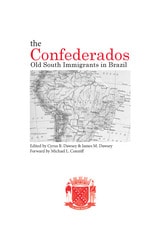
The Confederados
Old South Immigrants in BrazilCyrus B. Dawsey
University of Alabama Press, 1998
The story of exiles from the Confederate South who fled to Brazil after the US Civil War. The collection includes a previously unpublished narrative by an original settler
In the wake of the American Civil War, thousands of disillusioned Southerners sought refuge far from Reconstruction’s reach—many found it in Brazil. The Confederados is a compelling exploration of this little-known migration, tracing the journey of Confederate exiles who forged new lives in the sugarcane fields of São Paulo. Through vivid personal narratives, scholarly essays, and rare archival insights, this volume uncovers the cultural, agricultural, and religious legacy these settlers left behind.
From the harrowing voyage of Sarah Bellona Smith Ferguson to the enduring traditions of the Campo chapel, the book reveals how these Americans shaped—and were shaped by—their Brazilian surroundings. It examines their impact on education, Protestantism, and farming, and how their descendants maintain a distinct identity more than a century later.
Richly illustrated and deeply researched, The Confederados is essential reading for anyone interested in Southern history, diaspora studies, or the global echoes of the Civil War. This is not just a story of exile—it’s a testament to resilience, adaptation, and the enduring ties between two nations.
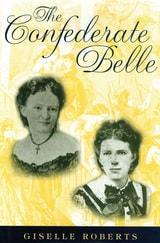
The Confederate Belle
Giselle Roberts
University of Missouri Press, 2003
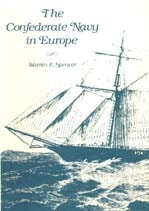
The Confederate Navy in Europe
Warren F. Spencer
University of Alabama Press, 1983
“A major contribution to Civil War and naval history.” —Journal of Southern History
The Civil War was fought not only on American battlefields but also in the shipyards, diplomatic salons, and ports of Europe. In this sweeping history of the Confederate navy’s operations overseas, Warren Spencer traces the South’s ambitious efforts to build, equip, and deploy a naval force across the Atlantic. Drawing on extensive archival research in the United States, Great Britain, and France, the book reveals how Confederate agents, diplomats, and naval officers pursued international support while attempting to challenge Union power on the seas.
More than a military narrative, this study offers a richly detailed examination of the intersection of naval warfare, diplomacy, and international politics. The author synthesizes scattered research and original documentary evidence to provide a comprehensive account of Confederate naval activity in Europe, illuminating the roles of shipbuilders, foreign governments, intelligence networks, and naval leaders. By engaging both published sources and archival records, the book presents fresh interpretations of controversial episodes and demonstrates how events far from American shores shaped the course of the Civil War.
This volume will appeal to readers of Civil War history, naval history, diplomatic history, and international relations. Scholars, students, and history enthusiasts alike will appreciate its careful research, engaging narrative, and global perspective on a conflict too often viewed solely through a domestic lens. Anyone interested in the maritime dimensions of the Civil War or the Confederacy’s quest for recognition abroad will find this book both enlightening and compelling.
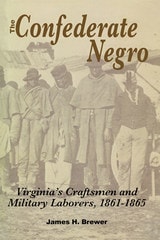
The Confederate Negro
Virginia's Craftsmen and Military Laborers, 1861-1865James H. Brewer
University of Alabama Press, 2007
A superb work in the social history of American industry
A Gettysburg College "Top 200 Civil War Books" selection
Mayflower Award Winner for 1970
The Congressional Black Caucus, Minority Voting Rights, and the U.S. Supreme Court
Christina R. Rivers
University of Michigan Press, 2014
Both the U.S. Supreme Court and the Congressional Black Caucus (CBC) claim to advocate minority political interests, yet they disagree over the intent and scope of the Voting Rights Act (VRA), as well as the interpretation of the equal protection clause of the 14th Amendment. Whereas the Court promotes color-blind policies, the CBC advocates race-based remedies. Setting this debate in the context of the history of black political thought, Rivers examines a series of high-profile districting cases, from Rodgers v. Lodge (1982) through NAMUDNO v. Holder (2009). She evaluates the competing approaches to racial equality and concludes, surprisingly, that an originalist, race-conscious interpretation of the 14th Amendment, along with a revised states' rights position regarding electoral districting, may better serve minority political interests.
The Congressional Endgame
Interchamber Bargaining and CompromiseJosh M. Ryan
University of Chicago Press, 2018
With The Congressional Endgame, Josh M. Ryan offers a coherent explanation of how the bicameral legislative process works in Congress and shows that the types of policy outcomes it produces are in line with those intended by the framers of the Constitution. Although each bargaining outcome may seem idiosyncratic, the product of strong leadership and personality politics, interchamber bargaining outcomes in Congress are actually structured by observable institutional factors. Ryan finds that the characteristics of the winning coalition are critically important to which chamber “wins” after bargaining, with both conference committees and an alternative resolution venue, amendment trading, creating policy that approximates the preferences of the more moderate chamber. Although slow and incremental, interchamber negotiations serve their intended purpose well, The Congressional Endgame shows; they increase the odds of compromise while at the same time offering a powerful constraint on dramatic policy changes.

The Conquest of Cool
Business Culture, Counterculture, and the Rise of Hip ConsumerismThomas Frank
University of Chicago Press, 1997
"[Thomas Frank is] perhaps the most provocative young cultural critic of the moment."—Gerald Marzorati, New York Times Book Review
"An indispensable survival guide for any modern consumer."—Publishers Weekly, starred review
"Frank makes an ironclad case not only that the advertising industry cunningly turned the countercultural rhetoric of revolution into a rallying cry to buy more stuff, but that the process itself actually predated any actual counterculture to exploit."—Geoff Pevere, Toronto Globe and Mail
"The Conquest of Cool helps us understand why, throughout the last third of the twentieth century, Americans have increasingly confused gentility with conformity, irony with protest, and an extended middle finger with a populist manifesto. . . . His voice is an exciting addition to the soporific public discourse of the late twentieth century."—T. J. Jackson Lears, In These Times
"An invaluable argument for anyone who has ever scoffed at hand-me-down counterculture from the '60s. A spirited and exhaustive analysis of the era's advertising."—Brad Wieners, Wired Magazine
"Tom Frank is . . . not only old-fashioned, he's anti-fashion, with a place in his heart for that ultimate social faux pas, leftist politics."—Roger Trilling, Details
The Conquest of The Illinois
George Rogers Clark. Foreword by Rand Burnette
Southern Illinois University Press, 2001
Written only a decade after George Rogers Clark’s conquest of Illinois, this firsthand account shows the region as it existed in the 1770s, explains how British occupation affected Kentucky settlers, and exhibits Clark’s enormous diplomatic skills in convincing the French settlers and Indians along the rivers of Illinois that they were better off under the jurisdiction of the Americans rather than the British. In his new foreword to this book, Rand Burnette refers to Clark as a psychologist and an expert in human relations.
Believing the British responsible for Indian raids on the people of Kentucky, Clark determined to capture that area, which was claimed by his home state of Virginia. “His plan, which he presented to Governor Patrick Henry,” Burnette notes, “was to take possession of the Illinois country by defeating the British at Kaskaskia, win the support of the French in that area, and thus control both the Mississippi and the Ohio Rivers. The British support of the Indians, who raided the Kentucky settlements from the Illinois country, would be at an end.”
Clark’s stirring narrative—written between 1789 and 1791 and covering 1773–1779—chronicles the events in the Old Northwest in the second half of the eighteenth century. Life on the frontier was dangerous and uncertain at this time. As Clark points out and Milo Milton Quaife underlines in his footnotes, death came to many at the hands of Indians or in military battles and skirmishes.
First published in 1920 and long out of print, the Quaife edition of Clark’s The Conquest of The Illinois reprinted here is for the modern reader superior to the original. First, Quaife provided an index. Equally important for modern readers, he standardized Clark’s spelling. (Clark had little formal education, and his spelling was even more eccentric than that found in a typical eighteenth-century account.) Finally, Quaife’s footnotes often include biographical sketches of the people in the book.
The Conscience of a Lawyer
Clifford J. Durr and American Civil Liberties, 1899–1975John A. Salmond
University of Alabama Press, 1990
A powerful portrait of principle and protest in the life of a Southern lawyer who stood for civil liberties.
Clifford Judkins Durr was an Alabama lawyer who played an important role in defending activists and other accused of disloyalty during the New Deal and McCarthy eras. His uncompromising commitment to civil liberties and civic decency caused him to often take unpopular positions.
In 1933, Durr moved to Washington to work as a lawyer for the Reconstruction Finance Corporation, a creation of Roosevelt’s new Democratic administration, becoming a dedicated New Dealer in the process. He was then appointed by President Franklin D. Roosevelt to the Federal Communications Commission (FCC), a politically sensitive position as FDR sought to counter the increasing power and concentration of broadcasters, many of whom were opponents of the New Deal. Durr resigned from the FCC in 1948 and after brief employment with the National Farmers Union in Colorado, the Durrs eventually returned to Montgomery, Alabama in the hope of returning to a more prosperous, less controversial life.
Durr continued to practice in Montgomery as counsel for black citizens whose rights had been violated and ultimately, in December, 1955, when police arrested Rosa Parks for refusing to give her bus seat to a white man he stepped in and lent his extensive legal prowess to her case and the continuing quest for civil rights. Closing his firm in 1964 Durr began to lecture in the United States and abroad. He died at his grandfather's farm in 1975.
The Conscience of the Court
Selected Opinions of Justice William J. Brennan Jr. on Freedom and EqualityEdited by Stephen L. Sepinuck and Mary Pat Treuthart
Southern Illinois University Press, 1999
The Conscience of the Court celebrates the work of Justice William J. Brennan Jr., who served on the United States Supreme Court for thirty-four years (1956–1990).
Stephen L. Sepinuck and Mary Pat Treuthart introduce and present selected judicial opinions written by Justice Brennan on issues involving personal freedom, civil liberties, and equality. Brennan is ranked by many as the best writer ever to have served on the Supreme Court, and his written opinions depict real people, often in desperate, emotional situations. Remarkable for their clarity of analysis, for their eloquence, and for their forcefulness and persuasiveness, his opinions demonstrate that judicial thought need not be a proprietary enclave of lawyers or the intellectual elite.
The extended excerpts selected by Sepinuck and Treuthart highlight Brennan's approach to judicial decision making. Concerned always with how each decision would actually affect people's lives, Brennan possessed a rare quality of empathy. In Brennan, the editors note, "people and groups who lacked influence in society—Communists and flag burners, children and foreigners, criminal defendants and racial minorities"—found a champion they could count on "to listen to their causes and judge them unmoved by the passions of the politically powerful."
In their introduction to each opinion, the editors provide background facts, discuss how the excerpted opinion transformed the law or otherwise fit into the realm of constitutional jurisprudence, and delve into Justice Brennan's judicial philosophy, his method of constitutional interpretation, and the language he used.
The Conscience of the University, and Other Essays
By Harry Huntt Ransom
University of Texas Press, 1982
In 1982, a century after the laying of the cornerstone of its first building, the University of Texas was ranked by the New York Times among the best in the nation. No one had more to do with that extraordinary achievement than Harry Huntt Ransom. From 1935 to his death in 1976, he served the University in positions ranging from instructor in English to chancellor of The University of Texas System. In the fifties, sixties, and seventies, he held a succession of administrative posts requiring him to face a myriad of perplexing problems. Among the critical issues calling for analysis and decision in those years were the post-Sputnik pressure for greater emphasis on science and technology, the student revolts during the 1960s, and the defection of growing numbers of university faculty to industry and government.
Harry Huntt Ransom did not merely respond to the problems of the times. He had his own large ambitions for the University of Texas, in particular the improvement of student programs, the development of a vigorous faculty, and—the achievement for which he is best remembered—the building of a world-renowned library.
He was concerned with the role of the university in society, what the university should do and do well, and what it should not do. Always he viewed these matters in broad perspective, and his approach to them was far-sighted and deeply philosophical.
As dean, vice-president, president, and chancellor, Ransom wrote and spoke often on these and other important subjects. Aside from the books that he wrote and edited, he left a prodigious amount of material, some of which had been published in various journals and some of which had been delivered as lectures and addresses and never made available in printed form.
For the last twenty-five years of Ransom's life his wife, Hazel, was his closest companion and confidant. At the urging of Harry's friends, colleagues, and admirers, she undertook the task of sifting through her late husband's papers in an effort to organize and preserve some of the important contributions he had made to the thought and planning that were so instrumental in shaping the University of Texas and higher education in general. In these essays we see the force of reasoning and grace of style for which Ransom was so widely admired. It was he who reminded us that books last longer than buildings. This is a book of lasting importance that Harry Ransom himself might have given us had he lived longer.
The Consciousness of the Litigator
Duffy Graham
University of Michigan Press, 2005
---Kimberly Kirkland, Franklin Pierce Law Center
The Consciousness of the Litigator investigates the role of the lawyer in modern American political and social life and in the judicial process, and plumbs lawyers' perceptions of themselves, their work, and, especially, their sense of right and wrong.
In so doing, the book sheds light on the unique and little-examined subject of the moral mind of the litigator, whose work extends to all corners of society and whose primary expertise---making legal arguments---is the fundamental skill of all lawyers.
The Consciousness of the Litigator stands with Michael Kelly's Lives of Lawyers as a must-read for the many law students, scholars, and practicing litigators who struggle to balance ethical questions with the dictates of their highly commercialized profession.
The Conservative Case for Class Actions
Brian T. Fitzpatrick
University of Chicago Press, 2019
Conservatives have opposed class actions in recent years, but Fitzpatrick argues that they should see such litigation not as a danger to the economy, but as a form of private enforcement of the law. He starts from the premise that all of us, conservatives and libertarians included, believe that markets need at least some rules to thrive, from laws that enforce contracts to laws that prevent companies from committing fraud. He also reminds us that conservatives consider the private sector to be superior to the government in most areas. And the relatively little-discussed intersection of those two beliefs is where the benefits of class action lawsuits become clear: when corporations commit misdeeds, class action lawsuits enlist the private sector to intervene, resulting in a smaller role for the government, lower taxes, and, ultimately, more effective solutions.
Offering a novel argument that will surprise partisans on all sides, The Conservative Case for Class Actions is sure to breathe new life into this long-running debate.

The Conservative Frontier
Texas and the Origins of the New RightJeff Roche
University of Texas Press, 2025
2026 Al Lowman Memorial Prize, Texas State Historical Association (TSHA)
2026 Bonney MacDonald Outstanding Book Award Winner, Center for the Study of the American West at West Texas A&M University (CSAW)
How West Texas business and culture molded the rise of conservatism in the United States.
Much of what we understand as modern American political conservatism was born in West Texas, where today it predominates. How did the people of such a vast region—larger than New England and encompassing big cities like Lubbock and Amarillo, as well as tiny towns from Anson to Dalhart—develop such a uniform political culture? And why and how did it go national?
Jeff Roche finds answers in the history of what he calls cowboy conservatism. Political power players matter in this story, but so do football coaches, newspaper editors, and a breakfast cereal tycoon who founded a capitalist utopia. The Conservative Frontier follows these and other figures as they promoted an ideology grounded in the entrepreneurial and proto-libertarian attitudes of nineteenth-century Texas ranchers, including a fierce devotion to both individualism and small-town notions of community responsibility. This political sensibility was in turn popularized by its association with the mythology and iconography of the cowboy as imagined in twentieth-century mass media. By the 1970s and the rise of Ronald Reagan, Roche shows, it was clear that the cowboy conservatism of West Texas had set the stage for the emergence of the New Right—the more professionalized and tech-savvy operation that dominated national conservative politics for the next quarter century.
The Conservative Resurgence and the Press
The Media's Role in the Rise of the RightJames Brian McPherson
Northwestern University Press, 2008
Consumers of American media find themselves in a news world that has shifted toward more conservative reporting. This book takes a measured, historical view of the shift, addressing factors that include the greater skill with which conservatives have used the media, the media’s gradual trend toward conservatism, the role of religion, and the effects of media conglomeration. The book makes the case that the media have managed to not only enable today’s conservative resurgence but also ignore, largely, the consequences of that change for the American people.
The Conspiracy Trial of the Chicago Seven
John Schultz
University of Chicago Press, 2009
In 1969, the Chicago Seven were charged with intent to "incite, organize, promote, and encourage" antiwar riots during the chaotic 1968 Democratic National Convention in Chicago. The defendants included major figures of the antiwar and racial justice movements: Abbie Hoffman and Jerry Rubin, the madcap founders of the Yippies; Tom Hayden and Rennie Davis, founders of Students for a Democratic Society and longtime antiwar organizers; David Dellinger, a pacifist and chair of the National Mobilization Committee to End the War in Vietnam; and Bobby Seale, co-founder of the Black Panther Party, who would be bound and gagged in the courtroom before his case was severed from the rest.
The Conspiracy Trial of the Chicago Seven is an electrifying account of the months-long trial that commanded the attention of a divided nation. John Schultz, on assignment for The Evergreen Review, witnessed the whole trial of the Chicago Seven, from the jury selection to the aftermath of the verdict. In his vivid account, Schultz exposes the raw emotions, surreal testimony, and judicial prejudice that came to define one of the most significant legal events in American history.
In October 2020, Aaron Sorkin's film, The Trial of the Chicago Seven, will bring this iconic trial to the screen.