Results by title
8113 books match the query 'Literary Criticism' and 1818 start with t
The Modern Jewish Canon
A Journey Through Language and CultureRuth R. Wisse
University of Chicago Press, 2003
The Modern Movement
A TLS CompanionEdited by John Gross
University of Chicago Press, 1993
In The Modern Movement, John Gross has assembled an entertaining selection of 155 articles and reviews about and by the great figures of literary modernism. The focus is on twelve key modernist writers: W. B. Yeats, Ezra Pound, D. H. Lawrence, James Joyce, T. S. Eliot, Wyndham Lewis, Virginia Wolf, W. H. Auden, Marcel Proust, Thomas Mann, Rainer Maria Rilke, and Franz Kafka. Another section gathers ten reviews and articles by Eliot and Woolf on then current writers and writing. In addition, there are more general articles on literary trends and issues by such prominent writers and critics as Anthony Burgess, Wallace Stevens, Anthony Powell, and Erich Heller.
This fascinating array reveals early opinions on what have come to be the classics of modernist literature. Readers will be treated to astute and often surprising opinions of their favorite writers on the most important literature of this century.
The Modern Myths
Adventures in the Machinery of the Popular ImaginationPhilip Ball
University of Chicago Press, 2021
Myths are usually seen as stories from the depths of time—fun and fantastical, but no longer believed by anyone. Yet, as Philip Ball shows, we are still writing them—and still living them—today. From Robinson Crusoe and Frankenstein to Batman, many stories written in the past few centuries are commonly, perhaps glibly, called “modern myths.” But Ball argues that we should take that idea seriously. Our stories of Dracula, Dr. Jekyll and Mr. Hyde, and Sherlock Holmes are doing the kind of cultural work that the ancient myths once did. Through the medium of narratives that all of us know in their basic outline and which have no clear moral or resolution, these modern myths explore some of our deepest fears, dreams, and anxieties. We keep returning to these tales, reinventing them endlessly for new uses. But what are they really about, and why do we need them? What myths are still taking shape today? And what makes a story become a modern myth?
In The Modern Myths, Ball takes us on a wide-ranging tour of our collective imagination, asking what some of its most popular stories reveal about the nature of being human in the modern age.
The Modernist Bestiary
Translating Animals and the Arts with Guillaume Apollinaire, Raoul Dufy and Graham SutherlandEdited by Sarah Kay and Timothy Mathews
University College London, 2020
The Modernist Corpse
Posthumanism and the PosthumousErin E. Edwards
University of Minnesota Press, 2018
An unconventional take on the corpse challenges traditional conceptions of who—and what—counts as human, while offering bold insights into the modernist project
Too often regarded as the macabre endpoint of life, the corpse is rarely discussed and largely kept out of the public eye. In The Modernist Corpse, Erin E. Edwards unearths the critically important but previously buried life of the corpse, which occupies a unique place between biology and technology, the living and the dead. Exploring the posthumous as the posthuman, Edwards argues that the corpse is central to understanding relations between the human and its “others,” including the animal, the machine, and the thing.
From photographs of lynchings to documentation of World War I casualties, the corpse is also central to the modernist project. Edwards turns critical attention to the corpse through innovative, posthumanist readings of canonical thinkers such as William Faulkner, Jean Toomer, W. E. B. Du Bois, Mina Loy, Djuna Barnes, and Gertrude Stein, offering new insights into the intersections among race, gender, technical media, and matter presumed to be dead. Edwards’s expansive approach to modernism includes diverse materials such as Hollywood film, experimental photography, autopsy discourses, and the comic strip Krazy Kat, producing a provocatively broad understanding of the modernist corpse and its various “lives.”
The Modernist Corpse both establishes important new directions for modernist inquiry and overturns common thought about the relationship between living and dead matter.
The Modernist Masquerade
Stylizing Life, Literature, and Costumes in RussiaColleen McQuillen
University of Wisconsin Press, 2013
The Modernist Movement in Brazil
A Literary StudyBy John Nist
University of Texas Press, 1967
“Ask an authority on Brazilian culture what he considers to be the most significant artistic event in Brazil during this century,” observes John Nist, “and he will quickly reply, ‘The Modern Art Week Exhibition, staged in Sao Paulo in February, 1922.’ This public demonstration and aesthetic manifesto represented a cut with the past, a violent break with tradition unparalleled in Brazilian history. The fact that Brazilians still discuss the poetical renovation achieved by Modernism shows how strongly the movement attacked and questioned traditional attitudes, cherished preconceptions, prejudiced aspects of a national sensibility that still persists, in some quarters, to this day. As a movement of research and experimentation, Modernism was, in the words of its principal prophet, Mário de Andrade, ‘a rupture, a revolt against the national intelligence.’ In time it became a national affirmation that resulted in the integration of Brazilian literature into the literature of the Western world—an integration too long overlooked by members of the English-speaking community.”
The literary revolution thus unleashed in 1922 in Latin America’s largest country is the subject of this book by Nist. Initially fostered by the Brazilian poets in response to new challenges in painting, sculpture, architecture, and music, the Modernist Movement has passed through four clear phases, which are traced by the author: first, the destructive and iconoclastic phase, 1922–1930; second, the serious and socially concerned phase, 1930–1940; third, the aesthetically formal phase, 1940–1950; fourth, the Concretist experimental phase, 1950 to the mid-1960s.
With similar competence Nist examines the fourfold achievement sought by these same poets: (1) a new age of humanity as well as a new artistic attitude; (2) a new aesthetic purity; (3) the termination of the divorce between humanity and nature, artist and human; (4) the discovery and establishment of a common ground between culture and spontaneity, tradition and originality, social and natural reality.
In addition to presenting the origin and evolution of the Modernist Movement from a historical perspective, the author pays critical attention to the artistic achievements of the leading poets of twentieth-century Brazil: Mário de Andrade, Oswald de Andrade, Manuel Bandeira, Jorge de Lima, Cassiano Ricardo, Carlos Drummond de Andrade, Cecília Meireles, Vinícius de Moraes, Augusto Frederico Schmidt, Murilo Mendes, João Cabral de Melo Neto, Domingos Carvalho da Silva, and others of similar stature.
The Modernist Nation
Generation, Renaissance, and Twentieth-Century American LiteratureMichael Soto
University of Alabama Press, 2007
The Modernist Nation examines why America's modern literary movements have come to be characterized as "generations" and "renaissances," such as the Lost Generation and the Beat Generation or the Harlem, Southern, and San Francisco Renaissances. The metaphor of rebirth, Michael Soto argues, offered and continues to offer American writers a kind of shorthand for imagining American cultural history, especially as a departure from Old World (English) trappings.
Soto highlights the interracial dynamics of American literary movements, touching on authors as varied as James Weldon Johnson, Malcolm Cowley, W. E. B. DuBois, Gertrude Stein, Ernest Hemingway, Zora Neale Hurston, and Jack Kerouac. After assessing the origins of the Lost Generation and the Harlem Renaissance, Soto traces the rise of the "bohemian artist" narrative, and demonstrates how a polyethnic cast of writers and critics constructed American literary production in terms of symbolic rebirth.
The Moment of Racial Sight
A HistoryIrene Tucker
University of Chicago Press, 2012
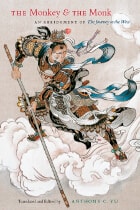
The Monkey and the Monk
An Abridgment of The Journey to the WestTranslated by Anthony C. Yu
University of Chicago Press, 2006
A compact abridgment of the legendary Chinese classic that inspired the hit game Black Myth: Wukong!
Anthony C. Yu’s celebrated translation of The Journey to the West reinvigorated one of Chinese literature’s most beloved classics for English-speaking audiences when it first appeared thirty years ago. Yu’s abridgment of his four-volume translation, The Monkey and the Monk, finally distills the epic novel’s most exciting and meaningful episodes without taking anything away from their true spirit.
These fantastic episodes recount the adventures of Xuanzang, a seventh-century monk who became one of China’s most illustrious religious heroes after traveling for sixteen years in search of Buddhist scriptures. Powerfully combining religious allegory with humor, fantasy, and satire, accounts of Xuanzang’s journey were passed down for a millennium before culminating in the sixteenth century with The Journey to the West. Now, readers of The Monkey and the Monk can experience the full force of his lengthy quest as he travels to India with four animal disciples, most significant among them a guardian-monkey known as “the Great Sage, Equal to Heaven.” Moreover, in its newly streamlined form, this acclaimed translation of a seminal work of world literature is sure to attract an entirely new following of students and fans.
“A new translation of a major literary text which totally supersedes the best existing version. . . . It establishes beyond contention the position of The Journey to the West in world literature, while at the same time throwing open wide the doors to interpretive study on the part of the English audience.”—Modern Language Notes, on the unabridged translation

The Monster with a Thousand Faces
Guises of the Vampire in Myth and LiteratureBrian J. Frost
University of Wisconsin Press, 1989
The Monstered Self
Narratives of Death and Performance in Latin American FictionEduardo González
Duke University Press, 1992
What interests González is the signature of authorial selfhood in narrative and performance, which he finds willfully and temptingly disfigured in the works he examines: horrific and erotic, subservient and tyrannical, charismatic and repellent. Searching out the personal image and plot, González uncovers two fundamental types of narrative: one that strips character of moral choice; and another in which characters' choices deprive them of personal autonomy and hold them in ritual bondage to a group. Thus The Monstered Self becomes a study of the conflict between individual autonomy and the stereotypes of solidarity.
Written in a characteristically allusive, elliptical style, and drawing on psychoanalysis, religion, mythology, and comparative literature, The Monstered Self is in itself a remarkable performance, one that will engage readers in anthropology, psychology, and cultural history as well as those specifically interested in Latin American narrative.
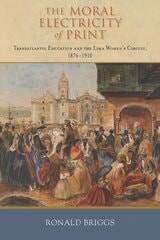
The Moral Electricity of Print
Transatlantic Education and the Lima Women's Circuit, 1876-1910Ronald Briggs
Vanderbilt University Press, 2017
Moral electricity—a term coined by American transcendentalists in the 1850s to describe the force of nature that was literacy and education in shaping a greater society. This concept wasn't strictly an American idea, of course, and Ronald Briggs introduces us to one of the greatest examples of this power: the literary scene in Lima, Peru, in the nineteenth century.
As Briggs notes in the introduction to The Moral Electricity of Print, "the ideological glue that holds the American hemisphere together is a hope for the New World as a grand educational project combined with an anxiety about the baleful influence of a politically and morally decadent Old World that dominated literary output through its powerful publishing interests." The very nature of living as a writer and participating in the literary salons of Lima was, by definition, a revolutionary act that gave voice to the formerly colonized and now liberated people. In the actions of this literary community, as men and women worked toward the same educational goals, we see the birth of a truly independent Latin American literature.
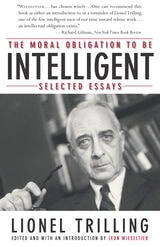
The Moral Obligation to Be Intelligent
Selected EssaysLionel Trilling
Northwestern University Press, 2009
Bringing together the thoughts of one of American literature’s sharpest cultural critics, this compendium will open the eyes of a whole new audience to the work of Lionel Trilling. Trilling was a strenuous thinker who was proud to think “too much.” As an intellectual he did not spare his own kind, and though he did not consider himself a rationalist, he was grounded in the world.
This collection features 32 of Trilling’s essays on a range of topics, from Jane Austen to George Orwell and from the Kinsey Report to Lolita. Also included are Trilling’s seminal essays “Art and Neurosis” and “Manners, Morals, and the Novel.” Many of the pieces made their initial appearances in periodicals such as The Partisan Review and Commentary; most were later reprinted in essay collections. This new gathering of his writings demonstrates again Trilling’s patient, thorough style. Considering “the problems of life”—in art, literature, culture, and intellectual life—was, to him, a vital occupation, even if he did not expect to get anything as simple or encouraging as “answers.” The intellectual journey was the true goal.
No matter the subject, Trilling’s arguments come together easily, as if constructing complicated defenses and attacks were singularly simple for his well-honed mind. The more he wrote on a subject and the more intricate his reasoning, the more clear that subject became; his elaboration is all function and no filler. Wrestling with Trilling’s challenging work still yields rewards today, his ideas speaking to issues that transcend decades and even centuries.
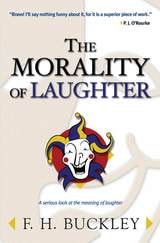
The Morality of Laughter
F. H. Buckley
University of Michigan Press, 2005
superior piece of work.”
—P. J. O’Rourke
“F. H. Buckley’s The Morality of Laughter is at once
a humorous look at serious matters and a serious
book about humor.”
—Crisis Magazine
“Buckley has written a . ne and funny book that will
be read with pleasure and instruction.”
—First Things
“. . . written elegantly and often wittily. . . .”
—National Post
“. . . a fascinating philosophical exposition of
laughter. . . .”
—National Review
“. . . at once a wise and highly amusing book.”
—Wall Street Journal Online
“. . . a useful reminder that a cheery society is a
healthy one.”
—Weekly Standard
The Mosaic Constitution
Political Theology and Imagination from Machiavelli to MiltonGraham Hammill
University of Chicago Press, 2012
It is a common belief that scripture has no place in modern, secular politics. Graham Hammill challenges this notion in The Mosaic Constitution, arguing that Moses’s constitution of Israel, which created people bound by the rule of law, was central to early modern writings about government and state.
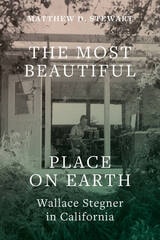
The Most Beautiful Place on Earth
Wallace Stegner in CaliforniaMatthew D. Stewart
University of Utah Press, 2021
This book tells the story of Stegner and his family as they made a home just outside of Palo Alto, California, during its transition from the Valley of Heart’s Delight (known for its rolling hills and orchards) to Silicon Valley. In this thoughtful study of the novels Stegner wrote in California—including his Pulitzer Prize–winning Angle of Repose—readers are invited to consider with Stegner what the practice of place requires in the American West. Specialists in the literature and history of the American West will find new analyses of Stegner and his influential work. Other readers will be guided through Stegner’s work in concrete and accessible prose, and anyone who has longed for home and a sense of place will encounter a powerful, beautiful, and at times tragic attempt to build and preserve it.
The Mourner's Song
War and Remembrance from the Iliad to VietnamJames Tatum
University of Chicago Press, 2002
Tatum's touchstone throughout is the Iliad, not just one of the earliest war poems, but also one of the most powerful examples of the way poetry can be a tribute to and consolation for what is lost in war. Reading the Iliad alongside later works inspired by war, Tatum reveals how the forms and processes of art convert mourning to memorial. He examines the role of remembrance and the distance from war it requires; the significance of landscape in memorialization; the artifacts of war that fire the imagination; the intimate relationship between war and love and its effects on the ferocity with which soldiers wage battle; and finally, the idea of memorialization itself. Because all survivors suffer the losses of war, Tatum's is a story of both victims and victors, commanders and soldiers, women and men. Photographs of war memorials in Vietnam, France, and the United States beautifully augment his testimonials.
Eloquent and deeply moving, The Mourner's Song will speak to anyone interested in the literature of war and the relevance of the classics to our most pressing contemporary needs.
The Mouth That Begs
Hunger, Cannibalism, and the Politics of Eating in Modern ChinaGang Yue
Duke University Press, 1999
Yue’s discussion begins with a brief look at ancient Chinese alimentary writing and then moves on to its main concern: the exploration and textual analysis of themes of eating in modern Chinese literature from the May Fourth period through the post-Tiananmen era. The broad historical scope of this volume illustrates how widely applicable eating-related metaphors can be. For instance, Yue shows how cannibalism symbolizes old China under European colonization in the writing of Lu Xun. In Mo Yan’s 1992 novel Liquorland, however, cannibalism becomes the symbol of overindulgent consumerism. Yue considers other writers as well, such as Shen Congwen, Wang Ruowang, Lu Wenfu, Zhang Zianliang, Ah Cheng, Zheng Yi, and Liu Zhenyun. A special section devoted to women writers includes a chapter on Xiao Hong, Wang Anyi, and Li Ang, and another on the Chinese-American women writers Jade Snow Wong, Maxine Hong Kingston, and Amy Tan. Throughout, the author compares and contrasts the work of these writers with similarly themed Western literature, weaving a personal and political semiotics of eating.
The Mouth That Begs will interest sinologists, literary critics, anthropologists, cultural studies scholars, and everyone curious about the semiotics of food.
The Moxon Tennyson
A Landmark in Victorian IllustrationSimon Cooke
Ohio University Press, 2021
The Muse in Bronzeville
African American Creative Expression in Chicago, 1932-1950Bone, Robert
Rutgers University Press, 2011
The Muse in Bronzeville, a dynamic reappraisal of a neglected period in African American cultural history, is the first comprehensive critical study of the creative awakening that occurred on Chicago's South Side from the early 1930s to the cold war. Coming of age during the hard Depression years and in the wake of the Great Migration, this generation of Black creative artists produced works of literature, music, and visual art fully comparable in distinction and scope to the achievements of the Harlem Renaissance.
This highly informative and accessible work, enhanced with reproductions of paintings of the same period, examines Black Chicago's "Renaissance" through richly anecdotal profiles of such figures as Richard Wright, Gwendolyn Brooks, Margaret Walker, Charles White, Gordon Parks, Horace Cayton, Muddy Waters, Mahalia Jackson, and Katherine Dunham. Robert Bone and Richard A. Courage make a powerful case for moving Chicago's Bronzeville, long overshadowed by New York's Harlem, from a peripheral to a central position within African American and American studies.
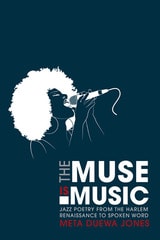
The Muse is Music
Jazz Poetry from the Harlem Renaissance to Spoken WordMeta DuEwa Jones
University of Illinois Press, 2013
This wide-ranging, ambitiously interdisciplinary study traces jazz's influence on African American poetry from the Harlem Renaissance to contemporary spoken word poetry. Examining established poets such as Langston Hughes, Ntozake Shange, and Nathaniel Mackey as well as a generation of up-and-coming contemporary writers and performers, Meta DuEwa Jones highlights the intersections of race, gender, and sexuality within the jazz tradition and its representation in poetry. Applying prosodic analysis to emphasize the musicality of African American poetic performance, she examines the gendered meanings evident in collaborative performances and in the criticism, images, and sounds circulating within jazz cultures.
The Music of Thought in the Poetry of George Oppen and William Bronk
Henry Weinfield
University of Iowa Press, 2009
From his careful readings of Oppen’s and Bronk’s poetry to his fascinating examination of the letters they exchanged, Weinfield provides important aesthetic, epistemological, and historical insights into their poetry and poetic careers. In bringing together for the first time the work of two of the most important poets of the postwar generation, The Music of Thought not only illuminates their poetry but also raises important questions about American literary history and the categories in terms of which it has generally been interpreted.

The Myth of Apollo and Daphne from Ovid to Quevedo
Love, Agon, and the GrotesqueMary E. Barnard
Duke University Press, 1987
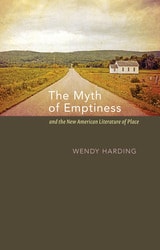
The Myth of Emptiness and the New American Literature of Place
Wendy Harding
University of Iowa Press, 2014
In The Myth of Emptiness and the New American Literature of Place, Wendy Harding identifies an important recent development in the literature of place that corrects the misperceptions resulting from these tropes. Works by Rick Bass, Charles Bowden, Ellen Meloy, Jonathan Raban, Rebecca Solnit, and Robert Sullivan move away from the tradition of nature writing, with its emphasis on the solitary individual communing with nature in uninhabited places, to recognize the interactions of human and other-than-human presences in the land. In different ways, all six writers reveal a more historically complex relationship between Americans and their environments. In this new literature of place, writers revisit abandoned, threatened, or damaged sites that were once represented as devoid of human presence and dig deeper to reveal that they are in fact full of the signs of human activity. These writers are interested in the role of social, political, and cultural relationships and the traces they leave on the landscape.
Throughout her exploration, Harding adopts a transdisciplinary perspective that draws on the theories of geographers, historians, sociologists, and philosophers to understand the reasons for the enduring perception of emptiness in the American landscape and how this new literature of place works with and against these ideas. She reminds us that by understanding and integrating human impacts into accounts of the landscape, we are better equipped to fully reckon with the natural and cultural crisis that engulfs all landscapes today.
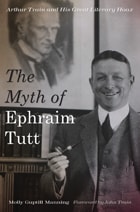
The Myth of Ephraim Tutt
Arthur Train and His Great Literary HoaxMolly Guptill Manning
University of Alabama Press, 2012
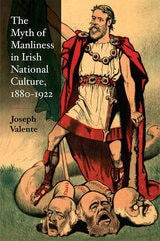
The Myth of Manliness in Irish National Culture, 1880-1922
Joseph Valente
University of Illinois Press, 2011
The Mythmaker
A Study of Motif and Symbol in the Short Stories of Jorge Luis BorgesBy Carter Wheelock
University of Texas Press, 1969
Readers who are intrigued, though often mystified, by the intellectual fantasies of Jorge Luis Borges will find this book a revelation, a skeleton key to one of the most fundamental and baffling aspects of Borges’s fictions: the pattern of symbolism with an inner meaning. Carter Wheelock’s study reduces a number of literary and intellectual abstractions to concrete terms, enabling the reader to understand Borges’s fantasies in ways that show them to be not so fantastic after all. Indeed, they are amazingly consistent and minutely accurate in their symbolic depiction of the magic universe of the mind.
Wheelock also discusses the affinity between Borges’s philosophical idealism and his “esthetic of the intelligence,” the relationship between these and the esthetic ideas of French Symbolism, and the influence on his fictions of the Rubáiyát of Omar Khayyám.
Why is it that this “writer’s writer” from the Argentine—erudite, allusive, elusive—has attracted such international attention? In Wheelock’s opinion, it is because he has symbolized in his short stories the fundamental form of the human consciousness, the functioning of the imaginative (world-creating) mechanism, and the eternal battle between form and chaos. The Mythmaker is concerned with elucidating the particulars of Borges’s fictional works, but even as it does so it also reveals their universality.
The Mythologizing of Mark Twain
Sara Davis
University of Alabama Press, 1984
How Samuel Clemens became Mark Twain—and Mark Twain became a myth.
The Mythologizing of Mark Twain explores the enduring fascination with one of America's most celebrated literary figures and examines how Samuel Langhorne Clemens became the cultural icon known around the world as Mark Twain. Bringing together a distinguished group of scholars, this thought-provoking collection investigates Twain not simply as an author, but as a powerful symbol whose life, works, and public persona have become inseparable from larger ideas about American identity, humor, democracy, individualism, and national character.
Readers and critics have long recognized Twain's literary genius, yet explaining the origins and significance of that genius remains an ongoing challenge. The essays in this volume address that challenge by exploring the many ways Twain has been interpreted, celebrated, debated, and transformed into a mythic figure. They examine how his writings helped define an American literary tradition while simultaneously contributing to the creation of a broader cultural mythology that continues to shape public perceptions of the United States and its history.
Rather than seeking a single interpretation of Twain, the contributors employ a range of critical approaches to illuminate the complexity of both the man and the legend. Their analyses reveal how the boundaries between Samuel Clemens, Mark Twain, and the popular image of "America's author" have often blurred, generating new layers of meaning for successive generations of readers and scholars.
The Mythologizing of Mark Twain is an essential resource for students and scholars of American literature, cultural history, and literary criticism. By examining the evolution of Twain's reputation and influence, the collection offers a deeper understanding of how literary figures become cultural myths and why Mark Twain remains one of the most enduring voices in the American imagination.
The Myths of Fiction
Studies in the Canonical Greek NovelsEdmund P. Cueva
University of Michigan Press, 2004
The tradition of historical literature begun by Herodotus and Thucydides molded the early Greek novel. As the genre evolved, however, Greek novels moved away from their historical roots to become more heavily influenced by mythological traditions. Edmund Cueva's new book examines the literary uses to which the ancient novelists put their mythological material. His work offers a stimulating discussion of myths and their rise to prominence as the key feature of the fully developed Greek novel. He also takes into account the impact of the Roman conquest on the development of the Greek novel, the last true literary creation of the Greek world. The Myths of Fiction will interest scholars of Greek literarure, imperial history, literary myth, intertextuality, and comparative literature.
Edmund Cueva is Associate Professor and Chair of Classics at Xavier University.
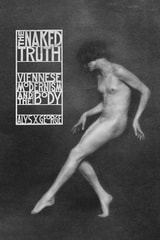
The Naked Truth
Viennese Modernism and the BodyAlys X. George
University of Chicago Press, 2020
Viennese modernism is often described in terms of a fin-de-siècle fascination with the psyche. But this stereotype of the movement as essentially cerebral overlooks a rich cultural history of the body. The Naked Truth, an interdisciplinary tour de force, addresses this lacuna, fundamentally recasting the visual, literary, and performative cultures of Viennese modernism through an innovative focus on the corporeal.
Alys X. George explores the modernist focus on the flesh by turning our attention to the second Vienna medical school, which revolutionized the field of anatomy in the 1800s. As she traces the results of this materialist influence across a broad range of cultural forms—exhibitions, literature, portraiture, dance, film, and more—George brings into dialogue a diverse group of historical protagonists, from canonical figures such as Egon Schiele, Arthur Schnitzler, Joseph Roth, and Hugo von Hofmannsthal to long-overlooked ones, including author and doctor Marie Pappenheim, journalist Else Feldmann, and dancers Grete Wiesenthal, Gertrud Bodenwieser, and Hilde Holger. She deftly blends analyses of popular and “high” culture, laying to rest the notion that Viennese modernism was an exclusively male movement. The Naked Truth uncovers the complex interplay of the physical and the aesthetic that shaped modernism and offers a striking new interpretation of this fascinating moment in the history of the West.
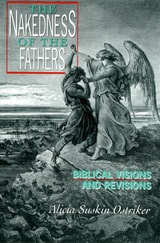
The Nakedness of the Fathers
Biblical Visions and RevisionsOstriker, Alicia Suskin
Rutgers University Press, 1997
In her introduction, "Entering the Tents, " Ostriker defines the need to struggle against a tradition in which women have been silenced and disempowered - and to recover the female power buried beneath the surface of the biblical texts. In "The Garden, " she reinterprets the mythically complex stories of Creation. Then she considers the stories of "The Fathers, " from Abraham and Isaac to Moses, David, and Solomon - and their wives, mothers, and sisters. In "The Return of the Mothers, " she begins with a radical new interpretation of the book of Esther, includes a meditation on the silenced wife of Job and the idea of justice, and concludes with a fable on the death of God and a prayer to the Shekhinah, the feminine aspect of God. Ostriker refuses to dismiss the Bible as meaningless to women. Instead, in this angry, eloquent, visionary book, she attempts to recover what is genuinely sacred in these sacred texts.
The Narcissus and the Pomegranate
An Archaeology of the Homeric Hymn to DemeterAnn Suter
University of Michigan Press, 2002
The author analyzes the traditional language of the hymn and Persephone's retelling of her story to Demeter, arguing that the hymn involves an earlier tale of Demeter and Persephone that predates the seventh century. Suter uses anthropological applications to illustrate that the story of Persephone's abduction does not reflect a female initiation rite into adulthood, as has been argued, but rather an hieros gamos. These methodologies point to the conclusion that Persephone was once a powerful goddess in her own right, independent of Hades and of Demeter as well. To test the accuracy of these possibilities, the book next examines evidence from outside the hymn. Other versions of the two myths in the hymn support the idea that these myths--Persephone's abduction and Demeter's nursing of Demophoön--were once separate and were late combined to create a new story. Evidence from the chief archaeological sites, from vase painting and other artistic forms is provided to enhance the argument. Thus the evidence from outside the hymn supports the conclusions of the textual analyses, giving surprising substantiation that the hymn itself commemorates the early days of the worship of the goddesses as a mother/daughter pair.
This book will be of particular interest to scholars of religious history, art history, archaeology, and literature. It is also accessible to the general reader interested in Greek literature, myths, and religion.
Ann Suter is Associate Professor of Classical Studies, University of Rhode Island.
The Narrative Secret of Flannery O'Connor
The Trickster as InterpreterRuthann Knechel Johansen
University of Alabama Press, 2009
“The ‘narrative secret’ of Johansen’s title refers to the strategies that she sees O’Connor using in her effort to communicate a spiritual message to a doubting audience. O’Connor knew from the beginning of her career that writing about the thing that mattered most to her—a person’s relationship in faith with Jesus—and being taken seriously as a writer meant [choosing] a dramatic and difficult way to get her vision across: to write stories that work first and foremost as engaging narratives and at the same time open up to the divine in the everyday world.
The Nation Writ Small
African Fictions and Feminisms, 1958-1988Susan Z. Andrade
Duke University Press, 2011
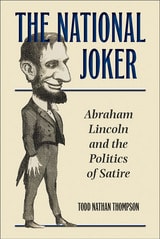
The National Joker
Abraham Lincoln and the Politics of SatireTodd Nathan Thompson
Southern Illinois University Press, 2015
In his speeches, writings, and public persona, Lincoln combined modesty and attack, engaging in strategic self-deprecation while denouncing his opponents, their policies, and their arguments, thus refiguring satiric discourse as political discourse and vice versa. At the same time, he astutely deflected his opponents’ criticisms of him by embracing and sometimes preemptively initiating those criticisms. Thompson traces Lincoln’s comic sources and explains how, in reapplying others’ jokes and stories to political circumstances, he transformed humor into satire. Time and time again, Thompson shows, Lincoln engaged in self-mockery, turning negative assumptions or depictions of him—as ugly, cowardly, jocular, inexperienced—into positive traits that identified him as an everyman while attacking his opponents’ claims to greatness, heroism, and experience as aristocratic or demagogic. Thompson also considers how Lincoln took advantage of political cartoons and other media to help proliferate the particular Lincoln image of the “self-made man”; underscores exceptions to Lincoln’s ability to mitigate negative, satiric depictions of him; and closely examines political cartoons from both the 1860 and 1864 elections. Throughout, Thompson’s deft analysis brings to life Lincoln’s popular humor.
The National Uncanny
Indian Ghosts and American SubjectsRenée L. Bergland
Dartmouth College Press, 2000
The Natural Contract
Michel Serres
University of Michigan Press, 1995
World history is often referred to as the story of human conflict. Those struggles that are seen as our history must now include the uncontrolled violence that humanity perpetrates upon the earth, and the uncontrollable menace to human life posed by the earth in reaction to this violence. Just as a social contract once brought order to human relations, Serres believes that we must now sign a "natural contract" with the earth to bring balance and reciprocity to our relations with the planet that gives us life. Our survival depends on the extent to which humans join together and act globally, on an earth now conceived as an entity.
Tracing the ancient beginnings of modernity, Serres examines the origins and possibilities of a natural contract through an extended meditation on the contractual foundations of law and science. By invoking a nonhuman, physical world, Serres asserts, science frees us from the oppressive confines of a purely social existence, but threatens to become a totalitarian order in its own right. The new legislator of the natural contract must bring science and law into balance.
Serres ends his meditation by retelling the story of the natural contract as a series of parables. He sees humanity as a spacecraft that with the help of science and technology has cast off from familiar moorings. In place of the ties that modernity and analytic reason have severed, we find a network of relations both stranger and stronger than any we once knew, binding us to one another and to the world. The philosopher's harrowing and joyous task, Serres tells us, is that of comprehending and experiencing the bonds of violence and love that unite us in our spacewalk to the spaceship Mother Earth.
"Wise, rich and poetic . . . not simply a philosophical study of the Environment, or an ecological questioning of Philosophy . . . Nature is acknowledged as an inside force which breaks [the philosopher's] discourse, and opens it up to a vigilant poetic meditation."--Substance: A Review of Theory and Literary Criticism

The Natural History of H. G. Wells
John Robert Reed
Ohio University Press, 1982
This new study offers a general reassessment of H. G. Wells as a writer and thinker. It concentrates upon the close relationship between Wells’ developing philosophy and his literary techniques. The early chapters examine Wells’ treatment of such subjects as confinement and escape, sex, the nature of human identity, the relationship of individual to race, human progress, and the importance of education. At the same time, the describe the emotional topography that Wells created as a mean of vivifying his ideas, a topography constructed from image complexes largely based upon the analogy between individual and racial evolution.
The major contribution of the book comes in its later chapters, which deal with Wells’ metaphysical assumptions and his approach to his craft. His views on free will and strength of will were intimately related to his methods of literary composition. The important later chapters detail this relationship, while describing some of Wells’ characteristic literary devices, such as the intentional violations of certain novelistic conventions or the sly borrowing from and alluding to contemporary works of literature in what amounted to a covert polemic.
On the whole, this study argues for a coherent and consistent, though developing, philosophy operating throughout Wells’ career and manifested in experimental literary works which, while not always successful, were consistently inventive and intelligently crafted in the service of Wells’ principle aim, the education of the human species to a command of its own destiny.
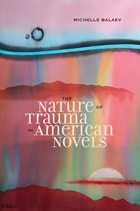
The Nature of Trauma in American Novels
Michelle Balaev
Northwestern University Press, 2012
In The Nature of Trauma in the American Novel, Michelle Balaev undertakes an ambitious rethinking of the foundations, implementations, and new possibilities of literary trauma theory.
The Nature of True Virtue
Jonathan Edwards
University of Michigan Press, 1960
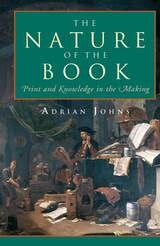
The Nature of the Book
Print and Knowledge in the MakingAdrian Johns
University of Chicago Press, 1998
"A compelling exposition of how authors, printers, booksellers and readers competed for power over the printed page. . . . The richness of Mr. Johns's book lies in the splendid detail he has collected to describe the world of books in the first two centuries after the printing press arrived in England."—Alberto Manguel, Washington Times
"[A] mammoth and stimulating account of the place of print in the history of knowledge. . . . Johns has written a tremendously learned primer."—D. Graham Burnett, New Republic
"A detailed, engrossing, and genuinely eye-opening account of the formative stages of the print culture. . . . This is scholarship at its best."—Merle Rubin, Christian Science Monitor
"The most lucid and persuasive account of the new kind of knowledge produced by print. . . . A work to rank alongside McLuhan."—John Sutherland, The Independent
"Entertainingly written. . . . The most comprehensive account available . . . well documented and engaging."—Ian Maclean, Times Literary Supplement
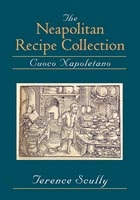
The Neapolitan Recipe Collection
Cuoco NapoletanoTerence Scully
University of Michigan Press, 2015
The Nearest Thing to Life
James Wood
Brandeis University Press, 2015
The Necessary Earth
Nature and Solitude in American LiteratureBy Wilson O. Clough
University of Texas Press, 1964
The Necessary Earth is a study of the degree to which the long American experience with an open frontier has entered into an inherently American literature to distinguish it from that of other lands. Since literature is, in the author’s words, “a compound of time, place, and the individual projection of personal experience and reflection into objective forms,” the American compulsion to communicate their experience and their difference was a virtual guarantee that a native literature would arrive.
The text falls into three major portions. The first considers the “age of wonder,” the impact of New World upon Old World comers to effect profound changes, and to set the new American on the parallel paths of idealism and pragmatism. The second part examines the effort of native-born writers to appropriate this experience for new metaphors and new literary theme. Without this effort, the frontier might have remained no more than a dwindling legend, and the transference to the theme of self-reliance might never have appeared. In the third portion the author turns to the twentieth century, examining here the degree to which the national theme of reliance on experience over tradition has persisted in the work of major authors.
Ranging thus from Jamestown and Plymouth to Wallace Stevens, the book stresses, throughout, the pull of untamed nature on the human spirit, and the echoes of that experience in what is most intrinsic in American literature. Without denying frontier lawlessness or native chauvinism, Clough directs our attention primarily to the problems of the creation of a new language and a new metaphor to meet the new experience, and the persistence of a truly American note into a maturing of both manner and matter.
The Necessary Past
Revising History in Contemporary African American PoetryAnnette Debo
Northwestern University Press, 2024
“Poets are lyric historians,” proclaimed Langston Hughes. Today, historical poetry offers a lyric history necessary to our current moment—poetry with the power to correct the past, realign the present, and create a more hopeful, or even hoped-for, future. The Necessary Past: Revising History in Contemporary African American Poetry focuses on six of today’s most celebrated poets: Elizabeth Alexander, Natasha Trethewey, A. Van Jordan, Kevin Young, Frank X Walker, and Camille T. Dungy. Their works reimagine the interiority of Black historical figures like the so-called Venus Hottentot Sara Baartman and the would-be spelling champion MacNolia Cox, the African American Native Guard who fought in the Civil War and the unknown victims of domestic violence, Jack Johnson and Jean-Michel Basquiat, Medgar Evers and those freed and enslaved in the early nineteenth century. These poets shift the power dynamic in revising our shared history, reconfiguring who speaks and whose stories are told, and writing a past that frees readers to change the present and envision a more just future.
The Necessity for Ruins and Other Topics
J. B. Jackson
University of Massachusetts Press, 1980
The Necromantics
Reanimation, the Historical Imagination, and Victorian British and Irish LiteratureRenée Fox
The Ohio State University Press, 2023
Winner, 2025 Sonya Rudikoff Award for the best first book in Victorian Studies
Honorable Mention, 2023 North American Victorian Studies Association First Book Prize
Honorable Mention, American Council for Irish Studies Donald Murphy Prize for Distinguished First Book
The Necromantics dwells on the literal afterlives of history. Reading the reanimated corpses—monstrous, metaphorical, and occasionally electrified—that Mary Shelley, Robert Browning, Charles Dickens, W. B. Yeats, Bram Stoker, and others bring to life, Renée Fox argues that these undead figures embody the present’s desire to remake the past in its own image. Fox positions “necromantic literature” at a nineteenth-century intersection between sentimental historiography, medical electricity, imperial gothic monsters, and the Irish Literary Revival, contending that these unghostly bodies resist critical assumptions about the always-haunting power of history.
By considering Irish Revival texts within the broader scope of nineteenth-century necromantic works, The Necromantics challenges Victorian studies’ tendency to merge Irish and English national traditions into a single British whole, as well as Irish studies’ postcolonial efforts to cordon off a distinct Irish canon. Fox thus forges new connections between conflicting political, formal, and historical traditions. In doing so, she proposes necromantic literature as a model for a contemporary reparative reading practice that can reanimate nineteenth-century texts with new aesthetic affinities, demonstrating that any effective act of reading will always be an effort of reanimation.
The Necropastoral
Poetry, Media, OccultsJoyelle McSweeney
University of Michigan Press, 2014
The Networked Wilderness
Communicating in Early New EnglandMatt Cohen
University of Minnesota Press, 2009
In The Networked Wilderness, Matt Cohen examines communications systems in early New England and finds that, surprisingly, struggles over information technology were as important as theology, guns, germs, or steel in shaping the early colonization of North America. Colonists in New England have generally been viewed as immersed in a Protestant culture of piety and alphabetic literacy. At the same time, many scholars have insisted that the culture of the indigenous peoples of the region was a predominantly oral culture. But what if, Cohen posits, we thought about media and technology beyond the terms of orality and literacy?
Reconceptualizing aural and inscribed communication as a spectrum, The Networked Wilderness bridges the gap between the history of the book and Native American systems of communication. Cohen reveals that books, paths, recipes, totems, and animals and their sounds all took on new interactive powers as the English negotiated the well-developed informational trails of the Algonquian East Coast and reported their experiences back to Europe. Native and English encounters forced all parties to think of each other as audiences for any event that might become a kind of "publication."
Using sources ranging from Thomas Morton's Maypole festival to the architecture of today's Mashantucket Pequot Museum and Research Center, Cohen shows that the era before the printing press came to New England was one of extraordinary fertility for communications systems in America.