Results by title
718 books match the query 'Civil rights' and 162 start with t
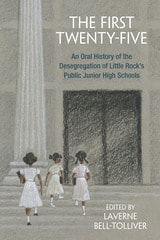
The First Twenty-Five
An Oral History of the Desegregation of Little Rock’s Public Junior High SchoolsLaVerne Bell-Tolliver
University of Arkansas Press, 2018
“It was one of those periods that you got through, as opposed to enjoyed. It wasn’t an environment that . . . was nurturing, so you shut it out. You just got through it. You just took it a day at a time. You excelled if you could. You did your best. You felt as though the eyes of the community were on you.”—Glenda Wilson, East Side Junior High
Much has been written about the historical desegregation of Little Rock Central High School by nine African American students in 1957. History has been silent, however, about the students who desegregated Little Rock’s five public junior high schools—East Side, Forest Heights, Pulaski Heights, Southwest, and West Side—in 1961 and 1962.
The First Twenty-Five gathers the personal stories of these students some fifty years later. They recall what it was like to break down long-standing racial barriers while in their early teens—a developmental stage that often brings emotional vulnerability. In their own words, these individuals share what they saw, heard, and felt as children on the front lines of the civil rights movement, providing insight about this important time in Little Rock, and how these often painful events from their childhoods affected the rest of their lives.
The Fourth Amendment
Original Understandings and Modern PolicingMichael J.Z. Mannheimer
University of Michigan Press, 2023
Police are required to obey the law. While that seems obvious, courts have lost track of that requirement due to misinterpreting the two constitutional provisions governing police conduct: the Fourth and Fourteenth Amendments. The Fourth Amendment forbids "unreasonable searches and seizures" and is the source of most constitutional constraints on policing. Although that provision technically applies only to the federal government, the Fourteenth Amendment, ratified in the wake of the Civil War, has been deemed to apply the Fourth Amendment to the States.
This book contends that the courts’ misinterpretation of these provisions has led them to hold federal and state law enforcement mistakenly to the same constitutional standards. The Fourth Amendment was originally understood as a federalism, or “states’ rights,” provision that, in effect, required federal agents to adhere to state law when searching or seizing. Thus, applying the same constraint to the States is impossible. Instead, the Fourteenth Amendment was originally understood in part as requiring that state officials (1) adhere to state law, (2) not discriminate, and (3) not be granted excessive discretion by legislators. These principles should guide judicial review of modern policing. Instead, constitutional constraints on policing are too strict and too forgiving at the same time. In this book, Michael J.Z. Mannheimer calls for a reimagination of what modern policing could look like based on the original understandings of the Fourth and Fourteenth Amendments.
The Freedom of the Migrant
Objections to NationalismVilém Flusser. Translated to the German by Kenneth Kronenberg. Edited and with an Introduction by Anke K. Finger
University of Illinois Press, 2013
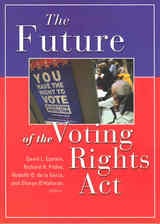
The Future of the Voting Rights Act
David Epstein
Russell Sage Foundation, 2006
The Gay Rights Question in Contemporary American Law
Andrew Koppelman
University of Chicago Press, 2002
The Gay Rights Question in Contemporary American Law offers an unusually nuanced analysis of the most pressing gay rights issues. Does antigay discrimination violate the Constitution? Is there any sound moral objection to homosexual conduct? Are such objections the moral and constitutional equivalent of racism? Must state laws recognizing same-sex unions be given effect in other states? Should courts take account of popular resistance to gay equality? Koppelman sheds new light on all these questions. Sure to upset purists on either side of the debate, Koppelman's book criticizes the legal arguments advanced both for and against gay rights. Just as important, it places these arguments in broader moral and social contexts, offering original, pragmatic, and workable legal solutions.
The Georgia of the North
Black Women and the Civil Rights Movement in New JerseyHettie V. Williams
Rutgers University Press, 2024
The Gospel of the Working Class
Labor's Southern Prophets in New Deal AmericaErik S. Gellman and Jarod Roll
University of Illinois Press, 2011
In this exceptional dual biography and cultural history, Erik S. Gellman and Jarod Roll trace the influence of two southern activist preachers, one black and one white, who used their ministry to organize the working class in the 1930s and 1940s across lines of gender, race, and geography. Owen Whitfield and Claude Williams, along with their wives Zella Whitfield and Joyce Williams, drew on their bedrock religious beliefs to stir ordinary men and women to demand social and economic justice in the eras of the Great Depression, New Deal, and Second World War.
The Great Migration and the Democratic Party
Black Voters and the Realignment of American Politics in the 20th CenturyKeneshia N. Grant
Temple University Press, 2020
Where Black people live has long been an important determinant of their ability to participate in political processes. The Great Migration significantly changed the way Democratic Party elites interacted with Black communities in northern cities, Detroit, New York, and Chicago. Many white Democratic politicians came to believe the growing pool of Black voters could help them reach their electoral goals—and these politicians often changed their campaign strategies and positions to secure Black support. Furthermore, Black migrants were able to participate in politics because there were fewer barriers to Black political participations outside the South.
The Great Migration and the Democratic Party frames the Great Migration as an important economic and social event that also had serious political consequences. Keneshia Grant created one of the first listings of Black elected officials that classifies them based on their status as participants in the Great Migration. She also describes some of the policy/political concerns of the migrants. The Great Migration and the Democratic Party lays the groundwork for ways of thinking about the contemporary impact of Black migration on American politics.
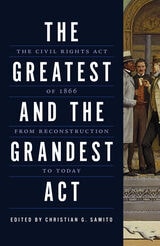
The Greatest and the Grandest Act
The Civil Rights Act of 1866 from Reconstruction to TodayEdited by Christian G. Samito
Southern Illinois University Press, 2018
Essays examine the history and legal ramifications of the act and highlight competing impulses within it, including the often-neglected Section 9, which allows the president to use the nation’s military in its enforcement; an investigation of how the Thirteenth Amendment operated to overturn the Dred Scott case; and New England’s role in the passage of the act. The act is analyzed as it operated in several states such as Kentucky, Missouri, and South Carolina during Reconstruction. There is also a consideration of the act and its interpretation by the Supreme Court in its first decades. Other essays include a discussion of the act in terms of contract rights and in the context of the post–World War II civil rights era as well as an analysis of the act’s backward-looking and forward-looking nature.
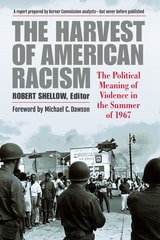
The Harvest of American Racism
The Political Meaning of Violence in the Summer of 1967Robert Shellow
University of Michigan Press, 2018
In the summer of 1967, in response to violent demonstrations that rocked 164 U.S. cities, the National Advisory Commission on Civil Disorders, a.k.a. the Kerner Commission, was formed. The Commission sought reasons for the disturbances, including the role that law enforcement played. Chief among its research projects was a study of 23 American cities, headed by social psychologist Robert Shellow. An early draft of the scientists’ analysis, titled “The Harvest of American Racism: The Political Meaning of Violence in the Summer of 1967,” provoked the Commission’s staff in November 1967 by uncovering political causes for the unrest; the team of researchers was fired, and the controversial report remained buried at the LBJ Presidential Library until now.
The first publication of the Harvest report half a century later reveals that many of the issues it describes are still with us, including how cities might more effectively and humanely react to groups and communities in protest. In addition to the complete text of the suppressed Harvest report, the book includes an introduction by Robert Shellow that provides useful historical context; personal recollections from four of the report’s surviving social scientists, Robert Shellow, David Boesel, Gary T. Marx, and David O. Sears; and an appendix outlining the differences between the unpublished Harvest analysis and the well-known Kerner Commission Report that followed it.
“The [Harvest of American Racism] report was rejected by Johnson administration functionaries as being far too radical—politically ‘unviable’… Social science can play an extremely positive role in fighting racial and other injustice and inequality, but only if it is matched with a powerful political will to implement the findings. That will has never come from within an American presidential administration—that will has only been forged in black and other radical communities’ movements for justice. The political power for change, as incremental as it has been, has come from within those communities. Washington responds, it does not lead."
—from the Foreword by Michael C. Dawson
The Hollow Hope
Can Courts Bring About Social Change?Gerald N. Rosenberg
University of Chicago Press, 1991
Rosenberg presents, with remarkable skill, an overwhelming case that efforts to use the courts to generate significant reforms in civil rights, abortion, and women's rights were largely failures.
"The real strength of The Hollow Hope . . . is its resuscitation of American Politics—the old-fashioned representative kind—as a valid instrument of social change. Indeed, the flip side of Mr. Rosenberg's argument that courts don't do all that much is the refreshing view that politics in the best sense of the word—as deliberation and choice over economic and social changes, as well as over moral issues—is still the core of what makes America the great nation it is. . . . A book worth reading."—Gary L. McDowell, The Washington Times
The Hollow Hope
Can Courts Bring About Social Change?Gerald N. Rosenberg
University of Chicago Press, 2023
Since its first publication in 1991, The Hollow Hope has spurred debate and challenged assumptions on both the left and the right about the ability of courts to bring about durable political and social change. What Gerald N. Rosenberg argued then, and what he confirms today through new evidence in this edition, is that it is nearly impossible to generate significant reforms through litigation: American courts are ineffective and relatively weak, far from the uniquely powerful sources for change they are often portrayed to be.
This third edition includes new data and a substantially updated analysis of civil rights, abortion rights and access, women’s rights, and marriage equality. Addressing changes in the political and social environment, Rosenberg draws lessons from the re-segregation of public schools, victories in marriage equality, and new obstacles to abortion access. Through these and other cases, the third edition confirms the power of the book’s original explanatory framework and deepens our understanding of the limits of judicial action in support of social reform, as well as the conditions under which courts do produce change. Up-to-date, thorough, and thought-provoking, The Hollow Hope remains vital reading.
The Hollow Hope
Can Courts Bring About Social Change? Second EditionGerald N. Rosenberg
University of Chicago Press, 2008
Finding that the answer is still a resounding no, Rosenberg reaffirms his powerful contention that it’s nearly impossible to generate significant reforms through litigation. The reason? American courts are ineffective and relatively weak—far from the uniquely powerful sources for change they’re often portrayed as. Rosenberg supports this claim by documenting the direct and secondary effects of key court decisions—particularly Brown v. Board of Education and Roe v. Wade. He reveals, for example, that Congress, the White House, and a determined civil rights movement did far more than Brown to advance desegregation, while pro-choice activists invested too much in Roe at the expense of political mobilization. Further illuminating these cases, as well as the ongoing fight for same-sex marriage rights, Rosenberg also marshals impressive evidence to overturn the common assumption that even unsuccessful litigation can advance a cause by raising its profile.
Directly addressing its critics in a new conclusion, The Hollow Hope, Second Edition promises to reignite for a new generation the national debate it sparked seventeen years ago.
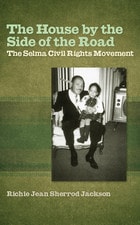
The House by the Side of the Road
The Selma Civil Rights MovementRichie Jean Sherrod Jackson
University of Alabama Press, 2011
King’s informal headquarters in Selma was the home of Dr. Sullivan and Richie Jean Sherrod Jackson and their young daughter, Jawana. The House by the Side of the Road is Richie Jean’s firsthand account of the private meetings King and his lieutenants, including Ralph David Abernathy and John Lewis, held in the haven of the Jackson home.
Sullivan Jackson was an African American dentist in Selma and a prominent supporter of the civil rights movement. Richie Jean was a close childhood friend of King’s wife, Coretta Scott King, a native of nearby Marion, Alabama. Richie Jean’s fascinating account narrates how, in the fraught months of 1965 that preceded the Voting Rights March, King and his inner circle held planning sessions and met with Assistant Attorney General John Doar to negotiate strategies for the event.
Just eight days after Bloody Sunday, President Lyndon Johnson made a televised addressed to a joint session of Congress on Monday, March 15. Jackson relates the intimate scene of King and his lieutenants watching as Johnson called the nation to dedicate itself to equal rights for all and ending his address with the words: “We shall overcome.” Five months later, Congress passed the 1965 Voting Rights Act on August 6.
The major motion picture Selma now commemorates the fiftieth anniversary of Bloody Sunday and the 1965 Voting Rights Act. In it, Niecy Nash and Kent Faulcon star as Sullivan and Richie Jean Jackson among a cast including Oprah Winfrey, Tom Wilkinson, and Cuba Gooding Jr. A gripping primary source, The House by the Side of the Road illuminates the private story whose public outcomes electrified the world and changed the course of American history.
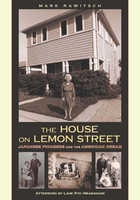
The House on Lemon Street
Japanese Pioneers and the American DreamMark Rawitsch
University Press of Colorado, 2013
Bringing this little-known story to light, The House on Lemon Street details the Haradas' decision to fight for the American dream. Chronicling their experiences from their immigration to the United States through their legal battle over their home, their incarceration during World War II, and their lives after the war, this book tells the story of the family's participation in the struggle for human and civil rights, social justice, property and legal rights, and fair treatment of immigrants in the United States.
The Harada family's quest for acceptance illuminates the deep underpinnings of anti-Asian animus, which set the stage for Executive Order 9066, and recognizes fundamental elements of our nation's anti-immigrant history that continue to shape the American story. It will be worthwhile for anyone interested in the Japanese American experience in the twentieth century, immigration history, public history, and law.
This publication was made possible with the support of Naomi, Kathleen, Ken, and Paul Harada, who donated funds in memory of their father, Harold Shigetaka Harada, honoring his quest for justice and civil rights. Additional support for this publication was also provided, in part, by UCLA's Aratani Endowed Chair as well as Wallace T. Kido, Joel B. Klein, Elizabeth A. Uno, and Rosalind K. Uno.
The Huddled Masses Myth
Immigration And Civil RightsKevin R. Johnson
Temple University Press, 2003
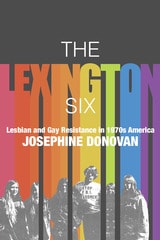
The Lexington Six
Lesbian and Gay Resistance in 1970s AmericaJosephine Donovan
University of Massachusetts Press, 2020
Finalist for the 2021 Lambda Literary Awards
On September 23, 1970, a group of antiwar activists staged a robbery at a bank in Massachusetts, during which a police officer was killed. While the three men who participated in the robbery were soon apprehended, two women escaped and became fugitives on the FBI's Ten Most Wanted list, eventually landing in a lesbian collective in Lexington, Kentucky, during the summer of 1974. In pursuit, the FBI launched a massive dragnet. Five lesbian women and one gay man ended up in jail for refusing to cooperate with federal officials, whom they saw as invading their lives and community. Dubbed the Lexington Six, the group's resistance attracted national attention, inspiring a nationwide movement in other minority communities. Like the iconic Stonewall demonstrations, this gripping story of spirited defiance has special resonance in today's America.
Drawing on transcripts of the judicial hearings, contemporaneous newspaper accounts, hundreds of pages of FBI files released to the author under the Freedom of Information Act, and interviews with many of the participants, Josephine Donovan reconstructs this fascinating, untold story. The Lexington Six is a vital addition to LGBTQ, feminist, and radical American history.
The Life Worth Living
Disability, Pain, and MoralityJoel Michael Reynolds
University of Minnesota Press, 2022
A philosophical challenge to the ableist conflation of disability and pain
More than 2,000 years ago, Aristotle said: “let there be a law that no deformed child shall live.” This idea is alive and well today. During the past century, Supreme Court Justice Oliver Wendell Holmes Jr. argued that the United States can forcibly sterilize intellectually disabled women and philosopher Peter Singer argued for the right of parents to euthanize certain cognitively disabled infants. The Life Worth Living explores how and why such arguments persist by investigating the exclusion of and discrimination against disabled people across the history of Western moral philosophy.
Joel Michael Reynolds argues that this history demonstrates a fundamental mischaracterization of the meaning of disability, thanks to the conflation of lived experiences of disability with those of pain and suffering. Building on decades of activism and scholarship in the field, Reynolds shows how longstanding views of disability are misguided and unjust, and he lays out a vision of what an anti-ableist moral future requires.
The Life Worth Living is the first sustained examination of disability through the lens of the history of moral philosophy and phenomenology, and it demonstrates how lived experiences of disability demand a far richer account of human flourishing, embodiment, community, and politics in philosophical inquiry and beyond.
Accessibility features: Retail e-book files for this title are screen-reader friendly with images accompanied by short alt text and/or extended descriptions.
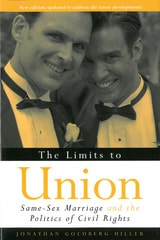
The Limits to Union
Same-Sex Marriage and the Politics of Civil RightsJonathan Goldberg-Hiller
University of Michigan Press, 2004
"The Limits to Union is a superb book about the complexities of recent political struggles over same-sex marriage. Goldberg-Hiller offers a sophisticated account of egalitarian rights advocacy and the reaction it has generated from established majorities animated by a 'new common sense' of exclusionary sovereign authority. The author's analysis is multidimensional and nuanced, but the core argument is bold, important, and well-supported. I recommend it very highly to everyone interested in understanding the character, possibilities, and constraints of civil rights amid our contemporary culture wars."
-Michael McCann, author of Rights at Work: Pay Equity Reform and the Politics of Legal Mobilization
"In this excellent book, Goldberg-Hiller uses Hawaii's experience to examine the interaction between courts and the political system. . . . Relying on briefs, legislative statements, and interviews with activists from both sides of the question, he views this familiar debate . . . through the unfamiliar prism of gay marriage, which allows him to gauge the viability and the pliability of the American civil rights ideal, and how gay and lesbian issues fit (or don't fit) within that ideal."
-Willian Heinzen, New York Law Journal
"Goldberg-Hiller presents the history of the same-sex marriage question since it first sparked debate in Hawaii. He follows the shifting debate through court cases, state propositions, and state and federal legislatures, considering questions about the constitutionality of the Defense of Marriage Act and the concept of equal protection under the law for gays and lesbians. This detailed treatment of the legal issues surrounding same-sex marriages is highly recommended."
-R. L. Abbott, University of Evansville
"[A] valuable contribution to the field, situating the gay marriage debate in broader contexts of theory, law and practice. [S]ame-sex marriage is an important issue...that finds itself caught in the friction points of much larger debates over the nature of rights, the limits of sovereignty and the proper role of courts and law in a democratic society. The Limits to Union should therefore be of interest even to those who do not think of themselves as interested in gay and lesbian rights issues."
-Evan Gerstmann, Loyola Marymount University, Law and Politics Book Review

The Limits to Union
Same-Sex Marriage and the Politics of Civil RightsJonathan Goldberg-Hiller
University of Michigan Press, 2002
"The Limits to Union is a superb book about the complexities of recent political struggles over same-sex marriage. Goldberg-Hiller offers a sophisticated account of egalitarian rights advocacy and the reaction it has generated from established majorities animated by a 'new common sense' of exclusionary sovereign authority. The author's analysis is multidimensional and nuanced, but the core argument is bold, important, and well-supported. I recommend it very highly to everyone interested in understanding the character, possibilities, and constraints of civil rights amid our contemporary culture wars."
-Michael McCann, author of Rights at Work: Pay Equity Reform and the Politics of Legal Mobilization
"In this excellent book, Goldberg-Hiller uses Hawaii's experience to examine the interaction between courts and the political system. . . . Relying on briefs, legislative statements, and interviews with activists from both sides of the question, he views this familiar debate . . . through the unfamiliar prism of gay marriage, which allows him to gauge the viability and the pliability of the American civil rights ideal, and how gay and lesbian issues fit (or don't fit) within that ideal."
-Willian Heinzen, New York Law Journal
"Goldberg-Hiller presents the history of the same-sex marriage question since it first sparked debate in Hawaii. He follows the shifting debate through court cases, state propositions, and state and federal legislatures, considering questions about the constitutionality of the Defense of Marriage Act and the concept of equal protection under the law for gays and lesbians. This detailed treatment of the legal issues surrounding same-sex marriages is highly recommended."
-R. L. Abbott, University of Evansville
"[A] valuable contribution to the field, situating the gay marriage debate in broader contexts of theory, law and practice. [S]ame-sex marriage is an important issue...that finds itself caught in the friction points of much larger debates over the nature of rights, the limits of sovereignty and the proper role of courts and law in a democratic society. The Limits to Union should therefore be of interest even to those who do not think of themselves as interested in gay and lesbian rights issues."
-Evan Gerstmann, Loyola Marymount University, Law and Politics Book Review
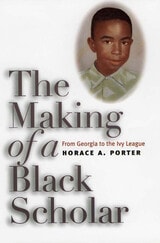
The Making of a Black Scholar
From Georgia to the Ivy LeagueHorace A. Porter
University of Iowa Press, 2003
The Making of a Black Scholar is structured around schools. Porter attends Georgia's segregated black schools until he enters the privileged world of Amherst College. He graduates (spending one semester at Morehouse College) and moves on to graduate study at Yale. He starts his teaching career at Detroit's Wayne State University and spends the 1980s at Dartmouth College and the 1990s at Stanford University.
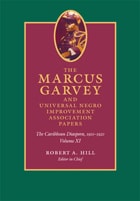
The Marcus Garvey and Universal Negro Improvement Association Papers, Volume XI
The Caribbean Diaspora, 1910–1920Marcus Garvey
Duke University Press, 2011
Praise for the Previous Volumes:
“The Marcus Garvey and Universal Negro Improvement Association Papers will take its place among the most important records of the Afro-American experience. . . . ‘The Marcus Garvey Papers’ lays the groundwork for a long overdue reassessment of Marcus Garvey and the legacy of racial pride, nationalism and concern with Africa he bequeathed to today’s black community.”—Eric Foner, the New York Times Book Review
“Until the publication of The Marcus Garvey and Universal Negro Improvement Association Papers, many of the documents necessary for a full assessment of Garvey’s thought or of his movement’s significance have not been easily accessible. Robert A. Hill and his staff . . . have gathered over 30,000 documents from libraries and other sources in many countries. . . . The Garvey papers will reshape our understanding of the history of black nationalism and perhaps increase our understanding of contemporary black politics.”—Clayborne Carson, the Nation
“Now is our chance, through these important volumes, to finally begin to come to terms with the significance of Garvey’s complex, fascinating career and the meaning of the movement he built.”—Lawrence W. Levine, the New Republic
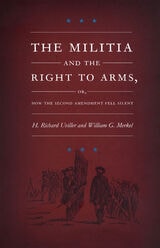
The Militia and the Right to Arms, or, How the Second Amendment Fell Silent
H. Richard Uviller and William G. Merkel
Duke University Press, 2002
—Amendment II, United States Constitution
The Second Amendment is regularly invoked by opponents of gun control, but H. Richard Uviller and William G. Merkel argue the amendment has nothing to contribute to debates over private access to firearms. In The Militia and the Right to Arms, or, How the Second Amendment Fell Silent, Uviller and Merkel show how postratification history has sapped the Second Amendment of its meaning. Starting with a detailed examination of the political principles of the founders, the authors build the case that the amendment's second clause (declaring the right to bear arms) depends entirely on the premise set out in the amendment's first clause (stating that a well-regulated militia is necessary to the security of a free state). The authors demonstrate that the militia envisioned by the framers of the Bill of Rights in 1789 has long since disappeared from the American scene, leaving no lineal descendants. The constitutional right to bear arms, Uviller and Merkel conclude, has evaporated along with the universal militia of the eighteenth century.
Using records from the founding era, Uviller and Merkel explain that the Second Amendment was motivated by a deep fear of standing armies. To guard against the debilitating effects of militarism, and against the ultimate danger of a would-be Caesar at the head of a great professional army, the founders sought to guarantee the existence of well-trained, self-armed, locally commanded citizen militia, in which service was compulsory. By its very existence, this militia would obviate the need for a large and dangerous regular army. But as Uviller and Merkel describe the gradual rise of the United States Army and the National Guard over the last two hundred years, they highlight the nation's abandonment of the militia ideal so dear to the framers. The authors discuss issues of constitutional interpretation in light of radically changed social circumstances and contrast their position with the arguments of a diverse group of constitutional scholars including Sanford Levinson, Carl Bogus, William Van Alstyne, and Akhil Reed Amar.
Espousing a centrist position in the polarized arena of Second Amendment interpretation, this book will appeal to those wanting to know more about the amendment's relevance to the issue of gun control, as well as to those interested in the constitutional and political context of America's military history.

The Nature Way
Writings from a Western Shoshone ElderCorbin Harney
University of Nevada Press, 2009
Corbin Harney’s long life encompassed remarkable changes in the lives of Native Americans and in the technological and political development of the world. Born into an impoverished Western Shoshone family on the Nevada-Idaho border and orphaned as a newborn, he was brought up by grandparents who taught him the traditional ways of their people and the ancient spiritual beliefs that sustained their culture. As an adult, Harney found his calling as a traditional healer and spiritual leader. Soon he became involved in the Shoshone struggle for civil rights, including their efforts to protect and heal their traditional lands in what became the Nevada Test Site. This involvement led Harney to his eventual role as a leader of the international antinuclear movement.The Nature Way is a rich compendium of Corbin Harney’s experience and wisdom. His account of his life incorporates the tragic history of Native Americans in the Great Basin after the arrival of Euro-Americans, his realization of his own identity as a Native American, and his long study of his people’s traditions and spiritual practices. His summary of the Shoshone and Paiute use of indigenous plants for food and healing highlights their understanding that the Earth and her denizens and products must be respected and protected in order to preserve the connection that all creatures have with sacred Mother Earth. Finally, his account of his role as an antinuclear activist expands on his awareness of the human responsibility to protect the Earth, especially from the extreme danger posed by nuclear technology and nuclear weapons of mass destruction. Corbin Harney’s voice is one of the clearest expressions yet of the values, concerns, and spirituality of contemporary Native America. He offers all of us an eloquent plea that we respect and cooperate with Nature to ensure the survival of the planet.
The New Black Middle Class in the Twenty-First Century
Landry, Bart
Rutgers University Press, 2018
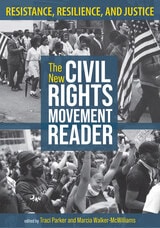
The New Civil Rights Movement Reader
Resistance, Resilience, and JusticeEdited by Traci Parker and Marcia Walker-McWilliams
University of Massachusetts Press, 2023
In the United States, the fight to secure full civil rights for African American people has endured for centuries. The movement has included many voices, among them, working people, charismatic activists, musicians and artists, the LGBTQIA community, veterans, suburbanites, and elected officials. Moving from the labor struggles of the 1930s to the sit-ins and boycotts of midcentury, and the Black Lives Matter protests of today, this expansive volume brings together first-person accounts, political documents and speeches, and historical photographs from each region of the country.
Designed for use in courses and engaging for general readers, this new compilation is the most diverse, most inclusive, and most comprehensive resource available for teaching and learning about the civil rights movement. With chronological and geographical depth, The New Civil Rights Movement Reader addresses a range of key topics, including youth activism, regional and local freedom struggles, voting rights, economic inequality, gender, sexuality, and culture, and the movement’s global reach.

The New Metropolis
Power, Place, and Inequality in Twenty-First-Century AmericaMargaret Weir
University of Chicago Press, 2027
A path-breaking investigation of changing patterns of inequality and contestation in America’s metropolises.
Since 1990, a new political geography of winners and losers has emerged in metros across America. This new metropolis looks nothing like the old. In many exurbs, suburban mansions abut declining towns and distressed communities. In historic central cities, African American communities reel from institutional stripping, even as gentrification and immigration revitalize once forgotten neighborhoods. The New Metropolis considers why, despite all the changes over the past four decades, we have recreated a metropolis that makes it harder for low-income Americans—especially low-income Americans of color—to thrive and why some efforts to promote equitable opportunity succeed against the odds.
With a focus on Chicago, Atlanta, and Houston, The New Metropolis shows how multi-level political actors and translocal networks build power across political boundaries to determine the pool of local public resources and the scope of local powers. Weir demonstrates how the timing of urbanization set up distinct conflicts over the public sector in Frostbelt versus Sunbelt metropolises, explaining how partisan divisions now supercharge these conflicts.
The New Metropolis shows why the battle over the metropolis sits at the center of American politics. It determines the shape of the public arenas where we make decisions and, ultimately, the kinds of connections Americans have with one another.
The New Real
Media and Mimesis in Japan from Stereographs to EmojiJonathan E. Abel
University of Minnesota Press, 2022
Unlocking a vital understanding of how literary studies and media studies overlap and are bound together
A synthetic history of new media reception in modern and contemporary Japan, The New Real positions mimesis at the heart of the media concept. Considering both mimicry and representation as the core functions of mediation and remediation, Jonathan E. Abel offers a new model for media studies while explaining the deep and ongoing imbrication of Japan in the history of new media.
From stereoscopy in the late nineteenth century to emoji at the dawn of the twenty-first, Abel presents a pioneering history of new media reception in Japan across the analog and digital divide. He argues that there are two realities created by new media: one marketed to us through advertising that proclaims better, faster, and higher-resolution connections to the real; and the other experienced by users whose daily lives and behaviors are subtly transformed by the presence and penetration of the content carried through new media. Intervening in contemporary conversations about virtuality, copyright, copycat violence, and social media, each chapter unfolds with a focus on a single medium or technology, including 3D photographs, the phonograph, television, videogames, and emoji.
By highlighting the tendency of the mediated to copy the world and the world to copy the mediated, The New Real provides a new path for analysis of media, culture, and their function in the world.
The New Woman in Alabama
Social Reforms and Suffrage, 1890–1920Mary Martha Thomas
University of Alabama Press, 1992
How Alabama women reshaped public life during the Progressive Era.
Between 1890 and 1920, middle-class white and black Alabama women created many clubs and organizations that took them out of the home and provided them with roles in the public sphere. Beginning with the Alabama Woman’s Christian Temperance Union in the 1880s and followed by the Alabama Federation of Women’s Clubs and the Alabama Federation of Colored Women’s Clubs in the 1890s, women spearheaded the drive to eliminate child labor, worked to improve the educational system, upgraded the jails and prisons, and created reform schools for both boys and girls.
Suffrage was also an item on the Progressive agenda. After a brief surge of activity during the 1890s, the suffrage drive lay dormant until 1912, when women created the Alabama Equal Suffrage Association. During their campaigns in the 1915 and 1919 to persuade the legislature to enfranchise women, the leaders learned the art of politics—how to educate, organize, lobby, and count votes. Women seeking validation for their roles as homemakers and mother demanded a hearing in the political arena for issues that affected them and their families. In the process they began to erase the line between the public world of men and the private world of women. These were the New Women who tackled the problems created by the industrialization and urbanization of the New South. By 1920 Alabama women had created new public spaces for themselves in these voluntary associations. As a consequence of their involvement in reform crusades, the women’s club movement, and the campaign for woman suffrage, women were no longer passive and dependent. They were willing and able to be rightful participants.
Thomas’s book is the first of its kind to focus on the reform activities of women during the Progressive Era, and the first to consider the southern woman and all the organizations of middle-class black and white women in the South and particularly in Alabama. It is also the first to explore the drive of Alabama women to obtain the vote. The development of political power among southern women progressed slowly. Demolishing as it did the myth of the “Southern Lady.” Traditionally confined to the domestic sphere, southern women had no experience in public decision making and were discouraged from attaining the skills necessary for participation in public debate. The division of women by race and class further impeded their political education. But through their participation in so-called women’s issues—child labor laws, temperance, and educational reform—women gained experience in influencing political leaders. Black and white women’s clubs provided the framework for state-wide lobbying.
Only in the wake of their success with domestic issues tackled through club organizations and temperance unions did women dare seek the right to vote. They learned how to wield political power through acceptable “ladylike” avenues, and it was this experience that led to their long but eventually successful drive for woman suffrage. The New Woman eventually found a way to replace the Southern Lady.
The New York Young Lords and the Struggle for Liberation
Darrel Wanzer-Serrano
Temple University Press, 2015
In The New York Young Lords and the Struggle for Liberation, Darrel Wanzer-Serrano details the numerous community initiatives that advanced decolonial sensibilities in El Barrio and beyond. Using archival research and interviews, he crafts an engaging account of the Young Lords’ discourse and activism. He rescues the organization from historical obscurity and makes an argument for its continued relevance, enriching and informing contemporary discussions about Latino/a politics.
The Next Twenty-five Years
Affirmative Action in Higher Education in the United States and South AfricaDavid L. Featherman, Martin Hall, and Marvin Krislov, editors
University of Michigan Press, 2009
"Ambitious, provocative, and wide-ranging, this rich collection of essays from U.S. and South African perspectives reflects the thinking of thoughtful advocates of affirmative action."
---William G. Bowen, President Emeritus, The Andrew W. Mellon Foundation, and President Emeritus, Princeton University
"Thoughtful commentary from outstanding experts on affirmative action’s future in two countries struggling to overcome a legacy of racial injustice."
---Derek Bok, 300th Anniversary University Research Professor, and President Emeritus, Harvard University
"An enormously important comparative study and reflection on affirmative (U.S.) and corrective (South Africa) action with exhaustive and sensitive treatment of a vital topic."
---Kader Asmal, Professor of Law, University of the Western Cape, Cape Town, and former Minister of Education, South Africa
A penetrating exploration of affirmative action's continued place in 21st-century higher education, The Next Twenty-five Years assembles the viewpoints of some of the most influential scholars, educators, university leaders, and public officials. Its comparative essays span the political spectrum and dissect debates in two nations to elucidate the legal, political, social, economic, and moral dimensions of affirmative action in higher education and its role in contributing to a just, equitable, and vital society.
David L. Featherman is Professor of Sociology and Psychology and Founding Director of the Center for Advancing Research and Solutions for Society at the University of Michigan.
Martin Hall is Vice-Chancellor of the University of Salford, Greater Manchester, and previously was Deputy Vice-Chancellor at the University of Cape Town.
Marvin Krislov is President of Oberlin College and previously was Vice President and General Counsel at the University of Michigan.
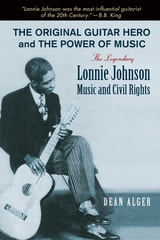
The Original Guitar Hero and the Power of Music
The Legendary Lonnie Johnson, Music, and Civil RightsDean Alger
University of North Texas Press, 2014
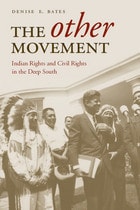
The Other Movement
Indian Rights and Civil Rights in the Deep SouthDenise E. Bates
University of Alabama Press, 2022
Examines the most visible outcome of the Southern Indian Rights Movement: state Indian affairs commissions
In recalling political activism in the post-World War II South, rarely does one consider the political activities of American Indians as they responded to desegregation, the passing of the Civil Rights Acts, and the restructuring of the American political party system. Native leaders and activists across the South created a social and political movement all their own, which drew public attention to the problems of discrimination, poverty, unemployment, low educational attainment, and poor living conditions in tribal communities.
While tribal-state relationships have historically been characterized as tense, most southern tribes—particularly non-federally recognized ones—found that Indian affairs commissions offered them a unique position in which to negotiate power. Although individual tribal leaders experienced isolated victories and generated some support through the 1950s and 1960s, the creation of the inter-tribal state commissions in the 1970s and 1980s elevated the movement to a more prominent political level. Through the formalization of tribal-state relationships, Indian communities forged strong networks with local, state, and national agencies while advocating for cultural preservation and revitalization, economic development, and the implementation of community services.
This book looks specifically at Alabama and Louisiana, places of intensive political activity during the civil rights era and increasing Indian visibility and tribal reorganization in the decades that followed. Between 1960 and 1990, U.S. census records show that Alabama’s Indian population swelled by a factor of twelve and Louisiana’s by a factor of five. Thus, in addition to serving as excellent examples of the national trend of a rising Indian population, the two states make interesting case studies because their Indian commissions brought formerly disconnected groups, each with different goals and needs, together for the first time, creating an assortment of alliances and divisions.
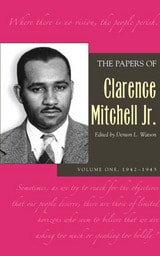
The Papers of Clarence Mitchell Jr., Volume I
1942–1943Clarence Mitchell Jr.
Ohio University Press, 2005
Clarence Mitchell Jr. was the driving force in the movement for passage of civil rights laws in America. The foundation for Mitchell’s struggle was laid during his tenure at the Fair Employment Practice Committee, where he led implementation of President Roosevelt’s policy barring racial discrimination in employment in the national defense and war industry programs. Mitchell’s FEPC reports and memoranda chart the beginning of the modern civil rights movement.
The first two volumes of a projected five-volume documentary edition of The Papers of Clarence Mitchell Jr. illuminate the FEPC’s work as a federal affirmative-action agency and the government’s struggle to enforce the nation’s antidiscrimination policy in industry, federal agencies, and labor unions.
Subsequent volumes will trace Mitchell’s successive enlistment of seven presidents in establishing and enforcing a permanent national nondiscrimination policy. Through his efforts, Congress passed the 1957, 1960, and 1964 Civil Rights Acts prohibiting discrimination in public accommodations, federal spending, and employment based on race, color, sex, and national origin; the 1965 Voting Rights Act; and the 1968 Fair Housing Act.
Editor Denton L. Watson introduces and annotates Mitchell’s writings, providing context and insight for students and scholars of civil rights history, government, law, and sociology.
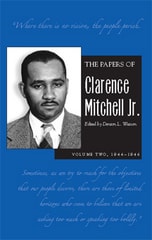
The Papers of Clarence Mitchell Jr., Volume II
1944–1946Clarence Mitchell Jr.
Ohio University Press, 2005
Clarence Mitchell Jr. was the driving force in the movement for passage of civil rights laws in America. The foundation for Mitchell’s struggle was laid during his tenure at the Fair Employment Practice Committee, where he led implementation of President Roosevelt’s policy barring racial discrimination in employment in the national defense and war industry programs. Mitchell’s FEPC reports and memoranda chart the beginning of the modern civil rights movement.
The first two volumes of a projected five-volume documentary edition of The Papers of Clarence Mitchell Jr. illuminate the FEPC’s work as a federal affirmative-action agency and the government’s struggle to enforce the nation’s antidiscrimination policy in industry, federal agencies, and labor unions.
Subsequent volumes will trace Mitchell’s successive enlistment of seven presidents in establishing and enforcing a permanent national nondiscrimination policy. Through his efforts, Congress passed the 1957, 1960, and 1964 Civil Rights Acts prohibiting discrimination in public accommodations, federal spending, and employment based on race, color, sex, and national origin; the 1965 Voting Rights Act; and the 1968 Fair Housing Act.
Editor Denton L. Watson introduces and annotates Mitchell’s writings, providing context and insight for students and scholars of civil rights history, government, law, and sociology.
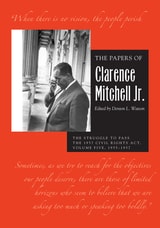
The Papers of Clarence Mitchell Jr., Volume V
The Struggle to Pass the 1957 Civil Rights Act, 1955–1958Clarence Mitchell Jr.
Ohio University Press, 2021
Volume V of The Papers of Clarence Mitchell Jr. records the successful effort to pass the 1957 Civil Rights Act: the first federal civil rights legislation since 1875.
Prior to the US Supreme Court’s landmark 1954 decision in Brown v. Board of Education, the NAACP had faced an impenetrable wall of opposition from southerners in Congress. Basing their assertions on the court’s 1896 “separate but equal” decision in Plessy v. Ferguson, legislators from the South maintained that their Jim Crow system was nondiscriminatory and thus constitutional. In their view, further civil rights laws were unnecessary. In ruling that legally mandated segregation of public schools was unconstitutional, the Brown decision demolished the southerners’ argument. Mitchell then launched the decisive stage of the struggle to pass modern civil rights laws.
The passage of the Civil Rights Act of 1957 was the first comprehensive lobbying campaign by an organization dedicated to that purpose since Reconstruction. Coming on the heels of the Brown decision, the 1957 law was a turning point in the struggle to accord Black citizens full equality under the Constitution. The act’s passage, however, was nearly derailed in the Senate by southern opposition and Senator Strom Thurmond’s record-setting filibuster, which lasted more than twenty-four hours. Congress later weakened several provisions of the act but—crucially—it broke a psychological barrier to the legislative enactment of such measures.
The Papers of Clarence Mitchell Jr. is a detailed record of the NAACP leader’s success in bringing the legislative branch together with the judicial and executive branches to provide civil rights protections during the twentieth century.
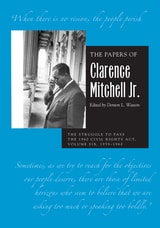
The Papers of Clarence Mitchell Jr., Volume VI
The Struggle to Pass the 1960 Civil Rights Act, 1959–1960Clarence Mitchell Jr.
Ohio University Press, 2021
The Civil Rights Act of 1960 aimed to close loopholes in its 1957 predecessor that had allowed continued voter disenfranchisement for African Americans and for Mexicans in Texas.
In early 1959, the newly seated Eighty-Sixth Congress had four major civil rights bills under consideration. Eventually consolidated into the 1960 Civil Rights Act, their purpose was to correct the weaknesses in the 1957 law. Mitchell’s papers from 1959 to 1960 show the extent to which congressional resistance to the passage of meaningful civil rights laws contributed to the lunch counter sit-ins in Greensboro, North Carolina, and to subsequent demonstrations. The papers reveal how the repercussions of these events affected the NAACP’s work in Washington and how, despite their dislike of demonstrations, NAACP officials used them to intensify the civil rights struggle.
Among the act’s seven titles were provisions authorizing federal inspection of local voter registration rolls and penalties for anyone attempting to interfere with voters on the basis of race or color. The law extended the powers of the US Commission on Civil Rights and broadened the legal definition of the verb to vote to encompass all elements of the process: registering, casting a ballot, and properly counting that ballot. Ultimately, Mitchell considered the 1960 act unsuccessful because Congress had failed to include key amendments that would have further strengthened the 1957 act. In the House, representatives used parliamentary tactics to stall employment protections, school desegregation, poll-tax elimination, and other meaningful civil rights reforms. The fight would continue.
The Papers of Clarence Mitchell Jr. series is a detailed record of the NAACP leader’s success in bringing the legislative branch together with the judicial and executive branches to provide civil rights protections during the twentieth century.
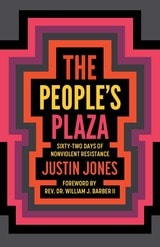
The People’s Plaza
Sixty-Two Days of Nonviolent ResistanceJustin Jones
Vanderbilt University Press, 2022
Central to the occupation was Justin Jones, a student of Fisk University and Vanderbilt Divinity School whose place at the forefront of the protests brought him and the occupation to the attention of the Tennessee state troopers, state and US senators, and Governor Bill Lee. The result was two months of solidarity in the face of rampant abuse, community in the face of state-sponsored terror, and standoff after standoff at the doorsteps of the people's house with those who claimed to represent them. In this, his first book, Jones describes those two revolutionary months of nonviolent resistance against a police state that sought to dehumanize its citizens.
The People's Plaza is a rumination on the abuse of power, and a vision of a more just, equitable, anti-racist Nashville—a vision that kept Jones and those with him posted on the plaza through intense heat, unprovoked arrests, vandalism, theft, and violent suppression. It is a first-person account of hope, a statement of intent, and a blueprint for nonviolent resistance in the American South and elsewhere.
The People’s Plaza
Sixty-Two Days of Nonviolent ResistanceJustin Jones
Vanderbilt University Press, 2022
Central to the occupation was Justin Jones, a student of Fisk University and Vanderbilt Divinity School whose place at the forefront of the protests brought him and the occupation to the attention of the Tennessee state troopers, state and US senators, and Governor Bill Lee. The result was two months of solidarity in the face of rampant abuse, community in the face of state-sponsored terror, and standoff after standoff at the doorsteps of the people's house with those who claimed to represent them. In this, his first book, Jones describes those two revolutionary months of nonviolent resistance against a police state that sought to dehumanize its citizens.
The People's Plaza is a rumination on the abuse of power, and a vision of a more just, equitable, anti-racist Nashville—a vision that kept Jones and those with him posted on the plaza through intense heat, unprovoked arrests, vandalism, theft, and violent suppression. It is a first-person account of hope, a statement of intent, and a blueprint for nonviolent resistance in the American South and elsewhere.
The Perils and Prospects of Southern Black Leadership
Gordon Blaine Hancock, 1884–1970Raymond Gavins
Duke University Press, 1993
The Piracy Crusade
How the Music Industry's War on Sharing Destroys Markets and Erodes Civil LibertiesAram Sinnreich
University of Massachusetts Press, 2013
In the decade and a half since Napster first emerged, forever changing the face of digital culture, the claim that “internet pirates killed the music industry” has become so ubiquitous that it is treated as common knowledge. Piracy is a scourge on legitimate businesses and hard-working artists, we are told, a “cybercrime” similar to identity fraud or even terrorism.
In The Piracy Crusade, Aram Sinnreich critiques the notion of “piracy” as a myth perpetuated by today's cultural cartels—the handful of companies that dominate the film, software, and especially music industries. As digital networks have permeated our social environment, they have offered vast numbers of people the opportunity to experiment with innovative cultural and entrepreneurial ideas predicated on the belief that information should be shared widely. This has left the media cartels, whose power has historically resided in their ability to restrict the flow of cultural information, with difficult choices: adapt to this new environment, fight the changes tooth and nail, or accept obsolescence. Their decision to fight has resulted in ever stronger copyright laws and the aggressive pursuit of accused infringers.
Yet the most dangerous legacy of this “piracy crusade” is not the damage inflicted on promising start-ups or on well-intentioned civilians caught in the crosshairs of file-sharing litigation. Far more troubling, Sinnreich argues, are the broader implications of copyright laws and global treaties that sacrifice free speech and privacy in the name of combating the phantom of piracy—policies that threaten to undermine the foundations of democratic society.
The Political Geographies of Pregnancy
Laura R. Woliver
University of Illinois Press, 2002
A searing study of how modern reproductive politics shapes women's bodily agency
Pregnancy indisputably takes place within a woman's body. But as reproductive power finds its way into the hands of medical professionals, lobbyists, and policymakers, the geographies of pregnancy are shifting, and the boundaries need to be redrawn, argues Laura R. Woliver. The Political Geographies of Pregnancy is a vigorous analysis of the ways modern reproductive politics are shaped by long-standing debates on abortion and adoption, surrogacy arrangements, new reproductive technologies, medical surveillance, and the mapping of the human genome.
Across a politically charged backdrop of reproductive issues, Woliver exposes strategies that claim to uphold the best interests of children, families, and women but in reality complicate women's struggles to have control over their own bodies. Utilizing feminist standpoint theory and promoting a feminist ethic of care, Woliver looks at abortion politics, modern adoption laws that cater to male-headed families, regulations that allow the state to monitor pregnant women but not always provide care for them, and the power structures behind the seemingly benign world of egg-selling and surrogate parenting. She also considers the potentially staggering political implications of mapping the human genome, and the exclusion of women's perspectives in discussions about legislation and advancements in reproductive technologies.
The Political Use of Racial Narratives
School Desegregation in Mobile, Alabama, 1954-97Richard A. Pride
University of Illinois Press, 2002
Exploring who benefits and who pays when different narratives are accepted as true, Pride offers a step-by-step account of how Mobile's culture changed each time a new and more forceful narrative was used to justify inequality. More than a retelling of Mobile's story of desegregation, The Political Use of Racial Narratives promotes the value of rhetorical and narrative analysis in the social sciences and history.
The Politics of Rights
Lawyers, Public Policy, and Political ChangeStuart A. Scheingold
University of Michigan Press, 2004
"Scheingold presents a clear, thoughtful discussion of the ways in which rights can both empower and constrain those seeking change in American society. While much of the writing on rights is abstract and obscure, The Politics of Rights stands out as an accessible and engaging discussion."
-Gerald N. Rosenberg, University of Chicago
"This book has already exerted an enormous influence on two generations of scholars. It has had an enormous influence on political scientists, sociologists, and anthropologists, as well as historians and legal scholars. With this new edition, this influence is likely to continue for still more generations. The Politics of Rights has, I believe, become an American classic."
-Malcolm Feeley, Boalt Hall School of Law, University of California, Berkeley, from the foreword
Stuart A. Scheingold is Professor Emeritus of Political Science at the University of Washington.
The Politics of Same-Sex Marriage
Edited by Craig A. Rimmerman and Clyde Wilcox
University of Chicago Press, 2007
Same-sex marriage emerged in 2004 as one of the hottest issues of the campaign season. But in a severe blow to gay rights advocates, all eleven states that had the issue on the ballot passed amendments banning the practice, and the subject soon dropped off the media’s radar. This pattern of waxing and waning in the public eye has characterized the debate over same-sex marriage since 1996 and the passing of the Defense of Marriage Act. Since then, court rulings and local legislatures have kept the issue alive in the political sphere, and conservatives and gay rights advocates have made the issue a key battlefield in the culture wars.
The Politics of Same-Sex Marriage brings together an esteemed list of scholars to explore all facets of this heated issue, including the ideologies and strategies on both sides of the argument, the public’s response, the use of the issue in political campaigns, and how same-sex marriage fits into the broad context of policy cycles and windows of political opportunity. With comprehensive coverage from a variety of different approaches, this volume will be a vital sourcebook for activists, politicians, and scholars alike.
The Power of the Badge
Sheriffs and Inequality in the United StatesEmily M. Farris and Mirya R. Holman
University of Chicago Press, 2024
A sobering exploration of the near unchecked power of sheriffs in the United States.
Across the United States, more than 3,000 sheriffs occupy a unique position in the US political and legal systems. Elected by voters—usually in low-visibility, noncompetitive elections—sheriffs oversee more than a third of law enforcement employees and control almost all local jails. They have the power to both set and administer policies, and they can imprison, harm, and even kill members of their communities. Yet, they enjoy a degree of autonomy not seen by other political officeholders.
The Power of the Badge offers an unprecedented, data-rich look into the politics of the office and its effects on local communities. Emily M. Farris and Mirya R. Holman draw on two surveys of sheriffs taken nearly a decade apart, as well as election data, case studies, and administrative data to show how a volatile combination of authority and autonomy has created an environment where sheriffs rarely change; elections seldom create meaningful accountability; employees, budgets, and jails can be used for political gains; marginalized populations can be punished; and reforms fail. Farris and Holman also track the increasingly close linkages between sheriffs and right-wing radical groups in an era of high partisanship and intra-federal conflict.
The Power to Heal
Civil Rights, Medicare, and the Struggle to Transform America's Health Care SystemDavid Barton Smith
Vanderbilt University Press, 2016
The book draws the reader into the struggles of the unsung heroes of the transformation, black medical leaders whose stubborn courage helped shape the larger civil rights movement. They demanded an end to federal subsidization of discrimination in the form of Medicare payments to hospitals that embraced the "separate but equal" creed that shaped American life during the Jim Crow era. Faced with this pressure, the Kennedy and Johnson Administrations tried to play a cautious chess game, but that game led to perhaps the biggest gamble in the history of domestic policy. Leaders secretly recruited volunteer federal employees to serve as inspectors, and an invisible army of hospital workers and civil rights activists to work as agents, making it impossible for hospitals to get Medicare dollars with mere paper compliance. These triumphs did not come without casualties, yet the story offers lessons and hope for realizing this transformational dream.
This book is the recipient of the Norman L. and Roselea J. Goldberg Prize from Vanderbilt University Press for the best book in the area of medicine.
The Price of Misfortune
Rights and Wrongs in Indebted AmericaDaniel Platt
University of Chicago Press, 2023
What can be taken from someone who has borrowed money and cannot repay? What do the victims of misfortune owe to their lenders, and what can they keep for themselves? The answers to those questions, immensely important for debtors, creditors, and society at large, have changed over time. The Price of Misfortune examines the cause of debtors’ rights in the modern United States and the struggles of reformers who fought to establish financial freedoms in law.
Daniel Platt shows how, in the wake of the Civil War, a range of advocates drew potent analogies between slavery, imprisonment for debt, and the experiences of wage garnishment and property foreclosure. He traces the ways those analogies were used to campaign for bold new protections for debtors, keeping them secure in their labor, property, and personhood. Yet, as Platt demonstrates, those reforms tended to assume as their ideal borrower someone who was white, propertied, and male. In subsequent decades, the emancipatory promise of debtors’ rights would be tested as women, wage earners, and African Americans seized on their language to challenge other structural inequalities: the dependency of marriage, the exploitation of industrial capitalism, and the oppression of Jim Crow. By reconstructing these forgotten developments—and recovering the experiences of indebted farmwives, sharecroppers, and wage workers—The Price of Misfortune narrates a new history of inequality, coercion, and law amid the early financialization of American capitalism.
The Price of Racial Reconciliation
Ronald W. Walters
University of Michigan Press, 2008
“In The Price of Racial Reconciliation, Ronald Walters offers an abundance of riches. This book provides an extraordinarily comprehensive and persuasive set of arguments for reparations, and will be the lens through which meaningful opportunities for reconciliation are viewed in the future. If this book does not lead to the success of the reparations movement, nothing will.”
—Charles J. Ogletree, Jesse Climenko Professor of Law, Harvard Law School
“The Price of Racial Reconciliation is a seminal study of comparative histories and race(ism) in the formation of state structures that prefigure(d) socioeconomic positions of Black peoples in South Africa and the United States. The scholarship is meticulous in brilliantly constructed analysis of the politics of memory, reparations as an immutable principle of justice, imperative for nonracial(ist) democracy, and a regime of racial reconciliation.”
—James Turner, Professor of African and African American Studies and Founder, Africana Studies and Research Center, Cornell University
“A fascinating and pathbreaking analysis of the attempt at racial reconciliation in South Africa which asks if that model is relevant to the contemporary American racial dilemma. An engaging multidisciplinary approach relevant to philosophy, sociology, history, and political science.”
—William Strickland, Associate Professor of Political Science, W.E.B. Du Bois Department of Afro-American Studies, University of Massachusetts Amherst
The issue of reparations in America provokes a lot of interest, but the public debate usually occurs at the level of historical accounting: “Who owes what for slavery?” This book attempts to get past that question to address racial restitution within the framework of larger societal interests. For example, the answer to the “why reparations?” question is more than the moral of payment for an injustice done in the past. Ronald Walters suggests that, insofar as the impact of slavery is still very much with us today and has been reinforced by forms of postslavery oppression, the objective of racial harmony will be disrupted unless it is recognized with the solemnity and amelioration it deserves. The author concludes that the grand narrative of black oppression in the United States—which contains the past and present summary of the black experience—prevents racial reconciliation as long as some substantial form of racial restitution is not seriously considered. This is “the price” of reconciliation.
The method for achieving this finding is grounded in comparative politics, where the analyses of institutions and political behaviors are standard approaches. The author presents the conceptual difficulties involved in the project of racial reconciliation by comparing South African Truth and Reconciliation and the demand for reparations in the United States.
Ronald Walters is Distinguished Leadership Scholar and Director, African American Leadership Program and Professor of Government and Politics, University of Maryland.
The Queen of America Goes to Washington City
Essays on Sex and CitizenshipLauren Berlant
Duke University Press, 1997
As Berlant traces the guiding images of U.S. citizenship through the process of privatization, she discusses the ideas of intimacy that have come to define national culture. From the fantasy of the American dream to the lessons of Forrest Gump, Lisa Simpson to Queer Nation, the reactionary culture of imperilled privilege to the testimony of Anita Hill, Berlant charts the landscape of American politics and culture. She examines the consequences of a shrinking and privatized concept of citizenship on increasing class, racial, sexual, and gender animosity and explores the contradictions of a conservative politics that maintains the sacredness of privacy, the virtue of the free market, and the immorality of state overregulation—except when it comes to issues of intimacy.
Drawing on literature, the law, and popular media, The Queen of America Goes to Washington City is a stunning and major statement about the nation and its citizens in an age of mass mediation. As it opens a critical space for new theory of agency, its narratives and gallery of images will challenge readers to rethink what it means to be American and to seek salvation in its promise.