425 books match the query 'Ethics' and 116 start with t
cover of The Journal of Clinical Ethics, volume 35 number 1 (Spring 2024)

The Journal of Clinical Ethics, volume 35 number 1 (Spring 2024)

The University of Chicago Press

University of Chicago Press Journals, 2024
This is volume 35 issue 1 of The Journal of Clinical Ethics. The Journal of Clinical Ethics is uniquely focused on ethical issues that arise in direct patient care, in the clinic and at the bedside, as well as with related issues and challenges in the broader practice of medicine, healthcare delivery, and best practices. The journal engages with issues of primary concern to physicians and patients—and families—and all members of the clinical team, including allied professionals in ethics consultation, as well as scholars and professionals in diverse disciplines and care-related practices: philosophy, law, theology, public and health policy, nursing, and organizational ethics.
[more]
cover of The Journal of Clinical Ethics, volume 35 number 2 (Summer 2024)

The Journal of Clinical Ethics, volume 35 number 2 (Summer 2024)

The University of Chicago Press

University of Chicago Press Journals, 2024
This is volume 35 issue 2 of The Journal of Clinical Ethics. The Journal of Clinical Ethics is uniquely focused on ethical issues that arise in direct patient care, in the clinic and at the bedside, as well as with related issues and challenges in the broader practice of medicine, healthcare delivery, and best practices. The journal engages with issues of primary concern to physicians and patients—and families—and all members of the clinical team, including allied professionals in ethics consultation, as well as scholars and professionals in diverse disciplines and care-related practices: philosophy, law, theology, public and health policy, nursing, and organizational ethics.
[more]
cover of The Journal of Clinical Ethics, volume 35 number 3 (Fall 2024)

The Journal of Clinical Ethics, volume 35 number 3 (Fall 2024)

The University of Chicago Press

University of Chicago Press Journals, 2024
This is volume 35 issue 3 of The Journal of Clinical Ethics. The Journal of Clinical Ethics is uniquely focused on ethical issues that arise in direct patient care, in the clinic and at the bedside, as well as with related issues and challenges in the broader practice of medicine, healthcare delivery, and best practices. The journal engages with issues of primary concern to physicians and patients—and families—and all members of the clinical team, including allied professionals in ethics consultation, as well as scholars and professionals in diverse disciplines and care-related practices: philosophy, law, theology, public and health policy, nursing, and organizational ethics.
[more]
cover of The Journal of Clinical Ethics, volume 35 number 4 (Winter 2024)

The Journal of Clinical Ethics, volume 35 number 4 (Winter 2024)

The University of Chicago Press

University of Chicago Press Journals, 2024
This is volume 35 issue 4 of The Journal of Clinical Ethics. The Journal of Clinical Ethics is uniquely focused on ethical issues that arise in direct patient care, in the clinic and at the bedside, as well as with related issues and challenges in the broader practice of medicine, healthcare delivery, and best practices. The journal engages with issues of primary concern to physicians and patients—and families—and all members of the clinical team, including allied professionals in ethics consultation, as well as scholars and professionals in diverse disciplines and care-related practices: philosophy, law, theology, public and health policy, nursing, and organizational ethics.
[more]
cover of The Journal of Clinical Ethics, volume 36 number 1 (Spring 2025)

The Journal of Clinical Ethics, volume 36 number 1 (Spring 2025)

The University of Chicago Press

University of Chicago Press Journals, 2025
This is volume 36 issue 1 of The Journal of Clinical Ethics. The Journal of Clinical Ethics is uniquely focused on ethical issues that arise in direct patient care, in the clinic and at the bedside, as well as with related issues and challenges in the broader practice of medicine, healthcare delivery, and best practices. The journal engages with issues of primary concern to physicians and patients—and families—and all members of the clinical team, including allied professionals in ethics consultation, as well as scholars and professionals in diverse disciplines and care-related practices: philosophy, law, theology, public and health policy, nursing, and organizational ethics.
[more]
cover of The Journal of Clinical Ethics, volume 36 number 2 (Summer 2025)

The Journal of Clinical Ethics, volume 36 number 2 (Summer 2025)

The University of Chicago Press

University of Chicago Press Journals, 2025
This is volume 36 issue 2 of The Journal of Clinical Ethics. The Journal of Clinical Ethics is uniquely focused on ethical issues that arise in direct patient care, in the clinic and at the bedside, as well as with related issues and challenges in the broader practice of medicine, healthcare delivery, and best practices. The journal engages with issues of primary concern to physicians and patients—and families—and all members of the clinical team, including allied professionals in ethics consultation, as well as scholars and professionals in diverse disciplines and care-related practices: philosophy, law, theology, public and health policy, nursing, and organizational ethics.
[more]
cover of The Journal of Clinical Ethics, volume 36 number 3 (Fall 2025)

The Journal of Clinical Ethics, volume 36 number 3 (Fall 2025)

The University of Chicago Press

University of Chicago Press Journals, 2025
This is volume 36 issue 3 of The Journal of Clinical Ethics. The Journal of Clinical Ethics is uniquely focused on ethical issues that arise in direct patient care, in the clinic and at the bedside, as well as with related issues and challenges in the broader practice of medicine, healthcare delivery, and best practices. The journal engages with issues of primary concern to physicians and patients—and families—and all members of the clinical team, including allied professionals in ethics consultation, as well as scholars and professionals in diverse disciplines and care-related practices: philosophy, law, theology, public and health policy, nursing, and organizational ethics.
[more]
cover of The Journal of Clinical Ethics, volume 36 number 4 (Winter 2025)

The Journal of Clinical Ethics, volume 36 number 4 (Winter 2025)

The University of Chicago Press

University of Chicago Press Journals, 2025
This is volume 36 issue 4 of The Journal of Clinical Ethics. The Journal of Clinical Ethics is uniquely focused on ethical issues that arise in direct patient care, in the clinic and at the bedside, as well as with related issues and challenges in the broader practice of medicine, healthcare delivery, and best practices. The journal engages with issues of primary concern to physicians and patients—and families—and all members of the clinical team, including allied professionals in ethics consultation, as well as scholars and professionals in diverse disciplines and care-related practices: philosophy, law, theology, public and health policy, nursing, and organizational ethics.
[more]
cover of The Journal of Clinical Ethics, volume 37 number 1 (Spring 2026)

The Journal of Clinical Ethics, volume 37 number 1 (Spring 2026)

The University of Chicago Press

University of Chicago Press Journals, 2026
This is volume 37 issue 1 of The Journal of Clinical Ethics. The Journal of Clinical Ethics is uniquely focused on ethical issues that arise in direct patient care, in the clinic and at the bedside, as well as with related issues and challenges in the broader practice of medicine, healthcare delivery, and best practices. The journal engages with issues of primary concern to physicians and patients—and families—and all members of the clinical team, including allied professionals in ethics consultation, as well as scholars and professionals in diverse disciplines and care-related practices: philosophy, law, theology, public and health policy, nursing, and organizational ethics.
[more]
cover of The Journal of Clinical Ethics, volume 37 number 2 (Summer 2026)

The Journal of Clinical Ethics, volume 37 number 2 (Summer 2026)

The University of Chicago Press

University of Chicago Press Journals, 2026
This is volume 37 issue 2 of The Journal of Clinical Ethics. The Journal of Clinical Ethics is uniquely focused on ethical issues that arise in direct patient care, in the clinic and at the bedside, as well as with related issues and challenges in the broader practice of medicine, healthcare delivery, and best practices. The journal engages with issues of primary concern to physicians and patients—and families—and all members of the clinical team, including allied professionals in ethics consultation, as well as scholars and professionals in diverse disciplines and care-related practices: philosophy, law, theology, public and health policy, nursing, and organizational ethics.
[more]
cover of The Journal of Clinical Ethics, volume 37 number 3 (Fall 2026)

The Journal of Clinical Ethics, volume 37 number 3 (Fall 2026)

The University of Chicago Press

University of Chicago Press Journals, 2026

This is volume 37 issue 3 of The Journal of Clinical Ethics. The Journal of Clinical Ethics is uniquely focused on ethical issues that arise in direct patient care, in the clinic and at the bedside, as well as with related issues and challenges in the broader practice of medicine, healthcare delivery, and best practices. The journal engages with issues of primary concern to physicians and patients—and families—and all members of the clinical team, including allied professionals in ethics consultation, as well as scholars and professionals in diverse disciplines and care-related practices: philosophy, law, theology, public and health policy, nursing, and organizational ethics.
[more]
cover of The Last Physician: Walker Percy and the Moral Life of Medicine

The Last Physician

Walker Percy and the Moral Life of Medicine

Carl Elliott and John Lantos, eds.

Duke University Press, 1999

Walker Percy brought to his novels the perspective of both a doctor and a patient. Trained as a doctor at Columbia University, he contracted tuberculosis during his internship as a pathologist at Bellevue Hospital and spent the next three years recovering, primarily in TB sanitoriums. This collection of essays explores not only Percy’s connections to medicine but also the underappreciated impact his art has had—and can have—on medicine itself.
The contributors—physicians, philosophers, and literary critics—examine the relevance of Percy’s work to current dilemmas in medical education and health policy. They reflect upon the role doctors and patients play in his novels, his family legacy of depression, how his medical background influenced his writing style, and his philosophy of psychiatry. They contemplate the private ways in which Percy’s work affected their own lives and analyze the author’s tendency to contrast the medical-scientific worldview with a more spiritual one. Assessing Percy’s stature as an author and elucidating the many ways that reading and writing can combine with diagnosing and treating to offer an antidote to despair, they ask what it means to be a doctor, a writer, and a seeker of cures and truths—not just for the body but for the malaise and diseased spirituality of modern times.
This collection will appeal to lovers of literature as well as medical professionals—indeed, anyone concerned with medical ethics and the human side of doctoring.

Contributors. Robert Coles, Brock Eide, Carl Elliott, John D. Lantos, Ross McElwee, Richard Martinez, Martha Montello, David Schiedermayer, Jay Tolson, Bertram Wyatt-Brown, Laurie Zoloth-Dorfman

[more]
cover of The Law of Love: From Autonomy to Communion

The Law of Love

From Autonomy to Communion

Stephen F. Brett, SSJ

University of Scranton Press, 2010

With an interdisciplinary combination of philosophy, theology, and family law, The Law of Love explores the impact of secular conceptions of autonomy on sexuality and family. Drawing from the thought of Aristotle, Cicero, Augustine, Aquinas, and the modern theologian Servais Pinckaers, Stephen F. Brett argues that the divorce of freedom from virtue has caused cultural relativism, and that a potent and healthy mix of temperance, chastity, and modesty is the antidote. Styled accessibly and quite cleverly with a broader audience in mind, The Law of Love will appeal to intellectuals of all faiths who are interested in facing the ambiguities and problems of contemporary life in a secularized society.
[more]
cover of The Liberalism of Care: Community, Philosophy, and Ethics

The Liberalism of Care

Community, Philosophy, and Ethics

Shawn C. Fraistat

University of Chicago Press, 2021

Attention to care in modern society has fallen out of view as an ethos of personal responsibility, free markets, and individualism has taken hold. The Liberalism of Care argues that contemporary liberalism is suffering from a crisis of care, manifest in a decaying sense of collective political responsibility for citizens’ well-being and for the most vulnerable members of our communities. Political scientist Shawn C. Fraistat argues that we have lost the political language of care, which, prior the nineteenth century, was commonly used to express these dimensions of political life.

To recover that language, Fraistat turns to three prominent philosophers—Plato, Jean-Jacques Rousseau, and William Godwin—who illuminate the varied ways caring language and caring values have structured core debates in the history of Western political thought about the proper role of government, as well as the rights and responsibilities of citizens. The Liberalism of Care presents a distinctive vision for our liberal politics where political communities and citizens can utilize the ethic and practices of care to face practical challenges.
[more]
cover of The Limits of Heroism: Homer and the Ethics of Reading

The Limits of Heroism

Homer and the Ethics of Reading

Mark Buchan

University of Michigan Press, 2005

The plots of Homeric poems depend upon the uncertainty of Odysseus and Achilles getting what they want, while the endings imply that getting what one wants may itself be a disaster. By examining specific episodes of the Odyssey, Mark Buchan illustrates the centrality of hazard and doubt to decision-making, and argues that such uncertainty affects not only the heroes themselves, but also the world around them. Buchan goes on to introduce the paradoxes of female desire in the poems, uncovering the ways that female desire at once upholds and threatens the poems' heroic male ideology. Finally, The Limits of Heroism questions the interplay between desire and ideals of heroism, and finds that the poems critique the very ideology that motivates their heroes.
[more]
cover of The Love Surgeon: A Story of Trust, Harm, and the Limits of Medical Regulation

The Love Surgeon

A Story of Trust, Harm, and the Limits of Medical Regulation

Sarah B. Rodriguez

Rutgers University Press, 2020

Dr. James Burt believed women’s bodies were broken, and only he could fix them. In the 1950s, this Ohio OB-GYN developed what he called “love surgery,” a unique procedure he maintained enhanced the sexual responses of a new mother, transforming her into “a horny little house mouse.” Burt did so without first getting the consent of his patients. Yet he was allowed to practice for over thirty years, mutilating hundreds of women in the process.

It would be easy to dismiss Dr. Burt as a monstrous aberration, a modern-day Dr. Frankenstein. Yet as medical historian Sarah Rodriguez reveals, that’s not the whole story. The Love Surgeon asks tough questions about Burt’s heinous acts and what they reveal about the failures of the medical establishment: How was he able to perform an untested surgical procedure? Why wasn’t he obliged to get informed consent from his patients? And why did it take his peers so long to take action?

The Love Surgeon is both a medical horror story and a cautionary tale about the limits of professional self-regulation.
[more]
cover of The Lublin Lectures and Works on Max Scheler

The Lublin Lectures and Works on Max Scheler

Karol Wojtyla

Catholic University of America Press, 2023
The Catholic University of America Press is honored to publish the English Critical Edition of the Works of Karol Wojtyła/John Paul II. Under the auspices of an international editorial board, the English Critical Edition will comprise more than 20 volumes, covering all of John Paul’s writings and correspondence in the years before and during his papacy. This collection is essential for several reasons. For one thing, gaining access to the saint’s writings has posed a significant challenge. Except for official papal addresses and documents preserved and disseminated by the Vatican, St. John Paul’s works have been scattered and limited. Many documents need a new translation. Finally, English-language audiences have faced the challenge, even in the case of published texts of dealing with several languages, various translations, and textual idiosyncrasies. The second volume of the series presents Wojtyła’s lectures at the Catholic University of Lublin and his works on Max Scheler. This volume consists of three parts: Karol Wojtyła’s lectures at the Lublin University from 1954 to 1957 (during three academic years); Wojtyła’s articles related to the ethical issues discussed in the Lublin lectures, and his habilitation thesis on Max Scheler from 1953 with other essays related more closely to Scheler’s thought. As was the case with Volume 1, Volume 2 also relies on the original manuscripts and typescripts of Wojtyła’s works. These original texts were compared with the Polish published editions, and the significant differences between them were marked in the scholarly apparatus. Some of the essays in this volume were never published in English, others were never published before.
[more]
cover of The Matter of Evil: From Speculative Realism to Ethical Pessimism

The Matter of Evil

From Speculative Realism to Ethical Pessimism

Drew M. Dalton

Northwestern University Press, 2024

A provocative and entirely new account of ethical reasoning that reconceives the traditional understanding of ethical action negatively

In this radical reconsideration of ethical reasoning in contemporary European philosophy, Drew M. Dalton makes the case for an absolutely grounded account of ethical normativity developed from a scientifically informed and purely materialistic metaphysics. Expanding on speculative realist arguments, Dalton argues that the limits placed on the nature of ethical judgments by Kant’s critique can be overcome through a moral evaluation of the laws of nature—specifically, the entropic principle that undergirds the laws of physics, chemistry, and biology. In order to extract a moral meaning from this simple material fact, Dalton scrutinizes the presumptions of classical accounts and traditional understandings of good and evil within the history of Western philosophy and ultimately asserts that ethical normativity can be reestablished absolutely without reverting to dogmatism.

By overturning our assumptions about the nature and value of reality, The Matter of Evil: From Speculative Realism to Ethical Pessimism presents a provocative new model of ethical responsibility that is both logically justifiable and scientifically sound. Dalton argues for “ethical pessimism,” a position previously marginalized in the West, as a means to cultivate an account of ethical responsibility and political activism that takes seriously the unbecoming of being and the moral horror of existence.
[more]
cover of The Modern Age

The Modern Age

James V. Schall

St. Augustine's Press, 2011
[more]
cover of The Morality of Everyday Life: Rediscovering an Ancient Alternative to the Liberal Tradition

The Morality of Everyday Life

Rediscovering an Ancient Alternative to the Liberal Tradition

Thomas Fleming

University of Missouri Press, 2007

In TheMorality of Everyday Life, Thomas Fleming offers an alternative to the enlightened liberalism espoused by thinkers as different as Kant, Mill, Rand, and Rawls. Philosophers in the liberal tradition, although they disagree on many important questions, agree that moral and political problems should be looked at from an objective point of view and a decision made from a rational perspective that is universally applied to all comparable cases.

Fleming instead places importance on the particular, the local, and moral complexity.  He advocates a return to premodern traditions, such as those exemplified in the texts of Aristotle, the Talmud, and the folk wisdom in ancient Greek literature, for a solution to ethical predicaments. In his view, liberalism and postmodernism ignore the fact that human beings by their very nature refuse to live in a world of universal abstractions.

While such modern philosophers as Kant and Kohlberg have regarded a mother’s self-sacrificing love for her children as beneath their level of morality, folk wisdom tells us it is nearly the highest morality, taking precedence over the duties of citizenship or the claims of humanity. Fleming believes that a modern type of “casuistry” should be applied to these moral conflicts in which the line between right and wrong is rarely clear.

This volume will appeal to students of ethics and classics, as well as the general educated reader, who will appreciate Fleming’s jargon-free prose. Teachers will find this text useful because each chapter is a self-contained essay that could be used as the basis for classroom discussion.   

[more]
cover of The Natural Law: A Beginner's Thomistic Guide

The Natural Law

A Beginner's Thomistic Guide

Steven J. Jensen

Catholic University of America Press, 2025
Drawing upon the timeless wisdom of Thomas Aquinas, The Natural Law offers clear insights into perplexing ethical dilemmas. The compelling conclusions of Aquinas emerge through a critical examination of contemporary ethical frameworks including moral relativism, utilitarianism, and Machiavellian politics. In part one, which elucidates the core principles of natural law ethics, the reader will discover fundamental truths underpinning the concepts of right and wrong, which are rooted in the very fabric of our humanity. Part two navigates the ethics of harm, grappling with contentious issues such as capital punishment, just war, and self-defense, while at the same time addressing moral quandaries like sacrificing one life in order to save another. This section also resolves thorny practical questions surrounding human actions. How can we tell the difference between an action and its consequences? How do we determine exactly what it means to kill another person? Part three ventures into the intricacies of human societies. The reader will explore the importance of authority and rules in guiding social interactions, from the nurturing bonds of the family to the shifting complexities of political society. The principles examined will shed light upon controversial topics within sexual ethics, such as transgenderism, faithful spousal intimacy, and cloning. The Natural Law invites readers on an engaging journey of critical inquiry. By challenging prevailing assumptions and provoking self-reflection, it will reshape your understanding of ethics and human nature, ultimately revealing your role and purpose within the universe.
[more]
cover of The Ontology of Becoming and the Ethics of Particularity

The Ontology of Becoming and the Ethics of Particularity

M. C. Dillon

Ohio University Press, 2012

M. C. Dillon (1938–2005) was widely regarded as a world-leading Merleau-Ponty scholar. His book Merleau-Ponty’s Ontology (1988) is recognized as a classic text that revolutionized the philosophical conversation about the great French phenomenologist. Dillon followed that book with two others: Semiological Reductionism, a critique of early-1990s linguistic reductionism, and Beyond Romance, a richly developed theory of love. At the time of his death, Dillon had nearly completed two further books to which he was passionately committed. The first one offers a highly original interpretation of Nietzsche’s ontology of becoming. The second offers a detailed ethical theory based on Merleau-Ponty’s account of carnal intersubjectivity. The Ontology of Becoming and the Ethics of Particularity collects these two manuscripts written by a distinguished philosopher at the peak of his powers—manuscripts that, taken together, offer a distinctive and powerful view of human life and ethical relations.

[more]
cover of The Origins of Bioethics: Remembering When Medicine Went Wrong

The Origins of Bioethics

Remembering When Medicine Went Wrong

John A. Lynch

Michigan State University Press, 2019

The Origins of Bioethics argues that what we remember from the history of medicine and how we remember it are consequential for the identities of doctors, researchers, and patients in the present day. Remembering when medicine went wrong calls people to account for the injustices inflicted on vulnerable communities across the twentieth century in the name of medicine, but the very groups empowered to create memorials to these events often have a vested interest in minimizing their culpability for them. Sometimes these groups bury this past and forget events when medical research harmed those it was supposed to help. The call to bioethical memory then conflicts with a desire for “minimal remembrance” on the part of institutions and governments. The Origins of Bioethics charts this tension between bioethical memory and minimal remembrance across three cases—the Tuskegee Syphilis Study, the Willowbrook Hepatitis Study, and the Cincinnati Whole Body Radiation Study—that highlight the shift from robust bioethical memory to minimal remembrance to forgetting.
[more]
cover of The Perspective of Morality: Philosophical Foundations of Thomistic Virtue Ethics

The Perspective of Morality

Philosophical Foundations of Thomistic Virtue Ethics

Martin Rhonheimer

Catholic University of America Press, 2011

The Perspective of the Acting Person introduces readers to one of the most important and provocative thinkers in contemporary moral philosophy
[more]
cover of The Philosophical Papers of Alan Donagan, Volume 1: Historical Understanding and the History of Philosophy

The Philosophical Papers of Alan Donagan, Volume 1

Historical Understanding and the History of Philosophy

Alan Donagan

University of Chicago Press, 1994

A major voice in late twentieth-century philosophy, Alan Donagan is distinguished for his theories on the history of philosophy and the nature of morality. The Philosophical Papers of Alan Donagan, volumes 1 and 2, collect 28 of Donagan's most important and best-known essays on historical understanding and ethics from 1957 to 1991.

Volume 1 includes essays on Spinoza, Descartes, Bradley, Collingwood, Russell, Moore, and Popper, as well as two previously unpublished papers on the history of philosophy as a discipline, and on Ryle and Wittgenstein's nature of philosophy. Linked by Donagan's commitment to the central importance of history for philosophy and his interest in problems of historical understanding, these essays represent the remarkable scope of Donagan's thought.
[more]
cover of The Philosophical Papers of Alan Donagan, Volume 2: Action, Reason, and Value

The Philosophical Papers of Alan Donagan, Volume 2

Action, Reason, and Value

Alan Donagan

University of Chicago Press, 1994

A major voice in late twentieth-century philosophy, Alan Donagan is distinguished for his theories on the history of philosophy and the nature of morality. The Philosophical Papers of Alan Donagan, volumes 1 and 2, collect 28 of Donagan's most important and best-known essays on historical understanding and ethics from 1957 to 1991.

Volume 2 addresses issues in the philosophy of action and moral theory. With papers on Kant, von Wright, Sellars, and Chisholm, this volume also covers a range of questions in applied ethics—from the morality of Truman's decision to drop atomic bombs on Hiroshima and Nagasaki to ethical questions in medicine and law.

[more]
cover of The Pinckaers Reader: Renewing Thomistic Moral Theology

The Pinckaers Reader

Renewing Thomistic Moral Theology

Servais Pinckaers O.P.

Catholic University of America Press, 2005
The first collection of its kind available in any language, this volume features the twenty most significant essays written by Pinckaers since his highly praised Sources.
[more]
cover of The Postgenomic Condition: Ethics, Justice, and Knowledge after the Genome

The Postgenomic Condition

Ethics, Justice, and Knowledge after the Genome

Jenny Reardon

University of Chicago Press, 2017

Now that we have sequenced the human genome, what does it mean? In The Postgenomic Condition, Jenny Reardon critically examines the decade after the Human Genome Project, and the fundamental questions about meaning, value and justice this landmark achievement left in its wake.

Drawing on more than a decade of research—in molecular biology labs, commercial startups, governmental agencies, and civic spaces—Reardon demonstrates how the extensive efforts to transform genomics from high tech informatics practiced by a few to meaningful knowledge beneficial to all exposed the limits of long-cherished liberal modes of knowing and governing life. Those in the American South challenged the value of being included in genomics when no hospital served their community.  Ethicists and lawyers charged with overseeing Scottish DNA and data questioned how to develop a system of ownership for these resources when their capacity to create things of value—new personalized treatments—remained largely unrealized. Molecular biologists who pioneered genomics asked whether their practices of thinking could survive the deluge of data produced by the growing power of sequencing machines. While the media is filled with grand visions of precision medicine, The Postgenomic Condition shares these actual challenges of the scientists, entrepreneurs, policy makers, bioethicists, lawyers, and patient advocates who sought to leverage liberal democratic practices to render genomic data a new source of meaning and value for interpreting and caring for life. It brings into rich empirical focus the resulting hard on-the-ground questions about how to know and live on a depleted but data-rich, interconnected yet fractured planet, where technoscience garners significant resources, but deeper questions of knowledge and justice urgently demand attention.

[more]
cover of The Professional Guinea Pig: Big Pharma and the Risky World of Human Subjects

The Professional Guinea Pig

Big Pharma and the Risky World of Human Subjects

Roberto Abadie

Duke University Press, 2010
The Professional Guinea Pig documents the emergence of the professional research subject in Phase I clinical trials testing the safety of drugs in development. Until the mid-1970s Phase I trials were conducted on prisoners. After that practice was outlawed, the pharmaceutical industry needed a replacement population and began to aggressively recruit healthy, paid subjects, some of whom came to depend on the income, earning their living by continuously taking part in these trials. Drawing on ethnographic research among self-identified “professional guinea pigs” in Philadelphia, Roberto Abadie examines their experiences and views on the conduct of the trials and the risks they assume by participating. Some of the research subjects he met had taken part in more than eighty Phase I trials. While the professional guinea pigs tended to believe that most clinical trials pose only a moderate health risk, Abadie contends that the hazards presented by continuous participation, such as exposure to potentially dangerous drug interactions, are discounted or ignored by research subjects in need of money. The risks to professional guinea pigs are also disregarded by the pharmaceutical industry, which has become dependent on the routine participation of experienced research subjects. Arguing that financial incentives compromise the ethical imperative for informed consent to be freely given by clinical-trials subjects, Abadie confirms the need to reform policies regulating the participation of paid subjects in Phase I clinical trials.
[more]
cover of The Province of Piety: Moral History in Hawthorne's Early Tales

The Province of Piety

Moral History in Hawthorne's Early Tales

Michael J. Colacurcio

Duke University Press, 1995

In this celebrated analysis of Nathaniel Hawthorne, Michael J. Colacurcio presents a view of the author as America’s first significant intellectual historian. Colacurcio shows that Hawthorne’s fiction responds to a wide range of sermons, pamphlets, and religious tracts and debates—a variety of moral discourses at large in the world of provincial New England.
Informed by comprehensive historical research, the author shows that Hawthorne was steeped in New England historiography, particularly the sermon literature of the seventeenth century. But, as Colacurcio shows, Hawthorne did not merely borrow from the historical texts he deliberately studied; rather, he is best understood as having written history. In The Province of Piety, originally published in 1984 (Harvard University Press), Hawthorne is seen as a moral historian working with fictional narratives—a writer brilliantly involved in examining the moral and political effects of Puritanism in America and recreating the emotional and cultural contexts in which earlier Americans had lived.
[more]
cover of The Rhetoric of Morality and Philosophy: Plato's Gorgias and Phaedrus

The Rhetoric of Morality and Philosophy

Plato's Gorgias and Phaedrus

Seth Benardete

University of Chicago Press, 1991

The Rhetoric of Morality and Philosophy, one of the most groundbreaking works of twentieth-century Platonic studies, is now back in print for a new generation of students and scholars to discover. In this volume, distinguished classicist Seth Benardete interprets and pairs two important Platonic dialogues, the Gorgias and the Phaedrus, illuminating Socrates’ notion of rhetoric and Plato’s conception of morality and eros in the human soul.

            Following his discussion of the Gorgias as a dialogue about the rhetoric of morality, Benardete turns to the Phaedrus as a discourse about genuine rhetoric, namely the science of eros, or true philosophy. This novel interpretation addresses numerous issues in Plato studies: the relation between the structure of the Gorgias and the image of soul/city in the Republic, the relation between the structure of Phaedrus and the concept of eros, and Socrates’ notion of ignorance, among others.

[more]
cover of The Right to Die with Dignity: An Argument in Ethics, Medicine, and Law

The Right to Die with Dignity

An Argument in Ethics, Medicine, and Law

Cohen-Almagor, Raphael

Rutgers University Press, 2001

There are few issues more divisive than what has become known as “the right to die.” One camp upholds “death with dignity,” regarding the terminally ill as autonomous beings capable of forming their own judgment on the timing and process of dying. The other camp advocates “sanctity of life,” regarding life as intrinsically valuable, and that should be sustained as long as possible. Is there a right answer?

Raphael Cohen-Almagor takes a balanced approach in analyzing this emotionally charged debate, viewing the dispute from public policy and international perspectives. He offers an interdisciplinary, compelling study in medicine, law, religion, and ethics. It is a comprehensive look at the troubling question of whether physician-assisted suicide should be allowed. Cohen-Almagor delineates a distinction between active and passive euthanasia and discusses legal measures that have been invoked in the United States and abroad. He outlines reasons non-blood relatives should be given a role in deciding a patient’s last wishes. As he examines euthanasia policies in the Netherlands and the 1994 Oregon Death with Dignity Act, the author suggests amendments and finally makes a circumscribed plea for voluntary physician-assisted suicide.
[more]
cover of The Rise of Common-Sense Conservatism: The American Right and the Reinvention of the Scottish Enlightenment

The Rise of Common-Sense Conservatism

The American Right and the Reinvention of the Scottish Enlightenment

Antti Lepistö

University of Chicago Press, 2021

In the years following the election of Donald Trump—a victory that hinged on the votes of white Midwesterners who were both geographically and culturally distant from the media’s coastal concentrations—there has been a flurry of investigation into the politics of the so-called “common man.” The notion that the salt-of-the-earth purity implied by this appellation is best understood by conservative politicians is no recent development, though. As Antti Lepistö shows in his timely and erudite book, the intellectual wellsprings of conservative “common sense” discourse are both older and more transnational than has been thought.

In considering the luminaries of American neoconservative thought—among them Irving Kristol, Gertrude Himmelfarb, James Q. Wilson, and Francis Fukuyama—Lepistö argues that the centrality of their conception of the common man accounts for the enduring power and influence of their thought. Intriguingly, Lepistö locates the roots of this conception in the eighteenth-century Scottish Enlightenment, revealing how leading neoconservatives weaponized the ideas of Adam Smith, Thomas Reid, and David Hume to denounce postwar liberal elites, educational authorities, and social reformers. Their reconfiguration of Scottish Enlightenment ideas ultimately gave rise to a defining force in modern conservative politics: the common sense of the common man. Whether twenty-first-century politicians who invoke the grievances of “the people” are conscious of this unusual lineage or not, Lepistö explains both the persistence of the trope and the complicity of some conservative thinkers with the Trump regime.

[more]
cover of The Rose and Geryon

The Rose and Geryon

Gabriella I. Baika

Catholic University of America Press, 2014
The Rose and Geryon examines patterns of verbal behavior in works by Jean de Meun and Dante (with a focus on the Romance of the Rose and the Divine Comedy) in relationship with the most influential systems of verbal sins in the Middle Ages, systems elaborated by William Peraldus, Thomas Aquinas, Domenico Cavalca, and Laurent of Orléans. The book begins with a presentation of these four systems, and from there proceeds to analyze Jean de Meun's Testament as a possible source of influence for the Divine Comedy and take a closer look at Dante's prose works in search for a comprehensive theory of sinful speech. Furthermore Baika discusses verbal transgressions such as flattery, evil counsel, double talk, sowing of discord, and falsifying of words, under the heading Lingua dolosa "The Guileful Tongue," and the relationship between violence and the poetic discourse. The myriad ways in which the two iconic poets of medieval France and Italy absorb the tradition of peccata linguae in their works prove that abusive speech was not the exclusive sphere of interest of the ecclesiastical writers; secular poetry in the vernacular enriched in original ways the medieval debate on verbal vices. The Rose and Geryon addresses scholars and students of French and Italian literatures, as well as readers interested in ethics and women's studies.
[more]
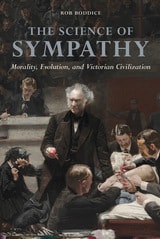
cover of The Science of Sympathy: Morality, Evolution, and Victorian Civilization

The Science of Sympathy

Morality, Evolution, and Victorian Civilization

Rob Boddice

University of Illinois Press, 2016

In his Descent of Man, Charles Darwin placed sympathy at the crux of morality in a civilized human society. His idea buttressed the belief that white, upper-class, educated men deserved their sense of superiority by virtue of good breeding. It also implied that societal progress could be steered by envisioning a new blueprint for sympathy that redefined moral actions carried out in sympathy's name. Rob Boddice joins a daring intellectual history of sympathy to a portrait of how the first Darwinists defined and employed it. As Boddice shows, their interpretations of Darwin's ideas sparked a cacophonous discourse intent on displacing previous notions of sympathy. Scientific and medical progress demanded that "cruel" practices like vivisection and compulsory vaccination be seen as moral for their ultimate goal of alleviating suffering. Some even saw the so-called unfit--natural targets of sympathy--as a danger to society and encouraged procreation by the "fit" alone. Right or wrong, these early Darwinists formed a moral economy that acted on a new system of ethics, reconceptualized obligations, and executed new duties. Boddice persuasively argues that the bizarre, even dangerous formulations of sympathy they invented influence society and civilization in the present day.
[more]
cover of The Scope of Morality

The Scope of Morality

Peter A. French

University of Minnesota Press, 1980

The Scope of Morality was first published in 1980. Minnesota Archive Editions uses digital technology to make long-unavailable books once again accessible, and are published unaltered from the original University of Minnesota Press editions.

The scope of morality, Peter A. French contends, is much narrower than many traditional and contemporary works in ethical theory suggest. We trivialize morality if we think it has something to say about everything we do; it touches us all, but not at all times.

This essay in philosophical ethics focuses upon the origin, purpose, and function of the various concepts to be found in a more or less mature morality. The author draws a distinction between moral concepts that arise from an individual's wish to live a worthwhile life and those directed towards the development of virtue in the moral community. Moral concepts, in his view, are subjective creations of human beings rather than laws with an objective basis in nature. The ethics of sociobiology, of the lifeboat and spaceship models, and of game theory all come under his critical eye in this useful and progressive work. The Scope of Morality, says Hector-Neri Castaneda, "represents a serious effort at discussing the nature of morality, taking into account the most important contributions of recent writers."

[more]
cover of The Search for Society: Quest for a Biosocial Science and Morality

The Search for Society

Quest for a Biosocial Science and Morality

Fox, Robin

Rutgers University Press, 1989
 .
[more]
cover of The Social Medicine Reader, Volume I, Third Edition: Ethics and Cultures of Biomedicine

The Social Medicine Reader, Volume I, Third Edition

Ethics and Cultures of Biomedicine

Jonathan Oberlander, Mara Buchbinder, Larry R. Churchill, Sue E. Estroff, Nancy M. King, Barry F. Saunders, Ronald P. Strauss, and Rebecca L. Walker, editors

Duke University Press, 2019

The extensively updated and revised third edition of the bestselling Social Medicine Reader provides a survey of the challenging issues facing today's health care providers, patients, and caregivers by bringing together moving narratives of illness, commentaries by physicians, debates about complex medical cases, and conceptually and empirically based writings by scholars in medicine, the social sciences, and the humanities.

Volume 1, Ethics and Cultures of Biomedicine, contains essays, case studies, narratives, fiction, and poems that focus on the experiences of illness and of clinician-patient relationships. Among other topics the contributors examine the roles and training of professionals alongside the broader cultures of biomedicine; health care; experiences and decisions regarding death, dying, and struggling to live; and particular manifestations of injustice in the broader health system. The Reader is essential reading for all medical students, physicians, and health care providers.
[more]
cover of The Socratic Paradox and Its Enemies

The Socratic Paradox and Its Enemies

Roslyn Weiss

University of Chicago Press, 2006
In The Socratic Paradox and Its Enemies, Roslyn Weiss argues that the Socratic paradoxes—no one does wrong willingly, virtue is knowledge, and all the virtues are one—are best understood as Socrates’ way of combating sophistic views: that no one is willingly just, those who are just and temperate are ignorant fools, and only some virtues (courage and wisdom) but not others (justice, temperance, and piety) are marks of true excellence.  
         
In Weiss’s view, the paradoxes express Socrates’ belief that wrongdoing fails to yield the happiness that all people want; it is therefore the unjust and immoderate who are the fools. The paradoxes thus emerge as Socrates’ means of championing the cause of justice in the face of those who would impugn it. Her fresh approach—ranging over six of Plato’s dialogues—is sure to spark debate in philosophy, classics, and political theory.
           
 “Regardless of whether one agrees or disagrees with Weiss, it would be hard not to admire her extraordinarily penetrating analysis of the many overlapping and interweaving arguments running through the dialogues.”—Daniel B. Gallagher, Classical Outlook
 
“Many scholars of Socratic philosophy . . . will wish they had written Weiss's book, or at least will wish that they had long ago read it.”—Douglas V. Henry, Review of Politics
[more]
cover of The Sources of Christian Ethics

The Sources of Christian Ethics

Servais Pinckaers

Catholic University of America Press, 2013
First published in 1985 as Les sources de la morale chrétienne by University Press Fribourg, this work has been recognized by scholars worldwide as one of the most important books in the field of moral theology
[more]
cover of The Subject and Other Subjects: On Ethical, Aesthetic, and Political Identity

The Subject and Other Subjects

On Ethical, Aesthetic, and Political Identity

Tobin Siebers

University of Michigan Press, 1998

The Subject and Other Subjects theorizes the differences among ethical, aesthetic, and political conceptions of identity. When a person is called beautiful, why does it strike us as an objectification? Is a person whom we consider to be an exemplary person still a person, and not an example? Can one person conceive what it means to have the perspective of a community? This study treats these thorny issues in the context of recent debates in cultural studies, feminism, literary criticism, narrative theory, and moral philosophy concerning the nature and directions of multiculturalism, post-modernity, and sexual politics.
Tobin Siebers raises a series of questions that "cross the wires" among ethical, aesthetic, and political definitions of the self, at once exposing our basic assumptions about these definitions and beginning the work of reconceiving them. The Subject and Other Subjects will broaden our ideas about the strange interplay between subjects and objects (and other subjects!) that characterizes modern identity, and so provoke lively debate among anthropologists, art historians, literary theorists, philosophers, and others concerned with how the question of the subject becomes entangled with ethics, aesthetics, and politics. As Siebers argues, the subject is in fact a tangled network of subjectivities, a matrix of identities inconceivable outside of symbols and stories.
Tobin Siebers is Professor of English at the University of Michigan, and author of Cold War Criticism and the Politics of Skepticism; Morals and Stories; The Ethics of Criticism; The Romantic Fantastic; and The Mirror of Medusa.
[more]
cover of The Tanner Lectures Vol 26

The Tanner Lectures Vol 26

Peterson, Grethe B

University of Utah Press, 2006

The Tanner Lectures on Human Values, founded July 1, 1978, at Clare Hall, Cambridge University, was established by the American scholar, industrialist, and philanthropist Obert Clark Tanner. Lectureships are awarded to outstanding scholars or leaders in broadly defined fields of human values, and transcend ethnic, national, religious, or ideological distinctions. Volume 26 features lectures given by Stephen Breyer, Carl Bildt, Axel Honneth, Paul Farmer, and Avishai Margalit.
[more]
cover of The Tanner Lectures on Human Values: Volume 33

The Tanner Lectures on Human Values

Volume 33

Mark Matheson

University of Utah Press, 2014

The Tanner Lectures on Human Values, founded July 1, 1978, at Clare Hall, Cambridge University, was established by the American scholar, industrialist, and philanthropist Obert Clark Tanner. Lectureships are awarded to outstanding scholars or leaders in broadly defined fields of human values and transcend ethnic, national, religious, or ideological distinctions. Volume 33 features lectures given during the academic year 2012-2013 at Stanford University; the University of Michigan; the University of Oxford; the University of California, Berkeley; Harvard University; the University of Utah; and the U.S. Ambassador’s Palace, Paris, France.
 
William G. Bowen, “Costs and Productivity in Higher Education” and “Prospects for an Online Fix: Can We Harness Technology in the Service of Our Aspirations?”
 
Craig Calhoun, “The Problematic Public: Revisiting Dewey, Arendt, and Habermas”
 
Michael Ignatieff, “Representation and Responsibility: Ethics and Public Office”
 
F. M. Kamm, “Who Turned the Trolley?” and “How Was the Trolley Turned?”
 
Claude Lanzmann, “Resurrection”
 
Robert Post, “Representative Democracy: The Constitutional Theory of Campaign Finance Reform” and “Campaign Finance Reform and the First Amendment”
 
Michael J. Sandal, “The Moral Economy of Speculation: Gambling, Finance, and the Common Good”
[more]
cover of The Theory of Morality

The Theory of Morality

Alan Donagan

University of Chicago Press, 1977

"Let us . . . nominate this the most important theoretical work on ethical or moral theory since John Rawls's Theory of Justice. If you have philosophical inclinations and want a good workout, this conscientious scrutiny of moral assumptions and expressions will be most rewarding. Donagan explores ways of acting in the Hebrew-Christian context, examines them in the light of natural law and rational theories, and proposes that formal patterns for conduct can emerge. All this is tightly reasoned, the argument is packed, but the language is clear."—Christian Century

"The man value of this book seems to me to be that it shows the force of the Hebrew-Christian moral tradition in the hands of a creative philosopher. Throughout the book, one cannot but feel that a serious philosopher is trying to come to terms with his religious-moral background and to defend it against the prevailing secular utilitarian position which seems to dominate academic philosophy."—Bernard Gert, Journal of Medicine and Philosophy
[more]
cover of The Ties That Bind

The Ties That Bind

Julius M. Moravcsik

Central European University Press, 2004

This book, like in classical times of Plato and Aristotle, treats individual and communal ethics as intertwined. At its heart lies the quartet of respect, concern for welfare of others, trust, and care as the basic communal ties. The community needs to be built on these. Acquisition and practice of other values and goods are within the frame of the four underlying "pillars." The four basic notions are attitudes and as such consist of both rational and emotional elements. Thus our ethics is neither based purely on sentiment nor purely on reason. As such they will yield us guidelines, to be filled in contextually, not rigid rule systems. Moravcsik's proposal for ethics is pluralistic but not relativistic. It does not deny some objective ground for sound communal life, but leaves many alternatives within which the four basic ties can be implemented.
[more]
cover of The Trace of Judaism: Dostoevsky, Babel, Mandelstam, Levinas

The Trace of Judaism

Dostoevsky, Babel, Mandelstam, Levinas

Val Vinokur

Northwestern University Press, 2009

Recipient, 2008 Guggenheim Fellowship

The defining quality of Russian literature, for most critics, is its ethical seriousness expressed through formal originality. The Trace of Judaism addresses this characteristic through the thought of the Lithuanian-born Franco-Jewish philosopher Emmanuel Levinas. Steeped in the Russian classics from an early age, Levinas drew significantly from Dostoevsky in his ethical thought. One can profitably read Russian literature through Levinas, and vice versa.
 
Vinokur links new readings of Fyodor Dostoevsky, Isaac Babel, and Osip Mandelstam to the work of Levinas, to ask: How does Judaism haunt Russian literature? In what ways is Levinas' ethics as "Russian" as it is arguably "Jewish"? And more broadly, how do ethics and aesthetics inflect each other? Vinokur considers how the encounter with the other invokes responsibilities ethical and aesthetic, and shows how the volatile relationship between ethics and aesthetics--much like the connection between the Russian and Jewish traditions--may be inextricably symbiotic. In an ambitious work that illuminates the writings of all of these authors, Vinokur pursues the implications of this reading for our understanding of the function of literature--its unique status as a sphere in which an ethical vision such as that of Levinas becomes comprehensible.
[more]
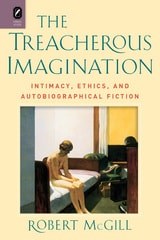
cover of The Treacherous Imagination: Intimacy, Ethics, and Autobiographical Fiction

The Treacherous Imagination

Intimacy, Ethics, and Autobiographical Fiction

Robert McGill

The Ohio State University Press, 2013
Many authors have been accused of betraying their loved ones by turning them into fictional characters. In The Treacherous Imagination, Robert McGill examines the ethics of writing such stories. He argues that while fiction has long appealed to readers with its narratives of private life, contemporary autobiographical fiction channels a widespread ambivalence about the value of telling all in a confessional age—an age in which fiction has an unprecedented power to leave people feeling libeled or exposed when they recognize themselves in it.
Observing that the interests of authors and their loved ones in such cases are often less divergent than they appear, McGill assess strategies by which both parties might use fiction not to hurt each other but to revise and revitalize intimacy. Discussing authors such as Philip Roth, Alice Munro, A. S. Byatt, and Hanif Kureishi, McGill questions whether people should always require exclusivity of each other with regard to the stories they tell about private life. Instead, authors and their intimates might jointly embrace fiction’s playful, transgressive qualities, even while reexamining the significance of that fiction’s intimations.
In treating autobiographical fiction as both a willful public indiscretion and a mediator of intimate relations, The Treacherous Imagination provides a comprehensive account of the various potentials that fiction holds to harm and to help those who write it, those who read it, and those who see themselves in it.
[more]
cover of The Virtues

The Virtues

John H. Garvey

Catholic University of America Press, 2022

An ancient question asks what role moral formation ought to play in education. It leads to such questions as, do intellectual and moral formation belong together? Is it possible to form the mind and neglect the heart? Is it wise? These perennial questions take on new significance today, when education — especially, higher education — has become a defining feature in the lives of young people. Throughout his more than 40 years in academia, John Garvey has reflected on the relationship between intellectual and moral formation, especially in Catholic higher education. For 12 years as the President of The Catholic University of America, he made the cultivation of moral virtue a central theme on campus, highlighting its significance across all aspects of University culture, from University policy to campus architecture. During his two decades of presiding at commencement exercises, first as Dean of Boston College Law School and then as President of The Catholic University of America, Garvey made a single virtue the centerpiece of his remarks each year. The Virtues is the fruit of those addresses. More reflective than analytical, its purpose is to invite conversation about what it means to live well. Following Catholic tradition, The Virtues places the theological virtues of faith, hope, and love at the center of the moral life, and the cardinal virtues — justice, temperance, fortitude, and prudence — with them. Alongside these major virtues, Garvey considers a collection of “little virtues,” habits that assist and accompany us in small but important ways on the path to goodness. Though he treats each virtue individually, a common thread unites his reflections. “The intellectual life depends on the moral life,” Garvey writes. “Without virtue we cannot sustain the practices necessary for advanced learning. In fact, without virtue, it’s hard to see what the purpose of the university is. Learning begins with love (for the truth). If we don’t have that, it’s hard to know why we would bother with education at all.” The Virtues invites its readers, especially students, to appreciate that the cultivation of virtue is indispensable to success, academic or otherwise, and more importantly, essential to their ultimate aim, a life well lived.
[more]
cover of The Void of Ethics: Robert Musil and the Experience of Modernity

The Void of Ethics

Robert Musil and the Experience of Modernity

Patrizia McBride

Northwestern University Press, 2006

In a pluralistic society without absolute standards of judgment, how can an individual live a moral life? This is the question Robert Musil (1880-1942), an Austrian-born engineer and mathematician turned writer, asked in essays, plays, and fiction that grapple with the moral ambivalence of modern life. Though unfinished, his monumental novel of Vienna in the febrile days before World War I, The Man without Qualities, is identified by German scholars as the most important literary work of the twentieth century.

In a fresh examination of his essays, notebooks, and fiction, Patrizia McBride reconstructs Musil's understanding of ethics as a realm of experience that eludes language and thought. After situating Musil's work within its contemporary cultural-philosophical horizon, as well as the historical background of rising National Socialism, McBride shows how the writer's notion of ethics as a void can be understood as a coherent and innovative response to the crises haunting Europe after World War I. She explores how Musil rejected the outdated, rationalistic morality of humanism, while simultaneously critiquing the irrationalism of contemporary art movements, including symbolism, impressionism, and expressionism. Her work reveals Musil's remarkable relevance today-particularly those aspects of his thought that made him unfashionable in his own time: a commitment to fighting ethical fundamentalism and a literary imagination that validates the pluralistic character of modern life.
[more]
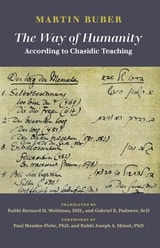
cover of The Way of Humanity: According to Chasidic Teaching

The Way of Humanity

According to Chasidic Teaching

Martin Buber, translated by Rabbi Bernard H. Mehlman, DHL and GabrielE. Padawer, ScD

Central Conference of American Rabbis, 2023

Martin Buber (1878–1965) was one of the most influential Jewish thinkers of the twentieth century. A philosopher, seeker, and nurturer of dialogue, he responded to the complexities of his times by affirming the fullness of interpersonal encounter and the spiritual everyday. In 1947, Buber delivered lectures interpreting six traditional Chasidic stories to a German-speaking audience, published as The Way of Humanity. In the first new English translation in over half a century, Rabbi Bernard H. Mehlman, DHL, and Gabriel E. Padawer, ScD, z"l, bring the work to contemporary readers in a clear, accessible voice. The teachings within highlight the subversion and innovation of the early Chasidic masters of the eighteenth and nineteenth centuries, while providing meaningful spiritual guidance and insight for any seeker today. Scholarly forewords by Paul Mendes-Flohr, PhD, and Rabbi Joseph A. Skloot, PhD, as well as an introduction, epilogue, and notes from the translators, place Buber’s work in historical context. Timeless and enlightening, The Way of Humanity guides us to inner meaning and highlights our human wholeness.

[more]