Results by title
377 books match the query 'French' and 106 start with t
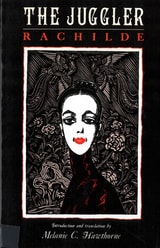
The Juggler
RachildeHawthorne, Melanie C
Rutgers University Press, 1990
The Juggler (La Jongleuse) is a "decadent" novel that was first published in 1900. Its author, Marguerite Vallette-Eymery (1860-1953), who used the pseudonym Rachilde, was a prolific novelist (over sixty works of fiction), playwright, literary critic and reviewer, and a forceful presence in French literary society of her time.
The protagonist of the novel, Eliante Donalger, is in some sense an exaggerated double for her creator--bizarre in appearance, clothing, and interests. Instinctively grasping a medical and psychological truth that the turn-of-the-century scientific world was only beginning to understand, Eliante maintains that there is nothing "natural" about human sexual expression. She claims to be in love with an inanimate (though anthropomorphic and sexually ambiguous) object, a Greek amphora, and the novel traces the rivalry between this faithful partner and an ardent human suitor, a young medical student. It is only through juggling, both literally and metaphorically, that Eliante is able to use her seductive power to maintain desire. The surprise ending challenges the limits of such power in a controversial and surprising twist.
Although Rachilde's work has been neglected in the past, the women's movement and feminist criticism have stimulated renewed interest in her fiction. The Juggler is a major rediscovery.
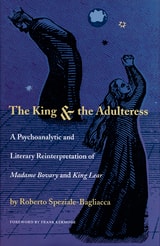
The King and the Adulteress
A Psychoanalytic and Literary Reinterpretation of Madame Bovary and King LearRoberto Speziale-Bagliacca
Duke University Press, 1998
Approaching the characters in Bovary and Lear from both an analytic and a critical viewpoint, Speziale-Bagliacca reinterprets many issues and events that involve archetypal figures of modern literary mythology. In fact, he reverses much of the received opinion about them. Charles Bovary, for example, far from being a victim of his wife’s neurotic restlessness or the epitome of a passive imbecile, is a masochist of the highest order who makes a decisive contribution to Emma’s miserable end. Lear, rather than a tragedy involving the sweet Cordelia, noble Kent, and the Fool as good and loyal supporters of an old king driven to madness by his overbearing evil daughters, is precisely the opposite. The sympathetic understanding of the reader should go, Speziale-Bagliacca suggests, also to Regan, Goneril, and Edmund, while the king, whose crisis is interpreted in the light of psychoanalytic findings on depression, finally becomes the true unbeloved "bastard" of the play.
Roberto Speziale-Bagliacca is a psychoanalyst and Professor of Psychotherapy at the Medical School of the University of Genoa. He is the author of On the Shoulders of Freud and many other works.
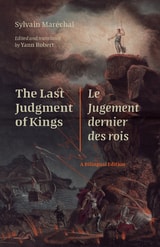
The Last Judgment of Kings / Le Jugement dernier des rois
A Bilingual EditionYann Robert
Bucknell University Press, 2025
Joué pour la première fois le lendemain de l’exécution de Marie-Antoinette, Le Jugement dernier des rois met en scène le procès burlesque des autres rois et reines d’Europe : exhibés et enchaînés tels des animaux, contraints de se battre pour un tonneau de biscuits, et finalement anéantis par l’éruption spectaculaire d’un volcan. Tel est le contexte scandaleux—tragédie et farce à la fois—de la pièce la plus célèbre de la Révolution française, bien connue de tous les spécialistes de cette période. Jusqu’à maintenant, pourtant, il n’existait ni édition critique ni traduction anglaise de cet ouvrage historique. Notre édition bilingue fait revivre la pièce de Maréchal et la replace au centre des plus grands débats chez les historiens de la Révolution, traitant de justice, religion, commémoration, comédie, et propagande. Provocateur, facile à lire, et concis—parfaitement adapté aux étudiants d’un cours de français ou d’histoire—Le Jugement dernier des rois propose ainsi une introduction idéale à la période révolutionnaire et à ses principales controverses.
Published by Bucknell University Press. Distributed worldwide by Rutgers University Press.
The Life of a Simple Man
Emile Guillaumin
University Press of New England, 1982

The Look of the 1960s
Barbarella and Pulp Pop ComicsJan Baetens and Hugo Frey
University of Texas Press, 2026
How the classic aesthetic of 1960s pulp comics influenced art, culture, and politics.
As a form of visual art, comic books rely on a distinct and eye-catching aesthetic. This is especially true of the iconic comics, graphic novels, and illustrations of the 1960s and 1970s. The Look of the 1960s explores the sources of inspiration that influenced the world of comics, beginning with the well-known French comics series Barbarella.
Noted comics scholars Jan Baetens and Hugo Frey analyze the impacts of the often-provocative images featured in the comics of the 1960s, which pushed back against French censorship in a politically tense time, and detail how women resisted their objectification in the comic book industry. Barbarella left its mark on the world and gained international attention, inspiring a movie adaptation and changing the look and content of other popular comics. The “Pulp Pop” movement remains relevant today, continuing to influence the art and political world. With new information about artists and an astute analysis of sociopolitical influence, The Look of the 1960s offers deep insights, making it a must read for comics fans all over the world.
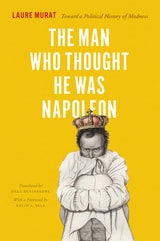
The Man Who Thought He Was Napoleon
Toward a Political History of MadnessLaure Murat
University of Chicago Press, 2014
From those two components, Laure Murat embarks on an exploration of the surprising relationship between history and madness. She uncovers countless stories of patients whose delusions seem to be rooted in the historical or political traumas of their time, like the watchmaker who believed he lived with a new head, his original having been removed at the guillotine. In the troubled wake of the Revolution, meanwhile, French physicians diagnosed a number of mental illnesses tied to current events, from “revolutionary neuroses” and “democratic disease” to the “ambitious monomania” of the Restoration. How, Murat asks, do history and psychiatry, the nation and the individual psyche, interface?
A fascinating history of psychiatry—but of a wholly new sort—The Man Who Thought He Was Napoleon offers the first sustained analysis of the intertwined discourses of madness, psychiatry, history, and political theory.
The Medieval Imagination
Jacques Le Goff
University of Chicago Press, 1988
"Le Goff is one of the most distinguished of the French medieval historians of his generation . . . he has exercised immense influence."—Maurice Keen, New York Review of Books
"The whole book turns on a fascinating blend of the brutally materialistic and the generously imaginative."—Tom Shippey, London Review of Books
"The richness, imaginativeness and sheer learning of Le Goff's work . . . demand to be experienced."—M. T. Clanchy, Times Literary Supplement
The Misfit of the Family
Balzac and the Social Forms of SexualityMichael Lucey
Duke University Press, 2003
The Misfit of the Family is a compelling argument that Balzac must be taken seriously as a major inventor and purveyor of new tools for analyzing connections between the sexual and the social. Lucey’s account of the novelist’s deployment of "sexual misfits" to impel a wide range of his most canonical works—Cousin Pons, Cousin Bette, Eugenie Grandet, Lost Illusions, The Girl with the Golden Eyes—demonstrates how even the flexible umbrella term "queer" barely covers the enormous diversity of erotic and social behaviors of his characters. Lucey draws on the thinking of Michel Foucault and Pierre Bourdieu and engages the work of critics of nineteenth-century French fiction, including Naomi Schor, D. A. Miller, Franco Moretti, and others. His reflections on Proust as Balzac’s most cannily attentive reader suggest how the lines of social and erotic force he locates in Balzac’s work continued to manifest themselves in twentieth-century writing and society.
The New Gods
E. M. Cioran
University of Chicago Press, 1974
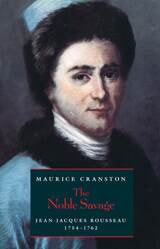
The Noble Savage
Jean-Jacques Rousseau, 1754-1762Maurice Cranston
University of Chicago Press, 1991
"Luckily for us, Maurice Cranston's The Noble Savage: Jean-Jacques Rousseau, 1754-1762 has managed to craft a highly detailed account of eight key years of Rousseau's life in such a way that we can both understand and even, on occasion, sympathize."—Olivier Bernier, Wall Street Journal
Maurice Cranston (1920-1993), a distinguished scholar and recipient of the James Tait Black Memorial Prize for his biography of John Locke, was professor of political science at the London School of Economics. His numerous books include The Romantic Movement and Philosophers and Pamphleteers, and translations of Rousseau's The Social Contract and Discourse on the Origins of Inequality.
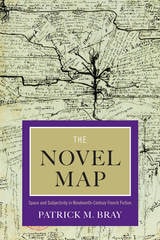
The Novel Map
Space and Subjectivity in Nineteenth-Century French FictionPatrick M. Bray
Northwestern University Press, 2013
Focusing on Stendhal, Gérard de Nerval, George Sand, Émile Zola, and Marcel Proust, The Novel Map: Mapping the Self in Nineteenth-Century French Fiction explores the ways that these writers represent and negotiate the relationship between the self and the world as a function of space in a novel turned map.
With the rise of the novel and of autobiography, the literary and cultural contexts of nineteenth-century France reconfigured both the ways literature could represent subjects and the ways subjects related to space. In the first-person works of these authors, maps situate the narrator within the imaginary space of the novel. Yet the time inherent in the text’s narrative unsettles the spatial self drawn by the maps and so creates a novel self, one which is both new and literary. The novel self transcends the rigid confines of a map. In this significant study, Patrick M. Bray charts a new direction in critical theory.
The Orient of Style
Modernist Allegories of ConversionBeryl Schlossman
Duke University Press, 1991
Toward the end of Remembrance of Things Past, the narrator describes the act of creating a work of art as a conversion of sensation into a spiritual equivalent. By means of such allegories of “conversion,” Schlossman shows, the modernist artist disappeared within the work of art and left behind the trace of his sublime vocation, a vocation in which he was transformed, in Schlossman’s words, “into a kind of priest kneeling at the altar of beauty before the masked divinity of representation.”
The author shows how allegory—the representation of the symbolic as something real—was adapted by modernist writers to reflect subjectivity while masking an authorial origin. She reveals how modernist allegory arose, as Walter Benjamin suggests, at the crossroads of history, sociology, economics, urban architecture, and art—providing a kind of map of capitalism—and was produced through the eyes of a melancholic gazing at a “monument of absence.”
The Poems of Aimeric de Peguilhan
Aimeric de Peguilhan, edited and translated with introduction and commentary by William P. Shepard and Frank M. Chambers
Northwestern University Press, 1950
The Poems of François Villon
François Villon
Brandeis University Press, 1982
The Politics of Play
Oulipo and the Legacy of French Literary LudicsAubrey Gabel
Northwestern University Press, 2026
Showing the political importance of play in postwar French literature
In postwar France, authors approached writing ludically, placing rules and conditions on language and on the context of composition itself. They eliminated “e’s” and feminized texts; they traveled according to strict rules and invented outright silly public personas. The Politics of Play: Oulipo and the Legacy of French Literary Ludics is a comprehensive examination of how and why French authors turned to these ludic methods to grapple with their political moment.
These writers were responding to a range of historical upheavals, from the rise and fall of French feminist and Third-Worldist groups to the aftermath of international socialism both at home, in the former Parisian Belt and in France more broadly, and abroad, in post-Yugoslavia Balkan states and elsewhere. Juxtaposing an array of case studies and drawing on cross-disciplinary methodologies, Aubrey Gabel reads three generations of the formalist literary group Oulipo, including Raymond Queneau, Georges Perec, and Jacques Jouet, alongside writers not traditionally deemed ludic—or sometimes not even conventionally known as novelists—such as the lesbian activist-writer Monique Wittig and the editor François Maspero. Gabel argues that literary ludics serve as both an authorial strategy and a political form: playful methods allow writers not only to represent history in code but also to intervene creatively—as political actors—in the fraught social fields of midcentury France and beyond.
The Port Royal New Testament
Jansenists and Vernacular Scripture in Seventeenth-Century FranceElizaveta Al-Faradzh
Catholic University of America Press, 2026
The Post Card
From Socrates to Freud and BeyondJacques Derrida
University of Chicago Press, 1987
You were reading a somewhat retro loveletter, the last in history. But you have not yet received it. Yes, its lack or excess of address prepares it to fall into all hands: a post card, an open letter in which the secret appears, but indecipherably.
What does a post card want to say to you? On what conditions is it possible? Its destination traverses you, you no longer know who you are. At the very instant when from its address it interpellates, you, uniquely you, instead of reaching you it divides you or sets you aside, occasionally overlooks you. And you love and you do not love, it makes of you what you wish, it takes you, it leaves you, it gives you.
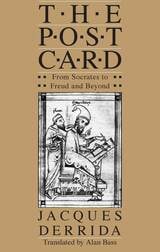
On the other side of the card, look, a proposition is made to you, S and p, Socrates and plato. For once the former seems to write, and with his other hand he is even scratching. But what is Plato doing with his outstretched finger in his back? While you occupy yourself with turning it around in every direction, it is the picture that turns you around like a letter, in advance it deciphers you, it preoccupies space, it procures your words and gestures, all the bodies that you believe you invent in order to determine its outline. You find yourself, you, yourself, on its path.
The thick support of the card, a book heavy and light, is also the specter of this scene, the analysis between Socrates and Plato, on the program of several others. Like the soothsayer, a "fortune-telling book" watches over and speculates on that-which-must-happen, on what it indeed might mean to happen, to arrive, to have to happen or arrive, to let or to make happen or arrive, to destine, to address, to send, to legate, to inherit, etc., if it all still signifies, between here and there, the near and the far, da und fort, the one or the other.
You situate the subject of the book: between the posts and the analytic movement, the pleasure principle and the history of telecommunications, the post card and the purloined letter, in a word the transference from Socrates to Freud, and beyond. This satire of epistolary literature had to be farci, stuffed with addresses, postal codes, crypted missives, anonymous letters, all of it confided to so many modes, genres, and tones. In it I also abuse dates, signatures, titles or references, language itself.
J. D.
"With The Post Card, as with Glas, Derrida appears more as writer than as philosopher. Or we could say that here, in what is in part a mock epistolary novel (the long section is called "Envois," roughly, "dispatches" ), he stages his writing more overtly than in the scholarly works. . . . The Post Card also contains a series of self-reflective essays, largely focused on Freud, in which Derrida is beautifully lucid and direct."—Alexander Gelley, Library Journal
The Powers of the False
Reading, Writing, Thinking beyond Truth and FictionDoro Wiese
Northwestern University Press, 2014
The Premodern Condition
Medievalism and the Making of TheoryBruce Holsinger
University of Chicago Press, 2005
Holsinger shows that the preoccupation with medieval cultures and practices among Bataille, Derrida, Lacan, Barthes, Bourdieu, and their cohorts was so wide ranging that it merits recognition as one of the most significant epiphenomena of postwar French thought. Not simply an object of nostalgic longing or an occasional source of literary exempla, the medieval epoch was continually mined by these thinkers for specific philosophical vocabularies, social formations, and systems of thought.
To supplement its master thesis, The Premodern Condition also contains original essays by Bataille and Bourdieu—translated here for the first time into English—that testify in various ways to the strange persistence of medievalisms in French postwar avant-garde writings. What results is an important and original work that will be a touchstone for specialists in medieval studies and critical theory alike.
The Present Hour
Yves Bonnefoy
Seagull Books, 2020
In The Present Hour, Bonnefoy’s latest collection, a personal narrative surfaces in splinters and shards. Every word from Bonnefoy is multifaceted, like the fragmented figures seen from different angles in cubist painting—as befits a poet who has written extensively about artists such as Goya, Picasso, Braque, and Gris. Throughout this moving collection, Bonnefoy’s poems echo each other, returning to and elaborating upon key images, thoughts, feelings, and people. Intriguing and enigmatic, this mixture of sonnet sequences and prose poems—or, as Bonnefoy sees them, “dream texts”—move from his meditations on friendship and friends like Jorge Luis Borges to a long, discursive work in free verse that is a self-reflection on his thought and process. These poems are the ultimate condensation of Bonnefoy’s ninety years of life and writing and they will be a valuable addition to the canon of his writings available in English.
“Beverley Bie Brahic does a splendid job of translating the latest work of Yves Bonnefoy. She catches his unique combination of human detail and a groping for the beyond. . . . Brahic does full justice to the profoundly moving text—with its frequent shifts between the personal and the searchingly philosophical.”—Joseph Frank, author of Responses to Modernity: Essays in the Politics of Culture
The Price of Literature
The French Novel's Theoretical TurnPatrick M. Bray
Northwestern University Press, 2019
Literary thought, or the theory produced by the text, can only function by exploring what escapes dominant representations. The Price of Literature analyzes how certain iconic texts from the nineteenth century (by Mme de Staël, Hugo, Balzac, Flaubert, and Proust) perform a theoretical turn to claim the freedom to represent anything in the world, but also literature’s ability to transform the world it represents. The conclusion advances a new way of thinking about literary scholarship—one based on how literature redistributes ways of writing by lending form to thought.
The Public Mirror
Moliere and the Social Commerce of DepictionLarry F. Norman
University of Chicago Press, 1999
Pairing close readings of Molière's comedies with insightful accounts of French social history and aesthetics, Norman shows how Molière conceived of satire as a "public mirror" provoking dynamic exchange and conflict with audience members obsessed with their own images. Drawing on these tensions, Molière portrays characters satirizing one another on stage, with their reactions providing dramatic conflict and propelling comic dialogue. By laying bare his society's system of imagining itself, Molière's satires both enthralled and enraged his original audience and provide us with a crucial key to the classical culture of representation.
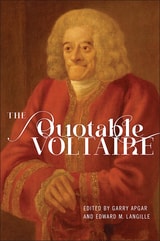
The Quotable Voltaire
Garry Apgar
Bucknell University Press, 2021
Drawing from a wide range of his publications, private letters, and remarks recorded by his contemporaries, The Quotable Voltaire includes material never before gathered in a single volume. English translations appear alongside the original French, and each quote is thoroughly indexed and referenced, with page numbers for both the first known publication edition of each entry and the most recent edition of Voltaire’s works. The book also features over 400 quotes about Voltaire, including commentary by eighteenth-century luminaries like Samuel Johnson, Catherine the Great, Casanova, and John Adams, as well as an eclectic assortment of modern-day personages ranging from Winston Churchill and Jorge Luis Borges to Mae West and Mike Tyson.
Lavishly illustrated with nearly three dozen images of Voltaire-related art, this collection opens with a scholarly essay that recounts the great man’s life and reflects on his outsized influence on Western culture. Whether you are a Voltaire scholar or a neophyte, The Quotable Voltaire is the perfect introduction to a brilliant mind.
The Reinvention of Obscenity
Sex, Lies, and Tabloids in Early Modern FranceJoan DeJean
University of Chicago Press, 2002
The Reinvention of Obscenity casts a fresh light on the mythical link between sexual impropriety and things French. Exploring the complicity between censorship, print culture, and obscenity, DeJean argues that mass market printing and the first modern censorial machinery came into being at the very moment that obscenity was being reinvented—that is, transformed from a minor literary phenomenon into a threat to society. DeJean's principal case in this study is the career of Moliére, who cannily exploited the new link between indecency and female genitalia to found his career as a print author; the enormous scandal which followed his play L'école des femmes made him the first modern writer to have his sex life dissected in the press.
Keenly alert to parallels with the currency of obscenity in contemporary America, The Reinvention of Obscenity will concern not only scholars of French history, but anyone interested in the intertwined histories of sex, publishing, and censorship.
The Right to Difference
French Universalism and the JewsMaurice Samuels
University of Chicago Press, 2016
Samuels demonstrates that Jewish difference has always been essential to the elaboration of French universalism, whether as its foil or as proof of its reach. He traces the development of this discourse through key moments in French history, from debates over granting Jews civil rights during the Revolution, through the Dreyfus Affair and Vichy, and up to the rise of a “new antisemitism” in recent years. By recovering the forgotten history of a more open, pluralistic form of French universalism, Samuels points toward new ways of moving beyond current ethnic and religious dilemmas and argues for a more inclusive view of what constitutes political discourse in France.
The Rock of Arles
Richard Klein
Duke University Press, 2024
The Ship of Virtuous Ladies
Symphorien Champier
Iter Press, 2018
The Shock of the Ancient
Literature and History in Early Modern FranceLarry F. Norman
University of Chicago Press, 2011
The cultural battle known as the Quarrel of the Ancients and Moderns served as a sly cover for more deeply opposed views about the value of literature and the arts. One of the most public controversies of early modern Europe, the Quarrel has most often been depicted as pitting antiquarian conservatives against the insurgent critics of established authority. The Shock of the Ancient turns the canonical vision of those events on its head by demonstrating how the defenders of Greek literature—rather than clinging to an outmoded tradition—celebrated the radically different practices of the ancient world.
At a time when the constraints of decorum and the politics of French absolutism quashed the expression of cultural differences, the ancient world presented a disturbing face of otherness. Larry F. Norman explores how the authoritative status of ancient Greek texts allowed them to justify literary depictions of the scandalous. The Shock of the Ancient surveys the diverse array of aesthetic models presented in these ancient works and considers how they both helped to undermine the rigid codes of neoclassicism and paved the way for the innovative philosophies of the Enlightenment. Broadly appealing to students of European literature, art history, and philosophy, this book is an important contribution to early modern literary and cultural debates.
The Silent Crossing
Pascal Quignard
Seagull Books, 2013
A haunting homage to life and liberty, to society and solitude, and to the binding and unbinding that constitute the weft of our lives.

The Southern Frontier 1670-1732
Verner Crane, with a new introduction by Steven C. Hahn
University of Alabama Press, 2004
A classic resource on the struggle for dominance in southern North America during the colonial period
This volume recounts the clashes and intrigues that played out over the landscape of the Old Southwest and across six decades as the Spanish, French, British, and ultimately Americans vied for control. Rivalry began soon after initial discovery, mapping, and exploration as the world powers, particularly England and France, competed for control of the lucrative fur trade in the Mississippi valley. The French attempted to establish trade networks stretching from the Atlantic Ocean inland to the Mississippi River and northward from ports on the Gulf of Mexico to the Ohio River. But they found the British already entrenched there.
Verner Crane guides us through this multinational struggle and navigates the border wars and diplomatic intrigues that played crucial roles in the settlement of the South by Euro-Americans. In his new introduction, Steven Hahn places the work in the context of its time, sketches its publication history, and provides biographical information on Crane.
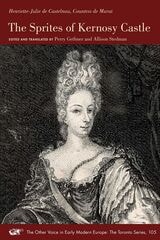
The Sprites of Kernosy Castle
Henriette-Julie de Castelnau, Countess de Murat
Iter Press, 2024
This novel reflects a shift in French values at the turn of the eighteenth century, which saw increased interest in the private lives of the aristocracy and the pre-Enlightenment questioning of political and religious orthodoxies. Novels of fiction and leisure gained popularity, and it was during this time that Henriette-Julie de Castelnau, the Countess de Murat, published her second leisure novel, The Sprites of Kernosy Castle. Combining humor, social satire, and a proto-feminist outlook, Murat crafts a well-constructed plot where the supernatural is debunked. Murat’s career was cut short when a series of “misdemeanors” related to the countess’s homosexual tendencies led to her arrest in 1702. Sprites, which was released during a partial reprieve from prison, is the final published work of this independent-minded early feminist author.
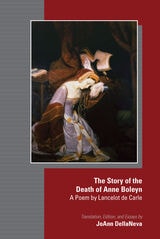
The Story of the Death of Anne Boleyn
A Poem by Lancelot de CarleEdited, Translated, and with Essays by JoAnn DellaNeva
Arizona Center for Medieval and Renaissance Studies, 2021
The Story of the Death of Anne Boleyn is a critical edition and translation of a long narrative poem written by the secretary to the French ambassador in London within two weeks of Anne Boleyn’s execution. It was intended as a diplomatic dispatch, relating the astonishing news of the queen’s demise (along with that of five alleged lovers). Uniquely among diplomatic correspondence, this dispatch was written in verse form. It thus straddles the domains of literature and history, of chronicle and fiction.
The base text for this edition is a previously unstudied manuscript housed at the British Library. Variants are given from all other known manuscripts found in Europe, including several key verses that were previously unpublished and that shed new light on the interpretation of the poem. The book features a sense-for-sense translation into modern English in free verse form, along with extensive explanatory notes. It also provides a study focusing on the historical background to the poem, an essay on the poet and the reception of his work, and a literary analysis of the poem.

The Surprising Effects of Sympathy
Marivaux, Diderot, Rousseau, and Mary ShelleyDavid Marshall
University of Chicago Press, 1988
Placing novels in the context of eighteenth-century writing about theater, fiction, and painting, Marshall argues that an unusual variety of authors and texts were concerned with the possibility of entering into someone else's thoughts and feelings. He shows how key eighteenth-century works reflect on the problem of how to move, touch, and secure the sympathy of readers and beholders in the realm of both "art" and "life." Marshall discusses the demands placed upon novels to achieve certain effects, the ambivalence of writers and readers about those effects, and the ways in which these texts can be read as philosophical meditations on the differences and analogies between the experiences of reading a novel, watching a play, beholding a painting, and witnessing the spectacle of someone suffering. The Surprising Effects of Sympathy traces the interaction of sympathy and theater and the artistic and philosophical problems that these terms represent in dialogues about aesthetics, moral philosophy, epistemology, psychology, autobiography, the novel, and society.
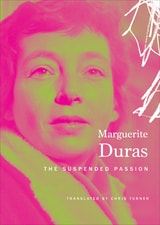
The Suspended Passion
InterviewsMarguerite Duras
Seagull Books, 2016
The interviews that make up the book were conducted in 1987, when Italian journalist Leopoldina Pallotta della Torre met the seventy-three-year-old Duras at her Paris flat and convinced her to sit for a series of conversations. The resulting book was published in Italian in 1989, but it somehow failed to attract a French publisher, and it was quickly forgotten. Nearly a quarter of a century later, however, the book was rediscovered and translated into French, and, it has now become a sensation. In its revealing pages, Duras speaks with extraordinary freedom about her life as a writer, her relationship to cinema, her friendship with Mitterand , her love of Chekhov and football, and, perhaps most significantly, her childhood in pre-war Vietnam, the experiences that propelled her most famous novel, The Lover.
A true literary event, finally available in English, The Suspended Passion is a remarkable document of an extraordinary literary life.
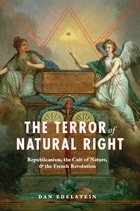
The Terror of Natural Right
Republicanism, the Cult of Nature, and the French RevolutionDan Edelstein
University of Chicago Press, 2009
Natural right—the idea that there is a collection of laws and rights based not on custom or belief but that are “natural” in origin—is typically associated with liberal politics and freedom. In The Terror of Natural Right, Dan Edelstein argues that the revolutionaries used the natural right concept of the “enemy of the human race”—an individual who has transgressed the laws of nature and must be executed without judicial formalities—to authorize three-quarters of the deaths during the Terror. Edelstein further contends that the Jacobins shared a political philosophy that he calls “natural republicanism,” which assumed that the natural state of society was a republic and that natural right provided its only acceptable laws. Ultimately, he proves that what we call the Terror was in fact only one facet of the republican theory that prevailed from Louis’s trial until the fall of Robespierre.
A highly original work of historical analysis, political theory, literary criticism, and intellectual history, The Terror of Natural Right challenges prevailing assumptions of the Terror to offer a new perspective on the Revolutionary period.
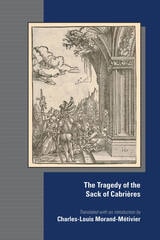
The Tragedy of the Sack of Cabrières
Translated by Charles-Louis Morand-Métivier
Arizona Center for Medieval and Renaissance Studies, 2022
April 1542 saw a massacre of epic proportions in the Luberon, in southeastern France, of its Waldensian population, who had been peacefully living there after they settled in a few centuries before. This massacre foreshadowed the wars of religion, which tore apart the kingdom for almost forty years. The Tragédie du Sac de Cabrières is the only play devoted to these events. This is a critical edition and English translation of the French play. Three critical editions of the play have been published in 1927, 1928, and 1998, and this new edition complements the previous works. This is the first English translation of the play and makes it available to an international audience of scholars and students of the early modern period.
This edition “translates” the moment of the play's creation, the representation of the event, and its importance in the narrative of religious persecutions in sixteenth-century France. It explains how history is dramatized through the creation of the scenic story and scenic play of Cabrières. and how the specific retelling of the events of Cabrières makes this a tool of historical narration, thus allowing the audience to participate in the unfolding of history before their eyes. Therefore, they become part of history, because it is played before their eyes so that they can not only witness it but also propagate the glory of the martyrs for future generations. This is not only a translation and a work of literary scholarship, it is an analysis of the literary, political, and religious production of this period, and a multidisciplinary analysis of Waldensianism in southeastern France.
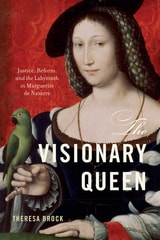
The Visionary Queen
Justice, Reform, and the Labyrinth in Marguerite de NavarreTheresa Brock
University of Delaware Press, 2024
The Wandering Life
Followed by "Another Era of Writing"Yves Bonnefoy
Seagull Books, 2023
The Wandering Life is a poetic culmination of Yves Bonnefoy’s wanderings and characterizes the final twenty-five years of his work. Bonnefoy was an ardent traveler throughout his life, and his journeys in foreign countries left a profound imprint on his work. The time he spent in Italy, translating Shakespeare’s work in England, in universities in the United States, in India with Octavio Paz, and more, affected his poetry in discernible ways and inspired The Wandering Life. Interweaving verse and prose—vignettes that range from a few lines in length to several pages—this volume is a fitting capstone to Bonnefoy’s oeuvre and appears in English translation for the first time to mark the centenary of Yves Bonnefoy’s birth.
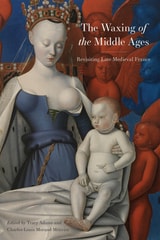
The Waxing of the Middle Ages
Revisiting Late Medieval FranceCharles-Louis Morand-Métivier
University of Delaware Press, 2023
The Waxing of the Middle Ages sets out to provide a rich, complex, and diverse study of these developments and to reassert that late medieval France is crucial in its own right. The collection argues for an approach that views the late medieval period not as an afterthought, or a blind spot, but as a period that is key in understanding the fluidity of time, traditions, culture, and history. Each essay explores some “cultural form,” to borrow Huizinga’s expression, to expose the false divide that has dominated modern scholarship.
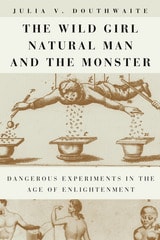
The Wild Girl, Natural Man, and the Monster
Dangerous Experiments in the Age of EnlightenmentJulia V. Douthwaite
University of Chicago Press, 2002
A variety of educational experiments failed to tame these feral children by the standards of the day. After telling their stories, Douthwaite turns to literature that reflects on similar experiments to perfect human subjects. Her examples range from utopian schemes for progressive childrearing to philosophical tales of animated statues, from revolutionary theories of regenerated men to Gothic tales of scientists run amok. Encompassing thinkers such as Rousseau, Sade, Defoe, and Mary Shelley, Douthwaite shows how the Enlightenment conceived of mankind as an infinitely malleable entity, first with optimism, then with apprehension. Exposing the darker side of eighteenth-century thought, she demonstrates how advances in science gave rise to troubling ethical concerns, as parents, scientists, and politicians tried to perfect mankind with disastrous results.
The Writing of Melancholy
Modes of Opposition in Early French ModernismRoss Chambers
University of Chicago Press, 1993
After the failed revolution of 1848, the sense of disillusion that swept through France deeply affected the literature of the time. Chambers argues that literary melancholy and disorientation constituted a symptom of historical conditions rather than, as many other critics contend, a willful resistance to them.
Enriched by careful readings of works by Flaubert, Nerval, Baudelaire, Gautier, and Hugo, this book is a subtle meditation on the powers of writing and reading and a suggestive contribution to current debates over the historical status of literary texts. Originally published in French, the book has been revised and expanded to include a new chapter on Gérard de Nerval's "Sylvie."
The Written World
Space, Literature, and the Chorological Imagination in Early Modern FranceJeffrey N. Peters
Northwestern University Press, 2018
In analyses of well-known authors such as Corneille, Molière, Racine, and Madame de Lafayette, Peters demonstrates that the apparent absence of physical space in seventeenth-century literary depiction indicates a subtle engagement with, rather than a rejection of, evolving principles of cosmological understanding. Space is not absent in these works so much as transformed in keeping with contemporaneous developments in early modern natural philosophy. The Written World will appeal to philosophers of literature and literary theorists as well as scholars of early modern Europe and historians of science and geography
Theater, War, and Memory in Crisis
Vichy, Algeria, the AftermathJohn Ireland
University of Michigan Press, 2025
Theories of Africans
Francophone Literature and Anthropology in AfricaChristopher L. Miller
University of Chicago Press, 1990
". . . a superb cross-disciplinary analysis."—Y. Mudimbe
This Africa
Novels by West Africans in English and FrenchJudith Illsley Gleason
Northwestern University Press, 1965
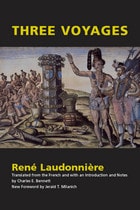
Three Voyages
Rene Laudonniere
University of Alabama Press, 2001
This translation of an eyewitness account by a major participant offers valuable information about all three attempts to establish a French colony on the south Atlantic coast of North America.
Rene Laudonniere's account of the three attempts by France to colonize what is now the United States is uniquely valuable because
he played a major role in each of the ventures—first, in 1562, as second in command during the founding of the ill-fated Charlesport, then as commander for the establishment of Fort Caroline on Florida's St. Johns River in 1564, and finally as the one to welcome French reinforcements the following year. It was also Laudonniere's destiny to witness the tragic fall of Fort Caroline to Spanish claims one month later.
Laudonniere wrote his chronicle, L'histoire Notable de la Floride, in 1565 following the fall of Fort Caroline as he recuperated in England. Much more than an account of his feelings and adventures, Laudonniere's history reveals him to be an exceedingly able and accurate geographer with a highly developed interest in anthropology.
The first English translation was published by Richard Hakluyt in 1587. Charles E. Bennett's graceful and accurate rendering in modern English was first published in 1975 by the University Press of Florida. Besides the account, thoroughly annotated and with present-day names identifying sites visited by the Frenchman, this volume includes a valuable introductory essay. The appendices to the volume are four noteworthy documents, the last of which—a guide to plants of 16th-century Florida—will be of exceptional interest to naturalists, gardeners, and students of folklore. The account itself will fascinate professional historians and anthropologists as well as general readers interested in the exciting and often moving
events of early European settlement in the New World.
Rene Laudonniere was a French adventurer and explorer of the 16th century who wrote L'histoire Notable de la Floride. Charles E. Bennett is a historian and former Florida congressman. He was coauthor of the Moss-Bennett legislation and was instrumental in the establishment of the Fort Caroline National Memorial and the Timucuan Ecological and Historical Preserve. Jerald T. Milanich is Curator in Archaeology at the Florida Museum of Natural History.
Through the Past Darkly
History and Memory in François Mauriac’s Bloc-notesNathan Bracher
Catholic University of America Press, 2004
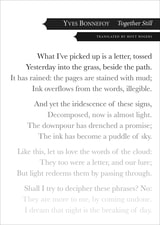
Together Still
Yves Bonnefoy
Seagull Books, 2017
The international community of letters mourned the recent death of Yves Bonnefoy, universally acclaimed as one of France’s greatest poets of the last half-century. A prolific author, he was often considered a candidate for the Nobel Prize and published a dozen major collections of poetry in verse and prose, several books of dream-like tales, and numerous studies of literature and art. His oeuvre has been translated into scores of languages, and he himself was a celebrated translator of Shakespeare, Yeats, Keats, and Leopardi.
Together Still is his final poetic work, composed just months before his death. The book is nothing short of a literary testament, addressed to his wife, his daughter, his friends, and his readers throughout the world. In these pages, he ruminates on his legacy to future generations, his insistence on living in the present, his belief in the triumphant lessons of beauty, and, above all, his courageous identification of poetry with hope.
Tomb(e)
Hélène Cixous
Seagull Books, 2014
Toward a Premodern Posthumanism
Anarchic Ontologies of Earthly Life in Early Modern FranceChad Córdova
Northwestern University Press, 2025
Drawing on early modern French thought to free nature and aesthetics from metaphysical humanism
What good is aesthetics in a time of ecological crisis? Toward a Premodern Posthumanism: Anarchic Ontologies of Earthly Life in Early Modern France shows that philosophical aesthetics contains unheeded potentialities for challenging the ontological subjection of nature to the human subject. Drawing on deconstructive, ecological, and biopolitical thought, Chad Córdova uncovers in aesthetics something irreducible to humanist metaphysics: an account of how beings emerge and are interrelated, responsive, and even response-able without reason or why.
This anarchic and atelic ontology, recovered from Kant, becomes the guiding thread for a new, premodern trajectory of posthumanism. Charting a path from Aristotle to Heidegger to today’s plant-thinking, with new readings of Montaigne, Pascal, Diderot, Rousseau, and others along the way, this capacious study reveals the untimely relevance of pre-1800 practices of writing, science, and art. Enacting a multitemporal mode of reading, Córdova offers a defense and illustration of the importance of returning to early modern texts as a way to rethink nature, art, ethics, and politics in a time when these concepts are in flux and more contentious than ever.