Results by title
527 books match the query 'Labor' and 100 start with t
The Myth of Opportunity
Music, Labor, and Platforms in the Twenty-First CenturyEdiz Ozelkan
Rutgers University Press, 2027
Justin Bieber launched his music career on YouTube in 2007, Lil Nas X’s “Old Town Road” exploded on TikTok in 2019, and Oliver Anthony’s “Rich Men North of Richmond” soared to the top of the Billboard charts just two weeks after its YouTube debut in 2023. These viral successes inspire countless artists to upload music online, fueled by the promise that technology can democratize opportunity, but does this promise hold true?
The Myth of Opportunity: Music, Labor, and Platforms in the Twenty-First Century critically examines the myth of technology as a great equalizer in the music industry. While platforms like Spotify claim to empower artists, the reality is that rewards remain highly unequal. Through macroeconomic analysis and time series methodology, this book investigates how streaming services have reshaped opportunity from a labor perspective across professions, industries, and regions, offering a comprehensive, empirical view on the true impact of digital platforms on cultural production with a focus on music.
The Mythology of Work
How Capitalism Persists Despite ItselfPeter Fleming
Pluto Press, 2015
In The Mythology of Work, Peter Fleming examines how neoliberal society uses the ritual of work—and the threat of its denial—to maintain the late capitalist class order. Work becomes a universal reference point, devoid of any moral or political worth, transforming our society into a factory that never sleeps. Blending critical theory with recent accounts of job-related suicides, office-induced paranoia, fear of relaxation, managerial sadism, and cynical corporate social responsibility campaigns, Fleming paints a bleak picture of a society in which economic and emotional disasters greatly outweigh any professed benefits.
The New Dollars and Dreams
American Incomes in the Late 1990sFrank Levy
Russell Sage Foundation, 1998

The New Left and Labor in 1960s
Peter B. Levy
University of Illinois Press, 1994
It is a powerful story: the relationship between the 1960s New Left and organized labor was summed up by hardhats confronting students and others over US involvement in Vietnam. But the real story goes beyond the "Love It or Leave It" signs and melees involving blue-collar types attacking protesters.
Peter B. Levy challenges these images by exploring the complex relationship between the two groups. Early in the 1960s, the New Left and labor had cooperated to fight for civil rights and anti-poverty programs. But diverging opinions on the Vietnam War created a schism that divided these one-time allies. Levy shows how the war, combined with the emergence of the black power movement and the blossoming of the counterculture, drove a permanent wedge between the two sides and produced the polarization that remains to this day.

The Nights Of Labor
The Workers' Dream in Nineteenth-Century FranceJacques Ranciere
Temple University Press, 1991
The Object of Labor
Commodification in Socialist HungaryMartha Lampland
University of Chicago Press, 1995
Exploring the effects of social change thrust upon communities against their will, Lampland examines the history of agrarian labor in Hungary from World War I to the early 1980s. She shows that rural workers had long been subject to strict state policies similar to those imposed by collectivization. Since the values of privatization and individualism associated with capitalism characterized rural Hungarian life both prior to and throughout the socialist period, capitalist ideologies of work and morality survived unscathed in the private economic practices of rural society. Lampland also shows how labor practices under socialism prepared the workforce for capitalism. By drawing villagers into factories and collective farms, for example, the socialist state forced farmers to work within tightly controlled time limits and to calculate their efforts in monetary terms. Indeed, this control and commodification of rural labor under socialism was essential to the transformation to capitalism.
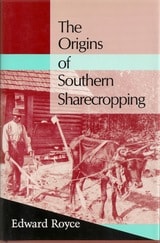
The Origins of Southern Sharecropping
Edward Royce
Temple University Press, 1993
Vivid primary accounts of post-Civil War life by planters and freed slaves complement this study of the rise of southern sharecropping. Edward Royce employs both historical and sociological methods to probe the question of why slavery was replaced by sharecropping rather than by some other labor arrangement. His detailed analysis illuminates conflicts between labor and capital as one group struggles to preserve the plantation system while the other pursues a quest for land and autonomy.
Royce contends that southern sharecropping occurred through a "constriction of possibilities," that it was shaped by default rather than orchestrated by economic reconstruction by white landowners and black laborers.
Highlighting the conflict-ridden nature of the process of social change, The Origins of Southern Sharecropping includes rich descriptions of the plantation system and gang labor, the freed slaves' dream of forty acres and a mule, the black colonization movement, the Freedman's Bureau, and racial relations after the war.
In the series Labor and Social Change, edited by Paula Rayman and Carmen Sirianni.

The Other End of the Needle
Continuity and Change among Tattoo WorkersDavid C. Lane
Rutgers University Press, 2021
Yet, Lane notes, prior research has focused almost exclusively on the tattoos—the outcome of an intricate social process—and have ignored the significance of tattoo workers themselves. "Tattooists," as Lane dubs them, make decisions, but they work within a social world that constrains and shapes the outcome of their labor—the tattoo. The goal of this book is to help readers understand the world of tattoo work as an intricate and nuanced form of work. Lane ultimately asks new questions about the social processes occurring prior to the tattoo’s existence.
The Pandemic and the Working Class
How US Labor Navigated COVID-19Edited by Nick Juravich and Steve Striffler
University of Illinois Press, 2025
Nick Juravich and Steve Striffler edit a collection that examines the effects of the pandemic on workers. Sections of the book focus on specific impacts and government efforts to restructure the economy; the dramatic effect of the pandemic on the hospitality industry; educators’ response on behalf of themselves and their students; frontline healthcare workers; and the innovative forms of labor organizing that emerged during and after COVID.
Contributors: Carlos Aramayo, Kathleen Brown, Sandrine Etienne, Ismael García-Colón, Puya Gerami, Maura Hagan, Connor Harney, Devan Hawkins, Leigh Howard, Marian Moser Jones, Doris Joy, Nick Juravich, Eric Larson, Kathryn M. Meyer, Samir Sonti, Steve Striffler, Lia Warner, Andrew B. Wolf, and Jennifer Zelnick
The Pew and the Picket Line
Christianity and the American Working ClassEdited by Christopher D. Cantwell, Heath W. Carter, and Janine Giordano Drake
University of Illinois Press, 2016
The Politics of Operations
Excavating Contemporary CapitalismSandro Mezzadra and Brett Neilson
Duke University Press, 2019
The Politics of Value
Three Movements to Change How We Think about the EconomyJane L. Collins
University of Chicago Press, 2017
Each case shows how the concrete actions of a group of citizens can prompt us to reflect on what is needed for a just and sustainable economic system. In one case, activists raised questions about the responsibilities of business, in the second about the significance of local economies, and in the third about the contributions of the public sector. Through these movements, Jane L. Collins maps a set of cultural conversations about the types of investments and activities that contribute to the health of the economy. Compelling and persuasive, The Politics of Value offers a new framework for viewing economic value, one grounded in thoughtful assessment of the social division of labor and the relationship of the state and the market to civil society.
The Postdevelopmental State
Dilemmas of Economic Democratization in Contemporary South KoreaJamie Doucette
University of Michigan Press, 2024
Winner of the 2025 Association of Korean Studies in Europe Book Prize
Over the last 25 years, South Korea has witnessed growing inequality due to the proliferation of non-standard employment, ballooning household debt, deepening export-dependency, and the growth of super-conglomerates such as Samsung and Hyundai. Combined with declining rates of economic growth and turbulent political events, these processes mark a departure from Korea’s past recognition as a high growth “developmental state.”
The Postdevelopmental State radically reframes research into the South Korean economy by foregrounding the efforts of pro-democratic reformers and social movements in South Korea to create an alternative economic model—one that can address Korea’s legacy of authoritarian economic development during the Cold War and neoliberal restructuring since the Asian Financial Crisis of the late 1990s. Understanding these attempts offers insight into the types of economic reforms that have been enacted since the late 1990s as well as the continued legacy of dictatorship-era politics within the Korean political and legal system. By examining the dilemmas economic democracy has encountered over the past 25 years, from the IMF Crisis to the aftermath of the Candlelight Revolution, the book reveals the enormous and comprehensive challenges involved in addressing the legacy of authoritarian economic models and their neoliberal transformations.
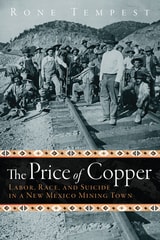
The Price of Copper
Labor, Race and Suicide in a New Mexico Mining TownRone Tempest
University Press of Colorado, 2027
The Price of Copper is a veteran journalist’s unflinching investigation of a family tragedy and long-standing mystery—the sensational 1938 suicide of powerful New Mexico copper mine boss Rone B. Tempest Sr. on the eve of his scheduled testimony before a federal labor board. From this dramatic opening, the book paints a vivid portrait of open-pit copper mining, labor conflicts, and corporate-sponsored racism in company mining towns across the Mountain West from the early years of the twentieth century to the first successes of the civil rights movement in the 1950s.
The author’s paternal grandfather, Rone Tempest Sr., was the general manager of the Chino Copper Mine in Santa Rita, New Mexico, which was owned by the Kennecott Copper Corporation and under investigation over labor practices. His boss was Salt Lake City copper baron and ruthless anti-union strikebreaker Daniel C. Jackling—the “Prophet of Porphyry,” who pioneered the industrial mining of low-grade copper ores by introducing the use of dynamite, steam shovels, rail, and giant mill works. After detailing the saga around Tempest Sr.’s death, the story follows the trajectory of the Chino mine over time, including the rise of predominantly Hispanic labor unions and the advancement of Hispanic workers to senior management roles—gains in civil rights that would have made the labor environment entirely unrecognizable to those fighting for reform in 1938.
A compelling and dramatic history of the great early twentieth-century advances in western copper mining that provided the essential metal needed to electrify the continent and the world, The Price of Copper is a unique personal story that connects to the broader history of copper mining in the West, as well as a valuable social history offering a new narrative about the dynamics of corporate management and giving additional insight into the formation of the “Copper Age” in the United States.
The Process Genre
Cinema and the Aesthetic of LaborSalomé Aguilera Skvirsky
Duke University Press, 2020
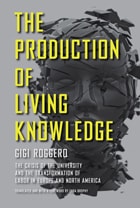
The Production of Living Knowledge
The Crisis of the University and the Transformation of Labor in Europe and North AmericaGigi Roggero
Temple University Press, 2011
Evaluating higher education institutions—particularly the rise of the “global university”—and their rapidly changing role in the global era, Gigi Roggero finds the system in crisis. In his groundbreaking book, The Production of Living Knowledge, Roggero examines the university system as a key site of conflict and transformation within “cognitive capitalism”—a regime in which knowledge has become increasingly central to the production process at large. Based on extensive fieldwork carried out through the activist method of conricerca, or “co-research,” wherein researchers are also subjects, Roggero’s book situates the crisis of the university and the changing composition of its labor force against the backdrop of the global economic crisis.
Combining a discussion of radical experiments in education, new student movements, and autonomist Marxian (or post-operaista) social theory, Roggero produces a distinctly transnational and methodologically innovative critique of the global university from the perspective of what he calls “living knowledge.”
In light of new student struggles in the United States and across the world, this first English-language edition is particularly timely.
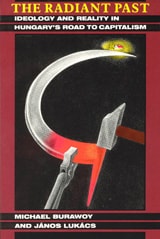
The Radiant Past
Ideology and Reality in Hungary's Road to CapitalismMichael Burawoy and János Lukács
University of Chicago Press, 1992
Michael Burawoy and Janos Lukacs consider this question from the standpoint of the Hungarian working class. Between 1983 and 1990 the authors carried out intensive studies in two core Hungarian industries, machine building and steel production, to produce the first extended participant-observation study of work and politics in state socialism.
"A fascinating and engagingly written eyewitness report on proletarian life in the waning years of goulash communism. . . . A richly rewarding book, one that should interest political scientists in a variety of subfields, from area specialists and comparativists to political economists, as well as those interested in Marxist and post-Marxist theory."—Elizabeth Kiss, American Political Science Review
"A very rich book. . . . It does not merely offer another theory of transition, but also presents a clear interpretive scheme, combined with sociological theory and vivid ethnographic description."—Ireneusz Bialecki, Contemporary Sociology
"Its informed skepticism of post-Communist liberal euphoria, its concern for workers, and its fine ethnographic details make this work valuable."—"àkos Róna-Tas, American Journal of Sociology
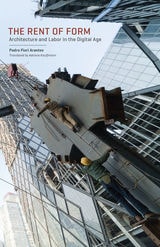
The Rent of Form
Architecture and Labor in the Digital AgePedro Fiori Arantes
University of Minnesota Press, 2019
A critique of prominent architects’ approach to digitally driven design and labor practices over the past two decades
With the advent of revolutionary digital design and production technologies, contemporary architects and their clients developed a taste for dramatic, unconventional forms. Seeking to amaze their audiences and promote their global brands, “starchitects” like Herzog & de Meuron and Frank Gehry have reaped substantial rewards through the pursuit of spectacle enabled by these new technologies. This process reached a climax in projects like Gehry’s Guggenheim Bilbao and the “Bilbao effect,” in which spectacular architectural designs became increasingly sought by municipal and institutional clients for their perceived capacity to enhance property values, which author Pedro Fiori Arantes calls the “rent of form.”
Analyzing many major international architectural projects of the past twenty years, Arantes provides an in-depth account of how this “architecture of exception” has come to dominate today’s industry. Articulating an original, compelling critique of the capital and labor practices that enable many contemporary projects, Arantes explains how circulation (via image culture), consumption (particularly through tourism), the division of labor, and the distribution of wealth came to fix a certain notion of starchitecture at the center of the industry.
Significantly, Arantes’s viewpoint is not that of Euro-American capitalism. Writing from the Global South, this Brazilian theorist offers a fresh perspective that advances ideas less commonly circulated in dominant, English-language academic and popular discourse. Asking key questions about the prevailing logics of finance capital, and revealing inconvenient truths about the changing labor of design and the treatment of construction workers around the world, The Rent of Form delivers a much-needed reevaluation of the astonishing buildings that have increasingly come to define world cities.

The Rise of the Chicago Police Department
Class and Conflict, 1850-1894Sam Mitrani
University of Illinois Press, 2013
In this book, Sam Mitrani cogently examines the making of the police department in Chicago, which by the late 1800s had grown into the most violent, turbulent city in America. Chicago was roiling with political and economic conflict, much of it rooted in class tensions, and the city's lawmakers and business elite fostered the growth of a professional municipal police force to protect capitalism, its assets, and their own positions in society. Together with city policymakers, the business elite united behind an ideology of order that would simultaneously justify the police force's existence and dictate its functions.
Tracing the Chicago police department's growth through events such as the 1855 Lager Beer riot, the Civil War, the May Day strikes, the 1877 railroad workers strike and riot, and the Haymarket violence in 1886, Mitrani demonstrates that this ideology of order both succeeded and failed in its aims. Recasting late nineteenth-century Chicago in terms of the struggle over order, this insightful history uncovers the modern police department's role in reconciling democracy with industrial capitalism.
The Roaring Nineties
Can Full Employment Be Sustained?Alan B. Krueger
Russell Sage Foundation, 2001

The Samuel Gompers Papers, Volume 13
Cumulative IndexSamuel Gompers, Edited by Peter J. Albert and Grace Palladino
University of Illinois Press, 2013

The Scene of Foreplay
Theater, Labor, and Leisure in 1960s New YorkGiulia Palladini
Northwestern University Press, 2017
Matching an original approach to historical materials and theoretical reflection, Palladini addresses the peculiar forms of production, reproduction, and consumption developed in the 1960s as labors of love, creating for artists a condition of “preliminarity” toward professional work and also functioning as a counterforce within productive economy, as a prelude where value is not yet assigned to labor.
The Scene of Foreplay proposes that such labors of love can be considered both as paradigmatic for contemporary forms of precarious labor and also resonating with echoes from marginal histories of the performing arts, in a nonlinear genealogy of queer resistance to ideas of capitalist productivity and professionalism. The book offers much for those interested in performance theory as well asin the history of theater and performance arts in the 1960s.
The Social Benefits of Education
Jere R. Behrman and Nevzer Stacey, Editors
University of Michigan Press, 1997
The Specter of Global China
Politics, Labor, and Foreign Investment in AfricaChing Kwan Lee
University of Chicago Press, 2017
Offering the clearest look yet at China’s state-driven investment in Africa, this book is rooted in six years of extensive fieldwork in copper mines and construction sites in Zambia, Africa’s copper giant. Lee shadowed Chinese, Indian, and South African managers in underground mines, interviewed Zambian miners and construction workers, and worked with Zambian officials. Distinguishing carefully between Chinese state capital and global private capital in terms of their business objectives, labor practices, managerial ethos, and political engagement with the Zambian state and society, she concludes that Chinese state investment presents unique potential and perils for African development. The Specter of Global China will be a must-read for anyone interested in the future of China, Africa, and capitalism worldwide.
The Terror of the Machine
Technology, Work, Gender, and Ecology on the U.S.-Mexico BorderBy Devon G. Peña
University of Texas Press, 1995
Born of thirteen years of field research, this interdisciplinary work explores the complex intersections of technology, class, gender, and ecology in the transnational milieu of Mexico's maquiladoras, foreign-owned assembly plants located along the U.S. border.
Devon Peña examines workplace and community struggles from the perspective of the women who work in the maquiladoras. He describes the workers' struggles for workplace democracy, social justice, and sustainable development. He also observes the circulation of struggle from the factory to the community, highlighting the efforts to establish worker-owned cooperatives in the border region during the 1970s and 1980s.
Female maquila workers are typically portrayed as passive, apolitical, and easily exploited. This book, however, presents an opposing view, investigating the "subaltern life of the shop floor"—the workers' informal methods of resistance to hazardous conditions, sexual harassment, and managerial tyranny. Using survey research, oral history, discourse analysis, and site ethnography, the author develops a cogent critique of labor-process theory, a critique grounded on his extensive study of actual workplace politics in the maquiladoras.
The Terror of the Machine is a trenchant analysis of the political, cultural, and environmental effects of maquila industrialization and an eloquent and persuasive call for alternatives in the direction of ecologically sustainable and culturally appropriate modes of development.

The Thinking Woman
Julienne van Loon
Rutgers University Press, 2021
While women have struggled to gain recognition in the discipline of philosophy, there is no shortage of brilliant female thinkers. What can these women teach us about ethics, politics, and the nature of existence, and how might we relate these big ideas back to the smaller everyday concerns of domestic life, work, play, love, and relationships?
Australian novelist Julienne van Loon goes on a worldwide quest to answer these questions, by engaging with eight world-renowned thinkers who have deep insights on humanity and society: media scholar Laura Kipnis, novelist Siri Hustvedt, political philosopher Nancy Holmstrom, psychoanalytic theorist Julia Kristeva, domestic violence reformer Rosie Batty, peace activist Helen Caldicott, historian Marina Warner, and feminist philosopher Rosi Braidotti. As she speaks to these women, she reflects on her own experiences. Combining the intimacy of a memoir with the intellectual stimulation of a theoretical text, The Thinking Woman draws novel connections between the philosophical, personal, and political. Giving readers a new appreciation for both the ethical complexities and wonder of everyday life, this book is inspiration to all thinking people.
The Triangle Fire, Protocols Of Peace
And Industrial Democracy In ProgressiveRichard A. Greenwald
Temple University Press, 2005
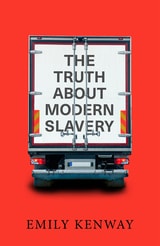
The Truth About Modern Slavery
Emily Kenway
Pluto Press, 2021
'A powerful treatise' - Amelia Gentleman, Guardian
In 2019, over 10,000 possible victims of slavery were found in the UK. From men working in Sports Direct warehouses for barely any pay, to teenaged Vietnamese girls trafficked into small town nail bars, we’re told that modern slavery is all around us, operating in plain sight.
But is this really slavery, and is it even a new phenomenon? Why has the British Conservative Party called it 'one of the great human rights issues of our time', when they usually ignore the exploitation of those at the bottom of the economic pile? The Truth About Modern Slavery reveals how modern slavery has been created as a political tool by those in power. It shows how anti-slavery action acts as a moral cloak, hiding the harms of the ‘hostile environment’ towards migrants, legitimising big brands’ exploitation of the poorest workers and oppressing sex workers.
Blaming the media's complicity, rich philanthropists' opportunism and our collective failure to realise the lies we’re being told, The Truth About Modern Slavery provides a vital challenge to conventional narratives on modern slavery.
The Ukrainian Challenge
Reforming Labour Market and Social PolicyILO-CEET ILO-CEET
Central European University Press, 1995
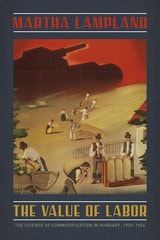
The Value of Labor
The Science of Commodification in Hungary, 1920-1956Martha Lampland
University of Chicago Press, 2016
Lampland trains her eye on the scientific claims of modern economic modeling, using Hungary’s unique vantage point to show how theories, policies, and techniques for commodifying agrarian labor that were born in the capitalist era were adopted by the socialist regime as a scientifically designed wage system on cooperative farms. Paying attention to the specific historical circumstances of Hungary, she explores the ways economists and the abstract notions they traffic in can both shape and be shaped by local conditions, and she compellingly shows how labor can be commodified in the absence of a labor market. The result is a unique account of economic thought that unveils hidden but necessary continuities running through the turbulent twentieth century.

The Visibility Bind
Being Seen, Getting Paid, and Paying the Price of Social Media SuccessBrooke Erin Duffy
University of Chicago Press, 0
A revelatory look at the people, platforms, and power struggles shaping work in the creator economy.
More than two decades after YouTube first invited scrappy amateurs to “broadcast yourself,” social media content creation has transformed into one of the fastest growing labor markets. Today, some two hundred million people work as platform-dependent content creators, influencers, or streamers. Social media platforms boldly tout the rewards of the digital creator economy: independence, flexibility, and the chance to convert one’s ingenuity into cash. Yet the image of work in this entrepreneurial Promised Land conceals a starker reality—one marked by labor precarity, exploitation, and entrenched structural inequalities.
In this essential work, award-winning communication scholar Brooke Erin Duffy analyzes the paradox of the “visibility bind.” On the one hand, labor devaluation and algorithmic suppression—where unseen forces and so-called “shadowbans” bury worker output—threaten to render creators invisible. On the other, excessive visibility introduces harms of its own, from scrutiny and surveillance to networked harassment. For creators at the margins—among them, creators of color, LGBTQ+ voices, and disability advocates—the bind is especially pronounced, belying the promise of a talent meritocracy.
Drawing on extensive, in-depth interviews and more than a decade of insight, Duffy situates creators’ experiences within the broader landscapes of self-commodification and platform capitalism. But while platforms hold immense power to structure the pathways to success, creators and influencers wield newfound sway in this high-stakes visibility game. They are organizing, building solidarity, and experimenting with new forms of labor consciousness.
Refuting conventional wisdom about creator careers, Duffy illuminates the hidden labor dynamics for a class of workers shaping everything from culture and commerce to civil liberties and geopolitical conflict. The Visibility Bind reveals the price and perils for anyone who “puts themselves out there.”

The Well-Being of the Elderly in Asia
A Four-Country Comparative StudyAlbert I. Hermalin, Editor
University of Michigan Press, 2010
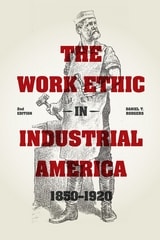
The Work Ethic in Industrial America 1850-1920
Second EditionDaniel T. Rodgers
University of Chicago Press, 2014
Daniel T. Rodgers masterfully explores the ways in which the eclipse of small-scale workshops by mechanized production and mass consumption triggered far-reaching shifts in perceptions of labor, leisure, and personal success. He also shows how the new work culture permeated society, including literature, politics, the emerging feminist movement, and the labor movement.
A staple of courses in the history of American labor and industrial society, Rodgers’s sharp analysis is sure to find a new audience, as twenty-first-century workers face another shift brought about by technology. The Work Ethic in Industrial America 1850–1920 is a classic with critical relevance in today’s volatile economic times.
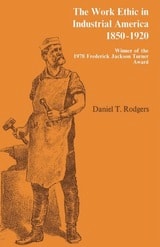
The Work Ethic in Industrial America, 1850-1920
Daniel T. Rodgers
University of Chicago Press, 1978

The Work of Gender
Service, Performance and Fantasy in Contemporary JapanEdited by Gitte Marianne Hansen and Fabio Gygi
National University of Singapore Press, 2022

The Work of Music
Labor and Creativity in Germany's Long Nineteenth CenturyCelia Applegate
University of Wisconsin Press, 2025
The Worker
Dominion and FormErnst Jünger, Edited by Laurence Paul Hemming, Translated from the German by Bogdan Costea and Laurence Paul Hemming
Northwestern University Press, 2018
Martin Heidegger considered Jünger “the only genuine follower of Nietzsche,” singularly providing “an interpretation which took shape in the domain of that metaphysics which already determines our epoch, even against our knowledge; this metaphysics is Nietzsche's doctrine of the ‘will to power.’” In The Worker, Jünger examines some of the defining questions of that epoch: the nature of individuality, society, and the state; morality, justice, and law; and the relationships between freedom and power and between technology and nature.
This work, appearing in its entirety in English translation for the first time, is an important contribution to debates on work, technology, and politics by one of the most controversial German intellectuals of the twentieth century. Not merely of historical interest, The Worker carries a vital message for contemporary debates about world economy, political stability, and equality in our own age, one marked by unsettling parallels to the 1930s.

The Workless
Stigma, Unpaid Labour and the Myth of Economic InactivityJames Morrison
Intellect Books, 2026
A critical analysis of historical and contemporary discourses around worklessness, economic inactivity, and the factors that contribute to people withdrawing from the conventional labor market.
How do we define and respond to worklessness? This book combines analysis of media and political narratives around worklessness and factors that limit individuals’ capacity for conventional paid work—from disability and long-term illness to caring responsibilities—with interviews that shed light on the lived experience of so-called economic inactivity.
In dissecting popular portrayals of “the workless” in the present and tracing the historical evolution of discourses around “inactivity”—especially work-limiting disability—James Morrison draws heavily on sociological theories of stigma and symbolic annihilation. Conceptualising the contemporary narrative about the UK's supposed crisis in economic inactivity as the latest in a continuum of periodic moral panics about worklessness, he argues that neoliberal definitions of work and worklessness are too narrow, as they deny—and render invisible—the importance of various forms of unpaid labor performed by many people classified as “inactive,” notably informal caregiving and volunteering.
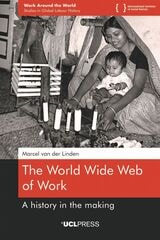
The World Wide Web of Work
A History in the MakingMarcel van der Linden
University College London, 2023
Global labor history is one of the fastest-growing fields of study worldwide today. This volume assembles a group of contributors from around the world to discuss the core concepts “capitalism” and “workers,” and to refine notions such as “coerced labor,” “household strategies,” and “labor markets.” It explores in new ways the connections between laborers in different parts of the world, arguing that both globalization and modern labor management originated in agriculture in the Global South and were only later introduced in Northern industrial settings. It reveals that nineteenth-century chattel slavery was frequently replaced by other forms of coerced labor, and it reconstructs the twentieth-century attempts of the International Labor Organisation to regulate work standards internationally. The book also pays attention to the relational inequality through which workers in wealthy countries benefit from the exploitation of those in poor countries. The final part addresses workers’ resistance and acquiescence: why collective actions often have unanticipated consequences, why and how workers sometimes organize massive flights from exploitation and oppression, and why proletarian revolutions took place in pre-industrial or industrializing countries but never in fully developed capitalist societies.
The World of Worker
LABOR IN TWENTIETH-CENTURY AMERICAJames R. Green
University of Illinois Press, 1998
The World of the Worker illuminates workers' lives at home, on
the job, and in the voting booths. A new preface enhances this social,
cultural, and political history: an unparalleled picture of working people
during the turbulent rise and fall of the labor movement.
"A fresh and provocative look at twentieth-century American unions,
and a fine introduction to recent labor history scholarship." --
Leslie Woodcock Tentler, Washington Post Book World
"Will be welcomed by anyone with a serious interest in labor history."
-- Library Journal
"Probably the best social history of twentieth-century labor
there is." -- Kirkus Reviews
"Virtually replaces any previously existing one-volume popular history
of the labor movement." -- Ron Radosh, Democratic Left

The Writers
A History of American Screenwriters and Their GuildBanks, Miranda J
Rutgers University Press, 2016
Threads
Gender, Labor, and Power in the Global Apparel IndustryJane L. Collins
University of Chicago Press, 2003
To dispel these misunderstandings, Jane L. Collins visited two very different apparel firms and their factories in the United States and Mexico. Moving from corporate headquarters to factory floors, her study traces the diverse ties that link First and Third World workers and managers, producers and consumers. Collins examines how the transnational economics of the apparel industry allow firms to relocate or subcontract their work anywhere in the world, making it much harder for garment workers in the United States or any other country to demand fair pay and humane working conditions.
Putting a human face on globalization, Threads shows not only how international trade affects local communities but also how workers can organize in this new environment to more effectively demand better treatment from their distant corporate employers.

Tight Knit
Global Families and the Social Life of Fast FashionElizabeth L. Krause
University of Chicago Press, 2018
Krause offers a revelatory look into how families involved in the fashion industry are coping with globalization based on longterm research in Prato, the historic hub of textile production in the heart of metropolitan Tuscany. She brings to the fore the tensions—over value, money, beauty, family, care, and belonging—that are reaching a boiling point as the country struggles to deal with the same migration pressures that are triggering backlash all over Europe and North America. Tight Knit tells a fascinating story about the heterogeneity of contemporary capitalism that will interest social scientists, immigration experts, and anyone curious about how globalization is changing the most basic of human conditions—making a living and making a life.
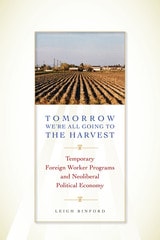
Tomorrow We're All Going to the Harvest
Temporary Foreign Worker Programs and Neoliberal Political EconomyBy Leigh Binford
University of Texas Press, 2013
From its inception in 1966, the Canadian Seasonal Agricultural Worker Program (SAWP) has grown to employ approximately 20,000 workers annually, the majority from Mexico. The program has been hailed as a model that alleviates human rights concerns because, under contract, SAWP workers travel legally, receive health benefits, contribute to pensions, are represented by Canadian consular officials, and rate the program favorably. Tomorrow We’re All Going to the Harvest takes us behind the ideology and examines the daily lives of SAWP workers from Tlaxcala, Mexico (one of the leading sending states), observing the great personal and family price paid in order to experience a temporary rise in a standard of living. The book also observes the disparities of a gutted Mexican countryside versus the flourishing agriculture in Canada, where farm labor demand remains high.
Drawn from extensive surveys and nearly two hundred interviews, ethnographic work in Ontario (destination of over 77 percent of migrants in the author’s sample), and quantitative data, this is much more than a case study; it situates the Tlaxcala-Canada exchange within the broader issues of migration, economics, and cultural currents. Bringing to light the historical genesis of “complementary” labor markets and the contradictory positioning of Mexican government representatives, Leigh Binford also explores the language barriers and nonexistent worker networks in Canada, as well as the physical realities of the work itself, making this book a complete portrait of a provocative segment of migrant labor.
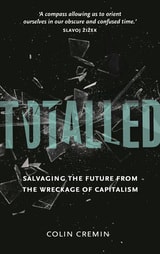
Totalled
Salvaging the Future from the Wreckage of CapitalismColin Cremin
Pluto Press, 2015
Totalled maps the deteriorating socio-economic, political, and ecological conditions in which we live. Yet Cremin asks how a utopian possibility discernable in the power of human creation can be realized even though as a society we are bound up materially, ideologically, libidinally—totally—to the capitalist machine of destruction. Totalled concludes with a politically and economically grounded set of propositions on how we might begin to imagine such a possibility.

Toxic Ivory Towers
The Consequences of Work Stress on Underrepresented Minority FacultyRuth Enid Zambrana
Rutgers University Press, 2018
Trade and Employment in Developing Countries, Volume 1
Individual StudiesEdited by Anne O. Krueger, Hal B. Lary, Terry Monson, and Narongchai Akrasanee
University of Chicago Press, 1980
Ten countries are studied: Brazil, Chile, Colombia, Indonesia, the Ivory Coast, Pakistan, South Korea, Thailand, Tunisia, and Uruguay. The contributors to the volume analyze the link between trade strategies and employment within a common framework, and the analyses of trade policy include the level and structure of protection, the relation of trade policy to labor demand, the labor intensiveness of trade, and the extent of distortions in factor markets and their effects on trade.
Trade and Employment in Developing Countries, Volume 2
Factor Supply and SubstitutionEdited by Anne O. Krueger
University of Chicago Press, 1982

Trying to Make Law Matter
Legal Reform and Labor Law in the Soviet UnionKathryn Hendley
University of Michigan Press, 1996
Trying to Make Law Matter provides unique insight into the possibility of creating the rule of law. It is based on Kathryn Hendley's pathbreaking field research into the actual practices of Russian trial courts, lawyers, factory managers, and labor unions, contrasting the idealistic legal pronouncements of workers' rights during the Gorbachev era with tawdry reality of inadequate courts and dispirited workers.
Hendley frames her study of Russian law in action with a lively theoretical analysis of the fundamental prerequisites of the rule of law not only as a set of ideals but as a legal system that rests on the participation of rights-bearing citizens. This work will appeal to law, political science, and sociology scholars as well as area specialists and those who study transitions to market democracy.
Kathryn Hendley is Professor, Law and Political Science, University of Wisconsin, Madison.