Results by title
527 books match the query 'Translations into English' and 139 start with t

The Fire Stays in Red
PoemsRonnie Someck
University of Wisconsin Press, 2002
"My mother dreams in Arabic, I dream in Hebrew," says Ronny Someck. Born in 1951, he was uprooted from his native Iraq when he was four. Transplanted to Israel, Someck spent his childhood in a transit camp for new immigrants. There he was surrounded by music, the great singers Umm Kulthum, Farid al Atrash, and Fairuz shouldering up against Elvis Presley and Billie Holiday. No wonder he is so beloved in Israel. In what other poet do we find Tarzan, Marilyn Monroe, and cowboys battling with Rabbi Yehuda Halevi for the hearts and souls of Israelis?
Someck’s poems are rich in slang and distinguished by staccato rhythms, quick cuts, close-ups, and disturbing segues. As in film noir, the sensations are of speed, danger, uncertainty. His distinct Sephardi voice invokes the odors of falafel and schwarma, the army with its supporting cast of recruits and commandos, the bustle of southern Tel Aviv with its small garages, shops, cheap restaurants, its gangs and its Arab workers. He is also the troubadour of the lovelorn, with poems that are hot, erotic, comic, tragic, agape at the wonders of a tear and a tattoo and a snapshot and a bra and a scarecrow.
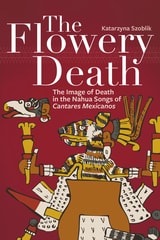
The Flowery Death
The Image of Death in the Nahua Songs of Cantares MexicanosKatarzyna Szoblik
University Press of Colorado, 2026
The Flowery Death is a groundbreaking exploration of xochimiquiztli, or “flowery death,” a central concept in the pre-Hispanic Nahua worldview. In the highly militarized societies of the Valley of Mexico, dying in honor of the gods—on the battlefield, in ritual sacrifice, or in childbirth—was not only a social expectation but also a path to spiritual glory. While this idea appears throughout colonial sources, previous studies have relied largely on the writings of Bernardino de Sahagún and other European chroniclers, whose perspectives often simplify or distort Indigenous understandings.
Drawing on the rich oral tradition preserved in the sixteenth-century manuscript Cantares Mexicanos, this book provides one of the first English translations of these songs since John Bierhorst’s 1985 translation. It combines paleographic fidelity, literal English translation, and detailed interpretation, revealing the metaphor- and symbol-rich meanings behind the songs. The book is divided into two interrelated parts: The first reconstructs the Nahua worldview, contextualizing war, death, and sacrifice through myths, chronicles, and visual sources; the second presents selected songs, offering readers the tools to understand their metaphors, historical references, and symbolic language, making the work both a scholarly reference and an accessible guide for students and enthusiasts.
By examining the cultural, religious, and social significance of xochimiquiztli, The Flowery Death provides fresh insights into Nahua ideology, gender roles, and collective memory. It is essential reading for anyone interested in Mesoamerican culture, early colonial history, and the power of Indigenous oral traditions.
The Forbidden
Poems from Iran and its ExilesSholeh Wolpé
Michigan State University Press, 2012
During the 1979 revolution, Iranians from all walks of life, whether Muslim, Jewish, Christian, socialist, or atheist, fought side-by-side to end one tyrannical regime, only to find themselves in the clutches of another. When Khomeini came to power, freedom of the press was eliminated, religious tolerance disappeared, women’s rights narrowed to fit within a conservative interpretation of the Quran, and non-Islamic music and literature were banned. Poets, writers, and artists were driven deep underground and, in many cases, out of the country altogether. This moving anthology is a testament to both the centuries-old tradition of Persian poetry and the enduring will of the Iranian people to resist injustice. The poems selected for this collection represent the young, the old, and the ancient. They are written by poets who call or have called Iran home, many of whom have become part of a diverse and thriving diaspora.
The Golden Thread and other Plays
By Emilio Carballido
University of Texas Press, 1970
Emilio Carballido was one of the most innovative and accomplished of Mexico's playwrights and one of the outstanding creators in the new Latin American theater. By his mid-forties he had already produced an impressive body of works in two very different veins. On the one hand, he mastered the techniques of the "well-made play." On the other, he developed a richly rewarding vein of fantasy, sometimes poetic, sometimes comic, sometimes macabre—and sometimes all three.
The plays in this volume are in the latter vein, ranging from surrealist farce in "The Intermediate Zone" to the grotesqueries of "The Time and the Place," from tragicomedy in "Theseus" to the dreamlike permutations of "The Golden Thread." But even at his most fantastic, Carballido never loses his remarkable gift for characterization: his peevish Minotaur, his raffish Nahual (were-jaguar) are wholly believable monsters.
The Grand Prize and Other Stories
Daniela Crasnaru
Northwestern University Press, 2005
Crasnaru portrays the lives of people so used to hardship that it never occurs to them to surrender. An unhappily married woman waits in vain for a call from a potential lover. A foul-mouthed mother of seven accuses a war hero of conning her out of her life savings. A lawyer is lured to a forest by a dead coworker's stories of a beautiful woman. Those with drab lives use fantasy to endure and those who believe themselves happy are forced to face grim realities. Crasnaru mixes elements of the ridiculous, the fanciful, and the grotesque with vivid realism and her remarkable stories, while taking place in a dark era in her nation's history, are about the human as well as the Romanian condition.
The Homilies of Saint Jerome, Volume 1 (1–59 on the Psalms)
Saint Jerome
Catholic University of America Press, 1965
The Hymns on Faith
Jeffrey T. St. Ephrem the Syrian
Catholic University of America Press, 2015
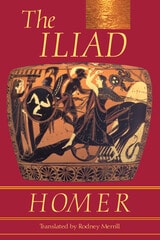
The Iliad
Homer
University of Michigan Press, 2007
nuances of English."
---Stephen G. Daitz, Professor Emeritus of Classics, City University of New York
Rodney Merrill's translation of Homer's Iliad offers a form of English poetry particularly relevant to the epic, producing a strong musical setting that brings many elements of the narrative truly to life. Most notable are the many battle scenes, in which Homer's strong dactylic hexameters make credible the "war-lust" in the deeds of the combatants.
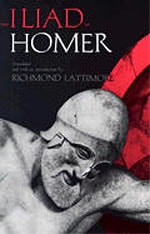
The Iliad of Homer
Translated by Richmond Lattimore
University of Chicago Press, 1951
"Certainly the best modern verse translation."—Gilbert Highet
"This magnificent translation of Homer's epic poem . . . will appeal to admirers of Homer and the classics, and the multitude who always wanted to read the great Iliad but never got around to doing so."—The American Book Collector
"Perhaps closer to Homer in every way than any other version made in English."—Peter Green, The New Republic
"The feat is decisive that it is reasonable to foresee a century or so in which nobody will try again to put the Iliad in English verse."—Robert Fitzgerald
"Each new generation is bound to produce new translations. [Lattimore] has done better with nobility, as well as with accuracy, than any other modern verse translator. In our age we do not often find a fine scholar who is also a genuine poet and who takes the greatest pains over the work of translation."—Hugh Lloyd-Jones, New York Review of Books
"Over the long haul Lattimore's translation is more powerful because its effects are more subtle."—Booklist
"Richmond Lattimore is a fine translator of poetry because he has a poetic voice of his own, authentic and unmistakable and yet capable of remarkable range of modulation. His translations make the English reader aware of the poetry."—Moses Hadas, The New York Times
The Immortality of the Soul; The Magnitude of the Soul; On Music; The Advantage of Believing; On Faith in Things Unseen
Saint Augustine
Catholic University of America Press, 1947
The Iuvenilia of Marc-Antoine Muret
With a translation, introduction, notes, and commentary by Kirk M. Summers
The Ohio State University Press, 2006
A growing interest in the contributions and perspectives of Renaissance authors who wrote in Latin has created an urgent need for accessible modern editions of their works. There is no hope of truly understanding the Renaissance, which, after all, was a revival of ancient learning integrated with an emerging modern world view, without taking into account the large body of work produced by neo-Latin authors. The Iuvenilia of Marc-Antoine Muret helps fill the need for critical editions that provide a general context and interpretation. A major neo-Latin poet, Muret was thoroughly versed in classical literature, mythology, rhetoric, and philosophy. He had inherited centuries of medieval learning and practices, both secular and religious. Muret incorporated the generic innovations of contemporary humanists while referring to current events and figures. In short, he summed up in his own person the body of human endeavor and thinking as it stood in his own time.
Given Muret’s importance, this lively translation by Kirk M. Summers, with an introduction, notes, and commentary, will appeal to classicists, including those interested in the classical tradition, as well as to scholars working on the French and European Renaissance.
The Land of Dreams
Vidar Sundstøl
University of Minnesota Press, 2014
Winner of the Riverton Prize for best Norwegian crime novel and named by Dagbladet as one of the top twenty-five Norwegian crime novels of all time, The Land of Dreams is the chilling first installment in Vidar Sundstøl’s critically acclaimed Minnesota Trilogy, set on the rugged north shore of Lake Superior and in the region’s small towns and deep forests.
The grandson of Norwegian immigrants, Lance Hansen is a U.S. Forest Service officer and has a nearly all-consuming passion for local genealogy and history. But his quiet routines are shattered one morning when he comes upon a Norwegian tourist brutally murdered near a stone cross on the shore of Lake Superior. Another Norwegian man is nearby; covered in blood and staring out across the lake, he can only utter the word kjærlighet. Love.
FBI agent Bob Lecuyer is assigned to the case, as is Norwegian detective Eirik Nyland, who is immediately flown in from Oslo. As the investigation progresses, Lance begins to make shocking discoveries—including one that involves the murder of an Ojibwe man on the very same site more than one hundred years ago. As Lance digs into two murders separated by a century, he finds the clues may in fact lead toward someone much closer to home than he could have imagined.
The Land of Dreams is the opening chapter in a sweeping chronicle from one of Norway’s leading crime writers—a portrait of an extraordinary landscape, an exploration of hidden traumas and paths of silence that trouble history, and a haunting study in guilt and the bonds of blood.
The Latin American Literary Boom and U.S. Nationalism during the Cold War
Deborah Cohn
Vanderbilt University Press, 2012
The high level of interest in Latin America paradoxically led the U.S. government to restrict these authors' physical presence in the United States through the McCarranWalter Act's immigration blacklist, even as cultural organizations cultivated the exchange of ideas with writers and sought to market translations of their work for the U.S. market.

The Lava of This Land
South African Poetry 1960-1996Denis Hirson
Northwestern University Press, 1997
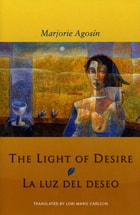
The Light of Desire
La Luz del DeseoMarjorie Agosín
Swan Isle Press, 2009
Marjorie Agosín’s intensely personal long poem The Light of Desire is both a secular and sacred meditation on love and its meanings in the land of Israel. Following the tradition of the Song of Songs and the secular poetry of Sepharad, the beloved in The Light of Desire is both physical and metaphorical. The lovers’ bodies are the paths, the geography, leading not only from desire to sensual pleasure, but to memory and illumination. The light on the pink stones of Jerusalem, the sunlight of Galilee, from hills to the sea, the fragrant air and “mantle of stars,” all become one in this tender, rhapsodic expression of longing and desire. This is not unrequited love, but rather a reciprocal passion that brings exquisite pleasure, pain, a sense of fragility, and the hope and belief in that which is eternal.
The poem was written over a four-year span in Jerusalem’s Mishkenot Sha’ananim neighborhood, overlooking the wall of the Second Temple, and these hallowed surroundings imbued Agosín’s poetic voice. Lori Marie Carlson’s sensitive translation maintains the spirit of the original Spanish in this bilingual edition.
The Loss
A Novella and Two Short StoriesVladimir Makanin
Northwestern University Press, 1998
In his celebrated short story "The Prisoner of the Caucasus," two Russian soldiers take a Chechen prisoner during the war, and as events unfold, Makanin reveals the casual brutality of the war but also the secret truths of the character's lives. In the novella The Loss, Pekalov, a drunkard and dreamer obsessed with the idea of building a tunnel under the Ural River, disappears in a ditch while working and is made a saint by the people of his village. "Klyucharyov and Alimushkin" tells the story of what happens when one man becomes remarkably lucky while the other loses all his luck.
The Mahabharata, Volume 2
Book 2: The Book of Assembly; Book 3: The Book of the ForestEdited by J. A. B. van Buitenen
University of Chicago Press, 1975
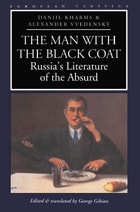
The Man with the Black Coat
Russia's Literature of the AbsurdDaniil Kharms and Alexander Vvedensky
Northwestern University Press, 1997
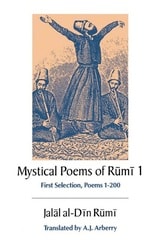
The Mystical Poems of Rumi 1
Jalal al-Din Rumi
University of Chicago Press, 1974
"An excellent introduction to Rumi, the greatest mystical poet of Islam. . . . Rumi's scope, like that of all great poets, is universal—reaching from sensuous luxuriance to the driest irony."—Sherman Goldman, East-West Journal
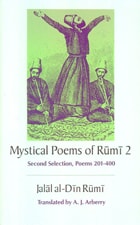
The Mystical Poems of Rumi 2
Second Selection, Poems 201-400Jalal al-Din Rumi
University of Chicago Press, 1991
Rumi, who wrote and preached in Persia during the thirteenth century, is one of history’s most celebrated mystics. His vast body of poetry includes a lengthy epic of religious mysticism, the Mathnavi, and more than three thousand lyrics and odes. A. J. Arberry, who selected four hundred of the lyrics for translation, calls Rumi "one of the world's greatest poets. In profundity of thought, inventiveness of image, and triumphant mastery of language, he stands out as the supreme genius of Islamic mysticism." Arberry’s authoritative translation is one of the few done directly from the original Persian.
A. J. Arberry (1905-69) was professor of Arabic at Cambridge University.
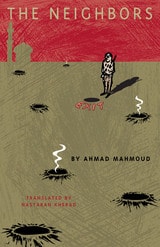
The Neighbors
By Ahmad Mahmoud
University of Texas Press, 2013
Ahmad Mahmoud sets The Neighbors against the backdrop of the oil nationalization crisis that gripped Iran in the early 1950s. His protagonist, Khaled, a young man from a rundown neighborhood in Ahvaz, a city in southern Iran, becomes involved in the struggle to wrest Iran’s oil industry from the British and, as the result of his political activities, comes to realize that there is more to life than the drudgery and poverty his parents and neighbors have experienced.
The Neighbors, published in 1974, cemented Mahmoud’s reputation as a novelist and captured the ethos of a generation—the generation that laid the groundwork for those who continue to struggle for democracy in Iran today. Though the novel received considerable praise and was read widely, its political nature earned the ire of Mohammad Reza Shah’s regime, and the Islamic Republic has objected to its sexually explicit content. This is the first time one of Ahmad Mahmoud’s novels has appeared in English translation.
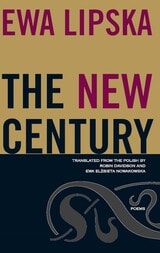
The New Century
PoemsEwa Lipska, translated from the Polisyh by Robin Davidson and Ewa Nowakowska
Northwestern University Press, 2009
Since the publication of her first book in 1967, Ewa Lipska has been among the most acclaimed of contemporary Polish poets. Yet, to date she has not enjoyed the same popularity in the United States as her fellow Poles Wislawa Szymborska, Czeslaw Milosz, and her contemporary Adam Zagajewski. The New Century: Poems, a selection of her recent work, introduces to an American audience the work of an underappreciated master.
Although Lipska’s work displays an acute awareness of history and politics, she’s nonetheless most concerned with individual experience and the most difficult philosophical questions of evil. Lipska is capable of being awed by beauty despite the deep pessimism that flows through her poems, including the failure of language itself to have any ameliorative effect on human experience.
Surreal, skeptical, and laced with wit, Lipska’s poetry, like that of Milosz and Szymborska, seems to effortlessly achieve a kind of hard-won and gracefully wielded authority that tells us something essential about the legacies of the twentieth century’s horrors.
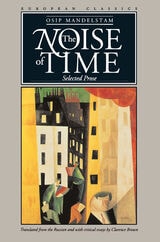
The Noise of Time
Selected ProseOsip Mandelstam
Northwestern University Press, 2002
This volume includes Mandelstam's "The Noise of Time," a series of autobiographical sketches; "The Egyptian Stamp," a novella; "Fourth Prose;" and the famous travel memoirs "Theodosia" and "Journey to Armenia."
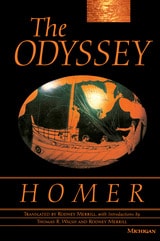
The Odyssey
Homer, Translated by Rodney Merrill
University of Michigan Press, 2002
This epic began life as the music composed by a "singer of tales," not as words on a page. As such, its meter allows for pleasing variations with a strong basic "beat," thus providing a rhythmic impetus that carries the story swiftly forward. The resulting "music" has important repercussions for the reader's perception of the many repeated elements that provide structure for the poem and bring out significant themes, just as the repetitions in a piece of music do.
This edition of the Odyssey includes selections for further reading, a list of proper names (with a guide to pronunciation), and three maps. It also provides introductory discussions of how the work came into being and was transmitted until it became the work we read, how it is divided into six "performance sessions" of four books each, and how the poem's various themes are developed. Rodney Merrill's Odyssey is thus an ideal edition for students, teachers, and general readers.
The audiobook is available on twelve cassettes, and is read by Rodney Merrill. This version will bring Homer's epic masterpiece to life like never before. Perfect for the car or classroom!
Rodney Merrill is retired and an independent scholar. He has taught at Stanford University, the University of San Francisco, and the University of California, Berkeley.
Thomas R. Walsh, Senior Professor at Occidental College, has written articles on Homeric poetics, with a forthcoming book on anger in Homer.
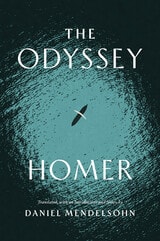
The Odyssey
Homer
University of Chicago Press, 2025
The most accurate and poetic translation of the world's greatest epic, which is now a film by Academy Award winner Christopher Nolan!
“This may be the best translation of The Odyssey yet."—Edith Hall, The Telegraph
A magnificent feat of translation, hailed by classicists and poets alike as a “momentous achievement”: “thrilling,” “rich and rhythmical,” “superb,” “mesmerizing,” “searingly faithful—yet absolutely original.”
With this edition of Homer’s Odyssey, the celebrated author, critic, and classicist Daniel Mendelsohn brings the great epic to vividly poetic new life. Widely known for his essays on classical literature and culture in The New Yorker and many other publications, Mendelsohn gives us a line-for-line rendering of The Odyssey that is both engrossing as poetry and true to its source. Rejecting the streamlining and modernizing approach of many recent translations, he artfully reproduces the epic’s formal qualities—meter, enjambment, alliteration, assonance—and in so doing restores to Homer’s masterwork its archaic grandeur. Mendelsohn’s expansive six-beat line, far closer to the original than that of other recent translations, allows him to capture each of Homer’s dense verses without sacrificing the amplitude and shadings of the original.
The result is the richest, most ample, most precise, and most musical Odyssey in English, conveying the beauty of its poetry, the excitement of its hero’s adventures, and the profundity of its insights. Supported by an extensive introduction and the fullest notes and commentary currently available, Daniel Mendelsohn’s Odyssey is poised to become the authoritative version of this magnificent and enduringly influential masterpiece.
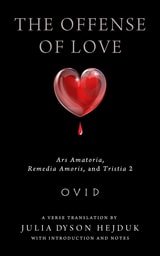
The Offense of Love
Ars Amatoria, Remedia Amoris, and Tristia 2Ovid, A verse translation by Julia D. Hejduk, with introduction and notes
University of Wisconsin Press, 2014
In exile, Ovid composed Sad Things (Tristia), which included a defense of his life and work as brilliant and cheeky as his controversial love manuals. In a poem addressed to Augustus (Tristia 2), he argues, "Since all of life and literature is one long, steamy sex story, why single poor Ovid out?" While seemingly groveling at the emperor's feet, he creates an image of Augustus as capricious tyrant and himself as suffering artist that wins over every reader (except the one to whom it was addressed).
Bringing together translations of the Ars Amatoria, Remedia Amoris, and Tristia 2, Julia Dyson Hejduk's The Offense of Love is the first book to include both the offense and the defense of Ovid's amatory work in a single volume. Hejduk's elegant and accurate translations, helpful notes, and comprehensive introduction will guide readers through Ovid's wickedly witty poetic tour of the literature, mythology, topography, religion, politics, and (of course) sexuality of ancient Rome.
Finalist, National Translation Award, American Literary Translators Association
A Choice Outstanding Academic Book
The One-Handed Pianist and Other Stories
Ilan Stavans
Northwestern University Press, 2007
The One-Handed Pianist was published to acclaim in the early 1990’s, with the two-part Spanish edition winning the Latino Literature Prize in 1989 and the Gamma Literature Prize in 1992. Its tales look at what it means to be Jewish in the Hispanic world—a world in which spirituality is often exercised outside the realm of orthodoxy.
Stavans constructs fables that raise questions about ethnicity and community; even Stavans’ person raises questions about ethnicity and community: what does it mean that a Jew of Eastern European lineage can call himself Latino and speak for that group?
The Oresteia
Agamemnon, Libation Bearers, and The Holy GoddessesAeschylus, A verse translation by David Mulroy, with introduction and notes
University of Wisconsin Press, 2018
This drama of the House of Atreus catches everyone in a bloody net. Queen Clytaemestra of Argos murders her husband Agamemnon. Their son Orestes avenges his father by killing his mother. The Furies, hideous deities who punish the murder of blood kin, pursue Orestes. Into this horrific cycle steps Athena, goddess of wisdom, who establishes the rule of law to replace fatal vengeance. Orestes is tried in court before a jury of Athenians and found not guilty. Athena transforms the Furies into benevolent goddesses and extols the virtue of mercy.
An important historical document as well as gripping entertainment, the Oresteia conveys beliefs and values of the ancient Athenians as they established the world's first great democracy. Aeschylus (525/4–456/5 B.C.E.) was the first of the three great tragic dramatists of ancient Greece, forerunner of Sophocles and Euripides. In this trilogy he created a new dramatic form with characters and plot, infused with spellbinding emotion. David Mulroy's fluid, accessible English translation with its rhyming choral songs does full justice to the meaning and theatricality of the ancient Greek. In an introduction and appendixes, he provides cultural background for modern readers, actors, and students.
The Other Side of Heaven
Post-War Fiction by Vietnamese and American WritersEdited by Wayne Karlin, Le Minh Khue, and Truong Vu
Northwestern University Press, 1995
The Poems
Robert Walser
Seagull Books, 2022
Admired by the likes of Kafka, Musil, and Walter Benjamin and acclaimed “unforgettable, heart-rending” by J. M. Coetzee, Swiss writer Robert Walser (1878–1956) remains one of the most influential authors of modern literature. Walser left school at fourteen and led a wandering and precarious existence while producing poems, stories, essays, and novels. In 1933, he abandoned writing and entered a sanatorium, where he remained for the rest of his life. “I am not here to write,” Walser said, “but to be mad.”
This first collection of Walser’s poems in English translation allows English-speaking readers to experience the author as he saw himself at the beginning and the end of his literary career––as a poet. The book also includes notes on dates of composition, draft versions of the printed poems, and brief biographical information on characters and locations that appear in the poems and may not be known to readers. Few writers have ever experienced such a steady rise in their reputation and public profile as Walser has seen in recent years, and this collection of his poems will help readers discover a unique writer whose off-kilter sensibility and innovations in form are perfectly suited to our fragmented, distracted, bewildering era.
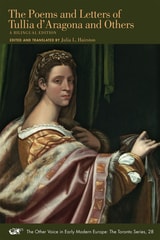
The Poems and Letters of Tullia d'Aragona and Others
A Bilingual EditionTullia d'Aragona and Others, Edited by Julia L. Hairston, Translated by Julia L. Hairston
Iter Press, 2014
Hairston has constructed a full personal, cultural and literary biography for d’Aragona, using newly discovered letters, archival material of other kinds, and contemporary theory about gender in women’s writing. Footnotes establish the intricacy of Tullia’s intellectual networks and her courting of intellectuals in rhyme. Hairston includes poems written to d’Aragona, including Girolamo Muzio’s long pastoral, Tirrhenia. She addresses with tact the question of how sexual Tullia’s relationships were with her various interlocutors. At times, as she says, one just can’t know, but that the issue is much less important than the poems themselves. I agree wholeheartedly. This is the editor Tullia has been waiting for: an indefatigable researcher, a creative biographer, and a precise and appreciative literary critic.
—Ann Rosalind Jones
Esther Cloudman Dunn Professor of Comparative Literature, Smith College
The figure of Tullia d’Aragona has long fascinated readers as the prototype of the “honest courtesan”, a woman who successfully exploited her physical and intellectual charms to win the adoration and respect of the Italian cultural elite. With Julia Hairston’s richly annotated edition of her collected verse, the product of more than a decade of scholarship, d’Aragona finally comes into focus also as poet. She emerges in this volume as one of the most distinctive protagonists in a key transitional moment in Italian literary history, when the aristocratic tradition of Petrarchist lyric began to be reshaped and democratized by its encounter with print.
—Virginia Cox
Professor of Italian, New York University
The Poems of François Villon
François Villon
Brandeis University Press, 1982
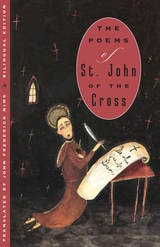
The Poems of St. John of the Cross
St. John of the Cross
University of Chicago Press, 1979
This dual-language edition makes available the original Spanish from the Codex of Sanlúcon de Barrameda with facing English translations. The work concludes with two essays—a critique of the poetry and a short piece on the Spanish text that appears alongside the translation—as well as brief notes on the individual poems.
The Prophecy and Other Stories
Drago Jancar
Northwestern University Press, 2009
These newly collected short stories reveal a master at the top of his game. Drago Jancar possesses an acute understanding of the human psyche, enabling his stories to resonate beyond their particular milieu. This collection features seven pieces, drawn from four different collections, that together present the struggle of individuals against powerful forces. The characters try to make sense of a world of shifting borders and changing names that make the idea of a "homeland"—either literal or figurative—a dream rather than a reality.
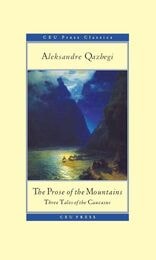
The Prose of the Mountains
Three Tales of the CaucasusAleksandre Qazbegi
Central European University Press, 2015
The Prose of the Mountains contains three tales of the Caucasus by Aleksandre Qazbegi, one of the most prescient and gifted chroniclers of the Georgian encounter with colonial modernity. His stories offer an invaluable counterpoint to the predominantly Russian narratives that have hitherto shaped scholarly accounts of the nineteenth-century Caucasus. “Memoirs of a Shepherd” poignantly chronicles the young author’s decision to pass seven years of his life as a shepherd with Georgian mountaineers. “Eliso” (the name of a Chechen girl) offers one of the most searing accounts on record of the forced migration of this people from their homeland to Ottoman lands. Set in the sixteenth century, “Khevis Beri Gocha” (the name of a Georgian village chief) classically chronicles a tragic misunderstanding between a severe father and his loving son.
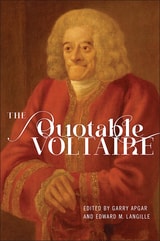
The Quotable Voltaire
Garry Apgar
Bucknell University Press, 2021
Drawing from a wide range of his publications, private letters, and remarks recorded by his contemporaries, The Quotable Voltaire includes material never before gathered in a single volume. English translations appear alongside the original French, and each quote is thoroughly indexed and referenced, with page numbers for both the first known publication edition of each entry and the most recent edition of Voltaire’s works. The book also features over 400 quotes about Voltaire, including commentary by eighteenth-century luminaries like Samuel Johnson, Catherine the Great, Casanova, and John Adams, as well as an eclectic assortment of modern-day personages ranging from Winston Churchill and Jorge Luis Borges to Mae West and Mike Tyson.
Lavishly illustrated with nearly three dozen images of Voltaire-related art, this collection opens with a scholarly essay that recounts the great man’s life and reflects on his outsized influence on Western culture. Whether you are a Voltaire scholar or a neophyte, The Quotable Voltaire is the perfect introduction to a brilliant mind.
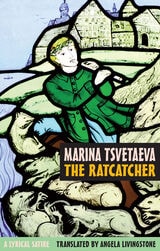
The Ratcatcher
Marina Tsvetaeva, translated from the Russian by Angela Livingstone
Northwestern University Press, 2000
The Ratcatcher, Marina Tsvetaeva's masterpiece, is a satirical version of the Pied Piper of Hamelin legend in the form of a complex narrative poem that bears all the marks of Tsvetaeva's poetic style. Written in 1926, it was not available in Russia until 1965, and has hitherto been virtually unknown in English.
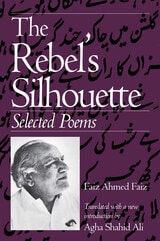
The Rebel's Silhouette
Selected PoemsFaiz Ahmed Faiz, translated and edited by Agha Shalid Ali
University of Massachusetts Press, 1995

The Salamander and Other Gothic Tales
Vladimir Odoevsky
Northwestern University Press, 1992
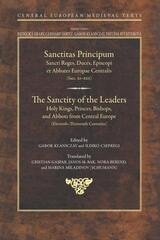
The Sanctity of the Leaders
Holy Kings, Princes, Bishops and Abbots from Central Europe (11th to 13th Centuries)Gábor Klaniczay
Central European University Press, 2023
The latest title in the Central European Medieval Texts series contains the lives of saints who were canonized in the eleventh through thirteenth centuries in the newly Christianized countries of Central and Eastern Europe (Bohemia, Poland, Hungary, and Dalmatia). A rejoinder to the earlier volume in the series, the Saints of the Christianization Age of Central Europe (CEMT, Vol. 6), containing hermits, missionaries, and martyrs, this second volume of hagiography is dominated by political or ecclesiastical leaders who became saintly patrons of their region and were highly venerated throughout the Middle Ages.
The legends in the volume present the two Hungarian holy kings Stephen and Ladislas, the holy duke Emeric, the Czech holy abbot Prokop of Sázava, three bishops, the Venetian-Hungarian Gellért of Csanád, the Polish Stanislas of Cracow (both martyrs), and the Dalmatian holy bishop Saint John of Trogir. Each “vita” is published in Latin original with an English translation and with prefaces discussing the textual tradition.
Saints’ lives have been recognized as an invaluable source of information on social and economic history, the history of mentalities and everyday life, cultural history, and, above all, as a special genre with crucial importance and prevalence in medieval literature.
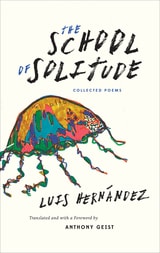
The School of Solitude
Collected PoemsLuis Hernández
Swan Isle Press, 2014
Derived from these notebooks, The School of Solitude is the first book of Hernández’s poetry in English. The haunting voice of Hernández evokes an irrevocably distant past, with the poems contemplating happiness and joy, love and fulfillment, yet always with a sense of sadness, solitude, and dream. Including rare images from Hernández’s notebooks, as well as several poems never before published in any language, The School of Solitude will be read not only for its powerful poetry and imagery, but also as a means to learn more about this enigmatic Latin American poet and the mystery of his life and work.
The Selected Poems of Miguel Hernandez
A Bilingual EditionMiguel Hernández
University of Chicago Press, 2001
Now, for the first time, Ted Genoways makes Hernández's extraordinary oeuvre available in an authoritative bilingual edition. Featuring some of the most tender and vigorous poetry on war, death, and social injustice written in the past century, nearly half of the poems in this volume appear in English for the first time, making it the most comprehensive bilingual collection of Hernández's work available. Arranged chronologically, The Selected Poems of Miguel Hernández presents Hernández's remarkable emotional range as well as his stylistic evolution from the Romantic shepherd poet to poet of the prison cell. Thorough annotations and introductory essays illuminate the biographical basis for many of Hernández's poems, while a foreword by Robert Bly and an afterword by Octavio Paz provide a striking frame for the work of this essential poet.
"What a victory it is to watch springing forth from our murky thicket of half-commercialized poetry the silver boar of Hernández's words-to see the world of paper part so as to allow the language tusks and shoulders to emerge, shining, pressed forward by his genius. This generous selection of Miguel Hernández's work, arranged, shepherded, and largely translated by Ted Genoways, is an immense gift for which all of us should be grateful."-from the Foreword by Robert Bly
"To gather Hernández's poetry in such a large volume is to bring one of the 20th century's most important poets to life again. Without Hernandez, the world community of poetry would not be what it is today. The Selected Poems must be read if vital poetry is to continue another 100 years, with Hernández's voice as a cherished example of why great poetry is timeless."—Ray González, Bloomsbury Review
"As Philip Levine write in The Kenyon Review, Hernández is 'one of the great talents of the century,' and this collection is a good place to discover (or rediscover) his moving verses."—Virginia Quarterly Review
"Vivid, often volatile imagery describes wrenching emotions and events in The Selected Poems of Miguel Hernández: A Bilingual Edition. . . . Raw, passionate, despairing and celebratory, these poems are a true discovery."—Publishers Weekly
"Arranged in three chronological sections, the poems presented are not the complete works, but they are a large and representative sampling of the best. This is certainly the most comprehensive bilingual edition of Hernández's poetry available. In addition to the poems, the editor includes eight illustrations, important prefatory materials, and a short list of references, and an epilogue by Octavio Paz."—Choice
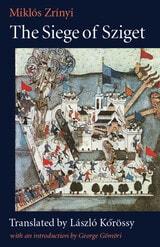
The Siege of Sziget
Miklos Zrinyi
Catholic University of America Press, 2011
The Sins of Childhood and Other Stories
Boleslav Prus
Northwestern University Press, 1996
The Sky Is Our Song
The "Phaenomena" of AratusAratus
University of Chicago Press, 2025
A poetic guide to the heavens, the Phaenomena of Aratus—dating from around 270 BCE—was widely known across the ancient world, second only in fame to the works of Homer. Beginning with an invocation to Zeus, the poem describes the constellations of the northern and southern skies, the celestial sphere, and weather signs. Aratus’s vivid work offered a complete handbook of astronomy, constellations, and weather, and this treatise on the night sky was later translated or adapted by luminaries including Cicero, Virgil, and Ovid. The Phaenomena remained popular throughout the Renaissance and had more than sixty printed editions by the early seventeenth century, but its fame has faded in the modern world.
With this edition, renowned translator and amateur astronomer Stanley Lombardo renders Aratus’s poem in reader-friendly vernacular English verse. Complete with endnotes, an accessible introduction, and astronomically accurate illustrations, The Sky Is Our Song brings this master poet’s celebration of the sky to a twenty-first-century audience, inviting new readers to follow Aratus on a visual journey through star signs, moon phases, weather phenomena, and all wonders of the heavens.

The Song of Songs
Love Lyrics from the BibleMarcia Falk
Brandeis University Press, 2004
The Spiritual Life and Other Writings
Camilla Battista Da Varano
Iter Press, 2023
Camilla Battista da Varano (1458–1524) was a Franciscan nun and the author of profound spiritual writings in both prose and verse. Raised in the princely household of Camerino in north-central Italy, she put her thorough humanist education to use explaining her own spiritual experience and delivering advice to others. Varano composed ecstatic revelations, prayers, poems, hagiography, spiritual direction, and commentary on convent legislation. She drew on a wide variety of sources, including scripture and Church Fathers, plus popular literature and proverbs. Varano was an erudite woman of considerable complexity, defying many of the commonplace images we associate with religious women of the late fifteenth and early sixteenth centuries.
The Stars, The Earth, The River
Short Stories by Le Minh KhueLe Minh Khue
Northwestern University Press, 1997
The Stars, the Earth, the River contains an excellent introduction by the translators, grounding the stories in Le Minh Khue's personal history. You simultaneously feel the rage of the author and the narrator when Khue disparagingly notes that the conversations around her center on luxuries, motor scooters, and business deals. Of what use, these stories ask, is such suffering? How can a culture honor the losses of war?
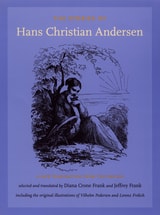
The Stories of Hans Christian Andersen
A New Translation from the DanishHans Christian Andersen
Duke University Press, 2005
In this collection are twenty-two tales that best represent Andersen’s literary legacy, including such classics as “The Little Mermaid,” “The Ugly Duckling,” “Thumbelisa,” and “The Emperor’s New Clothes,” as well as largely unfamiliar stories like “By the Outermost Sea.” Illuminating notes clarify references in the tales. And in an introductory essay, the Franks explore the writer and his times, placing the enigmatic and often bizarre figure of Andersen among his literary contemporaries, such as Charles Dickens and Søren Kierkegaard, with whom he crossed paths; and they bring to life Andersen’s fascinating relationship with the United States. Illustrated with the delicate and beautiful drawings that accompanied the original Danish publication, The Stories of Hans Christian Andersen will delight readers of all ages.
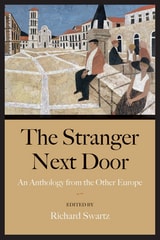
The Stranger Next Door
An Anthology from the Other EuropeRichard Swartz
Northwestern University Press, 2013
The Balkans have been so troubled by violence and misunderstanding that we have the verb “balkanize,” meaning to break up into smaller, warring components. While some of the region’s artists and thinkers have invariably fallen into nationalistic tendencies, the twenty-two prominent authors represented here, from the erstwhile Yugoslavia and its neighbors Albania and Bulgaria, have chosen to attempt to bridge these divides. The essays, biographical sketches, and stories in The Stranger Next Door form a project of understanding that picks up where politics fail. The English-language translation joins editions of the book that appeared concurrently in all of the participating countries.