Results by title
8113 books match the query 'Literary Criticism' and 1818 start with t
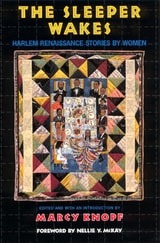
The Sleeper Wakes
Harlem Renaissance Stories by WomenKnopf-Newman, Marcy
Rutgers University Press, 1993
In recent years there has been an explosion of interest in the art and culture of the Harlem Renaissance. Yet this significant collection is the first definitive edition of Harlem Renaissance stories by women. The writers include Gwendolyn Bennett, Jessie Redmon Fauset, Angelina Weld Grimké, Zora Neale Hurston, Nella Larsen, Alice Dunbar-Nelson, and Dorothy West.
Published originally in periodicals such as The Crisis, Fire!!, and Opportunity, these twenty-seven stories have until now been virtually unavailable to readers. These stories are as compelling today as they were in the 1920s and 1930s. In them, we find the themes of black and white racial tension and misunderstanding, economic deprivation, passing, love across and within racial lines, and the attempt to maintain community and uplift the race.
Marcy Knopf's introduction surveys the history of the Harlem Renaissance, the periodicals and books it generated, and describes the rise to prominence of these women writers and their later fall from fame. She also includes a brief biography of each of the writers. Nellie Y. McKay's foreword analyzes the themes and concerns of the stories.
The Smell of Books
A Cultural-Historical Study of Olfactory Perception in LiteratureHans J. Rindisbacher
University of Michigan Press, 1993
Rindisbacher examines the works of the German Expressionists and of Baudelaire, Huxley, Rimbaud, Wilde, and Turgenev, as well as Holocaust memoirs and contemporary German books such as Patrick Suskind’s Das Parfum and Christa Wolf’s Storfall. He demonstrates that the sense of smell, which has heretofore occupied a position at the bottom of the sensory hierarchy, plays a consequential role in romantic, modern, and contemporary European and Russian literature.
The Social Conscience of Latin American Writing
By Naomi Lindstrom
University of Texas Press, 1998
A CHOICE Outstanding Academic Book
Literature in Latin America has long been a vehicle for debates over the interpretation of social history, cultural identity, and artistic independence. Indeed, Latin American literature has gained international respect for its ability to present social criticism through works of imaginative creation.
In this comprehensive, up-to-the-minute survey of research and opinion by leading Latin American cultural and literary critics, Naomi Lindstrom examines five concepts that are currently the focus of intense debate among Latin American writers and thinkers. Writing in simple, clear terms for both general and specialist readers of Latin American literature, she explores the concepts of autonomy and dependency, postmodernism, literary intellectuals and the mass media, testimonial literature, and gender issues, including gay and lesbian themes. Excerpts (in English) from relevant literary works illustrate each concept, while Lindstrom also traces its passage from the social sciences to literature.
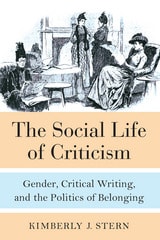
The Social Life of Criticism
Gender, Critical Writing, and the Politics of BelongingKimberly J. Stern
University of Michigan Press, 2016
This engaging study begins by looking at the eighteenth century, when critical writing started to assume the institutional and generic structures we associate with it today, and examines a series of case studies that illuminate how women writers engaged with the forms of intellectual sociability that defined nineteenth-century criticism—including critical dialogue, the club, the salon, and the publishing firm. In doing so, it clarifies the fascinating rhetorical and political debates surrounding the figure of the female critic and charts how women writers worked both within and against professional communities. Ultimately, Stern contends that gender was a formative influence on critical practice from the very beginning, presenting the history of criticism as a history of gender politics.
While firmly grounded in literary studies, The Social Life of Criticism combines an attention to historical context with a deep investment in feminist scholarship, social theory, and print culture. The book promises to be of interest not only to professional academics and graduate students in nineteenth-century literature but also to scholars in a wide range of disciplines, including literature, intellectual history, cultural studies, gender theory, and sociology.
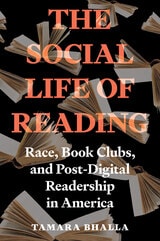
The Social Life of Reading
Race, Book Clubs, and Post-Digital Readership in AmericaTamara Bhalla
University of Massachusetts Press, 2027
Showing how what we read, and with whom, reveals how power works in America
In an interview about his novel The Emperor of Gladness being selected for Oprah’s Book Club, Ocean Vuong recalled the women in his mother’s nail salon—working-class immigrants, mostly single mothers—who would buy whatever book Oprah had chosen. What she gave them, Vuong reflected, was “access… a ticket into the discourse.” Books, he said, “can change the posture of somebody’s mother.” It’s a small observation, but it points to something Tamara Bhalla takes seriously in The Social Life of Reading: that how we read, what we read, and with whom we read is rarely just a matter of personal taste.
Bhalla reveals how social reading practices, from celebrity book selections to Goodreads reviews, are crucial arenas where power circulates, gets contested, and gets remade in contemporary American culture. Drawing on sociology of literature, ethnic studies, and feminist cultural analysis, she shows that reading, often framed as apolitical and personal, is fundamentally a political practice. Using the term “post-digital” to capture how 21st-century reading blends digital platforms with in-person gatherings and print, Bhalla traces two distinct reading cultures: mainstream communities, including celebrity book clubs, Goodreads, and Moms for Liberty, that center white, heteronormative values through affective, particularly maternal, responses to literature; and reading communities informed by digital Black feminism and traditions of self-definition, conscious consumption, and political engagement to imagine alternative literary futures.
The result is a striking portrait of contemporary reading culture as simultaneously structured by whiteness and shaped by the emergence of racially conscious alternatives. Bhalla demonstrates that what we read, with whom we read, and what we value in literature is not a matter of individual taste—it is a powerful cultural force shaping who gets represented, whose voices matter, and what stories get told.
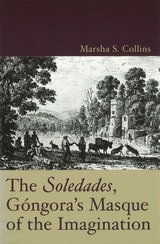
The Soledades, Góngora's Masque of the Imagination
Marsha S. Collins
University of Missouri Press, 2002
Prince of Darkness or Angel of Light? The pastoral masterpiece the Soledades garnered both titles for its author, Luis de Góngora, one of Spain's premier poets. In The Soledades, Góngora's Masque of the Imagination, Marsha S. Collins focuses on the brilliant seventeenth-century Spanish poet's contentious work of art. The Soledades have sparked controversy since they were first circulated at court in 1612-1614 and continue to do so even now, as Góngora has become for some critics the poster child of postmodernism. These perplexing 2,000-plus line pastoral poems garnered endless debates over the value and meaning of the author's enigmatic, challenging poetry and gave rise to his reputation, causing his very name to become an English term for obscurity.
Collins views these controversial poems in a different light, as a literary work that is a product of European court culture. She shows that the Soledades are in essence a court masque, an elaborate theatrical genre that combines a variety of cultural forms and that unfolds in the mind of the reader. Collins maintains that far from serving as an example of "art for art's sake," the Soledades represent Góngora's bid to transform poetic language into a new kind of visionary discourse that allows readers to access secret truths invisible to the average member of the reading public.
Each of Collins's four chapters analyzes a different facet of the Soledades, offering readers varied means of approaching Góngora's great work and helping the audience read the poems with greater understanding and appreciation.
The Soledades, Góngora's Masque of the Imagination demystifies the daunting, hermetic language of the Soledades to make this masterpiece of imperial Spain accessible to a new, and wider, circle of modern readers. Collins's book transports readers to the court of Habsburg Spain, offering a window to court culture—art, music, alchemy, emblems, garden architecture—and revealing the remarkable beauty of one of Spain's greatest literary masterpieces. Interdisciplinary and cross-cultural in approach, this book will appeal to all Hispanists, including those interested in the current "New Baroque" vogue in Hispanic scholarship, as well as specialists in Renaissance and Baroque English and European literature.
The Song of Songs and the Ancient Egyptian Love Songs
Michael V. Fox
University of Wisconsin Press, 1985
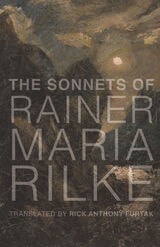
The Sonnets of Rainer Maria Rilke
Rainer Maria Rilke
St. Augustine's Press, 2021
In an expanded collection of Rilke’s sonnets, Rick Anthony Furtak not only makes this lyrical masterpiece accessible to the English reader, but he proves himself a master of sorts as well. His introduction that elaborates on Rilke’s marriage of vision and voice, intention and enigma, haunted companionship and abandonment is a stand-alone marvel for the reader. Furtak’s praised translation of Sonnets to Orpheus (University of Chicago Press, 2008) is surpassed in this much broader collection of verse that also includes the original German text. It is Furtak’s great achievement that Rilke resonates with the contemporary reader, who uncertain and searching wants to believe that the vision of existence can mirror much more than his own consciousness. In his feat of rendering Rilke in English, contextualizing the philosophical meanings of verse, and presenting literary romanticism, Furtak provides a formidable contribution to the vindication of true poetic voice.
The Soul of Tragedy
Essays on Athenian DramaEdited by Victoria Pedrick and Steven M. Oberhelman
University of Chicago Press, 2005
Exemplary of the nature and scope of this book, the essays range from Simon Goldhill's comparative study of music, gender, and culture to Martha Nussbaum's inspection of "the comic soul." Through the critical lenses of psychoanalysis, gender, social history, and philology, this compilation looks at Greek tragedy's peculiar power to illuminate the workings of the human soul. Structures of tragic meaning, the relationship between character desire and spectator experience, and investigations of tragedy's extraordinary preoccupation with gender reveal the form's emotional core and explain its rapid ascent through the hierarchy of cultural practices in classical Greece. The Soul of Tragedy is a celebration and a model of collaboration that will be essential reading for scholars in classics, literature, and drama.
The Soul of the Stranger
Reading God and Torah from a Transgender PerspectiveJoy Ladin
Brandeis University Press, 2018
The Souls of Black Folk
Essays and SketchesW.E.B. Du Bois
University of Massachusetts Press, 2018
Unlike Du Bois's more scholarly work, Souls blends narrative and autobiographical essays, and it continues to reach a wide domestic and international readership. This moving homage to black life and culture and its sharp economic and historical critique are more important than ever, resonating with today's unequivocal demand that Black Lives Matter in the twenty-first century.
The Sound of Listening
Poetry as Refuge and ResistancePhilip Metres
University of Michigan Press, 2018
Philip Metres stakes a claim for the cultural work that poems can perform—from providing refuge to embodying resistance, from recovering silenced voices to building a more just world, in communities of solitude and solidarity. Gathering a decade of his writing on poetry, he widens our sense of poetry as a way of being in the world, proposing that poems can offer a permeability to marginalized voices and a shelter from the imperial noise and despair that can silence us. The Sound of Listening ranges between expansive surveys of the poetry of 9/11, Arab American poetry, documentary poetry, landscape poetry, installation poetry, and peace poetry; personal explorations of poets such as Adrienne Rich, Khalil Gibran, Lev Rubinstein, and Arseny Tarkovsky; and intimate dialogues with Randa Jarrar, Fady Joudah, and Micah Cavaleri, that illuminate Metres’s practice of listening in his 2015 work, Sand Opera.
The Sound of Poetry / The Poetry of Sound
Edited by Marjorie Perloff and Craig Dworkin
University of Chicago Press, 2009
Sound—one of the central elements of poetry—finds itself all but ignored in the current discourse on lyric forms. The essays collected here by Marjorie Perloff and Craig Dworkinbreak that critical silence to readdress some of thefundamental connections between poetry and sound—connections that go far beyond traditional metrical studies.
Ranging from medieval Latin lyrics to a cyborg opera, sixteenth-century France to twentieth-century Brazil, romantic ballads to the contemporary avant-garde, the contributors to The Sound of Poetry/The Poetry of Sound explore such subjects as the translatability of lyric sound, the historical and cultural roles of rhyme,the role of sound repetition in novelistic prose, theconnections between “sound poetry” and music, between the visual and the auditory, the role of the body in performance, and the impact of recording technologies on the lyric voice. Along the way, the essaystake on the “ensemble discords” of Maurice Scève’s Délie, Ezra Pound’s use of “Chinese whispers,” the alchemical theology of Hugo Ball’s Dada performances, Jean Cocteau’s modernist radiophonics, and an intercultural account of the poetry reading as a kind of dubbing.
A genuinely comparatist study, The Sound of Poetry/The Poetry of Sound is designed to challenge current preconceptions about what Susan Howe has called “articulations of sound forms in time” as they have transformed the expanded poetic field of the twenty-first century.
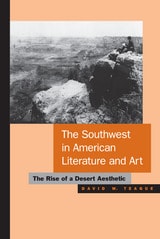
The Southwest in American Literature and Art
The Rise of a Desert AestheticDavid W. Teague
University of Arizona Press, 1997
By focusing on cultures that lived in the Southwest and by analyzing ways in which they described the land, David Teague persuasively argues against the destructive approach that Americans currently take to the region. Included are Native American legends and Spanish and Hispanic literature. However, the bulk of the study concentrates on Anglo American views of the Southwest, which have been generally at odds with the ecology of the deserts.
Ranging from oral traditions of the Navajo, Zuñi, and Hopi Indians to travel journals, fiction, and visual art, Teague examines the work of nearly thirty writers, artists, and explorers, including Alvar Núñez Cabeza de Vaca, Mary Austin, John Wesley Powell, and Frederic Remington. As he traces ideas about the desert over time, the author shows how American literature and art have come to represent the Southwest as a landscape to be sustained rather than transformed.
Bound to gain a prominent place in ecological criticism and in literature of the Southwest, this book offers important insights for scholars and students of literature, environmental studies, history, anthropology, and Native American studies. Its originality and vigor will also appeal to general readers with an interest in the landscape—and the future—of the American Southwest.
The Southwest in the American Imagination
The Writings of Sylvester Baxter, 1881-1889Curtis M. Hinsley
University of Arizona Press, 1996
Drawing on materials housed in half a dozen institutions and now brought together for the first time, this projected seven-volume work presents a cultural history of the Hemenway Expedition and early anthropology in the American Southwest, told in the voices of its participants and interpreted by contemporary scholars. Taken as a whole, the series comprises a thorough study and presentation of the cultural, historical, literary, and archaeological significance of the expedition, with each volume posing distinct themes and problems through a set of original writings such as letters, reports, and diaries. Accompanying essays guide readers to a coherent understanding of the history of the expedition and discuss the cultural and scientific significance of these data in modern debates.
This first volume, The Southwest in the American Imagination, presents the writings of Sylvester Baxter, a journalist who became Cushing's friend and publicist in the early 1880s and who traveled to the Southwest and wrote accounts of the expedition. Included are Baxter's early writings about Cushing and the Southwest, from 1881 to 1883, which reported enthusiastically on the anthropologist's work and lifestyle at Zuñi before the expedition. Also included are published accounts of the Hemenway Expedition and its scientific promise, from 1888 to 1889, drawing on Baxter's central role in expedition affairs as secretary-treasurer of the advisory board. Series co-editor Curtis Hinsley provides an introductory essay that reviews Baxter's relationship with Cushing and his career as a journalist and civic activist in Boston, and a closing essay that inquires further into the lasting implications of the "invention of the Southwest," arguing that this aesthetic was central to the emergence and development of southwestern archaeology.
Seen a century later, the Hemenway Expedition provides unusual insights into such themes as the formation of a Southwestern identity, the roots of museum anthropology, gender relations and social reform in the late nineteenth century, and the grounding of American nationhood in prehistoric cultures. It also conveys an intellectual struggle, ongoing today, to understand cultures that are different from the dominant culture and to come to grips with questions concerning America's meaning and destiny.
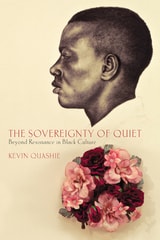
The Sovereignty of Quiet
Beyond Resistance in Black CultureQuashie, Kevin
Rutgers University Press, 2012
The book revisits such iconic moments as Tommie Smith and John Carlos’s protest at the 1968 Mexico City Olympics and Elizabeth Alexander’s reading at the 2009 inauguration of Barack Obama. Quashie also examines such landmark texts as Gwendolyn Brooks’s Maud Martha, James Baldwin’s The Fire Next Time, and Toni Morrison’s Sula to move beyond the emphasis on resistance, and to suggest that concepts like surrender, dreaming, and waiting can remind us of the wealth of black humanity.
The Sovereignty of Taste
James S. Hans
University of Illinois Press, 2002
Taste is everything, Hans says, for it produces the primary values that guide our lives. Taste is the fundamental organizing mechanism of human bodies, a lifelong effort to fit one's own rhythms to the rhythms and patterns of the natural world and the larger human community. It is an aesthetic sorting process by which one determines what belongs in--a conversation, a curriculum, a committee, a piece of art, a meal, a logical argument--and what should be left out. On the one hand, taste is the source of beauty, justice, and a sense of the good. On the other hand, as an arbiter of the laws of fair and free play, taste enters into more ominous and destructive patterns--but patterns nonetheless--of resentment and violence.
Hans develops his conception of taste through astute readings of five literary landmarks: Milan Kundera's The Unbearable Lightness of Being, Sophocles' Oedipus the King, William Faulkner's Light in August, and the poetry of Emily Dickinson and the Polish Nobel Laureate Czeslaw Milosz. These texts explore the art of soulmaking and the quest for personal expression: the costs as well as the fruits that come from acceding to the imperatives of one's being. They also reveal how the collision of personal and collective rhythms, whether in the Greek citadel or the Mississippi countryside, leads to violence and ritualized sacrifice.
Elegant, principled, and provocative, The Sovereignty of Taste is an essential book that restores taste to its rightful place of influence, shoring up the ground beneath civilization's feet and offering hope for the future of integrity, value, and aesthetic truth.
The Soviet Jewish Bookshelf
Jewish Culture and Identity Between the LinesMarat Grinberg
Brandeis University Press, 2022
In The Soviet Jewish Bookshelf, Marat Grinberg argues that in an environment where Judaism had been all but destroyed, and a public Jewish presence routinely delegitimized, reading uniquely provided many Soviet Jews with an entry to communal memory and identity. The bookshelf was both a depository of selective Jewish knowledge and often the only conspicuously Jewish presence in their homes. The typical Soviet Jewish bookshelf consisted of a few translated works from Hebrew and numerous translations from Yiddish and German as well as Russian books with both noticeable and subterranean Jewish content. Such volumes, officially published, and not intended solely for a Jewish audience, afforded an opportunity for Soviet Jews to indulge insubordinate feelings in a largely safe manner. Grinberg is interested in pinpointing and decoding the complex reading strategies and the specifically Jewish uses to which the books on the Soviet Jewish bookshelf were put. He reveals that not only Jews read them, but Jews read them in a specific way.
The Soviet Writers' Union and Its Leaders
Identity and Authority under StalinCarol Any
Northwestern University Press, 2021
Winner, University of Southern California Book Prize in Literary and Cultural Studies
The Soviet Writers’ Union offered writers elite status and material luxuries in exchange for literature that championed the state. This book argues that Soviet ruler Joseph Stalin chose leaders for this crucial organization, such as Maxim Gorky and Alexander Fadeyev, who had psychological traits he could exploit. Stalin ensured their loyalty with various rewards but also with a philosophical argument calculated to assuage moral qualms, allowing them to feel they were not trading ethics for self‑interest.
Employing close textual analysis of public and private documents including speeches, debate transcripts, personal letters, and diaries, Carol Any exposes the misgivings of Writers’ Union leaders as well as the arguments they constructed when faced with a cognitive dissonance. She tells a dramatic story that reveals the interdependence of literary policy, communist morality, state‑sponsored terror, party infighting, and personal psychology. This book will be an important reference for scholars of the Soviet Union as well as anyone interested in identity, the construction of culture, and the interface between art and ideology.
The Space In-Between
Essays on Latin American CultureSilviano Santiago
Duke University Press, 2001
Santiago’s work creates a theoretical field that transcends both the study of a specific national literature and the traditional perspectives of comparative literature. He examines the pedagogical and modernizing mission of Western voyagers from the conquistadors to the present. He deconstructs the ideas of “original” and “copy,” unpacking their implications for the notions of so-called dominant and dominated cultures. Santiago also confronts questions of cultural dependency and analyzes the problems involved in the imposition of an alien European history, the cultural displacements experienced by the Indians through their religious conversion, and the hierarchical suppression of native and Afro-Brazilian values.
Elegantly written and translated, The Space In-Between will provide insights and perspectives that will interest cultural and literary theorists, postcolonial scholars, and other students of contemporary culture.
The Spaces of Violence
James R. Giles
University of Alabama Press, 2006
Exploring the landscapes, cultures, and psychological spaces where violence takes root in contemporary American fiction.
The Spaces of Violence is an insightful work of literary criticism in which James R. Giles investigates the complex relationship between violence and space in contemporary American fiction. Through close readings of novels by influential writers including Russell Banks, Cormac McCarthy, Lewis Nordan, Dorothy Allison, Don DeLillo, Denis Johnson, Sherman Alexie, Robert Stone, and Bret Easton Ellis, Giles demonstrates how violence is shaped by the physical, social, and psychological environments in which it occurs.
Drawing on spatial and cultural theory, Giles argues that these novels inhabit a distinctive "fourthspace," a realm existing at the margins of mainstream society where violence permeates everyday life and destabilizes traditional boundaries of identity, community, and morality. Whether set in rural landscapes, urban centers, suburban communities, football stadiums, or transient spaces such as highways and bus stations, the works examined reveal how environments become intertwined with systems of power, alienation, trauma, and destruction.
The book concludes by extending its analysis to representations of violence within family structures, highlighting the far-reaching effects of social and cultural fragmentation. Offering a sophisticated framework for understanding violence in literature, The Spaces of Violence is an important contribution to contemporary literary and cultural studies.
The Spanish American Novel
A Twentieth-Century SurveyBy John S. Brushwood
University of Texas Press, 1975
In The Spanish American Novel, John S. Brushwood analyzes the twentieth-century Spanish American novel as an artistic expression of social reality. In relating the generic history of the novel to extraliterary events in Spanish America, he shows how twentieth-century fiction sets forth the essence of such phenomena as the first Perón regime, the Mexican Revolution, the Che Guevara legend, indigenismo, and the strongman political type. In essence, he views the novel as art rather than as document, but not as art alienated from society.
The discussion is organized chronologically, opening with the turn of the century and focusing on novels from 1900 to 1915 that exemplify various aspects of the nineteenth-century literary inheritance. Brushwood then highlights the avant-garde fiction (influenced by Proust and Joyce) of the 1920s as a precursory movement to the “new” Latin American novel, a phenomenon that came into its own during the 1940s. He then examines the “boom” in Spanish American fiction, the period of extensive international recognition of certain works, which he dates from 1962 or 1963.
In each era considered, the development of the novel is placed in dual perspective. One view—that of particularly significant novels in light of others published during the same year—is a cross section of the genre at one particular moment. The second view—that of a panorama of novels published in intervals between significant moments in the history of the novel—is more general and selective in the number of books discussed. Combining the historical with the analytical approach, the author proposes that the experience of a novel in which reality has been transformed into art is essential to our understanding of that reality.
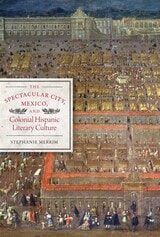
The Spectacular City, Mexico, and Colonial Hispanic Literary Culture
By Stephanie Merrim
University of Texas Press, 2010
Winner, Katherine Singer Kovacs Prize, Modern Language Association, 2010
The Spectacular City, Mexico, and Colonial Hispanic Literary Culture tracks the three spectacular forces of New World literary culture—cities, festivals, and wonder—from the sixteenth to the seventeenth century, from the Old World to the New, and from Mexico to Colombia, Peru, and Bolivia. It treats a multitude of imperialist and anti-imperialist texts in depth, including poetry, drama, protofiction, historiography, and journalism. While several of the landmark authors studied, including Hernán Cortés and Sor Juana Inés de la Cruz, are familiar, others have received remarkably little critical attention. Similarly, in spotlighting creole writers, Merrim reveals an intertextual tradition in Mexico that spans two centuries. Because the spectacular city reaches its peak in the seventeenth century, Merrim's book also theorizes and details the spirited work of the New World Baroque. The result is the rich examination of a trajectory that leads from the Renaissance ordered city to the energetic revolts of the spectacular city and the New World Baroque.
The Specter and the Speculative
Afterlives and Archives in the African DiasporaMae G. Henderson
Rutgers University Press, 2024
The Specter of Materialism
Queer Theory and Marxism in the Age of the Beijing ConsensusPetrus Liu
Duke University Press, 2023
The Speed Handbook
Velocity, Pleasure, ModernismEnda Duffy
Duke University Press, 2009
Duffy plunges full-throttle into speed’s “adrenaline aesthetics,” offering deft readings of works ranging from F. Scott Fitzgerald’s The Great Gatsby, through J. G. Ballard’s Crash, to the cautionary consumerism of Ralph Nader. He describes how speed changed understandings of space, distance, chance, and violence; how the experience of speed was commodified in the dawning era of mass consumption; and how society was incited to abhor slowness and desire speed. He examines how people were trained by new media such as the cinema to see, hear, and sense speed, and how speed, demanded of the efficient assembly-line worker, was given back to that worker as the chief thrill of leisure. Assessing speed’s political implications, Duffy considers how speed pleasure was offered to citizens based on criteria including their ability to pay and their gender, and how speed quickly became something to be patrolled by governments. Drawing on novels, news reports, photography, advertising, and much more, Duffy provides a breakneck tour through the cultural dynamics of speed.
The Spiral of Memory
InterviewsJoy Harjo
University of Michigan Press, 1995
The Spirit and the Letter
On the Interpretation of ScriptureGiorgio Agamben
Seagull Books, 2026
The problem of interpreting Scripture—above all, sacred scripture, but ultimately any form of writing—coincides with the very history of Western culture. It is no surprise, then, that an archaeological inquiry such as the one proposed here—on the problem of interpretation from Origen to Auerbach, from the Talmud to Benjamin—might hold unexpected revelations.
Essential reading for scholars of theology, religious studies, and hermeneutics interested in the history of scriptural interpretation, The Spirit and the Letter highlights how the interpretation of Scripture reveals itself as inseparable from ethics and politics.
The Split World of Gerard Manley Hopkins
Dennis Sobolev
Catholic University of America Press, 2011

The Springs of Liberty
The Satiric Tradition and Freedom of SpeechStewart Justman
Northwestern University Press, 1999

The Spy Story
John G. Cawelti and Bruce A. Rosenberg
University of Chicago Press, 1987
In addition to a general history of the genre, Cawelti and Rosenberg present in-depth analyses of the work of certain writers who have given the spy story its shape, among them John Buchan, Eric Ambler, Graham Greene, Ian Fleming, and John le Carré. The Spy Story also includes an extensive appendix, featuring a literary and historical bibliography of espionage and clandestinity, a list of the best spy novels and films, a catalog of major spy writers and their heroes, and a selection of novels on espionage themes written by major twentieth-century authors and public figures.
Written in a lively style that reflects the authors' enthusiasm for this intriguing form, The Spy Story will be read with pleasure by devotees of the genre as well as students of popular culture.
The Staff of Oedipus
Transforming Disability in Ancient GreeceMartha L. Rose
University of Michigan Press, 2013
Ancient Greek images of disability permeate the Western consciousness: Homer, Teiresias, and Oedipus immediately come to mind. But The Staff of Oedipus looks at disability in the ancient world through the lens of disability studies, and reveals that our interpretations of disability in the ancient world are often skewed. These false assumptions in turn lend weight to modern-day discriminatory attitudes toward disability.
Martha L. Rose considers a range of disabilities and the narratives surrounding them. She examines not only ancient literature, but also papyrus, skeletal material, inscriptions, sculpture, and painting, and draws upon modern work, including autobiographies of people with disabilities, medical research, and theoretical work in disability studies. Her study uncovers the realities of daily life for people with disabilities in ancient Greece and challenges the translation of the term adunatos (unable) as "disabled," with all its modern associations.
The Stage Life of Props
Andrew Sofer
University of Michigan Press, 2003
Using case studies that explore the Eucharistic wafer on the medieval stage, the bloody handkerchief on the Elizabethan stage, the skull on the Jacobean stage, the fan on the Restoration and early eighteenth-century stage, and the gun on the modern stage, Andrew Sofer reveals how stage props repeatedly thwart dramatic convention and reinvigorate theatrical practice.
While the focus is on specific objects, Sofer also gives us a sweeping history of half a millennium of stage history as seen through the device of the prop, revealing that as material ghosts, stage props are a way for playwrights to animate stage action, question theatrical practice, and revitalize dramatic form.
Andrew Sofer is Assistant Professor of English, Boston College. He was previously a stage director.
The Stamp of Class
Reflections on Poetry and Social ClassGary Lenhart
University of Michigan Press, 2005
-Lorenzo Thomas
The Stamp of Class explores the nature of reading poetry in the context of class and its themes and sheds new light on how this important yet little-heralded subject affects the poet's life and work.
While numerous works have taken up the question of race and gender as they relate to literary creation, this is the first book of its kind to probe the interplay between class and American poetry. Author Gary Lenhart considers poetry and class across a wide variety of time periods and poetic trends and reflects on a range of influential poets from the eighteenth to the twenty-first centuries.
The essays in The Stamp of Class deal with the question of class as reflected in the works of Tracie Morris, Tillie Olsen, Melvin Tolson, William Carlos Williams, Walt Whitman, and others. The work is rooted in the author's own experiences as a working-class poet and teacher and is the result of more than a decade of exploration.
Poet and scholar Gary Lenhart is Lecturer in English at Dartmouth College in Hanover, New Hampshire. His most recent books of poetry are Father and Son Night, Light Heart, and One at a Time. His essays and reviews have appeared in numerous magazines and journals, including the American Poetry Review, American Book Review, and Exquisite Corpse.
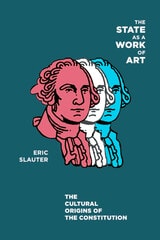
The State as a Work of Art
The Cultural Origins of the ConstitutionEric Slauter
University of Chicago Press, 2009
The founding of the United States after the American Revolution was so deliberate, so inspired, and so monumental in scope that the key actors considered this new government to be a work of art framed from natural rights. Recognizing the artificial nature of the state, these early politicians believed the culture of a people should inform the development of their governing rules and bodies. Eric Slauter explores these central ideas in this extensive and novel account of the origins and meanings of the Constitution of the United States. Slauter uncovers the hidden cultural histories upon which the document rests, highlights the voices of ordinary people, and considers how the artifice of the state was challenged in its effort to sustain inalienable natural rights alongside slavery and to achieve political secularization at a moment of growing religious expression.
A complement to classic studies of the Constitution’s economic, ideological, and political origins, The State as a Work of Art sheds new light on the origins of the Constitution and on ongoing debates over its interpretation.
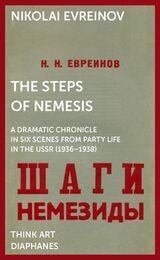
The Steps of Nemesis
A Dramatic Chronicle in Six Scenes from Party Life in the USSR (1936–1938)Nikolai Evreinov
Diaphanes, 2022
In the 1910s the Russian theater director and theorist Nikolai Evreinov (1879–1953) insisted on the theatricalization of life. Twenty years later, Evreinov, who had left Russia in 1924, was in exile in Paris when Stalin staged three elaborate political show trials in Moscow. Evreinov then meticulously read the transcripts of the trials in the Russian-language press, collected material on Nikolai Bukharin and the other defendants, consulted with experts, and finally wrote a play, his response to the staging of a judicial farce. With this response, he also wanted to rehabilitate his idea of the theatricalization of life. After all, the theatricalization of life does not mean performing false confessions, constructing conspiracies, fabricating facts, or casting hired witnesses. In his theatrical theory, Evreinov was careful not to make the theater of life invisible. His play is therefore not a historical reconstruction, but an imaginary look behind the scenes, in which the Stalinist perpetrators confess to the real crime in the end: the theater. Expertly translated into English for the first time by Zachary King, The Steps of Nemesis brings a fascinating play to a whole new world.
The Stony Dance
Unity and Gesture in Andrey Bely's PetersburgTimothy Langen
Northwestern University Press, 2005
Thoroughly versed in Russian and European modernism, in Bely's biography and writings, and in twentieth-century literary theory, Langen constructs an original analytic scheme for reading Petersburg. Guided by Bely's fertile but challenging notions of art and philosophy, he analyzes the novel first as an object embodying intentions and essences, then as a pattern of signification and events, and finally as a dance of gestures that coordinate body and meaning, regularity and surprise, self and other, and author, novel, and reader. The terms are derived from Bely's own writings, but they are nuanced with reference to Russian and European contexts and clarified with reference to philosophy and literary theory. Langen shows how Bely invariably challenges his own concepts and patterns, thereby creating an unusually demanding and dynamic text. In finding an approach to these enriching difficulties, this book at long last shows readers a welcoming way into Bely's thought, and his masterwork, and their place in the complex world of early twentieth-century literature.
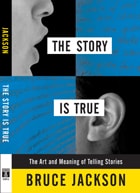
The Story Is True
The Art and Meaning of Telling StoriesBruce Jackson
Temple University Press, 2008
Making and experiencing stories, remembering and retelling them is something we all do. We tell stories over meals, at the water cooler, and to both friends and strangers. But how do stories work? What is it about telling and listening to stories that unites us? And, more importantly, how do we change them-and how do they change us?
In The Story Is True, author, filmmaker, and photographer Bruce Jackson explores the ways we use the stories that become a central part of our public and private lives. He examines, as no one before has, how stories narrate and bring meaning to our lives, by describing and explaining how stories are made and used. The perspectives shared in this engaging book come from the tellers, writers, filmmakers, listeners, and watchers who create and consume stories.
Jackson writes about his family and friends, acquaintances and experiences, focusing on more than a dozen personal stories. From oral histories, such as conversations the author had with poet Steven Spender, to public stories, such as what happened when Bob Dylan "went electric" at the 1965 Newport Folk Festival. Jackson also investigates how "words can kill" showing how diction can be an administrator of death, as in Nazi extermination camps. And finally, he considers the way lies come to resemble truth, showing how the stories we tell, whether true or not, resemble truth to the teller.
Ultimately, The Story Is True is about the place of stories-fiction or real-and the impact they have on the lives of each one of us.
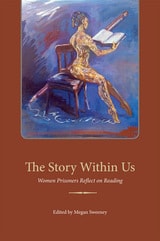
The Story Within Us
Women Prisoners Reflect on ReadingEdited by Megan Sweeney
University of Illinois Press, 2012
Framing the narratives within an analytic introduction and reflective afterword, Megan Sweeney highlights the crucial intellectual work that the incarcerated women perform despite myriad restrictions on reading and education in U.S. prisons. These women use the limited reading materials available to them as sources of guidance and support and as tools for self-reflection and self-education. Through their creative engagements with books, the women learn to reframe their own life stories, situate their experiences in relation to broader social patterns, deepen their understanding of others, experiment with new ways of being, and maintain a sense of connection with their fellow citizens on both sides of the prison fence.

The Story of All Things
Writing the Self in English Renaissance Narrative PoetryMarshall Grossman
Duke University Press, 1998
Relating subjectivity to the nature of language, Grossman uses the theories of Lacan to analyze the concept of the self as it encounters a transforming environment. He shows how ideological tensions arose from the reorganization and "modernization" of social life in revolutionary England and how the major poets of the time represented the division of the self in writings that are suspended between lyric and narrative genres. Beginning with the portrayals of the self inherited from Augustine, Dante, and Petrarch, he describes the influence of historic developments such as innovations in agricultural technology, civil war and regicide, and the emergence of republican state institutions on the changing representation of characters in the works of Spenser, Donne, Marvell, and Milton. Furthering this psychoanalytic critique of literary history, Grossman probes the linguistic effects of social and personal factors such as Augustine’s strained relationship with his mother and the marital disharmony of Milton and Mary Powell. With its focus on these and other "literary historical events," The Story of All Things not only proposes a new structural theory of narrative but constitutes a significant challenge to New Historicist conceptions of the self.
The Story of Fictional Truth
Realism from the Death to the Rise of the NovelPaul Dawson
The Ohio State University Press, 2023
The Story of Stone
Intertextuality, Ancient Chinese Stone Lore, and the Stone Symbolism in <i>Dream of the Red Chamber</i>, <i>Water Margin</i>, and <i>The Journey to the West</i>Jing Wang
Duke University Press, 1992
Bringing together Chinese myth, religion, folklore, art, and literature, this book is the first in any language to amass the sources of stone myth and stone lore in Chinese culture. Uniting classical Chinese studies with contemporary Western theoretical concerns, Wang examines these stone narratives by analyzing intertextuality within Chinese traditions. She offers revelatory interpretations to long-standing critical issues, such as the paradoxical character of the monkey in The Journey to the West, the circularity of narrative logic in The Dream of the Red Chamber, and the structural necessity of the stone tablet in Water Margin.
By both challenging and incorporating traditional sinological scholarship, Wang’s The Story of Stone reveals the ideological ramifications of these three literary works on Chinese cultural history and makes the past relevant to contemporary intellectual discourse. Specialists in Chinese literature and culture, comparative literature, literary theory, and religious studies will find much of interest in this outstanding work, which is sure to become a standard reference on the subject.
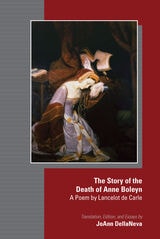
The Story of the Death of Anne Boleyn
A Poem by Lancelot de CarleEdited, Translated, and with Essays by JoAnn DellaNeva
Arizona Center for Medieval and Renaissance Studies, 2021
The Story of the Death of Anne Boleyn is a critical edition and translation of a long narrative poem written by the secretary to the French ambassador in London within two weeks of Anne Boleyn’s execution. It was intended as a diplomatic dispatch, relating the astonishing news of the queen’s demise (along with that of five alleged lovers). Uniquely among diplomatic correspondence, this dispatch was written in verse form. It thus straddles the domains of literature and history, of chronicle and fiction.
The base text for this edition is a previously unstudied manuscript housed at the British Library. Variants are given from all other known manuscripts found in Europe, including several key verses that were previously unpublished and that shed new light on the interpretation of the poem. The book features a sense-for-sense translation into modern English in free verse form, along with extensive explanatory notes. It also provides a study focusing on the historical background to the poem, an essay on the poet and the reception of his work, and a literary analysis of the poem.
The Story upon a Hill
The Puritan Myth in Contemporary American FictionChristopher Leise
University of Alabama Press, 2017
The Story upon a Hill: The Puritan Myth in Contemporary American Fiction analyzes the work of several of the most important contemporary writers in the United States as reinterpreting commonplace narratives of the country’s origins with a keen eye on the effects of inclusion and exclusion that Puritan myths promote. In 1989, Ronald Reagan recalled the words of Massachusetts Bay Colony governor John Winthrop, who imagined the colony as a “city upon a hill” for future nations to emulate. In Reagan’s speech, Winthrop’s signature rhetoric became an emblem of American idealism, and for many Americans, the Puritans’ New England was the place where the United States forged its original identity.
But what if Winthrop never gave that speech? What if he did not even write it? Historians cannot definitively answer these questions. In fact, no group that we refer to as American Puritans thought of themselves as Puritans. Rather, they were a group of dissident Christians often better defined by their disagreements than their shared beliefs.
Literary scholars interested in Anglo-American literary production from the seventeenth century through the present, historians, and readers interested in how ideas about Christianity circulate in popular culture will find fascinating the ways in which William Gaddis, Kurt Vonnegut, Thomas Pynchon, and Marilynne Robinson repurpose so-called Puritan forms of expression to forge a new narrative of New England’s Congregationalist legacy in American letters. Works by Colson Whitehead, Paul Auster, Toni Morrison, and others are also considered. The Story upon a Hill raises a provocative question: if the Puritans never existed as we understand them, what might American history look like in that context?
The Storytellers
Reading the Masterpieces of Nineteenth-Century Short FictionMichael Gorra
University of Chicago Press, 2026
Tracing the origins of the modern short story, Michael Gorra provides the first fully realized picture of a century’s worth of great tales.
The Storytellers offers a far-reaching account of the rich tradition of short narratives that flourished in nineteenth-century Europe and America, one that both prepared for and eventually gave way to the modern short story. Tracing unexpected resemblances across languages and decades, Michael Gorra restores a wide-angle view of the form in which works usually treated as stand-alone classics reveal themselves as parts of a single, lively conversation.
What unites these tales, Gorra argues, is their blend of novelty and unity. The book’s heart lies in a series of accessible readings of great tales by Herman Melville, Nikolai Gogol, Ivan Turgenev, E. T. A. Hoffmann, Guy de Maupassant, Nathaniel Hawthorne, Arthur Conan Doyle, Sarah Orne Jewett, Charles Chesnutt, and many more. Beyond its consideration of individual works, The Storytellers examines the formal and thematic concerns that bind the century together: the use of frame tales, accounts of social marginality, and an abundance of ghosts and uncanny coincidences. Over time, Gorra shows, these qualities yielded to a cooler realism, with Anton Chekhov as the key transitional figure. His compressed studies of ordinary lives inspired the modern short story and consigned the gothic flourishes of earlier tales to genre fiction.
What do we want from a story? What makes a tale worth telling? The nineteenth-century tale sought not the grand “meaning of life” promised by the novel, Gorra shows, but sudden revelations from singular events. The Storytellers gives readers an incomparable guide to a vast body of tales that still has the power to thrill and entertain.
The Stowe Debate
Rhetorical Strategies in "Uncle Tom's Cabin"Mason I. Lowance
University of Massachusetts Press, 1994
The thirteen contributors to this volume enter these debates from a variety of critical perspectives. They address questions of language and ideology, the tradition of the sentimental novel, biblical influences, and the rhetoric of antislavery discourse. As much as they disagree on various points, they share a keen interest in the cultural work that texts can do and an appreciation of the enduring power of Uncle Tom's Cabin.
The Straight Line
Writing on Poetry and PoetsRon Padgett
University of Michigan Press, 2000
But along with the playful wit comes Padgett's serious fascination with how words work. Essays discuss such subjects as the otherness of languages; French poets and their relationship to Cubist painters; an afternoon with the poet Edwin Denby; a tribute to Ted Berrigan; twentieth-century modernism; and suggestions for using the computer to write poetry.
The book concludes with pieces that Padgett has written during his thirty years as a teacher of poetry. Essays explore the unexpected relationships between poetry and dance; the practical value of using "gimmicks" to inspire poetry writing; and some radical and entertaining ideas for innovative ways to read creatively.
Ron Padgett is Publications Director, Teachers and Writers Collaborative. His books include Albanian Diary, Creative Reading, and Old Faithful: 18 Writers Present Their Favorite Writing Assignments.
The Stray Bullet
William S. Burroughs in MexicoJorge García-Robles
University of Minnesota Press, 2013
William S. Burroughs arrived in Mexico City in 1949, having slipped out of New Orleans while awaiting trial on drug and weapons charges that would almost certainly have resulted in a lengthy prison sentence. Still uncertain about being a writer, he had left behind a series of failed business ventures—including a scheme to grow marijuana in Texas and sell it in New York—and an already long history of drug use and arrests. He would remain in Mexico for three years, a period that culminated in the defining incident of his life: Burroughs shot his common-law wife, Joan Vollmer, while playing William Tell with a loaded pistol. (He would be tried and convicted of murder in absentia after fleeing Mexico.)
First published in 1995 in Mexico, where it received the Malcolm Lowry literary essay award, The Stray Bullet is an imaginative and riveting account of Burroughs’s formative experiences in Mexico, his fascination with Mexico City’s demimonde, his acquaintances and friendships there, and his contradictory attitudes toward the country and its culture. Mexico, Jorge García-Robles makes clear, was the place in which Burroughs embarked on his “fatal vocation as a writer.”
Through meticulous research and interviews with those who knew Burroughs and his circle in Mexico City, García-Robles brilliantly portrays a time in Burroughs’s life that has been overshadowed by the tragedy of Joan Vollmer’s death. He re-creates the bohemian Roma neighborhood where Burroughs resided with Joan and their children, the streets of postwar Mexico City that Burroughs explored, and such infamous figures as Lola la Chata, queen of the city’s drug trade. This compelling book also offers a contribution by Burroughs himself—an evocative sketch of his shady Mexican attorney, Bernabé Jurado.
The Structure of Leaves of Grass
By Thomas Edward Crawley
University of Texas Press, 1970
Modern critics and contemporary readers familiar with the field of Whitman criticism may find surprising an analysis of the structure of Leaves of Grass that concerns itself with Whitman as the poet-prophet and the identification of Whitman (or of his persona in the poem) with Christ. Early twentieth-century criticism has tended to exalt the early Whitman at the expense of the later one and to regard as poetically inferior the image of the national and democratically prophetic Whitman as expressed in the later editions.
Thomas Edward Crawley, in full knowledge of the contemporary currents of Whitman criticism, chooses to revert to this older view, through which he sheds new light on Whitman’s artistic achievement.
The basic premise of this study is that Walt Whitman’s Leaves of Grass is a unified work, lyrical, yet epic in quality, design, and spirit. Crawley’s purpose is to demonstrate the basis of this unity: its origin and operation and the nature of its realization. He demonstrates that an aesthetically maturing Whitman, in this work, was finally able to harmoniously bring together his individual and social subject matter.
Crawley defines the unifying spirit of Leaves of Grass in terms of Whitman’s concept of the poet-prophet and the poet-reader relationship. This concept is conveyed primarily through the development of the Christ- symbol, the dominant image in the poem. Through a careful analysis of Whitman’s handling of the simultaneous development of the poet-prophet and the nation, his masterful fusion of the personal element and the national element, an understanding of the complex structure of Leaves of Grass emerges.
Crawley presents an analysis of Whitman’s final and carefully arrived at grouping of the lyrics in the 1881 edition according to a definite, distinguishable pattern—a pattern revealed in Whitman’s use of allusions, in his transitional poems and passages, and, most important, in his thematic handling of imagery. The cumulative effect of these devices is emphasized.
The organic development of Leaves of Grass, made possible by Whitman’s faith in and careful adherence to his concept of the organic theory of art, is substantiated. Crawley concludes his analysis with a detailed examination of the growth of Leaves of Grass as reflected in the various editions leading up to the 1881 volume, the last to be revised and published by Whitman.

The Stuff of Our Forebears
Willa Cather's Southern HeritageJoyce McDonald
University of Alabama Press, 1998
Connecting Cather's work to the southern literary tradition and the South of her youth
A diverse and experimental writer who lived most of her life in New York City, Willa Cather is best known for her depiction of pioneer life on the Nebraska plains. Despite Cather's association with Nebraska, however, the novelist's Virginia childhood and her southern family were deeply influential in shaping her literary imagination.
Joyce McDonald shows evidence, for example, of Cather's southern sensibility in the class consciousness and aesthetic values of her characters and in their sense of place and desire for historical continuity, a sensibility also evident in her narrative technique of weaving stories within stories and in her use of folklore. For McDonald, however, what most links Cather and her work to the South and to the southern literary tradition is her use of pastoral modes.
Beginning with an examination of Cather's Virginia childhood and the southern influences that continued to mold her during the Nebraska years, McDonald traces the effects of those influences in Cather's novels. The patterns that emerge reveal not only Cather's strong ideological connection to the pastoral but also the political position implicit in her choice of that particular mode. Further analysis of Cather's work reveals her preoccupation with hierarchical constructs and with the use and abuse of power and her interest in order, control, and possession. The Willa Cather who emerges from the pages of The Stuff of Our Forebears is not the Cather who claimed to eschew politics but a far more political novelist than has heretofore been perceived.