Results by title
603 books match the query 'Description and travel' and 152 start with t
The Telling Distance
Conversations with the American DesertBruce Berger
University of Arizona Press, 1990
The Tensaw River
Alabama's Hidden Heritage CorridorMike Bunn
University of Alabama Press, 2025
Where nature meets history—explore Alabama’s hidden river legacy.
The Tensaw River introduces one of the American South’s richest and most fertile natural features. Author Mike Bunn is director of Historic Blakeley State Park, which is nestled in a prominent bend of the majestic Tensaw River. Reading Bunn is like sailing with a knowledgeable captain along the river’s natural and cultural byways as he offers a treasury of stories and facts that illuminate the river’s astonishing flora and fauna and the sweep of human history along the river’s ageless, meandering waterways.
Forming the eastern boundary of the expansive Mobile-Tensaw Delta, the Tensaw has had little industrial development. Left largely undisturbed, the river still flows free and bountiful into the grand estuary of Mobile Bay in ways and along vistas that would be recognizable to Native Americans centuries ago and to pioneers who arrived before Alabama became a state.
Bunn’s unforgettable stories in The Tensaw River trace the construction and occupation of the Bottle Creek site, an important mound complex built by Southeastern Native Americans a millennia ago. Nearby Blakeley is a spectral antebellum ghost town whose lost memories also tease the imagination. During the Civil War, the boom of artillery fire in the battle that sealed the fate of the city of Mobile echoed along the bends in the Tensaw.
Located near popular Gulf Coast travel destinations, the Tensaw’s forty-one-mile-long “Forgotten Cultural Heritage Corridor” is a gateway to the enchanting beauty of—and humankind’s enduring relationship to—the landscape of the American South.

The Tour Guide
Walking and Talking New YorkJonathan R. Wynn
University of Chicago Press, 2011
Everyone wants to visit New York at least once. The Big Apple is a global tourist destination with a dizzying array of attractions throughout the five boroughs. The only problem is figuring out where to start—and that’s where the city’s tour guides come in.
These guides are a vital part of New York’s raucous sidewalk culture, and, as The Tour Guide reveals, the tours they offer are as fascinatingly diverse—and eccentric—as the city itself. Visitors can take tours that cover Manhattan before the arrival of European settlers, the nineteenth-century Irish gangs of Five Points, the culinary traditions of Queens, the culture of Harlem, or even the surveillance cameras of Chelsea—in short, there are tours to satisfy anyone’s curiosity about the city’s past or present. And the guides are as intriguing as the subjects, we learn, as Jonathan R. Wynn explores the lives of the people behind the tours, introducing us to office workers looking for a diversion from their desk jobs, unemployed actors honing their vocal skills, and struggling retirees searching for a second calling. Matching years of research with his own experiences as a guide, Wynn also lays bare the grueling process of acquiring an official license and offers a how-to guide to designing and leading a tour.
Touching on the long history of tour-giving across the globe as well as the ups and downs of New York’s tour guide industry in the wake of 9/11, The Tour Guide is as informative and insightful as the chatty, charming, and colorful characters at its heart.

The Travels of Mendes Pinto
Fernão Mendes Pinto
University of Chicago Press, 1989
"[T]here is plenty here for the modern reader. . . . The vivid descriptions of swashbuckling military campaigns and exotic locations make this a great adventure story. . . . Mendes Pinto may have been a sensitive eyewitness, or a great liar, or a brilliant satirist, but he was certainly more than a simple storyteller."—Stuart Schwartz, The New York Times
The Travels of Reverend Olafur Egilsson
Karl Smari Hreinsson
Catholic University of America Press, 2016
The Twelve Chairs
A NovelIlya Ilf and Evgeny Petrov, Translated from the Russian by Anne O. Fisher with a Foreword by Alexander Ilf
Northwestern University Press, 2011
Winner, 2012 Northern California Book Award for Fiction in Translation
More faithful to the original text and its deeply resonant humor, this new translation of The Twelve Chairs brings Ilf and Petrov’s Russian classic fully to life. The novel’s iconic hero, Ostap Bender, an unemployed con artist living by his wits, joins forces with Ippolit Matveyevich Vorobyaninov, a former nobleman who has returned to his hometown to look for a cache of missing jewels hidden in chairs that have been appropriated by the Soviet authorities. The search for the chairs takes them from the provinces of Moscow to the wilds of the Transcaucasus mountains. On their quest they encounter a variety of characters, from opportunistic Soviet bureaucrats to aging survivors of the old propertied classes, each one more selfish, venal, and bungling than the last. A brilliant satire of the early years of the Soviet Union, as well as the inspiration for a Mel Brooks film, The Twelve Chairs retains its universal appeal.
The Unknown Islands
Raul Brandão, Translated by David Brookshaw
Tagus Press, 2020

The Very Worst Road
Travellers' Accounts of Crossing Alabama's Old Creek Indian Territory, 1820-1847Jeffrey C. Benton
University of Alabama Press, 2009

The Victoria History of Middlesex
Knightsbridge and HydePamela Taylor
University of London Press, 2017

The WPA Guide to 1930s Alabama
Harvey H. Jackson, III
University of Alabama Press, 2000
A fascinating time capsule, this classic guide captures Alabama at a critical moment in its history between the Great Depression and World War II and its aftermath.
The WPA guide to Alabama provides a unique snapshot of 1930s Alabama life and culture. Like the other state guides in the WPA's American Guide Series, it features essays on history, economy, people, folkways, education, and other characteristics of the state, as well as general information about the towns and cities. Fifteen suggested automobile tours encourage visitors and residents to explore every corner of the state, from the Gulf Coast to the Black Belt and the Tennessee Valley, from bayous to farmlands to mountain gorges.
When it was first published in 1941, the guide went far to dispel the myth of an Alabama consisting only of cotton fields, magnolias, and plantation houses by highlighting the vibrant university life in Tuscaloosa, the modern industrial activity in Birmingham, the informality of politics in Montgomery, the cultural diversity in Alabama's port city, Mobile, and the small town life in Huntsville before it became home to the space industry. The book includes a calendar of annual events, census data, and a wealth of information useful to the traveling public of the time and enlightening to readers today. The guide lists radio stations, buses, railroads, and highways as they existed before the advent of television, interstates, and malls.
Harvey Jackson's fascinating introduction assesses the guide as a historical document and recounts the involved and sometimes controversial process by which it was researched and written. Project directors struggled to make the guide palatable to its public while still addressing such issues as poverty and race relations and recognizing the state's diversity and its rich folk culture. The result makes for compelling reading for general readers and historians alike.
The Wanderer
A NovelAlexander Veltman, Stephen A. Bruce
Northwestern University Press, 2026
An unnamed narrator embarks on a rambling journey across the diverse borderlands of the Russian and Ottoman Empires—all without leaving his divan. Drawing on his own experiences in Bessarabia during the Russo-Turkish War of 1828–29, A. F. Veltman describes our Romantic narrator poring over a map and traversing distant, contested regions—at once imperial backwaters and cosmopolitan crossroads—where Romanians, Ruthenians, Jews, Bulgarians, Germans, and Turks comingle.
Meandering and motley in form and language, this lost classic of the early nineteenth century deploys metafictional innovations that anticipate postmodernist literature. The novel is speckled with dictionary entries, multiplication tables, philosophical digressions, and love poetry as Veltman swings from Gothic horror to antiquarian commentary to burlesque comedy. Past, present, and fantasy blend together, as Alexander the Great, Ovid, and Augustus join the narrator on his daydreamed journey of self-discovery.
Hugely popular in its day, The Wanderer is a remarkable tale that depicts the extraordinary places and peoples that met along the fault lines of once-great empires.
The Wapsipinicon Almanac
Selections from Thirty YearsTimothy Fay
University of Iowa Press, 2023

The War Against The Beavers
Learning to Be Wild in the North WoodsVerena Andermatt Conley
University of Minnesota Press, 2005
The Way Home
Essays on the Outside WestJames McVey
University of Utah Press, 2010
"A sense of place can be a complicated matter," writes James McVey in the prologue to his new collection of essays, The Way Home. Based on twenty years of living and traveling in the West, the collection includes essays on river running, backcountry skiing, fly fishing, and backpacking—all describing various attempts to engage in meaningful contact with the elements of wild nature, and to have a deep firsthand knowledge of a place. With an essayists breadth McVey engages ecology, geology, anthropology, psychology, and history as well as his own personal outdoor experiences to peer into the particulars of living in as complicated a place as the West. While the essays function within the tradition of western nature writing, they transcend regional issues insofar as they maintain a broader philosophical context that accounts for such global concerns as mass extinction and climate change.
The essays use backcountry experiences as occasions for reflection on such topics as nature and culture, conservation, and the human relation to the wild. They combine the naturalist’s commitment to landscape with the adventurer’s attention to technique and skill. The outdoor experiences function as ritualized activity, the purpose of which is to explore a specific relation with a place. As such, the essays consider certain nonrational ways of knowing the world, including a perception of aesthetics based on sensory participation with the more-than-human world. This gets to the heart of the essential connection in this work between its adventure themes and nature concerns--a connection very much concerned with issues of lifestyle and worldview. McVey describes his own journey in the West, traveling through the varying philosophical revelations wilderness presents—"a lifetime of questions"—finally landing on a conservation ethic, a feeling of home.
The Western Journals of Nehemiah and Henry Sanford, 1839–1846
Kenneth E. Lewis
Michigan State University Press, 2019
The Western San Juan Mountains
Their Geology, Ecology, and Human HistoryRob Blair
University Press of Colorado, 1996
The most complete work published on the natural history of southwest Colorado's majestic mountain system, The Western San Juan Mountains: Their Geology, Ecology, and Human History is designed to be used while exploring the scenic 235-mile paved San Juan Skyway, which passes through Durango, Silverton, Ouray, Telluride, Dolores, and Cortez.
The Western San Juan Mountains covers the physical environment, the biological communities, the human history, and points of interest represented on milepost signs along the highway. Some of the many topics covered include: how the San Juan Mountains were formed; why the landscape is so rugged and picturesque; why the vegetation changes from the lowlands to the alpine heights; energy and mineral resources of the area; why these mountains intrigued early explorers; factors that influence the unpredictable weather; and the first-known inhabitants.
The contributions to this guide include Fort Lewis College geologists, biologists, archaeologists, historians, and other specialists. Together they have amassed more than one hundred years of study based not only on previous work but on their own research.
This generously illustrated guidebook is aimed at all those who wish to understand this intricate mountain system in much greater detail than provided by most picture books.
The Windward Shore
A Winter on the Great LakesJerry Dennis
University of Michigan Press, 2012
If you have been enchanted by Jerry Dennis’s earlier work on sailing the Great Lakes, canoeing, angling, and the natural wonders of water and sky—or you have not yet been lucky enough to enjoy his engaging prose—you will want to immerse yourself in his powerful and insightful new book on winter in Great Lakes country.
Grounded by a knee injury, Dennis learns to live at a slower pace while staying in houses ranging from a log cabin on Lake Superior’s Keweenaw Peninsula to a $20 million mansion on the northern shore of Lake Michigan. While walking on beaches and exploring nearby woods and villages, he muses on the nature of time, weather, waves, agates, books, words for snow and ice, our complex relationship with nature, and much more.
From the introduction: “I wanted to present a true picture of a complex region, part of my continuing project to learn at least one place on earth reasonably well, and trusted that it would appear gradually and accumulatively—and not as a conventional portrait, but as a mosaic that included the sounds and scents and textures of the place and some of the plants, animals, and its inhabitants. Bolstered by the notion that a book is a journey that author and reader walk together, I would search for promising trails and follow them as far as my reconstructed knee would allow.”
The Winter Sailor
Francis R. Stebbins on Florida's Indian River, 1878-1888Edited by Carolyn Frances Baker Lewis
University of Alabama Press, 2004
A unique guide to Florida's frontier history along Indian River.
The Winter Sailor is a historical adventure that details the yearly winter travels of Francis R. Stebbins to Florida's Indian River. Stebbins, a writer from Michigan, visited Florida in March of 1878 and became entranced by its pristine beauty. Subsequently, Stebbins and his traveling companions made annual visits to Indian River—until 1888 when tragedy struck and ended Stebbins' yearly journeys.
Being an observant traveler, Stebbins began a series of descriptive articles for his hometown newspaper that chronicled his journeys to the Indian River area. Stebbins's articles tell of his own personal experiences during his leisurely visits, which included such activities as hunting and fishing, studying the natural surroundings, and excavating Indian mounds. What Stebbins enjoyed most was sailing down the river interviewing townspeople and examining local attractions as he went. His articles also detail the lifestyle of the region, food, fashion, industry, history, environment, and changes that occurred over time. Stebbins's articles not only entertained and informed but also became a travelogue for his readers. He inspired northern travelers to go south and visit Florida, which contributed to the beginnings of large-scale tourism in the region.
The Winter Sailor combines Stebbins's 49 articles along with three by his companions, to provide an enjoyable, historical guide. Unique among 19th-century travelogues, this fascinating look into Florida's past documents a decade of change to the Indian River wilderness and becomes Stebbins's gift to the present.
The Year of the Gorilla
George B. Schaller
University of Chicago Press, 2010
This seminal work chronicles George B. Schaller’s two years of travel and observation of gorillas in East and Central Africa in the late 1950s, high in the Virunga volcanoes on the Zaire-Rwanda-Uganda border. There, he learned that these majestic animals, far from being the aggressive apes of film and fiction, form close-knit societies of caring mothers and protective fathers watching over playful young. Alongside his observations of gorilla society, Schaller celebrates the enforced yet splendid solitude of the naturalist, recounts the adventures he experienced along the way, and offers a warning against poaching and other human threats against these endangered creatures. This edition features a postscript detailing Schaller’s more recent visits with gorillas, current to 2009.
“Whether the author is tracking gorillas, slipping past elephant herds on narrow jungle paths, avoiding poachers’ deadfalls, or routing Watusi invaders, this is an exciting book. Although Schaller feels that this is ‘not an adventure book,’ few readers will be able to agree.”—Irven DeVore, Science
The owl in Monument Canyon, and other stories from Indian country
H. Jackson Clark
University of Utah Press, 1993
There Was a River
Bruce Berger
University of Arizona Press, 1994
The Southwest Berger sees is an unusual, even odd, place, with inhabitants that are just as strange. In this collection of essays he introduces us to people and places that define a region and a way of life. We meet eccentric desert dwellers like Cactus Pete, who claimed to have mapped the mountains of Venus long before NASA penetrated its clouds. We chart the canals of Phoenix, which have created a Martian landscape out of an irrigation system dating back to the ancient Hohokam; stay at a "wigwam" motel in Holbrook, whose kitsch appeals even to Hopis; and dim our lights for the International Dark-Sky Association's efforts to keep night skies safe for astronomy.
Focusing on the interaction of people with the environment, Berger reveals an original vision of the Southwest that encompasses both city and wilderness. In a concluding essay centering on the sale of his mother's estate in Phoenix, he concedes that "our intention to leave the desert alone has resulted, unwittingly, in loss after loss, simply by our being here." Sometimes there are losses—a canyon, a house—but Berger attunes us to the prodigies of change.

They Came to Japan
An Anthology of European Reports on Japan, 1543-1640Michael Cooper, Editor
University of Michigan Press, 1995
This Contested Land
The Storied Past and Uncertain Future of America's National MonumentsMcKenzie Long
University of Minnesota Press, 2022
One woman’s enlightening trek through the natural histories, cultural stories, and present perils of thirteen national monuments, from Maine to Hawaii—now available in paperback
This land is your land. When it comes to national monuments, the sentiment could hardly be more fraught. Gold Butte in Nevada, Organ Mountains–Desert Peaks in New Mexico, Katahdin Woods and Waters in Maine, Cascade–Siskiyou in Oregon and California: these are among the thirteen natural sites McKenzie Long visits in This Contested Land, an eye-opening exploration of the stories these national monuments tell, the passions they stir, and the controversies surrounding them today.
Starting amid the fragrant sagebrush and red dirt of Bears Ears National Monument on the eve of the Trump Administration’s decision to reduce the site by 85 percent, Long climbs sandstone cliffs, is awed by Ancestral Pueblo cliff dwellings and is intrigued by 4,000-year-old petroglyphs. She hikes through remote pink canyons recently removed from the boundary of Grand Staircase–Escalante, skis to a backcountry hut in Maine to view a truly dark night sky, snorkels in warm Hawaiian waters to plumb the meaning of marine preserves, volunteers near the most contaminated nuclear site in the United States, and witnesses firsthand the diverse forms of devotion evoked by the Rio Grande. In essays both contemplative and resonant, This Contested Land confronts an unjust past and imagines a collaborative future that bears witness to these regions’ enduring Indigenous connections.
From hazardous climate change realities to volatile tensions between economic development and environmental conservation, practical and philosophical issues arise as Long seeks the complicated and often overlooked—or suppressed—stories of these incomparable places. Her journey, mindfully undertaken and movingly described, emphasizes in clear and urgent terms the unique significance of, and grave threats to, these contested lands.

This Is New Jersey
Cunningham, John T
Rutgers University Press, 1995
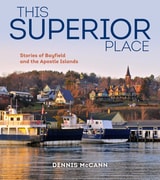
This Superior Place
Stories of Bayfield and the Apostle IslandsDennis McCann
Wisconsin Historical Society Press, 2013
Picturesque little Bayfield on Lake Superior is Wisconsin’s smallest city by population but one of its most popular visitor destinations. This book captures those unique qualities that keep tourists coming back year after year and offers a historically reliable look at the community as it is today and how it came to be. Abundantly illustrated with both historical and contemporary images, This Superior Place showcases, as author Dennis McCann writes, “a community where the past was layered with good times and down times, where natural beauty was the one resource that could not be exhausted by the hand of man, and where history is ever present.”
Because Bayfield serves as “the gateway to the Apostle Islands,” the book also includes chapters on the Apostle Islands National Lakeshore, Madeline Island, and the nearby Red Cliff Ojibwe community. It also covers the significant eras in the city’s history: lumbering, quarrying, commercial fishing, and the advent of the orchards visitors see today. It is not a guidebook as such but more of a visual and written tour of the city and the major elements that came together to make it what it is. Colorful stories from the past, written in Dennis McCann’s casual, humorous style, give a sense of the unique characters and events that have shaped this charming city on the lake.
This Vast Book of Nature
Writing the Landscape of New Hampshire’s White Mountains, 1784–1911Pavel Cenkl
University of Iowa Press, 2006
Starting with an exploration of Jeremy Belknap’s 1784 expedition to Mount Washington, which Cenkl links to the origins of tourism in the White Mountains, to the transformation of touristic and residential relationships to landscape, This Vast Book of Nature explores the ways competing visions of the landscape have transformed the White Mountains culturally and physically, through settlement, development, and—most recently—preservation, a process that continues today.
Thousand-Miler
Adventures Hiking the Ice Age TrailMelanie Radzicki McManus
Wisconsin Historical Society Press, 2017
In thirty-six thrilling days, Melanie Radzicki McManus hiked 1,100 miles around Wisconsin, landing her in the elite group of Ice Age Trail thru-hikers known as the Thousand-Milers. In prose that’s alternately harrowing and humorous, Thousand-Miler takes you with her through Wisconsin’s forests, prairies, wetlands, and farms, past the geologic wonders carved by long-ago glaciers, and into the neighborhood bars and gathering places of far-flung small towns. Follow along as she worries about wildlife encounters, wonders if her injured feet will ever recover, and searches for an elusive fellow hiker known as Papa Bear. Woven throughout her account are details of the history of the still-developing Ice Age Trail—one of just eleven National Scenic Trails—and helpful insight and strategies for undertaking a successful thru-hike.
In addition to chronicling McManus’s hike, Thousand-Miler also includes the little-told story of the Ice Age Trail’s first-ever thru-hiker Jim Staudacher, an account of the record-breaking thru-run of ultrarunner Jason Dorgan, the experiences of a young combat veteran who embarked on her thru-hike as a way to ease back into civilian life, and other fascinating tales from the trail. Their collective experiences shed light on the motivations of thru-hikers and the different ways hikers accomplish this impressive feat, providing an entertaining and informative read for outdoors enthusiasts of all levels.
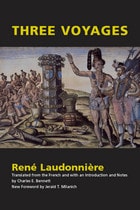
Three Voyages
Rene Laudonniere
University of Alabama Press, 2001
This translation of an eyewitness account by a major participant offers valuable information about all three attempts to establish a French colony on the south Atlantic coast of North America.
Rene Laudonniere's account of the three attempts by France to colonize what is now the United States is uniquely valuable because
he played a major role in each of the ventures—first, in 1562, as second in command during the founding of the ill-fated Charlesport, then as commander for the establishment of Fort Caroline on Florida's St. Johns River in 1564, and finally as the one to welcome French reinforcements the following year. It was also Laudonniere's destiny to witness the tragic fall of Fort Caroline to Spanish claims one month later.
Laudonniere wrote his chronicle, L'histoire Notable de la Floride, in 1565 following the fall of Fort Caroline as he recuperated in England. Much more than an account of his feelings and adventures, Laudonniere's history reveals him to be an exceedingly able and accurate geographer with a highly developed interest in anthropology.
The first English translation was published by Richard Hakluyt in 1587. Charles E. Bennett's graceful and accurate rendering in modern English was first published in 1975 by the University Press of Florida. Besides the account, thoroughly annotated and with present-day names identifying sites visited by the Frenchman, this volume includes a valuable introductory essay. The appendices to the volume are four noteworthy documents, the last of which—a guide to plants of 16th-century Florida—will be of exceptional interest to naturalists, gardeners, and students of folklore. The account itself will fascinate professional historians and anthropologists as well as general readers interested in the exciting and often moving
events of early European settlement in the New World.
Rene Laudonniere was a French adventurer and explorer of the 16th century who wrote L'histoire Notable de la Floride. Charles E. Bennett is a historian and former Florida congressman. He was coauthor of the Moss-Bennett legislation and was instrumental in the establishment of the Fort Caroline National Memorial and the Timucuan Ecological and Historical Preserve. Jerald T. Milanich is Curator in Archaeology at the Florida Museum of Natural History.
Through Time and the Valley
John R. Erickson
University of North Texas Press, 1995
Timberline U.S.A.
High-Country Encounters from California to MaineDonald Mace Williams
Utah State University Press, 2003
As a youth in Denver, Donald Mace Williams developed an affection for high mountain country. After a journalistic career spent mostly on flat lands, he set out to rediscover what was special about country above timberline. He hiked the high alpine in four of America's major ranges-the Rockies, Sierra Nevada, Cascades, and northern Appalachians-and in his narrative of his travels, he tells us what he saw and learned and who he met. Having visited some of these areas when younger, Williams compares his psychological and physical responses as an older man and how his ideas about how to treat the environment have evolved. A recurring theme is the compromises that people such as he make between the pull of mountains and freedom and the responsibilities of making a living in the lowlands. Mainly, he observes and experiences what is distinctive about the timberline environment.
Throughout his book, Williams gently informs readers regarding timberline history, nature, weather, and archaeology; high altitude physiology; and environmental concerns. Frequently, he recounts encounters with interesting and varied people he meets on the trails: a young British hiking companion who has come back to Colorado to repeat a climb on which, a year previously, his two fellow climbers died; a pilot who climbs isolated peaks in the Sierra Nevada in search of bouillon-can scrolls signed by famous early mountaineers; a "Literate Farmer" who pauses on a mountain trail in Vermont to discuss Robert Frost.
Donald Mace Williams is a retired journalist who has worked for such newspapers as The Wichita Eagle, Newsday, and the Fort Worth Star-Telegram. He has a Ph.D. in English from the University of Texas, has published one previous book (Interlude in Umbarger: Italian POWs and a Texas Church); poems in Western Humanities Review, Iron Horse Literary Review, and South Dakota Review; and a short story in Southwest Review. He now lives in Texas.
Time and the Town
A Provincetown ChronicleAdele Heller
Rutgers University Press, 1991
Time and the Town was the last of Mary Heaton Vorse's books. It is about many things —a town and its people, the author, a certain kind of idyllic life. As much as anything else, it is the biography of the house Vorse bought in 1907 and lived in, off and on, for the next thirty-six years. The moods of the house mirrored her own. "Our houses," she wrote, "are our biographies, the stories of our defeats and victories."
Tinged with nostalgia and disenchantment, the book describes a Provincetown that has changed, a place on the verge of modernity. It is no longer a major fishing port. It has become a place whose business is tourism. Contrasting the old and the new, Vorse celebrates the enduring character of the town itself. She tells stories that are engaging and charming, droll and fabulous. The wrinkled Mrs. Mary Mooncusser who, though drunk and stark naked, conducts herself with great decorum when Vorse pays her a call, might have stepped out of the pages of Sherwood Anderson or Eudora Welty. In another anecdote, the townspeople scour the beaches for cases of booze dumped into the sea by rumrunners and are briefly inflated with the spirit of ancestral smugglers and buccaneers.
Vorse herself remained something of an outsider in Provincetown, despite her evident affection for the place and its inhabitants. They surely regarded her as simply another of those artist-intellectuals--many of whom appear in the pages of this book. The "off-Cape" outsiders put the town in the national limelight but took no interest in local matters. Vorse here ponders local matters exclusively, almost, one suspects, as a way of forgetting the more complex matters that occupied her--her agonies of parental guilt, her resentment of domestic obligations, her third marriage, her depressions and breakdowns. The town is in that sense beyond time.

To Change the World
My Years in CubaRandall, Margaret
Rutgers University Press, 2009
Randall gives readers an inside look at her children's education, the process through which new law was enacted, the ins and outs of healthcare, employment, internationalism, culture, and ordinary people's lives. She explores issues of censorship and repression, describing how Cuban writers and artists faced them. She recounts one of the country's last beauty pageants, shows us a night of People's Court, and takes us with her when she shops for her family's food rations. Key figures of the revolution appear throughout, and Randall reveals aspects of their lives never before seen.
More than fifty black and white photographs, most by the author, add depth and richness to this astute and illuminating memoir. Written with a poet's ear, depicted with a photographer's eye, and filled with a feminist vision, To Change the Worldùneither an apology nor gratuitous attackùadds immensely to the existing literature on revolutionary Cuba.
To My Dearest Wife, Lide
Letters from George B. Gideon Jr. during Commodore Perry’s Expedition to Japan, 1853–1855Edited by M. Patrick Sauer and David A. Ranzan
University of Alabama Press, 2019
George B. Gideon Jr. served as second assistant engineer aboard the USS Powhatan from 1852 to 1856. From his position on the steam frigate, Gideon traveled to Singapore, Labuan, Borneo, Hong Kong, and many other Asian lands. During his time at sea, Gideon penned dozens of letters to his wife, Lide, back home in Philadelphia. Recently discovered in the attic of his great-great-grandniece, were fifty-one letters penned by Gideon providing thorough and insightful commentary throughout the voyage.
Through these correspondences, Gideon laboriously documents the details of his daily life on board, from the food they ate to the technical aspects of his work, as well as observations concerning the historical events unfolding around him, such as Chinese piracy, the Taiping Rebellion, the Crimean War, and the devastation of Shimoda. To My Dearest Wife, Lide: Letters from George B. Gideon Jr. during Commodore Perry’s Expedition to Japan, 1853–1855 is a rare first-person account of the landmark American naval expedition to Japan to establish commercial relations between the two countries. Gideon’s letters have been meticulously transcribed and annotated by the editors and are an invaluable primary historical source.
Gideon’s letters are candid and revealing, delving into the rampant dysfunction in the navy of the 1850s—sickness and disease, alcohol abuse, and poor leadership, among other challenges. Gideon also unabashedly shares his own cynical views of the navy’s role in supporting American economic interests in Japan. This firsthand account of the political mission of the Perry expedition is a unique contribution to naval and military history and gives readers a better view of life aboard a navy ship.
Touring The Sierra Nevada
Cheryl Angelina Koehler
University of Nevada Press, 2007
The complete guide to the entire Sierra Nevada
The Sierra Nevada is one of the most scenic, biologically diverse, and historically rich mountain ranges in North America. Touring the Sierra Nevada covers the entire range and its adjacent regions, exploring the Sierra Nevada from such world-famous sites as Lake Tahoe and Yosemite to picturesque mining towns, scenic alpine lakes, lush vineyards, and colorful hidden byways. Koehler offers suggestions for long tours and exciting daytrips, as well as detailed information about the history, geology, flora and fauna, economy, and unique features of places along the way. The book is illustrated with photographs and maps of the regions she describes. Koehler includes excursions for automobile travelers as well as backcountry adventures for hikers. She provides information about attractions in the Sierra’s two “jumping-off” cities, Sacramento and Reno, as well as in some of the major towns within the range. There is practical advice about contacting parks, museums, historical sites, visitors’ bureaus, U.S. Forest Service offices, and other agencies; finding lodging, campgrounds, and restaurants along the way; preparing for weather and altitude changes; and identifying further sources of information about the region in published guides and other books, as well as on websites. Koehler offers her readers the literary companionship of an experienced, charming, and vivacious guide through one of America’s most fascinating regions.
Tourism, Landscape, and the Irish Character
British Travel Writers in Pre-Famine IrelandWilliam H. A. Williams
University of Wisconsin Press, 2007
Picturesque but poor, abject yet sublime in its Gothic melancholy, the Ireland perceived by British visitors during the eighteenth and nineteenth centuries did not fit their ideas of progress, propriety, and Protestantism. The rituals of Irish Catholicism, the lamentations of funeral wakes, the Irish language they could not comprehend, even the landscapes were all strange to tourists from England, Wales, and Scotland. Overlooking the acute despair in England’s own industrial cities, these travelers opined in their writings that the poverty, bog lands, and ill-thatched houses of rural Ireland indicated moral failures of the Irish character.
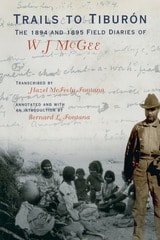
Trails to Tiburón
The 1894 and 1895 Field Diaries of W J McGeeW. J. McGee; Transcribed by Hazel McFeely Fontana; Annotated and with an Introduction by Bernard L. Fontana
University of Arizona Press, 2000
A self-taught scientist in the newly forming field of anthropology, McGee led two expeditions through southern Arizona and northern Sonora for the Bureau of American Ethnology. There he conducted ethnographic research among the Papagos (Tohono O'odham) and the Seris, and his subsequent publication The Seri Indians helped secure his place in the anthropological community.
McGee's complete journals of the expeditions, kept in small field notebooks and preserved in the Library of Congress, are published here for the first time. These journals contain detailed descriptions of the country and people McGee encountered and convey the adventure of traveling through wild and unfamiliar places—including a voyage to Isla Tiburón, or Shark Island, in the Gulf of California—and being plagued by foul weather, a shortage of supplies, and fear of attack from hostile Indians.
Trails to Tiburón features 57 historical photographs taken on the expedition, capturing the places McGee saw and the people he encountered. Fontana's notes to the diary provide useful botanical, geological, and ethnographic information, while his introduction places McGee and his field work in the context of late-nineteenth-century anthropology and science.
Trails to Tiburón reveals McGee's versatility as a field worker and shows his methods, often questioned today, to be the reasonable response of a man caught up in the intellectual fervor of his time. For anyone wanting to share in the spirit of adventure, these journals are a landmark in the annals of exploration.
Transatlantic Topographies
Islands, Highlands, JunglesIleana Rodriguez
University of Minnesota Press, 2004
Explores the construction of the Americas by and through European eyes
Transatlantic Topographies was first published in 2004. Minnesota Archive Editions uses digital technology to make long-unavailable books once again accessible, and are published unaltered from the original University of Minnesota Press editions.
Transatlantic Topographies studies the representation of American space during the initial confrontation between Europeans and Amerindians and during the eighteenth, nineteenth, and twentieth centuries. Starting from topographical descriptions of land, islands, highlands, and jungles, Ileana Rodríguez shows how existing systems of knowledge broke down with the discovery of the Americas and had to be reinvented through the interpretation of signs, the accumulation of evidence, material exchange, and, finally, through the learning, teaching, and “kidnapping” of language. Proceeding from the period of exploration to the modern creation of a “twentieth-century frontier,” Rodríguez charts the path that led from island paradise to jungle chaos, from representations of natural beauty to the racialization of the islands. Drawing attention to cross-cultural miscommunication and the riddles of meaning and message it produces, Transatlantic Topographies develops a highly nuanced understanding of the evolving forces of imperialism as they gave way to postcolonialism and then to transnationalism—and newly re-inscribed notions of imperial economic practices.
Travail In An Arab Land
Samuel Romanelli
University of Alabama Press, 1989
During a return voyage to Italy in 1786, he became stranded in Gibraltar for an extended time which depleted his funds, and his economic circumstances forced him to join a merchant travelling to Morocco. Through misadventure in Morocco, he lost his passport and was retained in that country for four years, the story of which forms Travail in an Arab Land, first published in 1792 in Berlin. The book is a firsthand account of the author’s adventures during the four years he was stranded in Sharifan Morocco between 1787 and 1790.
Traveler, Scholar, Political Adventurer
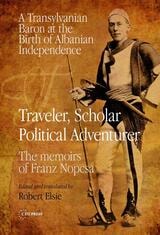
A Transylvanian Baron at the Birth of Albanian Independence: The memoirs of Franz NopcsaFranz Nopcsa
Central European University Press, 2014
Travelers to an Antique Land
The History and Literature of Travel to GreeceRobert Eisner
University of Michigan Press, 1993
Traveling Women
Narrative Visions of Early AmericaSusan Clair Imbarrato
Ohio University Press, 2006
Susan Clair Imbarrato closely examines women’s accounts of their journeys from 1700 to 1830, including Sarah Kemble Knight’s well-known journal of her trip from Boston to New York in 1704 and many lesser-known accounts, such as Sarah Beavis’s 1779 journal of her travel to Ohio via Kentucky and Susan Edwards Johnson’s account or her 1801–2 journey from Connecticut to North Carolina.
In the women’s keen observations and entertaining wit, readers will find bravado mixed with hesitation, as women set forth on business, to relocate, and for pleasure. These travelers wrote compellingly of crossing rivers and mountains, facing hunger, encountering native Americans, sleeping in taverns, and confronting slavery, expressing themselves in voices that differed in sensibility from male explorers and travelers.
These accounts, as Imbarrato shows, challenge assumptions that such travel was predominately a male enterprise. In addition, Traveling Women provides a more balanced portrait of westward settlement by affirming women’s importance in the settling of early America.

Travels Through France and Italy
Tobias Smollett
Northwestern University Press, 1997
Travels through France and Italy is a landmark work in travel literature. Full of prejudice, grousing, sharp observation, and caustic satire, it is the first travel book in modern literature to go beyond the simple conveyance of information to reflect the writer's state of mind.
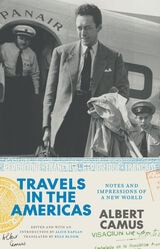
Travels in the Americas
Notes and Impressions of a New WorldAlbert Camus
University of Chicago Press, 2023
In March 1946, the young Albert Camus crossed from Le Havre to New York. Though he was virtually unknown to American audiences at the time, all that was about to change—The Stranger, his first book translated into English, would soon make him a literary star. By 1949, when he set out on a tour of South America, Camus was an international celebrity. Camus’s journals offer an intimate glimpse into his daily life during these eventful years and showcase his thinking at its most personal—a form of observational writing that the French call choses vues (things seen).
Camus’s journals from these travels record his impressions, frustrations, joys, and longings. Here are his unguarded first impressions of his surroundings and his encounters with publishers, critics, and members of the New York intelligentsia. Long unavailable in English, the journals have now been expertly retranslated by Ryan Bloom, with a new introduction by Alice Kaplan. Bloom’s translation captures the informal, sketch-like quality of Camus’s observations—by turns ironic, bitter, cutting, and melancholy—and the quick notes he must have taken after exhausting days of travel and lecturing. Bloom and Kaplan’s notes and annotations allow readers to walk beside the existentialist thinker as he experiences changes in his own life and the world around him, all in his inimitable style.

Travels in the Reich, 1933-1945
Foreign Authors Report from GermanyEdited by Oliver Lubrich
University of Chicago Press, 2010
“Even now,” wrote Christopher Isherwood in his Berlin Diary of 1933, “I can’t altogether believe that any of this has really happened.” Three years later, W. E. B. DuBois described Germany as “silent, nervous, suppressed; it speaks in whispers.” In contrast, a young John F. Kennedy, in the journal he kept on a German tour in 1937, wrote, “The Germans really are too good—it makes people gang against them for protection.”
Drawing on such published and unpublished accounts from writers and public figures visiting Germany, Travels in the Reich creates a chilling composite portrait of the reality of life under Hitler. Written in the moment by writers such as Virginia Woolf, Isak Dinesen, Samuel Beckett, Jean-Paul Sartre, William Shirer, Georges Simenon, and Albert Camus, the essays, letters, and articles gathered here offer fascinating insight into the range of responses to Nazi Germany. While some accounts betray a distressing naivete, overall what is striking is just how clearly many of the travelers understood the true situation—and the terrors to come.
Through the eyes of these visitors, Travels in the Reich offers a new perspective on the quotidian—yet so often horrifying—details of German life under Nazism, in accounts as gripping and well-written as a novel, but bearing all the weight of historical witness.
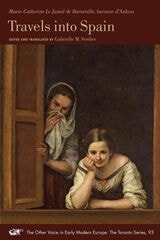
Travels into Spain
Marie-Catherine Le Jumel de Barneville, baronne d'Aulnoy
Iter Press, 2022
While mysteries remain in her biography, Madame d’Aulnoy’s tremendous literary talent is finally being rediscovered. Marie-Catherine Le Jumel de Barneville, baronne d’Aulnoy (1652–1705) was the first Frenchwoman to write, publicize, and publish the account of her travels into Spain as an independent woman. Considered the authority on Spain for nearly two centuries until historiographers labeled them as disreputable, Travels into Spain can now be appreciated for its ironic gaze on realities concealed from male travelers and Madame d’Aulnoy’s unabashedly female and often playful voice. Her writing casts a unique light on gender relations, the condition of women, cultural biases, national rivalries, and religious superstitions at a critical time in early modern cultural and literary history. The first modern translation of Travels into Spain, this book situates Madame d’Aulnoy’s account in its historical context. Travels into Spain is a masterpiece of ethnographic observation, expressing a woman’s view on gender relations, marriage, religion, fashion, food, bullfights, and the Inquisition.
Travels with a Donkey in the Cevennes
Robert Louis Stevenson
Northwestern University Press, 1996
Stevenson's third book, Travels with a Donkey was originally intended as a lighthearted sketch, a companion-piece to his recent Inland Voyage. Although he would not be recognized as a major author until the publication of Treasure Island and Dr. Jekyll and Mr. Hyde, one can see his voice developing. Full of charm and instruction, Travels with a Donkey serves as a guide to alternatives to the restless and distracted standard of contemporary travel.
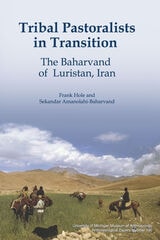
Tribal Pastoralists in Transition
The Baharvand of Luristan, IranFrank Hole and Sekandar Amanolahi-Baharvand
University of Michigan Press, 2021
Supplementary videos (on the migration, weaving, harvesting, and the bazaars) can be found on Fulcrum (fulcrum.org/UMMAA).
Tropical Visions in an Age of Empire
Edited by Felix Driver and Luciana Martins
University of Chicago Press, 2005
Bringing together a group of distinguished contributors from disciplines across the arts and humanities, this volume contains eleven beautifully illustrated essays—arranged in three sections devoted to voyages, mappings, and sites—that consider the ways that tropical places were encountered, experienced, and represented in visual form. Covering a wide range of tropical sites in the Pacific, South Asia, West Africa, the Caribbean, and Latin America, the book will appeal to a broad readership: scholars of postcolonial studies, art history, literature, imperial history, history of science, geography, and anthropology.
Troubled Water
A Journey Around the Black SeaJens Mühling
Haus Publishing, 2022
Fringing the Black Sea is a diverse array of countries, some centuries old and others emerging only after the collapse of the Soviet Union. Jens Mühling travels through this region, telling the stories of the people he meets along the way in order to paint a picture of the mix of cultures found here and to understand the present against a history stretching back to the arrival of Ancient Greek settlers and beyond.
A fluent Russian speaker with a knack for gaining the trust of those he meets, Mühling brings together a cast of characters as diverse as the stories he hears, all of whom are willing to tell him their complex, contradictory, and often fantastical tales full of grief and legend. He meets descendants of the so-called Pontic Greeks, whom Stalin deported to Central Asia and who have now returned; Circassians who fled to Syria a century ago and whose great-great-grandchildren have returned to Abkhazia; and members of ethnic minorities like the Georgian Mingrelians or Bulgarian Muslims, expelled to Turkey in the summer of 1989. Mühling captures the region’s uneasy alliance of tradition and modernity and the diverse humanity of those who live there.
Tsodilo Hills
Copper Bracelet of the KalahariAlec Campbell
Michigan State University Press, 2010
For 100,000 years, inhabitants of Botswana's Tsodilo Hills region left behind a record of their gathering wild foods, hunting, fishing, mining, rock painting, cattle herding, and metalworking, as well as of their participation in a coast-to-coast trade network. During the past 30 years, archaeologists, paleontologists, historians, and anthropologists have worked at Tsodilo.
Here is the Tsodilo story, the Hills' revelations brought together in one volume, beautifully illuminated by more than 150 color plates and maps. For scientists, this work brings together decades of research at a site in the Kalahari that was virtually unknown until the late 1970s. Tsodilo Hills also offers a fascinating glimpse into the history of the Kalahari Desert to the general reader, as well as an unsurpassedguide to an extraordinary world to the desert's many tourists.