Results by title
1917 books match the query 'Law' and 526 start with t
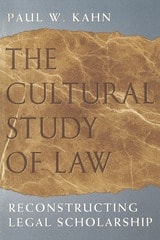
The Cultural Study of Law
Reconstructing Legal ScholarshipPaul W. Kahn
University of Chicago Press, 1999
"Professor Kahn's perspective is neat and alluring: We need a form of legal scholarship released from the project of reform so that we can better understand who and what we are. The new discipline should study 'not legal rules, but the imagination as it constructs a world of legal meaning.' . . . [C]oncise, good reading, and recommended." —New York Law Journal

The Culture of Control
Crime and Social Order in Contemporary SocietyDavid Garland
University of Chicago Press, 2001
Garland explains how the new policies of crime and punishment, welfare and security—and the changing class, race, and gender relations that underpin them—are linked to the fundamental problems of governing contemporary societies, as states, corporations, and private citizens grapple with a volatile economy and a culture that combines expanded personal freedom with relaxed social controls. It is the risky, unfixed character of modern life that underlies our accelerating concern with control and crime control in particular. It is not just crime that has changed; society has changed as well, and this transformation has reshaped criminological thought, public policy, and the cultural meaning of crime and criminals. David Garland's The Culture of Control offers a brilliant guide to this process and its still-reverberating consequences.
The Death Penalty in the Eighties
An Examination of the Modern System of Capital PunishmentWelsh S. White
University of Michigan Press, 1987
The Death Penalty in the Nineties
An Examination of the Modern System of Capital PunishmentWelsh S. White
University of Michigan Press, 1991
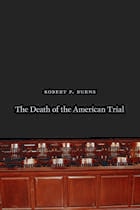
The Death of the American Trial
Robert P. Burns
University of Chicago Press, 2009
In The Death of the American Trial, distinguished legal scholar Robert P. Burns makes an impassioned case for reversing the rapid decline of the trial before we lose one of our public culture’s greatest achievements. As a practice that is adapted for modern times yet rooted in ancient wisdom, the trial is uniquely suited to balance the tensions—between idealism and realism, experts and citizens, contextual judgment and reliance on rules—that define American culture. Arguing that many observers make a grave mistake by taking a complacent or even positive view of the trial’s demise, Burns concludes by laying out the catastrophic consequences of losing an institution that so perfectly embodies democratic governance.
The Defence of Constitutionalism
Or the Czech Question in Post-National EuropeJirí Pribán
Karolinum Press, 2018
The Defender
The Battle to Protect the Rights of the Accused in PhiladelphiaEdward W. Madeira Jr. and Michael D. Schaffer
Temple University Press, 2020
Long before the Supreme Court ruled that impoverished defendants in criminal cases have a right to free counsel, Philadelphia’s public defenders were working to ensure fair trials for all. In 1934, when penniless defendants were routinely railroaded through the courts without ever seeing a lawyer, Philadelphia attorney Francis Fisher Kane helped create the Voluntary Defender Association, supported by charity and free from political interference, to represent poor people accused of crime.
When the Supreme Court’s 1963 decision Gideonv. Wainwright mandated free counsel for indigent defendants, the Defender (as it is now known) became more essential than ever, representing at least 70 percent of those caught in the machinery of justice in the city. Its groundbreaking work in juvenile advocacy, homicide representation, death-row habeas corpus petitions, parole issues, and alternative sentencing has earned a national reputation.
In The Defender, Edward Madeira, past president of the Defender’s Board of Directors, and former Philadelphia Inquirer journalist Michael Schaffer chart the 80-plus-year history of the organization as it grew from two lawyers in 1934 to a staff of nearly 500 in 2015.
This is a compelling story about securing justice for those who need it most.
The Delinquent Girl
edited by Margaret A. Zahn
Temple University Press, 2009
Over the past decade and a half, girls’ involvement in the juvenile justice system has increased. Yet the topic remains under-studied among criminologists. The Delinquent Girl is a “state-of-the-field” evaluation that identifies and analyzes girls who become delinquent, the kinds of crimes they commit and the reasons they commit them. The distinguished academics and practitioners who contributed to this volume provide an overview of the research on girls’ delinquency, discuss policy implications and point to areas where further research is critically needed.
The Democratic Constitution
Experimentalism and InterpretationBrian E. Butler
University of Chicago Press, 2017
Butler offers an alternative democratic conception of constitutional law, “democratic experimentalism,” and applies it in a thorough reconstruction of Supreme Court cases across the centuries, such as Brown v. Board of Education, Citizens United v. Federal Election Commission, Lucas v. South Carolina Coastal Council, and Lochner v. New York. In contrast to the traditional tools and conceptions of legal analysis that see the law as a formally unique and separate type of practice, democratic experimentalism combines democratic aims and experimental practice. Butler also suggests other directions jurisprudential roles could take: for example, adjudication could be performed by primary stakeholders with better information. Ultimately, Butler argues persuasively for a move away from the current absolute centrality of courts toward a system of justice that emphasizes local rule and democratic choice.
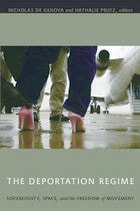
The Deportation Regime
Sovereignty, Space, and the Freedom of MovementNicholas De Genova and Nathalie Peutz, eds.
Duke University Press, 2010
Whether investigating the power that individual and corporate sponsors have over the fate of foreign laborers in Bahrain, the implications of Germany’s temporary suspension of deportation orders for pregnant and ill migrants, or the significance of the detention camp, the contributors reveal how deportation reflects and reproduces notions about public health, racial purity, and class privilege. They also provide insight into how deportation and deportability are experienced by individuals, including Arabs, South Asians, and Muslims in the United States. One contributor looks at asylum claims in light of an unusual anti-deportation campaign mounted by Algerian refugees in Montreal; others analyze the European Union as an entity specifically dedicated to governing mobility inside and across its official borders. The Deportation Regime addresses urgent issues related to human rights, international migration, and the extensive security measures implemented by nation-states since September 11, 2001.
Contributors: Rutvica Andrijasevic, Aashti Bhartia, Heide Castañeda , Galina Cornelisse , Susan Bibler Coutin, Nicholas De Genova, Andrew M. Gardner, Josiah Heyman, Serhat Karakayali, Sunaina Marr Maira, Guillermina Gina Nuñez, Peter Nyers, Nathalie Peutz, Enrica Rigo, Victor Talavera, William Walters, Hans-Rudolf Wicker, Sarah S. Willen
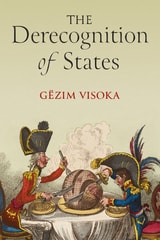
The Derecognition of States
Gëzim Visoka
University of Michigan Press, 2024
Gëzim Visoka argues that state derecognition is a highly controversial and unstable practice that has less to do with the unfulfillment of the conditions of statehood by the claimant than with the advancement of the self-interest of the former base state and derecognizing state. The derecognition of states is not a rule; rather, it is an exception in international diplomacy, driven by political expediency and is incompatible with original rationales for granting recognition. Yet, the derecognition of states is far more important than previously recognized in shaping the reversal dynamics of secession and state creation and in influencing regional peace, geopolitical rivalries, and the international order. By analyzing the withdrawal of recognition, the book offers a window into the reversal politics of unbecoming a sovereign state and how the arbitrary beginning and the end of diplomatic relations between states take place.
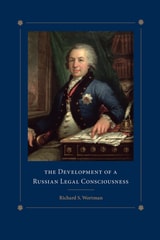
The Development of a Russian Legal Consciousness
Richard S. Wortman
University of Chicago Press, 1976
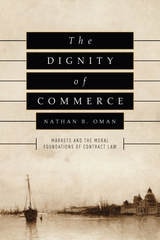
The Dignity of Commerce
Markets and the Moral Foundations of Contract LawNathan B. Oman
University of Chicago Press, 2016
With The Dignity of Commerce, Nathan B. Oman argues persuasively that well-functioning markets are morally desirable in and of themselves and thus a fit object of protection through contract law. Markets, Oman shows, are about more than simple economic efficiency. To do business with others, we must demonstrate understanding of and satisfy their needs. This ability to see the world from another’s point of view inculcates key virtues that support a liberal society. Markets also provide a context in which people can peacefully cooperate in the absence of political, religious, or ideological agreement. Finally, the material prosperity generated by commerce has an ameliorative effect on a host of social ills, from racial discrimination to environmental destruction.
The first book to place the moral status of the market at the center of the justification for contract law, The Dignity of Commerce is sure to elicit serious discussion about this central area of legal studies.
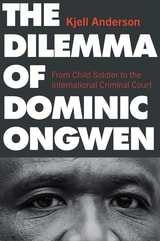
The Dilemma of Dominic Ongwen
From Child Soldier to the International Criminal CourtKjell Anderson
Rutgers University Press, 2027
Dominic Ongwen was abducted by Joseph Kony's Lord's Resistance Army while walking to school at the age of nine. He later rose through its ranks committing, and ultimately being convicted by the International Criminal Court (ICC) of, many of the same crimes of which he was once a victim. The Dilemma of Dominic Ongwen tells this extraordinary story through the voices of those who knew him best: family members, fighters, commanders, “wives,” victims, and trial participants. Their testimonies, gathered in Uganda and The Hague, form the backbone of a narrative that interlaces survivor accounts with legal analysis and vivid excerpts from the ICC trial. The book offers a rare, human-centered lens on international justice, illuminating the dilemmas of prosecuting a former child soldier for mass atrocities. It provides indispensable insights for scholars of international criminal law, transitional justice, political violence, trauma, and human rights.
The Dimensions of Tolerance
What Americans Believe About Civil LibertiesHerbert McClosky
Russell Sage Foundation, 1983
The Discourse of Police Interviews
Edited by Marianne Mason and Frances Rock
University of Chicago Press, 2020
The first book to focus exclusively on the discourses of police interviewing, The Discourse of Police Interviews examines leading debates, approaches, and topics in contemporary police interview research. Among other topics, the book explores the sociolegal, psychological, and discursive framework of popular police interview techniques employed in the United States and the United Kingdom, such as PEACE and Reid, and the discursive practices of institutional representatives like police officers and interpreters that can influence the construction and quality of linguistic evidence. Together, the contributions situate the police interview as part of a complex, and multistage, criminal justice process. The book will be of interest to both scholars and practitioners in a variety of fields, such as linguistic anthropology, interpreting studies, criminology, law, and sociology.
The Disenfranchisement of Ex-Felons
Elizabeth A. Hull, foreword by Representative John Conyers, Jr.
Temple University Press, 2006
The Disenfranchisement of Ex-Felons provides a comprehensive overview of the history, nature, and far-reaching sociological and political consequences of denying ex-felons the right to vote. Readers learn state practices in Florida and Ohio during the 2000 and 2004 presidential elections; arguments that have been used in court houses, legislatures, and the press to justify such practices; and attempts to reverse legislation through state and federal governments. In a timely appendix to the 2004 election, Elizabeth Hull makes her case that the battle for civil rights will not be won unless ex-felons, who have fulfilled their obligations to society, are restored the same rights afforded all other American citizens.
The Documentary History of the Ratification of the Constitution, Volume 11
Ratification of the Constitution by the States, Maryland, No. 1John P. Kaminski
Wisconsin Historical Society Press, 2015
The Documentary History of the Ratification of the Constitution, Volume 12
Ratification of the Constitution by the States, Maryland, No. 1John P. Kaminski
Wisconsin Historical Society Press, 2015
The Documentary History of the Ratification of the Constitution, Volume 25
Ratification of the Constitution by the States: Rhode Island, No. 2John P. Kaminski
Wisconsin Historical Society Press, 2012
Pulitzer Prize-winning historian Michael Kammen has noted that The Documentary History of the Ratification of the Constitution series "will be of enduring value centuries hence" and described it as "one of the most interesting documentary publications we have ever had." The American Bar Association Journal has stated, "Each new volume now fills another vital part of the mosaic of national history."
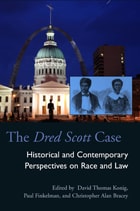
The Dred Scott Case
Historical and Contemporary Perspectives on Race and LawDavid Thomas Konig
Ohio University Press, 2010
In 1846 two slaves, Dred and Harriet Scott, filed petitions for their freedom in the Old Courthouse in St. Louis, Missouri. As the first true civil rights case decided by the U.S. Supreme Court, Dred Scott v. Sandford raised issues that have not been fully resolved despite three amendments to the Constitution and more than a century and a half of litigation.
The Dred Scott Case: Historical and Contemporary Perspectives on Race and Law presents original research and the reflections of the nation’s leading scholars who gathered in St. Louis to mark the 150th anniversary of what was arguably the most infamous decision of the U.S. Supreme Court. The decision, which held that African Americans “had no rights” under the Constitution and that Congress had no authority to alter that, galvanized Americans and thrust the issue of race and law to the center of American politics. This collection of essays revisits the history of the case and its aftermath in American life and law. In a final section, the present-day justices of the Missouri Supreme Court offer their reflections on the process of judging and provide perspective on the misdeeds of their nineteenth-century predecessors who denied the Scotts their freedom.
Contributors: Austin Allen, Adam Arenson, John Baugh, Hon. Duane Benton, Christopher Alan Bracey, Alfred L. Brophy, Paul Finkelman, Louis Gerteis, Mark Graber, Daniel W. Hamilton, Cecil J. Hunt II, David Thomas Konig, Leland Ware, Hon. Michael A. Wolff
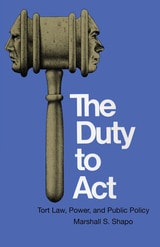
The Duty to Act
Tort Law, Power, and Public PolicyBy Marshall S. Shapo
University of Texas Press, 1977
A woman terrified by the threats of a jilted suitor is denied police protection. A workman collapses on the job and the employer is slow to help him. A bully in a bar begins to carry out threats of serious injury to a customer, after the bartender’s lackadaisical response. Springing from varied areas of human activity, such cases occupy an important area of the legal battleground called modern tort law. They also provide the basis for a fascinating legal analysis by Marshall S. Shapo.
Tort law is an important social mediator of events surrounding personal injuries. It impinges on many other areas of the law—those dealing with crime, constitutional protections against government officials and agencies, and property rights. Since litigated tort cases often involve brutal treatment or accidents inflicting severe physical harm, this area of the law generates much emotion and complex legal doctrine.
Shapo cuts through the emotion and the complexity to present a view of these problems that is both legally sound and intuitively appealing. His emphasis is on power relationships between private citizens and other individuals, as well as between private persons and governments and officials. He undertakes to define power in a meaningful way as it relates to many tort issues faced by ordinary citizens, and to make this definition precise by constant reference to concrete cases. His particular focus is on an age-old problem in tort law: the question of when a person has a duty to aid another in peril.
In analyzing a large number of cases in this category, Shapo develops an analysis that blends considerations of economic efficiency and humanitarian concern. Recognizing that economic considerations are significant in judicial analysis of these cases, he emphasizes elements that go beyond a simple concern with efficiency, especially the ability of one person to control another’s actions or exposure to risk.
These considerations of power and corresponding dependence provide the basis for Shapo’s study of the duties of both private citizens and governments to prevent injury to others. Calling on a broad range of legal precedents, he also refers to social science research dealing with the behavior of bystanders when fellow citizens are under attack.
Beyond his application of a power-based analysis to litigation traditionally based in tort doctrine, Shapo offers some speculative suggestions on the possible applicability of his views to several controversial areas of welfare law: medical care, municipal services, and educational standards.
This book was written with a view to readership by interested citizens as well as legal scholars, judges, and practicing attorneys.
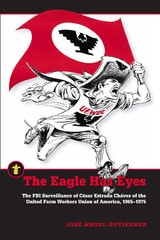
The Eagle Has Eyes
The FBI Surveillance of César Estrada Chávez of the United Farm Workers Union of America, 1965–1975José Angel Gutiérrez
Michigan State University Press, 2019
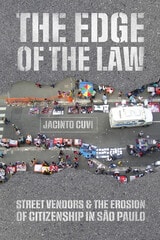
The Edge of the Law
Street Vendors and the Erosion of Citizenship in São PauloJacinto Cuvi
University of Chicago Press, 2025
With a little initiative and very little startup money, an outgoing individual might sell you a number of delights and conveniences familiar to city dwellers—from cold water bottles while you’re sitting in traffic to a popsicle from a cart on a summer afternoon in the park. Such vendors form a significant share of the workforce in São Paulo, Brazil, but their ubiquity belies perpetual struggle. Some have the right to practice their trade; others do not. All of them strive to make it—or stay afloat.
In The Edge of the Law, sociologist Jacinto Cuvi introduces us to the world of street vendors and teases out the relationship between the construction of legality and the experience of citizenship. As São Paulo’s city government undertakes a large-scale plan to cancel street vending licenses and evict street vendors, Cuvi reveals how the rights of informal workers can be revoked or withheld and how the lines can be redrawn between work that is “legal” and work that takes place under constant fear of law enforcement. Alongside the mechanics of disenfranchisement, Cuvi captures the lived experience of criminalization, dissecting the distribution of (shallow) rights among vendors who continually reinvent strategies to eke out a living while dealing with the constraints and pressures of informal citizenship at the edge of the law.
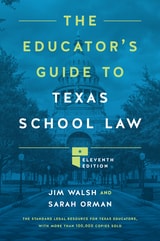
The Educator's Guide to Texas School Law
Eleventh EditionJim Walsh and Sarah Orman
University of Texas Press, 2026
A new edition of the most authoritative guide to Texas school law.
Over the past five years, the US Supreme Court, the White House, and the Texas legislature have collectively been responsible for seismic changes in the landscape of education in the Lone Star State. The eleventh edition of The Educator's Guide to Texas School Law is your up-to-date resource for understanding what the law is and what it means for effective school operations.
Intended for educators, school board members, attorneys, and taxpayers, the eleventh edition offers a comprehensive review of the evolving legal structure of schooling in Texas. Jim Walsh and Sarah Orman highlight pressing issues that educators encounter daily: What are teachers’ and students’ free speech rights? What about due process and religious exercise? Exactly how are teachers hired, and under what circumstances can they be fired? The Educators’ Guide also explains the role of the school board and important dimensions of school district governance, including procurement and compliance with the Open Meetings Act. This latest edition focuses intensively on recent areas of reform, including parents’ rights, special-needs law, and education savings accounts. More essential than ever, the Educator’s Guide provides clarity in uncertain times.
The Educator's Guide to Texas School Law
Ninth EditionBy Jim Walsh, Laurie Maniotis, and Frank Kemerer
University of Texas Press, 2018
Much has changed in the area of school law since the first edition of The Educator’s Guide was published in 1986. This new ninth edition offers an authoritative source on all major dimensions of Texas school law through the 2017 legislative sessions. Intended for educators, school board members, interested attorneys, and taxpayers, the ninth edition explains what the law is and what the implications are for effective school operations. It is designed to help professional educators avoid expensive and time-consuming lawsuits by taking effective preventive action. It is an especially valuable resource for school law courses and staff development sessions.
The ninth edition begins with a review of the legal structure of the Texas school system, incorporating recent innovative features such as charter schools and districts of innovation. Successive chapters address attendance, the instructional program, service to students with special needs, the rights of public school employees, the role of religion, student discipline, governmental transparency, privacy, parent rights, and the parameters of legal liability for schools and school personnel. The book includes discussion of major federal legislation, such as the Individuals with Disabilities Education Act, the Family Educational Rights and Privacy Act, Section 504 of the Rehabilitation Act of 1973, and the Every Student Succeeds Act. On the state level, the book incorporates new laws pertaining to cyberbullying and inappropriate relationships between students and employees. Key points are illustrated through case law, and a complete index of case citations is included.
The Educator's Guide to Texas School Law
Tenth EditionJim Walsh and Sarah Orman
University of Texas Press, 2022
Much has changed in the area of school law since the first edition of The Educator’s Guide to Texas School Law was published in 1986. This new tenth edition of The Educator’s Guide offers an authoritative source on Texas school law through the 2021 legislative sessions. Intended for educators, school board members, attorneys, and taxpayers, it explains what the law is and what the implications are for effective school operations; it helps professional educators avoid expensive and time-consuming lawsuits by taking effective preventive action; and it serves as a highly valuable resource for school law courses and staff development sessions.
The tenth edition begins with a review of the legal structure of the Texas school system, incorporating recent features such as charter schools and districts of innovation, then addresses the instructional program, service to students with special needs, the rights of public school employees, the role of religion, student discipline, governmental transparency, privacy, parental rights, and the parameters of legal liability for schools and school personnel. The book includes discussion of major federal legislation, such as the Individuals with Disabilities Education Act, the Family Educational Rights and Privacy Act, Section 504 of the Rehabilitation Act of 1973, and Title IX. On the state level, the book incorporates laws pertaining to cyberbullying, inappropriate relationships between students and employees, and human sexuality instruction.

The Effect of an Unconstitutional Statute
Oliver P. Field
University of Minnesota Press, 1935
The Effect of an Unconstitutional Statute was first published in 1935. Minnesota Archive Editions uses digital technology to make long-unavailable books once again accessible, and are published unaltered from the original University of Minnesota Press editions.
The Enchantment Of Reason
Pierre Schlag
Duke University Press, 1998
In examining the fierce resistance to questioning reason’s primacy, this renowned critic and professor of American law demonstrates how those who use and study the law perpetuate their own methodological blind spots. Claiming that reason has been endowed with a virtually mystical power to organize social life, Schlag unravels the seemingly rational world of judicial opinions, statutes, doctrines, and legal principles. In the process, he paints a shocking—and sure to be controversial—picture of the chaos and, indeed, violence of the American legal tradition.
This bold commentary on the irrationality of reason in American law and legal studies will interest not only legal scholars and philosophers but also serious thinkers across a broad disciplinary spectrum.
The English Language Common Law Workbook
A Resource for Students Studying English-medium Law DegreesIan Collins and David Brody
University of Michigan Press, 2025
The English Language Common Law Workbook is designed to support students in developing the core competencies necessary for studying in a common law context. It provides readings and exercises based on authentic legal materials for practicing critical reading and writing skills. In particular, it includes an extensive number of statutes and cases and accompanying exercises that give students an opportunity to work with the type of sources they will encounter in English-medium law degree programs. By emphasizing common law principles throughout, the book helps international students coming from non–common law jurisdictions familiarize themselves with how statutes and cases in common law countries are written and structured. Students are supported in critically reading statutes and cases by focusing on key terminology and language structures. Finally, the book supports students in applying the skills they learn to construct basic case briefs and answer hypothetical legal questions using the IRAC structure.
CEFR Levels: B2–C2
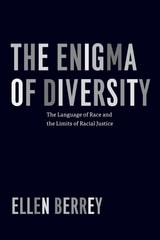
The Enigma of Diversity
The Language of Race and the Limits of Racial JusticeEllen Berrey
University of Chicago Press, 2015
Ellen Berrey digs deep into those questions in The Enigma of Diversity. Drawing on six years of fieldwork and historical sources dating back to the 1950s and making extensive use of three case studies from widely varying arenas—housing redevelopment in Chicago’s Rogers Park neighborhood, affirmative action in the University of Michigan’s admissions program, and the workings of the human resources department at a Fortune 500 company—Berrey explores the complicated, contradictory, and even troubling meanings and uses of diversity as it is invoked by different groups for different, often symbolic ends. In each case, diversity affirms inclusiveness, especially in the most coveted jobs and colleges, yet it resists fundamental change in the practices and cultures that are the foundation of social inequality. Berrey shows how this has led racial progress itself to be reimagined, transformed from a legal fight for fundamental rights to a celebration of the competitive advantages afforded by cultural differences.
Powerfully argued and surprising in its conclusions, The Enigma of Diversity reveals the true cost of the public embrace of diversity: the taming of demands for racial justice.
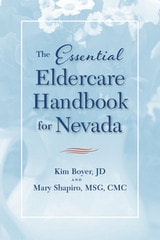
The Essential Eldercare Handbook for Nevada
Kim Boyer
University of Nevada Press, 2014
Boyer and Shapiro provide Nevada-specific information\--medical, legal, and financial\--on the wide range of problems that arise during the elder years. Case studies show how a typical family copes with troubles such as failing health or financial cares and what options they have. This guide will help any Nevada resident plan for their own senior years and take care of aging parents, spouses, and other loved ones.
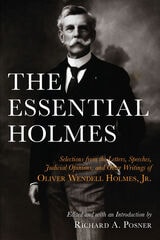
The Essential Holmes
Selections from the Letters, Speeches, Judicial Opinions, and Other Writings of Oliver Wendell Holmes, Jr.Oliver Wendell Holmes
University of Chicago Press, 1992
"A first-rate prose stylist, [Holmes] was perhaps the most quotable of all judges, as this ably edited volume shows."—Washington Post Book World
"Brilliantly edited, lucidly organized, and equipped with a compelling introduction by Judge Posner, [this book] is one of the finest single-volume samplers of any author's work I have seen. . . . Posner has fully captured the acrid tang of him in this masterly anthology."—Terry Teachout, National Review
"Excellent. . . . A worthwhile contribution to current American political/legal discussions."—Library Journal
"The best source for the reader who wants a first serious acquaintance with Holmes."—Thomas C. Grey, New York Review of Books

The Evidential Foundations of Probabilistic Reasoning
David A. Schum
Northwestern University Press, 2001
Synthesizing insights from law, philosophy and logic, probability, semiotics, artificial intelligence, psychology, and history, Schum provides a detailed examination of the various properties and uses of evidence and the evaluative skills evidence requires. Along with the evidential subtleties of probabilistic reasoning, Schum also explores the processes by which evidence is generated or discovered and looks at the intellectual and practical underpinnings of probabilistic reasoning. It is a useful resourse for students, researchers, and practitioners of every discipline concerned with evidence and its inferential use.

The Execution of Private Slovik
William Bradford Huie
Westholme Publishing, 2004
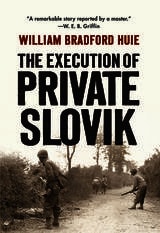
The Execution of Private Slovik
William Bradford Huie
Westholme Publishing, 2020
Seventy-Five Years Ago, the Last American Soldier Who Paid the Ultimate Price for Desertion
A New Edition of the Acclaimed Investigative Story
In August 1944, a drab convoy of raw recruits destined to join the 28th Division lumbered along a windy French road strewn with dead animals, shattered bodies, and burning equipment. One of those draftees was 24-year-old Eddie Slovik, a petty thief from Detroit who had spent his youth in and out of reform schools. Eddie's luck had recently changed, however, with a steady factory job and marriage to a beautiful girl who gave Eddie hope and security for the first time in his life. But their honeymoon—like that of many other wartime newlyweds—was interrupted by the call to service. The convoy came under intense artillery fire, and in the confusion Slovik became separated from his unit. He joined a Canadian outfit and traveled with them before finally reporting to the 28th Division. He carried a rifle but no ammunition. He was assigned to a platoon but walked away. Refusing to kill, Slovik was arrested, court martialed, and condemned to death. Hundreds of soldiers were tried for desertion during World War II and sentenced to die, but only Eddie Slovik paid the price, supposedly as a deterrent, yet word of the nature of his death was never officially released to the public.
In The Execution of Private Slovik, considered to be among the best investigative books ever written, journalist and author William Bradford Huie reconstructs this entire story with the full cooperation of the U.S. Army in order to find out what made Eddie Slovik an unlikely pacifist and why the affair was covered up. Through interviews with those who knew him and the hundreds of letters to his wife, the author reveals a hard luck depression-era kid who when faced with the reality of war realized that he simply could not kill another human being. Throughout, Huie reveals how Eddie Slovik's death has much to tell us about life and duty to one's country. This edition marking the seventy-fifth anniversary of the sentence being carried out, contains a new introduction by the author's daughter.
Praise for The Execution of Private Slovik:
"In the hands of an expert, who writes both passionately and with an almost transparent effort to be fair to all concerned, the story raises questions to which our wisest leaders still lack satisfying answers."
—New York Times
"A remarkable story reported by a master."—W. E. B. Griffin
"Recommended reading for all military historians."—Military Affairs
"Tremendously moving."—The Atlantic
"It is very likely that William Bradford Huie's The Execution of Private Slovikwill long survive the official histories of World War II. It is a big book and Mr. Huie deserves some sort of rich reward for this unburying of an incident of the war which must disturb us all. For Slovik was more than a 'coward.' He not only did not want to die but he did not want to kill, and one must look far in literature for a figure so moving as Private Slovik wandering about Europe not with bullets in his cartridge belt but with writing paper. The question is not 'How might we improve military procedures?' The question is, 'What has happened to love in our world when he who would rather love than kill must die?'"—from a letter to the New York Times

The Expert Witness in Islamic Courts
Medicine and Crafts in the Service of LawRon Shaham
University of Chicago Press, 2010
Shaham begins with a history of expert testimony in medieval Islamic culture, analyzing the different roles played by male experts, especially physicians and architects, and females, particularly midwives. From there, he focuses on the case of Egypt, tracing the country’s reform of its traditional legal system along European lines beginning in the late nineteenth century. Returning to a broader perspective, Shaham draws on a variety of legal and historical sources to place the phenomenon of expert testimony in cultural context. A truly comprehensive resource, The Expert Witness in Islamic Courts will be sought out by a broad spectrum of scholars working in history, religion, gender studies, and law.
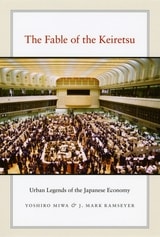
The Fable of the Keiretsu
Urban Legends of the Japanese EconomyYoshiro Miwa and J. Mark Ramseyer
University of Chicago Press, 2006
In their insightful analysis, the authors show that the very idea of the keiretsu was created and propagated by Marxist scholars in post-war Japan. Western scholars merely repatriated the legend to show the culturally contingent nature of modern economic analysis. Laying waste to the notion of keiretsu, the authors debunk several related “facts” as well: that Japanese firms maintain special arrangements with a “main bank,” that firms are systematically poorly managed, and that the Japanese government guided post-war growth. In demolishing these long-held assumptions, they offer one of the few reliable chronicles of the realities of Japanese business.
The Failure of Corporate Law
Fundamental Flaws and Progressive PossibilitiesKent Greenfield
University of Chicago Press, 2007
When used in conjunction with corporations, the term “public” is misleading. Anyone can purchase shares of stock, but public corporations themselves are uninhibited by a sense of societal obligation or strict public oversight. In fact, managers of most large firms are prohibited by law from taking into account the interests of the public in decision making, if doing so hurts shareholders. But this has not always been the case, as until the beginning of the twentieth century, public corporations were deemed to have important civic responsibilities.
With The Failure of Corporate Law, Kent Greenfield hopes to return corporate law to a system in which the public has a greater say in how firms are governed. Greenfield maintains that the laws controlling firms should be much more protective of the public interest and of the corporation’s various stakeholders, such as employees. Only when the law of corporations is evaluated as a branch of public law—as with constitutional law or environmental law—will it be clear what types of changes can be made in corporate governance to improve the common good. Greenfield proposes changes in corporate governance that would enable corporations to meet the progressive goal of creating wealth for society as a whole rather than merely for shareholders and executives.

The Fairer Death
Executing Women in OhioVictor L. Streib
Ohio University Press, 2006
Women on death row are such a rarity that, once condemned, they may be ignored and forgotten. Ohio, a typical, middle-of-the-road death penalty state, provides a telling example of this phenomenon. The Fairer Death: Executing Women in Ohio explores Ohio’s experience with the death penalty for women and reflects on what this experience reveals about the death penalty for women throughout the nation.
Victor Streib’s analysis of two centuries of Ohio death penalty legislation and adjudication reveals no obvious exclusion of women or even any recognition of an issue of sex bias. In this respect, Ohio’s justice system exemplifies the subtle and insidious nature of this cultural disparity.
Professor Streib provides detailed descriptions of the cases of the four women actually executed by Ohio since its founding and of the cases of the eleven women sentenced to death in Ohio in the current death penalty era (1973–2005). Some of these cases had a profound impact on death penalty law, but most were routine and drew little attention. A generation later, reversals and commutations have left only one woman on Ohio’s death row.
Although Streib focuses specifically on Ohio, the underlying premise is that Ohio is, in many ways, a typical death penalty state. The Fairer Death provides insight into our national experience, provoking questions about the rationale for the death penalty and the many disparities in its administration.
The Fall and Rise of Freedom of Contract
F. H. Buckley, ed.
Duke University Press, 1999
The 1970s was a decade of regulatory triumphalism in North America, marked by a surge in consumer, securities, and environmental regulation. Legal scholars predicted the “death of contract” and its replacement by regulation and reliance-based theories of liability. Instead, we have witnessed the reemergence of free bargaining norms. This revival can be attributed to the rise of law-and-economics, which laid bare the intellectual failure of anticontractarian theories. Scholars in this school note that consumers are not as helpless as they have been made out to be, and that intrusive legal rules meant ostensibly to help them often leave them worse off. Contract law principles have also been very robust in areas far afield from traditional contract law, and the essays in this volume consider how free bargaining rights might reasonably be extended in tort, property, land-use planning, bankruptcy, and divorce and family law.
This book will be of particular interest to legal scholars and specialists in contract law. Economics and public policy planners will also be challenged by its novel arguments.
Contributors. Gregory S. Alexander, Margaret F. Brinig, F. H. Buckley, Robert Cooter, Steven J. Eagle, Robert C. Ellickson, Richard A. Epstein, William A. Fischel, Michael Klausner, Bruce H. Kobayashi, Geoffrey P. Miller, Timothy J. Muris, Robert H. Nelson, Eric A. Posner, Robert K. Rasmussen, Larry E. Ribstein, Roberta Romano, Paul H. Rubin, Alan Schwartz, Elizabeth S. Scott, Robert E. Scott, Michael J. Trebilcock

The Farm
Life Inside a Women's PrisonAndi Rierden
University of Massachusetts Press, 1997
Written by a journalist, this book depicts the day-to-day struggles and concerns of inmates a the Connecticut Correctional Institution in Niantic (renamed the Janet S. York correctional Institution), the state's only prison for women. Build in 1917 as a work farm for prostitutes, unwed mothers, and other women of allegedly immoral character, “the Farm,” as it is still called, has long served as a barometer of prevailing social attitudes toward women.
In the summer of 1992, Andi Rierden obtained permission from the warden at Niantic to conduct research on life inside the institution. During the next three and a half years, she spent more than fifteen hundred hours among the women, recording interviews, strolling the grounds with inmates and corrections officers, sharing meals, attending classes and group counseling sessions, and tracking former inmates after their release.
The stories these women tell shed light ton a wide range of issues, from the effects of more stringent drug laws and sentences to the rise of violence among inmates. In the process it becomes clear that the ideal of rehabilitation has been largely abandoned and replaced by a belief in punishment and retribution.
The Fate of Law
Austin Sarat and Thomas R. Kearns, Editors
University of Michigan Press, 1993
For law and legal theory the end of the twentieth century is a time of contradiction; while the newly emerging politics of Eastern Europe seek to establish a new rule of law, voices in this country proclaim the "death of law." For the former, law provides hope for stability and fairness. For the latter, the fundamental values that provide a grounding for legality seem no longer secure or satisfying. The Fate of Law is a collection of five original essays, each of which discusses the problems and prospects of law in the late twentieth century. The essays pay particular attention to the impact of broad intellectual and political movements, especially feminism and postmodernism, on law and legal theory.
The Fate of Law investigates what happens under the critical scrutiny of those movements and in an era of growing skepticism about law's central claim to objectivity, neutrality, and reason. It describes the struggles that ensue and the responses that are made. Each of the essays that comprise this books is written in its own style and voice; each makes it own judgments and assessments.
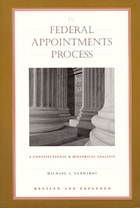
The Federal Appointments Process
A Constitutional and Historical AnalysisMichael J. Gerhardt
Duke University Press, 2003
Michael J. Gerhardt includes each U.S. president’s performance record regarding appointments, accounts of virtually all the major confirmation contests, as well as discussion of significant legal and constitutional questions raised throughout U.S. history. He also analyzes recess appointments, the Vacancies Act, the function of nominees in the appointment process, and the different treatment received by judicial and nonjudicial nominations. While discussing the important roles played by media and technology in federal appointments, Gerhardt not only puts particular controversies in perspective but also identifies important trends in the process, such as how leaders of different institutions attempt to protect—if not expand—their respective prerogatives by exercising their authority over federal appointments. Employing a newly emerging method of inquiry known as “historical institutionalism”—in which the ultimate goal is to examine the development of an institution in its entirety and not particular personalities or periods, this book concludes with suggestions for reforms in light of recent controversies springing from the longest delays in history that many judicial nominees face in the Senate.
Gerhardt’s intensive treatment of the subject will be of interest to students and scholars of political science, government, history, and legal studies.

The Federal Impeachment Process
A Constitutional and Historical AnalysisMichael J. Gerhardt
University of Chicago Press, 2000
In this edition, Michael Gerhardt draws on his experience as a commentator and expert witness to examine the likely political and constitutional consequences of President Clinton's impeachment and trial. Placing the President's acquittal in historical perspective, he argues that it fits easily within the impeachment process as it has evolved over the past two centuries. Impeachment, he shows, is an inherently political process designed to expose and remedy political crimes. Subject neither to judicial review nor to presidential veto, it is a unique congressional power that involves both political and constitutional considerations, including the gravity of the offense charged, the harm to the constitutional order, and the link between an official's misconduct and duties.
Significantly updated, this book will be the standard work on the federal impeachment process for years to come.
On the first edition:
"The most comprehensive, analytic study of the federal impeachment process to date."—Choice
"This book is by some margin the most successful . . . analysis of impeachment issues to have been written, and it will be the standard work for years to come."—Constitutional Commentary
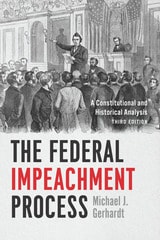
The Federal Impeachment Process
A Constitutional and Historical Analysis, Third EditionMichael J. Gerhardt
University of Chicago Press, 2019
For more than twenty years, The Federal Impeachment Process has served as the most complete analysis of the constitutional and legal issues raised in every impeachment proceeding in American history. Impeachment, Michael J. Gerhardt shows, is an inherently political process designed to expose and remedy political crimes—serious breaches of duty or injuries to the Republic. Subject neither to judicial review nor to presidential veto, it is a unique congressional power that involves both political and constitutional considerations, including the gravity of the offense charged, the harm to the constitutional order, and the link between an official’s misconduct and duties. For this third edition, Gerhardt updates the book to cover cases since President Clinton, as well as recent scholarly debates. He discusses the issues arising from the possible impeachment of Donald Trump, including whether a sitting president may be investigated, prosecuted, and convicted for criminal misconduct or whether impeachment and conviction in Congress is the only way to sanction a sitting president; what the “Emoluments Clause” means and whether it might provide the basis for the removal of the president; whether gross incompetence may serve as the basis for impeachment; and the extent to which federal conflicts of interest laws apply to the president and other high ranking officials.
Significantly updated, this book will remain the standard work on the federal impeachment process for years to come.
The Federalist Concordance
Edited by Thomas Engeman, Edward J. Erler, and Thomas B. Hofeller
University of Chicago Press, 1988
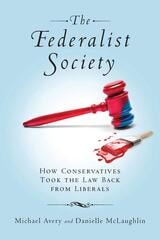
The Federalist Society
How Conservatives Took the Law Back from LiberalsMichael Avery
Vanderbilt University Press, 2013
Today the Society claims that 45,000 conservative lawyers and law students are involved in its activities. Four Supreme Court Justices--Antonin Scalia, Clarence Thomas, John Roberts, and Samuel Alito--are current or former members. Every single federal judge appointed in the two Bush presidencies was either a Society member or approved by members. During the Bush years, young Federalist Society lawyers dominated the legal staffs of the Justice Department and other important government agencies.
The Society has lawyer chapters in every major city in the United States and student chapters in every accredited law school. Its membership includes economic conservatives, social conservatives, Christian conservatives, and libertarians, who differ with each other on significant issues, but who cooperate in advancing a broad conservative agenda.
How did this happen? How did this group of conservatives succeed in moving their theories into the mainstream of legal thought?
What is the range of positions of those associated with the Federalist Society in areas of legal and political controversy? The authors survey these stances in separate chapters on
• regulation of business and private property
• race and gender discrimination and affirmative action
• personal sexual autonomy, including abortion and gay rights
• American exceptionalism and international law
The Firm, the Market, and the Law
R. H. Coase
University of Chicago Press, 1987
A Nobel Prize winner's most important, groundbreaking work, collected in one volume
The Firm, the Market, and the Law gathers the most important and lasting works by Nobel Prize-winning economist Ronald Coase. Awarded the Nobel Prize in 1991 for his groundbreaking work on the significance of transaction costs and property rights, Coase continually urged his fellow economists to examine the real-world foundations on which their theories rest. This volume collects some of his classic articles probing those very foundations. "The Nature of the Firm" (1937) introduced the then-revolutionary concept of transaction costs into economic theory. "The Problem of Social Cost" (1960) further developed this concept, emphasizing the effect of the law on the working of the economic system. The remaining papers and new introductory essay clarify and extend Coarse's arguments and address his critics.