Results by title
791 books match the query 'Levels' and 201 start with t
The Gee Years, 2007–2013
Herbert B. Asher
The Ohio State University Press, 2022
The Good-bye Window
A Year in the Life of a Day-Care CenterHarriet Brown
University of Wisconsin Press, 1998
Have you ever wondered what really goes on at your child’s day-care center after you say good-bye? Harriet Brown did. To satisfy her curiosity, she spent an entire year observing Red Caboose, a center in Madison, Wisconsin. This engaging and thought-provoking book is the story of that year.
In her beautifully written personal account, journalist and mother Brown takes us behind the scenes at a day-care center that works. At Red Caboose, one of the oldest independent centers in the country, we meet teachers who have worked with young children for more than twenty years. We watch the child-care union and parents struggle to negotiate a contract without ripping apart the fabric of trust and love that holds the Red Caboose community together.
We look at the center’s finances, to see what keeps Red Caboose going at a time when other good centers are disappearing. Best of all, we get to know the children, families, and teachers of Red Caboose—their struggles, their sorrows, their triumphs.
Started twenty-five years ago by a group of idealistic parents, the center has not only survived but thrived through some pretty tough times. In the world of day care, Red Caboose is a special place, a model for what child care in this country could and should be: not just babysitting, not just a service to working parents, but a benefit for children, families, teachers, and the community at large.
Brown sets her rich and engaging stories in the greater political and social context of our time. Why is so much child care bad? Why should working Americans worry about the link between welfare reform and child care? What can we learn from the history of child care?
This book is a must-read for parents, educators, and anyone who enjoys first-rate writing and dead-on insight into the lives of our youngest children and those who care for them.
“[Brown’s] writing is beautiful and her scholarship sound. Students considering day-care careers, day-care professionals, and concerned parents will gain insight by reading this provocative book, as will anyone who cares about the future of young children in this country.”—Choice
“I admire enormously the ambition of this book—its eagle-eyed witness and engrossing detail, plus the social importance of the project. I wish there were in the world more books like it.”—Lorrie Moore, author of Who Will Run the Frog Hospital?
“The Good-bye Window is a fascinating peek into the secret world of children. With the poignancy of Anne LaMott, and the reportorial grace of Tracy Kidder, Harriet Brown has written a terrific and worthwhile book.”—Meg Wolitzer, author of This Is Your Life
“Harriet Brown’s well-told story of the Red Caboose child-care center should be read by teachers and parents, but also by every legislator and politician in the land. Only a writer as good as Ms. Brown could display the dramatic complexities of a school community in which the youngest members enter crawling and emerge a few years later as articulate, empathetic, and well-socialized individuals, ready for the ‘real world.’”—Vivian Gussin Paley, author of The Boy Who Would Be a Helicopter
The Graduate Advisor Handbook
A Student-Centered ApproachBruce M. Shore
University of Chicago Press, 2014
One of the first books to approach advising from the advisor’s point of view, the handbook highlights the importance of a partnership in which both parties need to be invested. Shore emphasizes the interpersonal relationships at the heart of advising and reveals how advisors can draw on their own strengths to create a rewarding rapport.
The Graduate Advisor Handbook moves chronologically through the advising process, from the first knock on the door to the last reference letter. Along the way it covers transparent communication, effective motivation, and cooperative troubleshooting. Its clear-eyed approach also tackles touchy subjects, including what to do when personal boundaries are crossed and how to deliver difficult news. Sample scripts help advisors find the right words for even the toughest situations.
With resources dwindling and student and advising loads increasing, graduate advisors need all the resources they can find to give their students the help they need. The Graduate Advisor Handbook has the cool-headed advice and comprehensive coverage that advisors need to make the advising relationship not just effective but also enjoyable.
The High School
Sports, Spirit, and Citizens, 1903-2024Michael A. Messner
Rutgers University Press, 2025
In The High School, acclaimed sociologist Michael A. Messner reads through 120 years of El Gabilan, the yearbook from his own alma mater, Salinas High School in California, where his father taught and coached. Treating the yearbooks as a historical archive, Messner makes surprising discoveries about the school he thought he knew so well. For example, over fifty years before Title IX, the earliest yearbooks gave equal spotlights to boys’ and girls’ athletics, while the cheerleaders were all boys.
Tracing American life and culture from 1903 to 2024, Messner illuminates shifts in social practices at his high school that reflect broader changes in American culture across the twentieth century. The High School spotlights how the meanings and iconography of certain activities have changed radically over the decades, even as the “sports spirit complex”—involving athletes, cheerleaders, band members, and community boosters—has remained a central part of the high school experience. By exploring evolving sports cultures, socioeconomic conditions, racial demographics, and gender norms, Messner offers a fresh perspective on a defining feature of American teenage life.
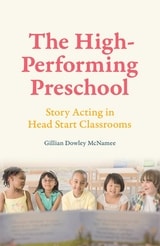
The High-Performing Preschool
Story Acting in Head Start ClassroomsGillian Dowley McNamee
University of Chicago Press, 2015
McNamee outlines how story acting cultivates children’s oral and written language skills. She shows how it creates a crucial opportunity for teachers to guide children inside the interior logic and premises of an idea, and how it fosters the creation of a literary community. Starting with Vygotsky and Paley, McNamee paints a detailed portrait of high-quality preschool teaching, showing how educators can deliver on the promise of Head Start and provide a setting for all young children to become articulate, thoughtful, and literate learners.
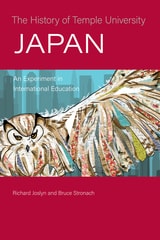
The History of Temple University Japan
An Experiment in International EducationRichard Joslyn and Bruce Stronach
Temple University Press, 2023
The authors recount the development of the academic program, the recruitment of students, and the support from Temple that enabled curricular and pedagogical improvement.
They also address the university’s relationships with three Japanese partners, and the financial threats and crises TUJ faced over the decades.
The History of Temple University Japan is not only an important documentation of TUJ, but also a history of U.S.-Japanese relations. What emerges is the significant impact TUJ has had on the thousands of students, faculty, and staff who have been a part of this international academic institution.
The Humanities in the Age of Information and Post-Truth
Edited by Ignacio López-Calvo and Christina Lux
Northwestern University Press, 2019
While the reader may suspect that these types of lucubration are a desperate reaction to decreased public funding for the humanities worldwide, a decreased enrollment of students, or anxiety over the future of our profession, there is in this volume a coherent argument for the continued need, perhaps more now than ever, to invest in humanities education if we are to have informed and socially conscious citizens rather than just willing consumers and obedient workers. Furthermore, the essays prove that the humanities and the arts are, after all, not a luxury but an integral part of a complete scholarly education.
The Idea and Practice of General Education
An Account of the College of the University of ChicagoThe College of the University of Chicago
University of Chicago Press, 1992
The Idea of a Catholic University
George Dennis O'Brien
University of Chicago Press, 2002
Truth is a central concept for both university and church, and O'Brien's book is built on the idea that there are different areas of truth—scientific, artistic, and religious—each with its own proper warrant and "method." In this light, he argues that one can reverse Shaw's comparison and uncover academic dogma and Christian freedom, university "infallibility" and dogmatic "fallibility."
Drawing on theology and the history of philosophy, O'Brien shows how religious truth relates to the work of a Catholic university. He then turns to the current controversies over Pope John Paul II's recent statement, Ex Corde Ecclesiae, which seeks to make Catholic universities conform to the church's official teaching office. O'Brien rejects the conventional "institutional-juridical" model used by the Vatican as improper both to faith and academic freedom. He argues for a "sacramental" model, one that respects the different kinds of "truth"—thus preserving the integrity of both church and university while making their combination in a Catholic university not only possible but desirable. O'Brien concludes with a practical consideration of how the ideal Catholic university might be expressed in the actual life of the contemporary curriculum and extracurriculum.
For anyone concerned about the place of religion in higher education, The Idea of a Catholic University will be essential reading.
The Idea of a Writing Laboratory
Neal Lerner
Southern Illinois University Press, 2009
The Idea of a Writing Laboratory is a book about possibilities, about teaching and learning to write in ways that can transform both teachers and students.
Author Neal Lerner explores higher education’s rich history of writing instruction in classrooms, writing centers and science laboratories. By tracing the roots of writing and science educators’ recognition that the method of the lab––hands-on student activity—is essential to learning, Lerner offers the hope that the idea of a writing laboratory will be fully realized more than a century after both fields began the experiment.
Beginning in the late nineteenth century, writing instructors and science teachers recognized that mass instruction was inadequate for a burgeoning, “non-traditional” student population, and that experimental or laboratory methods could prove to be more effective. Lerner traces the history of writing instruction via laboratory methods and examines its successes and failures through case studies of individual programs and larger reform initatives. Contrasting the University of Minnesota General College Writing Laboratory with the Dartmouth College Writing Clinic, for example, Lerner offers a cautionary tale of the fine line between experimenting with teaching students to write and “curing” the students of the disease of bad writing.
The history of writing within science education also wends its way through Lerner’s engaging work, presenting the pedagogical origins of laboratory methods to offer educators in science in addition to those in writing studies possibilities for long-sought after reform. The Idea of a Writing Laboratory compels readers and writers to “don those white coats and safety glasses and discover what works” and asserts that “teaching writing as an experiment in what is possible, as a way of offering meaning-making opportunities for students no matter the subject matter, is an endeavor worth the struggle.”
The Impact of College Diversity
Struggles and Successes at Age 30Elizabeth Aries
Temple University Press, 2023
The Impact of College Diversity details how exposure to diversity in college helped shape Black and white graduates process issues of economic and racial privilege and inequality at age 30. She investigates how college diversity experiences also facilitate the attainment of upward social mobility in lower-income students and the role that mobility played in their relationships with family and friends in their home communities. Aries further examines how interactions with peers of another race and class influenced development of citizenship skills and civic engagement, as well as Black students’ ability to cope with the challenges they faced in the professional world.
Aries concludes her study with a discussion of why elite colleges have been beneficial in promoting upward mobility in lower-income students, and the importance of achieving equity and inclusion in making diversity initiatives successful.
The Instruction Myth
Why Higher Education is Hard to Change, and How to Change ItJohn Tagg
Rutgers University Press, 2019
The Instruction Myth argues that yes, higher education can be reformed and reinvigorated, but it will not be an easy process. In fact, it will require universities to abandon their central operating principle, the belief that education revolves around instruction, easily measurable in course syllabi, credits, and enrollments. Acclaimed education scholar John Tagg presents a powerful case that instruction alone is worthless and that universities should instead be centered upon student learning, which is far harder to quantify and standardize. Yet, as he shows, decades of research have indicated how to best promote student learning, but few universities have systematically implemented these suggestions.
This book demonstrates why higher education must undergo radical change if it hopes to survive. More importantly, it offers specific policy suggestions for how universities can break their harmful dependence on the instruction myth. In this extensively researched book, Tagg offers a compelling diagnosis of what’s ailing American higher education and a prescription for how it might still heal itself.
The Intellectual Properties of Learning
A Prehistory from Saint Jerome to John LockeJohn Willinsky
University of Chicago Press, 2017
Willinsky begins with Saint Jerome in the fifth century, then traces the evolution of reading, writing, and editing practices in monasteries, schools, universities, and among independent scholars through the medieval period and into the Renaissance. He delves into the influx of Islamic learning and the rediscovery of classical texts, the dissolution of the monasteries, and the founding of the Bodleian Library before finally arriving at John Locke, whose influential lobbying helped bring about the first copyright law, the Statute of Anne of 1710. Willinsky’s bravura tour through this history shows that learning gave rise to our idea of intellectual property while remaining distinct from, if not wholly uncompromised by, the commercial economy that this concept inspired, making it clear that today’s push for marketable intellectual property threatens the very nature of the quest for learning on which it rests.
The Intimate University
Korean American Students and the Problems of SegregationNancy Abelmann
Duke University Press, 2009
Drawing on ten years of ethnographic research with Korean American students at the University of Illinois and closely following multiple generations of a single extended Korean American family in the Chicago metropolitan area, Abelmann investigates the complexity of racial politics at the American university today. Racially hyper-visible and invisible, Korean American students face particular challenges as they try to realize their college dreams against the subtle, day-to-day workings of race. They frequently encounter the accusation of racial self-segregation—a charge accentuated by the fact that many attend the same Evangelical Protestant church—even as they express the desire to distinguish themselves from their families and other Korean Americans. Abelmann concludes by examining the current state of the university, reflecting on how better to achieve the university’s liberal ideals despite its paradoxical celebration of diversity and relative silence on race.
The Journey Before Us
First-Generation Pathways from Middle School to CollegeLaura Nichols
Rutgers University Press, 2020
The Knowledge Most Worth Having
Edited by Wayne C. Booth
University of Chicago Press, 1967
The Landscape of Rural Service Learning, and What It Teaches Us All
Randy Stoecker
Michigan State University Press, 2016
The Latinx Guide to Graduate School
Genevieve Negrón-Gonzales and Magdalena L. Barrera
Duke University Press, 2023
The Launching of Duke University, 1924–1949
Robert F. Durden
Duke University Press, 1993
Made possible by a gift from James B. Duke, the wealthiest member of the family that had underwritten Trinity College since 1890, Duke University was organized with Few as president. Few's goal was to turn Duke into a world-class institution of higher education and these early years saw the development of much of what we know as Duke University today. Drawing on extensive archival material culled over a ten-year period, Durden discusses the building of the Medical Center, the rebuilding of the School of Law, the acquisition of the Duke Forest and development of the School of Forestry, the nurturing of the Divinity School, and the enrichment of the Graduate School of Arts and Sciences.
It was also during this period, as Durden details, that such treasures as the Sarah P. Duke Gardens were created, as well as some near treasures, as seen by the failed attempt to start an art museum. Although the story of the birth of this University belongs largely to William Preston Few, other people figure prominently and are discussed at length. Alice Baldwin, who led in the establishment of the Woman's College, emerges as a fascinating figure, as do William H. Wannamaker, James B. Duke, William Hanes Ackland, Robert L. Flowers, Justin Miller, and Wilburt Cornell Davision, among others.
Although impressive growth occurred in Duke's formative years, tensions also arose. The need to strike an institutional balance between the twin demands of teaching and research, of regional versus national status, combined with continual shortages of funds, created occasional obstacles. The problem of two sets of trustees, one for the university and another for the Duke Endowment, loomed largest of all. As Few himself said, during these early years Duke successfully embarked on a long journey, for it was not until after World War II that Duke University consolidated the growth begun in the inter-war years.
An important contribution to the history of Southern higher education as well as to Duke University, this book will be of great interest to historians, alumni, and friends of Duke University alike.
The Liberal Arts Advantage
Measuring the Deeper Value of a College EducationEdited by Richard Arum, Paul Courant, and Allyson Flaster
University of Chicago Press, 2026
Showcases new measurement strategies for assessing the impact of a liberal arts education on students and society.
More than ever before, our society is questioning the meaning and value of higher education, and liberal arts education, in particular, has come under substantial scrutiny. Economic detractors characterize liberal arts education as impractical, claiming that college should prepare students for the workforce. Others object to the curriculum, portraying it as broken or misdirected. According to these critics, the liberal arts education being offered in the United States is marked by its rejection of core intellectual and ideological commitments.
In The Liberal Arts Advantage, a wide range of scholars argue for how and why a liberal arts education uniquely develops skill sets and expertise needed for individuals and society to thrive in the twenty-first century. The contributors address foundational questions about what liberal arts education is, how it has been conceptualized in the past, and what we can learn from its societal and professional impacts. They present compelling, unique research and new methodological tools for assessing the outcomes of liberal arts graduates. Offering grounded and well-founded arguments in favor of our education system, The Liberal Arts Advantage persuasively explains why educational leaders should reinvest in liberal arts education.
The Life and Work of Francis Willey Kelsey
Archaeology, Antiquity, and the ArtsJohn Griffiths Pedley
University of Michigan Press, 2011
President of the Archaeological Institute of America, professor at the University of Michigan from 1889 to 1927, and president of the American Philological Association, Francis Kelsey was crucially involved in the founding or growth of major educational institutions. He came to maturity in a period of great technological change in communications, transportation, and manufacturing. Kelsey took full advantage of such innovations in his ceaseless drive to promote education for all, to further the expansion of knowledge, and to champion the benefits of the study of antiquity.
A vigorous traveler around the United States, Europe, and the Mediterranean, Kelsey strongly believed in the value of personally viewing sites ancient and modern and collecting artifacts that could be used by the new museums and universities that were springing up in the United States. This collecting habit put him in touch with major financiers of the day, including Charles Freer, Andrew Carnegie, and J. P. Morgan, as he sought their help for important projects.
Drawing heavily on Kelsey's daily diaries now held at the University of Michigan's Bentley Historical Library, John Griffiths Pedley gives us a biography that records the wide-ranging activities of a gifted and energetic scholar whose achievements mirrored the creative and contributive innovations of his contemporary Americans.
The Lost Promise
American Universities in the 1960sEllen Schrecker
University of Chicago Press, 2021
The 1950s through the early 1970s are widely seen as American academia’s golden age, when universities—well-funded and viewed as essential for national security, economic growth, and social mobility—embraced an egalitarian mission. Swelling in size, schools attracted new types of students and professors, including radicals who challenged their institutions’ calcified traditions. But that halcyon moment soon came to a painful and confusing end, with consequences that still afflict the halls of ivy. In The Lost Promise, Ellen Schrecker—our foremost historian of both the McCarthy era and the modern American university—delivers a far-reaching examination of how and why it happened.
Schrecker illuminates how US universities’ explosive growth intersected with the turmoil of the 1960s, fomenting an unprecedented crisis where dissent over racial inequality and the Vietnam War erupted into direct action. Torn by internal power struggles and demonized by conservative voices, higher education never fully recovered, resulting in decades of underfunding and today’s woefully inequitable system. As Schrecker’s magisterial history makes blazingly clear, the complex blend of troubles that disrupted the university in that pivotal period haunts the ivory tower to this day.
The Making of Chicana/o Studies
In the Trenches of AcademeAcuña, Rodolfo F
Rutgers University Press, 2011
The Making of Chicana/o Studies traces the philosophy and historical development of the field of Chicana/o studies from precursor movements to the Civil Rights era to today, focusing its lens on the political machinations in higher education that sought to destroy the discipline. As a renowned leader, activist, scholar, and founding member of the movement to establish this curriculum in the California State University system, which serves as a model for the rest of the country, Rodolfo F. Acuña has, for more than forty years, battled the trend in academia to deprive this group of its academic presence.
The book assesses the development of Chicana/o studies (an area of studies that has even more value today than at its inception)--myths about its epistemological foundations have remained uncontested. Acuña sets the record straight, challenging those in the academy who would fold the discipline into Latino studies, shadow it under the dubious umbrella of ethnic studies, or eliminate it altogether.
Building the largest Chicana/o studies program in the nation was no easy feat, especially in an atmosphere of academic contention. In this remarkable account, Acuña reveals how California State University, Northridge, was instrumental in developing an area of study that offers more than 166 sections per semester, taught by 26 tenured and 45 part-time instructors. He provides vignettes of successful programs across the country and offers contemporary educators and students a game plan--the mechanics for creating a successful Chicana/o studies discipline--and a comprehensive index of current Chicana/o studies programs nationwide.
Latinas/os, of which Mexican Americans are nearly seventy percent, comprise a complex sector of society projected to be just shy of thirty percent of the nation's population by 2050. The Making of Chicana/o Studies identifies what went wrong in the history of Chicana/o studies and offers tangible solutions for the future.

The Making of The University of Michigan 1817-1992
Howard H. Peckham
University of Michigan Press, 1994
The Making of the Modern University
Intellectual Transformation and the Marginalization of MoralityJulie A. Reuben
University of Chicago Press, 1996
Based on extensive research at eight universities—Harvard, Yale, Columbia, Johns Hopkins, Chicago, Stanford, Michigan, and California at Berkeley—Reuben examines the aims of university reformers in the context of nineteenth-century ideas about truth. She argues that these educators tried to apply new scientific standards to moral education, but that their modernization efforts ultimately failed. By exploring the complex interaction between institutional and intellectual change, Reuben enhances our understanding of the modern university, the secularization of intellectual life, and the association of scientific objectivity with value-neutrality.
The Myth of Achievement Tests
The GED and the Role of Character in American LifeEdited by James J. Heckman, John Eric Humphries, and Tim Kautz
University of Chicago Press, 2013
The Myth of Achievement Tests shows that achievement tests like the GED fail to measure important life skills. James J. Heckman, John Eric Humphries, Tim Kautz, and a group of scholars offer an in-depth exploration of how the GED came to be used throughout the United States and why our reliance on it is dangerous. Drawing on decades of research, the authors show that, while GED recipients score as well on achievement tests as high school graduates who do not enroll in college, high school graduates vastly outperform GED recipients in terms of their earnings, employment opportunities, educational attainment, and health. The authors show that the differences in success between GED recipients and high school graduates are driven by character skills. Achievement tests like the GED do not adequately capture character skills like conscientiousness, perseverance, sociability, and curiosity. These skills are important in predicting a variety of life outcomes. They can be measured, and they can be taught.
Using the GED as a case study, the authors explore what achievement tests miss and show the dangers of an educational system based on them. They call for a return to an emphasis on character in our schools, our systems of accountability, and our national dialogue.
Contributors
Eric Grodsky, University of Wisconsin–Madison
Andrew Halpern-Manners, Indiana University Bloomington
Paul A. LaFontaine, Federal Communications Commission
Janice H. Laurence, Temple University
Lois M. Quinn, University of Wisconsin–Milwaukee
Pedro L. Rodríguez, Institute of Advanced Studies in Administration
John Robert Warren, University of Minnesota, Twin Cities
The Myth of Political Correctness
The Conservative Attack on Higher EducationJohn K. Wilson
Duke University Press, 1995
The phrase "political correctness" is on everyone’s lips, on radio and television, and in newspapers and magazines. The phenomenon itself, however, has been deceptively described. Wilson steps into the nation’s favorite cultural fray to reveal that many of the most widely publicized anecdotes about PC are in fact more myth than reality. Based on his own experience as a student and in-depth research, he shows what’s really going on beneath the hysteria and alarmism about political correctness and finds that the most disturbing examples of thought policing on campus have come from the right. The image of the college campus as a gulag of left-wing totalitarianism is false, argues Wilson, created largely through the exaggeration of deceptive stories by conservatives who hypocritically seek to silence their political opponents.
Many of today’s most controversial topics are here: multiculturalism, reverse discrimination, speech codes, date rape, and sexual harassment. So are the well-recognized protagonists in the debate: Dinesh D’Souza, William Bennett, and Lynne Cheney, among others. In lively fashion and in meticulous detail, Wilson compares fact to fiction and lays one myth after another to rest, revealing the double standard that allows "conservative correctness" on college campuses to go unchallenged.
The Next Twenty-five Years
Affirmative Action in Higher Education in the United States and South AfricaDavid L. Featherman, Martin Hall, and Marvin Krislov, editors
University of Michigan Press, 2009
"Ambitious, provocative, and wide-ranging, this rich collection of essays from U.S. and South African perspectives reflects the thinking of thoughtful advocates of affirmative action."
---William G. Bowen, President Emeritus, The Andrew W. Mellon Foundation, and President Emeritus, Princeton University
"Thoughtful commentary from outstanding experts on affirmative action’s future in two countries struggling to overcome a legacy of racial injustice."
---Derek Bok, 300th Anniversary University Research Professor, and President Emeritus, Harvard University
"An enormously important comparative study and reflection on affirmative (U.S.) and corrective (South Africa) action with exhaustive and sensitive treatment of a vital topic."
---Kader Asmal, Professor of Law, University of the Western Cape, Cape Town, and former Minister of Education, South Africa
A penetrating exploration of affirmative action's continued place in 21st-century higher education, The Next Twenty-five Years assembles the viewpoints of some of the most influential scholars, educators, university leaders, and public officials. Its comparative essays span the political spectrum and dissect debates in two nations to elucidate the legal, political, social, economic, and moral dimensions of affirmative action in higher education and its role in contributing to a just, equitable, and vital society.
David L. Featherman is Professor of Sociology and Psychology and Founding Director of the Center for Advancing Research and Solutions for Society at the University of Michigan.
Martin Hall is Vice-Chancellor of the University of Salford, Greater Manchester, and previously was Deputy Vice-Chancellor at the University of Cape Town.
Marvin Krislov is President of Oberlin College and previously was Vice President and General Counsel at the University of Michigan.
The Non-Modern Crisis of the Modern University
D. Bret Leraul and Willy Thayer
Northwestern University Press, 2025
A landmark work of critical theory about the Western university from the Southern Cone
Renowned Chilean philosopher Willy Thayer’s La crisis no moderna de la universidad moderna, first published in 1996 and in an updated edition in 2019, is a landmark work of critical theory from the Southern Cone. Presented in English for the first time, The Non-Modern Crisis of the Modern University rewrites the idea of the Western university while also diagnosing the ills of postdictatorship Chile through a philosophically informed dismantling of its neoliberal institutionalization of higher education. Bret Leraul’s translation advances the vital work of globalizing critical university studies by disseminating theory from the Global South. If the university helped to construct Chile’s neoliberal society, Thayer’s polemical deconstruction of both will help readers reconstruct the cultural politics of the era to better understand the global hegemony of neoliberalism today.
The Ocean in the School
Pacific Islander Students Transforming Their UniversityRick Bonus
Duke University Press, 2020
The Ohio State University
An Illustrated HistoryRaimund E. Goerler
The Ohio State University Press, 2011
Raimund E. Goerler, acclaimed archivist and historian, has written the definitive guidebook to the history of The Ohio State University, one of the world's largest universities and a prominent land-grant institution. Using a topical strategy—ranging widely through critical events in OSU's history, vignettes of prominent alumni, and stories of well known campus buildings, historic sites, presidents, student life, traditions, and athletics—The Ohio State University: An Illustrated History is the first one-volume history of the University to appear in more than fifty years.
The Opinionated University
Academic Freedom, Diversity, and the Myth of Neutrality in American Higher EducationBrian Soucek
University of Chicago Press, 2026
Can a university ever truly be neutral in today’s social and political climate? Pushing against the tide of universities increasingly pledging to stay neutral about contentious issues, law professor Brian Soucek argues that their promises are doomed to fail—universities can’t help being opinionated.
In The Opinionated University, Soucek shows that neutrality is a myth by taking a deep dive into several prominent campus controversies of the day, including diversity, equity, and inclusion (DEI) efforts and restrictions on campus speech and protest. Each issue requires universities to choose a side in what they do, if not also in what they say. In everything from curricular and admissions decisions to their response to outside rankings and their evaluation of faculty, universities express the values at the heart of their mission. Soucek argues that those pushing for neutrality are only preventing universities from standing up for their values, whether in today’s current moment of crisis or in periods of political calm.
Both timely and deeply engaging, The Opinionated University calls on universities to dispense with neutrality as a governing principle and focus instead on what their mission should be, and who should determine it.
The Past in the Present
Women's Higher Education in the Twentieth-Century American SouthAmy T. McCandless
University of Alabama Press, 1999
The PhDictionary
A Glossary of Things You Don't Know (but Should) about Doctoral and Faculty LifeHerb Childress
University of Chicago Press, 2016
With more than two decades as a doctoral student, college teacher, and administrator, Herb Childress has tripped over almost every possible misunderstood term, run up against every arcane practice, and developed strategies to deal with them all. He combines current data and personal stories into memorable definitions of 150 key phrases and concepts graduate students will need to know (or pretend to know) as they navigate their academic careers. From ABD to white paper—and with buyout, FERPA, gray literature, and soft money in between—each entry contains a helpful definition and plenty of relevant advice. Wry and knowledgeable, Childress is the perfect guide for anyone hoping to scale the ivory tower.
The Pipeline Is Broken
Graduate Students of Color on Racism, Justice, and Joy in the AcademyOrly Clerge
Utah State University Press, 2026
The Pipeline Is Broken explores the reality of racial exclusion and bias in graduate student education, arguing that the insidious effects of structural and institutional racism substantially chip away at the very pipeline of future BIPOC academics—already limited for other racialized reasons.
A series of letters written by graduate students of color, this collection offers a multifaceted account of the challenges, oppositions, microaggressions, and outright discrimination that these students face in higher education settings. Graduate students describe navigating hostile mentoring relationships and unwelcoming campus cultures and peers and laboring for poverty wages to earn their degrees. Yet these letters celebrate joy, community, and agency, offering a more complete and affirming view of graduate student life. Through these brave personal stories, The Pipeline Is Broken asks readers to interrogate what it means to navigate higher education as a person of color and to understand that the reality of faculty of color’s numerical-minority status is a complicated phenomenon whose genesis rests not at the moment of job interview. Rather, these letters show, this status is an intricate manifestation of a process that begins in elementary schools, is reinforced in high schools and colleges, and is part and parcel of the minefield that is graduate education in America.
Essential reading for anyone who cares about racial equity in education, mentorship, leadership development, or student well-being, The Pipeline Is Broken is a guide, a mirror, and a call to action all in one, challenging graduate programs, faculty, and administrators to examine their complicity in maintaining inequitable systems and offering suggestions for building cultures of care.
The Pivot
One Pandemic, One UniversityRobert J. Bliwise
Duke University Press, 2022
The Politics of Liberal Education
Darryl Gless and Barbara Herrnstein Smith, eds.
Duke University Press, 1992
Within this area of consensus, however, the contributors display a wide range of approaches, illuminating the issues from the perspectives of their particular disciplines—classics, education, English, history, and philosophy, among others—and their individual experiences as teachers. Among the topics they discuss are canon-formation in the ancient world, the idea of a “common culture,” and the educational implications of such social movements as feminism, technological changes including computers and television, and intellectual developments such as “theory.” Readers interested in the controversies over American education will find this volume an informed alternative to sensationalized treatments of these issues.
Contributors. Stanley Fish, Phyllis Franklin, Henry Louis Gates Jr., Henry A. Giroux, Darryl J. Gless, Gerald Graff, Barbara Herrnstein Smith, George A. Kennedy, Bruce Kuklick, Richard A. Lanham, Elizabeth Kamarck Minnich, Alexander Nehamas, Mary Louise Pratt, Richard Rorty, Eve Kosofsky Sedgwick
The Power of Writing
Dartmouth '66 in the Twenty-First CenturyEdited by Christiane Donahue and Kelly Blewett
Dartmouth College Press, 2015
The Production of Living Knowledge
The Crisis of the University and the Transformation of Labor in Europe and North AmericaGigi Roggero
Temple University Press, 2011
Evaluating higher education institutions—particularly the rise of the “global university”—and their rapidly changing role in the global era, Gigi Roggero finds the system in crisis. In his groundbreaking book, The Production of Living Knowledge, Roggero examines the university system as a key site of conflict and transformation within “cognitive capitalism”—a regime in which knowledge has become increasingly central to the production process at large. Based on extensive fieldwork carried out through the activist method of conricerca, or “co-research,” wherein researchers are also subjects, Roggero’s book situates the crisis of the university and the changing composition of its labor force against the backdrop of the global economic crisis.
Combining a discussion of radical experiments in education, new student movements, and autonomist Marxian (or post-operaista) social theory, Roggero produces a distinctly transnational and methodologically innovative critique of the global university from the perspective of what he calls “living knowledge.”
In light of new student struggles in the United States and across the world, this first English-language edition is particularly timely.
The Public School Advantage
Why Public Schools Outperform Private SchoolsChristopher A. Lubienski and Sarah Theule Lubienski
University of Chicago Press, 2013
For decades research showing that students at private schools perform better than students at public ones has been used to promote the benefits of the private sector in education, including vouchers and charter schools—but much of these data are now nearly half a century old. Drawing on two recent, large-scale, and nationally representative databases, the Lubienskis show that any benefit seen in private school performance now is more than explained by demographics. Private schools have higher scores not because they are better institutions but because their students largely come from more privileged backgrounds that offer greater educational support. After correcting for demographics, the Lubienskis go on to show that gains in student achievement at public schools are at least as great and often greater than those at private ones. Even more surprising, they show that the very mechanism that market-based reformers champion—autonomy—may be the crucial factor that prevents private schools from performing better. Alternatively, those practices that these reformers castigate, such as teacher certification and professional reforms of curriculum and instruction, turn out to have a significant effect on school improvement.
Despite our politics, we all agree on the fundamental fact: education deserves our utmost care. The Public School Advantage offers exactly that. By examining schools within the diversity of populations in which they actually operate, it provides not ideologies but facts. And the facts say it clearly: education is better off when provided for the public by the public.
The Purposeful Graduate
Why Colleges Must Talk to Students about VocationTim Clydesdale
University of Chicago Press, 2015
The key, he argues, is simple: direct, systematic, and creative programs that engage undergraduates on the question of purpose. Backing up his argument with rich data from a Lilly Endowment grant that funded such programs on eighty-eight different campuses, he shows that thoughtful engagement of the notion of vocational calling by students, faculty, and staff can bring rich rewards for all those involved: greater intellectual development, more robust community involvement, and a more proactive approach to lifelong goals. Nearly every institution he examines—from internationally acclaimed research universities to small liberal arts colleges—is a success story, each designing and implementing its own program, that provides students with deep resources that help them to launch flourishing lives.
Flying in the face of the pessimistic forecast of higher education’s emaciated future, Clydesdale offers a profoundly rich alternative, one that can be achieved if we simply muster the courage to talk with students about who they are and what they are meant to do.
The Recombinant University
Genetic Engineering and the Emergence of Stanford BiotechnologyDoogab Yi
University of Chicago Press, 2015
Bay Area scientists, university administrators, and government officials were fascinated by and increasingly engaged in the economic and political opportunities associated with the privatization of academic research. Yi uncovers how the attempts made by Stanford scientists and administrators to demonstrate the relevance of academic research were increasingly mediated by capitalistic conceptions of knowledge, medical innovation, and the public interest. Their interventions resulted in legal shifts and moral realignments that encouraged the privatization of academic research for public benefit. The Recombinant University brings to life the hybrid origin story of biotechnology and the ways the academic culture of science has changed in tandem with the early commercialization of recombinant DNA technology.
The Reimagined PhD
Navigating 21st Century Humanities EducationLeanne M Horinko
Rutgers University Press, 2021
The Reorder of Things
The University and Its Pedagogies of Minority DifferenceRoderick A. Ferguson
University of Minnesota Press, 2012
In the 1960s and 1970s, minority and women students at colleges and universities across the United States organized protest movements to end racial and gender inequality on campus. African American, Chicano, Asia American, American Indian, women, and queer activists demanded the creation of departments that reflected their histories and experiences, resulting in the formation of interdisciplinary studies programs that hoped to transform both the university and the wider society beyond the campus.
In The Reorder of Things, however, Roderick A. Ferguson traces and assesses the ways in which the rise of interdisciplines—departments of race, gender, and ethnicity; fields such as queer studies—were not simply a challenge to contemporary power as manifest in academia, the state, and global capitalism but were, rather, constitutive of it. Ferguson delineates precisely how minority culture and difference as affirmed by legacies of the student movements were appropriated and institutionalized by established networks of power.
Critically examining liberationist social movements and the cultural products that have been informed by them, including works by Adrian Piper, Toni Cade Bambara, Jhumpa Lahiri, and Zadie Smith, The Reorder of Things argues for the need to recognize the vulnerabilities of cultural studies to co-option by state power and to develop modes of debate and analysis that may be in the institution but are, unequivocally, not of it.
The Rise of the Research University
A SourcebookEdited by Louis Menand, Paul Reitter, and Chad Wellmon
University of Chicago Press, 2017
The editors focus on the development of American universities such as Cornell, Johns Hopkins, Harvard, and the Universities of Chicago, California, and Michigan. Looking to Germany, they translate a number of seminal sources that formulate the shape and purpose of the university and place them next to hard-to-find English-language texts that took the German university as their inspiration, one that they creatively adapted, often against stiff resistance. Enriching these texts with short but insightful essays that contextualize their importance, the editors offer an accessible portrait of the early research university, one that provides invaluable insights not only into the historical development of higher learning but also its role in modern society.
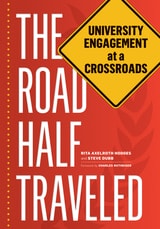
The Road Half Traveled
University Engagement at a CrossroadsRita Axelroth Hodges
Michigan State University Press, 2012
A growing number of universities are dedicating resources to support their surrounding communities, but much potential for advancement remains. A university’s mission as an “anchor institution,” as defined by the authors, is to consciously and strategically apply the institution’s long-term, place-based economic power, in combination with its human and intellectual resources, to better the welfare of the community in which it resides. Drawing on ten diverse universities as case studies, this eye-opening book explores practices and strategies that can be employed to improve conditions in low-income communities and emphasizes the critical roles of university leaders, philanthropy, and policy in this process. To date the most comprehensive account of the range of roles played by universities as anchors in their communities, The Road Half Traveled provides a forward-thinking perspective on new horizons in university and community partnership.
The Roles of Immigrants and Foreign Students in US Science, Innovation, and Entrepreneurship
Edited by Ina Ganguli, Shulamit Kahn, and Megan MacGarvie
University of Chicago Press, 2020
The School and Society and The Child and the Curriculum
John Dewey
University of Chicago Press, 1990
The School and Society and The Child and the Curriculum
John Dewey
University of Chicago Press, 1990
This edition brings Dewey's educational theory into sharp focus, framing his two classic works by frank assessments, past and present, of the practical applications of Dewey's ideas. In addition to a substantial introduction in which Philip W. Jackson explains why more of Dewey's ideas haven't been put into practice, this edition restores a "lost" chapter, dropped from the book by Dewey in 1915.
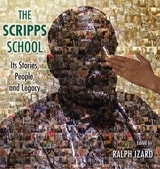
The Scripps School
Its Stories, People, and LegacyRalph Izard
Ohio University Press, 2018
An anecdotal history published on the occasion of the one hundredth anniversary of Ohio University’s renowned E. W. Scripps School of Journalism.
After its founding in 1924, what is now the E. W. Scripps School of Journalism at Ohio University quickly became one of the premier programs in the country. For decades, it has produced leaders who have reached the highest levels of journalism and communication in their careers, and their success is a direct product not only of the education they get in Athens but of the community the school fosters.
In this book, nearly one hundred alumni, faculty, friends, and students offer their stories of life at and after Scripps. The result is a multilayered, inspiring portrait of the school and how it shapes those who pass through its doors. At the same time, The Scripps School gives a nuanced history of journalism education at Ohio University. From covering assassinations and presidential elections to major moments in sports, alumni have documented the unprecedented and the historic, and here they show just how Scripps prepared them to be there.
The Scripps School, edited by former director Ralph Izard, is a love letter to the people and the institution. At a time when journalism is more important than ever, this book humanizes and contextualizes the profession in ways that will resonate in the Scripps community and beyond.