Results by title
2335 books match the query 'Modern' and 569 start with t

The Diaries of Judith Malina
1947-1957Judith Malina, Kate Bredeson
Northwestern University Press, 2026
Judith Malina’s newly restored diaries from a critical early decade in her personal, artistic, and political development
Judith Malina’s diaries from 1947 to 1957 are brought back into print in this volume, which charts her cofounding of The Living Theatre with husband and lifelong artistic partner Julian Beck. In these diaries, she narrates her developing political commitments and her expansive collaborations and personal relationships, as well as a moving account of her time in prison with activist Dorothy Day. This new edition features Kate Bredeson’s comprehensive introduction, which offers a detailed examination of Malina’s life and work in this period, along with additional historical context of these years and never-before-published photographs from Malina’s personal archives.
The Diaries of Judith Malina is a four-volume set that publishes for the first time together the edited diaries of radical theater director, actor, and activist Judith Malina from 1947 to 1971, the most influential period of her remarkable and storied career. A committed anarchist and pacifist, Malina made theater as a way to stoke revolutionary action. Her diaries showcase her political and social observations, cultural commentary, self-reflection, and wit. This expertly prepared set invites us to recognize Malina for her accomplishments not only as an artist and an activist but as one of the great literary diarists.
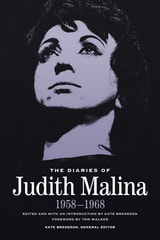
The Diaries of Judith Malina
1958-1968Judith Malina, Kate Bredeson, Tom Walker
Northwestern University Press, 2026
A previously unpublished volume of diaries recording Judith Malina’s extraordinary life and career in a moment of cultural revolution
Judith Malina’s diaries from the pivotal years of 1958 to 1968 are presented here in print for the first time. Meticulously edited and with an essential introduction by Kate Bredeson that offers a detailed discussion of Malina’s life and works during this period, the volume includes additional historical context and never-before-published photographs from Malina’s personal archives, as well as an illuminating foreword by Living Theatre archivist and longtime company member Tom Walker. This decade covers some of the most important years of Malina’s life and in the history of The Living Theatre, from career-defining productions of The Connection and The Brig to the company’s self-imposed European exile, when they created their signature works, including Paradise Now, Antigone, and Frankenstein.
The Diaries of Judith Malina is a four-volume set that publishes for the first time together the edited diaries of radical theater director, actor, and activist Judith Malina from 1947 to 1971, the most influential period of her remarkable and storied career. A committed anarchist and pacifist, Malina made theater as a way to engage in revolutionary action. Her diaries showcase her political and social observations, cultural commentary, self-reflection, and wit. This expertly prepared set invites us to recognize Malina for her accomplishments not only as an artist and an activist but as one of the great literary diarists.

The Diaries of Judith Malina
1968-1969Judith Malina, Kate Bredeson
Northwestern University Press, 2026
A newly restored edition of Judith Malina’s legendary diaries narrating a key moment of social, political, and cultural upheaval
Originally published by Judith Malina as The Enormous Despair, this slim, gripping collection of diaries from a pivotal period between 1968 and 1969 follows The Living Theatre’s return to the United States after their years of self-exile in Europe, their increasing notoriety and frequent arrests, and their cross-country touring. In these pages, Malina wrestles with the company’s artistic and political efforts during a moment of societal crisis and grapples with their future. Kate Bredeson’s introduction contextualizes Malina’s life and work in this period, while additional historical context and never-before-published photographs add new detail and depth to a stirring account of American social and political history.
The Diaries of Judith Malina is a four-volume set that publishes for the first time together the edited diaries of radical theater director, actor, and activist Judith Malina from 1947 to 1971, the most influential period of her remarkable and storied career. A committed anarchist and pacifist, Malina made theater as a way to engage in revolutionary action. Her diaries showcase her political and social observations, her cultural commentary, her self-reflection, and her wit. This expertly prepared set invites us to recognize Malina for her accomplishments not only as an artist and an activist but as one of the great literary diarists.

The Diaries of Judith Malina
1969-1971Judith Malina, Kate Bredeson, Ilion Troya
Northwestern University Press, 2026
Judith Malina’s never-before-published diaries describing a period of profound personal and professional transformation
The years 1969 to 1971 saw The Living Theatre’s greatest rupture, reckoning with its desire to leave its defining productions from the 1960s behind and move forward with new artistic works and practices. In these previously unpublished diaries, Judith Malina recounts these pivotal years, describing her transformative time in Brazil, including her experiences of daily life in jail while awaiting trial with her company members. This meticulously edited volume includes Kate Bredeson’s introduction, examining Malina’s life and work in this period, as well as additional historical context and never-before-published photographs. Living Theatre member Ilion Troya offers a foreword that provides new context for understanding the volume’s historical significance.
The Diaries of Judith Malina is a four-volume set that publishes for the first time together the edited diaries of radical theater director, actor, and activist Judith Malina from 1947 to 1971, the most influential period of her remarkable and storied career. A committed anarchist and pacifist, Malina made theater as a way to engage in revolutionary action. Her diaries showcase her political and social observations, cultural commentary, self-reflection, and wit. This expertly prepared set invites us to recognize Malina for her accomplishments not only as an artist and an activist but as one of the great literary diarists.
The Dilemmas of Dissidence in East-Central Europe
Citizen Intellectuals and Philosopher KingsBarbara J. Falk
Central European University Press, 2003
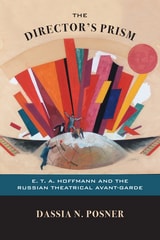
The Director's Prism
E. T. A. Hoffmann and the Russian Theatrical Avant-GardeDassia N. Posner
Northwestern University Press, 2016
Shortlist, 2019 Prague Quadrennial Best Scenography and Design Publication Award
The Director's Prism investigates how and why three of Russia's most innovative directors— Vsevolod Meyerhold, Alexander Tairov, and Sergei Eisenstein—used the fantastical tales of German Romantic writer E. T. A. Hoffmann to reinvent the rules of theatrical practice. Because the rise of the director and the Russian cult of Hoffmann closely coincided, Posner argues, many characteristics we associate with avant-garde theater—subjective perspective, breaking through the fourth wall, activating the spectator as a co-creator—become uniquely legible in the context of this engagement. Posner examines the artistic poetics of Meyerhold's grotesque, Tairov's mime-drama, and Eisenstein's theatrical attraction through production analyses, based on extensive archival research, that challenge the notion of theater as a mirror to life, instead viewing the director as a prism through whom life is refracted. A resource for scholars and practitioners alike, this groundbreaking study provides a fresh, provocative perspective on experimental theater, intercultural borrowings, and the nature of the creative process.

The Division of the World
On Archives, Empires and the Vanity of BordersMartin Zimmerman
Haus Publishing, 2021
At a time when Western nations are being urged to confront their colonial past, this book examines a major archive, revealing the scale of the Spanish colonial enterprise in South and Central America.
Established in 1785, the Archivo General de Indias in Seville holds roughly three hundred years of Spanish colonial history in the Americas. It houses 8,000 charts and around ninety million documents—among them Christopher Columbus’s logbook and the famous Treaty of Tordesillas which, mediated by the Pope and signed in 1494, entitled the Spanish and Portuguese kings to divide the world between them. With this treaty as a starting point, the historian Martin Zimmermann journeys into the age of discovery and recounts stories of dangerous passages, encounters with the unknown, colonial brutality, and the power of cartographers, illustrating the insatiable lust of colonialists to conquer, exploit, and own the world. Ursula Schulz-Dornburg’s photographs show the archive before its redevelopment in 2002, offering a unique view into one of Europe’s most significant archives.
The Doom of the Great City; Being the Narrative of a Survivor, Written A.D. 1942
William Delisle Hay
West Virginia University Press, 2025
The Dragon's Tail
Americans Face the Atomic AgeRobert A. Jacobs
University of Massachusetts Press, 2010
When President Harry Truman introduced the atomic bomb to the world in 1945, he described it as a God-given harnessing of “the basic power of the universe.” Six days later a New York Times editorial framed the dilemma of the new Atomic Age for its readers: “Here the long pilgrimage of man on Earth turns towards darkness or towards light.” American nuclear scientists, aware of the dangers their work involved, referred to one of their most critical experiments as “tickling the dragon's tail.”
Even after Hiroshima and Nagasaki, most Americans may not have been sure what an atomic bomb was or how it worked. But they did sense that it had fundamentally changed the future of the human race. In this book, Robert Jacobs analyzes the early impact of nuclear weapons on American culture and society. He does so by examining a broad range of stories, or “nuclear narratives,” that sought to come to grips with the implications of the bomb's unprecedented and almost unimaginable power.
Beginning with what he calls the “primary nuclear narrative,” which depicted atomic power as a critical agent of social change that would either destroy the world or transform it for the better, Jacobs explores a variety of common themes and images related to the destructive power of the bomb, the effects of radiation, and ways of surviving nuclear war. He looks at civil defense pamphlets, magazines, novels, and films to recover the stories the U.S. government told its citizens and soldiers as well as those presented in popular culture.
According to Jacobs, this early period of Cold War nuclear culture—from 1945 to the banning of above-ground testing in 1963—was distinctive for two reasons: not only did atmospheric testing make Americans keenly aware of the presence of nuclear weapons in their lives, but radioactive fallout from the tests also made these weapons a serious threat to public health, separate from yet directly linked to the danger of nuclear war.
The Dreamer and the Dream
Afrofuturism and Black Religious ThoughtRoger A. Sneed
The Ohio State University Press, 2021
In The Dreamer and the Dream: Afrofuturism and Black Religious Thought, Roger A. Sneed illuminates the interplay of Black religious thought with science fiction narratives to present a bold case for Afrofuturism as an important channel for Black spirituality. In the process, he challenges the assumed primacy of the Black church as the arbiter of Black religious life. Incorporating analyses of Octavia Butler’s Parable books, Janelle Monáe’s Afrofuturistic saga, Star Trek’s Captain Benjamin Sisko, Marvel’s Black Panther, and Sun Ra and the Nation of Islam, Sneed demonstrates how Afrofuturism has contributed to Black visions of the future. He also investigates how Afrofuturism has influenced religious scholarship that looks to Black cultural production as a means of reimagining Blackness in the light of the sacred. The result is an expansive new look at the power of science fiction and Afrofuturism to center the diversity of Black spirituality.
The Early Novel in French
Poetics of a Genre in the MakingVirginia Krause
Northwestern University Press, 2027
Examining the role of changes in print technologies and poetics in the early novel
Around the same time that Aristotle’s Poetics was reemerging from obscurity, Rabelais was composing his Pantagruel series, while a host of influential works in a chivalric, sentimental, or pastoral vein were being imported from Spain and Italy. From this emergent corpus, Rabelais’s is the only name to have unambiguously made it into our modern canon of literary history, where he appears to stand alone as an early pioneer of the novel. The Early Novel in French: Poetics of a Genre in the Making explores the literary, cultural, and eminently material soil in which these early forms of what we would come to know as the novel originally took root, showing how they were imaginatively responding to the practices and uncertainties of the literary texts of their own era as well as to works of classical antiquity.
Within the flowering of experimental fictional forms in mid-sixteenth-century France, Virginia Krause identifies historical subplots shaping the development of this genre. As rhetorical culture continued to animate fictions through an active literary tradition, print culture was changing the very fabric of books. The early novel was thus at once rhetorically fashioned and technologically manufactured. Meanwhile, the legacy of medieval romance adventure persisted, making the early novel in French both a new laboratory for Aristotelian immersion and a vehicle for a mysterious and fugitive romanesque. Krause sheds fresh light on this new and rapidly evolving genre: its lifelike personas or “person-fictions”; its material forms, from pocket-sized volumes to vast literary serials; its immersive powers; and its underappreciated role in the production of the modern author.
The Early Works of John Dewey, Volume 2, 1882 - 1898
Psychology, 1887John Dewey. Edited by Jo Ann Boydston
Southern Illinois University Press, 2008
With an original publication date of 1887, Psychology us Volume 2 of "The Early Works." It appears first in the series to introduce scholars and general readers to the use of modern textual criticism in a work outside the literary field. Designed as a "scholar's reading edition," the volumes presents the text of Dewey's work as the author intended, clear of editorial footnotes. All apparatus is conveniently arranged in appendix form. As evidence of its wide adoption and use as a college textbook, Psychology had a publishing history of twenty-six printings. For two of the reprintings, Dewey made extensive revisions in content to incorporate developments in the field of psychology as well as in his own thinking. The textual appendices include a thorough tabulation of these changes and detailed evidence for editorial decisions.
In recognition of the high quality and scholarly standards of the textual editing, this edition of Psychology is the first nonliterary work awarded the Seal of the Modern Language Association Center for Editions of American Authors. By applying to the work of a philosopher the procedures used in modern textual editions of American writers such as Hawthorne, the Southern Illinois University Dewey edition is establishing a pattern for future collected editions of the writings of American philosophers.
At the time Dewey wrote Psychology, the relation between psychology and philosophy was in dispute, and he attempted to incorporate the new physiological psychology represented by G. Stanley Hall into the philosophical system and ethics of George Sylvester Morris. He wrote in May, 1886, that he wanted his textbook in psychology to be one "with the greatest possible unity of principle, so that without ceasing to be a psychology, it shall be an introduction to philosophy in general." His goal, expressed in these terms, foreshadowed the direction of his work in the years that followed, with its continuing emphasis on the interrelations among the various disciplines rather than on separate specializations. In his long and fruitful professional career, this was to be his only attempt to treat the whole field of psychology systematically. Although he maintained a lively interest in psychology, that interest was expressed in connection with his writing in other areas such as ethics, education, logic, social philosophy and aesthetics.
The Economy of Glory
From Ancien Régime France to the Fall of NapoleonRobert Morrissey
University of Chicago Press, 2013
The Education of Mrs. Henry Adams
Eugenia Kaledin
University of Massachusetts Press, 1994
Marian Hooper Adams—Clover, as her friends called her—was an accomplished photographer and a witty, irreverent free spirit who moved easily within the cultural circles of nineteenth-century Boston. Why, then, in 1882, at the age of forty-two, did she swallow a lethal dose of potassium cyanide? And why did her husband of thirteen years fail even to mention her in his autobiography, The Education of Henry Adams?
These and other questions are explored in this first paperback edition of Eugenia Kaledin's pathbreaking biography. The book recreates the intense intellectual, cultural, and moral life of Boston and New England before, during, and after the Civil War and helps us to understand what could drive such a gifted, intelligent, and privileged woman to take her own life. Included is a portfolio of Adams's photographs of her husband and his famous circle.

The Eight Months of Prague Spring 1968
Jirí Hoppe
Karolinum Press, 2026
A detailed, empirically grounded account of the Prague Spring.
Prague Spring 1968 focuses on the key political and social developments between January and August, while situating them within the broader context of the deepening crisis of Czechoslovak state socialism since 1967. Structured chronologically into five parts, the book traces the fall of Antonín Novotný, the rise of Alexander Dubček and the reform project known as “socialism with a human face,” the rapid emancipation of media and civil society, the escalating conflict with the Soviet Union and its allies, and the Warsaw Pact invasion, followed by the Moscow negotiations. Drawing primarily on edited archival sources and critically engaging with extensive Czech and international scholarship, the study analyzes the Prague Spring as a distinctive democratization process centered on the transformation of the Communist Party’s leading role. Emphasizing empathetic historical interpretation, it provides a nuanced portrayal of key actors and decision-making dynamics, highlighting both the possibilities and structural limits of reform within a non-democratic socialist system.
The Eighth
Mahler and the World in 1910Stephen Johnson
University of Chicago Press, 2020
September 12, 1910: The world premiere of Gustav Mahler’s Eighth Symphony and the artistic breakthrough for which the composer had yearned all his life. Munich’s new Musik Festhalle was filled to capacity on two successive evenings for the performances, which were received with rapturous applause. Representatives of many European royal houses were in attendance, along with an array of stars from the musical and literary world, including Thomas Mann and the young Arnold Schoenberg. Also present were Alma Mahler, the composer’s wife, and Alma’s longtime lover, the architect Walter Gropius. Knowledge of their relationship would precipitate an emotional crisis in Mahler that, compounded with his heart condition and the loss of his young daughter Maria, would lead to his premature death the next year.
In The Eighth, Stephen Johnson provides a masterful account of the symphony’s far-reaching consequences and its effect on composers, conductors, and writers of the time. The Eighth looks behind the scenes at the demanding one-week rehearsal period leading up to the premiere—something unheard of at the time—and provides fascinating insight into Mahler’s compositional habits, his busy life as a conductor, his philosophical and literary interests, and his personal and professional relationships. Johnson expertly contextualizes Mahler’s work among the prevailing attitudes and political climate of his age, considering the art, science, technology, and mass entertainment that informed the world in 1910. The Eighth is an absorbing history of a musical masterpiece and the troubled man who created it.
The Embodiment of Reason
Kant on Spirit, Generation, and CommunitySusan Meld Shell
University of Chicago Press, 1996
Shell argues that the central animating issues of Kant's lifework concerned the perplexing relation of spirit to body. Through an exacting analysis of individual writings, Shell maps the philosophical contours of Kant's early intellectual struggles and their relation to his more mature thought. The paradox of mind in matter and the tensions it generates—between freedom and determinacy, independence and community, ideal and real—are shown to inform the whole of his work. Shell's fresh, penetrating analysis of the precritical works will surely catapult them to new prominence in Kant studies.
Shell's critique goes further to consider the context of contemporary intellectual life. She explores the fascinating realm of Kant's sexual and medical idiosyncracies, linking them to the primary concerns of his critical philosophy. She develops a sure-to-be controversial treatment of the connection between Kant's philosophy and his chronic hypochondria, and illuminates previously unforeseen connections in a remarkable convergence of life and thought, with important theoretical and practical implications for modern times.
The Emergence of Dialectical Theory
Philosophy and Political InquiryScott Warren
University of Chicago Press, 1984
Scott Warren’s ambitious and enduring work sets out to resolve the ongoing identity crisis of contemporary political inquiry. In the Emergence of Dialectical Theory, Warren begins with a careful analysis of the philosophical foundations of dialectical theory in the thought of Kant, Hegel, and Marx. He then examines how the dialectic functions in the major twentieth-century philosophical movements of existentialism, phenomenology, neomarxism, and critical theory. Numerous major and minor philosophers are discussed, but the emphasis falls on two of the greatest dialectical thinkers of the previous century: Maurice Merleau-Ponty and Jürgen Habermas.
Warren’s shrewd critique is indispensable to those interested in the history of social and political thought and the philosophical foundations of political theory. His work offers an alternative for those who find postmodernism to be at a philosophical impasse.
The Emergence of German Idealism
Michael Baur
Catholic University of America Press, 2018
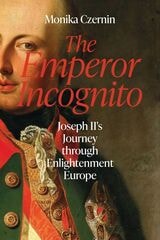
The Emperor Incognito
Joseph II's Journey through Enlightenment EuropeMonika Czernin
Haus Publishing, 2027
An emperor meets his people: the extraordinary journeys of Joseph II.
It is the end of the eighteenth century, and the European royal houses are beginning to falter. The young Habsburg emperor Joseph II realizes that reform is inevitable, and he eagerly soaks up Enlightenment ideas. Incognito, and without the usual pomp and entourage, he travels through his vast empire to see with his own eyes how his subjects live, suffer, and starve.
Along with princes and kings, he meets ordinary people and visits hospitals and factories in his search for new insights that will help him build a modern state. When he visits his sister Marie Antoinette in Versailles, he can see the French Revolution looming on the horizon. By the end of his journey, he had spent a quarter of his twenty-five-year reign on the road. With an introduction by Dominic Lieven and based on countless sources, Monika Czernin’s The Emperor Incognito tells the story of an extraordinary man in an age of great upheaval, who was far ahead of his time.
The End of Czechoslovakia
Jirí Musil
Central European University Press, 1995
Scholars and practitioners from both sides of the divide, Czech and Slovak, as well as international experts, take an in-depth look at the causes of Czechoslovakia's break-up, and explain why a seemingly successful country should disintegrate so quickly after the collapse of the communist regime. Besides exploring the political processes leading to the split, the authors analyse the underlying social, economic and cultural differences between the two nations and examine the historical roots of the problems. Particular attention is paid to changing Czech and Slovak attitudes towards the common state and towards each other, from the heyday of the First Republic to the disillusionment of the post-1989 period.

The End of the Cold War
European Unity, Socialism, and the Shift in Global PowerBogdan Denitch
University of Minnesota Press, 1990
The End of the Cold War was first published in 1990. Minnesota Archive Editions uses digital technology to make long-unavailable books once again accessible, and are published unaltered from the original University of Minnesota Press editions.
Against the backdrop of unprecedented change in the world political and social order, Bogdan Denitch charts the unique opportunities and potential pitfalls that accompany the increased economic and political integration of the European Community. Historically, any move toward unification has had broad ramifications. This, coming as it does in the wake of recent democratic upheavals in Europe, will bring to a close an entire era -- an era of a world dominated by superpowers and the cold war that defined there confrontations.
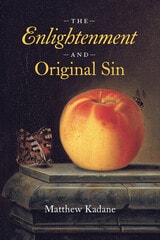
The Enlightenment and Original Sin
Matthew Kadane
University of Chicago Press, 2024
What was the Enlightenment? This question has been endlessly debated. In The Enlightenment and Original Sin, historian Matthew Kadane advances the bold claim that the Enlightenment is best defined through what it set out to accomplish, which was nothing short of rethinking the meaning of human nature.
Kadane argues that this project centered around the doctrine of original sin and, ultimately, its rejection, signaling the radical notion that an inherently flawed nature can be overcome by human means. Kadane explores this and other wide-ranging themes through the story of a previously unknown figure, Pentecost Barker, an eighteenth-century purser and wine merchant. By examining Barker’s personal diary and extensive correspondence with a Unitarian minister, Kadane tracks the transformation of Barker’s consciousness from a Puritan to an Enlightenment outlook, revealing through one man’s journey the large-scale shifts in self-understanding whose philosophical reverberations have shaped debates on human nature for centuries.
The Enlightenment
A GenealogyDan Edelstein
University of Chicago Press, 2010
What was the Enlightenment? Though many scholars have attempted to solve this riddle, none has made as much use of contemporary answers as Dan Edelstein does here. In seeking to recover where, when, and how the concept of “the Enlightenment” first emerged, Edelstein departs from genealogies that trace it back to political and philosophical developments in England and the Dutch Republic. According to Edelstein, by the 1720s scholars and authors in France were already employing a constellation of terms—such as l’esprit philosophique—to describe what we would today call the Enlightenment. But Edelstein argues that it was within the French Academies, and in the context of the Quarrel of the Ancients and the Moderns, that the key definition, concepts, and historical narratives of the Enlightenment were crafted.
A necessary corrective to many of our contemporary ideas about the Enlightenment, Edelstein’s book turns conventional thinking about the period on its head. Concise, clear, and contrarian, The Enlightenment will be welcomed by all teachers and students of the period.
The European Radical Left
Movements and Parties since the 1960sGiorgos Charalambous
Pluto Press, 2021
Is today’s left really new? How has the European radical left evolved?
Giorgos Charalambous answers these questions by looking at three moments of rapid political change - the late 1960s to late 1970s; the turn of the millennium; and post-2008. He challenges the conventional understanding of a ‘new left’, drawing out continuities with earlier movements and parties.
Charalambous examines the ‘Long ‘68’, symbolised by the May uprisings in France, which saw the rise of new left forces and the widespread criticism by younger radical activists of traditional communist and socialist parties. He puts this side by side with the turn of the millennium when the Global Justice Movement rose to prominence and changed the face of the international left, and also the period after the financial crash of 2008 and the rise of anti-austerity politics which initiated the most recent wave of new left parties such as Podemos in Spain and Syriza in Greece.
With a unique ‘two-level’ perspective, Charalambous approaches the left through both social movements and party politics, looking at identities, rhetoric and organization, and bringing a fresh new approach to radical history, as well as assessing challenges for both activists and scholars.
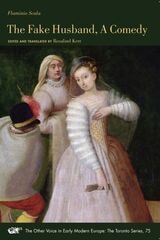
The Fake Husband, A Comedy
Flaminio Scala
Iter Press, 2020
The Other Voice in Early Modern Europe - The Toronto Series, volume 75
The Family Firm
monarchy, mass media and the British public, 1932-53Edward Owens
University of London Press, 2019
The Farther Adventures of Robinson Crusoe
The Stoke Newington EditionMaximillian E. Novak
Bucknell University Press, 2022
Published by Bucknell University Press. Distributed worldwide by Rutgers University Press.
The Fate of the Object
From Modern Object to Postmodern Sign in Performance, Art, and PoetryJon Erickson
University of Michigan Press, 1995
The Feeling of Letting Die
Necroeconomics and Victorian FictionJennifer MacLure
The Ohio State University Press, 2023
In The Feeling of Letting Die, Jennifer MacLure explores how Victorian novels depict the feelings that both fuel and are produced by an economic system that lets some people die in service of the free market. MacLure argues that Victorian authors present capitalism’s death function as a sticking point, a series of contradictions, and a problem to solve as characters grapple with systems that allow, demand, and cause the deaths of their less fortunate fellows.
Utilizing Achille Mbembe’s theorization of necropolitics, MacLure uses the term “necroeconomics,” positioning Victorian authors—even those who were deeply committed to liberal capitalism—as hyperaware of capitalism’s death function. Examining both canonical and lesser-known works by Elizabeth Gaskell, Harriet Martineau, Charles Dickens, William Morris, and George Eliot, The Feeling of Letting Die shows capitalism as not straightforwardly imposed via economic policy but instead as a system functioning through the emotions and desires of the human beings who enact it. In doing so, MacLure reveals how emotion functions as both the legitimating epistemic mode of capitalism and its most salient threat.

The First British Trade Expedition to China
Captain Weddell and the Courteen Fleet in Asia and Late Ming CantonNicholas D. Jackson
Hong Kong University Press, 2022
In The First British Trade Expedition to China, Nicholas D. Jackson explores the pioneering British trade expedition to China launched in the late Ming period by Charles I and the Courteen Association. Utilizing the vivid perspective of its commander Captain John Weddell, this study concentrates on the fleet’s adventures in south China between Portuguese Macao and the provincial capital, Guangzhou. Tracing the obscure origins of Sino-British diplomatic and commercial relations back to the late Ming era, Jackson examines the first episodes of Sino-British interaction, exchange, and collision in the seventeenth century. His analysis constitutes a groundbreaking study of early modern British initiatives and enterprises in the coastal areas of south China.
The First Epoch
The Eighteenth Century and the Russian Cultural ImaginationLuba Golburt
University of Wisconsin Press, 2014
Why did nineteenth-century Russians put the eighteenth century so quickly behind them? How does a meaningful present become a seemingly meaningless past? Interpreting texts by Lomonosov, Derzhavin, Pushkin, Viazemsky, Turgenev, Tolstoy, and others, Golburt finds surprising answers, in the process innovatively analyzing the rise of periodization and epochal consciousness, the formation of canon, and the writing of literary history.
Winner, Marc Raeff Book Prize, Eighteenth-Century Russian Studies Association
Winner, Heldt Prize for the Best Book by a Woman in Slavic/Eastern European/Eurasian Studies, Association for Women in Slavic Studies
Winner, Best Book in Literary and Cultural Studies, American Association of Teachers of Slavic and Eastern European Languages
The First Moderns
Profiles in the Origins of Twentieth-Century ThoughtWilliam R. Everdell
University of Chicago Press, 1997
"This exceptionally wide-ranging history is chock-a-block with anecdotes, factoids, odd juxtapositions, and useful insights. Most impressive. . . . For anyone interested in learning about late 19th- and early 20th- century imaginative thought, this engagingly written book is a good place to start."—Washington Post Book World
"The First Moderns brilliantly maps the beginning of a path at whose end loom as many diasporas as there are men."—Frederic Morton, The Los Angeles Times Book Review
"In this truly exciting study of the origins of modernist thought, poet and teacher Everdell roams freely across disciplinary lines. . . . A brilliant book that will prove useful to scholars and generalists for years to come; enthusiastically recommended."—Library Journal, starred review
"Everdell has performed a rare service for his readers. Dispelling much of the current nonsense about 'postmodernism,' this book belongs on the very short list of profound works of cultural analysis."—Booklist
"Innovative and impressive . . . [Everdell] has written a marvelous, erudite, and readable study."-Mark Bevir, Spectator
"A richly eclectic history of the dawn of a new era in painting, music, literature, mathematics, physics, genetics, neuroscience, psychiatry and philosophy."—Margaret Wertheim, New Scientist
"[Everdell] has himself recombined the parts of our era's intellectual history in new and startling ways, shedding light for which the reader of The First Moderns will be eternally grateful."—Hugh Kenner, The New York Times Book Review
"Everdell shows how the idea of "modernity" arose before the First World War by telling the stories of heroes such as T. S. Eliot, Max Planck, and Georges Serault with such a lively eye for detail, irony, and ambiance that you feel as if you're reliving those miraculous years."—Jon Spayde, Utne Reader
The First World War and Its Aftermath
The Shaping of the Modern Middle EastEdited by T.G. Fraser
Gingko, 2024
In addition to recounting the crucial international politics that drew fierce lines in the sands of the Middle East—a story of intrigue between the British, Russians, Ottomans, North Africans, Americans, and others—the contributors engage topics ranging from the war’s effects on women, the experience of the Kurds, sectarianism, the evolution of Islamism, and the importance of prominent intellectuals like Ziya Gökalp and Michel ‘Aflaq. They examine the dissolution of the Ottoman Empire, the exploitation of notions of Islamic unity and pan-Arabism, the influences of Woodrow Wilson and American ideals on Middle East leaders, and likewise the influence of Vladimir Lenin’s vision of a communist utopia. Altogether, they tell a story of promises made and promises broken, of the struggle between self-determination and international recognition, of centuries-old empires laying in ruin, and of the political poker of the twentieth century that carved up the region, separating communities into the artificial states we know today.
The First and Second Sikh Wars
Reginald George Burton
Westholme Publishing, 2008
The First and Second Sikh Wars of the 1840s were the final battles that secured British domination of the Indian subcontinent for the next century. Noted for both their brutality and sophistication in tactics—with large-scale cavalry clashes, sieges, and artillery and infantry engagements—the wars against the Sikh principalities not only handed control of India to Great Britain, but the defeated Sikh armies ended up becoming some of the most loyal and ablest soldiers of the British Empire. The lessons from these wars also influenced changes in British military policy and strategies, particularly against indigenous peoples. In 1911, the British Army command asked its historical branch in India to prepare a military history of the Sikh Wars. The result, The First and Second Sikh Wars, is a publication rich in detail and analysis and a treasure trove of background information about the British Army in India, Sikh culture at the time, and the battles of Ferozeshah, Aliwal, Chillianwala, and Gujrat. Despite the importance of these wars in the history of both the nineteenth century and the modern era, there are no similar complete narrative accounts of these conflicts available that rely on official records of the period. This facsimile is enhanced by historian Jon Coulston's new introduction and suggestions for further reading.
The Fold
Leibniz and the BaroqueGilles Deleuze
University of Minnesota Press, 1992
The Forces of Form in German Modernism
Malika Maskarinec
Northwestern University Press, 2018
Considering canonical artists such as Rodin and Klee, seminal authors such as Kafka and Döblin, and largely neglected thinkers in aesthetics and art history such as those associated with Empathy Aesthetics, Maskarinec unpacks the manifold anthropological and aesthetic concerns and historical lineage embedded in the idea of form as the precarious achievement of uprightness.
The Forces of Form in German Modernism makes a decisive contribution to our understanding of modernism and to contemporary discussions about form, empathy, materiality, and human embodiment.

The Foreign and Domestic Dimensions of Modern Warfare
Vietnam, Central America, and Nuclear StrategyHoward Mumford Jones
University of Alabama Press, 1988
An exploration of the nuclear arms race and the dangers arising with the advent of “limited warfare”
After the development of the atomic bomb in 1945, Americans became engaged in a "new kind of war" against totalitarianism. Enemies and objectives slipped out of focus, causing political and military aims to mesh as a struggle to contain communism both at home and abroad encompassed civilians as well as soldiers. In matters relating to Vietnam, Central America, and the nuclear arms race, the domestic and foreign dimensions of each issue became inseparable. Policymakers in Washington had to formulate strategies dictated by "limited war" in their search for peace.
Contributors to this volume demonstrate the multifaceted nature of modern warfare. Robert H. Ferrell establishes the importance of studying military history in understanding the post-World War II era. On Vietnam, Colonel Harry G. Summers, Jr., gives an intriguing argument regarding the U. S. Army; George C. Herring examines how America's decisions in 1954 assured deepened involvement; and Captain Mark Clodfelter uncovers new evidence concerning "Linebacker I." On the home front, Robert F. Burk analyzes the impact of the Cold War on the battle for racial justice; Charles DeBenedetti puts forth a challenging interpretation of the antiwar movement; and James C. Schneider provides perspective on the relationship between the Vietnam War and the Great Society. On Central America, two writers downplay communism in explaining the region's troubles. Ralph Lee Woodward, Jr., fits the Nicaraguan revolution in the long span of history, and Thomas M. Leonard shows how the Reagan administration forced Costa Rica to side with the United States's anti-Sandinista policy. Finally, on nuclear strategy, Donald M. Snow offers a thought-provoking assessment of the "star wars" program, and Daniel S. Papp recommends measures to promote understanding among the superpowers.
These essays demonstrate that the making of foreign policy is immensely complicated, not subject to easy solution or to simple explanation. Despite these complexities, the central objective of policymakers remained clear: to safeguard what was perceived as the national interest.
The Foucault Effect
Studies in GovernmentalityEdited by Graham Burchell, Colin Gordon, and Peter Miller
University of Chicago Press, 1991
Foucault's thoughts on political discourse and governmentality are supplemented by the essays of internationally renowned scholars. United by the common influence of Foucault's approach, they explore the many modern manifestations of government: the reason of state, police, liberalism, security, social economy, insurance, solidarity, welfare, risk management, and more. The central theme is that the object and the activity of government are not instinctive and natural things, but things that have been invented and learned.
The Foucault Effect analyzes the thought behind practices of government and argues that criticism represents a true force for change in attitudes and actions, and that extending the limits of some practices allows the invention of others. This unique and extraordinarily useful collection of articles and primary materials will open the way for a whole new set of discussions of the work of Michel Foucault as well as the status of liberalism, social policy, and insurance.
The Frame and the Mirror
On Collage and the PostmodernThomas P. Brockelman
Northwestern University Press, 2001
More than an introduction to the postmodern, The Frame and the Mirror advances our understanding of the contemporary world by relating its features to the peculiar characteristics of collage. Ultimately, Brockelman shows how collage demands that we reinterpret modernity, conceiving of it as suspended between a loss of certainty and a new kind of knowledge about the human condition. In doing so, his work challenges many of the claims made in the name of postmodernism—and offers in their place a new and ironic view of the cultural space in which contemporary and historical events occur.
The Freedom of Speech
Talk and Slavery in the Anglo-Caribbean WorldMiles Ogborn
University of Chicago Press, 2019
The Future City on the Inland Sea
A History of Imaginative Geographies of Lake SuperiorEric D. Olmanson
Ohio University Press, 2007
Winner of the AAG’s John Brinckerhoff Jackson Prize
Winner of the Great Lakes American Studies Association/Ohio University Press Book Award
Throughout the nineteenth century, the southern shores of Lake Superior held great promise for developers imagining the next great metropolis. These new territories were seen as expanses to be filled, first with romantic visions, then with scientific images, and later with vistas designed to entice settlement and economic development. The Future City on the Inland Sea describes the attempts of explorers under government, commercial, or scientific sponsorship to project their imaginative visions on a region where the future did not happen as planned.
Author Eric D. Olmanson takes a fresh look at the settlements in the vicinity of Chequamegon Bay and the Apostle Islands by analyzing the texts and images left by the missionaries, geologists, ordinance surveyors, newspaper editors, and boosters. The Future City on the Inland Sea shows how new visions of the place absorbed and replaced the old ones, eventually producing what might be called for the first time “a region.”
More than a regional geography, The Future City on the Inland Sea is an appraisal of these early efforts to meld geographies of physical nature with those of human ideals, a demonstration of how thoroughly and paradoxically those two realms are entangled.

The Future of Fallout, and Other Episodes in Radioactive World-Making
Joseph Masco
Duke University Press, 2020
The Gendering of Men, 1600–1750
The English PhallusThomas A. King
University of Wisconsin Press, 2004
Taking on nothing less than the formation of modern genders and sexualities, Thomas A. King develops a history of the political and performative struggles that produced both normative and queer masculinities in the seventeenth and eighteenth centuries. The result is a major contribution to gender studies, gay studies, and theater and performance history.
The Gendering of Men, 1600–1750 traces the transition from a society based on alliance, which had subordinated all men, women, and boys to higher ranked males, to one founded in sexuality, through which men have embodied their claims to personal and political privacy. King proposes that the male body is a performative production marking men’s resistance to their subjection within patriarchy and sovereignty. Emphasizing that categories of gender must come under historical analysis, The Gendering of Men explores men’s particpation in an ongoing struggle for access to a universal manliness transcending other biological and social differentials.
This is volume one of two projected volumes.
The Gendering of Men, 1600–1750
Volume 2, Queer ArticulationsThomas A. King
University of Wisconsin Press, 2008
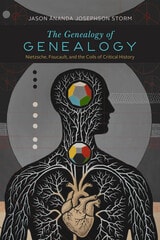
The Genealogy of Genealogy
Nietzsche, Foucault, and the Coils of Critical HistoryJason Ananda Josephson Storm
University of Chicago Press, 2026
The genealogical method—a mode of historical analysis that shows that what looks timeless is in fact contingent, bound to shifting relations of meaning, knowledge, and power—has become the dominant paradigm of humanistic inquiry. In The Genealogy of Genealogy, Jason Ānanda Josephson Storm turns this influential practice back on itself, tracing its unlikely rise through Nietzsche and Foucault and uncovering its suppressed ties to eugenics and racism. He rethinks the very stakes of critical history and proposes new tools for thinking about historical continuity, change, and difference.
Provocative and timely, The Genealogy of Genealogy offers both a diagnosis and a vision, challenging scholars across the humanities and social sciences to rethink how we write history and whether our most trusted methods are fit for the futures we seek to build.
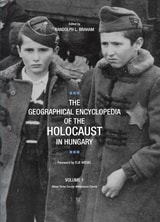
The Geographical Encyclopedia of the Holocaust in Hungary
Randolph L. Braham, Foreword by Elie Wiesel
Northwestern University Press, 2013
Winner of the 2013 National Jewish Book Award
The illustrated three-volume Geographical Encyclopedia of the Holocaust in Hungary is a definitive, authoritative, and magisterial resource, thorough and exhaustive. It documents and chronicles the wartime fate of the Jewish communities in that country where virulent antisemitism is anything but dead, even today. With scores of detailed maps and hundreds of photographs, this reference work is organized alphabetically by county, each prefaced with a map and a contextual history describing its Jewish population up to and into 1944.
Entries track the demographic, cultural, and religious changes in even the smallest communities where Jews lived before their marginalization, dispossession, ghettoization, and, finally, deportation to labor and death camps. The encyclopedia endows scholars and lay researchers with both panoramic and microscopic views of the virtually last-minute destruction of most of the Jews of Hungary, until then the last sizable surviving Jewish community in occupied Europe.
The German Epic in the Cold War
Peter Weiss, Uwe Johnson, and Alexander KlugeMatthew D. Miller
Northwestern University Press, 2018
Matthew Miller’s The German Epic in the Cold War explores the literary evolution of the modern epic in postwar German literature. Examining works by Peter Weiss, Uwe Johnson, and Alexander Kluge, it illustrates imaginative artistic responses in German fiction to the physical and ideological division of post–World War II Germany.
Miller analyzes three ambitious German-language epics from the second half of the twentieth century: Weiss’s Die Ästhetik des Widerstands (The Aesthetics of Resistance), Johnson’s Jahrestage (Anniversaries), and Kluge’s Chronik der Gefühle (Chronicle of Feelings). In them, he traces the epic’s unlikely reemergence after the catastrophes of World War II and the Shoah and its continuity across the historical watershed of 1989–91, defined by German unification and the dissolution of the Soviet Union.
Building on Franco Moretti’s codification of the literary form of the modern epic, Miller demonstrates the epic’s ability to understand the past; to come to terms with ethical, social, and political challenges in the second half of the twentieth century in German-speaking Europe and beyond; and to debate and envision possible futures.
The German Officer’s Boy
Harlan Greene
University of Wisconsin Press, 2005
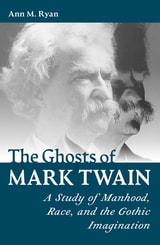
The Ghosts of Mark Twain
A Study of Manhood, Race, and the Gothic ImaginationAnn M Ryan
University of Missouri Press, 2025
Ann M. Ryan maps Twain’s resistance to ideals of white masculinity and his occasional capitulation to them. While Twain reflects upon the history of White men—including the intimate memory of his father’s failures and abuses—he also imagines a future in which Black men will gain an authentic voice and agency. Preferring the messy humanity of Mark Twain, Ryan calls into question the “St. Mark” school of criticism, which glosses—among other themes—Twain’s uneasy relation to Black culture. In unpublished works and excised material, Twain conjures memories and specters of Black men that are far from comforting. No longer “friends and allies” like fictive Ol’ Uncle Dan’l; these Black ghosts will settle for revenge if they can’t get justice.
Some of the works considered in The Ghosts of Mark Twain are not widely known: “Which Was It?,” “The United States of Lyncherdom,” No. 44: The Mysterious Stranger, and the Morgan manuscript of Pudd’nhead Wilson. Written into the record of these fragments is Twain’s desire to be a different kind of White man, just as their incomplete nature demonstrates how often he stumbled in that effort. When Jim describes the White and Black spirits hovering over Pap Finn, Twain reveals his own conflicted position in America’s racial history. And as Jim declares to Huck, “A body can’t tell yit which one gwyne to fetch him at de las.’”