Results by title
968 books match the query 'Movements' and 273 start with t
The Hermeneutics of Original Argument
Demonstration, Dialectic, RhetoricP. Christopher Smith
Northwestern University Press, 1998
The History of Continental Philosophy
Edited by Alan D. Schrift
University of Chicago Press, 2010
From Kant to Kierkegaard, from Hegel to Heidegger, continental philosophers have indelibly shaped the trajectory of Western thought since the eighteenth century. Although much has been written about these monumental thinkers, students and scholars lack a definitive guide to the entire scope of the continental tradition. The most comprehensive reference work to date, this eight-volume History of Continental Philosophy will both encapsulate the subject and reorient our understanding of it. Beginning with an overview of Kant’s philosophy and its initial reception, the History traces the evolution of continental philosophy through major figures as well as movements such as existentialism, phenomenology, hermeneutics, and poststructuralism. The final volume outlines the current state of the field, bringing the work of both historical and modern thinkers to bear on such contemporary topics as feminism, globalization, and the environment. Throughout, the volumes examine important philosophical figures and developments in their historical, political, and cultural contexts.
The first reference of its kind, A History of Continental Philosophy has been written and edited by internationally recognized experts with a commitment to explaining complex thinkers, texts, and movements in rigorous yet jargon-free essays suitable for both undergraduates and seasoned specialists. These volumes also elucidate ongoing debates about the nature of continental and analytic philosophy, surveying the distinctive, sometimes overlapping characteristics and approaches of each tradition. Featuring helpful overviews of major topics and plotting road maps to their underlying contexts, A History of Continental Philosophy is destined to be the resource of first and last resort for students and scholars alike.
The Idea of Hegel's "Science of Logic"
Stanley Rosen
University of Chicago Press, 2013
Rosen’s overarching question is how, if at all, rationalism can overcome the split between monism and dualism. Monism—which claims a singular essence for all things—ultimately leads to nihilism, while dualism, which claims multiple, irreducible essences, leads to what Rosen calls “the endless chatter of the history of philosophy.” The Science of Logic, he argues, is the fundamental text to offer a new conception of rationalism that might overcome this philosophical split. Leading readers through Hegel’s book from beginning to end, Rosen’s argument culminates in a masterful chapter on the Idea in Hegel. By fully appreciating the Science of Logic and situating it properly within Hegel’s oeuvre, Rosen in turn provides new tools for wrangling with the conceptual puzzles that have brought so many other philosophers to disaster.
The Illuminated Chronicle
Chronicle of the Deeds of the Hungarians from the Fourteenth-Century Illuminated CodexJános M. Bak
Central European University Press, 2018
The Illuminated Chronicle was composed in 1358 in the international artistic style at the royal court of Louis I of Hungary. Its text, presented here in a new edition and translation, is the most complete record of Hungary's medieval historical tradition, going back to the eleventh century and including the mythical past of its people. The pictures in this manuscript—formerly known as the Vienna Chronicle—are not merely occasional illustrations added to some exemplars, but text and image are closely connected and mutually related to each other, to qualify it as a proper “illuminated chronicle”. The artistic value of the miniatures is quite high, and the characters are drawn with detail and with a knowledge of anatomy. Forty-two of the miniatures are included in the present volume. A full color facsimile will be accessible online.
The 147 pictures are an invaluable source of information on late medieval cultural history, costume, and court life. In a historiographical context, The Illuminated Chronicle is an attempt at the popularization of the national history and a systematic appeal to circles beyond the old monastic-clerical audience.
The Illuminated Chronicle (Chronica de gestis Hungarorum e codice picto saec. xiv.) is the ninth volume in the Central European Medieval Texts, a Latin–English bilingual series.
The Influence of Darwin on Philosophy and Other Essays in Contemporary Thought
John Dewey. Edited by Larry A. Hickman. Introduction by Douglas Browning
Southern Illinois University Press, 2007
Presenting Dewey’s new view of philosophical inquiry
This critical edition of The Influence of Darwin on Philosophy and Other Essays in Contemporary Thought presents the results of John Dewey’s patient construction, throughout the previous sixteen years, of the radically new view of the methods and concerns of philosophical inquiry. It was a view that he continued to defend for the rest of his life.
In the 1910 The Influence of Darwin on Philosophy and Other Essays in Contemporary Thought—the first collection of Dewey’s previously published, edited essays—John Dewey provided readers with an overview of the scope and direction of his philosophical vision in one volume. The order in which the eleven essays were presented was a reverse chronology, with more recently published essays appearing first. The collection of eleven essays offered a detailed portrait of Dewey’s proposed reconstruction of the traditional concepts of knowledge and truth. It furthermore elaborated on how his new logic and his proposal regarding knowledge and truth fit comfortably together, not only with each other but also with a pragmatically proper understanding of belief, reality, and experience.
Because material in the Collected Works of John Dewey, 1882–1953 was published chronologically, however, the essays published together in the 1910 Darwin book have appeared in seven different volumes in the Collected Works. This new, critical edition restores a classic collection of essays authored and edited by John Dewey as they originally appeared in the volume. The edition is presented with ancillary materials, including responses by Dewey’s critics and an introduction by Douglas Browning.
The Inordinance of Time
Shaun Gallagher
Northwestern University Press, 1998
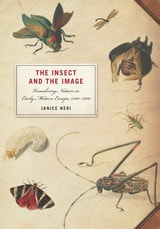
The Insect and the Image
Visualizing Nature in Early Modern Europe, 1500-1700Janice Neri
University of Minnesota Press, 2011
Once considered marginal members of the animal world (at best) or vile and offensive creatures (at worst), insects saw a remarkable uptick in their status during the early Renaissance. This quickened interest was primarily manifested in visual images—in illuminated manuscripts, still life paintings, the decorative arts, embroidery, textile design, and cabinets of curiosity. In The Insect and the Image, Janice Neri explores the ways in which such imagery defined the insect as a proper subject of study for Europeans of the early modern period.
It was not until the sixteenth century that insects began to appear as the sole focus of paintings and drawings—as isolated objects, or specimens, against a blank background. The artists and other image makers Neri discusses deployed this “specimen logic” and so associated themselves with a mode of picturing in which the ability to create a highly detailed image was a sign of artistic talent and a keenly observant eye. The Insect and the Image shows how specimen logic both reflected and advanced a particular understanding of the natural world—an understanding that, in turn, supported the commodification of nature that was central to global trade and commerce during the early modern era.
Revealing how sixteenth- and seventeenth-century artists and image makers shaped ideas of the natural world, Neri’s work enhances our knowledge of the convergence of art, science, and commerce today.

The Intellectual Earthquake
How Pragmatism Leveled Philosophy, Caused French Theory, and Reinvented SelfhoodJames Livingston
University of Chicago Press, 0
A look at how pragmatism—a quintessentially “American” philosophy—was the vanguard of a cultural revolution that altered the entire world.
As shaped by William James, John Dewey, Jane Addams, and others, pragmatism is considered the most American of philosophical currents, brashly privileging action, experience, embodiment, contingency, and real-world impact. In The Intellectual Earthquake, James Livingston recaptures pragmatism’s initial scandalous vitality and its worldwide influence. Livingston ambitiously covers more than a century, showing pragmatist roots in countless strains of thought, and connecting seemingly far-flung and disparate thinkers. He also aims to explain how pragmatism has been steadily maligned and misunderstood, and he makes the case for fresh attention to its lineal influence on “French Theory.”
The Intentional Spectrum and Intersubjectivity
Phenomenology and the Pittsburgh Neo-HegeliansMichael D. Barber
Ohio University Press, 2011
World-renowned analytic philosophers John McDowell and Robert Brandom, dubbed “Pittsburgh Neo-Hegelians,” recently engaged in an intriguing debate about perception. In The Intentional Spectrum and Intersubjectivity Michael D. Barber is the first to bring phenomenology to bear not just on the perspectives of McDowell or Brandom alone, but on their intersection. He argues that McDowell accounts better for the intelligibility of empirical content by defending holistically functioning, reflectively distinguishable sensory and intellectual intentional structures. He reconstructs dimensions implicit in the perception debate, favoring Brandom on knowledge’s intersubjective features that converge with the ethical characteristics of intersubjectivity Emmanuel Levinas illuminates.
Phenomenology becomes the third partner in this debate between two analytic philosophers, critically mediating their discussion by unfolding the systematic interconnectionamong perception, intersubjectivity, metaphilosophy, and ethics.
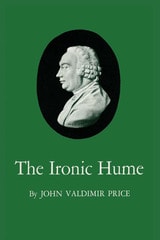
The Ironic Hume
By John Valdimir Price
University of Texas Press, 1965
Many of the seemingly bland assertions and bald statements of the eighteenth-century philosopher David Hume contain more than the mind immediately perceives. Author John Valdimir Price contends that an understanding of Hume's writings cannot be separated from an understanding of his life. By examining the works of Hume, Price shows the way in which an ironic way of seeing events and an ironic mode of expression permeated Hume's life and writings.
Price examines Hume's irony as it is exhibited in letters to his friends and in his writings concerned with morality, people, philosophy, politics, history, and above all religion. Hume's opinions on life in general are stated in works ranging from the Treatise of Human Nature and the Essays, Moral and Political, through the Enquiry concerning Human Understanding and the Enquiry concerning Principles of Morals, to the Dialogue and Four Dissertations of his maturity.
Price feels that Hume's recognition of the ironic in life came about from his perception of the disproportion between human hopes and human accomplishments. The rhetorical consequences of applying reason to a duality in human nature creates the ironic mode. Hume conceived man's opposing tendencies as his willingness to commit himself orally to a concept, a dogma, an idea, or an ideology, and his unwillingness to involve himself in the logical and rhetorical implications of articulating those principles.
Hume's use of the ironic mode in his writings provides him with a means of challenging certain dogmatic assumptions common to thought, particularly to traditional religious thought; it acts as a mask for his sceptical intentions, and it is an implied criticism of many ideas. In his political writing, Hume frequently implied that the question under argument was almost too ridiculous to deserve serious treatment. This tactic was effectively employed in the Account of Stewart, in which Hume came to the defense of a friend.
In his most profitable venture, the History of England, Hume not only used irony to advantage, but developed a new approach to the writing of history—the use of narrative. He presented history as a series of more or less connected events, not as a series of "right" or "wrong" attitudes.
The author believes that Hume's initial religious scepticism, combined with the predominant satiric-ironic mode in the literature of his time, led him to seek irony as a method of self expression. This scepticism, which permeated all of Hume's attitudes toward life, reached its most complete expression in the Dialogues concerning Natural Religion, which accepted reason as its guide, but also accepted experience as its master.
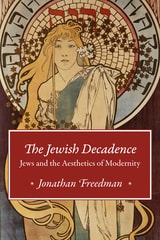
The Jewish Decadence
Jews and the Aesthetics of ModernityJonathan Freedman
University of Chicago Press, 2021
The first to tell this sweeping story, Freedman demonstrates the centrality of decadence to the aesthetics of modernity and its inextricability from Jewishness. Freedman recounts a series of diverse and surprising episodes that he insists do not belong solely to the past, but instead reveal that the identification of Jewishness with decadence persists today.
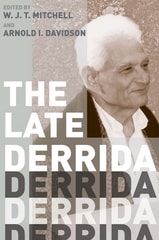
The Late Derrida
Edited by W. J. T. Mitchell and Arnold I. Davidson
University of Chicago Press, 2007
The rubric “The Late Derrida,” with all puns and ambiguities cheerfully intended, points to the late work of Jacques Derrida, the vast outpouring of new writing by and about him in the period roughly from 1994 to 2004. In this period Derrida published more than he had produced during his entire career up to that point. At the same time, this volume deconstructs the whole question of lateness and the usefulness of periodization. It calls into question the “fact” of his turn to politics, law, and ethics and highlights continuities throughout his oeuvre.
The scholars included here write of their understandings of Derrida’s newest work and how it impacts their earlier understandings of such classic texts as Glas and Of Grammatology. Some have been closely associated with Derrida since the beginning—both in France and in the United States—but none are Derrideans. That is, this volume is a work of critique and a deep and continued engagement with the thought of one of the most significant philosophers of our time. It represents a recognition that Derrida’s work has yet to be addressed—and perhaps can never be addressed—in its totality.
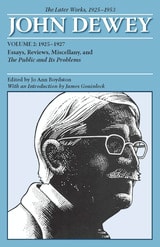
The Later Works of John Dewey, Volume 2, 1925 - 1953
1925-1927, Essays, Reviews, Miscellany, and The Public and Its ProblemsJohn Dewey. Edited by Jo Ann Boydston
Southern Illinois University Press, 2008
With the exception of Experience and Nature, (Volume 1 of the Later Works), this volume contains all of Dewey’s writings for 1925 and 1926, as well as his 1927 book, The Public and Its Problems. A Modern Language Association’s Committee on Scholarly Editions textual edition.
The first essay in this volume, “The Development of American Pragmatism,” is perhaps Dewey’s best-known article of these years, emphasizing the uniquely American origins of his own philosophical innovations. Other essays focus on Dewey’s continuing investigation of the “nature of intelligent conduct,” as, for example, his debate with David Wight Prall on the underpinnings of value, his study of sense-perception, and his support for outlawing of war. Also appearing here are Dewey’s final articles on the culture of the developing world, written for the New Republic after his travels to China, Turkey, and Mexico.
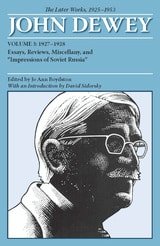
The Later Works of John Dewey, Volume 3, 1925 - 1953
1927-1928, Essays, Reviews, Miscellany, and "Impressions of Soviet Russia"John Dewey. Edited by Jo Ann Boydston
Southern Illinois University Press, 2008
All of Dewey’s writings for 1927 and 1928 with the exception of The Public and Its Problems, which appears in Volume 2, A Modern Language Association’s Committee on Scholarly Editions textual edition.
These essays are, as Sidorsky says in his Introduction, “framed, in great measure, by those two poles of his philosophical interest: looking backward, in a sense, to the defense of naturalistic metaphysics and moving forward to the justification and to the implications for practice of an empirical theory.”
Dewey’s five essays on education are evidence of his continued interest in that field. Among them is the frequently quoted “Why I Am a Member of the Teachers Union,” which is still used by the American Federation of Teachers in its recruiting efforts. Other highlights of this volume include the famous exchange between George Santayana and Dewey on Experience and Nature; an impassioned condemnation of the miscarriage of justice Dewey saw in the Sacco-Vanzetti trial; and a series of six articles on the Soviet Union based on Dewey’s trip to that country in 1928.
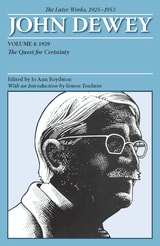
The Later Works of John Dewey, Volume 4, 1925 - 1953
1929: The Quest for CertaintyJohn Dewey. Edited by Jo Ann Boydston
Southern Illinois University Press, 2008
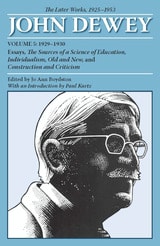
The Later Works of John Dewey, Volume 5, 1925 - 1953
1929-1930, Essays, The Sources of a Science of Education, Individualism, Old and New, and Construction and CriticismJohn Dewey. Edited by Jo Ann Boydston
Southern Illinois University Press, 2008
With the exception of The Quest for Certainty (Volume 4) this fifth volume brings together Dewey’s writings for the 1929–1930 period.
During this time Dewey published 4 books and 50 articles on philosophical, educational, political, and social issues. His philosophical essays include “What Humanism Means to Me” and “What I Believe,” both of which express Dewey’s faith in man’s potentialities and intelligence, and a lively Journal of Philosophy exchange with Ernest Nagel, William Ernest Hocking, C. I. Lewis, and F. J. E. Woodbridge. Educational writings include The Sources of a Science of Education. The contents of this volume reflect Dewey’s increasing involvement in social and political problems.
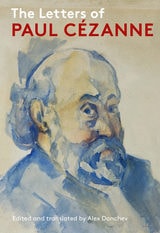
The Letters of Paul Cézanne
Alex Danchev
J. Paul Getty Trust, The, 2013
Revered and misunderstood by his peers and lauded by later generations as the father of modern art, Paul Cézanne (1839-1906) has long been a subject of fascination for artists and art lovers, writers, poets, and philosophers. His life was a ceaseless artistic quest, and he channeled much of his wide-ranging intellect and ferocious wit into his letters. Punctuated by exasperated theorizing and philosophical reflection, outbursts of creative ecstasy and melancholic confession, the artist’s correspondence reveals both the heroic and all-toohuman qualities of a man who is indisputably among the pantheon of all-time greats.
This new translation of Cézanne’s letters includes more than twenty that were previously unpublished and reproduces the sketches and caricatures with which Cézanne occasionally illustrated his words. The letters shed light on some of the key artistic relationships of the modern period—about one third of Cézanne’s more than 250 letters are to his boyhood companion Émile Zola, and he communicated extensively with Camille Pissarro and the dealer Ambroise Vollard. The translation is richly annotated with explanatory notes, and, for the first time, the letters are cross-referenced to the current catalogue raisonné. Numerous inaccuracies and archaisms in the previous English edition of the letters are corrected, and many intriguing passages that were unaccountably omitted have been restored. The result is a publishing landmark that ably conveys Cézanne’s intricacy of expression.
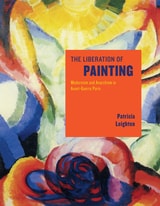
The Liberation of Painting
Modernism and Anarchism in Avant-Guerre ParisPatricia Leighten
University of Chicago Press, 2013
Leighten examines the circle of artists—Pablo Picasso, Juan Gris, František Kupka, Maurice de Vlaminck, Kees Van Dongen, and others—for whom anarchist politics drove the idea of avant-garde art, exploring how their aesthetic choices negotiated the myriad artistic languages operating in the decade before World War I. Whether they worked on large-scale salon paintings, political cartoons, or avant-garde abstractions, these artists, she shows, were preoccupied with social criticism. Each sought an appropriate subject, medium, style, and audience based on different conceptions of how art influences society—and their choices constantly shifted as they responded to the dilemmas posed by contradictory anarchist ideas. According to anarchist theorists, art should expose the follies and iniquities of the present to the masses, but it should also be the untrammeled expression of the emancipated individual and open a path to a new social order. Revealing how these ideas generated some of modernism’s most telling contradictions among the prewar Parisian avant-garde, The Liberation of Painting restores revolutionary activism to the broader history of modern art.
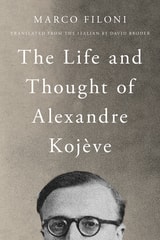
The Life and Thought of Alexandre Kojève
Marco Filoni and David Broder (Trans.)
Northwestern University Press, 2025
A fresh and vivid reappraisal of one of the most influential intellects of the modern era
Alexandre Kojève is one of the twentieth century’s most seductive and intriguing figures. A product of the Russian merchant bourgeoisie, he became, depending on one’s point of view, either an overzealous bureaucrat or a secret agent who infiltrated the upper echelons of French state bureaucracy, spending the last twenty years of his life working in international diplomacy and high finance. Marco Filoni describes each facet of Kojève’s different lives in crystalline detail: the cultural circles of his youth, his studies, his philosophical passions, his fundamental theoretical choices, and his intellectual network, as well as the students who would become part of the intellectual elite, including Lacan, Bataille, and Merleau-Ponty. Drawing on rich archival material, unpublished texts, correspondence, and written and oral testimonies, The Life and Thought of Alexandre Kojève is a major benchmark for scholars of Kojève and of twentieth-century intellectual and political history. Filoni paints a vibrant portrait of one of the most influential intellectuals of the modern era, deftly composing Kojève’s personal, political, and philosophical lives.
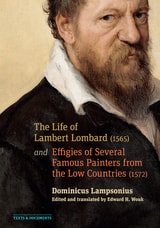
The Life of Lambert Lombard (1565); and Effigies of Several Famous Painters from the Low Countries (1572)
Dominicus Lampsonius
J. Paul Getty Trust, The, 2022
Dominicus Lampsonius’s The Life of Lambert Lombard (1565) is the earliest published biography of a Netherlandish artist. This neo-Latin account of the life of the painter, architect, and draftsman Lambert Lombard of Liège offers a theoretical exposition on the nature and ideal practice of Netherlandish art, emphasizing Lombard’s intellectual curiosity, interest in antiquity, attentive study of the human body, and exemplary generosity as a teacher.
This volume offers the first English edition of The Life of Lambert Lombard, complemented by a new translation of the inscriptions Lampsonius composed to accompany the Effigies of Several Famous Painters from the Low Countries (1572), a cycle of twenty-three engraved portraits of Netherlandish artists developed in collaboration with the print publisher Hieronymus Cock.
Together, The Life of Lambert Lombard and the Effigies established frameworks for a distinctly Netherlandish history of art. Responding to a growing sense of Netherlandish cultural and political identity on the eve of the Dutch Revolt, these texts proposed a critical alternative to Giorgio Vasari’s Lives of the Artists and its Italian model of art historical development, celebrating local ingenuity and skill. They remain the starting point for any history of the northern Renaissance.

The Limits of Utilitarianism
Harlan B. Miller and William H. Williams, Editors
University of Minnesota Press, 1982
The Limits of Utilitarianism was first published in 1982. Minnesota Archive Editions uses digital technology to make long-unavailable books once again accessible, and are published unaltered from the original University of Minnesota Press editions.
Many philosophers have argued that utilitarianism is an unacceptable moral theory and that promoting the general welfare is at best only one of the legitimate goals of public policy. Utilitarian principles seem to place no limits on the extent to which society may legitimately interfere with a person's liberties - provided that such actions can be shown to promote the long-term welfare of its members. These issues have played a central role in discussions of utilitarianism since the time of Bentham and Mill. Despite criticisms, utilitarianism remains the most influential and widely accepted moral theory of recent times.
In this volume contemporary philosophers address four aspects of utilitarianism: the principle of utility; utilitarianism vis-à-vis contractarianism; welfare; and voluntary cooperation and helping others. The editors provide an introduction and a comprehensive bibliography that covers all books and articles published in utilitarianism since 1930.
The Literary Work of Art
An Investigation of the Borderlines of Ontology, Logic, and Theory of LanguageRoman Ingarden
Northwestern University Press, 1973
The Literary Word of Art establishes the groundwork for a philosophy of literature, i.e., an ontology in terms of which the basic general structure of all lliterary works can be determined. This "essential anatomy" makes basic tools and concepts available for rigorous and subtle aesthetic analysis.
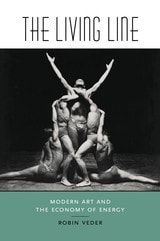
The Living Line
Modern Art and the Economy of EnergyRobin Veder
Dartmouth College Press, 2015
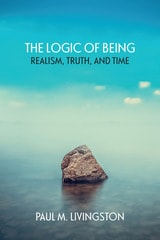
The Logic of Being
Realism, Truth, and TimePaul M. Livingston
Northwestern University Press, 2017
Livingston's formal and phenomenological analysis articulates and defends a realist position about being, time, and their relationship that understands that all of these are structured and constituted in a way that does not depend on the human mind, consciousness, or subjectivity. This approach provides a basis for new logically and phenomenologically based accounts of the structure of linguistic truth in relation to the appearance of objects and of the formal structure of time as given.
Livingston draws on philosophers from Plato and Aristotle to Davidson and Heidegger in this exploration. In it, readers and scholars will discover innovative connections between continental and analytic philosophy.
The Madness of Vision
On Baroque AestheticsChristine Buci-Glucksmann
Ohio University Press, 2013
Christine Buci-Glucksmann’s The Madness of Vision is one of the most influential studies in phenomenological aesthetics of the baroque. Integrating the work of Merleau-Ponty with Lacanian psychoanalysis, Renaissance studies in optics, and twentieth-century mathematics, the author asserts the materiality of the body and world in her aesthetic theory. All vision is embodied vision, with the body and the emotions continually at play on the visual field. Thus vision, once considered a clear, uniform, and totalizing way of understanding the material world, actually dazzles and distorts the perception of reality.
In each of the nine essays that form The Madness of Vision Buci-Glucksmann develops her theoretical argument via a study of a major painting, sculpture, or influential visual image—Arabic script, Bettini’s “The Eye of Cardinal Colonna,” Bernini’s Saint Teresa and his 1661 fireworks display to celebrate the birth of the French dauphin, Caravaggio’s Judith Beheading Holofernes, the Paris arcades, and Arnulf Rainer’s self-portrait, among others—and deftly crosses historical, national, and artistic boundaries to address Gracián’s El Criticón; Monteverdi’s opera Orfeo; the poetry of Hafiz, John Donne, and Baudelaire; as well as baroque architecture and Anselm Kiefer’s Holocaust paintings. In doing so, Buci-Glucksmann makes the case for the pervasive influence of the baroque throughout history and the continuing importance of the baroque in contemporary arts.
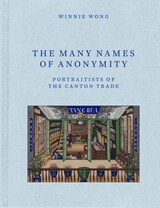
The Many Names of Anonymity
Portraitists of the Canton TradeWinnie Wong
University of Chicago Press, 2025
Challenging contemporary procedures for establishing attribution, chronology, and authenticity in Chinese art, Winnie Wong explores the means, methods, and stakes of recovering the names of an anonymous community of artists. To examine how Western art history has misconstrued and miscategorized names and identities in Chinese art, she looks to conflicting features of modernity: the European attachment of singular names to individuals and their works, and the Chinese use of socially contingent names that often are not attached to material labor and sometimes operate against it. Wong charts the genealogy of this naming problem by bringing to life the artists of the Qing Empire’s trade with Europeans at the port of Guangzhou, centering on a group of portraitists known by names that were recorded in a pidgin language: Chin Qua, Chit Qua, Spoilum, Lam Qua, and Ting Qua.
Many of these paintings survive today, yet scholars have identified only a handful of the painters’ identities. Pushing against Western norms that have shaped our understanding of authorship, Wong reveals that these artists shared names, created works in multiples, and signed their pieces with different names or none at all. This lavishly illustrated volume explores portraiture across media, including unfired clay, reverse painting on glass, watercolor on paper, oil on canvas, and the daguerreotype, to propose new ways of studying anonymity, copying, and the emergence of author names in the Sino-European visual culture of the long eighteenth century.

The Memory of Place
A Phenomenology of the UncannyDylan Trigg
Ohio University Press, 2011
From the frozen landscapes of the Antarctic to the haunted houses of childhood, the memory of places we experience is fundamental to a sense of self. Drawing on influences as diverse as Merleau-Ponty, Freud, and J. G. Ballard, The Memory of Place charts the memorial landscape that is written into the body and its experience of the world.
Dylan Trigg’s The Memory of Place offers a lively and original intervention into contemporary debates within “place studies,” an interdisciplinary field at the intersection of philosophy, geography, architecture, urban design, and environmental studies. Through a series of provocative investigations, Trigg analyzes monuments in the representation of public memory; “transitional” contexts, such as airports and highway rest stops; and the “ruins” of both memory and place in sites such as Auschwitz. While developing these original analyses, Trigg engages in thoughtful and innovative ways with the philosophical and literary tradition, from Gaston Bachelard to Pierre Nora, H. P. Lovecraft to Martin Heidegger. Breathing a strange new life into phenomenology, The Memory of Place argues that the eerie disquiet of the uncanny is at the core of the remembering body, and thus of ourselves. The result is a compelling and novel rethinking of memory and place that should spark new conversations across the field of place studies.
Edward S. Casey, Distinguished Professor of Philosophy at Stony Brook University and widely recognized as the leading scholar on phenomenology of place, calls The Memory of Place “genuinely unique and a signal addition to phenomenological literature. It fills a significant gap, and it does so with eloquence and force.” He predicts that Trigg’s book will be “immediately recognized as a major original work in phenomenology.”
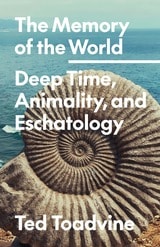
The Memory of the World
Deep Time, Animality, and EschatologyTed Toadvine
University of Minnesota Press, 2024
Advancing a phenomenological approach to deep time
Our imagination today is dominated by the end of the world, from sci-fi and climate fiction to actual predictions of biodiversity collapse, climate disruption, and the emergence of the Anthropocene. This obsession with the world’s precarity, The Memory of the World contends, relies on a flawed understanding of time that neglects the past and present with the goal of managing the future. Not only does this mislead sustainability efforts, it diminishes our encounters with the world and with human and nonhuman others.
Here, Ted Toadvine takes a phenomenological approach to deep time to show how our apocalyptic imagination forgets the sublime and uncanny dimensions of the geological past and far future. Guided by original readings of Maurice Merleau-Ponty, Emmanuel Levinas, Jacques Derrida, Jean-Luc Nancy, and others, he suggests that reconciling our embodied lives with the memory of the earth transforms our relationship with materiality, other forms of life, and the unprecedented future.
Integrating insights from phenomenology, deconstruction, critical animal studies, and new materialism, The Memory of the World argues for a new philosophy of time that takes seriously the multiple, pleated, and entangled temporal events spanning cosmic, geological, evolutionary, and human durations.
The Merleau-Ponty Aesthetics Reader
Philosophy and PaintingEdited and with an Introduction by Galen A. Johnson; Michael B. Smith, Translation Editor
Northwestern University Press, 1993
The Michel Henry Reader
Edited by Scott Davidson and Frédéric Seyler
Northwestern University Press, 2019
The Michel Henry Reader is an indispensable resource for those who are approaching Henry for the first time as well as for those who are already familiar with his work. It provides broad coverage of the major themes in his philosophy and new translations of Henry’s most important essays. Sixteen chapters are divided into four parts that demonstrate the profound implications of Henry’s philosophy of life: for phenomenology; for subjectivity; for politics, art, and language; and for ethics and religion.
The Middle Works of John Dewey, Volume 10, 1899 - 1924
Journal Articles, Essays, and Miscellany Published in the 1916-1917 PeriodJohn Dewey. Edited by Jo Ann Boydston
Southern Illinois University Press, 2008
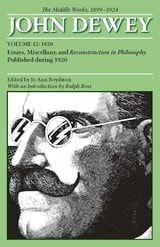
The Middle Works of John Dewey, Volume 12, 1899 - 1924
Essays, Miscellany, and Reconstruction in Philosophy Published during 1920John Dewey. Edited by Jo Ann Boydston
Southern Illinois University Press, 2008
A collection of all of Dewey’s writings for 1920 with the exception of Letters from China and Japan. A Modern Language Association Committee on Scholarly Editions textual edition.
The nineteen items collected here, including his major work, Reconstruction in Philosophy, evolved in the main from Dewey’s travel, touring, lecturing, and teaching in Japan and China. Ralph Ross notes in his Introduction to this volume that Reconstruction in Philosophy is “a radical book . . . a pugnacious book by a gentle man.” It is in this book that Dewey summarizes his version of pragmatism, then called Instrumentalism. For Dewey, the pragmatist, it was people acting on the strength of intelligence modeled on science who could find true ideas, ones “we can assimilate, validate, corroborate, and verify.” Optimism pervades Reconstruction of Philosophy; in keeping with Dewey’s world of open possibilities, the book recognizes that the observation and thought of human striving can make the difference between despair and affirmation of life.
The seven essays on Chinese politics and social tradition that Dewey sent back from the Orient exhibit both the liveliness and the sensitive power of an insightful mind. Set against a backdrop of Japanese hegemony in China, the last days of Manchu imperialism, Europe’s carving of China into concessions, and China’s subsequent refusal to accept the terms of the Treaty of Versailles, the essays were startlingly relevant in this time of Eastern turbulence and change.
At the National University of Peking, Dewey delivered a series of lectures on “Three Contemporary Philosophers: William James, Henri Bergson, and Bertrand Russell.” The James and Bergson lectures are published for the first time in this volume. Dewey chose these philosophers, according to Ralph Ross, because he was trying to show “his oriental audience what he believed and hoped about man and society and was talking about those fellow philosophers who shared the same beliefs and hopes.”
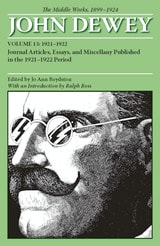
The Middle Works of John Dewey, Volume 13, 1899 - 1924
Journal Articles, Essays, and Miscellany Published in the 1921-1922 PeriodJohn Dewey. Edited by Jo Ann Boydston
Southern Illinois University Press, 2008
Volume 13 in The Middle Works of John Dewey, 1899–1924, series brings together Dewey’s writings for 1921 and 1922,with the exception of Human Nature and Conduct. A Modern Language Association Committee on Scholarly Editions textual edition.
Ralph Ross notes in his Introduction that the 53 items constituting this volume “defend Dewey’s beliefs at 63 and look forward to what he was yet to write.” The essays to which Dewey responded, as well as abstracts of articles that have been published only in Japanese, appear as appendixes.
The article “Valuation and Experimental Knowledge” treats a favorite Dewey theme: “Most of the important crises of life are cases where tastes are the only things worth discussing, and where, if the life of reason is to exist and prevail, judgment must be performed with regard for its logical implications.” The philosophical articles stress Dewey’s view that, as Ross remarks, “philosophies are not timeless and universal, but speak to times, places and conditions.”
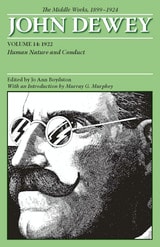
The Middle Works of John Dewey, Volume 14, 1899 - 1924
Human Nature and Conduct, 1922John Dewey. Edited by Jo Ann Boydston
Southern Illinois University Press, 2008
Volume 14 of The Middle Works of John Dewey, 1899–1924, series provides an authoritative edition of Dewey’s Human Nature and Conduct. A Modern Language Association Committee on Scholarly Editions textual edition.
Human Nature and Conduct evolved from the West Memorial Foundation lectures at Stanford University. The lectures were extensively rewritten and expanded into one of Dewey’s best-known works. As Murray G. Murphey says in his Introduction, “It was a work in which Dewey sought to make explicit the social character of his psychology and philosophy—something which had long been evident but never so clearly spelled out.”
Subtitled “An Introduction to Social Psychology,” Human Nature and Conduct sets forth Dewey’s view that habits are social functions, and that social phenomena, such as habit and custom and scientific methods of inquiry are moral and natural. Dewey concludes, “Within the flickering inconsequential acts of separate selves dwells a sense of the whole which claims and dignifies them. In its presence we put off mortality and live in the universal.”
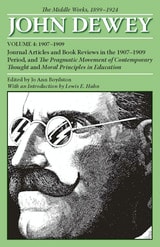
The Middle Works of John Dewey, Volume 4, 1899 - 1924
Journal Articles and Book Reviews in the 1907-1909 Period, and The Pragmatic Movement of Contemporary Thought and Moral Principles in EducationJohn Dewey. Edited by Jo Ann Boydston
Southern Illinois University Press, 2008
The Middle Works of John Dewey, Volume 6
Journal Articles, Book Reviews, Miscellany in the 1910-1911 Period, and How We ThinkJohn Dewey. Edited by Jo Ann Boydston
Southern Illinois University Press, 2008
William James, remarking in 1909 on the differences among the three leading spokesmen for pragmatism—himself, F. C. S. Schiller, and John Dewey—said that Schiller’s views were essentially “psychological,” his own, “epistemological,” whereas Dewey’s “panorama is the widest of the three.”
The two main subjects of Dewey’s essays at this time are also two of the most fundamental and persistent philosophical questions: the nature of knowledge and the meaning of truth. Dewey’s distinctive analysis is concentrated chiefly in seven essays, in a long, significant, and previously almost unknown work entitled “The Problem of Truth,” and in his book How We Think. As a whole, the 1910–11 writings illustrate especially well that which the Thayers identify in their Introduction as Dewey’s “deepening concentration on questions of logic and epistemology as contrasted with the more pronounced psychological and pedagogical treatment in earlier writings.”
The Middle Works of John Dewey, Volume 7, 1899 - 1924
Essays, Books Reviews, Encyclopedia Articles in the 1912-1914 Period, and Interest and Effort in EducationJohn Dewey. Edited by Jo Ann Boydston
Southern Illinois University Press, 2008
During the three years embraced by Volume 7, Dewey published twenty articles and reviews, one of the articles of monograph-length, “The Psychology of Social Behavior,” one small book, Interest and Effort in Education, and seventy encyclopedia articles.
A salient and arresting feature of the essays is the continuing polemic between Dewey and some of his critics. Ralph Ross, whose perceptive Introduction to the volume provides a broad perspective of the various philosophical controversies in which Dewey was engaged, comments that “when Dewey was pitting himself against important adversaries, his talents as a critic were fully evident.”
The Minor Gesture
Erin Manning
Duke University Press, 2016
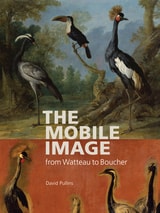
The Mobile Image from Watteau to Boucher
David Pullins
J. Paul Getty Trust, The, 2024
This book provides a new way of thinking about eighteenth-century French art and visual culture by prioritizing production over reception. Abandoning the ideologically driven discourse that distinguished fine from decorative art between the 1690s and 1770s, The Mobile Image reveals how the two have been inextricably bound from the earliest stages of artistic instruction through the daily life of painters’ workshops. In this study, author David Pullins defines artisanal and artistic means of learning, seeing, and making through a system of “mobile images”: motifs that were effectively engineered for mobility and designed never to be definitive, always awaiting replication and circulation. He examines the careers of Antoine Watteau, Jean-Baptiste Oudry, and François Boucher, situating them against a much broader cast of actors—such as printmakers, publishers, anonymous studio assistants, and architects, among others—to place eighteenth-century painting within a wider context of media and making.
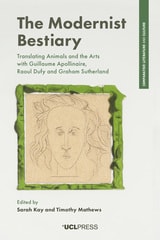
The Modernist Bestiary
Translating Animals and the Arts with Guillaume Apollinaire, Raoul Dufy and Graham SutherlandEdited by Sarah Kay and Timothy Mathews
University College London, 2020
The Moral Philosophy of Dietrich von Hildebrand
Martin Cajthaml
Catholic University of America Press, 2020
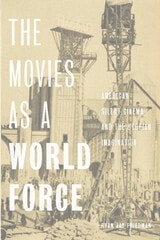
The Movies as a World Force
American Silent Cinema and the Utopian ImaginationFriedman, Ryan J
Rutgers University Press, 2019

The Natural World as a Philosophical Problem
Jan Patocka, edited by Ivan Chvatík and Lubica Ucnik, translated by Erika Abrams, foreword by Ludwig Landgrebe
Northwestern University Press, 2016
The Nature of Love, Volume 3
The Modern WorldIrving Singer
University of Chicago Press, 1987
"Irving Singer . . . has developed a method of historical analysis flexible enough to deal with all kinds of love, from Greek homosexual love in Plato, to the philia and agape of the New Testament, to the courtly love of medieval romance, to the Romantics, for whom love was magic. . . . [This] final volume brings us to the present. In 'The Modern World,' Singer offers readings of Freud, Proust, and Sartre, among others. He shows how their work was formed in reaction to the 19th-century ideal of 'merging' of the identities of lover and beloved. More often than not, the great modern writers portray love as impossible, as a field of failure and regret. . . . This masterpiece of critical thinking is a timely, eloquent, and scrupulous account of what, after all, still makes the world go round."—Thomas D'Evelyn, Christian Science Monitor
"This is the third of a three-volume history of the philosophy of love. It begins with Kierkegaard, Tolstoy, and Nietzsche in the nineteenth century and treats Freud, Proust, Bergson, D. H. Lawrence, G. B. Shaw, Santayana, Sartre, and others in the twentieth. Although the author's approach is primarily historical, he intersperses critical remarks throughout. Most of the major themes which are discussed by philosophers of love make their way into this history, including friendship, sexual love, and the distinction between love that is based on the value of the beloved and love that bestows value on the beloved. Singer devotes a number of pages to his own views on falling in love, being in love, and staying in love. . . . Singer's exposition is lucid and organized; his criticisms are insightful."—Ethics
"In this third volume of historical overview of the development of the Western conception of love, Singer uses writers, philosophers, and psychologists to provide the reader with an overview of love in the late 19th and 20th century. . . . Analyzing authors such as Tolstoy, Proust, D. H. Lawrence, and Shaw and philosophers such as Nietzsche, Kierkegaard, Sartre, and Santayana, as well as Freud, Singer . . . links each contributor's thoughts to the influence of previous writers and also provides some psycho-historical insight into their personal lives that might have been either a source or direct result of their views. In this final volume, Singer proceeds to look at not just the 'great men' influence but also provides a chapter overviewing scientific contributions to our understanding of love. . . . Singer's work is a significant contribution to understanding the social construction of important, abstract social and personal values. By tracing love through different historical periods through a variety of voices, Singer has created a rich history of the struggle between the ideal and the real, between the dreams of what love should provide and the reality of what relationships have been in each historical period. By personalizing the voice through psychohistorical analysis, Singer also provides insight into the shaping of ideas through the intimate struggles of the shapers."—Mark V. Chaffee, Contemporary Psychology

The Necessity of Pragmatism
John Dewey's Conception of PhilosophyR. W. Sleeper
University of Illinois Press, 1986
Identifying Dewey's differences with his pragmatist forerunners, Charles Sanders Peirce and William James, Sleeper elucidates Dewey's reshaping of pragmatism and the radical significance of his philosophy of culture. In this first paperback edition, a new introduction by Tom Burke establishes the ongoing importance of Sleeper's analysis of the integrity of Dewey's work and its implications for mathematics, aesthetics, and the cognitive sciences.
The New Century
Bergsonism, Phenomenology, and Responses to Modern ScienceEdited by Keith Ansell-Pearson and Alan D. Schrift
University of Chicago Press, 2010
From Kant to Kierkegaard, from Hegel to Heidegger, continental philosophers have indelibly shaped the trajectory of Western thought since the eighteenth century. Although much has been written about these monumental thinkers, students and scholars lack a definitive guide to the entire scope of the continental tradition. The most comprehensive reference work to date, this eight-volume History of Continental Philosophy will both encapsulate the subject and reorient our understanding of it. Beginning with an overview of Kant’s philosophy and its initial reception, the History traces the evolution of continental philosophy through major figures as well as movements such as existentialism, phenomenology, hermeneutics, and poststructuralism. The final volume outlines the current state of the field, bringing the work of both historical and modern thinkers to bear on such contemporary topics as feminism, globalization, and the environment. Throughout, the volumes examine important philosophical figures and developments in their historical, political, and cultural contexts.
The first reference of its kind, A History of Continental Philosophy has been written and edited by internationally recognized experts with a commitment to explaining complex thinkers, texts, and movements in rigorous yet jargon-free essays suitable for both undergraduates and seasoned specialists. These volumes also elucidate ongoing debates about the nature of continental and analytic philosophy, surveying the distinctive, sometimes overlapping characteristics and approaches of each tradition. Featuring helpful overviews of major topics and plotting road maps to their underlying contexts, A History of Continental Philosophy is destined to be the resource of first and last resort for students and scholars alike.
The Non-Modern Crisis of the Modern University
D. Bret Leraul and Willy Thayer
Northwestern University Press, 2025
A landmark work of critical theory about the Western university from the Southern Cone
Renowned Chilean philosopher Willy Thayer’s La crisis no moderna de la universidad moderna, first published in 1996 and in an updated edition in 2019, is a landmark work of critical theory from the Southern Cone. Presented in English for the first time, The Non-Modern Crisis of the Modern University rewrites the idea of the Western university while also diagnosing the ills of postdictatorship Chile through a philosophically informed dismantling of its neoliberal institutionalization of higher education. Bret Leraul’s translation advances the vital work of globalizing critical university studies by disseminating theory from the Global South. If the university helped to construct Chile’s neoliberal society, Thayer’s polemical deconstruction of both will help readers reconstruct the cultural politics of the era to better understand the global hegemony of neoliberalism today.
The Ontology of Becoming and the Ethics of Particularity
M. C. Dillon
Ohio University Press, 2012
M. C. Dillon (1938–2005) was widely regarded as a world-leading Merleau-Ponty scholar. His book Merleau-Ponty’s Ontology (1988) is recognized as a classic text that revolutionized the philosophical conversation about the great French phenomenologist. Dillon followed that book with two others: Semiological Reductionism, a critique of early-1990s linguistic reductionism, and Beyond Romance, a richly developed theory of love. At the time of his death, Dillon had nearly completed two further books to which he was passionately committed. The first one offers a highly original interpretation of Nietzsche’s ontology of becoming. The second offers a detailed ethical theory based on Merleau-Ponty’s account of carnal intersubjectivity. The Ontology of Becoming and the Ethics of Particularity collects these two manuscripts written by a distinguished philosopher at the peak of his powers—manuscripts that, taken together, offer a distinctive and powerful view of human life and ethical relations.
The Other Emerson
Branka Arsic
University of Minnesota Press, 2010
Considering Emerson first and foremost as a daring and original thinker, The Other Emerson focuses on three Emersonian subjects-subjectivity, the political, and the nature of philosophy-and range in topic from Emerson's relationships to slavery and mourning to his place in the development of Romanticism as reread by contemporary systems theory. It is Emerson's appreciation of truth's instability that link him to the European philosophical tradition.
Contributors: Eduardo Cadava, Princeton U; Sharon Cameron, Johns Hopkins U; Russell B. Goodman, U of New Mexico; Paul Grimstad, Yale U; Eric Keenaghan, U at Albany, SUNY; Gregg Lambert, Syracuse U; Sandra Laugier, Université de Picardie Jules Verne; Donald Pease, Dartmouth College.
The Other Side of Empathy
Jade E. Davis
Duke University Press, 2023