Results by title
527 books match the query 'Novel' and 157 start with t

The Powers
A NovelValerie Sayers
Northwestern University Press, 2015
In her inventive novel The Powers, Valerie Sayers, in both realistic and fantastic chapters, transports the reader to an age filled with giants: Dorothy Day and Walker Evans appear beside DiMaggio. The problems they face, from Catholic antisemitism to the challenge of pacifism in the face of overwhelming evil, play out in very public media, among them the photography of Evans and the baseball of DiMaggio. At once magical and familiar, The Powers is a story of witness and moral responsibility that will, like Joe DiMaggio, find some unlikely fans.
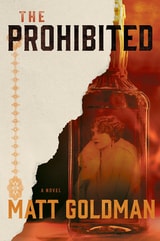
The Prohibited
A NovelMatt Goldman
University of Minnesota Press, 2026
A family, their liquor store, and the clash of the Eighteenth and Nineteenth Amendments in 1920s St. Paul
The Kaner brothers were getting by well enough running Kaner’s Fine Wine and Spirits in St. Paul, Minnesota, until Prohibition took effect in January 1920. With their liquor store shuttered, Red, Isaac, and Lewis are left to forge new livelihoods, their paths taking turns distinct as their personalities. All of the Kaners have secrets of their own—from a clandestine lover to a joyless marriage to an entanglement with the mob—but when it comes down to it, the family will do just about anything for each other, and they’re going to have to prove it.
The Prohibited follows the Kaner family in the wake of the Eighteenth Amendment. Isaac finds unlikely means to stay close to the family trade, becoming a rabbi (or someone the Feds believe is a rabbi, anyway) to exploit a loophole that allows men of the cloth to sell sacramental wine. Lewis takes the opportunity to pursue his lifelong dream of being a playwright, managing to secure the funds to produce a staged reading of his new play, albeit from an unlikely source. And Red is secretly happy to find himself working in a haberdashery, though he resents his wife’s suffragist allegiance and resulting support of Prohibition. Meanwhile, Red’s children bring challenges of their own: tough, quick-thinking Rose is working odd jobs to send herself to medical school and trying to fix her brother’s mess with the mob, something carefree Willie can’t seem to grasp is deadly serious. Tangled up in the Kaners’ story is Pearl Holgerson. After a tragic event up north, she has finally found community in the Rondo neighborhood in St. Paul, but she has a score to settle with Willie and just might get to him before the mob does.
Based loosely on Matt Goldman’s family history, The Prohibited brings to life 1920s St. Paul, a haven for bootleggers, gangsters, and bank robbers, but also home to many ordinary folks navigating a remarkable new social order. With his signature wry wit, Goldman presents an engrossing character study of a family testing their bonds, leaving their lives irrevocably changed.
Retail e-book files for this title are screen-reader friendly.
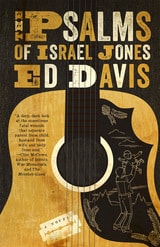
The Psalms of Israel Jones
A NovelEd Davis
West Virginia University Press, 2014
Secrets and snakes, rock and gospel, guilt and grace.
The Psalms of Israel Jones is the story of a father and son’s journey towards spiritual redemption. This novel tells the tale of a famous father trapped inside the suffocating world of rock and roll, and his son who is stranded within the bounds of conventional religion.
When Reverend Thomas Johnson receives an anonymous phone call, he learns his Dylanesque rock star father is acting deranged on stage, where he’s being worshipped by a cult of young people who slash their faces during performances. In his declining years, Israel Jones has begun to incite his fans to violence. They no longer want to watch the show—they want to be the show.
Eager to escape troubles with his congregation as well as gain an apology from his dad for abandoning his family, Reverend Johnson leaves town and joins Israel Jones’s Eternal Tour. This decision propels him to the center of a rock and roll hell, giving him one last chance to reconnect with his father, wife, congregation—and maybe even God.
The Psalms of Israel Jones is the 2010 Hackney Literary Award winner for an unpublished manuscript.
The Quality of Life Report
A NovelBy Meghan Daum, Foreword by Curtis Sittenfeld
University of Texas Press, 2017
The Red Kimono
A NovelJan Morrill
University of Arkansas Press, 2013
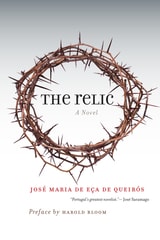
The Relic
A NovelJosé Maria De Eça De Queirós
Tagus Press, 2012
The Relic is an irreverent fictional autobiography narrating the picaresque adventures of Teodorico, a Portuguese playboy determined to be the sole heir of his absurdly pious, sexually repressed, and tyrannical Auntie. Sent to the Holy Land, he returns with what he presumes is the “relic of relics” in hopes of persuading Auntie to bequeath her vast fortune to him. While in Jerusalem, Teodorico has a vision in which he witnesses Christ's trial and crucifixion and the founding of Christianity—with a twist.
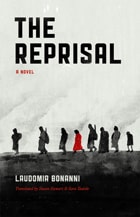
The Reprisal
A NovelLaudomia Bonanni
University of Chicago Press, 2013
Based on a number of incidents that took place in Abruzzo during the war, Laudomia Bonanni’s compact and tragic novel explores the overwhelming conflicts between ideology and community, justice and vengeance. The story is embedded in the cruel reality of Italian fascism, but its themes of revenge, sacrifice, and violence emerge as universal, delivered in prose that is at once lyrical and brutal.
The Round Dance
A NovelCarmine Abate
Rutgers University Press, 2024
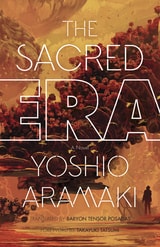
The Sacred Era
A NovelAramaki Yoshio
University of Minnesota Press, 2017
The magnum opus of a Japanese master of speculative fiction, and a book that established Yoshio Aramaki as a leading representative of the genre, The Sacred Era is part post-apocalyptic world, part faux-religious tract, and part dream narrative. In a distant future ruled by a new Papal Court serving the Holy Empire of Igitur, a young student known only as K arrives at the capital to take The Sacred Examination, a text that will qualify him for metaphysical research service with the court. His performance earns him an assignment in the secret Planet Bosch Research Department; this in turn puts him on the trail of a heretic executed many years earlier, whose headless ghost is still said to haunt the Papal Court, which carries him on an interplanetary pilgrimage across the Space Taklamakan Desert to the Planet Loulan, where time stands still, and finally to the mysterious, supposedly mythical Planet Bosch, a giant, floating plant-world that once orbited Earth but has somehow wandered 1,000 light years away.
K’s journey to this strange world, seemingly sprung from Hieronymus Bosch’s Garden of Earthly Delights, is a journey into inner and outer space, as the novel traffics in mystic and metaphysical questions only to transform them into technical and astrophysical problems, translating the substance of religious and mythic texts into the language of science fiction.
The Safe House
A NovelChristophe Boltanski
University of Chicago Press, 2017
When the Nazis came, Étienne Boltanski divorced his wife and walked out the front door, never to be seen again during the war. So far as the outside world knew, the Jewish doctor had fled. The truth was that he had sneaked back to hide in a secret crawl space at the heart of the house. There he lived for the duration of the war. With the Liberation, Étienne finally emerged, but he and his family were changed forever—anxious, reclusive, yet proudly eccentric. Their lives were spent, amid Bohemian disarray and lingering wartime fears, in the mansion’s recesses or packed comically into the protective cocoon of a Fiat.
That house (and its vehicular appendage) is at the heart of Christophe Boltanski’s ingeniously structured, lightly fictionalized account of his grandparents and their extended family. The novel unfolds room by room—each chapter opening with a floorplan—introducing us to the characters who occupy each room, including the narrator’s grandmother—a woman of “savage appetites”—and his uncle Christian, whose haunted artworks would one day make him famous. “The house was a palace,” Boltanski writes, “and they lived like hobos.” Rejecting convention as they’d rejected the outside world, the family never celebrated birthdays or even marked the passage of time, living instead in permanent stasis, ever more closely bonded to the house itself.
The Safe House was a literary sensation when published in France in 2015 and won the Prix de Prix, France’s most prestigious book prize. A French-language film adaptation, La cache, was released in 2025 from director Lionel Baier. With hints of Oulipian playfulness and an atmosphere of dark humor, The Safe House is an unforgettable portrait of a self-imprisoned family.
The Safety of Deeper Water
A NovelTim Poland
West Virginia University Press, 2009
When Sandy Holston is on dry land, she’s nothing special: a nurse who wears her hair in a ponytail and prefers a fishing lure as an earring. But once she dons waders, picks up a fly rod, and steps into a river, she becomes a remarkable, elegant fisherwoman who’s at peace with the world.
After surviving her marriage to Vernon - her violent, incarcerated ex-husband - peace is just what Sandy needs. So she moves to Damascus, a small town on the Ripshin River, where she plans to enjoy the fishing and the solitude. Finally she is on the brink of a life she desires in a place she loves. But as the Ripshin’s trout mysteriously die off, and as Sandy grows closer to a reclusive neighbor who has a propensity for fishing naked, her plans are put in jeopardy. Will Sandy be able to find peace - in the river or out - once Vernon is released from prison and fulfills his promise to hunt her down?
The Scummers
A NovelLEE MAYNARD
West Virginia University Press, 2012
The Shy Assassin
A NovelClara Usón; translated from Spanish by Lily Meyer
Vanderbilt University Press, 2025
In September 1977, Sandra Mozarowsky—a seventeen-year-old Spanish erotic film actress and purported lover of King Juan Carlos I—died after leaping from her fourth-floor balcony in Madrid. The mysterious circumstances surrounding her death drew immediate public interest and generated conspiracy theories. Was her death a suicide? A covert murder? A cry for help? In The Shy Assassin, award-winning Spanish novelist Clara Usón uses the tragic death of Mozarowsky to provide a powerful philosophical meditation on suicide and the turbulent years of the Spanish transition to democracy. Playfully drawing upon the work of philosophers like Ludwig Wittgenstein and Jean-Paul Sartre, Usón weaves together her own experiences as a rebellious teenager with those of Mozarowsky with great power and emotion. Winner of the prestigious Sor Juana Inés de la Cruz Prize, Usón’s novel is a funny, provocative, and deeply entertaining look at Spanish culture during a time of historic political and cultural change.

The Ski Jumpers
A NovelPeter Geye
University of Minnesota Press, 2022
Now in paperback: a writer and former ski jumper facing a terminal diagnosis takes one more leap—into a past of soaring flights and broken family bonds
A brilliant ski jumper has to be fearless—Jon Bargaard remembers this well. His memories of daring leaps and risks might be the key to the book he’s always wanted to write: a novel about his family, beginning with Pops, once a champion ski jumper himself, who also took Jon and his younger brother Anton to the heights. But Jon has never been able to get past the next, ruinous episode of their history, and now that he has received a terrible diagnosis, he’s afraid he never will.
In a bravura performance, Peter Geye follows Jon deep into the past he tried so hard to leave behind, telling the story he spent his life escaping. It begins with a flourish, his father and his hard-won sweetheart fleeing Chicago, and a notoriously ruthless gangster, to land in North Minneapolis. That, at least, was the tale Jon heard, one that becomes more and more suspect as he revisits the events that eventually tore the family in two, sending his father to prison, his mother to the state hospital, and placing himself, a teenager, in charge of thirteen-year-old Anton. Traveling back and forth in time, Jon tells his family’s story—perhaps his last chance to share it—to his beloved wife Ingrid, circling ever closer to the truth about those events and his own part in them, and revealing the perhaps unforgivable violence done to the brothers’ bond.
The dream of ski jumping haunts Jon as his tale unfolds, daring time to stop just long enough to stick the landing. As thrilling as those soaring flights, as precarious as the Bargaard family’s complicated love, as tender as Jon’s backward gaze while disease takes him inexorably forward, Peter Geye’s gorgeous prose brings the brothers to the precipice of their relationship, where they have to choose: each other, or the secrets they’ve held so tightly for so long.
Cover alt text: Lightly gradiented periwinkle sky background with white cloud in upper right corner and snow in lower left. At top, a cutout black-and-white image of a ski jumper appears and is cut off at the neck. Foreground: Book title in all-caps red, with author name beneath in all-caps white and “A Novel” beneath in all-cap dark grey. All text reads at a motion slant.
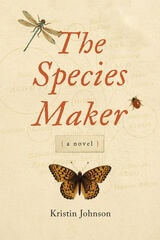
The Species Maker
A NovelKristin Johnson
University of Alabama Press, 2021
A historical novel about the role of science in modern life, set against the backdrop of the 1925 Scopes Trial.
When William Jennings Bryan began a campaign to get evolution out of American schools in the 1920s, entomologist Martin Sullivan sought refuge from the tumult in his research. Although the theory of evolution provides the foundation for his scientific work, he prefers the careful methods of observation and classification to the passion of public debate. But when Martin takes a job teaching college biology in Seattle, he finds it increasingly difficult to retreat to the haven of science. His students are taking sides in the debate over whether religion and evolution can be reconciled. Socialists are using evolution to justify revolution. Politicians are citing Darwin in defense of anti-immigration laws. And Martin’s own colleagues are insisting that only eugenic reforms will save the world. As anti-evolution legislation spreads across the country and passions flare on all sides, the effort to apply science to marriage laws and mate choice even begins to touch the lives of those he loves. By the time the state of Tennessee puts John T. Scopes on trial for teaching evolution in the summer of 1925, Martin can no longer ignore the debates that surround him and must take a stand in the fight over the role of science in American society.
Although set a hundred years ago, The Species Maker wrestles with many issues that continue to confront scientists and science watchers in the present day. Kristin Johnson draws on her experiences in the classroom and extensive knowledge of the history of science to depict what it might have been like for a careful scientist to watch the heated debates over teaching evolution in the United States in the 1920s.
Visit www.thespeciesmaker.com for supplemental material including historical essays, links to online primary sources, a glossary, and guiding questions useful for the classroom or book clubs.
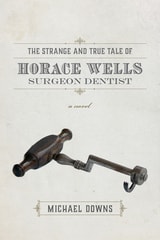
The Strange and True Tale of Horace Wells, Surgeon Dentist
A NovelMichael Downs
Acre Books, 2018
But that discovery would also thrust Wells into scandals that threatened his reputation, his family, and his sanity—hardships and triumphs that resonate in today’s struggles with what hurts us and what we take to stop the hurt.
In this novel, Michael Downs mines the gaps in the historical record and imagines the motivations and mysteries behind Wells’s morbid fascination with pain, as well as the price he and his wife, Elizabeth, paid—first through his obsession, then his addiction.
The book is a love story, but also a story of what love can’t redeem; of narcotic dreams and waking insanity; of humbug and miracle; of pain’s destruction and what pains can never be eased. Following Wells throughout New England and across the ocean to Paris, the novel immerses the reader in the nineteenth century, conveying through rich physical description and telling dialogue the tragic life of a dentist who gave everything to rid the world of suffering.
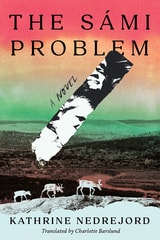
The Sámi Problem
A NovelKathrine Nedrejord
University of Minnesota Press, 2027
An incisive novel illuminating a young mother’s reckoning with her own identity and Sámi lineage through the lives and struggles of her ancestors
As a freelance journalist living in France, Marie Engmo has traveled far and wide to write about languages and local cultures threatened with extinction. But when she returns home to Norway for her áhkku’s (grandmother’s) funeral, she recognizes how far she has strayed from her own sense of self and her Sámi identity. Kathrine Nedrejord’s acclaimed novel—winner of Norway’s national book award—is the lucid and compelling story of Marie’s emotional search through her family’s past for a history and legacy that she might bequeath to her own infant daughter.
In spare and elegant prose, Nedrejord illuminates a young woman’s fierce and clear-eyed reckoning with the sacrifice and oppression that has marked the women and men in her family and generations of Indigenous Sámi communities in the northern reaches of Norway. As Marie awakens to the lengths her mother, grandmother, and great-grandmother traversed to survive discrimination and displacement, she uncovers and embodies their strength and dignity that are her—and her daughter’s—inheritance. What emerges is an unflinching examination of belonging to a minority that can never dominate, that will always have to negotiate and compromise its place in the world. As stirring as it is troubling, The Sámi Problem is itself an awakening and a literary triumph.
Retail e-book files for this title are screen-reader friendly.
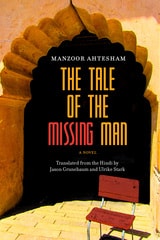
The Tale of the Missing Man
A NovelManzoor Ahtesham, translated from the Hindi by Jason Grunebaum and Ulrike Stark
Northwestern University Press, 2018
The Tale of the Missing Man (Dastan-e Lapata) is a milestone in Indo-Muslim literature. A refreshingly playful novel, it explores modern Muslim life in the wake of the 1947 partition of India and Pakistan. Zamir Ahmad Khan suffers from a mix of alienation, guilt, and postmodern anxiety that defies diagnosis. His wife abandons him to his reflections about his childhood, writing, ill-fated affairs, and his hometown, Bhopal, as he attempts to unravel the lies that brought him to his current state (while weaving new ones).
A novel of a heroic quest gone awry, The Tale of the Missing Man artfully twists the conventions of the Urdu romance, or dastan, tradition, where heroes chase brave exploits that are invariably rewarded by love. The hero of Ahtesham’s tale, living in the fast-changing city of Bhopal during the 1970s and ’80s, suffers an identity crisis of epic proportions: he is lost, missing, and unknown both to himself and to others. The result is a twofold quest in which the fate of protagonist and writer become inextricably and ironically linked. The lost hero sets out in search of himself, while the author goes in search of the lost hero, his fictionalized alter ego.
New York magazine cited the book as one of “the world's best untranslated novels.” In addition to raising important questions about Muslim identity, Ahtesham offers a very funny and thoroughly self-reflective commentary on the modern author’s difficulties in writing autobiography.
The Global Humanities Translation Prize is awarded annually to a previously unpublished translation that strikes the delicate balance between scholarly rigor, aesthetic grace, and general readability, as judged by a rotating committee of Northwestern faculty, distinguished international scholars, writers, and public intellectuals. The Prize is organized by the Global Humanities Initiative, which is jointly supported by Northwestern University’s Buffett Institute for Global Studies and Kaplan Institute for the Humanities.
The Teeth of the Souls
A NovelSteve Yates
Moon City Press, 2015
The story begins just after the Civil War when Leighton Shea Morkan, son of Irish immigrants, marries Patricia Grünhaagen Weitzer, daughter of a German banking family. Yet he can’t let go of his childhood love and wartime confidante, the house hand and former slave, Judith. Both unions produce children, one a shrouded secret, and one the heir to the Morkan legacy: the limestone quarries of Springfield, Missouri, and the bloody past, what Judith calls “The Teeth of the Souls.”
Grounded in broad historical research and spanning Missouri’s reconstruction, vigilantism, and fall from grace, The Teeth of the Souls chronicles the violent melding of immigrant strains—Irish, German, Scots-Irish, and African American—into the fabric of the Ozarks.
The Thirty-Foot Elvis
A novelJane F. Hankins
Parkhurst Brothers, Inc., 2013
The Trouble with Being Born
A NovelJeffrey DeShell
University of Alabama Press, 2008
The True Story of the Novel
Margaret Anne Doody
Rutgers University Press, 1997
Twentieth-century historians and critics defending the novel have emphasized its role as superseding something else, as a sort of legitimate usurper that deposed the Epic, a replacement of myth, or religious narrative. To say that the Age of Early Christianity was really also the Age of the Novel rumples such historical tidiness––but so it was. From the outset of her discussion, Doody rejects the conventional Anglo-Saxon distinction between Romance and Novel. This eighteenth-century distinction, she maintains, served both to keep the foreign––dark-skinned peoples, strange speakers, Muslims, and others––largely out of literature, and to obscure the diverse nature of the novel itself.
This deeply informed and truly comparative work is staggering in its breadth. Doody treats not only recognized classics, but also works of usually unacknowledged subgenres––new readings of novels like The Pickwick Papers, Puddn’head Wilson, L’Assommoir, Death in Venice, and Beloved are accompanied by insights into Death on the Nile or The Wind in the Willows. Non-Western writers like Chinua Achebe and Witi Ihimaera are also included. In her last section, Doody goes on to show that Chinese and Japanese novels, early and late, bear a strong and not incidental affinity to their Western counterparts. Collectively, these readings offer the basis for a serious reassessment of the history and the nature of the novel.
The True Story of the Novel marks the beginning of the twenty-first century’s understanding of fiction and of culture. It is essential reading for anyone with an interest in literature.
The Tunnel of Love
A NovelPeter De Vries
University of Chicago Press, 2015
The Twelve Chairs
A NovelIlya Ilf and Evgeny Petrov, Translated from the Russian by Anne O. Fisher with a Foreword by Alexander Ilf
Northwestern University Press, 2011
Winner, 2012 Northern California Book Award for Fiction in Translation
More faithful to the original text and its deeply resonant humor, this new translation of The Twelve Chairs brings Ilf and Petrov’s Russian classic fully to life. The novel’s iconic hero, Ostap Bender, an unemployed con artist living by his wits, joins forces with Ippolit Matveyevich Vorobyaninov, a former nobleman who has returned to his hometown to look for a cache of missing jewels hidden in chairs that have been appropriated by the Soviet authorities. The search for the chairs takes them from the provinces of Moscow to the wilds of the Transcaucasus mountains. On their quest they encounter a variety of characters, from opportunistic Soviet bureaucrats to aging survivors of the old propertied classes, each one more selfish, venal, and bungling than the last. A brilliant satire of the early years of the Soviet Union, as well as the inspiration for a Mel Brooks film, The Twelve Chairs retains its universal appeal.
The Typewriter Satyr
A NovelDwight Allen
University of Wisconsin Press, 2009
Finalist, General Fiction, Midwest Book Awards

The Very Air
A NovelDouglas Bauer
University of Iowa Press, 2014
The Very Air is a compelling exploration of human motives and hidden meanings. It is a detailed picture of America’s myth of the rugged individual in the psychological and narrative tradition of The Great Gatsby and Citizen Kane. With a resonant sense of the period and culture, Douglas Bauer evokes the freewheeling feel of the old Southwest in the charlatans of our own era. The Very Air shows, through storytelling both exhilarating and chilling, that the past is prologue and that our personal histories indeed shape the course of our individual futures.
The Voice of the River
A NovelMelanie Rae Thon
University of Alabama Press, 2011
The Vortex
A NovelJosé Eustasio Rivera
Duke University Press, 2018

The Wallpaper Fox
A NovelMorris Philipson
University of Chicago Press, 2000
"Philipson gives us a very believable portrait of a marriage. He also gives us no easy answers . . . and best of all, real storytelling." —Publishers Weekly
"This solid and serious novel emerges as not just an expose of what really goes on behind the well-groomed facades of the affluent, but a thoughtful exploration of character and the efficacy of moral action in forming and reforming it." —Jane Larkin Crain, New York Times Book Review
"A swift, no-fudging narrative by a writer it is always rewarding to rediscover." —Sophie Wilkins, National Review
"An extraordinary novel, fascinating, compelling, and totally disconcerting." —Fort Worth Star-Telegram
"Has the drama, intelligence and moral force of an American Howards End."-Cynthia Ozick
The Wanderer
A NovelAlexander Veltman, Stephen A. Bruce
Northwestern University Press, 2026
An unnamed narrator embarks on a rambling journey across the diverse borderlands of the Russian and Ottoman Empires—all without leaving his divan. Drawing on his own experiences in Bessarabia during the Russo-Turkish War of 1828–29, A. F. Veltman describes our Romantic narrator poring over a map and traversing distant, contested regions—at once imperial backwaters and cosmopolitan crossroads—where Romanians, Ruthenians, Jews, Bulgarians, Germans, and Turks comingle.
Meandering and motley in form and language, this lost classic of the early nineteenth century deploys metafictional innovations that anticipate postmodernist literature. The novel is speckled with dictionary entries, multiplication tables, philosophical digressions, and love poetry as Veltman swings from Gothic horror to antiquarian commentary to burlesque comedy. Past, present, and fantasy blend together, as Alexander the Great, Ovid, and Augustus join the narrator on his daydreamed journey of self-discovery.
Hugely popular in its day, The Wanderer is a remarkable tale that depicts the extraordinary places and peoples that met along the fault lines of once-great empires.
The Waters of Star Lake
A NovelSara Rath
University of Wisconsin Press, 2012
Newly widowed Natalie Waters expects only nostalgia and solitude at her quiet, rustic cabin. But the wilderness conceals more than one perilous mystery. Where in Wisconsin’s Northwoods did the notorious gangster John Dillinger hide $210,000 following a violent FBI shootout? And why do the local timberwolves incite so much rage among Natalie’s neighbors?
As predators circle and howl in the dark, Ginger, the bartender at the nearby Star Lake Saloon, draws Natalie deep into the secrets not only of Dillinger but of the ecologies of family, forest, and heart. With the reluctant support of her granddaughter and advice from a handsome wolf biologist, Natalie is forced to choose between adversity and adventure.
Sara Rath continues her popular Northwoods saga in this affirming and often humorous tale of romance, betrayal, and danger.
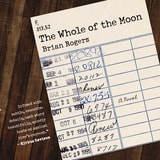
The Whole of the Moon
A NovelBrian Rogers
University of Nevada Press, 2017
An actor sits poolside waiting to hear whether he has been cast in a television pilot. Two kids ditch school in 1964 and go for a hike in the woods that turns dangerous. A woman named Dot remembers her husband who spent years working on a musical adaptation of The Great Gatsby. A young woman Felicity deals with the consequences of an unexpected pregnancy. Mike, a former high school star, attends an open tryout for the California Angels baseball team. And a boarding school teacher tells the story of his cousin, a social climber who has disappeared in the wake of a murder. These are the characters that populate The Whole of the Moon. Brian Rogers’ novel is about determination and failure and life in Southern California away from the red carpet.
The Whole of the Moon
A NovelBrian Rogers
University of Nevada Press, 2017
An actor sits poolside waiting to hear whether he has been cast in a television pilot. Two kids ditch school in 1964 and go for a hike in the woods that turns dangerous. A woman named Dot remembers her husband who spent years working on a musical adaptation of The Great Gatsby. A young woman Felicity deals with the consequences of an unexpected pregnancy. Mike, a former high school star, attends an open tryout for the California Angels baseball team. And a boarding school teacher tells the story of his cousin, a social climber who has disappeared in the wake of a murder. These are the characters that populate The Whole of the Moon. Brian Rogers’ novel is about determination and failure and life in Southern California away from the red carpet.

The Wild Earth’s Nobility
A NovelFrank Waters
Ohio University Press, 2002
The Wild Earth’s Nobility is the first of Frank Waters’s semiautobiographical novels in the Pikes Peak saga. Here, in a frontier town in the shadow of the commanding mountain, the Rogier family settles near an age-old route of migrating Native Americans. In an era of prospecting, silver strikes, and frenzied mining, Joseph Rogier becomes a successful building contractor, rears a large family, and is gradually overwhelmed by the power of the great peak.
In Waters’s visionary prose, the story becomes a mythic journey to reconcile instinct and reason, consciousness and intuition, and the powerful emotions of a family struggling with its own dreams and human limitations.
Frank Waters (1902-1995), one of the finest chroniclers of the American Southwest, wrote twenty-eight works of fiction and nonfiction. Of Pike’s Peak (1971), the Chicago Daily News wrote, “It is a product of maturity, written with a sustained strength and beauty of style rarely found in fiction today.”
Pike’s Peak is composed of three condensed novels: The Wild Earth’s Nobility, Below Grass Roots, and The Dust within the Rock.
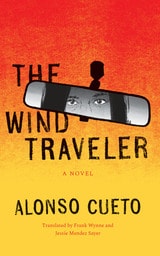
The Wind Traveler
A NovelBy Alonso Cueto; translated by Frank Wynne and Jessie Mendez Sayer
University of Texas Press, 2020
The Wind Traveler showcases the mesmerizing storytelling of Alonso Cueto at the top of his career. At the heart of his latest work is a seemingly ordinary man named Ángel, who sells kitchenware at a store in Lima. In the early 1990s, he had served as an army soldier, engaging in brutal acts whose aftermath still reverberates. He is forced to reckon with his past when a woman he was instructed to kill enters the store and buys a few items. How can she still be alive? What's more, how can she not recognize Ángel? Remarkably, she asks him to deliver her purchases to her house. From this moment, Ángel feels compelled to make amends through any means necessary, even if it requires sacrificing his life of quiet retirement.
A stirring tribute to the wounded souls who yearn to make peace with the past, The Wind Traveler offers a new vision of the fragile human connections that sustain a deeply fractured world.
The Wolf at Number 4
A NovelAyo Tamakloe-Garr
Ohio University Press, 2018
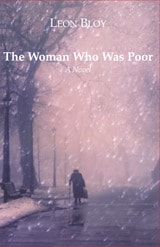
The Woman Who Was Poor
A NovelLeon Bloy
St. Augustine's Press, 2014
It is the story of a woman who is abysmally poor, brutally treated and exploited by her parents, living in the gutters of Paris, yet she retains the spiritual outlook and purity of a saint. We are spared no brutality, yet there are scenes of the most tender beauty.
The woman, Clotilde, becomes an artist's model, meeting all the great French writers, among them the gloomy and magnificent Marchenoir, who is Bloy himself. They are all impressed by the depth of her thoughts and feelings; she finally marries one of them. They are pitifully poor, and the pages that cover the birth and death of their child shock with horror while moving the reader in their tragic beauty and tenderness––for this is Bloy, always hovering between death and ecstasy. Left a widow, Clotilda finds her true vocation, a vocation of poverty. She is the woman who is poor, no other words describe her more accurately. The novel ends with those famous words of extraordinary optimism: "There is only one misery…not to be saints."
The Woods Colt
A Novel of the Ozarks HillsThames Williamson
University of Arkansas Press, 2023
Although more than one hundred novels set in the Ozarks were published before it, Thames Ross Williamson’s 1933 novel The Woods Colt was the first to achieve notable success both popularly and critically. Written entirely in regional dialect, The Woods Colt is the story of the violent and reckless Clint Morgan, whose attempts to secure love and freedom force him down a path of self-destruction.
Simultaneously exploitative and romantic, The Woods Colt carries us back to the heart of the Great Depression, heyday of the hillbilly in pop culture, when the perceived self-reliance and old-fashioned wisdom of rural people allowed audiences to not only escape their current circumstances but also imagine more hopeful ways of living. Williamson, a prolific author, answered this interest with a fast-paced and action-driven novel filled with folklore that had, ostensibly, been authenticated by none other than renowned Ozarks expert Vance Randolph.
The Woods Colt, with its familiar sense of danger and adventure, continues to offer insight and entertainment as it wrestles with timeless themes of economic struggle, cultural conflict, and modernization. With an introduction and explanatory notes from Phillip Douglas Howerton, this new edition makes the seminal novel available once more to scholars, regional enthusiasts, and anyone looking for a tale of the Ozark hills.
The Year She Disappeared
A NovelBy Ann Harleman
University of Texas Press, 2008
Nan and her four-year-old granddaughter Jane are taking their first airplane trip together, flying from Seattle to the East Coast. But this is no ordinary excursion. Nan is abducting Jane.
Nan's own daughter, Alex, believes Jane's father has been sexually abusing her, and she's asked Nan to take her away, to hide her. But when she and Jane arrive in Providence, Rhode Island, things begin to go wrong. The old friend whom Nan expected to stay with has vanished. Her son-in-law is on her trail. And Alex disappears.
"I'm too old for this!" Nan thinks, in furious, self-pitying despair. She wasn't a good wife; she wasn't a good mother. Now she's stranded in a strange city, without friends or money or even her own identity, in sole charge of a very unhappy little girl. When her new life offers new friends, new work, and even a new lover, she must decide whom to trust.
The Year She Disappeared explores the possibility—and the price—of late blooming love. Will the trials Nan faces during her year on the lam break her? Or will she discover who she really is?
The Year
A NovelTomas Espedal
Seagull Books, 2021
Written as a long poem, The Year is Espedal’s riveting stream of consciousness—profound, edgy, sometimes manic, but always intensely intimate.
These Granite Islands
A NovelSarah Stonich
University of Minnesota Press, 2013
These Granite Islands is an arresting novel about a woman who, on her deathbed, recalls the haunting and fateful summer of 1936, a summer that forever changed her life. Sarah Stonich’s debut novel, set on the Iron Range of Minnesota, is an intimate and gripping story of a friendship, a portrait of marriage, and a meditation on the tragedy of loss.
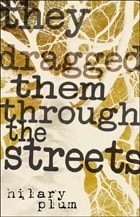
They Dragged Them through the Streets
A NovelHilary Plum
University of Alabama Press, 2013
They Dragged Them Through the Streets is a bold meditation on idealism, anger, and the American home front’s experience of today’s wars. This is an innovative work in the great tradition of war literature and a singular chronicle of one generation’s conflicts.
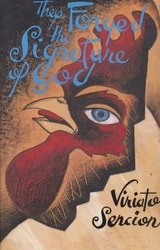
They Forged the Signature of God
A NovelViriato Sención
Northwestern University Press, 1995
Sención's novel follows the lives of three seminary students who suffer from church-state oppression. The book also gives a chilling portrait of Dr. Ramos, a sinister autocrat, who manages to survive six terms as president of his country through manipulation and tyranny. This finely textured novel gives a vivid picture of the internal politics of the Dominican Republic.
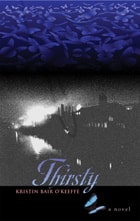
Thirsty
A NovelKristin Bair O’Keeffe
Ohio University Press, 2009
It is 1883, and all of Klara Bozic’s girlish dreams have come crashing down as she arrives in Thirsty, a gritty steel town carved into the slopes above the Monongahela River just outside of Pittsburgh. She has made a heartbreaking discovery. Her new husband Drago is as abusive as the father she left behind in Croatia.
In Kristin Bair O’Keeffe’s debut novel, Klara’s life unfolds over forty years as she struggles to find her place in a new country where her survival depends on the friends who nurture her: gutsy, funny Katherine Zupanovic, who isn‘t afraid of Drago’s fist; BenJo, the only black man in Thirsty to have his own shop; and strangely enough, Old Man Rupert, the town drunk.
Thirsty follows a chain of unlikely events that keep Klara’s spirit aloft: a flock of angelic butterflies descends on Thirsty; Klara gives birth to her first child in Old Man Rupert’s pumpkin patch; and BenJo gives her a talking bird. When Klara’s daughter marries a man even more brutal than Drago, Klara is forced to act. If she doesn’t finally break the cycle of violence in her family, her granddaughters will one day walk the same road, broken and bruised. As the threads that hold her family together fray and come undone, Klara has to decide if she has the courage to carve out a peaceful spot in the world for herself and her girls.
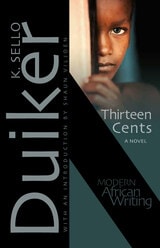
Thirteen Cents
A NovelK. Sello Duiker
Ohio University Press, 2013
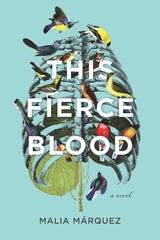
This Fierce Blood
A NovelMalia Márquez
Acre Books, 2021
In rural late-nineteenth-century New England, Wilhelmina Sylte is a settler starting a family with her Norwegian immigrant husband. When she forms an inexplicable connection with a mountain lion and her cubs living near their farm, Mina grapples with divided loyalties and the mysterious bond she shares with the animals.
In 1927 in southern Colorado, Josepa is accused of witchcraft by a local priest for using the healing practices passed down from her Native mother. Fighting for her family’s reputation and way of life, Sepa finds strength in worldly and otherworldly sources.
When Magdalena, an ecologist, inherits her great-grandmother Wilhelmina’s Vermont property, she and her astrophysicist husband decide to turn the old farm into a summer science camp for teens. As Magda struggles with both personal and professional responsibilities, the boundary between science and myth begins to blur.
Rich in historical and cultural detail, This Fierce Blood combines magical realism with themes of maternal ancestral inheritance, and also explores the ways Hispano/Indigenous traditions both conflicted and wove together, shaping the distinctive character of the American Southwest. Readers of Téa Obreht and Ruth Ozeki will find much to admire in this debut novel.
This Here Is Devil's Work
A NovelCurtis Bradley Vickers
University of Nevada Press, 2021
A twelve-year veteran of the fireline, Morgan believes he knows what his teenage half-brother (Jeremy) needs to do to shrug off boyhood: spend a single season fighting forest fires to earn money for auto mechanic school. But when Jeremy joins the Ruby Mountain Hotshots and earns the respect and admiration of their fire boss (Bailey), Morgan must battle his own demons before they destroy him.
Meanwhile, life hasn’t been easy on Jacklynn—she longs to escape the small town in Montana where she has lived her whole life and reunite with her daughter and grandson in Tucson. Jacklynn wants to make up for a lifetime of missteps by protecting the boy and making sure her daughter stays on course. On the same day that an attractive stranger waltzes into her life, an opportunity for life-changing money presents itself in the form of a dozen pregnant heifers. The only trouble is, they aren’t hers—not yet, anyway.
Morgan and Jacklynn’s paths cross when lightning ignites a blaze in the untamed Montana wilderness, and their choices force each other into
the fury.
Set against the backdrop of wildfires raging across the West and the firefighters who continue to put their lives on the line, This Here Is Devil’s Work explores how love and loneliness can sour, and how they can eventually lead to desperate and self-destructive acts even for those people we consider heroic.
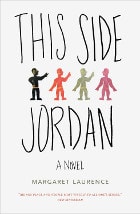
This Side Jordan
A NovelMargaret Laurence
University of Chicago Press, 2011
Best known for her novels about the Canadian prairie, Margaret Laurence began her career writing about West Africa. Based on her experience living with her husband on the Gold Coast (now Ghana) in the years just before independence, This Side Jordan confronts issues of race relations, sexism, and colonial exploitation.

Thomas Hardy from Serial to Novel
Mary Chase
University of Minnesota Press, 1927

Thunderclouds in the Forecast
A NovelClarence Major
Northwestern University Press, 2021
When Ray’s train is delayed in Lorena, a Gold Rush outpost turned college town, he meets Alice. Together they embark on a romance that tempts him to stay. By the time Ray arrives in San Francisco, Scotty has abandoned his bartending job, his rented room, and his scant belongings and skipped town with a married woman from Lorena. Now Ray has more than one reason to return.
A preeminent American writer who thrives on reinvention, Major returns with an unforgettable exploration of life on the brink of sweeping change. With spare prose and subtle poignancy, Thunderclouds in the Forecast probes love, loyalty, and belonging. As Toni Morrison wrote, “Clarence Major has a remarkable mind and the talent to match.”