Results by title
967 books match the query 'Theater' and 260 start with t
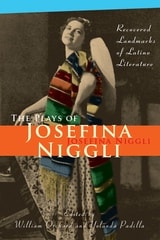
The Plays of Josefina Niggli
Recovered Landmarks of Latino LiteratureJosefina Niggli; Edited by William Orchard and Yolanda Padilla
University of Wisconsin Press, 2007
Although Niggli is perhaps best known for her fiction and folk plays, this anthology recovers her historical dramas, most of which have been long out of print or were never published. These plays are deeply concerned with the aftermath of the 1910 Mexican Revolution, imagining its implications for Mexico, Mexican Americans, and U.S.-Mexico relations. Included are Mexican Silhouettes (1928), Singing Valley (1936), The Cry of Dolores (1936), The Fair God (1936), Soldadera (1938), This is Villa! (1939), and The Ring of General Macias (1943). These works reflect on the making of history and often portray the Revolution through the lens of women’s experiences.
Also included in this volume are an extensive critical introduction to Niggli, a chronology of her life and writings, plus letters and reviews by, to, and about Josefina Niggli. that provide illuminating context for the plays.
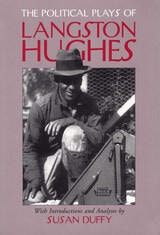
The Political Plays of Langston Hughes
Introductions and Analyses by Susan Duffy
Southern Illinois University Press, 2000
Among the most influential poets of the Harlem Renaissance, Langston Hughes is perhaps best remembered for the innovative use of jazz rhythms in his writing. While his poetry and essays received much public acclaim and scholarly attention, Hughes’ dramas are relatively unknown. Only five of the sixty-three plays Hughes scripted alone or collaboratively have been published (in 1963).
Published here, for the first time, are four of Hughes’ most poignant, poetic, and political dramas, Scottsboro Limited, Harvest (also known as Blood on the Fields), Angelo Herndon Jones, and De Organizer. Each play reflects Hughes’ remarkable professionalism as a playwright as well as his desire to dramatize the social history of the African American experience, especially in the context of the labor movements of the 1930s and their attempts to attract African American workers. Hughes himself counted prominent members of these leftist groups among his close friends and patrons; he formed a theater group with Whittaker Chambers, prompting an FBI investigation of Hughes and his writing in the 1930s. These plays, while easily read as idealistic propaganda pieces for the left, are nonetheless reflective of Hughes’ other more influential and studied works.
The first scholar to offer a systematic study of Hughes’ plays, Susan Duffy provides an informed introduction as well as a detailed analysis of each of the four plays. Duffy also establishes that De Organizer, a collaboration with noted jazz pianist and composer James P. Johnson (who also wrote its score) was indeed performed by the Labor Stage.
By making these forgotten texts available, and by presenting them within a scholarly discussion of 1930s leftist political movements, Duffy seeks to spark a renewed interest in Langston Hughes as an American playwright and political figure.
The Politics of Rape
Sexual Atrocity, Propaganda Wars, and the Restoration StageJennifer L. Airey
University of Delaware Press, 2013
Published by University of Delaware Press. Distributed worldwide by Rutgers University Press.
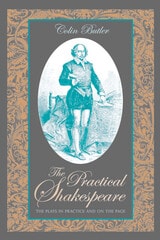
The Practical Shakespeare
The Plays in Practice and on the PageColin Butler
Ohio University Press, 2005
A comprehensive treatment of Shakespeare’s plays, The Practical Shakespeare: The Plays in Practice and on the Page illuminates for a general audience how and why the plays work so well.
Noting in detail the practical and physical limitations the Bard faced as he worked out the logistics of his plays, Colin Butler demonstrates how Shakespeare incorporated those limitations and turned them to his advantage: his management of entrances and exits; his characterization techniques; his handling of scenes off-stage; his control of audience responses; his organization of major scenes; and his use of prologues and choruses. A different aspect of the plays is covered in each chapter.
Butler draws most of his examples from mainstream plays, such as Macbeth, Othello, and Much Ado about Nothing. He brings special focus to A Midsummer Night’s Dream, which is treated as one of Shakespeare’s most important plays. Butler supports his major points with quotations, so readers can understand an issue even if they are unfamiliar with the particular play being discussed. The author also cross-references the use of dramatic devices in the plays, increasing the reader’s enjoyment and understanding of Shakespeare’s achievements.
Clear, jargon-free, easy-to-use, and comprehensive, The Practical Shakespeare looks at stagecraft and playwriting as conduits for students, teachers, and general audiences to engage with, understand, and appreciate the genius of Shakespeare.
The Problem of the Color[blind]
Racial Transgression and the Politics of Black PerformanceBrandi Wilkins Catanese
University of Michigan Press, 2011
The Purpose of Playing
Shakespeare and the Cultural Politics of the Elizabethan TheatreLouis Montrose
University of Chicago Press, 1996
Montrose first locates the public and professional theater within the ideological and material framework of Elizabethan culture. He considers the role of the professional theater and theatricality in the cultural transformation that was concurrent with religious and socio-political change, and then concentrates upon the formal means by which Shakespeare's Elizabethan plays called into question the absolutist assertions of the Elizabethan state. Drawing dramatic examples from the genres of tragedy and history, Montrose finally focuses his cultural-historical perspective on A Midsummer Night's Dream.
The Purpose of Playing elegantly demonstrates how language and literary imagination shape cultural value, belief, and understanding; social distinction and interaction; and political control and contestation.
The Recurrence of Fate
Theatre and Memory in Twentieth-Century RussiaSpencer Jay Golub
University of Iowa Press, 1994
How, why, and according to whose definitions and requirements does a culture self-consciously create memory and project its fate? In this remarkable book—the first in English to treat Russian history as theatre and cultural performance—Spencer Golub reveals the performative nature of Russian history in the twentieth century and the romantic imprisonment/self-imprisonment of the creative intelligentsia within this scenario.
The Revolution Will Be Improvised
The Intimacy of Cultural ActivismElizabeth Rodriguez Fielder
University of Michigan Press, 2024
Reading the output of these programs, Elizabeth Rodriguez Fielder argues that intimacy-making became an extension of participatory democracy. In doing so, Rodriguez Fielder supplants the success-failure binary for understanding social movements, focusing instead on how care work aligns with creative production. The Revolution Will Be Improvised returns to improvisation’s roots in economic and social necessity and locates it as a core tenet of the aesthetics of obligation, where a commitment to others drives the production and result of creative work. Thus, this book puts forward a methodology to explore the improvised, often ephemeral, works of art activism.
The Roots of Theatre
Rethinking Ritual and Other Theories of OriginEli Rozik
University of Iowa Press, 2002
The San Francisco Mime Troupe Reader
Susan Vaneta Mason, Editor
University of Michigan Press, 2005
It is also a history of the company that was the theater of the counterculture movement in the 1960s and that, against all odds, has managed to survive the often hostile economic climate for the arts in the United States. The plays selected are diverse, representing some of the Troupe's finest shows, and the book's illustrations capture some of the Troupe's most memorable moments.
These hilarious, edgy, and imaginative scripts are accompanied by insightful commentary by theater historian and critic Susan Vaneta Mason, who has been following the Troupe for more than three decades. The Mime Troupe Reader will engage and entertain a wide range of audiences, not only general readers but also those interested in the history of American social protest, the counterculture of the 1960s-particularly the San Francisco scene-and the evolution of contemporary political theater. It will also appeal to the legions of Troupe fans who return every year to see them stand up against another social or corporate Goliath.
The Sarah Siddons Audio Files
Romanticism and the Lost VoiceJudith Pascoe
University of Michigan Press, 2013
“The theatre scholar’s daunting but irresistible quest to recover some echoes of performance of the past has never been more engagingly presented than in Pascoe’s account of tracing the long-silenced voice of Sarah Siddons. Her report is a warm, witty, and highly informative exploration of the methodology and the pleasures of historical research.”
—Marvin Carlson, author of The Haunted Stage: The Theatre as Memory Machine
During her lifetime (1755–1831), English actress Sarah Siddons was an international celebrity acclaimed for her performances of tragic heroines. We know what she looked like—an endless number of artists asked her to sit for portraits and sculptures—but what of her famous voice, reported to cause audiences to hyperventilate or faint? In The Sarah Siddons Audio Files, Judith Pascoe takes readers on a journey to discover how the actor’s voice actually sounded. In lively and engaging prose, Pascoe retraces her quixotic search, which leads her to enroll in a “Voice for Actors” class, to collect Lady Macbeth voice prints, and to listen more carefully to the soundscape of her life.
Bringing together archival discoveries, sound recording history, and media theory, Pascoe shows how romantic poets’ preoccupation with voices is linked to a larger cultural anxiety about the voice’s ephemerality. The Sarah Siddons Audio Files contributes to a growing body of work on the fascinating history of sound and will engage a broad audience interested in how recording technology has altered human experience.
The Scene of Foreplay
Theater, Labor, and Leisure in 1960s New YorkGiulia Palladini
Northwestern University Press, 2017
Matching an original approach to historical materials and theoretical reflection, Palladini addresses the peculiar forms of production, reproduction, and consumption developed in the 1960s as labors of love, creating for artists a condition of “preliminarity” toward professional work and also functioning as a counterforce within productive economy, as a prelude where value is not yet assigned to labor.
The Scene of Foreplay proposes that such labors of love can be considered both as paradigmatic for contemporary forms of precarious labor and also resonating with echoes from marginal histories of the performing arts, in a nonlinear genealogy of queer resistance to ideas of capitalist productivity and professionalism. The book offers much for those interested in performance theory as well asin the history of theater and performance arts in the 1960s.
The Scenographic Imagination, Third Edition
Darwin Reid Payne
Southern Illinois University Press, 1993
In this enlarged and thoroughly revised third edition of his widely used text, Darwin Reid Payne explores the principles and philosophies that shape the visual elements of theatre.
Payne sets out to discover who scenographers are and to define their responsibilities. He sees scenographers as not merely craftspersons but artists with "a special vision that spans all the arts." Such artists are in a position to "extend and amplify underlying meanings of the production." The proper goal of beginning scenographers, according to Payne, is one day to be able to approach the job as artists in full command of their craft.
Payne seeks to instill in beginning scenographers a basic core of knowledge: an understanding of theatre history and the development of drama; a knowledge of art history and an understanding of periods and styles of architecture, painting, sculpture, furnishings, and costume; and a familiarity with the principles, techniques, and materials of pictorial and three-dimensional design. This new edition contains 248 illustrations, 38 more than the second edition. Payne’s goal, certainly, is to teach students what to do and how to do it; equally important, however, is Payne’s view that scenographers must know why.
To Payne, "Scenography is an art whose scope is nothing less than the whole world outside the theatre." Scenographers must read not only in their own field but in others as well. Payne has incorporated into his text many suggestions for outside readings, quoting passages and even entire chapters from important works. Stressing research, Payne argues that without knowledge of the literature of their own and related arts, scenographers cannot grow. And that is the emphasis of this book: to present aspiring scenographers with an approach and a set of concepts that will enable them to grow. Toward that end, Payne establishes five priorities, the first of which is to develop in students what he calls "time vision," or the ability to "see" the historical past as a living place with living inhabitants. The second priority is to bring about an awareness that allows students to "see" beneath the surface of objects and events. Third, students must be helped to recognize and appreciate the difference between the "concept of space as it exists outside the theatre and the concept of space as it is used within the theatre." The fourth priority is to ingrain in students an understanding of the importance of imagery to the scenographer, and the final priority is to teach those technical skills necessary to carry out the concepts of the scenographer.
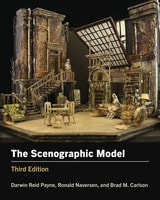
The Scenographic Model
Third EditionDarwin Reid Payne, Ronald Naversen, and Brad M. Carlson
Southern Illinois University Press, 2025
An authoritative guide to modelmaking for theater
This third edition of noted scenographer Darwin Reid Payne’s landmark text builds upon Payne’s theories and exercises to provide a modern exploration of the practice of theatrical modelmaking. With chapters on traditional and contemporary materials, tools, and techniques, the book serves as a foundational guide to understanding the historical, theoretical, and practical aspects of scenographic modelmaking, making it essential for the beginner, generalist, and professional design practitioner.
The volume begins with a brief history of the scenographic model and explores how modelmaking has adapted to changes in materials, technology, and commercial influences over time. It details setting up a safe, productive model-building studio before introducing the types and purposes of various scenographic models. It then instructs the reader in constructing common model elements and accessories. Later chapters explore how the models reveal stage space and create mood and atmosphere through tonal shading and lighting; discuss the use of found objects, collage techniques, and projection models in scenic design; and delve into 3D printing and computer routering. The final chapter provides information on various aspects of photography and image sharing related to design and production communication.
This comprehensive text provides information not just from theater but also from other modeling disciplines and sources, including architecture, film, dioramas, dollhouse modeling, and model railroading. A useful resource for high school, community college, university, and community theater enthusiasts, it is an excellent reference book for theater designers throughout the country.
The Second City Almanac of Improvisation
Anne Libera and Second City, Inc.
Northwestern University Press, 2004
The Second City Almanac of Improvisation - like the theatre itself - is a collection of diverse ideas, viewpoints, and memories, written by a vast array of teachers, actors, and directors who all got their start at the legendary comedy theatre. Fred Willard recalls his introduction to The Second City style in the mid-Sixties; Tim Kazurinsky gives a hilarious visual demonstration on the art of object work; "Saturday Night Live" star Tina Fey talks about re-improvising material as a mode of writing revue comedy; noted director Mick Napier takes on the thorny debate between long-form improvisation and short-form improvisation. Anne Libera guides the reader through each essay by providing a road map for understanding how The Second City method of improv-based comedy has become the industry standard.
Mike Nichols, Elaine May, Alan Arkin, Joan Rivers, Robert Klein, Peter Boyle, Harold Ramis, John Belushi, Dan Aykroyd, Bill Murray, John Candy, Martin Short, Gilda Radner, George Wendt, Jim Belushi, Bonnie Hunt, Mike Myers, Ryan Stiles, Rachel Dratch, Nia Vardalos - no other theatre can boast an alumni list of this magnitude. The Second City Almanac of Improvisation provides practical instruction, personal details, and inspiration to both improvisers and their fans.
The Sixties, Center Stage
Mainstream and Popular Performances in a Turbulent DecadeEdited by James M. Harding and Cindy Rosenthal
University of Michigan Press, 2017
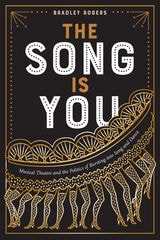
The Song Is You
Musical Theatre and the Politics of Bursting into Song and DanceBradley Rogers
University of Iowa Press, 2020
Musicals, it is often said, burst into song and dance when mere words can no longer convey the emotion. This book argues that musicals burst into song and dance when one body can no longer convey the emotion. Rogers shows how the musical’s episodes of burlesque and minstrelsy model the kinds of radical relationships that the genre works to create across the different bodies of its performers, spectators, and creators every time the musical bursts into song. These radical relationships—borne of the musical’s obsessions with “bad” performances of gender and race—are the root of the genre’s progressive play with identity, and thus the source of its subcultural power. However, this leads to an ethical dilemma: Are the musical’s progressive politics thus rooted in its embrace of regressive entertainments like burlesque and minstrelsy?
The Song Is You shows how musicals return again and again to this question, and grapple with a guilt that its joyous pleasures are based on exploiting the laboring bodies of its performers. Rogers argues that the discourse of “integration”—which claims that songs should advance the plot—has functioned to deny the radical work that the musical undertakes every time it transitions into song and dance. Looking at musicals from The Black Crook to Hamilton, Rogers confronts the gendered and racial dynamics that have always under-girded the genre, and asks how we move forward.

The Surprising Effects of Sympathy
Marivaux, Diderot, Rousseau, and Mary ShelleyDavid Marshall
University of Chicago Press, 1988
Placing novels in the context of eighteenth-century writing about theater, fiction, and painting, Marshall argues that an unusual variety of authors and texts were concerned with the possibility of entering into someone else's thoughts and feelings. He shows how key eighteenth-century works reflect on the problem of how to move, touch, and secure the sympathy of readers and beholders in the realm of both "art" and "life." Marshall discusses the demands placed upon novels to achieve certain effects, the ambivalence of writers and readers about those effects, and the ways in which these texts can be read as philosophical meditations on the differences and analogies between the experiences of reading a novel, watching a play, beholding a painting, and witnessing the spectacle of someone suffering. The Surprising Effects of Sympathy traces the interaction of sympathy and theater and the artistic and philosophical problems that these terms represent in dialogues about aesthetics, moral philosophy, epistemology, psychology, autobiography, the novel, and society.
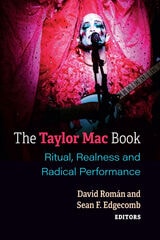
The Taylor Mac Book
Ritual, Realness and Radical PerformanceDavid Román and Sean F. Edgecomb, Editors
University of Michigan Press, 2023
Featuring essays, interviews, and commentaries by noted critics and artists, the volume examines the vastness of Mac’s theatrical imagination, the singularity of their voice, the inclusiveness of their cultural insights and critiques, and the creativity they display through stylistic and formal qualities and the unorthodoxies of their personal and professional trajectories. Contributors consider the range of Mac’s career as a playwright, performer, actor, and singer, expanding and enriching the conversation on this much-celebrated and deeply resonant body of work.
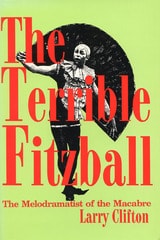
The Terrible Fitzball
The Melodramatist of the MacabreLarry Stephen Clifton
University of Wisconsin Press, 1993
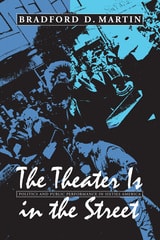
The Theater Is in the Street
Politics and Public Performance in 1960s AmericaBradford D. Martin
University of Massachusetts Press, 2004
During the 1960s, the SNCC Freedom Singers, The Living Theatre, the Diggers, the Art Workers Coalition, and the Guerrilla Art Action Group fused art and politics by staging unexpected and uninvited performances in public spaces. Through their activism and the response it provoked, art, theater, and politics began to converge and assume a new visibility in everyday life. While their specific political visions varied, these groups shared the impulse to stage performances and actions publicly—"in the streets"—eschewing museums, theaters, and other conventional halls of culture. Bradford D. Martin offers detailed portraits of each of these groups and examines why they embraced public performance as a vehicle to express and advance their politics.
At a time when the New Left and the counterculture were on the rise, these artists reflected the decade's political and cultural radicalism and helped to define a new aesthetic. Civil rights activists mobilized singing in the struggle for desegregation, introducing a vibrant musical form into the public space. The Living Theatre culminated an arduous quest to mesh artistic and political goals, leading audiences from theaters into the streets to begin the “beautiful nonviolent anarchist revolution.” The Diggers playfully engaged San Francisco's counterculture in politics with their carnivalesque public actions. The Art Workers Coalition and the Guerrilla Action Art Group sought to disrupt the conventional art world, mounting protests in and around New York City museums.
By questioning the values and assumptions that separated art from politics, these groups not only established public performance as a legitimate aesthetic but also provided a new creative vocabulary for future generations of artists. Their continued involvement with the women's liberation movement, rural communes, and political street theater into the 1970s and beyond challenges the popular myth that activists disengaged from politics after the 1960s.
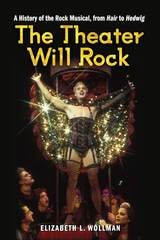
The Theater Will Rock
A History of the Rock Musical, from Hair to HedwigElizabeth L. Wollman
University of Michigan Press, 2010
"A much-needed study of the impact of rock music on the musical theater and its resulting challenges, complexities, failures, and successes. Anyone interested in Broadway will learn a great deal from this book."
---William Everett, author of The Musical: A Research Guide to Musical Theatre
"As Wollman weaves her historical narrative, she compellingly returns to . . . the conflict between the aesthetics and ideologies of rock music and the disciplined and commercial practices of the musical stage."
---Theatre Research International
"This well-written account puts the highs and lows of producing staged rock musicals in New York City into perspective and is well worth reading for the depth of insight it provides."
---Studies in Musical Theatre
Despite the genre’s influence and fame, there are still some critics who claim that the term “rock musical” is an oxymoron. The relationship between rock and the musical theater has been stormy from the start, and even the comparatively recent success of Rent has done little to convince theater producers that rock musicals are anything but highly risky ventures. Elizabeth L. Wollman explores the reasons behind these problematic connections and looks at the socioeconomic forces that underlie aesthetic decisions. She weighs the influence on the rock musical by mass media, sound, and recording technology, and the economic pressures that have affected New York theater in general over the past three decades. Finally, Wollman offers a meditation on the state of the musical, its relation to rock, and, ultimately, its future.
Packed with candid commentary by members of New York's vibrant theater community, The Theater Will Rock traces the rock musical’s evolution over nearly fifty years, in popular productions such as Hair, The Who's Tommy, Jesus Christ Superstar, The Rocky Horror Picture Show, Little Shop of Horrors, Rent, and Mamma Mia!—and in notable flops such as The Capeman.
Elizabeth L. Wollman is Assistant Professor of Music at Baruch College of the City University of New York.

The Theater in the Fiction of Marcel Proust
John Gaywood Linn
The Ohio State University Press, 1900
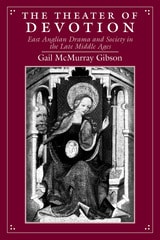
The Theater of Devotion
East Anglian Drama and Society in the Late Middle AgesGail McMurray Gibson
University of Chicago Press, 1989
The Theater of Michel Vinaver
David Bradby
University of Michigan Press, 1993
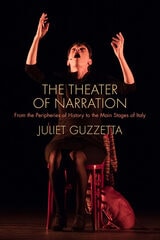
The Theater of Narration
From the Peripheries of History to the Main Stages of ItalyJuliet Guzzetta
Northwestern University Press, 2021
This book examines the theater of narration, an Italian performance genre and aesthetic that revisits historical events of national importance from local perspectives, drawing on the rich relationship between personal experiences and historical accounts. Incorporating original research from the private archives of leading narrators—artists who write and perform their work—Juliet Guzzetta argues that the practice teaches audiences how ordinary people aren’t simply witnesses to history but participants in its creation.
The theater of narration emerged in Italy during the labor and student protests, domestic terrorism, and social progress of the 1970s. Developing Dario Fo and Franca Rame’s style of political theater, influenced by Jerzy Grotowski and Bertolt Brecht, and following in the freewheeling actor‑author traditions of the commedia dell’arte, narrators created a new form of popular theater that grew in prominence in the 1990s and continues to gain recognition. Guzzetta traces the history of the theater of narration, contextualizing its origins—both political and intellectual—and centers the contributions of Teatro Settimo, a performance group overlooked in previous studies. She also examines the genre’s experiments in television and media.
The first full-length book in English on the subject, The Theater of Narration leverages close readings and a wealth of primary sources to examine the techniques used by narrators to remake history—a process that reveals the ways in which history itself is a theater of narration.
The Theater of Operations
National Security Affect from the Cold War to the War on TerrorJoseph Masco
Duke University Press, 2014
The Theater of Plautus
Playing to the AudienceBy Timothy J. Moore
University of Texas Press, 1998
The relationship between actors and spectators has been of perennial interest to playwrights. The Roman playwright Plautus (ca. 200 BCE) was particularly adept at manipulating this relationship. Plautus allowed his actors to acknowledge freely the illusion in which they were taking part, to elicit laughter through humorous asides and monologues, and simultaneously to flatter and tease the spectators.
These metatheatrical techniques are the focus of Timothy J. Moore's innovative study of the comedies of Plautus. The first part of the book examines Plautus' techniques in detail, while the second part explores how he used them in the plays Pseudolus, Amphitruo, Curculio, Truculentus, Casina, and Captivi. Moore shows that Plautus employed these dramatic devices not only to entertain his audience but also to satirize aspects of Roman society, such as shady business practices and extravagant spending on prostitutes, and to challenge his spectators' preconceptions about such issues as marriage and slavery. These findings forge new links between Roman comedy and the social and historical context of its performance.
The Theatre Couple in Early Modern Italy
Self-Fashioning and Mutual MarketingSerena Laiena
University of Delaware Press, 2024
Who were the first celebrity couples? How was their success forged? Which forces influenced their self-fashioning and marketing strategies?
These questions are at the core of this study, which looks at the birth of a phenomenon, that of the couple in show business, with a focus on the promotional strategies devised by two professional performers: Giovan Battista Andreini (1576–1654) and Virginia Ramponi (1583–ca.1631). This book examines their artistic path – a deliberately crafted and mutually beneficial joint career – and links it to the historical, social, and cultural context of post-Tridentine Italy. Rooted in a broad research field, encompassing theatre history, Italian studies, celebrity studies, gender studies, and performance studies, The Theatre Couple in Early Modern Italy revises the conventional view of the Italian diva, investigates the deployment of Catholic devotion as a marketing tool, and argues for the importance of the couple system in the history of Commedia dell’Arte, a system that continues to shape celebrity today.
The Theatre of Genocide
Four Plays about Mass Murder in Rwanda, Bosnia, Cambodia, and ArmeniaEdited and with an introduction by Robert Skloot
University of Wisconsin Press, 2008
The Theatre of Sabina Berman
The Agony of Ecstasy and Other PlaysSabina Berman. Translated by Adam Versenyi. Essay by Jacqueline E. Bixler
Southern Illinois University Press, 2003
The Theatre of Sabina Berman: The Agony of Ecstasy and Other Plays introduces and makes accessible to an English-speaking audience the work of the contemporary Mexican playwright Sabina Berman. The book contains translations of the four plays that established Berman’s career: The Agony of Ecstasy, Yankee, Puzzle, and Heresy. An introduction by Adam Versényi provides a critical assessment of each play, a discussion of the specific problems of translation involved, and placement of Berman’s work in the larger Mexican and Latin American context.
It is evident that Sabina Berman’s theatrical acumen matches the depth of her dramatic design whether it is the sheer variety of techniques from song to staged tableau that appear in The Agony of Ecstasy; the physicalization of what it means to be interrogated and to interrogate in Yankee; the final enigmatic image of a soldier alone on stage, silently aiming his firearm at an undefined threat that potentially emanates from the audience in Puzzle; or the manner in which the family narrates its own “heretical” actions in Heresy. It is the combination of theatrical technique with universal themes of self-definition that cuts across cultures and ultimately makes these plays translatable.
The Theatrical Event
Dynamics of Performance and PerceptionWillmar Sauter
University of Iowa Press, 2000

The Theatricalists
Making Politics AppearTheron Schmidt
Northwestern University Press, 2024
Examines how the politics of the theater can illuminate the theatricality of politics
Theatricality is often dismissed as a distraction from “real” politics, as when cynical political gestures are derided as “pure theater” or “only theater.” But the artists and theater companies discussed in this book, including Back to Back Theatre, Tim Crouch, Rabih Mroué, Nature Theater of Oklahoma, and Christoph Schlingensief, take a different approach. Theron Schmidt argues that they represent a “theatricalist turn” that explores and tests the conditions of the theater itself. Across diverse contexts of political engagement, ranging from disability rights to representations of violence, these theatrical conditions are interconnected with political struggles, such as those over who is seen and heard, how labor is valued, and what counts as “political” in the first place. In a so-called post-political era, The Theatricalists argues that an examination of theater’s internal politics can expand our understanding of the theatricality of politics more broadly.
The Theatricality of Greek Tragedy
Playing Space and ChorusGraham Ley
University of Chicago Press, 2007
Drawing on evidence from the surviving texts of tragedies by Aeschylus, Sophocles, and Euripides, Ley explains how scenes with actors were played in the open ground of the orchestra, often considered as exclusively the dancing place of the chorus. In reviewing what is known of the music and dance of Greek antiquity, Ley goes on to show that in the original productions the experience of the chorus—expressed in song and dance and in interaction with the characters—remained a vital characteristic in the performance of tragedy.
Combining detailed analysis with broader reflections about the nature of ancient Greek tragedy as an art form, this volume—supplemented with a series of illustrative drawings and diagrams—will be a necessary addition to the bookshelf of anyone interested in literature, theater, or classical studies.
The Trojan Women
Euripides
University of Chicago Press, 2013
A stand-alone edition of Euripides’s The Trojan Women, taken from Chicago’s renowned translations of the Greek tragedies.
Drawn from the authoritative third edition of the University of Chicago Press’s Complete Greek Tragedies series, this stand-alone edition presents Richmond Lattimore’s celebrated translation of a play with an antiwar message that continues to inspire and resonate with readers today. The Trojan Women takes place following the conquest of Troy and tells the story of its sole survivors—all women—who have been enslaved by the Greeks. Mourning their families and their fate, they grapple with the trauma they have experienced and contemplate a future far from home.
The aftermath of the Trojan War, while extensively depicted in ancient Greek epic, lyric poetry, and art, is rendered especially powerful through the hands of Euripides. An introduction by Mark Griffith and Glenn W. Most provides essential contextual information about the play’s first production, plot, and reception in antiquity.

The Trustus Plays
The Hammerstone, Drift, and Holy GhostJon Tuttle
Intellect Books, 2009
The Trustus Plays collects three full-length, award-winning performance texts by American playwright Jon Tuttle. Each play was a winner of the national Trustus Playwrights Festival contest and was then produced by the Trustus Theatre in Columbia, South Carolina. The Hammerstone is a comedy about two professors aging gracelessly, Drift is a dark comedy about marriage and divorce, and Holy Ghost is the story of German POWs held in the camps in the American south. Jon Tuttle provides an introduction to the plays, and Trustus founder and artistic director, Jim Thigpen, offers a preface describing Tuttle’s work within the context of the Trustus theatre’s dedication to experimental, edgy social drama.

The Unfinished Art of Theater
Avant-Garde Intellectuals in Mexico and BrazilSarah J. Townsend
Northwestern University Press, 2018
A certain idea of the avant-garde posits the possibility of a total rupture with the past. The Unfinished Art of Theater pulls back on this futuristic impulse by showing how theater became a key site for artists on the semiperiphery of capitalism to reconfigure the role of the aesthetic between 1917 and 1934. The book argues that this “unfinished art”—precisely because of its historic weakness as a representative institution in Mexico and Brazil, where the bourgeois stage had not (yet) coalesced—was at the forefront of struggles to redefine the relationship between art and social change.
Drawing on extensive archival research, Sarah J. Townsend reveals the importance of projects and texts that belie the rhetoric of rupture and immediacy associated with the avant-garde: ethnographic operas with ties to the recording industry, populist puppet plays, children’s radio programs about the wonders of technology, a philosophical drama about the birth of a new race, and an antifascist spectacle written for (but never performed at) a theater shut down by the police. Ultimately, the book makes the case that the very category of avant-garde art is bound up in the experience of dependency, delay, and the uneven development of capitalism.
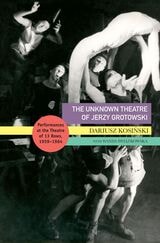
The Unknown Theatre of Jerzy Grotowski
Performances in the Theatre of 13 Rows, 1959–1964Dariusz Kosinski and Wanda Swiatkowska
Seagull Books, 2025
Polish director Jerzy Grotowski (1933–1999) was an international leader in experimental theater who became famous in the late 1960s for his revolutionary approach to audience involvement. This volume is devoted to Grotowski’s early work—the performances he directed in the Theatre of 13 Rows (later Laboratory Theatre of 13 Rows) between 1959 and 1964 when the theater was working in the provincial town Opole in south-western Poland. Having decided to work in his own independent theater, Grotowski moved to Opole in September 1956 and developed his ideas with young, inexperienced actors, creating important performances that foreshadowed his renowned masterpieces of the late 1960s.
In The Unknown Theatre of Jerzy Grotowski, Dariusz Kosiński and Wanda Świątkowska reconstruct, analyze, and interpret each of the nine performances directed by Grotowski over this period: from Orpheus based onJean Cocteau (1959) to Hamlet Study based on Stanisław Wyspiański (1964). Previously mentioned mainly in the context of the development of Grotowski’s method, these performances dealt with important social, political, and philosophical problems of postwar and post-Holocaust Poland. Grotowski also used these performances to experiment with the forces and problems that he later tried to be discreet about, such as sexuality.
Revealing unnoticed and forgotten aspects of Grotowski’s theater, this landmark book presents new materials and perspectives that give fresh life to the study of a genius of twentieth-century theater.

The Very Thought of Herbert Blau
Clark Lunberry and Joseph Roach, Editors
University of Michigan Press, 2018
Herbert Blau (1926–2013) was the most influential theater theorist, practitioner, and educator of his generation. He was the leading American interpreter of the works of Samuel Beckett and as a director was instrumental in introducing works of the European avant-garde to American audiences. He was also one of the most far-reaching and thoughtful American theorists of theater and performance, and author of influential books such as The Dubious Spectacle, The Audience, and Take Up the Bodies: Theater at the Vanishing Point.
In The Very Thought of Herbert Blau, distinguished artists and scholars offer reflections on what made Blau's contributions so visionary, transformative, and unforgettable, and why his ideas endure in both seminar rooms and studios. The contributors, including Lee Breuer, Sue-Ellen Case, Gautam Dasgupta, Elin Diamond, S. E. Gontarski, Linda Gregerson, Martin Harries, Bill Irwin, Julia Jarcho, Anthony Kubiak, Daniel Listoe, Clark Lunberry, Bonnie Marranca, Peggy Phelan, Joseph Roach, Richard Schechner, Morton Subotnick, Julie Taymor, and Gregory Whitehead, respond to Blau's fierce and polymorphous intellect, his relentless drive and determination, and his audacity, his authority, to think, as he frequently insisted, "at the very nerve ends of thought."
The Violate Man
Male/Male Rape in the American ImaginationAaron C. Thomas
Vanderbilt University Press, 2025
From the punchline of bro comedies to the vengeance arc of prison dramas, Thomas argues that male/male rape narratives are used by writers, filmmakers, and comedians to make sense of the changing landscape of American masculinity, and that these narratives have shifted widely since the 1960s, reflecting masculinity’s varying anxieties and concerns.
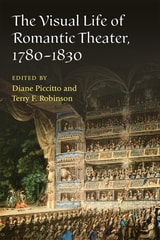
The Visual Life of Romantic Theater, 1780-1830
Edited by Diane Piccitto and Terry F. Robinson
University of Michigan Press, 2023
The Visual Life of Romantic Theater examines the dynamism and vibrancy of stage spectacle and its impact in an era of momentous social upheaval and aesthetic change. Situating theatrical production as key to understanding visuality ca. 1780-1830, this book places the stage front and center in Romantic scholarship—a field in a period long defined by its focus on poetry—by reenvisioning traditional approaches to artistic and social production. How, it asks, did dramaturgy and stagecraft influence aesthetic and sociopolitical concerns? How does a focus on visuality expand our understanding of the historical experience of theatergoing? In what ways did stage performance converge with visual culture beyond the theater? How did extra-theatrical genres engage with theatrical sight and spectacle? Finally, how does a focus on dramatic vision change the way we conceive of Romanticism itself? The volume’s essays by emerging and established scholars provide exciting and suggestive answers to these questions, along with a more capacious conception of Romantic theater as a locus of visual culture that reached well beyond playhouse walls.
The Vital Lie
Reality and Illusion in Modern DramaAnthony S. Abbott
University of Alabama Press, 1988
The Vital Lie: Reality and Illusion in Modern Drama is a sweeping inquiry into the stories people tell themselves in order to endure, survive, and belong. Moving from Ibsen and Strindberg to Beckett, Pinter, and beyond, Anthony S. Abbott traces the uneasy traffic between actuality and self-invention that animates modern theater. Rather than offering a simple survey, he uncovers a recurring dramatic predicament: the cognitive dissonance that afflict people when the beliefs they hold about themselves collide with reality.
Anthony S. Abbott writes with the erudite observation of a critic and the curiosity of a participant. His book explores illusion, meaning, and human resilience, a perspective that lends unusual urgency to its readings of canonical playwrights. Abbott's scholarship is expansive without becoming academic in the pejorative sense; his arguments remain animated by large questions about purpose, dignity, and the imaginative structures that sustain ordinary lives.
Ideal for theater devotees, literary historians, students of modernism, philosophy-minded readers, directors, dramaturgs, and anyone fascinated by self-deception, mythmaking, and identity. Admirers of intellectual biography, cultural criticism, existential inquiry, and ambitious cross-author interpretation will find this volume especially rewarding. Those who relish fresh angles on familiar classics will discover a study that is probing, elegant, and unexpectedly memorable.
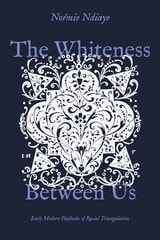
The Whiteness Between Us
Early Modern Playbooks of Racial TriangulationNoémie Ndiaye
University of Chicago Press, 2026
A theorization of the representational juxtapositions, frictions, and connections between Black people and other non-white people in early modern European theatre.
Over the course of the seventeenth century, European drama was an important tool for whiteness to imagine itself at the top of an aspirational structure of power relations. Indeed, that structure could only be aspirational at a time when Europeans were profoundly divided along easily racializable religious and ethnic lines, and when their sovereignty was threatened by the Ottoman empire. It was to strengthen this emerging consciousness of racial whiteness, Noémie Ndiaye argues, that European drama engaged in a form of racial triangulation, fitting Muslim, Jewish, Indigenous, Romani, and Asian characters into a spurious black/white racial binary.
Focusing on English, Spanish, and French drama from 1580 to 1715, The Whiteness Between Us shows how plays became a crucial tool to position not only black people but any non-white community in the new racial architecture that white supremacy sought to build. Ndiaye reveals the stage of this era as a space for wish fulfillment, enabling participants to imagine and work towards a whiter future.
The early modern playbooks of racial triangulation that Ndiaye brings to light can and have been reactivated for white supremacist purposes in our own day and age. Partly in response to the contemporary threat of white nationalism, scholars and students have sought to unearth the early modern roots of racial whiteness and white supremacy. Ndiaye’s book participates in this wave of interest, offering several innovations, including its capacious transnational claims.
The Wise Body
Conversations with Experienced DancersJacky Lansley and Fergus Early
Intellect Books, 2011
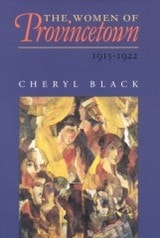
The Women of Provincetown, 1915–1922
Cheryl Black
University of Alabama Press, 2001
In this fascinating work, Cheryl Black reveals that, in addition to its role in developing an American tradition of non-commercial theatre, Provincetown has another, largely unacknowledged claim to fame as one of the first theatre companies in America in which women achieved prominence in every area of operation. At a time when women playwrights were rare, women directors rarer, and women scenic designers unheard of, Provincetown’s female members excelled in all of these roles.
In addition to the well-known playwright Susan Gaspell, the company’s female membership included luminaries such poets Edna St. Vincent Millay, Mina Loy, and Djuna Barnes; journalists Louise Bryant and Mary Heaton Vorce; novelists Neith Boyce and Evelyn Scott; and painter Marguerite Zorach. Illuminating a fascinating chapter in the history of one of the world's most picturesque and beloved artist colonies, The Women of Provincetown is an engaging work of social history, offering new insights into the relationship between gender and theatre. This work includes 40 images of the key artists in the book.
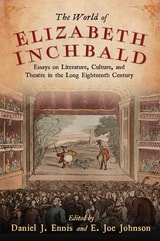
The World of Elizabeth Inchbald
Essays on Literature, Culture, and Theatre in the Long Eighteenth CenturyDaniel J. Ennis
University of Delaware Press, 2022
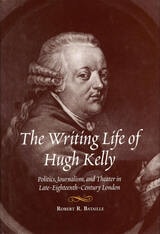
The Writing Life of Hugh Kelly
Politics, Journalism, and Theatre in Late-Eighteenth-Century LondonRobert R. Bataille
Southern Illinois University Press, 2000
Robert R. Bataille demonstrates convincingly that between 1767 and 1777, Anglo-Irish writer Hugh Kelly made major contributions in three areas of British culture: politics, journalism, and theater. Bataille shows how all three activities were integrated in Kelly’s life, suggesting that such interrelationships often existed in the rough and ready London culture during the early reign of King George III.
When he discovered several newspaper campaigns that Kelly orchestrated as a paid political propagandist for George III and his ministers, Bataille understood in part how important Kelly was to his era. In his capacity as propagandist, Kelly defended Hanoverian colonial policies on the eve of the American Revolution, served as a key opponent of the radical Wilkites, and promoted the acceptance of the 1774 Quebec Bill, which established, among other things, the right of the recently defeated French citizens of Quebec to maintain the French language.
A belletristic journalist, Kelly published theater reviews and essays that played a major role in shaping the taste of his era. He wrote in defense of the controversial sentimental drama, and whenever he could, he promoted the major theatrical figure of the age, David Garrick. Under his editorship, the newspaper Public Ledger became a leading source of theater information. Seeking to raise the status of the profession of journalism, he wrote essays and articles that provided his middle-class readers with an insider’s view of the operations of the journalist.
Assessing Kelly’s contributions to the novel and drama, Bataille argues that this powerful journalist stands in the vanguard in the larger struggle against traditional attitudes supporting male superiority and aristocratic privilege. Kelly wrote in favor of gender equality and middle-class respectability, striving to inculcate what modern scholars refer to as the values of sensibility. Bataille also argues, however, that Kelly knew his audience. Instrumental in the rise of professional writing and popular culture, he understood that he had to observe the needs of his audience, detecting cultural trends and using the skills of the rhetorician.
Theater & Propaganda
By George H. Szanto
University of Texas Press, 1978
This original and insightful study explores the points at which theater and propaganda meet. Defining propaganda as a form of "activated ideology," George H. Szanto discusses the distortion of information that occurs in dramatic literature in its stage, film, and television forms.
Szanto analyzes the nature of "integration propaganda," which is designed to render the audience passive and to encourage the acceptance of the status quo, as opposed to "agitation propaganda," which aims to inspire the audience to action. In Szanto's view, most popular western theater is saturated, though usually not intentionally, with integration propaganda. The overall purpose of Theater and Propaganda is twofold: to analyze the nature of integration propaganda so that it becomes visible to western readers as a tool of the dominant class in society, and to examine the manner by which unself-conscious propagandistic methods have saturated dramatic presentation.
In discussing the importance of propaganda within and between technological states, the author examines the seminal work of Jacques Ellul. In this chapter he analyzes the function of integration propaganda in a relatively stable society. The following chapter defines and analyzes three theaters (in the sense of performance) of propaganda: the theater of agitation propaganda, of integration propaganda, and of dialectical propaganda. In this section he uses examples from a variety of plays, movies, and television commercials. In succeeding chapters Szanto discusses the role of integration propaganda in the medieval Wakefield mystery plays and the plays of Samuel Beckett. The appendix, "Contradiction and Demystification," provides a general model that suggests ways of breaking down and overcoming the propagandistic intentions of an artwork and discusses theater's possible role in this breakdown.
Theater Enough
American Culture and the Metaphor of the World Stage, 1607–1789Jeffrey H. Richards
Duke University Press, 1991
The rhetoric, or discourse, of early American theater emerged out of the figures of speech that permeated the colonists’ lives and literary productions. Jeffrey H. Richards examines a variety of texts—histories, diaries, letters, journals, poems, sermons, political tracts, trial transcripts, orations, and plays—and looks at the writings of such authors as John Winthrop and Mercy Otis Warren. Richards places the American usage of theatrum mundi—the world depicted as a stage—in the context of classical and Renaissance traditions, but shows how the trope functions in American rhetoric as a register for religious, political, and historical attitudes.
Theater Game File
Viola Spolin
Northwestern University Press, 1989
Features include:
Over 200 color-coded cards
Suggestions for focusing, side-coaching, and evaluating games
Games for students of all ages and levels of experience
Handbook included