Results by title
1296 books match the query 'Women authors' and 235 start with t
The Minuses
Jami Macarty
University Press of Colorado, 2020
The Moral Electricity of Print
Transatlantic Education and the Lima Women's Circuit, 1876-1910Ronald Briggs
Vanderbilt University Press, 2017
Moral electricity—a term coined by American transcendentalists in the 1850s to describe the force of nature that was literacy and education in shaping a greater society. This concept wasn't strictly an American idea, of course, and Ronald Briggs introduces us to one of the greatest examples of this power: the literary scene in Lima, Peru, in the nineteenth century.
As Briggs notes in the introduction to The Moral Electricity of Print, "the ideological glue that holds the American hemisphere together is a hope for the New World as a grand educational project combined with an anxiety about the baleful influence of a politically and morally decadent Old World that dominated literary output through its powerful publishing interests." The very nature of living as a writer and participating in the literary salons of Lima was, by definition, a revolutionary act that gave voice to the formerly colonized and now liberated people. In the actions of this literary community, as men and women worked toward the same educational goals, we see the birth of a truly independent Latin American literature.
The Mouth of Earth
PoemsSarah P. Strong
University of Nevada Press, 2020
The Mouth of Earth serves as both a survival guide for those seeking connection with our planet and one another as well as a compassionate tribute to what we have lost or are losing—the human consequences of such destruction in a time of climate crisis and lost connectivity. Strong’s powerful poems offer us, if not consolation, at least a way toward comprehension in an age of loss, revealing both our ongoing denial of our planet’s fragility and the compelling urgency of our hunger for connection with all life.
The Nation Writ Small
African Fictions and Feminisms, 1958-1988Susan Z. Andrade
Duke University Press, 2011
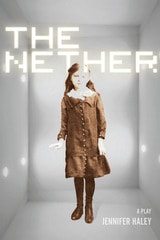
The Nether
A PlayJennifer Haley
Northwestern University Press, 2015
When the lines between reality and fantasy blur, what counts as ethical? Who decides?
The Nether, a daring examination of moral responsibility in virtual worlds, opens with a familiar interrogation scene given a technological twist. As Detective Morris, an online investigator, questions Mr. Sims about his activities in a role-playing realm so realistic it could be life, she finds herself on slippery ethical ground. Sims argues for the freedom to explore even the most deviant corners of our imagination. Morris holds that we cannot flesh out our malign fantasies without consequence. Their clash of wills leads to a consequence neither could have imagined. Suspenseful, ingeniously constructed, and fiercely intelligent, Haley’s play forces us to confront deeply disturbing questions about the boundaries of reality.
The Networked Recluse
The Connected World of Emily DickinsonMike Kelly, Carolyn Vega, Marta Werner, Susan Howe, Richard Wilbur
Amherst College Press, 2017
Yet that image scarcely captures the fullness and vitality of Dickinson’s life, most notably her many connections—to family, to friends, to correspondents, to the literary tastemakers of her day, even to the unnamed, and perhaps unknowable, “Master” to whom she addressed three of her most breathtaking works of prose. Through an exploration of a relatively small group of items from Dickinson’s vast literary remains, this volume—an accompaniment to an exhibition on Dickinson mounted at The Morgan Library & Museum in New York—demonstrates the complex ways in which these often humble objects came into conversation with other people, places, and events in the poet’s life. Seeing the network of connections and influences that shaped Dickinson’s life presents us with a different understanding of this most enigmatic yet elegiac poet in American letters, and allows us more fully to appreciate both her uniqueness and her humanity.
The materials collected here make clear that the story of Dickinson’s manuscripts, her life, and her work is still unfolding. While the image of Dickinson as the reclusive poet dressed only in white remains a popular myth, details of Dickinson’s life continue to emerge. Several items included both in the exhibit and in this volume were not known to exist until the present century. The scrap of biographical intelligence recorded by Sarah Tuthill in a Mount Holyoke catalogue, or the concern about Dickinson’s salvation expressed by Abby Wood in a private letter to Abiah Root, were acquired by Amherst College in the last fifteen years. What additional pieces of evidence remain to be uncovered and identified in the attics and basements of New England?
Published to accompany The Morgan Library & Museum’s pathbreaking exhibit I’m Nobody! Who are You? The Life and Poetry of Emily Dickinson—part of a series of exhibits at the Morgan celebrating and exploring the creative lives of significant women authors—The Networked Recluse offers the reader an account of the exhibit itself, together with a series of contributions by curators, scholars of Dickinson, and poets whose own work her words have influenced.
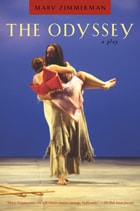
The Odyssey
A PlayMary Zimmerman
Northwestern University Press, 2006
With her trademark irreverent and witty twist on classic works, Zimmerman brings to life the story of Odysseus's ten-year journey
This dramatic adaptation of Homer's myth begins with a modern young woman who is struggling to understand Robert Fitzgerald's translation of The Odyssey. A classical muse appears, and the young woman becomes the goddess Athena--a tireless advocate for Odysseus in his struggle to get home. Zimmerman's adaptation depicts his encounters with characters such as Circe, the Cyclops, Poseidon, Calypso, the Sirens, and others in new and exciting ways.

The Off-Season
Jen Levitt
Four Way Books, 2016
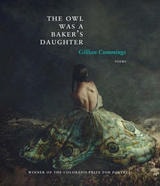
The Owl Was a Baker’s Daughter
Gillian Cummings
University Press of Colorado, 2018
If it is true, as Joseph Campbell said, that “the psychotic drowns in the same waters in which the mystic swims with delight,” then Cummings strains the boundaries of this notion: “Is it the same? The desire to end a life / and the need to know how: a flower’s simple bliss?” Her women and girls, part “little heavenling” and part “small hellborn,” understand the emptiness of utmost despair and long for that other emptiness, which can be thought of as union with God, the death of the troublesome ego. Cummings’s poetic ancestors may be Dickinson and Plath and her source here Shakespeare, but more contemporary voices also echo in her poems, those of Lucie Brock-Broido, Larissa Szporluk, and Cynthia Cruz. Here, in The Owl Was a Baker’s Daughter, is what might happen if, after sealing off the doors and turning on the gas, indeed, after dying, a poet had come to embrace the holiness in how “all dissolves: one color, / one moon, all earth, red as love, red as living.”

The Palace of Bones
Allison Eir Jenks
Ohio University Press, 2002
The Palace of Bones by Allison Eir Jenks is an often stark and startling vision of the way we live, the places we inhabit, and the relics we make to comfort ourselves.
Haunted by a quiet, unquenchable longing, Jenks expertly and calmly guides the reader through a vivid dreamscape in this first full-length collection of poems.
The Palace of Bones was selected by final judge and Pulitzer Prize winner Carolyn Kizer. At once dark in its vision and light in its tone, this remarkable book is its author’s self-confident invitation for us to join her in a world she knows intimately and has made almost familiar if not entirely safe.
The Palace of Bones is a stunning debut.
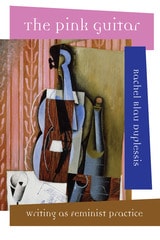
The Pink Guitar
Writing as Feminist PracticeRachel Blau DuPlessis
University of Alabama Press, 2006
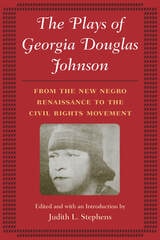
The Plays of Georgia Douglas Johnson
From the New Negro Renaissance to the Civil Rights MovementEdited and with an Introduction by Judith L. Stephens
University of Illinois Press, 2006
Recovering the stage work of one of America's finest black female writers
This volume collects twelve of Georgia Douglas Johnson's one-act plays, including two never-before-published scripts found in the Library of Congress. As an integral part of Washington, D.C.'s, thriving turn-of-the-century literary scene, Johnson hosted regular meetings with Harlem Renaissance writers and other artists, including Countee Cullen, Langston Hughes, May Miller, and Jean Toomer, and was herself considered among the finest writers of the time. Johnson also worked for U.S. government agencies and actively supported women's and minorities' rights.
As a leading authority on Johnson, Judith L. Stephens provides a brief overview of Johnson's career and significance as a playwright; sections on the creative environment in which she worked; her S Street Salon; "The Saturday Nighters," and its significance to the New Negro Theatre; selected photographs; and a discussion of Johnson's genres, themes, and artistic techniques.
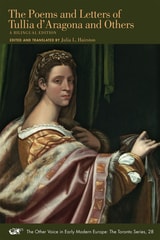
The Poems and Letters of Tullia d'Aragona and Others
A Bilingual EditionTullia d'Aragona and Others, Edited by Julia L. Hairston, Translated by Julia L. Hairston
Iter Press, 2014
Hairston has constructed a full personal, cultural and literary biography for d’Aragona, using newly discovered letters, archival material of other kinds, and contemporary theory about gender in women’s writing. Footnotes establish the intricacy of Tullia’s intellectual networks and her courting of intellectuals in rhyme. Hairston includes poems written to d’Aragona, including Girolamo Muzio’s long pastoral, Tirrhenia. She addresses with tact the question of how sexual Tullia’s relationships were with her various interlocutors. At times, as she says, one just can’t know, but that the issue is much less important than the poems themselves. I agree wholeheartedly. This is the editor Tullia has been waiting for: an indefatigable researcher, a creative biographer, and a precise and appreciative literary critic.
—Ann Rosalind Jones
Esther Cloudman Dunn Professor of Comparative Literature, Smith College
The figure of Tullia d’Aragona has long fascinated readers as the prototype of the “honest courtesan”, a woman who successfully exploited her physical and intellectual charms to win the adoration and respect of the Italian cultural elite. With Julia Hairston’s richly annotated edition of her collected verse, the product of more than a decade of scholarship, d’Aragona finally comes into focus also as poet. She emerges in this volume as one of the most distinctive protagonists in a key transitional moment in Italian literary history, when the aristocratic tradition of Petrarchist lyric began to be reshaped and democratized by its encounter with print.
—Virginia Cox
Professor of Italian, New York University
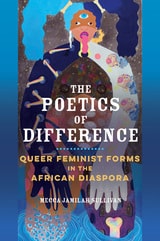
The Poetics of Difference
Queer Feminist Forms in the African DiasporaMecca Jamilah Sullivan
University of Illinois Press, 2021
From Audre Lorde, Ntozake Shange, and Bessie Head, to Zanele Muholi, Suzan-Lori Parks, and Missy Elliott, Black women writers and artists across the African Diaspora have developed nuanced and complex creative forms. Mecca Jamilah Sullivan ventures into the unexplored spaces of black women’s queer creative theorizing to learn its languages and read the textures of its forms. Moving beyond fixed notions, Sullivan points to a space of queer imagination where black women invent new languages, spaces, and genres to speak the many names of difference. Black women’s literary cultures have long theorized the complexities surrounding nation and class, the indeterminacy of gender and race, and the multiple meanings of sexuality. Yet their ideas and work remain obscure in the face of indifference from Western scholarship.
Innovative and timely, The Poetics of Difference illuminates understudied queer contours of black women’s writing.
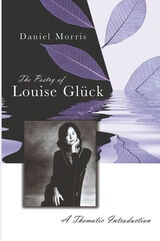
The Poetry of Louise Glück
A Thematic IntroductionDaniel Morris
University of Missouri Press, 2021
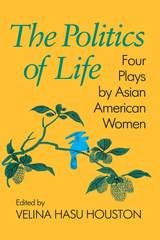
The Politics Of Life
edited by Velina Hasu Houston
Temple University Press, 1993
This anthology of work by three Asian American women playwrights—Wakako Yamauchi, Genny Lim, and Velina Hasu Houston—features pioneering contemporary writers who have made their mark in regional and ethnic theatres throughout the United States. In her introduction, Houston observes that the Asian American woman playwright is compelled "to mine her soul" and express the angst, fear, and rage that oppression has wrought while maintaining her relationship with America as a good citizen.
The plays are rich with cultural and political substance and have a feminist concern about women's spirit, intellect, and lives. They portray Asian and Asian American women who challenge the cultural and sexual stereotypes of the Asian female. Yamauchi's two plays deal with how easily a country can dishonor its citizens. In "12-1-A," a Japanese American family is incarcerated during World War II in an Arizona camp where Yamauchi herself was interned. "The Chairman's Wife" dramatizes the life of Madame Mao Tse Tung through the lens of events at Tien An Men Square in 1989. Lim's "Bitter Cane" is about the exploitation of Chinese laborers who were recruited to work the Hawaiian sugar cane plantations. In "Asa Ga Kimashita" ("Morning Has Broken"), Houston explores a Japanese woman's interracial romance in postwar Japan and the influence of traditional patriarchy on the lives of Japanese women.
These plays will entertain and enlighten, enrage and profoundly move audiences. With honesty, imagination and courage, each grapples with the politics of life.
In the series Asian American History and Culture, edited by Sucheng Chan, David Palumbo-Liu, Michael Omi, K. Scott Wong, and Linda Trinh Võ.
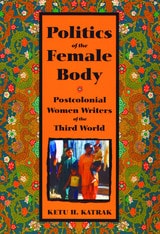
The Politics of the Female Body
Postcolonial Women WritersKetu H. Katrak
Rutgers University Press, 2006
Is it possible to simultaneously belong to and be exiled from a community? In Politics of the Female Body, Ketu H. Katrak argues that it is not only possible, but common, especially for women who have been subjects of colonial empires.
Through her careful analysis of postcolonial literary texts, Katrak uncovers the ways that the female body becomes a site of both oppression and resistance. She examines writers working in the English language, including Anita Desai from India, Ama Ata Aidoo from Ghana, and Merle Hodge from Trinidad, among others. The writers share colonial histories, a sense of solidarity, and resistance strategies in the on-going struggles of decolonization that center on the body.
Bringing together a rich selection of primary texts, Katrak examines published novels, poems, stories, and essays, as well as activist materials, oral histories, and pamphlets—forms that push against the boundaries of what is considered strictly literary. In these varied materials, she reveals common political and feminist alliances across geographic boundaries.
A unique comparative look at women’s literary work and its relationship to the body in third world societies, this text will be of interest to literary scholars and to those working in the fields of postcolonial studies and women’s studies.
The Proper Lady and the Woman Writer
Ideology as Style in the Works of Mary Wollstonecraft, Mary Shelley, and Jane AustenMary Poovey
University of Chicago Press, 1984
"The proper lady was a handy concept for a developing bourgeois patriarchy, since it deprived women of worldly power, relegating them to a sanctified domestic sphere that, in complex ways, nourished and sustained the harsh 'real' world of men. With care and subtle intelligence, Poovey examines this 'guardian and nemesis of the female self' through the ways it is implicated in the style and strategies of three very different writers."—Rachel M. Brownstein, The Nation
"The Proper Lady and the Woman Writer is a model of . . . creative discovery, providing a well-researched, illuminating history of women writers at the turn of the nineteenth century. [Poovey] creates sociologically and psychologically persuasive accounts of the writers: Wollstonecraft, who could never fully transcend the ideology of propriety she attacked; Shelley, who gradually assumed a mask of feminine propriety in her social and literary styles; and Austen, who was neither as critical of propriety as Wollstonecraft nor as accepting as Shelley ultimately became."—Deborah Kaplan, Novel
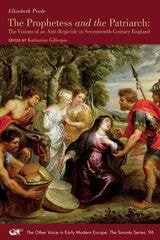
The Prophetess and the Patriarch
The Visions of an Anti-Regicide in Seventeenth-Century EnglandElizabeth Poole
Iter Press, 2023
In 1649, a seamstress named Elizabeth Poole appeared at the Whitehall debates in London to prophesy in front of Parliament’s army shortly after it had defeated the crown in the English civil wars. Invited to help deliberate the fate of Charles I, Poole advised the army to spare the king’s life but to put him on trial for tyranny and to enter into a new compact with the people. After her visions proved controversial, she was defamed as a prostitute and a witch. She retaliated by printing her prophecies, along with two new defenses of her original revelations. This collection publishes Poole’s pamphlets in full for the first time.
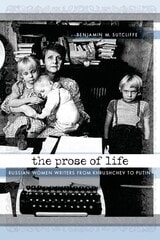
The Prose of Life
Russian Women Writers from Khrushchev to PutinBenjamin M. Sutcliffe
University of Wisconsin Press, 2009
A focus on the representation of everyday life in women’s prose reveals that a first generation of female writers (Natal’ia Baranskaia, Irina Grekova) both legitimated and limited their successors (Liudmila Petrushevskaia, Tat’iana Tolstaia, Liudmila Ulitskaia, and Svetlana Vasilenko) in their choice of literary topics. The Prose of Life traces the development, and intriguing ruptures, of recent Russian women’s prose, becoming a must-read for readers interested in Russian literature and gender studies.
2009 Outstanding Academic Title, Choice Magazine
The Queer Limit of Black Memory
Black Lesbian Literature and IrresolutionMatt Richardson
The Ohio State University Press, 2013
The Quick-Change Artist
StoriesCary Holladay
Ohio University Press, 2006
In these stories of magic and memory, clustered around a resort hotel in a small Virginia community, Cary Holladay takes the reader on an excursion through the changes wrought by time on the community and its visitors. From the quiet of a rural forest to the rhythms of rock and roll, The Quick-Change Artist is at once whimsical and hard-edged, dizzying in its matter-of-fact delivery of the fantastic.
Romance, a sense of place and belonging, and the supernatural—especially in the lives of children coming of age—offer windows into worlds beyond the ordinary throughout The Quick-Change Artist. In the title story, a young chambermaid is in love with a foreign magician who performs at the hotel where she works. In “Heaven,” set during the 1918 flu epidemic, a struggling mother and son rely on the support of their fortune-telling plow horse. The narrator of “Jane’s Hat” recalls a childhood enlivened by an unusual school principal and a friend who starts finding beauty everywhere.
Horses and the people who love them, wanderers and those who feed them, creatures that disappear and those who search for them: these are stories with a constant heart.
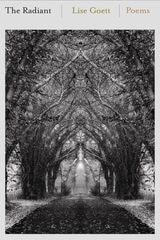
The Radiant
Lise Goett
Tupelo Press, 2024
The Radiant explores the psychological, physical, and spiritual challenges of living in a body and the changes and distortions that arise from the experience of the body’s limitations and inevitable death. The collection takes its title from the term for the point from which all meteors appear to emanate during a shower, luminous bodies in decay that when traced to their origin seem to converge at a single point. “Perhaps you can remember the time called before, the all-you-can-do-is-see-yourself-in-a-split-second where you recognize that everything you’ve ever known is going to be different after,” writes Goett in the collection’s final poem, “The Bookman,” recounting radiant points of no return and transformation that, in spite of their challenge, remain luminous.

The Reader's Repentance
Women Preachers, Women Writers, and Nineteenth-Century Social DiscourseChristine L. Krueger
University of Chicago Press, 1992
Christine L. Krueger persuasively argues that Evangelical Christianity, by assuming the spiritual equality of women and men and the moral superiority of middle-class women, opened a space for the linguistic empowerment of women and fostered the emergence of women orators and writers who, in complex and contradictory ways, became powerful public figures. In the light of unpublished or long out-of-print writing by eighteenth- and nineteenth-century women preachers, Krueger shows how these women drew on religious language to critique forms of male domination, promote female political power, establish communities of women, and, most significantly, feminize social discourse. She traces the legacy of these preachers through the work of writers as diverse as Hannah More, Charlotte Elizabeth Tonna, Elizabeth Gaskell, and George Eliot—women who, despite political differences, shared an evangelical strategy for placing women's concerns on the social agenda of their time.
Documenting and analyzing the tradition of women's preaching as a powerful and distinctly feminist force in the development of nineteenth-century social fiction, The Reader's Repentance reconstitutes a significant chapter in the history of women and culture. This original work will be of interest to students of women's history, literature, and eighteenth- and nineteenth-century society.
The Restless Dead
Necrowriting and DisappropriationCristina Rivera Garza
Vanderbilt University Press, 2020
Disappropriating is a political operation at the core of projects acknowledging, both at ethical and aesthetic levels, that writers always work with materials that are not their own. Writers borrow from the practitioners of a language, entering in a debt relationship that can only be covered by ushering the text back to the communities from which it grew. In a world rife with violence, where the experiences of many are erased by pillage and extraction, writing among and for the dead is a form of necrowriting that may well become a life-affirming act of decolonization and resistance.
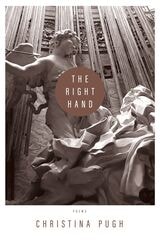
The Right Hand
Christina Pugh
Tupelo Press, 2024
Pain, piercing, and language: with urgent lyricism and lacunae on the page, The Right Hand explores the physical, emotional, and philosophical experiences of chronic pain, bodywork (especially acupuncture), and healing. In the second half of the collection, the poet spends extended time with Bernini's sculpture of St. Teresa in Ecstasy in Rome, finding this famous scene of wounding to be in dialogue with her own experience of pain, as well as her suspension between languages and spiritual isolation. In The Right Hand, the hidden sites of the body speak, and Bernini’s centuries-old arrow pierces us with hurting eloquence.
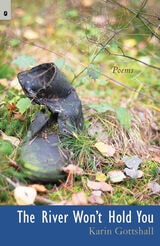
The River Won’t Hold You
Karin Gottshall
The Ohio State University Press, 2014
Haunting and haunted, The River Won’t Hold You navigates loneliness and loss with a quiet, relentless clarity. In poems shaped at the uneasy crossroads of imagination and lived experience, Karin Gottshall searches for solace in the charged spaces between them. “I tell myself I can be content with the pleasures / permitted ghosts,” she writes in “Afterlife,” “but my body wakes up / leaking saltwater, and won’t let my ghost-self be.”
Across the collection, poetic structure and the music of language become vessels for memory, philosophy, and ache. Generous in their formal range and attentive to both sound and silence, these poems resist tidy answers. The beauty of Gottshall's work arises from the steadiness of her gaze, and the startling precision of the images it lands on:
“Wide-open, staring eyes of the tiger / I drew and had to destroy because it wouldn’t sleep.”
The River Won’t Hold You shows how the places we fear most—the gaps, the afterlives, the undefinable spaces—can also be the ones that hold us.
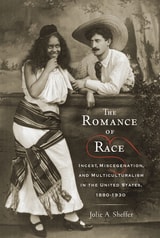
The Romance of Race
Incest, Miscegenation, and Multiculturalism in the United States, 1880-1930Sheffer, Jolie A.
Rutgers University Press, 2013
In the United States miscegenation is not merely a subject of literature and popular culture. It is in many ways the foundation of contemporary imaginary community. The Romance of Race examines the role of minority women writers and reformers in the creation of our modern American multiculturalism.
The national identity of the United States was transformed between 1880 and 1930 due to mass immigration, imperial expansion, the rise of Jim Crow, and the beginning of the suffrage movement. A generation of women writers and reformers—particularly women of color—contributed to these debates by imagining new national narratives that put minorities at the center of American identity. Jane Addams, Pauline Hopkins, Onoto Watanna (Winnifred Eaton), María Cristina Mena, and Mourning Dove (Christine Quintasket) embraced the images of the United States—and increasingly the world—as an interracial nuclear family. They also reframed public debates through narratives depicting interracial encounters as longstanding, unacknowledged liaisons between white men and racialized women that produced an incestuous, mixed-race nation.
By mobilizing the sexual taboos of incest and miscegenation, these women writers created political allegories of kinship and community. Through their criticisms of the nation’s history of exploitation and colonization, they also imagined a more inclusive future. As Jolie A. Sheffer identifies the contemporary template for American multiculturalism in the works of turn-of-the century minority writers, she uncovers a much more radical history than has previously been considered.
The Secret Powers of Naming
Sara Littlecrow-Russell; Introduction by Joy Harjo
University of Arizona Press, 2006
As Littlecrow-Russell explores how names imposed by outsiders both collide and merge with the identities that Natives create for themselves, these poems decisively counter the images of Indians as colorful dancers, stoic saints, and defeated warriors. These verses are not constructed of beautiful images, nor are they stories of redemption. Instead, Littlecrow-Russell offers stark and honest witness to urban and reservation life at the beginning of the twenty-first century. In short snaps of honed lyric and voice, she tackles topics ranging from family, love, and spirituality, to welfare, addiction, and the thorny politics of tribal identity. Her work displays tremendous bitterness and anger, but there is also dignity, humor, and plenty of irony.
Candid and compelling, this collection brings fluent verse and human face to the commonly misrepresented experiences of Native Americans.

The Secret in the Wings
A PlayMary Zimmerman
Northwestern University Press, 2014
A dark and mysterious homage to lesser-known fairy tales
Mary Zimmerman’s The Secret in the Wings adapts a group of lesser-known fairy tales to create a theatrical work that sets their dark mystery against her signature wit and humor. The framing story concerns a child and the frightening babysitter with whom her parents leave her. As the babysitter reads from a book, the characters in each of the tales materialize, with each tale breaking off just at its bleakest moment before giving way to the next one.
The central tale is told without interruption, after which each previous tale is successively resumed, with each looming disaster averted. As in Zimmerman’s other productions, here she uses costumes, props, sets, and lighting to brilliant effect, creating images and feelings that render the fairy tales in all their elemental and enduring power.
The Selected Letters of Elizabeth Stoddard
Jennifer Putzi
University of Iowa Press, 2012
As scholars of epistolarity have recently argued, letters provide more than just a biographical narrative; they also should be understood as aesthetic performances themselves. The correspondence provides a sense of Stoddard as someone who understood letter writing as a distinct and important literary genre, making this collection particularly well suited for new conceptualizations of the epistolary genre.
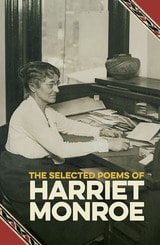
The Selected Poems of Harriet Monroe
Harriet Monroe, edited by Kevin McMullen
Southern Illinois University Press, 2026
Unearthing the overlooked poet behind Poetry magazine
Harriet Monroe, whose work as the visionary founding editor of Poetry magazine profoundly shaped the development of American poetry in the 20th century, was a vital and prolific poet in her own right. This volume showcases the sweeping breadth of Monroe’s poetic talents.
Monroe lived through a period of immense change and global conflict, from the American Civil War, through World War I and the Great Depression, up to the first stirrings of the second Great War. Through her poetry, Monroe confronted major issues, critiquing war, the impact of industrialization on the arts, and inequality, while championing women’s rights and environmental conservation—issues that remain pressingly relevant today. Monroe’s three collections of poetry, as well as her own “selected poems” volume, have all long been out of print. This book, then, represents the first appearance of many of these poems in more than 100 years. This selection includes meditations on modern technology and globalization in the early 20th century, love lyrics, hymns to the deserts of the American West, feminist reflections on gender and motherhood, and more. The volume also includes a number of poems that have never before been published, drawing on manuscripts found in Monroe’s papers at the University of Chicago Library.
Students at the University of Nebraska–Lincoln, under the guidance of Kevin McMullen, project manager of the Walt Whitman Archive, selected these poems to capture the range and breadth of Monroe’s styles and poetic interest. The poems, along with an extensive critical introduction and explanatory notes, establish Monroe’s place as an important and overlooked Modernist poet from the Midwest.
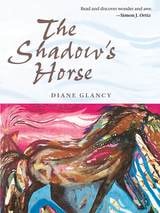
The Shadow’s Horse
Diane Glancy
University of Arizona Press, 2003
The Shadow's Horse is a new collection of poems in which Glancy walks the margin between her white and Indian heritage. In poems that conjure the persistence of fallen leaves or juxtapose images of Christ and the stockyards, she powerfully evokes place and spirit to address with intelligence and beauty issues of family, work, and faith.
In some of these poems Glancy recalls growing up with her Cherokee father, who worked in a stockyard, radically applying Christian theology to the slaughter of non-human creatures: The cattle go up the ramp
dragging their crosses.
Their voices are Gregorian chants
rising to the blue sky,
the cold clouds.
In others she examines the walk of history through the ordinary details of life-history seen from two points of view, early Euro-American and contemporary Native American. She sees her Native heritage as shortlived and fragile, yet as enduring as leaves, and she asks, "If you line up all the leaves that fall / how many times will they go around the earth?"
Writing in a cross-boundaried, fragmented voice—a voice based on the memory of the way language sounded when it was stretched across the cultures or walked in both worlds—Glancy has fashioned a book about speaking oneself into existence. The Shadow's Horse is the story of one culture made to sing the song of another until the Native voice is so erased it is nearly an illusion. Yet as readers of these poems will discover, the shadow of the past is as real as the horse it rides.

The Shared World
PoemsVievee Francis
Northwestern University Press, 2021
The latest collection from award-winning poet Vievee Francis, The Shared World imagines the ideas and ideals and spaces of the Black woman. The book delves into inherited memories and restrictions between families, lovers, and strangers and the perception and inconvenient truth of Black woman as mother—with or without child. Francis challenges the ways in which Black women are often dismissed while expected to be nurturing. This raw assemblage of poetic narratives stares down the oppressors from within and writes a new language in the art of taking back the body and the memory. These poetic narratives are brutal in their lyrical blows but tender with the bruised history left behind. “You can’t stop this / song,” she writes. “More hands than yours have closed / around my throat.”
Francis’s lyric gifts are on full display as she probes self-discovery, history, intimacy, and violence. Her voice encompasses humor and gravity, enigma and revelation. What emerges is a realm of intertwined experiences. “The secret to knowing the secret is to speak,” she concludes, “but we too often tell / the stories of no matter and avoid the one story that does matter. / In truth, we are bound by one story, so you’d think by now / we’d tell it, at least to each other.”
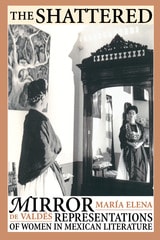
The Shattered Mirror
Representations of Women in Mexican LiteratureBy María Elena de Valdés
University of Texas Press, 1998
Popular images of women in Mexico—conveyed through literature and, more recently, film and television—were long restricted to either the stereotypically submissive wife and mother or the demonized fallen woman. But new representations of women and their roles in Mexican society have shattered the ideological mirrors that reflected these images. This book explores this major change in the literary representation of women in Mexico.
María Elena de Valdés enters into a selective and hard-hitting examination of literary representation in its social context and a contestatory engagement of both the literary text and its place in the social reality of Mexico. Some of the topics she considers are Carlos Fuentes and the subversion of the social codes for women; the poetic ties between Sor Juana Inés de la Cruz and Octavio Paz; questions of female identity in the writings of Rosario Castellanos, Luisa Josefina Hernández, María Luisa Puga, and Elena Poniatowska; the Chicana writing of Sandra Cisneros; and the postmodern celebration—without reprobation—of being a woman in Laura Esquivel's Like Water for Chocolate.
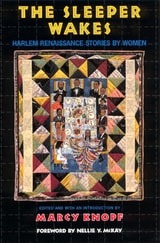
The Sleeper Wakes
Harlem Renaissance Stories by WomenKnopf-Newman, Marcy
Rutgers University Press, 1993
In recent years there has been an explosion of interest in the art and culture of the Harlem Renaissance. Yet this significant collection is the first definitive edition of Harlem Renaissance stories by women. The writers include Gwendolyn Bennett, Jessie Redmon Fauset, Angelina Weld Grimké, Zora Neale Hurston, Nella Larsen, Alice Dunbar-Nelson, and Dorothy West.
Published originally in periodicals such as The Crisis, Fire!!, and Opportunity, these twenty-seven stories have until now been virtually unavailable to readers. These stories are as compelling today as they were in the 1920s and 1930s. In them, we find the themes of black and white racial tension and misunderstanding, economic deprivation, passing, love across and within racial lines, and the attempt to maintain community and uplift the race.
Marcy Knopf's introduction surveys the history of the Harlem Renaissance, the periodicals and books it generated, and describes the rise to prominence of these women writers and their later fall from fame. She also includes a brief biography of each of the writers. Nellie Y. McKay's foreword analyzes the themes and concerns of the stories.
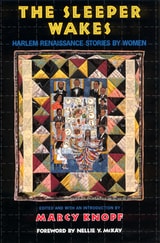
The Sleeper Wakes
Harlem Renaissance Stories by WomenKnopf-Newman, Marcy
Rutgers University Press, 1993
In recent years there has been an explosion of interest in the art and culture of the Harlem Renaissance. Yet this significant collection is the first definitive edition of Harlem Renaissance stories by women. The writers include Gwendolyn Bennett, Jessie Redmon Fauset, Angelina Weld Grimké, Zora Neale Hurston, Nella Larsen, Alice Dunbar-Nelson, and Dorothy West.
Published originally in periodicals such as The Crisis, Fire!!, and Opportunity, these twenty-seven stories have until now been virtually unavailable to readers. These stories are as compelling today as they were in the 1920s and 1930s. In them, we find the themes of black and white racial tension and misunderstanding, economic deprivation, passing, love across and within racial lines, and the attempt to maintain community and uplift the race.
Marcy Knopf's introduction surveys the history of the Harlem Renaissance, the periodicals and books it generated, and describes the rise to prominence of these women writers and their later fall from fame. She also includes a brief biography of each of the writers. Nellie Y. McKay's foreword analyzes the themes and concerns of the stories.
The Social Life of Criticism
Gender, Critical Writing, and the Politics of BelongingKimberly J. Stern
University of Michigan Press, 2016
This engaging study begins by looking at the eighteenth century, when critical writing started to assume the institutional and generic structures we associate with it today, and examines a series of case studies that illuminate how women writers engaged with the forms of intellectual sociability that defined nineteenth-century criticism—including critical dialogue, the club, the salon, and the publishing firm. In doing so, it clarifies the fascinating rhetorical and political debates surrounding the figure of the female critic and charts how women writers worked both within and against professional communities. Ultimately, Stern contends that gender was a formative influence on critical practice from the very beginning, presenting the history of criticism as a history of gender politics.
While firmly grounded in literary studies, The Social Life of Criticism combines an attention to historical context with a deep investment in feminist scholarship, social theory, and print culture. The book promises to be of interest not only to professional academics and graduate students in nineteenth-century literature but also to scholars in a wide range of disciplines, including literature, intellectual history, cultural studies, gender theory, and sociology.
The Soluble Hour
Hillary Gravendyk
Omnidawn, 2017
The Sorrow Apartments
Andrea Cohen
Four Way Books, 2024
What would I
think, coming
up after
my world
had evaporated?
I'd wish
I were water.
The Sorrow Apartments is home to spare and uncanny lyricism––as well as leaping narratives of mystery and loss and wonder. These poems race at once into the past and the possible. And yet, instead of holding things up to the light for a better view, Cohen lifts them to the dark and light, as in "Acapulco," where an unlikely companion points out, “as men tend to, / the stars comprising Orion’s belt — / as if it were the lustrous sparks and not / the leveling dark that connects us.” For a poet who has been called unfashionable from the get-go, unfashionable never looked so good.
The Sound of Memory
Themes from a Violinist’s LifeRebecca Fischer
The Ohio State University Press, 2022
The Sound of Thinking
A Listener's Companion to Conceptual MusicCraig Dworkin
University of Chicago Press, 2026
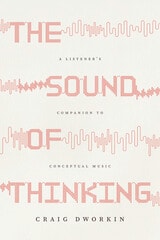
An artist draws two octaves of pitches randomly from a hat, just enough to set each syllable of the dictionary definition of imprimer (to score, to print). Trawling the internet for cute videos of cats “playing” piano, an artist splices together a complete, note-perfect performance of Arnold Schoenberg’s Opus 11. Half a century after the release of Miles Davis’s album Kind of Blue, a jazz quintet spends months of focused practice to reproduce the original exactly. These performances share a common denominator: absolute fidelity to the outcome of a system. From Marcel Duchamp to Yoko Ono, Steve Reich to Sun Ra, The Sound of Thinking brings together a diverse array of musical or sonic works that are algorithmic, automatic, permutational, procedural, or otherwise structured in contrast to the creative expressivity typically associated with artistic production.
In twenty-six short essays, each keyed to a term that begins with a different letter of the alphabet, Dworkin discusses work composed or performed according to a predetermined rule, transforming artistic creation into a system running its course. The pieces detailed here, drawn from more than a century of musical experimentation, offer a fresh perspective on the history of innovative music by decoupling music from expression and by shunting creativity from the level of organizing sounds to the level of devising a system that can do the organizing. Not only does this book spotlight the critical role of music in twentieth-century conceptual art, but it also identifies previously overlooked links among diverse artists and movements.

The Spiritual Life and Other Writings
Camilla Battista Da Varano
Iter Press, 2023
Camilla Battista da Varano (1458–1524) was a Franciscan nun and the author of profound spiritual writings in both prose and verse. Raised in the princely household of Camerino in north-central Italy, she put her thorough humanist education to use explaining her own spiritual experience and delivering advice to others. Varano composed ecstatic revelations, prayers, poems, hagiography, spiritual direction, and commentary on convent legislation. She drew on a wide variety of sources, including scripture and Church Fathers, plus popular literature and proverbs. Varano was an erudite woman of considerable complexity, defying many of the commonplace images we associate with religious women of the late fifteenth and early sixteenth centuries.
The Sprites of Kernosy Castle
Henriette-Julie de Castelnau, Countess de Murat
Iter Press, 2024
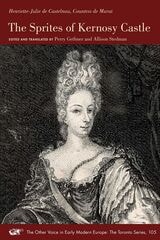
This novel reflects a shift in French values at the turn of the eighteenth century, which saw increased interest in the private lives of the aristocracy and the pre-Enlightenment questioning of political and religious orthodoxies. Novels of fiction and leisure gained popularity, and it was during this time that Henriette-Julie de Castelnau, the Countess de Murat, published her second leisure novel, The Sprites of Kernosy Castle. Combining humor, social satire, and a proto-feminist outlook, Murat crafts a well-constructed plot where the supernatural is debunked. Murat’s career was cut short when a series of “misdemeanors” related to the countess’s homosexual tendencies led to her arrest in 1702. Sprites, which was released during a partial reprieve from prison, is the final published work of this independent-minded early feminist author.

The Stuff of Our Forebears
Willa Cather's Southern HeritageJoyce McDonald
University of Alabama Press, 1998
Connecting Cather's work to the southern literary tradition and the South of her youth
A diverse and experimental writer who lived most of her life in New York City, Willa Cather is best known for her depiction of pioneer life on the Nebraska plains. Despite Cather's association with Nebraska, however, the novelist's Virginia childhood and her southern family were deeply influential in shaping her literary imagination.
Joyce McDonald shows evidence, for example, of Cather's southern sensibility in the class consciousness and aesthetic values of her characters and in their sense of place and desire for historical continuity, a sensibility also evident in her narrative technique of weaving stories within stories and in her use of folklore. For McDonald, however, what most links Cather and her work to the South and to the southern literary tradition is her use of pastoral modes.
Beginning with an examination of Cather's Virginia childhood and the southern influences that continued to mold her during the Nebraska years, McDonald traces the effects of those influences in Cather's novels. The patterns that emerge reveal not only Cather's strong ideological connection to the pastoral but also the political position implicit in her choice of that particular mode. Further analysis of Cather's work reveals her preoccupation with hierarchical constructs and with the use and abuse of power and her interest in order, control, and possession. The Willa Cather who emerges from the pages of The Stuff of Our Forebears is not the Cather who claimed to eschew politics but a far more political novelist than has heretofore been perceived.

The Sturdy Oak
A Composite Novel of American PoliticsElizabeth Jordan
Ohio University Press, 1998
In the spring of 1916, as the workers for woman suffrage were laying plans for another attack on the bastions of male supremacy, the idea for The Sturdy Oak was born. Based on the rules of an old parlor game, wherein one person begins a narrative, another continues it, and another follows, this collaborative effort by the leading writers of the day, such as Fannie Hurst, Dorothy Canfield, and Kathleen Norris, is a satiric look at the gender roles of the time.
There is much in The Sturdy Oak that reflects the New York campaign for suffrage of 1916–1917. The setting is the fictional city of Whitewater in upstate New York. Idealistic reformers are pitted against a ruthless political machine, and the traditional picture of man as “the sturdy oak” supporting woman, “the clinging vine,” is ridiculed in the portrayal of an engaging couple, George and Genevieve Remington. Nonetheless, the purpose of the book is not primarily ridicule but reform, and the reader is taken through the steps by which a confirmed anti-suffragist is gradually transformed into a supporter of the suffrage cause.
Beyond its historical interest, The Sturdy Oak is imbued with a political and social currency that makes it applicable even today. And because of the skill of the writers of this composite novel, even eight decades after its initial publication The Sturdy Oak is still, as the New York Times said in 1917, “irresistibly readable.”
The Submerged Plot and the Mother's Pleasure from Jane Austen to Arundhati Roy
Kelly A. Marsh
The Ohio State University Press, 2016
Combining feminist and rhetorical narratological approaches, Marsh’s study offers fresh readings of Persuasion, Jane Eyre, Bleak House, The Woman in White, The House of Mirth, The Last September, The Color Purple, A Thousand Acres, Bastard Out of Carolina, Talking to the Dead, and The God of Small Things. Through these readings, The Submerged Plot and the Mother’s Pleasure explores how the unnarratable can be communicated in fiction and offers a significant contribution to our understanding of narrative progression.
The Subversive Art of Zelda Fitzgerald
Deborah Pike
University of Missouri Press, 2017
This book gives light to the multiple artistic expressions of Great Gatsby-writer’s wife as modernist vanguard.
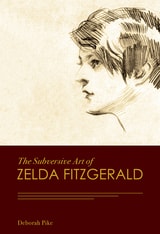
Known as an icon of the Jazz Age, a flamboyant socialite, and the mad wife of F. Scott, Zelda Fitzgerald has inspired studies of her life and work which focus on her earlier years, and on the myth of the glorious-but-doomed woman. As an unprecedented study of the totality Zelda Fitzgerald’s creative work, this book makes an important contribution to the history of women’s art with new perspectives on women and modernity, plagiarism, creative partnership, and the nature of mental illness.
Zelda Fitzgerald’s creative output was astonishing, considering the conditions under which she lived, and the brevity of her life: she wrote dozens of short stories, several journalistic pieces, a play, two novels, hundreds of letters, kept diaries and produced hundreds of artworks. Employing a new mode of literary analysis that draws upon critics, theorists, and historians to situate her work in its context, The Subversive Art of Zelda Fitzgerald rehabilitates the literary and artistic status of Zelda Fitzgerald by reassessing her life and writings in the light of archival sources. Such materials include medical and psychiatric documents; her unpublished novel; an artistic and spiritual diary; and over one hundred letters written from asylums.
While much of her writing can be read as a tactical response to her husband’s injunctions against her creativity, it can also be read as brilliant work in its own right. Far from imitating Scott’s style, Zelda Fitzgerald’s artistic output is vibrantly alive and utterly her own.
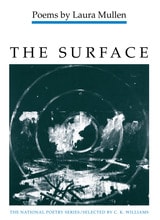
The Surface
POEMSLaura Mullen
University of Illinois Press, 1991
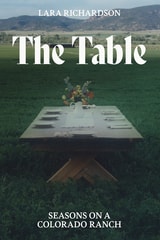
The Table
Seasons on a Colorado RanchLara Richardson
University Press of Colorado, 2024