Results by title
8113 books match the query 'Literary Criticism' and 1818 start with t
Tolkien Studies
An Annual Scholarly Review, Volume VIIMichael D.C. Drout
West Virginia University Press, 2010
Tolkien Studies
An Annual Scholarly Review, Volume VIIIMichael D.C. Drout
West Virginia University Press, 2011
Tolkien Studies
Volume XIMichael Drout
West Virginia University Press, 2014
Tolkien Studies: An Annual Scholarly Review presents the growing body of critical commentary and scholarship on both J. R. R. Tolkien’s voluminous fiction and his academic work in literary and linguistic fields.
Tolkien, Philosopher of War
Graham McAleer
Catholic University of America Press, 2024
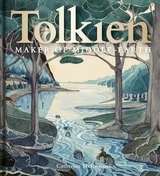
Tolkien
Maker of Middle-earthEdited by Catherine McIlwaine
Bodleian Library Publishing, 2018
Tolkien: Maker of Middle-earth explores the huge creative endeavor behind Tolkien’s enduring popularity. Lavishly illustrated with three hundred images of his manuscripts, drawings, maps, and letters, the book traces the creative process behind his most famous literary works—The Hobbit, The Lord of the Rings, and The Silmarillion—and reproduces personal photographs and private papers, many of which have never been seen before in print.
Six essays introduce the reader to the person of J. R. R. Tolkien and to main themes in his life and work, including the influence of northern languages and legends on the creation of his own legendarium; his concept of “Faërie” as an enchanted literary realm; the central importance of his invented languages in his fantasy writing; his visual imagination and its emergence in his artwork; and the encouragement he derived from his close friend C. S. Lewis and their literary group the Inklings.
The book brings together the largest collection of original Tolkien material ever assembled in a single volume. Drawing on the extensive archives of the Tolkien collections at the Bodleian Libraries, Oxford, which stretch to more than five hundred boxes, and Marquette University, Milwaukee, as well as private collections, this hugely ambitious and exquisitely produced book draws together the worlds of J. R. R. Tolkien – scholarly, literary, creative, and domestic—offering a rich and detailed understanding and appreciation of this extraordinary author.
This landmark publication, produced on the occasion of a major exhibition at the Bodleian Libraries in Oxford in 2018 and at the Morgan Library in New York in 2019, is set to become a standard work in the literature on J. R. R. Tolkien.
Tolkien
TreasuresCatherine McIlwaine
Bodleian Library Publishing, 2018
Tolstoy and Dostoevsky in Russian Symbolist Criticism
A ReaderEdited by Lindsay Ceballos, D. Brian Kim, and Chloë Kitzinger
Amherst College Press, 2026
At the turn of the twentieth century, Symbolist writers and thinkers at the forefront of Russian modernism cast Fyodor Dostoevsky and Leo Tolstoy as their chosen ancestors—examples to be exalted, repudiated, and ultimately surpassed. Their writings transformed the way these novelists were read within and beyond the Russian Empire. Many of the Symbolist writings on Tolstoy and Dostoevsky were long unavailable in English or were only available in outdated or unreliable translations. Presenting fresh annotated translations of some of the most influential Symbolist essays, Tolstoy and Dostoevsky in Russian Symbolist Criticism opens this globally influential body of criticism to a new anglophone audience. Readers will discover threads that extend toward writers from Sigmund Freud and J. M. Coetzee to Virginia Woolf and Mikhail Bakhtin. Tolstoy and Dostoevsky in Russian Symbolist Criticism will appeal to students encountering Tolstoy’s and Dostoevsky’s novels for the first time and to scholars of literary history and theory. This volume fills a longstanding gap in the study of Dostoevsky’s and Tolstoy’s novels and provides English-speaking readers with a missing key to the absorbing—and ongoing—story of their reception.
Tolstoy and His Problems
Views from the Twenty-First CenturyEdited by Inessa Medzhibovskaya
Northwestern University Press, 2019
In the broadest sense—with essays on a variety of issues that occupied Tolstoy, such as nihilism, mysticism, social theory, religion, Judaism, education, opera, and Shakespeare—the volume offers a fresh evaluation of Tolstoy's program to reform the ways we live, work, commune with nature and art, practice spirituality, exchange ideas and knowledge, become educated, and speak and think about history and social change.
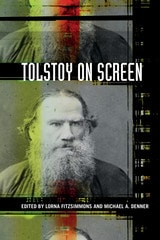
Tolstoy on Screen
Edited by Lorna Fitzsimmons and Michael A. Denner
Northwestern University Press, 2015
Scholarship on screen adaptation has proliferated in recent years, but it has remained largely focused on English- and Romance-language authors. Tolstoy on Screen aims to correct this imbalance with a comprehensive examination of film and television adaptations of Tolstoy’s fiction. Spanning the silent era to the present day, these essays consider well-known as well as neglected works in light of contemporary adaptation and media theory. The book is organized to facilitate a comparative, cross-cultural understanding of the various practices employed in different eras and different countries to bring Tolstoy’s writing to the screen. International in scope and rigorous in analysis, the essays cast new light on Tolstoy’s work and media studies alike.
Tolstoy's "The Death of Ivan Ilich"
A Critical CompanionGary R. Jahn
Northwestern University Press, 1998
Tolstoy's Major Fiction
Edward Wasiolek
University of Chicago Press, 1981
Tolstoy's Phoenix
From Method to Meaning in War and PeaceGeorge R. Clay
Northwestern University Press, 1998
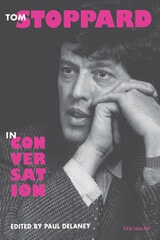
Tom Stoppard in Conversation
Paul Delaney, Editor
University of Michigan Press, 1994
This collection of interviews with British playwright Tom Stoppard, author of such well-known comedies as Travesties, Jumpers, and Rosencrantz and Guildenstern Are Dead, brings together for the first time Stoppard's most significant assessments of his own work.
A wide range of discussions are featured, from extensive conversations with the editors of Theatre Quarterly and Gambit to important interviews in lesser-known periodicals. The interviews include the playwright's unguarded comments to the daily press, from those of a dazzled young Stoppard the morning after the triumphant opening of Rosencrantz and Guildenstern to those of a veteran playwright still smarting from caustic reviews 36 hours after the opening of Hapgood. The interviews cover the full range of Stoppard's work, from his adaptations for the stage to his increasing involvement in film, and this volume makes many of them available for the first time. Also appearing for the first time in print are transcripts of radio interviews and an informal lecture by Stoppard called "The Event and the Text."
Tom Stoppard's conversations about his work shed light on questions of authorial intent and the creative process. Debates over interpretations of the plays will be enhanced by this record of Stoppard's own perceptions and insights. The collection also includes the most extensive bibliography and discography ever compiled of Stoppard's print interviews, broadcast interviews, and lectures.
Witty, illuminating, and informative, Tom Stoppard in Conversation will be of interest to scholars, students, directors, actors, and fans of Stoppard's work.
Tomb(e)
Hélène Cixous
Seagull Books, 2014
Tomboys
A Literary and Cultural HistoryMichelle Ann Abate
Temple University Press, 2008
Starting with the figure of the bold, boisterous girl in the mid-19th century and ending with the “girl power” movement of the 1990’s, Tomboys is the first full-length critical study of this gender-bending code of female conduct. Michelle Abate uncovers the origins, charts the trajectory, and traces the literary and cultural transformations that the concept of “tomboy” has undergone in the United States.
Abate focuses on literature including Louisa May Alcott's Little Women and Carson McCullers's The Member of the Wedding and films such as Peter Bogdanovich's Paper Moon and Jon Avnet's Fried Green Tomatoes. She also draws onlesser-known texts like E.D.E.N. Southworth's once wildly popular 1859 novel The Hidden Hand, Cold War lesbian pulp fiction, and New Queer Cinema from the 1990s.
Tomboys also explores the gender and sexual dynamics of tomboyism, and offers intriguing discussions of race and ethnicity's role in the construction of the enduring cultural archetype. Abate’s insightful analysis provides useful, thought-provoking connections between different literary works and eras. The result demystifies this cultural phenomenon and challenges readers to consider tomboys in a whole new light.
Toni Morrison and the Geopoetics of Place, Race, and Be/longing
Marilyn Sanders Mobley
Temple University Press, 2024
Mobley’s approach is as interdisciplinary, intersectional, nuanced, and complex as Morrison’s. She combines textual analysis with a study of Morrison’s cultural politics and narrative poetics and describes how Morrison engages with both history and the present political moment.
Informed by research in geocriticism, spatial literary studies, African American literary studies, and Black feminist studies at the intersection of poetics and cultural politics, Mobley identifies four narrative strategies that illuminate how Morrison creates such spaces in her fiction; what these spaces say about her understanding of place, race, and belonging; and how they constitute a way to read and re-read her work.
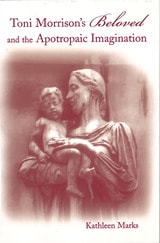
Toni Morrison's Beloved and the Apotropaic Imagination
Kathleen Marks
University of Missouri Press, 2002
Apotropaic, from the Greek, meaning “to turn away from,” refers to rituals that were performed in ancient times to ward off evil deities. Modern scholars use the term to denote an action that, in attempting to prevent an evil, causes that very evil. Freud employed the apotropaic to explain his thought concerning Medusa and the castration complex, and Derrida found the apotropaic’s logic of self-sabotage consonant with his own thought.
Marks draws on this critical history and argues that Morrison’s heroine’s effort to keep the past at bay is apotropaic: a series of gestures aimed at resisting a danger, a threat, an imperative. These gestures anticipate, mirror, and put into effect that which they seek to avoid—one does what one finds horrible so as to mitigate its horror. In Beloved, Sethe’s killing of her baby reveals this dynamic: she kills the baby in order to save it. As do all great heroes, Sethe transgresses boundaries, and such transgressions bring with them terrific dangers: for example, the figure Beloved. Yet Sethe’s action has ritualistic undertones that link it to the type of primal crimes that can bring relief to a petrified community. It is through these apotropaic gestures that the heroine and the community resist what Morrison calls “cultural amnesia” and engage in a shared past, finally inaugurating a new order of love.
Toni Morrison’s Beloved and the Apotropaic Imagination is eclectic in its approach—calling upon Greek religion, Greek mythology and underworld images, and psychology. Marks looks at the losses and benefits of the kind of self-damage/self-agency the apotropaic affords. Such an approach helps to frame the questions of the role of suffering in human life, the relation between humans and the underworld, and the uses of memory and history.
Toni Morrison
PLAYING WITH DIFFERENCELucille P. Fultz
University of Illinois Press, 2003
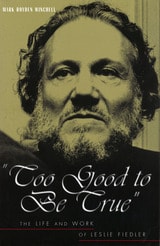
Too Good to Be True
The Life and Work of Leslie FiedlerMark Royden Winchell
University of Missouri Press, 2002
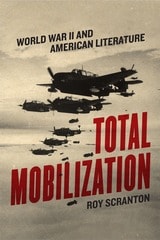
Total Mobilization
World War II and American LiteratureRoy Scranton
University of Chicago Press, 2019
Since World War II, the story of the trauma hero—the noble white man psychologically wounded by his encounter with violence—has become omnipresent in America’s narratives of war, an imaginary solution to the contradictions of American political hegemony. In Total Mobilization, Roy Scranton cuts through the fog of trauma that obscures World War II, uncovering a lost history and reframing the way we talk about war today.
Considering often overlooked works by James Jones, Wallace Stevens, Martha Gellhorn, and others, alongside cartoons and films, Scranton investigates the role of the hero in industrial wartime, showing how such writers struggled to make sense of problems that continue to plague us today: the limits of American power, the dangers of political polarization, and the conflicts between nationalism and liberalism. By turning our attention to the ways we make war meaningful—and by excavating the politics implicit within the myth of the traumatized hero—Total Mobilization revises the way we understand not only World War II, but all of postwar American culture.
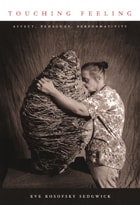
Touching Feeling
Affect, Pedagogy, PerformativityEve Kosofsky Sedgwick
Duke University Press, 2003
In prose sometimes somber, often high-spirited, and always accessible and moving, Touching Feeling interrogates—through virtuoso readings of works by Henry James, J. L. Austin, Judith Butler, the psychologist Silvan Tomkins and others—emotion in many forms. What links the work of teaching to the experience of illness? How can shame become an engine for queer politics, performance, and pleasure? Is sexuality more like an affect or a drive? Is paranoia the only realistic epistemology for modern intellectuals? Ultimately, Sedgwick's unfashionable commitment to the truth of happiness propels a book as open-hearted as it is intellectually daring.
Touching This Leviathan
Peter Wayne Moe
Oregon State University Press, 2021
Touching This Leviathan asks how we might come to know the unknowable—in this case, whales, animals so large yet so elusive, revealing just a sliver of back, a glimpse of a fluke, or a split-second breach before diving away.
Whale books often sit within disciplinary silos. Touching This Leviathan starts a conversation among them. Drawing on biology, theology, natural history, literature, and writing studies, Peter Wayne Moe offers a deep dive into the alluring and impalpable mysteries of Earth’s largest mammal.
Entertaining, thought-provoking, and swimming with intelligence and wit, Touching is Leviathan is creative nonfiction that gestures toward science and literary criticism as it invites readers into the belly of the whale.
Touching the Unreachable
Writing, Skinship, Modern JapanFusako Innami
University of Michigan Press, 2021
Finalist: 2025 British Comparative Literature Association First Book Prize | July 22, 2025
Fusako Innami offers the first comprehensive study of touch and skinship—relationality with the other through the skin—in modern Japanese writing. The concept of the unreachable—that is, the lack of characters’ complete ability to touch what they try to reach for—provides a critical intervention on the issue of intimacy. Touch has been philosophically addressed in France, but literature is an effective—or possibly the most productive—venue for exploring touch in Japan, as literary texts depict what the characters may be concerned with but may not necessarily say out loud. Such a moment of capturing the gap between the felt and the said—the interaction between the body and language—can be effectively analyzed by paying attention to layers of verbalization, or indeed translation, by characters’ utterances, authors’ depictions, and readers’ interpretations. Each of the writers discussed in this book—starting with Nobel prize winner Kawabata Yasunari, Tanizaki Jun’ichirō, Yoshiyuki Junnosuke, and Matsuura Rieko—presents a particular obsession with objects or relationality to the other constructed via the desire for touch.
In Touching the Unreachable, phenomenological and psychoanalytical approaches are cross-culturally interrogated in engaging with literary touch to constantly challenge what may seem like the limit of transferability regarding concepts, words, and practices. The book thereby not only bridges cultural gaps beyond geographic and linguistic constraints, but also aims to decentralize a Eurocentric hegemony in its production and use of theories and brings Japanese cultural and literary analyses into further productive and stimulating intellectual dialogues. Through close readings of the authors’ treatment of touch, Innami develops a theoretical framework with which to examine intersensorial bodies interacting with objects and the environment through touch.
Tough Enough
Arbus, Arendt, Didion, McCarthy, Sontag, WeilDeborah Nelson
University of Chicago Press, 2017
Tough Enough traces the careers of these women and their challenges to the pre-eminence of empathy as the ethical posture from which to examine pain. Their writing and art reveal an adamant belief that the hurts of the world must be treated concretely, directly, and realistically, without recourse to either melodrama or callousness. As Deborah Nelson shows, this stance offers an important counter-tradition to the familiar postwar poles of emotional expressivity on the one hand and cool irony on the other. Ultimately, in its insistence on facing reality without consolation or compensation, this austere “school of the unsentimental” offers new ways to approach suffering in both its spectacular forms and all of its ordinariness.
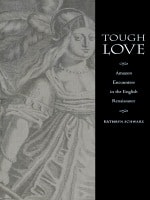
Tough Love
Amazon Encounters in the English RenaissanceKathryn Schwarz
Duke University Press, 2000
Despite seeming to function as signs for what is outside the social—the alien, the exotic, the other—Amazons in sixteenth- and seventeenth-century texts were often represented in conventionally domestic roles, as mothers and lovers, wives and queens, Schwarz demonstrates. She traces this pattern in works by Shakespeare, Spenser, Sidney, Raleigh, and Jonson, as well as in such materials as conduct manuals, explorers’ accounts, court spectacles, and political tracts. Through readings of these texts, Schwarz shows that the Amazon myth provided a language both for setting forth and for challenging the terms of social logic. In representations of Amazon encounters, she argues, homosocial bonds became indistinguishable from heterosexual desires, masculine agency attached itself as logically to women as it did to men, and sexual difference was made nearly impossible to sustain or define. Schwarz’s analysis unveils the Amazon as a theoretical term, one that illuminates the tensions and paradoxes through which ideologies of the domestic take shape.
Tough Love contributes to the ongoing discussion of gendered identity and sexual desire in the early modern period. It will interest students of queer theory, cultural studies, early modern history, feminism, and literature.
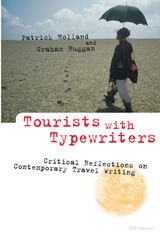
Tourists with Typewriters
Critical Reflections on Contemporary Travel WritingPatrick Holland and Graham Huggan
University of Michigan Press, 2000
The book maps new terrain in a growing area of critical study. Although critical of travel writing's complacency and its often unacknowledged ethnocentrism, the book recognizes its importance as both a literary and cultural form. While travel writing at its worst emerges as a crude expression of economic advantage, at its best it becomes a subtle instrument of cultural self-perception, a barometer for changing views of "other" (i.e., foreign, non-Western) cultures, and a trigger for the information circuits that tap us into the wider world.
Tourists with Typewriters gauges both the best and worst in contemporary travel writing, capturing the excitement of this most volatile--and at times infuriating--of literary genres. The book will appeal to general readers interested in a closer examination of travel writing and to academic readers in disciplines such as literary/cultural studies, geography, history, anthropology, and tourism studies.
"An eminently readable and informative study. It breathes tolerance and intelligence. It is critically perceptive and very au courant. It raises issues (coloniality, postmodernity, gender. . . ) and discusses books that readers of many different stripes will want to find out about." --Ross Chambers, University of Michigan
Patrick Holland, Associate Professor of English, University of Guelph, was born in New Zealand and educated in England, Australia, and Canada. Graham Huggan, Professor of English, University of Munich, was born in Hong Kong and educated in England and in British Columbia.
Toward a Cognitive Theory of Narrative Acts
Edited by Frederick Luis Aldama
University of Texas Press, 2010
Toward a Cognitive Theory of Narrative Acts brings together in one volume cutting-edge research that turns to recent findings in cognitive and neurobiological sciences, psychology, linguistics, philosophy, and evolutionary biology, among other disciplines, to explore and understand more deeply various cultural phenomena, including art, music, literature, and film. The essays fulfilling this task for the general reader as well as the specialist are written by renowned authors H. Porter Abbott, Patrick Colm Hogan, Suzanne Keen, Herbert Lindenberger, Lisa Zunshine, Katja Mellman, Lalita Pandit Hogan, Klarina Priborkin, Javier Gutiérrez-Rexach, Ellen Spolsky, and Richard Walsh. Among the works analyzed are plays by Samuel Beckett, novels by Maxine Hong Kingston, music compositions by Igor Stravinsky, art by Jean-Baptiste-Simeon Chardin, and films by Michael Haneke. Each of the essays shows in a systematic, clear, and precise way how music, art, literature, and film work in and of themselves and also how they are interconnected. Finally, while each of the essays is unique in style and methodological approach, together they show the way toward a unified knowledge of artistic creativity.
Toward a Latina Feminism of the Americas
Repression and Resistance in Chicana and Mexicana LiteratureBy Anna Marie Sandoval
University of Texas Press, 2008
Weaving strands of Chicana and Mexicana subjectivities, Toward a Latina Feminism of the Americas explores political and theoretical agendas, particularly those that undermine the patriarchy, across a diverse range of Latina authors. Within this range, calls for a coalition are clear, but questions surrounding the process of these revolutionary dialogues provide important lines of inquiry. Examining the works of authors such as Sandra Cisneros, Laura Esquivel, Carmen Boullosa, and Helena María Viramontes, Anna Sandoval considers resistance to traditional cultural symbols and contemporary efforts to counteract negative representations of womanhood in literature and society.
Offering a new perspective on the oppositional nature of Latina writers, Sandoval emphasizes the ways in which national literatures have privileged male authors, whose viewpoint is generally distinct from that of women—a point of departure rarely acknowledged in postcolonial theory. Applying her observations to the disciplinary, historical, and spatial facets of literary production, Sandoval interrogates the boundaries of the Latina experience. Building on the dialogues begun with such works as Sonia Saldivar-Hull's Feminism on the Border and Ellen McCracken's New Latina Narrative, this is a concise yet ambitious comparative approach to the historical and cultural connections (as well as disparities) found in Chicana and Mexicana literature.
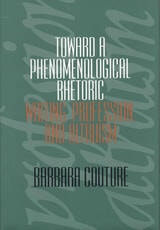
Toward a Phenomenological Rhetoric
Writing, Profession, and AltruismBarbara Couture
Southern Illinois University Press, 1998
Current rhetorical and critical theory for the most part separates writing from consciousness and presumes relative truth to be the only possible expressive goal for rhetoric. These presumptions are reflected in our tradition of persuasive rhetoric, which values writing that successfully argues one person’s belief at the expense of another’s. Barbara Couture presents a case for a phenomenological rhetoric, one that values and respects consciousness and selfhood and that restores to rhetoric the possibility of seeking an all-embracing truth through pacific and cooperative interaction.
Couture discusses the premises on which current interpretive theory has supported relative truth as the philosophical grounding for rhetoric, premises, she argues, that have led to constraints on our notion of truth that divorce it from human experience. She then shows how phenomenological philosophy might guide the theory and practice of rhetoric, reanimating its role in the human enterprise of seeking a shared truth. She proposes profession and altruism as two guiding metaphors for the phenomenological activity of "truth-seeking through interaction."
Among the contemporary rhetoricians and philosophers who influence Couture are Pierre Teilhard de Chardin, Martin Buber, Charles Altieri, Charles Taylor, Alasdair Maclntyre, and Jürgen Habermas.
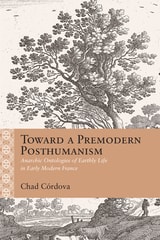
Toward a Premodern Posthumanism
Anarchic Ontologies of Earthly Life in Early Modern FranceChad Córdova
Northwestern University Press, 2025
Drawing on early modern French thought to free nature and aesthetics from metaphysical humanism
What good is aesthetics in a time of ecological crisis? Toward a Premodern Posthumanism: Anarchic Ontologies of Earthly Life in Early Modern France shows that philosophical aesthetics contains unheeded potentialities for challenging the ontological subjection of nature to the human subject. Drawing on deconstructive, ecological, and biopolitical thought, Chad Córdova uncovers in aesthetics something irreducible to humanist metaphysics: an account of how beings emerge and are interrelated, responsive, and even response-able without reason or why.
This anarchic and atelic ontology, recovered from Kant, becomes the guiding thread for a new, premodern trajectory of posthumanism. Charting a path from Aristotle to Heidegger to today’s plant-thinking, with new readings of Montaigne, Pascal, Diderot, Rousseau, and others along the way, this capacious study reveals the untimely relevance of pre-1800 practices of writing, science, and art. Enacting a multitemporal mode of reading, Córdova offers a defense and illustration of the importance of returning to early modern texts as a way to rethink nature, art, ethics, and politics in a time when these concepts are in flux and more contentious than ever.

Toward the End of the Century
Essays into PoetryWayne Dodd
University of Iowa Press, 1992
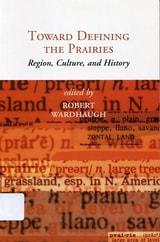
Towards Defining the Prairies
Region, Culture, and HistoryRobert Wardhaugh
University of Manitoba Press, 2001
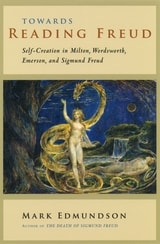
Towards Reading Freud
Self-Creation in Milton, Wordsworth, Emerson, and Sigmund FreudMark Edmundson
University of Chicago Press, 2007
“Marvelous. . . . Edmundson’s book offers an extraordinary challenge both to practicing analysts and to a scholarly community which all too uncomplainingly inhabits and reinforces the Freudian paradigm of interpretation. Edmundson reinvents an adventurous and dissident Freud as an antidote to . . . weary psychoanalytic commonplaces.”—Malcolm Bowie, Raritan
“This book takes a distinguished place in the ongoing effort to recontextualize Freud by stressing the literary, rather than the scientific roots and character of his theory.”—Virginia Quarterly Review
Towards the Ethics of Form in Fiction
Narratives of Cultural RemissionLeona Toker
The Ohio State University Press, 2010
Toker is especially interested in cultural remissions such as the carnivalesque—that is, the inverting of standard cultural hierarchies or the blurring of boundaries between normally separated social groups, actors and audiences, self and other. She argues that cultural remissions have the potential not simply to provide a break from the determinacies of our quotidian existence but also to return us to that existence with some alteration of our perceptions, beliefs, and values. Toker contends that the ethical consequences of reading fiction result from features of its aesthetics, particularly what she calls, following the semiotician Louis Hjemslev, “the form of the content”—the patterns arising from the artistic deployment of narrative details. In addition to addressing the carnivalesque discourse of Bakhtin as well as the theory of oppositionality developed by de Certeau and Chambers, she puts theory into practice through detailed analyses of canonical texts by Fielding, Sterne, Austen, Hawthorne, Dickens, Conrad, Joyce, and other writers.
Toxic Voices
The Villain from Early Soviet Literature to Socialist RealismEric Laursen
Northwestern University Press, 2013
Toys and Tools in Pink
Cultural Narratives of Gender, Science, and TechnologyCarol Colatrella
The Ohio State University Press, 2011
Traces of Gold
California's Natural Resources and the Claim to Realism in Western American LiteratureNicolas Witschi
University of Alabama Press, 2001
Artfully demonstrates the linkage of American literary realism to the texts, myths, and resources of the American West
From Gold Rush romances to cowboy Westerns, from hard-boiled detective thrillers to nature writing, the American West has long been known mainly through hackneyed representations in popular genres. But a close look at the literary history of the West reveals a number of writers who claim that their works represent the “real” West. As Nicolas Witschi shows, writers as varied as Bret Harte, John Muir, Frank Norris, Mary Austin, and Raymond Chandler have used claims of textual realism to engage, replicate, or challenge commonly held assumptions about the West, while historically acknowledged realists like William Dean Howells and Mark Twain have often relied on genre-derived impressions about the region.
The familiar association of the West with nature and the “great outdoors” implies that life in the West affords an unambiguous relationship with an unalloyed, non-human, real nature. But through a combination of textual scholarship, genre criticism, and materialist cultural studies, Witschi complicates this notion of wide-open spaces and unfettered opportunity. The West has been the primary source of raw materials for American industrial and economic expansion, especially between the California Gold Rush and World War II, and Witschi argues that the writers he examines exist within the intersections of cultural and material modes of production. Realistic depictions of Western nature, he concludes, must rely on the representation of the extraction of material resources like minerals, water, and oil.
With its forays into ecocriticism and cultural studies, Traces of Gold will appeal to students and scholars of American literature, American studies, and western history.
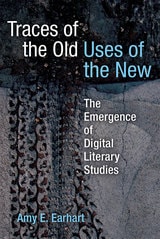
Traces of the Old, Uses of the New
The Emergence of Digital Literary StudiesAmy E. Earhart
University of Michigan Press, 2015
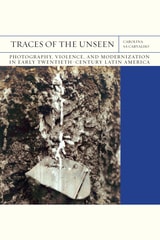
Traces of the Unseen
Photography, Violence, and Modernization in Early Twentieth-Century Latin AmericaCarolina Sá Carvalho
Northwestern University Press, 2023
Winner of the 2024 Roberto Reis Book Award
Winner of the LASA Environment Section Best Book of 2023
Winner of the LASA Amazonian Studies Section Best Book of 2024
Co-Winner of the LASA Book Award for the Visual Culture Studies 2024
A richly illustrated examination of photography as a technology for documenting, creating, and understanding the processes of modernization in turn-of-the-century Brazil and the Amazon
Photography at the turn of the twentieth century was not only a product of modernity but also an increasingly available medium to chronicle the processes of modernization. Traces of the Unseen: Photography, Violence, and Modernization in Early Twentieth-Century Latin America situates photography’s role in documenting the destruction wrought by infrastructure development and extractive capitalist expansion in the Amazon and outside the Brazilian metropole. Combining formal analysis of individual photographs with their inclusion in larger multimedia assemblages, Carolina Sá Carvalho explores how this visual evidence of violence was framed, captioned, cropped, and circulated. As she explains, this photographic creation and circulation generated a pedagogy of the gaze with which increasingly connected urban audiences were taught what and how to see: viewers learned to interpret the traces of violence captured in these images within the larger context of modernization.
Traces of the Unseen draws on works by Flavio de Barros, Euclides da Cunha, Roger Casement, Claude Lévi-Strauss, and Mario de Andrade to situate an unruly photographic body at the center of modernity, in all its disputed meanings. Moreover, Sá Carvalho locates historically specific practices of seeing within the geopolitical peripheries of capitalism. What emerges is a consideration of photography as a technology through which modern aspirations, moral inclinations, imagined futures, and lost pasts were represented, critiqued, and mourned.
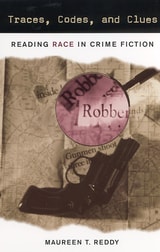
Traces, Codes, and Clues
Reading Race in Crime FictionReddy, Maureen T
Rutgers University Press, 2002
Detective fiction featuring white women and people of color such as Barbara Neelys Blanche White and Walter Mosleys Easy Rawlinshas become tremendously popular. Although they are considered "light reading," mysteries also hold important cultural and social "clues." Much recent scholarly work has demonstrated that race is both a cultural fiction not a biological reality and a central organizing principle of experience. Popular writers are likely to reflect the conventions of their own historical situations.
In Traces, Codes, and Clues: Reading Race in Crime Fiction, Maureen T. Reddy explores the ways in which crime fiction manipulates cultural constructions such as race and gender to inscribe dominant cultural discourses. She notes that even those writers who appear to set out to revise outdated conventions repeatedly reproduce the genres most conservative elements. The greatest obstacle to transforming crime fiction, Reddy states, is the fact that the genre itself is deeply embedded in the discourse of white (and male) superiority. There is, therefore, an absolute necessity to break away from that discourse through reversal or other strategies in order to produce work that defies, and thus helps readers to defy, the dominant ideology of race.
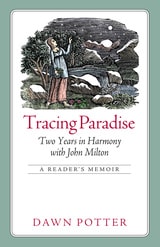
Tracing Paradise
Two Years in Harmony with John MiltonDawn Potter
University of Massachusetts Press, 2009
One winter morning, poet Dawn Potter sat down at her desk in Harmony, Maine, and began copying out the opening lines of John Milton's Paradise Lost. Her intent was to spend half an hour with a poem she had never liked, her goal to transcribe a page or two. Maybe she would begin to appreciate the poet's art, though she had no real expectations that the exercise would change her mind about the poem. Yet what began as a whim turned rapidly into an obsession, and soon Potter was immersed in a strange and unexpected project: she found herself copying out every single word of Milton's immense, convoluted epic.
Tracing Paradise: Two Years in Harmony with John Milton is her memoir of that long task. Over the course of twelve chapters, Potter explores her very personal response to Milton and Paradise Lost, tracing the surprising intersections between a seventeenth-century biblical epic and the routine joys and tragedies of domestic life in contemporary rural Maine. Curious, opinionated, and eager, she engages with the canon on mutable, individual terms. Though she writes perceptively about the details and techniques of Milton's art, always her reactions are linked to her present-tense experiences as a poet, small-time farmer, family member, and citizen of a poor and beleaguered north-country town.
A skilled and entertaining writer, Potter is also a wide-ranging and sophisticated reader. Yet her memoir is not a scholarly treatise: her enthusiasms and misgivings about both Milton and Paradise Lost ebb and flow with the days. Tracing Paradise reminds us that close engagement with another artist's task may itself be a form of creation. Above all, Potter's memoir celebrates one reader's difficult yet transformative love affair with Milton's glorious, irritating, inscrutable masterpiece.
Tracing Southern Storytelling in Black and White
Sarah Gilbreath Ford
University of Alabama Press, 2014
Exploring the shared storytelling traditions that shaped Southern literature across racial lines.
Tracing Southern Storytelling in Black and White is a study of the historical use of oral storytelling by southern writers in written works. In each chapter, Sarah Gilbreath Ford pairs a white and an African American writer to highlight points of confluence in black and white southern oral traditions. She argues that the connections between white and African American southern writers run deeper than critics have yet explored, and she uses textual comparisons to examine the racial mixing of oral culture.
On porches, in kitchens, and on the pages of their work, black and white southerners exchanged not just stories but strategies for telling stories. As a boy, Joel Chandler Harris listened to the stories of African American slaves, and he devised a framework to turn the oral stories into written ones. Harris’s use of the frame structure influenced how Charles Chesnutt recorded oral stories, but it led Alice Walker to complain that her heritage had been stolen. Mark Twain listened to African American storytellers as a child. His use of oral dialects then impacts how Ralph Ellison and William Faulkner employ oral storytelling and how Toni Morrison later writes in response to Faulkner. The interactions are not linear, not a chain of influence, but a network of interactions, borrowings, and revisions.
Ford’s pairings lead to new readings that reveal how the writers employ similar strategies in their narratives, due in part to shared historical context. While Zora Neale Hurston and William Faulkner, for example, use oral storytelling in the 1930s to examine the fear of racial mixing, Ellen Douglas and Ernest Gaines use it in the 1970s to build bridges between the races. Exploring the cultural crossing that occurs in the use of oral storytelling, Ford offers a different view of this common strategy in southern narrative and a new perspective on how culture is shared.
Trade and Romance
Michael Murrin
University of Chicago Press, 2013
Trading Tongues
Merchants, Multilingualism, and Medieval LiteratureJonathan Hsy
The Ohio State University Press, 2013
Tradition And Belief
Religious Writing in Late Anglo-Saxon EnglandClara A. Lees
University of Minnesota Press, 1999
Looks at early religious texts and their influence on medieval literature and culture.
Looks at early religious texts and their influence on medieval literature and culture.
In this major study of Anglo-Saxon religious texts-sermons, homilies, and saints’ lives written in Old English-Clare A. Lees reveals how the invention of preaching transformed the early medieval church, and thus the culture of medieval England. By placing Anglo-Saxon prose within a social matrix, her work offers a new way of seeing medieval literature through the lens of culture.To show how the preaching mission of the later Anglo-Saxon church was constructed and received, Lees explores the emergence of preaching from the traditional structures of the early medieval church-its institutional knowledge, genres, and beliefs. Understood as a powerful rhetorical, social, and epistemological process, preaching is shown to have helped define the sociocultural concerns specific to late Anglo-Saxon England.The first detailed study of traditionality in medieval culture, Tradition and Belief is also a case study of one cultural phenomenon from the past. As such-and by concentrating on the theoretically problematic areas of history, religious belief, and aesthetics-the book contributes to debates about the evolving meaning of culture.ISBN 0-8166-3002-X Cloth £34.50 $49.95xxISBN 0-8166-3003-8 Paper £14.00 $19.95x232 Pages 5 7/8 x 9 NovemberMedieval Cultures Series, volume 19Translation inquiries: University of Minnesota Press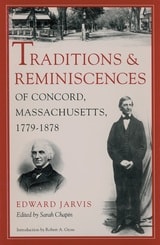
Traditions and Reminiscences of Concord, Massachusetts, 1779-1878
Edward Jarvis
University of Massachusetts Press, 1993
A statistician and pioneer in the treatment of the mentally ill, Edward Jarvis (1803–1884) decided late in life to record his recollections of Concord, Massachusetts, the town in which he was raised. Using Lemuel Shattuck's History of Concord as the springboard for his thoughts, Jarvis produced a remarkable document. Traditions and Reminiscences is encyclopedic in scope but intimate in style; it provides an astonishingly detailed account of life in early nineteenth-century Concord. Jarvis escorts us through the family home, making certain we understand the function and value of each item in the domestic scene. Then he is off to the neighbors' houses, to the schoolhouse, the church, the social clubs, the library, the post office, the town hall, and even the tavern, where he unabashedly counts patrons' drinks. Along the way we learn about neighborly cooperation—quiltings, husking bees, and barn raisings—about social manners and respectability, and about local vices. The result is a vast storehouse of information and a vivid portrait of life in an early nineteenth-century preindustrial community. The memoir also provides a first-hand witness to the crusade for moral reform that transformed mid-nineteenth-century New England.
Tragedy and the Return of the Dead
John D. Lyons
Northwestern University Press, 2018
Early modernity rediscovered tragedy in the dramas and the theoretical writings of the ancient Greeks and Romans. Attempting to make new tragic fictions, writers like Shakespeare, Webster, Hardy, Corneille, and Racine created a dramatic form that would probably have been unrecognizable to the ancient Athenians. Tragedy and the Return of the Dead recovers a model of the tragic that fits ancient tragedies, early modern tragedies, as well as contemporary narratives and films no longer called “tragic” but which perpetuate the same elements.
Authoritative, wide-ranging, and thought provoking, Tragedy and the Return of the Dead uncovers a set of interlocking plots of family violence that stretch from Greek antiquity up to the popular culture of today. Casting aside the elite, idealist view that tragedy manifests the conflict between two equal goods or the human struggle against the divine, John D. Lyons looks closely at tragedy’s staging of gory and painful deaths, ignominious burials, and the haunting return of ghosts. Through this adjusted lens Le Cid, Hamlet, Frankenstein, The Spanish Tragedy, Romeo and Juliet, Phèdre, Macbeth, and other early modern works appear in a striking new light. These works are at the center of a panorama that stretches from Aeschylus’s Agamemnon to Hitchcock’s Psycho and are placed against the background of the Gothic novel, Freud’s “uncanny,” and Burke’s “sublime.”
Lyons demonstrates how tragedy under other names, such as “Gothic fiction” and “thrillers,” is far from dead and continues as a vital part of popular culture.

Tragedy
Contradiction and RepressionRichard Kuhns
University of Chicago Press, 1991
From Aeschylus' classic drama The Persians to the hidden tragic themes in The Merchant of Venice, from the aesthetic writings of Kant to Kleist's narrative Michael Kohlhaas, Kuhns traces the writing and rewriting of the themes of ancient tragedy through modern texts. A culture's concept of fate, Kuhns argues, evolves along with its concepts and forms of tragedy. Examining the deep philosophical concerns of tragedy, he shows how the genre has changed from loss and mourning to contradiction and repression. He sees the fact that tragedy went underground during the optimism of the Enlightenment as a repression that continues into the American consciousness. Turning to Melville's The Confidence Man as an example of Old World despair giving way to New World nihilism, Kuhns indicates how psychoanalytic understanding of tragedy provides a method of interpretation that illuminates the continuous tradition from the ancient to the modern world. The study concludes with reflections on the poetry of Walt Whitman and Emily Dickinson. Each poet's celebration of the body, and the contribution of the senses to reason, perception, and poetic intuition, is seen as an embodiment of the modern tragic sensibility.
Tragic Effects
Ethics and Tragedy in the Age of TranslationTherese Augst
The Ohio State University Press, 2012
Tragic Effects: Ethics and Tragedy in the Age of Translation confronts the peculiar fascination with Greek tragedy as it shapes the German intellectual tradition, with particular focus on the often controversial practice of translating the Greeks. Whereas the tradition of emulating classical ideals in German intellectual life has generally emerged from the impulse to identify with models, the challenge of translating the Greeks underscores the linguistic and historical discontinuities inherent in the recourse to ancient material and inscribes that experience of disruption as fundamental to modernity.
Friedrich Hölderlin’s translations are a case in point. Regarded in his own time as the work of a madman, his renditions of Sophoclean tragedy intensify dramatic effect with the unsettling experience of familiar language slipping its moorings. His attention to marking the distances between ancient source text and modern translation has granted his Oedipus and Antigone a distinct longevity as objects of discussion, adaptation, and even retranslation. Cited by Walter Benjamin, Martin Heidegger, Bertolt Brecht, and others, Hölderlin’s Sophocles project follows a path both marked by various contexts and tinged by persistent quandaries of untranslatability.
Tragedy has long functioned as a cornerstone for questions about ethical life. By placing emphasis on processes of translation and adaptation, however, Tragic Effects approaches the question of ethics from a perspective informed by recent discourse in translation studies. Reconstructing an ancient text in this context requires negotiating the difficult tension between comprehending the distant past and preserving its radical singularity.
Tragic Encounters
Pushkin and European RomanticismMaksim Hanukai
University of Wisconsin Press, 2023
Many of Pushkin’s works move seamlessly between the closed world of traditional tragedy and the open world of Romantic tragic drama, and yet they follow neither the cathartic program prescribed by Aristotle nor the redemptive mythologies of the Romantics. Instead, the idiosyncratic and artistically mercurial Pushkin seized upon the newly unstable tragic mode to develop multiple, overlapping tragic visions. Providing new, innovative readings of such masterpieces as The Gypsies, Boris Godunov, The Little Tragedies, and The Bronze Horseman, Hanukai sheds light on an unexplored aspect of Pushkin’s work, while also challenging reigning theories about the fate of tragedy in the Romantic period.