Results by title
8812 books match the query 'Political Science' and 1911 start with t
The White Welfare State
The Racialization of U.S. Welfare PolicyDeborah E. Ward
University of Michigan Press, 2005
"In The White Welfare State, Deborah Ward assembles a powerful array of documentary and statistical evidence to reveal the mechanisms, centrality, and deep historical continuity of racial exclusion in modern 'welfare' provision in the United States. Bringing unparalleled scrutiny to the provisions and implementation of state-level mothers' pensions, she argues persuasively that racialized patterns of welfare administration were firmly entrenched in this Progressive Era legislation, only to be adopted and reinforced in the New Deal welfare state. With rigorous and clear-eyed analysis, she pushes us to confront the singular role of race in welfare's development, from its early 20th-century origins to its official demise at century's end."
--Alice O'Connor, University of California at Santa Barbara
"This is a richly informative and arresting work. The White Welfare State will force a reevaluation of the role racism has played as a fundamental feature in even the most progressive features of the American welfare state. Written elegantly, this book will provoke a wide-ranging discussion among social scientists, historians, and students of public policy."
--Ira Katznelson, Ruggles Professor of Political Science and History, Columbia University
"This book offers an original and absorbing account of early policies that shaped the course of the American welfare state. It extends yet challenges extant interpretations and expands our understanding of the interconnections of race and class issues in the U.S., and American political development more broadly."
--Rodney Hero, University of Notre Dame
The Wild East
Criminal Political Economies in South AsiaEdited by Barbara Harriss-White and Lucia Michelutti
University College London, 2019

The Will of the Many
How the Alterglobalisation Movement is Changing the Face of DemocracyMarianne Maeckelbergh
Pluto Press, 2009
Never before has the idea of democracy enjoyed the global dominance it holds today, but neoliberalism has left the practice of democracy in deep crisis.
Marianne Maeckelbergh argues that the most promising model for global democracy is not coming from traditional political parties or international institutions, but from the global networks of resistance to neoliberal economics, known collectively as the Alter-globalisation movement. Through extensive ethnography of decision-making practices within these movements, Maeckelbergh describes an alternative form of global democracy in the making.
Perfect for activists and students of political anthropology, this powerful and enlightening book offers radical changes.
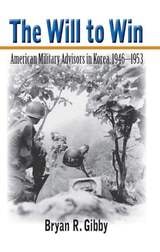
The Will to Win
American Military Advisors in Korea, 1946–1953Bryan R. Gibby
University of Alabama Press, 2012
One of America’s early attempts at nation building - US military advisors' shaping of the Republic of Korea Army (ROKA) from 1946 until 1953.
Gibby describes ROKA’s structure, mission, challenges, and successes, thereby linking the South Korean army and their US advisors to the traditional narrative of this “forgotten war.” The work also demonstrates the difficulties inherent in national reconstruction, focusing on barriers in culture and society, and the effects of rapid decolonization combined with intense nationalism and the appeal of communism to East Asia following the destruction of the Japanese empire. Key conclusions include the importance of individual advisors, the significance of the prewar advisory effort, and the depth of the impact these men had on individual Korean units and in a few cases on the entire South Korean army.
The success or failure of South Korean government in the decade following the end of World War II hinged on the loyalty, strength, and fighting capability of its army, which in turn relied on its American advisors. Gibby argues that without a proficient ROKA, the 1953 armistice, still in effect today, would not have been possible. He reexamines the Korean conflict from its beginning in 1945—particularly Korean politics, military operations, and armed forces—and demonstrates the crucial role the American military advisory program and personnel played to develop a more competent and reliable Korean army.
The Wilsonian Century
U.S. Foreign Policy since 1900Frank Ninkovich
University of Chicago Press, 1999
In the process of describing Wilson's legacy, Ninkovich reinterprets most of the twentieth century's main foreign policy developments. He views the 1920s, for example, not as an isolationist period but as a reversion to Taft's Dollar Diplomacy. The Cold War, with its faraway military interventions, illustrates Wilsonian America's preoccupation with achieving a cohesive world opinion and its abandonment of traditional, regional conceptions of national interest.
The Wilsonian Century offers a striking alternative to traditional interest-based interpretations of U.S. foreign policy. In revising the usual view of Wilson's contribution, Ninkovich shows the extraordinary degree to which Wilsonian ideas guided American policy through a century of conflict and tension.
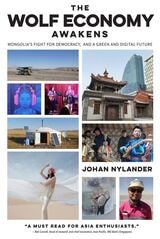
The Wolf Economy Awakens
Mongolia’s Fight for Democracy, and a Green and Digital FutureJohan Nylander
Hong Kong University Press, 2024
Mongolia, a vibrant democracy landlocked between Russia and China, stands on the edge of becoming Asia’s next boom nation—one of the richest countries per capita in the region. Referred to as the “wolf economy” for its vast natural resources (copper, gold, and rare earth metals), it is also home to a growing number of cutting-edge tech startups and international lifestyle brands. Its vast steppe landscape lends itself not only to herding and tourism but also to renewable energy production and filmmaking.
The Wolf Economy Awakens is about the individuals who are fighting to strengthen the country’s democracy and diversify its economy. It is about innovators aiming to realize Mongolia’s promise as a hub for green energy, tech and lifestyle entrepreneurs who are shaking up traditional industries, and go-getters who have left jobs on Wall Street to return to the country they love and help move it forward. Asia correspondent and award-winning author Johan Nylander travels across Mongolia to speak to the country’s leaders and innovators—not to mention a cast of digital nomads, jazz musicians, and ordinary families—and finds a nation ready to grasp a better future. Unlocking a country’s potential is never easy, but Mongolia stands every chance of becoming Asia’s next success story.
The Woman in the Violence
Gender, Poverty, and Resistance in PeruM. Cristina Alcalde
Vanderbilt University Press, 2010
Focusing on the experiences of women who are predominantly poor, nonwhite, rural-to-urban migrants with little or no formal education, The Woman in the Violence addresses a range of serious concerns. What types of violence do women experience at different stages in their lives? Which identities and roles are manifested throughout their lives, and do some of these increase their vulnerability to different forms of violence? What strategies do women employ to gain some power and control in these situations, and how can we conceptualize these strategies?
In examining these questions, The Woman in the Violence contributes to our understanding of violence, gender, race, resistance, and urbanism as it exposes and analyzes systemic violence against women. The everyday forms of resistance these women employ provide significant insight for students, scholars, and health professionals.
The Women of Katrina
How Gender, Race, and Class Matter in an American DisasterEmmanuel David
Vanderbilt University Press, 2012
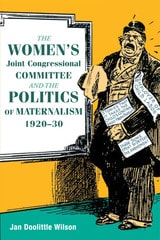
The Women's Joint Congressional Committee and the Politics of Maternalism, 1920-30
Jan Doolittle Wilson
University of Illinois Press, 2006
Jan Doolittle Wilson offers the first comprehensive history of the umbrella organization founded by former suffrage leaders in order to coordinate activities around women's reform. Encompassing nearly every major national women's organization of its time, the Women's Joint Congressional Committee (WJCC) evolved into a powerful lobbying force for the legislative agendas of more than twelve million women. Critics and supporters alike came to recognize it as "the most powerful lobby in Washington."
Examining the WJCC's most consequential and contentious campaigns, Wilson traces how the group's strategies, rhetoric, and success generated congressional and grassroots support for their far-reaching, progressive reforms. But the committee's early achievements sparked a reaction by big business that challenged and ultimately limited the programs these women envisioned. Using the WJCC as a lens, Wilson analyzes women's political culture during the 1920s. She also sheds new light on the initially successful ways women lobbied for social legislation, the limitations of that process for pursuing class-based reforms, and the enormous difficulties the women soon faced in trying to expand public responsibility for social welfare.
A volume in the series Women in American History, edited by Anne Firor Scott, Susan Armitage, Susan K. Cahn, and Deborah Gray White
The Work of Music
Labor and Creativity in Germany's Long Nineteenth CenturyCelia Applegate
University of Wisconsin Press, 2025
The Worker
Dominion and FormErnst Jünger, Edited by Laurence Paul Hemming, Translated from the German by Bogdan Costea and Laurence Paul Hemming
Northwestern University Press, 2018
Martin Heidegger considered Jünger “the only genuine follower of Nietzsche,” singularly providing “an interpretation which took shape in the domain of that metaphysics which already determines our epoch, even against our knowledge; this metaphysics is Nietzsche's doctrine of the ‘will to power.’” In The Worker, Jünger examines some of the defining questions of that epoch: the nature of individuality, society, and the state; morality, justice, and law; and the relationships between freedom and power and between technology and nature.
This work, appearing in its entirety in English translation for the first time, is an important contribution to debates on work, technology, and politics by one of the most controversial German intellectuals of the twentieth century. Not merely of historical interest, The Worker carries a vital message for contemporary debates about world economy, political stability, and equality in our own age, one marked by unsettling parallels to the 1930s.

The World Computer
Derivative Conditions of Racial CapitalismJonathan Beller
Duke University Press, 2021
The World Has Forgotten Us
Sinjar and the Islamic State’s Genocide of the YezidisThomas Schmidinger
Pluto Press, 2022
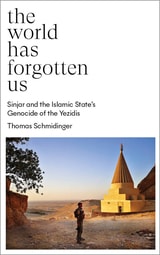
The persecution of the Yezidis, a religious community originating in Upper Mesopotamia, has been ongoing since at least the 10th century. On 3 August 2014, Islamic State attacked the Yezidi community in Sinjar, Kurdistan. Thousands were enslaved or killed in this genocide, and 100,000 people fled to Mount Sinjar, permanently exiled from their homes.
Here, Thomas Schmidinger talks to the Yezidis in Iraq who tell the history of their people, why the genocide happened and how it affects their lives today. This is the first full account of these events, as told by the Yezidis in their own words, to be published in English.
The failure of the Kurdistan Peshmerga of the PDK in Iraq to protect the Yezidis is explored, as is the crucial support given by the Syrian-Kurdish YPG. This multi-faceted and important history brings the fight and trauma of the Yezidis back into focus, calling for the world to remember their struggle.
The World Is Our Stage
The Global Rhetorical Presidency and the Cold WarAllison M. Prasch
University of Chicago Press, 2023
Crowds swarm when US presidents travel abroad, though many never hear their voices. The presidential body, moving from one secured location to another, communicates as much or more to these audiences than the texts of their speeches. In The World is Our Stage, Allison M. Prasch considers how presidential appearances overseas broadcast American superiority during the Cold War. Drawing on extensive archival research, Prasch examines five foundational moments in the development of what she calls the “global rhetorical presidency:” Truman at Potsdam, Eisenhower’s “Goodwill Tours,” Kennedy in West Berlin, Nixon in the People’s Republic of China, and Reagan in Normandy. In each case, Prasch reveals how the president’s physical presence defined the boundaries of the “Free World” and elevated the United States as the central actor in Cold War geopolitics.

The World Says No to War
Demonstrations against the War on IraqStefaan Walgrave
University of Minnesota Press, 2010
The World Wide Web of Work
A History in the MakingMarcel van der Linden
University College London, 2023
Global labor history is one of the fastest-growing fields of study worldwide today. This volume assembles a group of contributors from around the world to discuss the core concepts “capitalism” and “workers,” and to refine notions such as “coerced labor,” “household strategies,” and “labor markets.” It explores in new ways the connections between laborers in different parts of the world, arguing that both globalization and modern labor management originated in agriculture in the Global South and were only later introduced in Northern industrial settings. It reveals that nineteenth-century chattel slavery was frequently replaced by other forms of coerced labor, and it reconstructs the twentieth-century attempts of the International Labor Organisation to regulate work standards internationally. The book also pays attention to the relational inequality through which workers in wealthy countries benefit from the exploitation of those in poor countries. The final part addresses workers’ resistance and acquiescence: why collective actions often have unanticipated consequences, why and how workers sometimes organize massive flights from exploitation and oppression, and why proletarian revolutions took place in pre-industrial or industrializing countries but never in fully developed capitalist societies.
The World after Iraq
A Special Issue, Volume 14Nikolaos A. Stavrou, ed.
Duke University Press, 0
Contributors from the Mediterranean Basin and the U.S.—both supporters and critics of U.S. foreign policy in pre- and postwar Iraq—investigate the U.S.’s “war on terrorism” and its associated concept of “preemptive war” as viable political strategies. Other essays weigh the ramifications of recent U.S. foreign policy in the Middle East for the institutions that have governed international relations since World War II and consider the political, social, and economic costs of this policy both for the U.S. itself and for the countries it targets.
Contributors. Stephen C. Calleya, Vincent M. Cannistraro, Ted Galen Carpenter, Mohamed A. El-Khawas, Ivan Eland, William H. Lewis, Raymond Muhula, Bernard Reich, Burton M. Sapin, Joseph J. Sisco, Nikolaos A. Stavrou, Stansfield Turner
The World beyond the Windshield
Roads and Landscapes in the United States and EuropeChristof Mauch
Ohio University Press, 2008
For better or worse, the view through a car’s windshield has redefined how we see the world around us. In some cases, such as the American parkway, the view from the road was the be-all and end-all of the highway; in others, such as the Italian autostrada, the view of a fast, efficient transportation machine celebrating either Fascism or its absence was the goal. These varied environments are neither necessary nor accidental but the outcomes of historical negotiations, and whether we abhor them or take delight in them, they have become part of the fabric of human existence.
The World beyond the Windshield: Roads and Landscapes in the United States and Europe is the first systematic, comparative look at these landscapes. By looking at examples from the United States and Europe, the chapters in this volume explore the relationship between the road and the landscape thatit traverses, cuts through, defines, despoils, and enhances. The authors analyze the Washington Beltway and the Blue Ridge Parkway, as well as iconic roads in Italy, Nazi Germany, East Germany, and Great Britain. This is a story of the transatlantic exchange of ideas about environment and technology and of the national and nationalistic appropriations of such landscaping.
The World of the John Birch Society
Conspiracy, Conservatism, and the Cold WarD. J. Mulloy
Vanderbilt University Press, 2014
Named One of "Six Books for Insight on a Trump Presidency" by the Washington Post
As far as members of the hugely controversial John Birch Society were concerned, the Cold War revealed in stark clarity the loyalties and disloyalties of numerous important Americans, including Dwight Eisenhower, John Kennedy, and Earl Warren. Founded in 1958 as a force for conservative political advocacy, the Society espoused the dangers of enemies foreign and domestic, including the Soviet Union, organizers of the US civil rights movement, and government officials who were deemed "soft" on communism in both the Republican and Democratic parties. Sound familiar? In The World of the John Birch Society, author D. J. Mulloy reveals the tactics of the Society in a way they've never been understood before, allowing the reader to make the connections to contemporary American politics, up to and including the Tea Party. These tactics included organized dissemination of broad-based accusations and innuendo, political brinksmanship within the Republican Party, and frequent doomsday predictions regarding world events. At the heart of the organization was Robert Welch, a charismatic writer and organizer who is revealed to have been the lifeblood of the Society's efforts.
The Society has seen its influence recede from the high-water mark of 1970s, but the organization still exists today. Throughout The World of the John Birch Society, the reader sees the very tenets and practices in play that make the contemporary Tea Party so effective on a local level. Indeed, without the John Birch Society paving the way, the Tea Party may have encountered a dramatically different political terrain on its path to power.
The Youth Labor Market Problem
Its Nature, Causes, and ConsequencesEdited by Richard B. Freeman and David A. Wise
University of Chicago Press, 1982

Theater and Democracy in an Era of Immersion
James R. Ball III
University of Michigan Press, 2027
From theater to virtual reality, we find ourselves making sense of imagined worlds that surround us. Our experience of democracy in the twenty-first century is similar: we are spectators to politics, immersed in 24-hour news, joining candidates on the campaign trail, reflecting on civic life and national memory in spaces of culture. Theater and Democracy in an Era of Immersion draws on extensive interviews with artists to develop a theory of immersive spectatorship as political action, arguing that through our experience of art, we can cultivate practices to navigate the disorientations and disenchantments of our democracy. This theory complements and complicates debates over the democratic promise of participatory performance by theorizing a mode of spectatorship that cuts across media, disciplines, genres, and everyday experiences.
James R. Ball III investigates phenomena that compose our experience of democracy, including campaign trail debates and rallies; electoral microtargeting; misinformation, disinformation, and conspiracy theory; sonic weapons and psychic spying; political assassination; racist state violence; public commemoration; AI in government; and the democratic work of mourning. Theater and Democracy in an Era of Immersion provides a unique performance studies intervention into political theory, indicating new avenues for research into political spectatorship and the theatricality of deliberative and ocular democracy.
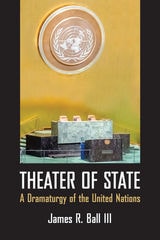
Theater of State
A Dramaturgy of the United NationsJames R. Ball III
Northwestern University Press, 2020
This study of the lived experience of spectacular politics on the world stage draws on theories of theater, performance, and politics to offer new ways of approaching issues of war, cosmopolitanism, international justice, governance, and activism. Situated at the nexus of two disciplines, performance studies and political science, this volume encourages conversations between the two so that each might offer lessons to the other.
Theatre Symposium, Vol. 28
Theatre and CitizenshipEdited by Andrew Gibb
University of Alabama Press, 2020
A collection of essays whose authors reach beyond simple definitions of citizenship as determined by documents and legal rights
The scholarly conference from which this publication emerged was circulated in the waning months of 2018, following a summer of urgent and emotional debate surrounding new US immigration policies regarding immigrant family separations, arguments fueled on one side by fears about the loss of social cohesion, and on the other by photographs of incarcerated children. Given the then-prevailing political atmosphere, editor Andrew Gibb anticipated that a good number of submissions might draw connections between the patterns, policies, and histories of immigration on the one hand, and theatrical or otherwise performance-centered expressions of citizenship, whether inclusive or exclusionary, on the other. In retrospect, what could have been foreseen is that theatre scholars, educators, and professionals would interpret recent events against a wider and more complex backdrop. The ultimate result of that initial call is this volume, a collection of essays whose authors reach beyond simple definitions of citizenship as determined by documents and legal rights, and who engage in larger conversations about what citizenship can mean, and how such meanings are expressed through theatre and performance.
Interestingly, while none of the authors published herein take up immigration as a central issue, they all make use of some combination of three particular analytical frameworks, all of which happen to be pertinent to the current immigrant experience and attempts to regulate it: bodies, institutions, and technologies.
Theatre Symposium, Vol. 9
Theatre and Politics in the Twentieth CenturyJohn C. Countryman
University of Alabama Press, 2001
This collection of essays explores how drama can teach political principles and entertain at the same time.
Political commentary is possible through "variety" theatre, this volume contends. Compiled from the April 2000 Theatre Symposium held on the campus of the University of Tennessee-Knoxville, this collection of essays presents a compelling mix of theoretical and practical viewpoints from a broad diversity of scholars from around the country.
What remains to be learned about the political objectives of Brecht's Lehrstriucke? What political power is resident in the satirical humor of Dario Fo's drama? What can we learn from Mordecai Gorelik's political/artistic philosophy that might inform contemporary practice? What was the impact of political theatre on Broadway between the wars? Is Thornton Wilder's Our Town the play we've always imagined it to be, or does it challenge the politics of its time? What is the role of theatre activism in raising consciousness about gender politics? These are only some of the questions addressed by this lively, informative discussion.
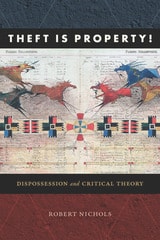
Theft Is Property!
Dispossession and Critical TheoryRobert Nichols
Duke University Press, 2020
Theodoret of Cyrrhus
The Bishop and the Holy ManTheresa Urbainczyk
University of Michigan Press, 2002
With the conversion of Constantine and his subsequent championing of the Christian cause, the Church rapidly began to increase its wealth and status. As coins filled the coffers of God, some Christians came to feel that their religion had become corrupted. They fled to the desert wastes, seeking a purer, holier life. These recluses and ascetics are the subjects of Theodoret's Religious History. The Syrian bishop had known many of them, some for all his life.
Urbainczyk argues that Theodoret's work was not merely written as an act of piety, but was in fact a very political treatise, addressing the theological disputes of his day. The main tensions of the early fifth century lay between the sees of Syrian Antioch and Egyptian Alexandria. One of Theodoret's aims was to show that Syria had produced individuals as pious as those of Egypt, about whom much had already been written. Urbainczyk studies the social background of these Syrian ascetics, describes the relationship between Theodoret's heroes and the Church community, and investigates how Theodoret presents his own personal relationship with the holy men.
This book is the first to examine Theodoret's role in his own work. Urbainczyk argues that the intimate details of Theodoret's life were not let slip accidentally but were inserted deliberately to buttress his own threatened position and to show how these independent men of God deferred to no one but himself.
Theodoret of Cyrrhus is an invaluable study for students of late antiquity, scholars of early Church history, early medieval historiographers and hagiographers.
Theresa Urbainczyk is College Lecturer in Classics, University College, Dublin.
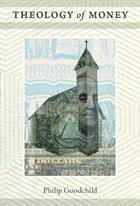
Theology of Money
Philip Goodchild
Duke University Press, 2009
Engaging with Christian theology and the thought of Carl Schmitt, Georg Simmel, Karl Marx, Adam Smith, and many others, Goodchild develops a theology of money based on four contentions, which he elaborates in depth. First, money has no intrinsic value; it is a promise of value, a crystallization of future hopes. Second, money is the supreme value in contemporary society. Third, the value of assets measured by money is always future-oriented, dependent on expectations about how much might be obtained for those assets at a later date. Since this value, when realized, will again depend on future expectations, the future is forever deferred. Financial value is essentially a degree of hope, expectation, trust, or credit. Fourth, money is created as debt, which involves a social obligation to work or make profits to repay the loan. As a system of debts, money imposes an immense and irresistible system of social control on individuals, corporations, and governments, each of whom are threatened by economic failure if they refuse their obligations to the money system. This system of debt has progressively tightened its hold on all sectors and regions of global society. With Theology of Money, Goodchild aims to make conscious our collective faith and its dire implications.
Theories Of The New Class
Intellectuals And PowerLawrence Peter King
University of Minnesota Press, 2004
Demonstrates the centrality of thinking about intellectual class formation to social theory
Old as the notion of the “New Class” is (the term was coined by anarchist Mikhail Bakunin around 1870), the idea of the ascendancy of an intellectual elite continues to engage, and perplex, social theorists. In Theories of the New Class, Iván Szelényi, one of the most incisive and respected analysts of the intellectual class, and his colleague Lawrence King put New Class theories into a broad historical framework for the first time.
Addressing the intellectual history of Marxism and socialism, theories of the increasing role of the state and technocratic elites in capitalism, and theories of contemporary social change, King and Szelényi’s work clearly links the centrality of thinking about intellectual class formation to a variety of theoretical and political projects that have shaped social theory and influenced political realities over the past century.King and Szelényi show that the idea of the New Class has stubbornly entered and reentered the agenda of critical social theorizing throughout the last century. Indeed, they interpret that the last century as a history of projects by different groups of the highly educated—factions of intellectuals, bureaucrats, technocrats, managers, and the left-wing humanistic intelligentsia—to gain ultimate power. A rare empirical discussion of theory, Theories of the New Class invigorates class theories by grounding them in contemporary issues; at the same time, it uses modern polemics to revitalize historical debates on the origins of capitalism.
Theories of Dependent Foreign Policy and the Case of Ecuador in the 1980s
Jeanne A. K. Hey
Ohio University Press, 1995
How do economic weakness and dependence influence foreign policy decisions and behavior in third world countries? Theories in Dependent Foreign Policy examines six foreign policy theories: compliance, consensus, counterdependence, realism, leader preferences and domestic politics, and each is applied to a series of case studies of Ecuador’s foreign policy during the 1980s under two regimes: Osvaldo Hurtado (1981-1984) and his successor León Febres Cordero (1984-1988).
Hey shows that Ecuador during this period represented the third world in many ways. It was a new democracy, having just emerged from years of military rule, extremely indebted to the West, and dependent on primary product export economy that relied heavily on importers, especially the United States.
Jeanne Hey finds that some of the most popular and enduring theories in western research, such as realism and compliance, poorly account for Ecuadorian foreign policy. She explains that poor countries like Ecuador have substantial foreign policy latitude in the diplomatic area. Drawing on archival research and interviews with policy makers including Presidents Hurtado and Febres Cordero, Dr. Hey convincingly argues that many of the traditional foreign policy theories do not “fit” dependent states, and inadequately account for the complexity of foreign policy in the third world.
Theorizing Global Order
The International, Culture and GovernanceEdited by Gunther Hellmann
Campus Verlag, 2018
Theorizing NGOs
States, Feminisms, and NeoliberalismVictoria Bernal and Inderpal Grewal, eds.
Duke University Press, 2014
Contributors. Sonia E. Alvarez, Victoria Bernal, LeeRay M. Costa, Inderpal Grewal, Laura Grünberg, Elissa Helms, Julie Hemment, Saida Hodžic, Lamia Karim, Sabine Lang, Lauren Leve, Kathleen O'Reilly, Aradhana Sharma
Theorizing Social Movements
Joe Foweraker
Pluto Press, 1995
Theory and Practice of Social Planning
Alfred J. Kahn
Russell Sage Foundation, 1969

Theory from the Trenches
Decolonization and the Horizons of Subaltern MarxismShozab Raza
Duke University Press, 2027
Theory in the Practice of the Nicaraguan Revolution
Bruce E. Wright
Ohio University Press, 1995
Even in the period following the electoral defeat of the Sandinista National Liberation Front (FSLN) in 1990, the revolution of 1979 continues to have a profound effect on the political economy of Nicaragua. Wright’s study, which is based on interviews with people from all walks of life—from government and party officials to academics and campesinos—as well as on the large volume of literature in both English and Spanish, focuses on the FSLN understanding of the relationships between the state, the party, and mass actors, and the nature of social classes. Wright considers the topics of agrarian reform, the development of mass organizations, the role of labor, and other aspects of the Nicaraguan political economy in order to assess their significance in theoretical as well as practical terms.
Theory of Governance and Other Miscellaneous Papers, 1921-1938 (CW32)
Eric Voegelin, Edited & Intro by William Petropulos & Gilbert Weiss, & Translated by William Petropulos, Jodi Cockerill, M. J. Hanak, Ingrid Heldt, Elisabeth von Lochner, & Sue Bollans
University of Missouri Press, 2004
This first of two volumes of Voegelin's miscellaneous papers brings together crucial writings, published for the first time, from the early, formative period of this scholar's thought. The book begins with Voegelin's dissertation on sociological method, completed under the direction of Othmar Spann and Hans Kelsen at the University of Vienna in 1922. It reveals an intimate knowledge of the writings of Georg Simmel and a skillful use of insights gained from Edmund Husserl's Logical Investigations and Ideas.
The dissertation, and other smaller pieces written at this time, addresses problems that remained of great importance to Voegelin throughout his life: the relation of insight to language, the structure of the human being, and the human's spiritual center. They disclose both Voegelin's theoretical reference points during these early years, including the thought of Henri Bergson, Othmar Spann, Georg Simmel, and Edmund Husserl, as well the young scholar's remarkably independent approach to theoretical problems.
Moreover, this volume includes a work that is fundamental to an understanding of Voegelin's theoretical development: his extended study on the "theory of governance," written between 1930 and 1932. It follows the issues that confront political society to their roots in the soul and in the soul's relationship to the ground of being.
The Theory of Governance and Other Miscellaneous Papers presents a meditative-exegetic study of texts from Augustine, Descartes, and Husserl, early examples of the meditations that became central to Voegelin's later work. Other essays included in this volume such as "Theory of Law" and "Political Theory as Human Science" develop these theoretical insights and refine Voegelin's methodological tools. This volume will be of interest to all scholars of the work of Eric Voegelin and of the refoundation of political philosophy in the twentieth century in general.
There Goes the Hood
Views of Gentrification from the Ground UpLance Freeman
Temple University Press, 2006
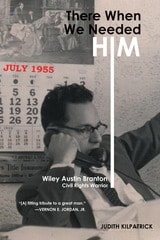
There When We Needed Him
Wiley Austin Branton, Civil Rights WarriorJudith Kilpatrick
University of Arkansas Press, 2007
These Islands
A Letter to BritainAli M. Ansari
Haus Publishing, 2018
With These Islands, Ali M. Ansari considers the idea of Britain as a political entity. This idea of Britain considers some nationalists as suppressed minorities in need of attention, and others as bigoted throwbacks to a more divisive age. Arguing the case for Great Britain from the perspective of the political mythology of the British state—with an emphasis on culture, ideas and narrative constructions—Ansari makes the claim that Britain’s strength lies in its ability to shape the popular imagination, both at home and abroad. He concludes that an “excess of enthusiasm” may yet do untold damage to the fabric of a state and society that has been carefully constructed over the centuries and may not be easily repaired.
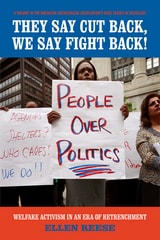
They Say Cutback, We Say Fight Back!
Welfare Activism in an Era of RetrenchmentEllen Reese
Russell Sage Foundation, 2012
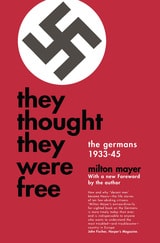
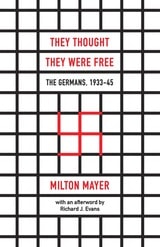
They Thought They Were Free
The Germans, 1933-45Milton Mayer
University of Chicago Press, 1966
“What happened here was the gradual habituation of the people, little by little, to being governed by surprise; to receiving decisions deliberated in secret; to believing that the situation was so complicated that the government had to act on information which the people could not understand, or so dangerous that, even if the people could not understand it, it could not be released because of national security. And their sense of identification with Hitler, their trust in him, made it easier to widen this gap and reassured those who would otherwise have worried about it.”--from Chapter 13, “But Then It Was Too Late”
They Thought They Were Free
The Germans, 1933–45Milton Mayer
University of Chicago Press, 2017
“When this book was first published it received some attention from the critics but none at all from the public. Nazism was finished in the bunker in Berlin and its death warrant signed on the bench at Nuremberg.”
That’s Milton Mayer, writing in a foreword to the 1966 edition of They Thought They Were Free. He’s right about the critics: the book was a finalist for the National Book Award in 1956. General readers may have been slower to take notice, but over time they did—what we’ve seen over decades is that any time people, across the political spectrum, start to feel that freedom is threatened, the book experiences a ripple of word-of-mouth interest.
They Thought They Were Free is an eloquent and provocative examination of the development of fascism in Germany. Mayer’s book is a study of ten Germans and their lives from 1933-45, based on interviews he conducted after the war when he lived in Germany. Mayer had a position as a research professor at the University of Frankfurt and lived in a nearby small Hessian town which he disguised with the name “Kronenberg.” “These ten men were not men of distinction,” Mayer noted, but they had been members of the Nazi Party; Mayer wanted to discover what had made them Nazis. His discussions with them of Nazism, the rise of the Reich, and mass complicity with evil became the backbone of this book, an indictment of the ordinary German that is all the more powerful for its refusal to let the rest of us pretend that our moment, our society, our country are fundamentally immune.
A new foreword to this edition by eminent historian of the Reich Richard J. Evans puts the book in historical and contemporary context. We live in an age of fervid politics and hyperbolic rhetoric. They Thought They Were Free cuts through that, revealing instead the slow, quiet accretions of change, complicity, and abdication of moral authority that quietly mark the rise of evil.
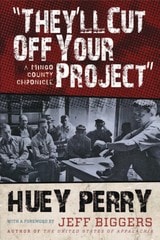
They'll Cut Off Your Project
A Mingo County ChronicleHuey Perry, with a foreword by Jeff Biggers
West Virginia University Press, 2010
In old England, if a king didn’t like you, he would cut off your head. Now, if they don’t like you, they’ll cut off your project!
As the Johnson Administration initiated its war on poverty in the 1960s, the Mingo County Economic Opportunity Commission project was established in southern West Virginia. Huey Perry, a young, local history teacher was named the director of this program and soon he began to promote self-sufficiency among low-income and vulnerable populations. As the poor of Mingo County worked together to improve conditions, the local political infrastructure felt threatened by a shift in power. Bloody Mingo County, known for its violent labor movements, corrupt government, and the infamous Hatfield-McCoy rivalry, met Perry’s revolution with opposition and resistance.
In They’ll Cut Off Your Project, Huey Perry reveals his efforts to help the poor of an Appalachian community challenge a local regime. He describes this community’s attempts to improve school programs and conditions, establish cooperative grocery stores to bypass inflated prices, and expose electoral fraud. Along the way, Perry unfolds the local authority’s hostile backlash to such change and the extreme measures that led to an eventual investigation by the FBI. They’ll Cut Off Your Project chronicles the triumphs and failures of the war on poverty, illustrating why and how a local government that purports to work for the public’s welfare cuts off a project for social reform.
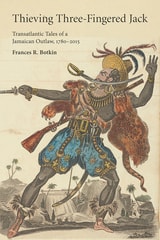
Thieving Three-Fingered Jack
Transatlantic Tales of a Jamaican Outlaw, 1780-2015Botkin, Frances R.
Rutgers University Press, 2018
The fugitive slave known as “Three-Fingered Jack” terrorized colonial Jamaica from 1780 until vanquished by Maroons, self-emancipated Afro-Jamaicans bound by treaty to police the island for runaways and rebels. A thief and a killer, Jack was also a freedom fighter who sabotaged the colonial machine until his grisly death at its behest. Narratives about his exploits shed light on the problems of black rebellion and solutions administered by the colonial state, creating an occasion to consider counter-narratives about its methods of divide and conquer. For more than two centuries, writers, performers, and storytellers in England, Jamaica, and the United States have “thieved" Three Fingered Jack's riveting tale, defining black agency through and against representations of his resistance.
Frances R. Botkin offers a literary and cultural history that explores the persistence of stories about this black rebel, his contributions to constructions of black masculinity in the Atlantic world, and his legacies in Jamaican and United States popular culture.
Think Tanks in America
Thomas Medvetz
University of Chicago Press, 2012
Thinker, Faker, Spinner, Spy
Corporate PR and the Assault on DemocracyEdited by David Miller and William Dinan
Pluto Press, 2007
Written by leading activists and writers, this book reveals the secrets of the PR trade including deception, the use of fake 'institutes', spying and dirty tricks. The impact can be devastating -- when the public is denied access to the truth, the results are rising inequality and environmental catastrophe.
Exposing the misdeeds of famous companies including Coca Cola, British Aerospace, Exxon and Monsanto, and revealing information about the covert funding of various apparently independent thinks tanks and institutes, the authors offer a guide to campaigns that can help us roll back corporate power and resist deceptive PR.
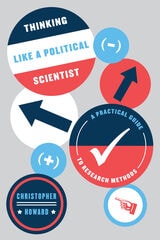
Thinking Like a Political Scientist
A Practical Guide to Research MethodsChristopher Howard
University of Chicago Press, 2017
With wit and practical wisdom, Christopher Howard draws on more than a decade of experience teaching research methods to transform a typically dreary subject and teach budding political scientists the critical skills they need to read published research more effectively and produce better research of their own. The first part of the book is devoted to asking three fundamental questions in political science: What happened? Why? Who cares? In the second section, Howard demonstrates how to answer these questions by choosing an appropriate research design, selecting cases, and working with numbers and written documents as evidence. Drawing on examples from American and comparative politics, international relations, and public policy, Thinking Like a Political Scientist highlights the most common challenges that political scientists routinely face, and each chapter concludes with exercises so that students can practice dealing with those challenges.
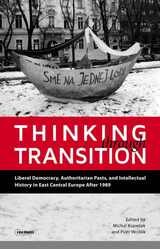
Thinking through Transition
Liberal Democracy, Authoritarian Pasts, and Intellectual History in East Central Europe After 1989Michal Kopecek
Central European University Press, 2015
Third World Studies
Theorizing LiberationGary Y. Okihiro
Duke University Press, 2024