Results by title
784 books match the query 'American Government' and 199 start with t
The Rise of the Entrepreneurial State
State and Local Economic Development Policy in the United StatesPeter K. Eisinger
University of Wisconsin Press, 1989
Eisinger’s meticulous research uncovers state and local governments’ transition from supply-side to demand-side strategies of market creation. He shows that, instead of relying solely on the supply-side strategies of tax breaks and other incentives to encourage business relocation, some governments promoted innovation and the creation of new business approaches.
The Rise of the Public Authority
Statebuilding and Economic Development in Twentieth-Century AmericaGail Radford
University of Chicago Press, 2013
The Rise of the Representative
Lawmakers and Constituents in Colonial AmericaPeverill Squire
University of Michigan Press, 2017
The Sagebrush State, 3d Edition
Nevada's History, Government, and PoliticsMichael W. Bowers
University of Nevada Press, 2006
The Sagebrush State, 4th Ed
Nevada’s History, Government, and PoliticsMichael W. Bowers
University of Nevada Press, 2013
The Sagebrush State, 5th Edition
Nevada's History, Government, and PoliticsMichael W. Bowers
University of Nevada Press, 2018
This comprehensive and insightful explanation discusses how Nevada’s history has shaped its political culture, and how its government operates today. The Sagebrush State serves as a highly readable and accessible text for the study of Nevada’s political history and constitution, which is a graduation requirement at the state’s colleges and universities. The fifth edition is updated through 2017 and includes the full text of the state constitution with extensive annotations of all amendments to the original 1864 document.
The Sagebrush State, 6th Edition
Nevada's History, Government, and PoliticsMichael W. Bowers
University of Nevada Press, 2021
The Sagebrush State, 7th Edition
Nevada's History, Government, and PoliticsMichael W. Bowers
University of Nevada Press, 2025
A dynamic study of Nevada’s government and politics from the state’s inception to the present day.
Starting with Michael W. Bowers’s first edition published in 1996, this concise volume explains the unique dynamics of Nevada’s formation and its political and economic development. David F. Damore continues this legacy in the book’s seventh edition by describing how even today, Nevada is unlike the other states in its politics and culture: economically conservative and averse to strong state government, yet socially libertarian and home to widespread gaming anchored by a 24/7 industry. Nevada has the highest percentage of federally owned lands and one of the highest rates of urbanization in the United States, yet it has often been dominated by rural legislators.
This comprehensive and insightful volume examines how Nevada’s history and founding have shaped its political culture and how its government operates today. The Sagebrush State serves as a highly readable and accessible text for the study of Nevada’s political history and constitution. The seventh edition is updated through 2023 and includes the results of the 2022 elections, policies advanced during the 2023 legislative session, and Nevada’s continuing recovery from the impacts of the COVID-19 recession. The full text of the state constitution with extensive annotations of all amendments to the original 1864 document is provided as an appendix.
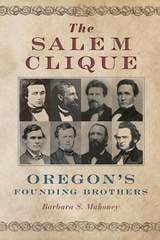
The Salem Clique
Oregon's Founding BrothersBarbara S. Mahoney
Oregon State University Press, 2017
While not in agreement with some of the more extreme contemporary accusations against the Clique, many historians have concluded that its members were vicious men who were able, because of their command of the Democratic party, to impose their hegemony on the Oregon Territory’s inhabitants. Other scholars have seen them as merely another instance of the contentious politics of the period.
Although the Salem Clique has been given considerable prominence in nearly every account of Oregon’s Territorial period, there has not been a detailed study of its role until now. What sort of people were these men? What was their impact on the issues, events, and movements of the period? What role did they play in the years after Oregon became a state? In The Salem Clique, Historian Barbara Mahoney sets out to answer these and many other questions in this comprehensive and deeply researched history.
The Search for Justice
Lawyers in the Civil Rights Revolution, 1950–1975Peter Charles Hoffer
University of Chicago Press, 2019
The Search for Justice is a look the role of the lawyers throughout the period, focusing on one of the central issues of the time: school segregation. The most notable participants to address this issue were the public interest lawyers of the NAACP’s Legal Defense Fund, whose counselors brought lawsuits and carried out appeals in state and federal courts over the course of twenty years. But also playing a part in the story were members of the bar who defended Jim Crow laws explicitly or implicitly and, in some cases, also served in state or federal government; lawyers who sat on state and federal benches and heard civil rights cases; and, finally, law professors who analyzed the reasoning of the courts in classrooms and public forums removed from the fray. With rich, copiously researched detail, Hoffer takes readers through the interactions of these groups, setting their activities not only in the context of the civil rights movement but also of their full political and legal legacies, including the growth of corporate private legal practice after World War II and the expansion of the role of law professors in public discourse, particularly with the New Deal. Seeing the civil rights era through the lens of law enables us to understand for the first time the many ways in which lawyers affected the course and outcome of the movement.

The Secrets of the Hopewell Box
Stolen Elections, Southern Politics, and a City's Coming of AgeJames D. Squires
Vanderbilt University Press, 1996
—Kirkus Reviews
"His richly textured narrative charts the Nashville machine's rupture with the state's top political boss, Edward Crump of Memphis, and traces the sweeping reforms that shattered rural white control of the state legislature. Squires dramatically reenacts the downfall of Nashville lawyer Tommy Osborn, convicted of jury tampering in 1964 after defending Teamsters boss Jimmy Hoffa. He follows Nashville's transformation into a crucible of the civil rights movement in this stirring chronicle of the South's coming-of-age."
—Publishers Weekly
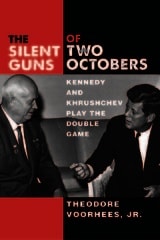
The Silent Guns of Two Octobers
Kennedy and Khrushchev Play the Double GameTheodore Voorhees, Jr.
University of Michigan Press, 2020
The Silent Guns of Two Octobers uses new as well as previously under-appreciated documentary evidence to link the Cuban Missile Crisis to the Checkpoint Charlie tank standoff to achieve the impossible—craft a new, thoughtful, original analysis of a political showdown everyone thought they knew everything about. Ultimately the book concludes that much of the Cold War rhetoric the leaders employed was mere posturing; in reality neither had any intention of starting a nuclear war. Theodore Voorhees reexamines Khrushchev’s and Kennedy’s leadership, decision, and rhetoric in light of the new documentary evidence available. Voorhees examines the impact of John F. Kennedy's domestic political concerns about his upcoming first midterm elections on his handling of the Cuban Missile Crisis through his use of back-channel dealings with Khrushchev during the lead-up to the crisis and in the closing days when the two leaders managed to reach a settlement.
The State You See
How Government Visibility Creates Political Distrust and Racial InequalityAaron J. Rosenthal
University of Michigan Press, 2023
The State You See uncovers a racial gap in the way the American government appears in people’s lives. It makes it clear that public policy changes over the last fifty years have driven all Americans to distrust the government that they see in their lives, even though Americans of different races are not seeing the same kind of government.
For white people, these policy changes have involved a rising number of generous benefits submerged within America’s tax code, which taken together cost the government more than Social Security and Medicare combined. Political attention focused on this has helped make welfare and taxes more visible representations of government for white Americans. As a result, white people are left with the misperception that government does nothing for them, apart from take their tax money to spend on welfare. Distrust of government is the result. For people of color, distrust is also rampant but for different reasons. Over the last fifty years, America has witnessed increasingly overbearing policing and swelling incarceration numbers. These changes have disproportionately impacted communities of color, helping to make the criminal legal system a unique visible manifestation of government in these communities.
While distrust of government emerges in both cases, these different roots lead to different consequences. White people are mobilized into politics by their distrust, feeling that they must speak up in order to reclaim their misspent tax dollars. In contrast, people of color are pushed away from government due to a belief that engaging in American elections will yield the same kind of unresponsiveness and violence that comes from interactions with the police. The result is a perpetuation of the same kind of racial inequality that has always been present in American democracy. The State You See is essential reading for anyone interested in understanding how the American government engages in subtle forms of discrimination and how it continues to uphold racial inequality in the present day.

The State and the City
Ted Robert Gurr and Desmond King
University of Chicago Press, 1987
Gurr and King's analysis assumes modern states have their own interests, institutional momentum, and the capacity to act with relative autonomy. Their historically based analysis begins with an account of the evolution of the Western state's interest in the viability of cities since the industrial revolution. Their agument extends to the local level, examining the nature of the local state and its autonomy from national political and economic forces.
Using cross-national evidence, Gurr and King examine specific problems of urban policy in the United States and Britain. In the United States, for example, they show how the dramatic increases in federal assistance to cities in the 1930s and the 1960s were made in response to urban crises, which simultaneously threatened national interests and offered opportunities for federal expansion of power. As a result, national and local states now play significant material and regulatory roles that can have as much impact on cities as all private economic activities.
A comparative analysis of thirteen American cities reflects the range and impact of the state's activities at the urban level. Boston, they argue, has become the archetypical postindustrial public city: half of its population and personal income are directly dependent on government spending. While Gurr and King are careful to delineate the limits to the extent and effectiveness of state intervention, they conclude that these limits are much broader than formerly thought. Ultimately, their evidence suggests that the continued decline of most of the old industrial cities is the result of public decisions to allow their economic fate to be determined in the private sector.
The State and the Stork
The Population Debate and Policy Making in US HistoryDerek S. Hoff
University of Chicago Press, 2012
From the founders’ fears that crowded cities would produce corruption, luxury, and vice to the zero population growth movement of the late 1960s to today’s widespread fears of an aging crisis as the Baby Boomers retire, the American population debate has always concerned much more than racial composition or resource exhaustion, the aspects of the debate usually emphasized by historians. In The State and the Stork, Derek Hoff draws on his extraordinary knowledge of the intersections between population and economic debates throughout American history to explain the many surprising ways that population anxieties have provoked unexpected policies and political developments—including the recent conservative revival. At once a fascinating history and a revelatory look at the deep origins of a crucial national conversation, The State and the Stork could not be timelier.
The Streets of San Francisco
Policing and the Creation of a Cosmopolitan Liberal Politics, 1950-1972Christopher Lowen Agee
University of Chicago Press, 2014
The Streets of San Francisco uncovers the seldom reported, street-level interactions between police officers and San Francisco residents and finds that police discretion was the defining feature of mid-century law enforcement. Postwar police officers enjoyed great autonomy when dealing with North Beach beats, African American gang leaders, gay and lesbian bar owners, Haight-Ashbury hippies, artists who created sexually explicit works, Chinese American entrepreneurs, and a wide range of other San Franciscans. Unexpectedly, this police independence grew into a source of both concern and inspiration for the thousands of young professionals streaming into the city's growing financial district. These young professionals ultimately used the issue of police discretion to forge a new cosmopolitan liberal coalition that incorporated both marginalized San Franciscans and rank-and-file police officers. The success of this model in San Francisco resulted in the rise of cosmopolitan liberal coalitions throughout the country, and today, liberal cities across America ground themselves in similar understandings of democracy, emphasizing both broad diversity and strong policing.
The Structure of Policy Change
Derek A. Epp
University of Chicago Press, 2018
Derek A. Epp argues that some agencies can indeed do that and that instability is at least partially a function of poor institutional design. While it is inherently more challenging to maintain stability around complex problems like immigration or climate change, the deliberative process itself can affect the degree of stability around an issue. Epp looks at whether agencies follow a deliberative model for decision making, in which policies are developed by means of debate among a small group of policymakers, or a collective model, in which the opinions of many people are aggregated, as with the stock market. He argues that, in many instances, the collective model produces more informed and stable policy outcomes that can be adapted more readily to new information and changing public priorities.
The Submerged State
How Invisible Government Policies Undermine American DemocracySuzanne Mettler
University of Chicago Press, 2011
“Keep your government hands off my Medicare!” Such comments spotlight a central question animating Suzanne Mettler’s provocative and timely book: why are many Americans unaware of government social benefits and so hostile to them in principle, even though they receive them? The Obama administration has been roundly criticized for its inability to convey how much it has accomplished for ordinary citizens. Mettler argues that this difficulty is not merely a failure of communication; rather it is endemic to the formidable presence of the “submerged state.”
In recent decades, federal policymakers have increasingly shunned the outright disbursing of benefits to individuals and families and favored instead less visible and more indirect incentives and subsidies, from tax breaks to payments for services to private companies. These submerged policies, Mettler shows, obscure the role of government and exaggerate that of the market. As a result, citizens are unaware not only of the benefits they receive, but of the massive advantages given to powerful interests, such as insurance companies and the financial industry. Neither do they realize that the policies of the submerged state shower their largest benefits on the most affluent Americans, exacerbating inequality. Mettler analyzes three Obama reforms—student aid, tax relief, and health care—to reveal the submerged state and its consequences, demonstrating how structurally difficult it is to enact policy reforms and even to obtain public recognition for achieving them. She concludes with recommendations for reform to help make hidden policies more visible and governance more comprehensible to all Americans.
The sad truth is that many American citizens do not know how major social programs work—or even whether they benefit from them. Suzanne Mettler’s important new book will bring government policies back to the surface and encourage citizens to reclaim their voice in the political process.
The Supreme Court and the NCAA
The Case for Less Commercialism and More Due Process in College SportsBrian L. Porto
University of Michigan Press, 2013
Two Supreme Court decisions, NCAA v. Board of Regents (1984) and NCAA v. Tarkanian (1988), have shaped college sports by permitting the emergence of a supercharged commercial enterprise with high financial stakes for institutions and individuals, while failing to guarantee adequate procedural protections for persons charged with wrongdoing within that enterprise. Brian L. Porto examines the conditions that led to the cases, the reasoning behind the justices' rulings, and the consequences of those rulings.
Arguing that commercialized college sports should be compatible with the goals of higher education and fair to all participants, Porto suggests that the remedy is a federal statute. His proposed College Sports Legal Reform Act would grant the NCAA a limited "educational exemption" from the antitrust laws, enabling it to enhance academic opportunities for athletes. The Act would also afford greater procedural protections to accused parties in NCAA disciplinary proceedings. Porto's prescription for reform in college sports makes a significant contribution to the debate about how best to address perennial problems in college sports such as cost containment, access to a meaningful education for athletes, and fairness in rule enforcement.
The Sympathetic State
Disaster Relief and the Origins of the American Welfare StateMichele Landis Dauber
University of Chicago Press, 2012
The Third Space of Sovereignty
The Postcolonial Politics of U.S.–Indigenous RelationsKevin Bruyneel
University of Minnesota Press, 2007
The imposition of modern American colonial rule has defined U.S.–indigenous relations since the time of the American Civil War. In resistance, Kevin Bruyneel asserts, indigenous political actors work across American spatial and temporal boundaries, demanding rights and resources from the government while also challenging the imposition of colonial rule over their lives. This resistance engenders what he calls a “third space of sovereignty,” which resides neither inside nor outside the U.S. political system but rather exists on its boundaries, exposing both the practices and limitations of American colonial rule.
The Third Space of Sovereignty offers fresh insights on such topics as the crucial importance of the formal end of treaty-making in 1871, indigenous responses to the prospect of U.S. citizenship in the 1920s, native politics during the tumultuous civil rights era of the 1960s, the question of indigenousness in the special election of California’s governor in 2003, and the current issues surrounding gaming and casinos.
In this engaging and provocative work, Bruyneel shows how native political actors have effectively contested the narrow limits that the United States has imposed on indigenous people’s ability to define their identity and to develop economically and politically on their own terms.
Kevin Bruyneel is assistant professor of politics at Babson College.
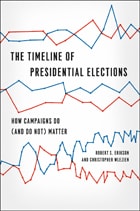
The Timeline of Presidential Elections
How Campaigns Do (and Do Not) MatterRobert S. Erikson and Christopher Wlezien
University of Chicago Press, 2012
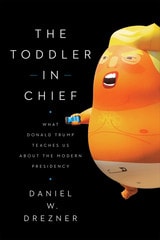
The Toddler in Chief
What Donald Trump Teaches Us about the Modern PresidencyDaniel W. Drezner
University of Chicago Press, 2020
Every president faces criticism and caricature. Donald Trump, however, is unique in that he is routinely characterized in ways more suitable for a toddler. What’s more, it is not just Democrats, pundits, or protestors who compare the president to a child; Trump’s staffers, subordinates, and allies on Capitol Hill also describe Trump like a small, badly behaved preschooler.
In April 2017, Daniel W. Drezner began curating every example he could find of a Trump ally describing the president like a toddler. So far, he’s collected more than one thousand tweets—a rate of more than one a day. In The Toddler-in-Chief, Drezner draws on these examples to take readers through the different dimensions of Trump’s infantile behavior, from temper tantrums to poor impulse control to the possibility that the President has had too much screen time. How much damage can really be done by a giant man-baby? Quite a lot, Drezner argues, due to the winnowing away of presidential checks and balances over the past fifty years. In these pages, Drezner follows his theme—the specific ways in which sharing some of the traits of a toddler makes a person ill-suited to the presidency—to show the lasting, deleterious impact the Trump administration will have on American foreign policy and democracy.
The “adults in the room” may not be able to rein in Trump’s toddler-like behavior, but, with the 2020 election fast approaching, the American people can think about whether they want the most powerful office turned into a poorly run political day care facility. Drezner exhorts us to elect a commander-in-chief, not a toddler-in-chief. And along the way, he shows how we must rethink the terrifying powers we have given the presidency.
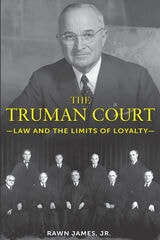
The Truman Court
Law and the Limits of LoyaltyRawn James
University of Missouri Press, 2021
The Truman Court: Law and the Limits of Loyalty argues that the years between FDR’s death in 1945 and Chief Justice Earl Warren’s confirmation in 1953—the dawn of the Cold War—were, contrary to widespread belief, important years in Supreme Court history. Never before or since has a president so quickly and completely changed the ideological and temperamental composition of the Court. With remarkable swiftness and certainty, Truman constructed a Court on which he relied to lend constitutional credence to his political agenda.
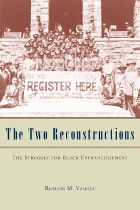
The Two Reconstructions
The Struggle for Black EnfranchisementRichard M. Valelly
University of Chicago Press, 2004
The Reconstruction era marked a huge political leap for African Americans, who rapidly went from the status of slaves to voters and officeholders. Yet this hard-won progress lasted only a few decades. Ultimately a "second reconstruction"—associated with the civil rights movement and the Voting Rights Act—became necessary.
How did the first reconstruction fail so utterly, setting the stage for the complete disenfranchisement of Southern black voters, and why did the second succeed? These are among the questions Richard M. Valelly answers in this fascinating history. The fate of black enfranchisement, he argues, has been closely intertwined with the strengths and constraints of our political institutions. Valelly shows how effective biracial coalitions have been the key to success and incisively traces how and why political parties and the national courts either rewarded or discouraged the formation of coalitions.
Revamping our understanding of American race relations, The Two Reconstructions brilliantly explains a puzzle that lies at the heart of America’s development as a political democracy.
The Uneasy Partnership
Gene Martin Lyons
Russell Sage Foundation, 1969

The Unicameral Legislature
Alvin Johnson
University of Minnesota Press, 1938
The United States of Ohio
One American State and Its Impact on the Other Forty-NineDavid E. Rohr
The Ohio State University Press, 2019
The United States of Ohio covers little-known facts about Ohio, such as how the state was the birthplace of both the National Football League and Major League Baseball and how it was Ohioans who led efforts toward racial integration in both sports. Readers will learn what makes the state a manufacturing and agricultural powerhouse—with both the largest tire company, Akron’s Goodyear, and the largest consumer products company, Cincinnati’s Proctor & Gamble, based there. The state grows, processes, and builds on a level that far outpaces the size of its population or expanse of its borders. And it is the birthplace of many prominent US figures—from Thomas Edison to John Glenn to Neil Armstrong. From sports to a century’s worth of entertainment superstars to aviation and space exploration, Ohio’s best have made for America’s greatest stories—all captured here in a look at the Buckeye State and its impact on the other forty-nine.
The WPA Guide to 1930s Alabama
Harvey H. Jackson, III
University of Alabama Press, 2000
A fascinating time capsule, this classic guide captures Alabama at a critical moment in its history between the Great Depression and World War II and its aftermath.
The WPA guide to Alabama provides a unique snapshot of 1930s Alabama life and culture. Like the other state guides in the WPA's American Guide Series, it features essays on history, economy, people, folkways, education, and other characteristics of the state, as well as general information about the towns and cities. Fifteen suggested automobile tours encourage visitors and residents to explore every corner of the state, from the Gulf Coast to the Black Belt and the Tennessee Valley, from bayous to farmlands to mountain gorges.
When it was first published in 1941, the guide went far to dispel the myth of an Alabama consisting only of cotton fields, magnolias, and plantation houses by highlighting the vibrant university life in Tuscaloosa, the modern industrial activity in Birmingham, the informality of politics in Montgomery, the cultural diversity in Alabama's port city, Mobile, and the small town life in Huntsville before it became home to the space industry. The book includes a calendar of annual events, census data, and a wealth of information useful to the traveling public of the time and enlightening to readers today. The guide lists radio stations, buses, railroads, and highways as they existed before the advent of television, interstates, and malls.
Harvey Jackson's fascinating introduction assesses the guide as a historical document and recounts the involved and sometimes controversial process by which it was researched and written. Project directors struggled to make the guide palatable to its public while still addressing such issues as poverty and race relations and recognizing the state's diversity and its rich folk culture. The result makes for compelling reading for general readers and historians alike.
The Whips
Building Party Coalitions in CongressC. Lawrence Evans
University of Michigan Press, 2018
The party whips are essential components of the U.S. legislative system, responsible for marshalling party votes and keeping House and Senate party members in line. In The Whips, C. Lawrence Evans offers a comprehensive exploration of coalition building and legislative strategy in the U.S. House and Senate, ranging from the relatively bipartisan, committee-dominated chambers of the 1950s to the highly polarized congresses of the 2000s. In addition to roll call votes and personal interviews with lawmakers and staff, Evans examines the personal papers of dozens of former leaders of the House and Senate, especially former whips. These records allowed Evans to create a database of nearly 1,500 internal leadership polls on hundreds of significant bills across five decades of recent congressional history.
The result is a rich and sweeping understanding of congressional party leaders at work. Since the whips provide valuable political intelligence, they are essential to understanding how coalitions are forged and deals are made on Capitol Hill.
Think Tanks in America
Thomas Medvetz
University of Chicago Press, 2012
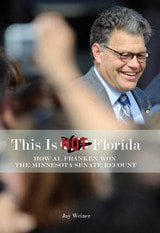
This Is Not Florida
How Al Franken Won the Minnesota Senate RecountJay Weiner
University of Minnesota Press, 2010
This Is Not Florida is the behind-the-scenes saga of the largest, longest, and most expensive election recount in American history. Reporter Jay Weiner covered the entire recount process-for which he was honored with Minnesota's most prestigious journalism award-following every bizarre twist and turn and its many colorful personalities. Based on daily reporting as well as interviews with more than forty campaign staffers and other participants in the recount, This Is Not Florida dives into the motivations of key players in the drama, including the exploits of Franken's lead attorney Marc Elias, some of the mistakes made by Coleman advisers, and how the Franken team's devotion to data collection helped Franken win the recount by a mere 312 votes.
In a fascinating, blow-by-blow account of the historic recount that captivated people nationwide, Jay Weiner gets inside campaign war rooms and judges' chambers and takes the reader from the uncertainties of Election Night 2008, through the controversial State Canvassing Board and a grueling eight-week trial, to an appeal to Minnesota's Supreme Court, and finally to Al Franken's long-awaited and emotional swearing-in.
This Is Not Florida presents an important and unforgettable moment in political history that proved that it's never really over until it's actually over
Three Capitals
St. Stephens, Huntsville, and Cahawba, 1818-1826William H. Brantley Jr
University of Alabama Press, 1976
"Three Capitals is an in-depth study of Alabama's first three seats of government--St. Stephens, Huntsville, and Cahawba.... The University of Alabama Press has reprinted the book in a handsome new edition with a pertinent introduction by Malcolm C. McMillan. Brantley's study is a tribute to the accomplishments of an amateur historian and contains a wealth of useful information."
--Bulletin of the History of the Early American Republic
Three Civilizations, Two Cultures, One State
Canada's Political TraditionsDouglas Verney
Duke University Press, 1986
To Keep the Republic
Thinking, Talking, and Acting Like a Democratic CitizenElizabeth C. Matto
Rutgers University Press, 2024
To Keep the Republic is a wake-up call about the responsibilities that come with being a citizen in a participatory democracy. It describes the many ways that individuals can make a difference on both local and national levels—and explains why they matter. Political scientist Elizabeth C. Matto highlights the multiple facets of democratic citizenship, identifies American democracy’s sometimes competing values and ideals, and explains how civic engagement can take various forms, including political conversation. Combining political philosophy with concrete suggestions for how to become a more engaged citizen, To Keep the Republic reminds us that democracy is not a spectator sport; it only works when we get off the sidelines and enter the political arena to make our voices heard.
To the Promised Land
A History of Government and Politics in OregonTom Marsh
Oregon State University Press, 2012
From Jason Lee’s first letter urging Congress to take possession of the Oregon Country to John Kitzhaber’s precedent-setting third term as governor, from the land frauds of the early 20th century to the state’s land-use planning goals, from the Beach Bill to the Bottle Bill, this book tells Oregon’s story.
Featuring interesting trivia, historical photographs, and biographical sketches of key politicians, To the Promised Land is an essential volume for readers interested in Oregon’s history.
Town Hall Meetings and the Death of Deliberation
Jonathan Beecher Field
University of Minnesota Press, 2019
Tracing the erosion of democratic norms in the US and the conditions that make it possible
Jonathan Beecher Field tracks the permutations of the town hall meeting from its original context as a form of democratic community governance in New England into a format for presidential debates and a staple of corporate governance. In its contemporary iteration, the town hall meeting models the aesthetic of the former but replaces actual democratic deliberation with a spectacle that involves no immediate electoral stakes or functions as a glorified press conference. Urgently, Field notes that though this evolution might be apparent, evidence suggests many US citizens don’t care to differentiate.
Forerunners: Ideas First
Short books of thought-in-process scholarship, where intense analysis, questioning, and speculation take the lead
Trading Democracy for Justice
Criminal Convictions and the Decline of Neighborhood Political ParticipationTraci Burch
University of Chicago Press, 2013
Treaty Politics and the Rise of Executive Agreements
International Commitments in a System of Shared PowersGlen S. Krutz and Jeffrey S. Peake
University of Michigan Press, 2011
"Krutz and Peake's examination of the increase use of executive agreements offers a valuable lesson in how the president and Congress have responded and adjusted to the growth in the complexity of foreign relations to meet the demands of an ever-increasingly complex and interconnected international community."
---Victoria Farrar-Myers, University of Texas, Arlington
"From reading Treaty Politics and the Rise of Executive Agreements, I learned a good deal about a topic that I thought I knew well. This book will be an excellent addition to the literature on the presidency. It will be read and cited by scholars working in this field."
---Benjamin Ginsberg, Johns Hopkins University
"Glen Krutz and Jeffrey Peake's Treaty Politics and the Rise of Executive Agreements offers a provocative analysis of a neglected topic. Their theoretical and empirical challenge to the usual explanation for the growth of executive agreements, their careful analysis of the treaty process in the Senate and when that body can be decisive, and their assessment of the House of Representatives' role in the agreement process provide important new scholarship for students of the presidency, Congress, and foreign policy."
---James M. McCormick, Iowa State University
In foreign relations, U.S. presidents have exercised a growing independence through the use of executive agreements. The U.S. Constitution specifies that two-thirds of the Senate must ratify a proposed treaty but makes no provision for other forms of international agreements. In 1942 the Supreme Court affirmed the legality of executive agreements, and since World War II, they have outnumbered treaties by more than ten to one. Are presidents trampling the Constitution or seeking to streamline the diplomatic process?
Glen S. Krutz and Jeffrey S. Peake argue that the preference for executive agreements is the result of a symbiotic evolution of the executive and the legislative branches and that in order for the United States to survive in a complex, ever-changing global environment and maintain its world power status, it must fulfill international commitments swiftly and confidently. Members of Congress concur that executive agreements allow each branch to function more effectively. At the same time, the House continues to oversee particular policy areas, and presidents still submit the majority of the most significant international commitments to the Senate as treaties.
Krutz and Peake conclude that executive agreements represent a mutual adaptation of the executive and the legislature in a system of shared power.
Glen S. Krutz is Associate Director of the Carl Albert Center and Professor of Political Science at the University of Oklahoma.
Jeffrey S. Peake is Professor and Department Chair, Department of Political Science at Clemson University.
Trial Courts as Organizations
Brian J Ostrom, Charles W Ostrom, Jr., Roger A Hanson and Matthew Kleiman
Temple University Press, 2007
Court administrators and judges have long acknowledged that culture plays an important role in the function of trial courts. Trial Courts as Organizations provides a comprehensive framework for understanding this organizational culture, along with a set of steps and tools to assess and measure the current and preferred culture.
The authors examine how courts operate, what characteristics they may display, and how they function as a unit to preserve judicial independence, strengthen organizational leadership, and influence court performance. They identify four different types of institutional cultures using a systematic analysis of alternative values on how work is done. Each culture is shown to have its own strengths and weaknesses in achieving values, such as timely case resolution, access to court services, and procedural justice. Accordingly, the authors find judges and administrators prefer a definite pattern of different cultures, called a "mosaic," to guide how their courts operate in the future.
Trumping Religion
The New Christian Right, the Free Speech Clause, and the CourtsSteven P. Brown
University of Alabama Press, 2004
The first scholarly treatment of the strategies employed by the New Christian Right in redefining religious freedom in the courtroom.
Trumping Religion provides a detailed analysis of the five major public-interest law firms that have litigated religion cases in the federal courts between 1980 and 2000. Allied with several highly vocal, evangelical ministries, such as those of Jerry Falwell and Pat Robinson, these legal organizations argue that religious expression is a form of protected speech and thereby gain a greater latitude of interpretation in the courts. The long-term agenda of the New Christian Right as illuminated by this study is to shape church-state jurisprudence in a way that permits free course for the Christian gospel.
Steven P. Brown presents his research and conclusions from a balanced viewpoint. In filling a distinct void in the literature, this book will be of considerable interest to political scientists, legal scholars, law schools and seminaries, and anyone concerned with the intersection of religion and judicial politics.
Trust
Representatives and ConstituentsWilliam T. Bianco
University of Michigan Press, 1994
Why do constituents sometimes defer to their representative's judgment, rewarding her for acting as she thinks best, even when she ignores their demands? By making decisions about trust, constituents determine whether their representative is rewarded for implementing their demands or for using her judgment. These decisions shape legislator behavior and, through behavior, policy outcomes. Therefore, any attempt to explain or evaluate representative institutions such as the modern Congress requires an answer to a simple question: When do constituents trust their representative, and what is the basis of that trust?
This book is the first systematic analysis of constituent trust. It assumes that elected officials and ordinary citizens are rational actors. However, the book moves beyond the standard rational choice framework in three ways. It avoids narrow, unrealistic assumptions about motivations and information. It shows that many kinds of behavior not usually thought of as rational choices, such as a voter's desire to be represented by "someone like them," are the product of a systematic, predictable calculus---a calculus aimed at securing favorable policy outcomes. Finally, the book uses interviews with ninety-three members of the U.S. House of Representatives to test its predictions about trust.
Turf Wars
How Congressional Committees Claim JurisdictionDavid C. King
University of Chicago Press, 1997
Political scientists have long maintained that jurisdictions are relatively static, changing only at times of dramatic reforms. Not so, says King. Combining quantitative evidence with interviews and case studies, he shows how on-going turf wars make jurisdictions fluid.
According to King, jurisdictional change stems both from legislators seeking electoral advantage and from nonpartisan House parliamentarians referring ambiguous bills to committees with the expertise to handle the issues. King brilliantly dissects the politics of turf grabbing and at the same time shows how parliamentarians have become institutional guardians of the legislative process.
Original and insightful, Turf Wars will be valuable to those interested in congressional studies and American politics more generally.
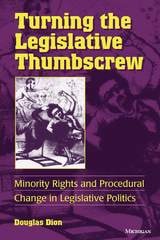
Turning the Legislative Thumbscrew
Minority Rights and Procedural Change in Legislative PoliticsDouglas Dion
University of Michigan Press, 2001
Twelve Ways to Save Democracy in Wisconsin
Matthew Rothschild
University of Wisconsin Press, 2021
From tightening campaign finance laws and banning gerrymandering to rooting out structural racism and moving toward economic equality, each chapter focuses on one of the dozen reforms that are required to heal democracy within the state. Rothschild provides an in-depth rationale for each, dismantling the counterarguments against them and exploring the complexities involved in implementing them. He offers concrete proposals and action items for grassroots organizers and concerned community advocates to restore constituent control of state politics. This pocket-sized handbook is essential for politically aware citizens as well as journalists and watchdogs who see Wisconsin as a crucial battleground state and political bellwether for the nation.

Twilight of the American State
Pierre Schlag
University of Michigan Press, 2023
Finalist: 2024 Order of the Coif Book Award | March 3, 2025
The sudden emergence of the Trump nation surprised nearly everyone, including journalists, pundits, political consultants, and academics. When Trump won in 2016, his ascendancy was widely viewed as a fluke. Yet time showed it was instead the rise of a movement—angry, militant, revanchist, and unabashedly authoritarian.
How did this happen? Twilight of the American State offers a sweeping exploration of how law and legal institutions helped prepare the grounds for this rebellious movement. The controversial argument is that, viewed as a legal matter, the American state is not just a liberal democracy, as most Americans believe. Rather, the American state is composed of an uneasy and unstable combination of different versions of the state—liberal democratic, administered, neoliberal, and dissociative. Each of these versions arose through its own law and legal institutions. Each emerged at different times historically. Each was prompted by deficits in the prior versions. Each has survived displacement by succeeding versions. All remain active in the contemporary moment—creating the political-legal dysfunction America confronts today.
Pierre Schlag maps out a big picture view of the tribulations of the American state. The book abjures conventional academic frameworks, sets aside prescriptions for quick fixes, dispenses with lamentations about polarization, and bypasses historical celebrations of the American Spirit.
Twin States, Different Paths
The Politics of New Hampshire and VermontBrian L. Porto
University of Massachusetts Press, 2026
A cultural and policy history that explains why two neighboring states developed divergent attitudes toward government and culture
At first glance, New Hampshire and Vermont seem like mirror images. Separated only by the Connecticut River, the oft-termed “Twin States” share a common history, relatively small populations, and heavily mountainous and forested landscapes dotted with small towns. Yet despite their similarities, they have evolved strikingly different political cultures, with Vermont prizing cooperation and community and New Hampshire celebrating independence and freedom from government. Perhaps nowhere is this divergence in political visions more pronounced than in their respective state mottos: Vermont’s communal "Freedom and Unity" and New Hampshire’s libertarian “Live Free or Die.”
Twin States, Different Paths explores these contrasting political cultures. Brian Porto traces these differences back to the land itself: to the geology and geography that shaped early settlement, patterns of land use, and the distinct ways people built their communities. From these origins emerged two enduring civic philosophies—New Hampshire’s devotion to low taxes and limited government, and Vermont’s emphasis on equality and shared responsibility. Bringing historical and cultural analysis together with contemporary case studies, Porto examines how these traditions influence each state’s approach to today’s policy challenges, including affordable housing and public-school funding. The result is a clear, balanced portrait of how deeply rooted attitudes toward freedom, unity, and governance continue to shape public life in both states.
Written with scholarly rigor yet in an engaging and accessible style, Twin States, Different Paths fills a notable gap in the study of New England politics. It offers insights not only for scholars and students of political culture, history, and public policy, but also for general readers, policymakers, and residents who wish to understand how two neighbors—so similar in geography and spirit—continue to follow such different paths in defining the role of government and community.
Two-Party Politics in the One-Party South
Alabama's Hill Country, 1874–1920Samuel L. Webb
University of Alabama Press, 1997
A challenge to the long-held view that the only important and influential politicians in post-Reconstruction Deep South states were Democrats.
In this insightful and exhaustively researched volume, Samuel L. Webb presents new evidence that, contrary to popular belief, voters in at least one Deep South state did not flee en masse from the Republican party after Reconstruction. As Webb demonstrates conclusively, the party gained strength among white voters in Upcountry areas of northern Alabama between 1896 and 1920. Not only did GOP presidential candidates win more than a dozen area counties but Republican congressional candidates made progress in Democratic strongholds, and local GOP officials gained control of several county courthouses.
Nor were these new Republicans simply the descendants of anti-Confederate families, as some historians have claimed. Rather, they were former independents, Greenbackers, and Populists, who, in keeping with the 1890s Populist movement, were reacting against what they perceived as the control of the Democratic party by "moneyed elites" and planter landlords. Webb also breaks with previous historical opinion by showing that ex-Populists in the Hill Country, who had been radical reformers during the 1890s, remained reform minded after 1900.
Webb's ground-breaking reassessment of Alabama state politics from Reconstruction to the 1920s describes a people whose political culture had strong roots in the democratic and egalitarian Jacksonian ideology that dominated north Alabama in the antebellum period. These people carried forward elements of Jacksonianism into the late 19th century, with its tenets continuing to influence them well into the early 20th century.
Tyranny of the Minority
The Subconstituency Politics Theory of RepresentationBenjamin G. Bishin
Temple University Press, 2009
Why do politicians frequently heed the preferences of small groups of citizens over those of the majority? Breaking new theoretical ground, Benjamin Bishin explains how the desires of small groups, which he calls “subconstituencies,” often trump the preferences of much larger groups.
Tyranny of the Minority provides a “unified theory of representation,” based in social psychology and identity theory, to explain how citizens’ intensity fosters knowledge and participation and drives candidates’ behavior in campaigns and legislators' behavior in Congress. Demonstrating the wide applicability of the theory, Bishin traces politicians' behavior in connection with a wide range of issues, including the Cuban trade embargo, the extension of hate-crimes legislation to protect gay men and lesbians, the renewal of the assault-weapons ban, abortion politics, and Congress's attempt to recognize the Armenian genocide. He offers a unique explanation of when, why, and how special interests dominate American national politics.