Results by title
808 books match the query 'Civilization' and 200 start with t
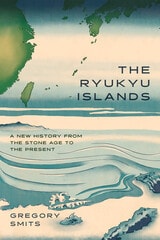
The Ryukyu Islands
A New History from the Stone Age to the PresentGregory Smits
University of Chicago Press, 2025
The Ryukyu Islands between Japan and Taiwan consist of around 160 islands and are home to about 1.5 million inhabitants. Across the islands’ history, sea-lanes and trade patterns have connected them to the East China Sea region, giving them a unique vantage point on the region’s changes and making them a useful lens through which to view and understand those transformations. In this book, Gregory Smits marshals his expertise to canvass the environmental, political, and social history of this fascinating area, emphasizing the diversity of influences from China, Japan, and Korea that have shaped it. Smits begins by tracing the islands’ early history from the time of the oldest extant human remains, through massive inflows of settlers from Japan, until the emergence of a centralized state in the sixteenth century. He then traces the development of the Ryukyu Kingdom from the fifteenth to the nineteenth century, examining its major cultural formations and the interplay of local and external influences driving its evolution. Finally, Smits ushers readers to the modern era, from the end of the Ryukyu Kingdom in 1879 through World War II, the era of American military control, and on to the present. He concludes with their present-day status as a tourist destination affected by ongoing geopolitical, economic, and environmental challenges. Synthesizing decades of research, this book is an indispensable, comprehensive guide to the islands’ history for scholars and nonspecialists alike.
The SBL Handbook of Style
SBL Press, 2014
The definitive source for how to write and publish in the field of biblical studies
The long-awaited second edition of the essential style manual for writing and publishing in biblical studies and related fields includes key style changes, updated and expanded abbreviation and spelling-sample lists, a list of archaeological site names, material on qur’anic sources, detailed information on citing electronic sources, and expanded guidelines for the transliteration and transcription of seventeen ancient languages.
Features:
- Expanded lists of abbreviations for use in ancient Near Eastern, biblical, and early Christian studies
- Information for transliterating seventeen ancient languages
- Exhaustive examples for citing print and electronic sources
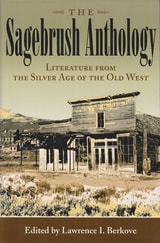
The Sagebrush Anthology
Literature from the Silver Age of the Old WestEdited by Lawrence I. Berkove
University of Missouri Press, 2006
The Second Birth
On the Political Beginnings of Human ExistenceTilo Schabert
University of Chicago Press, 2015
Schabert traces different figurations of power inherent to our singular existence, things such as numbers, time, thought, and desire, showing how they render our lives political ones—and, thus, how politics exists in us individually, long before it plays a role in the establishment of societies and institutions. Through these figurations of power, Schabert argues, we learn how to institute our own government within the political forces that already surround us—to create our own world within the one into which we have been born. In a stunning vision of human agency, this book ultimately sketches a political cosmos in which we are all builders, in which we can be at once political and free.
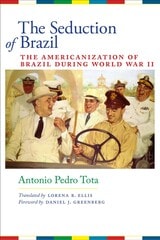
The Seduction of Brazil
The Americanization of Brazil during World War IIBy Antonio Pedro Tota
University of Texas Press, 2009
Following completion of the U.S. air base in Natal, Brazil, in 1942, U.S. airmen departing for North Africa during World War II communicated with Brazilian mechanics with a thumbs-up before starting their engines. This sign soon replaced the Brazilian tradition of touching the earlobe to indicate agreement, friendship, and all that was positive and good—yet another indication of the Americanization of Brazil under way during this period.
In this translation of O Imperialismo Sedutor, Antonio Pedro Tota considers both the Good Neighbor Policy and broader cultural influences to argue against simplistic theories of U.S. cultural imperialism and exploitation. He shows that Brazilians actively interpreted, negotiated, and reconfigured U.S. culture in a process of cultural recombination. The market, he argues, was far more important in determining the nature of this cultural exchange than state-directed propaganda efforts because Brazil already was primed to adopt and disseminate American culture within the framework of its own rapidly expanding market for mass culture. By examining the motives and strategies behind rising U.S. influence and its relationship to a simultaneous process of cultural and political centralization in Brazil, Tota shows that these processes were not contradictory, but rather mutually reinforcing.
The Seduction of Brazil brings greater sophistication to both Brazilian and American understanding of the forces at play during this period, and should appeal to historians as well as students of Latin America, culture, and communications.
The Slavs in European History and Civilization
Dvornik, Francis
Rutgers University Press, 1975
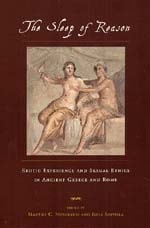
The Sleep of Reason
Erotic Experience and Sexual Ethics in Ancient Greece and RomeEdited by Martha C. Nussbaum and Juha Sihvola
University of Chicago Press, 2002
The Sleep of Reason brings together an international group of philosophers, philologists, literary critics, and historians to consider two questions normally kept separate: how is erotic experience understood in classical texts of various kinds, and what ethical judgments and philosophical arguments are made about sex? From same-sex desire to conjugal love, and from Plato and Aristotle to the Roman Stoic Musonius Rufus, the contributors demonstrate the complexity and diversity of classical sexuality. They also show that the ethics of eros, in both Greece and Rome, shared a number of commonalities: a focus not only on self-mastery, but also on reciprocity; a concern among men not just for penetration and display of their power, but also for being gentle and kind, and for being loved for themselves; and that women and even younger men felt not only gratitude and acceptance, but also joy and sexual desire.
Contributors:
* Eva Cantarella
* Kenneth Dover
* Chris Faraone
* Simon Goldhill
* Stephen Halliwell
* David M. Halperin
* J. Samuel Houser
* Maarit Kaimio
* David Konstan
* David Leitao
* Martha C. Nussbaum
* A. W. Price
* Juha Sihvola
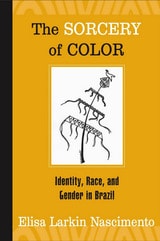
The Sorcery of Color
Identity, Race, and Gender in BrazilElisa Larkin Nascimento
Temple University Press, 2009
Originally published in 2003 in Portuguese, The Sorcery of Color argues that there are longstanding and deeply-rooted relationships between racial and gender inequalities in Brazil. In this pioneering book, Elisa Larkin Nascimento examines the social and cultural movements that have attempted, since the early twentieth century, to challenge and eradicate these conjoined inequalities.
The book's title describes the social sleight-of-hand that disguises the realities of Brazilian racial inequity. According to Nascimento, anyone who speaks of racism—or merely refers to another person as black—traditionally is seen as racist. The only acceptably non-racist attitude is silence. At the same time, Afro-Brazilian culture and history have been so overshadowed by the idea of a general "Brazilian identity" that to call attention to them is also to risk being labeled racist.
Incorporating leading international scholarship on Pan Africanism and Afrocentric philosophy with the writing of Brazilian scholars, Nascimento presents a compelling feminist argument against the prevailing policy that denies the importance of race in favor of a purposefully vague concept of ethnicity confused with color.
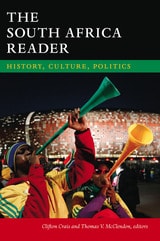
The South Africa Reader
History, Culture, PoliticsClifton Crais and Thomas V. McClendon, eds.
Duke University Press, 2013
The Southern Elite and Social Change
Essays in Honor of Willard B. Gatewood, Jr.Randy Finley
University of Arkansas Press, 2002
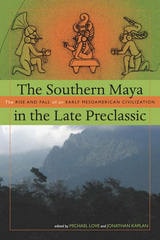
The Southern Maya in the Late Preclassic
The Rise and Fall of an Early Mesoamerican CivilizationMichael Love
University Press of Colorado, 2011
Recent research has provided a wealth of broadly based new data that have expanded the understanding of this region and its influence on greater Mesoamerica. In The Southern Maya in the Late Preclassic, prominent contributors debate whether the southern region was indeed "Maya" or instead a region of intense multiethnic interaction, with speakers of many languages and many sources of identity. The chapters address a host of advanced developments to which this area can lay claim--urbanism and city-states, the earliest Maya writing, and the origin of the Maya calendar--as well as additional issues including the construction of social and cultural identities, economic networks of early complex societies, relationships between the Maya and the Olmec, and a comprehensive discussion of the ancient city of Kaminaljuyu and its relationship to other cities in the region.
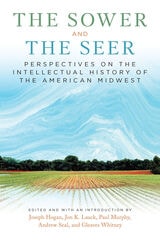
The Sower and the Seer
Perspectives on the Intellectual History of the American MidwestJoseph Hogan
Wisconsin Historical Society Press, 2021
The Midwest has been characterized as a fertile seedbed for the germination of great thinkers, but a wasteland for their further growth. The Sower and the Seer reveals that representation to be false. In fact, the region has sustained many innovative minds and been the locus of extraordinary intellectualism. It has also been the site of shifting interpretations—to some a frontier, to others a colonized space, a breadbasket, a crossroads, a heartland. As agrarian reformed (and Michigander) Liberty Hyde Bailey expressed in his 1916 poem “Sower and Seer,” the Midwestern landscape has given rise to significant visionaries, just as their knowledge has nourished and shaped the region.
The essays gathered for this collection examine individual thinkers, writers, and leaders, as well as movements and ideas that shaped the Midwest, including rural school consolidation, women’s literary societies, Progressive-era urban planning, and Midwestern radical liberalism. While disparate in subject and style, these essays taken together establish the irrefutable significance of the intellectual history of the American Midwest.
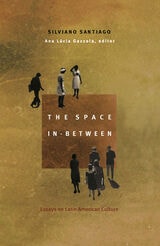
The Space In-Between
Essays on Latin American CultureSilviano Santiago
Duke University Press, 2001
Santiago’s work creates a theoretical field that transcends both the study of a specific national literature and the traditional perspectives of comparative literature. He examines the pedagogical and modernizing mission of Western voyagers from the conquistadors to the present. He deconstructs the ideas of “original” and “copy,” unpacking their implications for the notions of so-called dominant and dominated cultures. Santiago also confronts questions of cultural dependency and analyzes the problems involved in the imposition of an alien European history, the cultural displacements experienced by the Indians through their religious conversion, and the hierarchical suppression of native and Afro-Brazilian values.
Elegantly written and translated, The Space In-Between will provide insights and perspectives that will interest cultural and literary theorists, postcolonial scholars, and other students of contemporary culture.
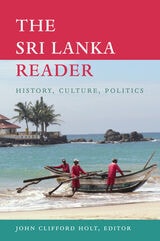
The Sri Lanka Reader
History, Culture, PoliticsJohn Clifford Holt, ed.
Duke University Press, 2011
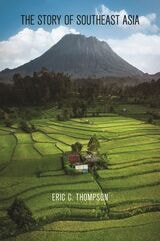
The Story of Southeast Asia
Edited by Eric Thompson
National University of Singapore Press, 2024
The oldest figurative cave paintings in the world are found on the island of Sulawesi in Indonesia. Hand stencils and animals painted some 45,000 years ago attest to a long history of human creativity. The Story of Southeast Asia tells how the peoples of the region have crafted their diverse societies and cultures over thousands of years. Southeast Asia has been a remarkable crossroads of global connections for millennia. Whereas other regions have been defined by centralizing forces, Southeast Asia’s story is one of complex networks of trade, ideas, and social relationships. Southeast Asians have created, localized, and remade their own cultural values by drawing on influences from around the world.
Marshalling the latest literature from anthropology, archaeology, history, and other disciplines, Eric C. Thompson highlights broad themes that cut across history: including the making—and evasion—of states, adoption of diverse religious practices, tolerance and flexibility regarding gender, processes of forging modern identities, struggles over sovereignty, and the making of modern nations in a postcolonial world. This readable, single-volume history reckons with the narrative pull of familiar colonial and national perspectives but maintains a regional and deep-historical focus. It will be a stimulating read for scholars as well as students and newcomers to Southeast Asian history.
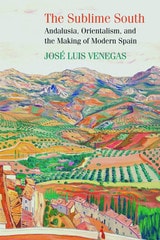
The Sublime South
Andalusia, Orientalism, and the Making of Modern SpainJose Luis Venegas
Northwestern University Press, 2018
The Sublime South: Andalusia, Orientalism, and the Making of Modern Spain is the first systematic study on cultural images of Andalusia as Spain’s “Orient” and the impact they have had on nation-building and modernization since the late nineteenth century. While a wealth of studies have examined how northern Europeans from the Romantic period viewed Spain and Andalusia as Europe’s Orient, little attention has been paid to how contemporary Spanish artists and intellectuals assimilated Romantic legacies to engage in an internal form of orientalism.
José Luis Venegas deftly explores Spain’s shifting engagements with oriental identity and otherness by looking, not just beyond national, ethnic, and racial borders, but at a territory that is institutionally embedded in the nation-state while symbolically placed between inclusion and abjection. The Sublime South shifts the focus and scale of Edward Said’s notion of orientalism by examining how it evolves and manifests transnationally, as the result of European colonialism in Africa and Asia, and intra-nationally, in a European yet orientalized country. Finally, Venegas challenges ethnocentric notions of Iberian cultures and fosters an understanding of the encounters between Western and Muslim cultures beyond opposing, and often mutually negating, essentialisms.
The Surreptitious Speech
Presence Africaine and the Politics of Otherness 1947-1987Edited by V. Y. Mudimbe
University of Chicago Press, 1992
The Taste for Civilization
Food, Politics, and Civil SocietyJanet A. Flammang
University of Illinois Press, 2009
This book explores the idea that table activities--the mealtime rituals of food preparation, serving, and dining--lay the foundation for a proper education on the value of civility, the importance of the common good, and what it means to be a good citizen. The arts of conversation and diplomatic speech are learned and practiced at tables, and a political history of food practices recasts thoughtfulness and generosity as virtues that enhance civil society and democracy. In our industrialized and profit-centered culture, however, foodwork is devalued and civility is eroding.
Looking at the field of American civility, Janet A. Flammang addresses the gendered responsibilities for foodwork's civilizing functions and argues that any formulation of "civil society" must consider food practices and the household. To allow space for practicing civility, generosity, and thoughtfulness through everyday foodwork, Americans must challenge the norms of unbridled consumerism, work-life balance, and domesticity and caregiving. Connecting political theory with the quotidian activities of the dinner table, Flammang discusses practical ideas from the "delicious revolution" and Slow Food movement to illustrate how civic activities are linked to foodwork, and she points to farmers' markets and gardens in communities, schools, and jails as sites for strengthening civil society and degendering foodwork.
The Theater of Devotion
East Anglian Drama and Society in the Late Middle AgesGail McMurray Gibson
University of Chicago Press, 1989
The Three Axial Ages
Moral, Material, MentalTorpey, John
Rutgers University Press, 2017
Torpey’s argument advances the idea that there are in fact three “Axial Ages,” instead of one original Axial Age and several subsequent, smaller developments. Each of the three ages contributed decisively to how humanity lives, and the difficulties it faces. The earliest, or original, Axial Age was a moral one; the second was material, and revolved around the creation and use of physical objects; and the third is chiefly mental, and focused on the technological. While there are profound risks and challenges, Torpey shows how a worldview that combines the strengths of all three ages has the potential to usher in a period of exceptional human freedom and possibility.
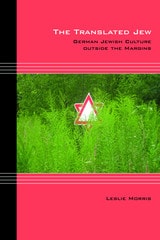
The Translated Jew
German Jewish Culture outside the MarginsLeslie Morris
Northwestern University Press, 2018
The Translated Jew brings together an eclectic set of literary and visual texts to reimagine the transnational potential for German Jewish culture in the twenty-first century. Departing from scholarship that has located the German Jewish text as an object that can be defined geographically and historically, Leslie Morris challenges national literary historiography and redraws the maps by which transnational Jewish culture and identity must be read.
Morris explores the myriad acts of translation, actual and metaphorical, through which Jewishness leaves its traces, taking as a given the always provisional nature of Jewish text and Jewish language. Although the focus is on contemporary German Jewish literary cultures, The Translated Jew also turns its attention to a number of key visual and architectural projects by American, British, and French artists and writers, including W. G. Sebald, Anne Blonstein, Hélène Cixous, Ulrike Mohr, Daniel Blaufuks, Paul Celan, Raymond Federman, and Rose Ausländer.
In thus realigning German Jewish culture with European and American Jewish culture and post-Holocaust aesthetics, this book explores the circulation of Jewishness between the United States and Europe. The insistence on the polylingualism of any single language and the multidirectionality of Jewishness are at the very center of The Translated Jew.
The United States and Latin America
Myths and Stereotypes of Civilization and NatureBy Fredrick B. Pike
University of Texas Press, 1992
The lazy greaser asleep under a sombrero and the avaricious gringo with money-stuffed pockets are only two of the negative stereotypes that North Americans and Latin Americans have cherished during several centuries of mutual misunderstanding. This unique study probes the origins of these stereotypes and myths and explores how they have shaped North American impressions of Latin America from the time of the Pilgrims up to the end of the twentieth century.
Fredrick Pike's central thesis is that North Americans have identified themselves with "civilization" in all its manifestations, while viewing Latin Americans as hopelessly trapped in primitivism, the victims of nature rather than its masters. He shows how this civilization-nature duality arose from the first European settlers' perception that nature—and everything identified with it, including American Indians, African slaves, all women, and all children—was something to be conquered and dominated. This myth eventually came to color the North American establishment view of both immigrants to the United States and all our neighbors to the south.
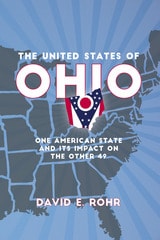
The United States of Ohio
One American State and Its Impact on the Other Forty-NineDavid E. Rohr
The Ohio State University Press, 2019
The United States of Ohio covers little-known facts about Ohio, such as how the state was the birthplace of both the National Football League and Major League Baseball and how it was Ohioans who led efforts toward racial integration in both sports. Readers will learn what makes the state a manufacturing and agricultural powerhouse—with both the largest tire company, Akron’s Goodyear, and the largest consumer products company, Cincinnati’s Proctor & Gamble, based there. The state grows, processes, and builds on a level that far outpaces the size of its population or expanse of its borders. And it is the birthplace of many prominent US figures—from Thomas Edison to John Glenn to Neil Armstrong. From sports to a century’s worth of entertainment superstars to aviation and space exploration, Ohio’s best have made for America’s greatest stories—all captured here in a look at the Buckeye State and its impact on the other forty-nine.
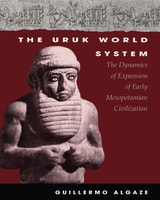
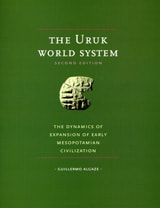
The Uruk World System
The Dynamics of Expansion of Early Mesopotamian CivilizationGuillermo Algaze
University of Chicago Press, 1993
In The Uruk World System, Guillermo Algaze concentrates instead on the unprecedented and wide-ranging process of external expansion that coincided with the rapid initial crystallization of Mesopotamian civilization. He contends that the rise of early Sumerian polities cannot be understood without also taking into account developments in surrounding peripheral areas.
Algaze reviews an extensive body of archaeological evidence for cross-cultural exchange between the nascent city-states in the Mesopotamian lowlands and communities in immediately surrounding areas. He shows that at their very inception the more highly integrated lowland centers succeeded in establishing a variety of isolated, far-flung outposts in areas at the periphery of the Mesopotamian lowlands. Embedded in an alien hinterland characterized by demonstrably less complex societies, the outposts were commonly established at the apex of preexisting regional settlement hierarchies and invariably at focal nodes astride important trade routes. Algaze argues that these early colonial out-posts served as collection points for coveted peripheral resources acquired in exchange for core manufactures and that they reflect an inherently asymmetrical system of economic hegemony that extended far beyond areas under the direct political control of Sumerian polities in southern Mesopotamia. From this he concludes that economic exploitation of less developed peripheral areas was integral to the earliest development of civilization in the ancient Near East.
The Uruk World System
The Dynamics of Expansion of Early Mesopotamian Civilization, Second EditionGuillermo Algaze
University of Chicago Press, 2005
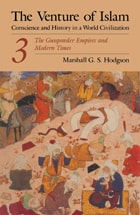
The Venture of Islam, Volume 3
The Gunpowder Empires and Modern TimesMarshall G. S. Hodgson
University of Chicago Press, 1977
In this concluding volume of The Venture of Islam, Hodgson describes the second flowering of Islam: the Safavi, Timuri, and Ottoman empires. The final part of the volume analyzes the widespread Islamic heritage in today's world.
"This is a nonpareil work, not only because of its command of its subject but also because it demonstrates how, ideally, history should be written."—The New Yorker
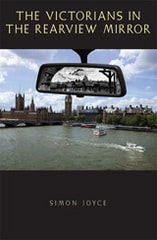
The Victorians in the Rearview Mirror
Simon Joyce
Ohio University Press, 2007
When Margaret Thatcher called in 1979 for a return to Victorian values such as hard work, self-reliance, thrift, and national pride, Labour Party leader Neil Kinnock responded that “Victorian values” also included “cruelty, misery, drudgery, squalor, and ignorance.”
The Victorians in the Rearview Mirror is an in-depth look at the ways that the twentieth century reacted to and reimagined its predecessor. It considers how the Victorian inheritance has been represented in literature, politics, film, and visual culture; the ways in which modernists and progressives have sought to differentiate themselves from an image of the Victorian; and how conservatives (and some liberals) have sought to revive elements of nineteenth-century life. Nostalgic and critical impulses combine to fix an understanding of the Victorians in the popular imagination.
Simon Joyce examines heritage culture, contemporary politics, and the “neo-Dickensian” novel to offer a more affirmative assessment of the Victorian legacy, one that lets us imagine a model of social interconnection and interdependence that has come under threat in today’s politics and culture.
Although more than one hundred years have passed since the death of Queen Victoria, the impact of her time is still fresh. The Victorians in the Rearview Mirror speaks to diverse audiences in literary and cultural studies, in addition to those interested in visual culture and contemporary politics, and situates detailed close readings of literary and cinematic texts in the context of a larger argument about the legacies of an era not as distant as we might like to think.

The Victory Album
Reflections on the Good Life after the Good WarPhilip D. Beidler
University of Alabama Press, 2010
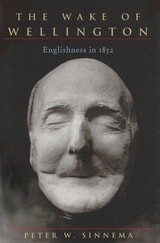
The Wake of Wellington
Englishness in 1852Peter W. Sinnema
Ohio University Press, 2006
Soldier, hero, and politician, the Duke of Wellington is one of the best-known figures of nineteenth-century England. From his victory at Waterloo over Napoleon in 1815, he rose to become prime minister of his country. But Peter Sinnema finds equal fascination in Victorian England’s response to the duke’s death.
The Wake of Wellington considers Wellington’s spectacular funeral pageant in the fall of 1852—an unprecedented event that attracted one and a half million spectators to London—as a threshold event against which the life of the soldier-hero and High Tory statesman could be re-viewed and represented.
Canvassing a profuse and dramatically proliferating Wellingtoniana, Sinnema examines the various assumptions behind, and implications of, the Times’s celebrated claim that the Irish-born Wellington “was the very type and model of an Englishman.” The dead duke, as Sinnema demonstrates, was repeatedly caught up in interpretive practices that stressed the quasi-symbolic relations between hero and nation.
The Wake of Wellington provides a unique view of how in death Wellington and his career were promoted as the consummation of a national destiny intimately bound up with Englishness itself, and with what it meant to be English at midcentury.
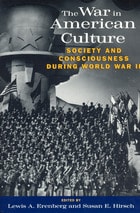
The War in American Culture
Society and Consciousness during World War IIEdited by Lewis A. Erenberg and Susan E. Hirsch
University of Chicago Press, 1996
World War II posed a crisis for American culture: to defeat the enemy, Americans had to unite across the class, racial and ethnic boundaries that had long divided them. Exploring government censorship of war photography, the revision of immigration laws, Hollywood moviemaking, swing music, and popular magazines, these essays reveal the creation of a new national identity that was pluralistic, but also controlled and sanitized. Concentrating on the home front and the impact of the war on the lives of ordinary Americans, the contributors give us a rich portrayal of family life, sexuality, cultural images, and working-class life in addition to detailed consideration of African Americans, Latinos, and women who lived through the unsettling and rapidly altered circumstances of wartime America.

The Water Kingdom
A Secret History of ChinaPhilip Ball
University of Chicago Press, 2017
Water, Ball shows, is a key that unlocks much of Chinese culture. In The Water Kingdom, he takes us on a grand journey through China’s past and present, showing how the complexity and energy of the country and its history repeatedly come back to the challenges, opportunities, and inspiration provided by the waterways. Drawing on stories from travelers and explorers, poets and painters, bureaucrats and activists, all of whom have been influenced by an environment shaped and permeated by water, Ball explores how the ubiquitous relationship of the Chinese people to water has made it an enduring metaphor for philosophical thought and artistic expression. From the Han emperors to Mao, the ability to manage the waters ― to provide irrigation and defend against floods ― was a barometer of political legitimacy, often resulting in engineering works on a gigantic scale. It is a struggle that continues today, as the strain of economic growth on water resources may be the greatest threat to China’s future.
The Water Kingdom offers an unusual and fascinating history, uncovering just how much of China’s art, politics, and outlook have been defined by the links between humanity and nature.
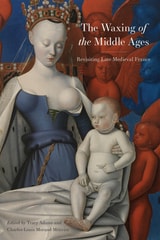
The Waxing of the Middle Ages
Revisiting Late Medieval FranceCharles-Louis Morand-Métivier
University of Delaware Press, 2023
The Waxing of the Middle Ages sets out to provide a rich, complex, and diverse study of these developments and to reassert that late medieval France is crucial in its own right. The collection argues for an approach that views the late medieval period not as an afterthought, or a blind spot, but as a period that is key in understanding the fluidity of time, traditions, culture, and history. Each essay explores some “cultural form,” to borrow Huizinga’s expression, to expose the false divide that has dominated modern scholarship.
The Work of Mothering
Globalization and the Filipino DiasporaHarrod Suarez
University of Illinois Press, 2017
Harrod J. Suarez's innovative readings of this cultural production explores issues of diaspora, gender, and labor. He details the ways literature and cinema play critical roles in encountering, addressing, and problematizing what we think we know about overseas Filipina workers. Though often seen as compliant subjects, the Filipina mother can also destabilize knowledge production that serves the interests of global empire, capitalism, and Philippine nationalism. Suarez examines canonical writers like Nick Joaquín, Carlos Bulosan, and Jessica Hagedorn to explore this disruption and understand the maternal specificity of the construction of overseas Filipina workers. The result is a series of readings that develop new ways of thinking through diasporic maternal labor that engages with the sociological imaginary.
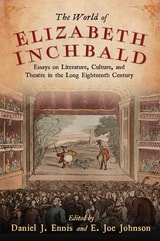
The World of Elizabeth Inchbald
Essays on Literature, Culture, and Theatre in the Long Eighteenth CenturyDaniel J. Ennis
University of Delaware Press, 2022
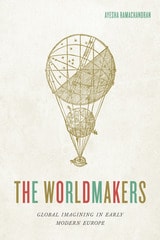
The Worldmakers
Global Imagining in Early Modern EuropeAyesha Ramachandran
University of Chicago Press, 2015
The Worldmakers moves beyond histories of globalization to explore how “the world” itself—variously understood as an object of inquiry, a comprehensive category, and a system of order—was self-consciously shaped by human agents. Gathering an international cast of characters, from Dutch cartographers and French philosophers to Portuguese and English poets, Ramachandran describes a history of firsts: the first world atlas, the first global epic, the first modern attempt to develop a systematic natural philosophy—all part of an effort by early modern thinkers to capture “the world” on the page.
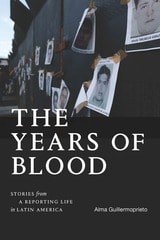
The Years of Blood
Stories from a Reporting Life in Latin AmericaAlma Guillermoprieto
Duke University Press, 2025

Theater Enough
American Culture and the Metaphor of the World Stage, 1607–1789Jeffrey H. Richards
Duke University Press, 1991
The rhetoric, or discourse, of early American theater emerged out of the figures of speech that permeated the colonists’ lives and literary productions. Jeffrey H. Richards examines a variety of texts—histories, diaries, letters, journals, poems, sermons, political tracts, trial transcripts, orations, and plays—and looks at the writings of such authors as John Winthrop and Mercy Otis Warren. Richards places the American usage of theatrum mundi—the world depicted as a stage—in the context of classical and Renaissance traditions, but shows how the trope functions in American rhetoric as a register for religious, political, and historical attitudes.
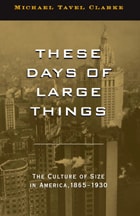
These Days of Large Things
The Culture of Size in America, 1865-1930Michael Tavel Clarke
University of Michigan Press, 2009
The United States at the turn of the twentieth century cultivated a passion for big. It witnessed the emergence of large-scale corporate capitalism; the beginnings of American imperialism on a global stage; record-level immigration; a rapid expansion of cities; and colossal events and structures like world's fairs, amusement parks, department stores, and skyscrapers. Size began to play a key role in American identity. During this period, bigness signaled American progress.
These Days of Large Things explores the centrality of size to American culture and national identity and the preoccupation with physical stature that pervaded American thought. Clarke examines the role that body size played in racial theory and the ways in which economic changes in the nation generated conflicting attitudes toward growth and bigness. Finally, Clarke investigates the relationship between stature and gender.
These Days of Large Things brings together a remarkable range of cultural material including scientific studies, photographs, novels, cartoons, architecture, and film. As a general cultural and intellectual history of the period, this work will be of interest to students and scholars in American studies, U.S. history, American literature, and gender studies.
Michael Tavel Clarke is Assistant Professor of English at the University of Calgary.
Cover photograph: "New York from Its Pinnacles," Alvin Langdon Coburn (1912). Courtesy of the George Eastman House.
"A fascinating study of the American preoccupation with physical size, this book charts new paths in the history of science, culture, and the body. A must-read for anyone puzzling over why Americans today love hulking SUVs, Mcmansions, and outsized masculine bodies."
---Lois Banner, University of Southern California
"From the Gilded Age through the Twenties, Clarke shows a nation-state obsessed with sheer size, ranging from the mammoth labor union to the 'Giant Incorporated Body' of the monopoly trust. These Days of Large Things links the towering Gibson Girl with the skyscraper, the pediatric regimen with stereotypes of the Jew. Spanning anthropology, medicine, architecture, business, and labor history, Clarke provides the full anatomy of imperial America and offers a model of cultural studies at its very best."
---Cecelia Tichi, Vanderbilt University
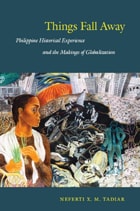
Things Fall Away
Philippine Historical Experience and the Makings of GlobalizationNeferti X. M. Tadiar
Duke University Press, 2009
Tadiar treats the historical experiences articulated in feminist, urban protest, and revolutionary literatures of the 1960s–90s as “cultural software” for the transformation of dominant social relations. She considers feminist literature in relation to the feminization of labor in the 1970s, when between 300,000 and 500,000 prostitutes were working in the areas around U.S. military bases, and in the 1980s and 1990s, when more than five million Filipinas left the country to toil as maids, nannies, nurses, and sex workers. She reads urban protest literature in relation to authoritarian modernization and crony capitalism, and she reevaluates revolutionary literature’s constructions of the heroic revolutionary subject and the messianic masses, probing these social movements’ unexhausted cultural resources for radical change.
Three-Way Street
Jews, Germans, and the TransnationalJay Howard Geller and Leslie Morris, Editors
University of Michigan Press, 2016
Among the first volumes to focus on German-Jewish transnationalism, this interdisciplinary collection spans the fields of history, literature, film, theater, architecture, philosophy, and theology as it examines the lives of significant emigrants. The individuals whose stories are reevaluated include German Jews Ernst Lubitsch, David Einhorn, and Gershom Scholem, the architect Fritz Nathan and filmmaker Helmar Lerski; and eastern European Jews David Bergelson, Der Nister, Jacob Katz, Joseph Soloveitchik, and Abraham Joshua Heschel—figures not normally associated with Germany. Three-Way Street addresses the gap in the scholarly literature as it opens up critical ways of approaching Jewish culture not only in Germany, but also in other locations, from the mid-nineteenth century to the present.
Through French Windows
An Introduction to France in the NinetiesJames Corbett
University of Michigan Press, 1994
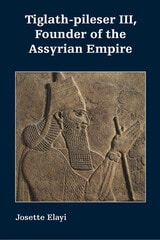
Tiglath-pileser III, Founder of the Assyrian Empire
Josette Elayi
SBL Press, 2022
Time Maps
Collective Memory and the Social Shape of the PastEviatar Zerubavel
University of Chicago Press, 2003
Who were the first people to inhabit North America? Does the West Bank belong to the Arabs or the Jews? Why are racists so obsessed with origins? Is a seventh cousin still a cousin? Why do some societies name their children after dead ancestors?
As Eviatar Zerubavel demonstrates in Time Maps, we cannot answer burning questions such as these without a deeper understanding of how we envision the past. In a pioneering attempt to map the structure of our collective memory, Zerubavel considers the cognitive patterns we use to organize the past in our minds and the mental strategies that help us string together unrelated events into coherent and meaningful narratives, as well as the social grammar of battles over conflicting interpretations of history. Drawing on fascinating examples that range from Hiroshima to the Holocaust, from Columbus to Lucy, and from ancient Egypt to the former Yugoslavia, Zerubavel shows how we construct historical origins; how we tie discontinuous events together into stories; how we link families and entire nations through genealogies; and how we separate distinct historical periods from one another through watersheds, such as the invention of fire or the fall of the Berlin Wall.
Most people think the Roman Empire ended in 476, even though it lasted another 977 years in Byzantium. Challenging such conventional wisdom, Time Maps will be must reading for anyone interested in how the history of our world takes shape.
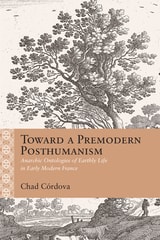
Toward a Premodern Posthumanism
Anarchic Ontologies of Earthly Life in Early Modern FranceChad Córdova
Northwestern University Press, 2025
Drawing on early modern French thought to free nature and aesthetics from metaphysical humanism
What good is aesthetics in a time of ecological crisis? Toward a Premodern Posthumanism: Anarchic Ontologies of Earthly Life in Early Modern France shows that philosophical aesthetics contains unheeded potentialities for challenging the ontological subjection of nature to the human subject. Drawing on deconstructive, ecological, and biopolitical thought, Chad Córdova uncovers in aesthetics something irreducible to humanist metaphysics: an account of how beings emerge and are interrelated, responsive, and even response-able without reason or why.
This anarchic and atelic ontology, recovered from Kant, becomes the guiding thread for a new, premodern trajectory of posthumanism. Charting a path from Aristotle to Heidegger to today’s plant-thinking, with new readings of Montaigne, Pascal, Diderot, Rousseau, and others along the way, this capacious study reveals the untimely relevance of pre-1800 practices of writing, science, and art. Enacting a multitemporal mode of reading, Córdova offers a defense and illustration of the importance of returning to early modern texts as a way to rethink nature, art, ethics, and politics in a time when these concepts are in flux and more contentious than ever.
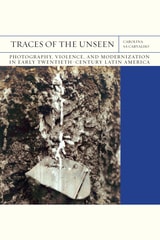
Traces of the Unseen
Photography, Violence, and Modernization in Early Twentieth-Century Latin AmericaCarolina Sá Carvalho
Northwestern University Press, 2023
Winner of the 2024 Roberto Reis Book Award
Winner of the LASA Environment Section Best Book of 2023
Winner of the LASA Amazonian Studies Section Best Book of 2024
Co-Winner of the LASA Book Award for the Visual Culture Studies 2024
A richly illustrated examination of photography as a technology for documenting, creating, and understanding the processes of modernization in turn-of-the-century Brazil and the Amazon
Photography at the turn of the twentieth century was not only a product of modernity but also an increasingly available medium to chronicle the processes of modernization. Traces of the Unseen: Photography, Violence, and Modernization in Early Twentieth-Century Latin America situates photography’s role in documenting the destruction wrought by infrastructure development and extractive capitalist expansion in the Amazon and outside the Brazilian metropole. Combining formal analysis of individual photographs with their inclusion in larger multimedia assemblages, Carolina Sá Carvalho explores how this visual evidence of violence was framed, captioned, cropped, and circulated. As she explains, this photographic creation and circulation generated a pedagogy of the gaze with which increasingly connected urban audiences were taught what and how to see: viewers learned to interpret the traces of violence captured in these images within the larger context of modernization.
Traces of the Unseen draws on works by Flavio de Barros, Euclides da Cunha, Roger Casement, Claude Lévi-Strauss, and Mario de Andrade to situate an unruly photographic body at the center of modernity, in all its disputed meanings. Moreover, Sá Carvalho locates historically specific practices of seeing within the geopolitical peripheries of capitalism. What emerges is a consideration of photography as a technology through which modern aspirations, moral inclinations, imagined futures, and lost pasts were represented, critiqued, and mourned.
Tradition
Edward Shils
University of Chicago Press, 1981
"Shils is a man of fabled learning, whose mind purrs powerfully like the moth at dusk. I hesitate to use the word conservative of him because it misses the central concern of his work, which is not conservatism, but the conservation of those human resources and achievements which are richest, and matter most."—David A. Martin, Times Literary Supplement
"Tradition is the first comprehensive treatment of the subject that encompasses the totality of tradition in all its multifaceted variables and functions. . . . It is a landmark analytical and theoretical sociological study that not only fills a need but also provides a basic model and impetus for further research."—H. Leon Abrams Jr., Sociology
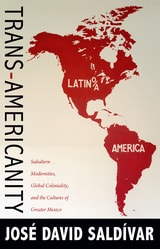
Trans-Americanity
Subaltern Modernities, Global Coloniality, and the Cultures of Greater MexicoJosé David Saldívar
Duke University Press, 2012
Transnational Construction of Mayanness
Reading Modern Mesoamerica through US ArchivesFernando Armstrong-Fumero
University Press of Colorado, 2023
Contributors tap documentary, ethnographic, and ethnoarchaeological sources from North America to expand established categories of fieldwork and archival research conducted within the national spaces of Mexico and Central America. A particularly rich and diverse set of case studies interrogate the historical processes that remove sources from their place of production in the “field” to the US, challenge the conventional wisdom regarding the geography of data sources that are available for research, and reveal a range of historical relationships that enabled US actors to shape the historical experience of Maya-speaking peoples.
The Transnational Construction of Mayanness offers rich insight into transnational relations and suggests new avenues of research that incorporate an expanded corpus of materials that embody the deep-seated relationship between Maya-speaking peoples and various gringo interlocutors. The work is an important bridge between Mayanist anthropology and historiography and broader literatures in American, Atlantic, and Indigenous studies.
Contributors: David Carey, M. Bianet Castellanos, Matilde Córdoba Azcárate, Lydia Crafts, John Gust, Julio Cesar Hoil Gutierréz, Jennifer Mathews, Matthew Watson
Transnational Cultural Flow from Home
Korean Community in Greater New YorkPyong Gap Min
Rutgers University Press, 2023
Transnational Cultural Flow from Home examines New York Korean immigrants’ collective efforts to preserve their cultural traditions and cultural practices and their efforts to transmit and promote them to New Yorkers by focusing on the Korean cultural elements such as language, foods, cultural festivals, and traditional and contemporary performing arts.
This publication was supported by the 2022 Korean Studies Grant Program of the Academy of Korean Studies (AKS-2022-P-009).
Trouillot Remixed
The Michel-Rolph Trouillot ReaderMichel-Rolph Trouillot. Edited by Yarimar Bonilla, Greg Beckett, and Mayanthi L. Fernando
Duke University Press, 2021