Results by title
1882 books match the query 'Criticism and interpretation' and 348 start with t
The Matrix of Lyric Transformation
Poetic Modes and Self-Presentation in Early Chinese Pentasyllabic PoetryCai Zong-qi
University of Michigan Press, 1997
The Meaning of Shakespeare, Volume 1
The Comedy of Errors, Henry VI, A Midsummer Night's Dream, The Merchant of Venice, Romeo and Juliet, King John, Richard II, Henry IV, Henry V, Henry VIII, Much Ado about Nothing, As You Like It, Twelfth Night, Julius Caesar, Hamlet, and MoreHarold C. Goddard
University of Chicago Press, 1960
Centuries after they were originally performed, the plays of Shakespeare continue to inspire, entertain, and awe audiences and readers today. At the same time, however, there's no question that even the most sophisticated reader can sometimes benefit from the insight and guidance of an expert when entering Shakespeare's long-gone world and complicated figurative language.
William Goddard is here to help. He taught Shakespeare for decades as much-loved professor at Swarthmore College, and here he distills that experience into an accessible, engaging companion to the plays. Across two volumes, Goddard covers all of Shakespeare's plays and brings fresh insight to familiar characters, scenes, and verses. Goddard writes, "The greatest poetry has always depicted the world as a little citadel of nobility threatened by an immense barbarism, a flickering candle surrounded by infinite night" Shakespeare's candle still burns, and with Goddard's help we can all see it brighter than ever.
The Meaning of Shakespeare, Volume 2
Troilus and Cressida, All's Well That Ends Well, Measure for Measure, Othello, Macbeth, King Lear, Timon of Athens, Antony and Cleopatra, Coriolanus, Pericles, Cymbeline, The Winter's Tale, The TempestHarold C. Goddard
University of Chicago Press, 1960
Centuries after they were originally performed, the plays of Shakespeare continue to inspire, entertain, and awe audiences and readers today. At the same time, however, there's no question that even the most sophisticated reader can sometimes benefit from the insight and guidance of an expert when entering Shakespeare's long-gone world and complicated figurative language.
William Goddard is here to help. He taught Shakespeare for decades as much-loved professor at Swarthmore College, and here he distills that experience into an accessible, engaging companion to the plays. Across two volumes, Goddard covers all of Shakespeare's plays and brings fresh insight to familiar characters, scenes, and verses. Goddard writes, "The greatest poetry has always depicted the world as a little citadel of nobility threatened by an immense barbarism, a flickering candle surrounded by infinite night" Shakespeare's candle still burns, and with Goddard's help we can all see it brighter than ever.
The Medieval Worlds of Neil Gaiman
From Beowulf to Sleeping BeautyShiloh Carroll
University of Iowa Press, 2023
Readers love to sink into Gaiman’s medieval worlds—but what makes them “medieval”? Shiloh Carroll offers an introduction to the idea of medievalism, how the literature and culture of the Middle Ages have been reinterpreted and repurposed over the centuries, and how the layers of interpretation have impacted Gaiman’s own use of medieval material. She examines influences from Norse mythology and Beowulf to medieval romances and fairy tales in order to expand readers’ understanding and appreciation of Gaiman’s work, as well as the rest of the medievalist films, TV shows, and books that are so popular today.
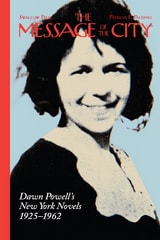
The Message of the City
Dawn Powell’s New York Novels, 1925–1962Patricia E. Palermo
Ohio University Press, 2016
Dawn Powell was a gifted satirist who moved in the same circles as Dorothy Parker, Ernest Hemingway, renowned editor Maxwell Perkins, and other midcentury New York luminaries. Her many novels are typically divided into two groups: those dealing with her native Ohio and those set in New York. “From the moment she left behind her harsh upbringing in Mount Gilead, Ohio, and arrived in Manhattan, in 1918, she dove into city life with an outlander’s anthropological zeal,” reads a recent New Yorker piece about Powell, and it is those New York novels that built her reputation for scouring wit and social observation.
In this critical biography and study of the New York novels, Patricia Palermo reminds us how Powell earned a place in the national literary establishment and East Coast social scene. Though Powell’s prolific output has been out of print for most of the past few decades, a revival is under way: the Library of America, touting her as a “rediscovered American comic genius,” released her collected novels, and in 2015 she was posthumously inducted into the New York State Writer’s Hall of Fame.
Engaging and erudite, The Message of the City fills a major gap in in the story of a long-overlooked literary great. Palermo places Powell in cultural and historical context and, drawing on her diaries, reveals the real-life inspirations for some of her most delicious satire.
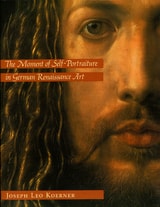
The Moment of Self-Portraiture in German Renaissance Art
Joseph Leo Koerner
University of Chicago Press, 1993
"[A] dazzling book. . . . He has turned out one of the most powerful, as well as one of the most ambitious, art-historical works of the last decade." — Anthony Grafton, New Republic
"Rich and splendid. . . . Joseph Koerner's book is a dazzling display of scholarship, enfolding Durer's artistic achievement within the broader issues of self and salvation, and like [Durer's] great Self-
Portrait it holds up a mirror to the modern fable of identity." — Bruce Boucher, The Times
"Remarkable and densely argued." — Marcia Pointon, British Journal of Aesthetics
"Herculean and brilliant. . . . Will echo in fields beyond the Sixteenth-Century and Art History." — Larry Silver, Sixteenth Century Journal
"May be the most ambitious of recent American reflections on the mysteries of German art. His elegantly written book deals with the fateful period in the history of German art when it reached its highest point. . . . Offers deeper and more disturbing insights into German Renaissance art than most earlier scholarship." — Willibald Sauerlander, New York Review of Books
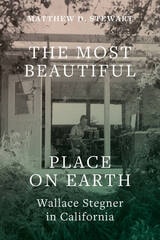
The Most Beautiful Place on Earth
Wallace Stegner in CaliforniaMatthew D. Stewart
University of Utah Press, 2021
This book tells the story of Stegner and his family as they made a home just outside of Palo Alto, California, during its transition from the Valley of Heart’s Delight (known for its rolling hills and orchards) to Silicon Valley. In this thoughtful study of the novels Stegner wrote in California—including his Pulitzer Prize–winning Angle of Repose—readers are invited to consider with Stegner what the practice of place requires in the American West. Specialists in the literature and history of the American West will find new analyses of Stegner and his influential work. Other readers will be guided through Stegner’s work in concrete and accessible prose, and anyone who has longed for home and a sense of place will encounter a powerful, beautiful, and at times tragic attempt to build and preserve it.
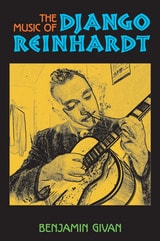
The Music of Django Reinhardt
Benjamin Givan
University of Michigan Press, 2009
"The Music of Django Reinhardt is an impressive contribution to the field of jazz studies. The book offers a penetrating view into the music of one of jazz's most intriguing early figures."
---Keith Waters, coauthor, Jazz: The First Hundred Years
"An important addition to the literature on jazz, Givan's book provides many insights into Reinhardt’s solo building and unorthodox guitar playing; it is richly illustrated with many excellent musical transcriptions."
---Thomas Owens, author of Bebop: The Music and Its Players
"Givan has painstakingly assembled an analytical interpretation of Reinhardt's music that is rigorous, compelling, and illuminating. This book makes a unique contribution to the field of jazz studies and guitar music in general."
---Brian Harker, author of Jazz: An American Journey
When most people think of the great jazz guitarist Django Reinhardt, they conjure up the unusual details of his colorful life: a childhood spent in gypsy encampments outside of Paris; the tragic caravan fire when he was eighteen that rendered his left hand nearly unusable; and his survival during World War II, when gypsies were massacred by the hundreds of thousands. The amazing story of Reinhardt’s life even became the basis for Woody Allen's Sweet and Lowdown.
Yet, it is the music of Django Reinhardt that made him one of the most original guitarists in history. In particular, his partnership with violinist Stéphane Grappelli, in the Quintette du Hot Club de France, brought him international renown and the attention of some of the most important American jazz musicians of the day, including Coleman Hawkins, Benny Carter, and Duke Ellington.
The Music of Django Reinhardt explores the story of the man and his music as never before. Benjamin Givan shows how one of jazz's greatest guitarists created his unparalleled sound. This book is an analytical study of his music, including his process, his improvisational style, and his instrumental technique.
The book features transcriptions from records of the 1920s through the 1950s and includes detailed discussion of selected performances from one of the most important guitarists in history.
Benjamin Givan is Assistant Professor of Music at Skidmore College. His writings on jazz have appeared in scholarly publications such as Current Musicology and the Musical Quarterly, as well as the popular jazz magazine Down Beat. He received his Ph.D. in music theory from Yale University.
The Music of James Tenney
Volume 1: Contexts and ParadigmsRobert Wannamaker
University of Illinois Press, 2021
Robert Wannamaker's monumental two-volume study explores the influential music and ideas of American composer, theorist, writer, performer, and educator James Tenney. Delving into the whole of Tenney's far-ranging oeuvre, Wannamaker provides in-depth, aurally grounded analyses of works linked to the artist's revolutionary theories of musical form, timbre, and harmonic perception.
Volume 1, Contexts and Paradigms, chronologically surveys Tenney's creative development and output. Wannamaker begins each section with biographical, aesthetic, and technical context that illuminates a distinct period in Tenney's career. From there, he analyzes a small number of pieces that illuminate the concerns, characteristics, and techniques that emerged in Tenney's music during that time. Wannamaker supplements the text with musical examples, graphs, and diagrams while also drawing on unpublished material and newly available primary sources to flesh out each work and the ideas that shaped it.
A landmark in experimental music scholarship, The Music of James Tenney is a first-of-its-kind consideration of the experimental music titan and his work.
The Music of James Tenney
Volume 2: A Handbook to the PiecesRobert Wannamaker
University of Illinois Press, 2021
Robert Wannamaker's monumental two-volume study explores the influential music and ideas of American composer, theorist, writer, performer, and educator James Tenney. Delving into the whole of Tenney's far-ranging oeuvre, Wannamaker offers close, aurally grounded analyses of works linked to the artist's revolutionary theories of musical form, timbre, and harmonic perception.
Written as a reference work, Volume 2, A Handbook to the Pieces, presents detailed entries on Tenney's significant post-1959 experimental works (excepting pieces covered in volume 1). Wannamaker includes technical information, an analysis of intentions and goals, graphs and musical examples, historical and biographical context, and thoughts from Tenney and others on specific works. Throughout, he discusses the striking compositional ideas found in Tenney's music and, where appropriate, traces an idea's appearance from one piece to the next to reveal the evolution of the composer's art and thought.
A landmark in experimental music scholarship, The Music of James Tenney is a first-of-its-kind consideration of the experimental music titan and his work.
The Music of Thought in the Poetry of George Oppen and William Bronk
Henry Weinfield
University of Iowa Press, 2009
From his careful readings of Oppen’s and Bronk’s poetry to his fascinating examination of the letters they exchanged, Weinfield provides important aesthetic, epistemological, and historical insights into their poetry and poetic careers. In bringing together for the first time the work of two of the most important poets of the postwar generation, The Music of Thought not only illuminates their poetry but also raises important questions about American literary history and the categories in terms of which it has generally been interpreted.
The Musician as Philosopher
New York’s Vernacular Avant-Garde, 1958–1978Michael Gallope
University of Chicago Press, 2024
The Musician as Philosopher explores the philosophical thought of avant-garde musicians in postwar New York: David Tudor, Ornette Coleman, the Velvet Underground, Alice Coltrane, Patti Smith, and Richard Hell. It contends that these musicians—all of whom are understudied and none of whom are traditionally taken to be composers—not only challenged the rules by which music is written and practiced but also confounded and reconfigured gendered and racialized expectations for what critics took to be legitimate forms of musical sound. From a broad historical perspective, their arresting music electrified a widely recognized social tendency of the 1960s: a simultaneous affirmation and crisis of the modern self.
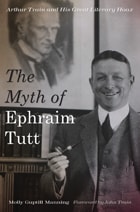
The Myth of Ephraim Tutt
Arthur Train and His Great Literary HoaxMolly Guptill Manning
University of Alabama Press, 2012
The Mythologizing of Mark Twain
Sara Davis
University of Alabama Press, 1984
How Samuel Clemens became Mark Twain—and Mark Twain became a myth.
The Mythologizing of Mark Twain explores the enduring fascination with one of America's most celebrated literary figures and examines how Samuel Langhorne Clemens became the cultural icon known around the world as Mark Twain. Bringing together a distinguished group of scholars, this thought-provoking collection investigates Twain not simply as an author, but as a powerful symbol whose life, works, and public persona have become inseparable from larger ideas about American identity, humor, democracy, individualism, and national character.
Readers and critics have long recognized Twain's literary genius, yet explaining the origins and significance of that genius remains an ongoing challenge. The essays in this volume address that challenge by exploring the many ways Twain has been interpreted, celebrated, debated, and transformed into a mythic figure. They examine how his writings helped define an American literary tradition while simultaneously contributing to the creation of a broader cultural mythology that continues to shape public perceptions of the United States and its history.
Rather than seeking a single interpretation of Twain, the contributors employ a range of critical approaches to illuminate the complexity of both the man and the legend. Their analyses reveal how the boundaries between Samuel Clemens, Mark Twain, and the popular image of "America's author" have often blurred, generating new layers of meaning for successive generations of readers and scholars.
The Mythologizing of Mark Twain is an essential resource for students and scholars of American literature, cultural history, and literary criticism. By examining the evolution of Twain's reputation and influence, the collection offers a deeper understanding of how literary figures become cultural myths and why Mark Twain remains one of the most enduring voices in the American imagination.

The Natural History of H. G. Wells
John Robert Reed
Ohio University Press, 1982
This new study offers a general reassessment of H. G. Wells as a writer and thinker. It concentrates upon the close relationship between Wells’ developing philosophy and his literary techniques. The early chapters examine Wells’ treatment of such subjects as confinement and escape, sex, the nature of human identity, the relationship of individual to race, human progress, and the importance of education. At the same time, the describe the emotional topography that Wells created as a mean of vivifying his ideas, a topography constructed from image complexes largely based upon the analogy between individual and racial evolution.
The major contribution of the book comes in its later chapters, which deal with Wells’ metaphysical assumptions and his approach to his craft. His views on free will and strength of will were intimately related to his methods of literary composition. The important later chapters detail this relationship, while describing some of Wells’ characteristic literary devices, such as the intentional violations of certain novelistic conventions or the sly borrowing from and alluding to contemporary works of literature in what amounted to a covert polemic.
On the whole, this study argues for a coherent and consistent, though developing, philosophy operating throughout Wells’ career and manifested in experimental literary works which, while not always successful, were consistently inventive and intelligently crafted in the service of Wells’ principle aim, the education of the human species to a command of its own destiny.
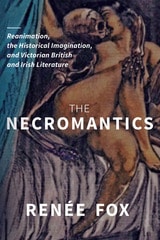
The Necromantics
Reanimation, the Historical Imagination, and Victorian British and Irish LiteratureRenée Fox
The Ohio State University Press, 2023
Winner, 2025 Sonya Rudikoff Award for the best first book in Victorian Studies
Honorable Mention, 2023 North American Victorian Studies Association First Book Prize
Honorable Mention, American Council for Irish Studies Donald Murphy Prize for Distinguished First Book
The Necromantics dwells on the literal afterlives of history. Reading the reanimated corpses—monstrous, metaphorical, and occasionally electrified—that Mary Shelley, Robert Browning, Charles Dickens, W. B. Yeats, Bram Stoker, and others bring to life, Renée Fox argues that these undead figures embody the present’s desire to remake the past in its own image. Fox positions “necromantic literature” at a nineteenth-century intersection between sentimental historiography, medical electricity, imperial gothic monsters, and the Irish Literary Revival, contending that these unghostly bodies resist critical assumptions about the always-haunting power of history.
By considering Irish Revival texts within the broader scope of nineteenth-century necromantic works, The Necromantics challenges Victorian studies’ tendency to merge Irish and English national traditions into a single British whole, as well as Irish studies’ postcolonial efforts to cordon off a distinct Irish canon. Fox thus forges new connections between conflicting political, formal, and historical traditions. In doing so, she proposes necromantic literature as a model for a contemporary reparative reading practice that can reanimate nineteenth-century texts with new aesthetic affinities, demonstrating that any effective act of reading will always be an effort of reanimation.
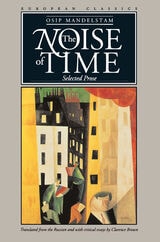
The Noise of Time
Selected ProseOsip Mandelstam
Northwestern University Press, 2002
This volume includes Mandelstam's "The Noise of Time," a series of autobiographical sketches; "The Egyptian Stamp," a novella; "Fourth Prose;" and the famous travel memoirs "Theodosia" and "Journey to Armenia."
The Nonconformists
Culture, Politics, and Nationalism in a Serbian Intellectual Circle, 1944-1991Nick Miller
Central European University Press, 2007
The Novel in the Age of Disintegration
Dostoevsky and the Problem of Genre in the 1870sKate Holland
Northwestern University Press, 2013
Scholars have long been fascinated by the creative struggles with genre manifested throughout Dostoevsky’s career. In The Novel in the Age of Disintegration, Kate Holland brings historical context to bear, showing that Dostoevsky wanted to use the form of the novel as a means of depicting disintegration brought on by various crises in Russian society in the 1860s. This required him to reinvent the genre. At the same time he sought to infuse his novels with the capacity to inspire belief in social and spiritual reintegration, so he returned to some older conventions of a society that was already becoming outmoded.
In thoughtful readings of Demons, The Adolescent, A Writer’s Diary, and The Brothers Karamazov, Holland delineates Dostoevsky’s struggle to adapt a genre to the reality of the present, with all its upheavals, while maintaining a utopian vision of Russia’s future mission.
The Novels of Nadine Gordimer
History from the InsideStephen Clingman
University of Massachusetts Press, 1986
In Nadine Gordimer's view, the novel can present history as historians cannot. Moreover, this presentation is not fictional in the sense of being “untrue.” Rather, fiction deals with an area of activity usually inaccessible to the sciences of greater externally: the area in which historical process is registered as the subjective experience of individuals in society; fiction give us “history from the inside.” Gordimer's novels give us an extraordinary and unique insight into historical experience in the period in which she writes.
The One Thomas More
Travis Curtright
Catholic University of America Press, 2012
The One and Only Law
Walter Benjamin and the Second CommandmentJames R. Martel
University of Michigan Press, 2014

The Orwell Mystique
A Study in Male IdeologyDaphne Patai
University of Massachusetts Press, 1984
The Orwell Mystique: A Study in Male Ideology is a pioneering work of feminist literary criticism that subjects the life and writing of George Orwell (1903–1950) to a sustained and rigorous feminist analysis. Published in 1984—the same year as the famous date in Orwell's most celebrated dystopian novel—the book examines all of Orwell's major novels, essays, and journalism and argues that his widely celebrated reputation for moral authority and plain-speaking democratic decency is fundamentally undercut by a pervasive and condescending attitude toward women.
Author Daphne Patai contends that Orwell's work is saturated with a male ideology so deeply embedded as to be largely invisible to mainstream criticism, which had long treated Orwell as an exemplar of intellectual honesty and political courage while overlooking the gender assumptions that structure his writing. Drawing on feminist theory and close textual analysis, Patai systematically traces the ways in which Orwell's androcentrism—his tendency to place men and male experience at the center of human life—shapes not only his fiction but also his essays, autobiographical writings, and political commentary.
The book is organized around a series of thematic and textual investigations. An introductory chapter establishes what Patai calls “the Orwell myth”—the cultural phenomenon by which Orwell's personal authority as a moral and political guide has been constructed and sustained. Subsequent chapters examine specific dimensions of Orwell's work and biography, including his experience of empire and the masculine codes embedded in his writings about colonialism; his treatments of vagabondage, manual labor, and working-class masculinity (notably in works such as Down and Out in Paris and London and The Road to Wigan Pier); and the androcentrism running through Nineteen Eighty-Four, in which Patai argues that the novel's treatment of women, sexuality, and the body reflects deeply patriarchal assumptions. The book also addresses Orwell's essays and journalism, situating his gender ideology within the broader context of mid-twentieth-century British patriarchal culture.
At the time of its publication, The Orwell Mystique was one of the first book-length feminist examinations of Orwell, and it generated significant scholarly debate. It remains an important and frequently cited work in both Orwell studies and feminist literary criticism.
The Other Emerson
Branka Arsic
University of Minnesota Press, 2010
Considering Emerson first and foremost as a daring and original thinker, The Other Emerson focuses on three Emersonian subjects-subjectivity, the political, and the nature of philosophy-and range in topic from Emerson's relationships to slavery and mourning to his place in the development of Romanticism as reread by contemporary systems theory. It is Emerson's appreciation of truth's instability that link him to the European philosophical tradition.
Contributors: Eduardo Cadava, Princeton U; Sharon Cameron, Johns Hopkins U; Russell B. Goodman, U of New Mexico; Paul Grimstad, Yale U; Eric Keenaghan, U at Albany, SUNY; Gregg Lambert, Syracuse U; Sandra Laugier, Université de Picardie Jules Verne; Donald Pease, Dartmouth College.
The Other Solzhenitsyn
Telling the Truth about a Misunderstood Writer and ThinkerDaniel J. Mahoney
St. Augustine's Press, 2014
This book above all explores philosophical, political, and moral themes in Solzhenitsyn’s two masterworks, The Gulag Archipelago and The Red Wheel, as well as in his great European novel In the First Circle. We see Solzhenitsyn as analyst of revolution, defender of the moral law, phenomenologist of ideological despotism, and advocate of “resisting evil with force.” Other chapters carefully explore Solzhenitsyn’s conception of patriotism, his dissection of ideological mendacity, and his controversial, but thoughtful and humane discussion of the “Jewish Question” in the Russian – and Soviet twentieth century. Some of Solzhenitsyn’s later writings, such as the “binary tales” that he wrote in the 1990s, are subject to critically appreciative analysis. And a long final chapter comments on Solzhenitsyn’s July 2007 Der Spiegel interview, his last word to Russia and the West. He is revealed to be a man of faith and freedom, a patriot but not a nationalist, and a principled advocate of self-government for Russia and the West.
A final Appendix reproduces the beautiful Introduction (“The Gift of Incarnation”) that the author’s widow, Natalia Solzhenitsyn, wrote to the 2009 Russian abridgment of The Gulag Archipelago, a work that is now taught in Russian high schools.
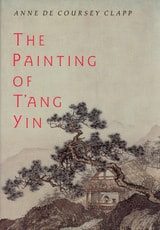
The Painting of T'ang Yin
Anne De Coursey Clapp
University of Chicago Press, 1991
Anne De Coursey Clapp's work also explores larger issues of Ming painting raised by the artist's turbulent career. She describes the social and intellectual values exalted in Ming Suchou, its system of patronage, the contrast between the professional and amateur artist, and the formative influence of twelfth-century Sung dynasty styles on Suchou painters. Clapp shows how T'ang Yin's artistic inventions were made in the course of leading the revival of Sung dynasty styles in Suchou: tracing T'ang Yin's early studies of ancient and contemporary masters, she describes how he reworked an antique style, converting it into a vehicle of expression that reached fruition in a long series of fresh and powerful paintings of landscapes and birds-and-flowers. In the process, she revises the distorted version of middle Ming painting written by later Chinese art theorists to justify their own social and artistic values, noting especially the role of art patrons and their effect on artistic production.
Clapp analyzes the increasing currency of painting as a means of social exchange in ancient China. In particular, she identifies commemorative painting as a major genre of the later dynasties and explores the role it played in the oeuvres of professional masters with its humanistic implications for the Chinese view of the ideal scholarly man. Her broad view of T'ang Yin's career shows him divided between the professional and amateur camps of his time: in landscape and figural subjects he was aligned with the professionals; in flower subjects with the amateurs. Clap argues that the uneven distribution of styles and genres between this master who was subject to the market, and those who were independent of it, suggests that T'ang deliberately tried to expand the range of his paintings in order to appeal to buyers in the lower educational and social strata. Illustrated by some of T'ang Yin's most celebrated paintings and by some which are published for the first time, her work is of tremendous importance to art, literary, and cultural historians of Ming China.
"In this important work, Anne de Coursey Clapp has drawn a clear picture of T'ang Yin's life, patronage relationships, and contribution to the history of Chinese painting. In the person of T'ang Yin, she has chosen an ideal focus around which to examine some of the misleading stereotypes
which have distorted our understanding of Chinese painting since the seventeenth century. Marked by analytical clarity and scrupulous scholarship, her work is a welcome addition to the few works in English on individual Chinese artists."—Louise Yuhas, Occidental College
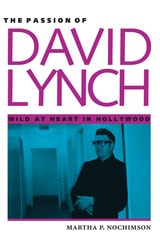
The Passion of David Lynch
Wild at Heart in HollywoodBy Martha P. Nochimson
University of Texas Press, 1997
Filmmaker David Lynch asserts that when he is directing, ninety percent of the time he doesn't know what he is doing. To understand Lynch's films, Martha Nochimson believes, requires a similar method of being open to the subconscious, of resisting the logical reductiveness of language. In this innovative book, she draws on these strategies to offer close readings of Lynch's films, informed by unprecedented, in-depth interviews with Lynch himself.
Nochimson begins with a look at Lynch's visual influences—Jackson Pollock, Francis Bacon, and Edward Hopper—and his links to Alfred Hitchcock and Orson Welles, then moves into the heart of her study, in-depth analyses of Lynch's films and television productions. These include Twin Peaks: Fire Walk with Me, Wild at Heart, Twin Peaks, Blue Velvet, Dune, The Elephant Man, Eraserhead, The Grandmother, The Alphabet, and Lynch's most recent, Lost Highway.
Nochimson's interpretations explode previous misconceptions of Lynch as a deviant filmmaker and misogynist. Instead, she shows how he subverts traditional Hollywood gender roles to offer an optimistic view that love and human connection are really possible.

The Passion of Ingmar Bergman
Frank Gado
Duke University Press, 1986
Gado concludes that whatever the outward appearance of Bergman's works, they contain an elementary psychic fantasy that links them all, revealing an artist who hoped to be a dramatist, "the new Strindberg," and who saw the camera as an extension of his pen.
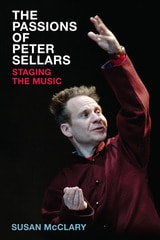
The Passions of Peter Sellars
Staging the MusicSusan McClary
University of Michigan Press, 2019
Many directors leave the musical aspects of opera entirely to the singers and conductor. Sellars, however, immerses himself in the score, and has created a distinctive visual vocabulary to embody musical gesture on stage, drawing on the energies of the music as he shapes characters, ensemble interaction, and large-scale dramatic trajectories. As a leading scholar of gender and music, and the history of opera, Susan McClary is ideally positioned to illuminate Sellars’s goal to address both the social tensions embodied in these operas as well as the spiritual dimensions of operatic performance. McClary considers Sellars’s productions of Mozart’s Le nozze di Figaro, Don Giovanni, and Così fan tutte; Handel’s Theodora; Messiaen’s Saint François d’Assise; John C. Adams’s Nixon in China, The Death of Klinghoffer, El Niño, and Doctor Atomic; Kaija Saariaho’s L’amour de loin, La Passion de Simone, and Only the Sound Remains; Purcell’s The Indian Queen; and Bach’s passions of Saint Matthew and Saint John. Approaching Sellars’s theatrical strategies from a musicological perspective, McClary blends insights from theater, film, and literary scholarship to explore the work of one of the most brilliant living interpreters of opera.
The Past as Present in the Drama of August Wilson
Harry J. Elam, Jr.
University of Michigan Press, 2004
The Philosopher and the Storyteller
Eric Voegelin and Twentieth-Century LiteratureCharles R. Embry
University of Missouri Press, 2018
Throughout his philosophical career, Eric Voegelin had much to say about literature in both his published work and his private letters. Many of his most trenchant comments regarding the analysis of literature appear in his correspondence with critic Robert Heilman, and, through his familiarity with that exchange, Charles Embry has gained extraordinary insight into Voegelin’s literary views.
The Philosopher and the Storyteller is the first book-length study of the literary dimensions of Voegelin’s philosophy—and the first to use his philosophy to read specific novels. Bringing to bear a thorough familiarity with both Voegelin and great literature, Embry shows that novels—like myths, philosophy, and religious texts—participate in the human search for the truth of existence, and that reading literature within a Voegelinian framework exposes the existential and philosophical dimensions of those works.
Embry focuses on two key elements of Voegelin’s philosophy as important for reading literature: metaxy, the in-between of human consciousness, and metalepsis, human participation in the community of being. He shows how Voegelin’s philosophy in general is rooted in literary-symbolic interpretation and, therefore, provides a foundation for the interpretation of literature. And finally he explores Voegelin’s insistence that the soundness of literary criticism lies in the consciousness of the reader.
Embry then offers Voegelinian readings that vividly illustrate the principles of this approach. First he considers Graham Swift’s Waterland as an example of the human search for meaning in the modern world, then he explores the deformation and recovery of reality in Heimito von Doderer’s long and complex novel The Demons, and finally he examines how Flannery O’Connor’s The Violent Bear It Away mythically expresses the flux of divine presence in what Voegelin calls the Time of the Tale.
The Philosopher and the Storyteller unites fiction and philosophy in the common quest to understand our nature, our world, and our cosmos. A groundbreaking exploration of the connection between Voegelin and twentieth-century literature, this book opens a new window on the philosopher’s thought and will motivate readers to study other novels in light of this approach.
The Philosophy of Nietzsche
Reiner Schürmann Lecture NotesReiner Schürmann
Diaphanes, 2018
This volume of Reiner Schürmann’s lectures unpacks Nietzsche’s ambivalence towards Kant, in particular positioning Nietzsche’s claim to have brought an end to German idealism against the backdrop of the Kantian transcendental-critical tradition. Rather than simply compare the two philosophers, Schürmann’s lectures help us to understand the consequences Nietzsche derived from Kantian concepts, as well as the wider horizon within which Nietzsche’s ideas arose and can best be shown to apply. According to Schürmann’s trenchant reading: if Nietzsche was indeed “fatal” to Western philosophy, as he claimed, he was so in large part because of the Kantian transcendental thinking from which he inherited the very elements and tools of his criticism.
The Philosophy, Theology, and Rhetoric of Marius Victorinus
Stephen A. Cooper
SBL Press, 2022
Pagan rhetor, (Neo-)Platonist philosopher, Christian theologian
This collection of essays is devoted to the rhetoric, Neoplatonic philosophy, and Christian theology of Marius Victorinus, a mid-fourth-century professor of rhetoric and philosopher who converted to Christianity late in life. Scholars from eight different countries, some of whom have not previously published in English, reflect on debates about his writings and theological development. These topics include Victorinus's deployment of philosophical sources for trinitarian theology, possible connections in his work to Origen, Augustine, Plotinus, Porphyry, and Gnosticism, as well as his contributions to Latin rhetoric and dialectic. Contributors include Jan Dominik Bogataj, Michael Chase, Nello Cipriani, Stephen A. Cooper, Volker Henning Drecoll, Lenka Karfíková, Josef Lössl, Václav Němec, Thomas Riesenweber, Guadalupe Lopetegui Semperena, Miran Špelič, Chiara O. Tommasi, John D. Turner, and Florian Zacher. The chapters in this volume are of great interest to students of late antique philosophy, Christian theology, and Latin rhetoric.
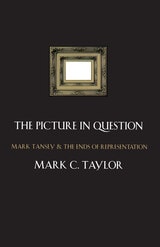
The Picture in Question
Mark Tansey and the Ends of RepresentationMark C. Taylor
University of Chicago Press, 1999
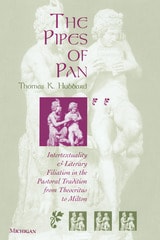
The Pipes of Pan
Intertextuality and Literary Filiation in the Pastoral Tradition from Theocritus to MiltonThomas K. Hubbard
University of Michigan Press, 1999
Pastoral poetry highlights the didactic relationship of older and younger shepherds, whether as rivals or as patron and successor. As such it is an ideal form for young poets' self-representation vis-à-vis their elders, whose work they simultaneously appropriated and transformed, even as the elder poets were represented in the new texts. This influence is reenacted in every generation: Theocritus vs. his Alexandrian forebears, Vergil vs. Theocritus, Calpurnius vs. Vergil, Nemesianus vs. Vergil and Calpurnius, Petrarch vs. Vergil, Boccaccio vs. Petrarch, Spenser vs. Vergil, along with Chaucer and Milton vs. Spenser.
The Pipes of Pan combines multiple strands of contemporary intertextual theory with reception aesthetics and Harold Bloom's theory of intersubjective conflict between generations of poets. It also provides one of the first systematic studies of intertextual and intersubjective dynamics within a whole genre.
This work will be of interest to classicists, students of literary theory, comparative literature, medieval and Renaissance literature, Italian humanism, and English literature of the sixteenth and seventeenth centuries. All texts are translated.
Thomas Hubbard is Associate Professor of Classics, University of Texas at Austin.

The Plays of David Storey
A Thematic StudyBy William Hutchings
Southern Illinois University Press, 1988
This is the first comprehensive play-by-play analysis of the drama of David Storey, one of the most acclaimed and innovative, sometimes controversial, writers in the British theatre since World War II. Grouping the plays according to theme, Hutchings demonstrates that the central focus in the drama of David Storey is the devaluation of traditional rituals in contemporary life and the disintegration of the family. A playwright attuned to the poetry in the ordinary, to the profundity, subtle eloquence, and dramatic tension in the mundane, Storey explores the ways people cope, or fail to cope, with complexity, with uncertainty, with constant, bewildering flux. He writes about groups—families (In Celebration, The Farm), rugby teams (The Changing Room), and construction crews (The Contractor). In his plays, individuals seek to overcome isolation and integrate themselves into a significant assemblage that transcends the self.
Hutchings notes that Storey frequently deals with working-class parents who cannot "understand their grown children’s anxieties, their discontentedness with life, their unstable marriages, and their inability to enjoy the benefits of the education and advantages they labored so hard for so many years to provide."
Storey understands and sympathizes with parents who have paid to educate their children out of their own spheres. He saw it happen in his own family, knew the disapproval of his father: "What else could my father think when, nearing sixty, he came home each day from the pit exhausted, shattered by fatigue, to find me—a young man ideally physically equipped to do the job which now left him totally prostrated—painting a picture of flowers, or writing a poem about a cloud. There was, and there is, no hope of reconciliation."
Hutchings supplements his thematic analysis of Storey’s plays by interweaving into his text 90 percent of a major interview with the playwright, the only such comprehensive interview in existence. Storey, who believes that readers "ought to be chary of all interviews," discusses alleged literary influences on his work, the current state of British theatre, and his reactions to critics. He also provides insight into various productions and performances in his work.
The Pleasure of Miss Pym
By Charles Burkhart
University of Texas Press, 1987
When British writers Philip Larkin and Lord David Cecil named Barbara Pym one of the twentieth century's most underrated authors in a 1977 Times Literary Supplement survey, they started a Barbara Pym revival that continued unabated in Great Britain and the United States. Barbara Pym's delightful tales of jumble sales and parish meetings, her ironic insights into the relationships between women and men, have won a devoted following. Indeed she is often compared to that most accomplished author of comedies of manners, Jane Austen.
The Pleasure of Miss Pym is a critical study of Pym as comic writer and of the links between her life and autobiographical writings and her fiction, written with a liveliness of style and tone that matches Pym's own. Not only does Charles Burkhart provide perceptive discussions of Pym's life and novels, he also illuminates the worldview represented in her work, the unique nature of her comedy, her religion, her place within the history of the novel, and her penetrating insights into male-female relationships. All of Pym's work, including the 1986 posthumous publication, An Academic Question, is intelligently surveyed here. Scholars of contemporary English literature will derive both instruction and pleasure from this elegantly written study, as will Pym's admiring readers, for whom it is also intended.
The Poetics of Impudence and Intimacy in the Age of Pushkin
Joe Peschio
University of Wisconsin Press, 2012
Joe Peschio offers the first comprehensive history of a set of associated behaviors known in Russian as “shalosti,” a word which at the time could refer to provocative behaviors like practical joking, insubordination, ritual humiliation, or vandalism, among other things, but also to literary manifestations of these behaviors such as the use of obscenities in poems, impenetrably obscure allusions, and all manner of literary inside jokes. One of the period’s most fashionable literary and social poses became this complex of behaviors taken together. Peschio explains the importance of literary shalosti as a form of challenge to the legitimacy of existing literary institutions and sometimes the Russian regime itself. Working with a wide variety of primary texts—from verse epistles to denunciations, etiquette manuals, and previously unknown archival materials—Peschio argues that the formal innovations fueled by such “prankish” types of literary behavior posed a greater threat to the watchful Russian government and the literary institutions it fostered than did ordinary civic verse or overtly polemical prose.

The Poetics of Yves Bonnefoy
John Naughton
University of Chicago Press, 1984
Though Bonnefoy's work is familiar to American scholars, the complexity of his thought and style has created a need for a critical introduction to his work. This first major study of Bonnefoy written in English provides an overview of his entire literary career. Naughton situates Bonnefoy in the context of the existential philosophical tradition that nurtured him and in the poetic and artistic tradition that includes Dante and Shakespeare, Piero and Poussin, Baudelaire and Rimbaud. Bonnefoy's poems appear in both French and English, and all quotations from his prose have been translated.
This book will appeal not only to the growing number of students and scholars of French literature interested in Bonnefoy's work, but also to those who study comparative poetry and the relation of poetry to art and to contemporary religious thought.
The Poetry and Poetics of Olga Sedakova
Origins, Philosophies, Points of ContentionEdited by Stephanie Sandler, Maria Khotimsky, Margarita Krimmel, and Oleg Novikov
University of Wisconsin Press, 2019
Essayists from Russia, Ukraine, Germany, Italy, and the United States show how Sedakova has contributed to ongoing aesthetic and cultural debates. Like Sedakova's own work, the volume affirms the capacity of words to convey meaning and to change our understanding of life itself. The volume also includes dozens of elegant new translations of Sedakova's poems.
The Poetry of Asher Reich
Portrait of a Hebrew PoetYair Mazor
University of Wisconsin Press, 2004
Asher Reich’s poetry has been characterized as vivid, vibrant, passionate, and expressionistic. Dominated by themes of stormy sensuality and frank sexuality, his dramatic imagery and metaphors interweave Mishnaic, Talmudic, and Biblical references in a colorful, complex poetic texture. The beautiful simplicity of Kovner’s drawings—depicting female figures and natural landscapes—resonates throughout the book. Tender, stark, and striking, the drawings illustrate life’s fragility and grace with a subtlety and dignity that complements Reich’s sensitive style.
Presenting contemporary Hebrew poetry, modern Israeli art, and informed literary commentary in an engaging format, this book promises to delight a broad audience of readers.
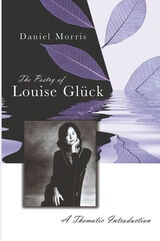
The Poetry of Louise Glück
A Thematic IntroductionDaniel Morris
University of Missouri Press, 2021
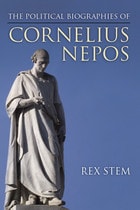
The Political Biographies of Cornelius Nepos
Rex Stem
University of Michigan Press, 2012
The Roman writer Cornelius Nepos was a friend of Cicero and Catullus and other first-century BCE authors, and portions of his encyclopedic work On Famous Men are the earliest surviving biographies written in Latin. In The Political Biographies of Cornelius Nepos, Rex Stem presents Nepos as a valuable witness to the late Republican era, whose biographies share the exemplary republican political perspective of his contemporaries Cicero and Livy. Stem argues that Nepos created the genre of grouped political biographies in order to characterize renowned Mediterranean figures as role models for Roman leaders, and he shows how Nepos invested his biographies with moral and political arguments against tyranny.
This book, the first to regard Nepos as a serious thinker in his own right, also functions as a general introduction to Nepos, placing him in his cultural context. Stem examines Nepos' contributions to the growth of biography, and he defends Nepos from his critics at the same time that he lays out the political significance and literary innovation of Nepos' writings. Accessible to advanced undergraduates, this volume is addressed to a general audience of classicists and ancient historians, as well as those broadly interested in biography, historiography, and political thought.
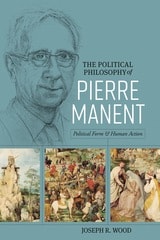
The Political Philosophy of Pierre Manent
Political Form and Human ActionJoseph Wood
Catholic University of America Press, 2024
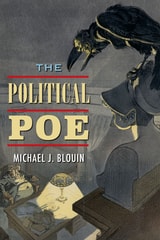
The Political Poe
Michael Blouin
University of Iowa Press, 2026
The Politics of Black Joy
Zora Neale Hurston and Neo-AbolitionismLindsey Stewart
Northwestern University Press, 2021
Stewart develops Hurston’s contributions to political theory and philosophy of race by introducing the politics of joy as a refusal of neo-abolitionism, a political tradition that reduces southern Black life to tragedy or social death. To develop the politics of joy, Stewart draws upon Zora Neale Hurston’s essays, Beyoncé’s Lemonade, and figures across several disciplines including Frederick Douglass, W. E. B. Du Bois, Toni Morrison, Angela Davis, Saidiya Hartman, Imani Perry, Eddie Glaude, and Audra Simpson. The politics of joy offers insights that are crucial for forming needed new paths in our current moment. For those interested in examining popular conceptions of Black political agency at the intersection of geography, gender, class, and Black spirituality, The Politics of Black Joy is essential reading.
The Politics of Reception
Critical Constructions of Mikhail ZoshchenkoGreg Carleton
Northwestern University Press, 1998
The Politics of Sentiment
Imagining and Remembering GuayaquilBy O. Hugo Benavides
University of Texas Press, 2006
Between 1890 and 1930, the port city of Guayaquil, Ecuador, experienced a liberal revolution and a worker's movement—key elements in shaping the Ecuadorian national identity. In this book, O. Hugo Benavides examines these and other pivotal features in shaping Guayaquilean identity and immigrant identity formation in general in transnational communities such as those found in New York City.
Turn-of-the-century Ecuador witnessed an intriguing combination of transformations: the formation of a national citizenship; extension of the popular vote to members of a traditional underclass of Indians and those of African descent; provisions for union organizing while entering into world market capitalist relations; and a separation of church and state that led to the legalization of secular divorces. Assessing how these phenomena created a unique cultural history for Guayaquileans, Benavides reveals not only a specific cultural history but also a process of developing ethnic attachment in general. He also incorporates a study of works by Medardo Angel Silva, the Afro-Ecuadorian poet whose singular literature embodies the effects of Modernism's arrival in a locale steeped in contradictions of race, class, and sexuality.
Also comprising one of the first case studies of Raymond Williams's hypothesis on the relationship between structures of feeling and hegemony, this is an illuminating illustration of the powerful relationships between historically informed memories and contemporary national life.
The Politics of Taste
Beatriz González and Cold War AestheticsAna María Reyes
Duke University Press, 2019
The Politics of Vibration
Music as a Cosmopolitical PracticeMarcus Boon
Duke University Press, 2022