Results by title
8812 books match the query 'Political Science' and 1911 start with t

The Atlantic Divide in Antitrust
An Examination of US and EU Competition PolicyDaniel J. Gifford and Robert T. Kudrle
University of Chicago Press, 2015
With The Atlantic Divide in Antitrust, Daniel J. Gifford and Robert T. Kudrle explore many of the main contested areas of contemporary antitrust, including mergers, price discrimination, predatory pricing, and intellectual property. After identifying how prevailing analyses differ across these areas, they then examine the policy ramifications. Several themes run throughout the book, including differences in the amount of discretion firms have in dealing with purchasers, the weight given to the welfare of various market participants, and whether competition tends to be viewed as an efficiency-generating process or as rivalry. The authors conclude with forecasts and suggestions for how greater compatibility might ultimately be attained.

The Attack of the Blob
Hannah Arendt's Concept of the SocialHanna Fenichel Pitkin
University of Chicago Press, 1998
"[O]ne leaves this book feeling enriched and challenged. Pitkin prompts us to rethink our understanding of Arendt and to demythologize the pervasive sense of political helplessness Arendt herself sought so hard to articulate. . . . [A] cause for celebration."—Peter Baehr, Times Literary Supplement
"[Arendt] is certainly among the most original and outstanding political theorists of the twentieth century. . . . It is difficult to imagine a hostile critic examining more effectively than Pitkin . . . Arendt's concept of the social, for hostility would inhibit the acquisition of the mastery of Arendt's texts that Pitkin displays at every turn."—Peter Berkowitz, New Republic
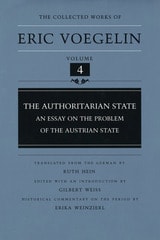
The Authoritarian State (CW4)
An Essay on the Problem of the Austrian StateEric Voegelin, Edited & Intro by Gilbert Weiss, Translated by Ruth Hein, & Historical Commentary by Erika Weinzierl
University of Missouri Press, 1999
Published in Vienna in 1936, The Authoritarian State by Eric Voegelin has remained virtually unknown to the public until now. Sales of the German edition were halted following the Nazi invasion of Austria in 1938, and the entire printing was later destroyed by wartime bombing. In this volume, Voegelin offers a critical examination of the most prominent European theories of state and constitutional law of the period while providing a political and historical analysis of the Austrian situation. He discusses the dismissal of Parliament in 1933, the civil war, the murder of Federal Chancellor Dollfuss, the adoption of the "Authoritarian Constitution" of 1934, and the predicament of being sandwiched between Hitler and Mussolini.
A radical critique of Hans Kelsen's pure theory of law lies at the heart of this work, marking Voegelin's definitive departure from Neo-Kantian epistemology. For the first time, Voegelin elaborates on the important distinction between theoretical concepts and political symbols as a basis for explaining the nontheoretical and speculative character of ideologies, both left and right. He shows that total and authoritarian are symbols of ideological self-interpretation that have no theoretical value, a distinction basic to his later work in The New Science of Politics.
Available for the first time in English, The Authoritarian State is a valuable addition to the Voegelin canon and to the field of intellectual history in general.

The Autobiography of Harry S. Truman
Edited with a New Introduction by Robert H. Ferrell
University of Missouri Press, 2002

The Autonomous Animal
Self-Governance and the Modern SubjectClaire E. Rasmussen
University of Minnesota Press, 2011
Autonomy is a vital concept in much of modern theory, defining the Subject as capable of self-governance. Democratic theory relies on the concept of autonomy to provide justification for participatory government and the normative goal of democratic governance, which is to protect the ability of the individual to self-govern.
Offering the first examination of the concept of autonomy from a postfoundationalist perspective, The Autonomous Animal analyzes how the ideal of self-governance has shaped everyday life. Claire E. Rasmussen begins by considering the academic terrain of autonomy, then focusing on specific examples of political behavior that allow her to interrogate these theories. She demonstrates how the adolescent—a not-yet-autonomous subject—highlights how the ideal of self-governance generates practices intended to cultivate autonomy by forming the individual’s relationship to his or her body. She points up how the war on drugs rests on the perception that drug addicts are the antithesis of autonomy and thus must be regulated for their own good. Showing that the animal rights movement may challenge the distinction between human and animal, Rasmussen also examines the place of the endurance athlete in fitness culture, where self-management of the body is the exemplar of autonomous subjectivity.
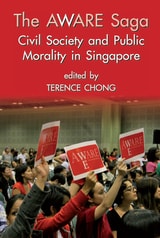
The Aware Saga
Civil Society and Public Morality in SingaporeEdited by Terence Chong
National University of Singapore Press, 2011
In this book, academics and public intellectuals examine the AWARE saga within the context of Singapore's civil society, considering the political and historical background and how the issues it raised relate to contemporary societal trends. In addition to documenting a milestone event for Singapore's civil society, the authors offer provocative interpretations that will interest a broad range of readers.
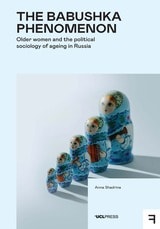
The Babushka Phenomenon
Older Women and the Political Sociology of Ageing in RussiaAnna Shadrina
University College London, 2025
The word “babushka” literally means “grandmother,” but it has come to represent much more since the Soviet era, not least the family caregiver. In her new study, Anna Shadrina explores the marginalization of older women in post-Soviet Russia, shedding light on the complex image of the babushka as both the cornerstone of the family unit and a passive recipient of social benefits. The author argues that this image has been shaped in no small part by welfare cutbacks that shifted the responsibility of family care from the state to individual women, as well as the increasing frustration of working-age people with the post-socialist economic system. Ultimately, she shows that despite being ostracized from society for defying age- and gender-specific social expectations, older women occupy a crucial position as active contributors to the economy.
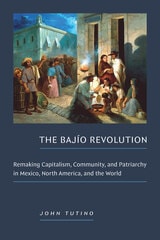
The Bajío Revolution
Remaking Capitalism, Community, and Patriarchy in Mexico, North America, and the WorldJohn Tutino
Duke University Press, 2025

The Bakhtin Circle
Philosophy, Culture and PoliticsCraig Brandist
Pluto Press, 2002
This is the first book to bring together this significant new research on the Circle, setting it within a historical and intellectual context and emphasising the importance of the work of the Circle as a whole. Craig Brandist offers a new look at the significance of Bakhtin's legacy, and brings into clearer focus the contribution of others in the circle--including Voloshinov, Medvedev, Pumpianskii and Kagan--whose work has so often been obscured, assessing the fundamental role they played in shaping Bakhtinian thought.
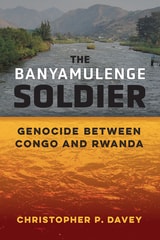
The Banyamulenge Soldier
Genocide between Congo and RwandaChristopher P. Davey
University of Michigan Press, 2025
Challenging the preconceived perpetrator and victim categories with a forward-thinking approach using the concept of genocide narrative identity—meaning a narrative identity shaped by experiences of social destruction or uses of genocide as a concept—Christopher P. Davey reveals how the stories we tell about ourselves shapes who we are. He shows that Banyamulenge experiences of genocide between Congo and Rwanda are layered around agencies of victimhood and perpetration of genocide. Using soldier and other community narratives, Davey examines the subjective nature of genocide in perception of an event, strategic deployment of the label, and in the (re)shaping of social worlds inhabited by this community and therefore impacting others in Congo and Rwanda. The Banyamulenge Soldier offers an insider view of the historical dynamics of current conflicts in South Kivu while adding to our understanding of relational genocide theory.
The Barren Sacrifice
An Essay on Political ViolencePaul Dumouchel
Michigan State University Press, 2015

The Barthes Fantastic
Literature, Criticism, and the Practice of LanguageJohn Lurz
University of Chicago Press, 2025
In The Barthes Fantastic, John Lurz explores the intersection of literature and everyday life—and confronts some habits of literary study—through a reading of the work of Roland Barthes. An influential French theorist, Barthes wrote prolifically on the place of language and the play of signs in the ways we produce cultural and aesthetic meaning. Ranging across the entire sweep of Barthes’s varied career, Lurz shows how Barthes’s insights into signification and literature involve particular intellectual activities that impart significance to the world. Doing so allows him to develop an expanded understanding of the fantastic as a conceptual category—a way of thinking—in which the texts we read come to inform the texture of our real lives. Ultimately, The Barthes Fantastic enlarges our sense of what we learn as students of literature and gives us a new picture of a writer we thought we knew.
The Basic Symbols of the American Political Tradition
Willmoore Kendall
Catholic University of America Press, 1995

The Basque Insurgents
ETA, 1952–1980Robert P. Clark
University of Wisconsin Press, 1984
Blamed, at first, by the Spanish government for the recent Madrid train bombings, ETA (Euzkadi ta Askatasuna), the Basque nationalist organization, has been perhaps the most violent insurgent group on the European continent. Yet little is known about it outside of Spain. This book, now back in print, offers a full analytical study of ETA.
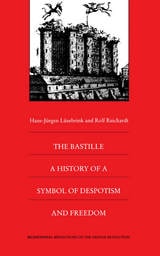
The Bastille
A History of a Symbol of Despotism and FreedomHans-Jürgen Lüsebrink and Rolf Reichardt
Duke University Press, 1997
To facilitate the symbolic nature of the investigation, this analysis of the evolving signification of the Bastille moves from the French Revolution to the nineteenth century to contemporary history. The narrative also shifts from France to other cultural arenas, like the modern European colonial sphere, where the overthrow of the Bastille acquired radical new signification in the decolonization period of the 1940s and 1950s. The Bastille demonstrates the potency of the interdisciplinary historical research that has characterized the end of this century, combining quantitative and qualitative approaches, and taking its methodological tools from history, sociology, linguistics, and cultural and literary studies.

The Battle for Alabama's Wilderness
Saving the Great Gymnasiums of NatureJohn N. Randolph
University of Alabama Press, 2005
Traces the development of Alabama's environmental movement from its beginnings with the establishment of The Alabama Conservancy in the late 1960s and early '70s to the preservation efforts of present-day activist groups
The grassroots effort to preserve Alabama's Wilderness Areas spanned thirty years, from 1967 to 1997. The first battle, to establish the Sipsey Wilderness in the Bankhead National Forest, was the catalyst for reform of national policy regarding public land preserves in the eastern United States. It, and the later campaigns—to establish the Cheaha Wilderness, to enlarge the Sipsey, and to create the Dugger Mountain Wilderness—are classic tales of citizen activists overcoming the quagmire of federal bureaucracy and the intransigence of hostile politicians. Early political opposition to proposed designation or expansion of wilderness areas in Alabama was based on the belief that limiting development of these lands would negatively impact the state's powerful timber industry. In response to such opposition, serious environmental activism was born in Alabama.
Using newspaper reports, Congressional testimony, interviews, and his own recollections, John Randolph traces the development of Alabama's environmental movement from its beginnings with the establishment of The Alabama Conservancy in the late 1960s and early '70s to the preservation efforts of present-day activist groups, such as the Alabama Environmental Council, the Cahaba River Society, and the Alabama Wilderness Alliance.
The Battle for Alabama's Wilderness permits all of the players—pro and con—to speak for themselves, but the heroes—people like Mary Burks, Blanche Dean, Joab Thomas, and Pete Conroy—embody the vision, hope, and persistence required of those who succeed in their preservation efforts. Randolph's account is a testament to the power of grassroots citizen groups who are committed to a common cause and inspired by a shared ideal.
The Battle for White Male Supremacy
The Hydra Reshaping Right-Wing PoliticsMary McThomas
University of Chicago Press, 2027
Explains how interconnected race and gender ideologies underlie grievance politics on the Right and reveals how both are transforming American politics, policy, and law.
In The Battle for White Male Supremacy, Mary McThomas sheds new light on the entwined racial and gender ideologies that have come to define large segments of the American Right and are roiling American law and politics. Individual chapters trace the development, ideas, and influence of several key groups: incels, alt-right vigilante groups, Christian nationalists, and men’s rights groups at war with the judiciary. While these groups are often treated as discrete phenomena with distinct histories and ostensibly different goals, all share an interconnected belief system of victimhood and embattled white masculinity. By tracking these similarities, McThomas exposes how racial and gendered belief systems are connected both within and across groups.
What is more, McThomas shows that these groups’ beliefs and tactics have moved from the extremist fringes of society to the mainstream of American politics. They’ve gained broad traction in public opinion and political discourse, and they are transforming law and policy at both the state and federal levels.
The Battle for the Mind
War and Peace in the Era of Mass CommunicationGary S. Messinger
University of Massachusetts Press, 2011
Most people typically think of armed conflict in physical terms, involving guns and bombs, ships and planes, tanks and missiles. But today, because of mass communication, war and the effort to prevent it are increasingly dependent on non-physical factors—the capacity to persuade combatants and citizens to engage in violence or avoid it, and the packaging of the information on which decision making is based. This book explores the many ways that mass communication has revolutionized international relations, whether the aim is to make war effectively or to prevent it.
Gary Messinger shows that over the last 150 years a succession of breakthroughs in the realm of media has reshaped the making of war and peace. Along with mass newspapers, magazines, books, motion pictures, radio, television, computer software, and telecommunication satellites comes an array of strategies for exploiting these media to control popular beliefs and emotions. Images of war now arrive in many forms and reach billions of people simultaneously. Political and military leaders must react to crowd impulses that sweep around the globe. Nation-states and nongovernmental groups, including terrorists, use mass communication to spread their portrayals of reality.
Drawing on a wide range of media products, from books and articles to films and television programs, as well as his own research in the field of propaganda studies, Messinger offers a fresh and comprehensive overview. He skillfully charts the path that has led us to our current situation and suggests where we might go next.
The Battle for the University of Alabama
The Perilous Path of Higher Education in the Reconstruction SouthWilliam Warren Rogers, Jr.
University of Alabama Press, 2025
Traces the little-known story of the bitter contest for the fate of the University of Alabama after the Civil War.
In The Battle for the University of Alabama, William Warren Rogers Jr. gives a fascinating account of the fierce struggle over the nature of the University of Alabama after the Civil War. Union forces reduced the campus to ruins as the war ended, and the university did not reopen until 1869. In the interregnum, powerful forces shifted the trajectory of the school. Alabama Republicans authored an egalitarian state constitution that delivered oversight of the university to the Republican Party. That set the stage for turmoil and confrontation. This book tells the story of that conflict.
In the next few years, Democrats charged Republicans with turning the university into a “radical” institution. They alleged that a handful of unqualified individuals had gained faculty positions because of their political allegiance, which resulted in the university’s academic desecration. Professors were bitterly denounced in the state newspaper press and quite personally in Tuscaloosa. Administration of the university became part of the fratricidal political debate in the state. Political violence and questions concerning race, specifically the possible integration of the university, illuminated the controversies of the Reconstruction years. Many of these questions resonate even today.
This authoritative account sets events at the University of Alabama against the backdrop of what occurred at other state universities in the Reconstruction South. The University of North Carolina experienced controversy similar to Alabama’s. At the University of Georgia, however, calm prevailed. This story of the incendiary events at Alabama’s flagship university charts new ground and provides a revelatory look into the extraordinary partisanship that characterized the South after the Civil War.
The Battle to Stay in America
Immigration's Hidden Front LineMichael Kagan
University of Nevada Press, 2025
The Battle to Stay in America is the story of a community coming to grips with the federal government’s crackdown on immigrants, and learning how to defend itself. Informative and personal, this is a story about mothers and fathers, lawyers and activists, local police and federal agencies, and a struggle for the identity of a nation. This is the quintessential story of the war on immigrants, as fought and felt on the front lines in the heart of America.
The Behavioral Origins of War
D. Scott Bennett and Allan C. Stam
University of Michigan Press, 2003
Challenging the view that theories of war are nothing more than competing explanations for observed behavior, this expansive study incorporates variables from multiple theories and thus accounts for war's multiplicity of causes. While individual theories offer partial explanations for international conflict, only a valid set of theories can provide a complete explanation. Bennett and Stam's unconventional yet methodical approach opens the way for cumulative scientific progress in international relations.
D. Scott Bennett is Professor of Political Science at the Pennsylvania State University. Allan C. Stam is Associate Professor in the Government Department at Dartmouth College.
The Bellwether
Why Ohio Picks the PresidentKyle Kondik
Ohio University Press, 2016
Since 1896, Ohio voters have failed to favor the next president only twice (in 1944 and 1960). Time after time, Ohio has found itself in the thick of the presidential race, and 2016 is shaping up to be no different. What about the Buckeye State makes it so special? In The Bellwether, Kyle Kondik, managing editor for the nonpartisan political forecasting newsletter Sabato’s Crystal Ball, blends data-driven research and historical documentation to explain Ohio’s remarkable record as a predictor of presidential results and why the state is essential to the 2016 election and beyond.
Part history, part journalism, this entertaining and astute guide proposes that Ohio has been the key state in the Electoral College for more than a century and examines what the idea of the swing state has come to mean. In discussing the evidence, Kondik uses the state’s oft-mentioned status as a microcosm of the nation as a case study to trace the evolution of the American electorate, and identifies which places in Ohio have the most influence on the statewide result. Finally, he delves into the answer to the question voting Ohioans consider every four years: Will their state remain a bellwether, or is their ability to pick the president on its way out?
The Beloved Border
Humanity and Hope in a Contested LandMiriam Davidson
University of Arizona Press, 2021
The book draws on a variety of sources to explain how border issues intersect and how the current situation, while made worse under the Trump administration, is in fact the result of decades of prohibition, crackdowns, and wall building on the border. Davidson addresses subjects such as violence in Mexico, particularly against the press; cross-border gun smuggling and legal gun sales; the rise in migrant detentions, deportations, and deaths since the crackdown began; controversy over humanitarian aid in the desert; border patrol crimes and abuses; and the legal, ethical, and moral issues raised by increased police presence and militarization on the border. The book also looks at the environmental impact of wall building and construction of a planned copper mine near Tucson, especially on the jaguar and other endangered species.
Davidson shares the history of sanctuary and argues that this social movement and others that have originated on the border are vanguards of larger global movements against the mistreatment of migrant workers and refugees, police brutality, and other abuses of human and natural rights. She gives concrete examples of positive ways in which border people are promoting local culture and cross-border solidarity through health care, commerce, food, art, and music. While death and suffering continue to occur, The Beloved Border shows us how the U.S.-Mexico border could be, and in many ways already is, a model for peaceful coexistence worldwide.
The Beneficiary
Bruce Robbins
Duke University Press, 2017

The Berber Identity Movement and the Challenge to North African States
By Bruce Maddy-Weitzman
University of Texas Press, 2011
Like many indigenous groups that have endured centuries of subordination, the Berber/Amazigh peoples of North Africa are demanding linguistic and cultural recognition and the redressing of injustices. Indeed, the movement seeks nothing less than a refashioning of the identity of North African states, a rewriting of their history, and a fundamental change in the basis of collective life. In so doing, it poses a challenge to the existing political and sociocultural orders in Morocco and Algeria, while serving as an important counterpoint to the oppositionist Islamist current.
This is the first book-length study to analyze the rise of the modern ethnocultural Berber/Amazigh movement in North Africa and the Berber diaspora. Bruce Maddy-Weitzman begins by tracing North African history from the perspective of its indigenous Berber inhabitants and their interactions with more powerful societies, from Hellenic and Roman times, through a millennium of Islam, to the era of Western colonialism. He then concentrates on the marginalization and eventual reemergence of the Berber question in independent Algeria and Morocco, against a background of the growing crisis of regime legitimacy in each country. His investigation illuminates many issues, including the fashioning of official national narratives and policies aimed at subordinating Berbers in an Arab nationalist and Islamic-centered universe; the emergence of a counter-movement promoting an expansive Berber "imagining" that emphasizes the rights of minority groups and indigenous peoples; and the international aspects of modern Berberism.
The Best of What We Are
Reflections on the Nicaraguan RevolutionJohn Brentlinger
University of Massachusetts Press, 1995
The Sandinista revolution in Nicaragua inspired many North Americans, including the author of this moving and informative book. John Brentlinger made six trips to Nicaragua, both before and after the defeat of the Sandinista Party. Combining the insights of a philosopher with the experiences of a participant-observer, he interprets the Sandinista period as a people’s struggle for self-realization in work, culture, politics, and community.
The book alternates between journal and essay chapters, weaving descriptions of personal experiences together with interviews and analysis. Whether telling the story of the last day of a young teacher’s life, describing new forms of poetry and art, examining representations of Nicaragua in the U.S. media, or discussing the government’s success and failures, Brentlinger vividly captures the spirit and enduring significance of the Sandinista revolution.
The Betrayal of Dissent
Beyond Orwell, Hitchens and the New American CenturyScott Lucas
Pluto Press, 2004
political writer, and the standard-bearer of honesty and decency for the honourable 'Left'. In this controversial polemic, Scott Lucas argues that the exaltation of Orwell, far from upholding dissent against the State, has sought to quash such opposition. Indeed, Orwell has become the icon of those who, in the pose of the contrarian, try to silence public opposition to US and U K foreign policy in the 'War on Terror'.
Lucas's lively and readable critique of public intellectuals including Christopher Hitchens, Michael Walzer, David Aaronovitch, and Johann Hari – who have all invoked Orwellian honesty and decency to shut down dissent – will appeal to anyone disillusioned with the wars in Afghanistan and Iraq.
Lucas contends that these leading journalists and commentators have used Orwell to justify their own political transition from radicals to upholders of the establishment. All of them play influential roles in supporting the UK and US governments' charge that opponents of war -- and those who question the motives behind American foreign policy and its implementation -- should be condemned as 'appeasers of mass murder'.
This controversial book shows how Orwell has been used since 9/11 to justify, in the guise of independent thought, the suppression of dissent. We must rescue ourselves from Orwell and from those who take on his guise so, as Lucas puts it, our ‘silencing is… vital to a "manufacture of consent" for the wars which are supposedly being fought in our name and for our good’.
The Biden School and the Engaged University of Delaware, 1961-2021
Daniel Rich
University of Delaware Press, 2023

The Big Boxcar
Alfred Maund
University of Illinois Press, 1957
The Big Boxcar, written from a totally black perspective by a white author, bears witness to the structural racism of a social order that sets ordinary people of different colors against each other to the disadvantage of all. Alan Wald's introduction documents Maund's life of activism and his uncompromising commitment to social emancipation.
The Big Data Agenda
Data Ethics and Critical Data StudiesAnnika Richterich
University of Westminster Press, 2018
This book highlights that the capacity for gathering, analysing, and utilising vast amounts of digital (user) data raises significant ethical issues. Annika Richterich provides a systematic contemporary overview of the field of critical data studies that reflects on practices of digital data collection and analysis. The book assesses in detail one big data research area: biomedical studies, focused on epidemiological surveillance. Specific case studies explore how big data have been used in academic work.
The Big Data Agenda concludes that the use of big data in research urgently needs to be considered from the vantage point of ethics and social justice. Drawing upon discourse ethics and critical data studies, Richterich argues that entanglements between big data research and technology/ internet corporations have emerged. In consequence, more opportunities for discussing and negotiating emerging research practices and their implications for societal values are needed.
An electronic version of this book is freely available, thanks to the support of libraries working with Knowledge Unlatched. KU is a collaborative initiative designed to make high quality books Open Access for the public good. More information about the initiative and details about KU's Open Access programme can be found at www.knowledgeunlatched.org.
The Big No
Kennan Ferguson
University of Minnesota Press, 2021
What it means to celebrate the potential and the power of no
What does it mean to refuse? To not participate, to not build a better world, to not come up with a plan? To just say “no”? Against the ubiquitous demands for positive solutions, action-oriented policies, and optimistic compromises, The Big No refuses to play. Here leading scholars traverse the wide range of political action when “no” is in the picture, analyzing topics such as collective action, antisocialism, empirical science, the negative and the affirmative in Deleuze and Derrida, the “real” and the “clone,” Native sovereignty, and Afropessimism.
In his introduction, Kennan Ferguson sums up the concept of the “Big No,” arguing for its political importance. Whatever its form—he identifies various strains—the Big No offers power against systems of oppression. Joshua Clover argues for the importance of Marx and Fanon in understanding how people are alienated and subjugated. Theodore Martin explores the attractions of antisociality in literature and life, citing such novelists as Patricia Highsmith and Richard Wright. François Laruelle differentiates nonphilosophy from other forms of French critical theory. Katerina Kolozova applies this insight to the nature of reality itself, arguing that the confusion of thought and reality leads to manipulation, automation, and alienation. Using poetry and autobiography, Frank Wilderson shows how Black people—their bodies and being—are displaced in politics, replaced and erased by the subjectivities of violence, suffering, and absence. Andrew Culp connects these themes of negativity, comparing and contrasting the refusals of antiphilosophy and Afropessimism.
Thinking critically usually demands alternatives: how would you fix things? But, as The Big No shows, being absolutely critical—declining the demands of world-building—is one necessary response to wrong, to evil. It serves as a powerful reminder that the presumption of political action is always positive.
Contributors: Joshua Clover, U of California Davis and U of Copenhagen; Andrew Culp, California Institute of the Arts; Katerina Kolozova, Institute of Social Sciences and Humanities Skopje; Theodore Martin, U of California, Irvine; Anthony Paul Smith, La Salle U; Frank B. Wilderson III, U of California, Irvine.
The Biological Consequences of Socioeconomic Inequalities
Barbara Wolfe
Russell Sage Foundation, 2013
The Birth of Capitalism
A 21st Century PerspectiveHenry Heller
Pluto Press, 2011
In the light of the deepening crisis of capitalism and continued non-Western capitalist accumulation, Henry Heller re-examines the debates surrounding the transition from feudalism to capitalism in Europe and elsewhere.
Focusing on arguments about the origin, nature and sustainability of capitalism, Heller offers a new reading of the historical evidence and a critical interrogation of the transition debate. He advances the idea that capitalism must be understood as a political as well as an economic entity. This book breathes new life into the scholarship, taking issue with the excessively economistic approach of Robert Brenner, which has gained increasing support over the last ten years. It concludes that the future of capitalism is more threatened than ever before.
The new insights in this book make it essential reading for engaged students and scholars of political economy and history.

The Birth of Energy
Fossil Fuels, Thermodynamics, and the Politics of WorkCara New Daggett
Duke University Press, 2019

The Birth of Solidarity
The History of the French Welfare StateFrançois Ewald
Duke University Press, 2020
The Black Boom
Riley, Jason L.
Templeton Press, 2021
Economic inequality continues to be one of America’s most hotly debated topics. Still, there has been relatively little discussion of the fact that black-white gaps in joblessness, income, poverty and other measures were shrinking before the pandemic. Why was it happening, and why did this phenomenon go unacknowledged by so much media?
In The Black Boom, Jason L. Riley—acclaimed Wall Street Journal columnist and senior fellow at the Manhattan Institute—digs into the data and concludes that the economic lives of black people improved significantly under policies put into place during the Trump administration. To acknowledge as much is not to endorse the 45th president but to champion policies that achieve a clear moral objective shared by most Americans.
Riley argues that before the Covid-19 pandemic of 2020, the economic fortunes of blacks improved under Trump to an extent unseen under Obama and unseen going back several generations. Black unemployment and poverty reached historic lows, and black wages increased faster than white wages.
Less inequality is something that everyone wants, but disapproval of Trump’s personality and methods too often skewed the media’s appraisal of effective policies advocated by his administration. If we're going to make real progress in improving the lives of low-income minorities, says Riley, we must look beyond our partisan differences at what works and keep doing it. Unfortunately, many press outlets were unable or unwilling to do that.
Riley notes that political reporters were not unaware of this data. Instead, they chose to ignore or downplay it because it was inconvenient. In their view, Trump, because he was a Republican and because he was Trump, had it in for blacks, and thus his policy preferences would be harmful to minorities. To highlight that significant racial disparities were narrowing on his watch—that the administration’s tax and regulatory reforms were mainly boosting the working and middle classes rather than ‘the rich’—would have undermined a narrative that the media preferred to advance, regardless of its veracity.”
As with previous books in our New Threats to Freedom series, The Black Boom includes two essays from prominent experts who take issue with the author’s perspective. Juan Williams, a veteran journalist, and Wilfred Reilly, a political scientist, contribute thoughtful responses to Riley and show that it is possible to share a deep concern for disadvantaged groups while disagreeing on how best to help them.
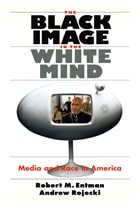
The Black Image in the White Mind
Media and Race in AmericaRobert M. Entman and Andrew Rojecki
University of Chicago Press, 2001
Using the media, and especially television, as barometers of race relations, Robert Entman and Andrew Rojecki explore but then go beyond the treatment of African Americans on network and local news to incisively uncover the messages sent about race by the entertainment industry-from prime-time dramas and sitcoms to commercials and Hollywood movies. While the authors find very little in the media that intentionally promotes racism, they find even less that advances racial harmony. They reveal instead a subtle pattern of images that, while making room for Blacks, implies a racial hierarchy with Whites on top and promotes a sense of difference and conflict. Commercials, for example, feature plenty of Black characters. But unlike Whites, they rarely speak to or touch one another. In prime time, the few Blacks who escape sitcom buffoonery rarely enjoy informal, friendly contact with White colleagues—perhaps reinforcing social distance in real life.
Entman and Rojecki interweave such astute observations with candid interviews of White Americans that make clear how these images of racial difference insinuate themselves into Whites' thinking.
Despite its disturbing readings of television and film, the book's cogent analyses and proposed policy guidelines offer hope that America's powerful mediated racial separation can be successfully bridged.
"Entman and Rojecki look at how television news focuses on black poverty and crime out of proportion to the material reality of black lives, how black 'experts' are only interviewed for 'black-themed' issues and how 'black politics' are distorted in the news, and conclude that, while there are more images of African-Americans on television now than there were years ago, these images often don't reflect a commitment to 'racial comity' or community-building between the races. Thoroughly researched and convincingly argued."—Publishers Weekly
"Drawing on their own research and that of a wide array of other scholars, Entman and Rojecki present a great deal of provocative data showing a general tendency to devalue blacks or force them into stock categories."—Ben Yagoda, New Leader
Winner of the Frank Luther Mott Award for best book in Mass Communication and the Robert E. Lane Award for best book in political psychology.
The Black Worker
Race, Labor, and Civil Rights Since EmancipationEdited by Eric Arnesen
University of Illinois Press, 2006
Uniting the latest scholarship on race, labor, and civil rights, The Black Worker aims to establish the richness of the African American working-class experience, and the indisputable role of black workers in shaping the politics and history of labor and race in the United States.
To capture the complexity of African Americans’ experiences in the workplace, this reader examines workers engaged in a wide array of jobs, including sharecropping, coal mining, domestic service, longshoring, automobile manufacturing, tobacco processing, railroading, prostitution, lumbering, and municipal employment. The essays’ subjects include black migration, strikebreaking, black conservatism, gender, and the multiple forms of employment discrimination in the South and North. Other contributions deal explicitly with state policy and black workers during the transition from slavery to freedom, World Wars I and II, and the 1960s.
The variety of challenges made by these workers, both quiet and overt, served as clear reminders to the supporters of white supremacy that, despite their best efforts through violence, fraud, and the law, as long as they insisted on racial inequality, the “race question” would never be fully resolved.
Contributors: Eric Arnesen, Beth Tompkins Bates, Cynthia M. Blair, Tera W. Hunter, William Powell Jones, Brian Kelly, Robert Korstad, Nelson Lichtenstein, Joseph A. McCartin, Steven A. Reich, Leslie A. Schwalm, Nan Elizabeth Woodruff
The Black Youth Employment Crisis
Edited by Richard B. Freeman and Harry J. Holzer
University of Chicago Press, 1986
The contributors identify primary determinants on both the demand and supply sides of the market and provide new information on important aspects of the problem, such as drug use, crime, economic incentives, and attitudes among the unemployed. Their studies reveal that, contrary to popular assumptions, no single factor is the predominant cause of black youth employment problems. They show, among other significant factors, that where female employment is high, black youth employment is low; that even in areas where there are many jobs, black youths get relatively few of them; that the perceived risks and rewards of crime affect decisions to work or to engage in illegal activity; and that churchgoing and aspirations affect the success of black youths in finding employment.
Altogether, these papers illuminate a broad range of economic and social factors which must be understood by policymakers before the black youth employment crisis can be successfully addressed.

The Blood of Abraham
Insights into the Middle EastJimmy Carter
University of Arkansas Press, 2007

The Blue Guitar
Political Representation and CommunityNancy L. Schwartz
University of Chicago Press, 1988
In The Blue Guitar (the title alludes to a poem by Wallace Stevens), Nancy L. Schwartz offers a radically new understanding of representation. As she sees it, representatives should be—and, in the past, have been—more than mere delegates or trustees of individual desires and interests and the process of representation more than the appropriation of power and control. Ideally, representation should transform both representative and citizen. Representatives should be caretakers of the community, not the watchdogs of special interest groups or individuals. Citizens in turn should feel increased personal responsibility for the whole that membership in the community entails. Moreover, representatives should serve as founders of their constituencies, constituting communities whose members value citizenship as an end in itself.
In her analysis, Schwartz canvasses the political experience of ancient, medieval, and Renaissance city-states to discover the communitarian meaning of citizenship, and she draws on classical political theory from Plato to Rousseau and Hegel, on the political sociology of Marx and Weber, and on such contemporary theorists as Arendt and Pitkin. Schwartz also enters the controversy over whether local, state, and national legislators should be selected by district or at-large elections. After examining a set of key Supreme Court cases on voting rights and district elections, she proposes that representatives come from single-member geographic districts.
The Bonds of Inequality
Debt and the Making of the American CityDestin Jenkins
University of Chicago Press, 2021
In this passionate and deeply researched book, Destin Jenkins shows in vivid detail how, beyond the borrowing decisions of American cities and beneath their quotidian infrastructure, there lurks a world of politics and finance that is rarely seen, let alone understood. Focusing on San Francisco, The Bonds of Inequality offers a singular view of the postwar city, one where the dynamics that drove its creation encompassed not only local politicians but also banks, credit rating firms, insurance companies, and the national municipal bond market. Moving between the local and the national, The Bonds of Inequality uncovers how racial inequalities in San Francisco were intrinsically tied to municipal finance arrangements and how these arrangements were central in determining the distribution of resources in the city. By homing in on financing and its imperatives, Jenkins boldly rewrites the history of modern American cities, revealing the hidden strings that bind debt and power, race and inequity, democracy and capitalism.

The Bonfire of The Decencies
Repairing and Restoring the British ConstitutionPeter Hennessy and Andrew Blick
Haus Publishing, 2022
In The Bonfire of the Decencies, Peter Hennessy and Andrew Blick use Boris Johnson’s tenure as prime minister to argue that mechanisms for the upholding of constitutional principles in the United Kingdom are deficient and require an overhaul. They show that, from the outset, Johnson’s time in office was a source of serious disruption that saw standards and integrity compromised, as well as constitutional values violated. Those problems, however, did not end with Johnson’s removal from office. Rather, they are part of longer-term tendencies in the UK, and of a worrying international trend towards the weakening of democracy. Hennessy and Blick analyze the pre-existing vulnerabilities that Johnson exposed in the UK system of government and conclude with a series of proposals to repair the damage and prevent a repetition of this anxious episode in the UK’s political history.
The Book of Politics
China in TheoryMichael Dutton
Duke University Press, 2024

The Book of Sleep
Haytham El Wardany
Seagull Books, 2020
What is sleep? How can this most unproductive of human states—metaphorically called death’s shadow or considered the very pinnacle of indolence—be envisioned as action and agency? And what do we become in sleep? What happens to the waking selves we understand ourselves to be?
Written in the spring of 2013, as the Egyptian government of President Mohammed Morsi was unraveling in the face of widespread protests, The Book of Sleep is a landmark in contemporary Arabic literature. Drawing on the devices and forms of poetry, philosophical reflection, political analysis, and storytelling, this genre-defying work presents us with an assemblage of fragments that combine and recombine, circling around their central theme but refusing to fall into its gravity.
“My concern was not to create a literary product in the conventional sense, but to try and use literature as a methodology for thinking,” El Wardany explains. In this volume, sleep shapes sentences and distorts conventions. Its protean instability throws out memoir and memory, dreams and hallucinatory reverie, Sufi fables and capitalist parables, in the quest to shape a question. The Book of Sleep is a generous and generative attempt to reimagine possibility and hope in a world of stifling dualities and constrictions.
The Book of the Dead
Muriel Rukeyser
West Virginia University Press, 2018
Published for the first time alongside photographs by Nancy Naumburg, who accompanied Rukeyser to Gauley Bridge in 1936, this edition of The Book of the Dead includes an introduction by Catherine Venable Moore, whose writing on the topic has been anthologized in Best American Essays.
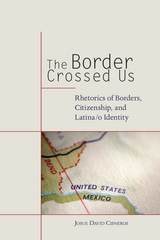
The Border Crossed Us
Rhetorics of Borders, Citizenship, and Latina/o IdentityJosue David Cisneros
University of Alabama Press, 2013
Explores efforts to restrict and expand notions of US citizenship as they relate specifically to the US-Mexico border and Latina/o identity.
Borders and citizenship go hand in hand. Borders define a nation as a territorial entity and create the parameters for national belonging. But the relationship between borders and citizenship breeds perpetual anxiety over the purported sanctity of the border, the security of a nation, and the integrity of civic identity.
In The Border Crossed Us, Josue David Cisneros addresses these themes as they relate to the US-Mexico border, arguing that issues ranging from the Mexican-American War of 1846–1848 to contemporary debates about Latina/o immigration and border security are negotiated rhetorically through public discourse. He explores these rhetorical battles through case studies of specific Latina/o struggles for civil rights and citizenship, including debates about Mexican American citizenship in the 1849 California Constitutional Convention, 1960s Chicana/o civil rights movements, and modern-day immigrant activism.
Cisneros posits that borders—both geographic and civic—have crossed and recrossed Latina/o communities throughout history (the book’s title derives from the popular activist chant, “We didn’t cross the border; the border crossed us!”) and that Latina/os in the United States have long contributed to, struggled with, and sought to cross or challenge the borders of belonging, including race, culture, language, and gender.
The Border Crossed Us illuminates the enduring significance and evolution of US borders and citizenship, and provides programmatic and theoretical suggestions for the continued study of these critical issues.
The Border Within
The Economics of Immigration in an Age of FearTara Watson and Kalee Thompson
University of Chicago Press, 2021
For decades, immigration has been one of the most divisive, contentious topics in American politics. And for decades, urgent calls for its policy reform have gone mostly unanswered. As the discord surrounding the modern immigration debate has intensified, border enforcement has tightened. Crossing harsher, less porous borders makes unauthorized entry to the United States a permanent, costly undertaking. And the challenges don’t end on the other side.
At once enlightening and devastating, The Border Within examines the costs and ends of America’s interior enforcement—the policies and agencies, including ICE, aimed at removing immigrants already living in the country. Economist Tara Watson and journalist Kalee Thompson pair rigorous analysis with deeply personal stories from immigrants and their families to assess immigration’s effects on every aspect of American life, from the labor force to social welfare programs to tax revenue. What emerges is a critical, utterly complete examination of what non-native Americans bring to the country, including immigration’s tendency to elevate the wages and skills of those who are native-born.
News coverage has prompted many to question the humanity of American immigration policies; The Border Within opens a conversation of whether it is effective. The United States spends billions each year on detention and deportation, all without economic gain and at a great human cost. With depth and discipline, the authors dissect the shock-and-awe policies that make up a broken, often cruel system, while illuminating the lives caught in the chaos. It is an essential work with far-reaching implications for immigrants and non-immigrants alike.
The Border of Lights Reader
Bearing Witness to Genocide in the Dominican RepublicMegan Jeanette Myers
Amherst College Press, 2021
"By bringing together in one volume poetry, visual arts, literary analysis, in-depth interviews and historical analysis this volume will provide its readers with a comprehensive view of the causes and the aftermath of the massacre." —Ramón Antonio Victoriano-Martínez, University of British Columbia
Contributions by Julia Alvarez, Amanda Alcántara, DeAndra Beard, Nancy Betances, Jésula Blanc, Matías Bosch Carcuro, Cynthia Carrión, Raj Chetty, Catherine DeLaura, Magaly Colimon, Juan Colón, Robin Maria DeLugan, Lauren Derby, Rosa Iris Diendomi Álvarez, Polibio Díaz, Rana Dotson, Rita Dove, Rhina P. Espaillat, Maria Cristina Fumagalli, Saudi García, Scherezade García, Juan Carlos González Díaz, Kiran C. Jayaram, Pierre Michel Jean, Nehanda Loiseau Julot, Jake Kheel, Carlos Alomia Kollegger, Jackson Lorrain “Jhonny Rivas”, Radio Marién, Padre Regino Martínez Bretón, Sophie Maríñez, April J. Mayes, Jasminne Mendez, Komedi Mikal PGNE, Osiris Mosquea, Megan Jeanette Myers, Rebecca Osborne, Ana Ozuna, Edward Paulino, John Presimé, Laura Ramos, Amaury Rodríguez, Doña Carmen Rodríguez de Paulino, The DREAM Project, Silvio Torres-Saillant, Ilses Toribio, Deisy Toussaint, Évelyne Trouillot, Richard Turits, William Vazquez, Chiqui Vicioso, Bridget Wooding, and Óscar Zazo.
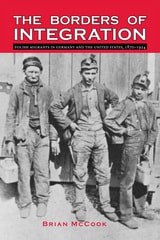
The Borders of Integration
Polish Migrants in Germany and the United States, 1870–1924Brian McCook
Ohio University Press, 2011
The issues of immigration and integration are at the forefront of contemporary politics. Yet debates over foreign workers and the desirability of their incorporation into European and American societies too often are discussed without a sense of history. McCook’s examination questions static assumptions about race and white immigrant assimilation a hundred years ago, highlighting how the Polish immigrant experience is relevant to present-day immigration debates on both sides of the Atlantic. Further, his research shows the complexity of attitudes toward immigration in Germany and the United States, challenging historical myths surrounding German national identity and the American “melting pot.”
In a comparative study of Polish migrants who settled in the Ruhr Valley and northeastern Pennsylvania, McCook shows that in both regions, Poles become active citizens within their host societies through engagement in social conflict within the public sphere to defend their ethnic, class, gender, and religious interests. While adapting to the Ruhr and northeastern Pennsylvania, Poles simultaneously retained strong bonds with Poland, through remittances, the exchange of letters, newspapers, and frequent return migration. In this analysis of migration in a globalizing world, McCook highlights the multifaceted ways in which immigrants integrate into society, focusing in particular on how Poles created and utilized transnational spaces to mobilize and attain authentic and more permanent identities grounded in newer broadly conceived notions of citizenship.