Results by title
22279 books match the query 'Social Science' and 4007 start with t
Time Maps
Collective Memory and the Social Shape of the PastEviatar Zerubavel
University of Chicago Press, 2003
Who were the first people to inhabit North America? Does the West Bank belong to the Arabs or the Jews? Why are racists so obsessed with origins? Is a seventh cousin still a cousin? Why do some societies name their children after dead ancestors?
As Eviatar Zerubavel demonstrates in Time Maps, we cannot answer burning questions such as these without a deeper understanding of how we envision the past. In a pioneering attempt to map the structure of our collective memory, Zerubavel considers the cognitive patterns we use to organize the past in our minds and the mental strategies that help us string together unrelated events into coherent and meaningful narratives, as well as the social grammar of battles over conflicting interpretations of history. Drawing on fascinating examples that range from Hiroshima to the Holocaust, from Columbus to Lucy, and from ancient Egypt to the former Yugoslavia, Zerubavel shows how we construct historical origins; how we tie discontinuous events together into stories; how we link families and entire nations through genealogies; and how we separate distinct historical periods from one another through watersheds, such as the invention of fire or the fall of the Berlin Wall.
Most people think the Roman Empire ended in 476, even though it lasted another 977 years in Byzantium. Challenging such conventional wisdom, Time Maps will be must reading for anyone interested in how the history of our world takes shape.
Time Matters
On Theory and MethodAndrew Abbott
University of Chicago Press, 2001
Time Matters focuses particularly on questions of time, events, and causality. Abbott grounds each essay in straightforward examinations of actual social scientific analyses. Throughout, he demonstrates the crucial assumptions we make about causes and events, about actors and interaction and about time and meaning every time we employ methods of social analysis, whether in academic disciplines, market research, public opinion polling, or even evaluation research. Turning current assumptions on their heads, Abbott not only outlines the theoretical orthodoxies of empirical social science, he sketches new alternatives, laying down foundations for a new body of social theory.

Time Out of Joint
The Queer and the Customary in AfricaKirk Fiereck, Neville Hoad, and Danai Mupotsa, special issue editors
Duke University Press, 0
Contributors. Cal (Crystal) Biruk, Laura Edmondson, Kirk Fiereck, Neville Hoad, Phoebe Kisubi, Keguro Macharia, Danai Mupotsa, Edgar Nabutanyi, Eddie Ombagi, Ruth Ramsden-Karelse
Time Passages
Collective Memory and American Popular CultureGeorge Lipsitz
University of Minnesota Press, 2001
The classic work on collective memory and popular culture in the United States.
Probes the complicated relationship between postwar America between historical memory and commercial culture—popular television, music, and film.
Time Travels
Feminism, Nature, PowerElizabeth Grosz
Duke University Press, 2005
Grosz’s reflections on how rethinking time might generate new understandings of nature, culture, subjectivity, and politics are wide ranging. She moves from a compelling argument that Charles Darwin’s notion of biological and cultural evolution can potentially benefit feminist, queer, and antiracist agendas to an exploration of modern jurisprudence’s reliance on the notion that justice is only immanent in the future and thus is always beyond reach. She examines Henri Bergson’s philosophy of duration in light of the writings of Gilles Deleuze, Maurice Merleau-Ponty, and William James, and she discusses issues of sexual difference, identity, pleasure, and desire in relation to the thought of Deleuze, Friedrich Nietzsche, Michel Foucault, and Luce Irigaray. Together these essays demonstrate the broad scope and applicability of Grosz’s thinking about time as an undertheorized but uniquely productive force.
Time and Decision
Economic and Psychological Perspectives of Intertemporal ChoiceGeorge Loewenstein
Russell Sage Foundation, 2003
Time and the Town
A Provincetown ChronicleAdele Heller
Rutgers University Press, 1991
Time and the Town was the last of Mary Heaton Vorse's books. It is about many things —a town and its people, the author, a certain kind of idyllic life. As much as anything else, it is the biography of the house Vorse bought in 1907 and lived in, off and on, for the next thirty-six years. The moods of the house mirrored her own. "Our houses," she wrote, "are our biographies, the stories of our defeats and victories."
Tinged with nostalgia and disenchantment, the book describes a Provincetown that has changed, a place on the verge of modernity. It is no longer a major fishing port. It has become a place whose business is tourism. Contrasting the old and the new, Vorse celebrates the enduring character of the town itself. She tells stories that are engaging and charming, droll and fabulous. The wrinkled Mrs. Mary Mooncusser who, though drunk and stark naked, conducts herself with great decorum when Vorse pays her a call, might have stepped out of the pages of Sherwood Anderson or Eudora Welty. In another anecdote, the townspeople scour the beaches for cases of booze dumped into the sea by rumrunners and are briefly inflated with the spirit of ancestral smugglers and buccaneers.
Vorse herself remained something of an outsider in Provincetown, despite her evident affection for the place and its inhabitants. They surely regarded her as simply another of those artist-intellectuals--many of whom appear in the pages of this book. The "off-Cape" outsiders put the town in the national limelight but took no interest in local matters. Vorse here ponders local matters exclusively, almost, one suspects, as a way of forgetting the more complex matters that occupied her--her agonies of parental guilt, her resentment of domestic obligations, her third marriage, her depressions and breakdowns. The town is in that sense beyond time.
Time for Childhoods
Young Poets and Questions of AgencyRachel Conrad
University of Massachusetts Press, 2020
Time for Childhoods presents a selection of striking twentieth-and twenty-first-century American poetry written by young people, and highlights how young poets imagined and shaped time for their own poetic purposes. Through close engagement with archival materials, as well as select interviews and correspondence with adult mentors, Conrad discerns how young writers figured social realities and political and racial injustices, and discusses what important advocates such as Gwendolyn Brooks and June Jordan can teach us about supporting the agency of young poets. This essential study demonstrates that young poets have much to contribute to ongoing conversations about time and power.
Time in Archaeology
Time Perspectivism RevisitedSimon Holdaway
University of Utah Press, 2011
The point of departure for this volume lies in the post-tumultuous times of processual archaeology, in the 1970s and 1980s, when Geoff Bailey, Lewis Binford, David Clarke, Robert Dunnell, Robert Foley, and Michael Schiffer, among others, initiated a deconstruction of time as used in archaeology. Here, the authors further this deconstruction.
Time in Archaeology was originally convened as an electronic symposium held at the Society of American Archaeology meetings in 2003. The result is a tightly focused group of papers that provide both a historical background to the development of the ideas of time perspectivism as well as a range of case studies that illustrate where scholars have taken the ideas. This book demonstrates the importance of concepts of time with excellent discussions and perspectives from twelve scholars working in vastly different arenas. It is a rigorous examination of the assumptions we make and the impacts of those assumptions. After reading this you may never think about time in quite the same way.
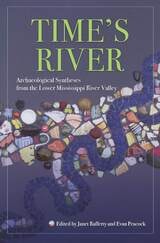
Time's River
Archaeological Syntheses from the Lower Mississippi ValleyEdited by Janet Rafferty and Evan Peacock
University of Alabama Press, 2008
An archaeologically rich region, in advance of impending disturbance
This volume stands as a key general resource for archaeologists working in the region extending from Louisiana through Mississippi north to Missouri and Kentucky, and it represents an opportunity to influence for decades a large part of the archaeological work to take place in the Southeast.
The book responds to a need for a comprehensive archaeological overview of the Lower Mississippi Valley that forms a portion of an interstate corridor spanning nine states that will run from southern Michigan to the Texas-Mexico border. The culturally sensitive Mississippi Delta is one of the richest archaeological areas in North America, and it is crucial that research designs be comprehensive, coordinated, and meet current preservation and future research needs. The authors are well-respected researchers from both within and outside the region with expertise in the full range of topics that comprise American archaeology. They examine matters of method and theory, the application of materials science, geophysics, and other high-tech tools in archaeology that provide for optimum data-recovery.
Time, History, and Belief in Aztec and Colonial Mexico
By Ross Hassig
University of Texas Press, 2001
Based on their enormously complex calendars that recorded cycles of many kinds, the Aztecs and other ancient Mesoamerican civilizations are generally believed to have had a cyclical, rather than linear, conception of time and history. This boldly revisionist book challenges that understanding. Ross Hassig offers convincing evidence that for the Aztecs time was predominantly linear, that it was manipulated by the state as a means of controlling a dispersed tribute empire, and that the Conquest cut off state control and severed the unity of the calendar, leaving only the lesser cycles. From these, he asserts, we have inadequately reconstructed the pre-Columbian calendar and so misunderstood the Aztec conception of time and history.
Hassig first presents the traditional explanation of the Aztec calendrical system and its ideological functions and then marshals contrary evidence to argue that the Aztec elite deliberately used calendars and timekeeping to achieve practical political ends. He further traces how the Conquest played out in the temporal realm as Spanish conceptions of time partially displaced the Aztec ones. His findings promise to revolutionize our understanding of how the Aztecs and other Mesoamerican societies conceived of time and history.
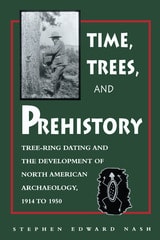
Time, Trees, and Prehistory
Tree Ring dating and the Development of NA Archaeology 1914 to 1950Stephen E Nash
University of Utah Press, 2006
Dendrochronology, the science of assigning precise calendar dates to annual growth rings in trees, provided accurate dates at a time when North American archaeologists had no absolute dating techniques available to guide their analyses. Time, Trees, and Prehistory examines the growth, development, application, and interpretive implications of North American archaeological tree-ring dating from 1914 to 1950.
The development of dendrochronology forced archaeologists to radically revise their understanding of the prehistoric past, compressing by nearly fifty percent the time scale of the archaeological record. Basketmaker sites, for instance, were once thought to be four thousand years old; tree-ring application demonstrated that these sites dated well into the present millennium. Classic sites in Chaco Canyon and Mesa Verde were believed occupied for nearly a thousand years, but tree-ring dates demonstrated that such sites were often built, occupied, and abandoned in just over a century. Other similar changes in temporal scale forced archaeologists to reconsider their interpretations of the rate of prehistoric cultural change, population growth, and the degree of social and political complexity in the Southwest.
Time, Trees, and Prehistory examines archaeological practices of the 1920s, 30s, and 40s and demonstrates that tree-ring dating set the stage that enabled revolutionary developments in archaeological method and theory in succeeding decades.
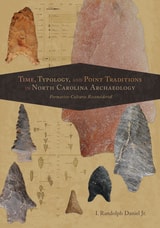
Time, Typology, and Point Traditions in North Carolina Archaeology
Formative Cultures ReconsideredI. Randolph Daniel Jr.
University of Alabama Press, 2021
Revisiting the stone tools that reshaped our understanding of North Carolina's prehistoric past.
In the 1964 landmark publication The Formative Cultures of the Carolina Piedmont, Joffre Coe established a projectile point typology and chronology that, for the first time, allowed archaeologists to identify the relative age of a site or site deposit based on the point types recovered there. Consistent with the cultural-historical paradigm of the day, the “Coe axiom” stipulated that only one point type was produced at one moment in time in a particular location. Moreover, Coe identified periods of “cultural continuity” and “discontinuity” in the chronology based on perceived similarities and differences in point styles through time.
In Time, Typology, and Point Traditions in North Carolina Archaeology: Formative Cultures Reconsidered, I. Randolph Daniel Jr. reevaluates the Coe typology and sequence, analyzing their strengths and weaknesses. Daniel reviews the history of the projectile point type concept in the Southeast and revisits both Coe’s axiom and his notions regarding cultural continuity and change based on point types. In addition, Daniel updates Coe’s typology by clarifying or revising existing types and including types unrecognized in Coe’s monograph. Daniel also adopts a practice-centered approach to interpreting types and organizes them into several technological traditions that trace ancestral-descendent communities of practice that relate to our current understanding of North Carolina prehistory.
Appealing to professional and avocational archaeologists, Daniel provides ample illustrations of points in the book as well as color versions on a dedicated website. Daniel dedicates a final chapter to a discussion of the ethical issues related to professional archaeologists using private artifact collections. He calls for greater collaboration between professional and avocational communities, noting the scientific value of some private collections.
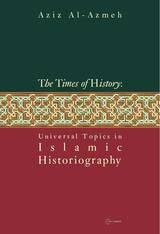
Times of History
Universal Topics in Islamic HistoriographyAziz Al-Azmeh
Central European University Press, 2007
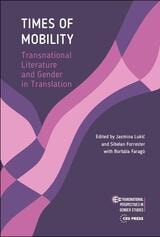
Times of Mobility
Transnational Literature and Gender in TranslationJasmina Lukic
Central European University Press, 2020
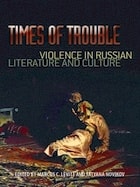
Times of Trouble
Violence in Russian Literature and CultureEdited by Marcus C. Levitt and Tatyana Novikov
University of Wisconsin Press, 2007
From the country that has added to our vocabulary such colorful terms as "purges," "pogroms," and "gulag," this collection investigates the conspicuous marks of violence in Russian history and culture.
Russians and non-Russians alike have long debated the reasons for this endemic violence. Some have cited Russia's huge size, unforgiving climate, and exposed geographical position as formative in its national character, making invasion easy and order difficult. Others have fixed the blame on cultural and religious traditions that spurred internecine violence or on despotic rulers or unfortunate episodes in the nation's history, such as the Mongol invasion, the rule of Ivan the Terrible, or the "Red Terror" of the revolution. Even in contemporary Russia, the specter of violence continues, from widespread mistreatment of women to racial antagonism, the product of a frustrated nationalism that manifests itself in such phenomena as the wars in Chechnya.
Times of Trouble is the first in English to explore the problem of violence in Russia. From a variety of perspectives, essays investigate Russian history as well as depictions of violence in the visual arts and in literature, including the works of Fyodor Dostoevsky, Isaac Babel, Mikhail Lermontov, and Nina Sadur. From the Mongol invasion to the present day, topics include the gulag, genocide, violence against women, anti-Semitism, and terrorism as a tool of revolution.
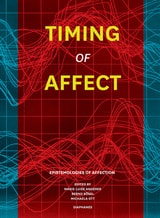
Timing of Affect
Epistemologies of AffectionEdited by Marie-Luise Angerer, Bernd Bösel, and Michaela Ott
Diaphanes, 2014
Tiny Publics
A Theory of Group Action and CultureGary Alan Fine
Russell Sage Foundation, 2012
Tirana Modern
Biblio-Ethnography on the Margins of EuropeMatthew Rosen
Vanderbilt University Press, 2022
Drawing on material collected through fieldwork with a community of readers, writers, and translators attached to the independent Albanian publisher Pika pa sipërfaqe (Point without Surface), Tirana Modern provides a tightly focused ethnography of literary culture in Albania that brings into relief the more general dialectic between social imagination and social reality as mediated by reading and literature.
Tired of Weeping
Mother Love, Child Death, and Poverty in Guinea-BissauJonina Einarsdottir
University of Wisconsin Press, 2004
Title of Totonicapán
transcription, translation, and commentary by Allen J. Christenson
University Press of Colorado, 2022
The Title of Totonicapán is a land title written by surviving members of the K’iche’ Maya nobility, a branch of the Maya that dominated the highlands of western Guatemala prior to the Spanish invasion in 1524, and it was duly signed by the ruling lords of all three major K’iche’ lineages—the Kaweqib’, the Nijayib’, and the Ajaw K’iche’s. Titles of this kind were relatively common for Maya communities in the Guatemalan highlands in the first century after the Spanish Conquest as a means of asserting land rights and privileges for its leaders. Like the Popol Vuh, the Title of Totonicapán is written in the elevated court language of the early Colonial period and eloquently describes the mythic origins and history of the K’iche’ people. For the most part, the Title of Totonicapán agrees with the Popol Vuh’s version of K’iche’ history and cosmology, providing a complementary account that attests traditions that must have been widely known and understood. But in many instances the Totonicapán document is richer in detail and departs from the Popol Vuh’s more cursory description of history, genealogy, and political organization. In other instances, it contradicts assertions made by the authors of the Popol Vuh, perhaps a reflection of internal dissent and jealousy between rival lineages within the K’iche’ hierarchy. It also contains significant passages of cosmology and history that do not appear in any other highland Maya text.
This volume makes a comprehensive and updated edition of the Title of Totonicapán accessible to scholars and students in history, anthropology, archaeology, and religious studies in Latin America, as well as those interested in Indigenous literature and Native American/Indigenous studies more broadly. It is also a stand-alone work of Indigenous literature that provides additional K’iche’ perspectives, enhancing the reading of other colonial Maya sources.
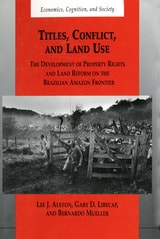
Titles, Conflict, and Land Use
The Development of Property Rights and Land Reform on the Brazilian Amazon FrontierLee J. Alston, Gary D. Libecap, and Bernardo Mueller
University of Michigan Press, 1999
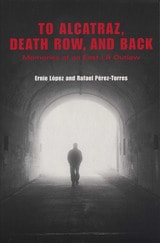
To Alcatraz, Death Row, and Back
Memories of an East LA OutlawBy Ernie López and Rafael Pérez-Torres
University of Texas Press, 2005
When Ernie López was a boy selling newspapers in Depression-era Los Angeles, his father beat him when he failed to bring home the expected eighty to ninety cents a day. When the beatings became unbearable, he took to petty stealing to make up the difference. As his thefts succeeded, Ernie's sense of necessity got tangled up with ambition and adventure. At thirteen, a joyride in a stolen car led to a sentence in California's harshest juvenile reformatory. The system's failure to show any mercy soon propelled López into a cycle of crime and incarceration that resulted in his spending decades in some of America's most notorious prisons, including four and a half years on death row for a murder López insists he did not commit.
To Alcatraz, Death Row, and Back is the personal life story of a man who refused to be broken by either an abusive father or an equally abusive criminal justice system. While López freely admits that "I've been no angel," his insider's account of daily life in Alcatraz and San Quentin graphically reveals the violence, arbitrary infliction of excessive punishment, and unending monotony that give rise to gang cultures within the prisons and practically insure that parolees will commit far worse crimes when they return to the streets. Rafael Pérez-Torres discusses how Ernie López's experiences typify the harsher treatment that ethnic and minority suspects often receive in the American criminal justice system, as well as how they reveal the indomitable resilience of Chicanos/as and their culture. As Pérez-Torres concludes, "López's story presents us with the voice of one who—though subjected to a system meant to destroy his soul—not only endured but survived, and in surviving prevailed."
To Be A Slave in Brazil
1550-1888Mattoso, Katia M de Queiros
Rutgers University Press, 1986
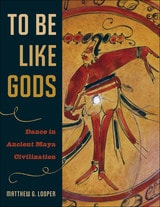
To Be Like Gods
Dance in Ancient Maya CivilizationBy Matthew G. Looper
University of Texas Press, 2009
Winner, Association for Latin American Art Book Award, 2010
The Maya of Mexico and Central America have performed ritual dances for more than two millennia. Dance is still an essential component of religious experience today, serving as a medium for communication with the supernatural. During the Late Classic period (AD 600-900), dance assumed additional importance in Maya royal courts through an association with feasting and gift exchange. These performances allowed rulers to forge political alliances and demonstrate their control of trade in luxury goods. The aesthetic values embodied in these performances were closely tied to Maya social structure, expressing notions of gender, rank, and status. Dance was thus not simply entertainment, but was fundamental to ancient Maya notions of social, religious, and political identity.
Using an innovative interdisciplinary approach, Matthew Looper examines several types of data relevant to ancient Maya dance, including hieroglyphic texts, pictorial images in diverse media, and architecture. A series of case studies illustrates the application of various analytical methodologies and offers interpretations of the form, meaning, and social significance of dance performance. Although the nuances of movement in Maya dances are impossible to recover, Looper demonstrates that a wealth of other data survives which allows a detailed consideration of many aspects of performance. To Be Like Gods thus provides the first comprehensive interpretation of the role of dance in ancient Maya society and also serves as a model for comparative research in the archaeology of performance.
To Be Nsala's Daughter
Decomposing the Colonial GazeChérie N. Rivers
Duke University Press, 2023
To Be Suddenly White
Literary Realism and Racial PassingSteven J. Belluscio
University of Missouri Press, 2006
To Be Suddenly White offers new readings of traditional passing narratives from the African American literary tradition, such as James Weldon Johnson’s The Autobiography of an Ex-Coloured Man, Nella Larsen’s Passing, and George Schuyler’s Black No More. It is also the first full-length work to consider a number of Jewish American and Italian American prose texts, such as Mary Antin’s The Promised Land, Anzia Yezierska’s Bread Givers, and Guido d’Agostino’s Olives on the Apple Tree, as racial passing narratives in their own right. Belluscio also demonstrates the contradictions that result from the passing narrative’s exploration of racial subjectivity, racial difference, and race itself.
When they are seen in comparison, ideological differences begin to emerge between African American passing narratives and “white ethnic” (Jewish American and Italian American) passing narratives. According to Belluscio, the former are more likely to engage in a direct critique of ideas of race, while the latter have a tendency to become more simplistic acculturation narratives in which a character moves from a position of ethnic difference to one of full American identity.
The desire “to be suddenly white” serves as a continual point of reference for Belluscio, enabling him to analyze how writers, even when overtly aware of the problematic nature of race (especially African American writers), are also aware of the conditions it creates, the transformations it provokes, and the consequences of both. Byexamining the content and context of these works, Belluscio elucidates their engagement with discourses of racial and ethnic differences, assimilation, passing, and identity, an approach that has profound implications for the understanding of American literary history.

To Be a Man Is Not a One-Day Job
Masculinity, Money, and Intimacy in NigeriaDaniel Jordan Smith
University of Chicago Press, 2017
Drawing on twenty-five years of experience in southeastern Nigeria, Daniel Jordan Smith takes readers through the principal phases and arenas of men’s lives: the transition to adulthood; searching for work and making a living; courtship, marriage, and fatherhood; fraternal and political relationships; and finally, the attainment of elder status and death. He relates men’s struggles both to fulfill their own aspirations and to meet society’s expectations. He also considers men who behave badly, mistreat their wives and children, or resort to crime and violence. All of these men face similar challenges as they navigate the complex geometry of money and intimacy. Unraveling these connections, Smith argues, provides us with a deeper understanding of both masculinity and society in Nigeria.
To Be an Immigrant
Kay Deaux
Russell Sage Foundation, 2006
To Be the Main Leaders of Our People
A History of Minnesota Ojibwe Politics, 1825-1898Rebecca Kugel
Michigan State University Press, 1998
In the spring of 1868, people from several Ojibwe villages located along the upper Mississippi River were relocated to a new reservation at White Earth, more than 100 miles to the west. In many public declarations that accompanied their forced migration, these people appeared to embrace the move, as well as their conversion to Christianity and the new agrarian lifestyle imposed on them. Beneath this surface piety and apparent acceptance of change, however, lay deep and bitter political divisions that were to define fundamental struggles that shaped Ojibwe society for several generations.
In order to reveal the nature and extent of this struggle for legitimacy and authority, To Be The Main Leaders of Our People reconstructs the political and social history of these Minnesota Ojibwe communities between the years 1825 and 1898. Ojibwe political concerns, the thoughts and actions of Ojibwe political leaders, and the operation of the Ojibwe political system define the work's focus. Kugel examines this particular period of time because of its significance to contemporary Ojibwe history. The year 1825, for instance, marked the beginning of a formal alliance with the United States; 1898 represented not an end, but a striking point of continuity, defying the easy categorizations of Native peoples made by non-Indians, especially in the closing years of the nineteenth century.
In this volume, the Ojibwe "speak for themselves," as their words were recorded by government officials, Christian missionaries, fur traders, soldiers, lumbermen, homesteaders, and journalists. While they were nearly always recorded in English translation, Ojibwe thoughts, perceptions, concerns, and even humor, clearly emerge. To Be The Main Leaders of Our People expands the parameters of how oral traditions can be used in historical writing and sheds new light on a complex, but critical, series of events in ongoing relations between Native and non-Native people.
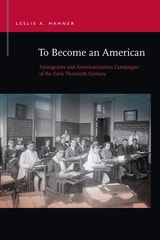
To Become an American
Immigrants and Americanization Campaigns of the Early Twentieth CenturyLeslie A. Hahner
Michigan State University Press, 2017
To Care for Creation
The Emergence of the Religious Environmental MovementStephen Ellingson
University of Chicago Press, 2016
To Care for Creation chronicles this movement and explains how it has emerged despite institutional and cultural barriers, as well as the hurdles posed by logic and practices that set religious environmental organizations apart from the secular movement. Ellingson takes a deep dive into the ways entrepreneurial activists tap into and improvise on a variety of theological, ethical, and symbolic traditions in order to issue a compelling call to arms that mobilizes religious audiences. Drawing on interviews with the leaders of more than sixty of these organizations, Ellingson deftly illustrates how activists borrow and rework resources from various traditions to create new meanings for religion, nature, and the religious person’s duty to the natural world.

To Care for the Sick and Bury the Dead
African American Lodges and Cemeteries in TennesseeLeigh Ann Gardner
Vanderbilt University Press, 2022
These Black cemeteries dot the Tennessee landscape, but few know their history or the societies of care they represent. To Care for the Sick and Bury the Dead is the first book-length look at these cemeteries and the lodges that fostered them.
This book is a must-have for genealogists, historians, and family members of the people buried in these cemeteries.
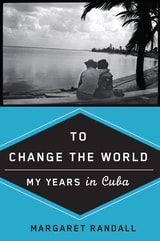
To Change the World
My Years in CubaRandall, Margaret
Rutgers University Press, 2009
Randall gives readers an inside look at her children's education, the process through which new law was enacted, the ins and outs of healthcare, employment, internationalism, culture, and ordinary people's lives. She explores issues of censorship and repression, describing how Cuban writers and artists faced them. She recounts one of the country's last beauty pageants, shows us a night of People's Court, and takes us with her when she shops for her family's food rations. Key figures of the revolution appear throughout, and Randall reveals aspects of their lives never before seen.
More than fifty black and white photographs, most by the author, add depth and richness to this astute and illuminating memoir. Written with a poet's ear, depicted with a photographer's eye, and filled with a feminist vision, To Change the Worldùneither an apology nor gratuitous attackùadds immensely to the existing literature on revolutionary Cuba.
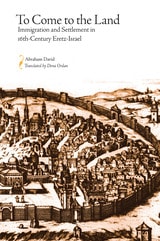
To Come to the Land
Immigration and Settlement in 16th-Century Eretz-IsraelAbraham David, translated by Dena Ordan
University of Alabama Press, 1999
To Come to the Land makes available in English a vast body of research,
previously available only in Hebrew, on the early history of the land now
known as Israel.
Abraham David here focuses on the Spanish and Portuguese Jews who fled
the Iberian Peninsula during the 16th century, tracing the beginnings of
Sephardic influence in the land of Israel.
After the Ottoman Turks conquered Syria, Palestine, and Egypt in 1516,
the Ottoman regime, unlike their Mamluk predecessors, encouraged economic
development and settlement throughout the region. This openness to immigration
offered a solution to the crisis Iberian Jews were undergoing as a result
of their expulsion from Spain and the forced conversions in Portugal. Within
a few years of the Ottoman conquest, Jews of Spanish extraction, many of
them clustered in urban areas, dominated the Jewish communities of Eretz-Israel.
In this carefully researched study, David examines the lasting impression
made by these enterprising Jewish settlers on the commercial, social, and
intellectual life of the area under early Ottoman rule. Of particular interest
is his examination of the cities of Jerusalem and Safed and David's succinct
biographies of leading Jewish personalities throughout the region.
This first English translation of a ground-breaking Hebrew work provides
a comprehensive overview of a significant chapter in the history of Israel
and explores some of the factors that brought to it the best minds of the
age. Essential for scholars of late Medieval Jewish history, To Come to
the Land will also be an important resource for scholars of intellectual
history, as it provides background crucial to an understanding of the intellectual
flourishing of the period.
To Dance is Human
A Theory of Nonverbal CommunicationJudith Lynne Hanna
University of Chicago Press, 1987
To Defend This Sunrise
Black Women’s Activism and the Authoritarian Turn in NicaraguaCourtney Desiree Morris
Rutgers University Press, 2023
To Die in this Way
Nicaraguan Indians and the Myth of Mestizaje, 1880-1965Jeffrey L. Gould
Duke University Press, 1998
Through interviews with indigenous peoples and records of the elite discourse that suppressed the expression of cultural differences and rationalized the destruction of Indian communities, Gould tells a story of cultural loss. Land expropriation and coerced labor led to cultural alienation that shamed the indigenous population into shedding their language, religion, and dress. Beginning with the 1870s, Gould historicizes the forces that prompted a collective movement away from a strong identification with indigenous cultural heritage to an “acceptance” of a national mixed-race identity.
By recovering a significant part of Nicaraguan history that has been excised from the national memory, To Die in This Way critiques the enterprise of third world nation-building and thus marks an important step in the study of Latin American culture and history that will also interest anthropologists and students of social and cultural historians.
To Dwell among Friends
Personal Networks in Town and CityClaude S. Fischer
University of Chicago Press, 1982
To Exist is to Resist
Black Feminism in EuropeEdited by Akwugo Emejulu and Francesca Sobande
Pluto Press, 2019
Deeply aware that they are constructed as 'Others' living in a racialised and hierarchical continent, the contibutors explore gender, class, sexuality and legal status to show that they are both invisible - presumed to be absent from and irrelevant to European societies - and hyper-visible - assumed to be passive and sexualised, angry and irrational.
Through imagining a future outside the neocolonial frames and practices of contemporary Europe, this book explores a variety of critical spaces including motherhood and the home, friendships and intimate relationships, activism and community, and literature, dance and film.
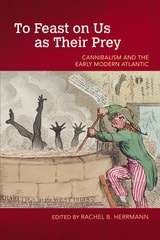
To Feast on Us as Their Prey
Cannibalism and the Early Modern AtlanticRachel B. Herrmann
University of Arkansas Press, 2019
Winner, 2020 Association for the Study of Food and Society Book Award, Edited Volume
Long before the founding of the Jamestown, Virginia, colony and its Starving Time of 1609–1610—one of the most famous cannibalism narratives in North American colonial history—cannibalism played an important role in shaping the human relationship to food, hunger, and moral outrage. Why did colonial invaders go out of their way to accuse women of cannibalism? What challenges did Spaniards face in trying to explain Eucharist rites to Native peoples? What roles did preconceived notions about non-Europeans play in inflating accounts of cannibalism in Christopher Columbus’s reports as they moved through Italian merchant circles?
Asking questions such as these and exploring what it meant to accuse someone of eating people as well as how cannibalism rumors facilitated slavery and the rise of empires, To Feast on Us as Their Prey posits that it is impossible to separate histories of cannibalism from the role food and hunger have played in the colonization efforts that shaped our modern world.

To Fight Aloud Is Very Brave
American Poetry and the Civil WarFaith Barrett
University of Massachusetts Press, 2012
Focusing on literary and popular poets, as well as work by women, African Americans, and soldiers, this book considers how writers used poetry to articulate their relationships to family, community, and nation during the Civil War. Faith Barrett suggests that the nationalist “we” and the personal “I” are not opposed in this era; rather they are related positions on a continuous spectrum of potential stances. For example, while Julia Ward Howe became famous for her “Battle Hymn of the Republic,” in an earlier poem titled “The Lyric I” she struggles to negotiate her relationship to domestic, aesthetic, and political stances.
Barrett makes the case that Americans on both sides of the struggle believed that poetry had an important role to play in defining national identity. She considers how poets created a platform from which they could speak both to their own families and local communities and to the nations of the Confederacy, the Union, and the United States. She argues that the Civil War changed the way American poets addressed their audiences and that Civil War poetry changed the way Americans understood their relationship to the nation.
To Flourish or Destruct
A Personalist Theory of Human Goods, Motivations, Failure, and EvilChristian Smith
University of Chicago Press, 2015
In his 2010 book What Is a Person?, Christian Smith argued that sociology had for too long neglected this fundamental question. Prevailing social theories, he wrote, do not adequately “capture our deep subjective experience as persons, crucial dimensions of the richness of our own lived lives, what thinkers in previous ages might have called our ‘souls’ or ‘hearts.’” Building on Smith’s previous work, To Flourish or Destruct examines the motivations intrinsic to this subjective experience: Why do people do what they do? How can we explain the activity that gives rise to all human social life and social structures?
Smith argues that our actions stem from a motivation to realize what he calls natural human goods: ends that are, by nature, constitutionally good for all human beings. He goes on to explore the ways we can and do fail to realize these ends—a failure that can result in varying gradations of evil. Rooted in critical realism and informed by work in philosophy, psychology, and other fields, Smith’s ambitious book situates the idea of personhood at the center of our attempts to understand how we might shape good human lives and societies.
To Give Their Gifts
Health, Community, and DemocracyRichard A. Couto
Vanderbilt University Press, 2002

To Have and To Hit
CULTURAL PERSPECTIVES ON WIFE BEATINGEdited by Dorothy Ayers Counts, Judith K. Brown, and Jacquelyn C. Campbell
University of Illinois Press, 1999
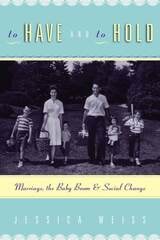
To Have and to Hold
Marriage, the Baby Boom, and Social ChangeJessica Weiss
University of Chicago Press, 2000
Jessica Weiss delves beneath these mythic images and paints a far more complex picture that reveals strong continuities between the baby boomers and their parents. Drawing on interviews with American couples from the 1950s to the 1980s, Weiss creates a dynamic portrait of family and social change in the postwar era. She pairs these firsthand accounts with a deft analysis of movies, television shows, magazines, and advice books from each decade, providing an unprecedented and intimate look at ordinary marriages in a time of sweeping cultural change.
Weiss shows how young couples in the 1950s attempted to combine egalitarian hopes with traditional gender roles. Middle-class women encouraged their husbands to become involved fathers. Midlife wives and mothers reshaped the labor force and the home by returning to work in the 1960s. And couples strove for fulfilling marriages as they dealt with the pressures of childrearing in the midst of the sexual and divorce revolutions of the 1960s and 1970s. By the 1980s, they were far more welcoming to the ideas of the women's movement than has often been assumed. More than simply changing with the times, the parents of the baby boom contributed to changing times themselves.
Weiss's excellent use of family interviews that span three decades, her imaginative examination of popular culture, and her incisive conclusions make her book an invaluable contribution not only to our understanding of the past but also to our understanding of men's and women's roles in today's family.
"Weiss has written an enlightening book that examines the dynamics of American families past and present. . . . Since Weiss is a historian, she provides analyses of her arguments that are factual rather than emotive, and her use of family interviews further contributes to a strong presentation. Overall, this is a unique works because its multidisciplinary approach informs but never preaches on the emotionally charged topic of the American family.—Sheila Devaney, Library Journal
To Heal the Scourge of Prejudice
The Life and Writings of Hosea EastonHosea Easton
University of Massachusetts Press, 1999
How did racial prejudice originate and why has it been so deeply rooted in American culture? What have been the long-term effects of prejudice on the intellectual, communal, and psychological resources of African Americans? How might the nightmare of racial domination be truly brought to an end? Still pertinent today, these were among the key questions addressed more than a century and a half ago by Hosea Easton (1799–1837), an important yet long neglected activist and intellectual.
A black minister from New England, Easton rose to prominence during the 1820s and 1830s by joining in the struggle of free African Americans to resist southern slavery and secure racial equality. From this experience he developed a deep understanding of the problem of "race" in the United States and became a trenchant critic of white supremacy and its devastating consequences. This volume brings back into print the only extended writings of Easton that have survived into our time: his insightful, almost prescient A Treatise on the Intellectual Character, and the Civil and Political Condition of the Colored People of the U. States, first published in 1837; and his passionate 1828 Thanksgiving Day “Address.” The book also provides a biographical portrait of Easton and his family, drawn from primary documents as well as secondary sources in the areas of biography, genealogy, and social history.
To Live Here, You Have to Fight
How Women Led Appalachian Movements for Social JusticeJessica Wilkerson
University of Illinois Press, 2019
Jessica Wilkerson tells their stories within the larger drama of efforts to enact change in the 1960s and 1970s. She shows white Appalachian women acting as leaders and soldiers in a grassroots war on poverty--shaping and sustaining programs, engaging in ideological debates, offering fresh visions of democratic participation, and facing personal political struggles. Their insistence that caregiving was valuable labor clashed with entrenched attitudes and rising criticisms of welfare. Their persistence, meanwhile, brought them into unlikely coalitions with black women, disabled miners, and others to fight for causes that ranged from poor people's rights to community health to unionization.
Inspiring yet sobering, To Live Here, You Have to Fight reveals Appalachian women as the indomitable caregivers of a region--and overlooked actors in the movements that defined their time.
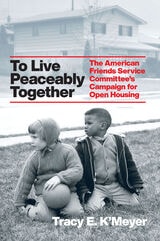
To Live Peaceably Together
The American Friends Service Committee's Campaign for Open HousingTracy E. K'Meyer
University of Chicago Press, 2022
The bitterly tangled webs of race and housing in the postwar United States hardly suffer from a lack of scholarly attention. But Tracy K’Meyer’s To Live Peaceably Together delivers something truly new to the field: a lively examination of a predominantly white faith-based group—the Quaker-aligned American Friends Service Committee (AFSC)—that took a unique and ultimately influential approach to cultivating wider acceptance of residential integration. Built upon detailed stories of AFSC activists and the obstacles they encountered in their work in Chicago, Philadelphia, and Richmond, California, To Live Peaceably Together is an engaging and timely account of how the organization allied itself to a cause that demanded constant learning, reassessment, and self-critique. K’Meyer details the spiritual and humanist motivations behind the AFSC, its members’ shifting strategies as they came to better understand structural inequality, and how those strategies were eventually adopted by a variety of other groups. Her fine-grained investigation of the cultural ramifications of housing struggles provides a fresh look at the last seventy years of racial activism.

To Live Peaceably Together
The American Friends Service Committee's Campaign for Open HousingTracy E. K'Meyer
University of Chicago Press, 2022
This is an auto-narrated audiobook edition of this book.
A groundbreaking look at how a predominantly white faith-based group reset the terms of the fight to integrate US cities.
The bitterly tangled webs of race and housing in the postwar United States hardly suffer from a lack of scholarly attention. But Tracy K’Meyer’s To Live Peaceably Together delivers something truly new to the field: a lively examination of a predominantly white faith-based group—the Quaker-aligned American Friends Service Committee (AFSC)—that took a unique and ultimately influential approach to cultivating wider acceptance of residential integration. Built upon detailed stories of AFSC activists and the obstacles they encountered in their work in Chicago, Philadelphia, and Richmond, California, To Live Peaceably Together is an engaging and timely account of how the organization allied itself to a cause that demanded constant learning, reassessment, and self-critique. K’Meyer details the spiritual and humanist motivations behind the AFSC, its members’ shifting strategies as they came to better understand structural inequality, and how those strategies were eventually adopted by a variety of other groups. Her fine-grained investigation of the cultural ramifications of housing struggles provides a fresh look at the last seventy years of racial activism.