Results by title
22279 books match the query 'Social Science' and 4007 start with t

Tracking King Tiger
Reies López Tijerina and the FBIJosé Angel Gutiérrez
Michigan State University Press, 2019
Tracking Modernity
India’s Railway and the Culture of MobilityMarian Aguiar
University of Minnesota Press, 2010
Since the colonial period in India, the railway has been idealized as a rational utopia—a moving box in which racial and class differences might be amalgamated under a civic, secular, and public order. Aguiar charts this powerful image into the postcolonial period, showing how the culture of mobility exposes this symbol of reason as surprisingly dynamic and productive. Looking in turn at the partition of India, labor relations, rituals of travel, works of literature and film, visual culture, and the Mumbai train bombings of 2006, Aguiar finds incongruities she terms “counternarratives of modernity” to signify how they work both with and against the dominant rhetoric. Revealing railways as a microcosm of tensions within Indian culture, Aguiar demonstrates how their representations have challenged prevailing ideas of modernity.
Tracking Prehistoric Migrations
Pueblo Settlers among the Tonto Basin HohokamJeffery J. Clark
University of Arizona Press, 2001
Puebloan migration was initially limited in scale, resulting in the co-residence of migrants and local groups within a single community. Once this co-residence settlement pattern is reconstructed, relations between the two groups are examined and the short-term and long-term impacts of migration are assessed. The early Classic period is associated with the appearance of the Salado horizon in the Tonto Basin. The results of this research suggest that migration and co-residence was common throughout the basins and valleys in the region defined by the Salado horizon, although each local sequence relates a unique story. The methodological and theoretical implications of Clark's work extend well beyond the Salado and the Southwest and apply to any situation in which the scale and impact of prehistoric migration are contested.
Tracks on the Ocean
A History of Trailblazing, Maps, and Maritime TravelSara Caputo
University of Chicago Press, 2024
Sara Caputo’s Tracks on the Ocean is a sweeping history of how we have understood routes of travel over the ocean and how we came to represent that movement as a cartographical line. Focusing on the representation of sea journeys in the Western world from the early sixteenth century to the present, Caputo deftly argues that the depiction of these lines is inextricable from European imperialism, the rise of modernity, and attempts at mastery over nature. Caputo recounts the history of ocean tracks through an array of lively stories and characters, from the expeditions of Captain James Cook in the eighteenth century to tracks depicted in Moby Dick and popular culture of the nineteenth century to the use of navigational techniques by the British navy. She discusses how tracks evolved from tools of surveying into tools of surveillance and, eventually, into paths of environmental calamity. The impulse to record tracks on the ocean is, Caputo argues, reflective of an ongoing desire for order, schematization, and personal visibility, as well as occupation and permanent ownership—in this case over something that is unoccupiable and impossible to truly possess. Both beautifully written and deeply researched, Tracks on the Ocean shares how the lines drawn on maps tell the audacious and often tragic and violent stories of ocean voyages.
Trading Democracy for Justice
Criminal Convictions and the Decline of Neighborhood Political ParticipationTraci Burch
University of Chicago Press, 2013
Tradition
Edward Shils
University of Chicago Press, 1981
"Shils is a man of fabled learning, whose mind purrs powerfully like the moth at dusk. I hesitate to use the word conservative of him because it misses the central concern of his work, which is not conservatism, but the conservation of those human resources and achievements which are richest, and matter most."—David A. Martin, Times Literary Supplement
"Tradition is the first comprehensive treatment of the subject that encompasses the totality of tradition in all its multifaceted variables and functions. . . . It is a landmark analytical and theoretical sociological study that not only fills a need but also provides a basic model and impetus for further research."—H. Leon Abrams Jr., Sociology
Tradition in the Twenty-First Century
Locating the Role of the Past in the PresentTrevor J. Blank and Robert Glenn Howard
Utah State University Press, 2013
Emphasizing how tradition adapts, survives, thrives, and either mutates or remains stable in today’s modern world, the contributors pay specific attention to how traditions now resist or expedite dissemination and adoption by individuals and communities. This complex and intimate portrayal of tradition in the twenty-first century offers a comprehensive overview of the folkloristic and popular conceptualizations of tradition from the past to present and presents a thoughtful assessment and projection of how “tradition” will fare in years to come. The book will be useful to advanced undergraduate or graduate courses in folklore and will contribute significantly to the scholarly literature on tradition within the folklore discipline.
Additional Contributors: Simon Bronner, Stephen Olbrys Gencarella, Merrill Kaplan, Lynne S. McNeill, Elliott Oring, Casey R. Schmitt, and Tok Thompson

Traditional Archery from Six Continents
The Charles E. Grayson CollectionText by Charles E. Grayson, Mary French, Michael J. O'Brien, & Photos by Daniel
University of Missouri Press, 2007
As a major hunting tool and weapon, the bow changed human history around the world, and its diverse forms reflect the cultures that adopted it. Those variations can be seen in the Charles E. Grayson Archery Collection housed at the University of Missouri–Columbia Museum of Anthropology, one of the largest and most comprehensive assemblages of archery-related materials in the world. This handsome book offers a unique look at archery as it has been practiced through the ages.
Drawing on a collection of more than five thousand bows, arrows, and associated paraphernalia, Traditional Archery from Six Continents presents color photographs and descriptions of some three hundred items—including quivers, thumb rings, and more—that represent traditional archery practices and customs from around the world. From the Chinese “monkey bow” to the English longbow, the artifacts are organized by region, taking in equipment from Asia, the Middle East, Africa, the Americas, and Europe used over the past five hundred years.
The book’s introduction provides an overview of traditional archery and its nomenclature, and chapter essays situate the items in their historical, cultural, and technological contexts. Plate descriptions note materials, construction methods, dimensions, and temporal and cultural affiliations. The sharp, detailed photographs will enable users to identify the geographic or cultural origins of other pieces by visual comparison. Additional illustrations show how archery equipment has been used in various settings such as hunting, warfare, and sport.
These superb representations from a masterful collection constitute a complete introduction to worldwide archery and mark the first wide-ranging survey of European and non-European archery equipment. Traditional Archery from Six Continents will be the standard reference work in the study of archery, indispensable for students of material culture or general readers interested in the history of this timeless art.
Traditional Arid Lands Agriculture
Understanding the Past for the FutureEdited by Scott E. Ingram and Robert C. Hunt
University of Arizona Press, 2015
Traditional agriculture, nonindustrial plant cultivation for human use, is practiced worldwide by millions of smallholder farmers in arid lands. Advancing an understanding of traditional agriculture can improve its practice and contribute to understanding the past. Traditional agriculture has been practiced in the U.S. Southwest and northwest Mexico for at least four thousand years and intensely studied for at least one hundred years. What is not known or well-understood about traditional arid lands agriculture in this region has broad application for research, policy, and agricultural practices in arid lands worldwide.
The authors represent the disciplines of archaeology, anthropology, agronomy, art, botany, geomorphology, paleoclimatology, and pedology. This multidisciplinary book will engage students, practitioners, scholars, and any interested in understanding and advancing traditional agriculture.
Traditional Healers and Childhood in Zimbabwe
Pamela Reynolds
Ohio University Press, 1995
Based on the author’s fieldwork among the people of Zezuru, this study focuses on children as clients and as healers in training. In Reynolds’s ethnographic investigation of possession and healing, she pays particular attention to the way healers are identified and authenticated in communities, and how they are socialized in the use of medicinal plants, dreams, and ritual healing practices. Reynolds examines spiritual interpretation and remediation of children’s problems, including women’s roles in these activities, and the Zezuru concepts of trauma, evil, illness, and death. Because this study was undertaken just after the War of Liberation in Zimbabwe, it also documents the devastating effects of the war.
Traditional Navajo Teachings
Sacred Narratives and CeremoniesRobert S. McPherson
University Press of Colorado, 2020
—Cindy Yurth, The Navajo Times
"In Sacred Narratives and Ceremonies, the authors lay the foundation of traditional Navajo beliefs and practices. They provide an inside perspective rarely discussed by non-medicine people and share the beauty and power of a system that unites humans to the holy beings—through teachings, rituals, materials, and daily behavior. This book is pure gold. It is full of traditional wisdom available to those wanting to understand Navajo culture as seen through the eyes of its elders. I highly recommend this book as a treasure trove for the Diné people."
—Clayton Long, participant/creator of the Navajo Rosetta Stone; Bilingual Education Director (retired), San Juan School District, Utah; and curriculum developer for the Navajo Nation
Traditional Navajo Teachings
The Earth Surface PeopleRobert S. McPherson
University Press of Colorado, 2020
—Clayton Long, a participant/creator of the Navajo Rosetta Stone; Bilingual Education Director (retired), San Juan School District, Utah; and curriculum developer for the Navajo Nation.
Traditional Navajo Teachings
The Natural WorldRobert S. McPherson
University Press of Colorado, 2020
"Navajo teachings provide a classic study of a land-based religion that involves every aspect of the physical world in a spiritual universe. Nothing is too big or small—everything holds a power, provides a teaching, and responds through an inner form. Beyond the material life of daily existence, there lies a world of interconnected relations made apparent in Volume II, The Natural World. This book graphically describes elements of life rooted in the Navajo philosophy of hózhǫ́. A unified harmony results. I highly recommend this book as a study in understanding the power of relationships that populate the Diné worldview."
—Clayton Long, a participant/creator of the Navajo Rosetta Stone; Bilingual Education Director (retired), San Juan School District, Utah; and curriculum developer for the Navajo Nation.
"For days after reading The Natural World, I found myself looking at my surroundings in a different way. The vibrant spirit of the earth and every plant or animal I encountered seemed to glow through a translucent shell. I have always been a nature-lover and gotten a sense of peace from being outdoors, but since reading these beautiful Navajo teachings I am filled with a profound sense of joy and gratitude every time I walk outside."
—Cindy Yurth, The Navajo Times
Traditional, National, and International Law and Indigenous Communities
Edited by Marianne O. Nielsen and Karen Jarratt-Snider
University of Arizona Press, 2020
While all of these issues are rooted in colonization, Indigenous peoples are using their own solutions to demonstrate the resilience, persistence, and innovation of their communities. With chapters focusing on the use and misuse of law as it pertains to Indigenous peoples in North America, Latin America, Canada, Australia, and New Zealand, this book offers a wide scope of global injustice. Despite proof of oppressive legal practices concerning Indigenous peoples worldwide, this book also provides hope for amelioration of colonial consequences.
Traditions and Reminiscences of Concord, Massachusetts, 1779-1878
Edward Jarvis
University of Massachusetts Press, 1993
A statistician and pioneer in the treatment of the mentally ill, Edward Jarvis (1803–1884) decided late in life to record his recollections of Concord, Massachusetts, the town in which he was raised. Using Lemuel Shattuck's History of Concord as the springboard for his thoughts, Jarvis produced a remarkable document. Traditions and Reminiscences is encyclopedic in scope but intimate in style; it provides an astonishingly detailed account of life in early nineteenth-century Concord. Jarvis escorts us through the family home, making certain we understand the function and value of each item in the domestic scene. Then he is off to the neighbors' houses, to the schoolhouse, the church, the social clubs, the library, the post office, the town hall, and even the tavern, where he unabashedly counts patrons' drinks. Along the way we learn about neighborly cooperation—quiltings, husking bees, and barn raisings—about social manners and respectability, and about local vices. The result is a vast storehouse of information and a vivid portrait of life in an early nineteenth-century preindustrial community. The memoir also provides a first-hand witness to the crusade for moral reform that transformed mid-nineteenth-century New England.
Traditions, Transitions, and Technologies
Themes in Southwestern ArchaeologySarah H. Schlanger
University Press of Colorado, 2016
Traffic in Asian Women
Laura Hyan Yi Kang
Duke University Press, 2020

Traffick
The Illicit Movement of People and ThingsGargi Bhattacharyya
Pluto Press, 2005
Trafficked Children and Youth in the United States
Reimagining SurvivorsElzbieta M. Gozdziak
Rutgers University Press, 2016
Breaking new ground, Trafficked Children in the United States offers a fresh take on what matters most to these young people as they rebuild their lives in America.
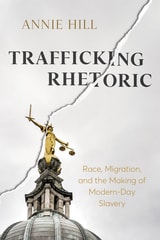
Trafficking Rhetoric
Race, Migration, and the Making of Modern-Day SlaveryAnnie Hill
The Ohio State University Press, 2024
Honorable Mention, 2025 NCA Public Address Division’s Marie Hochmuth Nichols Award
Human trafficking has generated intense global concern, with stories of sex slavery and images of women forced into prostitution so persuasive that states have raced to respond ahead of empirical data and clear definitions of the crime. In Trafficking Rhetoric, Annie Hill analyzes the entanglement of state veneration and state violence by tracking how the United Kingdom points to the alleged crimes of others in order to celebrate itself and conceal its own aggression. Hill compares the UK’s acclaimed rescue approach to human trafficking with its hostile approach to migration, arguing that they are two sides of the same coin—one that relies on rhetorical constructions of “trafficked women” and “illegal migrants” to materialize the UK as an Anglo-white space.
Drawing from official estimates, policy papers, NGO reports, news stories, and awareness campaigns and situating them in the broader EU context, Hill accounts for why the UK’s antitrafficking agenda emerged with such rhetorical force in the early twenty-first century. Trafficking Rhetoric reframes controversies over labor, citizenship, and migration while challenging the continued traction of race-baiting and gender bias in determining who has the right to live, work, and belong in the nation.

Trafficking Women’s Human Rights
Julietta Hua
University of Minnesota Press, 2011
The history of human beings bought and sold, forced into lives of abject servitude or sexual slavery, is a story as old as civilization and yet still of global concern today. How this story is told, Julietta Hua argues, says much about our cultural beliefs. Through a critical inquiry into representations of human trafficking, she reveals the political, social, and cultural strains underlying our current preoccupation with this issue and the difficulty of framing human rights in universal terms.
In Trafficking Women’s Human Rights, Hua maps the ways in which government, media, and scholarship have described sex trafficking for U.S. consumption. As her investigation takes us from laws like the Victims of Trafficking and Violence Protection Act to political speeches and literary and media images, it uncovers dark assumptions about race, difference, and the United States’ place in the world expressed—and often promoted—by such images. The framing itself, exploiting dichotomies of victim/agent, rescued/rescuer, trafficked/smuggled, illustrates the limits of universalism in addressing human rights.
Uniquely broad in scope, this work considers the laws of human trafficking in conjunction with popular culture. In doing so, it constructively draws attention to the ways in which notions of racialized sexualities form our ideas about national belonging, global citizenship, and, ultimately, human rights.
Trafficking in Antiblackness
Modern-Day Slavery, White Indemnity, and Racial JusticeLyndsey P. Beutin
Duke University Press, 2023
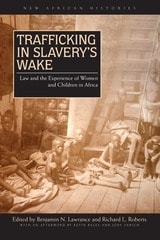
Trafficking in Slavery’s Wake
Law and the Experience of Women and Children in AfricaBenjamin N. Lawrance
Ohio University Press, 2012
Women and children have been bartered, pawned, bought, and sold within and beyond Africa for longer than records have existed. This important collection examines the ways trafficking in women and children has changed from the aftermath of the “end of slavery” in Africa from the late nineteenth century to the present.
The formal abolition of the slave trade and slavery did not end the demand for servile women and children. Contemporary forms of human trafficking are deeply interwoven with their historical precursors, and scholars and activists need to be informed about the long history of trafficking in order to better assess and confront its contemporary forms. This book brings together the perspectives of leading scholars, activists, and other experts, creating a conversation that is essential for understanding the complexity of human trafficking in Africa.
Human trafficking is rapidly emerging as a core human rights issue for the twenty-first century. Trafficking in Slavery’s Wake is excellent reading for the researching, combating, and prosecuting of trafficking in women and children.
Contributors: Margaret Akullo, Jean Allain, Kevin Bales, Liza Stuart Buchbinder, Bernard K. Freamon, Susan Kreston, Benjamin N. Lawrance, Elisabeth McMahon, Carina Ray, Richard L. Roberts, Marie Rodet, Jody Sarich, and Jelmer Vos.
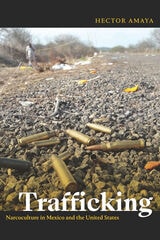
Trafficking
Narcoculture in Mexico and the United StatesHector Amaya
Duke University Press, 2020
Tragic No More
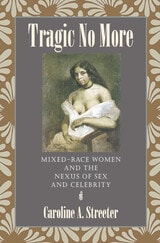
Mixed-Race Women and the Nexus of Sex and CelebrityCaroline A. Streeter
University of Massachusetts Press, 2012
Streeter's subjects include concert pianist Philippa Schuyler, Dorothy West's novel The Wedding (in print and on screen), Danzy Senna's novels Caucasia and Symptomatic, and celebrity performing artists Mariah Carey, Alicia Keys, and Halle Berry. She opens with a chapter that examines the layered media response to Essie Mae Washington-Williams, Senator Strom Thurmond's biracial daughter. Throughout the book, Streeter engages the work of feminist critics and others who have written on interracial sexuality and marriage, biracial identity, the multiracial movement, and mixed race in cultural studies.

Tragic Spirits
Shamanism, Memory, and Gender in Contemporary MongoliaManduhai Buyandelger
University of Chicago Press, 2013
Trail to Heaven
Knowledge and Narrative in a Northern Native CommunityRobin Ridington
University of Iowa Press, 1992
Trailer Park America
Reimagining Working-Class CommunitiesLeontina Hormel
Rutgers University Press, 2023
Trajectories of Empire
Transhispanic Reflections on the African DiasporaJerome C. Branche
Vanderbilt University Press, 2022
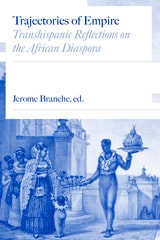
The book’s chapters explore what Blackness means in the so-called racial democracies of Brazil and Cuba today. Among the historical narratives and themes it covers are the role of medical science in the objectification and nullification of Black female personhood during slavery in nineteenth-century Brazil; the protocols of portraiture in the colonial period that, in including enslaved individuals, pictorially highlight and freeze their supposed inferiority vis-à-vis their owners; and those aspects of discourse that promote colonial capture and oppression in terms of evangelization and the saving of souls, or simply create the discursive template as early as the fifteenth century, for their continued alienation and marginalization across generations.
Trajectories of Empire’s contributions come from the fields of literary criticism, visual culture, history, anthropology, popular culture (rap), and cultural studies. As the product of an interdisciplinary collective, this book will be of interest to scholars in Iberian or Hispanic studies, Africana studies, postcolonial studies, and transatlantic studies, as well as the general public.
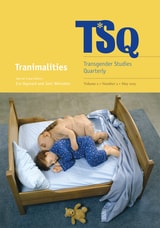
Tranimalities
Eva S. Hayward and Jami Weinstein, special issue editors
Duke University Press, 0
Trans Care
Hil Malatino
University of Minnesota Press, 2020
A radical and necessary rethinking of trans care
What does it mean for trans people to show up for one another, to care deeply for one another? How have failures of care shaped trans lives? What care practices have trans subjects and communities cultivated in the wake of widespread transphobia and systemic forms of trans exclusion?
Trans Care is a critical intervention in how care labor and care ethics have been thought, arguing that dominant modes of conceiving and critiquing the politics and distribution of care entrench normative and cis-centric familial structures and gendered arrangements. A serious consideration of trans survival and flourishing requires a radical rethinking of how care operates.
Forerunners is a thought-in-process series of breakthrough digital works. Written between fresh ideas and finished books, Forerunners draws on scholarly work initiated in notable blogs, social media, conference plenaries, journal articles, and the synergy of academic exchange. This is gray literature publishing: where intense thinking, change, and speculation take place in scholarship.
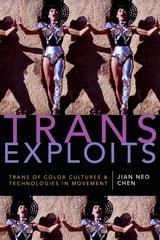
Trans Exploits
Trans of Color Cultures and Technologies in MovementJian Neo Chen
Duke University Press, 2019
Trans Philosophy
Perry Zurn
University of Minnesota Press, 2024
Establishing trans philosophy as a unique field of inquiry, offering tools for our quest toward a more just and equitable world
Trans Philosophy defines this burgeoning and polymorphous discipline as philosophical work that is accountable to and illuminative of cross-cultural and global trans experiences, histories, and cultural productions. Across language and politics, feminism and phenomenology, and decolonial theory, it addresses trans worldmaking in all its beauty and mundanity.
Critically, the editors center the contributions of trans and gender-nonconforming philosophers from around the globe. Showcasing work from a range of emerging and established voices, Trans Philosophy addresses discrimination, embodiment, identity, language, and law, utilizing diverse philosophical methods to attend to significant intersections between trans experience and class, disability, race, nationality, and sexuality.
At a time when trans-exclusionary views are gaining traction in politics as well as philosophy, this volume urgently redraws the contours of trans discourse, centering the wisdom already generated in trans and other gender-disruptive communities.
Contributors: Megan Burke, Sonoma State U; Robin Dembroff, Yale U; Marie Draz, San Diego State U; Che Gossett, U of Pennsylvania; Ryan Gustafsson, U of Melbourne; Stephanie Kapusta, Dalhousie U; Tamsin Kimoto, Washington U, St. Louis; Hil Malatino, Pennsylvania State U and Rock Ethics Institute; Amy Marvin, Lafayette U; Marlene Wayar.
Retail e-book files for this title are screen-reader friendly.

Trans Pornography
Sophie Pezzutto and Lynn Comella, special issue editors
Duke University Press, 2020
Contributors
Skylar Adams, Carolyn Bronstein, Lynn Comella, Korra Del Rio, Sly Fawkes, Aster Gilbert, RL Goldberg, Laura Horak, Valentina Mia, Geoffrey H. Nicholson, Sophie Pezzutto, Matt Richardson, Whitney Strub, Rae Threat

Trans Studies en las Americas
Claudia Sofia Garriga-López, Cole Rizki, and Juana María Rodríguez, special issue editors
Duke University Press, 0
This special issue of TSQ prompts a conversation between trans and travesti studies scholars working across the Américas to investigate how shifts in cultural practices, aesthetics, geographies, and languages enliven theories of politics, subjectivity, and embodiment. Contributors to this issue offer a hemispheric perspective on trans and travesti issues to the Anglophone academy, expand transgender studies to engage geopolitical connections, and bring interdisciplinary approaches to topics ranging from policy to cultural production. This issue is an unprecedented English-language collection by Latin American and Latinx scholars on trans and travesti issues.
Contributors. Lino Arruda, Daniel Coleman, Cynthia Citlallin Delgado, El Colectivo del Archivo de la Memoria Trans, Juan Carlos Garrido, Claudia Sofía Garriga-López, Bernadine Hernández, Hillary Hiner, Denilson Lopes, Andrés Lopez, Cole Rizki, Juana María Rodríguez, Oli Rodriguez, Marcia Lucia Machuca Rose, Martín de Mauro Rucovsky, Dora Silva Santana, Susy Shock, Sayak Valencia
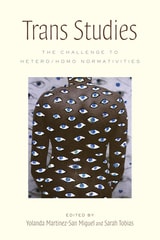
Trans Studies
The Challenge to Hetero/Homo NormativitiesMartínez-San Miguel, Yolanda
Rutgers University Press, 2016
From Caitlyn Jenner to Laverne Cox, transgender people have rapidly gained public visibility, contesting many basic assumptions about what gender and embodiment mean. The vibrant discipline of Trans Studies explores such challenges in depth, building on the insights of queer and feminist theory to raise provocative questions about the relationships among gender, sexuality, and accepted social norms.
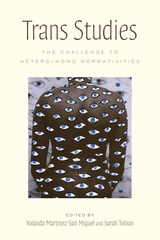
Trans Studies
The Challenge to Hetero/Homo NormativitiesMartínez-San Miguel, Yolanda
Rutgers University Press, 2016
From Caitlyn Jenner to Laverne Cox, transgender people have rapidly gained public visibility, contesting many basic assumptions about what gender and embodiment mean. The vibrant discipline of Trans Studies explores such challenges in depth, building on the insights of queer and feminist theory to raise provocative questions about the relationships among gender, sexuality, and accepted social norms.
Trans*formational Pedagogies
Z. Nicolazzo, Susan B. Marine, and Francisco J. Galarte, special issue editors
Duke University Press, 0
Trans*historicities
Leah DeVun and Zeb Tortorici, special issue editors
Duke University Press, 2018
Contributors. Kadji Amin, M. W. Bychowski, Fernanda Carvajal, Howard Chiang, Leah DeVun, Julian Gill-Peterson, Jack Halberstam, Asato Ikeda, Jacob Lau, Kathleen P. Long, Maya Mikdashi, Robert Mills, Carlos Motta, Marcia Ochoa, Kai Pyle, C. Riley Snorton, Zeb Tortorici, Jennifer Louise Wilson
Trans- Political Economy
Dan Irving and Vek Lewis, special issue editors
Duke University Press, 0
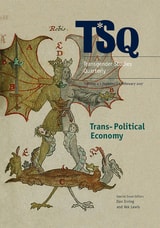
This issue of TSQ: Transgender Studies Quarterly, “Trans-Political Economy,” edited by Dan Irving and Vek Lewis, addresses how capitalism differentially and unequally affects trans and sex/gender-diverse people across the globe. “We all, from our different social and political locations, become implicated in those architectures through our everyday interactions with a variety of coordinated and contradictory institutions and rationalities that order our lives across different local and global geopolitical spaces and scales,” write Lewis and Irving. The editors of and contributors to this issue reveal how the narrowly constructed objects of trans studies and political economy (such as gender, labor, class, and economy) have been complicit in the necropolitical devaluation of trans lives and existing strategies crafted for trans survival. Topics include trans visibility and commodity culture; trans credit reporting; the growing population of T-girls, trans women truckers; trans street-based sex workers; the system of sex/gender identification for trans asylum seekers in South Africa; and waria affective labor in Indonesia. There is also a roundtable deconstructing trans* political economy.
The Arts & Culture section of this issue features a review of season 7 of RuPaul's Drag Race in relation to certain political-economic elements of the drag industry as well as an in-depth look at the representation of transgender lives on film, specifically in Dallas Buyers Club.
Trans-Americanity
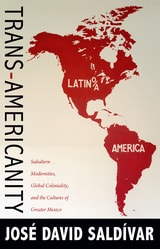
Subaltern Modernities, Global Coloniality, and the Cultures of Greater MexicoJosé David Saldívar
Duke University Press, 2012
Trans-Indigenous
Methodologies for Global Native Literary StudiesChadwick Allen
University of Minnesota Press, 2012
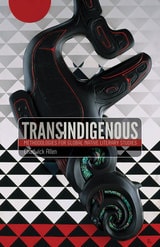
What might be gained from reading Native literatures from global rather than exclusively local perspectives of Indigenous struggle? In Trans-Indigenous, Chadwick Allen proposes methodologies for a global Native literary studies based on focused comparisons of diverse texts, contexts, and traditions in order to foreground the richness of Indigenous self-representation and the complexity of Indigenous agency.
Through demonstrations of distinct forms of juxtaposition—across historical periods and geographical borders, across tribes and nations, across the Indigenous–settler binary, across genre and media—Allen reclaims aspects of the Indigenous archive from North America, Hawaii, Aotearoa New Zealand, and Australia that have been largely left out of the scholarly conversation. He engages systems of Indigenous aesthetics—such as the pictographic discourse of Plains Indian winter counts, the semiotics of Navajo weaving, and Maori carving traditions, as well as Indigenous technologies like large-scale North American earthworks and Polynesian ocean-voyaging waka—for the interpretation of contemporary Indigenous texts. The result is a provocative reorienting of the call for Native intellectual, artistic, and literary sovereignty that fully prioritizes the global Indigenous.
Trans-Status Subjects
Gender in the Globalization of South and Southeast AsiaSonita Sarker and Esha Niyogi De, eds.
Duke University Press, 2002
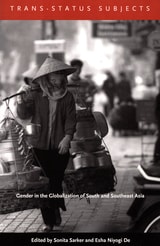
The contributors—including literary and film theorists, geographers, historians, sociologists, and anthropologists—show how the dominant colonial powers prefigured the ideologies of gender and sexuality that neocolonial nation-states have later refigured; investigate economic and artistic production; and explore labor, capital, and social change. The essays cover a range of locales—including Sri Lanka, Vietnam, Thailand, Singapore, Borneo, Indonesia, and the United States. In investigating issues of power, mobility, memory, and solidarity in recent eras of globalization, the contributors—scholars and activists from South Asia, Southeast Asia, England, Australia, Canada, and the United States—illuminate various facets of the new concept of trans-status subjects.
Trans-Status Subjects carves out a new area of inquiry at the intersection of feminisim and critical geography, as well as globalization, postcolonial, and cultural studies.
Contributors. Anannya Bhattacharjee, Esha Niyogi De, Karen Gaul, Ketu Katrak, Karen Leonard, Philippa Levine, Kathryn McMahon, Andrew McRae, Susan Morgan, Nihal Perera, Sonita Sarker, Jael Silliman, Sylvia Tiwon, Gisele Yasmeen
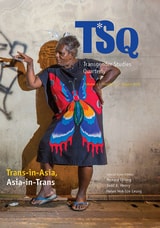
Trans-in-Asia, Asia-in-Trans
Howard Chiang, Todd A. Henry, and Helen Hok-Sze Leung, special issue editors
Duke University Press, 0
Trans/Feminisms
Susan Stryker and Talia M. Bettcher, special issue editors
Duke University Press, 0
This special double issue of TSQ goes beyond the simplistic dichotomy between an exclusionary transphobic feminism and an inclusive trans-affirming feminism. Exploring the ways in which trans issues are addressed within feminist and women’s organizations and social movements around the world, contributors ask how trans, genderqueer, and nonbinary issues are related to feminist movements today, what kind of work is currently undertaken in the name of trans/feminism, what new paradigms and visions are emerging, and what questions still need to be taken up. Central to this special issue is the recognition that trans/feminist politics cannot restrict itself to the domain of gender alone.
This issue features numerous shorter works that represent the diversity of trans/feminist practices and problematics and, in addition to original research articles, includes theory, reports, manifestos, opinion pieces, reviews, and creative/artistic productions, as well as republished key documents of trans/feminist history and international scholarship.
Contributors: Miriam Abelson, Sara Ahmed, Aitzole Araneta, Alexandre Baril, Marie-Hélène/Sam Bourcier, micha cárdenas, Daniel Chávez, Jeanne Córdova, Pedro J. DiPietro, Lucía Egaña, A. Finn Enke, Karine Espineira, Sandra Fernández, Simon D. Fisher, Tania Hammidi, Christoph Hanssmann, Emma Louise Heaney, Hailey Kaas, Cael Keegan, Faris Khan, Yana Kirey-Sitnikova, Terence Kumpf, Riki Lane, Helen Hok-Sze Leung, Claudia Sofia Garriga López, Tommi Avicolli Mecca, L. Leigh Ann van der Merwe, Scott Morgensen, Marcio Jose Ornat, Ruin S. M. Pae, José Quiroga, Naomi Scheman, Joseli Maria Silva, reese simpkins, Miriam Solá, Sandy Stone, Stefania Voli, Rinaldo Walcott, Lori Watson, Cristan Williams, Shana Ye, Asli Zengin
Trans/Portraits
Voices from Transgender CommunitiesJackson Wright Shultz
Dartmouth College Press, 2015
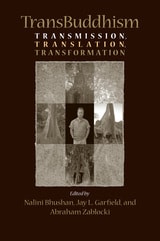
TransBuddhism
Transmission, Translation, and TransformationNalini Bhushan
University of Massachusetts Press, 2009
The chapters in the first section explore the transmission of Buddhism to the West, ranging from the writings of one of its earliest western interpreters, the Wesleyan missionary R. Spence Hardy, to the globalization of Tibetan Buddhist reincarnation, to the development and practice of Buddhism within the American prison system. The concluding chapter of this section presents a case study of a Japanese Buddhist temple in Oregon that ultimately died out—an example of a transmission that failed.
The second section looks at the complex issues that arise in the translation of Buddhist terms, texts, and concepts from one language or cultural milieu to another. Two chapters examine the challenges confronted by those who translate Buddhist texts—one exploring the contemporary translation of Tibetan Buddhism, the second analyzing an exchange of poetry in medieval Japan. The other two chapters describe the translation of Buddhist ideas into new cultural domains in America, specifically film and sports.
The final section presents case studies in the transformation of Buddhism which is resulting from its new global interconnections. Topics include the role of women in transforming Buddhist patriarchy, Buddhist-Freudian dialogue in relationship to mourning, and the interplay between Buddhism and the environmental movement.
The book also includes images created by the noted artist Meridel Rubenstein which frame the individual chapters within a nonverbal exploration of the themes discussed.
In addition to the editors, contributors include Mark Blum, Mario D'Amato, Sue Darlington, Elizabeth Eastman, Connie Kassor, Tom Rohlich, Judith Snodgrass, Jane Stangl, and Karma Lekshe Tsomo.
Transatlantic Central Europe
Contesting Geography and Redifining Culture beyond the NationJessie Labov
Central European University Press, 2019

Transatlantic Conversations
Nineteenth-Century American Women’s Encounters with Italy and the Atlantic WorldBeth L. Lueck
University of New Hampshire Press, 2017
This unique interdisciplinary essay collection offers a fresh perspective on the active involvement of American women authors in the nineteenth-century transatlantic world. Internationally diverse contributors explore topics ranging from women's social and political mobility to their authorship and activism. While a number of essays focus on such well-known writers as Margaret Fuller, Catharine Maria Sedgwick, Harriet Beecher Stowe, George Eliot, Louisa May Alcott, and Charlotte Perkins Gilman, other, perhaps lesser-known authors are also included, such as E. D. E. N. Southworth, Elizabeth Stuart Phelps, Elizabeth Peabody, Jeannette Hart, and Laura Richards.
These essays show the spectrum of interests and activities in which nineteenth-century women were involved as they moved, geographically and metaphorically, toward gaining their independence and the right to control their lives. Traveling far and wide—to Italy, France, Great Britain, and the Bahamas—these writers came into contact with realities far different from their own. On topics ranging from homeopathy and literary endeavors to politics and revolution, they conversed with others, reaching and inspiring transnational audiences with their words and deeds, and creating a space for self-expression in the rapidly changing transatlantic world.
Transatlantic Disbelonging
Unruliness, Pleasure, and Play in Nigerian Diasporic Women's ArtBimbola Akinbola
Duke University Press, 2025