Results by title
28167 books match the query 'History' and 6372 start with t
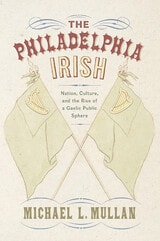
The Philadelphia Irish
Nation, Culture, and the Rise of a Gaelic Public SphereMichael L. Mullan
Rutgers University Press, 2021
Using Jurgen Habermas’s concept of a public sphere, the author reveals how the Irish constructed a plebian “counter” public of Gaelic meaning through various mechanisms of communication, the ethnic press, the meeting rooms of Irish societies, the consumption of circulating pamphlets, oratory, songs, ballads, poems, and conversation.
Settled in working class neighborhoods of vast spatial separation in an industrial city, the Irish resisted a parochialism identified with neighborhood and instead extended themselves to construct a vibrant, culturally engaged network of Irish rebirth in Philadelphia, a public of Gaelic meaning.
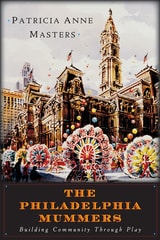
The Philadelphia Mummers
Building Community Through PlayPatricia Anne Masters
Temple University Press, 2007
Every New Year's Day since 1901, the Philadelphia Mummers have presented a spectacular show of shows that raucously snakes and shimmies its way through city streets. The Mummers Parade features music, dance, comedy, and mime, along with dazzling costumes and floats. Although the lavish event is now televised to a wide audience, it is still rooted in the same neighborhoods where it began.
This book explores the community created and annually reaffirmed by the Philadelphia Mummers. The author spent more than five years with the Mummers, observing their lives and rituals as she took part in their preparations and parades. Writing with the fascination of a sociologist and the excitement of a participant, Masters examines the Mummers from their beginnings. Through the prism of their century-long history, we can see how communities retain their identities and how they are affected by larger cultural trends.
The Philadelphia Reader
Robert Huber
Temple University Press, 2006
The Philistines and Other Sea Peoples in Text and Archaeology
Ann E. Killebrew
SBL Press, 2013

The Philly Fan's Code
The 50 Toughest, Craziest, Most Legendary Philadelphia Athletes of the Last 50 YearsMike Tanier
Temple University Press, 2011
Face it: Philadelphia athletes are often as tough as their fans are passionate. How else to explain the rabid appeal of the bone-crunching Broad Street Bullies? Chuck Bednarik was one of the looniest tunes in Philadelphia sports history, but fuggedabout him. In The Philly Fan's Code, New York Times sportswriter Mike Tanier provides fun and opinionated essays that evaluate the 50 greatest, toughest, and most eccentric legends of Philly sports since Concrete Charlie hung up his cleats.
Using his own "rubric" to calculate the impact of each athlete, Tanier ranks well-adjusted players like Mark Howe alongside both unpredictable athletes like Brad Lidge—who followed an almost perfect season with a 162-game catastrophe—and quirky ones, such as Wilt Chamberlain, who may be better known for bragging about his sexual conquests than for scoring 100 points in a game. And let's not forget our visitor from Planet Lovetron… Then there are the real wild cards-players like Terrell Owens, who does sit-ups in his driveway and whose impact—for better or worse— outlasted the few actual games he played for the Eagles. As for Tanier's choice for the No. 1 toughest, craziest, most legendary player, well, you'll have to read the book to see if you agree. Whether you do or don't, The Philly Fan's Code will provide hours of debates and memories of who our toughest sports heroes were—or weren't.
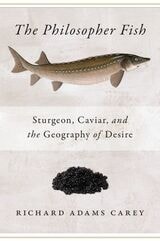
The Philosopher Fish
Sturgeon, Caviar, and the Geography of DesireRichard Adams Carey
Brandeis University Press, 2024
From the acclaimed eco-journalist Rick Carey comes a fascinating chronicle of a fast-disappearing fish—and of the people whose lives and livelihoods depend on it. Since the days of the Persian Empire, caviar has trumpeted status, wealth, prestige, and sex appeal. In this remarkable journey to caviar’s source, Carey immerses himself in the world of the sturgeon, the fish that lays these golden eggs. The sturgeon has a fascinating biological past—and a very uncertain future. Sturgeon populations worldwide have declined seventy percent in the last twenty years. Meanwhile, the beluga sturgeon, producer of the most coveted caviar, has climbed to number four on the World Wildlife Fund’s most-endangered species list. A high-stakes cocktail of business, crime, diplomacy, technology, and the dilemmas of conservation, The Philosopher Fish is the epic story of a 250-million-year-old fish struggling to survive.
This new edition includes new chapters bringing up to date the story of this elusive and mysterious fish, and the people involved with both preserving and exploiting it.
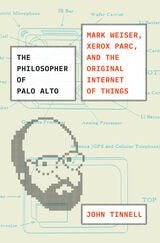
The Philosopher of Palo Alto
Mark Weiser, Xerox PARC, and the Original Internet of ThingsJohn Tinnell
University of Chicago Press, 2023
When developers and critics trace the roots of today’s Internet of Things—our smart gadgets and smart cities—they may single out the same creative source: Mark Weiser (1952–99), the first chief technology officer at Xerox PARC and the so-called “father of ubiquitous computing.” But Weiser, who died young at age 46 in 1999, would be heartbroken if he had lived to see the ways we use technology today. As John Tinnell shows in this thought-provoking narrative, Weiser was an outlier in Silicon Valley. A computer scientist whose first love was philosophy, he relished debates about the machine’s ultimate purpose. Good technology, Weiser argued, should not mine our experiences for saleable data or demand our attention; rather, it should quietly boost our intuition as we move through the world.
Informed by deep archival research and interviews with Weiser’s family and colleagues, The Philosopher of Palo Alto chronicles Weiser’s struggle to initiate a new era of computing. Working in the shadows of the dot-com boom, Weiser and his collaborators made Xerox PARC headquarters the site of a grand experiment. Throughout the building, they embedded software into all sorts of objects—coffeepots, pens, energy systems, ID badges—imbuing them with interactive features. Their push to integrate the digital and the physical soon caught on. Microsoft’s Bill Gates flagged Weiser’s Scientific American article “The Computer for the 21st Century” as a must-read. Yet, as more tech leaders warmed to his vision, Weiser grew alarmed about where they wished to take it.
In this fascinating story of an innovator and a big idea, Tinnell crafts a poignant and critical history of today’s Internet of Things. At the heart of the narrative is Weiser’s desire for deeper connection, which animated his life and inspired his notion of what technology at its best could be.
The Philosophical Life
Arthur P. Urbano
Catholic University of America Press, 2013

The Philosophical Papers of Alan Donagan, Volume 1
Historical Understanding and the History of PhilosophyAlan Donagan
University of Chicago Press, 1994
Volume 1 includes essays on Spinoza, Descartes, Bradley, Collingwood, Russell, Moore, and Popper, as well as two previously unpublished papers on the history of philosophy as a discipline, and on Ryle and Wittgenstein's nature of philosophy. Linked by Donagan's commitment to the central importance of history for philosophy and his interest in problems of historical understanding, these essays represent the remarkable scope of Donagan's thought.
The Philosophical Papers of Alan Donagan, Volume 2
Action, Reason, and ValueAlan Donagan
University of Chicago Press, 1994
Volume 2 addresses issues in the philosophy of action and moral theory. With papers on Kant, von Wright, Sellars, and Chisholm, this volume also covers a range of questions in applied ethics—from the morality of Truman's decision to drop atomic bombs on Hiroshima and Nagasaki to ethical questions in medicine and law.
The Philosophical Roots of Anthropology
William Adams
CSLI, 1998
Like most anthropologists, Adams had previously accepted the premise that anthropology's intellectual roots go back no further than the moral philosophy of the Enlightenment, or perhaps at the earliest to the humanism of the Renaissance. In this volume, Adams recognizes that many good ideas were anticipated in antiquity and that these ideas have had a lasting influence on anthropological models in particular. He has chosen five philosophical currents whose influence has been, and is, very widespread, particularly in North American anthropology: progressivism, primitivism, natural law, German idealism, and "Indianology". He argues that the influences of these currents in North American anthropology occur in a unique combination that is not found in the anthropologies of other countries. Without neglecting the anthropologies of other countries, this work serves as the basis for the explanation of the true historical and philosophical underpinnings of anthropology and its goals.
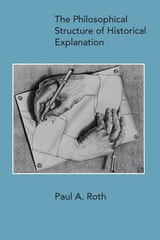
The Philosophical Structure of Historical Explanation
Paul A. Roth
Northwestern University Press, 2019
In The Philosophical Structure of Historical Explanation, Paul A. Roth resolves disputes persisting since the nineteenth century about the scientific status of history. He does this by showing why historical explanations must take the form of a narrative, making their logic explicit, and revealing how the rational evaluation of narrative explanation becomes possible. Roth situates narrative explanations within a naturalistic framework and develops a nonrealist (irrealist) metaphysics and epistemology of history—arguing that there exists no one fixed past, but many pasts. The book includes a novel reading of Thomas S. Kuhn’s The Structure of Scientific Revolutions, showing how it offers a narrative explanation of theory change in science. This book will be of interest to researchers in historiography, philosophy of history, philosophy of science, philosophy of social science, and epistemology.
The Philosophy Scare
The Politics of Reason in the Early Cold WarJohn McCumber
University of Chicago Press, 2016
McCumber begins with the story of Max Otto, whose appointment to the UCLA Philosophy Department in 1947 was met with widespread protest charging him as an atheist. Drawing on Otto’s case, McCumber details the hugely successful conservative efforts that, by 1960, had all but banished the existentialist and pragmatist paradigms—not to mention Marxism—from philosophy departments all across the country, replacing them with an approach that valorized scientific objectivity and free markets and which downplayed the anti-theistic implications of modern thought. As he shows, while there have since been many instances of definitive and even explosive rejection of this conservative trend, its effects can still be seen at American universities today.
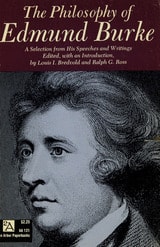
The Philosophy of Edmund Burke
A Selection from His Speeches and WritingsEdmund Burke
University of Michigan Press, 1960
The Philosophy of Punishment and the History of Political Thought
Edited by Peter Karl Koritansky
University of Missouri Press, 2011
For the last half century, the philosophical debates over punishment have been deadlocked at two schools of thought: Utilitarianism and Retributivism. In his introduction, Koritansky provides an overview of the stymied debate by analyzing H. L. A. Hart’s argument for a philosophy unifying the theories of Utilitarianism and Retributivism. While Koritansky allows that both theories have contributed substantially to the contemporary understanding of punishment, he points out that Hart’s lack of success in combining these theories proves that both are less than ideal. From this starting point, Koritansky urges transcendence from these two theories in order to respond to new developments and circumstances surrounding the enactment of punishment today.
Conveniently divided into three sections, the book explores pagan and Christian premodern thought; early modern thought, culminating in chapters on Kant and classic Utilitarianism; and postmodern thought as exemplified in the theories of Nietzsche and Foucault. In all, the essays probe the work of Plato, Saint Augustine, Saint Thomas Aquinas, Thomas Hobbes, Immanuel Kant, Cesere Beccaria, Jeremy Bentham, John Stuart Mill, Friedrich Nietzsche, and Michel Foucault.
These essays devoted to the philosophy of punishment from the perspective of political thought delve deep into key contributions from thinkers of all eras to help further debates on punishment, provide the history of political thought in order to trace changes and effects on future theories, as well as expose the roots of the two prevailing schools of thought. This collection will engage all social scientists interested in the issue of punishment and energize the ongoing debate surrounding this complex issue.
The Philosophy, Theology, and Rhetoric of Marius Victorinus
Stephen A. Cooper
SBL Press, 2022
Pagan rhetor, (Neo-)Platonist philosopher, Christian theologian
This collection of essays is devoted to the rhetoric, Neoplatonic philosophy, and Christian theology of Marius Victorinus, a mid-fourth-century professor of rhetoric and philosopher who converted to Christianity late in life. Scholars from eight different countries, some of whom have not previously published in English, reflect on debates about his writings and theological development. These topics include Victorinus's deployment of philosophical sources for trinitarian theology, possible connections in his work to Origen, Augustine, Plotinus, Porphyry, and Gnosticism, as well as his contributions to Latin rhetoric and dialectic. Contributors include Jan Dominik Bogataj, Michael Chase, Nello Cipriani, Stephen A. Cooper, Volker Henning Drecoll, Lenka Karfíková, Josef Lössl, Václav Němec, Thomas Riesenweber, Guadalupe Lopetegui Semperena, Miran Špelič, Chiara O. Tommasi, John D. Turner, and Florian Zacher. The chapters in this volume are of great interest to students of late antique philosophy, Christian theology, and Latin rhetoric.
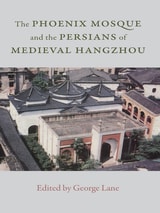
The Phoenix Mosque and the Persians of Medieval Hangzhou
Edited by George Lane
Gingko, 2018
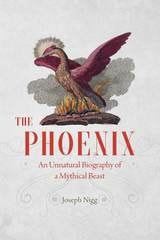
The Phoenix
An Unnatural Biography of a Mythical BeastJoseph Nigg
University of Chicago Press, 2016
Beginning in ancient Egypt and traveling around the globe and through the centuries, Nigg’s vast and sweeping narrative takes readers on a brilliant tour of the cross-cultural lore of this famous, yet little-known, immortal bird. Seeking both the similarities and the differences in the phoenix’s many myths and representations, Nigg describes its countless permutations over millennia, including legends of the Chinese “phoenix,” which was considered one of the sacred creatures that presided over China’s destiny; classical Greece and Rome, where it can be found in the writings of Herodotus and Ovid; nascent and medieval Christianity, in which it came to embody the resurrection; and in Europe during the Renaissance, when it was a popular emblem of royals. Nigg examines the various phoenix traditions, the beliefs and tales associated with them, their symbolic and metaphoric use, the skepticism and speculation they’ve raised, and their appearance in religion, bestiaries, and even contemporary popular culture, in which the ageless bird of renewal is employed as a mascot and logo, including for our own University of Chicago.
Never bested by hardship or defeated by death, the phoenix is the ultimate icon of hope and rebirth. And in The Phoenix: An Unnatural Biography of a Mythical Beast, it finally has its due—a complete chronicle worthy of such a fantastic and phantasmal creature. This entertaining and informative look at the
life and transformation of the phoenix will be the authoritative source for anyone fascinated by folklore and mythology, re-igniting our curiosity about one of myth’s greatest beasts.
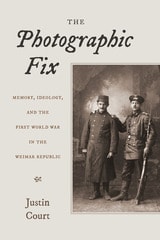
The Photographic Fix
Memory, Ideology, and the First World War in the Weimar RepublicJustin Court
University of Michigan Press, 2026
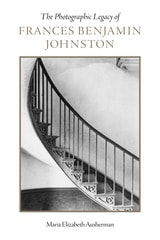
The Photographic Legacy of Frances Benjamin Johnston
Maria Elizabeth Ausherman
University of Alabama Press, 2022
An illustrated account of the life and work of the pioneering photographer
The Photographic Legacy of Frances Benjamin Johnston (1864–1952) draws on original papers and photographs from the Library of Congress to document the extraordinary life and nearly seventy-year career of this pioneering photographer. Maria Elizabeth Ausherman illuminates the early origins of Johnston’s style and vision, and her attempts to change society through her art. One of the first women to work in an emerging field dominated by men, Johnston achieved acclaim as an accomplished photographer and photojournalist.
As the official White House photographer for five administrations, she was instrumental in defining the medium and inspiring women to train in and appreciate photography. But it is her monumental nine-state survey of southern American architecture that stands as her most significant contribution to the history and development of photography both as art and as documentary. Through her photography, Johnston showed reverence for the beautiful historic buildings she appreciated and also helped shape architectural and photographic preservation in the United States.
The Photography of Gustave Le Gray
Eugenia Parry Janis
University of Chicago Press, 1987
Drawing on entirely new material Eugenia Parry Janis fully analyzes the life and work of Le Gray and demonstrates the originality of his artistic achievement in the context of discoveries about his personal and professional history. Janis, approaching the photographs of Le Gray with the methods and sensibilities of an art historian, reveals telling connections between Le Gray's choices of subject matter and formal means of presentation and the existing pictorial practice of other media such as painting. This same approach makes her sensitive to Le Gray's departures from such traditional practice, and she skillfully illustrates how he evolved from student painter into master photographer. In doing so she gives us a glimpse of the way in which Le Gray's manipulation of the photographic process was always informed by his pictorial needs and by his developing style.
The Phratries of Attica
S. D. Lambert
University of Michigan Press, 1998
The Physician's Hand
Work Culture and Conflict in American NursingBarbara Melosh
Temple University Press, 1982
This book recasts nursing history and places it in the context of women’s history, labor history, medical history, and sociology. Removed from the limited framework of professionalization, nursing history can provide a fresh perspective on broader issues in social history. First, it offers an illuminating example of the ways in which gender informs work and, conversely. How work reproduces and transforms relationships of power and inequality.
Second, the experience of nurses adds a new dimension to our understanding of work. More than a study of professionalization, nursing history is the story of women workers’ experience in a rationalizing service industry. Like other workers, nurses faced a fundamental reorganization of work that changed the content and experience of nursing. But unlike many others, they did not suffer a dilution of skill. The book also explores the shifting configurations of social relations on the job and their implications for nurses’ work.
Third, nurses’ history provides a useful standpoint for analyzing the possibilities and limitations of women’s work.
Finally, nursing history alerts us to the complexities of working women’s consciousness, countering the common notion of women’s passivity in the workplace.
The Physician’s Hand traces nursing history from the twenties to the seventies. It begins just after World War I when the "trained nurse" had gained a secure place in medical care but not yet found a niche in the hospital. Most worked in private duty. Chapter 1 outlines the theoretical framework of professionalization. Chapter 2 examines the history and culture of hospital schools, and the following chapters focus on the changing structure and experience of nursing in its three major settings: private duty nursing, public health care, and hospital work. The conclusion weighs the competing traditions of professionalization and occupational culture in nurses’ history and their meaning for the current crisis in nursing.
The Physiology of New York Boarding-Houses
Faflik, David
Rutgers University Press, 2008
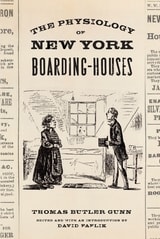
In his introduction, David Faflik considers what made Gunn's book a compelling read in the past and how today it can elucidate our understanding of the formation and evolution of urban American life and letters.
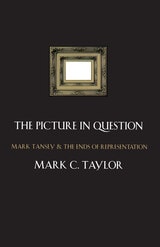
The Picture in Question
Mark Tansey and the Ends of RepresentationMark C. Taylor
University of Chicago Press, 1999
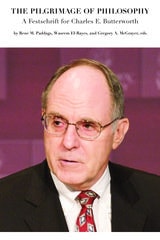
The Pilgrimage of Philosophy
A Festschrift for Charles E. Butterworthel-rayes
St. Augustine's Press, 2019
This book intends to introduce readers to the work of Charles E. Butterworth, and thereby to introduce students to Medieval islamic political philosophy, of which Butterworth is one of the world’s most prominent scholars. In a wider sense, the Festschrift introduces its readers to the current debates on Medieval islamic political philosophy, related as they are to the questions of the relationship between islam and Christianity, the Medieval to the Modern world, and reason and revelation. Butterworth’s scholarship spans six decades, primarily translating, editing, and interpreting the works of the Muslim political philosopher Alfarabi (d. 950) and Averroes (Ibn Rushd, d. 1198). He began his studies of Muslim political philosophy at a time when the Middle East and islam did not have the political salience they have acquired in more recent years. instead, Butterworth’s reason for engaging with islam was rooted in the question of the relationship between reason and revelation.
While one possible answer was pursued in the Christian, latin West, the islamic borderlands of Greek, Roman, and Muslim civilization offered another. By exploring Averroes, who provides the possibility of an Aristotelian-Islamic political philosophy, and Alfarabi, who pursues a Platonic-islamic political philosophy, Butterworth showed how islamic civilization provided a viable alternative to the theologico-political question reason v revelation, as well as serving as an inspiration to the latin West.
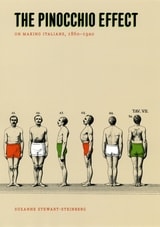
The Pinocchio Effect
On Making Italians, 1860-1920Suzanne Stewart-Steinberg
University of Chicago Press, 2007
Taking as her guiding metaphor the character of Pinocchio—a national icon made famous in 1881 by the eponymous children’s book—Susan Stewart-Steinberg argues that just like the renowned puppet, modern Italians were caught in a complex interplay between freely chosen submission and submission demanded by an outside force. In doing so, she explores all the ways that identity was constructed through newly formed attachments, voluntary and otherwise, to the young nation. Featuring deft readings of the period’s most important Italian cultural and social thinkers—including the theorist of mass psychology Scipio Sighele, the authors Matilde Serao and Edmondo De Amicis, the criminologist Cesare Lombroso, and the pedagogue Maria Montessori—Stewart-Steinberg’s richly multidisciplinary book will set a new standard in Italian studies.
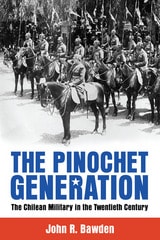
The Pinochet Generation
The Chilean Military in the Twentieth CenturyJohn R. Bawden
University of Alabama Press, 2016
Understanding the military generation that transformed modern Chile.
Chilean soldiers in the twentieth century appear in most historical accounts, if they appear at all, as decontextualized figures or simply as a single man: Augusto Pinochet. In his incisive study The Pinochet Generation: The Chilean Military in the Twentieth Century, John R. Bawden provides compelling new insights into the era and posits that Pinochet and his men were responsible for two major transformations in Chile’s constitution as well as the political and economic effects that followed.
Determined to refocus what he sees as a “decontextualized paucity” of historical information on Chile’s armed forces, Bawden offers a new perspective to explain why the military overthrew the government in 1973 as well as why and how Chile slowly transitioned back to a democracy at the end of the 1980s. Standing apart from other views, Bawden insists that the Chilean military’s indigenous traditions and customs did more than foreign influences to mold their beliefs and behavior leading up to the 1973 coup of Salvador Allende.
Drawing from defense publications, testimonial literature, and archival materials in both the United States and Chile, The Pinochet Generation characterizes the lens through which Chilean officers saw the world, their own actions, and their place in national history. This thorough analysis of the Chilean services’ history, education, values, and worldview shows how this military culture shaped Chilean thinking and behavior, shedding light on the distinctive qualities of Chile’s armed forces, the military’s decision to depose Allende, and the Pinochet dictatorship’s resilience, repressiveness, and durability.
Bawden’s account of Chile’s vast and complex military history of the twentieth century will appeal to political scientists, historians, faculty and graduate students interested in Latin America and its armed forces, students of US–Latin American diplomacy, and those interested in issues of human rights.
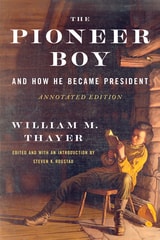
The Pioneer Boy, and How He Became President
Annotated EditionWilliam M. Thayer, edited and with an introduction by Steven K. Rogstad
University of Illinois Press, 2026
This new edition of Pioneer Boy reprints the text with extensive annotations by Steven K. Rogstad. In his reappraisal of the work, Rogstad taps the factual history woven into the plot and dialogue to illuminate how the young Lincoln presented by Thayer compares with historical documents and credible reminisces of the future president. Rogstad’s chapter-by-chapter analysis reveals the work as an astute biography while reevaluating Thayer as a source worthy of consideration within Lincoln scholarship. An introduction offers an in-depth consideration of Lincoln’s own presentations of his youth, Thayer’s career, and the book’s long life.
A new look at an overlooked text, The Pioneer Boy, and How He Became President analyzes what we can learn from William M. Thayer’s popular book.
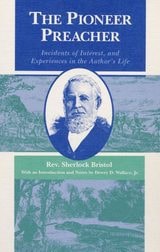
The Pioneer Preacher
Incidents of Interest, and Experiences in the Author's LifeRev. Sherlock Bristol. Introduction and notes by Dewey D. Wallace Jr. Illustrated by Isabelle Blood.
University of Illinois Press, 1989
Originally published in 1887, The Pioneer Preacher is a lively account of a Congregationalist minister's attempts to lead a sin-free existence on the American frontier. Sherlock Bristol (1815-1906) was a California gold miner, wagon train captain, Wisconsin farmer, Idaho rancher, Indian fighter, abolitionist, and Oberlin-trained clergyman. While serving a series of churches in the East, he periodically cured himself of "nervous disorders" by journeying out West. He only broke the Sabbath once---during an Indian attack!
Reflecting in his memoirs the exploits of Daniel Boone and Davy Crockett, Bristol delights in recounting his adventures, ecclesiastical or otherwise. He vividly recalls his redemption in the wilderness where he enjoyed having "little opportunity for reading books or mental exercise, and an abundance of calls for muscular employment." Greatly influenced by the evangelist Charles G. Finney at Oberlin, Bristol tried to teach miners and frontiersmen the principles of revivalism, postmillennialism, and perfectionism. In The Pioneer Preacher he shares his own disputatious views on abolition, American Indians, temperance, and other issues of his day.
The Pipes of Pan
Intertextuality and Literary Filiation in the Pastoral Tradition from Theocritus to MiltonThomas K. Hubbard
University of Michigan Press, 1999
Pastoral poetry highlights the didactic relationship of older and younger shepherds, whether as rivals or as patron and successor. As such it is an ideal form for young poets' self-representation vis-à-vis their elders, whose work they simultaneously appropriated and transformed, even as the elder poets were represented in the new texts. This influence is reenacted in every generation: Theocritus vs. his Alexandrian forebears, Vergil vs. Theocritus, Calpurnius vs. Vergil, Nemesianus vs. Vergil and Calpurnius, Petrarch vs. Vergil, Boccaccio vs. Petrarch, Spenser vs. Vergil, along with Chaucer and Milton vs. Spenser.
The Pipes of Pan combines multiple strands of contemporary intertextual theory with reception aesthetics and Harold Bloom's theory of intersubjective conflict between generations of poets. It also provides one of the first systematic studies of intertextual and intersubjective dynamics within a whole genre.
This work will be of interest to classicists, students of literary theory, comparative literature, medieval and Renaissance literature, Italian humanism, and English literature of the sixteenth and seventeenth centuries. All texts are translated.
Thomas Hubbard is Associate Professor of Classics, University of Texas at Austin.
The Place of Enchantment
British Occultism and the Culture of the ModernAlex Owen
University of Chicago Press, 2004
In answering this question for the first time, The Place of Enchantment breaks new ground in its consideration of the role of occultism in British culture prior to World War I. Rescuing occultism from its status as an "irrational indulgence" and situating it at the center of British intellectual life, Owen argues that an involvement with the occult was a leitmotif of the intellectual avant-garde. Carefully placing a serious engagement with esotericism squarely alongside revolutionary understandings of rationality and consciousness, Owen demonstrates how a newly psychologized magic operated in conjunction with the developing patterns of modern life. She details such fascinating examples of occult practice as the sex magic of Aleister Crowley, the pharmacological experimentation of W. B. Yeats, and complex forms of astral clairvoyance as taught in secret and hierarchical magical societies like the Hermetic Order of the Golden Dawn.
Through a remarkable blend of theoretical discussion and intellectual history, Owen has produced a work that moves far beyond a consideration of occultists and their world. Bearing directly on our understanding of modernity, her conclusions will force us to rethink the place of the irrational in modern culture.
The Place of the Stage
License, Play, and Power in Renaissance EnglandSteven Mullaney
University of Michigan Press, 1995
In this richly textured multidisciplinary work, Steven Mullaney examines the cultural situation of popular drama in Elizabethan and Jacobean England. Relying upon a dynamic model of cultural production, Mullaney defines an original and historically grounded perspective on the emergence of popular theater and illustrates the critical, revisionary role it played in the symbolic economy of Renaissance England. Combining literary, historical, and broadly conceived cultural analysis, he investigates, among other topics, the period's exhaustive "rehearsal" of other cultures and its discomfiting apprehensions of the self; the politics of vanished forums for ideological production such as the wonder-cabinet and the leprosarium; the cultural poetics of royal entries; and the incontinent, uncanny language of treason. As Mullaney demonstrates, Shakespearean drama relied upon and embodied the marginal license of the popular stage and, as a result, provides us with powerful readings of the shifting bases of power, license, and theatricality in Elizabethan and Jacobean England. "A major study, not merely of selected Shakespearean plays but of the very conditions of the possibility of Renaissance drama." --Louis Montrose, University of California, San Diego "Mullaney's rich and engaged reading of the place of Shakespeare's stage represents the texture of early modern life and its cultural productions in the vivid tradition of annales history and brilliantly exemplifies his theoretical call for a poetics of culture." -- Shakespeare Quarterly "Mullaney marshals an impressive range of cultural representations which, taken together, will undoubtedly force a reconsideration of the semiotics of the Elizabethan stage." --Times Higher Education Supplement ". . . something of a dramatic feat in cultural studies: literary critic Mullaney calls in a cast ranging from Clifford Geertz and Pierre Bourdieu to Raymond Williams, Mary Douglas, and Michel Foucault." --Contemporary Sociology.
The Places Where Men Pray Together
Cities in Islamic Lands, Seventh through the Tenth CenturiesPaul Wheatley
University of Chicago Press, 2001
Building on the tenth-century geographer al-Maqdisi's writings on urban centers of the Islamic world, buttressed by extensive comparative material from roadbooks, topographies, histories, adab literatures, and gazetteers of the time, Wheatley identifies the main functions of different Islamic urban centers. Chapters on each of the thirteen centers that al-Maqdisi identified, ranging from the Atlantic to the Indus and from the Caspian to the Sudan, form the heart of this book. In each case Wheatley shows how specific agglomeration and accessibility factors combined to make every city functionally distinct as a creator of effective space. He also demonstrates that, far from revolutionizing every aspect of life in these cities, the adoption of Islam often affected the development of these cities less than previously existing local traditions.
The Places Where Men Pray Together is a monumental work that will speak to scholars and readers across a broad variety of disciplines, from historians, anthropologists, and sociologists to religious historians, archaeologists, and geographers.
The Places of History
Regionalism Revisited in Latin AmericaDoris Sommer, ed.
Duke University Press, 1999
Representing a broad range of contemporary criticism, this volume features many short essays by the most well-known and respected Latin Americanists, each devoting attention to specific matters of history. The topics range from Incan architecture to Chicano and Nuyorican habitats; from turn of the century Argentine criminology to Caribbean homophobia; from the rhetorics of independence and dictatorship to Mexican ambivalence about opera and Brazil’s move beyond monarchy; and from the precarious survival of Spanish language in Latin America to its paradoxical legacy of enlightenment in the Philippines. Originally published as a special issue of Modern Language Quarterly (June 1996), this expanded edition includes a new introduction by Doris Sommer and a new essay by Vincente Rafael. Viewed together, these essays reveal a cultural richness that is sure to interest literary scholars and Latin Americanists alike.
Contributors. Carlos J. Alonso, Antonio Benítez-Rojo, John Beverley, Debra A. Castillo, Arcadio Diaz-Quiñones, Juan Flores, Mary M. Gaylord, José Limón, Josefina Ludmer, Francine Masiello, Antonio Mazzotti, Walter D. Mignolo, Sylvia Molloy, Mary Louise Pratt, Vincente Rafael, Julio Ramos, Susana Rotker, Roberto Schwarz, Diana Taylor, Nancy Vogeley
The Plains Across
The Overland Emigrants and the Trans-Mississippi West, 1840-60John D. Unruh, Jr.
University of Illinois Press, 1979
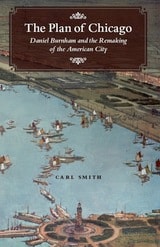
The Plan of Chicago
Daniel Burnham and the Remaking of the American CityCarl Smith
University of Chicago Press, 2006
Arguably the most influential document in the history of urban planning, Daniel Burnham’s 1909 Plan of Chicago, coauthored by Edward Bennett and produced in collaboration with the Commercial Club of Chicago, proposed many of the city’s most distinctive features, including its lakefront parks and roadways, the Magnificent Mile, and Navy Pier. Carl Smith’s fascinating history reveals the Plan’s central role in shaping the ways people envision the cityscape and urban life itself.
Smith’s concise and accessible narrative begins with a survey of Chicago’s stunning rise from a tiny frontier settlement to the nation’s second-largest city. He then offers an illuminating exploration of the Plan’s creation and reveals how it embodies the renowned architect’s belief that cities can and must be remade for the better. The Plan defined the City Beautiful movement and was the first comprehensive attempt to reimagine a major American city. Smith points out the ways the Plan continues to influence debates, even a century after its publication, about how to create a vibrant and habitable urban environment.
Richly illustrated and incisively written, his insightful book will be indispensable to our understanding of Chicago, Daniel Burnham, and the emergence of the modern city.

The Planet Mars
A History of Observation and DiscoveryWilliam Sheehan
University of Arizona Press, 1996
In this timely and vividly written account, William Sheehan traces human fascination with Mars back to the naked-eye observers of the planet. He recalls the early telescopic observers who first made out enigmatic markings and polar caps on its surface. Through lively historical anecdotes, he describes in detail the debate over the so-called canals of Mars, which encouraged speculation that the planet might be inhabited. Finally, Sheehan describes more recent theories about the planet, leading up to the present, when unmanned spacecraft have enabled us to make giant strides in exploration.
Well documented and sparked with human interest, this book will be a useful companion and guide in interpreting the barrage of headlines about Mars that is sure to come over the next few years. Amateurs will appreciate the contributions that have been made to Martian studies by people like themselves, and professionals will find much original material that has never before been published. The American Mars Global Surveyor is scheduled for launch in November 1996, and soon after the American Mars Pathfinder will make its way toward the red planet. A Russian mission consisting of an orbiter and two landers will be launched in October 1997. These space travelers will write a whole new chapter in the dramatic story of Mars, a planet whose exploration has only just begun. Astronomy Book Club main selection and selections of Book-of-the-Month Club and Quality Paperback Book Club.
The Platform Economy
How Japan Transformed the Consumer InternetMarc Steinberg
University of Minnesota Press, 2019
Offering a deeper understanding of today’s internet media and the management theory behind it
Platforms are everywhere. From social media to chat, streaming, credit cards, and even bookstores, it seems like almost everything can be described as a platform. In The Platform Economy, Marc Steinberg argues that the “platformization” of capitalism has transformed everything, and it is imperative that we have a historically precise, robust understanding of this widespread concept.
Taking Japan as the key site for global platformization, Steinberg delves into that nation’s unique technological and managerial trajectory, in the process systematically examining every facet of the elusive word platform. Among the untold stories revealed here is that of the 1999 iPhone precursor, the i-mode: the world’s first widespread mobile internet platform, which became a blueprint for Apple and Google’s later dominance of the mobile market. Steinberg also charts the rise of social gaming giants GREE and Mobage, chat tools KakaoTalk, WeChat, and LINE, and video streaming site Niconico Video, as well as the development of platform theory in Japan, as part of a wider transformation of managerial theory to account for platforms as mediators of cultural life.
Analyzing platforms’ immense impact on contemporary media such as video streaming, music, and gaming, The Platform Economy fills in neglected parts of the platform story. In narrating the rise and fall of Japanese platforms, and the enduring legacy of Japanese platform theory, this book sheds light on contemporary tech titans like Facebook, Google, Apple, and Netflix, and their platform-mediated transformation of contemporary life—it is essential reading for anyone wanting to understand what capitalism is today and where it is headed.
The Platonic Tradition
Peter Kreeft
St. Augustine's Press, 2016
In the first of his eight lectures, Peter Kreeft defines Platonism and its “Big Idea,” the idea of a transcendent reality that the history of philosophy has labeled “Platonic Ideas” or Platonic Forms. In the second lecture, he briefly explores Plato’s two basic predecessors or sources, myth and Socrates; and then looks at 12 applications of the Forms in Plato’s own dialogues. The third lecture covers the three most important modifications or additions to Plato himself in the Platonic tradition: Aristotle, Plotinus, and Augustine, each of whom gave the Forms a new metaphysical address. The fourth lecture explores six Christian Platonists, three in the New Testament and three philosophers, Justin Martyr, Bonaventure, and Aquinas.

The Play in the System
The Art of Parasitical ResistanceAnna Watkins Fisher
Duke University Press, 2020
The Play of Allusion in the Historia Augusta
David Rohrbacher
University of Wisconsin Press, 2015
The Play of Allusion in the Historia Augusta
David Rohrbacher
University of Wisconsin Press, 2020
The Play of Fictions
Studies in Ovid's Metamorphoses Book 2A. M. Keith
University of Michigan Press, 1992
The Player's Passion
Studies in the Science of ActingJoseph R. Roach
University of Michigan Press, 1993
The Players
The Men Who Made Las VegasJack Sheehan
University of Nevada Press, 1997
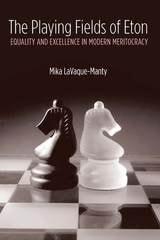
The Playing Fields of Eton
Equality and Excellence in Modern MeritocracyMika LaVaque-Manty
University of Michigan Press, 2009
"Beautifully written and brilliantly argued, The Playing Fields of Eton takes us on a three-century tour of modern mental and physical life. We visit gymnasiums and dueling fields, murderball courts and Olympic venues, and while immersed in thought-provoking stories of people wrestling with the twin pursuit of equality and excellence, we find ourselves learning what it might mean to be modern. With equal measures of erudition and gentle humor, Mika LaVaque-Manty convincingly refutes the view that egalitarian progress forecloses possibilities for human excellence."
---Elisabeth Ellis, Texas A&M University
"A very insightful and clearly written philosophical inquiry into the nature of sport."
---Marion Smiley, Brandeis University
"A marvelously original analysis of the tensions---and interdependence---between equality and excellence in modern political life. From eighteenth-century dueling to contemporary doping in sports, LaVaque-Manty illuminates the bodily life of democracy at play, and challenges us to think in new ways about the connections between achievement and autonomy. The Playing Fields of Eton is an important book that pushes liberal and democratic theory in fruitful new directions."
---Sharon Krause, Brown University
Can equality and excellence coexist? If we assert that no person stands above the rest, can we encourage and acknowledge athletic, artistic, and intellectual achievements? Perhaps equality should merely mean equality of opportunity. But then how can society reconcile inherent differences between men and women, the strong and the weak, the able-bodied and the disabled?
In The Playing Fields of Eton, Mika LaVaque-Manty addresses questions that have troubled philosophers, reformers, and thoughtful citizens for more than two centuries. Drawing upon examples from the eighteenth-century debate over dueling as a gentleman's prerogative to recent controversies over athletes' use of performance-enhancing drugs, LaVaque-Manty shows that societies have repeatedly redefined equality and excellence. One constant remains, however: sports provide an arena for working out tensions between these two ideals.
Just as in sports where athletes are sorted by age, sex, and professional status, in modern democratic society excellence has meaning only in the context of comparisons among individuals who are, theoretically, equals. LaVaque-Manty's argument will engage philosophers, and his inviting prose and use of familiar illustrations will welcome nonphilosophers to join the conversation.
Mika LaVaque-Manty is Associate Professor of Political Science at the University of Michigan.
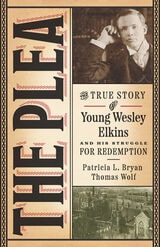
The Plea
The True Story of Young Wesley Elkins and His Struggle for RedemptionPatricia L. Bryan
University of Iowa Press, 2022
On a moonlit night in 1889, Iowa farmer John Elkins and his young wife, Hattie, were brutally murdered in their bed. Eight days later, their son, eleven-year-old Wesley Elkins, was arrested and charged with murder. The community reeled with shock by both the gruesome details of the homicides and the knowledge of the accused perpetrator—a small, quiet boy weighing just 75 pounds.
Accessible and fast-moving, The Plea delivers a complete, complex, and nuanced narrative of this horrific crime, while shedding light on the legal, social, and political environment of Iowa and the country in the late 1800s and early 1900s.
The Pleasure of Miss Pym
By Charles Burkhart
University of Texas Press, 1987
When British writers Philip Larkin and Lord David Cecil named Barbara Pym one of the twentieth century's most underrated authors in a 1977 Times Literary Supplement survey, they started a Barbara Pym revival that continued unabated in Great Britain and the United States. Barbara Pym's delightful tales of jumble sales and parish meetings, her ironic insights into the relationships between women and men, have won a devoted following. Indeed she is often compared to that most accomplished author of comedies of manners, Jane Austen.
The Pleasure of Miss Pym is a critical study of Pym as comic writer and of the links between her life and autobiographical writings and her fiction, written with a liveliness of style and tone that matches Pym's own. Not only does Charles Burkhart provide perceptive discussions of Pym's life and novels, he also illuminates the worldview represented in her work, the unique nature of her comedy, her religion, her place within the history of the novel, and her penetrating insights into male-female relationships. All of Pym's work, including the 1986 posthumous publication, An Academic Question, is intelligently surveyed here. Scholars of contemporary English literature will derive both instruction and pleasure from this elegantly written study, as will Pym's admiring readers, for whom it is also intended.
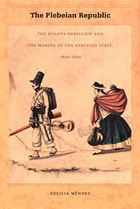
The Plebeian Republic
The Huanta Rebellion and the Making of the Peruvian State, 1820–1850Cecilia Méndez
Duke University Press, 2005
In addition to official sources such as trial dossiers, census records, tax rolls, wills, and notary and military records, Méndez uses a wide variety of previously unexplored sources produced by the mostly Quechua-speaking rebels. She reveals the Huanta rebellion as a complex interaction of social, linguistic, economic, and political forces. Rejecting ideas of the Andean rebels as passive and reactionary, she depicts the barely literate insurgents as having had a clear idea of national political struggles and contends that most local leaders of the uprising invoked the monarchy as a source of legitimacy but did not espouse it as a political system. She argues that despite their pronouncements of loyalty to the Spanish crown, the rebels’ behavior evinced a political vision that was different from both the colonial regime and the republic that followed it. Eventually, their political practices were subsumed into those of the republican state.