Results by title
28167 books match the query 'History' and 6372 start with t

The Scientific Enterprise in Early Modern Europe
Readings from IsisEdited by Peter Dear
University of Chicago Press, 1997
The anthology features classic and prize-winning articles by renowned scholars, including "Totius in verba: Rhetoric and Authority in the Early Royal Society," by Peter Dear; "The Melanchthon Circle, Rheticus, and the Wittenberg Interpretation of the Copernican Theory," by Robert S. Westman; "Laboratory Design and the Aim of Science," by Owen Hannaway; "Geography as Self-Definition in Early Modern England," by Lesley B. Cormack; "What Happened to Occult Qualities in the Scientific Revolution?" by Keith Hutchison; and "Galileo, Motion, and Essences," by Margaret J. Osler.
Also, "Scientific Patronage: Galileo and the Telescope," by Richard S. Westfall; "The Telescope in the Seventeenth Century," by Albert Van Helden; "Descartes on Refraction," by Bruce S. Eastwood; "Early Seventeenth-Century Atomism," by Christoph Meinel; "Robert Boyle and Structural Chemistry in the Seventeenth Century," by Thomas S. Kuhn; "Newton's Alchemy and His Theory of Matter," by B. J. T. Dobbs; "The House of Experiment in Seventeenth-Century England," by Steven Shapin; and "Maria Winkelmann at the Berlin Academy," by Londa Scheibinger.
This carefully structured collection will help readers approach complex questions—involving argument and experiment, audience and agency, authority and institutions.
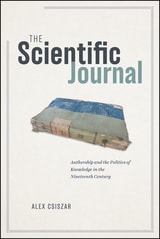
The Scientific Journal
Authorship and the Politics of Knowledge in the Nineteenth CenturyAlex Csiszar
University of Chicago Press, 2018
The Scientific Journal tells the story of how that changed. Alex Csiszar takes readers deep into nineteenth-century London and Paris, where savants struggled to reshape scientific life in the light of rapidly changing political mores and the growing importance of the press in public life. The scientific journal did not arise as a natural solution to the problem of communicating scientific discoveries. Rather, as Csiszar shows, its dominance was a hard-won compromise born of political exigencies, shifting epistemic values, intellectual property debates, and the demands of commerce. Many of the tensions and problems that plague scholarly publishing today are rooted in these tangled beginnings. As we seek to make sense of our own moment of intense experimentation in publishing platforms, peer review, and information curation, Csiszar argues powerfully that a better understanding of the journal’s past will be crucial to imagining future forms for the expression and organization of knowledge.

The Scientific Life
A Moral History of a Late Modern VocationSteven Shapin
University of Chicago Press, 2008
Conventional wisdom has long held that scientists are neither better nor worse than anyone else, that personal virtue does not necessarily accompany technical expertise, and that scientific practice is profoundly impersonal. Shapin, however, here shows how the uncertainties attending scientific research make the virtues of individual researchers intrinsic to scientific work. From the early twentieth-century origins of corporate research laboratories to the high-flying scientific entrepreneurship of the present, Shapin argues that the radical uncertainties of much contemporary science have made personal virtues more central to its practice than ever before, and he also reveals how radically novel aspects of late modern science have unexpectedly deep historical roots. His elegantly conceived history of the scientific career and character ultimately encourages us to reconsider the very nature of the technical and moral worlds in which we now live.
Building on the insights of Shapin’s last three influential books, featuring an utterly fascinating cast of characters, and brimming with bold and original claims, The Scientific Life is essential reading for anyone wanting to reflect on late modern American culture and how it has been shaped.
The Scientific Literature
A Guided TourEdited by Joseph E. Harmon and Alan G. Gross
University of Chicago Press, 2007
The scientific article has been a hallmark of the career of every important western scientist since the seventeenth century. Yet its role in the history of science has not been fully explored. Joseph E. Harmon and Alan G. Gross remedy this oversight with The Scientific Literature, a collection of writings—excerpts from scientific articles, letters, memoirs, proceedings, transactions, and magazines—that illustrates the origin of the scientific article in 1665 and its evolution over the next three and a half centuries.
Featuring articles—as well as sixty tables and illustrations, tools vital to scientific communication—that represent the broad sweep of modern science, The Scientific Literature is a historical tour through both the rhetorical strategies that scientists employ to share their discoveries and the methods that scientists use to argue claims of new knowledge. Commentaries that explain each excerpt’s scientific and historical context and analyze its communication strategy accompany each entry.
A unique anthology, The Scientific Literature will allow both the scholar and the general reader to experience first hand the development of modern science.
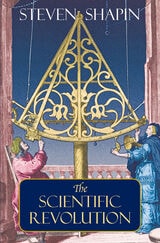
The Scientific Revolution
Steven Shapin
University of Chicago Press, 1996
"Shapin's account is informed, nuanced, and articulated with clarity. . . . This is not to attack or devalue science but to reveal its richness as the human endeavor that it most surely is. . . .Shapin's book is an impressive achievement."—David C. Lindberg, Science
"Shapin has used the crucial 17th century as a platform for presenting the power of science-studies approaches. At the same time, he has presented the period in fresh perspective."—Chronicle of Higher Education
"Timely and highly readable . . . A book which every scientist curious about our predecessors should read."—Trevor Pinch, New Scientist
"It's hard to believe that there could be a more accessible, informed or concise account of how it [the scientific revolution], and we have come to this. The Scientific Revolution should be a set text in all the disciplines. And in all the indisciplines, too."—Adam Phillips, London Review of Books
"Shapin's treatise on the currents that engendered modern science is a combination of history and philosophy of science for the interested and educated layperson."—Publishers Weekly
"Superlative, accessible, and engaging. . . . Absolute must-reading."—Robert S. Frey, Bridges
"This vibrant historical exploration of the origins of modern science argues that in the 1600s science emerged from a variety of beliefs, practices, and influences. . . . This history reminds us that diversity is part of any intellectual endeavor."—Choice
"Most readers will conclude that there was indeed something dramatic enough to be called the Scientific Revolution going on, and that this is an excellent book about it."—Anthony Gottlieb, The New York Times Book Review

The Scientific Revolution
Steven Shapin
University of Chicago Press, 2018
“An excellent book.”—Anthony Gottlieb, New York Times Book Review
“Timely and highly readable. . . . A book which every scientist curious about our predecessors should read.”—Trevor Pinch, New Scientist
“Shapin's account is informed, nuanced, and articulated with clarity. . . . This is not to attack or devalue science but to reveal its richness as the human endeavor that it most surely is. . . . Shapin's book is an impressive achievement.”—David C. Lindberg, Science
“It's hard to believe that there could be a more accessible, informed or concise account. . . . The Scientific Revolution should be a set text in all the disciplines. And in all the indisciplines, too.”—Adam Phillips, London Review of Books
The Scientific Revolution
A Historiographical InquiryH. Floris Cohen
University of Chicago Press, 1994
Cohen's discussions range from scholarly interpretations of Galileo, Kepler, and Newton, to the question of why the Scientific Revolution took place in seventeenth-century Western Europe, rather than in ancient Greece, China, or the Islamic world. Cohen contends that the emergence of early modern science was essential to the rise of the modern world, in the way it fostered advances in technology.
A valuable entrée to the literature on the Scientific Revolution, this book assesses both a controversial body of scholarship, and contributes to understanding how modern science came into the world.

The Scientific-Military State
How Enlightened Engineers Reinvented Early American GovernmentSveinn M. Jóhannesson
University of Chicago Press, 2026
In The Scientific-Military State, Sveinn M. Jóhannesson charts the emergence of a new kind of governance in early-nineteenth-century America: the scientific-military state. Federal officials used mathematics, science, and other forms of enlightened knowledge to launch the nation’s very first experiments in scientific education and expert administration. These figures forged a new intellectual elite that socially elevated itself above ordinary soldiers, workers, and civilians and reshaped the military state itself beyond familiar models of standing army or militia. Originating primarily from the US Military Academy at West Point, these experts, who were often engineers, debated statecraft, analyzed topography, designed fortifications, manufactured weapons, built infrastructure, and exercised military power as the United States spread across the continent. But the even deeper result was a transformed relationship between the government and its citizens, one that echoes today.
The Scope of History
Studies in the Historiography of Alfonso el SabioCharles F. Fraker
University of Michigan Press, 1996
In his introduction the author addresses the place of Alfonso's work in its own time, giving the reader a notion of what other works in the genre were like and how they differ. The connecting thread running through these chapters is a continuing focus on the art of the compiler. Medieval historical compilations are by definition scissors-and-paste jobs, stringing older texts together to tell new, different stories. But the Alfonsine editors bend the rules: in the short run they make their work yield the themes they think important, and in the long run they build a literary monument of impressive architecture.
Charles F. Fraker is Professor Emeritus in Romance Languages, University of Michigan.
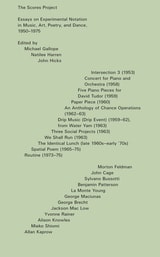
The Scores Project
Essays on Experimental Notation in Music, Art, Poetry, and Dance, 1950–1975Michael Gallope
J. Paul Getty Trust, The, 2025
Individuals working in and across the fields of visual art, music, poetry, theater, and dance in the mid–twentieth century began to use experimental scores in ways that revolutionized artistic practice and opened up new forms of interdisciplinary collaboration. Their experimental methods—associated with the neo-avant-garde, neo-Dadaism, intermedia, Fluxus, and postmodernism—exploded in notoriety during the 1960s in locales from New York to Europe, East Asia, and Latin America, becoming foundational to global trends in contemporary art and performance.
The Scores Project provides an in-depth view of this historical moment. Through expert commentaries from an interdisciplinary team of scholars with accompanying illustrations, this publication examines a series of experimental scores by John Cage, George Brecht, Sylvano Bussotti, Morton Feldman, Allan Kaprow, Alison Knowles, Jackson Mac Low, Benjamin Patterson, Yvonne Rainer, Mieko Shiomi, David Tudor, and La Monte Young. Ambitious, provocative, and playful, The Scores Project is an illuminating resource to scholars and students who seek to understand this innovative and historically complex moment in the history of art.
An expanded edition of this open-access publication is available for free online at www.getty.edu/publications/scores/. It includes more than 2,800 images, audio/video files, and interactive features. Also available are free PDF and EPUB downloads of the book.

The Scots Irish of Early Pennsylvania
A Varied PeopleJudith A. Ridner
Temple University Press, 2018
The Scots Irish were one of early Pennsylvania’s largest non-English immigrant groups. They were stereotyped as frontier ruffians and Indian haters. In The Scots Irish of Early Pennsylvania, historian Judith Ridner insists that this immigrant group was socio-economically diverse. Servants and free people, individuals and families, and political exiles and refugees from Ulster, they not only pioneered new frontier settlements, but also populated the state’s cities—Philadelphia and Pittsburgh—and its towns, such as Lancaster, Easton, and Carlisle.
Ridner provides a much-overdue synthesis and reassessment of this immigrant group, tracing a century of Scotch-Irish migration from 1720 to 1820. These men and women brought their version of Ulster to the colonies in their fierce commitments to family, community, entrepreneurship, Presbyterianism, republican politics, and higher education. The settlements they founded across the state, including many farms, businesses, meetinghouses, and colleges, ensured that Pennsylvania would be their cradle in America, and these settlements stand as powerful testaments to their legacy to the state’s history and development.

The Scramble for the Amazon and the "Lost Paradise" of Euclides da Cunha
Susanna B. Hecht
University of Chicago Press, 2013

The Scrapbook in American Culture
Susan Tucker
Temple University Press, 2006

The Scribes of the Torah
The Formation of the Pentateuch in Its Literary and Historical ContextsKonrad Schmid
SBL Press, 2023
A revised view of the Pentateuch with consequences for the broader literary history of the Bible
This collection of thirty-one studies on the Pentateuch represents more than twenty years of Konrad Schmid’s research and publications advocating for a new view of the Pentateuch’s formation. Schmid’s essays present the case for a Persian period Priestly document that provided a basic narrative thread to the Torah, which included separate, pre-Priestly components of narratives in Genesis and the Moses story. Schmid’s open discussion includes evidence from various fields, such as literary history, comparative cultural history, historical linguistics, epigraphy, and archaeology. The essays are divided into eight sections usefully structured around the themes of the Pentateuch in the Enneateuch, the history of scholarship, the formation of the Torah, Genesis, the Moses story, the Priestly document, legal texts, and the Pentateuch in the history of ancient Israel’s religion.

The Scripps Newspapers Go to War, 1914-18
Dale Zacher
University of Illinois Press, 2007
Zacher's account delves into details inside a major newspaper operation during World War I and provides fascinating accounts of its struggles with competition, attending to patriotic duties, and internal editorial dissent. Zacher also looks at war-related issues, considering the newspapers' relationship with President Woodrow Wilson, American neutrality, the move to join the war, and fallout from disillusionment over the actuality of war. As Zacher shows, the progressive spirit and political independence at the Scripps newspapers came under attack and was changed forever during the era.
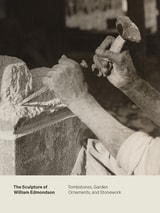
The Sculpture of William Edmondson
Tombstones, Garden Ornaments, and StoneworkMarin R. Sullivan
Vanderbilt University Press, 2021
William Edmondson (1874–1951) was the first African American sculptor to have a one-person exhibition at the Museum of Modern Art. Edmondson started sculpting in his late fifties, after the Nashville Women's Hospital, where he worked as a janitor, closed. During his life he was well known for his yard art, such as whimsical birdbaths and "critters" of real and imaginary provenance, and the grave markers he carved for African American families. His sculptures are now highly sought after by collectors.
The Sculpture of William Edmondson: Tombstones, Garden Ornaments, and Stonework is the first large-scale museum examination of artist William Edmondson's career in over twenty years. Organized by Cheekwood Curator-at-Large Marin R. Sullivan, the exhibition draws upon new scholarship and methodologies to contextualize Edmondson's sculpture, both within the histories of Nashville during the Interwar years and the art histories of modern art in the United States.
Edmondson has largely been confined to narratives that focus on his artistic discovery by white patrons in the 1930s, his work's formal resonance with so-called primitivism and direct carving techniques, and his place in the traditions of African American "outsider" art. This exhibition revisits Edmondson's work within these frameworks, but also seeks to reevaluate his sculpture on its own terms and as part of a comprehensive practice that included the creation of commercial objects rather than strictly fine art.
The exhibition's title references the sign that hung on the outside of Edmondson's studio, advertising what was for sale and on view to the public in his yard, including tombstones, birdbaths, and statuary meant to be used and intended for outdoor rather than gallery display.
The Sea Mark
Captain John Smith’s Voyage to New EnglandRussell M. Lawson
University Press of New England, 2015

The Sea
Thalassography and HistoriographyPeter N. Miller, Editor
University of Michigan Press, 2013
The Seabed
A Human and Literary HistoryJimmy Packham and Laurence Publicover
University of Chicago Press, 2026
Uncovers human histories, cultures, and politics on the ocean floor.
While often characterized as an alien realm, the seabed has long been fundamental to human life. As new technologies offer ever greater access to this environment, the bottom of the ocean is key to debates about our future—and yet we are poorly equipped to understand our relation to it.
The Seabed plumbs the ocean’s depths to reveal a rich and complex history of human activity at the seafloor, a history that extends from the classical world to the present. Jimmy Packham and Laurence Publicover highlight the literary significance of the seabed, examining works by writers including Aphra Behn, Anton Chekhov, Euripides, Herman Melville, M. NourbeSe Philip, William Shakespeare, Derek Walcott, and H. G. Wells, as well as lesser-known authors who have imagined this dark and mysterious realm. Putting these in dialogue with the science writing of Rachel Carson, Sylvia Earle, and others, and with visual art, politics, and historical case studies, they show how imaginative speculations concerning the ocean floor have influenced, and continue to inform, human activity on the seabed itself. Through chapters that explore sea burial and seafloor memorials, scientific exploration, deep-sea infrastructure, salvage from the seabed, and deep-sea extraction, the book reveals that the ocean floor’s cultural visibility has fluctuated over time. But longstanding visions of the seabed continue to shape our relationship with this place, a site for undersea cables and—in the near future—deep-sea mining.
The bottom of the ocean is closer than we think. Understanding our history there is crucial to assessing the present and imagining our future.

The Search for God's Law
Islamic Jurisprudence in the Writings of Sayf al-Din al-AmidiBernard G Weiss
University of Utah Press, 2011
Weiss’s new introduction provides an overview of Amidi’s jurisprudence that facilitates deeper comprehension of the challenging dialectic of the text. This edition includes an in-depth analysis of the nature of language and the ways in which it mediates the law, while shaping it at the same time. An updated index has been added.

The Search for Justice
Lawyers in the Civil Rights Revolution, 1950–1975Peter Charles Hoffer
University of Chicago Press, 2019
The Search for Justice is a look the role of the lawyers throughout the period, focusing on one of the central issues of the time: school segregation. The most notable participants to address this issue were the public interest lawyers of the NAACP’s Legal Defense Fund, whose counselors brought lawsuits and carried out appeals in state and federal courts over the course of twenty years. But also playing a part in the story were members of the bar who defended Jim Crow laws explicitly or implicitly and, in some cases, also served in state or federal government; lawyers who sat on state and federal benches and heard civil rights cases; and, finally, law professors who analyzed the reasoning of the courts in classrooms and public forums removed from the fray. With rich, copiously researched detail, Hoffer takes readers through the interactions of these groups, setting their activities not only in the context of the civil rights movement but also of their full political and legal legacies, including the growth of corporate private legal practice after World War II and the expansion of the role of law professors in public discourse, particularly with the New Deal. Seeing the civil rights era through the lens of law enables us to understand for the first time the many ways in which lawyers affected the course and outcome of the movement.
The Search for Mabila
The Decisive Battle between Hernando de Soto and Chief TascalusaEdited by Vernon James Knight Jr.
University of Alabama Press, 2009

The Search for Medieval Music in Africa and Germany, 1891-1961
Scholars, Singers, MissionariesAnna Maria Busse Berger
University of Chicago Press, 2020
The book unfolds in three parts. Busse Berger starts with the origins of comparative musicology circa 1900, when early proponents used ideas from comparative linguistics to test whether parallels could be drawn between nonwestern and medieval European music. She then turns to youth movements of the era—the Wandervogel, Jugendmusikbewegung, and Singbewegung—whose focus on joint music making influenced many musicologists. Finally, she considers case studies of Protestant and Catholic mission societies in what is now Tanzania, where missionaries—many of them musicologists and former youth-group members—extended the discipline via ethnographic research and a focus on local music and communities. In highlighting these long-overlooked transnational connections and the role of global music in early musicology, Busse Berger shapes a fresh conception of music scholarship during a pivotal part of the twentieth century.

The Search for a Socialist El Dorado
Finnish Immigration to Soviet Karelia from the United States and Canada in the 1930sAlexey Golubev and Irina Takala
Michigan State University Press, 2014
The Search for the Codex Cardona
Arnold J. Bauer
Duke University Press, 2009
Bauer first saw the Codex Cardona in 1985 in the Crocker Nuclear Laboratory at the University of California, Davis, where scholars from Stanford and the University of California were attempting to establish its authenticity. Allowed to gently lift a few pages of this ancient treasure, Bauer was hooked. By 1986, the Codex had again disappeared from public view. Bauer’s curiosity about the Codex and its whereabouts led him down many forking paths—from California to Seville and Mexico City, to the Firestone Library in Princeton, to the Getty Museum in Los Angeles and Christie’s in New York—and it brought him in contact with an international cast of curators, agents, charlatans, and erudite book dealers. The Search for the Codex Cardona is a mystery that touches on issues of cultural patrimony, the workings of the rare books and manuscripts trade, the uncertainty of archives and evidence, and the ephemerality of the past and its remains.
The Seasons Of Fire
Reflections On Fire In The WestDavid J. Strohmaier
University of Nevada Press, 2001
Fire is a fearsome constant in the America West. As the author David J. Strohmaier notes, "Whether we have tended a campfire along Oregon's Deschutes River in March, engaged the advancing front of a Great Basin wildfire in the torrid heat of August, or watched fire settle into the subdued, smoldering leaf piles of October, all of our lives, to one degree or another, are bracketed by fire." In The Seasons of Fire, Strohmaier effectively blends nature writing, personal essay, and philosophical analysis as he deliberately crosses disciplinary boundaries. He discusses the "moral" dimensions of fire—not only whether fires are good, bad, or indifferent phenomena, but also how fire, more generally understood, shapes meaning for human life. The consequences of discussing the moral side of fire speak directly to the contours of the human soul, and to our sense of our place on the land. Strohmaier, a long-term firefighter himself, includes accurate and sometimes gut-wrenching descriptions of the firefighter's experience.

The Second Amendment on Trial
Critical Essays on District of Columbia v. HellerSaul A. Cornell
University of Massachusetts Press, 2013
On the final day of its 2008 term, a sharply divided U.S. Supreme Court issued a 5-to-4 decision striking down the District of Columbia's stringent gun control laws as a violation of the Second Amendment. Reversing almost seventy years of settled precedent, the high court reinterpreted the meaning of the “right of the people to keep and bear arms” to affirm an individual right to own a gun in the home for purposes of self-defense. The landmark ruling not only opened a new chapter in the contentious history of gun rights and gun control but also revealed both the strengths and problems of originalist constitutional theory and jurisprudence.
This volume brings together some of the best scholarship on the Heller case, with essays by legal scholars and historians representing a range of ideological viewpoints and applying different interpretive frameworks. Following the editors' introduction, which describes the issues involved and the arguments on each side, the essays are organized into four sections. The first includes two of the most important historical briefs filed in the case, while the second offers different views of the role of originalist theory. Section three presents opposing interpretations of the ruling and its relationship to modern constitutional doctrine. The final section explores historical research post-Heller, including new findings on patterns of gun ownership in colonial and Revolutionary America.
In addition to the editors, contributors include Nelson Lund, Joyce Lee Malcolm, Jack Rakove, Reva B. Siegel, Cass R. Sunstein, Kevin M. Sweeney, and J. Harvie Wilkinson III.

The Second Battle for Africa
Garveyism, the US Heartland, and Global Black FreedomErik S. McDuffie
Duke University Press, 2024

The Second Conquest of Latin America
Coffee, Henequen, and Oil during the Export Boom, 1850-1930Edited by Steven C. Topik and Allen Wells
University of Texas Press, 1997
Between 1850 and 1930, Latin America's integration into the world economy through the export of raw materials transformed the region. This encounter was nearly as dramatic as the conquistadors' epic confrontation with Native American civilizations centuries before. An emphasis on foreign markets and capital replaced protectionism and self-sufficiency as the hemisphere's guiding principles. In many ways, the means employed during this period to tie Latin America more closely to western Europe and North America resemble strategies currently in vogue. Much can be learned from analyzing the first time that Latin Americans embraced export-led growth.
This book focuses on the impact of three key export commodities: coffee, henequen, and petroleum. The authors concentrate on these rather than on national economies because they illustrate more concretely the interaction between the environment, natural and human resources, and the world economy. By analyzing how different products spun complex webs of relationships with their respective markets, the essays in this book illuminate the tensions and contradictions found in the often conflictive relationship between the local and the global, between agency and the not-so-invisible hand. Ultimately, the contributors argue that the results of the "second conquest" were not one-sided as Latin Americans and foreigners together forged a new economic order—one riddled with contradictions that Latin America is still attempting to resolve today.
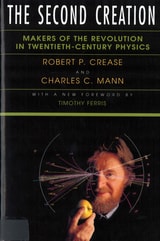
The Second Creation
Makers of the Revolution in Twentieth-Century PhysicsCrease, Robert P
Rutgers University Press, 1996
The Second Creation tells the story of some of the most talented and idiosyncratic people in the world--many times in their own words. Crease and Mann conducted hundreds of interviews to capture the thinking and the personalities as well as the science. The authors make this complex subject matter clear and absorbing.
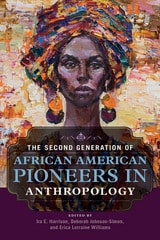
The Second Generation of African American Pioneers in Anthropology
Ira E. Harrison, Deborah Johnson-Simon, Erica Lorraine Williams
University of Illinois Press, 2018

The Second Great Emancipation
The Mechanical Cotton Picker, Black Migration, and How They Shaped the Modern SouthDonald Holley
University of Arkansas Press, 2000
In The Second Great Emancipation, Donald Holley uses statistical and narrative analysis to demonstrate that farm mechanization occurred in the Delta region of Arkansas, Louisiana, and Mississippi after the region’s population of farm laborers moved away for new opportunities. Rather than pushing labor off the land, Holley argues, the mechanical cotton picker enabled the continuation of cotton cultivation in the post-plantation era, opening the door for the civil rights movement, while ushering a period of prosperity into the South.
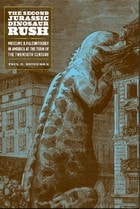
The Second Jurassic Dinosaur Rush
Museums and Paleontology in America at the Turn of the Twentieth CenturyPaul D. Brinkman
University of Chicago Press, 2010
The so-called “Bone Wars” of the 1880s, which pitted Edward Drinker Cope against Othniel Charles Marsh in a frenzy of fossil collection and discovery, may have marked the introduction of dinosaurs to the American public, but the second Jurassic dinosaur rush, which took place around the turn of the twentieth century, brought the prehistoric beasts back to life. These later expeditions—which involved new competitors hailing from leading natural history museums in New York, Chicago, and Pittsburgh—yielded specimens that would be reconstructed into the colossal skeletons that thrill visitors today in museum halls across the country.
Reconsidering the fossil speculation, the museum displays, and the media frenzy that ushered dinosaurs into the American public consciousness, Paul Brinkman takes us back to the birth of dinomania, the modern obsession with all things Jurassic. Featuring engaging and colorful personalities and motivations both altruistic and ignoble, The Second Jurassic Dinosaur Rush shows that these later expeditions were just as foundational—if not more so—to the establishment of paleontology and the budding collections of museums than the more famous Cope and Marsh treks. With adventure, intrigue, and rivalry, this is science at its most swashbuckling.

The Second Palestinian Intifada
A Chronicle of a People's StruggleRamzy Baroud
Pluto Press, 2006
Ramzy Baroud is a veteran journalist and former producer for Al-Jazeera TV. This is his comprehensive account of the momentous events of the last five years which shaped the political landscape not only of Palestine and Israel but of the entire Middle East region.
Addressing the most controversial issues, including the alarming escalation in suicide bombings, and the construction of the Separation Wall, he reports on the huge rate of unemployment and hunger in the Occupied Territories -- statistics so critical that NGOs compare their magnitude to African nations such as the Congo. From the brutality of the Israeli army to the ever-compromising nature of the Palestinian Authority, few are spared Baroud’s thoughtful critique.
The book is clear and concise, with one chapter dedicated to the major events of each year, and includes a comprehensive timeline.
The Second Part of the Popular Errors
Laurent Joubert
University of Alabama Press, 1995
English translation of the second volume of Laurent Joubert’s 1578 French work Erreurs Populaires
Joubert proposed to dispel folk remedies and folklore still relied on by doctors and care-givers in France. It also challenged medical theories and advice from classical Greek and Latin writers that French doctors followed uncritically.
The Second World War
A Marxist HistoryChris Bambery
Pluto Press, 2014
The Second World War casts a long shadow, portrayed as a necessary and paradigmatic war that defeated fascism. During recent wars in Iraq, Afghanistan and elsewhere, US presidents and British prime ministers have tried to claim they were following in the footsteps of Winston Churchill by standing up to dictators.
In The Second World War Chris Bambery tests this position in a thorough account of the war and tries to understand why it still dominates TV history channels and school history books.
Bambery argues that the conflict ultimately was about a division of the world between the great powers, as well as a rising of ordinary people against fascism. He offers a complex and radical analysis, that is unique when compared to many modern and conventional histories of the war.

The Secret Diplomacy of the Vietnam War
The Negotiating Volumes of the Pentagon PapersEdited by George C. Herring
University of Texas Press, 1983
In 1971 RAND consultant Daniel J. Ellsberg made national news by handing over to the New York Times a top secret Pentagon study on the Vietnam War. Publication of the Pentagon Papers rocked the American defense establishment and fanned the flames of the growing antiwar protest movement in the United States.
By late that year, most of the Pentagon Papers had been released to the public. Four volumes, however, were held back, Ellsberg himself conceding their special sensitivity. These so-called negotiating volumes deal with the diplomacy of the war between 1964 and 1968. Published in book form with extensive commentary, they provide an indispensable source for the study of diplomacy during the Vietnam conflict.
These documents cover thirteen major peace contacts and initiatives that took place during the presidency of Lyndon Johnson. They furnish a wealth of new information about the American bombing pauses of May 1965 and January 1966; several third-party peace initiatives; and a still virtually unknown 1965 contact, mysteriously called “xyz,” between North Vietnamese and American diplomats in Paris. They afford the most complete documentation yet available of the Polish-sponsored peace move codenamed “marigold” and the abortive peace initiative launched early in 1967 by British Prime Minister Wilson and Soviet Premier Kosygin.
The utility of this important book is greatly enhanced by Herring’s extensive annotation, highly informative introductory essays, and helpful glossaries.

The Secret History of Emotion
From Aristotle's Rhetoric to Modern Brain ScienceDaniel M. Gross
University of Chicago Press, 2006
Through a radical rereading of Aristotle, Seneca, Thomas Hobbes, Sarah Fielding, and Judith Butler, among others, Daniel M. Gross reveals a persistent intellectual current that considers emotions as psychosocial phenomena. In Gross’s historical analysis of emotion, Aristotle and Hobbes’s rhetoric show that our passions do not stem from some inherent, universal nature of men and women, but rather are conditioned by power relations and social hierarchies. He follows up with consideration of how political passions are distributed to some people but not to others using the Roman Stoics as a guide. Hume and contemporary theorists like Judith Butler, meanwhile, explain to us how psyches are shaped by power. To supplement his argument, Gross also provides a history and critique of the dominant modern view of emotions, expressed in Darwinism and neurobiology, in which they are considered organic, personal feelings independent of social circumstances.
The result is a convincing work that rescues the study of the passions from science and returns it to the humanities and the art of rhetoric.
The Secret Leprosy of Modern Days
Narcotic Addiction and Cultural Crisis in the United States, 1870-1920Timothy A. Hickman
University of Massachusetts Press, 2007
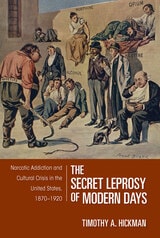
Although the topic of habitual narcotic use first surfaced in the United States during the 1820s, it was not until after the Civil War that it became a subject of widespread public attention. Beginning in the 1870s, an increasingly urgent discussion of what some described as a national epidemic of “drug addiction” could be found in both medical journals and the popular press. Today, nearly a century and a half later, the term is so commonplace we speak of people being “addicted” to just about anything. Yet as Timothy A. Hickman argues in this revealing interdisciplinary study, the meaning of addiction has always been as much cultural as scientific and never fixed.
In The Secret Leprosy of Modern Days, Hickman resituates the idea of addiction within its original late nineteenth- and early twentieth-century context. Through close readings of a broad range of literary, medical, and legal texts, he shows how Americans of that era conceptualized the dangers of drug addiction in terms of other preoccupations and fears. Anxieties about the accelerating pace of technological change, the loss of personal autonomy, and the degeneration of society attributed to both foreign influences and a decline of manliness all fed into a widespread sense of cultural crisis—a crisis of which the spiraling “drug problem” was seen as both contributing cause and consequence. Not surprisingly, Hickman points out, deeply held assumptions of class, race, and gender also figured into the popular understanding of addiction. While white middle-class addicts were often depicted as helpless victims of the social and economic pressures of modern life, their less privileged and nonwhite counterparts were regarded as morally weak. Over time the distinction between “addict as patient” and “addict as criminal” came to be accepted by the emerging medical establishment and codified into law, eventually finding expression in the Harrison Narcotics Act of 1914, the first national anti-narcotic legislation in the history of the United States—and the basis for much thinking about addiction and drug policy ever since.
The Secret Life Of John C. Van Dyke
Selected LettersDavid W. Teague
University of Nevada Press, 1997
The author of The Desert, the book that made the American landscape accessible to the mainstream mind, was much less like his fellow environmental prophets John Muir and Henry David Thoreau than he would have had us believe. Van Dyke claimed to have wandered "alone on horseback for thousands of miles through the American Southwest and northern Mexico," as readers of The Desert—now in the millions since the book was published in 1901—were told. He did not. In The Secret Life of John C. Van Dyke, Teague and Wild unmask the desert saint with Van Dyke’s own recently discovered letters. These letters depict a privileged, patrician, and pampered member of the upper-class. His incriminating correspondence reveals that he saw most of the desert from plush railroad cars and grand hotel rooms. In the introduction, the editors clear up many misconceptions scholars currently hold about Van Dyke’s ecological principles, about his outdoorsmanship, and about his trip through the desert itself. As the centennial of the publication of The Desert approaches, this lively collection of letters helps set the record straight. The John C. Van Dyke unveiled in The Secret Life is a more varied character than we had supposed—still worthy of much admiration for his remarkable accomplishments, but still mysterious, and not the man we thought him to be.

The Secret Life of Things
Animals, Objects, and It-Narratives in Eighteenth-Century EnglandMark Blackwell
Bucknell University Press, 2023
Published by Bucknell University Press.
Distributed worldwide by Rutgers University Press.
The Secret Lives of Citizens
Pursuing the Promise of American LifeThomas Geoghegan
University of Chicago Press, 2000
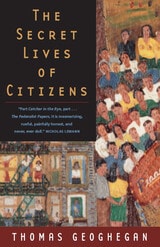
"This is unlike any public-policy book I've ever read: part Catcher in the Rye, part The Road to Wigan Pier, part The Federalist Papers, it is mesmerizing, rueful, painfully honest, and never, ever dull."—Nicholas Lemann, author of The Big Test
"Extraordinary. It has the essential trait of a memorable book, in that after reading it you look at daily life in a lastingly different way." —James Fallows, author of Breaking the News
"[Geoghegan] has written a book that is not only compelling to read but that provokes us to seriously reflect on the choices we make and how we spend our time." —Jonathan Coleman, Washington Post Book World
"Geoghegan's language is playful. . . . Personal reminiscence mixing with historical anecdote, dipping into complex themes . . . shifting from wistful nostalgia to dark comedy." —Robert B. Reich, New York Times Book Review
"A truly strange and wonderful book." — William Finnegan
The Secret Protocol
The Molotov-Ribbentrop Pact and the Falsification of HistoryAntonella Salomoni, Translated by Antony Shugaar
University of Wisconsin Press, 2025
From the moment of the secret protocol’s inception—and the near-instantaneous rumors of its existence—it generated friction and competing narratives. The document became public during the Nuremberg trials, but the USSR declared it a fabrication evidencing the West’s willingness to falsify history. It continues to be relevant to the reconfiguration of history currently advanced by Vladimir Putin. By centering the rumors, accusations, and propaganda the pact precipitated, Salomoni illuminates how political actors can use and abuse history, how they create and disseminate truths and falsehoods, and how they can blur the boundary between facts and fictions even in the glaring face of black-and-white documentation.

The Secret Trust of Aspasia Cruvellier Mirault
The Life and Trials of a Free Woman of Color in Antebellum GeorgiaJanice L. Sumler-Edmond
University of Arkansas Press, 2008
The Secret of Secrets
The Scholarly Career of a Pseudo-Aristotelian Text in the Latin Middle AgesSteven J. Williams
University of Michigan Press, 2003
The Secrets We Keep
Hidden Histories of the Byzantine EmpireRoland Betancourt
J. Paul Getty Trust, The, 2024
Secrecy has played a role throughout human history and continues to capture the popular imagination. Some of the most seductive aspects of the Byzantine Empire—such as the relics of the imperial palace and the military uses of Greek fire—have been shrouded in mystery for centuries. This book provides a brief history of secrecy in Byzantium and examines the role of the art historian in uncovering the truth, demonstrating how visual evidence can not only reveal new findings but also purposely conceal answers.
Art historians face many challenges in their search for hidden knowledge, including accessing accounts preserved in fragmentary glimpses and reconciling how practices of speculation and reconstruction result in different, and sometimes contradictory, understandings. With pressing urgency, this book asks scholars to consider their role in articulating the stories of marginalized people, particularly for queer and trans history.
At the core of these investigations is the quest to discover how clandestine knowledge was transmitted and how relationships were strengthened by collective secret keeping, as well as how concealment is used as a strategy for exercising power. With insights into the religious, imperial, military, and cultural uses of secrecy, this book offers an intriguing look at the ways secrecy manifested itself during the Byzantine Empire and the implications it has for the issues we face today.
The Secrets of Alchemy
Lawrence M. Principe
University of Chicago Press, 2012

The Secrets of the Hopewell Box
Stolen Elections, Southern Politics, and a City's Coming of AgeJames D. Squires
Vanderbilt University Press, 1996
—Kirkus Reviews
"His richly textured narrative charts the Nashville machine's rupture with the state's top political boss, Edward Crump of Memphis, and traces the sweeping reforms that shattered rural white control of the state legislature. Squires dramatically reenacts the downfall of Nashville lawyer Tommy Osborn, convicted of jury tampering in 1964 after defending Teamsters boss Jimmy Hoffa. He follows Nashville's transformation into a crucible of the civil rights movement in this stirring chronicle of the South's coming-of-age."
—Publishers Weekly
The Seduction of Brazil
The Americanization of Brazil during World War IIBy Antonio Pedro Tota
University of Texas Press, 2009
Following completion of the U.S. air base in Natal, Brazil, in 1942, U.S. airmen departing for North Africa during World War II communicated with Brazilian mechanics with a thumbs-up before starting their engines. This sign soon replaced the Brazilian tradition of touching the earlobe to indicate agreement, friendship, and all that was positive and good—yet another indication of the Americanization of Brazil under way during this period.
In this translation of O Imperialismo Sedutor, Antonio Pedro Tota considers both the Good Neighbor Policy and broader cultural influences to argue against simplistic theories of U.S. cultural imperialism and exploitation. He shows that Brazilians actively interpreted, negotiated, and reconfigured U.S. culture in a process of cultural recombination. The market, he argues, was far more important in determining the nature of this cultural exchange than state-directed propaganda efforts because Brazil already was primed to adopt and disseminate American culture within the framework of its own rapidly expanding market for mass culture. By examining the motives and strategies behind rising U.S. influence and its relationship to a simultaneous process of cultural and political centralization in Brazil, Tota shows that these processes were not contradictory, but rather mutually reinforcing.
The Seduction of Brazil brings greater sophistication to both Brazilian and American understanding of the forces at play during this period, and should appeal to historians as well as students of Latin America, culture, and communications.
The Seduction of Space
Cruising French CinemaJules O'Dwyer
University of Minnesota Press, 2025
A bold and far-reaching new study of French queer cinema reimagines the relationship between sexuality and space
Spatiality has long been a crucial and potent lens for understanding French culture and aesthetics. While canonical greats of French cinema such as Jean-Luc Godard, Agnès Varda, and Louis Malle invoked the notion of flânerie to explore ideas of modernism, spatial exploration, and urban sociality, Jules O’Dwyer demonstrates how a more recent generation of French queer filmmakers continues to engage with—and contest—this legacy by focusing attention on the cognate practice of cruising.
Through the work of Jacques Nolot, Sébastien Lifshitz, Christophe Honoré, Vincent Dieutre, Alain Guiraudie, and others, The Seduction of Space draws film theory, queer studies, and spatial inquiry into close proximity to examine the politics of cruising and the gendering of space. Making the case that cinema not only documents the queer spaces of the past but continues to produce them, O’Dwyer maps the relationships between sex and spatiality as he takes up such varied topics as public sex in the porn theater, racial eroticization in the banlieue, and the ecocritical valences of rural cruising.
Foregrounding the crucial role that spatiality plays in shaping the parameters of France’s visual cultures and political imaginary, The Seduction of Space is both an urgent queer reconceptualization of this tradition and a clarion call for film scholars to tarry with the politics of sexuality in all its messiness.
Retail e-book files for this title are screen-reader friendly with images accompanied by short alt text and/or extended descriptions.