Results by title
1427 books match the query 'Politics' and 14 start with v

Vampires, Mummies and Liberals
Bram Stoker and the Politics of Popular FictionDavid Glover
Duke University Press, 1996
Glover’s efforts reveal a writer who was more wide-ranging and politically engaged than his current reputation suggests. An Irish Protestant and nationalist, Stoker nonetheless drew his political inspiration from English liberalism at a time of impending crisis, and the tradition’s contradictions and uncertainties haunt his work. At the heart of Stoker’s writing Glover exposes a preoccupation with those sciences and pseudo-sciences—from physiognomy and phrenology to eugenics and sexology—that seemed to cast doubt on the liberal faith in progress. He argues that Dracula should be read as a text torn between the stances of the colonizer and the colonized, unable to accept or reject the racialized images of backwardness that dogged debates about Irish nationhood. As it tracks the phantasmatic form given to questions of character and individuality, race and production, sexuality and gender, across the body of Stoker’s writing, Vampires, Mummies, and Liberals draws a fascinating portrait of an extraordinary transitional figure.
Combining psychoanalysis and cultural theory with detailed historical research, this book will be of interest to scholars of Victorian and Irish fiction and to those concerned with cultural studies and popular culture.

Vanishing Bees
Science, Politics, and Honeybee HealthSuryanarayanan, Sainath
Rutgers University Press, 2016

Veganism, Sex and Politics
Tales of Danger and PleasureC. Lou Hamilton
Intellect Books, 2019
Venezuela's Bolivarian Democracy
Participation, Politics, and Culture under ChávezDavid Smilde and Daniel Hellinger, eds.
Duke University Press, 2011
Contributors
Carolina Acosta-Alzuru
Julia Buxton
Luis Duno Gottberg
Sujatha Fernandes
María Pilar García-Guadilla
Kirk A. Hawkins
Daniel Hellinger
Michael E. Johnson
Luis E. Lander
Margarita López-Maya
Elizabeth Gackstetter Nichols
Coraly Pagan
Guillermo Rosas
Naomi Schiller
David Smilde
Alejandro Velasco
Victor Arnautoff and the Politics of Art
Robert W. Cherny
University of Illinois Press, 2017

Virgil and The Tempest
The Politics of ImitationDonna B. Hamilton
The Ohio State University Press, 1900
Virtuous Citizens
Counterpublics and Sociopolitical Agency in Transatlantic LiteratureKendall McClellan
University of Alabama Press, 2021
Transatlantic Perspectives on Civic Identity and Political Participation.
The rise of the bourgeois public sphere and the contemporaneous appearance of counterpublics in the eighteenth century deeply influenced not only how politicians and philosophers understood the relationships among citizens, disenfranchised subjects, and the state but also how members of the polity understood themselves. In Virtuous Citizens: Counterpublics and Sociopolitical Agency in Transatlantic Literature, Kendall McClellan uncovers a fundamental and still redolent transformation in conceptions of civic identity that occurred over the course of the eighteenth and nineteenth centuries. Literature of this period exposes an emotional investment in questions of civic selfhood born out of concern for national stability and power, which were considered products of both economic strength and a nation’s moral fiber. McClellan shows how these debates traversed the Atlantic to become a prominent component of early American literature, evident in works by James Fenimore Cooper, Catharine Maria Sedgwick, Sarah Josepha Hale, and Harriet Beecher Stowe, among others.
Underlying popular opinion about who could participate in the political public, McClellan argues, was an impassioned rhetorical wrestling match over the right and wrong ways to demonstrate civic virtue. Relying on long-established tropes of republican virtue that lauded self-sacrifice and disregard for personal safety, abolitionist writers represented loyalty to an ideals-based community as the surest safeguard of both private and public virtue. This evolution in civic virtue sanctioned acts of protest against the state, offered disenfranchised citizens a role in politics, and helped usher in the modern transnational public sphere.
Virtuous Citizens shows that the modern public sphere has always constituted a vital and powerful space for those invested in addressing injustice and expanding democracy. To illuminate some of the fundamental issues underlying today’s sociopolitical unrest, McClellan traces the transatlantic origins of questions still central to the representation of movements like Black Lives Matter, the Women’s March, and the Alt-Right: What is the primary loyalty of a virtuous citizen? Are patriots those who defend the current government against attacks, external and internal, or those who challenge the government to fulfill sociopolitical ideals?
Visibility Interrupted
Rural Queer Life and the Politics of UnbecomingCarly Thomsen
University of Minnesota Press, 2021
A questioning of the belief in the power of LGBTQ visibility through the lives of queer women in the rural Midwest
Today most LGBTQ rights supporters take for granted the virtue of being “out, loud, and proud.” Most also assume that it would be terrible to be LGBTQ in a rural place. By considering moments in which queerness and rurality come into contact, Visibility Interrupted argues that both positions are wrong. In the first monograph on LGBTQ women in the rural Midwest, Carly Thomsen deconstructs the image of the rural as a flat, homogenous, and anachronistic place where LGBTQ people necessarily suffer. And she suggests that visibility is not liberation and will not lead to liberation.
Far from being an unambiguous good, argues Thomsen, visibility politics can, in fact, preclude collective action. They also advance metronormativity, postraciality, and capitalism. To make these interventions, Thomsen develops the theory of unbecoming: interrogating the relationship between that which we celebrate and that which we find disdainful—the past, the rural, politics—is crucial for developing alternative subjectivities and politics. Unbecoming precedes becoming. Drawing from critical race studies, disability studies, and queer Marxism, in addition to feminist and queer studies, the insights of this book will be useful to scholars theorizing issues far beyond sexuality and place and to social justice activists who want to move beyond visibility.
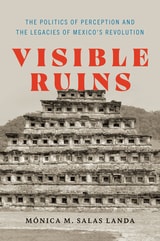
Visible Ruins
The Politics of Perception and the Legacies of Mexico's RevolutionMónica M. Salas Landa
University of Texas Press, 2024
2026 Honorable Mention, Mejor Libro, Historia Reciente y Memoria Section of the Latin American Studies Association
An examination of the failures of the Mexican Revolution through the visual and material records.
The Mexican Revolution (1910–1920) introduced a series of state-led initiatives promising modernity, progress, national grandeur, and stability; state surveyors assessed land for agrarian reform, engineers used nationalized oil for industrialization, archaeologists reconstructed pre-Hispanic monuments for tourism, and anthropologists studied and photographed Indigenous populations to achieve their acculturation. Far from accomplishing their stated goals, however, these initiatives concealed violence, and permitted land invasions, forced displacement, environmental damage, loss of democratic freedom, and mass killings. Mónica M. Salas Landa uses the history of northern Veracruz to demonstrate how these state-led efforts reshaped the region's social and material landscapes, affecting what was and is visible. Relying on archival sources and ethnography, she uncovers a visual order of ongoing significance that was established through postrevolutionary projects and that perpetuates inequality based on imperceptibility.
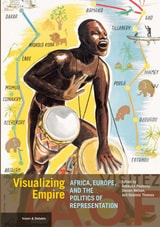
Visualizing Empire
Africa, Europe, and the Politics of RepresentationRebecca Peabody
J. Paul Getty Trust, The, 2021
An exploration of how an official French visual culture normalized France’s colonial project and exposed citizens and subjects to racialized ideas of life in the empire.
By the end of World War I, having fortified its colonial holdings in the Caribbean, Latin America, Africa, the Indian Ocean, and Asia, France had expanded its dominion to the four corners of the earth. This volume examines how an official French visual culture normalized the country’s colonial project and exposed citizens and subjects alike to racialized ideas of life in the empire. Essays analyze aspects of colonialism through investigations into the art, popular literature, material culture, film, and exhibitions that represented, celebrated, or were created for France’s colonies across the seas.
These studies draw from the rich documents and media—photographs, albums, postcards, maps, posters, advertisements, and children’s games—related to the nineteenth- and twentieth-century French empire that are held in the Getty Research Institute’s Association Connaissance de l’histoire de l’Afrique contemporaine (ACHAC) collections. ACHAC is a consortium of scholars and researchers devoted to exploring and promoting discussions of race, iconography, and the colonial and postcolonial periods of Africa and Europe.
Vital Minimum
Need, Science, and Politics in Modern FranceDana Simmons
University of Chicago Press, 2015
The result was the concept of the "vital minimum"--the living wage, a measure of physical and social needs. In this book, Dana Simmons traces the history of this concept, revealing the intersections between technologies of measurement, such as calorimeters and social surveys, and technologies of wages and welfare, such as minimum wages, poor aid, and welfare programs. In looking at how we define and measure need, Vital Minimum raises profound questions about the authority of nature and the nature of inequality.
Voegelinian Readings of Modern Literature
Edited by Charles R. Embry
University of Missouri Press, 2011
For Voegelinian Readings of Modern Literature, scholar Charles R. Embry has collected essays that consider particular pieces of literature in light of the philosopher’s work. These essays supply a theoretical grounding for the reading of novels, poems, and plays and reveal how the Voegelinian perspective exposes the existential and philosophical dimensions of the literary works themselves. As a unit, this collection of essays shows how modern pieces of literature can symbolize their creators’ participation in the human search for the truth of existence—just as myths, philosophical works, and religious texts always have.
Voegelin’s primary concern as a philosopher was to expose the roots of the disturbances of the modern era—religious conflict, imperialism, war—so that the sources of order leading to meaning are revealed. The openness of Voegelinian thought and the many ways he considered the levels of reality generate intriguing themes for literary criticism. In these essays, noted Voegelin scholars focus on American and European literary artists from the 1700s through the late twentieth century, including Emily Dickinson, Henrik Ibsen, Thomas Carlyle, D. H. Lawrence, Marcel Proust, and Hermann Broch.
While the intersection of the work of Eric Voegelin and literature has been a part of Voegelin scholarship for decades, this book explores that relationship in an extended form. Through a broad collection of thoughtful essays, Voegelinian Readings of Modern Literature reveals how much Voegelin did to break down the barriers between literature and philosophy and makes an engaging contribution to Voegelin scholarship.
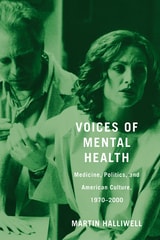
Voices of Mental Health
Medicine, Politics, and American Culture, 1970-2000Halliwell, Martin
Rutgers University Press, 2017
Together, these three dimensions bring into conversation a diverse cast of late-century writers, filmmakers, actors, physicians, politicians, policy-makers, and social critics. In doing so, Martin Halliwell’s Voices of Mental Health breaks new ground in deepening our understanding of the place, politics, and trajectory of mental health from the moon landing to the millennium.
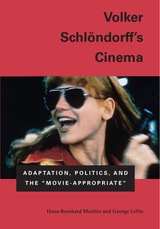
Volker Schlondorff's Cinema
Adaptation, Politics, and the "Movie-Appropriate"Hans-Bernhard Moeller and George Lellis
Southern Illinois University Press, 2002
Volker Schlöndorff’s Cinema: Adaptation, Politics and the “Movie-Appropriate”examines the work of major postwar Germandirector Volker Schlöndorff in historical, economic, and artistic contexts. Incorporating a film-by-film, twenty-eight chapter study, Hans-Bernhard Moeller & George Lellis reveal a complexity and formalambitiousness of Schlöndorff that is comparable to that found in Wenders, Herzog, andFassbinder. In spite of Schlöndorff’s successes with films like The Lost Honor ofKatharina Blum and The Tin Drum, as well as his acclaimed work in the U.S. with Death of a Salesman, Gathering of Old Men and The Handmaid’s Tale, this is the first in-depthcritical study of the filmmaker’s career.
In the context of film and television history, this book relates Schlöndorff’s oeuvre to the New German Cinema, to his formative years as a student and production assistant in France, and to his roots in the Weimar cinema’s tradition. It reveals how Schlöndorff entered into the German film production system in the 1960s, how he came to rely on German public television in the 1970s, and then moved to the international and American financing in the 1980s, attempting to redevelop the Babelsberg studios in a 1990s post-Wall Germany while continuing to make his own films into the 21st century. The book captures how Schlöndorff’s nearly half century of ongoing creativity and productivity ties together.
The authors analyze the artistry of each Schlöndorff movie arguing that his output as a whole embodies a provocative and sometimes contradictory set of balances. Schlöndorff combines commercial interest with significant artistic ambition, blends the kinesthetic pleasures of moving images with the seriousness of fine literature, links the intensity of individualized personal experience to an awareness of broader political issues, and represents a specifically German sensibility even as he reaches out to the international audiences.
The authors demonstrate the cyclical recurrence in his cinema of certain themes (individual and collective rebellion, fascist suppression, masochistic love), narrative patterns (the Western, the thriller, the subjective mood piece), and stylistic approaches (Brechtian Verfremdung, the creation of careful leitmotif structures, the use of the grotesque). In over thirty years of filmmaking, Schlöndorff has produced a remarkable unified body of work that deserves the attention of a book-length study. Authors Hans-Bernhard Moeller and George Lellis offer the first such study of its kind.
Volker Schlöndorff’s Cinema: Adaptation, Politics, and the “Movie-Appropriate” features forty-one illustrations.