Results by title
349 books match the query 'Violence' and 44 start with v

VIOLENT DEATH IN THE CITY
SUICIDE, ACCIDENT, AND MURDER IN NINETEEROGER LANE
The Ohio State University Press, 1999
Vampire Nation
Violence as Cultural ImaginaryTomislav Z. Longinovi
Duke University Press, 2011
Interpreting oral and written narratives and visual culture, Longinović traces the early modern invention of ‘the serbs’ and the category’s twentieth-century transformations. He describes the influence of Bram Stoker’s nineteenth-century novel Dracula on perceptions of the Balkan region and reflects on representations of hybrid identities and their violent destruction in the works of the region’s most prominent twentieth-century writers. Concluding on a hopeful note, Longinović considers efforts to imagine a new collective identity in non-nationalist terms. These endeavors include the emigrant Yugoslav writer David Albahari’s Canadian Trilogy and Cyber-Yugoslavia, a mock nation-state with “citizens” in more than thirty countries.

Vengeance Is Mine
The Scandalous Love Triangle That Triggered the Boyce-Sneed FeudBill Neal
University of North Texas Press, 2011
Vengeance in Reverse
The Tangled Loops of Violence, Myth, and MadnessMark R. Anspach
Michigan State University Press, 2017
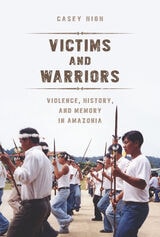
Victims and Warriors
Violence, History, and Memory in AmazoniaCasey High
University of Illinois Press, 2015
Victims and Warriors examines contemporary violence in the context of political and economic processes that transcend local events. Casey High explores how popular imagery of Amazonian violence has become part of Waorani social memory in oral histories, folklore performances, and indigenous political activism. As Amazonian forms of social memory merge with constructions of masculinity and other intercultural processes, the Waorani absorb missionaries, oil development, and logging depredations into their legacy of revenge killings and narratives of victimhood. High shows that these memories of past violence form sites of negotiation and cultural innovation, and thus violence comes to constitute a central part of Amazonian sociality, identity, and memory.
Violence As Obscenity
Limiting the Media's First Amendment ProtectionKevin W. Saunders
Duke University Press, 1996
Saunders examines the public debate on media violence, the arguments of professional and public interest groups urging governmental action, and the media and the ACLU’s desire for self-regulation. Citing research that links violence in the media to actual violence, Saunders argues that a present danger to public safety may be reduced by invoking the existing law on obscenity. Reviewing the justifications of that law, he finds that not only is the legal history relied on by the Supreme Court inadequate to distinguish violence from sex, but also many of the justifications apply more forcefully to instances of violence than to sexually explicit material that has been ruled obscene. Saunders also examines the actions that Congress, states, and municipalities have taken to regulate media violence as well as the legal limitations imposed on such regulations by the First Amendment protections given to speech and the press. In discussing the current operation of the obscenity exception and confronting the issue of censorship, he advocates adapting to the regulation of violent material the doctrine of variable obscenity, which applies a different standard for material aimed at youth, and the doctrine of indecency, which allows for federal regulation of broadcast material.
Cogently and passionately argued, Violence as Obscenity will attract scholars of American constitutional law and mass communication, and general readers moved by current debates about media violence, regulation, and censorship.
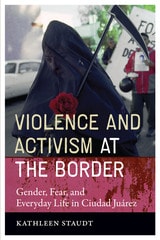
Violence and Activism at the Border
Gender, Fear, and Everyday Life in Ciudad JuarezBy Kathleen Staudt
University of Texas Press, 2008
Between 1993 and 2003, more than 370 girls and women were murdered and their often-mutilated bodies dumped outside Ciudad Juárez in Chihuahua, Mexico. The murders have continued at a rate of approximately thirty per year, yet law enforcement officials have made no breakthroughs in finding the perpetrator(s). Drawing on in-depth surveys, workshops, and interviews of Juárez women and border activists, Violence and Activism at the Border provides crucial links between these disturbing crimes and a broader history of violence against women in Mexico. In addition, the ways in which local feminist activists used the Juárez murders to create international publicity and expose police impunity provides a unique case study of social movements in the borderlands, especially as statistics reveal that the rates of femicide in Juárez are actually similar to other regions of Mexico.
Also examining how non-governmental organizations have responded in the face of Mexican law enforcement's "normalization" of domestic violence, Staudt's study is a landmark development in the realm of global human rights.

Violence and Culture in the Antebellum South
By Dickson D. Bruce, Jr.
University of Texas Press, 1979
This provocative book draws from a variety of sources—literature, politics, folklore, social history—to attempt to set Southern beliefs about violence in a cultural context. According to Dickson D. Bruce, the control of violence was a central concern of antebellum Southerners.
Using contemporary sources, Bruce describes Southerners’ attitudes as illustrated in their duels, hunting, and the rhetoric of their politicians. He views antebellum Southerners as pessimistic and deeply distrustful of social relationships and demonstrates how this world view impelled their reliance on formal controls to regularize human interaction.
The attitudes toward violence of masters, slaves, and “plain-folk”—the three major social groups of the period—are differentiated, and letters and family papers are used to illustrate how Southern child-rearing practices contributed to attitudes toward violence in the region. The final chapter treats Edgar Allan Poe as a writer who epitomized the attitudes of many Southerners before the Civil War.

Violence and Difference
Girard, Derrida, and DeconstructionAndrew J. McKenna
University of Illinois Press, 1992
theory of Jacques Derrida in terms of each other--to create an interpretive strategy that he
hopes will "salvage deconstruction from the flashy sterility it favors."
Violence and Grace
Exceptional Life between Shakespeare and ModernityNichole E. Miller
Northwestern University Press, 2014
In Violence and Grace, Nichole Miller establishes a conceptual link between early modern English drama and twentieth-century political theology, both of which emerge from the experience of political crisis. Miller’s analyses accordingly undertake to retrieve for political theology the relations between gender, sexuality, and the political aesthetics of violence on the early modern stage, addressing the plays of Marlowe, Middleton, and especially Shakespeare. In doing so, she expands our understanding of drama’s continuing theoretical impact.
Violence and Indigenous Communities
Confronting the Past and Engaging the PresentEdited by Susan Sleeper-Smith, Jeffrey Ostler, and Joshua L. Reid
Northwestern University Press, 2021
In contrast to past studies that focus narrowly on war and massacre, treat Native peoples as victims, and consign violence safely to the past, this interdisciplinary collection of essays opens up important new perspectives. While recognizing the long history of genocidal violence against Indigenous peoples, the contributors emphasize the agency of individuals and communities in genocide’s aftermath and provide historical and contemporary examples of activism, resistance, identity formation, historical memory, resilience, and healing. The collection also expands the scope of violence by examining the eyewitness testimony of women and children who survived violence, the role of Indigenous self-determination and governance in inciting violence against women, and settler colonialism’s promotion of cultural erasure and environmental destruction.
By including contributions on Indigenous peoples in the United States, Canada, the Pacific, Greenland, Sápmi, and Latin America, the volume breaks down nation-state and European imperial boundaries to show the value of global Indigenous frameworks. Connecting the past to the present, this book confronts violence as an ongoing problem and identifies projects that mitigate and push back against it.
Violence and Inequality
An Archaeological HistoryThomas P. Leppard
University Press of Colorado, 2023
The assumption that violence and its threat buttressed elite social control is now challenged from various perspectives. This volume incorporates new models of the relationship between violence and social inequalities into the archaeology of social complexity, building more complicated and nuanced understandings of how different modes of social violence can militate different types of social constitution. Contributions from a variety of methodological angles—such as the bioarchaeology of health and trauma and radiogenic isotope studies and the aesthetics of violence—use a comparative perspective, drawing on data from the Southwestern US, Bronze Age China, early dynastic Egypt, ancient Mesopotamia, Roman Britain, and the Andes.
Violence and Inequality offers an original and deep history of violence and inequality. Understanding the long-term intersection of violence and inequality and how they support or erode one another is of intrinsic importance, making this work significant to the study of archaeology, economic history, and collective action.

Violence and Memory
The Mulele Rebellion in Postcolonial CongoEmery Kalema
Duke University Press, 2027
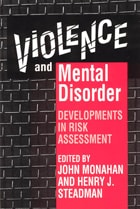
Violence and Mental Disorder
Developments in Risk AssessmentEdited by John Monahan and Henry J. Steadman
University of Chicago Press, 1994
"Essential for all those who are interested in the study of risk assessment of violence. It is particularly important for the researcher in this area. . . . For the clinician who must make violence assessments it is important reading as well."—Stewart Levine, Bulletin of the American Academy of Psychiatry and the Law
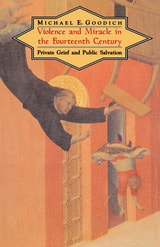
Violence and Miracle in the Fourteenth Century
Private Grief and Public SalvationMichael E. Goodich
University of Chicago Press, 1995
Rescue miracles offer a wide range of voices rarely heard in medieval history, from women and children to peasants and urban artisans. They tell of salvation not just from the ravages of nature and war, but from the vagaries of a violent society—crime, unfair judicial practices, domestic squabbles, and communal or factional conflict. The stories speak to a collapse of confidence in decaying institutions, from the law to the market to feudal authority. Particularly, the miraculous escapes documented during the Hundred Years' War, the Italian communal wars, and other conflicts are vivid testimony to the end of aristocratic warfare and the growing victimization of noncombatants.
Miracles, Goodich finds, represent the transcendent and unifying force of faith in a time of widespread distress and the hopeless conditions endured by the common people of the Middle Ages. Just as the lives of the saints, once dismissed as church propaganda, have become valuable to historians, so have rescue miracles, as evidence of an underlying medieval mentalite. This work expands our knowledge of that state of mind and the grim conditions that colored and shaped it.
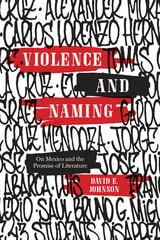
Violence and Naming
On Mexico and the Promise of LiteratureBy David E. Johnson
University of Texas Press, 2019
Reclaiming the notion of literature as an institution essential for reflecting on the violence of culture, history, and politics, Violence and Naming exposes the tension between the irreducible, constitutive violence of language and the reducible, empirical violation of others. Focusing on an array of literary artifacts, from works by journalists such as Elena Poniatowska and Sergio González Rodríguez to the Zapatista communiqués to Roberto Bolaño's The Savage Detectives and 2666, this examination demonstrates that Mexican culture takes place as a struggle over naming—with severe implications for the rights and lives of women and indigenous persons.
Through rereadings of the Conquest of Mexico, the northern Mexican feminicide, the Zapatista uprising in Chiapas, the disappearance of the forty-three students at Iguala in 2014, and the 1999 abortion-rights scandal centering on “Paulina,” which revealed the tenuousness of women’s constitutionally protected reproductive rights in Mexico, Violence and Naming asks how societies can respond to violence without violating the other. This essential question is relevant not only to contemporary Mexico but to all struggles for democracy that promise equality but instead perpetuate incessant cycles of repression.
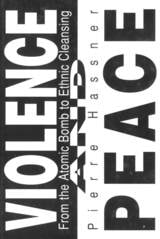
Violence and Peace
From the Atomic Bomb to Ethnic CleansingPierre Hassner
Central European University Press, 1997
Violence and Policing
Madiha Tahir and Shamus Khan, special issue editors
Duke University Press, 0
Contributors. Kim Shayo Buchanan, Samira Bueno, Andrew M. Carruthers, Didier Fassin, Ilana Feldman, Phillip Atiba Goff, Jesse A. Goldberg, Rivke Jaffe, Caren Kaplan, Shamus Khan, Andrea Miller, Fatima Mojaddedi, Stuart Schrader, Madiha Tahir, Michelle C. Velasquez-Potts, Graham Denyer Willis

Violence and Redemption, Volume 15
Candace Vogler and Patchen Markell
Duke University Press, 0
The essays examine topics such as the socioeconomic crisis in Mexico in the 1980s; continuities between plantation slavery, colonization, and the emergence of independent states as war machines in Africa; the culture of a Palestinian suicide bomber; the architecture of mass rioting and rape in Indonesia; the experience of unredeemed suffering in Herman Melville’s “Shiloh;” and the aggression of Aborigines in Australia.
Contributors. Tim Blackmore, John Borneman, Gillian Cowlishaw, Richard Falk, Ken Graves, Ghassan Hage, Abidin Kusno, Eva Lipman, Claudio Lomnitz, Patchen Markell, Achille Mbembe, Laura Nader, Steven Sampson, Nancy Scheper-Hughes, Candace Vogler, Michael Warner, Margaret Werry, Richard Ashby Wilson

Violence and Splendor
Alphonso Lingis
Northwestern University Press, 2011
“The Sacred” studies the ways death—the death of others and our own death—fascinates and energizes us. It exhibits the glory in violence and sacrilege. The book culminates in “Splendor,” a study of collective performances that create splendor. Concerning itself most immediately with philosophy, psychology, aesthetics, anthropology, and the theory of religion, Violence and Splendor bridges the discourses of continental philosophy and cross-cultural studies. Further drawing insights from both Western and non-Western traditions, it brings such diverse fields as psychology, art and aesthetics, botany, politics, history, zoology, and religious theory into a new and significant dialogue about the nature of humanity.
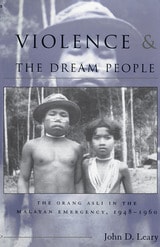
Violence and the Dream People
The Orang Asli in the Malayan Emergency, 1948-1960John D. Leary
Ohio University Press, 1995
Violence and the Dream People is an account of a little-known struggle by the Malayan government and the communist guerrillas, during the 1948-1960 Malayan Emergency, to win the allegiance of the Orang Asli, the indigenous people of the peninsular Malaya. The author argues that the use of force by both sides in their attempts to woo or coerce the jungle dwellers to support one side or the other in the conflict, caused tensions among the Orang Asli that resulted in counter violence against the interlopers and internecine killings in the tribal groups.
This study challenges the depiction of the Orang Asli as naïve innocents, unwittingly manipulated by outsiders for their own purposes. Heavily outnumbered, they looked to their own resources to survive, in the face of relocation, conscription, random bombings, and haphazard killing. Leary argues that they were shrewd enough to recognize the winning side and backed their judgment with force where necessary.
Violence and the Dream People is an important study of a much neglected facet of the Malayan Emergency and of the history of the indigenous peoples of the Malay Peninsula.
Violence and the Medieval Clergy
Gerhard Jaritz
Central European University Press, 2012
Violence and the Mimetic Unconscious, Volume 2
The Affective HypothesisNidesh Lawtoo
Michigan State University Press, 2023
Violence and the Oedipal Unconscious
vol. 1, The Catharsis HypothesisNidesh Lawtoo
Michigan State University Press, 2023

Violence in Modern Philosophy
Piotr Hoffman
University of Chicago Press, 1989
In his previous book, Doubt, Time, Violence, Hoffman explored the theme of violence in relation to Descartes' problematic of doubt and Heidegger's work on temporality. The pivotal notion deriving from that investigation is the notion of the other as the ultimate limit of one's powers. In effect, Hoffman argues, our practical mastery of the natural environment still leaves intact the limitation of human agents by each other. In a violent environment, the other emerges as an insurmountable obstacle to one's aims and purposes or as an inescapable danger which one is powerless to hold at bay. The other is thus the focus of an ultimate resistance to one's powers.
The special status of the other, as Hoffman articulates it, is at the root of several key notions around which modern philosophy has built its problematic. Arguing here that when the theme of violence is taken into account many conceptual tensions and puzzles receive satisfying solutions, Hoffman traces the theme through the issue of things versus properties; through Kant's treatment of causality, necessity, and freedom in the Critique of Pure Reason; and through the early parts of Hegel's Logic. The result is a complete reorientation and reinterpretation of these important texts.
Violence in Modern Philosophy offers patient and careful textual clarification in light of Hoffman's central thesis regarding the other as ultimate limit. With a high level of originality, he shows that the theme of violence is the hidden impulse behind much of modern philosophy. Hoffman's unique stress on the constitutive importance of violence also offers a challenge to the dominant "compatibilist" tradition in moral and political theory. Of great interest to all philosophers, this work will also provide fresh insights to anthropologists and all those in the social sciences and humanities who occupy themselves with the general theory of culture.
Violence in Rural South Africa, 1880–1963
Sean Redding
University of Wisconsin Press, 2023
Many violent acts attempted to reestablish and reinforce a moral, social, and political order among Africans. However, what constituted a moral order changed as white governance became more intrusive, land became scarcer, and people reconstructed their notions of “traditional” culture. State policies became obstacles around which Africans had to navigate by invoking the idea of tradition, using the state’s court system, alleging the use of witchcraft, or engaging in violent threats and acts. Redding’s use of multiple court cases and documents to discuss several types of violence provides a richer context for the scholarly conversation about the legitimation of violence in traditions, family life, and political protest.
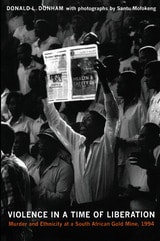
Violence in a Time of Liberation
Murder and Ethnicity at a South African Gold Mine, 1994Donald L. Donham
Duke University Press, 2011

Violence in the Films of Alfred Hitchcock
A Study in MimesisDavid Humbert
Michigan State University Press, 2017
Violence in the Hill Country
The Texas Frontier in the Civil War EraBy Nicholas Keefauver Roland
University of Texas Press, 2021
2022 Ramirez Family Award for Most Significant Scholarly Book, Texas Institute of Letters
An in-depth history of the Civil War in the Texas Hill Country, this book examines patterns of violence on the Texas frontier to illuminate white Americans’ cultural and political priorities in the nineteenth century.
In the nineteenth century, Texas’s advancing western frontier was the site of one of America’s longest conflicts between white settlers and native peoples. The Texas Hill Country functioned as a kind of borderland within the larger borderland of Texas itself, a vast and fluid area where, during the Civil War, the slaveholding South and the nominally free-labor West collided. As in many borderlands, Nicholas Roland argues, the Hill Country was marked by violence, as one set of peoples, states, and systems eventually displaced others.
In this painstakingly researched book, Roland analyzes patterns of violence in the Texas Hill Country to examine the cultural and political priorities of white settlers and their interaction with the century-defining process of national integration and state-building in the Civil War era. He traces the role of violence in the region from the eve of the Civil War, through secession and the Indian wars, and into Reconstruction. Revealing a bitter history of warfare, criminality, divided communities, political violence, vengeance killings, and economic struggle, Roland positions the Texas Hill Country as emblematic of the Southwest of its time.
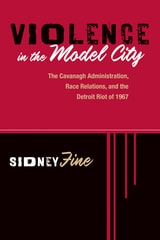
Violence in the Model City
The Cavanagh Administration, Race Relations, and the Detroit Riot of 1967Sidney Fine
Michigan State University Press, 2007
On July 23, 1967, the Detroit police raided a blind pig (after-hours drinking establishment), touching off the most destructive urban riot of the 1960s. It took the U.S. Army, the Michigan National Guard, the Michigan State Police, and the Detroit police department—17,000 men—more than a week to restore order. When all was done, the riot had claimed 43 lives (mostly Black) and resulted in nearly 700 injuries. Over 7,000 individuals were arrested, with property damage estimates over $75 million. Yet, Detroit had been lauded nationally as a "model city" in the governance of a large industrial metropolis. On the 40th anniversary of this nation-changing event, we are pleased to reissue Sidney Fine's seminal work—a detailed study of what happened, why, and with what consequences.
Violence in the Work of Composition
Recognizing, Intervening, Amelioratingedited by Scott Gage and Kristie S. Fleckenstein
Utah State University Press, 2022
This book provides a focused, nuanced, and systematic discussion of violence and its presence and influence across pedagogical and administrative sites. Violence in the Work of Composition offers a close look at the nature of violence as it emerges in the work of composition; provides strategies for identifying violence, especially covert violence, addressing its impact and preventing its eruption across many sites; and invites readers to reflect on both the presence of violence and the hope for its cessation. Contributors consider, first, how compositionists can recognize the ways their work inadvertently enacts and/or perpetuates violence and, second, how they can intervene and mitigate that violence.
Rich with the voices of myriad stakeholders, Violence in the Work of Composition initiates an essential conversation about violence and literacy education at a time when violence in its many forms continues to shape our culture, communities, and educational systems.
Contributors: Kerry Banazek, Katherine Bridgman, Eric Camarillo, Elizabeth Chilbert Powers, Joshua Daniel, Lisa Dooley, Allison Hargreaves, Jamila Kareem, Lynn C. Lewis, Trevor Meyer, Cathryn Molloy, Kellie Sharp-Hoskins, Ellen Skirvin, Krista Speicher Sarraf, Thomas Sura, James Zimmerman
Violence of Democracy
Interparty Conflict in South IndiaRuchi Chaturvedi
Duke University Press, 2023
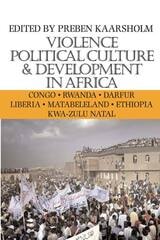
Violence, Political Culture & Development in Africa
Preben Kaarsholm
Ohio University Press, 2006

Violence, the Body, and the South, Volume 73
Houston A. Baker Jr. and Dana D. Nelson, eds.
Duke University Press, 0
This collection represents first-rate examples of gender, critical race, genre, and material culture studies. Topics ranging from epistemological and authorial rebellions marking Frederick Douglass’s Narrative and Charles Chesnutt’s The Marrow of Tradition to the twentieth-century labors of writers, such as Francisco Goldman and Helena María Viramontes, who work to make visible the complexities of “North” and “South” with respect to subordinated Latino/a bodies. William Faulkner is revisited in an essay on the internalization of “race” in Light in August. Guess Who’s Coming to Dinner and In the Heat of the Night are analyzed in a framework of homopolitical desire. Genre and regional studies combine in an energetic essay resituating Harriet Jacobs’s Incidents in the Life of a Slave Girl with respect to “Northern” fiction.
Contributors. Houston A. Baker Jr., Jeannine DeLombard, Laura Doyle, Jennifer Rae Greeson, Andrea Levine, Dana D. Nelson, Ana Patricia Rodríguez, Bryan Wagner

Violence, the Sacred, and Things Hidden
A Discussion with René Girard at Esprit (1973)René Girard
Michigan State University Press, 2022
Violence
Analysis, Intervention, and PreventionSean Byrne
Ohio University Press, 2012
In a world desperate to comprehend and address what appears to be an ever-enlarging explosion of violence, this book provides important insights into crucial contemporary issues, with violence providing the lens. Violence: Analysis, Intervention, and Prevention provides a multidisciplinary approachto the analysis and resolution of violent conflicts. In particular, the book discusses ecologies of violence, and micro-macro linkages at the local, national, and international levels as well as intervention and prevention processes critical to constructive conflict transformation.
The causes of violence are complex and demand a deep multidimensional analysis if we are to fully understand its driving forces. Yet in the aftermath of such destruction there is hope in the resiliency, knowledge, and creativity of communities, organizations, leaders, and international agencies to transform the conditions that lead to such violence.

Violence
Analysis, Intervention, and PreventionSean Byrne
Ohio University Press, 0
In a world desperate to comprehend and address what appears to be an ever-enlarging explosion of violence, this book provides important insights into crucial contemporary issues, with violence providing the lens. Violence: Analysis, Intervention, and Prevention provides a multidisciplinary approach to the analysis and resolution of violent conflicts. In particular, the book discusses ecologies of violence, and micro-macro linkages at the local, national, and international levels as well as intervention and prevention processes critical to constructive conflict transformation.
The causes of violence are complex and demand a deep multidimensional analysis if we are to fully understand its driving forces. Yet in the aftermath of such destruction there is hope in the resiliency, knowledge, and creativity of communities, organizations, leaders, and international agencies to transform the conditions that lead to such violence.
Violent Acts and Urban Space in Contemporary Tel Aviv
Revisioning MomentsBy Tali Hatuka
University of Texas Press, 2010
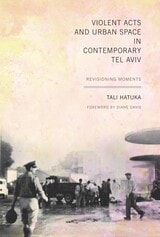
Violent acts over the past fifteen years have profoundly altered civil rituals, cultural identity, and the meaning of place in Tel Aviv. Three events in particular have shed light on the global rule of urban space in the struggle for territory, resources, and power: the assassination of Prime Minister Rabin in 1995 in the city council square; the suicidal bombing at the Dolphinarium Discothèque along the shoreline in 2001; and bombings in the Neve Shaanan neighborhood in 2003.
Tali Hatuka uses an interdisciplinary framework of urban theory and sociopolitical theory to shed light on the discourse regarding violent events to include an analysis of the physical space where these events take place. She exposes the complex relationships among local groups, the state, and the city, challenging the national discourse by offering a fresh interpretation of contesting forces and their effect on the urban environment.
Perhaps the most valuable contribution of this book is its critical assessment of the current Israeli reality, which is affected by violent events that continually alter the everyday life of its citizens. Although these events have been widely publicized by the media, there is scant literature focusing on their impact on the urban spaces where people live and meet. In addition, Hatuka shows how sociopolitical events become crucial defining moments in contemporary lived experience, allowing us to examine universal questions about the way democracy, ideology, and memory are manifested in the city.
Violent Criminal Acts and Actors Revisited
Lonnie Athens
University of Illinois Press, 1997
as "the most far-reaching, provocative, and profound analysis of violent conduct" available in criminological literature. In Violent Criminal Acts and Actors Revisited, Athens returns to his pioneering work and finds that his premises are just as relevant and original as in their earlier version--and that they have been curiously, and to society's detriment, overlooked.
Rather than finding the causes of criminal behavior in external forces
or personality disorders, as conventional wisdom often does, Athens renews his fundamental argument that a violent situation comes into being when defined by an individual as a situation that calls for violence--that an actor responds to the circumstance as he or she defines it. Based on the author's many firsthand interviews with offenders and on his personal experience, Violent Criminal Acts and Actors Revisited augments Athens’s call to reexamine the source and locus of violent criminal behavior.
Violent Democracies in Latin America
Enrique Desmond Arias and Daniel M. Goldstein, eds.
Duke University Press, 2010
The contributors—anthropologists, political scientists, sociologists, and historians—explore how individuals and institutions in Latin American democracies, from the rural regions of Colombia and the Dominican Republic to the urban centers of Brazil and Mexico, use violence to impose and contest notions of order, rights, citizenship, and justice. They describe the lived realities of citizens and reveal the historical foundations of the violence that Latin America suffers today. One contributor examines the tightly woven relationship between violent individuals and state officials in Colombia, while another contextualizes violence in Rio de Janeiro within the transnational political economy of drug trafficking. By advancing the discussion of democratic Latin American regimes beyond the usual binary of success and failure, this collection suggests more sophisticated ways of understanding the challenges posed by violence, and of developing new frameworks for guaranteeing human rights in Latin America.
Contributors: Enrique Desmond Arias, Javier Auyero, Lilian Bobea, Diane E. Davis, Robert Gay, Daniel M. Goldstein, Mary Roldán, Todd Landman, Ruth Stanley, María Clemencia Ramírez
Vision and Violence
Arthur P. Mendel
University of Michigan Press, 1999
Much of the book is devoted to an examination of the persistence of the apocalyptic heritage from ancient Greek and Hebrew civilizations, through the religious revivals of the Middle Ages and the Enlightenment belief in progress, to its importance in Hegelian and Bolshevik thought, and finally to its expression today in the resurgence of religious fundamentalism in Judaism, Christianity, and Islam.
Mendel concludes his remarkable book with an appeal for the more modest and humane philosophy of the "repair of the world," which, he argues, is central to biblical teaching.
The late Arthur P. Mendel was Professor of History, University of Michigan, specializing in Russian intellectual history. His first book, Dilemmas of Progress in Tsarist Russia: Legal Marxism and Legal Populism, established him as one of the outstanding historians of his generation. Richard Landes is co-founder, with Stephen O'Leary, of the Center for Millennial Studies. He is also Associate Professor of History, Boston University, and author of Relics, Apocalypse, and the Deceits of History: Ademar of Chabannes, 989-1034.

Visions of Violence
German Avant-Gardes After FascismRichard Langston
Northwestern University Press, 2007
An extreme faction of aesthetic modernity intent on bulldozing contemporary life, the avant-garde has regularly employed visions of violence in their push for societal and cultural renewal. But in the shadow of unparalleled war and genocide, such aesthetic violence lost its force. This book explores the reconfiguration of the avant-garde in response to the violent transformation of European reality. Citing the emergence of independent avant-garde practitioners in the place of the previous collective, Richard Langston considers six individual exemplars of Germany’s post-fascist avant-garde—works that span the last six decades: painter, writer, and filmmaker Peter Weiss’s appropriation of French surrealism in the fifties; writer Dieter Wellershoff’s coterie of “new realists”; artist Wolf Vostell’s mediation and conflation of the experiences of the Auschwitz trials and the Vietnam War; poet and novelist Dieter Brinkmann’s collages from the seventies; the multimedia displacements of Alexander Kluge; and the performative engagements of dramatists Christoph Schlingensief and Rene Pollesch.
Taking stock of the evolution of Germany’s post-fascist avant-gardes, Langston’s book shows how the movement from Weiss to Pollesch exhibits the problems that both modernity and postmodernity pose for an aesthetic engagement of Germany’s violent past.
Visual Occupations
Violence and Visibility in a Conflict ZoneGil Z. Hochberg
Duke University Press, 2015
Visuality of Violence
Witnessing the Policing of RaceOfelia Ortiz Cuevas
Temple University Press, 2025
Addressing the frequently ignored experiences of Asian and Native Americans, among others, in its comparative undertaking, Visuality of Violence exceeds intersectional mapping to uniquely charge the spectacle of racial violence as a foundational practice in its continued presence in contemporary society. Cuevas argues that the visual presentations of the racial body throughout history requires a reckoning and acknowledgement of the material and legal effects of the images, narratives, and practices used to maintain hegemonic racial order and inequality.
In holding a theoretical mirror to history, Visuality of Violence reveals liberal mythical reliance on the ideals of western law and its rationalities as the location of justice and freedom, thereby presenting its readers with a new understanding in the quest for peace and liberation.
In the series Critical Race, Indigeneity, and Relationality