Results by title
603 books match the query 'Description and travel' and 27 start with w

Wake of the Unseen Object
Travels through Alaska's Native LandscapesTom Kizzia
University of Alaska Press, 2020
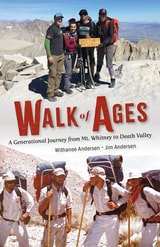
Walk of Ages
A Generational Journey from Mt. Whitney to Death ValleyWithanee Andersen
University of Nevada Press, 2024
With hopes of being listed in the Guinness Book of World Records, Jim led the first documented walk from the highest to lowest point in the contiguous United States in 1974. He lived, albeit just barely, to tell the tale to his daughter, sparking a desire in Withanee to retrace his steps in his honor. In 2017, she took on the incredible task of recreating Jim’s legacy trek of 131 miles with the help of divine intervention, ice-cold beer, and her parents, who were following along as the support party.
Walk of Ages humorously relates the parallel journey of an epic adventure told from two perspectives—a daughter’s difficult quest, and a father who supports her through it while recalling his own experiences from four decades earlier. Throughout this momentous odyssey, readers will realize how a once-in-a-generation adventure leads to life-changing transformation, and that the bond between father and daughter knows no bounds.
Walking Towards Walden
A Pilgrimage in Search of PlaceJohn Hanson Mitchell
University Press of New England, 2015
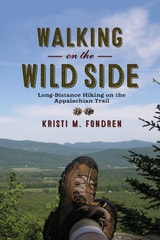
Walking on the Wild Side
Long-Distance Hiking on the Appalachian TrailFondren, Kristi M
Rutgers University Press, 2015
The most famous long-distance hiking trail in North America, the 2,181-mile Appalachian Trail—the longest hiking-only footpath in the world—runs along the Appalachian mountain range from Georgia to Maine. Every year about 2,000 individuals attempt to “thru-hike” the entire trail, a feat equivalent to hiking Mount Everest sixteen times. In Walking on the Wild Side, sociologist Kristi M. Fondren traces the stories of forty-six men and women who, for their own personal reasons, set out to conquer America’s most well known, and arguably most social, long-distance hiking trail.
In this fascinating in-depth study, Fondren shows how, once out on the trail, this unique subculture of hikers lives mostly in isolation, with their own way of acting, talking, and thinking; their own vocabulary; their own activities and interests; and their own conception of what is significant in life. They tend to be self-disciplined, have an unwavering trust in complete strangers, embrace a life of poverty, and reject modern-day institutions. The volume illuminates the intense social intimacy and bonding that forms among long-distance hikers as they collectively construct a long-distance hiker identity. Fondren describes how long-distance hikers develop a trail persona, underscoring how important a sense of place can be to our identity, and to our sense of who we are. Indeed, the author adds a new dimension to our understanding of the nature of identity in general.
Anyone who has hiked—or has ever dreamed of hiking—the Appalachian Trail will find this volume fascinating. Walking on the Wild Side captures a community for whom the trail is a sacred place, a place to which they have become attached, socially, emotionally, and spiritually.
Walking to the Sun
A Journey through America's Energy LandscapesTom Haines
University Press of New England, 2018
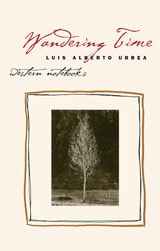
Wandering Time
Western NotebooksLuis Alberto Urrea
University of Arizona Press, 1999
Fleeing a failed marriage and haunted by ghosts of his past, Luis Alberto Urrea jumped into his car and headed west. Driving cross-country with a cat named Rest Stop, Urrea wandered the West from one year’s spring through the next.
Hiking into aspen forests where leaves “shiver and tinkle like bells” and poking alongside creeks in the Rockies, he sought solace and wisdom. In the forested mountains he learned not only the names of trees—he learned how to live. As nature opened Urrea’s eyes, writing opened his heart. In journal entries that sparkle with discovery, Urrea ruminates on music, poetry, and the landscape. With wonder and spontaneity, he relates tales of marmots, geese, bears, and fellow travelers. He makes readers feel mountain air “so crisp you feel you could crunch it in your mouth” and reminds us all to experience the magic and healing of small gestures, ordinary people, and common creatures.
Urrea has been heralded as one of the most talented writers of his generation. In poems, novels, and nonfiction, he has explored issues of family, race, language, and poverty with candor, compassion, and often astonishing power. Wandering Time offers his most intimate work to date, a luminous account of his own search for healing and redemption.
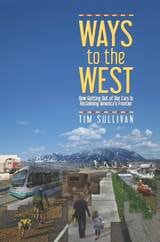
Ways to the West
How Getting Out of Our Cars Is Reclaiming America's FrontierTim Sullivan
Utah State University Press, 2015
In Ways to the West, Tim Sullivan embarks on a car-less road trip through the Intermountain West, exploring how the region is taking on what may be its greatest challenge: sustainable transportation. Combining personal travel narrative, historical research, and his professional expertise in urban planning, Sullivan takes a critical yet optimistic and often humorous look at how contemporary Western cities are making themselves more hospitable to a life less centered on the personal vehicle.
The modern West was built by the automobile, but so much driving has jeopardized the West’s mystic hold on the American future. At first, automobility heightened the things that made the West great, but love became dependence, and dependence became addiction. Via his travels by bicycle, bus, and train through Las Vegas, Phoenix, Denver, Boise, Salt Lake City, and Portland, Sullivan captures the modern transportation evolution taking place across the region and the resulting ways in which contemporary Western communities are reinterpreting classic American values like mobility, opportunity, adventure, and freedom.
Finding a West created, lost, and reclaimed, Ways to the West will be of great interest to anyone curious about sustainable transportation and the history, geography, and culture of the American West.

We Came Naked and Barefoot
The Journey of Cabeza de Vaca across North AmericaBy Alex D. Krieger
University of Texas Press, 2002
Second place, Presidio La Bahia Award, Sons of the Republic of Texas, 2003
Perhaps no one has ever been such a survivor as álvar Núñez Cabeza de Vaca. Member of a 600-man expedition sent out from Spain to colonize "La Florida" in 1527, he survived a failed exploration of the west coast of Florida, an open-boat crossing of the Gulf of Mexico, shipwreck on the Texas coast, six years of captivity among native peoples, and an arduous, overland journey in which he and the three other remaining survivors of the original expedition walked some 1,500 miles from the central Texas coast to the Gulf of California, then another 1,300 miles to Mexico City.
The story of Cabeza de Vaca has been told many times, beginning with his own account, Relación de los naufragios, which was included and amplified in Gonzalo Fernando de Oviedo y Váldez's Historia general de las Indias. Yet the route taken by Cabeza de Vaca and his companions remains the subject of enduring controversy. In this book, Alex D. Krieger correlates the accounts in these two primary sources with his own extensive knowledge of the geography, archaeology, and anthropology of southern Texas and northern Mexico to plot out stage by stage the most probable route of the 2,800-mile journey of Cabeza de Vaca.
This book consists of several parts, foremost of which is the original English version of Alex Krieger's dissertation (edited by Margery Krieger), in which he traces the route of Cabeza de Vaca and his companions from the coast of Texas to Spanish settlements in western Mexico. This document is rich in information about the native groups, vegetation, geography, and material culture that the companions encountered. Thomas R. Hester's foreword and afterword set the 1955 dissertation in the context of more recent scholarship and archaeological discoveries, some of which have supported Krieger's plot of the journey. Margery Krieger's preface explains how she prepared her late husband's work for publication. Alex Krieger's original translations of the Cabeza de Vaca and Oviedo accounts round out the volume.
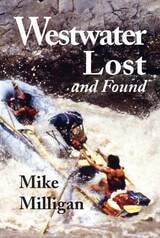
Westwater Lost and Found
Mike Milligan
Utah State University Press, 2004
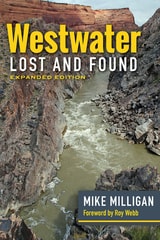
Westwater Lost and Found
Expanded EditionMike Milligan
Utah State University Press, 2024
This expanded edition brings to light historical events and explores how Westwater’s location greatly contributed to early Grand (Upper) Colorado River boaters’ knowledge and how the lush Westwater Valley and Cisco became critical stops for water, wood, and grass along the North Branch of the Old Spanish Trail. Other new additions include explorer Ellsworth Kolb’s unpublished manuscript describing his 1916–1917 boating experiences on the Grand and Gunnison Rivers; two stories relating to Outlaw Cave, one of which expands upon the mystery of the outlaw brothers; a letter from James E. Miller to Frederick S. Dellenbaugh in 1906 revealing new information about his boating excursion with Oro DeGarmo Babcock on the Grand River in 1897; and a portion of botanist Frederick Kreutzfeld’s little-known journal of 1853 that describes Captain John W. Gunnison’s railroad survey.
Loaded with extensive information and river-running history, Milligan’s guide is sure to enhance readers’ knowledge of the Upper Colorado River and Grand Canyon regions. Boaters, river guides, scholars of the American West, and historians of the Colorado, Green, and Gunnison Rivers or the Old Spanish Trail will gain much from this new edition.
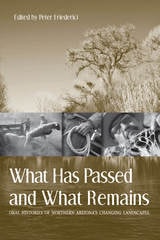
What Has Passed and What Remains
Oral Histories of Northern Arizona's Changing LandscapesEdited by Peter Friederici
University of Arizona Press, 2010
Thirteen narratives—from ranchers, foresters, scientists, Native American farmers, and others—tell how northern Arizona landscapes and livelihoods reflect rapid social and environmental change. The twentieth century saw huge changes as Arizona’s human population swelled and vacation-home developments arose in the backcountry. Riparian areas dried up, cattle ranching declined, and some wildlife species vanished while others thrived. The people whose words are preserved here have watched it all happen.
The book is a product of Northern Arizona University’s Ecological Oral Histories project, which has been collecting remembrances of long-time area residents who have observed changes to the land from the 1930s to the present day. It carves a wide swath, from the Arizona Strip to the Mogollon Rim, from valleys near Prescott to the New Mexico line. It takes readers to the Bar Heart Ranch north of Williams and to the Doy Reidhead Ranch southeast of Holbrook, to the forests of Flagstaff and the mesas of Indian country.
Enhanced with more than fifty illustrations, this book brings environmental change down to earth by allowing us to see it through the eyes of those whose lives it has directly touched. What Has Passed and What Remains is a window on the past that carries important lessons for the future.

What Wars Leave Behind
The Faceless and the ForgottenJ. Malcolm Garcia
University of Missouri Press, 2014
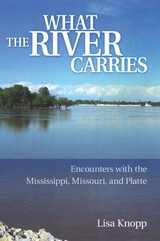
What the River Carries
Encounters with the Mississippi, Missouri, and PlatteLisa Knopp
University of Missouri Press, 2012
Because Knopp was born and raised just a few blocks away, she considers the Mississippi from the perspective of a native resident, a “dweller in the land.” She revisits places she has long known: Nauvoo, Illinois, the site of two nineteenth-century utopias, one Mormon, one Icarian; Muscatine, Iowa, once the world’s largest manufacturer of pearl (mussel shell) buttons; and the mysterious prehistoric bird- and bear-shaped effigy mounds of northeastern Iowa. On a downriver trip between the Twin Cities and St. Louis, she meditates on what can be found in Mississippi river water—state lines, dissolved oxygen, smallmouth bass, corpses, family history, wrecked steamboats, mayfly nymphs, toxic perfluorinated chemicals, philosophies.
Knopp first encountered the Missouri as a tourist and became acquainted with it through literary and historical documents, as well as stories told by longtime residents. Her journey includes stops at Fort Bellefontaine, where Lewis and Clark first slept on their sojourn to the Pacific; Little Dixie, Missouri’s slaveholding, hemp-growing region, as revealed through the life of Jesse James’s mother; Fort Randall Dam and Lake Francis Case, the construction of which destroyed White Swan on the Yankton Sioux Reservation; and places that produced unique musical responses to the river, including Native American courting flutes, indie rock, Missouri River valley fiddling, Prohibition-era jazz jam sessions, and German folk music.
Knopp’s relationship with the Platte is marked by intentionality: she settled nearby and chose to develop deep and lasting connections over twenty years’ residence. On this adventure, she ponders the half-million sandhill cranes that pass through Nebraska each spring, the ancient varieties of Pawnee corn growing at the Great Platte River Road Archway Monument, a never-broken tract of tallgrass prairie, the sugar beet industry, and the changes in the river brought about by the demands of irrigation.
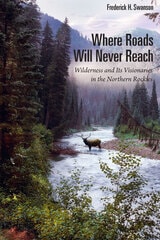
Where Roads Will Never Reach
Wilderness and Its Visionaries in the Northern RockiesFrederick H. Swanson
University of Utah Press, 2015
The Rocky Mountains of Idaho and Montana are home to some of the most important remaining American wilderness areas, preserved because of citizens who stood against massive development schemes that would have diminished important wildlife habitat and the abiding sense of remoteness found in such places. Where Roads Will Never Reach tells the stories of hunters, anglers, outfitters, scientists, and other concerned citizens who devoted themselves to protecting remnant wild lands and ecosystems in the Northern Rockies. Environmental historian Frederick Swanson argues that their heartfelt, dedicated work helped boost the American wilderness movement to its current prominence.
Based on newly available archival sources and interviews with many of the participants, this groundbreaking study explores for the first time the grassroots campaigns that yielded some of the largest designated wilderness areas in America.
Where the Strange Roads Go Down
Mary del Villar and Fred del Villar; Foreword by Susan Hardy Aiken
University of Arizona Press, 1999
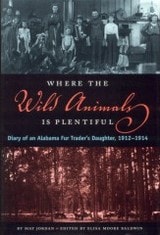
Where the Wild Animals Is Plentiful
Diary of an Alabama Fur Trader's Daughter, 1912-1914May Jordan
University of Alabama Press, 2006
This rare find--a journal of a young backwoods woman--provides a unique picture of rural life in southwestern Alabama early in the 20th century.
"I am a little Alabama girl living on the frontier where the wild animals is plentiful," wrote May Jordan in 1912. During the hunting season her father traveled Washington County buying furs, and May--already 23--accompanied him on two of these trips, cooking meals, helping out with the business, and recording their experiences.
May's diary of these trips from December 1912 to March 1914 describes the routine of the fur trade and provides a vivid portrait of wilderness travel and social customs. Through May's eyes, readers can experience the sights and sounds of pine forests and swamps, the difficulty of wading through waist-deep mud, and the neighborliness of the people living in this isolated area. May also shares both the solace of religious faith and her love of laughter as reflected in the jokes she records.
Elisa Moore Baldwin provides an introduction that traces Jordan family history and describes economic, social, and political conditions during the period. Baldwin also includes annotations based on court records, census rolls, and other primary sources and photographs of many of the characters in May's narrative to provide a vivid picture of the times. Because few first-person accounts exist of the life of poor whites, this diary will be invaluable to students of southern and women's history; no comparable work exists for this part of Alabama during this era. May's journal takes us to another world and teaches us about the lively human spirit in the face of hardship and loneliness.
Where the Wind Dreams of Staying
Searching for Purpose and Place in the WestEric Dieterle
Oregon State University Press, 2016
Dieterle’s journey leads from the plateau of eastern Washington through the landscapes of seven states, ending in the shadow of the San Francisco peaks in northern Arizona. Readers will find rich, detailed explorations of western landscapes balanced with stories of personal reflection, determination, doubt, and fulfillment.
White Waters and Black
Gordon MacCreagh
University of Chicago Press, 2001
Wide Skies
Finding a Home in the WestGary Holthaus
University of Arizona Press, 1997
A true place in the world: how many people have looked for it and how many have finally found it in the American West? Here, with writer Gary Holthaus, readers will reflect upon their own sense of place as they travel the lands and enter the lives of people in small towns and on ranches all over the West from Utah to Oregon to Alaska. Farmers and merchants, writers and teachers, truckers and trappers: their stories ring with hope and fear as their wide-open spaces increasingly come under siege.
Here are reflections on a long journey, together with notes of a personal odyssey and a plea for preserving the West's natural beauty-its meadows and mountains, its bears and Golden Eagles, its antelope and wolverines. This is important, says Holthaus, because if the region is home for him and for others, too, then it is crucial for newcomers and old-timers alike not to "further foul a nest that is becoming increasingly crowded." As he finds his way and adjusts his eyes to modern realities of greed and indifference, he also comes to grips with loss and learns to balance "the harm one inevitably does" with acts of compassion and positive change.
Deep in the national consciousness, the mythical West of film and fiction continues to shape our vision of ourselves as Americans. This book is a view not from the media, not from think tanks or legislators or policy makers, but from Westerners themselves, who tell us about the circumstances of their lives. Their West is indisputably the real West, and only as we come to understand better its realities will we come to know ourselves both as individuals and as a nation.
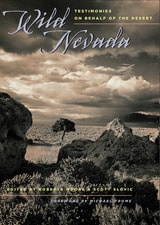
Wild Nevada
Testimonies on Behalf of the DesertRoberta Moore
University of Nevada Press, 2005
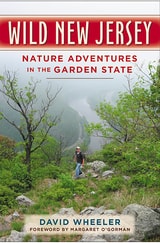
Wild New Jersey
Nature Adventures in the Garden StateDavid Wheeler
Rutgers University Press, 2011
Wild New Jersey invites readers along Wheeler’s whirlwind year-long tour of the most ecologically diverse state for its size in America. Along with the expert guidance of charismatic wildlife biologists and local conservationists, he explores mountains, valleys, beaches, pine barrens, caves, rivers, marshlands, and more—breathtaking landscapes and the state’s Noah’s Ark of fascinating creatures.
This isn’t your ordinary ride on the Jersey Turnpike. Fasten your seatbelts and join Wheeler as he . . .
- Kayaks through the Meadowlands under the watchful eye of the Empire State Building,
- Pans for cretaceous fossils in a hidden brook once home to mastodons and giant sloths,
- Rides a fishing boat in the frigid snows of winter on a high-seas quest for Atlantic puffins,
- Trudges through the eerie darkness of a bog on a mysterious night hike,
- Dogsleds across the windswept alpine slopes in the haunts of the porcupine and bobcat.
With Wheeler’s compelling narrative, in-depth background details, and eye for revealing the offbeat, you can count this as the first nature book to paint the extraordinary picture of New Jersey’s unlikely wilderness in all its glory. Come along for all the adventure and insight in Wild New Jersey!
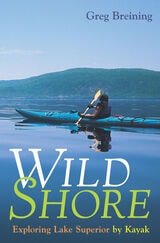
Wild Shore
Exploring Lake Superior By KayakGreg Breining
University of Minnesota Press, 2002
A real-life adventure and journey of discovery on the greatest of the Great Lakes
Over two years, Greg Breining set out to circle Lake Superior by kayak. Paddling more than one thousand miles, he camped on the lake’s islands and shorelines, visited its places of rare beauty and solitude, experienced its wildly varied moods, and explored remote historic sites and isolated communities. The result is Wild Shore, a tale of outdoor adventure, colorful characters, memorable stories, and personal discovery.
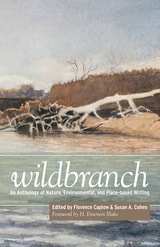
Wildbranch
An Anthology of Nature, Environmental, and Place-based WritingEdited by Florence Caplow and Susan A. Cohen. Foreword by H. Emerson Blake
University of Utah Press, 2010
Wildbranch: An Anthology of Nature, Environmental, and Place-based Writing is a powerful collection of mostly unpublished essays and poetry by both prominent American environmental writers and exciting new voices. The poetry and essays by more than fifty contributors offer the reader glimpses into places as diverse as a forest in West Africa, the moors of Ireland, the canyons of the Sonoran desert mountains, and the fields of New England, and they reflect the varied perspectives of field biologists, hunters, farmers, environmental educators, wilderness guides, academics, writers, and artists.
The collection is an intimate portrait of the natural world drawn through the wisdom, ecological consciousness, and open hearts of these exceptional contributors. The Wildbranch Writing Workshop, cosponsored by Orion magazine and Sterling College, has encouraged thoughtful natural history, outdoor, and environmental writing for more than twenty years. The Wildbranch faculty has included its founder E. Anne Proulx, the essayists Edward Hoagland, Janisse Ray, and Scott Russell Sanders, the poet Alison Hawthorne Deming, and many other notable authors. Many have work included in the anthology.
Winner of the New Mexico Book Association's Southwest Book Design & Production Awards for Excellence in the category Trade Books: Non-illustrated.
Wind in the Rock
The Canyonlands of Southeastern UtahAnn Zwinger
University of Arizona Press, 1978

Winter Notes on Summer Impressions
Fyodor Dostoevsky
Northwestern University Press, 1997
In June 1862, Dostoevsky left Petersburg on his first excursion to Western Europe. Ostensibly making the trip to consult Western specialists about his epilepsy, he also wished to see firsthand the source of the Western ideas he believed were corrupting Russia. Over the course of his journey he visited a number of major cities, including Berlin, Paris, London, Florence, Milan, and Vienna. He recorded his impressions in Winter Notes on Summer Impressions, which were first published in the February 1863 issue of Vremya (Time), the periodical of which he was the editor.
Among other themes, Dostoevsky reveals his Pan-Slavism, rejecting European culture as corrupt and exhorting Russians to resist the temptation to emulate or adopt European ways of life.
With the Lapps in the High Mountains
A Woman among the Sami, 1907–1908Emilie Demant Hatt; Edited and translated by Barbara Sjoholm; Foreword by Hugh Beach
University of Wisconsin Press, 2013
Wrecks of Human Ambition
A History of Utah's Canyon Country to 1936Nelson, Paul T.
University of Utah Press, 0
Most of the previous works regarding the history of this unique region have focused on either early exploration or twentieth-century controversies that erupted over mineral and water development and the creation of national parks and wilderness areas. This volume fills a gap in existing histories by focusing on early historical themes from the confrontation between Euro-Christian ideals and this challenging landscape. It centers on three interconnected interpretations of the area that unfolded when visitors from green, well-watered, productive lands approached this desert. The Judeo-Christian obligation to “make the desert bloom,” encompassed ideas of millenarianism and of Indian conversion and acculturation as well as the Old Testament symbolism of the “garden” and the “desert.” It was embodied in the efforts of Spanish missionaries who came to the canyon country from the 1500s to the 1700s, and in the experiences of Mormon settlers from about 1850 to 1909. Another conflicting sentiment saw the region simply as bad land to avoid, an idea strongly held by U.S. government explorers in the 1850s. This conclusion too was reinforced by the experiences of those who attempted to settle and exploit this country. Finally, though, the rise of tourism brought new ideas of wilderness reverence to the canyon country. The bad lands became valuable precisely because they were so distinct from traditionally settled landscapes.
In pursuing the conflict between Euro-Christian ideals and an arid, rugged, resistant landscape of deserts and canyons, Paul Nelson provides in clear, engaging language the most detailed examination yet published of colonial Spain’s encounter with the region and lays out some of Mormonism’s rare failures in settling the arid West.