Results by title
1210 books match the query 'Mexico' and 43 start with w
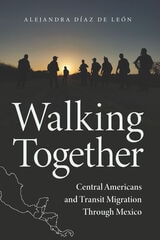
Walking Together
Central Americans and Transit Migration Through MexicoAlejandra Díaz de León
University of Arizona Press, 2023
Migrants in transit form several types of social networks, develop trust, and engage in acts of solidarity. The need to be recognized and grieved, compounded by the practical use of pooling information and resources, leads migrants to form small, strong groups called road families. Through the generalized sharing of information and small items such as food and blankets, migrants also form a transient community that includes everyone on the road at the same time. Sociologist Alejandra Díaz de León shows the trajectories of families that left together, showing, surprisingly, that families might not be the best social arrangement in transit.
Drawing on multisited research, this work contributes to debates on the role of social networks in clandestine migration processes and to discussions on how people create social networks and trust under violent and stressful situations. The detailed ethnographic narratives and accessible writing weave together theory with empirical observations to highlight and humanize the migrant experience.
Sitting at the intersection of border studies, immigration studies, and Latinx studies, this concise volume shows how Central American migrants in transit through Mexico survive the precarious and unpredictable road by forming different types of social ties.
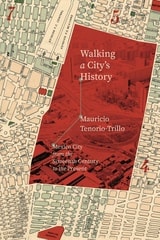
Walking a City's History
Mexico City from the Sixteenth Century to the PresentMauricio Tenorio-Trillo
University of Chicago Press, 2026
Walking a City’sHistory is both a richly documented panoramic view of Mexico City’s long history and an intimate essay on its social and cultural fabric. In this book, Mauricio Tenorio-Trillo uses his expertise as a historian and his talents as a storyteller to bring the city to life.
Using influential moments in Mexico City’s history from the Battle of Tenochtitlán in 1521 to the present, Tenorio-Trillo illustrates the capital’s transformations against a national and global background. Walking a City’s History offers an original, unique perspective on the social, architectural, artistic, and political dimensions of Mexico City, guided by chronicles, literary works, historical accounts, and the author’s own lifetime of walks through the city.
Wandering Peoples
Colonialism, Ethnic Spaces, and Ecological Frontiers in Northwestern Mexico, 1700–1850Cynthia Radding
Duke University Press, 1997
Radding describes this colonial mission not merely as an instance of Iberian expansion but as a site of cultural and political confrontation. This alternative vision of colonialism emphasizes the economic links between mission communities and Spanish mercantilist policies, the biological consequences of the Spanish policy of forced congregación, and the cultural and ecological displacements set in motion by the practices of discipline and surveillance established by the religious orders. Addressing wider issues pertaining to ethnic identities and to ecological and cultural borders, Radding’s analysis also underscores the parallel production of colonial and subaltern texts during the course of a 150-year struggle for power and survival.
War Of Conquest
How it was Waged Here in MexicoArthur J. O. Anderson
University of Utah Press, 1978
Warfare and the Fall of a Fortified Center
Archaeological Investigations at AguatecaTakeshi Inomata
Vanderbilt University Press, 2006
VIMA Series #3
Water and Politics
Clientelism and Reform in Urban MexicoVeronica Herrera
University of Michigan Press, 2017
Most of the world’s population lives in cities in developing countries, where access to basic public services, such as water, electricity, and health clinics, is either inadequate or sorely missing. Water and Politics shows how politicians benefit politically from manipulating public service provision for electoral gain. In many young democracies, politicians exchange water service for votes or political support, rewarding allies or punishing political enemies. Surprisingly, the political problem of water provision has become more pronounced, as water service represents a valuable political currency in resource-scarce environments.
Water and Politics finds that middle-class and industrial elites play an important role in generating pressure for public service reforms.

Water and Ritual
The Rise and Fall of Classic Maya RulersBy Lisa J. Lucero
University of Texas Press, 2006
In the southern Maya lowlands, rainfall provided the primary and, in some areas, the only source of water for people and crops. Classic Maya kings sponsored elaborate public rituals that affirmed their close ties to the supernatural world and their ability to intercede with deities and ancestors to ensure an adequate amount of rain, which was then stored to provide water during the four-to-five-month dry season. As long as the rains came, Maya kings supplied their subjects with water and exacted tribute in labor and goods in return. But when the rains failed at the end of the Classic period (AD 850-950), the Maya rulers lost both their claim to supernatural power and their temporal authority. Maya commoners continued to supplicate gods and ancestors for rain in household rituals, but they stopped paying tribute to rulers whom the gods had forsaken.
In this paradigm-shifting book, Lisa Lucero investigates the central role of water and ritual in the rise, dominance, and fall of Classic Maya rulers. She documents commoner, elite, and royal ritual histories in the southern Maya lowlands from the Late Preclassic through the Terminal Classic periods to show how elites and rulers gained political power through the public replication and elaboration of household-level rituals. At the same time, Lucero demonstrates that political power rested equally on material conditions that the Maya rulers could only partially control. Offering a new, more nuanced understanding of these dual bases of power, Lucero makes a compelling case for spiritual and material factors intermingling in the development and demise of Maya political complexity.
Watering the Revolution
An Environmental and Technological History of Agrarian Reform in MexicoMikael D. Wolfe
Duke University Press, 2017
Waves of Decolonization
Discourses of Race and Hemispheric Citizenship in Cuba, Mexico, and the United StatesDavid Luis-Brown
Duke University Press, 2008
Luis-Brown traces unfolding narratives of decolonization across a broad range of texts. He explores how Martí and Du Bois, known as the founders of Cuban and black nationalisms, came to develop anticolonial discourses that cut across racial and national divides. He illuminates how cross-fertilizations among the Harlem Renaissance, Mexican indigenismo, and Cuban negrismo in the 1920s contributed to broader efforts to keep pace with transformations unleashed by ongoing conflicts over imperialism, and he considers how those transformations were explored in novels by McKay of Jamaica, Jesús Masdeu of Cuba, and Miguel Ángel Menéndez of Mexico. Focusing on ethnography’s uneven contributions to decolonization, he investigates how Manuel Gamio, a Mexican anthropologist, and Zora Neale Hurston each adapted metropolitan social science for use by writers from the racialized periphery.
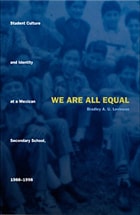
We Are All Equal
Student Culture and Identity at a Mexican Secondary School, 1988–1998Bradley A. U. Levinson
Duke University Press, 2001
Exploring how students develop a cultural “game of equality” that enables them to identify—across typical class and social boundaries—with their peers, the school, and the nation, Levinson considers such issues as the organizational and discursive resources that students draw on to maintain this culture. He also engages cultural studies, media studies, and globalization theory to examine the impact of television, music, and homelife on the students and thereby better comprehend—and problematize—the educational project of the state. Finding that an ethic of solidarity is sometimes used to condemn students defined as different or uncooperative and that little attention is paid to accommodating the varied backgrounds of the students—including their connection to indigenous, peasant, or working class identities—Levinson reveals that their “schooled identity” often collapses in the context of migration to the United States or economic crisis in Mexico. Finally, he extends his study to trace whether the cultural game is reinforced or eroded after graduation as well as its influence relative to the forces of family, traditional gender roles, church, and global youth culture.
We Are All Equal will be of particular interest to educators, sociologists, Latin Americanists, and anthropologists.
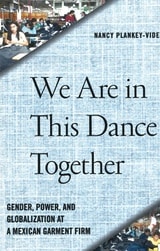
We Are in This Dance Together
Gender, Power, and Globalization at a Mexican Garment FirmPlankey-Videla, Nancy
Rutgers University Press, 2012
Changes in the global economy have real and contradictory outcomes for the everyday lives of women workers. In 2001, Nancy Plankey-Videla had a rare opportunity to witness these effects firsthand. Having secured access to one of Latin America's top producers of high-end men's suits in Mexico for participant-observer research, she labored as a machine operator for nine months on a shop floor made up, mostly, of women. The firm had recently transformed itself from traditional assembly techniques, to lean, cutting-edge, Japanese-style production methods. Lured initially into the firm by way of increased wages and benefits, workers had helped shoulder the company's increasing debts. When the company's plan for successful expansion went awry and it reneged on promises it had made to the workforce, women workers responded by walking out on strike.
Building upon in-depth interviews with over sixty workers, managers, and policy makers, Plankey-Videla documents and analyzes events leading up to the female-led factory strike and its aftermath—including harassment from managers, corrupt union officials and labor authorities, and violent governor-sanctioned police actions. We Are in This Dance Together illustrates how the women's shared identity as workers and mothers—deserving of dignity, respect, and a living wage—became the basis for radicalization and led to further civic organizing against the state, the company, and the corrupt union to demand justice.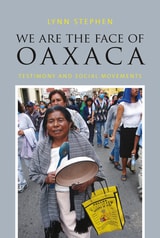
We Are the Face of Oaxaca
Testimony and Social MovementsLynn Stephen
Duke University Press, 2013
The movement was met with violent repression. Participants were imprisoned, tortured, and even killed. Lynn Stephen emphasizes the crucial role of testimony in human rights work, indigenous cultural history, community and indigenous radio, and women's articulation of their rights to speak and be heard. She also explores transborder support for APPO, particularly among Oaxacan immigrants in Los Angeles. The book is supplemented by a website featuring video testimonials, pictures, documents, and a timeline of key events.

We Came Naked and Barefoot
The Journey of Cabeza de Vaca across North AmericaBy Alex D. Krieger
University of Texas Press, 2002
Second place, Presidio La Bahia Award, Sons of the Republic of Texas, 2003
Perhaps no one has ever been such a survivor as álvar Núñez Cabeza de Vaca. Member of a 600-man expedition sent out from Spain to colonize "La Florida" in 1527, he survived a failed exploration of the west coast of Florida, an open-boat crossing of the Gulf of Mexico, shipwreck on the Texas coast, six years of captivity among native peoples, and an arduous, overland journey in which he and the three other remaining survivors of the original expedition walked some 1,500 miles from the central Texas coast to the Gulf of California, then another 1,300 miles to Mexico City.
The story of Cabeza de Vaca has been told many times, beginning with his own account, Relación de los naufragios, which was included and amplified in Gonzalo Fernando de Oviedo y Váldez's Historia general de las Indias. Yet the route taken by Cabeza de Vaca and his companions remains the subject of enduring controversy. In this book, Alex D. Krieger correlates the accounts in these two primary sources with his own extensive knowledge of the geography, archaeology, and anthropology of southern Texas and northern Mexico to plot out stage by stage the most probable route of the 2,800-mile journey of Cabeza de Vaca.
This book consists of several parts, foremost of which is the original English version of Alex Krieger's dissertation (edited by Margery Krieger), in which he traces the route of Cabeza de Vaca and his companions from the coast of Texas to Spanish settlements in western Mexico. This document is rich in information about the native groups, vegetation, geography, and material culture that the companions encountered. Thomas R. Hester's foreword and afterword set the 1955 dissertation in the context of more recent scholarship and archaeological discoveries, some of which have supported Krieger's plot of the journey. Margery Krieger's preface explains how she prepared her late husband's work for publication. Alex Krieger's original translations of the Cabeza de Vaca and Oviedo accounts round out the volume.
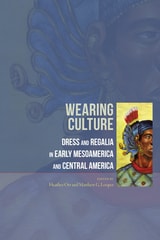
Wearing Culture
Dress and Regalia in Early Mesoamerica and Central AmericaHeather Orr
University Press of Colorado, 2014
Documenting the elaborate practices of costume, adornment, and body modification in Panama, Costa Rica, Nicaragua, Honduras, Oaxaca, the Soconusco region of southern Mesoamerica, the Gulf Coast Olmec region (Olman), and the Maya lowlands, this book demonstrates that adornment was used as a tool for communicating status, social relationships, power, gender, sexuality, behavior, and political, ritual, and religious identities. Despite considerable formal and technological variation in clothing and ornamentation, the early indigenous cultures of these regions shared numerous practices, attitudes, and aesthetic interests. Contributors address technological development, manufacturing materials and methods, nonfabric ornamentation, symbolic dimensions, representational strategies, and clothing as evidence of interregional sociopolitical exchange.
Focusing on an important period of cultural and artistic development through the lens of costuming and adornment, Wearing Culture will be of interest to scholars of pre-Hispanic and pre-Columbian studies.
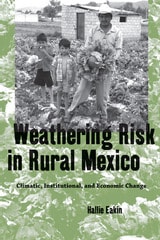
Weathering Risk in Rural Mexico
Climatic, Institutional, and Economic ChangeHallie Eakin
University of Arizona Press, 2006
In Weathering Risk in Rural Mexico, Hallie Eakin draws on ethnographic data collected in three agricultural communities in rural Mexico to show how economic and climatic change are not only linked in cause and effect at the planetary scale but also interact in unpredictable and complex ways in the context of regional political and trade relationships, national economic and social programs, and the decision making of institutions, enterprises, and individuals.She shows how the parallel processes of globalization and climatic change result in populations that are “doubly exposed” and thus particularly vulnerable.
Chapters trace the effects of El Niño in central Mexico in the late 1990s alongside some of the principal changes in the country’s agricultural policy. Eakin argues that in order to develop policies that effectively address rural poverty and agricultural development, we need an improved understanding of how households cope simultaneously with various sources of uncertainty and adjust their livelihoods to accommodate newly evolving environmental, political, and economic realities.
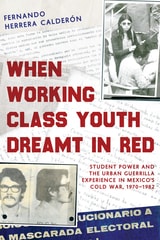
When Working Class Youth Dreamt in Red
Student Power and the Urban Guerrilla Experience in Mexico's Cold War, 1970–1982Fernando Herrera Calderón
University of Arizona Press, 2027
The 1970s in Mexico were turbulent from the start. Insurgent voices converged across cities and rural peripheries. Militant labor, urban popular sectors, and Indigenous collectives erupted in expressions of broad social exhaustion. Rebellion, rooted in the layered betrayals of the postrevolutionary state and the fractures of a deteriorating modernity under the Institutional Revolutionary Party (PRI), fermented and boiled over.
At the core of this moment, Mexican youth found their way to political-military organizations, coalescing around shared ecologies of dissent and embedded in broader currents of revolutionary struggle. When Working Class Youth Dreamt in Red reconstructs these insurgent youth cultures and guerrilla imaginaries, reorienting the historiographical lens to center radical working class youth—especially urban students—as protagonists in a wider saga of revolutionary experimentation and political rupture.
At its conceptual core, this book offers a bold new interpretation of a turbulent moment in Mexican history. It shows how class shaped the epistemic horizons through which proletarian youth understood themselves and makes visible their role as central actors at the vanguard of a revolutionary time.
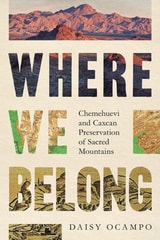
Where We Belong
Chemehuevi and Caxcan Preservation of Sacred MountainsDaisy Ocampo
University of Arizona Press, 2023
The author brings together the history and experiences of the Chemehuevi people and their ties with Mamapukaib, or the Old Woman Mountains in the East Mojave Desert, and the Caxcan people and their relationship with Tlachialoyantepec, or Cerro de las Ventanas, in Zacatecas, Mexico. Through a trans-Indigenous approach, Daisy Ocampo weaves historical methodologies (oral histories, archival research, ethnography) with Native studies and historic preservation to reveal why Native communities are the most knowledgeable and transformational caretakers of their sacred places.
This work transcends national borders to reveal how settler structures are sustained through time and space in the Americas. Challenging these structures, traditions such as the Chemehuevi Salt Songs and Caxcan Xuchitl Dance provide both an old and a fresh look at how Indigenous people are reimagining worlds that promote Indigenous-to-Indigenous futures through preservation.
Ultimately, the stories of these two peoples and places in North America illuminate Indigenous sovereignty within the field of public history, which is closely tied to governmental policies, museums, archives, and agencies involved in historic preservation.
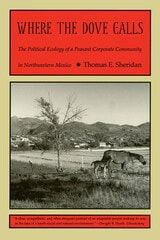
Where the Dove Calls
The Political Ecology of a Peasant Corporate Community in Northwestern MexicoThomas E. Sheridan
University of Arizona Press, 1988
Sheridan has written an ethnography of resource control, one that weds the approaches of political economy and cultural ecology in order to focus upon both the external linkages and internal adaptations that shape three peasant corporate communities. He examines the ecological and economic constraints which scarce and necessary resources place upon households in Cucurpe, and then investigates why many such households have formed corporate communities to insure their access to resources beyond their control. Finally, he identifies the class differences that exist within the corporate communities as well as between members of those organizations and the private ranchers who surround them.
Where the Dove Calls (the meaning of "Cucurpe" in the language of the Opata Indians), an important contribution to peasant studies, reveals the household as the basic unit of Cucurpe society. By viewing Cucurpe's corporate communities as organizations of fiercely independent domestic units rather than as expressions of communal solidarity, Sheridan shows that peasants are among the exploiters as well as the exploited. Cucurpe¤os struggle to maintain the autonomy of their households even as they join together to protect corporate grazing lands and irrigation water. Any attempt to weaken or destroy that independence is met with opposition that ranges from passive resistance to violence.
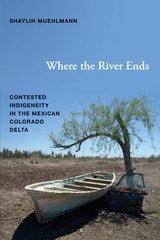
Where the River Ends
Contested Indigeneity in the Mexican Colorado DeltaShaylih Muehlmann
Duke University Press, 2013

Where the Strange Roads Go Down
Mary del Villar and Fred del Villar; Foreword by Susan Hardy Aiken
University of Arizona Press, 1999
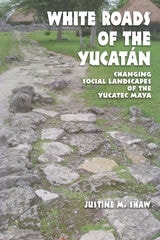
White Roads of the Yucatán
Changing Social Landscapes of the Yucatec MayaJustine M. Shaw
University of Arizona Press, 2008
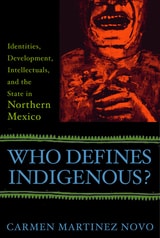
Who Defines Indigenous?
Identities, Development, Intellectuals, and the State in Northern MexicoMartinez Novo, Carmen
Rutgers University Press, 2006
For years, conventional scholarship has argued that minority groups are better served when the majority groups that absorb them are willing to recognize and allow for the preservation of indigenous identities. But is the reinforcement of ethnic identity among migrant groups always a process of self-liberation? In this surprising study, Carmen Martínez Novo draws on her ethnographic research of the Mixtec Indians’ migration from the southwest of Mexico to Baja California to show that sometimes the push for indigenous labels is more a process of external oppression than it is of minority empowerment.
In Baja California, many Mixtec Indians have not made efforts to align themselves as a coherent demographic. Instead, Martínez Novo finds that the push for indigenous identity in this region has come from local government agencies, economic elites, intellectuals, and other external agents. Their concern has not only been over the loss of rich culture. Rather, the pressure to maintain an indigenous identity has stemmed from the desire to secure a reproducible abundance of cheap “Indian” labor. Meanwhile, many Mixtecs reject their ethnic label precisely because being “Indian” means being a commercial agriculture low-wage worker or an urban informal street vendor—an identity that interferes with their goals of social mobility and economic integration.
Bringing a critical new perspective to the complex intersection among government and scholarly agendas, economic development, global identity politics, and the aspirations of local migrants, this provocative book is essential reading for scholars working in the fields of sociology, anthropology, and ethnic studies.

Wild Sea
Eco-Wars and Surf Stories from the Coast of the CaliforniasSerge Dedina
University of Arizona Press, 2011
Dedina grew up in Imperial Beach, California, just north of the Mexican border, and he feels equally at home in Mexico and the States. An expert on gray whales, he eloquently describes the fight he helped to lead against the Mitsubishi Corporation, whose plan to build a salt-processing plant in the San Ignacio Lagoon in Baja California would have destroyed the world’s last undeveloped gray whale lagoon. With similar fervor, Dedina describes helping to construct the unlikely coalition that succeeded in defeating a proposed toll road that would have decimated a legendary California surf spot.
In between, he writes about the first surfers in Baja, the Great Baja Land Rush of the 1990s, Tijuana’s punk music scene, the pop-culture wrestling phenomenon lucha libre, the reasons why ocean pollution must be stopped, and the way HBO took over his hometown. Anyone interested in what’s happening to our natural places or just yearning to read about someone really making a difference in the world will find this a book worth sinking their teeth into.
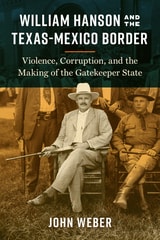
William Hanson and the Texas-Mexico Border
Violence, Corruption, and the Making of the Gatekeeper StateJohn Weber
University of Texas Press, 2024
An examination of the career of Texas Ranger and immigration official William Hanson illustrating the intersections of corruption, state-building, and racial violence in early twentieth century Texas.
At the Texas-Mexico border in the 1910s and 1920s, William Hanson was a witness to, and an active agent of, history. As a Texas Ranger captain and then a top official in the Immigration Service, he helped shape how US policymakers understood the border, its residents, and the movement of goods and people across the international boundary. An associate of powerful politicians and oil company executives, he also used his positions to further his and his patrons' personal interests, financial and political, often through threats and extralegal methods.
Hanson’s career illustrates the ways in which legal exclusion, white-supremacist violence, and official corruption overlapped and were essential building blocks of a growing state presence along the border in the early twentieth century. In this book, John Weber reveals Hanson’s cynical efforts to use state and federal power to proclaim the border region inherently dangerous and traces the origins of current nativist politics that seek to demonize the border population. In doing so, he provides insight into how a minor political appointee, motivated by his own ambitions, had lasting impacts on how the border was experienced by immigrants and seen by the nation.

Wind and Power in the Anthropocene
Dominic Boyer and Cymene Howe
Duke University Press, 2019
In his volume, Energopolitics, Boyer examines the politics of wind power and how it is shaped by myriad factors, from the legacies of settler colonialism and indigenous resistance to state bureaucracy and corporate investment. Drawing on interviews with activists, campesinos, engineers, bureaucrats, politicians, and bankers, Boyer outlines the fundamental impact of energy and fuel on political power. Boyer also demonstrates how large conceptual frameworks cannot adequately explain the fraught and uniquely complicated conditions on the Isthmus, illustrating the need to resist narratives of Anthropocenic universalism and to attend to local particularities.
In her volume, Ecologics, Howe narrates how an antidote to the Anthropocene became both failure and success. Tracking the development of what would have been Latin America's largest wind park, Howe documents indigenous people's resistance to the project and the political and corporate climate that derailed its renewable energy potential. Using feminist and more-than-human theories, Howe demonstrates how the dynamics of energy and environment cannot be captured without understanding how human aspirations for energy articulate with nonhuman beings, technomaterial objects, and the geophysical forces that are at the heart of wind and power.
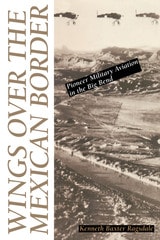
Wings over the Mexican Border
Pioneer Military Aviation in the Big BendBy Kenneth Baxter Ragsdale
University of Texas Press, 1997
Against a backdrop of revolution, border banditry, freewheeling aerial dramatics, and World War II comes this compelling look at the rise of U.S. combat aviation at an unlikely proving ground—a remote airfield in the rugged reaches of the southwestern Texas borderlands. Here, at Elmo Johnson's Big Bend ranch, hundreds of young Army Air Corps pilots demonstrated the U.S. military's reconnaissance and emergency response capabilities and, in so doing, dramatized the changing role of the airplane as an instrument of war and peace.
Kenneth Ragsdale's gripping account not only sets the United States squarely in the forefront of aerial development but also provides a reflective look at U.S.-Mexican relations of the 1920s, 1930s, and 1940s, particularly the tense days and aftermath of the Escobar Rebellion of 1929. He paints a vivid picture of the development of the U.S. aerial strike force; the character, ideals, and expectations of the men who would one day become combat leaders; and the high esteem in which U.S. citizens held the courageous pilots.
Particularly noteworthy is Ragsdale's portrait of Elmo Johnson, the Big Bend rancher, trader, and rural sage who emerges as the dominant figure at one of the most unusual facilities in the annals of the Air Corps. Wings over the Mexican Border tells a stirring story of the American frontier juxtaposed with the new age of aerial technology.

Without Masters
Autogestión, Anarchist Ethics, and Mexico City PunkLivia K. Stone
Duke University Press, 2026

Women Filmmakers in Mexico
The Country of Which We DreamBy Elissa J. Rashkin
University of Texas Press, 2001
Women filmmakers in Mexico were rare until the 1980s and 1990s, when women began to direct feature films in unprecedented numbers. Their films have won acclaim at home and abroad, and the filmmakers have become key figures in contemporary Mexican cinema. In this book, Elissa Rashkin documents how and why women filmmakers have achieved these successes, as she explores how the women's movement, film studies programs, governmental film policy, and the transformation of the intellectual sector since the 1960s have all affected women's filmmaking in Mexico.
After a historical overview of Mexican women's filmmaking from the 1930s onward, Rashkin focuses on the work of five contemporary directors—Marisa Sistach, Busi Cortés, Guita Schyfter, María Novaro, and Dana Rotberg. Portraying the filmmakers as intellectuals participating in the public life of the nation, Rashkin examines how these directors have addressed questions of national identity through their films, replacing the patriarchal images and stereotypes of the classic Mexican cinema with feminist visions of a democratic and tolerant society.

Women Who Live Evil Lives
Gender, Religion, and the Politics of Power in Colonial GuatemalaBy Martha Few
University of Texas Press, 2002
Women Who Live Evil Lives documents the lives and practices of mixed-race, Black, Spanish, and Maya women sorcerers, spell-casters, magical healers, and midwives in the social relations of power in Santiago de Guatemala, the capital of colonial Central America. Men and women from all sectors of society consulted them to intervene in sexual and familial relations and disputes between neighbors and rival shop owners; to counter abusive colonial officials, employers, or husbands; and in cases of inexplicable illness.
Applying historical, anthropological, and gender studies analysis, Martha Few argues that women's local practices of magic, curing, and religion revealed opportunities for women's cultural authority and power in colonial Guatemala. Few draws on archival research conducted in Guatemala, Mexico, and Spain to shed new light on women's critical public roles in Santiago, the cultural and social connections between the capital city and the countryside, and the gender dynamics of power in the ethnic and cultural contestation of Spanish colonial rule in daily life.
Women Who Stay Behind
Pedagogies of Survival in Rural Transmigrant MexicoRuth Trinidad Galván
University of Arizona Press, 2015
The book studies women’s and families’ use of cultural knowledge, community activism, and teaching and learning spaces. Throughout, Trinidad Galván provides answers to these questions: How does the migration of loved ones alter community, familial, and gender dynamics? And what social relations (convivencia), cultural knowledge, and women-centered pedagogies sustain women’s survival (supervivencia)?
Researchers, educators, and students interested in migration studies, gender studies, education, Latin American studies, and Mexican American studies will benefit from the ethnographic approach and theoretical insight of this groundbreaking work.
Women and Alcohol in a Highland Maya Town
Water of Hope, Water of SorrowBy Christine Eber
University of Texas Press, 1995
Healing roles and rituals involving alcohol are a major source of power and identity for women and men in Highland Chiapas, Mexico, where abstention from alcohol can bring a loss of meaningful roles and of a sense of community. Yet, as in other parts of the world, alcohol use sometimes leads to abuse, whose effects must then be combated by individuals and the community.
In this pioneering ethnography, Christine Eber looks at women and drinking in the community of San Pedro Chenalhó to address the issues of women’s identities, roles, relationships, and sources of power. She explores various personal and social strategies women use to avoid problem drinking, including conversion to Protestant religions, membership in cooperatives or Catholic Action, and modification of ritual forms with substitute beverages.
The book’s women-centered perspective reveals important data on women and drinking not reported in earlier ethnographies of Highland Chiapas communities. Eber’s reflexive approach, blending the women’s stories, analyses, songs, and prayers with her own and other ethnographers’ views, shows how Western, individualistic approaches to the problems of alcohol abuse are inadequate for understanding women’s experiences with problem and ritual drinking in a non-Western culture.
In a new epilogue, Christine Eber describes how events of the last decade, including the Zapatista uprising, have strengthened women's resolve to gain greater control over their lives by controlling the effects of alcohol in the community.
Women in Contemporary Mexican Politics
By Victoria E. Rodríguez
University of Texas Press, 2003
Since the mid-1980s, a dramatic opening in Mexico's political and electoral processes, combined with the growth of a new civic culture, has created unprecedented opportunities for women and other previously repressed or ignored groups to participate in the political life of the nation. In this book, Victoria Rodríguez offers the first comprehensive analysis of how Mexican women have taken advantage of new opportunities to participate in the political process through elected and appointed office, nongovernmental organizations, and grassroots activism.
Drawing on scores of interviews with politically active women conducted since 1994, Rodríguez looks at Mexican women's political participation from a variety of angles. She analyzes the factors that have increased women's political activity: from the women's movement, to the economic crises of the 1980s and 1990s, to increasing democratization, to the victory of Vicente Fox in the 2000 presidential election. She maps out the pathways that women have used to gain access to public life and also the roadblocks that continue to limit women's participation in politics, especially at higher levels of government. And she offers hopeful, yet realistic predictions for women's future participation in the political life of Mexico.
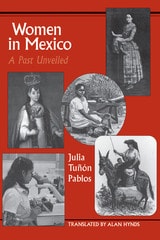
Women in Mexico
A Past UnveiledBy Julia Tuñón Pablos
University of Texas Press, 1999
Throughout Mexico's history, women have been subjected to a dual standard: exalted in myth, they remain subordinated in their social role by their biology. But this dualism is not so much a battle between the sexes as the product of a social system. The injustices of this system have led Mexican women to conclude that they deserve a better world, one worth struggling for.
Published originally in Spanish as Mujeres en México: Una historia olvidada, this work examines the role of Mexican women from pre-Cortés to the 1980s, addressing the interplay between myth and history and the gap between theory and practice. Pointing to such varied prototypes as the Virgin of Guadalupe, La Malinche, and Sor Juana, Tuñón contrasts what these women represent with more realistic but less-exalted counterparts such as Josefa Ortiz de Domínguez, La Güera Rodríguez, and Juana Belén Gutiérrez de Mendoza. She also discusses the identity transformation by which indigenous women come to see themselves as Mexicanas, and analyzes such issues as women's economic dislocation in the labor force, education, and self-image.
In challenging the illusion that historians have created of women in Mexico's history, Tuñón hopes to recover feminism—with its strengths and weaknesses, its vision of the world that is both intellectual and full of feeling. By examining the social world of Mexico, she also hopes to determine those situations that cause oppression, exploitation, and marginalization of women.
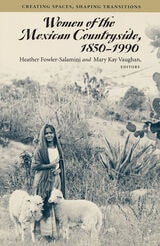
Women of the Mexican Countryside, 1850-1990
Creating Spaces, Shaping TransitionsHeather Fowler-Salamini
University of Arizona Press, 1994
Drawing on Mexican community studies, gender studies, and rural studies, these essays overturn the stereotypes of Mexican peasant women by exploring the complexity of their lives and roles and examining how these have changed over time. The book emphasizes the active roles of women in the periods of civil war, 1854-76, and the commercialization of agriculture, 1880-1910. It highlights their vigorous responses to the violence of revolution, their increased mobility, and their interaction with state reforms in the period from 1910 to 1940. The final essays focus on changing gender relations in the countryside under the impact of rapid urbanization and industrialization since 1940. Because histories of Latin American women have heretofore neglected rural areas, this volume will serve as a touchstone for all who would better understand women's lives in a region of increasing international economic importance. Women of the Mexican Countryside demonstrates that, contrary to the peasant stereotype, these women have accepted complex roles to meet constantly changing situations.
CONTENTS
I—Women and Agriculture in Nineteenth-Century Mexico
1. Exploring the Origins of Democratic Patriarchy in Mexico: Gender and Popular Resistance in the Puebla Highlands, 1850-1876, Florencia Mallon
2. "Cheaper Than Machines": Women and Agriculture in Porfirian Oaxaca (1880-1911), Francie R. Chassen-López
3. Gender, Work, and Coffee in C¢rdoba, Veracruz, 1850-1910, Heather Fowler-Salamini
4. Gender, Bridewealth, and Marriage: Social Reproduction of Peons on Henequen Haciendas in Yucatán (1870-1901), Piedad Peniche Rivero
II—Rural Women and Revolution in Mexico
5. The Soldadera in the Mexican Revolution: War and Men's Illusions, Elizabeth Salas
6. Rural Women's Literacy and Education During the Mexican Revolution: Subverting a Patriarchal Event?, Mary Kay Vaughan
7. Doña Zeferina Barreto: Biographical Sketch of an Indian Woman from the State of Morelos, Judith Friedlander
8. Seasons, Seeds, and Souls: Mexican Women Gardening in the American Mesilla (1900-1940), Raquel Rubio Goldsmith
III—Rural Women, Urbanization, and Gender Relations
9. Three Microhistories of Women's Work in Rural Mexico, Patricia Arias
10. Intergenerational and Gender Relations in the Transition from a Peasant Economy to a Diversified Economy, Soledad González Montes
11. From Metate to Despate: Rural Women's Salaried Labor and the Redefinition of Gendered Spaces and Roles, Gail Mummert
12. Changes in Rural Society and Domestic Labor in Atlixco, Puebla (1940-1990), Maria da Glória Marroni de Velázquez
13. Antagonisms of Gender and Class in Morelos, Mexico, JoAnn Martin
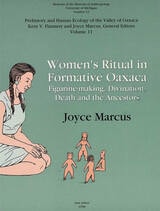
Women's Ritual in Formative Oaxaca
Figurine-making, Divination, Death and the AncestorsJoyce Marcus
University of Michigan Press, 1998
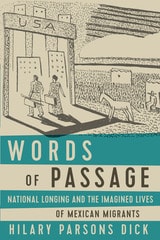
Words of Passage
National Longing and the Imagined Lives of Mexican MigrantsBy Hilary Parsons Dick
University of Texas Press, 2018
Migration fundamentally shapes the processes of national belonging and socioeconomic mobility in Mexico—even for people who never migrate or who return home permanently. Discourse about migrants, both at the governmental level and among ordinary Mexicans as they envision their own or others’ lives in “El Norte,” generates generic images of migrants that range from hardworking family people to dangerous lawbreakers. These imagined lives have real consequences, however, because they help to determine who can claim the resources that facilitate economic mobility, which range from state-sponsored development programs to income earned in the North.
Words of Passage is the first full-length ethnography that examines the impact of migration from the perspective of people whose lives are affected by migration, but who do not themselves migrate. Hilary Parsons Dick situates her study in the small industrial city of Uriangato, in the state of Guanajuato. She analyzes the discourse that circulates in the community, from state-level pronouncements about what makes a “proper” Mexican to working-class people’s talk about migration. Dick shows how this migration discourse reflects upon and orders social worlds long before—and even without—actual movements beyond Mexico. As she listens to men and women trying to position themselves within the migration discourse and claim their rights as “proper” Mexicans, she demonstrates that migration is not the result of the failure of the Mexican state but rather an essential part of nation-state building.
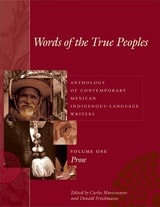
Words of the True Peoples/Palabras de los Seres Verdaderos
Anthology of Contemporary Mexican Indigenous-Language Writers/Antología de Escritores Actuales en Lenguas Indígenas de México: Volume One/Tomo Uno: Prose/ProsaEdited by Carlos Montemayor and Donald Frischmann
University of Texas Press, 2005
As part of the larger, ongoing movement throughout Latin America to reclaim non-Hispanic cultural heritages and identities, indigenous writers in Mexico are reappropriating the written word in their ancestral tongues and in Spanish. As a result, the long-marginalized, innermost feelings, needs, and worldviews of Mexico's ten to twenty million indigenous peoples are now being widely revealed to the Western societies with which these peoples coexist. To contribute to this process and serve as a bridge of intercultural communication and understanding, this groundbreaking, three-volume anthology gathers works by the leading generation of writers in thirteen Mexican indigenous languages: Nahuatl, Maya, Tzotzil, Tzeltal, Tojolabal, Tabasco Chontal, Purepecha, Sierra Zapoteco, Isthmus Zapoteco, Mazateco, Ñahñu, Totonaco, and Huichol.
Volume 1 contains narratives and essays by Mexican indigenous writers. Their texts appear first in their native language, followed by English and Spanish translations. Frischmann and Montemayor have abundantly annotated the English, Spanish, and indigenous-language texts and added glossaries and essays that trace the development of indigenous texts, literacy, and writing. These supporting materials make the anthology especially accessible and interesting for nonspecialist readers seeking a greater understanding of Mexico's indigenous peoples.
The other volumes of this work will be Volume 2: Poetry/Poesía and Volume 3: Theater/Teatro.
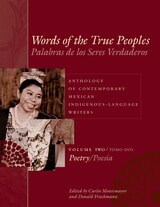
Words of the True Peoples/Palabras de los Seres Verdaderos
Anthology of Contemporary Mexican Indigenous-Language Writers/Antología de Escritores Actuales en Lenguas Indígenas de México: Volume Two/Tomo Dos: Poetry/PoesíaEdited by Carlos Montemayor and Donald Frischmann
University of Texas Press, 2005
As part of the larger, ongoing movement throughout Latin America to reclaim non-Hispanic cultural heritages and identities, indigenous writers in Mexico are reappropriating the written word in their ancestral tongues and in Spanish. As a result, the long-marginalized, innermost feelings, needs, and worldviews of Mexico's ten to twenty million indigenous peoples are now being widely revealed to the Western societies with which these peoples coexist. To contribute to this process and serve as a bridge of intercultural communication and understanding, this groundbreaking, three-volume anthology gathers works by the leading generation of writers in thirteen Mexican indigenous languages: Nahuatl, Maya, Tzotzil, Tzeltal, Tojolabal, Tabasco Chontal, Purepecha, Sierra Zapoteco, Isthmus Zapoteco, Mazateco, Ñahñu, Totonaco, and Huichol.
Volume Two contains poetry by Mexican indigenous writers. Their poems appear first in their native language, followed by English and Spanish translations. Montemayor and Frischmann have abundantly annotated the Spanish, English, and indigenous-language texts and added glossaries and essays that discuss the formal and linguistic qualities of the poems, as well as their place within contemporary poetry. These supporting materials make the anthology especially accessible and interesting for nonspecialist readers seeking a greater understanding of Mexico's indigenous peoples.
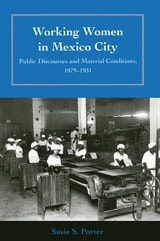
Working Women in Mexico City
Public Discourses and Material Conditions, 1879-1931Susie S. Porter
University of Arizona Press, 2003
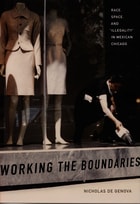
Working the Boundaries
Race, Space, and "Illegality" in Mexican ChicagoNicholas De Genova
Duke University Press, 2005
De Genova worked for two and a half years as a teacher of English in ten industrial workplaces (primarily metal-fabricating factories) throughout Chicago and its suburbs. In Working the Boundaries he draws on fieldwork conducted in these factories, in community centers, and in the homes and neighborhoods of Mexican migrants. He describes how the meaning of “Mexican” is refigured and racialized in relation to a U.S. social order dominated by a black-white binary. Delving into immigration law, he contends that immigration policies have worked over time to produce Mexicans as the U.S. nation-state’s iconic “illegal aliens.” He explains how the constant threat of deportation is used to keep Mexican workers in line. Working the Boundaries is a major contribution to theories of race and transnationalism and a scathing indictment of U.S. labor and citizenship policies.
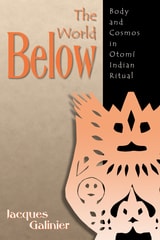
World Below
Body and Cosmos in Otomí Indian RitualJacques Galinier
University Press of Colorado, 2004
Drawing upon both Freud and theories of the carnivalesque, Galinier argues that the "world below" (the lower half of the body) provides the foundation for an indigenous metapsychology that is at once very close to and very far away from the Freudian conceptual apparatus.
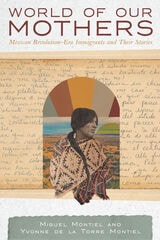
World of Our Mothers
Mexican Revolution–Era Immigrants and Their StoriesMiguel Montiel and Yvonne de la Torre Montiel
University of Arizona Press, 2022
While the women share a historic immigration journey, each story provides unique details and circumstances that testify to the diversity of the immigrant experience. The oral histories, a project more than forty years in the making, let these women speak for themselves, while historical information is added to support and illuminate the women’s voices.
The book, which includes a foreword by Irasema Coronado, director of the School of Transborder Studies, and Chris Marin, professor emeritus, both at Arizona State University, is divided into four parts. Part 1 highlights the salient events of the Revolution; part 2 presents an overview of what immigrants inherited upon their arrival to the United States; part 3 identifies challenges faced by immigrant families; and part 4 focuses on stories by location—Arizona mining towns, Phoenix barrios, and Midwestern colonias—all communities that immigrant women helped create. The book concludes with ideas on how readers can examine their own family histories. Readers are invited to engage with one another to uncover alternative interpretations of the immigrant experience and through the process connect one generation with another.

Writing Pancho Villa's Revolution
Rebels in the Literary Imagination of MexicoBy Max Parra
University of Texas Press, 2006
The 1910 Mexican Revolution saw Francisco "Pancho" Villa grow from social bandit to famed revolutionary leader. Although his rise to national prominence was short-lived, he and his followers (the villistas) inspired deep feelings of pride and power amongst the rural poor. After the Revolution (and Villa's ultimate defeat and death), the new ruling elite, resentful of his enormous popularity, marginalized and discounted him and his followers as uncivilized savages. Hence, it was in the realm of culture rather than politics that his true legacy would be debated and shaped.
Mexican literature following the Revolution created an enduring image of Villa and his followers. Writing Pancho Villa's Revolution focuses on the novels, chronicles, and testimonials written from 1925 to 1940 that narrated Villa's grassroots insurgency and celebrated—or condemned—his charismatic leadership. By focusing on works by urban writers Mariano Azuela (Los de abajo) and Martín Luis Guzmán (El águila y la serpiente), as well as works closer to the violent tradition of northern Mexican frontier life by Nellie Campobello (Cartucho), Celia Herrera (Villa ante la historia), and Rafael F. Muñoz (¡Vámonos con Pancho Villa!), this book examines the alternative views of the revolution and of the villistas. Max Parra studies how these works articulate different and at times competing views about class and the cultural "otherness" of the rebellious masses. This unique revisionist study of the villista novel also offers a deeper look into the process of how a nation's collective identity is formed.