Results by title
3785 books match the query 'Poetry' and 184 start with w

WEB OF FANTASIES
Gaze, Image, & Gender in Ovid’s MetamorphosesPatricia B Salzman-Mitchell
The Ohio State University Press, 2005
The book observes that while feminist models of the gaze can create productive readings of the poem, these models are too limited and reductive for such a protean and complex text as Metamorphoses. This work brings forth the pervasive importance of the act of looking in the poem which will affect future readings of Ovid’s epic.
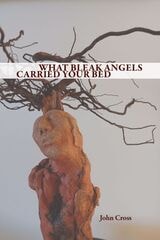
WHAT BLEAK ANGELS CARRIED YOUR BED
John Cross
Omnidawn, 2026
John Cross’s WHAT BLEAK ANGELS CARRIED YOUR BED opens in exile and st(r)ays there. The character Mathias, a trickster who opens this collection, wakes with a primal utterance and startled vision born of commotion. Bewildered by the noise of our culture, he finds brief glimpses of meaning in fleeting, slippery moments. Mathias navigates life in exile, exploring the depths of his situation through the beat of his song and stutter, which manifests in a deranging of language and finds a foothold in cosmic disorder. A “scavenger for armor” in a world of loss and wreckage, he feels the terror of existence while holding onto the promise of a “breath still audible at near dark.”
The second half of the book opens in the harsh light of a sun that “pushes down on our feet” and implores that we witness our world. In this brightness, Cross conjures shadows from his own memory and confronts a world where a president throws “his people to the wolves.” These poems move through the world in wonder, offering an elegiac hushed prayer to all that we are losing in a changing environment, to “the oriole ascending / the palo verde of bee vibration . . . & Mitchell’s satyr butterfly.”
WHAT BLEAK ANGELS CARRIED YOUR BED is the winner of the 2023 Omnidawn Poetry Open Contest, selected by Maw Shein Win.
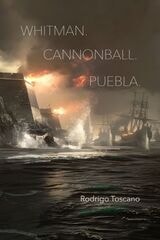
WHITMAN. CANNONBALL. PUEBLA.
Rodrigo Toscano
Omnidawn, 2025
This four-part collection of poetic fables engages the emerging field of global-poetics through Hispano-Americano lenses. Amid global crises between states, and cultural destabilization manifesting across mass popular culture and literature, WHITMAN. CANNONBALL. PUEBLA. sets out to invigorate conversation about how the United States might adapt to a wider hemispheric consciousness. Toscano’s poems present a cultural landscape where the Anglo-capitalist outlook is tempered—if not subsumed—by a Greater Americas “Salamanca Humanism,” which was the basis for the 1948 United Nations Universal Declaration of Human Rights.
The book is divided into four sections that develop the idea of a Greater Americas as hinging on negotiation between Anglo and Hispano values, consider a potential catastrophic Anglo-American imperialism, imagine life in a Post-Empire crisis, and compose allegories about the historical consciousness of a people oversaturated with media.
WITH AKHMATOVA AT THE BLACK GATES
Stephen Berg
University of Illinois Press, 2000
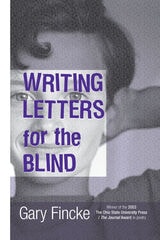
WRITING LETTERS FOR THE BLIND
Gary Fincke
The Ohio State University Press, 2003
These poems begin in the coming-of-age moments that change us by forcing recognition of physical weakness, the power of sex, the importance of family, the presence of evil, and the prevalence of mortality. The book opens with narratives taken primarily from childhood and then, divided by long poem sequences, moves to adulthood and confrontation with the identity we acquire through close relationships and the pressures of our appetites, finally ending with what reads as a universal prayer of redemption.
Writing Letters for the Blind presents the reader with visions of this world and all its beauty and sordidness, joy and disappointment. This poet reports the breaking news just in from the heart and soul, and the body as well. “My father has taught me the beatitudes of sight,” Fincke tells us, always aware of what we owe to those who brought us here. He stays up through the starry darkness in the insomnia of one who feels it his duty to pay passionate attention, a poet engaged in “the basic defense of simple things.”
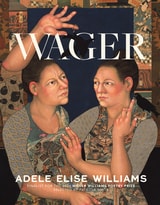
Wager
Adele Elise Williams
University of Arkansas Press, 2024
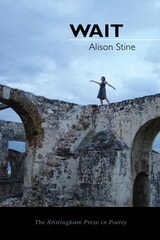
Wait
Alison Stine
University of Wisconsin Press, 2011
In a small town under a spell, a child bride prays for the sheriff’s gun. Iron under a bed stops a nightmare. The carousel artist can carve only birds. Part fairy tale and part gothic ballad, Wait spans a single year: the year before a young woman’s marriage. Someone is always watching—from the warehouse, from the woods. And on the outskirts of town, someone new is waiting.
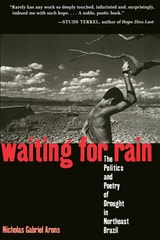
Waiting for Rain
The Politics and Poetry of Drought in Northeast BrazilNicholas Gabriel Arons
University of Arizona Press, 2004
In order to understand the impact of drought and the phenomenon of drought politics, Nicholas Gabriel Arons goes beyond traditional social-science scholarship to sources such as novels, poetry, popular art, and oral history. For many people in the region, these artistic renditions of life are, ironically, a better reflection of reality than political rhetoric, government archives, and newspaper accounts—even though they are infused with myth or hyperbole.
Drawing on interviews with artists and poets and on his own experiences in the Brazilian Northeast, Arons has written a poignant account of how drought has impacted the region’s culture. He intertwines ecological, social, and political issues with the words of some of Brazil’s most prominent authors and folk poets to show how themes surrounding drought—hunger, migration, endurance, nostalgia for the land—have become deeply embedded in Nordeste identity. Through this tapestry of sources, Arons shows that what is often thought of as a natural phenomenon is actually the result of centuries of social inequality, political corruption, and unsustainable land use.
Waiting for Rain dramatically depicts a region still suffering from austere social and political realities, where drought—even during rainy seasons—is ubiquitous in the hearts and minds of its residents. A book of hope and resistance, myth and reality, and suffering and salvation, it is also a personal narrative of self-discovery, tracing a young man’s struggle to understand how human tragedy on a grand scale can exist alongside natural beauty.
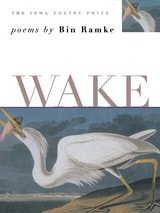
Wake
Bin Ramke
University of Iowa Press, 1999
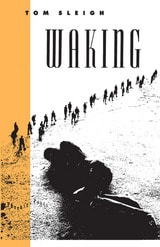
Waking
Tom Sleigh
University of Chicago Press, 1990
". . . . it takes a book like Tom Sleigh's Waking to remind us of all that was most innately stirring and necessary about the confessional insurrection. . . . in Waking Sleigh proves himself worthy of spinning gold thread from the straw of sincerity, elevating his so-called confessions from the merely revealing to the durably revelatory."—David Barber, Poetry
"[Sleigh] is a consummate stylist whose formal control and exploitation of convention is graceful and calm. And yet it is from the calm and steady control that some of Sleigh's most emotionally powerful moments are acheived. . . .Waking is one of the strongest collections of poems to appear in the last few years."—Michael Collier, Partisan Review
"Tom Sleigh's second book of poems, Waking is so fine one can hardly do justice to it in a review. The second poem, 'Ending,' is a remarkable piece of work which introduces the notion of the 'hook'—which hooks us to life even while it kills us. It is a presence of painful mortality which haunts the rest of the book."—Liz Rosenberg, New York Times Book Review
"Waking handsomely and affirmatively demonstrates its own clean and demanding premise: one's imagination is awakened to life by the burden of mortality. One reads in these poems a view not of the poet's suffering, but of our own temporal joys and sorrows."—Jay Meek, Hungry Mind Review
"With the publication of Waking, his second collection of poems, Tom Sleigh establishes his voice among the strongest of his generation. A poet of subject and craft, his skill allows him to avoid the slackness of much free verse and, at the same time, break free of the stiff old numbers in order to create a spoken language of rhythmic intensity and eloquence. . . . In this book Tom Sleigh's vigilance provides his readers with an invaluable gift: we can wake our lives."—Stuart Dischell, Boston Review
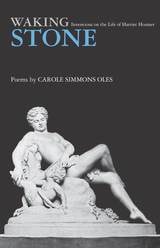
Waking Stone
Inventions on the Life of Harriet HosmerCarole Simmons Oles
University of Arkansas Press, 2006
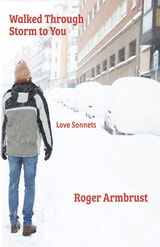
Walked Through Storm to You
Love SonnetsRoger Armbrust
Parkhurst Brothers, Inc., 2022
In this book of 126 sonnets, the poet invites us to walk with him as his creative sense takes us through every mood of nature on earth, and to the universe beyond. Imagery’s connections turn hearing 2 a.m. rain into Hemingway’s and James Dickey’s typewriter keys, leading the poet to write. Each poem seems to meld us to relationships.

Walking Backwards
Lee Sharkey
Tupelo Press, 2016
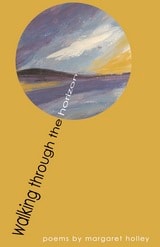
Walking Through the Horizon
PoemsMargaret Holley
University of Arkansas Press, 2006
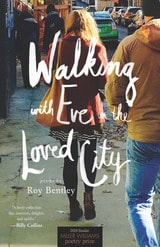
Walking with Eve in the Loved City
PoemsRoy Bentley
University of Arkansas Press, 2018
Finalist, 2018 Miller Williams Poetry Prize
Walking with Eve in the Loved City is an ambitious collection. Using a variety of male figures—Jeff Goldblum, Ringo Starr, the poet’s uncle Billy, to name a few—these poems skillfully interrogate masculinity and its cultural artifacts, searching for a way to reconcile reverence for the father figure with a crisis of faith about the world as run by men. And yet, despite the gravity of the subjects these poems engage, this is a hopeful, frequently funny book that encourages the reader to look deeply at the world, and then to laugh if she can.
Roy Bentley often accomplishes this work through a careful balancing of honesty and misdirection, as when in the poem “Can’t Help Falling in Love” the real drama of the narrative—the appearance of an affair between the speaker’s father and a drive-in restaurant carhop—operates as a backdrop for the eight-year-old speaker’s puerile attraction to the woman; or when the vampire Nosferatu (a frequent figure in the poems) materializes in a trailer park, his immortality becoming a lens through which to process the speaker’s righteous anger about wealth and poverty.
God too features prominently—as does doubt. Drawing from the vernacular of his childhood, Bentley accesses the simultaneous austerity and lyrical opulence of the King James Bible to invent stories in which the last note struck is often a call to pay kinder attention. More than anything, these poems serve as humanistic advocates, using the power of narrative—film, interview, imagination, memoir—to highlight how people matter.
Walking with Eve in the Loved City invites the reader to join in this watching and witnessing, to take part in renewing how we see.
Wallace Stevens and the Critical Schools
Melita C. Schaum
University of Alabama Press, 1988
Wallace Stevens and the Critical Schools reveals a field marked by conflict and contradiction, both within and among critical works in their attempts to explicate and appropriate this major American poet. Stevens’ changing reception among the critical schools reveals much about the shifting nature of American literature and criticism in this century and illuminates the often polemical process of literary canon formation. Each chapter of this book examines a particular aspect of the 20th-century critical involvement with Wallace Stevens’ poetry, introduced by a discussion of the poet’s work as an arena for the convergence of modern critical tendencies and concerns.
First, the author examines the avant-garde milieu of early 20th-century modernism, which implicated Stevens in its melee of affiliations and enmities and which influenced critics’ ambivalent responses to his early work. She traces the critical controversies of the poet’s emergence before and during the 1920s, specifically the clash between New Humanism and aestheticism, and demonstrates how the quality of irony in Stevens’ work became a part of the critics’ general repertoire in their assessment of this poet.
The 1930s, 1940s, and 1950s were decades during which Stevens criticism became dominated by the New Critical ideology. The turn toward deconstruction in Stevens criticism stands in part as a response to the New Critical dilemma, seen in the manner in which such critics as J. Hillis Miller and Joseph Riddel appropriated the concept of “decreation” to explain the sense of rupture in Stevens’ late poetry yet brought that concept to its logical end in a deconstructive paradigm.
Finally, Schaum identifies four major theoretical approaches to Stevens in the past two decades that continue to inform and direct the field of critical dissent and exploration in the 1980s. Such theories as Bloomian misprision, versions of hermeneutic criticism, redefinitions of the deconstructive enterprise, and the contemporary call for a new historicism continue the battle to appropriate Stevens as the “hard prize” of critical aims and investigations.
Wallace Stevens and the Limits of Reading and Writing
Bart Eeckhout
University of Missouri Press, 2002

Walt Whitman Bathing
POEMSDavid Wagoner
University of Illinois Press, 1996
"When Wagoner looks at something, he brings it to vivid and immediate life through an extraordinary power with a simple name: love. He is as formally various as Thomas Hardy, as playful as Dickinson, as wry as Frost." -- Dave Smith
"A sharp-eyed, even gutsy nature poet, the deftest and tenderest of love poets, Wagoner is a verbal magician capable of surprising, sometimes crazy tours de force."-- X. J. Kennedy
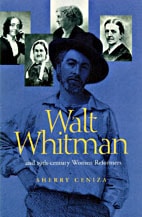
Walt Whitman and Nineteenth-Century Women Reformers
Sherry Ceniza
University of Alabama Press, 1999
WINNER OF THE ELIZABETH AGEE PRIZE IN AMERICAN LITERATURE
Examining Whitman’s poetic development through the documented influence of nineteenth‑century women reformers.
Walt Whitman and 19th-Century Women Reformers documents Whitman's friendships with women during the 1850s, the decade of Whitman's most creative period. The book reveals startling connections between the first three editions of Leaves of Grass and the texts generated by the women he knew during this period, many of whom were radical activists in the women's rights movement.
Sherry Ceniza argues that Whitman's editions of Leaves became progressively more radically 'feminist' as he followed the women's rights movement during the 1850s and that he was influenced by what he called the 'true woman of the new aggressive type . . . woman under the new dispensation.' Ceniza documents the progression of the National Woman's Rights movement through the lives and writings of three of its leaders- Abby Hills Price, Paulina Wright Davis, and Ernestine L. Rose. By juxtaposing the texts written by these women with Leaves, Ceniza shows that Whitman used many of the same arguments and rhetorical gestures as his female activist friends.
The book also discusses the influence of women engaged in women's rights outside the National Woman's Rights organization. And Ceniza's opening chapter is devoted to a fresh interpretation of the life and thought of another strong-minded woman who influenced the poet's writing-Louisa Van Velsor Whitman, Walt Whitman's mother.
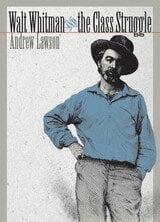
Walt Whitman and the Class Struggle
Andrew Lawson
University of Iowa Press, 2006
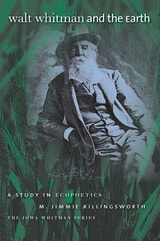
Walt Whitman and the Earth
A Study of EcopoeticsM. Jimmie Killingsworth
University of Iowa Press, 2005
It grows such sweet things out of such corruptions,
It turns harmless and stainless on its axis, with such endless successions of diseas’d corpses,
It distills such exquisite winds out of such infused fetor,
It renews with such unwitting looks its prodigal, annual, sumptuous crops,
It gives such divine materials to men, and accepts such leavings from them at last.
—Walt Whitman, from “This Compost”
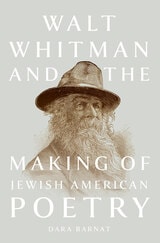
Walt Whitman and the Making of Jewish American Poetry
Dara Barnat
University of Iowa Press, 2023
Dara Barnat presents a genealogy of Jewish American poets in dialogue with Whitman, and with each other, and reveals how the lineage of Jewish American poets responding to Whitman extends far beyond the likes of Allen Ginsberg. From Emma Lazarus and Adah Isaacs Menken, through twentieth-century poets such as Charles Reznikoff, Karl Shapiro, Kenneth Koch, Muriel Rukeyser, Adrienne Rich, Marge Piercy, Alicia Suskin Ostriker, and Gerald Stern, this book demonstrates that Whitman has been adopted by Jewish American poets as a liberal symbol against exclusionary and anti-Semitic elements in high modernist literary culture. The turn to Whitman serves as a mode of exploring Jewish and American identity.
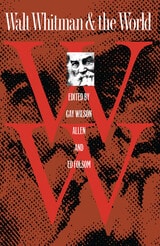
Walt Whitman and the World
Gay Wilson Allen
University of Iowa Press, 1995
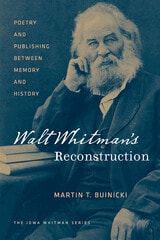
Walt Whitman's Reconstruction
Poetry and Publishing between Memory and HistoryMartin T. Buinicki
University of Iowa Press, 2012
For Walt Whitman, living and working in Washington, D.C., after the Civil War, Reconstruction meant not only navigating these tumultuous years alongside his fellow citizens but also coming to terms with his own memories of the war. Just as the work of national reconstruction would continue long past its official end in 1877, Whitman’s own reconstruction would continue throughout the remainder of his life as he worked to revise his poetic project—and his public image—to incorporate the disasters that had befallen the Union. In this innovative and insightful analysis of the considerable poetic and personal reimagining that is the hallmark of these postwar years, Martin Buinicki reveals the ways that Whitman reconstructed and read the war.
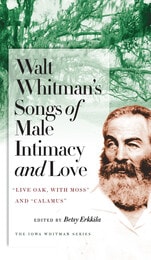
Walt Whitman's Songs of Male Intimacy and Love
"Live Oak, with Moss" and "Calamus"Whitman, Walt
University of Iowa Press, 2011
In his 1859 “Live Oak, with Moss,” Walt Whitman’s unpublished sheaf of twelve poems on manly passion, the poet dreams of a city where men who love men can live and love openly. The revised “Live Oak, with Moss” poems became “Calamus,” Whitman’s cluster of poems on “adhesive” and manly love, comradeship, and democracy, in Leaves of Grass. Commemorating both the first publication of the “Calamus” poems and the little-known manuscript of notebook poems out of which the “Calamus” cluster grew, Whitman scholar Betsy Erkkila brings together in a single edition for the first time the “Live Oak, with Moss” poems, the 1860 “Calamus” poems, and the final 1881 “Calamus” poems. In addition to honoring the sesquicentennial of the “Calamus” cluster, she celebrates the ongoing legacy of Whitman’s songs of manly passion, sex, and love.
The volume begins with Whitman’s elegantly handwritten manuscript of the “Live Oak, with Moss” poems, printed side by side with a typeset transcription and followed by a facsimile of the 1860 version of the “Calamus” poems. The concluding section reprints the final version of the “Calamus” poems from the 1881 edition of Leaves of Grass. In an afterword, Erkkila discusses the radical nature of these poems in literary, sexual, and social history; the changes Whitman made in the “Live Oak” and “Calamus” poems in the post–Civil War and Reconstruction years; the literary, political, and other contests surrounding the poems; and the constitutive role the poems have played in the emergence of modern heterosexual and homosexual identity in the United States and worldwide. The volume closes with a selected bibliography of works that have contributed to the critical and interpretive struggles around Whitman’s man-loving life.
One hundred and fifty years after Whitman’s brave decision to speak publicly about a fully realized democracy, his country is still locked in a struggle over the rights of homosexuals. These public battles have been at the very center of controversies over the life, work, and legacy of Walt Whitman, America’s (and the world’s) major poet of democracy and its major singer of what he called “manly love” in all its moods. Together the poems in this omnibus volume affirm his creation of a radical new language designed to convey and affirm the poet’s man love.
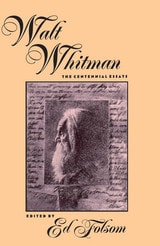
Walt Whitman
The Centennial EssaysEd Folsom
University of Iowa Press, 1994
In 1992, the year of the hundredth anniversary of Walt Whitman's death, a major gathering of international scholars took place at the University of Iowa. Over 150 participants heard papers by 20 of the world's most eminent critics of Whitman. Three generations of scholars offered new essays that brilliantly tracked the course of past and present Whitman scholarship. So significant was this historic celebration of the great American poet that the opening session was covered by CBS “Sunday Morning,” National Public Radio's “Morning Edition,” the New York Times, and other newspapers across the country. Musical and theatrical performances, art exhibitions, slide shows, readings, songs, and even a recently discovered recording of Whitman's voice were presented during the three days of the conference.
But the heart of the conference was this series of original essays by some of the most innovative scholars working in the field of American literature. There has ever been a more important collection of Whitman criticism. In these essays, readers will find the most suggestive recent approaches to Whitman alongside the most reliable traditional approaches. Walt Whitman: The Centennial Essays captures Whitman's energy and vitality, which have only increased in the century after his death.
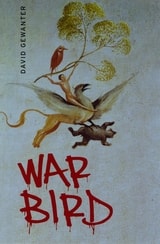
War Bird
David Gewanter
University of Chicago Press, 2009
From Three at 4:43
And here comes my friend, limping on
his heavy boot, the heel come off. A cobbler's shop
appears, and I buy the black nails, the dwarf's hammer, glue and strapping.
I work hard on it, bending there
until he speaks and walks on.
But as he is dead, his voice and step
make no sound.
In his third book of poems, David Gewanter takes on wartime America, showing our personal costs and inextricable complicities. The constructs of our social lives, the conventions of our political values, the ambitions of our private fantasies—all these collide comically and tragically. Here, the far right marries the far left, and the sacred is undone by the profane. Gewanter's ironic vision pulls together details from science, history, philosophy, the disappearing dailies, and the emotional life of an engaged and singular mind into poems on the move with tense rhythms, rich correspondences, and daring hairpin turns. War Bird gives the lie to the shining moral complacencies of the homefront. Unsettling yet radiant, this collection is a book for troubled times, for what Whitman called, in “1861,” our “hurrying, crashing, sad, distracted year.”
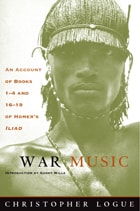
War Music
An Account of Books 1-4 and 16-19 of Homer's IliadChristopher Logue
University of Chicago Press, 2003
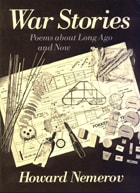
War Stories
Poems about Long Ago and NowHoward Nemerov
University of Chicago Press, 1987
"These new poems of Howard Nemerov are the poems of a master at his best. What is more, they are accessible. They speak out in a beautiful unclouded voice of the experience of a flyer of the Second World War. Although as 'war poems' they take their place among the best of that genre, they resonate far beyond their history with an arresting immediacy."—Karl Shapiro
"Nemerov is the poet of our sanity, his the vision of the heroic ordinary. . . . Forty years after W. W. II, Nemerov's experiences in that war translate into timeless poetry. . . . Nemerov's poetry will outlast our generation: to read it now is to take part in something of ourselves and our world that will—and should—endure."—The Virginia Quarterly Review
"Throughout all his verse, formal language sets up a proscenium, keeping sentiment at a distance. In this elegant theatre, he tells stories that always, first, are works of art."—Denise Low, Kansas City Star
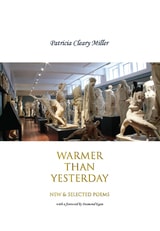
Warmer Than Yesterday
New and Selected PoemsPatricia Cleary Miller
BkMk Press, 2024
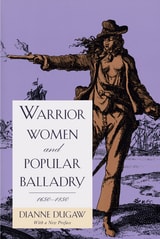
Warrior Women and Popular Balladry, 1650-1850
Dianne Dugaw
University of Chicago Press, 1995
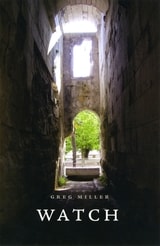
Watch
Greg Miller
University of Chicago Press, 2009
Strasbourg
The yellow and green rose, and the pink rock,
The chestnuts blooming, the cobblestone square,
Our Lady’s tower rising everywhere,
Dark timbered fronts; the mechanical clock
Whose rooster crows three times for Peter’s flock,
The Apostles, the old man’s and the child’s share
Of time—aspire I’d say to make me stare
And stop. I praise what I might otherwise mock,
The locked contingencies, the stock of losses,
Bright liquidity everywhere channeled,
A storied cityscape of destinies
Averted as when, turning, a young Turk tosses
His hands in the air and my chest’s pummeled,
“My brother, forgive me!” and my thoughts freeze.
In Watch, Greg Miller describes a fresh purposefulness in his life and achieves a new level of poetic thinking and composition in his writing. Artfully combining the religious and secular worldviews in his own sense of human culture, Miller complicates our understanding of all three. The poems in Watch sift layers of natural and human history across several continents, observing paintings, archeological digs, cityscapes, seascapes, landscapes—all in an attempt to envision a clear, grounded spiritual life. Employing an impressive array of traditional meters and various kinds of free verse, Miller’s poems celebrate communities both invented and real.
Praise for Iron Wheel
“Miller demonstrates that what Eliot said about reading a poem may be equally true of writing them: the best thing ‘is to be very, very intelligent’ and intelligence is not the same as erudition. Whether the world is made, found, or named, Miller offers an engaging portrait of things as they are.’’—David Orr, Poetry
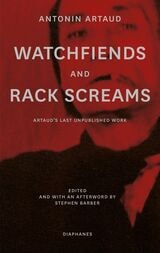
Watchfiends and Rack Screams
Artaud’s Last Unpublished WorkAntonin Artaud
Diaphanes, 2024
Antonin Artaud’s last large-scale work, published in its complete form in English for the first time.
Drawings on texts and letters dating from 1946, some of them written while he was still confined at the Rodez psychiatric hospital, Artaud devoted the months of November 1946 to February 1947 to completing his book through a long series of vocal improvisations titled Interjections, dictated at his pavilion on the edge of Paris. He cursed the assassins he believed were on their way there to steal his semen, to make his brain go “up in smoke as under the action of one of those machines created to suck up filth from the floor,” and finally to erase him. The publisher who had commissioned the book, Louis Broder, was horrified at reading its incandescent, fiercely obscene, and anti-religious manuscript and refused to publish it. Ambitious and experimental in scale, fragmentary and ferocious in intent, it was not published until 1978, in an edition prepared by Artaud’s close friend Paule Thévenin. Artaud commented that it was an “impossible” book, and that “nobody has ever read it from end to end, not even its own author.”
Clayton Eshleman, together with his translation collaborators such as David Rattray, began to work soon after 1978 on an English-language edition, with extracts appearing especially in Eshleman’s poetry magazine, Sulfur. This volume presents his translations with additional ones by Paul Buck, and Catherine Petit it in its complete form in English for the first time.
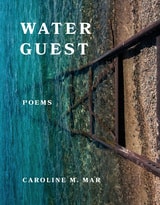
Water Guest
Caroline M. Mar
University of Wisconsin Press, 2025
Raising questions of inheritance, the conundrum of land ownership, and the violence of history, Mar gives voice to the lost writing of Chinese laborers and silent communion to those of us still here—immigrant and Indigenous, settler and resister. This engaging collection finds acceptance, if not resolution, through the questions themselves.
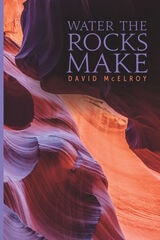
Water the Rocks Make
David McElroy
University of Alaska Press, 2021
Set primarily in Alaska, where author David McElroy has lived most of his life, the real action in these poems is in thought—the mind coming to terms (words) with consciousness, the mixing and rendering of reality and imagination. McElroy delves down the many rapid turns toward meaning through these contemplations on personification of a long-tailed boat in Asia; Adam tasked with naming the creatures; synthesizing the agony of accident, disease, and death; Descartes musing about an oilfield bridge; the excitement of sensual love; or the history and creativity emerging from a landfill.
There is sadness here, but through the rigorous manipulation of imagery, rhythm, and sound, Water the Rocks Make strives to “…contribute their daily/ details in our remarkable trick of happiness…to rise from the mulch/ of dreams like seedling teak goofy with life/ and floppy leaves.”
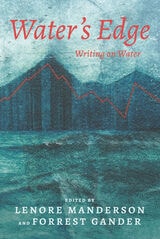
Water's Edge
Writing on WaterEdited by Lenore Manderson and Forrest Gander
Northwestern University Press, 2023
A wide-ranging consideration of water’s plenitude and paucity—and of our relationship to its many forms
Water is quotidian, ubiquitous, precious, and precarious. With their roots in this element, the authors of Water’s Edge reflect on our natural environment: its forms, textures, and stewardship. Born from a colloquium organized by the editors at the Institute at Brown for Environment and Society, the anthology features a diverse group of writers and artists from half a dozen countries, from different fields of scholarship and practice: artists, biologists, geologists, poets, ecocritics, actors, and anthropologists. The contributors explore and celebrate water while reflecting on its disturbances and pollution, and their texts and art play with the boundaries by which we differentiate literary forms.
In the creative nonfiction, poetry, and visual art collected here, water moves from backdrop to subject. Ashley Dawson examines the effects of industrial farming on the health of local ecosystems and economies. Painter Kulvinder Kaur Dhew captures water’s brilliance and multifaceted reflections through a series of charcoal pieces that interlace the collection. Poet Arthur Sze describes the responsibility involved in the careful management of irrigation ditches in New Mexico. Rather than concentrating their thoughts into a singular, overwhelming argument, the authors circulate moments of apprehension, intimation, and felt experience. They are like tributaries, each carrying, in a distinctive style, exigent and often intimate reports concerning a substance upon which all living organisms depend.
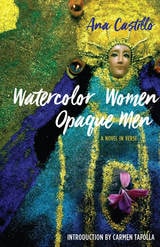
Watercolor Women Opaque Men
A Novel in VerseAna Castillo, introduction by Carmen Tafolla
Northwestern University Press, 2017
In this updated edition of Ana Castillo’s celebrated novel in verse, featuring a new introduction by Poet Laureate of Texas Carmen Tafolla, we revisit the story’s spirited heroine, known only as “Ella” or “She,” as she takes us through her own epic journey of self-actualization as an artist and a woman. With a remarkable combination of tenderness, lyricism, wicked humor, and biting satire, Castillo dramatizes Ella’s struggle through poverty as a Chicano single mother at the threshold of the twenty-first century, fighting for upward mobility while trying to raise her son to be independent and self-sufficient. Urged on by the gods of the ancients, Ella’s life interweaves with those of others whose existences are often neglected, even denied, by society’s status quo. Castillo’s strong rhythmic voice and exploration of such issues as love, sexual orientation, and cultural identity will resonate with readers today as much as they did upon the book’s original publication more than ten years ago. This expanded edition also includes a short preface by the author, as well as a glossary, a reader’s guide, and a list of additional suggested readings.

Waterlings
Veno Taufer
Northwestern University Press, 2000
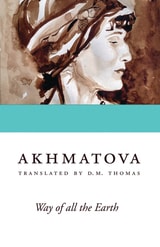
Way of All the Earth
Anna Akhmatova
Ohio University Press, 2001
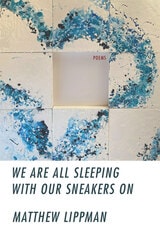
We Are All Sleeping with Our Sneakers On
Matthew Lippman
Four Way Books, 2024

We Are Called Human
The Poetry of Richard HugoMichael S. Allen
University of Arkansas Press, 1982
We Are Changed to Deer at the Broken Place
Kelly Weber
Tupelo Press, 2022
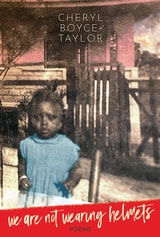
We Are Not Wearing Helmets
PoemsCheryl Boyce-Taylor
Northwestern University Press, 2022
Born in Trinidad and having grown up in Queens, Boyce‑Taylor creates a framework for her own experience out of the life experiences and work of beloved Black women in history. She salutes the women who have lifted her, including Audre Lorde, Fannie Lou Hamer, Ntozake Shange, and Winnie Mandela, as well as her mother, Eugenia Boyce, and her beloved daughter‑in‑law, Deisha Head Taylor.
The poems in this collection are unapologetic, fierce, and confrontational while remaining caring and intimate. They stand strong in the face of adversity and boldly demand what is owed while still honoring and cherishing what is loved.
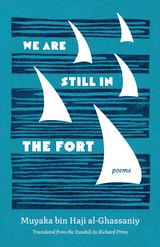
We Are Still in the Fort
PoemsMuyaka bin Haji al-Ghassaniy; Translated from the Swahili by Richard Prins
Vanderbilt University Press, 2026
We Are Still in the Fort is a curated selection of about seventy poems by Muyaka bin Haji al-Ghassaniy, divided into three sections spanning the quotidian, the amorous, and the political. The first part, “‘I Swipe Their String of Fish’: Poems of Mombasan Society,” features his often satirical commentary on daily life in Mombasa. The second part, “‘Take Your Misery With You’: Poems of Love and Marriage,” focuses on his psychologically sensitive observations on the volatility of love, marriage, and illicit affairs. The last part, “‘We Are Still in the Fort’: Poems of War and State,” includes epigrammatic critiques of local political leaders and a series of anti-imperialist poems defending Mombasa’s independence against the invading Omani Empire. The volume also features contextual materials on Muyaka and the context of Swahili poetry, a translator’s note, and introductions for each of the three sections.
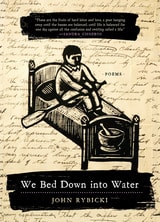
We Bed Down into Water
PoemsJohn Rybicki
Northwestern University Press, 2008
John Rybicki offers up an unafraid set of poems in this charged book of verse. We Bed Down Into Water is rich with imagery of family, love, illness, death, and, indeed, water, which seeps in throughout the pages: rivers, pools, rain, and tears. His moving stories, in both prose and verse, struggle to hang on to a vision of the world that can still allow benevolence, luck, and laughter. In this, the collection embodies a contradiction: it is a tender book of fury, a book of bleak hopefulness.
Rybicki’s work is steeped in challenge: the biological and spiritual challenge posed by his beloved’s recurrent cancer or the daily challenges of an adopted child who could be, all too easily, lost. He spins these phenomenal struggles into a lyrical book that offers hope and awakens the reader into a new way of seeing.
We Remain Traditional
Sylvia Chan
University Press of Colorado, 2018
In We Remain Traditional, Sylvia Chan juxtaposes the elegy, the conflict, and the brashness of a relationship that summons wild musicality in its love and frustration. Through the speaker and Adam, the beloveds offer thirty-two consolations for the gendered history of Chinese American women—a break and affirmation of their traditions. What saves these two characters is their music—a peace treaty for the book’s form or “fractured paradise,” a language that protects and protests their bodies in Oakland, California.
Marked by vulnerability and intimacy, Chan interrogates a young woman’s childhood sexual abuse. In the vein of Stacy Doris and Paul Celan, Chan asks, because she is a child of violent tradition, what is her visceral grief? This is a speaker who aspires to create universal experiences for her listeners, to transform jazz into narrative. This is a wild, beautiful, and ambitious first book: Chan refuses to apologize for the terror in her conviction and compassion. To choose a man who is behind her sexual, psychological, and political exploitation is to forgive his narcissism, aggression, and addiction. To love, simply, is to live unafraid of pushing boundaries and being happy.
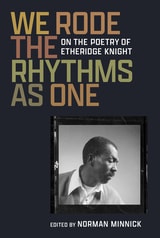
We Rode the Rhythms as One
On the Poetry of Etheridge KnightEdited by Norman Minnick
University of Michigan Press, 2026
Knight’s story is one of transformation—an odyssey from hardship and incarceration to artistic prominence—anchored by his unwavering belief in the power of poetry to unite and heal. This comprehensive volume is also a historical and cultural exploration, situating Knight’s work amid the Black Arts Movement, the Civil Rights Movement, and the ongoing fight for social justice. Readers will find themselves drawn to Knight’s unfiltered voice, his reflections on Black identity, and his insistence on making poetry accessible to all—whether through intimate letters or reflections on the sociopolitical climate that shaped his art. Suitable for poetry enthusiasts, scholars, and general readers alike, We Rode the Rhythms as One invites us to reconsider Knight’s enduring impact and the vital role of poetry in reflecting and reshaping human experience.
We Saw the Light
Conversations between New American Cinema and PoetryDaniel Kane
University of Iowa Press, 2009
Drawing on unpublished correspondences and personal interviews with key figures in the innovative poetry and film communities, Daniel Kane’s stunningly erudite and accessible work not only provides a fresh look at avant-garde poetry and film but also encourages readers to rethink the artistic scenes of the 1960s and today. We Saw the Light will reframe the very way we talk about how film influences poetry and force us to think anew about the radical ways in which art is created and in turn influences subsequent work.
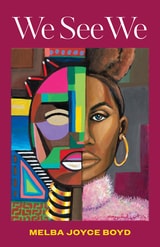
We See We
Melba Joyce Boyd
University of Michigan Press, 2027
Michigan poet laureate Melba Joyce Boyd’s tenth poetry collection, We See We, is a deeply emplaced volume, grounded in Boyd’s hometown of Detroit. The book takes its title from a poem in the collection dedicated to the late photographer, photojournalist, and filmmaker Hugh Grannum, who trained his camera on Black Detroit. Boyd takes a similar approach in this volume, collecting poems “about seeing our collective selves within our interconnected individual lives.” Divided into two sections—Inflexions and Elegies—the poems evoke Detroit’s past and present through works about Romare Bearden at the Detroit Institute of Arts, Idlewild, the 1967 Detroit Rebellion, Aretha Franklin, John Sinclair, and the varied lives of people Boyd knew and loved who demonstrate that you do not have to be famous to have historical impact. As former Michigan poet laureate Nandi Comer writes in the interview that concludes the volume, the poems in this collection are “filled with artists, friends, elders, and collaborators,” making the poems in the collection into “an education in Detroit’s artistic life.”
We Who Battle Demons
Sober SonnetsRoger A.
Parkhurst Brothers, Inc., 2011