Results by title
58 books match the query 'Whitman, Walt' and 23 start with w
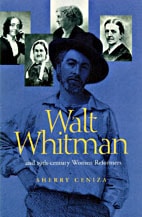
Walt Whitman and Nineteenth-Century Women Reformers
Sherry Ceniza
University of Alabama Press, 1999
WINNER OF THE ELIZABETH AGEE PRIZE IN AMERICAN LITERATURE
Examining Whitman’s poetic development through the documented influence of nineteenth‑century women reformers.
Walt Whitman and 19th-Century Women Reformers documents Whitman's friendships with women during the 1850s, the decade of Whitman's most creative period. The book reveals startling connections between the first three editions of Leaves of Grass and the texts generated by the women he knew during this period, many of whom were radical activists in the women's rights movement.
Sherry Ceniza argues that Whitman's editions of Leaves became progressively more radically 'feminist' as he followed the women's rights movement during the 1850s and that he was influenced by what he called the 'true woman of the new aggressive type . . . woman under the new dispensation.' Ceniza documents the progression of the National Woman's Rights movement through the lives and writings of three of its leaders- Abby Hills Price, Paulina Wright Davis, and Ernestine L. Rose. By juxtaposing the texts written by these women with Leaves, Ceniza shows that Whitman used many of the same arguments and rhetorical gestures as his female activist friends.
The book also discusses the influence of women engaged in women's rights outside the National Woman's Rights organization. And Ceniza's opening chapter is devoted to a fresh interpretation of the life and thought of another strong-minded woman who influenced the poet's writing-Louisa Van Velsor Whitman, Walt Whitman's mother.
Walt Whitman and the Class Struggle
Andrew Lawson
University of Iowa Press, 2006
Walt Whitman and the Earth
A Study of EcopoeticsM. Jimmie Killingsworth
University of Iowa Press, 2005
It grows such sweet things out of such corruptions,
It turns harmless and stainless on its axis, with such endless successions of diseas’d corpses,
It distills such exquisite winds out of such infused fetor,
It renews with such unwitting looks its prodigal, annual, sumptuous crops,
It gives such divine materials to men, and accepts such leavings from them at last.
—Walt Whitman, from “This Compost”
Walt Whitman and the Making of Jewish American Poetry
Dara Barnat
University of Iowa Press, 2023
Dara Barnat presents a genealogy of Jewish American poets in dialogue with Whitman, and with each other, and reveals how the lineage of Jewish American poets responding to Whitman extends far beyond the likes of Allen Ginsberg. From Emma Lazarus and Adah Isaacs Menken, through twentieth-century poets such as Charles Reznikoff, Karl Shapiro, Kenneth Koch, Muriel Rukeyser, Adrienne Rich, Marge Piercy, Alicia Suskin Ostriker, and Gerald Stern, this book demonstrates that Whitman has been adopted by Jewish American poets as a liberal symbol against exclusionary and anti-Semitic elements in high modernist literary culture. The turn to Whitman serves as a mode of exploring Jewish and American identity.
Walt Whitman and the World
Gay Wilson Allen
University of Iowa Press, 1995
Walt Whitman's "Song of Myself"
A Mosaic of InterpretationsEdwin Haviland Miller
University of Iowa Press, 1991
Walt Whitman's Reconstruction
Poetry and Publishing between Memory and HistoryMartin T. Buinicki
University of Iowa Press, 2012
For Walt Whitman, living and working in Washington, D.C., after the Civil War, Reconstruction meant not only navigating these tumultuous years alongside his fellow citizens but also coming to terms with his own memories of the war. Just as the work of national reconstruction would continue long past its official end in 1877, Whitman’s own reconstruction would continue throughout the remainder of his life as he worked to revise his poetic project—and his public image—to incorporate the disasters that had befallen the Union. In this innovative and insightful analysis of the considerable poetic and personal reimagining that is the hallmark of these postwar years, Martin Buinicki reveals the ways that Whitman reconstructed and read the war.
Walt Whitman's Selected Journalism
Walt Whitman
University of Iowa Press, 2015
Walt Whitman’s Selected Journalism covers Whitman’s early years as a part-time editorialist and ambivalent schoolteacher between 1838 and 1841. After 1841, it follows his work as a dedicated full-time newspaperman and editor, most prominently at the New York Aurora and the Brooklyn Daily Eagle between 1842 and 1848. After 1848 and up to the Civil War, Whitman’s journalism shows his slow transformation from daily newspaper editor to poet. This volume gathers journalism from throughout these early years in his career, focusing on reporting, reviews, and editorials on politics and democratic culture, the arts, and the social debates of his day. It also includes some of Whitman’s best early reportage, in the form of the short, personal pieces he wrote that aimed to give his readers a sense of immediacy of experience as he guided them through various aspects of daily life in America’s largest metropolis.
Over time, journalism’s limitations pushed Whitman to seek another medium to capture and describe the world and the experience of America with words. In this light, today’s readers of Whitman are doubly indebted to his career in journalism. In presenting Whitman-the-journalist in his own words here, and with useful context and annotations by renowned scholars, Walt Whitman’s Selected Journalism illuminates for readers the future poet’s earliest attempts to speak on behalf of and to the entire American republic.

Walt Whitman's Songs of Male Intimacy and Love
"Live Oak, with Moss" and "Calamus"Whitman, Walt
University of Iowa Press, 2011
In his 1859 “Live Oak, with Moss,” Walt Whitman’s unpublished sheaf of twelve poems on manly passion, the poet dreams of a city where men who love men can live and love openly. The revised “Live Oak, with Moss” poems became “Calamus,” Whitman’s cluster of poems on “adhesive” and manly love, comradeship, and democracy, in Leaves of Grass. Commemorating both the first publication of the “Calamus” poems and the little-known manuscript of notebook poems out of which the “Calamus” cluster grew, Whitman scholar Betsy Erkkila brings together in a single edition for the first time the “Live Oak, with Moss” poems, the 1860 “Calamus” poems, and the final 1881 “Calamus” poems. In addition to honoring the sesquicentennial of the “Calamus” cluster, she celebrates the ongoing legacy of Whitman’s songs of manly passion, sex, and love.
The volume begins with Whitman’s elegantly handwritten manuscript of the “Live Oak, with Moss” poems, printed side by side with a typeset transcription and followed by a facsimile of the 1860 version of the “Calamus” poems. The concluding section reprints the final version of the “Calamus” poems from the 1881 edition of Leaves of Grass. In an afterword, Erkkila discusses the radical nature of these poems in literary, sexual, and social history; the changes Whitman made in the “Live Oak” and “Calamus” poems in the post–Civil War and Reconstruction years; the literary, political, and other contests surrounding the poems; and the constitutive role the poems have played in the emergence of modern heterosexual and homosexual identity in the United States and worldwide. The volume closes with a selected bibliography of works that have contributed to the critical and interpretive struggles around Whitman’s man-loving life.
One hundred and fifty years after Whitman’s brave decision to speak publicly about a fully realized democracy, his country is still locked in a struggle over the rights of homosexuals. These public battles have been at the very center of controversies over the life, work, and legacy of Walt Whitman, America’s (and the world’s) major poet of democracy and its major singer of what he called “manly love” in all its moods. Together the poems in this omnibus volume affirm his creation of a radical new language designed to convey and affirm the poet’s man love.
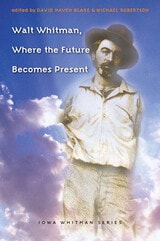
Walt Whitman, Where the Future Becomes Present
David Haven Blake
University of Iowa Press, 2008
Walt Whitman, Where the Future Becomes Present invigorates Whitman studies by garnering insights from a diverse group of writers and intellectuals. Writing from the perspectives of art history, political theory, creative writing, and literary criticism, the contributors place Whitman in the center of both world literature and American public life. The volume is especially notable for being the best example yet published of what the editors call the New Textuality in Whitman studies, an emergent mode of criticism that focuses on the different editions of Whitman’s poems as independent works of art.
Written one hundred fifty years after the book’s publication, these timely, innovative responses to Leaves of Grass confirm that the future of Whitman’s poems is vital to our present.
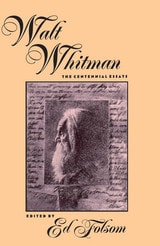
Walt Whitman
The Centennial EssaysEd Folsom
University of Iowa Press, 1994
In 1992, the year of the hundredth anniversary of Walt Whitman's death, a major gathering of international scholars took place at the University of Iowa. Over 150 participants heard papers by 20 of the world's most eminent critics of Whitman. Three generations of scholars offered new essays that brilliantly tracked the course of past and present Whitman scholarship. So significant was this historic celebration of the great American poet that the opening session was covered by CBS “Sunday Morning,” National Public Radio's “Morning Edition,” the New York Times, and other newspapers across the country. Musical and theatrical performances, art exhibitions, slide shows, readings, songs, and even a recently discovered recording of Whitman's voice were presented during the three days of the conference.
But the heart of the conference was this series of original essays by some of the most innovative scholars working in the field of American literature. There has ever been a more important collection of Whitman criticism. In these essays, readers will find the most suggestive recent approaches to Whitman alongside the most reliable traditional approaches. Walt Whitman: The Centennial Essays captures Whitman's energy and vitality, which have only increased in the century after his death.
Walt Whitman
The Correspondence, Volume VIITed Genoways
University of Iowa Press, 2005
Now, more than forty years after the inaugural volume’s original publication, Ted Genoways brings scholars the latest volume in Walt Whitman: The Correspondence. Incorporating all of the letters Miller had collected before his death in 2001 and combining them with more than a hundred previously unknown letters he himself gathered, Genoways’s volume is a perfect accompaniment to Miller’s original work.
Among the more than one hundred fifty letters collected in this volume are numerous correspondences concerning Whitman’s Civil War years, including a letter sending John Hay, the personal secretary to Abraham Lincoln, a manuscript copy of “O Captain, My Captain!” Additional letters address various aspects of the production of Leaves of Grass, the most notable being an extensive correspondence surrounding the Deathbed Edition, gathered by Whitman’s friend Horace Traubel, and reproduced here for the first time. Most significantly, this volume at last incorporates Whitman’s early letters to Abraham Paul Leech, first published by Arthur Golden in American Literature in 1986. The revelations contained in these letters must be considered among the most important discoveries about Whitman’s life made during the last half of the twentieth century.
Regardless of whether their significance is great or small, immediate or long-term, each new piece of Whitman’s correspondence returns us to a particular moment in his life and suggests the limitless directions that remain for Whitman scholarship.
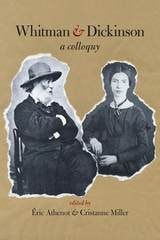
Whitman & Dickinson
A ColloquyEric Athenot and Cristanne Miller
University of Iowa Press, 2018
Essays included in this book cover the topics of mentoring influence on each poet, religion, the Civil War, phenomenology, the environment, humor, poetic structures of language, and Whitman’s and Dickinson’s twentieth- and twenty-first–century reception—including prolonged engagement with Adrienne Rich’s response to this “strange uncoupled couple” of poets who stand at the beginning of an American national poetic.
Contributors Include:
Marina Camboni
Andrew Dorkin
Vincent Dussol
Betsy Erkkilä
Ed Folsom
Christine Gerhardt
Jay Grossman
Jennifer Leader
Marianne Noble
Cécile Roudeau
Shira Wolosky
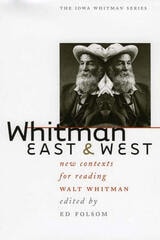
Whitman East and West
New Contexts for Reading Walt WhitmanEd Folsom
University of Iowa Press, 2002
Confirming the growing international spirit of American studies, the essays in Whitman East and West developed out of a landmark conference in Beijing, the first major conference in China to focus on an American poet. Scholars from Asia, Europe, and North America set out to track the ways in which Whitman's poetry has become part of China's cultural landscape as well as the literary landscapes of other countries. By describing his assimilation into other cultures and his resulting transformation into a hybrid poet, these essayists celebrate Whitman's multiple manifestations in other languages and contexts.
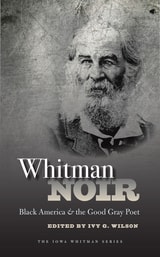
Whitman Noir
Black America and the Good Gray PoetIvy Wilson
University of Iowa Press, 2014
Whitman Noir: Black America and the Good Gray Poet explores the meaning of blacks and blackness in Whitman’s imagination and, equally significant, also illuminates the aura of Whitman in African American letters from Langston Hughes to June Jordan, Margaret Walker to Yusef Komunyakaa. The essays, which feature academic scholars and poets alike, address questions of literary history, the textual interplay between author and narrator, and race and poetic influence. The volume as a whole reveals the mutual engagement with a matrix of shared ideas, contradictions, and languages to expose how Whitman influenced African American literary production as well as how African American Studies brings to bear new questions and concerns for evaluating Whitman.
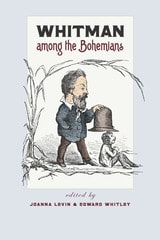
Whitman among the Bohemians
Joanna Levin and Edward Whitley
University of Iowa Press, 2014
In this milieu, Whitman found sympathetic supporters of his poetic vision, professional connections, rivals, romantic partners, and close friends, and left a lasting impression on poet and critic Edmund Clarence Stedman, an erstwhile bohemian who later in the century emerged as a tastemaker of American poetry. Yet for many years, the bohemians associated with Pfaff’s have served merely as minor background characters in Whitman scholarship. Whitman among the Bohemians corrects that by exploring in depth the connections Whitman made at Pfaff’s and the impact they had on him, his poetry, and his career. In telling the story of these intersecting social and professional links that converged at Pfaff’s in the late 1850s and early 1860s, the essays in this volume powerfully demonstrate just how much we can learn about Whitman and his work by viewing him within the context of American bohemia.
CONTRIBUTORS: Stephanie Blalock, Ruth Bohan, Leif Eckstrom, Logan Esdale, Amanda Gailey, Karen Karbiener, Joanna Levin, Mary Loeffelholz, Eliza Richards, Ingrid Satelmajer, Robert J. Scholnick, Edward Whitley
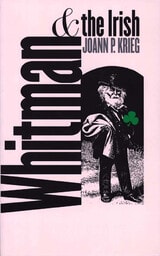
Whitman and the Irish
Joann P. Krieg
University of Iowa Press, 2000
Though Walt Whitman created no Irish characters in his early works of fiction, he did include the Irish as part of the democratic portrait of America that he drew in Leaves of Grass. He could hardly have done otherwise. In 1855, when the first edition of Leaves of Grass was published, the Irish made up one of the largest immigrant populations in New York City and, as such, maintained a cultural identity of their own. All of this “Irishness” swirled about Whitman as he trod the streets of his Mannahatta, ultimately becoming part of him and his poetry. As members of the working class, famous authors, or close friends, the Irish left their mark on Whitman the man and poet. In Whitman and the Irish, Joann Krieg convincingly establishes their importance within the larger framework of Whitman studies.
Focusing on geography rather than biography, Krieg traces Whitman's encounters with cities where the Irish formed a large portion of the population—New York City, Boston, Camden, and Dublin—or where, as in the case of Washington, D.C., he had exceptionally close Irish friends. She also provides a brief yet important historical summary of Ireland and its relationship with America.
Whitman and the Irish does more than examine Whitman's Irish friends and acquaintances: it adds a valuable dimension to our understanding of his personal world and explores a number of vital questions in social and cultural history. Krieg places Whitman in relation to the emerging labor culture of ante-bellum New York, reveals the relationship between Whitman's cultural nationalism and the Irish nationalism of the late nineteenth century, and reflects upon Whitman's involvement with the Union cause and that of Irish American soldiers.
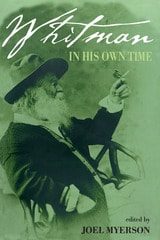
Whitman in His Own Time
A Biographical Chronicle of His Own Life, Drawn from Recollections, Memoirs, and Interviews by Friends and AssociatesJoel Myerson
University of Iowa Press, 2000
Few American writers were as concerned with their public image as was Walt Whitman. He praised his own work in unsigned reviews; he included engravings or photographs of himself in numerous editions of his work; and he assisted in the writing of two biographies of himself. Whitman was also written about extensively by others throughout his lifetime. Whitman in His Own Time is a collection of these contemporary accounts of the "good gray poet."
The interviews with and recollections of Whitman collected by Joel Myerson represent a wide spectrum of accounts—visitors from America and abroad; newspaper interviewers; Whitman's doctor and nurse during his final illness; his literary executors; a student from his early schoolteaching days; and such well-known authors as Bronson Alcott, John Burroughs, and Henry David Thoreau. The selections also paint a well-rounded picture of Whitman, from his early days as a schoolteacher to the moment of his death, and demonstrate a varying range of attitudes toward the poet. Yet throughout the entire collection, Whitman himself holds center stage, and he is seen as vividly today as he was over one hundred years ago. Myerson's introduction to this expanded edition places these accounts of Whitman within the context of the time and discusses new scholarship on Whitman's life.

Whitman in Poland
The Reception and Role of the American Poet in Polish National CultureMarta A. Skwara
University of Iowa Press, 2020
Poland; how and why the mid-1950s saw the greatest flourish of interest in Whitman as he was read in terms of “socialist realism” in accordance with the political indoctrination of the era; how Whitman’s image in Poland evolved from his first Polish translators and enthusiasts on through modernist poets’ responses; and how reading multiple Polish translations of the same Whitman poem by different translators allows us to see changing cultural and comparative contexts. Readers will get a full picture of how Whitman has functioned as a presence in Polish prose and poetry, and even in cinema and television.
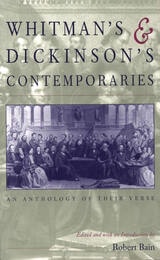
Whitman's & Dickinson's Contemporaries
An Anthology of their VerseEdited and with an Introduction by Robert Bain
Southern Illinois University Press, 1996
Emily Dickinson and Walt Whitman were not the poetic stars of their day; only a few friends knew that Dickinson wrote, and Whitman’s following was minuscule, if influential. But the contemporaries who eclipsed these major poets now have largely disappeared from our literary landscape.
In this distinctive anthology, Robert Bain gathers together thirteen other scholars to re-present the poetry of these former luminaries, allowing readers to rediscover them, reconstruct the poetic contexts of their age, and better understand why Whitman and Dickinson now overshadow other poets of their time.
Arranged chronologically according to the birth dates of the poets, this anthology introduces each poet’s work, providing biographical information and discussing the major forms and themes of the work. Each introduction places the poet in a literary and historical context with Whitman and Dickinson and provides a bibliography of secondary sources.
This remarkable book recovers a part of our literary heritage that has been lost.

Whitman's Drama of Consensus
Kerry C. Larson
University of Chicago Press, 1988
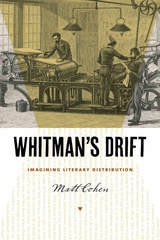
Whitman's Drift
Imagining Literary DistributionMatt Cohen
University of Iowa Press, 2017
Still, as the budding poet learned, books neither sell themselves nor move themselves: without an efficient set of connections to get books to readers, the democratic media-saturated future Whitman imagined would have remained warehoused. Whitman’s works sometimes ran through the “many-cylinder’d steam printing press” and were carried in bulk on “the strong and quick locomotive.” Yet during his career, his publications did not follow a progressive path toward mass production and distribution. Even at the end of his life, in the 1890s as his fame was growing, the poet was selling copies of his latest works by hand to visitors at his small house in Camden, New Jersey. Mass media and centralization were only one part of the rich media world that Whitman embraced.
Whitman’s Drift asks how the many options for distributing books and newspapers shaped the way writers wrote and readers read. Writers like Whitman spoke to the imagination inspired by media transformations by calling attention to connectedness, to how literature not only moves us emotionally, but moves around in the world among people and places. Studying that literature and how it circulated can help us understand not just how to read Whitman’s works and times, but how to understand what is happening to our imaginations now, in the midst of the twenty-first century media explosion.
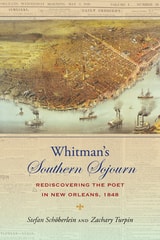
Whitman's Southern Sojourn
Rediscovering the Poet in New Orleans, 1848Stefan Schöberlein
University of Iowa Press, 2025
Far from some brief escape, New Orleans was a significant milestone in Whitman’s development as a political firebrand, as well as a major step for a professional journalist on the rise. Through a wealth of new texts, contexts, and personalities, Stefan Schöberlein and Zachary Turpin paint a vivid picture of a writer on the verge of Leaves of Grass, embracing the contradictions and the multitudes of New Orleans.