Results by title
28167 books match the query 'History' and 1118 start with w
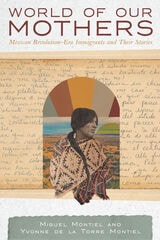
World of Our Mothers
Mexican Revolution–Era Immigrants and Their StoriesMiguel Montiel and Yvonne de la Torre Montiel
University of Arizona Press, 2022
While the women share a historic immigration journey, each story provides unique details and circumstances that testify to the diversity of the immigrant experience. The oral histories, a project more than forty years in the making, let these women speak for themselves, while historical information is added to support and illuminate the women’s voices.
The book, which includes a foreword by Irasema Coronado, director of the School of Transborder Studies, and Chris Marin, professor emeritus, both at Arizona State University, is divided into four parts. Part 1 highlights the salient events of the Revolution; part 2 presents an overview of what immigrants inherited upon their arrival to the United States; part 3 identifies challenges faced by immigrant families; and part 4 focuses on stories by location—Arizona mining towns, Phoenix barrios, and Midwestern colonias—all communities that immigrant women helped create. The book concludes with ideas on how readers can examine their own family histories. Readers are invited to engage with one another to uncover alternative interpretations of the immigrant experience and through the process connect one generation with another.

World-Wide-Walks
Peter d'Agostino: Crossing Natural-Cultural-Virtual FrontiersEdited by Peter d'Agostino and David Tafler
Intellect Books, 2018
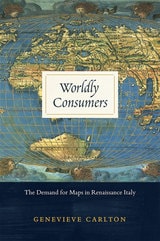
Worldly Consumers
The Demand for Maps in Renaissance ItalyGenevieve Carlton
University of Chicago Press, 2015
Drawing on a variety of sixteenth-century sources, including household inventories, epigrams, dedications, catalogs, travel books, and advice manuals, Worldly Consumers studies how individuals displayed different maps in their homes as deliberate acts of self-fashioning. One citizen decorated with maps of Bruges, Holland, Flanders, and Amsterdam to remind visitors of his military prowess, for example, while another hung maps of cities where his ancestors fought or governed, in homage to his auspicious family history. Renaissance Italians turned domestic spaces into a microcosm of larger geographical places to craft cosmopolitan, erudite identities for themselves, creating a new class of consumers who drew cultural capital from maps of the time.
Worldly Provincialism
German Anthropology in the Age of EmpireH. Glenn Penny and Matti Bunzl, Editors
University of Michigan Press, 2003
Furthermore, this volume calls for a more nuanced understanding of Germany's standing in postcolonial studies. In contrast to the prevailing view of German imperialism as a direct precursor to Nazi atrocities, this volume proposes a key insight that goes to the heart of German historiography: There is no clear trajectory to be drawn from the complex ideologies of imperial anthropology to the race science embraced by the Nazis. Instead of relying on a nineteenth-century explanation for twentieth-century crimes, this volume ultimately illuminates German ethnology and anthropology as local phenomena, best approached in terms of their own worldly provincialism.
H. Glenn Penny is Assistant Professor of History at the University of Missouri, Kansas City.
Matti Bunzl Assistant Professor of Anthropology and History at the University of Illinois at Urbana-Champaign.
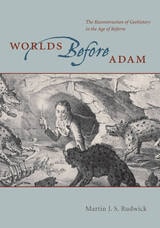
Worlds Before Adam
The Reconstruction of Geohistory in the Age of ReformMartin J. S. Rudwick
University of Chicago Press, 2008
The first detailed account of the reconstruction of prehuman geohistory, Martin J. S. Rudwick’s Worlds Before Adam picks up where his celebrated Bursting the Limits of Time leaves off. Here, Rudwick takes readers from the post-Napoleonic Restoration in Europe to the early years of Britain’s Victorian age, chronicling the staggering discoveries geologists made during the period: the unearthing of the first dinosaur fossils, the glacial theory of the last ice age, and the meaning of igneous rocks, among others. Ultimately, Rudwick reveals geology to be the first of the sciences to investigate the historical dimension of nature, a model that Charles Darwin used in developing his evolutionary theory.
Featuring an international cast of colorful characters, with Georges Cuvier and Charles Lyell playing major roles and Darwin appearing as a young geologist, Worlds Before Adam is a worthy successor to Rudwick’s magisterial first volume. Completing the highly readable narrative of one of the most momentous changes in human understanding of our place in the natural world, Worlds Before Adam is a capstone to the career of one of the world’s leading historians of science.
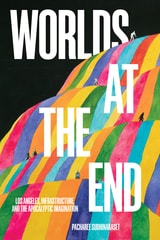
Worlds at the End
Los Angeles, Infrastructure, and the Apocalyptic ImaginationPacharee Sudhinaraset
Temple University Press, 2024
Worlds at the End analyzes destruction, rupture, and continuance through texts ranging from Karen Tei Yamashita’s Tropic of Orange, which considers racial colonial infrastructure, to the work of Diné poet Esther Belin, which illuminates how the separation between the Indian reservation and LA is part of a broader infrastructural network of termination. And she unpacks Octavia Butler’s post-apocalyptic novel, Parable of the Sower, where LA’s freeways and roadways are routes of forced migration, colonization, and flight.
Tearing down existing institutions that marginalize people of color and moving past them, Worlds at the End highlights the imaginaries of those subjugated, racialized, and made other, for whom modernity, freedom, and progress meant violence, brutality, and relegation to the status of devalued surplus populations. As Sudhinaraset deftly shows, the apocalypse marks moments of historical and spatial transition, offering stories of doomsdays that will give rise to resurgence and regeneration.
Worlds in the Sky
Planetary Discovery from Earliest Times Through Voyager and MagellanWilliam Sheehan
University of Arizona Press, 1992
In Worlds in the Sky, William Sheehan gives us a history of this long fascination, weaving together scientific history, anecdotes surrounding planetary discoveries, and the personal reflections of an incurable amateur astronomer. He describes how we arrived at our current understanding of the Moon and the planets and shows how certain individuals in history shaped the world’s knowledge about the Solar System.
Worldviews of the Greenlanders
An Inuit Arctic PerspectiveBirgitte Sonne
University of Alaska Press, 2017
Worldviews of the Greenlanders draws upon extensive Danish and Greenlandic research on Inuit arctic peoples—as well as Birgitte Sonne’s own decades of scholarship and fieldwork—to present in rich detail the key symbols and traditional beliefs of Greenlandic Natives, as well as the changes brought about by contact with colonial traders and Christian missionaries. It includes critical updates to our knowledge of the Greenlanders’ pre-colonial world and their ideas on space, time, and other worldly beings. This expansive work will be a touchstone of Arctic Native studies for academics who wish to expand their knowledge past the boundaries of North America.
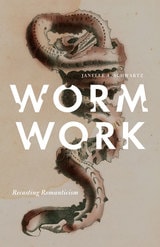
Worm Work
Recasting RomanticismJanelle A. Schwartz
University of Minnesota Press, 2012
Worms. Natural history is riddled with them. Literature is crawling with them. From antiquity to today, the ubiquitous and multiform worm provokes an immediate discomfort and unconscious distancing: it remains us against them in anthropocentric anxiety. So there is always something muddled, or dirty, or even offensive when talking about worms. Rehabilitating the lowly worm into a powerful aesthetic trope, Janelle A. Schwartz proposes a new framework for understanding such a strangely animate nature. Worms, she declares, are the very matter with which the Romantics rethought the relationship between a material world in constant flux and the human mind working to understand it.
Worm Work studies the lesser-known natural historical records of Abraham Trembley and his contemporaries and the familiar works of Erasmus Darwin, Charles Darwin, William Blake, Mary Shelley, and John Keats, to expose the worm as an organism that is not only reviled as a taxonomic terror but revered as a sign of great order in nature as well as narrative. This book traces a pattern of cultural production, a vermiculture that is as transformative of matter as it is of mind. It distinguishes decay or division as positive processes in Romantic era writings, compounded by generation or renewal and used to represent the biocentric, complex structuring of organicism.
Offering the worm as an archetypal figure through which to recast the evolution of a literary order alongside questions of taxonomy from 1740 to 1820 and on, Schwartz unearths Romanticism as a rich humus of natural historical investigation and literary creation.
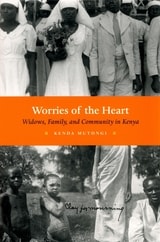
Worries of the Heart
Widows, Family, and Community in KenyaKenda Mutongi
University of Chicago Press, 2007
Throughout the twentieth century and into the twenty-first, rates of widowhood have been remarkably high in Kenya. Yet despite their numbers, widows and their families exist at the margins of society, and their lives act as a barometer for the harsh realities of rural Kenya. Mutongi here argues that widows survive by publicly airing their social, economic, and political problems, their “worries of the heart.” Initially aimed at the men in their community, and then their colonial rulers, this strategy changed after independence as widows increasingly invoked the language of citizenship to demand their rights from the new leaders of Kenya—leaders whose failure to meet the needs of ordinary citizens has led to deep disenchantment and altered Kenyans’ view of their colonial past. An innovative blend of ethnography and historical research, Worries of the Heart is a poignant narrative rich with insights into postcolonial Africa.
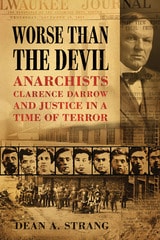
Worse than the Devil
Anarchists, Clarence Darrow, and Justice in a Time of TerrorDean A. Strang
University of Wisconsin Press, 2013
Largely overlooked for almost a century, the compelling story of this case emerges vividly in this meticulously researched book by Dean A. Strang. In its focus on a moment when patriotism, nativism, and terror swept the nation, Worse than the Devil exposes broad concerns that persist even today as the United States continues to struggle with administering criminal justice to newcomers and outsiders.
Worse than the Devil
Anarchists, Clarence Darrow, and Justice in a Time of TerrorDean A. Strang
University of Wisconsin Press, 2016
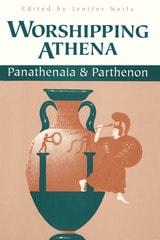
Worshipping Athena
Panathenaia And ParthenonEdited by Jenifer Neils
University of Wisconsin Press, 1996
Editor Jenifer Neils and the contributors—eminent classicists, archaeologists, and art historians—explore the role of the Panathenaia in Athenian life and compare it with similar festivals held throughout the ancient Greek world. They discuss such topics as the Panathenaia’s mythical origins, the phenomenon of the festival’s valuable prizes (oil-filled amphoras, rather than the customary laurel wreath), and the architecture, sculpture, and painting related to the festival.
Worshipping Athena will provide valuable insights to scholars and students concerned with ancient religion, mythology, art, literature, and gender issues, as well as anyone with a keen interest in the ritual topography of the Athenian Acropolis and the iconography of the Parthenon frieze.
Worth Their Salt
Colleen Whitley
Utah State University Press, 1996
Worthy of Freedom
Indenture and Free Labor in the Era of EmancipationJonathan Connolly
University of Chicago Press, 2024
In this book, historian Jonathan Connolly traces the normalization of indenture from its controversial beginnings to its widespread adoption across the British Empire during the nineteenth century. Initially viewed as a covert revival of slavery, indenture caused a scandal in Britain and India. But over time, economic conflict in the colonies altered public perceptions of indenture, now increasingly viewed as a legitimate form of free labor and a means of preserving the promise of abolition. Connolly explains how the large-scale, state-sponsored migration of Indian subjects to work on sugar plantations across Mauritius, British Guiana, and Trinidad transformed both the notion of post-slavery free labor and the political economy of emancipation.
Excavating legal and public debates and tracing practical applications of the law, Connolly carefully reconstructs how the categories of free and unfree labor were made and remade to suit the interests of capital and empire, showing that emancipation was not simply a triumphal event but, rather, a deeply contested process. In so doing, he advances an original interpretation of how indenture changed the meaning of “freedom” in a post-abolition world.
Worthy of Freedom
Indenture and Free Labor in the Era of EmancipationJonathan Connolly
University of Chicago Press, 2024
A study of Indian indentured labor in Mauritius, British Guiana, and Trinidad that explores the history of indenture’s normalization.
In this book, historian Jonathan Connolly traces the normalization of indenture from its controversial beginnings to its widespread adoption across the British Empire during the nineteenth century. Initially viewed as a covert revival of slavery, indenture caused a scandal in Britain and India. But over time, economic conflict in the colonies altered public perceptions of indenture, now increasingly viewed as a legitimate form of free labor and a means of preserving the promise of abolition. Connolly explains how the large-scale, state-sponsored migration of Indian subjects to work on sugar plantations across Mauritius, British Guiana, and Trinidad transformed both the notion of post-slavery free labor and the political economy of emancipation.
Excavating legal and public debates and tracing practical applications of the law, Connolly carefully reconstructs how the categories of free and unfree labor were made and remade to suit the interests of capital and empire, showing that emancipation was not simply a triumphal event but, rather, a deeply contested process. In so doing, he advances an original interpretation of how indenture changed the meaning of “freedom” in a post-abolition world.
Worthy of the Cause for Which They Fight
The Civil War Diary of Brigadier General Harris Reynolds, 1861-1865Robert Patrick Bender
University of Arkansas Press, 2011
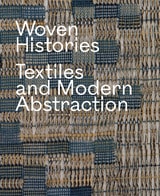
Woven Histories
Textiles and Modern AbstractionEdited by Lynne Cooke
University of Chicago Press, 2023
Published on the occasion of an exhibition curated by Lynne Cooke, Woven Histories offers a fresh and authoritative look at textiles—particularly weaving—as a major force in the evolution of abstraction. This richly illustrated volume features more than fifty creators whose work crosses divisions and hierarchies formerly segregating the fine arts from the applied arts and handicrafts.
Woven Histories begins in the early twentieth century, rooting the abstract art of Sophie Taeuber-Arp in the applied arts and handicrafts, then features the interdisciplinary practices of Anni Albers, Sonia Delaunay, Liubov Popova, Varvara Stepanova, and others who sought to effect social change through fabrics for furnishings and apparel. Over the century, the intersection of textiles and abstraction engaged artists from Ed Rossbach, Kay Sekimachi, Ruth Asawa, Lenore Tawney, and Sheila Hicks to Rosemarie Trockel, Ellen Lesperance, Jeffrey Gibson, Igshaan Adams, and Liz Collins, whose textile-based works continue to shape this discourse. Including essays by distinguished art historians as well as reflections from contemporary artists, this ambitious project traces the intertwined histories of textiles and abstraction as vehicles through which artists probe urgent issues of our time.
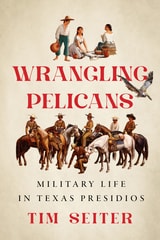
Wrangling Pelicans
Military Life in Texas PresidiosTim Seiter
University of Texas Press, 2025
2026 Excellence in Historic Preservation Award, Daughters of the American Revolution
2026 Summerlee Book Prize, Center for History and Culture of Southeast Texas and the Upper Gulf Coast
2026 Tejano Book Prize, Tejano Genealogy Society of Austin (TGSA)
A richly detailed history of daily life for colonial Spanish soldiers surviving on the eighteenth-century Texas Gulf Coast.
In 1775, Spanish King Carlos III ordered the capture of American pelicans for his wildlife park in Madrid. The command went to the only Spanish fort on the Texas coast—Presidio Nuestra Señora de Loreto de la Bahía in present-day Goliad. But the overworked soldiers stationed at the fort had little interest indulging a king an ocean away. Their days were consumed with guarding their community against powerful Indigenous peoples and managing the demands of frontier life. The royal order went ignored.
Wrangling Pelicans brings to life the world of Presidio La Bahía’s Hispano soldiers, whose duties ranged from heated warfare to high-stakes diplomacy, while their leisure pursuits included courtship, card playing, and cockfighting. It highlights the lives of presidio women and reveals the ways the Spanish legal system was used by and against the soldiers as they continually negotiated their roles within the empire and their community. Although they were agents of the Spanish crown, soldiers at times defied their king and even their captain as they found ways to assert their autonomy. Offering a fresh perspective on colonial Texas, Wrangling Pelicans recreates the complexities of life at the empire’s edge, where survival mattered more than royal decrees.
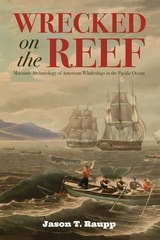
Wrecked on the Reef
Maritime Archaeology of American Whaleships in the Pacific OceanJason T. Raupp
University of Alabama Press, 2025
Take to the sea on this maritime archaeological exploration of nineteenth-century American whaling ships
American whaleships of the early nineteenth century were more than ocean-going vessels—they were complex workplaces, designed for long-term voyages, round-the-clock labor, and the large-scale extraction of marine resources. In Wrecked on the Reef, maritime archaeologist Jason T. Raupp presents a pioneering study of these ships as mobile production platforms, rooted in the logic of industrial capitalism operating far from land.
Drawing on shipwreck sites from the central Pacific region, Raupp offers a rare archaeological look at everyday life aboard nineteenth-century whaling vessels during the so-called “Golden Age” of whaling. He examines the tools used to hunt and process whales, the strict labor hierarchies onboard, and the physical evidence of diverse, often vulnerable crews who lived and worked under demanding conditions. By combining maritime and industrial archaeology, Raupp reveals how these ships functioned not just as transportation, but as full-scale factories at sea.
Chapters trace the rise of Pacific whaling, the importance of Hawaii as a supply and repair hub, the design and mechanics of whaleships, and the dangerous work crews performed in extreme isolation. Raupp shows how these ships were not only technological marvels of their time, but also part of a much larger system of labor, risk, and ocean-based resource extraction that fueled American expansion into the Pacific.
By exploring whaleships as floating work sites, Raupp offers readers a deeper understanding of maritime labor, capitalism, and imperialism in the nineteenth century. Wrecked on the Reef charts a new course in the study of labor and landscape at sea, providing significant contributions to maritime archaeology, industrial history, and environmental humanities.
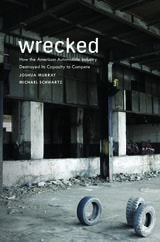
Wrecked
How the American Automobile Industry Destroyed Its Capacity to CompeteJoshua Murray
Russell Sage Foundation, 2019
Today Japanese and many European automakers produce higher quality cars at lower cost than their American counterparts thanks to a flexible form of production characterized by long-term sole suppliers, assembly and supply plants located near each other, and just-in-time delivery of raw materials. While this style of production was, in fact, pioneered in the U.S. prior to World War II, in the years after the war, American automakers deliberately dismantled this system. As Murray and Schwartz show, flexible production accelerated innovation but also facilitated workers’ efforts to unionize plants and carry out work stoppages. To reduce the efficacy of strikes and combat the labor militancy that flourished between the Depression and the postwar period, the industry dispersed production across the nation, began maintaining large stockpiles of inventory, and eliminated single sourcing. While this restructuring of production did ultimately reduce workers’ leverage, it also decreased production efficiency and innovation. The U.S. auto industry has struggled ever since to compete with foreign automakers, and formerly thriving motor cities have suffered the consequences of mass deindustrialization.
Murray and Schwartz argue that new business models that reinstate flexible production and prioritize innovation rather than cheap labor could stem the outsourcing of jobs and help revive the auto industry. By clarifying the historical relationships between production processes, organized labor, and industrial innovation, Wrecked provides new insights into the inner workings and decline of the U.S. auto industry.
Wrecked
The Edmund Fitzgerald and the Sinking of the American EconomyThomas M Nelson
Michigan State University Press, 2025
Wrecks of Human Ambition
A History of Utah's Canyon Country to 1936Nelson, Paul T.
University of Utah Press, 0
Most of the previous works regarding the history of this unique region have focused on either early exploration or twentieth-century controversies that erupted over mineral and water development and the creation of national parks and wilderness areas. This volume fills a gap in existing histories by focusing on early historical themes from the confrontation between Euro-Christian ideals and this challenging landscape. It centers on three interconnected interpretations of the area that unfolded when visitors from green, well-watered, productive lands approached this desert. The Judeo-Christian obligation to “make the desert bloom,” encompassed ideas of millenarianism and of Indian conversion and acculturation as well as the Old Testament symbolism of the “garden” and the “desert.” It was embodied in the efforts of Spanish missionaries who came to the canyon country from the 1500s to the 1700s, and in the experiences of Mormon settlers from about 1850 to 1909. Another conflicting sentiment saw the region simply as bad land to avoid, an idea strongly held by U.S. government explorers in the 1850s. This conclusion too was reinforced by the experiences of those who attempted to settle and exploit this country. Finally, though, the rise of tourism brought new ideas of wilderness reverence to the canyon country. The bad lands became valuable precisely because they were so distinct from traditionally settled landscapes.
In pursuing the conflict between Euro-Christian ideals and an arid, rugged, resistant landscape of deserts and canyons, Paul Nelson provides in clear, engaging language the most detailed examination yet published of colonial Spain’s encounter with the region and lays out some of Mormonism’s rare failures in settling the arid West.
Wrestlin' Jacob
A Portrait of Religion in Antebellum Georgia and the Carolina Low CountryErskine Clarke
University of Alabama Press, 2000
Wrestling with God, scripture, and conscience in the nineteenth‑century South
First published in 1979, Wrestlin’ Jacob offers important insights into the intersection of black and white religious history in the South. Erskine Clarke provides two arenas—one urban and one rural—that show what happened when white ministers tried to bring black slaves into the fold of Christianity. Clarke illustrates how the good intentions—and vain illusions—of the white preachers, coupled with the degradation and cultural strength of the slaves, played a significant role in the development of black churches in the South.
From 1833 to 1847, Reverend Charles Colcock Jones served as an itinerant minister to slaves on the rice and cotton plantations in Liberty County, Georgia. The aim of Jones, and of the largely Puritan-descended slave owners, was to harvest not only good Christians but also obedient and hard-working slaves. At the same time, similar efforts were under way in cosmopolitan Charleston, South Carolina. Charleston permitted blacks to worship only under the supervision of whites, and partially as a result, whites and blacks worshiped together in ways that would be unheard of later in the segregated South.
Clarke examines not only the white ministers’ motivation in their missionary work but also the slaves’ reasons for becoming a part of the church. He addresses the important issue of the continuity of African traditions with the religious life of slaves and provides a significant introduction to the larger issues of slavery and religion in the South.
Wrestling to Rasslin'
Ancient Sport to American SpectacleGerald W. Morton and George M. O'Brien
University of Wisconsin Press, 1985
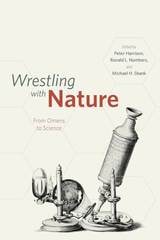
Wrestling with Nature
From Omens to ScienceEdited by Peter Harrison, Ronald L. Numbers, and Michael H. Shank
University of Chicago Press, 2011
When and where did science begin? Historians have offered different answers to these questions, some pointing to Babylonian observational astronomy, some to the speculations of natural philosophers of ancient Greece. Others have opted for early modern Europe, which saw the triumph of Copernicanism and the birth of experimental science, while yet another view is that the appearance of science was postponed until the nineteenth century.
Rather than posit a modern definition of science and search for evidence of it in the past, the contributors to Wrestling with Nature examine how students of nature themselves, in various cultures and periods of history, have understood and represented their work. The aim of each chapter is to explain the content, goals, methods, practices, and institutions associated with the investigation of nature and to articulate the strengths, limitations, and boundaries of these efforts from the perspective of the researchers themselves. With contributions from experts representing different historical periods and different disciplinary specializations, this volume offers a fresh perspective on the history of science and on what it meant, in other times and places, to wrestle with nature.

Wrigley Field
The Long Life and Contentious Times of the Friendly ConfinesStuart Shea
University of Chicago Press, 2014
In Wrigley Field: The Long Life and Contentious Times of the Friendly Confines, Stuart Shea provides a detailed and fascinating chronicle of this living historic landmark. The colorful history revealed in Wrigley Field shows how the stadium has evolved through the years to meet the shifting priorities of its owners and changing demands of its fans. While Wrigley Field today seems irreplaceable, we learn that from game one it has been the subject of endless debates over its future, its design, and its place in the neighborhood it calls home. To some, it is a hallowed piece of baseball history; to others, an icon of mismanagement and ineptitude. Shea deftly navigates the highs and lows, breaking through myths and rumors. And with another transformation imminent, he brings readers up to date on negotiations, giving much-needed historical context to the maneuvering.
Wrigley Field is packed with facts, stories, and surprises that will captivate even the most fair-weather fan. From dollar signs (the Ricketts family paid $900 million for the team and stadium in 2009), to exploding hot dog carts (the Cubs lost that game 6–5), to the name of Billy Sianis’s curse-inducing goat (Sonovia), Shea uncovers the heart of the stadium’s history. As the park celebrates its centennial, Wrigley Field continues to prove that its colorful and dramatic history is more interesting than any of its mythology.
Writers of Conviction
The Personal Politics of Zona Gale, Dorothy Canfield Fisher, Rose Wilder Lane, and Josephine HerbstJulia C. Ehrhardt
University of Missouri Press, 2004
Writers of the Black Chicago Renaissance
Edited by Steven C. Tracy
University of Illinois Press, 2011
The volume covers a vast collection of subjects, including many important writers such as Richard Wright, Gwendolyn Brooks, and Lorraine Hansberry as well as cultural products such as black newspapers, music, and theater. The book includes individual entries by experts on each subject; a discography and filmography that highlight important writers, musicians, films, and cultural presentations; and an introduction that relates the Harlem Renaissance, the White Chicago Renaissance, the Black Chicago Renaissance, and the Black Arts Movement.
Contributors are Robert Butler, Robert H. Cataliotti, Maryemma Graham, James C. Hall, James L. Hill, Michael Hill, Lovalerie King, Lawrence Jackson, Angelene Jamison-Hall, Keith Leonard, Lisbeth Lipari, Bill V. Mullen, Patrick Naick, William R. Nash, Charlene Regester, Kimberly Ruffin, Elizabeth Schultz, Joyce Hope Scott, James Smethurst, Kimberly M. Stanley, Kathryn Waddell Takara, Steven C. Tracy, Zoe Trodd, Alan Wald, Jamal Eric Watson, Donyel Hobbs Williams, Stephen Caldwell Wright, and Richard Yarborough.
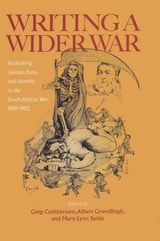
Writing A Wider War
Rethinking Gender, Race, and Identity in the South African War, 1899–1902Greg Cuthbertson
Ohio University Press, 2002
Writing a Wider War presents a dramatically new interpretation of the role of Boer women in the conflict and profoundly changes how we look at the making of Afrikaner nationalism. African experiences of the war are also examined, highlighting racial subjugation in the context of colonial war and black participation, and showcasing important new research by African historians.
The collection includes a reassessment of British imperialism and probing essays on J. A. Hobson; the masculinist nature of life on commando among Boer soldiers; Anglo-Jewry; secularism; health and medicine; nursing, women, and disease in the concentration camps; and the rivalry between British politicians and generals. An examination of the importance of the South African War in contemporary British political economy, and the part played by imperial propaganda, rounds off a thoroughly groundbreaking reinterpretation of this formative event in South Africa's history.
Writing Against Reform
Aesthetic Realism in the Progressive EraArielle Zibrak
University of Massachusetts Press, 2024
Throughout the Progressive Era, reform literature became a central feature of the American literary landscape. Works like Upton Sinclair’s The Jungle, Charlotte Perkins Gilman’s “The Yellow Wall-Paper,” and Jacob Riis’s How the Other Half Lives topped bestseller lists and jolted middle-class readers into action.
While realism and social reform have a long-established relationship, prominent writers of the period such as Henry James, Edith Wharton, James Weldon Johnson, Rebecca Harding Davis, and Kate Chopin resisted explicit political rhetoric in their own works and critiqued reform aesthetics, which too often rang hollow. Arielle Zibrak reveals that while these writers were often seen as indifferent to the political currents of their time, their work is a part of a little explored debate on the relationship between literature and politics at the heart of Progressive Era publishing. Examining the critique of reform aesthetics within the tradition of American realist literature of the late nineteenth and early twentieth centuries, Writing Against Reform promises to change the way we think about the fiction of this period and many of America’s leading writers.
Writing Against the Family
Gender in Lawrence and JoyceCynthia Lewiecki-Wilson
Southern Illinois University Press, 1994
This first feminist book-length comparison of D. H. Lawrence and James Joyce offers striking new readings of a number of the novelists’ most important works, including Lawrence’s Man Who Died and Joyce’s Finnegans Wake.
Cynthia Lewiecki-Wilson argues that a feminist reader must necessarily read with and against theories of psychoanalysis to examine the assumptions about gender embedded within family relations and psychologies of gender found in the two authors’ works. She challenges the belief that Lawrence and Joyce are opposites, inhabiting contrary modernist camps; instead they are on a continuum, with both engaged in a reimagination of gender relations.
Lewiecki-Wilson demonstrates that both Lawrence and Joyce write against a background of family material using family plots and family settings. While previous discussions of family relations in literature have not questioned assumptions about the family and about sex roles within it, Lewiecki-Wilson submits the systems of meaning by which gender is construed to a feminist analysis. She reexamines Lawrence and Joyce from the point of view of feminist psychoanalysis, which, she argues, is not a set of beliefs or a single theory but a feminist practice that analyzes how systems of meaning construe gender and produce a psychology of gender.
Lewiecki-Wilson argues against a theory of representation based on gender, however, concluding that Lawrence’s and Joyce’s texts, in different ways, test the idea of a female aesthetic. She analyzes Lawrence’s portrait of family relations in Sonsand Lovers, The Rainbow, and Women in Love and compares Joyce’s Portrait of the Artist as a Young Man with Lawrence’s autobiographical text. She then shows that Portrait begins a deconstruction of systems of meaning that continues and increases in Joyce’s later work, including Ulysses.
Lewiecki-Wilson concludes by showing that Lawrence, Joyce, and Freud relate family material to Egyptian myth in their writings. She identifies Freud’s essay "Leonardo da Vinci and a Memory of Childhood" as an important source for Joyce’s Finnegans Wake, which portrays beneath the gendered individual a root androgyny and asserts an unfixed, evolutionary view of family relations.
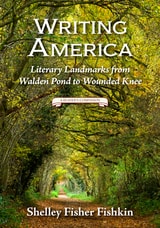
Writing America
Literary Landmarks from Walden Pond to Wounded Knee (A Reader's Companion)Fishkin, Shelley Fisher
Rutgers University Press, 2015
American novelist E.L. Doctorow once observed that literature “endows places with meaning.” Yet, as this wide-ranging new book vividly illustrates, understanding the places that shaped American writers’ lives and their art can provide deep insight into what makes their literature truly meaningful.
Published on the eve of the 50th anniversary of the Historic Preservation Act, Writing America is a unique, passionate, and eclectic series of meditations on literature and history, covering over 150 important National Register historic sites, all pivotal to the stories that make up America, from chapels to battlefields; from plantations to immigration stations; and from theaters to internment camps. The book considers not only the traditional sites for literary tourism, such as Mark Twain’s sumptuous Connecticut home and the peaceful woods surrounding Walden Pond, but also locations that highlight the diversity of American literature, from the New York tenements that spawned Abraham Cahan’s fiction to the Texas pump house that irrigated the fields in which the farm workers central to Gloria Anzaldúa’s poetry picked produce. Rather than just providing a cursory overview of these authors’ achievements, acclaimed literary scholar and cultural historian Shelley Fisher Fishkin offers a deep and personal reflection on how key sites bore witness to the struggles of American writers and inspired their dreams. She probes the global impact of American writers’ innovative art and also examines the distinctive contributions to American culture by American writers who wrote in languages other than English, including Yiddish, Chinese, and Spanish.
Only a scholar with as wide-ranging interests as Shelley Fisher Fishkin would dare to bring together in one book writers as diverse as Gloria Anzaldúa, Nicholas Black Elk, David Bradley, Abraham Cahan, S. Alice Callahan, Raymond Chandler, Frank Chin, Elizabeth Cook-Lynn, Countee Cullen, Frederick Douglass, Paul Laurence Dunbar, Jessie Fauset, William Faulkner, F. Scott Fitzgerald, Allen Ginsberg, Jovita González, Rolando Hinojosa, Langston Hughes, Zora Neale Hurston, Lawson Fusao Inada, James Weldon Johnson, Erica Jong, Maxine Hong Kingston, Irena Klepfisz, Nella Larsen, Emma Lazarus, Sinclair Lewis, Genny Lim, Claude McKay, Herman Melville, N. Scott Momaday, William Northup, John Okada, Miné Okubo, Simon Ortiz, Américo Paredes, John P. Parker, Ann Petry, Tomás Rivera, Wendy Rose, Morris Rosenfeld, John Steinbeck, Harriet Beecher Stowe, Henry David Thoreau, Mark Twain, Yoshiko Uchida, Tino Villanueva, Nathanael West, Walt Whitman, Richard Wright, Hisaye Yamamoto, Anzia Yezierska, and Zitkala-Ša.
Leading readers on an enticing journey across the borders of physical places and imaginative terrains, the book includes over 60 images, and extended excerpts from a variety of literary works. Each chapter ends with resources for further exploration. Writing America reveals the alchemy though which American writers have transformed the world around them into art, changing their world and ours in the process.
Writing Art History
Disciplinary DeparturesMargaret Iversen and Stephen Melville
University of Chicago Press, 2010
Faced with an increasingly media-saturated, globalized culture, art historians have begun to ask themselves challenging and provocative questions about the nature of their discipline. Why did the history of art come into being? Is it now in danger of slipping into obsolescence? And, if so, should we care?
In Writing Art History, Margaret Iversen and Stephen Melville address these questions by exploring some assumptions at the discipline’s foundation. Their project is to excavate the lost continuities between philosophical aesthetics, contemporary theory, and art history through close readings of figures as various as Michael Baxandall, Martin Heidegger, Jacques Lacan, and Alois Riegl. Ultimately, the authors propose that we might reframe the questions concerning art history by asking what kind of writing might help the discipline to better imagine its actual practices—and its potential futures.
Writing Beat and Other Occasions of Literary Mayhem
John Tytell
Vanderbilt University Press, 2014
Approaching the history of post-war twentieth century American literature, and in particular the Beat literary movement of Kerouac, Ginsberg, Burroughs, and others, Tytell finds himself uniquely positioned as an eyewitness to many of these stories. In this book, he shares his insight with the reader. As he interviewed, drank, traveled, and survived countless moments with some of these literary legends, Tytell discovered much about the craft of nonfiction, biography, and the nature of history. Writing Beat demonstrates, through Tytell's growth as a professor and historian of the Beats, lessons learned and hazards encountered for those aspiring to become writers themselves.
As we approach the sixtieth anniversary of Allen Ginsberg's Howl, Writing Beat reminds us writers do not spring to life fully formed, and the struggle to get to literature can be a blast.

Writing Beijing
History and Knowledge of the CapitalNaixi Feng
University of Michigan Press, 2027
Writing Beijing offers a comprehensive study of the textual representations of the city from the late Ming dynasty through the Republican era, interrogating how urban narratives were actively constructed, adapted, and repurposed across periods of political transformation. Scholars, officials, and travelers reshaped the capital’s identity by rewriting older texts, borrowing new surveys, and even inserting critiques into guidebooks.. This study reveals how the crises brought by intense social transformation, including dynastic collapse and foreign invasion, forced writers to reinvent Beijing on paper. Some turned the city into a monument to lost glory; others documented everyday life to resist imperialism. These narratives served to critique contemporary sociopolitical conditions, assert cultural legitimacy during times of crisis, and ultimately shape Beijing’s enduring cultural image as China’s symbolic capital.
Naixi Feng bridges literary studies, urban history, and critical historiography by examining a wide range of genres—including literary miscellanies, local gazetteers, Qing imperial compilations, Republican textbooks, social reports, and travel guides—to demonstrate how writing about Beijing was never merely descriptive but always a site of cultural and political contestation.
Writing Cities
Exploring Early Modern Urban DiscourseJames S. Amelang
Central European University Press, 2020

Writing Faith
Text, Sign, and History in the Miracles of Sainte FoyKathleen Ashley and Pamela Sheingorn
University of Chicago Press, 1999
As Ashley and Sheingorn show, differing agendas shaped the miracle stories over time. The first author, Bernard of Angers, used his narratives to critique popular religion and to establish his own literary reputation, while the monks who continued the collection tried to enhance their monastery's prestige. Because these stories were rhetorical constructions, Ashley and Sheingorn argue, we cannot use them directly as sources of historical data. Instead, they demonstrate how analyzing representations common to groups of miracle stories—such as negative portrayals of Muslims on the eve of the Crusades—can reveal the traces of history.
Writing Ground Zero
Japanese Literature and the Atomic BombJohn Whittier Treat
University of Chicago Press, 1994
Treat recounts the controversial history of Japanese public discourse around Hiroshima and Nagasaki—a discourse alternatively celebrated and censored—from August 6, 1945, to the present day. He includes works from the earliest survivor writers, including Hara Tamiki and Ota Yoko, to such important Japanese intellectuals today as Oe Kenzaburo and Oda Makoto. Treat argues that the insights of Japanese writers into the lessons of modern atrocity share much in common with those of Holocaust writers in Europe and the practitioners of recent poststructuralist nuclear criticism in America. In chapters that take up writers as diverse as Hiroshima poets, Tokyo critics, and Nagasaki women novelists, he explores the implications of these works for critical, literary, and cultural theory.
Treat summarizes the Japanese contribution to such ongoing international debates as the crisis of modern ethics, the relationship of experience to memory, and the possibility of writing history. This Japanese perspective, Treat shows, both confirms and amends many of the assertions made in the West on the shift that the death camps and nuclear weapons have jointly signaled for the modern world and for the future.
Writing Ground Zero will be read not only by students of Japan, but by all readers concerned with the fate of culture after the fact of nuclear war in our time.
Writing Groups
History, Theory, and ImplicationsAnne Ruggles Gere
Southern Illinois University Press, 1987
Drawing upon previously unpublished archival materials as well as historical accounts, Gere traces the history of writing groups in America, from their origins over a century ago to their recent reappearance in the works of Macrorie, Elbow, Murray, and others.
From this historical perspective Gere examines the theoretical foundations of writing groups, challenging the traditional concept of writing as an individual performance. She offers instead a broader view of authorship that includes both individual and social dimensions, with implications not only for the teaching of composition but also for theories of rhetoric and literacy.
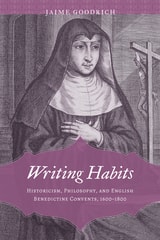
Writing Habits
Historicism, Philosophy, and English Benedictine Convents, 1600–1800Jaime Goodrich
University of Alabama Press, 2021
The first in-depth examination of the texts produced in English Benedictine convents between 1600 and 1800.
After Catholicism became illegal in England during the sixteenth century, Englishwomen established more than twenty convents on the Continent that attracted thousands of nuns and served as vital centers of Catholic piety until the French Revolution. Today more than 1,000 manuscripts and books produced by, and for, the Benedictine convents are extant in European archives. Writing Habits: Historicism, Philosophy, and English Benedictine Convents, 1600–1800 provides the first substantive analysis of these works in order to examine how members of one religious order used textual production to address a major dilemma experienced by every English convent on the Continent: How could English nuns cultivate a cloistered identity when the Protestant Reformation had swept away nearly all vestiges of English monasticism?
Drawing on an innovative blend of methodologies, Jaime Goodrich contends that the Benedictines instilled a collective sense of spirituality through writings that created multiple overlapping communities, ranging from the earthly society of the convent to the transhistorical network of the Catholic Church. Because God resides at the heart of these communities, Goodrich draws on the works of Martin Buber, a twentieth-century Jewish philosopher who theorized that human community forms a circle, with each member acting as a radius leading toward the common center of God. Buber’s thought, especially his conception of the I-You framework for personal and spiritual relationships, illuminates a fourfold set of affiliations central to Benedictine textual production: between the nuns themselves, between the individual nun and God, between the convent and God, and between the convent and the Catholic public sphere. By evoking these relationships, the major genres of convent writing—administrative texts, spiritual works, history and life writing, and controversial tracts—functioned as tools for creating community and approaching God.
Through this Buberian reading of the cloister, Writing Habits recovers the works of Benedictine nuns and establishes their broader relevance to literary history and critical theory.
Writing Histories of Rhetoric
Edited by Victor J. Vitanza
Southern Illinois University Press, 1994
This collection of essays, edited by Victor J. Vitanza, is a historiography of rhetoric, summarizing what has recently been accomplished in the revision of traditional histories of rhetoric and discussing what might be accomplished in the future. Featuring a variety of approaches—classical, revisionary, and avant-garde—it includes articles by Janet M. Atwill, James A. Berlin, William A. Covino, Sharon Crowley, Hans Kellner, John Poulakos, Takis Poulakos, John Schilb, Jane Sutton, Kathleen Ethel Welch, Lynn Worsham, and Victor J. Vitanza.
In the first essay, Sharon Crowley identifies the major players and primary issues in a chronological narrative of the debate about the writing of the history of rhetoric that has arisen between traditionalists / essentialists and revisionists/constructionists. In recent years, traditionalists have demanded a more complete and accurate history, while revisionists have sought a critical understanding of the various epistemological-ideological grounds upon which a history of rhetoric had been and could be constructed. Revisionists, in their search for multiple, contestatory histories, have begun to critique one another, breaking into two general groups: one favoring a political-social program, the other resisting and disrupting such an approach.
Vitanza echoes Crowley’s review of this ongoing debate by asking a crucial question: What exactly does it mean to be a revisionist historian? By combining the disintegration of various revisionist and subversive positions into a communal "we," he asks an additional question: Who is the "we" writing histories of rhetoric?
The essays that follow give a rich answer to Vitanza’s questions. They bring the writing of histories of rhetoric into the larger area of postmodern theory, raising neglected issues of race, gender, and class. Written with a variety of intentions, some of the essays are expository and highly argumentative while others are manifestos, innovative and far-reaching in tone. Still others are summaries and background studies, providing useful information to both the novice student and the experienced scholar.
This book, situated at a juncture between two disciplines, composition studies and speech, will be a landmark collection for many years.
Writing History in the Digital Age
Jack Dougherty and Kristen Nawrotzki, editors
University of Michigan Press, 2013
Writing History in the Digital Age began as a “what-if” experiment by posing a question: How have Internet technologies influenced how historians think, teach, author, and publish? To illustrate their answer, the contributors agreed to share the stages of their book-in-progress as it was constructed on the public web.
To facilitate this innovative volume, editors Jack Dougherty and Kristen Nawrotzki designed a born-digital, open-access, and open peer review process to capture commentary from appointed experts and general readers. A customized WordPress plug-in allowed audiences to add page- and paragraph-level comments to the manuscript, transforming it into a socially networked text. The initial six-week proposal phase generated over 250 comments, and the subsequent eight-week public review of full drafts drew 942 additional comments from readers across different parts of the globe.
The finished product now presents 20 essays from a wide array of notable scholars, each examining (and then breaking apart and reexamining) if and how digital and emergent technologies have changed the historical profession.
Writing History!
A Companion for HistoriansJeanette Kamp, Susan Legêne, Matthias van Rossum and Sebas Rümke
Amsterdam University Press, 2018
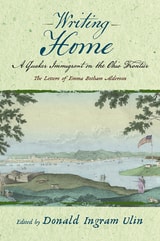
Writing Home
A Quaker Immigrant on the Ohio Frontier; the Letters of Emma Botham AldersonDonald Ingram Ulin
Bucknell University Press, 2020
Introductions and notes situate the letters in relation to their critical, biographical, literary, and historical contexts. Editor Donald Ulin discusses the relationship between Alderson’s letters and her sister Mary Howitt’s Our Cousins in Ohio (1849), a remarkable instance of transatlantic literary collaboration.
Writing Home offers an unparalleled opportunity for studying immigrant correspondence due to Alderson’s unusually well-documented literary and religious affiliations. The notes and introductions provide background on nearly all the places, individuals, and events mentioned in the letters.
Published by Bucknell University Press. Distributed worldwide by Rutgers University Press.
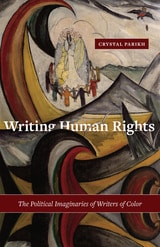
Writing Human Rights
The Political Imaginaries of Writers of ColorCrystal Parikh
University of Minnesota Press, 2017
The legal texts and aspirational ideals of human rights are usually understood and applied in a global context with little bearing on the legal discourse, domestic political struggles, or social justice concerns within the United States. In Writing Human Rights, Crystal Parikh uses the international human rights regime to read works by contemporary American writers of color—Toni Morrison, Chang-rae Lee, Ana Castillo, Aimee Phan, and others—to explore the conditions under which new norms, more capacious formulations of rights, and alternative kinds of political communities emerge.
Parikh contends that unlike humanitarianism, which views its objects as victims, human rights provide avenues for the creation of political subjects. Pairing the ethical deliberations in such works as Beloved and A Gesture Life with human rights texts like the United Nations Convention Against Torture, she considers why principles articulated as rights in international conventions and treaties—such as the right to self-determination or the right to family—are too often disregarded at home. Human rights concepts instead provide writers of color with a deeply meaningful method for political and moral imagining in their literature.
Affiliating transnational works of American literature with decolonization, socialist, and other political struggles in the global south, this book illuminates a human rights critique of idealized American rights and freedoms that have been globalized in the twenty-first century. In the absence of domestic human rights enforcement, these literatures provide a considerable repository for those ways of life and subjects of rights made otherwise impossible in the present antidemocratic moment.
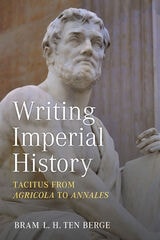
Writing Imperial History
Tacitus from Agricola to AnnalesBram L. H. ten Berge
University of Michigan Press, 2023
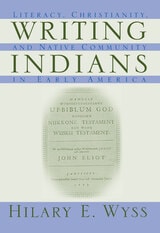
Writing Indians
Literacy, Christianity, and Native Community in Early AmericaHilary E. Wyss
University of Massachusetts Press, 2000
A study of cultural encounter, this book takes a fresh look at the much ignored and often misunderstood experience of Christian Indians in early America. Focusing on New England missionary settlements from the mid-seventeenth to the early nineteenth centuries, Hilary E. Wyss examines the ways in which Native American converts to Christianity developed their own distinct identity within the context of a colonial culture.
With an approach that weaves together literature, religious studies, and ethno-history, Wyss grounds her work in the analysis of a rarely read body of “autobiographical” writings by Christian Indians, including letters, journal entries, and religious confessions. She then juxtaposes these documents to the writings of better known Native Americans like Samson Occom as well as to the published works of Anglo-Americans, such as Mary Rowlandson's famous captivity narrative and Eleazor Wheelock's accounts of his charity schools.
In their search for ostensibly “authentic” Native voices, scholars have tended to overlook the writings of Christian Indians. Yet, Wyss argues, these texts reveal the emergence of a dynamic Native American identity through Christianity. More specifically, they show how the active appropriation of New England Protestantism contributed to the formation of a particular Indian identity that resisted colonialism by using its language against itself.
Writing Instruction in Nineteenth-Century American Colleges
James A. Berlin. Foreword by Donald C. Stuart
Southern Illinois University Press, 1984
Defining a rhetoric as a social invention arising out of a particular time, place, and set of circumstances, Berlin notes that “no rhetoric—not Plato’s or Aristotle’s or Quintilian’s or Perelman’s—is permanent.” At any given time several rhetorics vie for supremacy, with each attracting adherents representing various views of reality expressed through a rhetoric.
Traditionally rhetoric has been seen as based on four interacting elements: “reality, writer or speaker, audience, and language.” As emphasis shifts from one element to another, or as the interaction between elements changes, or as the definitions of the elements change, rhetoric changes. This alters prevailing views on such important questions as what is appearance, what is reality.
In this interpretive study Berlin classifies the three 19th-century rhetorics as classical, psychological-epistemological, and romantic, a uniquely American development growing out of the transcendental movement. In each case studying the rhetoric provides insight into society and the beliefs of the people.
Writing Japonisme
Aesthetic Translation in Nineteenth-Century French ProsePamela A. Genova
Northwestern University Press, 2016