Results by title
4030 books match the query 'Language Arts & Disciplines' and 189 start with w
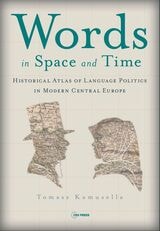
Words in Space and Time
A Historical Atlas of Language Politics in Modern Central EuropeTomasz Kamusella
Central European University Press, 2022
With forty-two extensively annotated maps, this atlas offers novel insights into the history and mechanics of how Central Europe’s languages have been made, unmade, and deployed for political action. The innovative combination of linguistics, history, and cartography makes a wealth of hard-to-reach knowledge readily available to both specialist and general readers. It combines information on languages, dialects, alphabets, religions, mass violence, or migrations over an extended period of time.
The story first focuses on Central Europe’s dialect continua, the emergence of states, and the spread of writing technology from the tenth century onward. Most maps concentrate on the last two centuries. The main storyline opens with the emergence of the Western European concept of the nation, in accord with which the ethnolinguistic nation-states of Italy and Germany were founded. In the Central European view, a “proper” nation is none other than the speech community of a single language. The Atlas aspires to help users make the intellectual leap of perceiving languages as products of human history and part of culture. Like states, nations, universities, towns, associations, art, beauty, religions, injustice, or atheism—languages are artefacts invented and shaped by individuals and their groups.

Words on Words
Quotations about Language and LanguagesEdited by David Crystal and Hilary Crystal
University of Chicago Press, 2000
The quotations are grouped thematically under 65 different headings, from "The Nature of Language" through the "Language of Politics" to "Quoting and Misquoting." This arrangement enables the reader to explore a topic through a variety of lenses, ancient and modern, domestic and foreign, scientific and casual, ironic and playful. Three thorough indexes—to authors, sources, and key words—provide different entry points into the collection. A valuable resource for professional writers and scholars, Words on Words is for anyone who loves language and all things linguistic.
Wordsworth's Formative Years
George Wilbur Meyer
University of Michigan Press, 1934
Work of Teaching Writing
Learning from Fiction, Film, and DramaJoseph Harris
Utah State University Press, 2020
Each chapter examines a fictional representation of writing classes—as portrayed in Dead Poets Society, Up the Down Staircase, Educating Rita, Push, and more—and shifts the conversation from how these works portray teachers to how they dramatize the actual work of teaching. Harris considers scenes of instruction from different stages of the writing process and depictions of students and teachers at work together to highlight the everyday aspects of teaching writing.
In the writing classroom the ideas of teachers come to life in the work of their students. The Work of Teaching Writing shows what fiction, film, and drama can convey about the moment of exchange between teacher and student as they work together to create new insights into writing. It will interest both high school and undergraduate English teachers, as well as graduate students and scholars in composition and rhetoric, literary studies, and film studies.
Workbook for The ESL Writer's Handbook, 2nd Edition
Janine Carlock, Maeve Eberhardt, Jaime Horst, and Lionel Menasche
University of Michigan Press, 2018
The new edition of the Workbook includes 85 exercises to facilitate students’ understanding of some of the most complex or troublesome writing areas discussed in the Handbook. Exercises have been revised, and new exercises have been added to Sections 4 (Research Paper) and 5 (Grammar and Style).
Workbook to Accompany the Second Edition of Donald M. Ayers's English Words from Latin and Greek Elements
Revised EditionHelena Dettmer and Marcia Lindgren
University of Arizona Press, 2005
The Workbook has now been revised to make it more relevant and useful. It features a new dictionary exercise and word analysis exercises, the replacement of true-false exercises that have caused the most difficulty for students, and the elimination of archaic words and other items that have become dated. The authors have also improved the clarity of the instructions for individual exercises, in some cases adding notes or providing sample answers. As part of the revised front matter, there is a new introduction written just for students to help them get the most out of the workbook. English Words and the Workbook have met with unqualified success in English and Classics courses at both the advanced secondary and college levels. This revision of the Workbook helps to ensure the continuing relevance of the roots approach to vocabulary building for tomorrow’s students.
Working Lives of New Writing Center Directors
Nicole I. Caswell
Utah State University Press, 2016
The first book-length empirical investigation of writing center directors’ labor, The Working Lives of New Writing Center Directors presents a longitudinal qualitative study of the individual professional lives of nine new directors. Inspired by Kinkead and Harris’s Writing Centers in Context (1993), the authors adopt a case study approach to examine the labor these directors performed and the varied motivations for their labor, as well as the labor they ignored, deferred, or sidelined temporarily, whether or not they wanted to.
The study shows directors engaged in various types of labor—everyday, disciplinary, and emotional—and reveals that labor is never restricted to a list of job responsibilities, although those play a role. Instead, labor is motivated and shaped by complex and unique combinations of requirements, expectations, values, perceived strengths, interests and desires, identities, and knowledge. The cases collectively distill how different institutions define writing and appropriate resources to writing instruction and support, informing the ongoing wider cultural debates about skills (writing and otherwise), the preparation of educators, the renewal/tenuring of educators, and administrative “bloat” in academe.
The nine new directors discuss more than just their labor; they address their motivations, their sense of self, and their own thoughts about the work they do, facets of writing center director labor that other types of research or scholarship have up to now left invisible. The Working Lives of New Writing Center Directors strikes a new path in scholarship on writing center administration and is essential reading for present and future writing center administrators and those who mentor them.
Working Text (Student Workbook)
X-Word Grammar and Writing Activities for StudentsSue Livingston
Gallaudet University Press, 2010
Working Test: X-Word Grammar and Writing Activities for Students features 86 X-Word Grammar reading and writing exercises divided into five parts of increasing complexity. Deaf, second-language, and other students experiencing difficulty with English composition can perform these exercises as homework or as in-class activities. Through these exercises, they can master English grammar, improve their facility with language constructions, and meet the challenges of becoming better writers.
Working Text (Teacher's Guide)
Teaching Deaf and Second-Language Students to Be Better WritersSue Livingston
Gallaudet University Press, 2010
After teaching developmental writing to deaf students for may years, Sue Livingston found that students who can read and analyze written texts become better writers. They achieve their improvement by reading, then writing about what they have read. Livingston has embodied her successful approach in Working Text: Teaching Deaf and Second-Language Students to Be Better Writers.
In this straightforward instructional book, Livingston first explains what is involved and why her methods work with deaf students, second-language students, and other students who need to improve their writing ability. Upon this foundation, Working Text delineates how to teach students to write through reading and writing exercises. These exercises have been carefully crafted using the X-Word Grammar approach to help students discover common language constructions that they can apply to their own writing. As the students progress, their understanding of the elements of good writing will grow.
Working Text also includes all of the exercises and appendices featured in the Working Test: X-Word Grammar and Writing Activities for Students workbook, both in print and on on a special CD. The answers for the exercises are included as well, as are sample quizzes, and the CD can be used in the classroom for interactive lessons in conjunction with the student workbook. Working Text: Teaching Deaf and Second-Language Students to Be Better Writers, in concert with its companion student workbook, will help deaf, second-language, and other students develop into markedly better, more confident writers.

Working Together
Collaborative Information Practices for Organizational LearningMary M. Somerville
Assoc of College & Research Libraries, 2011
Working Together
Collaborative Information Practices for Organizational LearningMary M. Somerville
Assoc of College & Research Libraries, 2011
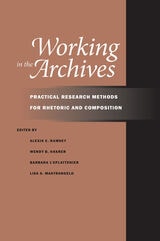
Working in the Archives
Practical Research Methods for Rhetoric and CompositionEdited by Alexis E. Ramsey, Wendy B. Sharer, Barbara L'Eplattenier, Lisa S. Mastrangelo
Southern Illinois University Press, 2010
Archival research of any magnitude can be daunting. With this in mind, Alexis E. Ramsey, Wendy B. Sharer, Barbara L’Eplattenier, and Lisa Mastrangelo have developed an indispensable volume for the first-time researcher as well as the seasoned scholar. Working in the Archives is a guide to the world of rhetoric and composition archives, from locating an archival source and its materials to establishing one’s own collection of archival materials. This practical volume provides insightful information on a variety of helpful topics, such as basic archival theory, processes, and principles; the use of hidden or digital archives; the intricacies of searching for and using letters and photographs; strategies for addressing the dilemmas of archival organization without damaging the provenance of materials; the benefits of seeking sources outside academia; and the difficult (yet often rewarding) aspects of research on the Internet.
Working in the Archives moves beyond the basics to discuss the more personal and emotional aspects of archival work through the inclusion of interviews with experienced researchers such as Lynée Lewis Gaillet, Peter Mortensen, Kathryn Fitzgerald, Kenneth Lindblom, and David Gold. Each shares his or her personal stories of the joys and challenges that face today’s researchers.
Packed with useful recommendations, this volume draws on the knowledge and experiences of experts to present a well-rounded guidebook to the often winding paths of academic archival investigation. These in-depth yet user-friendly essays provide crucial answers to the myriad questions facing both fledgling and practiced researchers, making Working in the Archives an essential resource.

Working in the Virtual Stacks
Laura Townsend Kane
American Library Association, 2011
Working with Faculty Writers
Anne Ellen Geller and Michele Eodice
Utah State University Press, 2013
Contributors from a variety of institution types and perspectives consider who faculty writers are and who they may be in the future, reveal the range of locations and models of support for faculty writers, explore the ways these might be delivered and assessed, and consider the theoretical, philosophical, political, and pedagogical approaches to faculty writing support, as well as its relationship to student writing support.
With the pressure on faculty to be productive researchers and writers greater than ever, this is a must-read volume for administrators, faculty, and others involved in developing and assessing models of faculty writing support.
Workplace Learning and Leadership
Paul Signorelli
American Library Association, 2011
The best kind of learning is that which never ends—and a culture of training means that staff will be more flexible and responsive to new ideas and strategies, imperative in today's libraries. In this practical resource, leading workplace trainers Reed and Signorelli offer guidance on improving the effectiveness of training programs. Their book takes readers through the entire process of developing, implementing, and sustaining training programs and communities of learning, in order to
- Empower individuals to become leaders and teachers by cultivating a culture of ongoing learning
- Connect library staff and users to information resources so they can effectively use them to their benefit
- Develop skills among both managers and workers for practicing continuous formal and informal training
World War II and the Cold War
The Rhetoric of Hearts and Minds, Volume VIIIMartin J. Medhurst
Michigan State University Press, 2018
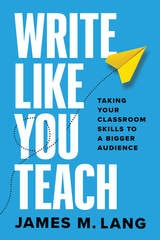
Write Like You Teach
Taking Your Classroom Skills to a Bigger AudienceJames M. Lang
University of Chicago Press, 2025
After years spent cultivating their expertise and passion for a subject, scholars are uniquely positioned to write great books. Yet, accustomed to writing for an audience of their peers, many scholars find it challenging to adapt their writing to a style that is accessible and engaging to the general public. James M. Lang argues that academics are regularly called on to pitch their research to a general audience: their undergraduates. If only there were a way to translate the skills they use in the classroom into their writing. . . .
In Write Like You Teach, Lang—a veteran writer and teacher—distills the elements of good classroom teaching into guidelines for writing for a general audience. He encourages authors to pay attention to how their readers learn and to embrace exploration, experimentation, and creativity in their writing. Lang asks his readers to consider the questions that all great teachers ask themselves: How will I get the attention of my students? How do I make them curious about the subject? What stories or examples will illustrate the more difficult concepts or theories in the course? When will I pause in the class and give students a break from hard thinking? What will I do at the end of the class to remind students about my key messages and leave them wanting to know more?
Write Like You Teach includes examples from successful writers and useful anecdotes from Lang’s own classroom and writing career. Indeed, Lang takes his own advice to heart: like a good teacher, he varies the form of each chapter, making sure to introduce some surprises to keep the reader engaged. Each chapter ends with writing prompts to help readers practice their newly acquired skills, and an appendix provides additional advice on publishing and promoting one’s work. Teachers who follow Lang’s suggestions will find new ways to connect with their readers—and like any good student, they will never approach writing the same way again.
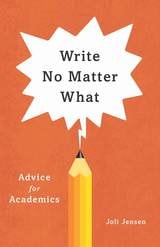
Write No Matter What
Advice for AcademicsJoli Jensen
University of Chicago Press, 2017
Jensen begins by busting the myth that universities are supportive writing environments. She points out that academia, an arena dedicated to scholarship, offers pressures that actually prevent scholarly writing. She shows how to acknowledge these less-than-ideal conditions, and how to keep these circumstances from draining writing time and energy. Jensen introduces tools and techniques that encourage frequent, low-stress writing. She points out common ways writers stall and offers workarounds that maintain productivity. Her focus is not on content, but on how to overcome whatever stands in the way of academic writing.
Write No Matter What draws on popular and scholarly insights into the writing process and stems from Jensen’s experience designing and directing a faculty writing program. With more than three decades as an academic writer, Jensen knows what really helps and hinders the scholarly writing process for scholars in the humanities, social sciences,and sciences.
Cut down the academic sword of Damocles, Jensen advises. Learn how to write often and effectively, without pressure or shame. With her encouragement, writers of all levels will find ways to create the writing support they need and deserve.
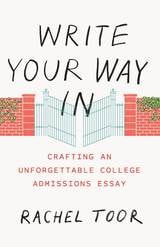
Write Your Way In
Crafting an Unforgettable College Admissions EssayRachel Toor
University of Chicago Press, 2017
The good news? You already have the “secret sauce” for crafting a compelling personal essay: your own experiences and your unique voice.
More than twenty million students apply to college every year; many of them look similar in terms of test scores, grades, courses taken, extracurricular activities. Admissions officers wade through piles of files. As an applicant, you need to think about what will interest an exhausted reader. What can you write that will make her argue to admit you instead of the thousands of other applicants?
A good essay will be conversational and rich in vivid details, and it could only be written by one person—you. This book will help you figure out how to find and present the best in yourself. You’ll acquire some useful tools for writing well—and may even have fun—in the process.
Writer's Block
The Cognitive DimensionMike Rose
Southern Illinois University Press, 1984
Writer’s block is more than a mere matter of discomfort and missed deadlines; sustained experiences of writer’s block may influence academic success and career choices. Writers in the business world, professional writers, and students all have known this most common and least studied problem with the composing process. Mike Rose, however, sees it as a limitable problem that can be precisely analyzed and remedied through instruction and tutorial programs.
Rose defines writer’s block as “an inability to begin or continue writing for reasons other than a lack of skill or commitment,” which is measured by “passage of time with limited productive involvement in the writing task.” He applies insights of cognitive psychology to reveal dimensions of the problem never before examined.
In his three-faceted approach, Rose develops and administers a questionnaire to identify writers experiencing both high and low degrees of blocking; through stimulated recall he examines the composing processes of these writers; and he proposes a cognitive conceptualization of writer’s block and of the composing process.
In drawing up his model, Rose delineates many cognitive errors that cause blocking, such as inflexible rules or conflicting planning strategies. He also discusses the practices and strategies that promote effective composition.
The reissue of this classic study of writer’s block includes a new preface by the author that advocates more mixed-methods research in rhetoric and composition, details how he conducted his writer’s block study, and discusses how his approach to a study like this would be different if conducted today.
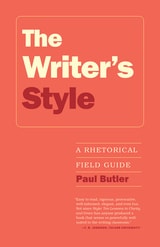
Writer's Style
A Rhetorical Field GuidePaul Butler
Utah State University Press, 2018
In a departure from the deficiency model associated with other commonly used style guides, author Paul Butler encourages writers to see style as a malleable device to use for their own purposes, rather than a domain of rules or privilege. He encourages writing instructors to present style as a practical, accessible, and rhetorical tool, working with models that connect to a broad range of writing situations—including traditional texts like essays, newspaper articles, and creative nonfiction as well as digital texts in the form of tweets, Facebook postings, texts, email, visual rhetoric, YouTube, and others.
Though designed for use in first-year composition courses in which students are learning to write for various audiences, purposes, and contexts, The Writer’s Style is a richly layered work that will serve anyone considering how style applies to their professional, personal, creative, or academic writing.
Writing Abroad
A Guide for TravelersPeter Chilson and Joanne B. Mulcahy
University of Chicago Press, 2017
Writing Abroad is meant for travelers of all backgrounds and writing levels: a student embarking on overseas study; a retiree realizing a dream of seeing China; a Peace Corps worker in Kenya. All can benefit from documenting their adventures, whether on paper or online. Through practical advice and adaptable exercises, this guide will help travelers hone their observational skills, conduct research and interviews, choose an appropriate literary form, and incorporate photos and videos into their writing.
Writing about travel is more than just safeguarding memories—it can transform experiences and tease out new realizations. With Writing Abroad, travelers will be able to deepen their understanding of other cultures and write about that new awareness in clear and vivid prose.
Writing Across Cultures
Robert Eddy
Utah State University Press, 2019
Robert Eddy and Amanda Espinosa-Aguilar offer a new framework for teaching that acknowledges the changing demographics of US college classrooms as the field of writing studies moves toward real equity and expanding diversity. Writing Across Cultures utilizes a streamlined cross-racial and interculturally tested method of introducing students to academic writing via sequenced assignments that are not confined by traditional and static approaches. They focus on helping students become engaged members of a new culture—namely, the rapidly changing collegiate discourse community. The book is based on a multi-racial rhetoric that assumes that writing is inherently a social activity. Students benefit most from seeing composing as an act of engaged communication, and this text uses student samples, not professionally authored ones, to demonstrate this framework in action.
Writing Across Cultures will be a significant contribution to the field, aiding teachers, students, and administrators in navigating the real challenges and wonderful opportunities of multi-racial learning spaces.
Writing Across Difference
Theory and InterventionJames Rushing Daniel
Utah State University Press, 2021
No text in composition has made such a sweeping attempt to place the multiple areas of translingualism, anti-racism, anticolonialism, interdisciplinarity, and disability into conversation or to represent the field as broadly unified around the concept of difference. The chapters in this book specifically explore how monolingual ideology is maintained in institutions and how translingual strategies can (re)include difference; how narrative-based interventions can promote writing across difference in classrooms and institutions by complicating dominant discourses; and how challenging dominant logics of class, race, ability, and disciplinarity can present opportunities for countering divisiveness.
Writing Across Difference offers writing scholars a sustained intellectual encounter with the crisis of difference and foregrounds the possibilities such an encounter offers for collective action toward a more inclusive and equitable society. It presents a variety of approaches for intervening in classrooms and institutions in the interest of focalizing, understanding, negotiating, and bridging difference. The book will be a valuable resource to those disturbed by the bigotry, violence, and fanaticism that mark our political culture and who are seeking inspiration, models, and methods for collective response.
Contributors: Anis Bawarshi, Jonathan Benda, Megan Callow, James Rushing Daniel, Cherice Escobar Jones, Laura Gonzales, Juan Guerra, Stephanie Kerschbaum, Katie Malcolm, Nadya Pittendrigh, Mya Poe, Candice Rai, Iris Ruiz, Ann Shivers-McNair, Neil Simpkins, Alison Y. L. Stephens, Sumyat Thu, Katherine Xue, Shui-yin Sharon Yam
Writing Assessment, Social Justice, and the Advancement of Opportunity
Mya Poe
University Press of Colorado, 2018
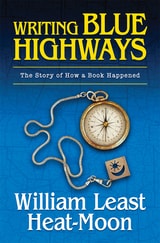
Writing BLUE HIGHWAYS
The Story of How a Book HappenedWillliam Least Heat-Moon
University of Missouri Press, 2023
Winner, Distinguished Literary Achievement, Missouri Humanities Council, 2015
The story behind the writing of the best-selling Blue Highways is as fascinating as the epic trip itself. More than thirty years after his 14,000-mile, 38-state journey, William Least Heat-Moon reflects on the four years he spent capturing the lessons of the road trip on paper—the stops and starts in his composition process, the numerous drafts and painstaking revisions, the depressing string of rejections by publishers, the strains on his personal relationships, and many other aspects of the toil that went into writing his first book. Along the way, he traces the hard lessons learned and offers guidance to aspiring and experienced writers alike. Far from being a technical manual, Writing Blue Highways: The Story of How a Book Happenedis an adventure story of its own, a journey of “exploration into the myriad routes of heart and mind that led to the making of a book from the first sorry and now vanished paragraph to the last words that came not from a graphite pencil but from a letterpress in Tennessee.”
Readers will not find a collection of abstract formulations and rules for writing; rather, this book gracefully incorporates examples from Heat-Moon’s own experience. As he explains, “This story might be termed an inadvertent autobiography written not by the traveler who took Ghost Dancing in 1978 over the byroads of America but by a man only listening to him. That blue-roadman hasn’t been seen in more than a third of a century, and over the last many weeks as I sketched in these pages, I’ve regretted his inevitable departure.” Filtered as the struggles of the “blue-roadman” are through the awareness of someone more than thirty years older with a half dozen subsequent books to his credit, the story of how his first book “happened” is all the more resonant for readers who may not themselves be writers but who are interested in the tricky balance of intuitive creation and self-discipline required for any artistic endeavor.
Writing Center Administrators as Campus Leaders
Candis Bond
Utah State University Press, 2026
Writing Center Administrators as Campus Leaders challenges the current erasure of the WCA role within discourse on campus leadership by highlighting the various ways these leaders have had transformative impacts on their institutions, emphasizing the wide range of knowledge, skills, and added value that WCAs bring to the university ecosystem.
Contributors from diverse institutions, institutional contexts, identity formations, and career paths theorize different forms of leadership from within and beyond writing centers. The first section brings together perspectives on leadership theory and practice, focusing on the practical gains offered and challenges afforded via writing center professional pathways. The second section emphasizes partnerships and networks forged through intentional and creative leadership models. In the final section, contributors consider the emotional and affective dimensions of WCA labor, offering multiple roadmaps for WCAs to transition their experiences into more recognition, resources, and broader administrative roles while underscoring the potential of inclusive, community-focused leadership for current and aspiring WCAs.
Providing key insights and practical examples, Writing Center Administrators as Campus Leaders validates and inspires current and future WCAs and informs university administrators on the ways that WCAs can and do impact higher education as true campus leaders.
Writing Centers and Learning Commons
Staying Centered While Sharing Common GroundSteven J. Corbett
Utah State University Press, 2022
The chapters comprehensively examine the ways writing centers make the most of sharing common ground. Directors, coordinators, administrators, and stakeholders draw on past and present attention to writing center studies to help shape the future of the learning commons and narrate their substantial collective experience with collaborative efforts to stay centered while empowering colleagues and student writers at their institutions. The contributors explore what is gained and lost by affiliating writing centers with learning commons, how to create sound pedagogical foundations that include writing center philosophies, how writing center practices evolved or have been altered by learning center affiliations, and more.
Writing Centers and Learning Commons is for all stakeholders of writing in and across campuses collaborating on (by choice or edict), or wishing to explore the possibilities of, a learning commons enterprise.
Contributors: Alice Batt, Cassandra Book, Charles A. Braman, Elizabeth Busekrus Blackmon, Virginia Crank, Celeste Del Russo, Patricia Egbert, Christopher Giroux, Alexis Hart, Suzanne Julian, Kristen Miller, Robby Nadler, Michele Ostrow, Helen Raica-Klotz, Kathleen Richards, Robyn Rohde, Nathalie Singh-Corcoran, David Stock
Writing Centers and Racial Justice
A Guidebook for Critical PraxisTalisha Haltiwanger Morrison
Utah State University Press, 2023
In five thematically organized sections—Countering Racism and Colonialism in Higher Education; Recruitment, Hiring, and Retention; Tutor Education and Professional Development; Engaging with Campus and Community; and Holding Our Professional Organizations Accountable—scholars from a variety of institutions, both large and small, public and private, present critical reflection and concrete guidance on anti-racist writing center administrative policies and practices. Several chapters include sample materials, such as course syllabi, consultant education activities, and recruitment materials, to help current and aspiring writing center administrators implement changes in their own contexts.
Writing Centers and Racial Justice is the first book to offer clear and actionable advice on how writing centers and their staff can take up racial or social justice work that will result in real sustainable change. Writing center directors, professionals, and tutors, as well as administrators and decision makers at the institutional level, will benefit from this thoughtful and effective text.
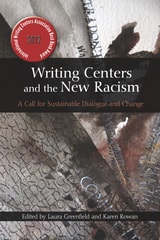
Writing Centers and the New Racism
A Call for Sustainable Dialogue and ChangeLaura Greenfield and Karen Rowan
Utah State University Press, 2011
Laura Greenfield and Karen Rowan have created a rich resource for writing center tutors, administrators, and scholars. Motivated by a scholarly interest in race, literacy, and pedagogy, and by an ethical commitment to antiracism work, contributors address a series of related questions: How does institutionalized racism in American education shape the culture of literacy and language education in the writing center? How does racism operate in the discourses of writing center scholarship and lore, and in what ways are writing centers unwittingly complicit in racist practices? How can they meaningfully operationalize antiracist work? How do they persevere through the difficulty and messiness of negotiating race and racism in their daily practice?
The conscientious, nuanced attention to race in Writing Centers and the New Racism is meant to model what it means to be bold in engagement with these hard questions and to spur the kind of sustained, productive, multivocal, and challenging dialogue that, with a few important exceptions, has been absent from the field.
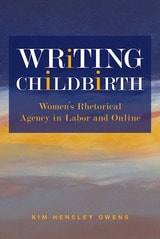
Writing Childbirth
Women’s Rhetorical Agency in Labor and OnlineKim Hensley Owens
Southern Illinois University Press, 2015
Women seeking to express concerns about childbirth or to challenge institutionalized medicine by writing online birth plans or birth stories exercise rhetorical agency in undeniably feminist ways. In Writing Childbirth: Women’s Rhetorical Agency in Labor and Online, author Kim Hensley Owens explores how women create and use everyday rhetorics in planning for, experiencing, and writing about childbirth.
Drawing on medical texts, popular advice books, and online birth plans and birth stories, as well as the results of a childbirth writing survey, Owens considers how women’s agency in childbirth is sanctioned, and how it is not. She examines how women’s rhetorical choices in writing interact with institutionalized medicine and societal norms. Writing Childbirth reveals the contradictory messages women receive about childbirth, their conflicting expectations about it, and how writing and technology contribute to and reconcile these messages and expectations.
Demonstrating the value of extending rhetorical investigations of health and medicine beyond patient-physician interactions and the discourse of physicians, Writing Childbirth offers fresh insight into feminist rhetorical agency and technology and expands our understanding of the rhetorics of health and medicine.
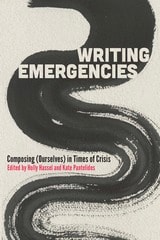
Writing Emergencies
Composing (Ourselves) in Times of CrisisHolly Hassel
Utah State University Press, 2026
Despite the adage “there are no writing emergencies,” at times situations invite or require immediate written response. In a modern era of social media and with the constancy of “crisis,” knowing when, how, and why to respond quickly is increasingly important. In Writing Emergencies, a diverse group of authors contribute scholarly, narrative-based discussions of writing emergencies, descriptions of more and less successful strategies, and a reflective conclusion that offers implications for writing studies praxis and theory.
In this collection, contributors demonstrate the reality of writing emergencies—in their own writing lives, classrooms, and programs—and they offer both self- and community-focused approaches for response. Chapters focus on discernment and prioritization, recognizing that all stressors are not necessarily emergencies. Instead, expanding our vocabulary for (and subsequent understanding) of the kinds of difficulties we come across can build our professional capacity and support greater career sustainability. The volume also illustrates the role of coalitions in navigating writing emergencies and how purposefully building and activating these coalitions subverts some challenges before they become emergencies, particularly those that are recurrent or manufactured.
Writing Emergencies both names and grapples with writing emergencies and offers insights for capacity-building in the acts of filtering and prioritizing competing urgent demands. The findings are meaningful for all leaders, students, and teachers who center care in their relationships with others.
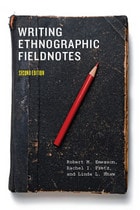
Writing Ethnographic Fieldnotes, Second Edition
Robert M. Emerson, Rachel I. Fretz, and Linda L. Shaw
University of Chicago Press, 2011
Writing Expertise
A Research-Based Approach to Writing and Learning Across DisciplinesLinda Adler-Kassner
University Press of Colorado, 2023
In Writing Expertise, Linda Adler-Kassner and Elizabeth Wardle address the question, “How can instructors across disciplines best help students write well?” Drawing on research about how disciplines use writing to engage in shared ways of thinking, practicing, and demonstrating knowledge, the authors offer an approach that helps faculty across the disciplines invite students to bring new ideas and identities to their work. Throughout the book, Adler-Kassner and Wardle help instructors explore what it means to write well in their courses, fields, or disciplines and offer strategies and activities that can help them improve their assignments by infusing research-based writing activities into their courses.
Writing Expertise provides an innovative, equity- and research-based approach to writing in the disciplines that will enrich instructor and student thinking. Thoughtful discussions and well-designed activities provide the support needed to help instructors put disciplinary thinking into written form, develop systematic aways of learning about the students who write in their courses, and ultimately develop more effective, inclusive courses.
Writing Fiction for Children
STORIES ONLY YOU CAN TELLJudy K. Morris
University of Illinois Press, 2001
A published author of both fiction and nonfiction for children, Morris draws on extensive experience teaching children how to write and teaching adults how to write for children. Here she combines concrete methods and step-by-step techniques with succinct rules of thumb: work at making your novel whole from the start; never underestimate the power of the plain truth; personality quirks are no substitute for character; doing a good job of writing usually means doing a good job of rewriting.
Using judiciously chosen examples from successful children's literature, Writing Fiction for Children covers the building blocks of plot, characters, and setting and addresses common problems such as awkward plotting, oversimplifying, and taking a preachy or self-conscious tone. Pragmatic exercises stimulate writers to scour their experiences, sharpen their powers of observation, and capture the details, voice, and narrative energy that can bring stories vividly to life and keep readers submerged in make-believe. Loaded with practical advice and helpful exercises, Writing Fiction for Children is especially useful for anyone who aspires to write for children in the "middle ages" of eight to twelve.
Children's books should be hopeful, thrilling, funny, interesting, touching, and a pleasure to read, Morris says. Above all, they must have something at stake that matters. While conceding that only the author can provide the spark of a story to tell, Morris offers invaluable guidance on the daily work of crafting, shaping, refining, revising, and publishing a children's novel.
Writing Fiction, Tenth Edition
A Guide to Narrative CraftJanet Burroway, with Elizabeth Stuckey-French, and Ned Stuckey-French
University of Chicago Press, 2019
A creative writer’s shelf should hold at least three essential books: a dictionary, a style guide, and Writing Fiction. Janet Burroway’s best-selling classic is the most widely used creative writing text in America, and for more than three decades it has helped hundreds of thousands of students learn the craft. Now in its tenth edition, Writing Fiction is more accessible than ever for writers of all levels—inside or outside the classroom.
This new edition continues to provide advice that is practical, comprehensive, and flexible. Burroway’s tone is personal and nonprescriptive, welcoming learning writers into the community of practiced storytellers. Moving from freewriting to final revision, the book addresses “showing not telling,” characterization, dialogue, atmosphere, plot, imagery, and point of view. It includes new topics and writing prompts, and each chapter now ends with a list of recommended readings that exemplify the craft elements discussed, allowing for further study. And the examples and quotations throughout the book feature a wide and diverse range of today’s best and best-known creators of both novels and short stories.
This book is a master class in creative writing that also calls on us to renew our love of storytelling and celebrate the skill of writing well. There is a very good chance that one of your favorite authors learned the craft with Writing Fiction. And who knows what future favorite will get her start reading this edition?
Writing Genres
Amy J. Devitt
Southern Illinois University Press, 2008
In Writing Genres, Amy J. Devitt examines genre from rhetorical, social, linguistic, professional, and historical perspectives and explores genre's educational uses, making this volume the most comprehensive view of genre theory today.
Writing Genres does not limit itself to literary genres or to ideas of genres as formal conventions but additionally provides a theoretical definition of genre as rhetorical, dynamic, and flexible, which allows scholars to examine the role of genres in academic, professional, and social communities.
Writing Genres demonstrates how genres function within their communities rhetorically and socially, how they develop out of their contexts historically, how genres relate to other types of norms and standards in language, and how genres nonetheless enable creativity. Devitt also advocates a critical genre pedagogy based on these ideas and provides a rationale for first-year writing classes grounded in teaching antecedent genres.
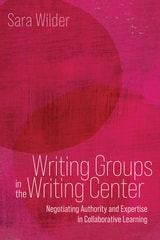
Writing Groups in the Writing Center
Negotiating Authority and Expertise in Collaborative LearningSara Wilder
Utah State University Press, 2025
As many higher education institutions strive to create spaces and systems that increase equity, accessibility, and diversity, they recognize the need for improved mentorship across academic levels. This book analyzes the significant benefits as well as the challenges faced by writing groups in providing such support. Wilder presents a nuanced account of how facilitators scaffold group practice, how members use and build genre knowledge across disciplines, and how institutional contexts shape emotional labor requirements.
For educators and tutors, the book provides an in-depth examination of the facilitator role, describing essential logistical, emotional, and intellectual practices, and addresses common conflicts and challenges. Administrators can find valuable material for training tutor-facilitators and frameworks for conceptualizing writing group functions on campus. For researchers, the book extends scholarship on writing groups, writing transfer, and collaborative learning, bridging writing center and broader writing studies research.
In an era of concern about generative AI’s role in writing education, Writing Groups in the Writing Center extends research on group facilitation, collaborative learning, and authority negotiation in writing center communities of practice and emphasizes the human connections that make collaborative writing meaningful and valuable for student writers.
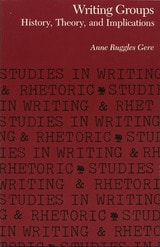
Writing Groups
History, Theory, and ImplicationsAnne Ruggles Gere
Southern Illinois University Press, 1987
Drawing upon previously unpublished archival materials as well as historical accounts, Gere traces the history of writing groups in America, from their origins over a century ago to their recent reappearance in the works of Macrorie, Elbow, Murray, and others.
From this historical perspective Gere examines the theoretical foundations of writing groups, challenging the traditional concept of writing as an individual performance. She offers instead a broader view of authorship that includes both individual and social dimensions, with implications not only for the teaching of composition but also for theories of rhetoric and literacy.
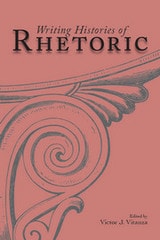
Writing Histories of Rhetoric
Edited by Victor J. Vitanza
Southern Illinois University Press, 1994
This collection of essays, edited by Victor J. Vitanza, is a historiography of rhetoric, summarizing what has recently been accomplished in the revision of traditional histories of rhetoric and discussing what might be accomplished in the future. Featuring a variety of approaches—classical, revisionary, and avant-garde—it includes articles by Janet M. Atwill, James A. Berlin, William A. Covino, Sharon Crowley, Hans Kellner, John Poulakos, Takis Poulakos, John Schilb, Jane Sutton, Kathleen Ethel Welch, Lynn Worsham, and Victor J. Vitanza.
In the first essay, Sharon Crowley identifies the major players and primary issues in a chronological narrative of the debate about the writing of the history of rhetoric that has arisen between traditionalists / essentialists and revisionists/constructionists. In recent years, traditionalists have demanded a more complete and accurate history, while revisionists have sought a critical understanding of the various epistemological-ideological grounds upon which a history of rhetoric had been and could be constructed. Revisionists, in their search for multiple, contestatory histories, have begun to critique one another, breaking into two general groups: one favoring a political-social program, the other resisting and disrupting such an approach.
Vitanza echoes Crowley’s review of this ongoing debate by asking a crucial question: What exactly does it mean to be a revisionist historian? By combining the disintegration of various revisionist and subversive positions into a communal "we," he asks an additional question: Who is the "we" writing histories of rhetoric?
The essays that follow give a rich answer to Vitanza’s questions. They bring the writing of histories of rhetoric into the larger area of postmodern theory, raising neglected issues of race, gender, and class. Written with a variety of intentions, some of the essays are expository and highly argumentative while others are manifestos, innovative and far-reaching in tone. Still others are summaries and background studies, providing useful information to both the novice student and the experienced scholar.
This book, situated at a juncture between two disciplines, composition studies and speech, will be a landmark collection for many years.
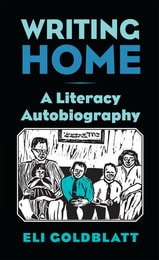
Writing Home
A Literacy AutobiographyEli Goldblatt
Southern Illinois University Press, 2012
Writing Instruction in Nineteenth-Century American Colleges
James A. Berlin. Foreword by Donald C. Stuart
Southern Illinois University Press, 1984
Defining a rhetoric as a social invention arising out of a particular time, place, and set of circumstances, Berlin notes that “no rhetoric—not Plato’s or Aristotle’s or Quintilian’s or Perelman’s—is permanent.” At any given time several rhetorics vie for supremacy, with each attracting adherents representing various views of reality expressed through a rhetoric.
Traditionally rhetoric has been seen as based on four interacting elements: “reality, writer or speaker, audience, and language.” As emphasis shifts from one element to another, or as the interaction between elements changes, or as the definitions of the elements change, rhetoric changes. This alters prevailing views on such important questions as what is appearance, what is reality.
In this interpretive study Berlin classifies the three 19th-century rhetorics as classical, psychological-epistemological, and romantic, a uniquely American development growing out of the transcendental movement. In each case studying the rhetoric provides insight into society and the beliefs of the people.
Writing Majors
Eighteen Program ProfilesGreg Giberson
Utah State University Press, 2015
The writing major is among the most exciting scenes in the evolving American university. Writing Majors is a collection of firsthand descriptions of the origins, growth, and transformations of eighteen different programs. The chapters provide useful administrative insight, benchmark information, and even inspiration for new curricular configurations from a range of institutions.
A practical sourcebook for those who are building, revising, or administering their own writing majors , this volume also serves as a historical archive of a particular instance of growth and transformation in American higher education. Revealing bureaucratic, practical, and institutional matters as well as academic ideals and ideologies, each profile includes sections providing a detailed program review and rationale, an implementation narrative, and reflection and prospection about the program.
Documenting eighteen stories of writing major programs in various stages of formation, preservation, and reform and exposing the contingencies of their local and material constitution, Writing Majors speaks as much to the “how to” of building writing major programs as to the larger “what,” “why,” and “how” of institutional growth and change.
Writing Maternity
Medicine, Anxiety, Rhetoric, and GenreDara Rossman Regaignon
The Ohio State University Press, 2021
Writing New Media
Theory and Applications for Expanding the Teaching of CompositionAnne Frances Wysocki, Johndan Johnson-Eilola, Cynthia L. Selfe, & Geoffrey Sirc
Utah State University Press, 2004
As new media mature, the changes they bring to writing in college are many and suggest implications not only for the tools of writing, but also for the contexts, personae, and conventions of writing. An especially visible change has been the increase of visual elements-from typographic flexibility to the easy use and manipulation of color and images. Another would be in the scenes of writing-web sites, presentation "slides," email, online conferencing and coursework, even help files, all reflect non-traditional venues that new media have brought to writing. By one logic, we must reconsider traditional views even of what counts as writing; a database, for example, could be a new form of written work.
The authors of Writing New Media bring these ideas and the changes they imply for writing instruction to the audience of rhetoric/composition scholars. Their aim is to expand the college writing teacher's understanding of new media and to help teachers prepare students to write effectively with new media beyond the classroom. Each chapter in the volume includes a lengthy discussion of rhetorical and technological background, and then follows with classroom-tested assignments from the authors' own teaching.
Writing Opportunities
Writing, Learning, and Rightful Presence in College TransitionsBrad Jacobson
Utah State University Press, 2026
Writing Opportunities presents in-depth text histories illustrating the interrelationship of writing, identities, and belonging in college writing transitions. Drawing on more than two years of research with three Latinx/a/o students transitioning from the same high school class to the local university, Brad Jacobson brings together analyses of interview transcripts, student writing, classroom genres, and institutional policies to foreground a sense of belonging as central to writing development and learning.
Including interviews with students and their instructors, Jacobson traces writing opportunities that Hercules, Jain, and Lucy were afforded as they transitioned from high school to college writing, particularly in general education courses. Chapters attend to multiple levels of interaction to show how policies, practices, and social histories can impact opportunities for learning. With attention to dominant discourses of writing that narrow what counts as good writing as well as positive opportunity structures that extend possibilities for identification, engagement, and deep learning, Jacobson also posits writing as an opportunity for writers to explore possibilities for who we are and who we may become.
Jacobson’s humanizing research invites readers to consider opportunity from multiple perspectives and shows how subtle shifts in relationships among students, instructors, and institutions can increase meaningful learning and provide a sense of belonging in educational contexts.
Writing Pathways to Student Success
Lillian Craton
University Press of Colorado, 2017
Teachers of first-year composition courses do essential work. Teaching argumentation and conventions of university-level writing; demystifying citation and punctuation; promoting reading comprehension and analysis. Yet such skills, as important as they are, do not reflect the full scope of our discipline. Some of the best learning in composition coursework relates to students' growth as successful individuals able to live and write in a complex world. Composition instructors demand civil discourse and respect for diversity. They coach students in time management and the creative process. They build up confidence, break down learning obstacles, and promote self-examination. The essays found in Writing Pathways for Student Success, written by and for instructors of college writing, examine life lessons that both students and instructors learn from first-year composition courses.
Contributors: Lori Brown, Kathryn Crowther, Casie Fedukovich, Rachel Anya Fomalhaut, Lynée Lewis Gaillet, Christopher Garland, Ruth A. Goldfine, Pamela Henney, Rachel McCoppin, Deborah Mixson-Brookshire, Karen Bishop Morris, Sarah O’Connor, Abigail G. Scheg, Lisa Whalen
Writing Performance
Poeticizing the Researcher's BodyRonald J. Pelias
Southern Illinois University Press, 1999
Ronald J. Pelias is concerned with writing about performance, from the everyday performative routines to the texts on stage. He seeks to write performatively, to offer poetic or aesthetic renderings of performance events in order to capture some sense of their nature. In his quest for the spirit of theatrical performances, Pelias asks more of the written word than the word can deliver. Yet the attempt is both desirable—and necessary. To discuss performance without some accounting for its essence as art, he asserts, is at best misleading, at worst, fraud.
Pelias divides his efforts to present performance events into three general categories: "Performing Every Day," "On Writing and Performing," and "Being a Witness." "Performing Every Day" focuses on performances ranging from the daily business of enacting roles to the telling of tales that make life meaningful. It incorporates essays about the ongoing process of presenting oneself in everyday life; the gender script that insists that men enact manly performances; the classroom performances of teachers and students; stories of gender, class, and race that mark identity; and a performance installation entitled "A Day’s Talk."
"On Writing and Performing" examines the written script and performance practices. It includes a description of a struggle between a writer and a performer as they protect their own interests; an intimate look at an apprehensive performer; a short play entitled "The Audition"; and a chronicle of performance process from the perspective of an actor.
"Being a Witness" examines performance from the perspective of the audience and the director: being an audience member; viewing theatre in the context of New York City; directing and being directed by actors’ bodies; and watching The DEF Comedy Jam.
Writing Philosophy
A Guide to Professional Writing and PublishingRichard A. Watson
Southern Illinois University Press, 1992
Richard A. ("Red") Watson has published fiction, general nonfiction, and scholarly books. His essay "On the Zeedijk," about Descartes in Holland and first published in The Georgia Review, was the lead essay in The Pushcart Prize XV, 1990–1991: Best of the Small Presses. Red knows writing.
He also knows academe and has written Writing Philosophy as a kind of survival manual for undergraduates, graduate students, and junior faculty members in philosophy. Also helpful to those in the humanities and the social sciences, the book is a guide to the professional writing and publishing that are essential to an active participation in the conversation and discussion that constitute these professional fields. To the extent that publication is the crucial factor in tenure decisions, it will help the beginning scholar meet tenure criteria.
Despite the importance of the oral tradition in philosophy and the influence of the dialogue, many philosophical points are so intricate and complex that they can be advanced, followed, and criticized only if they are written as stepwise arguments for study and contemplation at length and at leisure. Watson provides a set of basic principles and a plan for writing argumentative papers of 1,500 to 15,000 words (3 to 30 printed pages) and books containing a sequence of sustained arguments of 70,000 to 150,000 words (200 to 300 printed pages).
Because the first book of most professional philosophers is a revised dissertation, Watson presents a plan for writing that dissertation in such a way that its chapters will serve as publishable articles and the dissertation itself will need very little rewriting as a book. His discussion of the principles of reason, clarity, and argument ranges from such topics as dangling participles and the proper usage of ellipses to matters of categorization and univocity.
Writing Placement in Two-Year Colleges
The Pursuit of Equity in Postsecondary EducationJessica Nastal
University Press of Colorado, 2023