Results by title
3785 books match the query 'Poetry' and 184 start with w

Wordplay for Kids
A Sourcebook of Poems, Rhymes, and Read-AloudsTim Wadham
American Library Association, 2015
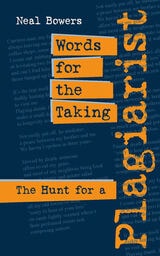
Words for the Taking
The Hunt for a PlagiaristNeal Bowers
Southern Illinois University Press, 2007
In January 1992, poet Neal Bowers received a phone call that changed his life. He learned his poems had been stolen and published under another name. Bowers hired a copyright lawyer and a private detective, and they began the agonizing hunt to track down the person who stole his creative work.
Bowers was dealing with more than the theft of words. He uncovered the plagiarist’s unsavory past when he found convicted child molester David Jones, who published the poems using the name David Sumner.
Determined to hold the plagiarist accountable, Bowers is drawn into a bizarre game of catch-me-if-you-can. His odyssey introduces him to the legal system and a sympathetic female detective, reveals the reactions of fellow poets, and provokes a flood of nationwide publicity and a deluge of letters from strangers interested in the case. Letters from Bowers’s attorney to Jones and phone conversations between the two produce unsatisfactory results. In the end, the plagiarist is not punished, and Bowers deals with the loss of friends, derision from his colleagues, and trouble in his marriage.
Words for the Taking: The Hunt for a Plagiarist, first published in 1997, is as much a commentary on our cultural view of plagiarism as it is a real-life detective story. Bowers’s wry and disturbing account of being the victim of a serial plagiarist offers unexpected twists and startling revelations. This updated edition presents a final consideration of the bizarre case and remains the only book to offer a personal account of the effects of plagiarism.
Ten years after the original publication, Neal Bowers finds his life as a writer altered in ways he could never have foreseen. His responses to the series of events show his vulnerability as an artist and his adjustment to being a victim. In a new chapter, Bowers describes his renewed quest in 2006 for a resolution and explains why he chose to give up writing poetry.
This beautifully written case study about the discovery and attempted resolution of an intellectual crime will appeal to academicians and general readers alike who care about language, the state of poetry, and intellectual property in contemporary America.
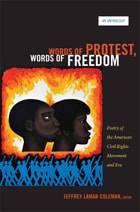
Words of Protest, Words of Freedom
Poetry of the American Civil Rights Movement and EraJeffrey Lamar Coleman, ed.
Duke University Press, 2012
Some of the poems address crucial movement-related events—such as the integration of the Little Rock schools, the murders of Emmett Till and Medgar Evers, the emergence of the Black Panther party, and the race riots of the late 1960s—and key figures, including Martin Luther King Jr., Malcolm X, and John and Robert Kennedy. Other poems speak more broadly to the social and political climate of the times. Along with Jeffrey Lamar Coleman's headnotes, the poems recall the heartbreaking and jubilant moments of a tumultuous era. Altogether, more than 150 poems by approximately 100 poets showcase the breadth of the genre of civil rights poetry.
Selected contributors. Maya Angelou, W. H. Auden, Amiri Baraka, Gwendolyn Brooks, Lucille Clifton Lawrence Ferlinghetti, Allen Ginsberg, Langston Hughes, June Jordan, Philip Levine, Audre Lorde, Robert Lowell, Pauli Murray, Huey P. Newton, Adrienne Rich, Sonia Sanchez, Léopold Sédar Senghor, Derek Walcott, Alice Walker, Yevgeny Yevtushenko
Words to Create a World
Daniel Hoffman
University of Michigan Press, 1993
Between these are discussions of books by and about founding modernists (Pound, Moore, Sitwell, Frost, Graves, Auden) who do not “succumb to the imitative fallacy and gibber at the window because the house is on fire.” Hoffman’s historical imagination elucidates the work of many other contemporary American and British poets, including his own. Words to Create a World will appeal to the reader who enjoys poetry and who hopes for guidance over the sprawling terrain of verse in the twentieth century.
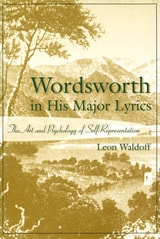
Wordsworth in His Major Lyrics
The Art and Psychology of Self-RepresentationLeon Waldoff
University of Missouri Press, 2001
Wordsworth in His Major Lyrics explores the identity, role, and subjectivity of the speaker in Wordsworth's finest and best-known longer lyrics—"Tintern Abbey," "Resolution and Independence," "Ode: Intimations of Immortality," and "Elegiac Stanzas." Because Wordsworth is the most autobiographical poet of the Romantic period, and perhaps in the English language, readers naturally take the speaker to be the poet himself or, as Wordsworth says in his prefaces and essays, "the poet in his own person."
Some readers allow for a fictional dimension in the characterization of the speaker and refer to him as a persona; others treat him as a biographical self, defined in literary, political, historical, or cultural terms. Leon Waldoff examines the critical issues posed by these different understandings of the speaker's identity and argues for a conception of Wordsworth's lyrical "I" that deals with the dramatic and psychological complexities of the speaker's act of self-representation.
Taking concepts from Freud and Winnicott, this book presents a psychoanalytic model for defining the speaker and conceptualizing his subjectivity. Waldoff suggests that the lyrical "I" in each poem is a transitional self of the poet. The poem offers, in the suspended moment and cultural space of lyrical form, a self-dramatization in which the speaker attempts to act out, in the sense of both performing and attempting to achieve, a reconstitution and transformation of the self.
In a series of close readings that provide formalistic and psychological analysis, the book shows that the major lyrics contain compelling evidence that Wordsworth devoted much of his poetic art to each speaker's act of self-dramatization. The various strategies that each speaker employs and the self- dramatizing character of his utterance are theorized and assimilated into an understanding of the subjectivity he represents.
Waldoff concludes that Wordsworth's lyrical "I" requires a conception of subjectivity that gives greater recognition to its individual, psychological dimensions and to the art of self-representation in each poem than recent Wordsworth criticism has provided. This important new work will be appreciated by anyone interested in Wordsworth or in Romantic poetry.
Wordsworth's Second Nature
A Study of the Poetry and PoliticsJames Chandler
University of Chicago Press, 1984
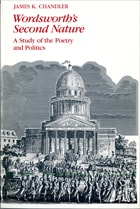
Central to the discussion, which restores Wordsworth to both the French and English contexts in which he matured, is a consideration of his relation to Rousseau and Burke. Chandler maintains that by the time Wordsworth set forth his "program for poetry" in 1798, he had turned away from the Rousseauist idea of nature that had informed his early republican writings. He had already become a poet of what Burke called "second nature"–human nature cultivated by custom, habit, and tradition–and an opponent of the quest for first principles that his friend Coleridge could not forsake. In his analysis of the poetry, Chandler suggests that even Wordsworth's most apparently private moments, the lyrical "spots of time," ideologically embodied the uncalculated habits of an oral narrative discipline and a native English mind.
Work Done Right
David Dominguez
University of Arizona Press, 2003
I pulled into Galdini Sausage at noon.
The workers walked out of production
and swatted away the flies desperate for pork.
Pork gripped the men and was everywhere,
in the form of blood, in the form of fat,
and in pink meat that stuck to the workers' shoes.
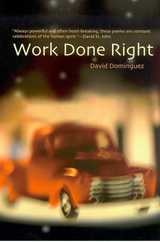
Work Done Right is a sequence of narrative poems, told with a lyricist's tenderness and an eye for detail, that address the human condition in unexpected ways. David Dominguez explores Abraham's struggle to maintain personal dignity in harsh circumstances, juxtaposing bleak images of the sausage factory with the hope of finding one's true place in the world. Through his sensuously textured words, he pays tribute to people and place as he takes readers on a mystic journey toward redemption.

Working Classics
POEMS ON INDUSTRIAL LIFEEdited by Peter Oresick and Nicholas Coles
University of Illinois Press, 1990
anthology of poems captures the drama of work and working-class life in
industrial America. It speaks of rolling mills, mine shafts, and foundries,
and of a people who dig coal, tap blast furnaces, sew shirts, clean fish,
and assemble cars. These subjects, though largely absent from literary
anthologies and textbooks, are increasingly evident in the work of contemporary
poets. Working Classics gathers the best and most representative
of these poems, American and Canadian, from 1945 to the present.
Included are poems by Antler, Robert Bly, Lorna Dee Cervantes, Jim Daniels,
Patricia Dobler, Stephen Dunn, Tess Gallagher, Edward Hirsch, David Ignatow,
June Jordan, Lawrence Joseph, Philip Levine, Chris Llewellyn, Joyce Carol
Oates, Anthony Petrosky, Michael Ryan, Gary Soto, Tom Wayman, James Wright,
and many others. The result is a diverse and evocative collection of 169
poems by 74 poets, nearly a third of them women.
Working Time
Essays on Poetry, Culture, and TravelJane Miller
University of Michigan Press, 1992
The essays consider notions of time, duration, narrative, documentary, and history in American poetry, and view poetry in the light of developments in feminism, postmodern theory, and contemporary poetic practice. In addition to poetry, Miller investigates a range of cultural products and art forms, including film, video, photography, painting, sculpture, music, and the Madonna phenomenon.
Works of Hesiod and the Homeric Hymns
Including Theogony and Works and DaysEdited by Daryl Hine
University of Chicago Press, 2004
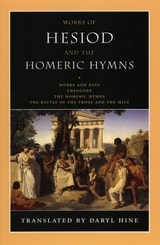
In Works of Hesiod and the Homeric Hymns, highly acclaimed poet and translator Daryl Hine brings to life the words of Hesiod and the world of Archaic Greece. While most available versions of these early Greek writings are rendered in prose, Hine's illuminating translations represent these early classics as they originally appeared, in verse. Since prose was not invented as a literary medium until well after Hesiod's time, presenting these works as poems more closely approximates not only the mechanics but also the melody of the originals.
This volume includes Hesiod's Works and Days and Theogony, two of the oldest non-Homeric poems to survive from antiquity. Works and Days is in part a farmer's almanac—filled with cautionary tales and advice for managing harvests and maintaining a good work ethic—and Theogony is the earliest comprehensive account of classical mythology—including the names and genealogies of the gods (and giants and monsters) of Olympus, the sea, and the underworld. Hine brings out Hesiod's unmistakable personality; Hesiod's tales of his escapades and his gritty and persuasive voice not only give us a sense of the author's own character but also offer up a rare glimpse of the everyday life of ordinary people in the eighth century BCE.
In contrast, the Homeric Hymns are more distant in that they depict aristocratic life in a polished tone that reveals nothing of the narrators' personalities. These hymns (so named because they address the deities in short invocations at the beginning and end of each) are some of the earliest examples of epyllia, or short stories in the epic manner in Greek.
This volume unites Hine's skillful translations of the Works of Hesiod and the Homeric Hymns—along with Hine's rendering of the mock-Homeric epic The Battle of the Frogs and the Mice—in a stunning pairing of these masterful classics.
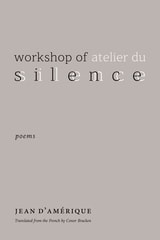
Workshop of Silence
PoemsJean D’Amérique; Translated from French by Conor Bracken
Vanderbilt University Press, 2025
Though D’Amérique’s poems grow out of soils strewn with stones and splotched with blood, they also grow out of play, one of the more daring and dangerous modes there is (“being happy is worth the price” he says in “worth the price”). Produced in a bilingual edition, with a side-by-side translation by Conor Bracken as well as a critical introduction, Workshop of Silence preserves and approximates this spirit of play and scrutiny so that the sound of the translation bears as much semantic heft as the signifying content of the words. This leads, oftentimes, to choices that may seem odd or tangential, but ultimately highlight D’Amérique’s experimentation with the French language in and on poetic form—the puns, the intricate play of assonance and consonance, the rhymes and kennings, the lineation and inversions. These all serve to recalibrate a reader’s relationship with the language he is writing in, one that has been used for centuries to subjugate people throughout the Global South. The more we recognize language as a mighty and strange substance that can be manipulated to do weird things and to effect arbitrary outcomes, the more we can both revel in its potential and question what it has led us to take for granted.
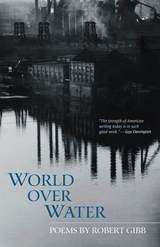
World Over Water
PoemsRobert Gibb
University of Arkansas Press, 2007
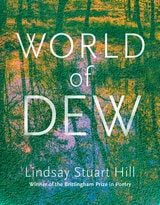
World of Dew
Lindsay Stuart Hill
University of Wisconsin Press, 2025
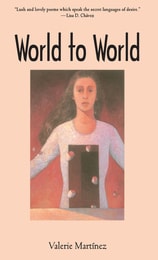
World to World
Valerie Martínez
University of Arizona Press, 2004
Martínez explores the dynamic of creation/dissolution in original and intriguing ways. Here are the strange and provocative landscapes of the body and its disappearance . . . of matter and the absence of matter . . . of what is formed and what is falling from form. Throughout this compelling cycle, her deft manipulations of poetic structure disclose the boundaries where flesh, matter, and language become spirit, space, and "cataractical brilliance."
In charting the relationships between time, form, body, language, and emptiness, World to World maps the territories where the visible and the invisible meet, offering unexpected discoveries for discerning readers.
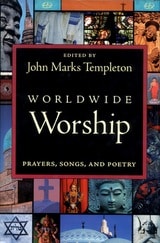
Worldwide Worship
Prayers Song & PoetryJohn Marks Templeton
Templeton Press, 2000
Drawn from classical and religious texts, as well as the work of poets and other artists, Worldwide Worship is a unique celebration of worship found in many religious traditions. These selections have been chosen singularly and as a group by John Marks Templeton, not only for their individual aesthetic beauty, but also to assist us in learning various lessons of life.
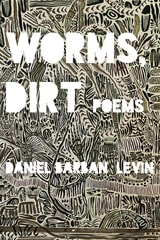
Worms, Dirt
Daniel Barban Levin
Four Way Books, 2026
“The / drugs, the page, none of it is here. That was years ago,” Daniel Barban Levin writes in his debut collection of poems, trying to create an inventory of blank spaces, to describe the persistent presence — the psychological furniture — of what no longer exists. “There was a room. I lived there. / Now, I can’t find it anymore.”
Written in the wake of the media storm surrounding the revelation of the Sarah Lawrence cult, interrogating the constructs of confessionalism and journalistic epistemology after the release of memoirs and viral articles and a Hulu docu-series, Worms, Dirt considers the soil beneath the story playing out aboveground. These poems are a unique telling of two kinds of departure – leaving a cult and exiting a relationship. They weave together fragments and elisions of memory — “Was any of it right? Did any of it happen the way / You remembered?” — reverse engineering a story from the aftermath — “The piece you still can’t find. It must be true. He was // Gentle. Sometimes, he was gentle.” Devastating and open-hearted, these pages transcribe transformation and reconstruction of self, survival, reckoning. They confront the intimate betrayals of belonging to a high-control group or seeking love from the wrong romantic relationships. These lyrics confront horror and a fragile hope in their recognition of this inconceivable thing, the soft flesh smothered by the scar: “The hands’ capacity / For gentleness even as you watched them, in disbelief, dismantle you.”
Traversing New York and New Hampshire and landing in Los Angeles, Levin treats the things we leave behind as the material from which we grow. Most striking about Worms, Dirt is its lyrical metacommentary — as a book about writing a book, it constantly refuses the constraints of the imposed narrative memoir and the parasitic appetite for sensationalism, easily commodified true crime, and flattening characterizations of victims and villains. “For I am at work, writing this / For I have accrued so many reasons to live.”
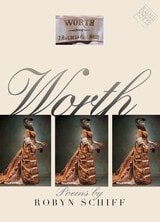
Worth
Robyn Schiff
University of Iowa Press, 2002
In Worth Robyn Schiff inquires about making, buying, selling, and stealing in the material world, the natural landscape, and the human soul. Opening with the renowned couture house of Charles Frederick Worth, the father of high fashion— “The dress was so big, / one's hand is useless to take glass from table; / the skirt approaches while the hand is yet distanced” —and ending with the House of De Beers and a diamond thief named Adam Worth— “You'll know me by my approach / I'm coming on foot with a diamond in my mouth” —Schiff moves from Cartier and Tiffany to the Shedd Aquarium, from Marie Antoinette to the Civil War, from Mary Pickford to Marilyn Monroe.
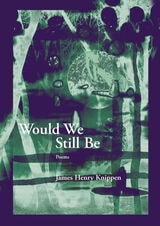
Would We Still Be
James Henry Knippen
New Issues Poetry and Prose, 2021
In Would We Still Be, James Henry Knippen crafts the anxieties that emanate from human existence—grief, fear, hopelessness, uncertainty—into poetic reflections that express a deep reverence for the musicality and incantational capacity of language. Like a moon or a wren, two of the book’s obsessions, these haunting poems call us to consider beauty’s connection to the transitory. Among the ghosts that wander these pages—those of loved ones, those we are, and those we will become—Knippen asks if image is enough, if sound is enough, if faith is enough. In doing so, these poems seek out the soul’s communion with voice, encouraging us to sing our fate.
Woven Stone
Simon J. Ortiz
University of Arizona Press, 1992
Going for the Rain (1976) expresses closeness to a specific Native American way of life and its philosophy and is structured in the narrative form of a journey on the road of life. A Good Journey (1977), an evocation of Ortiz's constant awareness of his heritage, draws on the oral tradition of his Pueblo culture. Fight Back: For the Sake of the People, For the Sake of the Land (1980)—revised for this volume—has its origins in his work as a laborer in the uranium industry and is intended as a political observation and statement about that industry's effects on Native American lands and lives.
In an introduction written for this volume, Ortiz tells of his boyhood in Acoma Pueblo, his early love for language, his education, and his exposure to the wider world. He traces his development as a writer, recalling his attraction to the Beats and his growing political awareness, especially a consciousness of his and other people's social struggle.
"Native American writers must have an individual and communally unified commitment to their art and its relationship to their indigenous culture and people," writes Ortiz. "Through our poetry, prose, and other written works that evoke love, respect, and responsibility, Native Americans may be able to help the United States of America to go beyond survival."
Wreading
A Poetics of Awareness, or How Do We Know What We Know?Jed Rasula
University of Alabama Press, 2022
A diverse collection of essays and interviews on reading, teaching, and writing poetry from a preeminent critic and scholar.
Jed Rasula is a distinguished scholar of avant-garde poetics, noted for his erudition, intellectual range, and critical independence. Wreading: A Poetics of Awareness, or How Do We Know What We Know? is a collection of essays and interviews that reflects the breadth and diversity of his curiosity.
While this volume presents highlights from Rasula’s criticism, it also serves as a carefully assembled intellectual autobiography. Wreading consists of two parts: an assortment of Rasula’s solo criticism and selected interviews and conversations with other poets and scholars. These detailed conversations are with Evelyn Reilly, Leonard Schwartz, Tony Tost, Mike Chasar, Joel Bettridge, and Ming-Qian Ma. Their exchanges address ecopoetics, the corporate university, the sheer volume of contemporary poetry, and more. This substantial set of dialogues gives readers a glimpse inside a master critic’s deeply informed critical practice, illuminating his intellectual touchstones.
The balance between essay and interview achieves a distillation of Rasula’s long-established idea of “wreading.” In his original use, the term denotes how any act of criticism inherently adds to the body of writing that it purports to read. In this latest form, Wreading captures a critical perception that sparks insight and imagination, regardless of what it sees.
Writing Like a Woman
Alicia Ostriker
University of Michigan Press, 1983
Writing Not Writing
Poetry, Crisis, and ResponsibilityTom Fisher
University of Iowa Press, 2017
Writing Not Writing both confirms this question into which crisis puts poetry and explores alternative modes of “response” and “responsibility” that poetry makes possible. Reading the silences of Oppen, Carl Rakosi, and Bob Kaufman, the renunciation of Laura Riding, and other more contemporary instances of poetic abnegation, Tom Fisher explores silence, refusal, and disavowal as political and ethical modes of response in a time of continuous crisis. Through a turn away from writing, these poets offer strategies of refusal and departure that leave anagrammatical hollows behind, activating the negational capacities of writing and aesthetics to disrupt the empire of sense, speech, and agency.
Fisher’s work is both an engaging and detailed analysis of four individual poets who left poetry behind and a theoretically provocative exploration of the political and ethical possibilities of silence, not-doing, and disavowal. In lucid but nuanced terms, Fisher makes the case that, from at least modernism forward, poetry is marked by refusals of speech and sense in order to open possibilities of response outside conventional forms of responsibility.
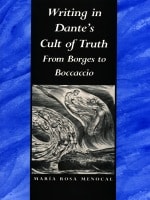
Writing in Dante's Cult of Truth
From Borges to BocaccioMaría Rosa Menocal
Duke University Press, 1991
Beginning with a reading of La vita nuova and the Commedia, this literary history of poetic literary histories explores the Dantean poetic experience as it has been limited and rewritten by later poets, particularly Petrarch, Boccaccio, Borges, Pound, Eliot, and the all but forgotten Silvio Pellico, author of Le mie prigioni. By blending discussions of Dante’s own marriage of literature and literary history with those investigations into the imitative qualities of later works, Writing in Dante’s Cult of Truth presents an intertextual literary history, one which seeks to maintain the uncanniness of literature, while imagining history to be neither linear nor clearly distinguishable from literature itself.
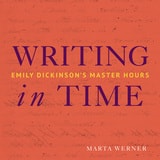
Writing in Time
Emily Dickinson's Master HoursMarta L. Werner
Amherst College Press, 2021
For more than half a century, the story of Emily Dickinson’s “Master” documents has been the largely biographical tale of three letters to an unidentified individual. Writing in Time seeks to tell a different story—the story of the documents themselves. Rather than presenting the “Master” documents as quarantined from Dickinson’s larger scene of textual production, Marta Werner’s innovative new edition proposes reading them next to Dickinson’s other major textual experiment in the years between ca. 1858–1861: the Fascicles. In both, Dickinson can be seen testing the limits of address and genre in order to escape bibliographical determination and the very coordinates of “mastery” itself. A major event in Dickinson scholarship, Writing in Time: Emily Dickinson’s Master Hours proposes new constellations of Dickinson’s work as well as exciting new methodologies for textual scholarship as an act of “intimate editorial investigation.”
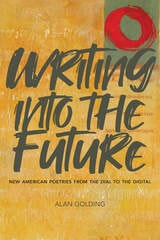
Writing into the Future
New American Poetries from "The Dial" to the DigitalAlan Golding
University of Alabama Press, 2022
Writing into the Future: New American Poetries from “The Dial” to the Digital collects Alan Golding’s essays on the futures (past and present) of poetry and poetics. Throughout the 13 essays gathered in this collection, Golding skillfully joins literary critique with a concern for history and a sociological inquiry into the creation of poetry. In Golding’s view, these are not disparate or even entirely distinct critical tasks. He is able to fruitfully interrogate canons and traditions, both on the page and in the politics of text, culture, and institution.
A central thread running through the chapters is a longstanding interest in how various versions of the “new” have been constructed, received, extended, recycled, resisted, and reanimated in American poetry since modernism. To chart the new, Golding contends with both the production and the reception of poetry, in addition to analyzing the poems themselves. In a generally chronological order, Golding reconsiders the meaning for contemporary poets of high modernists like Ezra Pound and William Carlos Williams, as well as the influential poetry venues The Dial and The Little Review, where less prominent but still vital poets contested what should come “next.” Subsequent essays track that contestation through The New American Poetry and later anthologies.
Mid-century major figures like Robert Creeley and George Oppen are discussed in their shared concern for the serial poem. Golding’s essays bring us all the way back to the present of the poetic future, with writing on active poets like Rachel Blau DuPlessis, Susan Howe, and Bruce Andrews and on the anticipation of digital poetics in the material texts of L=A=N=G=U=A=G=E writing. Golding charts the work of defining poetry’s future and how we rewrite the past for an unfolding present.
Writing the Australian Crawl
William Stafford
University of Michigan Press, 1978
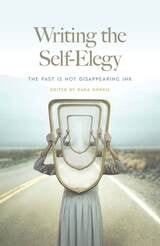
Writing the Self-Elegy
The Past Is Not Disappearing InkEdited by Kara Dorris
Southern Illinois University Press, 2023
Honest, aching, and intimate, self-elegies are unique poems focusing on loss rather than death, mourning versions of the self that are forgotten or that never existed. Within their lyrical frame, multiple selves can coexist—wise and naïve, angry and resigned—along with multiple timelines, each possible path stemming from one small choice that both creates new selves and negates potential selves. Giving voice to pain while complicating personal truths, self-elegies are an ideal poetic form for our time, compelling us to question our close-minded certainties, heal divides, and rethink our relation to others.
In Writing the Self-Elegy, poet Kara Dorris introduces us to this prismatic tradition and its potential to forge new worlds. The self-elegies she includes in this anthology mix autobiography and poetics, blending craft with race, gender, sexuality, ability and disability, and place—all of the private and public elements that build individual and social identity. These poems reflect our complicated present while connecting us to our past, acting as lenses for understanding, and defining the self while facilitating reinvention. The twenty-eight poets included in this volume each practice self-elegy differently, realizing the full range of the form. In addition to a short essay that encapsulates the core value of the genre and its structural power, each poet’s contribution concludes with writing prompts that will be an inspiration inside the classroom and out. This is an anthology readers will keep close and share, exemplifying a style of writing that is as playful as it is interrogative and that restores the self in its confrontation with grief.
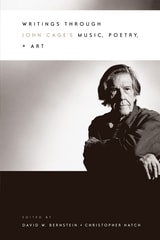
Writings through John Cage's Music, Poetry, and Art
Edited by David W. Bernstein and Christopher Hatch
University of Chicago Press, 2001
The essays in this collection grew out of a pivotal gathering during which a spectrum of participants including composers, music scholars, and visual artists, literary critics, poets, and filmmakers convened to examine Cage's extraordinary artistic legacy. Beginning with David Bernstein's introductory essay on the reception of Cage's music, the volume addresses topics ranging from Cage's reluctance to discuss his homosexuality, to his work as a performer and musician, and his forward-looking, provocative experimentation with electronic and other media. Several of the essays draw upon previously unseen sketches and other source materials. Also included are transcripts of lively panel discussions among some of Cage's former colleagues. Taken together, this collection is a much-needed contribution to the study of one of the most significant American artists of the twentieth century.
Written in Water, Written in Stone
Twenty Years of Poets on PoetryMartin Lammon, Editor
University of Michigan Press, 1996
Included are selections from, among others, Robert Bly, Hayden Carruth, Amy Clampitt, Robert Creeley, Tess Gallagher, Donald Hall, Robert Hayden, Galway Kinnell, Richard Kostelanetz, Maxine Kumin, Philip Levine, Marge Piercy, Anne Sexton, Charles Simic, Louis Simpson, William Stafford, Diane Wakoski, Charles Wright, and James Wright. This diverse collection of popular contemporary poets is sure to appeal to a wide range of readers.
Martin Lammon teaches creative writing at Fairmont State College. He is a poet and editor of the literary magazine Kestrel.
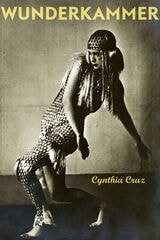
Wunderkammer
Cynthia Cruz
Four Way Books, 2014
water/tongue
mai c. doan
Omnidawn, 2019
what I'm on
Luis Humberto Valadez
University of Arizona Press, 2009
José García
put a thirty-five to me
my mother was in the other room
He would have done us both
if not for the lust of my fear
This new Mexican American/Chicano voice is all at once arresting, bracing, shocking, and refreshing. This is not the poetry you learned in school. It owes as much to hip hop as it does to the canon. But Valadez has paid his academic dues, and he certainly knows how to craft a poem. It’s just that he does it his way.
i anagram and look and subject to deformation and reconfiguring . . .
it ain’t events or blocks that ahm jettisoning through this process
it be layers of meaning, identity, narrative, and ego that gets peeled off
i can only increase my own understanding
what nature
PoemsSteve Fay
Northwestern University Press, 1998
whitewards
Katarína Kucbelová
Seagull Books, 2025
Katarína Kucbelová’s whitewards is a haunting and deeply moving sequence of poems that unfolds in a stark, snowbound landscape where winter seems endless. Three unnamed figures struggle to find their way through a snow-covered mountainside, grappling with uncertainty, unspoken fears, and the weight of questions they can barely put into words. Framed as a series of brief fragments and longer passages that use a range of narrative and cinematic techniques, the collection explores themes of identity, survival, and the search for meaning in a time of global crisis—whether political, environmental, or technological. Yet amid the darkness, Kucbelová finds light in storytelling itself, offering it as a form of solace, a way to break through loneliness, and a means to endure. The beauty of her images stimulates and inspires, acting as an antidote to the bleakness of the world. This stunning collection of poems explores identity, survival, and the power that storytelling possesses to bring light even to the bleakest landscapes.