244 books match the query 'Arkansas' and 52 start with a

cover of A Capital Idea: An Illustrated History of the Capital Hotel

A Capital Idea

An Illustrated History of the Capital Hotel

Steven Weintz

University of Arkansas Press, 2002

The Capital Hotel is uniquely beautiful, with its cast-iron façade and marble lobby, its high-ceilinged rooms, and its rich history. Since its opening in 1876, it has been the stage for the struggles, schemes, and dreams of generations of politicians, debutantes, prostitutes, carpenters, and businessmen. And a wide variety of owners and visionaries has shaped the hotel's fortunes, among them the Yankee entrepreneur who started it all; the Italian immigrant family who kept it going in its worst days; the architect who envisioned new lives for old buildings; and the financiers and craftsmen who brought the Capital to its current glory as a luxury hotel. The story of the Capital Hotel is also the story of Little Rock, and of many American cities: built in the commercial boom of the 1870s, in full flower at the turn of the century, battered by the Depression, optimistic in the postwar era, but decrepit by the late 1960s, then renovated in the 1980s and thriving today. This lavishly illustrated volume traces the history of the hotel from its origins as a commercial building to its spectacular renovation into a jewel of downtown Little Rock.
[more]
cover of A Captive Audience: Voices of Japanese American Youth in World War II Arkansas

A Captive Audience

Voices of Japanese American Youth in World War II Arkansas

Ali Welky

Butler Center for Arkansas Studies, 2015

Using archival primary material such as photographs, yearbooks, artwork, and first-person written accounts, A Captive Audience gives an inside look at the experiences of young people at the Rohwer and Jerome Relocation Centers in Arkansas during the forced incarceration of Japanese Americans during World War II. Many young internees at the camps saw their families lose their homes, businesses, and possessions on the West Coast when the U.S. government rounded up people of Japanese descent after the bombing of Pearl Harbor. Yet through all the chaos and heartbreak of the internment experience, young people often brought a unique perspective of hope and resiliency.
Intended for young-adult readers, this book explores important dimensions of Arkansas and U.S. history, including human rights and what it means to be an American.

[more]
cover of A Corner of the Tapestry: A History of the Jewish Experience in Arkansas, 1820s–1990s

A Corner of the Tapestry

A History of the Jewish Experience in Arkansas, 1820s–1990s

Carolyn LeMaster

University of Arkansas Press, 1994
One of the most comprehensive studies ever done on a state’s Jewish community, A Corner of the Tapestry is the story—untold until now—of the Jews who helped to settle Arkansas and who stayed and flourished to become a significant part of the state’s history and culture. LeMaster has spent much of the past sixteen years compiling and writing this saga. Data for the book have been collected in part from the American Jewish Archives, American Jewish Historical Society, the stones in Arkansas’s Jewish cemeteries, more than fifteen hundred articles and obituaries from journals and newspapers, personal letters from hundreds of present and former Jewish Arkansans, congregational histories, census and court records, and some four hundred oral interviews conducted in a hundred cities and towns in Arkansas. This meticulous work chronicles the lives and genealogy of not only the highly visible and successful Jews who settled in Arkansas, but also those who comprised the warp and woof of society. It is a decidedly significant contribution to Arkansas history as well as to the wider study of Jews in the nation.
[more]
cover of A Documentary History of Arkansas

A Documentary History of Arkansas

C. Fred Williams

University of Arkansas Press, 2013

A Documentary History of Arkansas provides a comprehensive look at Arkansas history from the state's earliest events to the present. Here are newspaper articles, government bulletins, legislative acts, broadsides, letters, and speeches that, taken collectively, give a firsthand glimpse at how the twenty-fifth state's history was made. Enhanced by additional documents and brought up to date since its original publication in 1984, this new edition is the standard source for essential primary documents illustrating the state's political, social, economic, educational, and environmental history.
[more]
cover of A Documentary History of Arkansas

A Documentary History of Arkansas

C. Fred Williams

University of Arkansas Press, 0
This collection of documents represents a behind-the-scenes look at Arkansas from earliest times to 1984. Here are newspaper articles, government bulletins, legislative acts, broadsides, letters, and speeches. Collectively, they give a firsthand glimpse at how the twenty-fifth state’s history was made. Consideration is given to social and cultural aspects of Arkansas history, with special attention focused on the role played by women and blacks.
[more]
cover of A History of Southern Missouri and Northern Arkansas: Being an Account of the Early Settlements, the Civil War, the Ku-Klux, and Times of Peace

A History of Southern Missouri and Northern Arkansas

Being an Account of the Early Settlements, the Civil War, the Ku-Klux, and Times of Peace

William Monks

University of Arkansas Press, 2006

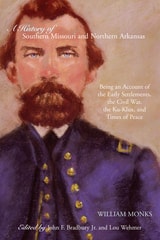
Originally published in 1907 and now reprinted for the first time, this is the only account published by a Union guerrilla in the border region of the central Ozarks, where political and civil violence lasted from the Civil War well into the 1880s.

There were probably many people who wanted to shoot Billy Monks. He was a Union patriot and skilled guerrilla fighter to some, but others called him a bushwhacker, a murderer, and a thief. His was a very personal combat: he commanded, rallied, arrested, killed, quarreled with, and sued people he knew. His life provides a striking example of the cliché that the war did not end in 1865, but continued fiercely on several fronts for another decade as partisan factions settled old scores and battled for local political control.

This memoir was Monks’s last salvo at his old foes, by turns self-defense and an uncompromising affirmation of the Radical Union cause in the Ozarks. The editors include a new biographical sketch of the author, fill in gaps in his narrative, identify all the people and places to which he refers, and offer a detailed index. Monks himself illustrated the volume with staged photographs of key events re-created by aged comrades who appear to have been just barely able to hoist the muskets they hold as props.

[more]
cover of A History of Southland College: The Society of Friends and Black Education in Arkansas

A History of Southland College

The Society of Friends and Black Education in Arkansas

Thomas Kennedy

University of Arkansas Press, 2009
In 1864 Alida and Calvin Clark, two abolitionist members of the Religious Society of Friends from Indiana, went on a mission trip to Helena, Arkansas. The Clarks had come to render temporary relief to displaced war orphans but instead found a lifelong calling. During their time in Arkansas, they started the school that became Southland College, which was the first institution of higher education for blacks west of the Mississippi, and they set up the first predominately black monthly meeting of the Religious Society of Friends in North America. Their progressive racial vision was continued by a succession of midwestern Quakers willing to endure the primitive conditions and social isolation of their work and to overcome the persistent challenges of economic adversity, social strife, and natural disaster. Southland’s survival through six difficult and sometimes dangerous decades reflects both the continuing missionary zeal of the Clarks and their successors as well as the dedication of the black Arkansans who sought dignity and hope at a time when these were rare commodities for African Americans in Arkansas.
[more]
cover of A History of the Ozarks, Volume 1: The Old Ozarks

A History of the Ozarks, Volume 1

The Old Ozarks

Brooks Blevins

University of Illinois Press, 2020

Winner of the Missouri History Book Award, from the State Historical Society of Missouri
Winner of the Arkansiana Award, from the Arkansas Library Association


Geologic forces raised the Ozarks. Myth enshrouds these hills. Human beings shaped them and were shaped by them. The Ozarks reflect the epic tableau of the American people—the native Osage and would-be colonial conquerors, the determined settlers and on-the-make speculators, the endless labors of hardscrabble farmers and capitalism of visionary entrepreneurs. The Old Ozarks is the first volume of a monumental three-part history of the region and its inhabitants. Brooks Blevins begins in deep prehistory, charting how these highlands of granite, dolomite, and limestone came to exist. From there he turns to the political and economic motivations behind the eagerness of many peoples to possess the Ozarks. Blevins places these early proto-Ozarkers within the context of larger American history and the economic, social, and political forces that drove it forward. But he also tells the varied and colorful human stories that fill the region's storied past—and contribute to the powerful myths and misunderstandings that even today distort our views of the Ozarks' places and people. A sweeping history in the grand tradition, A History of the Ozarks, Volume 1: The Old Ozarks is essential reading for anyone who cares about the highland heart of America.

[more]
cover of A History of the Ozarks, Volume 2: The Conflicted Ozarks

A History of the Ozarks, Volume 2

The Conflicted Ozarks

Brooks Blevins

University of Illinois Press, 2019
The Ozarks of the mid-1800s was a land of divisions. The uplands and its people inhabited a geographic and cultural borderland straddling Midwest and west, North and South, frontier and civilization, and secessionist and Unionist. As civil war raged across the region, neighbor turned against neighbor, unleashing a generation of animus and violence that lasted long after 1865. The second volume of Brooks Blevins's history begins with the region's distinctive relationship to slavery. Largely unsuitable for plantation farming, the Ozarks used enslaved persons on a smaller scale or, in some places, not at all. Blevins moves on to the devastating Civil War years where the dehumanizing, personal nature of Ozark conflict was made uglier by the predations of marching armies and criminal gangs. Blending personal stories with a wide narrative scope, he examines how civilians and soldiers alike experienced the war, from brutal partisan warfare to ill-advised refugee policies to women's struggles to safeguard farms and stay alive in an atmosphere of constant danger. The war stunted the region's growth, delaying the development of Ozarks society and the processes of physical, economic, and social reconstruction. More and more, striving uplanders dedicated to modernization fought an image of the Ozarks as a land of mountaineers and hillbillies hostile to the idea of progress. Yet the dawn of the twentieth century saw the uplands emerge as an increasingly uniform culture forged, for better and worse, in the tumult of a conflicted era.
[more]
cover of A History of the Ozarks, Volume 3: The Ozarkers

A History of the Ozarks, Volume 3

The Ozarkers

Brooks Blevins

University of Illinois Press, 2021

Between the world wars, America embraced an image of the Ozarks as a remote land of hills and hollers. The popular imagination stereotyped Ozarkers as ridge runners, hillbillies, and pioneers—a cast of colorful throwbacks hostile to change. But the real Ozarks reflected a more complex reality.

Brooks Blevins tells the cultural history of the Ozarks as a regional variation of an American story. As he shows, the experiences of the Ozarkers have not diverged from the currents of mainstream life as sharply or consistently as the mythmakers would have it. If much of the region seemed to trail behind by a generation, the time lag was rooted more in poverty and geographic barriers than a conscious rejection of the modern world and its progressive spirit. In fact, the minority who clung to the old days seemed exotic largely because their anachronistic ways clashed against the backdrop of the evolving region around them. Blevins explores how these people’s disproportionate influence affected the creation of the idea of the Ozarks, and reveals the truer idea that exists at the intersection of myth and reality.

The conclusion to the acclaimed trilogy, The History of the Ozarks, Volume 3: The Ozarkers offers an authoritative appraisal of the modern Ozarks and its people.
[more]
cover of A Journal of Travels into the Arkansas Territory During the Year 1819

A Journal of Travels into the Arkansas Territory During the Year 1819

Thomas Nuttall

University of Arkansas Press, 1999

This is the famous naturalist Thomas Nuttall's only surviving complete journal of his American scientific explorations. Covering his travels in Arkansas and what is now Oklahoma, it is pivotal to an understanding of the Old Southwest in the early nineteenth century, when the United States was taking inventory of its acquisitions from the Louisiana Purchase.

The account follows Nuttall's route from Philadelphia to Pittsburg, down the Ohio River to its mouth, then down the Mississippi River to the Arkansas Post, and up the Arkansas River with a side trip to the Red River. It is filled with valuable details on the plants, animals, and geology of the region, as well as penetrating observations of the resident native tribes, the military establishment at Fort Smith, the arrival of the first governor of Arkansas Territory, and the beginnings of white settlement.

Originally published in 1980 by the University of Oklahoma Press, this fine edited version of Nuttall's work boasts a valuable introduction, notes, maps, and bibliography by Savoie Lottinville. The editor provided common names for those given in scientific classification and substituted modern genus and species names for the ones used originally by Nuttall. The resulting journal is a delight to read for anyone—historian, researcher, visitor, resident, or enthusiast.

[more]
cover of A Life of Albert Pike

A Life of Albert Pike

Walter Lee Brown

University of Arkansas Press, 1997

A Life of Albert Pike, originally published in 1997, is as much a study of antebellum Arkansas as it is a portrait of the former general. A native of Massachusetts, Pike settled in Arkansas Territory in 1832 after wandering the Great Plains of Texas and New Mexico for two years. In Arkansas he became a schoolteacher, newspaperman, lawyer, Whig leader, poet, Freemason, and Confederate general who championed secession and fought against Black suffrage. During his tenure as Sovereign Grand Commander of the Scottish Rite—a position he held for more than thirty years beginning in 1859—Pike popularized the Masonic movement in the American South and Far West. In the wake of the Civil War, Pike left Arkansas, ultimately settling in Washington, D.C., where he lived out his last years in the Mason's House of the Temple.

Drawing on original documents, Pike’s copious writings, and interviews with Pike’s descendants, Walter Lee Brown presents a fascinating personal history that also serves as a rich compendium of Arkansas’s antebellum history.

 
[more]
cover of A Little Rock Boyhood: Growing Up in the Great Depression

A Little Rock Boyhood

Growing Up in the Great Depression

A. Cleveland Harrison

Butler Center for Arkansas Studies, 2010
History books provide the statistics and the “big picture” of the Great Depression, but what did any of that mean for a family just trying to make it through those years? A. Cleveland Harrison’s A Little Rock Boyhood provides that viewpoint in this evocative memoir as he captures what Little Rock was like for him as a child in the 1930s. The Harrison family’s experiences and those of their extended family and neighbors bring the tough economic times down to the individual level. The youngest Harrison is an able reporter, relating the memories of an observant though naive child. All was not grim, though, if you were a kid, and Harrison describes those happy times. He remembers his life in the residential neighborhoods of downtown Little Rock when a child could grow up in difficult times without becoming difficult. This book is an insightful look back at a time, a place, and a childhood.
[more]
cover of A Photographer of Note: Arkansas Artist Geleve Grice

A Photographer of Note

Arkansas Artist Geleve Grice

Geleve Grice

University of Arkansas Press, 2003

In a selection of more than one hundred black and white images taken over a period of sixty years, this book bears witness to the life of a remarkable photographer and to small-town African American life in the middle of the twentieth century. Geleve Grice was born and raised near Pine Bluff, and he has documented the ordinary life of his community: parades, graduations, weddings, club events, and whatever else brought people together. In the process he has created a remarkable historical portrait of an African American community. Through his lens we glimpse the daily patterns of segregated Pine Bluff, and we also participate in the excitement of greeting extraordinary visitors. Martin Luther King Jr., Mary McLeod Bethune, Harry S. Truman, and others all came through town.

Folklorist Robert Cochran worked with Grice to select these photographs from the thousands he has taken across a lifetime. They organized the work chronologically, reflecting Grice’s early years in small-town Arkansas, his travel as a serviceman in World War II, and his long career in Pine Bluff. Cochran’s accompanying chapters link Grice to the great tradition of American community photographers. He also shows how work for pay-at the Arkansas Agricultural, Mechanical and Normal College in Pine Bluff; at the Arkansas State Press daily newspaper; through his own studio-shaped Grice’s work. Cochran shows that Grice not only made his living taking photographs for jobs, but that he also made his own life by making photographs for himself-and now for history.
[more]
cover of A Piece of My Soul: Quilts by Black Arkansans

A Piece of My Soul

Quilts by Black Arkansans

Cuesta Benberry

University of Arkansas Press, 2000
Arkansas is well known for its rich tradition of upland folk arts. Little, however, has been reported from the lowland areas, particulary on African American contributions to the state's cultural heritage. A Piece of My Soul: Quilts by Black Arkansans seeks to rectify that oversight by drawing attention to the extensive, important collection of African American quilts in the Old State House Museum in Little Rock. Over seventy-five individual pieces of patchwork art are presented in this publication in full-color plates, each with a commentary by the exhibit's guest curator, Cuesta Benberry. The book details the importance of quilting to black Arkansans; the quilts' uses, materials and construction; and what each piece says about the artist and her beliefs. We are granted a glimpse into the living conditions and cultural mores of the quilters' lives. Regionalisms, such as the unusual custom of renaming traditional quilt patterns for things seen in the farmyard, such as Rooster Tail or Chicken Feet, and of piecing patchwork funerary cloths to decorate coffins are discussed. This impressive collection of cultural artifacts is placed in the larger context of the African American experience through an introduction by noted scholar Raymond Dobard (art history, Howard University), co-author, with Jacqueline Tobin, of the highly acclaimed book, Hidden in Plain View: The Secret Story of Quilts and the Underground Railroad (1999, Doubleday). All those interested in American folk art, the quilting craft, and black history will find this beautiful book fascinating and rewarding.
[more]
cover of A Place Apart: A Pictorial History of Hot Springs, Arkansas

A Place Apart

A Pictorial History of Hot Springs, Arkansas

Ray Hanley

University of Arkansas Press, 2011

Hot Springs National Park was recognized nationally in 2010 when the U.S. Mint unveiled the design of the first quarter of 56 in a series called the America the Beautiful Quarters Program. In 1903 a Chicago magazine, The 400, told its upscale readers about Hot Springs, Arkansas. The article's author wrote, "I also perceive a Chicago-Hot Springs air line of macadamized highway, lined with meteoric automobiles ribboning off the 750 miles between the cities in a thousand or less minutes. The perspective is almost delirious." Such exuberant words are testimony to what Hot Springs, "a place apart," has been to the nation since the early European explorers found vapors rising from the thermal springs-47 of them from which a million gallons of 143-degree water flow each day. A Place Apart offers readers a balanced history in words and historic photographs of a unique locale in the state of Arkansas. The hot springs of what the Native Americans called Washita were on the national map of Pres. Thomas Jefferson when the United States acquired what would become Arkansas in the Louisiana Purchase of 1804. Congress created the Hot Springs Reservation in 1832-the first land that the federal government set aside for preservation-granting federal protection of the thermal waters, and renamed it Hot Springs National Park in 1921. This book provides a fascinating visual history of pioneers, wealthy barons, scoundrels, gamblers (including such frequent visitors as Al Capone and Lucky Luciano), colorful politicians, and the hundreds of thousands of people who came to the spa city in hopes of regaining their fleeting health. Also covered are such famous attractions as Oaklawn Park, a thoroughbred horse-racing track, and Bathhouse Row, with its eight turn-of-the-century historic buildings.
[more]
cover of A Place Called Sweet Shrub: The Second Novel in a Trilogy

A Place Called Sweet Shrub

The Second Novel in a Trilogy

Jane Roberts Wood

University of North Texas Press, 2000

Together for the first time as a classic Texas trilogy: The Train to Estelline A Place Called Sweet Shrub Dance a Little Longer The Lucinda "Lucy" Richards trilogy, spanning the years from 1911 to the 1930s, has everything good books should have: a variety of landscapes, characters of all ages and social classes, an overall tenderness that never lapses into sentimentality, and a sense of the comic amidst the tragic. Lucy is feisty, funny, and completely open-armed about life. Josh passionately confronts danger and greed and prejudice with courage and humor and, sometimes, with bare fists. Even the minor characters are so rife with color that you first turn the pages quickly to see what they will do next and, then, you turn them slowly so as to savor each page of this remarkable trilogy. A Place Called Sweet Shrub : In 1915 it has been three years since Lucy Richards left her teaching post in West Texas and returned home where she is busy being indispensable to her eccentric mother, keeping her Aunt Catherine comfortable, and taking on many of the chores her very pregnant sister no longer feels up to. She decides to choose a husband from the local beaus, but none of them stand a chance when handsome, irreverent Josh Arnold comes to town. The newlyweds move to the sleepy hamlet of Sweet Shrub, Arkansas, where they are soon caught up in the lives of their neighbors and discover that the surface tranquillity of the town hides simmering tensions and unrest that will inevitably result in tragedy.
[more]
cover of A Pryor Commitment

A Pryor Commitment

David Pryor

Butler Center for Arkansas Studies, 2009

David Pryor’s career of public service is unparalleled in Arkansas history: he has been elected state representative, congressman, governor, and, alongside Dale Bumpers, U.S. senator (1979–1997). Through it all, Pryor’s curiosity, compassion, and concern for ordinary Americans draw the reader from one colorful vignette to another.
[more]
cover of A Remembrance of Eden: Harriet Bailey Bullock Daniel's Memories of a Frontier Plantation in Arkansas, 1849–1872

A Remembrance of Eden

Harriet Bailey Bullock Daniel's Memories of a Frontier Plantation in Arkansas, 1849–1872

Margaret Jones Bolsterli

University of Arkansas Press, 1993
In her perceptive chronicle of everyday life on an Arkansas plantation, Harriet Bailey Bullock Daniel sheds light on the plantation economy, medical practices, religion, slavery, and sex roles in the period from 1849 until Daniel's marriage in 1872. The work is a rich mixture of mundane details surrounded by momentous events, and Daniel's sure grasp of both provides enjoyment and enlightenment for any reader.
[more]
cover of A Rough Sort of Beauty: Reflections on the Natural Heritage of Arkansas

A Rough Sort of Beauty

Reflections on the Natural Heritage of Arkansas

Dana Steward

University of Arkansas Press, 2002
What does it mean to have a sense of place? Through history, memoir, poetry, and fiction, the writers of these essays answer this question in a variety of ways, giving us their collective history of natural Arkansas. They speak of the interrelationships of humans and nature, and of the struggles for balance between economic realities and landscape preservation. The book evokes the sheer physical diversity of the Natural State, from the Ozarks and the Boston Mountains to Crowley's Ridge, the Grand Prairie, and the Delta. But far more than mere geography, these are places of intense meaning: sites of enlightenment, conflict, comfort, and vivid experience. Rivers and mountains, plains and forests — these are shorthand terms for specific, beloved, storied places.
[more]
cover of A Whole Country in Commotion: The Louisiana Purchase and the American Southwest

A Whole Country in Commotion

The Louisiana Purchase and the American Southwest

Patrick G. Williams

University of Arkansas Press, 2005

Bringing together the work of prominent scholars and rising stars in southern, western, and Indian history, A Whole Country in Commotion explores lesser-known aspects of one of the better-known episodes in U.S. history. While the purchase has been seen as a great boon for the United States, doubling the size of the new nation and securing American navigation on the Mississippi River, it also brought turmoil to many. Looking past the triumphal aspects of the purchase, this book examines the “negotiations among peoples, nations and empires that preceded and followed the actual transfer of territory.” Its nine essays highlight the “commotion” the purchase stirred up—among nations, among Louisiana residents and newcomers, even among those who remained east of the Mississippi. Many of these essays look at the portion of the Louisiana territory that would become Arkansas to illustrate the profound impact of the purchase on the diverse populations of the American Southwest. Others explore the woeful commotion brought to many thousands of lives as Jefferson’s “noble bargain” set the stage for the forced migration of native and African Americans from the east to the west of the Mississippi.
[more]
cover of Adventures in the Wild: Tales from Biologists of the Natural State

Adventures in the Wild

Tales from Biologists of the Natural State

Joy Trauth

University of Arkansas Press, 2008

The true tales in this collection will take readers from the chicken houses of Arkansas to the caves of Venezuela and Mexico to the coast of Alaska. These fifteen adventures range from amusing to life threatening. Some are filled with suspense and danger in exotic places, while others document more routine but important biological field and lab work. Meet the roommate with the rash that wouldn't go away, a friendly bull, some blind cave fish, killer whales, drug smugglers, and hairy roots that are used to produce new medicines. Read about researchers crawling through rotten-egg-smelling muck in search of an elusive mosquitofish, diving into the cold black water of the White River in search of mussels, flying with bush pilots in Alaska, and working with David Attenborough in Arkansas. Here are teachers and researchers, biologists all, all from one university, real people who get their feet wet and their hands dirty in the pursuit of knowledge.
[more]
cover of Agenda for Reform: Winthrop Rockefeller as Governor of Arkansas, 1967–71

Agenda for Reform

Winthrop Rockefeller as Governor of Arkansas, 1967–71

Cathy Kunzinger Urwin

University of Arkansas Press, 1991
When Winthrop Rockefeller was elected governor of Arkansas in 1966, he became the first Republican to hold the governor's office since Reconstruction. Cathy Kunzinger Urwin examines Rockefeller's tenure by looking beyond his immediate successes and failures to the broader, dramatic changes that marked the era. Rockefeller helped break up the political machines that had controlled Arkansas politics for almost a hundred years, made lasting contributions in the areas of prison reform and civil rights, and obliged the Democratic Party to find Dale Bumpers, a young, bright, progressive gubernatorial candidate to oppose him in 1970.
[more]
cover of An Arkansas Florilegium: The Atlas of Botanist Edwin Smith Illustrated by Naturalist Kent Bonar

An Arkansas Florilegium

The Atlas of Botanist Edwin Smith Illustrated by Naturalist Kent Bonar

Edwin Smith

University of Arkansas Press, 2017

An Arkansas Florilegium is a late-flowering extension of the work initiated sixty years ago with University of Arkansas botanist Edwin B. Smith’s first entries in his pioneering Atlas and Annotated List of the Vascular Plants of Arkansas. Soon after this seminal survey of the state’s flora was published in 1978, Kent Bonar, a Missouri-born Thoreau acolyte employed as a naturalist by the Arkansas Park Service, began lugging the volume along on hikes through the woods surrounding his Newton County home, entering hundreds upon hundreds of meticulous illustrations into Smith’s work.

Thirty-five years later, with Smith retired and Bonar long gone from the park service but still drawing, Bonar’s weathered and battered copy of the atlas was seized by a diverse cadre of amateur admirers motivated by fears of its damage or loss. Their fears were certainly justified; after all, the pages were now jammed to the margins with some 3,500 drawings, and the volume had already survived one accidental dunking in an Ozark stream.

An Arkansas Florilegium brings Smith’s and Bonar’s knowledge and lifelong diligence to the world in this unique mix of art, science, and Arkansas saga.
[more]
cover of An Arkansas Folklore Sourcebook

An Arkansas Folklore Sourcebook

W.K. McNeil

University of Arkansas Press, 1992

Arkansas’s rich folk tradition is shown by the variety of its manifestations: a 250-year-old ballad, an archaic method of hewing railroad crossties with a broadax, the use of poultices and toddies to treat the common cold, and swamps of evil repute are all parts of the tradition that constitutes Arkansas folklore. In fact, as the essays selected by W.K. McNeil and William M. Clements show, these few examples only begin to tell the story.

Starting with a working description of folklore as “cultural material that is traditional and unofficial” and characterized by a pattern of oral transmission, variation, formulaic structures, and usually uncertain origin, the authors survey in detail a wide array of folk objects, activities, beliefs, and customs. Among the rich offerings in this sourcebook are a discussion of the history of folklore research in Arkansas, an examination of some of the traditional songs and music still being preformed, a thoughtful exploration of the serious side of “tall tales” and “windies,” an investigation of folk architecture in Arkansas and what it reveals about our cultural origins, a study of many traditional foods and there preparation methods, an analysis of superstitions and beliefs, and a description of festivals and celebrations that are observed to this day.

Complemented by biographies of reference works and audio and video recordings of the state’s folk materials, An Arkansas Folklore Sourcebook is the first complete guide to the study of one state’s “unofficial culture.”
[more]
cover of An Arkansas History for Young People: Fourth Edition

An Arkansas History for Young People

Fourth Edition

Shay E. Hopper

University of Arkansas Press, 2008
Adopted by the State of Arkansas for 2008 Once again, the State of Arkansas has adopted An Arkansas History for Young People as an official textbook for middle-level and/or junior-high-school Arkansas-history classes. This fourth edition incorporates new research done after extensive consultations with middle-level and junior-high teachers from across the state, curriculum coordinators, literacy coaches, university professors, and students themselves. It includes a multitude of new features and is now full color throughout. This edition has been completely redesigned and now features a modern format and new graphics suitable for many levels of student readers. The completely revised fourth edition includes new unit, chapter, and section divisions as well as five brand-new chapters: an introductory chapter with information on the symbols, flag, and songs of Arkansas; chapter 2, which covers the geography of Arkansas; chapter 3, on state and local government; chapter four, on economics and tourism; and a “modern” chapter on the Arkansas of today and the future, which completes the learning adventure. This edition also has two “special features”: one on the Central High School crisis of 1957 and another on the William J. Clinton Presidential Library. It also has new and interesting features for students like the “Guide to Reading” (at the beginning of each chapter, there is a list of important terms, people, places and events for the student to keep in mind as he or she reads [corresponding to blue vocabulary words in the text, which are define in the margin]), “County Quest,” “I Am an Arkansan,” “Did You Know?” “Only in Arkansas,” “A Day in the Life,” “Chapter Reflection” questions and activities, over forty-five new content maps, and a comprehensive new map atlas.
[more]
cover of An Epitaph for Little Rock: A Fiftieth Anniversary Retrospective on the Central High Crisis

An Epitaph for Little Rock

A Fiftieth Anniversary Retrospective on the Central High Crisis

John A. Kirk

University of Arkansas Press, 2008

This collection of essays mines the Arkansas Historical Quarterly from the 1960s to the present to form a body of work that represents some of the finest scholarship on the crisis, from distinguished southern historians Numan V. Bartley, Neil R. McMillen, Tony A. Freyer, Roy Reed, David L. Chappell, Lorraine Gates Schuyler, John A. Kirk, Azza Salama Layton, and Ben F. Johnson III. A comprehensive array of topics are explored, including the state, regional, national, and international dimensions of the crisis as well as local white and black responses to events, gender issues, politics, and law. Introduced with an informative historiographical essay from John A. Kirk, An Epitaph for Little Rock is essential reading on this defining moment in America's civil rights struggle.
[more]
cover of Anti-Catholicism in Arkansas: How Politicians, the Press, the Klan, and Religious Leaders Imagined an Enemy, 1910–1960

Anti-Catholicism in Arkansas

How Politicians, the Press, the Klan, and Religious Leaders Imagined an Enemy, 1910–1960

Kenneth C. Barnes

University of Arkansas Press, 2016

Winner, 2017 Ragsdale Award

A timely study that puts current issues—religious intolerance, immigration, the separation of church and state, race relations, and politics—in historical context.

The masthead of the Liberator, an anti-Catholic newspaper published in Magnolia, Arkansas, displayed from 1912 to 1915 an image of the Whore of Babylon. She was an immoral woman sitting on a seven-headed beast, holding a golden cup “full of her abominations,” and intended to represent the Catholic Church.

Propaganda of this type was common during a nationwide surge in antipathy to Catholicism in the early twentieth century. This hostility was especially intense in largely Protestant Arkansas, where for example a 1915 law required the inspection of convents to ensure that priests could not keep nuns as sexual slaves.

Later in the decade, anti-Catholic prejudice attached itself to the campaign against liquor, and when the United States went to war in 1917, suspicion arose against German speakers—most of whom, in Arkansas, were Roman Catholics.

In the 1920s the Ku Klux Klan portrayed Catholics as “inauthentic” Americans and claimed that the Roman church was trying to take over the country’s public schools, institutions, and the government itself. In 1928 a Methodist senator from Arkansas, Joe T. Robinson, was chosen as the running mate to balance the ticket in the presidential campaign of Al Smith, a Catholic, which brought further attention.

Although public expressions of anti-Catholicism eventually lessened, prejudice was once again visible with the 1960 presidential campaign, won by John F. Kennedy.

Anti-Catholicism in Arkansas illustrates how the dominant Protestant majority portrayed Catholics as a feared or despised “other,” a phenomenon that was particularly strong in Arkansas.

[more]
cover of Architects of Little Rock: 1833-1950

Architects of Little Rock

1833-1950

Charles Witsell

University of Arkansas Press, 2014

Architects of Little Rock provides biographical and historical sketches of the architects working in Little Rock from 1830 to 1950. Thirty-five architects are profiled, including George R. Mann, Thomas Harding, Charles L. Thompson, Max. F. Mayer, Edwin B. Cromwell, George H. Wittenberg, Lawson L. Delony, and others. Readers will learn who these influential professionals were, where they came from, where they were educated, how they lived, what their families were like, how they participated in the life of the city, and what their buildings contributed to the city. Famous buildings, including the Historic Arkansas Museum, the Old State House, the Arkansas State Capitol, St. Andrews Cathedral, Little Rock City Hall, the Pulaski County Court House, Little Rock Central High School, and Robinson Auditorium are showcased, bringing attention to and encouraging appreciation of the city’s historic buildings.

Published in collaboration with the Fay Jones School of Architecture.

[more]
cover of Arkansas

Arkansas

John Gould Fletcher

University of Arkansas Press, 1995

Like a well-planned time capsule, Arkansas is a fascinating picture of the state’s evolution: from a wilderness explored by Hernando de Soto to a rowdy and often lawless frontier, a partner in the shameful dislocation of Native Americans, a state in the Confederacy, a source of homegrown populists, and always a land of opportunity.

As Harry S. Ashmore states in his introduction to this third volume of the John Gould Fletcher Series, “Arkansas still stands up as its author intended, a poet’s imaginative treatment of a ‘history both tragic and comic—with its deep legendary roots going far back into the remote prehistoric past.’ It has earned a permanent place among the books that must be read by those who seek to understand the matrix in which new forces of economic and social change are reshaping Arkansas’s traditional society.”
[more]
cover of Arkansas Archaeology: Essays in Honor of Dan and Phyllis Morse

Arkansas Archaeology

Essays in Honor of Dan and Phyllis Morse

Robert C. Mainfort

University of Arkansas Press, 1999

Arkansas has long been recognized as a state with a rich archaeological heritage that is unsurpassed in North America. The Toltec Mounds were made famous by the Smithsonian's research at the turn of the century. The Sloan site, dated to 8500 B.C., is the oldest documented burial ground in the New World. The alluvial plain of the central Mississippi River valley supported perhaps the greatest prehistoric urban population. And the Parkin site has yielded important information about the de Soto incursion into the continent. This festschrift recognizes the contributions made in researching this varied heritage by Dan and Phyllis Morse from the inception of the Arkansas Archeological Survey in 1967 to their retirement in 1997. The essays were prepared by thirteen of their colleagues, recognized experts in archaeology and related fields, and represent state-of-the-art knowledge about Arkansas's archaeology. The topics range broadly: from prehistoric environments and regional syntheses to specialized studies of specific culture periods and historical archaeology. Paul and Hazel Delcourt and Roger Saucier provide a chapter that will serve as a standard reference for many years on Holocene environments; Chris Gillam's contribution demonstrates the utility of Geographic Information Systems in broad-scale pattern analysis; Robert Mainfort uses large collections of ceramics to show that traditional methods for grouping Late Mississippian sites are insufficient; Michael Hoffman introduces a new line of evidence from old newspaper accounts; and Frank Schambach, in reinterpreting the spectacular Spiro site in eastern Oklahoma, gives us a powerful, classic example of archaeological and ethnohistoric interpretation. This volume will, of course, be of great interest to professional archaeologists and anthropologists, but the essays are also accessible to students, amateur archaeologists, historians, and enthusiastic general readers. As the new millennium dawns, this book celebrates the legacy of two very distinguished careers in archaeology and heralds the proliferation of innovative new approaches and techniques for the continuing study of Arkansas's prehistoric peoples.
[more]
cover of Arkansas Biography: A Collection of Notable Lives

Arkansas Biography

A Collection of Notable Lives

Nancy Williams

University of Arkansas Press, 2000
Eight years in the making, Arkansas Biography brings to light the lives of those who have helped shape Arkansas history for over four hundred years. Featured are not only the trailblazers, such as steamboat captain Henry Shreve, Olympic gold medalist Bill Carr, discount mogul Sam Walton, and aviator Louise Thaden, but also those whose lives reflect their culture and times—musicians, scientists, teachers, preachers, and journalists. One hundred and eighty contributors—professional and avocational historians—offer clear vignettes of nearly three hundred individuals, beginning with Hernando de Soto, who crossed the Mississippi River in the summer of 1540. The entries include birth and death dates and places, life and career highlights, lineage, anecdotes, and source material. This is a browser's book with an Arkansas voice. The wealth of information condensed into this single reference volume will be valuable to general readers of all ages, libraries, museums, and scholars. A fitting summary at the turn of a millennium, Arkansas Biography pays lasting tribute to the men and women who have enriched the life and character of the state and, by extension, the region and the nation.
[more]
cover of Arkansas Godfather: The Story of Owney Madden and How He Hijacked Middle America

Arkansas Godfather

The Story of Owney Madden and How He Hijacked Middle America

Graham Nown

Butler Center for Arkansas Studies, 2013

Owney Madden lived a seemingly quiet life for decades in the resort town of Hot Springs, Arkansas, while he was actually helping some of America's most notorious gangsters rule a vast criminal empire. In 1987, Graham Nown first told Madden's story in his book The English Godfather, in which he traced Madden's boyhood in England, his immigration to New York City, and his rise to mob boss. Nown also uncovered a love story involving Madden and the daughter of the Hot Springs postmaster. Before his arrival in Hot Springs, Madden was one of the most powerful gangsters in New York City and former owner of the famous Cotton Club in Harlem. The story of his life shows us a world where people can break the law without ever getting caught, and where criminality is so entwined in government and society that one might wonder what is legality and what isn't.
[more]
cover of Arkansas Made, Volume 1: A Survey of the Decorative, Mechanical, and Fine Arts Produced in Arkansas through 1950

Arkansas Made, Volume 1

A Survey of the Decorative, Mechanical, and Fine Arts Produced in Arkansas through 1950

Swannee Bennett

University of Arkansas Press, 2020

Arkansas Made is the culmination of Historic Arkansas Museum’s exhaustive investigations into the history of the state’s material culture. Decades of meticulous research have resulted in this exciting two-volume survey of cabinetmakers, silversmiths, potters, fine artists, quilters, and other artisans working in communities all over the state.

The work of the artisans documented here has been the driving force of Historic Arkansas Museum’s mission to collect and preserve Arkansas’s creative legacy and rich artistic traditions. Artisans from across Arkansas’s rich cultural landscape come to life among the colorful quilts, playful temperance jugs, and inventive effigies included in Volume I. Readers will delight not only in the striking full-color images but also in the stories that weave them together across time and region to create a lively picture of art and artisanship in a state too little celebrated for its creative output.

Volume 1
Quilts and Textiles • Ceramics • Silver •Weaponry • Furniture • Vernacular Architecture • Native American Art

 
[more]
cover of Arkansas Made, Volume 2: A Survey of the Decorative, Mechanical, and Fine Arts Produced in Arkansas through 1950

Arkansas Made, Volume 2

A Survey of the Decorative, Mechanical, and Fine Arts Produced in Arkansas through 1950

Swannee Bennett

University of Arkansas Press, 2020

Arkansas Made is the culmination of Historic Arkansas Museum’s exhaustive investigations into the history of the state’s material culture. Decades of meticulous research have resulted in this exciting two-volume survey of cabinetmakers, silversmiths, potters, fine artists, quilters, and other artisans working in communities all over the state.

The work of the artisans documented here has been the driving force of Historic Arkansas Museum’s mission to collect and preserve Arkansas’s creative legacy and rich artistic traditions. The photographs and fine artworks that enliven the pages of Volume II represent not only a delightfully broad scope of talent in genres ranging from landscapes to cubist portraits to political cartoons, but also a longstanding tradition of advocacy and support for the arts in Arkansas.

Volume 2
Photography • Fine Art

 
[more]
cover of Arkansas Mammals: Their Natural History, Classification, and Distribution

Arkansas Mammals

Their Natural History, Classification, and Distribution

John A. Sealander

University of Arkansas Press, 1990

Heavily illustrated with color photographs, Arkansas Mammals is the comprehensive guide to the state’s mammal population. Endangered or threatened species of mammals and missing species known to have been present in recent times are discussed, along with non-native species that have become an important part of the mammal fauna in Arkansas and adjacent states.
[more]
cover of Arkansas Travelers: Geographies of Exploration and Perception, 1804-1834

Arkansas Travelers

Geographies of Exploration and Perception, 1804-1834

Andrew J. Milson

University of Arkansas Press, 2023

Winner, 2020 J.G. Ragsdale Book Award from the Arkansas Historical Association

“I reckon stranger you have not been used much to traveling in the woods,” a hunter remarked to Henry Rowe Schoolcraft as he trekked through the Ozark backcountry in late 1818. The ensuing exchange is one of many compelling encounters between Arkansas travelers and settlers depicted in Arkansas Travelers: Geographies of Exploration and Perception, 1804–1834. This book is the first to integrate the stories of four travelers who explored Arkansas during the transformative period between the Louisiana Purchase of 1803 and statehood in 1836: William Dunbar, Thomas Nuttall, Henry Rowe Schoolcraft, and George William Featherstonhaugh.

In addition to gathering their tales of treacherous rivers, drunken scoundrels, and repulsive food, historian and geographer Andrew J. Milson explores the impact such travel narratives have had on geographical understandings of Arkansas places. Using the language in each traveler’s narrative, Milson suggests, and the book includes, new maps that trace these perceptions, illustrating not just the lands traversed, but the way travelers experienced and perceived place. By taking a geographical approach to the history of these spaces, Arkansas Travelers offers a deeper understanding—a deeper map—of Arkansas.

[more]
cover of Arkansas Wildlife: A History

Arkansas Wildlife

A History

Keith B. Sutton

University of Arkansas Press, 1998

Lavishly illustrated with black and white photos, this book tells the story of the state's wildlife in a historical and national context. It describes the resident species, their environments, early conservation efforts to save them, and the attitudes of those who sought to make use of Arkansas's natural resources.
[more]
cover of Arkansas Women and the Right to Vote: The Little Rock Campaigns: 1868-1920

Arkansas Women and the Right to Vote

The Little Rock Campaigns: 1868-1920

Bernadette Cahill

Butler Center for Arkansas Studies, 2015
Women from all over Arkansas—left out of the civil rights granted by the post–Civil War Reconstruction Amendments—took part in a long struggle to gain the primary civil right of American citizens: voting. The state’s capital city of Little Rock served as the focal point not only for suffrage work in Arkansas, but also for the state’s contribution to the nationwide nonviolent campaign for women’s suffrage that reached its climax between 1913 and 1920. Based on original research, Cahill’s book relates the history of some of those who contributed to this victorious struggle, reveals long-forgotten photographs, includes a map of the locations of meetings and rallies, and provides a list of Arkansas suffragists who helped ensure that discrimination could no longer exclude women from participation in the political life of the state and nation.
[more]
cover of Arkansas and the New South, 1874–1929

Arkansas and the New South, 1874–1929

Carl Moneyhon

University of Arkansas Press, 1997

This study is the first published in the Histories of Arkansas, a new series that will build a complete chronological history of the state from the colonial period through modern times. Under the general editorship of noted historian Elliott West, this series will include various thematic histories as well as the chronologically arranged core volumes.

In Arkansas and the New South, 1874–1929 Carl Moneyhon examines the struggle of Arkansas’s people to enter the economic and social mainstreams of the nation in the years from the end of Reconstruction to the beginning of the Great Depression. Economic changes brought about by development of the timber industry, exploitation of the rich coal fields in the western part of the state, discovery of petroleum, and building of manufacturing industries transformed social institutions and fostered a demographic shift from rural to urban settings.

Arkansans were notably successful in bringing the New South to their state, relying on individual enterprise and activist government as they integrated more fully into the national economy and society. But by 1929 persistent problems in the still dominant agricultural sector, the onset of the depression, and heightening social tensions arrested progress and dealt the state a major economic setback that would only be overcome in the years following World War II.

Expanding upon scholarly articles that merely touch on this era in Arkansas history and delving into pertinent primary sources, Moneyhon offers not only an overall look at the state but also an explanation for the singular path it took during these momentous years.
[more]
cover of Arkansas in Ink: Gunslingers, Ghosts, and Other Graphic Tales

Arkansas in Ink

Gunslingers, Ghosts, and Other Graphic Tales

Guy Lancaster

Butler Center for Arkansas Studies, 2014

In 1837 Representative Joseph J. Anthony stabs the speaker of the house to death during a debate about wolf pelts. In 1899 Hot Springs police shoot it out with the county sheriffs over control of illegal gambling. In 1974 President Richard Nixon resigns in part due to the outspokenness of Pine Bluff native Martha Mitchell. In this special print project of the online Encyclopedia of Arkansas History & Culture, legendary cartoonist Ron Wolfe brings these and many other stories to life. Accompanied by selected entries from the encyclopedia, Wolfe’s cartoons highlight the oddities and absurdities of our state’s history. Seriously, you couldn’t make up this stuff.
[more]
cover of Arkansas in Modern America since 1930

Arkansas in Modern America since 1930

Ben F. Johnson III

University of Arkansas Press, 2019

This second edition of Arkansas in Modern America since 1930 represents a significant rewriting of and elaboration on the first edition, published in 2000. Historian Ben F. Johnson fills in gaps, reconsiders his original conclusions, and reflects on new developments in historical scholarship, extending the book’s analysis of the political, economic, social, and cultural positions into 2018.

Particularly impressive for the breadth of its scope, Arkansas in Modern America since 1930 offers an overview of the factors that moved Arkansas from a primarily rural society to one more in step with the modern economy and perspectives of the nation as a whole. The narrative covers the roles of Daisy Bates, Sam Walton, Don Tyson, Bill Clinton, and other influential figures in the state’s history to reveal a state shaped by global as much as by local forces. The second edition of this important book will continue to set the standard for analysis and interpretation of Arkansas’s place in the contemporary world.

 
[more]
cover of Arkansas in Modern America, 1930–1999

Arkansas in Modern America, 1930–1999

Ben F. Johnson III

University of Arkansas Press, 2000
This elegantly written narrative traces Arkansas's evolution from a primarily rural society in the early 1900s to its expanding manufacturing economy and its growing prosperity and parity with the rest of the nation. Ben Johnson explores the influence of federal-state relations, beginning with the New Deal programs of President Franklin Roosevelt and continuing through the administrations of native son Bill Clinton. With particular sensitivity, he examines organized labor in the timber industry and in row crop agriculture; school desegregation, "white flight," and the private academy movement in the delta region; the growth of Wal-Mart and the poultry industry in the northwest section of the state; and the expansion of outdoor recreation and tourism as lakes were constructed and game populations rejuvenated. This book is particularly impressive for the breadth of its scope. Johnson offers detailed information on women, music and literature, organized religion, environmental trends, and other important cultural influences. Third in the popular Histories of Arkansas series, Arkansas in Modern America extends the narrative into the contemporary era with a format aimed at students and general readers. This important book will set the standard, for years to come, for analysis and interpretation of Arkansas's place in the twentieth century.
[more]
cover of Arkansas, 1800-1860: Remote and Restless

Arkansas, 1800-1860

Remote and Restless

S. Charles Bolton

University of Arkansas Press, 1998

Often thought of as a primitive backwoods peopled by rough hunters and unsavory characters, early Arkansas was actually productive and dynamic in the same manner as other American territories and states. In this, the second volume in the Histories of Arkansas, S. Charles Bolton describes the emigration, mostly from other southern states, that carried Americans into Arkansas; the growth of an agricultural economy based on cotton, corn, and pork; the dominance of evangelical religion; and the way in which women coped with the frontier and made their own contributions toward its improvement. He closely compares the actual lifestyles of the settlers with the popularly held, uncomplimentary image.

Separate chapters deal with slavery and the lives of the slaves and with Indian affairs, particularly the dispossession of the native Quapaws and the later-arriving Cherokees. Political chapters explore opportunism in Arkansas Territory, the rise of the Democratic Party under the control of the Sevier-Johnson group known as the Dynasty, and the forces that led Arkansas to secede from the Union. In addition, Arkansas’s role in the Mexican War and the California gold rush is treated in detail.

In truth, geographic isolation and a rugged terrain did keep Arkansas underpopulated, and political violence and a disastrous experience in state banking tarnished its reputation, but the state still developed rapidly and successfully in this period, playing an important role on the southwestern frontier.

Winner of the 1999 Booker Worthen Literary Prize

[more]
cover of Arkansas, Arkansas Volume 1: Writers and Writings from the Delta to the Ozarks, 1541-1969

Arkansas, Arkansas Volume 1

Writers and Writings from the Delta to the Ozarks, 1541-1969

John C. Guilds

University of Arkansas Press, 1999

From the expeditions of de Soto in the sixteenth century to the celebrated work of such contemporary writers as Maya Angelou, Ellen Gilchrist, and Miller Williams, Arkansas has enjoyed a rich history of letters. These two volumes gather the best work from Arkansas's rich literary history celebrating the variety of its voices and the national treasure those voices have become.
[more]
cover of Arkansas, Arkansas Volume 2: Writers and Writings from the Delta to the Ozarks,The Contemporary Scene, 1970–present

Arkansas, Arkansas Volume 2

Writers and Writings from the Delta to the Ozarks,The Contemporary Scene, 1970–present

john Guilds

University of Arkansas Press, 1999

From the expeditions of de Soto in the sixteenth century to the celebrated work of such contemporary writers as Maya Angelou, Ellen Gilchrist, and Miller Williams, Arkansas has enjoyed a rich history of letters. These two volumes gather the best work from Arkansas's rich literary history celebrating the variety of its voices and the national treasure those voices have become.
[more]
cover of Arkansas/Arkansaw: How Bear Hunters, Hillbillies, and Good Ol' Boys Defined a State

Arkansas/Arkansaw

How Bear Hunters, Hillbillies, and Good Ol' Boys Defined a State

Brooks Blevins

University of Arkansas Press, 2009

What do Scott Joplin, John Grisham, Gen. Douglas MacArthur, Maya Angelou, Brooks Robinson, Helen Gurley Brown, Johnny Cash, Alan Ladd, and Sonny Boy Williamson have in common? They’re all Arkansans. What do hillbillies, rednecks, slow trains, bare feet, moonshine, and double-wides have in common? For many in America these represent Arkansas more than any Arkansas success stories do. In 1931 H. L. Mencken described AR (not AK, folks) as the “apex of moronia.” While, in 1942 a Time magazine article said Arkansas had “developed a mass inferiority complex unique in American history.” Arkansas/Arkansaw is the first book to explain how Arkansas’s image began and how the popular culture stereotypes have been perpetuated and altered through succeeding generations. Brooks Blevins argues that the image has not always been a bad one. He discusses travel accounts, literature, radio programs, movies, and television shows that give a very positive image of the Natural State. From territorial accounts of the Creole inhabitants of the Mississippi River Valley to national derision of the state’s triple-wide governor’s mansion to Li’l Abner, the Beverly Hillbillies, and Slingblade, Blevins leads readers on an entertaining and insightful tour through more than two centuries of the idea of Arkansas. One discovers along the way how one state becomes simultaneously a punch line and a source of admiration for progressives and social critics alike.

Winner, 2011 Ragsdale Award

[more]
cover of Arkansas: A Concise History

Arkansas

A Concise History

Jeannie M. Whayne

University of Arkansas Press, 2019

Distilled from Arkansas: A Narrative History, the definitive work on the subject since its original publication in 2002, Arkansas: A Concise History is a succinct one-volume history of the state from the prehistory period to the present. Featuring four historians, each bringing his or her expertise to a range of topics, this volume introduces readers to the major issues that have confronted the state and traces the evolution of those issues across time.

After a brief review of Arkansas’s natural history, readers will learn about the state’s native populations before exploring the colonial and plantation eras, early statehood, Arkansas’s entry into and role in the Civil War, and significant moments in national and global history, including Reconstruction, the Gilded Age, the Progressive Era, the Elaine race massacre, the Great Depression, both world wars, and the Civil Rights Movement. Linking these events together, Arkansas: A Concise History offers both an understanding of the state’s history and a perspective on that history’s implications for the political, economic, and social realities of today.
[more]
cover of Arkansas: A Narrative History

Arkansas

A Narrative History

Jeannie M. Whayne

University of Arkansas Press, 2013

Arkansas: A Narrative History is a comprehensive history of the state that has been invaluable to students and the general public since its original publication. Four distinguished scholars cover prehistoric Arkansas, the colonial period, and the nineteenth and twentieth centuries and incorporate the newest historiography to bring the book up to date for 2012.

A new chapter on Arkansas geography, new material on the civil rights movement and the struggle over integration, and an examination of the state’s transition from a colonial economic model to participation in the global political economy are included. Maps are also dramatically enhanced, and supplemental teaching materials are available.

“No less than the first edition, this revision of Arkansas: A Narrative History is a compelling introduction for those who know little about the state and an insightful survey for others who wish to enrich their acquaintance with the Arkansas past.”
—Ben Johnson, from the Foreword

[more]
cover of Arkansas: An Illustrated Atlas

Arkansas

An Illustrated Atlas

Tom Paradise

Butler Center for Arkansas Studies, 0

This book goes beyond traditional atlases by using colorful graphics, fun facts, and up-to-date statistics to explain, describe, and illuminate our state.
[more]