Results by title
15 books match the query 'Arthurian romances'
Arthurian Intertextualities
Misreading and Rereading Malory's Morte Darthur and the Alliterative and Stanzaic MortesFiona Tolhurst and K. S. Whetter
University of Michigan Press, 2025
Arthurian Intertextualities offers new readings of Malory’s Morte as well as the two English poems that most influenced him. Tolhurst and Whetter situate Malory’s Arthur story in the context of fourteenth- and fifteenth-century England. Combining these contexts with intertextual analysis of scenes and characters from Le Morte Darthur and both sources, the authors illustrate the full extent of Malory’s debt to these two English poems while making a stronger case for Malory’s artistry—and the stanzaic-poet’s artistry—than previous scholarship has acknowledged. These new readings demand a reassessment of Arthurian women, kingship, and warfare and heroism, including reconsidering the alliterative-poet’s attitude to war and to Arthur as conqueror. The authors also offer a spirited defense of Malory’s Guenevere, who remains frequently maligned by scholars, and argue for Palomydes’s acceptance by his Round Table Fellowship. Arthurian Intertextualities will appeal to readers who are interested in the book that serves as the source for most of the Arthuriana (whether novels, plays, works of art, or films) in today’s world: Le Morte Darthur.
Collaborative Meaning in Medieval Scribal Culture
The Otho La3amonElizabeth J. Bryan
University of Michigan Press, 1999
In Collaborative Meaning in Medieval Scribal Culture, Bryan compares examples from the British Library Cotton Otho C.xiii manuscript of La3amon's Brut, the early thirteenth-century verse history that translated King Arthur into English for the first time. She discovers cultural attitudes that valued communal aspects of manuscript texts--for example, a view of the physical book as connecting all who read or even held it to each other.
The study is divided into two parts. Part one presents Early Middle English concepts of "enjoining" texts and explores the theoretical and methodological challenges they pose to present-day readers of scribally-produced texts. Part two conducts a detailed study of the multiple interpretations built into the manuscript text. Illustrations of manuscript pages accompany analysis, and the reader is invited to engage in interpreting the manuscript text.
Collaborative Meaning in Medieval Scribal Culture will be of interest to students and specialists in medieval chronicle histories, Middle English, Arthurian literature, and literary and textual theory.
Elizabeth J. Bryan is Associate Professor of English, Brown University.
From Topic to Tale
Logic and Narrativity in the Middle AgesEugene VanceForeword by Wlad Godzich
University of Minnesota Press, 1987
From Topic to Tale was first published in 1987. Minnesota Archive Editions uses digital technology to make long-unavailable books once again accessible, and are published unaltered from the original University of Minnesota Press editions.
The transition from the Middle Ages to the Renaissance has been discussed since the 1940s as a shift from a Latinate culture to one based on a vernacular language, and, since the 1960s, as a shift from orality to literacy. From Topic to Tale focuses on this multifaceted transition, but it poses the problem in different terms: it shows how a rhetorical tradition was transformed into a textual one, and ends ultimately in a discussion of the relationship between discourse and society.
The rise of French vernacular literacy in the twelfth century coincided with the emergence of logic as a powerful instrument of the human mind. With logic come a new concern for narrative coherence and form, a concern exemplified by the work of Chretien de Troyes. Many brilliant poetic achievements crystallized in the narrative art of Chretien, establishing an enduring tradition of literary technique for all of Europe. Eugene Vance explores the intellectual context of Chretien's vernacular literacy, and in particular, the interaction between the three "arts of language" (grammar, logic, and rhetoric) compromising the trivium. Until Vance, few critics have studied the contribution of logic to Chretiens poetics, nor have they assessed the ethical bond between rationalism and the new heroic code of romance.
Vance takes Chretien de Troyes' great romance, Yvain ou le chevalier au lion,as the centerpiece of the Twelfth-Century Renaissance. It is also central to his own thesis, which shows how Chretien forged a bold new vision of humans as social beings situated between beasts and angels and promulgated the symbolic powers of language, money, and heraldic art to regulate the effects of human desire. Vance's reading of the Yvain contributes not only to the intellectual history of the Middle Ages, but also to the continuing dialogue between contemporary critical theory and medieval culture.
Eugene Vance is professor of French and comparative literature at Emory University and principal editor of a University of Nebraska series, Regents Studies in Medieval Culture. Wlad Godzich is director of the Center for Humanistic Studies at the University of Minnesota and co-editor of the series Theory and History of Literature.
New Troy
Fantasies Of Empire In The Late Middle AgesSylvia Federico
University of Minnesota Press, 2003
Examines the political and literary uses of the Trojan legend in the medieval period
England in the late fourteenth century witnessed a large-scale social revolt, a lingering and seemingly hopeless war with France, and fierce factional conflicts in royal politics and London civic government—struggles in which all parties sought to justify their actions by claiming historical precedent. How the Trojan legend figured in these claims—and in competing assertions of authorial legitimacy, nationhood, and rule in the later Middle Ages—is the complex nexus of history, myth, literature, and identity that Sylvia Federico explores in this ambitious book.
During the late medieval period, many European political and social groups took great pains to associate themselves with the ancient city; the claim on Troy, Federico asserts, was crucial to nationhood and was always a political act. Her book examines the poetry and prose of several late medieval authors, focusing particularly on how Chaucer’s use of the Trojan legend helped to set the terms by which the Ricardian and Lancastrian periods were distinguished, and further helped to establish English literary history as a noble precedent in its own right. Federico’s book affords remarkable insight into the workings of the medieval historical imagination.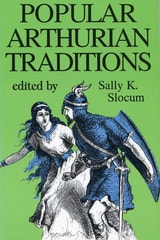
Popular Arthurian Traditions
Sally K. Slocum
University of Wisconsin Press, 1992

Sealed in Parchment
Rereadings of Knighthood in the Illuminated Manuscripts of Chretien de TroyesSandra Hindman
University of Chicago Press, 1994
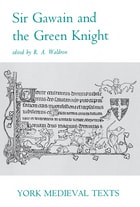
Sir Gawain and the Green Knight
R. A. Waldron
Northwestern University Press, 1972
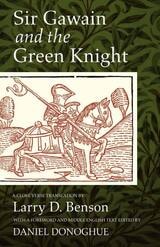
Sir Gawain and the Green Knight
A Close Verse TranslationLarry D. Benson
West Virginia University Press, 2012
Sir Gawain and the Green Knight is a late fourteenth-century Middle English alliterative romance outlining an adventure of Sir Gawain, a knight of King Arthur’s Round Table. In this poem, Sir Gawain accepts a challenge from a mysterious green warrior. In a struggle to uphold his oath along this quest, Gawain demonstrates chivalry, loyalty, and honor. This new verse translation of the most popular and enduring fourteenth century poem to survive to the present offers students an accessible way of approaching the literature of medieval England without losing the flavor of the original writing. The language of Sir Gawain presents considerable problems to present-day readers as it is written in the West Midlands dialect before English became standardized. With a foreword by David Donoghue, the close verse translation includes facing pages of the original fourteenth-century text and its modern translation.
Medieval European Studies Series, Volume 13
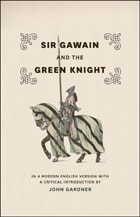
Sir Gawain and the Green Knight
In a Modern English Version with a Critical IntroductionTranslated, Edited, and with an Introduction by John Gardner
University of Chicago Press, 2011
The adventures and challenges of Sir Gawain, King Arthur’s nephew and a knight at the Round Table, including his duel with the mysterious Green Knight, are among the oldest and best known of Arthurian stories. Here the distinguished author and poet John Gardner has captured the humor, elegance, and richness of the original Middle English in flowing modern verse translations of this literary masterpiece. Besides the tale of Sir Gawain and the Green Knight, this edition includes two allegorical poems, “Purity” and “Patience”; the beautiful dream allegory “Pearl”; and the miracle story “Saint Erkenwald,” all attributed to the same anonymous poet, a contemporary of Chaucer and an artist of the first rank.
The Alliterative Morte Arthure
The Owl and the Nightingale and Five Other Middle English PoemsJohn Gardner
Southern Illinois University Press, 1973
Poets of every age deal with roughly the same human emotions, and for the experienced reader poetry is interesting or not depending upon the moment-by-moment intensity of its appeal. This skillful rendering by John Gardner of seven Middle English poems into sparklingly modern verse translation—most of them for the first time—represents a selection of poems that, generally, have real artistic value but are so difficult to read in the original that they are not as well known as they deserve to be. The seven poems are: The Alliterative Morte Arthure, Winner and Waster, The Parliament of the Three Ages, Summer Sunday, The Debate of Body and Soul, The Thrush and the Nightingale,and The Owl and the Nightingale.
The first four poems represent high points in the alliterative renaissance of the fourteenth century. Morte Arthure,here translated for the first time in its entirety into modern verse, is the only heroic romance in Middle English—a work roughly in the same genre as the French Song of Roland. The other three poems have been included in the anthology as further poetic examples.
With his employment of extensive comments and notes on the poems, Gardner provides a wealth of aids to appreciation and understanding of his outstanding translations. The anthology will be of interest to general readers as well as to students.
The Book of Merlyn
The Conclusion to The Once and Future KingBy T. H. White, foreword by Gregory Maguire, prologue by Sylvia Townsend Warner, illustrations by Trevor Stubley
University of Texas Press, 2018
This magical account of King Arthur’s last night on earth, rediscovered in a collection of T. H. White’s papers at the Harry Ransom Center at the University of Texas at Austin, spent twenty-six weeks on the New York Times bestseller list following its publication in 1977. While preparing for his final, fatal battle with his bastard son, Mordred, Arthur returns to the Animal Council with Merlyn, where the deliberations center on ways to abolish war. More self-revealing than any other of White’s books, Merlyn shows his mind at work as he agonized over whether to join the fight against Nazi Germany while penning the epic that would become The Once and Future King. The Book of Merlyn has been cited as a major influence by such illustrious writers as Kazuo Ishiguro, J. K. Rowling, Helen Macdonald, Neil Gaiman, and Lev Grossman.
“Arriving from beyond the curve of time and apparently from the grave, The Book of Merlyn stirs its own pages, saying, wait: you didn’t get the whole story. . . . It gives us a final glimpse of those two immortal characters, Wart and Merlyn, up close, slo-mo, with a considered and affectionate scrutiny. The book is an elegiac posting from a master storyteller of the twentieth century. Its reissue in our next century is just as welcome as when it first arrived forty years ago. . . . Certainly the moral questions about the military use of force perplex the world still. . . . The efficacy of treaties, the trading of insults among the potentates of the day, the testing of weapons, the weaponizing of trade—these strategies are still front and center. Rather terrifyingly so. We do well to revisit what that old schoolteacher of children, Merlyn, has been trying to point out to us about power and responsibility.”
—Gregory Maguire, from the foreword
The Danger of Romance
Truth, Fantasy, and Arthurian FictionsKaren Sullivan
University of Chicago Press, 2018
Yet is it possible that romance is expressing a truth—and a truth unrecognized by realist genres? The Arthurian literature of the Middle Ages, Karen Sullivan argues, consistently ventriloquizes in its pages the criticisms that were being made of romance at the time, and implicitly defends itself against those criticisms. The Danger of Romance shows that the conviction that ordinary reality is the only reality is itself an assumption, and one that can blind those who hold it to the extraordinary phenomena that exist around them. It demonstrates that that which is rare, ephemeral, and inexplicable is no less real than that which is commonplace, long-lasting, and easily accounted for. If romance continues to appeal to audiences today, whether in its Arthurian prototype or in its more recent incarnations, it is because it confirms the perception—or even the hope—of a beauty and truth in the world that realist genres deny.
The Lancelot-Grail Cycle
Text and TransformationsEdited by William W. Kibler
University of Texas Press, 1994
Composed in Old French between about 1220 and 1240, the Lancelot-Grail Cycle is a group of five prose romances centered on the love affair between Lancelot and Guenevere. It consists of an immense central core, the Lancelot Proper, introduced by The History of the Holy Grail and The Story of Merlin and concluded by The Quest for the Holy Grail and The Death of Arthur.
This volume brings together thirteen essays by noted scholars from the first symposium ever devoted exclusively to the Lancelot-Grail Cycle. Exploring the cycle's evolution across the literatures of medieval France, Italy, Spain, Catalonia, and England, the authors take a variety of approaches that highlight a broad range of cultural, social, historical, and political concerns and offer a comparative and interdisciplinary vision of this great romance.
The Romance of Tristan and Isolt
Norman B. Spector
Northwestern University Press, 1992
Toward a Theater of the Oppressed
The Dramaturgy of John ArdenJaved Malick
University of Michigan Press, 1995
Malick situates Arden's dramaturgy in the wider context of the radical alternative tradition in Western drama, drawing connections to Brecht, Piscator, the radical playwrights of the 1960s. He then explores the formal structure, ideological implications, and historical significance of Arden's work, treating his stage plays as one dramaturgically coherent opus- from the early Waters of Babylon to his and Margaretta D'Arcy's ambitious trilogy, The Island of the Mighty. Finally, he discusses the last phase of Arden and D'Arcy's political and artistic development, which led them to turn their backs on the professional theater circuit. He argues that Arden's rejection of the institutional stage was the logical outcome of his persistent search for alternative forms of political theater.
Toward a Theater of the Oppressed will be invaluable reading for those interested in modern drama, political theater, and popular performance, as well as students of contemporary British drama.
Javed Malick is Reader in English, Khalsa College, University of Delhi, India.